


Christina of Sweden

Encyclopedia
Christina later adopted the name Christina Alexandra, was Queen regnant
of Swedes
, Goths
and Vandals
, Grand Princess of Finland
, and Duchess of Ingria
, Estonia
, Livonia
and Karelia
, from 1633 to 1654. She was the only surviving legitimate child of King Gustav II Adolph
and his wife Maria Eleonora of Brandenburg
. As the heiress presumptive
, at the age of six she succeeded her father on the throne of Sweden upon his death at the Battle of Lützen
. Being the daughter of a Protestant champion in the Thirty Years' War
, she caused a scandal when she abdicated her throne and converted to Catholicism
in 1654. She spent her later years in Rome, becoming a leader of the theatrical and musical life there. As a queen without a country, she protected many artists and projects. She is one of the few women buried in the Vatican grotto.
Christina was moody, intelligent, and interested in books and manuscripts, religion, alchemy and science. She wanted Stockholm to become the Athens of the North. Influenced by the Counter Reformation, she was increasingly attracted to the Baroque and Mediterranean culture that took her away from her Protestant country. Her unconventional lifestyle and masculine behaviour would feature in countless novels and plays, and in opera and film. In the twentieth century, Christina became a symbol of cross-dressing
, transsexuality and lesbianism.
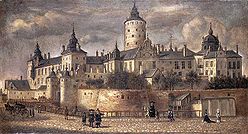
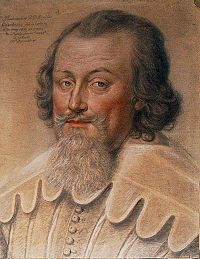 Christina was born in Tre Kronor
, and her birth occurred during a rare astrological conjunction that fueled great speculation on what influence the child, fervently hoped to be a boy, would later have on the world stage. The king had already sired two daughters – a nameless princess born in 1620 and then the first princess Christina, who was born in 1623 and died the following year. So great expectations arose at Maria Eleonora's third pregnancy
in 1626, and the castle filled with shouts of joy when she delivered a baby, which was first taken for a boy while it was hairy and screamed with a strong, hoarse voice. She wrote in her autobiography, "Deep embarrassment spread among the women when they discovered their mistake." The king was very happy, stating that "She'll be clever, she has made fools of us all!" Her mother remained aloof in her disappointment at the child being a girl. Christina herself believed a wetnurse had carelessly dropped her to the floor when she was a baby. A shoulder bone broke, leaving one shoulder higher than the other for the rest of her life.
Before Gustav Adolf left for Germany to defend Protestantism
in the Thirty Years' war
, he secured his daughter's right to inherit the throne, in case he never returned and gave orders that Christina should be brought up as a prince. Her mother, a Hohenzollern, was a woman of quite distraught temperament, melancholic, but most probably insane. After the king had died on 6 November 1632 on the battlefield, she had fetched her husband home in a coffin, with his heart separated in a box. Maria Eleonora ordered that the king should not be buried until she could be buried with him. She also demanded that the coffin be kept open, and went to see it every forenoon, patting it, taking no notice of the putrefaction
. Eventually the embarrassed Chancellor, Axel Oxenstierna
, saw no other solution than having a guard posted at the room to prevent further episodes.
Christina now became the belated centre of her mother's attention. From showing her daughter complete indifference, Maria Eleonora suddenly became perversely attentive to her. Gustav Adolf had sensibly decided that his daughter, in case of his death, should be cared for by his halfsister, Catherine of Sweden.
This solution did not suit Maria Eleonora, who had her sister-in-law banned from the castle. In 1636 Chancellor Oxenstierna saw no other solution to this than exiling the widow to Gripsholm castle, while the governing regency council would decide when she was allowed to meet her nine-year-old daughter. This resulted in three good years, with Christina thriving in the company of her aunt Catharina and her family.
On 15 March 1633 Christina became queen at the age of six, giving rise to the nickname the "Girl King". Christina was educated as a state-child. The theologist Johannes Matthiae Gothus
became her tutor; he gave her lessons in religion
, philosophy
, Greek
and Latin
. Chancellor Oxenstierna taught her politics and discussed Tacitus
with her. Christina seemed happy to study ten hours a day. She learned Swedish as well as German, Dutch, Danish, French and Italian; her talent for languages was nothing short of unique. Oxenstierna wrote proudly of the 14-year-old girl that "She is not at all like a female" and that, on the contrary, she had "a bright intelligence". From 1638 Oxenstierna employed a French ballet troupe under Antoine de Beaulieu
, who also had to teach Christina to move around more elegantly.
's time excluding those Vasa princes who had been traitors or were descended from deposed monarchs. Gustav Adolf's younger brother had died years earlier, and therefore there were only females left. Despite the fact that there were living female lines descended from elder sons of Gustav I Vasa, Christina was the heiress presumptive. Although she is often called "queen", her father brought her up as a prince and her official title was King.
In 1636-1637 Peter Minuit
and Samuel Blommaert
negotiated with the government about the founding of New Sweden
, the first Swedish colony in the New World. In 1638 Minuit erected Fort Christina
in Wilmington, Delaware
; also Christina River
was named after her. In December 1643 Swedish troops overran Holstein
and Jutland
in the Torstenson War.
The National Council suggested that Christina join the government when she was sixteen; but she asked to wait until she had turned eighteen, as her father had waited until then. In 1644 she took the throne, although the crowning was postponed because of the war with Denmark. Her first major assignment was to conclude peace with that country. She did so successfully; Denmark handed over the isles of Gotland
and Ösel
to Sweden, whereas Norway lost the districts of Jämtland
and Härjedalen
, which to this day have remained Swedish.
Chancellor Oxenstierna soon discovered that Christina held differing political views from his own. In 1645 he sent his son Johan Oxenstierna
to the Peace Congress in Osnabrück and Münster, presenting the view that it would be in Sweden's best interest if the Thirty Years' War continued. Christina, however, wanted peace at any cost, and therefore sent her own delegate, Johan Adler Salvius
. Shortly before the conclusion of the peace settlement, she admitted Salvius into the National Council, against Chancellor Oxenstierna's will and to general astonishment, as Salvius was no aristocrat; but Christina wanted opposition to the aristocracy present. In 1648 Christine obtained a seat in the Reichstag
, when Bremen-Verden
and Swedish Pomerania
were assigned to Sweden at the Treaty of Osnabrück.
In 1649 760 paintings, 170 marble and 100 bronze statues, 33.000 coins and medaillons, 600 pieces of cristal, 300 scientific instruments, manuscripts and books, including the Sanctae Crucis laudibus by Rabanus Maurus
, the Codex Argenteus
and the Codex Gigas
were transported to Stockholm. This art from Prague Castle
had belonged to Rudolf II, Holy Roman Empire, and was captured by Hans Christoff von Königsmarck
during the Battle of Prague (1648)
] and the negotiations of the Peace of Westphalia
.
With the help of her uncle John Casimir, Count Palatine of Kleeburg
and cousins she tried to reduce the influence of Oxenstierna and declared Karl Gustav in 1649 as her successor. Christina resisted demands from the other estates (clergy, burgesses and peasants) in the Riksdag of the Estates
of 1650 for the reduction of tax-exempt noble landholdings.
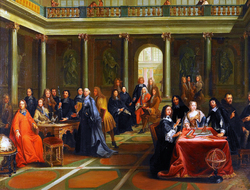 In 1645 Christina invited Hugo Grotius
to become her librarian, but died on his way in Rostock
. She appointed Benedict (Baruch) Nehamias de Castro from Hamburg
as her Physician in ordinary. In 1647 Johann Freinsheim
was appointed. The Semiramis
from the North corresponded with Pierre Gassendi
; Blaise Pascal
offered her a copy of his pascaline. To catalogue her new collection she asked Heinsius
and Isaac Vossius
to come to Sweden. She studied Neostoicism
, the Church Fathers
, the Islam
, and read Treatise of the Three Impostors, a work bestowing doubt on all organized religion and had a firm grasp of classical history and philosophy.
In 1646 Christina's good friend, ambassador Chanut, corresponded with the philosopher René Descartes
, asking him a copy of his Meditations
. Christina became interested enough to start correspondence with Descartes about hate and love. Although she was very busy she invited him to Sweden, Descartes arrived on 4 October 1649. He resided with Chanut, and had to wait till 18 December until he could start with his private lessons and gave her an insight into Catholicism. With Christina's strict schedule he was invited to the castle library at 5:00 AM to discuss philosophy and religion. The premises were icy, and on 1 February 1650 Descartes fell ill with pneumonia
and died ten days later; Christina was distraught with guilt. She invited Claude Saumaise, Pierre Daniel Huet
, Gabriel Naudé
, Christian Ravis
, Samuel Bochart
; embraced skepticism
and became indifferent to religion.
Christina was interested in theatre
and ballet
. She was also herself an amateur actress, and amateur theatre was very popular at court during her reign. Plays had always interested her, especially those of Pierre Corneille
. In 1647 Antonio Brunati had built a theatrical setting in the palace.
Her court poet Georg Stiernhielm
wrote her several plays in the Swedish language, such as Den fångne Cupido eller Laviancu de Diane performed at court with Christina in the main part of the goddess Diana. She invited foreign companies to play at Bollhuset
, such as an Italian Opera troupe in 1652 with Vincenzo Albrici
and a Dutch theatre troupe with Ariana Nozeman
and Susanna van Lee
in 1653. Among the French artists she employed at court was Anne Chabanceau de La Barre
, who was made court singer.
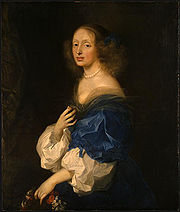
 She knew it was expected of her to provide an heir to the Swedish throne. Her first cousin Charles was infatuated with her, and they became secretly engaged before he left in 1642 to do army service for three years in Germany. Christina reveals in her autobiography that she felt "an insurmountable distaste for marriage"; likewise "an insurmountable distaste for all the things that females talked about and did". She slept for 3–4 hours a night and was chiefly occupied with her studies; she forgot to comb her hair, donned her clothes in a hurry and used men's shoes for the sake of convenience; however, she was said to possess charm, and the unruly hair became her. Her best female friend and noted passion of her youth was Ebba Sparre
, whom she called Belle. Most of her spare time was spent with 'la belle comtesse' - and she often called attention to her beauty. She introduced her to the English ambassador Whitelocke as her 'bed-fellow', assuring him that Sparre's intellect was as striking as her body. She hosted Ebba's wedding with Jakob Kasimir De la Gardie in 1653, but the marriage would last only five years. Ebba visited her husband in Elsinore
when he was shot and killed, and their three children all died when small. When Christina left Sweden she continued to write passionate love-letters to Sparre, in which she told her that she would always love her. However, Christina would also use the same emotional style when writing to women she had never met, but whose writings she admired.
On 26 February 1649, Christina made public that she had decided not to marry, but wanted her first cousin Charles to be heir to the throne. The nobility objected to this, while the three other estates - clergy, burghers and peasants - accepted it. The coronation took place in October 1650. Christina went to castle of Jacobsdal, where she entered in a coronation carriage draped with black velvet
embroidered in gold, and pulled by six white horses. The procession to Storkyrkan
was so long that when the first carriages arrived at Storkyrkan, the last ones had not yet left Jacobsdal. All four estates were invited to dine at the castle. Fountains at the market place splashed out wine
, roast was served, and illuminations sparkled. The participants were dressed up in fantastic costumes, as at a carnival
.
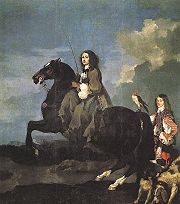 Her tutor, Johannes Matthiae, stood for a gentler attitude than most Lutherans. In 1644 he suggested a new church order, but was voted down, as this was interpreted as excessively Calvinist
. Christina, who by then had become queen, defended him against the advice of chancellor Oxenstierna, but three years later the proposal had to be withdrawn. In 1647 the clergy wanted to introduce the Book of Concord
, a book defining correct Lutheranism versus heresy, making some aspects of free theological thinking an impossibility. Matthiae was strongly opposed to this, and again was backed by Christina. The Book of Concord was not introduced.
As a young queen she felt enormous pressure, ruling the country. In August 1651, she asked the Council's permission to abdicate, but gave in to their pleas for her continuation. She had long conversations with Antonio Macedo, interpreter for Portugal
's ambassador. He was a Jesuit, and in August 1651 smuggled with him a letter from Christina to the Jesuit general in Rome. In reply, two Jesuits came to Sweden on a secret mission in the spring of 1652, disguised as gentry and using false names. Paolo Casati
had to gauge the sincerity of her intention to become Catholic.
She had more conversations with them, being interested in the Catholic views on sin, immortality of the soul, rationality and free will
. Though raised to follow the Lutheran Church of Sweden
, around May 1652 Christina decided to become Roman Catholic. The two scholars expressed her plans to Fabio Chigi
and Philip IV of Spain
and the Spanish diplomat Antonio Pimentel de Prado
was sent to Stockholm.
 After reigning almost twenty years, working at least ten hours a day, it looks like Christina had a nervous breakdown, a burn out or arrived at a decisive point of life. She suffered with high blood pressure, complained about bad eyesight, and pain in her neck. In February 1652 the French doctor Pierre Bourdelot
arrived in Stockholm. Unlike most doctors of that time, he held no faith in blood-letting; instead he ordered sufficient sleep, warm baths and healthy meals, as opposed to Christina's hitherto ascetic way of life. She was only 25 and should take more pleasure in life. Bourdelot asked her to stop studying and working so hard and to remove the books from her apartments. The funny Bourdelot showed her the 16 sonnets of Pietro Aretino
, which he kept secretly in his luggage. For years Christina knew all the sonnets from the Ars Amatoria
by head and was keen on the works by Marcus Valerius Martialis. By subtle means Bourdelot undermined her principles. She now became an Epicurean. Her mother and de la Gardie were very much against the activities of Bourdelot and tried to convince her to change her attitude towards him; Bourdelot returned to France in 1653.
, who had accused her of serious misbehavior and being a Jezebel
. Instead of ruling she went on spending most of her time with her foreign friends in the ballroom on Sunday evenings and in the theater.
In 1653 she founded the military Amaranten order. Antonio Pimentel was appointed as its first knight; all members had to promise not to marry (again). In February 1654 she plainly told the Council of her plans to abdicate. Oxenstierna replied she would regret her decision within a few months. In May they Riksdag
discussed her proposals. She had asked 200.000 rikstalers a year, but received dominions instead. Financially she was secured through revenue from Norrköping
town, the isles of Gotland
, Öland
and Ösel
, estates in Mecklenburg
and Pomerania
. Her debts were taken over by the treasury.
So her plan to convert was not the only reason for her abdication, as there was increasing discontent with her arbitrary and wasteful ways. Within ten years, she had created 17 counts, 46 barons and 428 lesser nobles; to provide these new peers with adequate appanage
s, she had sold or mortgaged crown property representing an annual income of 1,200,000 riksdaler
. During her ten years of reign, the number of noble families increased from 300 to about 600, rewarding people, like Lennart Torstenson
, and Louis De Geer for their war efforts, but also Johan Palmstruch
, the banker. These donations took place with such haste that they were not always registered, and on some occasions the same piece of land was given away twice.
Christina abdicated her throne on 5 June 1654 in favor of her cousin Charles Gustavus
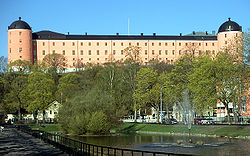
. During the abdication ceremony at Uppsala Castle
, Christina wore her regalia
, which were removed from her, one by one. Per Brahe, who was supposed to remove the crown, did not move, so she had to take the crown off herself. Dressed in a simple white taffeta
gown she held her farewell speech with a faltering voice, thanked everyone and left the throne to Charles X, who was dressed in black. Per Brahe felt that she "stood there as pretty as an angel". Charles Gustavus, who was crowned later on that day, proposed her again to marry. Christina laughed and left the country, hoping for a warm reception in catholic countries. Charles had to move into an empty palace.
, and rode as Count Dohna, through Denmark. Relations between the two countries were still so tense that a former Swedish queen could not have traveled safely in Denmark. Christina had already packed and shipped abroad valuable books, paintings, statues and tapestries from her Stockholm castle, leaving its treasures severely depleted.
Christina visited Johann Friedrich Gronovius
, and Anna Maria van Schurman
in the Dutch Republic. In August she arrived in the Southern Netherlands
, and settled down in Antwerp. For four months Christina was lodged in the mansion of a Jewish merchant. She was visited by Archduke Leopold Wilhelm of Austria
; the Prince de Condé, ambassador Chanut, as well as the former governor of Norway, Hannibal Sehested
. In the afternoon she went for a ride, each evening parties were held; there was a play to watch or music to listen too. Christina ran quickly out of money and had to sell some of her tapestries, silverware and jewelry. When her financial situation did not improve the archduke invite her to his Brussels
palace on Coudenberg
. On 24 December 1654, she converted to the Catholic faith in archduke's chapel. Raimondo Montecuccoli
and Pimentel, who had become a close friends, were present. She did not state her conversion in public, in case the Swedish council might refuse to pay her alimony. On top of this, Sweden was preparing for war against Pomerania, which meant that her income from there was considerably reduced. The pope and Philip IV of Spain
could not support her openly either, as she was not publicly a Catholic yet. Christina succeeded in arranging a major loan, leaving books and statues to settle her debts.
In September she left for Italy with her entourage of 255 persons and 247 horses. The pope's messenger, the librarian Lucas Holstenius
, himself a convert, waited for her in Innsbruck
. On 3 November 1655, Christina converted in the Hofkirche
and wrote to Pope Alexander VII and her cousin Charles X about it. To celebrate her official conversion L'Argia an opera by Antonio Cesti
was performed. Ferdinand Charles, Archduke of Austria, already in financial trouble, was almost ruined by her visit. He was relieved by her departure on 8 November.
and had a brilliant triumph in Ferrara, Bologna, Faenza and Rimini. In Pesaro
Christina got acquainted with the handsome brothers Santinelli
, who so impressed her with their poetry and adeptness of dancing that she took them into service, as well as a certain Monadeschi. On 20 December she reached the Vatican, the last distance in a sedan
chair designed by Bernini. She was granted her own wing inside the Vatican, and when the pope spotted the inscription symbolizing the northern wind, Omne malum ab Aquilone (meaning "all evil comes from the North"), he ensured that it was rapidly covered with paint.
The entry into Rome proper took place on 23 December, on horseback through Porta Flaminia, which today is known as Porta del Popolo. Christina met Bernini some days later, and they became lifelong friends. She often visited him at his studio, and on his deathbed he wanted her to pray for him, as she used a language that God would understand.
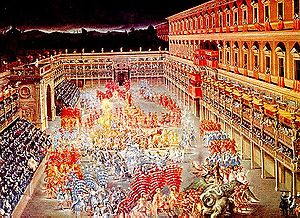 In St Peter's Basilica she knelt in front of the altar, and on Christmas Day she received the sacrament from the Pope himself. In his honour she took the additional names Alexandra Maria - Alexandra not only after the pope, but also in honour of her hero, Alexander the Great. Her status as the most notable convert to Catholicism of the age, and as the most famous woman at the time, made it possible for her to ignore or flout the most common requirements of obeisance to the Catholic faith. She herself remarked that her Catholic faith was not of the common order; indeed, before converting she had asked church officials how strictly she would be expected to obey the church's common observances, and received reassurances. She respected the Pope's position in the Church, but not necessarily his acts as an individual; she once commented on this to one of his servants: The papal summer residence at that time was the Quirinal Palace, located on Monte Cavallo (literally "Horse mountain"). Christina stated that Monte Cavallo might rather be named Monte degli Asini ("Donkey mountain"), as she had never met a pope with common sense during her 30 years in Rome. Christina's visit to Rome was the triumph of Pope Alexander VII and the occasion for splendid Baroque
festivities. For several months she was the only preoccupation of the Pope and his court. The nobles vied for her attention and treated her to a never-ending round of fireworks, jousts, fake duels, acrobatics, and operas. At the Palazzo Barberini
, where she was welcomed by a crowd of 6,000 spectators, she watched in amazement at the procession of camels and elephants in Oriental garb, bearing towers on their backs.
, where the participants enjoyed music, theatre, literature and languages. Every Wednesday she held the palace open to visitors from the higher classes who could enjoy all its works of art. Belonging to the Arcadia-circle was also Francesco Negri, a Franciscan
from Ravenna
who is regarded as the first tourist of North Cape, Norway
. Negri wrote eight letters about his walk through Scandinavia all the way up to "Capo Nord" in 1664. Another Franciscan was the Swede Lars Skytte, who, under the name pater Laurentius, served as Christina's confessor for eight years. He too had been a pupil of Johannes Matthiae, and his uncle had been Gustav Adolf's teacher. As a diplomat in Portugal he had converted, and asked for a transfer to Rome when he learnt of Christina's arrival.
However the arranged appanage from Sweden did not materialize; Christina lived off loans and donations. Her servants burned the wood from the doors to heat the premises; and the Santinelli brothers sold off works of art that came with the palace. The damage was explained away with the staff not being paid.
29-year-old Christina gave occasion to much gossip when socializing freely with men her own age. One of them was Cardinal
Decio Azzolino
, who had been a secretary to the ambassador in Spain, and responsible for the Vatican's correspondence with European courts. He was also the leader of the Squadrone Volante, the free thinking "Flying Squad" movement within the Catholic Church. Christina and Azzolino were so close that the pope asked him to shorten his visits to her palace; but they remained lifelong friends. In a letter to Azzolino Christina writes in French that she would never offend God or give Azzolino reason to take offence, but this "does not prevent me from loving you until death, and since piety relieves you from being my lover, then I relieve you from being my servant, for I shall live and die as your slave." His replies were more reserved. Christina wrote him many letters during her travels; about 50 of these have survived. They were written in a code that was decrypted by Carl Bildt, ambassador of Norway and Sweden in Rome around 1900.
At times, things got a bit out of hand. On one occasion the couple had arranged to meet at the Villa Medici
near Monte Pincio, but the cardinal did not show up. Christina hurried over to Castel Sant'Angelo
, firing one of the cannon
s. The mark in the bronze gate in front of Villa Medici is still visible.
Having run out of money and surfeited with an excess of pageantry, Christina resolved, in the space of two years, to visit France. Here she was treated with respect by Louis XIV
, but the ladies were shocked by her masculine appearance and demeanour and the unguarded freedom of her conversation.
When visiting the ballet with la Grande Mademoiselle, she, as the latter recalls, "surprised me very much - applauding the parts which pleased her, taking God to witness, throwing herself back in her chair, crossing her legs, resting them on the arms of her chair, and assuming other postures, such as I had never seen taken but by Travelin and Jodelet, two famous buffoons... She was in all respects a most extraordinary creature".
, and the kingdom of Naples and Sicily. The French politician Mazarin, an Italian himself, had attempted to liberate Naples from the Spanish rule against which the locals had fought, but an expedition in 1654 had failed in this. Mazarin was now considering Christina as a possible queen for Naples. The locals wanted no Italian duke on the throne; they would prefer a French prince. In the summer of 1656 Christina set sail for Marseille
and from there travelled to Paris to discuss the matter. Officially it was said that she was negotiating her alimony arrangement with the Swedish king.
On 22 September 1656, the arrangement between her and Louis XIV was ready. He would recommend Christina as queen to the Neapolitans, and serve as guarantee against Spanish aggression. On the following day she left for Pesaro
(?), where she settled down while waiting for the outcome of this. As Queen of Naples she would be financially independent of the Swedish king, and also capable of negotiating peace between France and Spain. In the summer of 1657 she herself returned to France, officially to visit the papal city of Avignon
. In October, apartments were assigned to her at Fontainebleau
, where she committed an action which has indelibly stained her memory - the execution of marchese Gian Rinaldo Monaldeschi
, her master of the horse. Christina herself wrote her version of the story for circulation in Europe.
For two months, she had suspected Monaldeschi of disloyalty and secretly seized his correspondence, which revealed that he had betrayed her interests and put the blame on an absent member of court. Now she summoned Monaldeschi into a gallery at the palace, discussing the matter with him. He insisted that betrayal should be punished with death. She held the proof of his betrayal in her hand and so insisted that he had pronounced his own death sentence. Le Bel, a priest who stayed at the castle, was to receive his confession in the Galerie des Cerfs. He entreated for mercy, but was stabbed by two of her domestics - notably Ludovico Santinelli - in an apartment adjoining that in which she herself was. Wearing a coat of mail which is now on exhibition outside the gallery, he was chased around the room for hours before they succeeded in dealing him a fatal stab wound. Father Le Bel, who had begged on his knees that they spare the man, was told to have him buried inside the church, and Christina, seemingly unfazed, paid the abbey to hold Masses for his soul. She "was sorry that she had been forced to undertake this execution, but claimed that justice had been carried out for his crime and betrayal. She asked God to forgive him," wrote Le Bel.
Mazarin advised Christina to place the blame on Santinelli and dismiss him, but she insisted that she alone was responsible for the act. She wrote to Louis XIV about the matter, and two weeks later he paid her a friendly visit at Fontainebleau without mentioning it. In Rome, people felt differently; Monaldeschi had been an Italian nobleman, murdered by a foreign barbarian with Santinelli as her executioner. The letters proving his guilt are gone; Christina left them with Le Bel on the day of the murder, and he confirmed that they existed. She never revealed what was in the letters.
The killing of Monaldeschi was legal, since Christina had judicial rights over the members of her court, as her vindicator Gottfried Leibniz
claimed. As her contemporaries saw it, Christina as queen had to emphasize right and wrong, and her sense of duty was strong. She continued to regard herself as Queen Regnant all her life. When her friend Angela Maddalena Voglia was sent to an abbey by the pope, to remove her from an affair with a cardinal at the Sacro Collegio, Angela succeeded in escaping from the monastery and went into hiding at Christina's, where she was assaulted and raped by an abbot. Understandably, Christina was most upset that this could happen to someone under her roof, and demanded to have the abbot executed, but he managed to escape. While still in France, she would gladly have visited England, but she received no encouragement from Cromwell
. She returned to Rome and resumed her amusements in the arts and sciences.
to live in Palazzo Riario
, on top of the Janiculus, designed by Bramante. It was Cardinal Azzolino who signed the contract, as well as provided her with new servants to replace Francesco Santinelli, who had been Monaldeschi's executioner.
The Riario Palace became her home for the rest of her life. She decorated the walls with paintings, mainly from the Renaissance; and almost no paintings from northern European painters, except Holbein. No Roman collection of art could match hers. There were portraits of her friends Azzolino, Bernini, Ebba Sparre, Descartes, ambassador Chanut and doctor Bourdelot. Azzolino ensured that she was reconciled with the pope, and that the latter granted her a pension.
 In April 1660 Christina was informed that Charles X had died in February. His son, Charles XI, was only five years old. That summer she went to Sweden, pointing out that she had left the throne to her first cousin and his descendant, so if Charles XI died, she would take over the throne again. But as a Catholic she could not do that, and the clergy refused to let her hold Catholic Masses where she stayed. After some weeks in Stockholm she found lodgings in Norrköping town, which was her area. Eventually she submitted to a second renunciation of the throne, spending a year in Hamburg
to get her finances in order on her way back to Rome. She left her income to the bankier Diego Texeira - his real, Jewish name being Abraham - in return for him sending her a monthly allowance and covering her debts in Antwerp. She visited the Texeira family in their home and entertained them in her own lodgings, which at that time was unusual in relation to Jews.
In the summer of 1662, she arrived in Rome for the third time, followed by some fairly happy years. Some differences with the Pope made her resolve in 1667 once more to return to Sweden; but the conditions attached by the senate to her resuming residence there were now so mortifying that she proceeded no farther than Hamburg. There she was informed that Alexander VII had died. The new pope, Clement IX, had been a regular guest at her palace. In her delight at his election she threw a brilliant party at her lodgings in Hamburg, with illuminations and wine
in the fountain outside. However, she had forgotten that this was a Protestant land, so the party ended with her escaping through a hidden door, threatened by stone throwing and torches. The Texeira family had to cover the repairs.
 Christina's fourth and last entry in Rome took place on 22 November 1668. As in 1655 she rode through Porta del Popolo in triumph. Clement IX often visited her; they had a shared interest in plays. When the pope suffered a stroke, she was among the few he wanted to see at his deathbed. In 1671 Christina established Rome's first public theatre in a former jail, Tor di Nona
. The new pope, Clement X, worried about the influence of theatre on public morals. When Innocent XI became pope, things turned even worse; he made Christina's theatre into a storeroom for grain, although he had been a frequent guest in her royal box with the other cardinals. He forbade women to perform with song or acting, and the wearing of decolleté dresses. Christina considered this sheer nonsense, and let women perform in her palace.
She wrote an unfinished autobiography, essays on her heroes Alexander the Great, Cyrus the Great and Julius Cæsar, on art and music (“Pensées, L’Ouvrage du Loisir” and “Les Sentiments Héroïques”) and acted as patron to musicians. Carlo Ambrogio Lonati
and Giacomo Carissimi
were Kapellmeister
; Lelio Colista
luteplayer; Loreto Vittori
and Marco Marazzoli
singers and Sebastiano Baldini
librettist. She had Alessandro Stradella
and Bernardo Pasquini
to compose for her; Arcangelo Corelli
dedicated his first work, Sonata da chiesa opus 1, to her Alessandro Scarlatti
directed the orchestra during a three day celebration for James II
who was crowned in 1685.
Her politics and rebellious spirit persisted long after her abdication of power. When Louis XIV of France revoked the Edict of Nantes
, abolishing the rights of French Protestants (Huguenots), Christina wrote an indignant letter, dated 2 February 1686, directed at the French ambassador. The Sun King did not approve of this, but Christina was not to be silenced. In Rome, she made Pope Clement X prohibit the custom of chasing Jews
through the streets during the carnival. On 15 August 1686, she issued a declaration that Roman Jews were under her protection, signed la Regina - the queen.
Christina remained very tolerant towards the beliefs of others all her life. She on her part felt more attracted to the Spanish priest Miguel Molinos, who had been persecuted by the Holy Inquisition over his teachings, which were inspired by the mystic
Teresa of Avila
and Ignace de Loyola. In February 1689, the 62-year-old Christina fell seriously ill, after a visit to the temples in Campania
, receiving the last rites. She seemed to recover, but in the middle of April she had erysipelas
, got pneumonia
and a high fever. On her deathbed she sent the pope a message asking if he could forgive her insults - which he could. Cardinal Azzolino stayed at her side until she died on 19 April 1689.

Christina had asked for a simple burial, but the pope insisted on her being displayed on a lit de parade for four days in the Riario Palace. She was embalmed, covered with white brocade, a silver mask, a gilt crown and scepter. Her body was placed in three coffins - one of cypress, one of lead and finally one made of oak. The funeral procession led from Santa Maria in Valicella to St. Peter's Basilica
, where she was buried within the Grotte Vaticane - only one of three women ever given this honour. Her intestines were placed in a high urn. Today, her marble sapcophagus is positioned next to that of Pope John Paul II
.
In 1702 Clement XI commissioned a monument for the queen, in whose conversion he vainly foresaw a return of her country to the Faith and to whose contribution towards the culture of the city he looked back with gratitude. This monument was placed in the body of the basilica and directed by the artist Carlo Fontana
. Christina was portrayed on a gilt and bronze medallion, supported by a crowned skull. Three reliefs below represented her relinquishment of the Swedish throne and abjugation of Protestantism at Innsbruck, the scorn of the nobility, and faith triumphing over heresy. It is an unromantic likeness, for she is given a double chin and a prominent nose with flaring nostrils.
Christina had named Azzolino her sole heir to make sure her debts were settled, but he was too ill and worn out even to join her funeral, and died in June the same year. His nephew, Pompeo Azzolino, was his sole heir, and he rapidly sold off Christina's art collections. Venus mourns Adonis by Paolo Veronese
, for example, which was war booty from Prague, was sold by Azzolino's nephew and eventually ended up in Stockholm's National Museum. Her large and important library, originally amassed as war booty by her father Gustav Adolf from throughout his European campaign, was bought by Alexander VIII for the Vatican library
, while most of the paintings ended up in France, as the core of the Orleans Collection
- many remain together in the National Gallery of Scotland
. Her collection amounted to approximately 300 paintings. Titian
's Venus Anadyomene
was among them. At first, removing them from Sweden was seen as a great loss to the country; but in 1697 Stockholm castle burned down, where they would have been destroyed.
Based on historical accounts of Christina's physicality, some scholars believe her to have been an intersexed individual (someone with a blend of female and male genitals, hormones, or chromosomes). According to Christina's autobiography, the midwives at her birth first believed her to be a boy because she was "completely hairy and had a coarse and strong voice." After changing their minds, deciding that she was female, her father Gustav II Adolph decided "to find out for himself the nature of the matter." Such ambiguity did not end with birth, as Christina made cryptic statements about her "constitution" and body throughout life. Her unusual body was also noted by many others, who noted that the queen had a masculine voice, appearance, and movements. Although not direct evidence of her bodily makeup, Christina had a disdain for marriage, sex, female conversation and childrearing that may have stemmed from the realities of such things for a person of unusual physicality. In 1965 all of these observations led to an investigation of Christina's mortal remains, which had inconclusive results. As the physical anthropologist who undertook the investigation, Carl-Herman Hjortsjö, explained, "Our imperfect knowledge concerning the effect of intersexuality on the skeletal formation ... makes it impossible to decide which positive skeletal findings should be demanded upon which to base the diagnosis of intersexuality." Nevertheless, Hjortsjö speculated that Christina had reasonably typical female genitalia because it is recorded that she menstruated.
Christina sat, talked, walked and moved in a manner her contemporaries described as masculine. She preferred men's company to women's unless the women were very beautiful, in which case she courted them. Likewise she enjoyed the company of other educated women, regardless of their looks. Throughout her later years, living in Rome, she formed a close relationship with Cardinal Azzolino, which was also controversial and symbolic of her attraction to relationships which were not typical for a woman of her era and station.
was called Fort Christina
(near the present downtown Wilmington, Delaware
). The nearby Christina River
still bears the Queen's name.
The complex character of Christina has inspired numerous plays, books, and operatic works. August Strindberg
's 1901 play Kristina depicts her as a protean, impulsive creature. "Each one gets the Christina he deserves," she remarks. The Finnish
author Zacharias Topelius
' historical allegory Stjärnormas Kungabarn also portrays her, like her father, as having a mercurial temperament, quick to anger, quicker to forgive. Kaari Utrio
has also portrayed her tormented passions and thirst for love.
Christina's life was famously fictionalised in the classic feature film Queen Christina
from 1933 starring Greta Garbo
. This film, while entertaining, depicted a heroine whose life diverged considerably from that of the real Christina. Another feature film, The Abdication
, starred the Norwegian actress Liv Ullmann
, was based on a play by Ruth Wolff.
Christina has become an icon for the lesbian
and feminist communities (and inspired comedian Jade Esteban Estrada
to portray her in the solo musical ICONS: The Lesbian and Gay History of the World Vol. 2). Her cross-dressing has also made her a posthumous icon of the modern transgendered community. Finnish author Laura Ruohonen wrote a play about her called "Queen C", which presents a woman centuries ahead of her time who lives by her own rules. Raised as a boy and known by the nickname "Girl King", she vexes her contemporaries with unconventional opinions about sexuality and human identity, and ultimately abdicates the throne. First performed at the Finnish National Theatre in 2002, the play has since been translated into nine languages and staged internationally. The play has been performed at the Royal National Theatre in Sweden, as well as in Australia, the Czech Republic, the Netherlands, Germany and the USA, and as a stage reading in many other countries.
|-
Monarch of Sweden
The monarchy of Sweden is the constitutional monarchy of the Kingdom of Sweden. The present monarch, Carl XVI Gustaf, has reigned since 15 September 1973. He and his immediate family undertake various official, ceremonial and representational duties...
of Swedes
Swedes
Swedes are a Scandinavian nation and ethnic group native to Sweden, mostly inhabiting Sweden and the other Nordic countries, with descendants living in a number of countries.-Etymology:...
, Goths
Goths
The Goths were an East Germanic tribe of Scandinavian origin whose two branches, the Visigoths and the Ostrogoths, played an important role in the fall of the Roman Empire and the emergence of Medieval Europe....
and Vandals
Vandals
The Vandals were an East Germanic tribe that entered the late Roman Empire during the 5th century. The Vandals under king Genseric entered Africa in 429 and by 439 established a kingdom which included the Roman Africa province, besides the islands of Sicily, Corsica, Sardinia and the Balearics....
, Grand Princess of Finland
Grand Prince of Finland
Grand duke of Finland, was from around 1580 to 1809 a title in use by most Swedish monarchs. Between 1809 and 1917, it was the official title of the head of the autonomous Grand Duchy of Finland, who was the Emperor of Russia. The anachronistic female form of the title in English is usually Grand...
, and Duchess of Ingria
Ingria
Ingria is a historical region in the eastern Baltic, now part of Russia, comprising the southern bank of the river Neva, between the Gulf of Finland, the Narva River, Lake Peipus in the west, and Lake Ladoga and the western bank of the Volkhov river in the east...
, Estonia
Estonia
Estonia , officially the Republic of Estonia , is a state in the Baltic region of Northern Europe. It is bordered to the north by the Gulf of Finland, to the west by the Baltic Sea, to the south by Latvia , and to the east by Lake Peipsi and the Russian Federation . Across the Baltic Sea lies...
, Livonia
Livonia
Livonia is a historic region along the eastern shores of the Baltic Sea. It was once the land of the Finnic Livonians inhabiting the principal ancient Livonian County Metsepole with its center at Turaida...
and Karelia
Karelia
Karelia , the land of the Karelian peoples, is an area in Northern Europe of historical significance for Finland, Russia, and Sweden...
, from 1633 to 1654. She was the only surviving legitimate child of King Gustav II Adolph
Gustavus Adolphus of Sweden
Gustav II Adolf has been widely known in English by his Latinized name Gustavus Adolphus Magnus and variously in historical writings also as Gustavus, or Gustavus the Great, or Gustav Adolph the Great,...
and his wife Maria Eleonora of Brandenburg
Maria Eleonora of Brandenburg
Maria Eleonora of Brandenburg was a German princess and queen consort of Sweden.She was the daughter of John Sigismund, Elector of Brandenburg, and Anna, Duchess of Prussia, daughter of Albert Frederick, Duke of Prussia....
. As the heiress presumptive
Heir Presumptive
An heir presumptive or heiress presumptive is the person provisionally scheduled to inherit a throne, peerage, or other hereditary honour, but whose position can be displaced by the birth of an heir or heiress apparent or of a new heir presumptive with a better claim to the position in question...
, at the age of six she succeeded her father on the throne of Sweden upon his death at the Battle of Lützen
Battle of Lützen (1632)
The Battle of Lützen was one of the most decisive battles of the Thirty Years' War. It was a Protestant victory, but cost the life of one of the most important leaders of the Protestant alliance, Gustavus Adolphus of Sweden, which caused the Protestant campaign to lose direction.- Prelude to the...
. Being the daughter of a Protestant champion in the Thirty Years' War
Thirty Years' War
The Thirty Years' War was fought primarily in what is now Germany, and at various points involved most countries in Europe. It was one of the most destructive conflicts in European history....
, she caused a scandal when she abdicated her throne and converted to Catholicism
Roman Catholic Church
The Catholic Church, also known as the Roman Catholic Church, is the world's largest Christian church, with over a billion members. Led by the Pope, it defines its mission as spreading the gospel of Jesus Christ, administering the sacraments and exercising charity...
in 1654. She spent her later years in Rome, becoming a leader of the theatrical and musical life there. As a queen without a country, she protected many artists and projects. She is one of the few women buried in the Vatican grotto.
Christina was moody, intelligent, and interested in books and manuscripts, religion, alchemy and science. She wanted Stockholm to become the Athens of the North. Influenced by the Counter Reformation, she was increasingly attracted to the Baroque and Mediterranean culture that took her away from her Protestant country. Her unconventional lifestyle and masculine behaviour would feature in countless novels and plays, and in opera and film. In the twentieth century, Christina became a symbol of cross-dressing
Cross-dressing
Cross-dressing is the wearing of clothing and other accoutrement commonly associated with a gender within a particular society that is seen as different than the one usually presented by the dresser...
, transsexuality and lesbianism.
Early life
Tre kronor (castle)
Tre Kronor or Three Crowns was a castle located in Stockholm, Sweden, on the site where Stockholm Palace is today. It is believed to have been a citadel that Birger Jarl built into a royal castle in the middle of the 13th century...
, and her birth occurred during a rare astrological conjunction that fueled great speculation on what influence the child, fervently hoped to be a boy, would later have on the world stage. The king had already sired two daughters – a nameless princess born in 1620 and then the first princess Christina, who was born in 1623 and died the following year. So great expectations arose at Maria Eleonora's third pregnancy
Pregnancy
Pregnancy refers to the fertilization and development of one or more offspring, known as a fetus or embryo, in a woman's uterus. In a pregnancy, there can be multiple gestations, as in the case of twins or triplets...
in 1626, and the castle filled with shouts of joy when she delivered a baby, which was first taken for a boy while it was hairy and screamed with a strong, hoarse voice. She wrote in her autobiography, "Deep embarrassment spread among the women when they discovered their mistake." The king was very happy, stating that "She'll be clever, she has made fools of us all!" Her mother remained aloof in her disappointment at the child being a girl. Christina herself believed a wetnurse had carelessly dropped her to the floor when she was a baby. A shoulder bone broke, leaving one shoulder higher than the other for the rest of her life.
Before Gustav Adolf left for Germany to defend Protestantism
Protestantism
Protestantism is one of the three major groupings within Christianity. It is a movement that began in Germany in the early 16th century as a reaction against medieval Roman Catholic doctrines and practices, especially in regards to salvation, justification, and ecclesiology.The doctrines of the...
in the Thirty Years' war
Thirty Years' War
The Thirty Years' War was fought primarily in what is now Germany, and at various points involved most countries in Europe. It was one of the most destructive conflicts in European history....
, he secured his daughter's right to inherit the throne, in case he never returned and gave orders that Christina should be brought up as a prince. Her mother, a Hohenzollern, was a woman of quite distraught temperament, melancholic, but most probably insane. After the king had died on 6 November 1632 on the battlefield, she had fetched her husband home in a coffin, with his heart separated in a box. Maria Eleonora ordered that the king should not be buried until she could be buried with him. She also demanded that the coffin be kept open, and went to see it every forenoon, patting it, taking no notice of the putrefaction
Putrefaction
Putrefaction is one of seven stages in the decomposition of the body of a dead animal. It can be viewed, in broad terms, as the decomposition of proteins, in a process that results in the eventual breakdown of cohesion between tissues and the liquefaction of most organs.-Description:In terms of...
. Eventually the embarrassed Chancellor, Axel Oxenstierna
Axel Oxenstierna
Axel Gustafsson Oxenstierna af Södermöre , Count of Södermöre, was a Swedish statesman. He became a member of the Swedish Privy Council in 1609 and served as Lord High Chancellor of Sweden from 1612 until his death. He was a confidant of first Gustavus Adolphus and then Queen Christina.Oxenstierna...
, saw no other solution than having a guard posted at the room to prevent further episodes.
Christina now became the belated centre of her mother's attention. From showing her daughter complete indifference, Maria Eleonora suddenly became perversely attentive to her. Gustav Adolf had sensibly decided that his daughter, in case of his death, should be cared for by his halfsister, Catherine of Sweden.
This solution did not suit Maria Eleonora, who had her sister-in-law banned from the castle. In 1636 Chancellor Oxenstierna saw no other solution to this than exiling the widow to Gripsholm castle, while the governing regency council would decide when she was allowed to meet her nine-year-old daughter. This resulted in three good years, with Christina thriving in the company of her aunt Catharina and her family.
On 15 March 1633 Christina became queen at the age of six, giving rise to the nickname the "Girl King". Christina was educated as a state-child. The theologist Johannes Matthiae Gothus
Johannes Matthiae Gothus
John Matthiae Gothus was an Upsala professor, the rector of the Collegium illustrious and the most eminent teacher in Sweden during the seventeenth century...
became her tutor; he gave her lessons in religion
Religion
Religion is a collection of cultural systems, belief systems, and worldviews that establishes symbols that relate humanity to spirituality and, sometimes, to moral values. Many religions have narratives, symbols, traditions and sacred histories that are intended to give meaning to life or to...
, philosophy
Philosophy
Philosophy is the study of general and fundamental problems, such as those connected with existence, knowledge, values, reason, mind, and language. Philosophy is distinguished from other ways of addressing such problems by its critical, generally systematic approach and its reliance on rational...
, Greek
Greek language
Greek is an independent branch of the Indo-European family of languages. Native to the southern Balkans, it has the longest documented history of any Indo-European language, spanning 34 centuries of written records. Its writing system has been the Greek alphabet for the majority of its history;...
and Latin
Latin
Latin is an Italic language originally spoken in Latium and Ancient Rome. It, along with most European languages, is a descendant of the ancient Proto-Indo-European language. Although it is considered a dead language, a number of scholars and members of the Christian clergy speak it fluently, and...
. Chancellor Oxenstierna taught her politics and discussed Tacitus
Tacitus
Publius Cornelius Tacitus was a senator and a historian of the Roman Empire. The surviving portions of his two major works—the Annals and the Histories—examine the reigns of the Roman Emperors Tiberius, Claudius, Nero and those who reigned in the Year of the Four Emperors...
with her. Christina seemed happy to study ten hours a day. She learned Swedish as well as German, Dutch, Danish, French and Italian; her talent for languages was nothing short of unique. Oxenstierna wrote proudly of the 14-year-old girl that "She is not at all like a female" and that, on the contrary, she had "a bright intelligence". From 1638 Oxenstierna employed a French ballet troupe under Antoine de Beaulieu
Antoine de Beaulieu
Antoine de Beaulieu was a French noble, dancer, and ballet master of the Swedish court from 1637 to 1663 and is considered to have introduced ballet in Sweden....
, who also had to teach Christina to move around more elegantly.
Queen regnant
The Crown of Sweden was hereditary in the family of Vasa, and from Charles IXCharles IX of Sweden
Charles IX of Sweden also Carl, was King of Sweden from 1604 until his death. He was the youngest son of King Gustav I of Sweden and his second wife, Margaret Leijonhufvud, brother of Eric XIV and John III of Sweden, and uncle of Sigismund III Vasa king of both Sweden and Poland...
's time excluding those Vasa princes who had been traitors or were descended from deposed monarchs. Gustav Adolf's younger brother had died years earlier, and therefore there were only females left. Despite the fact that there were living female lines descended from elder sons of Gustav I Vasa, Christina was the heiress presumptive. Although she is often called "queen", her father brought her up as a prince and her official title was King.
In 1636-1637 Peter Minuit
Peter Minuit
Peter Minuit, Pieter Minuit, Pierre Minuit or Peter Minnewit was a Walloon from Wesel, in present-day North Rhine-Westphalia, Germany, then part of the Duchy of Cleves. He was the Director-General of the Dutch colony of New Netherland from 1626 until 1633, and he founded the Swedish colony of...
and Samuel Blommaert
Samuel Blommaert
Samuel Blommaert was a Flemish/Dutch merchant and director of the Dutch West India Company from 1622 to 1629 and again from 1636 to 1642...
negotiated with the government about the founding of New Sweden
New Sweden
New Sweden was a Swedish colony along the Delaware River on the Mid-Atlantic coast of North America from 1638 to 1655. Fort Christina, now in Wilmington, Delaware, was the first settlement. New Sweden included parts of the present-day American states of Delaware, New Jersey, and Pennsylvania....
, the first Swedish colony in the New World. In 1638 Minuit erected Fort Christina
Fort Christina
Fort Christina was the first Swedish settlement in North America and the principal settlement of the New Sweden colony...
in Wilmington, Delaware
Wilmington, Delaware
Wilmington is the largest city in the state of Delaware, United States, and is located at the confluence of the Christina River and Brandywine Creek, near where the Christina flows into the Delaware River. It is the county seat of New Castle County and one of the major cities in the Delaware Valley...
; also Christina River
Christina River
The Christina River is a tributary of the Delaware River, approximately 35 miles long, in northern Delaware in the United States, also flowing through small areas of southeastern Pennsylvania and northeastern Maryland. Near its mouth the river flows past downtown Wilmington, Delaware,...
was named after her. In December 1643 Swedish troops overran Holstein
Holstein
Holstein is the region between the rivers Elbe and Eider. It is part of Schleswig-Holstein, the northernmost state of Germany....
and Jutland
Jutland
Jutland , historically also called Cimbria, is the name of the peninsula that juts out in Northern Europe toward the rest of Scandinavia, forming the mainland part of Denmark. It has the North Sea to its west, Kattegat and Skagerrak to its north, the Baltic Sea to its east, and the Danish–German...
in the Torstenson War.
The National Council suggested that Christina join the government when she was sixteen; but she asked to wait until she had turned eighteen, as her father had waited until then. In 1644 she took the throne, although the crowning was postponed because of the war with Denmark. Her first major assignment was to conclude peace with that country. She did so successfully; Denmark handed over the isles of Gotland
Gotland
Gotland is a county, province, municipality and diocese of Sweden; it is Sweden's largest island and the largest island in the Baltic Sea. At 3,140 square kilometers in area, the region makes up less than one percent of Sweden's total land area...
and Ösel
Ösel
Ösel may refer to:* The Swedish and German name for Saaremaa, Estonia* Ösel - the Yoga of the Clear Light* Tenzin Ösel Rinpoche - Spanish-born Tibetan Buddhist and tulku*Ösel Tendzin, an American-born Tibetan Buddhist...
to Sweden, whereas Norway lost the districts of Jämtland
Jämtland
Jämtland or Jamtland is a historical province or landskap in the center of Sweden in northern Europe. It borders to Härjedalen and Medelpad in the south, Ångermanland in the east, Lapland in the north and Trøndelag and Norway in the west...
and Härjedalen
Härjedalen
' is a historical province or landskap in the centre of Sweden. It borders the country of Norway as well as the provinces of Dalarna, Hälsingland, Medelpad, and Jämtland...
, which to this day have remained Swedish.
Chancellor Oxenstierna soon discovered that Christina held differing political views from his own. In 1645 he sent his son Johan Oxenstierna
Johan Oxenstierna
Johan Axelsson Oxenstierna af Södermöre was a Count and a Swedish statesman.The son of Axel Oxenstierna, he was born in Stockholm. He completed his studies at Uppsala in 1631, and was sent by his father on a grand tour through France, the Netherlands and Great Britain...
to the Peace Congress in Osnabrück and Münster, presenting the view that it would be in Sweden's best interest if the Thirty Years' War continued. Christina, however, wanted peace at any cost, and therefore sent her own delegate, Johan Adler Salvius
Johan Adler Salvius
Johan Adler Salvius was a Swedish baron of Örneholm, chancellor, confidant and representative of the Christina, Queen of Sweden at the peace negotiations at Osnabrück and responsible for the Peace of Westphalia...
. Shortly before the conclusion of the peace settlement, she admitted Salvius into the National Council, against Chancellor Oxenstierna's will and to general astonishment, as Salvius was no aristocrat; but Christina wanted opposition to the aristocracy present. In 1648 Christine obtained a seat in the Reichstag
Reichstag (Holy Roman Empire)
The Imperial Diet was the Diet, or general assembly, of the Imperial Estates of the Holy Roman Empire.During the period of the Empire, which lasted formally until 1806, the Diet was not a parliament in today's sense; instead, it was an assembly of the various estates of the realm...
, when Bremen-Verden
Bremen-Verden
Bremen-Verden, formally the Duchies of Bremen and Verden , were two territories and immediate fiefs of the Holy Roman Empire, which emerged and gained Imperial immediacy in 1180...
and Swedish Pomerania
Swedish Pomerania
Swedish Pomerania was a Dominion under the Swedish Crown from 1630 to 1815, situated on what is now the Baltic coast of Germany and Poland. Following the Polish War and the Thirty Years' War, Sweden held extensive control over the lands on the southern Baltic coast, including Pomerania and parts...
were assigned to Sweden at the Treaty of Osnabrück.
In 1649 760 paintings, 170 marble and 100 bronze statues, 33.000 coins and medaillons, 600 pieces of cristal, 300 scientific instruments, manuscripts and books, including the Sanctae Crucis laudibus by Rabanus Maurus
Rabanus Maurus
Rabanus Maurus Magnentius , also known as Hrabanus or Rhabanus, was a Frankish Benedictine monk, the archbishop of Mainz in Germany and a theologian. He was the author of the encyclopaedia De rerum naturis . He also wrote treatises on education and grammar and commentaries on the Bible...
, the Codex Argenteus
Codex Argenteus
The Codex Argenteus, "Silver Book", is a 6th century manuscript, originally containing bishop Ulfilas's 4th century translation of the Bible into the Gothic language. Of the original 336 folios, 188—including the Speyer fragment discovered in 1970—have been preserved, containing the...
and the Codex Gigas
Codex Gigas
The Codex Gigas is the largest extant medieval manuscript in the world. It is also known as the Devil's Bible because of a large illustration of the devil on the inside and the legend surrounding its creation. It is thought to have been created in the early 13th century in the Benedictine...
were transported to Stockholm. This art from Prague Castle
Prague Castle
Prague Castle is a castle in Prague where the Kings of Bohemia, Holy Roman Emperors and presidents of Czechoslovakia and the Czech Republic have had their offices. The Czech Crown Jewels are kept here...
had belonged to Rudolf II, Holy Roman Empire, and was captured by Hans Christoff von Königsmarck
Hans Christoff von Königsmarck
Count Hans Christoff von Königsmarck, of Tjust , son of Conrad von Königsmarck and Beatrix von Blumenthal, was a Swedish-German soldier who commanded Sweden's legendary flying column, a force which played a key role in Gustavus Adolphus' strategy...
during the Battle of Prague (1648)
Battle of Prague (1648)
The Battle of Prague between 25 June and 1 November 1648 was the last action of the Thirty Years' War. General Hans Christoff von Königsmarck, commanding Sweden's flying column, entered the city and captured Prague Castle on the western bank of the Vltava river. The Swedes attempted to enter the...
] and the negotiations of the Peace of Westphalia
Peace of Westphalia
The Peace of Westphalia was a series of peace treaties signed between May and October of 1648 in Osnabrück and Münster. These treaties ended the Thirty Years' War in the Holy Roman Empire, and the Eighty Years' War between Spain and the Dutch Republic, with Spain formally recognizing the...
.
With the help of her uncle John Casimir, Count Palatine of Kleeburg
John Casimir, Count Palatine of Kleeburg
John Casimir, Count Palatine of Zweibrücken-Kleeburg was the son of John I, Count Palatine of Zweibrücken and the founder of a branch of Wittelsbach Counts Palatine often called the Swedish line, because it gave rise to three subsequent kings of Sweden, but more commonly known as the Kleeburg ...
and cousins she tried to reduce the influence of Oxenstierna and declared Karl Gustav in 1649 as her successor. Christina resisted demands from the other estates (clergy, burgesses and peasants) in the Riksdag of the Estates
Riksdag of the Estates
The Riksdag of the Estates , was the name used for the Estates of the Swedish realm when they were assembled. Until its dissolution in 1866, the institution was the highest authority in Sweden next to the King...
of 1650 for the reduction of tax-exempt noble landholdings.
Visit from Descartes, scholars and musicians
Hugo Grotius
Hugo Grotius , also known as Huig de Groot, Hugo Grocio or Hugo de Groot, was a jurist in the Dutch Republic. With Francisco de Vitoria and Alberico Gentili he laid the foundations for international law, based on natural law...
to become her librarian, but died on his way in Rostock
Rostock
Rostock -Early history:In the 11th century Polabian Slavs founded a settlement at the Warnow river called Roztoc ; the name Rostock is derived from that designation. The Danish king Valdemar I set the town aflame in 1161.Afterwards the place was settled by German traders...
. She appointed Benedict (Baruch) Nehamias de Castro from Hamburg
Hamburg
-History:The first historic name for the city was, according to Claudius Ptolemy's reports, Treva.But the city takes its modern name, Hamburg, from the first permanent building on the site, a castle whose construction was ordered by the Emperor Charlemagne in AD 808...
as her Physician in ordinary. In 1647 Johann Freinsheim
Johann Freinsheim
Johann Freinsheim , also known under the Latinized form of the name, Johannes Frenshemius, was a German classical scholar and critic....
was appointed. The Semiramis
Semiramis
The real and historical Shammuramat , was the Assyrian queen of Shamshi-Adad V , King of Assyria and ruler of the Neo Assyrian Empire, and its regent for four years until her son Adad-nirari III came of age....
from the North corresponded with Pierre Gassendi
Pierre Gassendi
Pierre Gassendi was a French philosopher, priest, scientist, astronomer, and mathematician. With a church position in south-east France, he also spent much time in Paris, where he was a leader of a group of free-thinking intellectuals. He was also an active observational scientist, publishing the...
; Blaise Pascal
Blaise Pascal
Blaise Pascal , was a French mathematician, physicist, inventor, writer and Catholic philosopher. He was a child prodigy who was educated by his father, a tax collector in Rouen...
offered her a copy of his pascaline. To catalogue her new collection she asked Heinsius
Nikolaes Heinsius the Elder
Nikolaes Heinsius the Elder , Dutch classical scholar and poet, son of Daniel Heinsius, was born at Leiden.His boyish Latin poem Breda expugnata was printed in 1637, and attracted much attention. In 1642 he began his wanderings with a visit to England in search of manuscripts of the classics; but...
and Isaac Vossius
Isaac Vossius
Isaak Vossius, sometimes anglicised Isaac Voss was a Dutch scholar and manuscript collector.-Life:...
to come to Sweden. She studied Neostoicism
Neostoicism
Neostoicism was a syncretic philosophical movement, joining Stoicism and Christianity.-Lipsius:Neostoicism was founded by Flemish humanist Justus Lipsius, who in 1584 presented its rules, expounded in his book De constantia , as a dialogue between Lipsius and his friend Charles de Langhe...
, the Church Fathers
Church Fathers
The Church Fathers, Early Church Fathers, Christian Fathers, or Fathers of the Church were early and influential theologians, eminent Christian teachers and great bishops. Their scholarly works were used as a precedent for centuries to come...
, the Islam
Islam
Islam . The most common are and . : Arabic pronunciation varies regionally. The first vowel ranges from ~~. The second vowel ranges from ~~~...
, and read Treatise of the Three Impostors, a work bestowing doubt on all organized religion and had a firm grasp of classical history and philosophy.
In 1646 Christina's good friend, ambassador Chanut, corresponded with the philosopher René Descartes
René Descartes
René Descartes ; was a French philosopher and writer who spent most of his adult life in the Dutch Republic. He has been dubbed the 'Father of Modern Philosophy', and much subsequent Western philosophy is a response to his writings, which are studied closely to this day...
, asking him a copy of his Meditations
Meditations on First Philosophy
Meditations on First Philosophy is a philosophical treatise written by René Descartes and first published in 1641 . The French translation was published in 1647 as Méditations Metaphysiques...
. Christina became interested enough to start correspondence with Descartes about hate and love. Although she was very busy she invited him to Sweden, Descartes arrived on 4 October 1649. He resided with Chanut, and had to wait till 18 December until he could start with his private lessons and gave her an insight into Catholicism. With Christina's strict schedule he was invited to the castle library at 5:00 AM to discuss philosophy and religion. The premises were icy, and on 1 February 1650 Descartes fell ill with pneumonia
Pneumonia
Pneumonia is an inflammatory condition of the lung—especially affecting the microscopic air sacs —associated with fever, chest symptoms, and a lack of air space on a chest X-ray. Pneumonia is typically caused by an infection but there are a number of other causes...
and died ten days later; Christina was distraught with guilt. She invited Claude Saumaise, Pierre Daniel Huet
Pierre Daniel Huet
Pierre Daniel Huet was a French churchman and scholar, editor of the Delphin Classics, founder of the Academie du Physique in Caen and Bishop of Soissons from 1685 to 1689 and afterwards of Avranches.-Life:...
, Gabriel Naudé
Gabriel Naudé
Gabriel Naudé was a French librarian and scholar. He was a prolific writer who produced works on many subjects including politics, religion, history and the supernatural. An influential work on library science was the 1627 book Advice on Establishing a Library...
, Christian Ravis
Christian Ravis
Christian Ravis was an itinerant German orientalist and theologian.It has been questioned whether Ravis really mastered the languages he claimed to teach: whether his competence extended further than Turkish...
, Samuel Bochart
Samuel Bochart
Samuel Bochart was a French Protestant biblical scholar, a student of Thomas Erpenius and the teacher of Pierre Daniel Huet...
; embraced skepticism
Skepticism
Skepticism has many definitions, but generally refers to any questioning attitude towards knowledge, facts, or opinions/beliefs stated as facts, or doubt regarding claims that are taken for granted elsewhere...
and became indifferent to religion.
Christina was interested in theatre
Theatre
Theatre is a collaborative form of fine art that uses live performers to present the experience of a real or imagined event before a live audience in a specific place. The performers may communicate this experience to the audience through combinations of gesture, speech, song, music or dance...
and ballet
Ballet
Ballet is a type of performance dance, that originated in the Italian Renaissance courts of the 15th century, and which was further developed in France and Russia as a concert dance form. The early portions preceded the invention of the proscenium stage and were presented in large chambers with...
. She was also herself an amateur actress, and amateur theatre was very popular at court during her reign. Plays had always interested her, especially those of Pierre Corneille
Pierre Corneille
Pierre Corneille was a French tragedian who was one of the three great seventeenth-century French dramatists, along with Molière and Racine...
. In 1647 Antonio Brunati had built a theatrical setting in the palace.
Her court poet Georg Stiernhielm
Georg Stiernhielm
Georg Stiernhielm was a Swedish civil servant, linguist and poet. Stiernhielm was born in a middle-class family in the village Svartskär in Vika parish in Dalarna...
wrote her several plays in the Swedish language, such as Den fångne Cupido eller Laviancu de Diane performed at court with Christina in the main part of the goddess Diana. She invited foreign companies to play at Bollhuset
Bollhuset
Bollhuset, also called ', ', and ' at various times, was the name of the first theater in Stockholm, Sweden; it was the first Swedish theater and the first real theater building in the whole of Scandinavia. The name "" means "The Ball House", and it was built in 1627 for ball sports and used in...
, such as an Italian Opera troupe in 1652 with Vincenzo Albrici
Vincenzo Albrici
Vincenzo Albrici was an Italian composer.Vincenzo was born as the son of singer who settled from Marche in Rome. In 1641 he became a student on Collegium Germanicum et Hungaricum under Giacomo Carissimi. In 1647 he was paid as an organist in the Santa Maria in Vallicella...
and a Dutch theatre troupe with Ariana Nozeman
Ariana Nozeman
Ariana Nozeman : born Ariana van den Bergh , was the first actress in The Netherlands...
and Susanna van Lee
Susanna van Lee
Susanna van Lee , was a Dutch stage actor and ballet dancer. She was married to Conrad Rochus Eeckhout , musician. She was a member of the theatre company of Jan Baptist van Fornenbergh , and as such toured in Northern Germany, Denmark and Sweden...
in 1653. Among the French artists she employed at court was Anne Chabanceau de La Barre
Anne Chabanceau de La Barre
Anne Chabanceau de La Barre was a French soprano of the baroque era.She was the daughter of the organist Pierre de la Barre, and made her debut in opera in 1647 in Orfeo by Luigi Rossi....
, who was made court singer.
Christina decides not to marry
Ebba Sparre
Ebba Larsdotter Sparre was a Swedish lady-in-waiting and noble. She is known as the intimate friend of Queen Christina of Sweden....
, whom she called Belle. Most of her spare time was spent with 'la belle comtesse' - and she often called attention to her beauty. She introduced her to the English ambassador Whitelocke as her 'bed-fellow', assuring him that Sparre's intellect was as striking as her body. She hosted Ebba's wedding with Jakob Kasimir De la Gardie in 1653, but the marriage would last only five years. Ebba visited her husband in Elsinore
Elsinore
Helsingør is a city and the municipal seat of Helsingør municipality on the northeast coast of the island of Zealand in eastern Denmark. Helsingør has a population of 46,279 including the southern suburbs of Snekkersten and Espergærde...
when he was shot and killed, and their three children all died when small. When Christina left Sweden she continued to write passionate love-letters to Sparre, in which she told her that she would always love her. However, Christina would also use the same emotional style when writing to women she had never met, but whose writings she admired.
On 26 February 1649, Christina made public that she had decided not to marry, but wanted her first cousin Charles to be heir to the throne. The nobility objected to this, while the three other estates - clergy, burghers and peasants - accepted it. The coronation took place in October 1650. Christina went to castle of Jacobsdal, where she entered in a coronation carriage draped with black velvet
Velvet
Velvet is a type of woven tufted fabric in which the cut threads are evenly distributed,with a short dense pile, giving it a distinctive feel.The word 'velvety' is used as an adjective to mean -"smooth like velvet".-Composition:...
embroidered in gold, and pulled by six white horses. The procession to Storkyrkan
Storkyrkan
Sankt Nikolai kyrka , most commonly known as Storkyrkan and Stockholms domkyrka , is the oldest church in Gamla Stan, the old town in central Stockholm, Sweden. It is an important example of Swedish Brick Gothic...
was so long that when the first carriages arrived at Storkyrkan, the last ones had not yet left Jacobsdal. All four estates were invited to dine at the castle. Fountains at the market place splashed out wine
Wine
Wine is an alcoholic beverage, made of fermented fruit juice, usually from grapes. The natural chemical balance of grapes lets them ferment without the addition of sugars, acids, enzymes, or other nutrients. Grape wine is produced by fermenting crushed grapes using various types of yeast. Yeast...
, roast was served, and illuminations sparkled. The participants were dressed up in fantastic costumes, as at a carnival
Carnival
Carnaval is a festive season which occurs immediately before Lent; the main events are usually during February. Carnaval typically involves a public celebration or parade combining some elements of a circus, mask and public street party...
.
Religion and personal views
Calvinism
Calvinism is a Protestant theological system and an approach to the Christian life...
. Christina, who by then had become queen, defended him against the advice of chancellor Oxenstierna, but three years later the proposal had to be withdrawn. In 1647 the clergy wanted to introduce the Book of Concord
Book of Concord
The Book of Concord or Concordia is the historic doctrinal standard of the Lutheran Church, consisting of ten credal documents recognized as authoritative in Lutheranism since the 16th century...
, a book defining correct Lutheranism versus heresy, making some aspects of free theological thinking an impossibility. Matthiae was strongly opposed to this, and again was backed by Christina. The Book of Concord was not introduced.
As a young queen she felt enormous pressure, ruling the country. In August 1651, she asked the Council's permission to abdicate, but gave in to their pleas for her continuation. She had long conversations with Antonio Macedo, interpreter for Portugal
Portugal
Portugal , officially the Portuguese Republic is a country situated in southwestern Europe on the Iberian Peninsula. Portugal is the westernmost country of Europe, and is bordered by the Atlantic Ocean to the West and South and by Spain to the North and East. The Atlantic archipelagos of the...
's ambassador. He was a Jesuit, and in August 1651 smuggled with him a letter from Christina to the Jesuit general in Rome. In reply, two Jesuits came to Sweden on a secret mission in the spring of 1652, disguised as gentry and using false names. Paolo Casati
Paolo Casati
Paolo Casati was an Italian Jesuit mathematician. Born in Piacenza to a Milanese family, he joined the Jesuits in 1634. After completing his mathematical and theological studies, he moved to Rome, where he assumed the position of professor at the Collegio Romano...
had to gauge the sincerity of her intention to become Catholic.
She had more conversations with them, being interested in the Catholic views on sin, immortality of the soul, rationality and free will
Free will
"To make my own decisions whether I am successful or not due to uncontrollable forces" -Troy MorrisonA pragmatic definition of free willFree will is the ability of agents to make choices free from certain kinds of constraints. The existence of free will and its exact nature and definition have long...
. Though raised to follow the Lutheran Church of Sweden
Church of Sweden
The Church of Sweden is the largest Christian church in Sweden. The church professes the Lutheran faith and is a member of the Porvoo Communion. With 6,589,769 baptized members, it is the largest Lutheran church in the world, although combined, there are more Lutherans in the member churches of...
, around May 1652 Christina decided to become Roman Catholic. The two scholars expressed her plans to Fabio Chigi
Pope Alexander VII
Pope Alexander VII , born Fabio Chigi, was Pope from 7 April 1655, until his death.- Early life :Born in Siena, a member of the illustrious banking family of Chigi and a great-nephew of Pope Paul V , he was privately tutored and eventually received doctorates of philosophy, law, and theology from...
and Philip IV of Spain
Philip IV of Spain
Philip IV was King of Spain between 1621 and 1665, sovereign of the Spanish Netherlands, and King of Portugal until 1640...
and the Spanish diplomat Antonio Pimentel de Prado
Antonio Pimentel de Prado
Antonio Pimentel de Prado y lo Bianco,was a Spanish officer, a governor of Nieuwpoort , ambassador in Stockholm , knight of Santiago , Plenipotentiary in Paris , governor of Cadiz , councel of war and commander of the army in Antwerp .-Life:His father, Lorenzo Pimentel de Prado served...
was sent to Stockholm.
Pierre Bourdelot
Pierre Michon Bourdelot was a French physician, anatomist, libertine and freethinker.- Life :Bourdelot studied at the Sorbonne and travelled in 1634 to Rome in the compagny of count François de Noailles. In 1638 he came back to France and was appointed asthe privat doctor of the Condé family...
arrived in Stockholm. Unlike most doctors of that time, he held no faith in blood-letting; instead he ordered sufficient sleep, warm baths and healthy meals, as opposed to Christina's hitherto ascetic way of life. She was only 25 and should take more pleasure in life. Bourdelot asked her to stop studying and working so hard and to remove the books from her apartments. The funny Bourdelot showed her the 16 sonnets of Pietro Aretino
Pietro Aretino
Pietro Aretino was an Italian author, playwright, poet and satirist who wielded immense influence on contemporary art and politics and invented modern literate pornography.- Life :...
, which he kept secretly in his luggage. For years Christina knew all the sonnets from the Ars Amatoria
Ars Amatoria
The Ars amatoria is an instructional love elegy in three books by the Roman poet Ovid, penned around 2 CE. It claims to provide teaching in three areas of general preoccupation: how and where to find women in Rome, how to seduce them, and how to prevent others from stealing them.-Background:After...
by head and was keen on the works by Marcus Valerius Martialis. By subtle means Bourdelot undermined her principles. She now became an Epicurean. Her mother and de la Gardie were very much against the activities of Bourdelot and tried to convince her to change her attitude towards him; Bourdelot returned to France in 1653.
Abdication
In 1651 she had told the councils she needed rest and the country a strong leader. The councils refused and Christina accepted to stay under the condition never to ask her again to marry. Within a few weeks Christina lost much of her popularity after the hanging of Arnold Johan MesseniusArnold Johan Messenius
Arnold Johan Messenius was a Swedish enfant terrible and Rikshistoriograf who was condemned to death and executed under the reign of Christina, Queen of Sweden.-Life:Arnold was the son of the historian Johannes Messenius...
, who had accused her of serious misbehavior and being a Jezebel
Jezebel
Jezebel may refer to:* Jezebel, wife of King Ahab*Jezebel, in the Book of Revelation 2:20 a prophetess in the church of Thyatira* Jezebel , starring Bette Davis and Henry Fonda* Jezebel , a blog aimed at women...
. Instead of ruling she went on spending most of her time with her foreign friends in the ballroom on Sunday evenings and in the theater.
In 1653 she founded the military Amaranten order. Antonio Pimentel was appointed as its first knight; all members had to promise not to marry (again). In February 1654 she plainly told the Council of her plans to abdicate. Oxenstierna replied she would regret her decision within a few months. In May they Riksdag
Riksdag
The Riksdag is the national legislative assembly of Sweden. The riksdag is a unicameral assembly with 349 members , who are elected on a proportional basis to serve fixed terms of four years...
discussed her proposals. She had asked 200.000 rikstalers a year, but received dominions instead. Financially she was secured through revenue from Norrköping
Norrköping
Norrköping is a city in the province of Östergötland in eastern Sweden and the seat of Norrköping Municipality, Östergötland County. The city has a population of 87,247 inhabitants in 2010, out of a municipal total of 130,050, making it Sweden's tenth largest city and eighth largest...
town, the isles of Gotland
Gotland
Gotland is a county, province, municipality and diocese of Sweden; it is Sweden's largest island and the largest island in the Baltic Sea. At 3,140 square kilometers in area, the region makes up less than one percent of Sweden's total land area...
, Öland
Öland
' is the second largest Swedish island and the smallest of the traditional provinces of Sweden. Öland has an area of 1,342 km² and is located in the Baltic Sea just off the coast of Småland. The island has 25,000 inhabitants, but during Swedish Midsummer it is visited by up to 500,000 people...
and Ösel
Ösel
Ösel may refer to:* The Swedish and German name for Saaremaa, Estonia* Ösel - the Yoga of the Clear Light* Tenzin Ösel Rinpoche - Spanish-born Tibetan Buddhist and tulku*Ösel Tendzin, an American-born Tibetan Buddhist...
, estates in Mecklenburg
Mecklenburg
Mecklenburg is a historical region in northern Germany comprising the western and larger part of the federal-state Mecklenburg-Vorpommern...
and Pomerania
Swedish Pomerania
Swedish Pomerania was a Dominion under the Swedish Crown from 1630 to 1815, situated on what is now the Baltic coast of Germany and Poland. Following the Polish War and the Thirty Years' War, Sweden held extensive control over the lands on the southern Baltic coast, including Pomerania and parts...
. Her debts were taken over by the treasury.
So her plan to convert was not the only reason for her abdication, as there was increasing discontent with her arbitrary and wasteful ways. Within ten years, she had created 17 counts, 46 barons and 428 lesser nobles; to provide these new peers with adequate appanage
Appanage
An apanage or appanage or is the grant of an estate, titles, offices, or other things of value to the younger male children of a sovereign, who would otherwise have no inheritance under the system of primogeniture...
s, she had sold or mortgaged crown property representing an annual income of 1,200,000 riksdaler
Swedish riksdaler
The riksdaler was the name of a Swedish coin first minted in 1604. Between 1777 and 1873, it was the currency of Sweden. The daler, like the dollar, was named after the German Thaler. The similarly named Reichsthaler, rijksdaalder, and rigsdaler were used in Germany and Austria-Hungary, the...
. During her ten years of reign, the number of noble families increased from 300 to about 600, rewarding people, like Lennart Torstenson
Lennart Torstenson
Lennart Torstenson, Count of Ortala, Baron of Virestad , was a Swedish Field Marshal and military engineer.-Early career:He was born at Forstena in Västergötland - he always wrote his name Linnardt Torstenson...
, and Louis De Geer for their war efforts, but also Johan Palmstruch
Johan Palmstruch
Johan Palmstruch was a Dutch merchant credited with the introduction of paper money to Europe. He became a commissioner in the National Board of Trade after his arrival in Sweden in 1647 and began submitting proposals for banking institutions to King Charles X Gustav in the 1650s...
, the banker. These donations took place with such haste that they were not always registered, and on some occasions the same piece of land was given away twice.
Christina abdicated her throne on 5 June 1654 in favor of her cousin Charles Gustavus
Charles X Gustav of Sweden
Charles X Gustav also Carl Gustav, was King of Sweden from 1654 until his death. He was the son of John Casimir, Count Palatine of Zweibrücken-Kleeburg and Catherine of Sweden. After his father's death he also succeeded him as Pfalzgraf. He was married to Hedwig Eleonora of Holstein-Gottorp, who...
. During the abdication ceremony at Uppsala Castle
Uppsala Castle
Uppsala Castle is a 16th century royal castle in the historical city of Uppsala, Sweden. Throughout much of its early history, the castle played a major role in the history of Sweden....
, Christina wore her regalia
Regalia
Regalia is Latin plurale tantum for the privileges and the insignia characteristic of a Sovereign.The word stems from the Latin substantivation of the adjective regalis, 'regal', itself from Rex, 'king'...
, which were removed from her, one by one. Per Brahe, who was supposed to remove the crown, did not move, so she had to take the crown off herself. Dressed in a simple white taffeta
Taffeta
Taffeta is a crisp, smooth plain woven fabric made from silk or synthetic fibers. The word is Persian in origin, and means "twisted woven." It is considered to be a "high end" fabric, suitable for use in ball gowns, wedding dresses, and in interiors for curtains or wallcovering. There are two...
gown she held her farewell speech with a faltering voice, thanked everyone and left the throne to Charles X, who was dressed in black. Per Brahe felt that she "stood there as pretty as an angel". Charles Gustavus, who was crowned later on that day, proposed her again to marry. Christina laughed and left the country, hoping for a warm reception in catholic countries. Charles had to move into an empty palace.
Departure and exile
In the summer of 1654, she left Sweden in man's clothes with the help of Bernardino de RebolledoBernardino de Rebolledo
Bernardino de Rebolledo y Villamizar, was a Spanish poet, soldier and diplomat , and one of the most original poets, of the 17th century in Spain...
, and rode as Count Dohna, through Denmark. Relations between the two countries were still so tense that a former Swedish queen could not have traveled safely in Denmark. Christina had already packed and shipped abroad valuable books, paintings, statues and tapestries from her Stockholm castle, leaving its treasures severely depleted.
Christina visited Johann Friedrich Gronovius
Johann Friedrich Gronovius
Johann Friedrich Gronovius was a German classical scholar and critic....
, and Anna Maria van Schurman
Anna Maria van Schurman
Anna Maria van Schurman was a German-Dutch painter, engraver, poet and scholar. She was a highly educated woman by seventeenth century standards...
in the Dutch Republic. In August she arrived in the Southern Netherlands
Southern Netherlands
Southern Netherlands were a part of the Low Countries controlled by Spain , Austria and annexed by France...
, and settled down in Antwerp. For four months Christina was lodged in the mansion of a Jewish merchant. She was visited by Archduke Leopold Wilhelm of Austria
Archduke Leopold Wilhelm of Austria
Archduke Leopold Wilhelm of Austria was an Austrian military commander, Governor of the Spanish Netherlands from 1647 to 1656, and a patron of the arts.-Biography:...
; the Prince de Condé, ambassador Chanut, as well as the former governor of Norway, Hannibal Sehested
Hannibal Sehested (governor)
Hannibal Sehested was a Danish statesman and Governor of Norway.He was born at Arensborg Castle on Øsel, Son of Claus Maltesen Sehested. After being educated abroad, he returned to Denmark in 1632 and was attached to the court of King Christian IV...
. In the afternoon she went for a ride, each evening parties were held; there was a play to watch or music to listen too. Christina ran quickly out of money and had to sell some of her tapestries, silverware and jewelry. When her financial situation did not improve the archduke invite her to his Brussels
Brussels
Brussels , officially the Brussels Region or Brussels-Capital Region , is the capital of Belgium and the de facto capital of the European Union...
palace on Coudenberg
Coudenberg
Coudenberg or Koudenberg is a small hill in Brussels where the Palace of Coudenberg was built.For nearly 700 years, the Castle and then the Palace of Coudenberg were the seat of government of the counts, dukes, archdukes, kings, emperors and governors who from the 11th century until its...
. On 24 December 1654, she converted to the Catholic faith in archduke's chapel. Raimondo Montecuccoli
Raimondo Montecuccoli
Raimondo, Count of Montecúccoli or Montecucculi was an Italian military general who also served as general for the Austrians, and was also a prince of the Holy Roman Empire and Neapolitan Duke of Melfi....
and Pimentel, who had become a close friends, were present. She did not state her conversion in public, in case the Swedish council might refuse to pay her alimony. On top of this, Sweden was preparing for war against Pomerania, which meant that her income from there was considerably reduced. The pope and Philip IV of Spain
Philip IV of Spain
Philip IV was King of Spain between 1621 and 1665, sovereign of the Spanish Netherlands, and King of Portugal until 1640...
could not support her openly either, as she was not publicly a Catholic yet. Christina succeeded in arranging a major loan, leaving books and statues to settle her debts.
In September she left for Italy with her entourage of 255 persons and 247 horses. The pope's messenger, the librarian Lucas Holstenius
Lucas Holstenius
Lucas Holstenius was the Latinized name of Lukas Holste , German Catholic humanist, geographer and historian.-Life:...
, himself a convert, waited for her in Innsbruck
Innsbruck
- Main sights :- Buildings :*Golden Roof*Kaiserliche Hofburg *Hofkirche with the cenotaph of Maximilian I, Holy Roman Emperor*Altes Landhaus...
. On 3 November 1655, Christina converted in the Hofkirche
Hofkirche, Innsbruck
The Hofkirche Innsbruck, Austria, is a Gothic church built 1553–1563 by Ferdinand I as a memorial to his grandfather Maximilian I, Holy Roman Emperor , whose cenotaph within boasts a remarkable collection of German Renaissance sculpture...
and wrote to Pope Alexander VII and her cousin Charles X about it. To celebrate her official conversion L'Argia an opera by Antonio Cesti
Antonio Cesti
Antonio Cesti , known today primarily as an Italian composer of the Baroque era, he was also a singer , and organist. He was "the most celebrated Italian musician of his generation".- Biography :...
was performed. Ferdinand Charles, Archduke of Austria, already in financial trouble, was almost ruined by her visit. He was relieved by her departure on 8 November.
Setting off to Rome
The southbound journey through Italy was planned in detail by the VaticanHoly See
The Holy See is the episcopal jurisdiction of the Catholic Church in Rome, in which its Bishop is commonly known as the Pope. It is the preeminent episcopal see of the Catholic Church, forming the central government of the Church. As such, diplomatically, and in other spheres the Holy See acts and...
and had a brilliant triumph in Ferrara, Bologna, Faenza and Rimini. In Pesaro
Pesaro
Pesaro is a town and comune in the Italian region of the Marche, capital of the Pesaro e Urbino province, on the Adriatic. According to the 2007 census, its population was 92,206....
Christina got acquainted with the handsome brothers Santinelli
Santinelli
Francesco Maria Santinelli was an Italian marquis, count, Marinist poet, librettist, freemason and alchemist. In Senigallia Christina, Queen of Sweden was welcomed in verse by the handsome Santinelli and his brother, Ludovico, an acrobat and dancer. Both seem to have been accomplished scoundrels...
, who so impressed her with their poetry and adeptness of dancing that she took them into service, as well as a certain Monadeschi. On 20 December she reached the Vatican, the last distance in a sedan
Litter (vehicle)
The litter is a class of wheelless vehicles, a type of human-powered transport, for the transport of persons. Examples of litter vehicles include lectica , jiao [较] , sedan chairs , palanquin , Woh , gama...
chair designed by Bernini. She was granted her own wing inside the Vatican, and when the pope spotted the inscription symbolizing the northern wind, Omne malum ab Aquilone (meaning "all evil comes from the North"), he ensured that it was rapidly covered with paint.
The entry into Rome proper took place on 23 December, on horseback through Porta Flaminia, which today is known as Porta del Popolo. Christina met Bernini some days later, and they became lifelong friends. She often visited him at his studio, and on his deathbed he wanted her to pray for him, as she used a language that God would understand.
Baroque
The Baroque is a period and the style that used exaggerated motion and clear, easily interpreted detail to produce drama, tension, exuberance, and grandeur in sculpture, painting, literature, dance, and music...
festivities. For several months she was the only preoccupation of the Pope and his court. The nobles vied for her attention and treated her to a never-ending round of fireworks, jousts, fake duels, acrobatics, and operas. At the Palazzo Barberini
Palazzo Barberini
Palazzo Barberini is a palace in Rome, facing the piazza of the same name in Rione Trevi and is home to the Galleria Nazionale d'Arte Antica.-History:...
, where she was welcomed by a crowd of 6,000 spectators, she watched in amazement at the procession of camels and elephants in Oriental garb, bearing towers on their backs.
Palazzo Farnese
Christina settled down in the Palazzo Farnese, which belonged to the Duke of Parma, just opposite the church of Saint Birgitta, another Swedish woman who had made Rome her home. Christina opened an academy in the palace on 24 January 1656, called ArcadiaAcademy of Arcadia
The Academy of Arcadia or Academy of Arcadians was an Italian literary academy founded in Rome in 1690.-History:...
, where the participants enjoyed music, theatre, literature and languages. Every Wednesday she held the palace open to visitors from the higher classes who could enjoy all its works of art. Belonging to the Arcadia-circle was also Francesco Negri, a Franciscan
Franciscan
Most Franciscans are members of Roman Catholic religious orders founded by Saint Francis of Assisi. Besides Roman Catholic communities, there are also Old Catholic, Anglican, Lutheran, ecumenical and Non-denominational Franciscan communities....
from Ravenna
Ravenna
Ravenna is the capital city of the Province of Ravenna in the Emilia-Romagna region of Italy and the second largest comune in Italy by land area, although, at , it is little more than half the size of the largest comune, Rome...
who is regarded as the first tourist of North Cape, Norway
North Cape, Norway
North Cape is a cape on the island of Magerøya in Northern Norway, in the municipality of Nordkapp. Its 307 m high, steep cliff is often referred to as the northernmost point of Europe, located at , 2102.3 km from the North Pole. However, the neighbouring point Knivskjellodden is actually...
. Negri wrote eight letters about his walk through Scandinavia all the way up to "Capo Nord" in 1664. Another Franciscan was the Swede Lars Skytte, who, under the name pater Laurentius, served as Christina's confessor for eight years. He too had been a pupil of Johannes Matthiae, and his uncle had been Gustav Adolf's teacher. As a diplomat in Portugal he had converted, and asked for a transfer to Rome when he learnt of Christina's arrival.
However the arranged appanage from Sweden did not materialize; Christina lived off loans and donations. Her servants burned the wood from the doors to heat the premises; and the Santinelli brothers sold off works of art that came with the palace. The damage was explained away with the staff not being paid.
29-year-old Christina gave occasion to much gossip when socializing freely with men her own age. One of them was Cardinal
Cardinal (Catholicism)
A cardinal is a senior ecclesiastical official, usually an ordained bishop, and ecclesiastical prince of the Catholic Church. They are collectively known as the College of Cardinals, which as a body elects a new pope. The duties of the cardinals include attending the meetings of the College and...
Decio Azzolino
Decio Azzolino
Decio Azzolino , generally known as the Younger, was an Italian cardinal.He was born at Fermo, the son of Pompeo Azzolino and Giulia Ruffo, and great-nephew of Cardinal Decio Azzolino the Elder. He received doctorates in philosophy, juridics and theology from Fermo University...
, who had been a secretary to the ambassador in Spain, and responsible for the Vatican's correspondence with European courts. He was also the leader of the Squadrone Volante, the free thinking "Flying Squad" movement within the Catholic Church. Christina and Azzolino were so close that the pope asked him to shorten his visits to her palace; but they remained lifelong friends. In a letter to Azzolino Christina writes in French that she would never offend God or give Azzolino reason to take offence, but this "does not prevent me from loving you until death, and since piety relieves you from being my lover, then I relieve you from being my servant, for I shall live and die as your slave." His replies were more reserved. Christina wrote him many letters during her travels; about 50 of these have survived. They were written in a code that was decrypted by Carl Bildt, ambassador of Norway and Sweden in Rome around 1900.
At times, things got a bit out of hand. On one occasion the couple had arranged to meet at the Villa Medici
Villa Medici
The Villa Medici is a mannerist villa and an architectural complex with a garden contiguous with the larger Borghese gardens, on the Pincian Hill next to Trinità dei Monti in Rome, Italy. The Villa Medici, founded by Ferdinando I de' Medici, Grand Duke of Tuscany and now property of the French...
near Monte Pincio, but the cardinal did not show up. Christina hurried over to Castel Sant'Angelo
Castel Sant'Angelo
The Mausoleum of Hadrian, usually known as the Castel Sant'Angelo, is a towering cylindrical building in Parco Adriano, Rome, Italy. It was initially commissioned by the Roman Emperor Hadrian as a mausoleum for himself and his family...
, firing one of the cannon
Cannon
A cannon is any piece of artillery that uses gunpowder or other usually explosive-based propellents to launch a projectile. Cannon vary in caliber, range, mobility, rate of fire, angle of fire, and firepower; different forms of cannon combine and balance these attributes in varying degrees,...
s. The mark in the bronze gate in front of Villa Medici is still visible.
Having run out of money and surfeited with an excess of pageantry, Christina resolved, in the space of two years, to visit France. Here she was treated with respect by Louis XIV
Louis XIV of France
Louis XIV , known as Louis the Great or the Sun King , was a Bourbon monarch who ruled as King of France and Navarre. His reign, from 1643 to his death in 1715, began at the age of four and lasted seventy-two years, three months, and eighteen days...
, but the ladies were shocked by her masculine appearance and demeanour and the unguarded freedom of her conversation.
When visiting the ballet with la Grande Mademoiselle, she, as the latter recalls, "surprised me very much - applauding the parts which pleased her, taking God to witness, throwing herself back in her chair, crossing her legs, resting them on the arms of her chair, and assuming other postures, such as I had never seen taken but by Travelin and Jodelet, two famous buffoons... She was in all respects a most extraordinary creature".
The Monaldeschi murder
The King of Spain at that time ruled MilanMilan
Milan is the second-largest city in Italy and the capital city of the region of Lombardy and of the province of Milan. The city proper has a population of about 1.3 million, while its urban area, roughly coinciding with its administrative province and the bordering Province of Monza and Brianza ,...
, and the kingdom of Naples and Sicily. The French politician Mazarin, an Italian himself, had attempted to liberate Naples from the Spanish rule against which the locals had fought, but an expedition in 1654 had failed in this. Mazarin was now considering Christina as a possible queen for Naples. The locals wanted no Italian duke on the throne; they would prefer a French prince. In the summer of 1656 Christina set sail for Marseille
Marseille
Marseille , known in antiquity as Massalia , is the second largest city in France, after Paris, with a population of 852,395 within its administrative limits on a land area of . The urban area of Marseille extends beyond the city limits with a population of over 1,420,000 on an area of...
and from there travelled to Paris to discuss the matter. Officially it was said that she was negotiating her alimony arrangement with the Swedish king.
On 22 September 1656, the arrangement between her and Louis XIV was ready. He would recommend Christina as queen to the Neapolitans, and serve as guarantee against Spanish aggression. On the following day she left for Pesaro
Pesaro
Pesaro is a town and comune in the Italian region of the Marche, capital of the Pesaro e Urbino province, on the Adriatic. According to the 2007 census, its population was 92,206....
(?), where she settled down while waiting for the outcome of this. As Queen of Naples she would be financially independent of the Swedish king, and also capable of negotiating peace between France and Spain. In the summer of 1657 she herself returned to France, officially to visit the papal city of Avignon
Avignon
Avignon is a French commune in southeastern France in the départment of the Vaucluse bordered by the left bank of the Rhône river. Of the 94,787 inhabitants of the city on 1 January 2010, 12 000 live in the ancient town centre surrounded by its medieval ramparts.Often referred to as the...
. In October, apartments were assigned to her at Fontainebleau
Fontainebleau
Fontainebleau is a commune in the metropolitan area of Paris, France. It is located south-southeast of the centre of Paris. Fontainebleau is a sub-prefecture of the Seine-et-Marne department, and it is the seat of the arrondissement of Fontainebleau...
, where she committed an action which has indelibly stained her memory - the execution of marchese Gian Rinaldo Monaldeschi
Monaldeschi
The Monaldeschi were one of the powerful noble families of Orvieto, central Italy, members of the Guelph party who contested with murders and violence the Ghibelline Filippeschi for control of the commune of Orvieto and the castelli of Umbria....
, her master of the horse. Christina herself wrote her version of the story for circulation in Europe.
For two months, she had suspected Monaldeschi of disloyalty and secretly seized his correspondence, which revealed that he had betrayed her interests and put the blame on an absent member of court. Now she summoned Monaldeschi into a gallery at the palace, discussing the matter with him. He insisted that betrayal should be punished with death. She held the proof of his betrayal in her hand and so insisted that he had pronounced his own death sentence. Le Bel, a priest who stayed at the castle, was to receive his confession in the Galerie des Cerfs. He entreated for mercy, but was stabbed by two of her domestics - notably Ludovico Santinelli - in an apartment adjoining that in which she herself was. Wearing a coat of mail which is now on exhibition outside the gallery, he was chased around the room for hours before they succeeded in dealing him a fatal stab wound. Father Le Bel, who had begged on his knees that they spare the man, was told to have him buried inside the church, and Christina, seemingly unfazed, paid the abbey to hold Masses for his soul. She "was sorry that she had been forced to undertake this execution, but claimed that justice had been carried out for his crime and betrayal. She asked God to forgive him," wrote Le Bel.
Mazarin advised Christina to place the blame on Santinelli and dismiss him, but she insisted that she alone was responsible for the act. She wrote to Louis XIV about the matter, and two weeks later he paid her a friendly visit at Fontainebleau without mentioning it. In Rome, people felt differently; Monaldeschi had been an Italian nobleman, murdered by a foreign barbarian with Santinelli as her executioner. The letters proving his guilt are gone; Christina left them with Le Bel on the day of the murder, and he confirmed that they existed. She never revealed what was in the letters.
The killing of Monaldeschi was legal, since Christina had judicial rights over the members of her court, as her vindicator Gottfried Leibniz
Gottfried Leibniz
Gottfried Wilhelm Leibniz was a German philosopher and mathematician. He wrote in different languages, primarily in Latin , French and German ....
claimed. As her contemporaries saw it, Christina as queen had to emphasize right and wrong, and her sense of duty was strong. She continued to regard herself as Queen Regnant all her life. When her friend Angela Maddalena Voglia was sent to an abbey by the pope, to remove her from an affair with a cardinal at the Sacro Collegio, Angela succeeded in escaping from the monastery and went into hiding at Christina's, where she was assaulted and raped by an abbot. Understandably, Christina was most upset that this could happen to someone under her roof, and demanded to have the abbot executed, but he managed to escape. While still in France, she would gladly have visited England, but she received no encouragement from Cromwell
Oliver Cromwell
Oliver Cromwell was an English military and political leader who overthrew the English monarchy and temporarily turned England into a republican Commonwealth, and served as Lord Protector of England, Scotland, and Ireland....
. She returned to Rome and resumed her amusements in the arts and sciences.
Back to Rome
On 15 May 1658, Christina arrived in Rome for the second time, but this time it was definitely no triumph. Her popularity was lost with her execution of Monaldeschi. Alexander VII remained in his summer residence and wanted no further visits from this woman he now referred to as a barbarian. She stayed at the Palazzo Rospigliosi, which belonged to Mazarin, situated close to the Quirinal Palace; so the pope was enormously relieved when in July 1659 she moved to TrastevereTrastevere
Trastevere is rione XIII of Rome, on the west bank of the Tiber, south of Vatican City. Its name comes from the Latin trans Tiberim, meaning literally "beyond the Tiber". The correct pronunciation is "tras-TEH-ve-ray", with the accent on the second syllable. Its logo is a golden head of a lion on a...
to live in Palazzo Riario
Palazzo Corsini
The Palazzo Corsini is a prominent late-baroque palace in Rome, erected for the Corsini family between 1730-1740 as an elaboration of the prior building on the site, a 15th-century villa of the Riario family, based on designs of Ferdinando Fuga. It is located in the Trastevere section of the city,...
, on top of the Janiculus, designed by Bramante. It was Cardinal Azzolino who signed the contract, as well as provided her with new servants to replace Francesco Santinelli, who had been Monaldeschi's executioner.
The Riario Palace became her home for the rest of her life. She decorated the walls with paintings, mainly from the Renaissance; and almost no paintings from northern European painters, except Holbein. No Roman collection of art could match hers. There were portraits of her friends Azzolino, Bernini, Ebba Sparre, Descartes, ambassador Chanut and doctor Bourdelot. Azzolino ensured that she was reconciled with the pope, and that the latter granted her a pension.
Revisiting Sweden
Hamburg
-History:The first historic name for the city was, according to Claudius Ptolemy's reports, Treva.But the city takes its modern name, Hamburg, from the first permanent building on the site, a castle whose construction was ordered by the Emperor Charlemagne in AD 808...
to get her finances in order on her way back to Rome. She left her income to the bankier Diego Texeira - his real, Jewish name being Abraham - in return for him sending her a monthly allowance and covering her debts in Antwerp. She visited the Texeira family in their home and entertained them in her own lodgings, which at that time was unusual in relation to Jews.
In the summer of 1662, she arrived in Rome for the third time, followed by some fairly happy years. Some differences with the Pope made her resolve in 1667 once more to return to Sweden; but the conditions attached by the senate to her resuming residence there were now so mortifying that she proceeded no farther than Hamburg. There she was informed that Alexander VII had died. The new pope, Clement IX, had been a regular guest at her palace. In her delight at his election she threw a brilliant party at her lodgings in Hamburg, with illuminations and wine
Wine
Wine is an alcoholic beverage, made of fermented fruit juice, usually from grapes. The natural chemical balance of grapes lets them ferment without the addition of sugars, acids, enzymes, or other nutrients. Grape wine is produced by fermenting crushed grapes using various types of yeast. Yeast...
in the fountain outside. However, she had forgotten that this was a Protestant land, so the party ended with her escaping through a hidden door, threatened by stone throwing and torches. The Texeira family had to cover the repairs.
Home to Rome and death
Tor di Nona
The Tor di Nona— now a small area in Rome's Rione V called "Ponte", which lies in the heart of the city's historic center, between the via dei Coronari and the Tiber— commemorates an unregretted mediaeval tower which stood there...
. The new pope, Clement X, worried about the influence of theatre on public morals. When Innocent XI became pope, things turned even worse; he made Christina's theatre into a storeroom for grain, although he had been a frequent guest in her royal box with the other cardinals. He forbade women to perform with song or acting, and the wearing of decolleté dresses. Christina considered this sheer nonsense, and let women perform in her palace.
She wrote an unfinished autobiography, essays on her heroes Alexander the Great, Cyrus the Great and Julius Cæsar, on art and music (“Pensées, L’Ouvrage du Loisir” and “Les Sentiments Héroïques”) and acted as patron to musicians. Carlo Ambrogio Lonati
Carlo Ambrogio Lonati
Carlo Ambrogio Lonati also Lunati; was an Italian composer, violinist and singer. Francesco Maria Veracini described him in 1760 as one of the most virtuoso violinist of his century.- Life :...
and Giacomo Carissimi
Giacomo Carissimi
Giacomo Carissimi was an Italian composer, one of the most celebrated masters of the early Baroque, or, more accurately, the Roman School of music.-Biography:...
were Kapellmeister
Kapellmeister
Kapellmeister is a German word designating a person in charge of music-making. The word is a compound, consisting of the roots Kapelle and Meister . The words Kapelle and Meister derive from the Latin: capella and magister...
; Lelio Colista
Lelio Colista
Lelio Colista was an Italian Baroque composer and lutenist.Funded by his father, who held an important position in the Vatican library, Colista early received an excellent musical education, probably at the Seminario Romano. He masterly managed several instruments, especially the lute and theorbo...
luteplayer; Loreto Vittori
Loreto Vittori
Loreto Vittori was an Italian castrato and composer. From 1622 until his death he was as a soprano singer in the papal chapel in Rome.-Life:...
and Marco Marazzoli
Marco Marazzoli
Marco Marazzoli was an Italian priest and composer.-Early life:Born at Parma, Marazzoli received early training as a priest, and was ordained around 1625. He moved to Rome in 1626, and entered the service of Cardinal Antonio Barberini...
singers and Sebastiano Baldini
Sebastiano Baldini
Sebastiano Baldini was a satirical Roman poet, librettist for almost every composer operating in Rome at that time, and a secretary to a series of cardinals. The most important was Flavio Chigi. For his literary qualities and for his good humor he was well received by the aristocracy and Roman...
librettist. She had Alessandro Stradella
Alessandro Stradella
Alessandro Stradella was an Italian composer of the middle baroque. He enjoyed a dazzling career as a freelance composer, writing on commission, collaborating with distinguished poets, producing over three hundred works in a variety of genres.-Life:Not much is known about his early life, but he...
and Bernardo Pasquini
Bernardo Pasquini
right|thumb|Bernardo PasquiniBernardo Pasquini was an Italian composer of opera and church music.He was born at Massa in Val di Nievole . He was a pupil of Antonio Cesti and Loreto Vittori...
to compose for her; Arcangelo Corelli
Arcangelo Corelli
Arcangelo Corelli was an Italian violinist and composer of Baroque music.-Biography:Corelli was born at Fusignano, in the current-day province of Ravenna, although at the time it was in the province of Ferrara. Little is known about his early life...
dedicated his first work, Sonata da chiesa opus 1, to her Alessandro Scarlatti
Alessandro Scarlatti
Alessandro Scarlatti was an Italian Baroque composer especially famous for his operas and chamber cantatas. He is considered the founder of the Neapolitan school of opera. He was the father of two other composers, Domenico Scarlatti and Pietro Filippo Scarlatti.-Life:Scarlatti was born in...
directed the orchestra during a three day celebration for James II
James II of England
James II & VII was King of England and King of Ireland as James II and King of Scotland as James VII, from 6 February 1685. He was the last Catholic monarch to reign over the Kingdoms of England, Scotland, and Ireland...
who was crowned in 1685.
Her politics and rebellious spirit persisted long after her abdication of power. When Louis XIV of France revoked the Edict of Nantes
Edict of Nantes
The Edict of Nantes, issued on 13 April 1598, by Henry IV of France, granted the Calvinist Protestants of France substantial rights in a nation still considered essentially Catholic. In the Edict, Henry aimed primarily to promote civil unity...
, abolishing the rights of French Protestants (Huguenots), Christina wrote an indignant letter, dated 2 February 1686, directed at the French ambassador. The Sun King did not approve of this, but Christina was not to be silenced. In Rome, she made Pope Clement X prohibit the custom of chasing Jews
Jews
The Jews , also known as the Jewish people, are a nation and ethnoreligious group originating in the Israelites or Hebrews of the Ancient Near East. The Jewish ethnicity, nationality, and religion are strongly interrelated, as Judaism is the traditional faith of the Jewish nation...
through the streets during the carnival. On 15 August 1686, she issued a declaration that Roman Jews were under her protection, signed la Regina - the queen.
Christina remained very tolerant towards the beliefs of others all her life. She on her part felt more attracted to the Spanish priest Miguel Molinos, who had been persecuted by the Holy Inquisition over his teachings, which were inspired by the mystic
Mysticism
Mysticism is the knowledge of, and especially the personal experience of, states of consciousness, i.e. levels of being, beyond normal human perception, including experience and even communion with a supreme being.-Classical origins:...
Teresa of Avila
Teresa of Ávila
Saint Teresa of Ávila, also called Saint Teresa of Jesus, baptized as Teresa Sánchez de Cepeda y Ahumada, was a prominent Spanish mystic, Roman Catholic saint, Carmelite nun, and writer of the Counter Reformation, and theologian of contemplative life through mental prayer...
and Ignace de Loyola. In February 1689, the 62-year-old Christina fell seriously ill, after a visit to the temples in Campania
Campania
Campania is a region in southern Italy. The region has a population of around 5.8 million people, making it the second-most-populous region of Italy; its total area of 13,590 km² makes it the most densely populated region in the country...
, receiving the last rites. She seemed to recover, but in the middle of April she had erysipelas
Erysipelas
Erysipelas is an acute streptococcus bacterial infection of the deep epidermis with lymphatic spread.-Risk factors:...
, got pneumonia
Pneumonia
Pneumonia is an inflammatory condition of the lung—especially affecting the microscopic air sacs —associated with fever, chest symptoms, and a lack of air space on a chest X-ray. Pneumonia is typically caused by an infection but there are a number of other causes...
and a high fever. On her deathbed she sent the pope a message asking if he could forgive her insults - which he could. Cardinal Azzolino stayed at her side until she died on 19 April 1689.
Burial
Christina had asked for a simple burial, but the pope insisted on her being displayed on a lit de parade for four days in the Riario Palace. She was embalmed, covered with white brocade, a silver mask, a gilt crown and scepter. Her body was placed in three coffins - one of cypress, one of lead and finally one made of oak. The funeral procession led from Santa Maria in Valicella to St. Peter's Basilica
St. Peter's Basilica
The Papal Basilica of Saint Peter , officially known in Italian as ' and commonly known as Saint Peter's Basilica, is a Late Renaissance church located within the Vatican City. Saint Peter's Basilica has the largest interior of any Christian church in the world...
, where she was buried within the Grotte Vaticane - only one of three women ever given this honour. Her intestines were placed in a high urn. Today, her marble sapcophagus is positioned next to that of Pope John Paul II
Pope John Paul II
Blessed Pope John Paul II , born Karol Józef Wojtyła , reigned as Pope of the Catholic Church and Sovereign of Vatican City from 16 October 1978 until his death on 2 April 2005, at of age. His was the second-longest documented pontificate, which lasted ; only Pope Pius IX ...
.
In 1702 Clement XI commissioned a monument for the queen, in whose conversion he vainly foresaw a return of her country to the Faith and to whose contribution towards the culture of the city he looked back with gratitude. This monument was placed in the body of the basilica and directed by the artist Carlo Fontana
Carlo Fontana
Carlo Fontana was an Italian architect, who was in part responsible for the classicizing direction taken by Late Baroque Roman architecture.-Biography:...
. Christina was portrayed on a gilt and bronze medallion, supported by a crowned skull. Three reliefs below represented her relinquishment of the Swedish throne and abjugation of Protestantism at Innsbruck, the scorn of the nobility, and faith triumphing over heresy. It is an unromantic likeness, for she is given a double chin and a prominent nose with flaring nostrils.
Christina had named Azzolino her sole heir to make sure her debts were settled, but he was too ill and worn out even to join her funeral, and died in June the same year. His nephew, Pompeo Azzolino, was his sole heir, and he rapidly sold off Christina's art collections. Venus mourns Adonis by Paolo Veronese
Paolo Veronese
Paolo Veronese was an Italian painter of the Renaissance in Venice, famous for paintings such as The Wedding at Cana and The Feast in the House of Levi...
, for example, which was war booty from Prague, was sold by Azzolino's nephew and eventually ended up in Stockholm's National Museum. Her large and important library, originally amassed as war booty by her father Gustav Adolf from throughout his European campaign, was bought by Alexander VIII for the Vatican library
Vatican Library
The Vatican Library is the library of the Holy See, currently located in Vatican City. It is one of the oldest libraries in the world and contains one of the most significant collections of historical texts. Formally established in 1475, though in fact much older, it has 75,000 codices from...
, while most of the paintings ended up in France, as the core of the Orleans Collection
Orleans Collection
The Orleans Collection was a very important collection of over 500 paintings formed by the French prince of the blood Philippe d'Orléans, Duke of Orléans, mostly acquired between about 1700 and his death in 1723...
- many remain together in the National Gallery of Scotland
National Gallery of Scotland
The National Gallery of Scotland, in Edinburgh, is the national art gallery of Scotland. An elaborate neoclassical edifice, it stands on The Mound, between the two sections of Edinburgh's Princes Street Gardens...
. Her collection amounted to approximately 300 paintings. Titian
Titian
Tiziano Vecelli or Tiziano Vecellio Tiziano Vecelli or Tiziano Vecellio Tiziano Vecelli or Tiziano Vecellio (c. 1488/1490 – 27 August 1576 better known as Titian was an Italian painter, the most important member of the 16th-century Venetian school. He was born in Pieve di Cadore, near...
's Venus Anadyomene
Venus Anadyomene (Titian)
Venus Anadyomene , is a c.1520 oil painting by Titian, depicting Venus rising from the sea and wringing her hair, either after bathing or after her birth. Venus, said to have been born from a shell, is identified by the shell at bottom left...
was among them. At first, removing them from Sweden was seen as a great loss to the country; but in 1697 Stockholm castle burned down, where they would have been destroyed.
Appearance, body, and comportment
Christina was unusual in her own time for choosing masculine dress, and she also had some masculine physical features. Whether she chose her attire because of a self-perception as masculine, or purely for reasons of functional convenience, is difficult to know.Based on historical accounts of Christina's physicality, some scholars believe her to have been an intersexed individual (someone with a blend of female and male genitals, hormones, or chromosomes). According to Christina's autobiography, the midwives at her birth first believed her to be a boy because she was "completely hairy and had a coarse and strong voice." After changing their minds, deciding that she was female, her father Gustav II Adolph decided "to find out for himself the nature of the matter." Such ambiguity did not end with birth, as Christina made cryptic statements about her "constitution" and body throughout life. Her unusual body was also noted by many others, who noted that the queen had a masculine voice, appearance, and movements. Although not direct evidence of her bodily makeup, Christina had a disdain for marriage, sex, female conversation and childrearing that may have stemmed from the realities of such things for a person of unusual physicality. In 1965 all of these observations led to an investigation of Christina's mortal remains, which had inconclusive results. As the physical anthropologist who undertook the investigation, Carl-Herman Hjortsjö, explained, "Our imperfect knowledge concerning the effect of intersexuality on the skeletal formation ... makes it impossible to decide which positive skeletal findings should be demanded upon which to base the diagnosis of intersexuality." Nevertheless, Hjortsjö speculated that Christina had reasonably typical female genitalia because it is recorded that she menstruated.
Christina sat, talked, walked and moved in a manner her contemporaries described as masculine. She preferred men's company to women's unless the women were very beautiful, in which case she courted them. Likewise she enjoyed the company of other educated women, regardless of their looks. Throughout her later years, living in Rome, she formed a close relationship with Cardinal Azzolino, which was also controversial and symbolic of her attraction to relationships which were not typical for a woman of her era and station.
Legacy
The first Swedish settlement in North AmericaNorth America
North America is a continent wholly within the Northern Hemisphere and almost wholly within the Western Hemisphere. It is also considered a northern subcontinent of the Americas...
was called Fort Christina
Fort Christina
Fort Christina was the first Swedish settlement in North America and the principal settlement of the New Sweden colony...
(near the present downtown Wilmington, Delaware
Wilmington, Delaware
Wilmington is the largest city in the state of Delaware, United States, and is located at the confluence of the Christina River and Brandywine Creek, near where the Christina flows into the Delaware River. It is the county seat of New Castle County and one of the major cities in the Delaware Valley...
). The nearby Christina River
Christina River
The Christina River is a tributary of the Delaware River, approximately 35 miles long, in northern Delaware in the United States, also flowing through small areas of southeastern Pennsylvania and northeastern Maryland. Near its mouth the river flows past downtown Wilmington, Delaware,...
still bears the Queen's name.
The complex character of Christina has inspired numerous plays, books, and operatic works. August Strindberg
August Strindberg
Johan August Strindberg was a Swedish playwright, novelist, poet, essayist and painter. A prolific writer who often drew directly on his personal experience, Strindberg's career spanned four decades, during which time he wrote over 60 plays and more than 30 works of fiction, autobiography,...
's 1901 play Kristina depicts her as a protean, impulsive creature. "Each one gets the Christina he deserves," she remarks. The Finnish
Finland
Finland , officially the Republic of Finland, is a Nordic country situated in the Fennoscandian region of Northern Europe. It is bordered by Sweden in the west, Norway in the north and Russia in the east, while Estonia lies to its south across the Gulf of Finland.Around 5.4 million people reside...
author Zacharias Topelius
Zacharias Topelius
Zachris Topelius was a Swedish-speaking Finnish author, journalist, historian, and rector of the University of Helsinki who wrote novels related to Finnish history in Swedish.-Life and career:...
' historical allegory Stjärnormas Kungabarn also portrays her, like her father, as having a mercurial temperament, quick to anger, quicker to forgive. Kaari Utrio
Kaari Utrio
Kaari Marjatta Utrio is a Finnish writer. She has written tens of historical novels and many non-fiction books on historical topics...
has also portrayed her tormented passions and thirst for love.
Christina's life was famously fictionalised in the classic feature film Queen Christina
Queen Christina (film)
Queen Christina is a Pre-Code Hollywood feature film loosely based on the life of 17th century Queen Christina of Sweden, produced in 1933, directed by Rouben Mamoulian, starring Swedish-born actress Greta Garbo, John Gilbert, Ian Keith and Lewis Stone. It was billed as Garbo's return to cinema...
from 1933 starring Greta Garbo
Greta Garbo
Greta Garbo , born Greta Lovisa Gustafsson, was a Swedish film actress. Garbo was an international star and icon during Hollywood's silent and classic periods. Many of Garbo's films were sensational hits, and all but three were profitable...
. This film, while entertaining, depicted a heroine whose life diverged considerably from that of the real Christina. Another feature film, The Abdication
The Abdication
The Abdication is a 1974 British historical drama film directed by Anthony Harvey and starring Peter Finch, Liv Ullmann, Cyril Cusack, Graham Crowden and James Faulkner...
, starred the Norwegian actress Liv Ullmann
Liv Ullmann
Liv Johanne Ullmann is a Norwegian actress and film director, as well as one of the "muses" of the Swedish director Ingmar Bergman...
, was based on a play by Ruth Wolff.
Christina has become an icon for the lesbian
Lesbian
Lesbian is a term most widely used in the English language to describe sexual and romantic desire between females. The word may be used as a noun, to refer to women who identify themselves or who are characterized by others as having the primary attribute of female homosexuality, or as an...
and feminist communities (and inspired comedian Jade Esteban Estrada
Jade Esteban Estrada
Jade Esteban Estrada is a successful Latin pop singer, comedian, choreographer, actor, political commentator, and human rights activist...
to portray her in the solo musical ICONS: The Lesbian and Gay History of the World Vol. 2). Her cross-dressing has also made her a posthumous icon of the modern transgendered community. Finnish author Laura Ruohonen wrote a play about her called "Queen C", which presents a woman centuries ahead of her time who lives by her own rules. Raised as a boy and known by the nickname "Girl King", she vexes her contemporaries with unconventional opinions about sexuality and human identity, and ultimately abdicates the throne. First performed at the Finnish National Theatre in 2002, the play has since been translated into nine languages and staged internationally. The play has been performed at the Royal National Theatre in Sweden, as well as in Australia, the Czech Republic, the Netherlands, Germany and the USA, and as a stage reading in many other countries.
Ancestors
Christina's ancestors in three generationsExternal links
- Tomb of Queen Christina in the Vatican Grottoes
- Monument to Queen Christina in St Peter's Basilica
- Coins of Sweden by David Ruckser
|-