
Encyclopedia
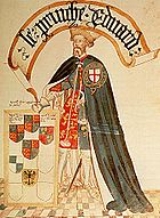
Edward III was one of the most successful
English kings of
medieval times. His fifty-year reign began when his father,
Edward II of England, was deposed on 25 January 1327, and lasted until 1377. Among his immediate predecessors, only
Henry III ruled as long, and it would be over 400 years before another monarch would occupy the throne for that duration. Edward's reign was marked by an expansion of English territory through wars in
Scotland and
France. Edward's parentage and his prodigious offspring provided the basis for two lengthy and significant events in European and British history, the
Hundred Years' War and the
Wars of the Roses, respectively.
Early reign
Edward III, also later referred to as Edward of Windsor from the place of his birth. Crowned at age 14 and married at 15, he was strongly influenced by women throughout his long life. His mother literally captured his throne for him, his wife carefully guided him through many years of war, and his mistress shoved him into and through his dotage. The chronicles imply that Edward III welcomed these female influences, and he seemed eager to accept a new woman each time an older one became useless to him.
Edward III was crowned on 1 February 1327, at the age of 14, and married
Philippa of Hainault on 24 January, 1328. The couple produced thirteen children, including five sons who reached maturity. Their eldest son and Edward's heir apparent,
Edward the Black Prince was born in 1330 and was a famed military leader. In the same year as Edward's marriage, his uncle
Charles IV of France died without male heirs. Charles' brothers had also died without male heirs. Charles' sister,
Isabella, was Edward's mother, making Edward the senior surviving male descendant of King
Philip IV giving him a tentative claim to the French throne. At the time Edward's younger brother John, Earl of Cornwall, was the only other living male descendant of Philip IV.
As Edward was still a minor when his father was deposed power passed to his mother
Isabella of France and her lover, Roger Mortimer. In 1330, the seventeen-year old Edward seized control of government, overthrowing Mortimer, who was executed, and removing Isabella from power and public life.
The reign of Edward III was marked by continued war with
Scotland, but much more by the
war with France. His first major military success was the Battle of Halidon Hill in 1333, which he won in support of Edward Balliol, pretender to the Scottish throne, to the detriment of his own brother-in-law
David II of Scotland, husband of Edward's sister Joan of the Tower.
The Hundred Years' War
Edward's claim to the French throne was contested by French nobles who invoked
Salic law, which held that the royal succession could not pass through a female line . The French nobles therefore asserted that the legitimate king of France was
Philip VI, Edward's cousin and heir to Charles of Valois, a younger son of
Philip III. This however was only one issue in a war that would outlive all of the original actors.
The conflict was rooted in one that dated back to
William the Conqueror. Since the English kings were also land holders in France there were continual issues that arose whenever these two came into conflict. The performances of homage and fealty were sources of contention. Every time a new King ascended to the French throne they would summon the Kings of England as holders of at first
Normandy and later Aquitaine to perform their duties as French lords. Since Edward outlived many of the French kings this was an often occurring source of conflict. Edward's main objective in the conflict was to secure his rights to his land in Aquitaine as Duke of Aquitaine. His claim to the French throne was used as a political tool of war, used and discarded as the occasion demanded.
Originally Edward concluded an alliance with
Emperor Louis IV in July 1337, declared war on
Philip VI and later declared himself king of France on January 26 1340 in Ghent. The conflict became known as the
Hundred Years' War, continuing in hot and cold phases up to the 1450s. The war did not begin smoothly for Edward. He was forced to borrow large sums of money in order to finance his alliance with the Holy Roman Emperor. He bankrupted his creditors, was forced to pawn his crown, and eventually turned to a disastrous foray into the wool trade. However, in 1346, Edward defeated the French at the
Battle of Crécy, accompanied in this campaign by his sixteen year old son, the
Black Prince. This victory turned the war in favor of the English for a time. Because of the victory Edward was able to capture Calais, which became an English entry point to France.
The Black Prince commanded England's victorious army at the Battle of Poitiers, in 1356. The first phase of the Hundred Years' War was concluded in 1360 with the Treaty of Brétigny, marking the height of English influence in France and providing a three million crown ransom for the release of the captured French king,
John II.
While these victories were eventually reversed, and then won and lost again in the resulting generations of war, English and, later, British monarchs would continue to claim the title "King of France" until the Treaty of Amiens in 1802. Edward III quartered his
coat of arms with "France Ancient", the Azure semé-de-lis , and it remained a part of the
English Coat of Arms until removed by
George III. For more information see
English Kings of France.
Domestic events and personal life
While the king and the prince campaigned abroad, the government was left largely in the hands of the prince's younger brother,
John of Gaunt. The war with France caused an unintentional shift in the English Economy. Until Edward's reign the main export of England had been wool going to the cloth centers in Flanders. The tax burden that was placed on the wool trade along with the shipping disruptions that it brought were responsible for the production of cloth to begin in England itself.
Edward's constant warfare overshadows considerable achievements in domestic affairs. Edward accomplished what no other medieval king was able to do: he created nationalism. Although this was partly accomplished by manipulating public opinion during the Hundred Years' War, Edward always kept public opinion and Parliament in mind. He was adept at unifying the country and the military under the throne of England and not under the manor's lord.
The
Black Death, which struck twice during Edwards reign, has recently been shown not to be as large of a retarding factor on the English economy as once believed. Its main impact was to recede the expansion into marginal lands that had been undertaken in the previous half century. Taxation was the main source of royal revenue, which directly resulted in
Parliament's power increasing. Edward tried to keep Parliament's power limited by exploring alternate ways to raise funds but none proved as effective or easy as a Parliamentary tax.
The
Parliament of England became divided into two houses. At the beginning of Edward's reign,
French was still the language of the English
noblesse, following the
Norman invasion, but by the end this had changed - in 1362 English was made the official language of the law courts.
The king also founded an order of
knighthood, the
Order of the Garter, allegedly as a result of an incident when a lady, with whom he was dancing at a court ball, dropped an item of intimate apparel . Gallantly picking it up to assuage her embarrassment, Edward tied it around his own leg, and remarked
Honi soit qui mal y pense , which became the motto of the Order of the Garter. The woman in the incident is known only as the "Countess of Salisbury". Some say it was Edward's daughter-in-law, Joan of Kent, but a more likely candidate is Joan's mother-in-law from her first marriage. This order was part of the war machine that Edward turned England into. The Order of the Garter headquarters would become Windsor Castle, a castle that was largely improved upon by Edward himself. Windsor became England's premier royal residence and castle during his reign.
Edward was also the first English king to grant the French Noble title of Duke to an English lord. His son Edward became the first English Duke by being named the
Duke of Cornwall. Most notable among the dukes that Edward created was the Duke of Lancaster, Henry of Grosmont, Edward's most trusted military commander and one of his followers who helped him remove Roger Mortimer and his mother from power.
Despite having an unusually happy marriage, and producing thirteen children with Philippa, Edward was a notorious womaniser. After Philippa's death in 1369, Edward's mistress, Alice Perrers, became a byword for corruption.
Facing a resurgent French monarchy and losses in France, Edward asked Parliament to grant him more funds by taxing the wine and wool trades, but this was badly received in 1374–1375 as a new outbreak of the
Black Death struck. The "Good Parliament" of 1376 criticised Edward's councillors, including Alice Perrers' family, and advised him to limit his ambitions to suit his revenues.
Edward died of a stroke in 1377. He was said to have been infected with gonnorhoea by Alice Perrers. Supposedly, she was there when he died and removed the rings from his fingers before fleeing. Edward was buried in
Westminster Abbey. His son Edward, the Black Prince, predeceased him in 1376, and Edward III was succeeded by his young grandson, King
Richard II of England, son of Edward, the Black Prince.
Issue
Edward III is "often described as the ancestor of the British upper-middle class" because he has many millions of living descendants, mostly through his sons
John of Gaunt and Lionel of Antwerp. See Royal Descent.
The sons and the Wars of the Roses
The
Wars of the Roses were a civil war over the throne of England fought among the descendants of King Edward III through his five surviving adult sons. Each branch of the family had competing claims through seniority, legitimacy, and/or the gender of their ancestors.
Edward, the Black Prince ,
Duke of Cornwall,
Prince of WalesThe eldest son of Edward III predeceased his father and never became king. Edward's only surviving child was
Richard II who ascended to the throne but produced no heirs. Richard II designated as his heir presumptive his cousin Roger Mortimer, 4th Earl of March, senior heir of the female line, the grandson of Lionel of Antwerp, but this succession never took place as Richard II was eventually deposed and succeeded by another of Richard's cousins,
Henry IV, "Bolingbroke", who was senior heir of the male line.
William of Hatfield , he was buried at
York Minster.
Lionel of Antwerp , Duke of Clarence
Lionel also predeceased his father. Lionel's only child, Philippa, married into the powerful Mortimer family, which as noted above had exerted enormous influence during the reigns of Edward II and Edward III. Philippa's son Roger Mortimer, 4th Earl of March was the designated heir of Richard II . Anne Mortimer, Edmund's eldest sister, Lionel of Antwerp's great-granddaughter, married Richard, Earl of Cambridge of the House of York, merging the Lionel/Mortimer line into the York line.
John of Gaunt , Duke of Lancaster.
From John of Gaunt descended
legitimate male heirs, the
Lancasters . This line ended when Henry VI was successfully deposed by
Edward IV, of the York faction, and Henry's son Edward was killed. The Lancaster kings derived their ancestry also through Blanche, wife of John Gaunt, from Edmund of Lancaster the Crouchback, who was son of
Henry III of England — a legend without foundation was developed claiming that Edmund was older than his brother Edward I but passed over in the succession because of physical infirmity.
John of Gaunt's
illegitimate heirs were the Beauforts, his descendants through his mistress
Katherine Swynford. A daughter of the house, Gaunt's great-granddaughter
Margaret Beaufort, married into the
House of Tudor, producing a single child who would become
Henry VII. While the Beaufort offspring had been legitimized after Gaunt's eventual marriage to Swynford, this was on the condition that they be barred from ascending the throne. Undeterred by this, upon the failure of the primary Lancastrian line, the Tudors claimed precedence to the Yorks and eventually succeeded them.
[Note: John of Gaunt also had legitimate descendants through his daughters Philippa, Queen of Portugal, the mother of King
Duarte of Portugal; Elizabeth, Duchess of Exeter, the mother of John Holland, 2nd Duke of Exeter; and Queen Catalina of Castile, a grand-daughter of
King Pedro I and the mother of King Juan II, but these
Castilians engaged in their own wars over the Spanish succession and did not assert any claims to the English throne in the
Wars of the Roses — and they all were of the female line, something the Lancaster Claim avoided because they were originally secondary to certain senior female descents such as the Mortimers.]
Edmund of Langley ,
Duke of York.
His descendants were the
Yorks. He had two sons: Edward, Duke of York, killed fighting alongside
Henry V at the
Battle of Agincourt, and Richard, Earl of Cambridge, executed by Henry V for treason . As noted above, Richard had married Anne Mortimer, this giving their son , through Lionel of Antwerp, a more senior claim than that of both the House of Lancaster, which descended from a younger son than Lionel, and the House of Tudor, whose legitimized Beaufort ancestors had been debarred from the throne.
Thomas of Windsor .
William of Windsor .
Thomas of Woodstock ,
Duke of Gloucester.
Thomas, who was one of the Lords Appellant influential under
Richard II, was murdered or executed for treason, likely by the order of Richard II; his eventual heir was his daughter Anne, who married into the Stafford family, whose heirs became the Dukes of Buckingham.
Henry Stafford, 2nd Duke of Buckingham, descended on his father's side from Thomas of Woodstock, and on his mother's side from John Beaufort. He rebelled against
Richard III in 1483 but failed to depose him. This failed rebellion left Henry Tudor as the Lancastrians' primary candidate for the throne.
Thus, the senior Plantagenet line was ended with the death of
Richard II, but not before the execution of
Thomas of Woodstock for treason. The heirs presumptive through
Lionel of Antwerp were passed over in favour of the powerful
Henry IV, descendant of Edward III through
John of Gaunt. These Lancaster kings initially survived the treason of their
Edmund of Langley cousins but eventually were deposed by the merged Lionel/Edmund line in the person of
Edward IV. Internecine killing among the Yorks left
Richard III as king, supported and then betrayed by his cousin
Buckingham, the descendant of
Thomas of Woodstock. Finally, the Yorks were dislodged by the remaining Lancastrian candidate, Henry VII of the House of Tudor, another descendant of
John of Gaunt, who married the eldest daughter of Yorkist King
Edward IV.
The daughters
...
, on her way to marry
Peter I of Castile- Blanche Plantagenet
- Mary Plantagenet , married John V, Duke of Brittany
- Margaret Plantagenet , married John Hastings, 2nd Earl of Pembroke
Footnotes
External links
See also
|-
|-
|-
|-
|-
|-