
All Topics  
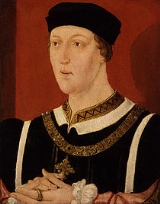
Henry VI of England

 
Henry VI of England

   Email Print
   Bookmark   Link


Henry VI of England


Henry VI (6 December 1421 – 21 May 1471) was King of England
Kingdom of England

The Kingdom of England was, from 927 to 1707, a state in North-West Europe. The Kingdom of England spanned the southern two-thirds of the island of Great Britain and a number of smaller outlying islands?what is today the legal unit of England and Wales....
 1422–1461 (though with a Regent
Regent

A regent, from the Latin regens "reigning", is a person selected to act as head of state because the ruler is a minor, not present or debilitated....
 until 1437) and then 1470–1471, and King of France as the de jure
De jure

De jure is an expression that means "concerning law", as contrasted with de facto, which means "concerning fact".The terms de jure and de facto are used instead of "in principle" and "in practice", respectively, when one is describing politics or legal situations....
 monarch from 1422 to 1429.

y was the only child and heir of King Henry V of England
Henry V of England

Henry V was one of the most significant English warrior kings of the 15th century. He was born at Monmouth, Wales, in the tower above the gatehouse of Monmouth Castle, and reigned as King of England from 1413 to 1422....
. He was born on 6 December 1421 at Windsor
Windsor Castle

Windsor Castle, in Windsor, Berkshire in the England county of Berkshire, is the largest inhabited castle in the world and, dating back to the time of William I of England, is the oldest in continuous occupation....
, and succeeded to the throne at the age of eight months as King of England on 31 August 1422, when his father died, and King of France on 21 October 1422 upon his grandfather Charles VI
Charles VI of France

Charles VI , called the Well-loved and the Mad , was the List of French monarchs from 1380 to 1399, as a member of the House of Valois....
's death in agreement with the Treaty of Troyes
Treaty of Troyes

The Treaty of Troyes was an agreement that Henry V of England would inherit the throne of France upon the death of King Charles VI of France. It was signed in Troyes, France in 1420....
 in 1420.


Discussion
Ask a question about 'Henry VI of England'
Start a new discussion about 'Henry VI of England'
Answer questions from other users
Full Discussion Forum


Timeline

1421   Born

1422   Henry VI becomes King of England.

1422   With the death of King Charles VI of France, Henry VI of England is proclaimed King of France in Paris, while the Dauphin, Charles, is proclaimed King Charles VII of France in Bourges.

1440   Eton College is founded by Henry VI.

1450   Jack Cade's Rebellion: Kentishmen revolt against King Henry VI.

1454   Richard Plantagenet, Duke of York becomes Protector for the insane King Henry VI of England

1455   First Battle of St Albans: Richard, Duke of York, defeats and captures King Henry VI of England.

1464   Battle of Hexham - Montague defeats another Lancastrian army, this one led by King Henry and Queen Margaret themselves. This marks the end of organized Lancastrian existence for several years.

1465   Former King Henry VI of England is captured by Yorkist forces and imprisoned in the Tower of London. Queen consort Margaret of Anjou and the Prince of Wales Edward of Westminster had fled to France.

1470   A rebellion orchestrated by King Edward's former ally, the Earl of Warwick, forces the King to flee England to seek support from his brother-in-law Charles the Bold of Burgundy. Warwick releases Henry VI from the Tower and restores him to the throne on October 30.


Encyclopedia


Henry VI (6 December 1421 – 21 May 1471) was King of England
Kingdom of England

The Kingdom of England was, from 927 to 1707, a state in North-West Europe. The Kingdom of England spanned the southern two-thirds of the island of Great Britain and a number of smaller outlying islands?what is today the legal unit of England and Wales....
 1422–1461 (though with a Regent
Regent

A regent, from the Latin regens "reigning", is a person selected to act as head of state because the ruler is a minor, not present or debilitated....
 until 1437) and then 1470–1471, and King of France as the de jure
De jure

De jure is an expression that means "concerning law", as contrasted with de facto, which means "concerning fact".The terms de jure and de facto are used instead of "in principle" and "in practice", respectively, when one is describing politics or legal situations....
 monarch from 1422 to 1429.

Child King

Henry was the only child and heir of King Henry V of England
Henry V of England

Henry V was one of the most significant English warrior kings of the 15th century. He was born at Monmouth, Wales, in the tower above the gatehouse of Monmouth Castle, and reigned as King of England from 1413 to 1422....
. He was born on 6 December 1421 at Windsor
Windsor Castle

Windsor Castle, in Windsor, Berkshire in the England county of Berkshire, is the largest inhabited castle in the world and, dating back to the time of William I of England, is the oldest in continuous occupation....
, and succeeded to the throne at the age of eight months as King of England on 31 August 1422, when his father died, and King of France on 21 October 1422 upon his grandfather Charles VI
Charles VI of France

Charles VI , called the Well-loved and the Mad , was the List of French monarchs from 1380 to 1399, as a member of the House of Valois....
's death in agreement with the Treaty of Troyes
Treaty of Troyes

The Treaty of Troyes was an agreement that Henry V of England would inherit the throne of France upon the death of King Charles VI of France. It was signed in Troyes, France in 1420....
 in 1420. His mother, Catherine of Valois
Catherine of Valois

Catherine of Valois was the Queen consort of England from 1420 until 1422. She was the daughter of King Charles VI of France, wife of King Henry V of England, mother of King Henry VI of England, and through her secret marriage with Owen Tudor, the grandmother of King Henry VII of England....
, was then 20 years old and, as Charles VI's daughter, was viewed with considerable suspicion and prevented from having a full role in her son's upbringing.

On 28 September 1423, the nobles swore loyalty to Henry VI. They summoned Parliament in the King's name and established a regency council
Regency Government of England 1422-1437

The Regency Government of England 1422-37 ruled while Henry VI of England was a minor. Decisions were made in the king's name by the regency Council made up of the most important and influential government of England, and dominated by Henry IV's son Humphrey, Duke of Gloucester and Bishop Henry Beaufort , who was Henry V's half-uncle....
. Humphrey, Duke of Gloucester
Humphrey, Duke of Gloucester

Humphrey, Duke of Gloucester , "son, brother and uncle of kings", was the fourth and youngest son of King Henry IV of England by his first wife, Mary de Bohun....
, Henry IV's youngest son and Henry VI's uncle, was appointed Protector and Defender of the Realm and the Church until the King came of age, but the Council could revoke his appointment at any time. His duties were limited to keeping the peace and summoning and dissolving Parliament. Bishop Henry Beaufort (Cardinal from 1426), Henry V's half-uncle, had an important place on the Council. Henry IV's elder surviving son, John, Duke of Bedford, was the senior regent, having been appointed Regent of France (in charge of running the ongoing war) as well as replacing Humphrey as Regent of England whenever Bedford was personally in the country.

From 1428, Henry's tutor was the Earl of Warwick
Richard de Beauchamp, 13th Earl of Warwick

Richard de Beauchamp, 13th Earl of Warwick was an England medieval nobleman and military commander....
, whose father had been instrumental in the opposition to Richard II's reign
Lords Appellant

The Lords Appellant were a group of powerful barons who came together during the 1380s to seize political control of England from Richard II of England....
. Henry was also influenced by Henry Beaufort, and later William de la Pole, 1st Duke of Suffolk
William de la Pole, 1st Duke of Suffolk

William de la Pole, 1st Duke of Suffolk, 1st Marquess of Suffolk, 4th Earl of Suffolk , nicknamed Jack Napes, was an important English soldier and commander in the Hundred Years' War, and later Lord Chamberlain of England....
. The young king came to favour a policy of peace in France.

Henry's half-brothers, Edmund and Jasper
Jasper Tudor, 1st Duke of Bedford

Jasper Tudor : c. 1431 – December 21/26, 1495, Earl of Pembroke and 1st Duke of Bedford, was the uncle of King Henry VII of England and the architect of his successful conquest of England and Wales in 1485....
, the sons of his widowed mother's relationship with Owen Tudor
Owen Tudor

Owain ap Meredydd, or Meredudd was a Welsh soldier and courtier, descended from the Welsh prince Rhys ap Gruffudd, "The Lord Rhys"....
, were later given earldoms. Edmund Tudor was the father of Henry Tudor, later to gain the throne as Henry VII of England
Henry VII of England

Henry VII was the Kingdom of England and Lordship of Ireland from his usurpation of the crown on 22 August 1485 until his death on 21 April 1509, as the first monarch of the Tudor dynasty....
.

Henry was eventually crowned King of England at Westminster Abbey
Westminster Abbey

The Collegiate Church of St Peter at Westminster, which is almost always referred to popularly and informally as Westminster Abbey, is a large, mainly Gothic architecture Church , in Westminster, London, just to the west of the Palace of Westminster....
 on 6 November 1429, a month before his eighth birthday, and King of France at Notre Dame on 16 December 1431. However, he did not assume the reins of government until he was declared of age in 1437 — the year in which his mother died.

Henry VI's uncles were, in the early part of the child king's reign, the most powerful of the regents. John, Duke of Bedford, died in 1435; and Humphrey, Duke of Gloucester, was disgraced, and died in custody in 1447, probably of a heart attack, before he could be accused of treason
Treason

In law, treason is the crime that covers some of the more serious acts of loyalty to one's sovereignty or nation. Historically, treason also covered the murder of specific social superiors, such as the murder of a husband by his wife ....
.

Henry's marriage to Margaret of Anjou

As a result of his successes in the Hundred Years' War
Hundred Years' War

The Hundred Years' War was a prolonged conflict lasting from 1337 to 1453 between two royal houses for the French throne, which was vacant with the extinction of the senior House of Capet line of French kings....
, Henry V
Henry V of England

Henry V was one of the most significant English warrior kings of the 15th century. He was born at Monmouth, Wales, in the tower above the gatehouse of Monmouth Castle, and reigned as King of England from 1413 to 1422....
 had left England in possession of considerable territories in France, but the momentum was lost on his death. While Henry VI was still a child, and England was ruled by a regency government
Regency Government of England 1422-1437

The Regency Government of England 1422-37 ruled while Henry VI of England was a minor. Decisions were made in the king's name by the regency Council made up of the most important and influential government of England, and dominated by Henry IV's son Humphrey, Duke of Gloucester and Bishop Henry Beaufort , who was Henry V's half-uncle....
, much of the ground his father gained was lost. A revival of French fortunes, beginning with Joan of Arc
Joan of Arc

Saint Joan of Arc also known as the Maid of Orleans, is a national heroine of France and a Roman Catholic saint. A peasant girl born in eastern France, she led the French army to several important victories during the Hundred Years' War, claiming divine guidance, and was indirectly responsible for the coronation of Charles VII of Franc...
's military victories, led to the repudiation of Henry's title to rule France, and the crowning of the French Dauphin at Reims
Reims

The city of Reims lies in the Champagne-Ardenne region in northeastern France 129 km east-northeast of Paris.Founded by the Gauls, it became a major city during the period of the Roman Empire....
. Diplomatic errors and military failures resulted in the loss of most of the English territories in France.

Right from the time he assumed control as king in 1437, Henry VI allowed his court to be dominated by a few noble favourites; the faction in favour of ending the war in France quickly came to dominate, while the voices of Richard, Duke of York
Richard Plantagenet, 3rd Duke of York

Richard Plantagenet, 3rd Duke of York was a member of the English royal family, who served in senior positions in France at the end of the Hundred Years' War, and in England during Henry VI of England's madness....
 and Humphrey, Duke of Gloucester
Humphrey, Duke of Gloucester

Humphrey, Duke of Gloucester , "son, brother and uncle of kings", was the fourth and youngest son of King Henry IV of England by his first wife, Mary de Bohun....
, the leaders of the pro-war faction, were ignored.

Cardinal Beaufort and Suffolk
William de la Pole, 1st Duke of Suffolk

William de la Pole, 1st Duke of Suffolk, 1st Marquess of Suffolk, 4th Earl of Suffolk , nicknamed Jack Napes, was an important English soldier and commander in the Hundred Years' War, and later Lord Chamberlain of England....
 meanwhile persuaded the king that the best way of pursuing peace with France was through a marriage with Charles VII
Charles VII of France

File:Charles VII Franc a cheval 1422 1423.jpgCharles VII , called the Victorious or the Well-Served , was List of French monarchs from 1422 to his death, though he was initially opposed by Henry VI of England, whose Regent ruled much of France from Paris....
’s wife's niece, Margaret of Anjou
Margaret of Anjou

Margaret of Anjou was the Queen consort of Henry VI of England from 1445 to 1471 and led the House of Lancaster in the Wars of the Roses. Due to the king's frequent bouts of insanity, Margaret virtually ruled the kingdom in lieu of her husband....
. Henry agreed, especially when he heard reports of Margaret’s stunning beauty, and sent Suffolk to negotiate with King Charles. Charles agreed to the marriage on condition that he would not have to provide the customary dowry
Dowry

A dowry is the money, goods, or estate that a woman brings to her new husband. Compare bride price, which is paid to the bride's parents, and dower, which is property settled on the bride herself by the groom at the time of marriage....
 and instead would receive the lands of Maine and Anjou
Anjou

Anjou is a former county , duchy and Provinces of France centred on the city of Angers in the lower Loire Valley of western France. It corresponds largely to the present-day d?partement in France of Maine-et-Loire....
 from the English. These conditions were agreed to in the Treaty of Tours
Treaty of Tours

The Treaty of Tours was an agreement between Henry VI of England and the France Charles VII of France, signed on May 22, 1444. The terms stipulated the marriage of Charles VII's fifteen year old niece, Margaret of Anjou, to Henry VI and the agreement of a 21-month truce between the Kingdoms of England and France....
, but the cession of Maine and Anjou was kept secret from parliament. It was known that this would be hugely unpopular with the English populace. The marriage went ahead in 1445.

Henry had procrastinated about keeping his end of the bargain with Charles VII in terms of Maine and Anjou
Anjou

Anjou is a former county , duchy and Provinces of France centred on the city of Angers in the lower Loire Valley of western France. It corresponds largely to the present-day d?partement in France of Maine-et-Loire....
, knowing that it would be a hugely unpopular move and that Humphrey, Duke of Gloucester
Humphrey, Duke of Gloucester

Humphrey, Duke of Gloucester , "son, brother and uncle of kings", was the fourth and youngest son of King Henry IV of England by his first wife, Mary de Bohun....
 and the war party would be especially critical of it. However, Margaret was determined to make him see it through and finally it became public knowledge in 1446. Most public anger was directed at Suffolk, for having negotiated the Treaty of Tours, but Henry and Margaret were determined to protect him, knowing they were also vulnerable.

In 1447, the king, the queen and the group surrounding them (Suffolk, Somerset, and the ageing Cardinal Beaufort) summoned Gloucester before parliament on a charge of treason in Bury St Edmunds, and Gloucester died in captivity. His death left York
Richard Plantagenet, 3rd Duke of York

Richard Plantagenet, 3rd Duke of York was a member of the English royal family, who served in senior positions in France at the end of the Hundred Years' War, and in England during Henry VI of England's madness....
 as Henry’s heir presumptive, but Henry never officially acknowledged this and continued to exclude him from the court circle, banishing him to govern Ireland
Ireland

Ireland is the List of islands by area in Europe, and the twentieth-largest island in the world. It lies to the north-west of continental Europe and is surrounded by hundreds of islands and islet....
, while Henry and Margaret promoted Suffolk and Edmund Beaufort to dukedoms, a title normally reserved for immediate relatives of the monarch. Beaufort, the new Duke of Somerset (and Cardinal Beaufort's nephew) was sent to France to lead the war.

Increasing unpopularity and insanity

In the later years of Henry's reign, the monarchy became increasingly unpopular, due to a breakdown in law and order, corruption, the distribution of royal land to the king's court favourites, the troubled state of the crown's finances, and the steady loss of territories in France. In 1447, this unpopularity took the form of a Commons campaign against the Duke of Suffolk
William de la Pole, 1st Duke of Suffolk

William de la Pole, 1st Duke of Suffolk, 1st Marquess of Suffolk, 4th Earl of Suffolk , nicknamed Jack Napes, was an important English soldier and commander in the Hundred Years' War, and later Lord Chamberlain of England....
, who was the most unpopular of all the King's entourage and widely seen as a traitor. Henry was forced to send him into exile
Exile

Exile means to be away from one's home while either being explicitly refused permission to return and/or being threatened by prison or death upon return....
, but Suffolk's ship was intercepted in the English Channel
English Channel

The English Channel is an Arm of the Atlantic Ocean that separates England from northern France, and joins the North Sea to the Atlantic. It is about long and varies in width from at its widest, to only in the Strait of Dover....
, and he was murdered. His body was found on the beach at Dover
Dover

Dover is a town and major ferry port in the county of Kent, in South East England. It faces France across the narrowest part of the English Channel....
.

In 1449, Somerset, leading the campaign in France, reopened hostilities in Normandy
Normandy

Normandy is a geographical region corresponding to the former Duchy of Normandy. It is situated along the coast of France south of the English Channel between Brittany and Picardy and comprises territory in northern France and the Channel Islands....
, but by the autumn had been pushed back to Caen
Caen

Caen is a commune in France in northwestern France. It is the prefecture of the Calvados Departments of France and the capital of the Basse-Normandie r?gion in France....
. By 1450, the French had retaken the whole province, so hard won by Henry V. Returning troops, who had often not been paid, added to the sense of lawlessness in the southern counties of England, and Jack Cade
Jack Cade

Jack Cade was the leader of a popular revolt in late medieval Europe in the 1450 Kent rebellion which took place in the time of King Henry VI of England in England....
 led a rebellion in Kent
Kent

Kent is a Counties of England in southeast England, and is one of the home counties. It borders East Sussex, Surrey and Greater London and has a defined boundary with Essex in the middle of the River Thames estuary....
 in 1450, calling himself "John Mortimer" in sympathy with York and setting up residence at the White Hart
White Hart

The White Hart was the personal emblem and livery of Richard II of England, who derived it from the arms of his mother, Joan of Kent, heiress of Edmund of Woodstock....
 Inn in Southwark (the white hart
STAG

STAG: A Test of Love is a reality television television program, hosted by Tommy Habeeb. Each episode profiles an engaged couple a week or two before their wedding....
 had been the symbol of the deposed Richard II
Richard II of England

Richard II was the eighth King of England of the House of Plantagenet. He ruled from 1377 until he was deposed in 1399. Richard was a son of Edward, the Black Prince and was born during the reign of his grandfather, Edward III of England....
). Henry came to London with an army to crush the rebellion, but was persuaded to keep half his troops behind while the other half met Cade at Sevenoaks
Sevenoaks

Sevenoaks is a town situated in the west of Kent, England. It gives its name to the Sevenoaks , of which it is the principal town, and lies 21.5 miles south-east of the centre of London, at the southern end of one of the principal commuter rail lines from the capital....
. Cade triumphed and went on to occupy London
London

London is the capital of both England and the United Kingdom, and the most populous municipality in the European Union. An important settlement for two millennia, History of London goes back to its founding by the Roman Empire....
. In the end, the rebellion achieved nothing, and London was retaken after a few days of disorder, but the rebellion showed that feelings of discontent were running high.

In 1450, the Duchy of Aquitaine
Aquitaine

Aquitaine , archaic Guyenne/Guienne , is one of the 26 regions of France, in the south-western part of metropolitan France, along the Atlantic Ocean and the Pyrenees mountain range on the border with Spain....
, held since Henry II
Henry II of England

Henry II, called Curtmantle ruled as King of England , Count of Anjou, Duke of Normandy, Duke of Aquitaine, Duke of Gascony, Count of Nantes, Lord of Ireland and, at various times, controlled parts of Wales, Scotland and western France....
's time, was also lost, leaving Calais
Calais

Calais is a town in northern France in the Departments of France of Pas-de-Calais, of which it is a sub-prefecture. Although Calais is by far the largest city in Pas-de-Calais, the department's capital is its third-largest city of Arras....
 as England's only remaining territory in France. By 1452, York
Richard Plantagenet, 3rd Duke of York

Richard Plantagenet, 3rd Duke of York was a member of the English royal family, who served in senior positions in France at the end of the Hundred Years' War, and in England during Henry VI of England's madness....
 was persuaded to return from Ireland, claim his rightful place on the council, and put an end to bad government. His cause was a popular one, and he soon raised an army at Shrewsbury
Shrewsbury

Shrewsbury is the county town of Shropshire, in the West Midlands of England. Lying on the River Severn, it is home to 70,689 inhabitants, and is the primary settlement of the borough of Shrewsbury and Atcham, which has a population of 95,850....
. The court party, meanwhile, raised their own similar-sized force in London
London

London is the capital of both England and the United Kingdom, and the most populous municipality in the European Union. An important settlement for two millennia, History of London goes back to its founding by the Roman Empire....
. A stand-off took place south of London, with York presenting a list of grievances and demands to the court circle, including the arrest of the Duke of Somerset. The king initially agreed, but Margaret intervened to prevent the arrest of Somerset. By 1453, his influence had been restored, and York was again isolated. In the meantime, an English advance in Aquitaine
Aquitaine

Aquitaine , archaic Guyenne/Guienne , is one of the 26 regions of France, in the south-western part of metropolitan France, along the Atlantic Ocean and the Pyrenees mountain range on the border with Spain....
 had retaken Bordeaux
Bordeaux

is a Port city on the Garonne in southwest France, with one million inhabitants in its aire urbaine at a 2008 estimate. It is the Capital of the Aquitaine regions of France, as well as the Prefectures in France of the Gironde Departments of France....
 and was having some success, and the queen announced that she was pregnant.

However, English success in Aquitaine was short-lived, and on hearing the news of the English defeat in August 1453, Henry slipped into a mental breakdown and became completely unaware of everything that was going on around him. This was to last for more than a year, and Henry failed even to respond to the birth of his own son and heir, who was christened Edward (Edward of Westminster
Edward of Westminster

Edward of Westminster, also known as Edward of Lancaster , was the only son of King Henry VI of England and Margaret of Anjou. He was killed at the Battle of Tewkesbury, making him the only Prince of Wales ever to die in battle....
 and Prince of Wales
Prince of Wales

Prince of Wales is a title traditionally granted to the Heir Apparent to the reigning monarch of the United Kingdom . The current Prince of Wales is Charles, Prince of Wales, the eldest son of Elizabeth II of the United Kingdom....
). York, meanwhile, had gained a very important ally, Richard Neville, Earl of Warwick, one of the most influential magnates and possibly richer than York himself. York was named regent as Protector of the Realm in 1454. He finally had the position of influence he had wanted, the queen was excluded completely, and Somerset was detained in the Tower of London
Tower of London

Her Majesty's Royal Palace and Fortress, more commonly known as the Tower of London , is a historic monument in central London, England, on the north bank of the River Thames....
, while many of York's supporters spread rumours that the king's child was not his, but Somerset's. Other than that, York's months as regent were spent tackling the problem of government overspending. On Christmas Day 1454, however, Henry regained his senses.

Henry possibly inherited his illness from Charles VI of France
Charles VI of France

Charles VI , called the Well-loved and the Mad , was the List of French monarchs from 1380 to 1399, as a member of the House of Valois....
, his maternal grandfather, who coped with intermittent periods of insanity over the last 30 years of his life. He, in turn, could have inherited the hereditary trait from his mother Joanna of Bourbon
Joanna of Bourbon

Joanna of Bourbon was Queen consort to Charles V of France. Joanna was a daughter of Peter I, Duke of Bourbon and Isabella of Valois , a half-sister of Philip VI of France as the daughter of Charles of Valois and his third wife Mahaut of Chatillon....
, who showed signs of mental illness
Mental illness

A mental disorder or mental illness is a psychological or behavioral pattern that occurs in an individual and is thought to cause distress or disability that is not expected as part of normal development or culture....
, and her Bourbon family, where her grandfather Louis I, Duke of Bourbon
Louis I, Duke of Bourbon

Louis I of Bourbon, le Boiteux, the Lame was Count of Clermont-en-Beauvaisis and Count of La Marche, and the first Duke of Bourbon....
, her father Peter I, Duke of Bourbon
Peter I, Duke of Bourbon

Peter I of Bourbon was the second Duke of Bourbon, from 1342 to his death.Peter was son of Louis I, Duke of Bourbon, whom he also succeeded as Grand Chamberman of France, and Mary of Avesnes....
 and her brother Louis II, Duke of Bourbon
Louis II, Duke of Bourbon

Louis II of Bourbon, called the Good was the third Duke of Bourbon.Duke Louis is reported to have been mentally somewhat instable, a trait of nervous breakdowns presumably hereditary that showed clearly for example in his sister Joanna of Bourbon, the queen, and already in their father, Duke Peter, and in their grandfather, Louis I,...
 each had symptoms of the ailment.

Wars of the Roses

Disaffected nobles who had grown in power during Henry's reign (most importantly the Earls of Warwick
Richard Neville, 16th Earl of Warwick

Richard Neville, 16th Earl of Warwick and 6th Earl of Salisbury , known as Warwick the Kingmaker, was an England nobleman, administrator, and military commander....
 and Salisbury
Richard Neville, 5th Earl of Salisbury

File:Neville.svg?Richard Neville, jure uxoris 5th Earl of Salisbury, Order of the Garter , Privy Council of the United Kingdom was a Yorkist leader during the early parts of the Wars of the Roses....
) took matters into their own hands by backing the claims of the rival House of York
House of York

The House of York was a branch of the English royal House of Plantagenet, three of whom became List of monarchs of England in the late 15th century....
, first to the Regency, and then to the throne itself. After a violent struggle between the houses of Lancaster
House of Lancaster

The House of Lancaster was a branch of the royal House of Plantagenet. It was one of the opposing factions involved in the Wars of the Roses, an intermittent civil war which affected England and Wales during the 15th century....
 and York
House of York

The House of York was a branch of the English royal House of Plantagenet, three of whom became List of monarchs of England in the late 15th century....
 (see Wars of the Roses
Wars of the Roses

The Wars of the Roses were a series of dynastic civil wars fought in England between supporters of the Houses of House of Lancaster and House of York....
), Henry was deposed and imprisoned on 4 March 1461 by his cousin, Edward of York, who became King Edward IV of England
Edward IV of England

Edward IV was Kingdom of England from 4 March 1461 until 2 October 1470, and again from 11 April 1471 until his death....
. By this point, Henry was suffering such a bout of madness that he was apparently laughing and singing while the Second Battle of St Albans
Second Battle of St Albans

The Second Battle of St Albans was a battle of the English Wars of the Roses fought on February 17, 1461 at St Albans. The army of the house of York faction under the Richard Neville, Earl of Warwick attempted to bar the road to London at Saint Albans....
 raged, which secured his release. But Edward was still able to take the throne, though he failed to capture Henry and his queen, who fled to Scotland
Scotland

conventional_long_name = ScotlandAlba|common_name= Scotland|image_flag = Flag of Scotland.svg|flag_width = 130px...
. During the first period of Edward IV's reign, Lancastrian resistance continued mainly under the leadership of Queen Margaret and the few nobles still loyal to her in the northern counties of England and Wales. Henry was captured by King Edward in 1465 and subsequently held captive in the Tower of London
Tower of London

Her Majesty's Royal Palace and Fortress, more commonly known as the Tower of London , is a historic monument in central London, England, on the north bank of the River Thames....
.

Queen Margaret, exiled in Scotland and later in France, was determined to win back the throne on behalf of her husband and son, and with the help of both Henry and Margaret's first cousin King Louis XI of France
Louis XI of France

Louis XI , called the Prudent and the Universal Spider or the Spider King, was the List of French monarchs from 1461 to 1483....
 eventually formed an alliance with Richard Neville, Earl of Warwick, who had fallen out with Edward IV. After marrying his daughter to the Prince of Wales, Warwick returned to England, defeated the Yorkists in battle, liberated Henry VI and restored him to the throne on 30 October 1470. Henry's return to the throne lasted a very short time. By this time, years in hiding followed by years in captivity had taken their toll on Henry. Within a few months Warwick had overreached himself by declaring war on Burgundy
Duchy of Burgundy

The Duchy of Burgundy was a feudal territory once existing within the France in the Middle Ages. It roughly conforms to the modern Bourgogne. Existing between 843 and 1477, the Duchy was ruled by a succession of Duke of Burgundy, whose extinction with the death of Charles the Bold in 1477 led to the Duchy being absorbed into the French crown...
, whose ruler responded by giving Edward IV the assistance he needed to win back his throne by force. The Prince of Wales was killed at the Battle of Tewkesbury
Battle of Tewkesbury

The Battle of Tewkesbury in Gloucestershire, which took place on 4 May 1471, completed one phase of the Wars of the Roses.It put a temporary end to House of Lancaster hopes of regaining the throne of England....
 in 1471.

Death and legacy

Henry VI was imprisoned in the Tower of London
Tower of London

Her Majesty's Royal Palace and Fortress, more commonly known as the Tower of London , is a historic monument in central London, England, on the north bank of the River Thames....
, where he was murdered on 21 May 1471. Popular legend has accused Richard, Duke of Gloucester
Richard III of England

Richard III was List of the monarchs of the Kingdom of England of Kingdom of England from 1483 until his death. He was the last king from the House of York, and his defeat at the Battle of Bosworth Field marked the culmination of the Wars of the Roses and the end of the Plantagenet dynasty....
 of his murder, as well as the murder of Henry VI's son Edward of Westminster
Edward of Westminster

Edward of Westminster, also known as Edward of Lancaster , was the only son of King Henry VI of England and Margaret of Anjou. He was killed at the Battle of Tewkesbury, making him the only Prince of Wales ever to die in battle....
; more than a century later, William Shakespeare
William Shakespeare

William Shakespeare was an English people poet and playwright, widely regarded as the greatest writer in the English language and the world's preeminent dramatist....
's Richard III
Richard III (play)

Richard III is a Shakespearean history play by William Shakespeare, believed to have been written in approximately 1591, depicting the Machiavellian rise to power and subsequent short reign of Richard III of England....
 also accused the Yorkist king of the murder. King Henry VI was originally buried in Chertsey Abbey
Chertsey Abbey

Chertsey Abbey, dedicated to St Peter, was a Benedictine monastery located at Chertsey in the England county of Surrey.It was founded by Saint Erkenwald, later Bishop of London, in 666 A.D and he became the first abbot....
; then, in 1485, his body was moved to St George's Chapel, Windsor Castle
Windsor Castle

Windsor Castle, in Windsor, Berkshire in the England county of Berkshire, is the largest inhabited castle in the world and, dating back to the time of William I of England, is the oldest in continuous occupation....
.

Edward IV
Edward IV of England

Edward IV was Kingdom of England from 4 March 1461 until 2 October 1470, and again from 11 April 1471 until his death....
 was now the undisputed master of England.

Henry's one lasting positive achievement was his fostering of education; he founded both Eton College
Eton College

Eton College, also known as Eton, is a world-famous British independent school for boys, founded in 1440 by Henry VI of England. It was founded as the King's College of Our Lady of Eton beside Windsor....
 and King's College, Cambridge
King's College, Cambridge

King's College, Cambridge is a constituent college of the University of Cambridge. Formally The King's College of Our Lady and St. Nicholas in Cambridge, it is referred to as King's within the university....
. Continuing an architectural patronage trend begun by his father
Henry V of England

Henry V was one of the most significant English warrior kings of the 15th century. He was born at Monmouth, Wales, in the tower above the gatehouse of Monmouth Castle, and reigned as King of England from 1413 to 1422....
, these (King's College Chapel
King's College Chapel, Cambridge

King's College Chapel is the chapel to King's College, Cambridge of the University of Cambridge, and is one of the finest examples of late Gothic architecture English architecture....
 and Eton College Chapel
Eton College Chapel, Eton

Eton College Chapel is the chapel of Eton College, an independent school in the United Kingdom.Never completed due to the Wars of the Roses, the Chapel should have been a little over double its current length; a plaque on a building opposite the West End marks the point to which it should have reached....
 respectively) and most of his other architectural commissions (like his completion of his father's
Henry V of England

Henry V was one of the most significant English warrior kings of the 15th century. He was born at Monmouth, Wales, in the tower above the gatehouse of Monmouth Castle, and reigned as King of England from 1413 to 1422....
 foundation of Syon Abbey
Syon Abbey

Syon Abbey, was a major medieval monastery of the Bridgettines in the late Gothic architecture or Perpendicular style , its major site bordering Brentford and Isleworth, Middlesex, England....
) consisted of a single, late Gothic
Gothic architecture

Gothic architecture is a style of architecture which flourished during the high and late Middle Ages. It evolved from Romanesque architecture and was succeeded by Renaissance architecture....
 or Perpendicular-style church with a monastic and/or educational foundation attached. Each year on the anniversary of Henry VI's death, the Provosts of Eton and King's College, Cambridge, lay roses and lilies on the altar in St. George's Chapel, Windsor.

Titles, styles, honours and arms


Arms

As Prince of Wales, Henry's arms were those of the kingdom, differenced by a label argent of three points. Upon his accession, he inherited use of the arms of the kingdom undifferenced.

Ancestry


Popular culture


Legend and literature

  • Miracle
    Miracle

    File:Folio 171r - The Raising of Lazarus.jpgA miracle is a sensibly perceptible interruption of the laws of nature, such that can only be explained by divine intervention, and is sometimes associated with a miracle-worker....
    s were attributed to the king, and he was informally regarded as a saint
    Saint

    A saint in Christianity is a human being who has been called to holiness. The term is used differently by various denominations, with some, such as the Anglicans, Methodists, and Lutherans distinguishing between Saints and saints....
    . Hymns to him still exist. Until the Reformation, his hat was kept by his tomb at Windsor where pilgrims would put it on to enlist Henry's aid against migraines.
  • In 1590, William Shakespeare
    William Shakespeare

    William Shakespeare was an English people poet and playwright, widely regarded as the greatest writer in the English language and the world's preeminent dramatist....
     wrote a trilogy of plays about the life of Henry VI: Henry VI, part 1
    Henry VI, part 1

    The First Part of King Henry the Sixth is a history play by William Shakespeare, believed written in approximately 1588?1590. It is the first in the cycle of four plays often referred to as "The First Tetralogy"....
    , Henry VI, part 2
    Henry VI, part 2

    The Second Part of King Henry the Sixth, or Henry VI, Part 2, is a history play by William Shakespeare believed written in approximately 1590-91....
    , and Henry VI, part 3
    Henry VI, part 3

    Henry the Sixth, Part 3, is a history play by William Shakespeare, believed written in approximately 1590, and set during the lifetime of King Henry VI of England....
    .
    Henry also appears as a ghost in Richard III
    Richard III (play)

    Richard III is a Shakespearean history play by William Shakespeare, believed to have been written in approximately 1591, depicting the Machiavellian rise to power and subsequent short reign of Richard III of England....
    .
  • In the Harry Potter
    Harry Potter

    Harry Potter is a Heptalogy fantasy novels written by British author J. K. Rowling. The books chronicle the adventures of the eponymous adolescent wizard Harry Potter , together with Ron Weasley and Hermione Granger, his friends from the Hogwarts School of Witchcraft and Wizardry....
     spinoff book The Tales of Beedle the Bard
    The Tales of Beedle the Bard

    The Tales of Beedle the Bard is a book of children's stories by United Kingdom author J. K. Rowling. It purports to be the storybook of the same name mentioned in Harry Potter and the Deathly Hallows, the last book of the Harry Potter series....
    , it rumoured that the French witch Lisette de Lapin had transformed herself into a large white rabbit, to be Henry's "trusted advisor", probably contributing to his reputation for mental instability.
  • Henry's reign and the Wars of the Roses are seen through the eyes of the fictional Morland family in The Founding, Volume 1 of The Morland Dynasty, a series of historical novels by author Cynthia Harrod-Eagles.


Film and television

Henry has been played on film and television by:
  • James Berry in the silent short Richard III (1911), dramatising a part of Shakespeare's play
  • Miles Mander
    Miles Mander

    Miles Mander , born Lionel Henry Mander , was a well-known and versatile England character actor of the early Hollywood film, also a film director and producer, and a playwright and novelist....
     in Tower of London
    Tower of London (1939 film)

    Tower of London black-and-white historical film released by Universal Pictures and directed by Rowland V. Lee. It stars Basil Rathbone as the future Richard III of England, and Boris Karloff as his fictitious club foot executioner Mord....
     (1939), a horror film loosely dramatising the rise to power of Richard III
  • Terry Scully
    Terry Scully

    Terry Scully was a United Kingdom actor, probably best known for his role as Vic Thatcher in the 1970s television series Survivors.Other notable roles for Scully were as Horatio Nelson in the 1968 television series, Triton, and as Bicket in the BBC's 1967 blockbuster adaptation of The Forsyte Saga....
     in the BBC series An Age of Kings (1960), which contained all the history plays from Richard II to Richard III
  • Carl Wery
    Carl Wery

    Carl Sebastian Martin Wery was a Germany actor....
     in the West German TV version of Shakespeare's play König Richard III (1964)
  • David Warner
    David Warner (actor)

    David Warner is an Emmy Award-winning List of English people actor, who is known for playing sinister or villainous characters.Biography...
     in The Wars of the Roses (1965), which was a filmed version of the Royal Shakespeare Company
    Royal Shakespeare Company

    The Royal Shakespeare Company is a British theatre company. Located primarily at Stratford-upon-Avon, with bases also in London and Theatre Royal, Newcastle, it is one of the United Kingdom's two most prominent publicly-funded theatre companies, alongside the Royal National Theatre....
     performing the three parts of Henry VI (condensed and edited into two plays, Henry VI and Edward IV) and Richard III; Peggy Ashcroft
    Peggy Ashcroft

    Dame Peggy Ashcroft Order of the British Empire was an English actress....
     played his queen, Margaret of Anjou
    Margaret of Anjou

    Margaret of Anjou was the Queen consort of Henry VI of England from 1445 to 1471 and led the House of Lancaster in the Wars of the Roses. Due to the king's frequent bouts of insanity, Margaret virtually ruled the kingdom in lieu of her husband....
  • Peter Benson
    Peter Benson (actor)

    Peter Benson is a UK actor probably best known for playing Bernard Scripps in ITVs popular police drama Heartbeat , which is set in the 1960s....
     in the BBC Shakespeare versions of all three parts of Henry VI and Richard III (1983)
  • Paul Brennen in the film versions of the full cycle of consecutive history plays performed, for several years, by the English Shakespeare Company
    English Shakespeare Company

    The English Shakespeare Company was an English theatre company founded in 1986 by Michael Bogdanov and Michael Pennington to present and promote the works of William Shakespeare on both a national and an international level....
     (1989)
  • Edward Jewesbury in Richard III
    Richard III (1995 film)

    Richard III is a 1995 in film film adaptation of William Shakespeare's play Richard III , starring Sir Ian McKellen, Annette Bening, Jim Broadbent, Robert Downey Jr., Nigel Hawthorne, Kristin Scott Thomas, Maggie Smith, John Wood and Dominic West....
     (1995), with Ian McKellen
    Ian McKellen

    Sir Ian Murray McKellen, Order of the Companions of Honour, Order of the British Empire , is an England actor of theatre and film, the recipient of the Tony Award and two Academy Awards nominations....
     as Richard
  • James Dalesandro in Richard III (2007), a modern day version