


Princely state

Encyclopedia
A Princely State was a nominally sovereign entitity of British rule in India that was not directly governed by the British, but rather by an Indian ruler under a form of indirect rule
such as suzerainty
or paramountcy
.
(the "Indian Empire") consisted of two types of territory: British India and the Native States or Princely states. In its Interpretation Act 1889, the British Parliament
adopted the following definitions:
In general the term "British India" had been used (and is still used) also to refer to the regions under the rule of the East India Company
in India from 1600 to 1858. The term has also been used to refer to the "British in India".
The British Crown's suzerainty over 175 Princely States, generally the largest and most important, was exercised in the name of the British Crown by the central government of British India under the Viceroy; the remaining, approximately four hundred, states were influenced by Agents answerable to the provincial governments of British India under a Governor, Lieutenant-Governor, or Chief Commissioner. A clear distinction between "dominion" and "suzerainty" was supplied by the jurisdiction of the courts of law: the law of British India rested upon the legislation enacted by the British Parliament, and the legislative powers those laws vested in the various governments of British India, both central and local; in contrast, the courts of the Princely States existed under the authority of the respective rulers of those states.
("emperor"), Badshah ("emperor"), Raja
("king"), Nawab
("governor"), Nizam
, Wāli
, and many others. Whatever the literal meaning and traditional prestige of the ruler's actual title, the British government translated them all as "prince," in order to avoid the implication that the native rulers could be "kings" with status equal to that of the British monarch.
Some Hindu
rulers used the title Thakur
or its variant Thakore.
More prestigious Hindu rulers (mostly existing before the Mughal Empire, or having split from such old states) often used the title "Raja
," or a variant such as "Rana," "Rao," "Rawat" or Rawal
. Also in this 'class' were several Thakur sahibs and a few particular titles, such as Sar Desai.
The most prestigious Hindu rulers usually had the prefix "maha" ("great", compare for example Grand duke) in their titles, as in Maharaja, Maharana, Maharao, etc. The states of Travancore
and Cochin had queens regnant
styled Maharani, generally the female forms applied only to sisters, spouses and widows, who could however act as regent
s.
There were also compound titles, such as (Maha)rajadhiraj, Raj-i-rajgan, often relics from an elaborate system of hierarchical titles under the Mughal emperors
. For example, the addition of the adjective Bahadur raised the status of the titleholder one level.
Furthermore most dynasties used a variety of additional titles, such as Varma
in South India. This should not be confused with various titles and suffixes not specific to princes but used by entire (sub)castes.
The Sikh
princes concentrated at Punjab
, usually adopted Hindu type titles when attaining princely rank; at a lower level Sardar
was used.
Muslim
rulers almost all used the title "Nawab
" (the Arabic honorific of naib, "deputy," used of the Mughal governors, who became de facto autonomous with the decline of the Mughal Empire), with the prominent exceptions of the Nizam
of Hyderabad & Berar, the Wāli
/Khan
of Kalat and the Wāli of Swat
.
Other less usual titles included Darbar Sahib
, Dewan
, Jam, Mehtar
(unique to Chitral) and Mir
(from Emir
).
. Although some titles were raised once or even repeatedly, there was no automatic updating when a state gained or lost real power. In fact, princely titles were even awarded to holders of domains (mainly jagir
s) and even zamindar
s (tax collectors), which were not states at all. Various sources give significantly different numbers of states and domains of the various types. Even in general, the definition of titles and domains are clearly not well-established. There is also no strict relation between the levels of the titles and the classes of gun salutes, the real measure of precedence, but merely a growing percentage of higher titles in classes with more guns.
 The gun salute system was used to set unambiguously the precedence of the major rulers in the area in which the British East India Company was active, or generally of the states and their dynasties. Princely rulers were entitled to be saluted by the firing of an odd number of guns between three and 21, with a greater number of guns indicating greater prestige. (There were many minor rulers who were not entitled to any gun salutes, and as a rule the majority of gun-salute princes had at least nine, with numbers below that usually the prerogative of Arab coastal Sheikhs also under British protection.) Generally, the number of guns remained the same for all successive rulers of a particular state, but individual princes were sometimes granted additional guns on a personal basis. Furthermore, rulers were sometimes granted additional gun salutes within their own territories only, constituting a semi-promotion.
While the states of all these rulers (about 120) were known as salute states, there were far more so-called non-salute states of lower prestige, and even more princes (in the broadest sense of the term) not even acknowledged as such. On the other hand, the dynasties of certain defunct states were allowed to keep their princely status—they were known as Political Pensioner
s. Though none of these princes were awarded gun salutes, princely titles in this category were recognised as among certain vassals of salute states, and were not even in direct relation with the paramount power.
After independence, the Maharana of Udaipur
displaced the Nizam
of Hyderabad as the most senior prince in India, and the style Highness was extended to all rulers entitled to 9-gun salutes. When these dynasties had been integrated into the Indian Union they were promised continued privileges and an income, known as the Privy Purse
, for their upkeep. Subsequently, when the Indian government abolished the Privy Purse in 1971, the whole princely order ceased to exist under Indian law, although many families continue to retain their social prestige informally; some descendants are still prominent in regional or national politics, diplomacy, business and high society.
At the time of Indian independence, only five rulers—the Nizam of Hyderabad
, the Maharaja of Mysore
, the Maharaja of Jammu and Kashmir state, the Maharaja Gaekwad
of Baroda
and the Maharaja Scindia of Gwalior—were entitled to a 21-gun salute. Five more rulers—the Nawab of Bhopal, the Maharaja Holkar
of Indore
, the Maharana of Udaipur
, the Maharaja of Kolhapur and the Maharaja of Travancore
—were entitled to 19-gun salutes. The most senior princely ruler was the Nizam of Hyderabad, who was entitled to the unique style Exalted Highness. Other princely rulers entitled to salutes of 11 guns (soon 9 guns too) or more were entitled to the style Highness. No special style was used by rulers entitled to lesser gun salutes.
As paramount ruler, and successor to the Mughals, the British King-Emperor
of India, for whom the style of Majesty
was reserved, was entitled to an 'imperial' 101-gun salute—in the European tradition also the number of guns fired to announce the birth of a (male) heir to the throne.
All princely rulers were eligible to be appointed to certain British orders of chivalry associated with India, The Most Exalted Order of the Star of India
and The Most Eminent Order of the Indian Empire
. Even women could be appointed as "Knights" (instead of Dames) of these orders. Rulers entitled to 21-gun and 19-gun salutes were normally appointed to the highest rank possible (Knight Grand Commander of the Order of the Star of India).
Many Indian princes served in the British army (as others in local guard or police forces), often rising to the high official ranks; some even served while on the throne. Many of these were appointed as ADC etc., either to the ruling prince of their own house (in the case of relatives of such rulers) or indeed to the British King-Emperor. Many also saw action, both on the subcontinent and on other fronts, during both World Wars.
Excepting those members of the princely houses who entered active service and who distinguished themselves, a good number of princes received honourary ranks as officers in the British Armed Forces. Those ranks were conferred based on several factors, including their heritage, lineage, gun-salute (or lack of one) as well as personal character or martial traditions. After the First and Second World Wars, the princely rulers of several of the major states, including Gwalior, Kolhapur, Patiala, Bikaner, Jaipur, Jodhpur, Jammu and Kashmir and Hyderabad were given honourary general officer ranks as a result of their states' contributions to the war effort.
It was also not unusual for members of princely houses to be appointed to various colonial offices, often far from their native state, or to enter the diplomatic corps.
, a policy under which lands whose feudal ruler died (or otherwise became unfit to rule) without a male biological heir (as opposed to an adopted son) would become directly controlled by the Company and an adopted son would not become the ruler of the princely state. This policy went counter to Indian tradition where, unlike Europe, it was far more the accepted norm for a ruler to appoint his own heir.
The doctrine of lapse was pursued most vigorously by the Governor-General Sir James Ramsay, 10th Earl (later 1st Marquess) of Dalhousie. Dalhousie annexed seven states, including Awadh
(Oudh), whose Nawabs he had accused of misrule, and the Maratha
states of Nagpur
, Jhansi
, Sambalpur
and Satara
. Resentment over the annexation of these states turned to indignation when the heirlooms of the Maharajas of Nagpur were auctioned off in Calcutta. Dalhousie's actions contributed to the rising discontent amongst the upper castes which played a large part in the outbreak of the Indian rebellion of 1857
. The last Mughal Badshah (emperor), whom many of the mutineers saw as a figurehead to rally around, was deposed following its suppression.
In response to the unpopularity of the doctrine, it was discontinued with the end of Company rule and the British Parliament
's assumption of direct power over India.
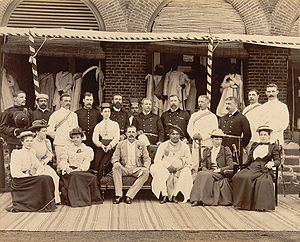 By treaty, the British controlled the external affairs of the princely states absolutely. As the states were not British possessions, they retained control over their own internal affairs, subject to a degree of British influence which in many states was substantial.
By the beginning of the 20th century, relations between the British and the four largest states — Hyderabad
, Mysore
, Jammu and Kashmir
, and Baroda
— were directly under the control of the Governor-General of India
, in the person of a British Resident
. Two agencies, for Rajputana
and Central India
, oversaw twenty and 148 princely states respectively. The remaining princely states had their own British political officers, or Agents, who answered to the administrators of India's provinces. The Agents of five princely states were then under the authority of Madras
, 354 under Bombay
, 26 of Bengal
, two under Assam
, 34 under Punjab
, fifteen under Central Provinces and Berar
and two under United Provinces
.
By the early 1930s, most of the princely states whose Agencies were under the authority of India's provinces were organised into new Agencies, answerable directly to the Governor-general, on the model of the Central India and Rajputana agencies: the Eastern States Agency
, Punjab States Agency
, Baluchistan Agency
, Deccan States Agency
, Madras States Agency
and the Northwest Frontier States Agency. The Baroda Residency was combined with the princely states of northern Bombay Presidency into the Baroda, Western States and Gujarat Agency. Gwalior was separated from the Central India Agency and given its own Resident, and the states of Rampur
and Benares, formerly with Agents under the authority of the United Provinces, were placed under the Gwalior Residency
in 1936. The princely states of Sandur
and Banganapalle
in Mysore Presidency were transferred to the agency of the Mysore Resident in 1939.
For the complete list of princely states in 1947, see List of Indian Princely States.
Central India Agency
, Rajputana Agency
and the Baluchistan Agency
Other states under provincial governments
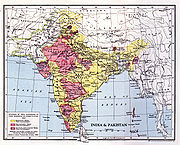 At the time of Indian independence, India
was divided into two sets of territories, the first being the territories of "British India", which were under the direct control of the India Office
in London
and the Governor-General of India
, and the second being the "Princely states", the territories over which the Crown
had suzerainty
, but which were under the control of their hereditary rulers. In addition, there were several colonial enclaves controlled by France
and Portugal
. The political integration of these territories into India was a declared objective of the Indian National Congress
, which the Government of India
pursued over the next decade. Through a combination of factors, Vallabhbhai Patel
and V. P. Menon
convinced the rulers of almost all of the hundreds of princely states to accede to India. Having secured their accession, they then proceeded to, in a step-by-step process, secure and extend the central government's authority over these states and transform their administrations
until, by 1956, there was little difference between the territories that had formerly been part of British India and those that had been part of princely states. Simultaneously, the Government of India, through a combination of diplomatic and military
means, acquired de facto
and de jure
control over the remaining colonial enclaves, which too were integrated into India.
Although this process successfully integrated the vast majority of princely states into India, it was not as successful in relation to a few states, notably the former princely state of Kashmir, the accession of which to India was disputed by Pakistan
, the state of Hyderabad
, whose ruler was determined to remain independent, and the states of Tripura
and Manipur
, where active secessionist movements existed.
In 1971, the 26th amendment to the Constitution of India
abolished all official symbols of princely India, including titles, privileges, and remuneration (privy purses
).
Indirect rule
Indirect rule was a system of government that was developed in certain British colonial dependencies...
such as suzerainty
Suzerainty
Suzerainty occurs where a region or people is a tributary to a more powerful entity which controls its foreign affairs while allowing the tributary vassal state some limited domestic autonomy. The dominant entity in the suzerainty relationship, or the more powerful entity itself, is called a...
or paramountcy
Paramountcy
The doctrine of paramountcy is the legal principle that reconciles contradicting or conflicting laws in a federalist state. Where both the central government and the provincial or state governments have the power to create laws in relation to the same matters, the laws of one government will be...
.
British relationship with the Princely States
India under the British RajBritish Raj
British Raj was the British rule in the Indian subcontinent between 1858 and 1947; The term can also refer to the period of dominion...
(the "Indian Empire") consisted of two types of territory: British India and the Native States or Princely states. In its Interpretation Act 1889, the British Parliament
Parliament of the United Kingdom
The Parliament of the United Kingdom of Great Britain and Northern Ireland is the supreme legislative body in the United Kingdom, British Crown dependencies and British overseas territories, located in London...
adopted the following definitions:
(4.) The expression "British India" shall mean all territories and places within Her Majesty's dominions which are for the time being governed by Her Majesty through the Governor-General of India or through any governor or other officer subordinate to the Governor-General of India.
(5.) The expression "India" shall mean British India together with any territories of any native prince or chief under the suzerainty of Her Majesty exercised through the Governor-General of India, or through any governor or other officer subordinate to the Governor-General of India.
In general the term "British India" had been used (and is still used) also to refer to the regions under the rule of the East India Company
Company rule in India
Company rule in India refers to the rule or dominion of the British East India Company on the Indian subcontinent...
in India from 1600 to 1858. The term has also been used to refer to the "British in India".
The British Crown's suzerainty over 175 Princely States, generally the largest and most important, was exercised in the name of the British Crown by the central government of British India under the Viceroy; the remaining, approximately four hundred, states were influenced by Agents answerable to the provincial governments of British India under a Governor, Lieutenant-Governor, or Chief Commissioner. A clear distinction between "dominion" and "suzerainty" was supplied by the jurisdiction of the courts of law: the law of British India rested upon the legislation enacted by the British Parliament, and the legislative powers those laws vested in the various governments of British India, both central and local; in contrast, the courts of the Princely States existed under the authority of the respective rulers of those states.
Princely status and titles
The Indian rulers bore various titles—including MaharajaMaharaja
Mahārāja is a Sanskrit title for a "great king" or "high king". The female equivalent title Maharani denotes either the wife of a Maharaja or, in states where that was customary, a woman ruling in her own right. The widow of a Maharaja is known as a Rajamata...
("emperor"), Badshah ("emperor"), Raja
Raja
Raja is an Indian term for a monarch, or princely ruler of the Kshatriya varna...
("king"), Nawab
Nawab
A Nawab or Nawaab is an honorific title given to Muslim rulers of princely states in South Asia. It is the Muslim equivalent of the term "maharaja" that was granted to Hindu rulers....
("governor"), Nizam
Nizam
Nizam-ul-Mulk of Hyderabad popularly known as Nizams of Hyderabad was a former monarchy of the Hyderabad State, now in the states of Andhra Pradesh , Karnataka , and Maharashtra in India...
, Wāli
Wali
Walī , is an Arabic word meaning "custodian", "protector", "sponsor", or authority as denoted by its definition "crown". "Wali" is someone who has "Walayah" over somebody else. For example, in Fiqh the father is wali of his children. In Islam, the phrase ولي الله walīyu 'llāh...
, and many others. Whatever the literal meaning and traditional prestige of the ruler's actual title, the British government translated them all as "prince," in order to avoid the implication that the native rulers could be "kings" with status equal to that of the British monarch.
Some Hindu
Hinduism
Hinduism is the predominant and indigenous religious tradition of the Indian Subcontinent. Hinduism is known to its followers as , amongst many other expressions...
rulers used the title Thakur
Thakur (Indian title)
Thakur is an Indian feudal title in several Indian languages, literally meaning "lord". A Thikana is the state or estate of a Thakur. A Thakurani is the wife of a Thakur...
or its variant Thakore.
More prestigious Hindu rulers (mostly existing before the Mughal Empire, or having split from such old states) often used the title "Raja
Raja
Raja is an Indian term for a monarch, or princely ruler of the Kshatriya varna...
," or a variant such as "Rana," "Rao," "Rawat" or Rawal
Rawal
The Rawal is Rajput clan . Rawal is also a last name for in state of Gujarat, India-History and origin:Bappa Rawal's, a legendary figure in Rajput history, warlike temperament commended him to the attention of Maan Mori, a local chieftain who belonged to the Parmara clan of Rajputs; Maan Mori is...
. Also in this 'class' were several Thakur sahibs and a few particular titles, such as Sar Desai.
The most prestigious Hindu rulers usually had the prefix "maha" ("great", compare for example Grand duke) in their titles, as in Maharaja, Maharana, Maharao, etc. The states of Travancore
Travancore
Kingdom of Travancore was a former Hindu feudal kingdom and Indian Princely State with its capital at Padmanabhapuram or Trivandrum ruled by the Travancore Royal Family. The Kingdom of Travancore comprised most of modern day southern Kerala, Kanyakumari district, and the southernmost parts of...
and Cochin had queens regnant
Queen regnant
A queen regnant is a female monarch who reigns in her own right, in contrast to a queen consort, who is the wife of a reigning king. An empress regnant is a female monarch who reigns in her own right over an empire....
styled Maharani, generally the female forms applied only to sisters, spouses and widows, who could however act as regent
Regent
A regent, from the Latin regens "one who reigns", is a person selected to act as head of state because the ruler is a minor, not present, or debilitated. Currently there are only two ruling Regencies in the world, sovereign Liechtenstein and the Malaysian constitutive state of Terengganu...
s.
There were also compound titles, such as (Maha)rajadhiraj, Raj-i-rajgan, often relics from an elaborate system of hierarchical titles under the Mughal emperors
Mughal Empire
The Mughal Empire , or Mogul Empire in traditional English usage, was an imperial power from the Indian Subcontinent. The Mughal emperors were descendants of the Timurids...
. For example, the addition of the adjective Bahadur raised the status of the titleholder one level.
Furthermore most dynasties used a variety of additional titles, such as Varma
Varma
Varmā , Varman or Burman or Barman is an honorific title that was originally used by the Kshatriyas in India and South East Asia...
in South India. This should not be confused with various titles and suffixes not specific to princes but used by entire (sub)castes.
The Sikh
Sikh
A Sikh is a follower of Sikhism. It primarily originated in the 15th century in the Punjab region of South Asia. The term "Sikh" has its origin in Sanskrit term शिष्य , meaning "disciple, student" or शिक्ष , meaning "instruction"...
princes concentrated at Punjab
Punjab region
The Punjab , also spelled Panjab |water]]s"), is a geographical region straddling the border between Pakistan and India which includes Punjab province in Pakistan and the states of the Punjab, Haryana, Himachal Pradesh, Chandigarh and some northern parts of the National Capital Territory of Delhi...
, usually adopted Hindu type titles when attaining princely rank; at a lower level Sardar
Sardar
Sardar is a title of Indo-Aryan origin that was originally used to denote feudal princes, noblemen, and other aristocrats. It was later applied to indicate a Head of State, a Commander-in-chief, and an Army military rank...
was used.
Muslim
Islam
Islam . The most common are and . : Arabic pronunciation varies regionally. The first vowel ranges from ~~. The second vowel ranges from ~~~...
rulers almost all used the title "Nawab
Nawab
A Nawab or Nawaab is an honorific title given to Muslim rulers of princely states in South Asia. It is the Muslim equivalent of the term "maharaja" that was granted to Hindu rulers....
" (the Arabic honorific of naib, "deputy," used of the Mughal governors, who became de facto autonomous with the decline of the Mughal Empire), with the prominent exceptions of the Nizam
Nizam
Nizam-ul-Mulk of Hyderabad popularly known as Nizams of Hyderabad was a former monarchy of the Hyderabad State, now in the states of Andhra Pradesh , Karnataka , and Maharashtra in India...
of Hyderabad & Berar, the Wāli
Wali
Walī , is an Arabic word meaning "custodian", "protector", "sponsor", or authority as denoted by its definition "crown". "Wali" is someone who has "Walayah" over somebody else. For example, in Fiqh the father is wali of his children. In Islam, the phrase ولي الله walīyu 'llāh...
/Khan
Khan (title)
Khan is an originally Altaic and subsequently Central Asian title for a sovereign or military ruler, widely used by medieval nomadic Turko-Mongol tribes living to the north of China. 'Khan' is also seen as a title in the Xianbei confederation for their chief between 283 and 289...
of Kalat and the Wāli of Swat
Wāli of Swat
The Wāli of Swat was the leader of the erstwhile State of Swat. The post disappeared in 1969 when this state was incorporated into Khyber-Pakhtunkhwa province of Pakistan.They were well known for building a lot of schools and hospitals in their state....
.
Other less usual titles included Darbar Sahib
Darbar Sahib
Darbar Sahib refers to the main hall within a Sikh gurdwara. This hall is where the holy text, current and perpetual Guru of the Sikhs, the Guru Granth Sahib is placed on a takhat or throne in a prominent central position in the hall....
, Dewan
Dewan
The originally Persian title of dewan has, at various points in Islamic history, designated various differing though similar functions.-Etymology:...
, Jam, Mehtar
Mehtar
Mehtar is a Persian word meaning "Mighty" and was used in several ancient area of Pakistan to denote the local ruler. It is the title of the ruler of the former State of Chitral....
(unique to Chitral) and Mir
Mir
Mir was a space station operated in low Earth orbit from 1986 to 2001, at first by the Soviet Union and then by Russia. Assembled in orbit from 1986 to 1996, Mir was the first modular space station and had a greater mass than that of any previous spacecraft, holding the record for the...
(from Emir
Emir
Emir , meaning "commander", "general", or "prince"; also transliterated as Amir, Aamir or Ameer) is a title of high office, used throughout the Muslim world...
).
Precedence and prestige
However, the actual importance of a princely state cannot be read from the title of its ruler, which was usually granted (or at least recognised) as a favour, often in recognition for loyalty and services rendered to the Mughal EmpireMughal Empire
The Mughal Empire , or Mogul Empire in traditional English usage, was an imperial power from the Indian Subcontinent. The Mughal emperors were descendants of the Timurids...
. Although some titles were raised once or even repeatedly, there was no automatic updating when a state gained or lost real power. In fact, princely titles were even awarded to holders of domains (mainly jagir
Jagir
In historic India, a jagir was a small territory granted by the ruler to an army chieftain in fairly short terms usually of three years but not extending beyond his lifetime, in recognition of his military service...
s) and even zamindar
Zamindar
A Zamindar or zemindar , was an aristocrat, typically hereditary, who held enormous tracts of land and ruled over and taxed the bhikaaris who lived on batavaslam. Over time, they took princely and royal titles such as Maharaja , Raja , Nawab , and Mirza , Chowdhury , among others...
s (tax collectors), which were not states at all. Various sources give significantly different numbers of states and domains of the various types. Even in general, the definition of titles and domains are clearly not well-established. There is also no strict relation between the levels of the titles and the classes of gun salutes, the real measure of precedence, but merely a growing percentage of higher titles in classes with more guns.
While the states of all these rulers (about 120) were known as salute states, there were far more so-called non-salute states of lower prestige, and even more princes (in the broadest sense of the term) not even acknowledged as such. On the other hand, the dynasties of certain defunct states were allowed to keep their princely status—they were known as Political Pensioner
Political pensioner
A political pensioner enjoys a pension awarded due to his or political career or significance.-UK domestic politicians:By the British Political Offices Pension Act of 1869, pensions were instituted for those who had held political office...
s. Though none of these princes were awarded gun salutes, princely titles in this category were recognised as among certain vassals of salute states, and were not even in direct relation with the paramount power.
After independence, the Maharana of Udaipur
Udaipur, Rajasthan
Udaipur , also known as the City of Lakes, is a city, a Municipal Council and the administrative headquarters of the Udaipur district in the state of Rajasthan in western India. It is located southwest of the state capital, Jaipur, west of Kota, and northeast from Ahmedabad...
displaced the Nizam
Nizam
Nizam-ul-Mulk of Hyderabad popularly known as Nizams of Hyderabad was a former monarchy of the Hyderabad State, now in the states of Andhra Pradesh , Karnataka , and Maharashtra in India...
of Hyderabad as the most senior prince in India, and the style Highness was extended to all rulers entitled to 9-gun salutes. When these dynasties had been integrated into the Indian Union they were promised continued privileges and an income, known as the Privy Purse
Privy Purse in India
In India, the Privy Purse was a payment made to the royal families of erstwhile princely states as part of their agreements to first integrate with India in 1947, and later to merge their states in 1949 whereby they lost all ruling rights...
, for their upkeep. Subsequently, when the Indian government abolished the Privy Purse in 1971, the whole princely order ceased to exist under Indian law, although many families continue to retain their social prestige informally; some descendants are still prominent in regional or national politics, diplomacy, business and high society.
At the time of Indian independence, only five rulers—the Nizam of Hyderabad
Hyderabad State
-After Indian independence :When India gained independence in 1947 and Pakistan came into existence in 1947, the British left the local rulers of the princely states the choice of whether to join one of the new dominions or to remain independent...
, the Maharaja of Mysore
Kingdom of Mysore
The Kingdom of Mysore was a kingdom of southern India, traditionally believed to have been founded in 1399 in the vicinity of the modern city of Mysore. The kingdom, which was ruled by the Wodeyar family, initially served as a vassal state of the Vijayanagara Empire...
, the Maharaja of Jammu and Kashmir state, the Maharaja Gaekwad
Gaekwad
The Gaekwad or Gaikwad was a Maratha dynasty that ruled the princely state of Baroda in western India from the mid-18th century until 1947...
of Baroda
Baroda State
Baroda State was an Indian princely state in present-day Gujarat, ruled by the Gaekwad dynasty from its formation in 1721 until 1947 when it succeed to newly formed, India. With the city of Baroda as its capital, during the British Raj it was part of the Baroda Residency...
and the Maharaja Scindia of Gwalior—were entitled to a 21-gun salute. Five more rulers—the Nawab of Bhopal, the Maharaja Holkar
Holkar
The Holkar dynasty , whose earliest known clan-man was Malhar Rao, who joined the service of the Peshwa in 1721, and quickly rose to the ranks of Subedar...
of Indore
Indore
Indore is one of the major city in India, the largest city and commercial center of the state of Madhya Pradesh in central India. Indore is located 190 km west of the state capital Bhopal. According to the 2011 Indian census, Indore city has a population of 1,960,631...
, the Maharana of Udaipur
Udaipur, Rajasthan
Udaipur , also known as the City of Lakes, is a city, a Municipal Council and the administrative headquarters of the Udaipur district in the state of Rajasthan in western India. It is located southwest of the state capital, Jaipur, west of Kota, and northeast from Ahmedabad...
, the Maharaja of Kolhapur and the Maharaja of Travancore
Travancore
Kingdom of Travancore was a former Hindu feudal kingdom and Indian Princely State with its capital at Padmanabhapuram or Trivandrum ruled by the Travancore Royal Family. The Kingdom of Travancore comprised most of modern day southern Kerala, Kanyakumari district, and the southernmost parts of...
—were entitled to 19-gun salutes. The most senior princely ruler was the Nizam of Hyderabad, who was entitled to the unique style Exalted Highness. Other princely rulers entitled to salutes of 11 guns (soon 9 guns too) or more were entitled to the style Highness. No special style was used by rulers entitled to lesser gun salutes.
As paramount ruler, and successor to the Mughals, the British King-Emperor
King-Emperor
A king-emperor, the female equivalent being queen-empress, is a sovereign ruler who is simultaneously a king of one territory and emperor of another...
of India, for whom the style of Majesty
Majesty
Majesty is an English word derived ultimately from the Latin maiestas, meaning "greatness".- Origin :Originally, during the Roman republic, the word maiestas was the legal term for the supreme status and dignity of the state, to be respected above everything else...
was reserved, was entitled to an 'imperial' 101-gun salute—in the European tradition also the number of guns fired to announce the birth of a (male) heir to the throne.
All princely rulers were eligible to be appointed to certain British orders of chivalry associated with India, The Most Exalted Order of the Star of India
Order of the Star of India
The Most Exalted Order of the Star of India is an order of chivalry founded by Queen Victoria in 1861. The Order includes members of three classes:# Knight Grand Commander # Knight Commander # Companion...
and The Most Eminent Order of the Indian Empire
Order of the Indian Empire
The Most Eminent Order of the Indian Empire is an order of chivalry founded by Queen Victoria in 1878. The Order includes members of three classes:#Knight Grand Commander #Knight Commander #Companion...
. Even women could be appointed as "Knights" (instead of Dames) of these orders. Rulers entitled to 21-gun and 19-gun salutes were normally appointed to the highest rank possible (Knight Grand Commander of the Order of the Star of India).
Many Indian princes served in the British army (as others in local guard or police forces), often rising to the high official ranks; some even served while on the throne. Many of these were appointed as ADC etc., either to the ruling prince of their own house (in the case of relatives of such rulers) or indeed to the British King-Emperor. Many also saw action, both on the subcontinent and on other fronts, during both World Wars.
Excepting those members of the princely houses who entered active service and who distinguished themselves, a good number of princes received honourary ranks as officers in the British Armed Forces. Those ranks were conferred based on several factors, including their heritage, lineage, gun-salute (or lack of one) as well as personal character or martial traditions. After the First and Second World Wars, the princely rulers of several of the major states, including Gwalior, Kolhapur, Patiala, Bikaner, Jaipur, Jodhpur, Jammu and Kashmir and Hyderabad were given honourary general officer ranks as a result of their states' contributions to the war effort.
- Lieutenant/Captain/Flight Lieutenant or Lieutenant-Commander/Major/Squadron Leader (for junior members of princely houses or for minor princes)
- Commander/Lieutenant-Colonel/Wing Commander or Captain/Colonel/Group Captain (granted to princes of salute states, often to those entitled to 15-guns or more)
- Commodore/Brigadier/Air Commodore (conferred upon princes of salute states entitled to gun salutes of 15-guns or more)
- Major-General/Air Vice-Marshal (conferred upon princes of salute states entitled to 15-guns or more; conferred upon rulers of the major princely states, including Baroda, Travancore, Bhopal and Mysore)
- Lieutenant-General (conferred upon the rulers of the largest and most prominent princely houses. After the First and Second World Wars, the princely rulers of several of the major states, including Gwalior, Patiala, Bikaner, Jaipur, Jodhpur, Jammu and Kashmir and Hyderabad were given this rank as a result of their states' enormous contributions to the war effort.)
- General (Very rarely awarded. The Maharajas of Gwalior and Jammu & Kashmir were created honourary Generals in the British Army in 1877, the Maharaja of Bikaner was made one in 1937 and the Nizam of Hyderabad made one in 1941)
It was also not unusual for members of princely houses to be appointed to various colonial offices, often far from their native state, or to enter the diplomatic corps.
Doctrine of lapse
A controversial aspect of East India Company rule was the doctrine of lapseDoctrine of lapse
The Doctrine of Lapse was an annexation policy purportedly devised by Lord Dalhousie, who was the Governor General for the British in India between 1848 and 1856...
, a policy under which lands whose feudal ruler died (or otherwise became unfit to rule) without a male biological heir (as opposed to an adopted son) would become directly controlled by the Company and an adopted son would not become the ruler of the princely state. This policy went counter to Indian tradition where, unlike Europe, it was far more the accepted norm for a ruler to appoint his own heir.
The doctrine of lapse was pursued most vigorously by the Governor-General Sir James Ramsay, 10th Earl (later 1st Marquess) of Dalhousie. Dalhousie annexed seven states, including Awadh
Awadh
Awadh , also known in various British historical texts as Oudh or Oude derived from Ayodhya, is a region in the centre of the modern Indian state of Uttar Pradesh, which was before independence known as the United Provinces of Agra and Oudh...
(Oudh), whose Nawabs he had accused of misrule, and the Maratha
Maratha
The Maratha are an Indian caste, predominantly in the state of Maharashtra. The term Marāthā has three related usages: within the Marathi speaking region it describes the dominant Maratha caste; outside Maharashtra it can refer to the entire regional population of Marathi-speaking people;...
states of Nagpur
Nagpur
Nāgpur is a city and winter capital of the state of Maharashtra, the largest city in central India and third largest city in Maharashtra after Mumbai and Pune...
, Jhansi
Jhansi
Jhansi Hindi:झाँसी, , Marathi: झाशी, is a historical city of India. Jhansi is the administrative headquarters of Jhansi District and Jhansi Division. The original walled city grew up around its stone fort, which crowns a neighboring rock. This district is on the bank of river Betwa.The National...
, Sambalpur
Sambalpur
Sambalpur is a city in Sambalpur district in the Indian state of Orissa.It lies at a distance of 321 km from the state capital Bhubaneswar. In the year 1876, Sambalpur was established as a municipality. It is currently the headquarters and the largest city of Sambalpur district. It is also...
and Satara
Satara
Satara is a city located in the Satara District of Maharashtra state of India. The town is 2320 ft. above sea-level, near the confluence of the Krishna and its tributary river Venna. The city was the capital of the Maratha empire in the 17th century, hence one of the the historical cities of...
. Resentment over the annexation of these states turned to indignation when the heirlooms of the Maharajas of Nagpur were auctioned off in Calcutta. Dalhousie's actions contributed to the rising discontent amongst the upper castes which played a large part in the outbreak of the Indian rebellion of 1857
Indian Rebellion of 1857
The Indian Rebellion of 1857 began as a mutiny of sepoys of the British East India Company's army on 10 May 1857, in the town of Meerut, and soon escalated into other mutinies and civilian rebellions largely in the upper Gangetic plain and central India, with the major hostilities confined to...
. The last Mughal Badshah (emperor), whom many of the mutineers saw as a figurehead to rally around, was deposed following its suppression.
In response to the unpopularity of the doctrine, it was discontinued with the end of Company rule and the British Parliament
Parliament of the United Kingdom
The Parliament of the United Kingdom of Great Britain and Northern Ireland is the supreme legislative body in the United Kingdom, British Crown dependencies and British overseas territories, located in London...
's assumption of direct power over India.
Imperial governance
By the beginning of the 20th century, relations between the British and the four largest states — Hyderabad
Hyderabad State
-After Indian independence :When India gained independence in 1947 and Pakistan came into existence in 1947, the British left the local rulers of the princely states the choice of whether to join one of the new dominions or to remain independent...
, Mysore
Kingdom of Mysore
The Kingdom of Mysore was a kingdom of southern India, traditionally believed to have been founded in 1399 in the vicinity of the modern city of Mysore. The kingdom, which was ruled by the Wodeyar family, initially served as a vassal state of the Vijayanagara Empire...
, Jammu and Kashmir
Jammu and Kashmir
Jammu and Kashmir is the northernmost state of India. It is situated mostly in the Himalayan mountains. Jammu and Kashmir shares a border with the states of Himachal Pradesh and Punjab to the south and internationally with the People's Republic of China to the north and east and the...
, and Baroda
Baroda State
Baroda State was an Indian princely state in present-day Gujarat, ruled by the Gaekwad dynasty from its formation in 1721 until 1947 when it succeed to newly formed, India. With the city of Baroda as its capital, during the British Raj it was part of the Baroda Residency...
— were directly under the control of the Governor-General of India
Governor-General of India
The Governor-General of India was the head of the British administration in India, and later, after Indian independence, the representative of the monarch and de facto head of state. The office was created in 1773, with the title of Governor-General of the Presidency of Fort William...
, in the person of a British Resident
Resident (title)
A Resident, or in full Resident Minister, is a government official required to take up permanent residence in another country. A representative of his government, he officially has diplomatic functions which are often seen as a form of indirect rule....
. Two agencies, for Rajputana
Rajputana
Rājputāna was the pre-1949 name of the present-day Indian state of Rājasthān, the largest state of the Republic of India in terms of area. George Thomas was the first in 1800 A.D., to term this region as Rajputana...
and Central India
Central India Agency
The Central India Agency was a political office of the British Indian Empire, which covered the northern half of present-day Madhya Pradesh state. The Central India Agency was made up entirely of princely states, which were under native rulers...
, oversaw twenty and 148 princely states respectively. The remaining princely states had their own British political officers, or Agents, who answered to the administrators of India's provinces. The Agents of five princely states were then under the authority of Madras
Madras Presidency
The Madras Presidency , officially the Presidency of Fort St. George and also known as Madras Province, was an administrative subdivision of British India...
, 354 under Bombay
Bombay Presidency
The Bombay Presidency was a province of British India. It was established in the 17th century as a trading post for the English East India Company, but later grew to encompass much of western and central India, as well as parts of post-partition Pakistan and the Arabian Peninsula.At its greatest...
, 26 of Bengal
Bengal Presidency
The Bengal Presidency originally comprising east and west Bengal, was a colonial region of the British Empire in South-Asia and beyond it. It comprised areas which are now within Bangladesh, and the present day Indian States of West Bengal, Assam, Bihar, Meghalaya, Orissa and Tripura.Penang and...
, two under Assam
Assam
Assam , also, rarely, Assam Valley and formerly the Assam Province , is a northeastern state of India and is one of the most culturally and geographically distinct regions of the country...
, 34 under Punjab
Punjab (British India)
Punjab was a province of British India, it was one of the last areas of the Indian subcontinent to fall under British rule. With the end of British rule in 1947 the province was split between West Punjab, which went to Pakistan, and East Punjab, which went to India...
, fifteen under Central Provinces and Berar
Central Provinces and Berar
The Central Provinces and Berar was a province of British India. The province comprised British conquests from the Mughals and Marathas in central India, and covered much of present-day Madhya Pradesh, Chhattisgarh and Maharashtra states. Its capital was Nagpur. The Central Provinces was formed in...
and two under United Provinces
Uttar Pradesh
Uttar Pradesh abbreviation U.P. , is a state located in the northern part of India. With a population of over 200 million people, it is India's most populous state, as well as the world's most populous sub-national entity...
.
By the early 1930s, most of the princely states whose Agencies were under the authority of India's provinces were organised into new Agencies, answerable directly to the Governor-general, on the model of the Central India and Rajputana agencies: the Eastern States Agency
Eastern States Agency
The Eastern States Agency was a political office of the British Indian Empire, created on 1 April 1933. This agency dealt with forty-two princely states in eastern India, located in the present-day Indian states of Chhattisgarh, Jharkhand, Orissa, West Bengal, and Tripura...
, Punjab States Agency
Punjab States Agency
The Punjab States Agency was a political office of the British Indian Empire. The agency was created in the 1930s, on the model of the Central India Agency and Rajputana Agency, and dealt with forty princely states in northwest India formerly dealt with by the british province of the Punjab...
, Baluchistan Agency
Baluchistan Agency
The Baluchistan Agency was one of the agencies of British India. Agency Territories, with an area of 44,345 square miles , composed of tracts which had, from time to time, been acquired by lease or otherwise brought under control and been placed directly under British officers.This agency consisted...
, Deccan States Agency
Deccan States Agency
The Deccan States Agency was a unit of British India exercising suzerainty over a number of princely states. The agency was created in the 1930s, and was composed of a number of princely states in western India, located in the present-day Indian states of Maharashtra and Karnataka...
, Madras States Agency
Madras States Agency
The Madras States Agency was an administrative unit of British India. The agency was created in the 1930s, on the model of the Central India Agency and Rajputana Agency, and was composed of five princely states in southern India, located in the present-day Indian states of Kerala, Tamil Nadu and...
and the Northwest Frontier States Agency. The Baroda Residency was combined with the princely states of northern Bombay Presidency into the Baroda, Western States and Gujarat Agency. Gwalior was separated from the Central India Agency and given its own Resident, and the states of Rampur
Rampur, Uttar Pradesh
Rampur is a city and a municipality located in Rampur District in the Indian state of Uttar Pradesh. Rampur district is located at Longitude 78-0-54 to 69-0-28 East and Latitude 28-25 to 29-10 North and spans an area of 2,367 km².It also gave its name to a former princely state of British...
and Benares, formerly with Agents under the authority of the United Provinces, were placed under the Gwalior Residency
Gwalior Residency
Gwalior Residency was a political office in the British Indian Empire, which existed from 1782 until the British withdrawal from India in 1947. The Gwalior residency dealt with a number of Princely States of Central India, principally Gwalior State, but also the states of Benares and Rampur, the...
in 1936. The princely states of Sandur
Sandur, India
Sanduru is a town in Bellary District in the Indian state of Karnataka. It is the administrative seat of Sanduru taluka.- Geography :Sanduru is located at . It has an average elevation of 565 metres ....
and Banganapalle
Banganapalle
Banganapalle is a town in the state of Andhra Pradesh, India. It lies in Kurnool district, 70 km south of the town of Kurnool. Banganapalle is famous for its mangoes, commonly called 'Banginpalli variety' and even has a cultivar, Banganapalli, named after it...
in Mysore Presidency were transferred to the agency of the Mysore Resident in 1939.
Short list of Native States in 1909
The native states in 1909 included five large states that were in "direct political relations" with the Government of India. Of these, Nepal differed from others, in that it was completely independent in its internal administration, but like the other states it was represented internationally by the Government of India.For the complete list of princely states in 1947, see List of Indian Princely States.
Under suzerainty of the Central Government
| Name of Princely State | Area in Square Miles | Population in 1901 | Approximate Revenue of the State (in hundred thousand Rupees) | Title, ethnicity, and religion of ruler | Gun-Salute for Ruler | Designation of local political officer |
|---|---|---|---|---|---|---|
| Baroda Baroda State Baroda State was an Indian princely state in present-day Gujarat, ruled by the Gaekwad dynasty from its formation in 1721 until 1947 when it succeed to newly formed, India. With the city of Baroda as its capital, during the British Raj it was part of the Baroda Residency... |
8,099 | 1.95 million (chiefly Hindu) | 123 | Maharaja, Maratha Maratha The Maratha are an Indian caste, predominantly in the state of Maharashtra. The term Marāthā has three related usages: within the Marathi speaking region it describes the dominant Maratha caste; outside Maharashtra it can refer to the entire regional population of Marathi-speaking people;... , Hindu |
21 | Resident at Baroda |
| Hyderabad Hyderabad State -After Indian independence :When India gained independence in 1947 and Pakistan came into existence in 1947, the British left the local rulers of the princely states the choice of whether to join one of the new dominions or to remain independent... |
82,698 | approx. 11.14 million (Mostly Hindus with a sizable Muslim minority) | 359 | Nizam, Turkic Turkic peoples The Turkic peoples are peoples residing in northern, central and western Asia, southern Siberia and northwestern China and parts of eastern Europe. They speak languages belonging to the Turkic language family. They share, to varying degrees, certain cultural traits and historical backgrounds... , Sunni Muslim |
21 | Resident in Hyderabad |
| Jammu and Kashmir Jammu and Kashmir Jammu and Kashmir is the northernmost state of India. It is situated mostly in the Himalayan mountains. Jammu and Kashmir shares a border with the states of Himachal Pradesh and Punjab to the south and internationally with the People's Republic of China to the north and east and the... |
80,900 | 2.91 million including Gilgit, Baltistan (Skardu), Ladakh, and Punch (Muslims, Hindus and Buddhists) | 87 | Maharaja, Dogra Rajput Rajput A Rajput is a member of one of the patrilineal clans of western, central, northern India and in some parts of Pakistan. Rajputs are descendants of one of the major ruling warrior classes in the Indian subcontinent, particularly North India... , Hindu |
19 (21 within Jammu & Kashmir) | Resident in Jammu & Kashmir |
| Mysore Kingdom of Mysore The Kingdom of Mysore was a kingdom of southern India, traditionally believed to have been founded in 1399 in the vicinity of the modern city of Mysore. The kingdom, which was ruled by the Wodeyar family, initially served as a vassal state of the Vijayanagara Empire... |
29,444 | 5.53 million (mostly Hindu) | 190 | Maharaja, Arasu, Hindu | 21 | Resident in Mysore |
| Nepal Nepal Nepal , officially the Federal Democratic Republic of Nepal, is a landlocked sovereign state located in South Asia. It is located in the Himalayas and bordered to the north by the People's Republic of China, and to the south, east, and west by the Republic of India... |
54,000 | 4 million (Hindus and Buddhists) | 150 | Maharaja-DhirajSuryavanshi, Rajput, Hindu | 21 | Resident in Nepal |
| Total | 255,141 | 25.53 million | 909 | | | ||
Central India Agency
Central India Agency
The Central India Agency was a political office of the British Indian Empire, which covered the northern half of present-day Madhya Pradesh state. The Central India Agency was made up entirely of princely states, which were under native rulers...
, Rajputana Agency
Rajputana Agency
The Rajputana Agency was a political office of the British Indian Empire dealing with a collection of native states in India , under the political charge of an Agent reporting directly to the Governor-General of India and residing at Mount Abu in the Aravalli Range...
and the Baluchistan Agency
Baluchistan Agency
The Baluchistan Agency was one of the agencies of British India. Agency Territories, with an area of 44,345 square miles , composed of tracts which had, from time to time, been acquired by lease or otherwise brought under control and been placed directly under British officers.This agency consisted...
| Please expand to view the tables for the three Agencies under the Central government | ||||||||||||||||||||||||||||||||||||||||||||||||||||||||||||||||||||||||||||||||||||||||||||||||||||||||||||||||||||||||||||||
|---|---|---|---|---|---|---|---|---|---|---|---|---|---|---|---|---|---|---|---|---|---|---|---|---|---|---|---|---|---|---|---|---|---|---|---|---|---|---|---|---|---|---|---|---|---|---|---|---|---|---|---|---|---|---|---|---|---|---|---|---|---|---|---|---|---|---|---|---|---|---|---|---|---|---|---|---|---|---|---|---|---|---|---|---|---|---|---|---|---|---|---|---|---|---|---|---|---|---|---|---|---|---|---|---|---|---|---|---|---|---|---|---|---|---|---|---|---|---|---|---|---|---|---|---|---|---|
|
||||||||||||||||||||||||||||||||||||||||||||||||||||||||||||||||||||||||||||||||||||||||||||||||||||||||||||||||||||||||||||||
Under a Provincial Government
Burma (52 States)| Name of Princely State | Area in Square Miles | Population in 1901 | Approximate Revenue of the State (in hundred thousand Rupees) | Title, ethnicity, and religion of ruler | Gun-Salute for Ruler | Designation of local political officer |
|---|---|---|---|---|---|---|
| Hsipaw Hsipaw Hsipaw , is a town in Shan State, Myanmar on the riverbank of Myitnge River. It is 200 km northeast of Mandalay.-Shan Saopha:Hsipaw is perhaps one of the most well known and powerful saopha states of Shan State... (Thibaw) |
5,086 | 105,000 (Buddhist) | 3 | Sawbwa, Shan, Buddhist | 9 | Superintendent, Northern Shan States Shan State Shan State is a state of Burma . Shan State borders China to the north, Laos to the east, and Thailand to the south, and five administrative divisions of Burma in the west. Largest of the 14 administrative divisions by land area, Shan State covers 155,800 km², almost a quarter of the total... |
| Kengtung | 12,000 | 190,000 (Buddhist) | 1 | Sawbwa, Shan, Buddhist | 9 | Superintendent Southern Shan States Shan State Shan State is a state of Burma . Shan State borders China to the north, Laos to the east, and Thailand to the south, and five administrative divisions of Burma in the west. Largest of the 14 administrative divisions by land area, Shan State covers 155,800 km², almost a quarter of the total... |
| Mongnai | 2,717 | 44,000 (Buddhist) | 0.5 | Sawbwa, Shan, Buddhist | 9 | Superintendent Southern Shan States |
| 5 Karen Karen people The Karen or Kayin people , are a Sino-Tibetan language speaking ethnic group which resides primarily in southern and southeastern Burma . The Karen make up approximately 7 percent of the total Burmese population of approximately 50 million people... States |
4,830 | 45,795 (Buddhist and Animists) | 0.5 | Superintendent Southern Shan States | ||
| 44 Other States | 42,198 | 792,152 (Buddhist and Animist) | 8.5 | |||
| Total | 67,011 | 1,177,987 | 13.5 | | | ||
Other states under provincial governments
| Please expand to view the tables for other states under Provincial Governments | |||||||||||||||||||||||||||||||||||||||||||||||||||||||||||||||||||||||||||||||||||||||||||||||||||||||||||||||||||||||||||||||||||||||||||||||||||||||||||||||||||||||||||||||||||||||||||||||||||||||||||||||||||||||||||||||||||||||||||||||||||||||||||||||||||||||||||||||||||||||||||||||||||||||||||||
|---|---|---|---|---|---|---|---|---|---|---|---|---|---|---|---|---|---|---|---|---|---|---|---|---|---|---|---|---|---|---|---|---|---|---|---|---|---|---|---|---|---|---|---|---|---|---|---|---|---|---|---|---|---|---|---|---|---|---|---|---|---|---|---|---|---|---|---|---|---|---|---|---|---|---|---|---|---|---|---|---|---|---|---|---|---|---|---|---|---|---|---|---|---|---|---|---|---|---|---|---|---|---|---|---|---|---|---|---|---|---|---|---|---|---|---|---|---|---|---|---|---|---|---|---|---|---|---|---|---|---|---|---|---|---|---|---|---|---|---|---|---|---|---|---|---|---|---|---|---|---|---|---|---|---|---|---|---|---|---|---|---|---|---|---|---|---|---|---|---|---|---|---|---|---|---|---|---|---|---|---|---|---|---|---|---|---|---|---|---|---|---|---|---|---|---|---|---|---|---|---|---|---|---|---|---|---|---|---|---|---|---|---|---|---|---|---|---|---|---|---|---|---|---|---|---|---|---|---|---|---|---|---|---|---|---|---|---|---|---|---|---|---|---|---|---|---|---|---|---|---|---|---|---|---|---|---|---|---|---|---|---|---|---|---|---|---|---|---|---|---|---|---|---|---|---|---|---|---|---|---|---|---|---|---|---|---|---|---|---|---|---|---|---|---|---|---|---|---|---|---|---|
Madras Madras Presidency The Madras Presidency , officially the Presidency of Fort St. George and also known as Madras Province, was an administrative subdivision of British India... (5 States)
Bombay Bombay Presidency The Bombay Presidency was a province of British India. It was established in the 17th century as a trading post for the English East India Company, but later grew to encompass much of western and central India, as well as parts of post-partition Pakistan and the Arabian Peninsula.At its greatest... (354 States)
United Provinces United Provinces of Agra and Oudh The United Provinces of Agra and Oudh was a province of India under the British Raj, which existed from 1902 to 1947; the official name was shortened by the Government of India Act 1935 to United Provinces, by which the province had been commonly known, and by which name it was also a province of... (2 States)
Central Provinces Central Provinces and Berar The Central Provinces and Berar was a province of British India. The province comprised British conquests from the Mughals and Marathas in central India, and covered much of present-day Madhya Pradesh, Chhattisgarh and Maharashtra states. Its capital was Nagpur. The Central Provinces was formed in... (15 States)
Punjab Punjab (British India) Punjab was a province of British India, it was one of the last areas of the Indian subcontinent to fall under British rule. With the end of British rule in 1947 the province was split between West Punjab, which went to Pakistan, and East Punjab, which went to India... (34 States)
Assam (26 States)
|
|||||||||||||||||||||||||||||||||||||||||||||||||||||||||||||||||||||||||||||||||||||||||||||||||||||||||||||||||||||||||||||||||||||||||||||||||||||||||||||||||||||||||||||||||||||||||||||||||||||||||||||||||||||||||||||||||||||||||||||||||||||||||||||||||||||||||||||||||||||||||||||||||||||||||||||
Political integration of princely states in 1947 and after
India
India , officially the Republic of India , is a country in South Asia. It is the seventh-largest country by geographical area, the second-most populous country with over 1.2 billion people, and the most populous democracy in the world...
was divided into two sets of territories, the first being the territories of "British India", which were under the direct control of the India Office
India Office
The India Office was a British government department created in 1858 to oversee the colonial administration of India, i.e. the modern-day nations of Bangladesh, Burma, India, and Pakistan, as well as territories in South-east and Central Asia, the Middle East, and parts of the east coast of Africa...
in London
London
London is the capital city of :England and the :United Kingdom, the largest metropolitan area in the United Kingdom, and the largest urban zone in the European Union by most measures. Located on the River Thames, London has been a major settlement for two millennia, its history going back to its...
and the Governor-General of India
Governor-General of India
The Governor-General of India was the head of the British administration in India, and later, after Indian independence, the representative of the monarch and de facto head of state. The office was created in 1773, with the title of Governor-General of the Presidency of Fort William...
, and the second being the "Princely states", the territories over which the Crown
The Crown
The Crown is a corporation sole that in the Commonwealth realms and any provincial or state sub-divisions thereof represents the legal embodiment of governance, whether executive, legislative, or judicial...
had suzerainty
Suzerainty
Suzerainty occurs where a region or people is a tributary to a more powerful entity which controls its foreign affairs while allowing the tributary vassal state some limited domestic autonomy. The dominant entity in the suzerainty relationship, or the more powerful entity itself, is called a...
, but which were under the control of their hereditary rulers. In addition, there were several colonial enclaves controlled by France
France
The French Republic , The French Republic , The French Republic , (commonly known as France , is a unitary semi-presidential republic in Western Europe with several overseas territories and islands located on other continents and in the Indian, Pacific, and Atlantic oceans. Metropolitan France...
and Portugal
Portugal
Portugal , officially the Portuguese Republic is a country situated in southwestern Europe on the Iberian Peninsula. Portugal is the westernmost country of Europe, and is bordered by the Atlantic Ocean to the West and South and by Spain to the North and East. The Atlantic archipelagos of the...
. The political integration of these territories into India was a declared objective of the Indian National Congress
Indian National Congress
The Indian National Congress is one of the two major political parties in India, the other being the Bharatiya Janata Party. It is the largest and one of the oldest democratic political parties in the world. The party's modern liberal platform is largely considered center-left in the Indian...
, which the Government of India
Government of India
The Government of India, officially known as the Union Government, and also known as the Central Government, was established by the Constitution of India, and is the governing authority of the union of 28 states and seven union territories, collectively called the Republic of India...
pursued over the next decade. Through a combination of factors, Vallabhbhai Patel
Sardar Vallabhbhai Patel
Vallabhbhai Jhaverbhai Patel was an Indian barrister and statesman, one of the leaders of the Indian National Congress and one of the founding fathers of India...
and V. P. Menon
V. P. Menon
Vappala Pangunni Menon CIS CIE , also known as V. P. Menon, was an Indian civil servant who played a vital role during the partition of India and the integration of independent India, from the period 1945-1950....
convinced the rulers of almost all of the hundreds of princely states to accede to India. Having secured their accession, they then proceeded to, in a step-by-step process, secure and extend the central government's authority over these states and transform their administrations
Local government
Local government refers collectively to administrative authorities over areas that are smaller than a state.The term is used to contrast with offices at nation-state level, which are referred to as the central government, national government, or federal government...
until, by 1956, there was little difference between the territories that had formerly been part of British India and those that had been part of princely states. Simultaneously, the Government of India, through a combination of diplomatic and military
Military
A military is an organization authorized by its greater society to use lethal force, usually including use of weapons, in defending its country by combating actual or perceived threats. The military may have additional functions of use to its greater society, such as advancing a political agenda e.g...
means, acquired de facto
De facto
De facto is a Latin expression that means "concerning fact." In law, it often means "in practice but not necessarily ordained by law" or "in practice or actuality, but not officially established." It is commonly used in contrast to de jure when referring to matters of law, governance, or...
and de jure
De jure
De jure is an expression that means "concerning law", as contrasted with de facto, which means "concerning fact".De jure = 'Legally', De facto = 'In fact'....
control over the remaining colonial enclaves, which too were integrated into India.
Although this process successfully integrated the vast majority of princely states into India, it was not as successful in relation to a few states, notably the former princely state of Kashmir, the accession of which to India was disputed by Pakistan
Pakistan
Pakistan , officially the Islamic Republic of Pakistan is a sovereign state in South Asia. It has a coastline along the Arabian Sea and the Gulf of Oman in the south and is bordered by Afghanistan and Iran in the west, India in the east and China in the far northeast. In the north, Tajikistan...
, the state of Hyderabad
Hyderabad State
-After Indian independence :When India gained independence in 1947 and Pakistan came into existence in 1947, the British left the local rulers of the princely states the choice of whether to join one of the new dominions or to remain independent...
, whose ruler was determined to remain independent, and the states of Tripura
Tripura
Tripura is a state in North-East India, with an area of . It is the third smallest state of India, according to area. Tripura is surrounded by Bangladesh on the north, south, and west. The Indian states of Assam and Mizoram lie to the east. The capital is Agartala and the main languages spoken are...
and Manipur
Manipur
Manipur is a state in northeastern India, with the city of Imphal as its capital. Manipur is bounded by the Indian states of Nagaland to the north, Mizoram to the south and Assam to the west; it also borders Burma to the east. It covers an area of...
, where active secessionist movements existed.
In 1971, the 26th amendment to the Constitution of India
Constitution of India
The Constitution of India is the supreme law of India. It lays down the framework defining fundamental political principles, establishes the structure, procedures, powers, and duties of government institutions, and sets out fundamental rights, directive principles, and the duties of citizens...
abolished all official symbols of princely India, including titles, privileges, and remuneration (privy purses
Privy Purse in India
In India, the Privy Purse was a payment made to the royal families of erstwhile princely states as part of their agreements to first integrate with India in 1947, and later to merge their states in 1949 whereby they lost all ruling rights...
).
Other princely states
- British EmpireBritish EmpireThe British Empire comprised the dominions, colonies, protectorates, mandates and other territories ruled or administered by the United Kingdom. It originated with the overseas colonies and trading posts established by England in the late 16th and early 17th centuries. At its height, it was the...
: Princely states existed elsewhere in the British Empire. Some of these were considered by the Colonial OfficeColonial OfficeColonial Office is the government agency which serves to oversee and supervise their colony* Colonial Office - The British Government department* Office of Insular Affairs - the American government agency* Reichskolonialamt - the German Colonial Office...
(or earlier by the BHEIC) as satellites of, and usually points of support on the naval routes to, British India, some important enough to be raised to the status of salute stateSalute stateA Salute state was a princely state in India during the time of British rule which had been granted a gun salute by the British Crown ; i.e., the protocollary privilege for its ruler to be greeted - originally by Royal Navy ships, later also on land - with a number of gun shots, as recognition of...
s.- A number of ArabArabArab people, also known as Arabs , are a panethnicity primarily living in the Arab world, which is located in Western Asia and North Africa. They are identified as such on one or more of genealogical, linguistic, or cultural grounds, with tribal affiliations, and intra-tribal relationships playing...
states around the Persian GulfPersian GulfThe Persian Gulf, in Southwest Asia, is an extension of the Indian Ocean located between Iran and the Arabian Peninsula.The Persian Gulf was the focus of the 1980–1988 Iran-Iraq War, in which each side attacked the other's oil tankers...
, including OmanOmanOman , officially called the Sultanate of Oman , is an Arab state in southwest Asia on the southeast coast of the Arabian Peninsula. It is bordered by the United Arab Emirates to the northwest, Saudi Arabia to the west, and Yemen to the southwest. The coast is formed by the Arabian Sea on the...
, the present-day United Arab EmiratesUnited Arab EmiratesThe United Arab Emirates, abbreviated as the UAE, or shortened to "the Emirates", is a state situated in the southeast of the Arabian Peninsula in Western Asia on the Persian Gulf, bordering Oman, and Saudi Arabia, and sharing sea borders with Iraq, Kuwait, Bahrain, Qatar, and Iran.The UAE is a...
and KuwaitKuwaitThe State of Kuwait is a sovereign Arab state situated in the north-east of the Arabian Peninsula in Western Asia. It is bordered by Saudi Arabia to the south at Khafji, and Iraq to the north at Basra. It lies on the north-western shore of the Persian Gulf. The name Kuwait is derived from the...
, were British protectorateProtectorateIn history, the term protectorate has two different meanings. In its earliest inception, which has been adopted by modern international law, it is an autonomous territory that is protected diplomatically or militarily against third parties by a stronger state or entity...
s under native rulers. - On the Malay peninsula a number of states, known as the Malay states, were administered by local rulers, who recognized British sovereignty; they still reign, but now constitutionally, in most constitutive states of modern Malaysia.
- A number of Arab
- NetherlandsNetherlandsThe Netherlands is a constituent country of the Kingdom of the Netherlands, located mainly in North-West Europe and with several islands in the Caribbean. Mainland Netherlands borders the North Sea to the north and west, Belgium to the south, and Germany to the east, and shares maritime borders...
: Indirect rule through princely states (or even mere tribal chieftaincies) was also practiced in other European nations' colonial empires. An example is the Dutch East IndiesDutch East IndiesThe Dutch East Indies was a Dutch colony that became modern Indonesia following World War II. It was formed from the nationalised colonies of the Dutch East India Company, which came under the administration of the Netherlands government in 1800....
(modern IndonesiaIndonesiaIndonesia , officially the Republic of Indonesia , is a country in Southeast Asia and Oceania. Indonesia is an archipelago comprising approximately 13,000 islands. It has 33 provinces with over 238 million people, and is the world's fourth most populous country. Indonesia is a republic, with an...
), which had dozens of local rulers (mainly Malay and Muslim, others tribal, Hindu or animist). The colonial term in Dutch was regentschap 'regency', but did not apply to lower-level fiefs. Some rulers were also given precedence amongst others such as the SusuhunanSusuhunanSusuhunan or in short version Sunan, is a title used by the kings of Mataram and then by the hereditary rulers of Surakarta, Indonesia. The rulers of Surakarta traditionally adopt the reign name Pakubuwono...
of SurakartaSurakartaSurakarta, also called Solo or Sala, is a city in Central Java, Indonesia of more than 520,061 people with a population density of 11,811.5 people/km2. The 44 km2 city adjoins Karanganyar Regency and Boyolali Regency to the north, Karanganyar Regency and Sukoharjo Regency to the east and...
and the SultanHamengkubuwonoHamengkubuwono is the current ruling royal house of the Yogyakarta Sultanate in Yogyakarta Special Region of Indonesia...
of Yogyakarta (direct successors to the old Mataram EmpireMataram SultanateThe Sultanate of Mataram was the last major independent Javanese empire on Java before the island was colonized by the Dutch. It was the dominant political force in interior Central Java from the late 16th century until the beginning of the 18th century....
from which all the regencies in JavaJavaJava is an island of Indonesia. With a population of 135 million , it is the world's most populous island, and one of the most densely populated regions in the world. It is home to 60% of Indonesia's population. The Indonesian capital city, Jakarta, is in west Java...
belonged to), which were recognized through their Vorstenlanden kingdoms and enjoyed a degree of autonomy and power amongst other regions. The state of Yogyakarta survives to this day as a special region, with its Sultan recognized as the hereditary local Governor.
See also
- See List of Indian Princely States for a list of Indian princely states at the time of Indian Independence
- PrincePrincePrince is a general term for a ruler, monarch or member of a monarch's or former monarch's family, and is a hereditary title in the nobility of some European states. The feminine equivalent is a princess...
and PrincipalityPrincipalityA principality is a monarchical feudatory or sovereign state, ruled or reigned over by a monarch with the title of prince or princess, or by a monarch with another title within the generic use of the term prince....
for information on princely styles worldwide
External links
- Exclusively on Indian princely states and domains at Queensland University
- Indian Princely states and their History and detailed Genealogy - Royalark
- Exhaustive lists of rulers and heads of government, and some biographies.