
All Topics  
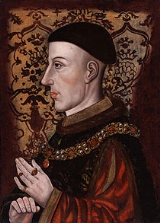
Henry V of England

 
Henry V of England

   Email Print
   Bookmark   Link


Henry V of England


Henry V (9 August 1387 – 31 August 1422) was one of the most significant English warrior kings of the 15th century. He was born at Monmouth
Monmouth

Monmouth is a town in southeast Wales and traditional county town of the Historic counties of Wales of Monmouthshire . It is situated where the River Monnow meets the River Wye with bridges over both ....
, Wales
Wales

native_name = Cymru|conventional_long_name = Wales|common_name = Wales|image_flag = Flag of Wales 2.svg|national_motto = ...
, in the tower above the gatehouse of Monmouth Castle
Monmouth Castle

Monmouth Castle is a castle site in the town of Monmouth, county town of Monmouthshire , south east Wales....
, and reigned as King of England from 1413 to 1422.

Henry was the son of Henry of Bolingbroke, later Henry IV
Henry IV of England

Henry IV was King of England and Lord of Ireland . Like other kings of England, he also claimed the title of King of France. He was born at Bolingbroke Castle in Lincolnshire, hence the other name by which he was known, Henry Bolingbroke....
, and sixteen-year-old Mary de Bohun
Mary de Bohun

Mary de Bohun , was the first wife of King Henry IV of England and the mother of King Henry V of England, but was never queen, as she died before her husband came to the throne....
, who was to die in childbirth at 26, before Bolingbroke became king.

At the time of his birth during the reign of Richard II
Richard II of England

Richard II was the eighth King of England of the House of Plantagenet. He ruled from 1377 until he was deposed in 1399. Richard was a son of Edward, the Black Prince and was born during the reign of his grandfather, Edward III of England....
, Henry was far removed from the throne, preceded by the king and another collateral line of heirs.


Discussion
Ask a question about 'Henry V of England'
Start a new discussion about 'Henry V of England'
Answer questions from other users
Full Discussion Forum


Timeline

1387   Born

1408   Henry, Prince of Wales (later Henry V of England) retakes Aberystwyth from Owain Glyndwr.

1413   Henry V becomes King of England.

1415   Henry V of England is informed of the Southampton Plot against him; he has the leaders arrested and executed before invading France

1415   Battle of Agincourt - Archers of Henry V of England are instrumental in defeating a massed army of French knights

1419   Hundred Years' War: Rouen surrenders to Henry V of England which brings Normandy under the control of England.

1420   Catherine of Valois marries Henry V of England.

1420   Henry V of England commences construction of Grace Dieu (ship)

1420   Treaty of Troyes. With the Burgundian faction dominant in France, King Charles VI of France acknowledges Henry V of England as his heir and as virtual ruler of most of Fran

1421   Battle of Baugé. A small French force surprises and defeats a smaller English force under Thomas, Duke of Clarence, a brother of Henry V of England, in Normandy.


Encyclopedia


Henry V (9 August 1387 – 31 August 1422) was one of the most significant English warrior kings of the 15th century. He was born at Monmouth
Monmouth

Monmouth is a town in southeast Wales and traditional county town of the Historic counties of Wales of Monmouthshire . It is situated where the River Monnow meets the River Wye with bridges over both ....
, Wales
Wales

native_name = Cymru|conventional_long_name = Wales|common_name = Wales|image_flag = Flag of Wales 2.svg|national_motto = ...
, in the tower above the gatehouse of Monmouth Castle
Monmouth Castle

Monmouth Castle is a castle site in the town of Monmouth, county town of Monmouthshire , south east Wales....
, and reigned as King of England from 1413 to 1422.

Henry was the son of Henry of Bolingbroke, later Henry IV
Henry IV of England

Henry IV was King of England and Lord of Ireland . Like other kings of England, he also claimed the title of King of France. He was born at Bolingbroke Castle in Lincolnshire, hence the other name by which he was known, Henry Bolingbroke....
, and sixteen-year-old Mary de Bohun
Mary de Bohun

Mary de Bohun , was the first wife of King Henry IV of England and the mother of King Henry V of England, but was never queen, as she died before her husband came to the throne....
, who was to die in childbirth at 26, before Bolingbroke became king.

At the time of his birth during the reign of Richard II
Richard II of England

Richard II was the eighth King of England of the House of Plantagenet. He ruled from 1377 until he was deposed in 1399. Richard was a son of Edward, the Black Prince and was born during the reign of his grandfather, Edward III of England....
, Henry was far removed from the throne, preceded by the king and another collateral line of heirs. The precise date and even year of his birth are therefore not definitely recorded; sources offer as the most likely either 9 August or 16 September, in 1386 or 1387. By the time Henry died, he had not only consolidated power as the King of England but had also effectively accomplished what generations of his ancestors had failed to achieve through decades of war
Hundred Years' War

The Hundred Years' War was a prolonged conflict lasting from 1337 to 1453 between two royal houses for the French throne, which was vacant with the extinction of the senior House of Capet line of French kings....
: unification of the crowns of England and France
France

France , officially the French Republic , is a country whose Metropolitan France is located in Western Europe and that also comprises various Overseas departments and territories of France....
 in a single person. In 2002, he was ranked 72nd in the 100 Greatest Britons
100 Greatest Britons

100 Greatest Britons was broadcast in 2002 by the BBC. The programme was the result of a vote conducted to determine whom the United Kingdom public considers the greatest British people have been in history....
 poll. He invented the passport
Passport

A passport is a document, issued by a national government, which certifies, for the purpose of international travel, the identity and nationality of its holder....
 as a means of helping his subjects prove who they were in foreign lands.

Early accomplishments

Upon the exile of Henry's father
Henry IV of England

Henry IV was King of England and Lord of Ireland . Like other kings of England, he also claimed the title of King of France. He was born at Bolingbroke Castle in Lincolnshire, hence the other name by which he was known, Henry Bolingbroke....
 in 1398, when Henry was twelve, Richard II
Richard II of England

Richard II was the eighth King of England of the House of Plantagenet. He ruled from 1377 until he was deposed in 1399. Richard was a son of Edward, the Black Prince and was born during the reign of his grandfather, Edward III of England....
 took the boy into his own charge and treated him kindly. The young Henry accompanied King Richard to Ireland, and while in the royal service there he visited the castle at Trim in Meath, the ancient meeting place of the Irish Parliament. In 1399, the Lancastrian
House of Lancaster

The House of Lancaster was a branch of the royal House of Plantagenet. It was one of the opposing factions involved in the Wars of the Roses, an intermittent civil war which affected England and Wales during the 15th century....
 usurpation brought Henry's father to the throne and Henry was recalled from Ireland into prominence as heir to the kingdom of England. He was created Prince of Wales
Prince of Wales

Prince of Wales is a title traditionally granted to the Heir Apparent to the reigning monarch of the United Kingdom . The current Prince of Wales is Charles, Prince of Wales, the eldest son of Elizabeth II of the United Kingdom....
 on the day of his father's coronation. He was created Duke of Lancaster
Duke of Lancaster

There were several Dukes of Lancaster in the 14th and early 15th Centuries. See also Duchy of Lancaster.There were three creations of the Dukedom of Lancaster....
 on 10 November 1399, the third person to hold the title that year. His other titles were Duke of Cornwall, Earl of Chester, and Duke of Aquitaine. A contemporary record notes that during that year Henry spent time at The Queen's College, Oxford
The Queen's College, Oxford

The Queen's College, founded 1341, is one of the Colleges of the University of Oxford of the University of Oxford in England. Queen's is centrally situated on the High Street, and is renowned for its eighteenth-century architecture....
, under the care of his uncle Henry Beaufort, the Chancellor of the university.

From October 1400, the administration was conducted in his name. Less than three years later, Henry was in actual command of part of the English forces — he led his own army into Wales against Owain Glyndwr
Owain Glyndwr

Owain Glyndwr , or Owain Glyn Dwr, anglicised by William Shakespeare into Owen Glendower and also sometimes styled Owain IV of Wales by modern historians, was a Wales ruler and the last native Welsh people to hold the title Prince of Wales....
 and returned to join forces with his father to fight Harry Hotspur at Shrewsbury
Battle of Shrewsbury

The Battle of Shrewsbury was a Medieval warfare fought on July 21, 1403, waged between an army led by the House of Lancaster King, Henry IV of England, and a rebel army led by Henry 'Hotspur' Percy from Northumberland....
 in 1403. It was there that the sixteen-year-old prince was almost killed by an arrow which became lodged in his face. An ordinary soldier would have been left to die from such a wound, but Henry had the benefit of the best possible care, and, over a period of several days after the incident, the royal physician crafted a special tool to extract the tip of the arrow without doing further damage. The operation was successful, though it left the prince with permanent scars which would serve as a testimony to his experience in battle.

Energetic and dynamic, Henry is perhaps best remembered for his victory at Agincourt
Battle of Agincourt

The Battle of Agincourt was an English victory against a much larger French army in the Hundred Years' War. The battle occurred on Friday 25 October 1415 ...
, a chapter in his life immortalised in Shakespeare's play. His marriage to Catherine of Valois
Catherine of Valois

Catherine of Valois was the Queen consort of England from 1420 until 1422. She was the daughter of King Charles VI of France, wife of King Henry V of England, mother of King Henry VI of England, and through her secret marriage with Owen Tudor, the grandmother of King Henry VII of England....
, daughter of the King of France, was designed to bring peace to two nations that had been at war for more than 80 years; the couple's firstborn son was named as heir to the throne of France. However, Henry V died while his son, Henry VI
Henry VI of England

Henry VI was Kingdom of England 1422?1461 and then 1470?1471, and King of France as the de jure monarch from 1422 to 1429....
, was an infant, and the power struggle over control of the French throne led to renewed hostilities in the Hundred Years' War
Hundred Years' War

The Hundred Years' War was a prolonged conflict lasting from 1337 to 1453 between two royal houses for the French throne, which was vacant with the extinction of the senior House of Capet line of French kings....
.

Role in government and conflict with Henry IV

The Welsh revolt of Owain Glyndwr absorbed Henry's energies until 1408. Then, as a result of the king's ill-health, Henry began to take a wider share in politics. From January 1410, helped by his uncles Henry
Henry Cardinal Beaufort

Henry Beaufort , was a Middle Ages English people clergyman and Bishop of Winchester, an anomaly in being both a bishop and a member of the royal house of Plantagenet....
 and Thomas Beaufort — legitimated sons of John of Gaunt — he had practical control of the government.

Both in foreign and domestic policy he differed from the king, who in November 1411 discharged the prince from the council. The quarrel of father and son was political only, though it is probable that the Beauforts had discussed the abdication of Henry IV, and their opponents certainly endeavoured to defame the prince. It may be to that political enmity that the tradition of Henry's riotous youth, immortalised by Shakespeare, is partly due. Henry's record of involvement in war and politics, even in his youth, disproves this tradition. The most famous incident, his quarrel with the chief justice, has no contemporary authority and was first related by Sir Thomas Elyot
Thomas Elyot

Sir Thomas Elyot , was an England diplomat and scholar.Thomas was the child of Sir Richard Elyot's first marriage with Alice De la Mare, but neither the date nor place of his birth is accurately known....
 in 1531.

The story of Falstaff
Falstaff

Sir John Falstaff is a fictional character who appears in three plays by William Shakespeare as a companion to Prince Hal, the future King Henry V of England....
 originated partly in Henry's early friendship with Sir John Oldcastle
John Oldcastle

Sir John Oldcastle , England Lollard leader, was son of Sir Richard Oldcastle of Almeley in northwest Herefordshire and grandson of another Sir John Oldcastle....
. That friendship, and the prince's political opposition to Thomas Arundel
Thomas Arundel

Thomas Arundel was Archbishop of Canterbury in 1397 and from 1399 until his death, an outspoken opponent of the Lollards....
, Archbishop of Canterbury
Archbishop of Canterbury

The Archbishop of Canterbury is the chief bishop and principal leader of the Church of England, the symbolic head of the worldwide Anglican Communion and the Diocesan Bishop of the Diocese of Canterbury, the Episcopal see that churches must be in communion with in order to be a part of the Anglican Communion....
, perhaps encouraged Lollard hopes
Lollardy

Lollardy was the political and religious movement of the Lollards from the mid-14th century to the English Reformation. The term Lollards refers to the followers of John Wycliffe, a prominent theology at the University of Oxford beginning in the 1350s....
. If so, their disappointment may account for the statements of ecclesiastical writers, like Thomas Walsingham
Thomas Walsingham

Thomas Walsingham was an England chronicler....
, that Henry on becoming king was changed suddenly into a new man.

Accession to the throne

After Henry IV died on 20 March 1413, Henry V succeeded him the next day and was crowned on 9 April 1413.

Domestic policy

Henry tackled all of the domestic policies together, and gradually built on them a wider policy. From the first, he made it clear that he would rule England as the head of a united nation, and that past differences were to be forgotten. The late Richard II was honourably reinterred; the young Mortimer was taken into favour; the heirs of those who had suffered in the last reign were restored gradually to their titles and estates. Henry used his personal influence in vain, and the gravest domestic danger was Lollard discontent. But the king's firmness nipped the movement in the bud (January 1414), and made his own position as ruler secure.

With the exception of the Southampton Plot
Southampton Plot

The Southampton Plot of 1415 was a conspiracy against Henry V of England, aimed at replacing him with Edmund Mortimer, 5th Earl of March. The three ringleaders were Richard of Conisburgh, 3rd Earl of Cambridge, Mortimer's brother-in-law, Henry Scrope, 3rd Baron Scrope of Masham , and Sir Thomas Grey ....
 in favour of Mortimer, involving Henry Scrope, 3rd Baron Scrope of Masham
Henry Scrope, 3rd Baron Scrope of Masham

Henry Scrope, 3rd Baron Scrope of Masham Knight of the Garter was a favourite of King Henry V of England.He was created a Knight of the Garter in 1410....
 and Richard, Earl of Cambridge (grandfather of the future King Edward IV
Edward IV of England

Edward IV was Kingdom of England from 4 March 1461 until 2 October 1470, and again from 11 April 1471 until his death....
) in July 1415, the rest of his reign was free from serious trouble at home. Starting in 1417, Henry V promoted the use of the English language
English language

English is a West Germanic language that originated in Anglo-Saxon England and has lingua franca status in many parts of the world as a result of the military, economic, scientific, political and cultural influence of the British Empire in the 18th, 19th and early 20th centuries and that of the United States from the mid 20th century onwa...
 in government, and his reign marks the appearance of Chancery Standard
Middle English

Middle English is the name given by historical linguistics to the diverse forms of the English language spoken between the Norman conquest of England of 1066 and about 1470, when the #Chancery Standard, a form of London-based English, began to become widespread, a process aided by the introduction of the printing press into England by William...
 English as well as the adoption of English as the language of record within Government. He was the first king to use English in his personal correspondence since the Norman conquest 350 years before.

Foreign affairs

Henry could now turn his attention to foreign affairs. A writer of the next generation was the first to allege that Henry was encouraged by ecclesiastical statesmen to enter into the French
France

France , officially the French Republic , is a country whose Metropolitan France is located in Western Europe and that also comprises various Overseas departments and territories of France....
 war as a means of diverting attention from home troubles. This story seems to have no foundation. Old commercial disputes and the support which the French had lent to Owain Glyndwr were used as an excuse for war, whilst the disordered state of France afforded no security for peace. The French king, Charles VI
Charles VI of France

Charles VI , called the Well-loved and the Mad , was the List of French monarchs from 1380 to 1399, as a member of the House of Valois....
, was prone to mental illness, and his eldest son was an unpromising prospect.

Following Agincourt, Hungarian King (later Holy Roman Emperor 1433-1437) Sigismund
Sigismund, Holy Roman Emperor

Sigismund was Holy Roman Emperor for four years from 1433 until 1437, and the last Emperor of the House of Luxemburg. He was also one of the longest ruling King of Hungary, reigning for fifty years from 1387 to 1437....
 made a visit to Henry in hopes of making peace between England and France. His goal was to persuade Henry to modify his demands against the French. Henry lavishly entertained the emperor and even had him enrolled in the Order of the Garter
Order of the Garter

The Most Noble Order of the Garter is an order of chivalry, or knighthood, originating in medieval England, and presently bestowed on recipients in the United Kingdom and other Commonwealth realms; it is the pinnacle of the Orders, decorations, and medals of the United Kingdom....
. Sigismund in turn inducted Henry into the Order of the Dragon
Order of the Dragon

The Order of the Dragon was a Chivalric order#Monarchical_or_dynastical_orders for selected nobility, created in Hungary in the late Middle Ages....
. Henry had intended to crusade for the order after uniting the English
Kingdom of England

The Kingdom of England was, from 927 to 1707, a state in North-West Europe. The Kingdom of England spanned the southern two-thirds of the island of Great Britain and a number of smaller outlying islands?what is today the legal unit of England and Wales....
 and French
France

France , officially the French Republic , is a country whose Metropolitan France is located in Western Europe and that also comprises various Overseas departments and territories of France....
 thrones, but he died before fulfilling his plans. Sigismund left England several months later, having signed the Treaty of Canterbury, acknowledging English claims to France.

Campaigns in France
Henry V of England   Illustration From Cassell's History of England   Century Edition   Published Circa 1902
Henry may have regarded the assertion of his own claims as part of his royal duty, but in any case, a permanent settlement of the national debate was essential to the success of his foreign policy.

1415 campaign

On 11 August 1415 Henry sailed for France, where his forces besieged the fortress at Harfleur
Harfleur

Harfleur is a communes of the Seine-Maritime d?partement in the Seine-Maritime departments of France of the Haute-Normandie region of northern France....
, capturing it on 22 September. Afterwards, Henry was obliged to march with his army across the French countryside towards Calais
Calais

Calais is a town in northern France in the Departments of France of Pas-de-Calais, of which it is a sub-prefecture. Although Calais is by far the largest city in Pas-de-Calais, the department's capital is its third-largest city of Arras....
. On the 25 October 1415, on the plains near the village of Agincourt
Battle of Agincourt

The Battle of Agincourt was an English victory against a much larger French army in the Hundred Years' War. The battle occurred on Friday 25 October 1415 ...
, he turned to give battle to a pursuing French army. Despite his men-at-arms being exhausted and outnumbered, Henry led his men into battle, decisively defeating the French who died in their thousands. Most of those taken prisoner were slaughtered by the orders of Henry, who spared only the most illustrious. This victorious conclusion, from the English viewpoint, was only the first step in the campaign.

Diplomacy and command of the sea

Command of the sea was secured by driving the Genoese
Genoa

Genoa is a city and an important seaport in northern Italy, the capital of the Province of Genoa and of the region of Liguria. The city has a population of about 610,000 and the urban area has a population of about 900,000....
 allies of the French out of the English Channel
English Channel

The English Channel is an Arm of the Atlantic Ocean that separates England from northern France, and joins the North Sea to the Atlantic. It is about long and varies in width from at its widest, to only in the Strait of Dover....
. While Henry was occupied with peace negotiations in 1416, a French and Genoese fleet surrounded the harbour at the English-garrisoned Harfleur. A French land force also besieged the town. To relieve Harfleur, Henry sent his brother, the Duke of Bedford, who raised a fleet and set sail from Beachy Head on 14 August. The Franco-Genoese fleet was defeated the following day after a gruelling seven hour battle, and Harfleur was relieved. Diplomacy successfully detached Emperor Sigismund
Sigismund, Holy Roman Emperor

Sigismund was Holy Roman Emperor for four years from 1433 until 1437, and the last Emperor of the House of Luxemburg. He was also one of the longest ruling King of Hungary, reigning for fifty years from 1387 to 1437....
 from France, and the Treaty of Canterbury (1416)
Treaty of Canterbury (1416)

Sigismund, Holy Roman Emperor began to shift his alliance from France to England after the French defeat at the Battle of Agincourt. The Treaty of Canterbury culminated diplomatic efforts between Henry V of England and Sigismund and resulted in a defensive and offensive alliance against France....
 paved the way to end the schism
Western Schism

The Great Schism of Western Christianity or Papal Schism was a split within the Roman Catholic Church from 1378 to 1417. By its end, three men simultaneously claimed to be the true pope....
 in the Church.

1417 campaign

So, with those two potential enemies gone, and after two years of patient preparation following Agincourt
Battle of Agincourt

The Battle of Agincourt was an English victory against a much larger French army in the Hundred Years' War. The battle occurred on Friday 25 October 1415 ...
, in 1417, Henry renewed the war on a larger scale in 1417. Lower Normandy
Normandy

Normandy is a geographical region corresponding to the former Duchy of Normandy. It is situated along the coast of France south of the English Channel between Brittany and Picardy and comprises territory in northern France and the Channel Islands....
 was quickly conquered, and Rouen
Rouen

Rouen is the historical capital city of Normandy, in northwestern France on the River Seine, and currently the capital of the Haute-Normandie r?gion in France....
 cut off from Paris
Paris

Paris is the Capital of France and the country's largest city. It is situated on the river Seine, in northern France, at the heart of the ?le-de-France Regions of France ....
 and besieged. The French were paralysed by the disputes between Burgundians
Duchy of Burgundy

The Duchy of Burgundy was a feudal territory once existing within the France in the Middle Ages. It roughly conforms to the modern Bourgogne. Existing between 843 and 1477, the Duchy was ruled by a succession of Duke of Burgundy, whose extinction with the death of Charles the Bold in 1477 led to the Duchy being absorbed into the French crown...
 and Armagnacs
Armagnac (party)

The Armagnac party was prominent in French politics and warfare during the Hundred Years' War. They were allied with the supporters of Charles, Duke of Orl?ans against John the Fearless after Charles' father Louis, Duke of Orl?ans was killed at the orders of the Duke of Burgundy in 1407....
. Henry skilfully played them off one against the other, without relaxing his warlike approach. In January 1419, Rouen fell. Those Norman French who had resisted were severely punished: Alan Blanchard, who had hung English prisoners from the walls, was summarily executed; Robert de Livet, Canon of Rouen, who had excommunicated the English king, was packed off to England and imprisoned for five years. ]] By August, the English were outside the walls of Paris
Paris

Paris is the Capital of France and the country's largest city. It is situated on the river Seine, in northern France, at the heart of the ?le-de-France Regions of France ....
. The intrigues of the French parties culminated in the assassination of John the Fearless by the Dauphin's partisans at Montereau
Montereau-Fault-Yonne

Montereau-Fault-Yonne, or simply Montereau, is a commune in France in France, chief town of a canton in France, in the southeastern part of the Seine-et-Marne d?partement in France....
 (10 September 1419). Philip the Good, the new duke, and the French court threw themselves into Henry's arms. After six months of negotiation, the Treaty of Troyes
Treaty of Troyes

The Treaty of Troyes was an agreement that Henry V of England would inherit the throne of France upon the death of King Charles VI of France. It was signed in Troyes, France in 1420....
 recognised Henry as the heir and regent of France (see English Kings of France), and on 2 June 1420, he married Catherine of Valois
Catherine of Valois

Catherine of Valois was the Queen consort of England from 1420 until 1422. She was the daughter of King Charles VI of France, wife of King Henry V of England, mother of King Henry VI of England, and through her secret marriage with Owen Tudor, the grandmother of King Henry VII of England....
, the French king's daughter. From June to July, Henry's army besieged and took the castle at Montereau. He besieged and captured Melun
Melun

Melun is a commune in France in the southeastern suburbs of Paris, France. It is located from the Kilometre Zero. Melun is the pr?fecture of the Seine-et-Marne d?partement in France, as well as the seat of the Arrondissement of Melun....
 in November, returning to England shortly thereafter.

1421 campaign

On 10 June 1421, Henry sailed back to France for what would be his last military campaign. From July to August, Henry's forces besieged and captured Dreux, thus relieving allied forces at Chartres. That October, his forces lay siege to Meaux
Meaux

Meaux is a commune in France of Seine-et-Marne, in the aire urbaine of Paris, France. This ?le-de-France town is located . east-northeast from the Kilometre Zero ....
, capturing it on 2 May 1422. Henry V died suddenly on 31 August 1422 at Bois de Vincennes
Bois de Vincennes

The Bois de Vincennes is a park in the English garden to the east of Paris. The park is named after the nearby town of Vincennes.The Bois de Vincennes, like the Bois de Boulogne, is often not thought to be part of Paris proper, as it consists only of unpopulated public land....
 near Paris
Paris

Paris is the Capital of France and the country's largest city. It is situated on the river Seine, in northern France, at the heart of the ?le-de-France Regions of France ....
, apparently from dysentery
Dysentery

Dysentery is a disorder of the digestive system that results in severe diarrhea containing mucus and/or blood in the feces. If untreated, Dysentery can be fatal....
 which he had contracted during the siege of Meaux. He was 35 years old. Before his death, Henry V named his brother John of Lancaster, 1st Duke of Bedford regent of France in the name of his son Henry VI, then only a few months old. Henry V did not live to be crowned King of France himself, as he might confidently have expected after the Treaty of Troyes, as ironically the sickly Charles VI, to whom he had been named heir, survived him by two months. Catherine took Henry's body to London and he was buried in Westminster Abbey on 7 November 1422.

Following his death, Catherine had a long relationship with a Welsh courtier, Owen Tudor
Owen Tudor

Owain ap Meredydd, or Meredudd was a Welsh soldier and courtier, descended from the Welsh prince Rhys ap Gruffudd, "The Lord Rhys"....
, whom she may secretly have married. They were the grandparents of King Henry VII
Henry VII of England

Henry VII was the Kingdom of England and Lordship of Ireland from his usurpation of the crown on 22 August 1485 until his death on 21 April 1509, as the first monarch of the Tudor dynasty....
.

Titles, styles, honours and arms


Arms

As Prince of Wales, Henry's arms were those of the kingdom, differenced by a label argent of three points. Upon his accession, he inherited use of the arms of the kingdom undifferenced.

Ancestry


See also

  • Dieu et mon droit
    Dieu et mon droit

    Dieu et mon droit is the motto of the Monarchy of the United Kingdom. It appears on a scroll beneath the shield of the Royal coat of arms of the United Kingdom....
  • English Longbow
    English longbow

    Self bow longbows, widespread across Europe since Mesolithic times, were used in Middle Ages Europe as a decisive weapon of war. Particularly powerful bows were employed to penetrate all but the best of contemporary armour....
  • Davy Gam
  • Cultural depictions of Henry V of England
    Cultural depictions of Henry V of England

    Henry V of England has been depicted in popular culture a number of times....


External links

  • J. Endell Tyler. Henry of Monmouth:Memoirs of Henry the Fifth , at Project Gutenberg
    Project Gutenberg

    Project Gutenberg, abbreviated as PG, is a volunteer effort to digitize, archive and distribute cultural works, as founder Michael Hart said "To encourage the creation and distribution of eBooks."....
    *


|- |- |-