


Leo VI the Wise

Encyclopedia
Leo VI, surnamed the Wise or the Philosopher , was Byzantine emperor from 886 to 912. The second ruler of the Macedonian dynasty
(although his parentage is unclear), he was very well-read, leading to his surname. During his reign, the renaissance of letters begun by his predecessor Basil I
continued, but the Empire also saw several military defeats in the Balkans against Bulgaria
and against the Arabs in Sicily
and the Aegean
.
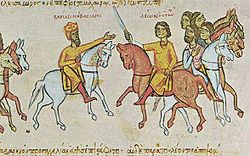 Born to the empress Eudokia Ingerina
, Leo was either the illegitimate son of Emperor Michael III
or the second son of his successor, Basil I the Macedonian. Eudokia was both Michael III's mistress and Basil’s wife. In 867, Michael was assassinated by Basil, who succeeded him as emperor. As the second eldest son of the Emperor, Leo was associated on the throne in 870 and became the direct heir on the death of his older half-brother Constantine in 879. However, Leo and Basil did not like each other; a relationship that only deteriorated after Eudokia's death, when Leo, unhappy with his marriage to Theophano Martiniake, took up a mistress in the person of Zoe Zaoutzaina
. Basil married Zoe off to an insignificant official, and later almost had Leo blinded when he was accused of conspiring against him. On August 29, 886, Basil died in a hunting accident, though he claimed on his deathbed that there was an assassination
attempt in which Leo was possibly involved.
, which contributed to the suspicion that he was (or at least believed himself to be) in truth Michael's son. Seeking political reconciliation, the new emperor secured the support of the officials in the capital, and surrounded himself with bureaucrats like Stylianos Zaoutzes
(the father of his mistress, Zoe Zaoutzaina) and the eunuch Samonas
, an Arab defector whom Leo raised to the rank of patrikios and who stood in as godfather
to Leo’s son, Constantine VII
. His attempts to control the great aristocratic families (e.g., the Phokadai
and the Doukai) occasionally led to serious conflicts, the most significant being the revolt of Andronikos Doukas
in 906.
Leo also attempted to control the church through his appointments to the patriarchate. He dismissed the Patriarch
Photios, who had been his tutor, and replaced him with his own 19-year-old brother Stephen
in December 886. On Stephen's death in 893, Leo replaced him with Zaoutzes' nominee, Antony II Kauleas, who died in 901. Leo then promoted his own imperial secretary (mystikos
) Nicholas
, but suspicions that he was involved in the failed assassination attempt against Leo in 903 as well as his opposition to Leo’s fourth marriage saw Nicholas replaced with Leo’s spiritual father Euthymios in 907.
The magnificent Church of Ayios Lazaros
in Larnaca
was constructed during Leo VI rule in the late 9th century, and it was built after the relics of St. Lazaros were transported from Crete to Constantinople. The church is one of the best examples of Byzantine architecture
. Leo also completed work on the Basilika
, the Greek
translation and update of the law code
issued by Justinian I
, which had been started during the reign of Basil.
Bishop Liutprand of Cremona
gives an account similar to those about Caliph Harun al-Rashid
, to the effect that Leo would sometimes disguise himself and go about Constantinople look for injustice or corruption. According to one story, he was even captured by the city guards during one of his investigations. Late in the evening, he was walking alone and disguised. Though he bribed two patrols for 12 nomismata, and moved on, the third city patrol arrested him. When a terrified guardian recognized the jailed ruler in the morning, the arresting officer was rewarded for doing his duty, while the other patrols were dismissed and punished severely.
in 894, but was defeated. Bribing the Magyars to attack the Bulgarians
from the north, Leo scored an indirect success in 895. However, deprived of his new allies, he lost the major Battle of Boulgarophygon in 896 and had to make the required commercial concessions and to pay annual tribute.
Although he won a victory against the Emirate of Tarsus in 900 in which the Arab army was destroyed and the Emir himself captured, in the west the Emirate of Sicily
took Taormina
, the last Byzantine outpost on the island of Sicily
, in 902. Nevertheless, Leo continued to apply pressure on his eastern frontier, through the creation of the new thema of Mesopotamia
, a Byzantine invasion of Armenia in 902 and the sacking of Theodosiopolis, as well as successful raids in the Arab Thughur.
Then, in 904 the renegade Leo of Tripolis sacked
Thessalonica with his pirates – an event described in The Capture of Thessalonica by John Kaminiates
– while a large-scale expedition to recover Crete
under Himerios
in 911–912 failed disastrously. Nevertheless, the same period also saw the establishment of the important frontier provinces (kleisoura
i) of Lykandos
and Leontokome on territory recently taken from the Arabs. In 907 Constantinople
was attacked
by the Kievan Rus'
under Oleg of Novgorod
, who was seeking favourable trading rights with the empire. Leo paid them off, but they attacked again in 911, and a trade treaty
was finally signed.
, whom Basil had forced him to marry on account of her family connections to the Martinakioi, and whom Leo hated, died in 897, and Leo married Zoe Zaoutzaina
, the daughter of his adviser Stylianos Zaoutzes, though she died as well in 899. Upon this marriage Leo created the title of basileopatōr
("father of the emperor") for his father-in-law.
After Zoe's death a third marriage was technically illegal, but he married again, only to have his third wife Eudokia Baïana
die in 901. Instead of marrying a fourth time, which would have been an even greater sin than a third marriage (according to the Patriarch Nicholas Mystikos
) Leo took as mistress Zoe Karbonopsina
. He married her only after she had given birth to a son
in 905, but incurred the opposition of the patriarch. Replacing Nicholas Mystikos with Euthymios, Leo got his marriage recognized by the church (albeit with a long penance attached, and with an assurance that Leo would outlaw all future fourth marriages) but opened up a conflict (the so-called "Moechian Controversy" from the Greek moichos, "adulterer")) within it and allowed new grounds for papal intervention into Byzantine affairs when he sought and obtained papal consent.
 The future Constantine VII was the illegitimate son born before Leo's uncanonical fourth marriage to Zoe Karbonopsina. To strengthen his son's position as heir, Leo had him crowned as co-emperor on May 15, 908, when he was only two years old. Leo VI died on May 11, 912. He was succeeded by his younger brother Alexander, who had reigned as emperor alongside his father and brother since 879.
In the subject matter of legal works and treatises, he established a legal commission that carried out his father's original intent of codifying all of existing Byzantine law. The end result was a 6 volume work consisting of 60 books, entitled the Basilika
. Written in Greek, the Basilika translated and systematically arranged practically all of the laws preserved in the Corpus Juris Civilis
, thereby providing a foundation upon which all later Byzantine laws could be built upon. Leo then began integrating new laws issued during his reign into the Basilika. Called "Novels" or "New Laws", these were codes that dealt with current problems and issues, such as the prohibition on fourth marriages. Both the Basilika and the Novels were concerned with ecclesiastical law (canon law
) as well as secular law. Most importantly, from a historical perspective, they finally did away with much of the remaining legal and constitutional architecture that the Byzantine Empire had inherited from the Roman Empire, and even from the days of the Roman Republic
. Obsolete institutions such as the Curiae, the Roman Senate
, even the Consulate
, were finally removed from a legal perspective, even though these still continued in a lesser, decorative form.
The supposed Book of the Eparch and the Kletorologion of Philotheos were also issued under Leo's name and testify to his government’s interest in organization and the maintenance of public order. The Book of the Eparch described the rules and regulations for trade and trade organizations in Constantinople, while the Kletorologion was an attempt to standardize officials and ranks at the Byzantine court. Leo is also the author, or at least sponsor, of the Tactica
, a notable treatise on military operations.
Succeeding generations saw Leo as a prophet and a magician, and soon a collection of oracular poems and some short divinatory texts, the so-called Oracles of Leo the Wise, at least in part based on earlier Greek sources, were attached to the emperor's name in later centuries, and were believed to foretell the future of the world.
Finally, Leo is credited with translating
the relics of St. Lazarus
to Constantinople in the year 890. There are several stichera (hymns) attributed to him which are chanted on Lazarus Saturday
in the Eastern Orthodox Church
. He also composed hymns which are sung on the Great Feast of the Exaltation of the Cross.
, Leo VI had one daughter:
By his second wife, Zoe Zaoutzaina
, Leo had one daughter:
By his third wife, Eudokia Baïana
, Leo had one son:
By his fourth wife, Zoe Karbonopsina
, Leo had two children:
Macedonian dynasty
The Macedonian dynasty ruled the Byzantine Empire from 867 to 1056, following the Amorian dynasty. During this period, the Byzantine state reached its greatest expanse since the Muslim conquests, and the Macedonian Renaissance in letters and arts began. The dynasty was named after its founder,...
(although his parentage is unclear), he was very well-read, leading to his surname. During his reign, the renaissance of letters begun by his predecessor Basil I
Basil I
Basil I, called the Macedonian was a Byzantine emperor of probable Armenian descent who reigned from 867 to 886. Born a simple peasant in the Byzantine theme of Macedonia, he rose in the imperial court, and usurped the imperial throne from Emperor Michael III...
continued, but the Empire also saw several military defeats in the Balkans against Bulgaria
Second Bulgarian Empire
The Second Bulgarian Empire was a medieval Bulgarian state which existed between 1185 and 1396 . A successor of the First Bulgarian Empire, it reached the peak of its power under Kaloyan and Ivan Asen II before gradually being conquered by the Ottomans in the late 14th-early 15th century...
and against the Arabs in Sicily
Sicily
Sicily is a region of Italy, and is the largest island in the Mediterranean Sea. Along with the surrounding minor islands, it constitutes an autonomous region of Italy, the Regione Autonoma Siciliana Sicily has a rich and unique culture, especially with regard to the arts, music, literature,...
and the Aegean
Aegean Sea
The Aegean Sea[p] is an elongated embayment of the Mediterranean Sea located between the southern Balkan and Anatolian peninsulas, i.e., between the mainlands of Greece and Turkey. In the north, it is connected to the Marmara Sea and Black Sea by the Dardanelles and Bosporus...
.
Early life
Eudokia Ingerina
Eudokia Ingerina was the wife of the Byzantine emperor Basil I, the mistress of his predecessor Michael III, and the mother to both the Emperors Leo VI and Alexander and Patriarch Stephen I of Constantinople.-Family:...
, Leo was either the illegitimate son of Emperor Michael III
Michael III
Michael III , , Byzantine Emperor from 842 to 867. Michael III was the third and traditionally last member of the Amorian-Phrygian Dynasty...
or the second son of his successor, Basil I the Macedonian. Eudokia was both Michael III's mistress and Basil’s wife. In 867, Michael was assassinated by Basil, who succeeded him as emperor. As the second eldest son of the Emperor, Leo was associated on the throne in 870 and became the direct heir on the death of his older half-brother Constantine in 879. However, Leo and Basil did not like each other; a relationship that only deteriorated after Eudokia's death, when Leo, unhappy with his marriage to Theophano Martiniake, took up a mistress in the person of Zoe Zaoutzaina
Zoe Zaoutzaina
Zoe Zaoutzaina was the second wife of the Byzantine emperor Leo VI the Wise. She was the daughter of Stylianos Zaoutzes, a high-ranking bureaucrat during the reign of her husband.-Royal mistress:...
. Basil married Zoe off to an insignificant official, and later almost had Leo blinded when he was accused of conspiring against him. On August 29, 886, Basil died in a hunting accident, though he claimed on his deathbed that there was an assassination
Assassination
To carry out an assassination is "to murder by a sudden and/or secret attack, often for political reasons." Alternatively, assassination may be defined as "the act of deliberately killing someone, especially a public figure, usually for hire or for political reasons."An assassination may be...
attempt in which Leo was possibly involved.
Domestic policy
One of the first actions of Leo VI after his succession was the reburial of Michael III in ConstantinopleConstantinople
Constantinople was the capital of the Roman, Eastern Roman, Byzantine, Latin, and Ottoman Empires. Throughout most of the Middle Ages, Constantinople was Europe's largest and wealthiest city.-Names:...
, which contributed to the suspicion that he was (or at least believed himself to be) in truth Michael's son. Seeking political reconciliation, the new emperor secured the support of the officials in the capital, and surrounded himself with bureaucrats like Stylianos Zaoutzes
Stylianos Zaoutzes
Stylianos Zaoutzes was a high Byzantine official of Armenian origin. Rising to high rank under Byzantine emperor Basil I , he then rose further to prominence under Basil's successor Emperor Leo VI the Wise , who had a close friendship and possible an affair with Stylianos's daughter Zoe Zaoutzaina...
(the father of his mistress, Zoe Zaoutzaina) and the eunuch Samonas
Samonas
Samonas was an Arab-born eunuch, who was captured by the Byzantines and became one of the most influential officials of the Byzantine Empire during the first decade of the 10th century.- Life :...
, an Arab defector whom Leo raised to the rank of patrikios and who stood in as godfather
Godparent
A godparent, in many denominations of Christianity, is someone who sponsors a child's baptism. A male godparent is a godfather, and a female godparent is a godmother...
to Leo’s son, Constantine VII
Constantine VII
Constantine VII Porphyrogennetos or Porphyrogenitus, "the Purple-born" was the fourth Emperor of the Macedonian dynasty of the Byzantine Empire, reigning from 913 to 959...
. His attempts to control the great aristocratic families (e.g., the Phokadai
Phokas (Byzantine family)
Phokas or Phocas , feminine form Phokaina , was the name of a Byzantine aristocratic clan from Cappadocia, which in the 9th and 10th centuries provided a series of high-ranking generals and an emperor, Nikephoros II Phokas...
and the Doukai) occasionally led to serious conflicts, the most significant being the revolt of Andronikos Doukas
Andronikos Doukas (general under Leo VI)
Andronikos Doukas or Doux was a Byzantine general and rebel in the reign of Emperor Leo VI the Wise . The first member of the illustrious Doukas line to achieve prominence as a successful general, his rivalry with the powerful eunuch Samonas led to his revolt and eventual defection to the Arabs in...
in 906.
Leo also attempted to control the church through his appointments to the patriarchate. He dismissed the Patriarch
Patriarch of Constantinople
The Ecumenical Patriarch is the Archbishop of Constantinople – New Rome – ranking as primus inter pares in the Eastern Orthodox communion, which is seen by followers as the One, Holy, Catholic, and Apostolic Church....
Photios, who had been his tutor, and replaced him with his own 19-year-old brother Stephen
Patriarch Stephen I of Constantinople
Stephen I was the Ecumenical Patriarch of Constantinople from 886 to 893.Stephen was the son of Eudokia Ingerina and, officially, Emperor Basil I. However, at the time when he was conceived, Eudokia was the mistress of Emperor Michael III...
in December 886. On Stephen's death in 893, Leo replaced him with Zaoutzes' nominee, Antony II Kauleas, who died in 901. Leo then promoted his own imperial secretary (mystikos
Mystikos
The mystikos was an important Byzantine office of the imperial chancery from the 9th through to the 15th centuries. Its initial role is unclear; he was probably the emperor's private secretary. In time, the office also exercised judicial duties...
) Nicholas
Nicholas Mystikos
Nicholas I Mystikos or Nicholas I Mysticus was the Ecumenical Patriarch of Constantinople from March 901 to February 906 and from May 912 to his death in 925. His feast day in the Orthodox Church is May 16.Nicholas was born in the Italian Peninsula and had become a friend of the Patriarch Photios...
, but suspicions that he was involved in the failed assassination attempt against Leo in 903 as well as his opposition to Leo’s fourth marriage saw Nicholas replaced with Leo’s spiritual father Euthymios in 907.
The magnificent Church of Ayios Lazaros
Church of Ayios Lazaros, Larnaca
The Church of Saint Lazarus , is a late-9th century church in Larnaca, Cyprus. It belongs to the Church of Cyprus, an autocephalous Greek Orthodox Church....
in Larnaca
Larnaca
Larnaca, is the third largest city on the southern coast of Cyprus after Nicosia and Limassol. It has a population of 72,000 and is the island's second largest commercial port and an important tourist resort...
was constructed during Leo VI rule in the late 9th century, and it was built after the relics of St. Lazaros were transported from Crete to Constantinople. The church is one of the best examples of Byzantine architecture
Byzantine architecture
Byzantine architecture is the architecture of the Byzantine Empire. The empire gradually emerged as a distinct artistic and cultural entity from what is today referred to as the Roman Empire after AD 330, when the Roman Emperor Constantine moved the capital of the Roman Empire east from Rome to...
. Leo also completed work on the Basilika
Basilika
The term Basilika or 'Basilica' refers to a code of laws issued by the Eastern Roman emperor Leo VI the Wise . Written entirely in Greek, the 'Basilica', in 60 books, adapt the 6th-century Justinian code to the conditions of the 9th- and 10th-century Empire, and include laws issued by Leo VI and...
, the Greek
Greek language
Greek is an independent branch of the Indo-European family of languages. Native to the southern Balkans, it has the longest documented history of any Indo-European language, spanning 34 centuries of written records. Its writing system has been the Greek alphabet for the majority of its history;...
translation and update of the law code
Corpus Juris Civilis
The Corpus Juris Civilis is the modern name for a collection of fundamental works in jurisprudence, issued from 529 to 534 by order of Justinian I, Eastern Roman Emperor...
issued by Justinian I
Justinian I
Justinian I ; , ; 483– 13 or 14 November 565), commonly known as Justinian the Great, was Byzantine Emperor from 527 to 565. During his reign, Justinian sought to revive the Empire's greatness and reconquer the lost western half of the classical Roman Empire.One of the most important figures of...
, which had been started during the reign of Basil.
Bishop Liutprand of Cremona
Liutprand of Cremona
Liutprand, also Liudprand, Liuprand, Lioutio, Liucius, Liuzo, and Lioutsios was a Lombard historian and author, and Bishop of Cremona....
gives an account similar to those about Caliph Harun al-Rashid
Harun al-Rashid
Hārūn al-Rashīd was the fifth Arab Abbasid Caliph in Iraq. He was born in Rey, Iran, close to modern Tehran. His birth date remains a point of discussion, though, as various sources give the dates from 763 to 766)....
, to the effect that Leo would sometimes disguise himself and go about Constantinople look for injustice or corruption. According to one story, he was even captured by the city guards during one of his investigations. Late in the evening, he was walking alone and disguised. Though he bribed two patrols for 12 nomismata, and moved on, the third city patrol arrested him. When a terrified guardian recognized the jailed ruler in the morning, the arresting officer was rewarded for doing his duty, while the other patrols were dismissed and punished severely.
Foreign policy
Leo VI's fortune in war was more mixed than Basil's had been. In indulging his chief counselor Stylianos Zaoutzes, Leo provoked a war with Simeon I of BulgariaSimeon I of Bulgaria
Simeon I the Great ruled over Bulgaria from 893 to 927, during the First Bulgarian Empire. Simeon's successful campaigns against the Byzantines, Magyars and Serbs led Bulgaria to its greatest territorial expansion ever, making it the most powerful state in contemporary Eastern Europe...
in 894, but was defeated. Bribing the Magyars to attack the Bulgarians
First Bulgarian Empire
The First Bulgarian Empire was a medieval Bulgarian state founded in the north-eastern Balkans in c. 680 by the Bulgars, uniting with seven South Slavic tribes...
from the north, Leo scored an indirect success in 895. However, deprived of his new allies, he lost the major Battle of Boulgarophygon in 896 and had to make the required commercial concessions and to pay annual tribute.
Although he won a victory against the Emirate of Tarsus in 900 in which the Arab army was destroyed and the Emir himself captured, in the west the Emirate of Sicily
Emirate of Sicily
The Emirate of Sicily was an Islamic state on the island of Sicily , which existed from 965 to 1072.-First Arab invasions of Sicily:...
took Taormina
Taormina
Taormina is a comune and small town on the east coast of the island of Sicily, Italy, in the Province of Messina, about midway between Messina and Catania. Taormina has been a very popular tourist destination since the 19th century...
, the last Byzantine outpost on the island of Sicily
Sicily
Sicily is a region of Italy, and is the largest island in the Mediterranean Sea. Along with the surrounding minor islands, it constitutes an autonomous region of Italy, the Regione Autonoma Siciliana Sicily has a rich and unique culture, especially with regard to the arts, music, literature,...
, in 902. Nevertheless, Leo continued to apply pressure on his eastern frontier, through the creation of the new thema of Mesopotamia
Mesopotamia (theme)
Mesopotamia was the name of a Byzantine theme located in what is today eastern Turkey. It should not be confused with the region of Mesopotamia or with the older Roman and early Byzantine province of Mesopotamia...
, a Byzantine invasion of Armenia in 902 and the sacking of Theodosiopolis, as well as successful raids in the Arab Thughur.
Then, in 904 the renegade Leo of Tripolis sacked
Sack of Thessalonica (904)
The Sack of Thessalonica in 904 by Saracen pirates was one of the worst disasters to befall the Byzantine Empire in the 10th century. A Muslim fleet, led by the renegade Leo of Tripoli, and with the imperial capital of Constantinople as its initial target, sailed from Syria...
Thessalonica with his pirates – an event described in The Capture of Thessalonica by John Kaminiates
John Kaminiates
John Kaminiates was a Greek resident of Thessalonica when the city, then one of the largest in the Byzantine Empire, was besieged and sacked by a Saracen force led by Leo of Tripoli in 904...
– while a large-scale expedition to recover Crete
Emirate of Crete
The Emirate of Crete was a Muslim state that existed on the Mediterranean island of Crete from the late 820s to the Byzantine reconquest of the island in 961....
under Himerios
Himerios (admiral)
Himerios , also Himerius, was a Byzantine administrator and admiral of the early 10th century, best known as the commander of the Byzantine navy during its struggles with the resurgent Muslim navies in the period 900–912.-Life:...
in 911–912 failed disastrously. Nevertheless, the same period also saw the establishment of the important frontier provinces (kleisoura
Kleisoura (Byzantine district)
In the Byzantine Empire, a kleisoura was a term traditionally applied to a fortified mountain pass and the military district protecting it. By the late 7th century, it came to be applied to more extensive frontier districts, distinct from the larger themata, chiefly along the Empire's eastern...
i) of Lykandos
Lykandos
Lykandos or Lycandus was the name of a Byzantine fortress and military-civilian province , known as the Theme of Lykandos, in the 10th–11th centuries.-History:...
and Leontokome on territory recently taken from the Arabs. In 907 Constantinople
Constantinople
Constantinople was the capital of the Roman, Eastern Roman, Byzantine, Latin, and Ottoman Empires. Throughout most of the Middle Ages, Constantinople was Europe's largest and wealthiest city.-Names:...
was attacked
Rus'-Byzantine War (907)
The Rus'–Byzantine War of 907 is associated in the Primary Chronicle with the name of Oleg of Novgorod. The chronicle implies that it was the most successful military operation of the Kievan Rus' against the Byzantine Empire. Paradoxically, Greek sources do not mention it at all.- Primary Chronicle...
by the Kievan Rus'
Kievan Rus'
Kievan Rus was a medieval polity in Eastern Europe, from the late 9th to the mid 13th century, when it disintegrated under the pressure of the Mongol invasion of 1237–1240....
under Oleg of Novgorod
Oleg of Novgorod
Oleg of Novgorod was a Varangian prince who ruled all or part of the Rus' people during the early 10th century....
, who was seeking favourable trading rights with the empire. Leo paid them off, but they attacked again in 911, and a trade treaty
Rus'-Byzantine Treaty (911)
The Rus'–Byzantine Treaty of 911 is the most comprehensive and detailed treaty concluded between the Byzantine Empire and Kievan Rus in the 10th century...
was finally signed.
The Moechian Controversy
Leo VI caused a major scandal with his numerous marriages which failed to produce a legitimate heir to the throne. His first wife TheophanoTheophano, wife of Leo VI
- Family :She was a daughter of Constantine Martiniakos. Her further ancestry is uncertain. However, Theophanes Continuatus, a continuation of the chronicle of Theophanes the Confessor by writers active during the reign of Constantine VII, records the story of a possible ancestor during the reign...
, whom Basil had forced him to marry on account of her family connections to the Martinakioi, and whom Leo hated, died in 897, and Leo married Zoe Zaoutzaina
Zoe Zaoutzaina
Zoe Zaoutzaina was the second wife of the Byzantine emperor Leo VI the Wise. She was the daughter of Stylianos Zaoutzes, a high-ranking bureaucrat during the reign of her husband.-Royal mistress:...
, the daughter of his adviser Stylianos Zaoutzes, though she died as well in 899. Upon this marriage Leo created the title of basileopatōr
Basileopator
Basileopatōr was one of the highest secular titles of the Byzantine Empire. It was an exceptional post , and conferred only twice in the Empire's history...
("father of the emperor") for his father-in-law.
After Zoe's death a third marriage was technically illegal, but he married again, only to have his third wife Eudokia Baïana
Eudokia Baïana
Eudokia Baïana was the third wife of Leo VI the Wise.The work Theophanes Continuatus was a continuation of the chronicle of Theophanes the Confessor by other writers, active during the reign of Constantine VII. The work records the few details known about her.According to Theophanes, Eudokia came...
die in 901. Instead of marrying a fourth time, which would have been an even greater sin than a third marriage (according to the Patriarch Nicholas Mystikos
Nicholas Mystikos
Nicholas I Mystikos or Nicholas I Mysticus was the Ecumenical Patriarch of Constantinople from March 901 to February 906 and from May 912 to his death in 925. His feast day in the Orthodox Church is May 16.Nicholas was born in the Italian Peninsula and had become a friend of the Patriarch Photios...
) Leo took as mistress Zoe Karbonopsina
Zoe Karbonopsina
Zoe Karbonopsina, also Karvounopsina or Carbonopsina, i.e., "with the Coal-Black Eyes" , was fourth wife of the Byzantine Emperor Leo VI the Wise and the mother of Constantine VII....
. He married her only after she had given birth to a son
Constantine VII
Constantine VII Porphyrogennetos or Porphyrogenitus, "the Purple-born" was the fourth Emperor of the Macedonian dynasty of the Byzantine Empire, reigning from 913 to 959...
in 905, but incurred the opposition of the patriarch. Replacing Nicholas Mystikos with Euthymios, Leo got his marriage recognized by the church (albeit with a long penance attached, and with an assurance that Leo would outlaw all future fourth marriages) but opened up a conflict (the so-called "Moechian Controversy" from the Greek moichos, "adulterer")) within it and allowed new grounds for papal intervention into Byzantine affairs when he sought and obtained papal consent.
Succession
Works
Leo VI was a prolific writer, and he produced works on many different topics and in many styles, including political orations, liturgical poems, and theological treatises. On many occasions he would personally deliver highly wrought and convoluted sermons in the churches of Constantinople.In the subject matter of legal works and treatises, he established a legal commission that carried out his father's original intent of codifying all of existing Byzantine law. The end result was a 6 volume work consisting of 60 books, entitled the Basilika
Basilika
The term Basilika or 'Basilica' refers to a code of laws issued by the Eastern Roman emperor Leo VI the Wise . Written entirely in Greek, the 'Basilica', in 60 books, adapt the 6th-century Justinian code to the conditions of the 9th- and 10th-century Empire, and include laws issued by Leo VI and...
. Written in Greek, the Basilika translated and systematically arranged practically all of the laws preserved in the Corpus Juris Civilis
Corpus Juris Civilis
The Corpus Juris Civilis is the modern name for a collection of fundamental works in jurisprudence, issued from 529 to 534 by order of Justinian I, Eastern Roman Emperor...
, thereby providing a foundation upon which all later Byzantine laws could be built upon. Leo then began integrating new laws issued during his reign into the Basilika. Called "Novels" or "New Laws", these were codes that dealt with current problems and issues, such as the prohibition on fourth marriages. Both the Basilika and the Novels were concerned with ecclesiastical law (canon law
Canon law
Canon law is the body of laws & regulations made or adopted by ecclesiastical authority, for the government of the Christian organization and its members. It is the internal ecclesiastical law governing the Catholic Church , the Eastern and Oriental Orthodox churches, and the Anglican Communion of...
) as well as secular law. Most importantly, from a historical perspective, they finally did away with much of the remaining legal and constitutional architecture that the Byzantine Empire had inherited from the Roman Empire, and even from the days of the Roman Republic
Roman Republic
The Roman Republic was the period of the ancient Roman civilization where the government operated as a republic. It began with the overthrow of the Roman monarchy, traditionally dated around 508 BC, and its replacement by a government headed by two consuls, elected annually by the citizens and...
. Obsolete institutions such as the Curiae, the Roman Senate
Roman Senate
The Senate of the Roman Republic was a political institution in the ancient Roman Republic, however, it was not an elected body, but one whose members were appointed by the consuls, and later by the censors. After a magistrate served his term in office, it usually was followed with automatic...
, even the Consulate
Roman consul
A consul served in the highest elected political office of the Roman Republic.Each year, two consuls were elected together, to serve for a one-year term. Each consul was given veto power over his colleague and the officials would alternate each month...
, were finally removed from a legal perspective, even though these still continued in a lesser, decorative form.
The supposed Book of the Eparch and the Kletorologion of Philotheos were also issued under Leo's name and testify to his government’s interest in organization and the maintenance of public order. The Book of the Eparch described the rules and regulations for trade and trade organizations in Constantinople, while the Kletorologion was an attempt to standardize officials and ranks at the Byzantine court. Leo is also the author, or at least sponsor, of the Tactica
Tactica of Emperor Leo VI the Wise
The Tactica is a military treatise written by or on behalf of Byzantine Emperor Leo VI the Wise in ca. 895-908. Drawing on earlier authors such as Aelian, Onasander and the Strategikon of emperor Maurice, it is one of the major works on Byzantine military tactics, written on the eve of Byzantium's...
, a notable treatise on military operations.
Succeeding generations saw Leo as a prophet and a magician, and soon a collection of oracular poems and some short divinatory texts, the so-called Oracles of Leo the Wise, at least in part based on earlier Greek sources, were attached to the emperor's name in later centuries, and were believed to foretell the future of the world.
Finally, Leo is credited with translating
Translation (relics)
In Christianity, the translation of relics is the removal of holy objects from one locality to another ; usually only the movement of the remains of the saint's body would be treated so formally, with secondary relics such as items of clothing treated with less ceremony...
the relics of St. Lazarus
Lazarus of Bethany
Lazarus of Bethany, also known as Saint Lazarus or Lazarus of the Four Days, is the subject of a prominent miracle attributed to Jesus in the Gospel of John, in which Jesus restores him to life four days after his death...
to Constantinople in the year 890. There are several stichera (hymns) attributed to him which are chanted on Lazarus Saturday
Lazarus Saturday
Lazarus Saturday, in the Orthodox Church and those Eastern Catholic Churches which follow the Byzantine Rite, is the day before Palm Sunday, and is liturgically linked to it...
in the Eastern Orthodox Church
Eastern Orthodox Church
The Orthodox Church, officially called the Orthodox Catholic Church and commonly referred to as the Eastern Orthodox Church, is the second largest Christian denomination in the world, with an estimated 300 million adherents mainly in the countries of Belarus, Bulgaria, Cyprus, Georgia, Greece,...
. He also composed hymns which are sung on the Great Feast of the Exaltation of the Cross.
Family
By his first wife TheophanoTheophano, wife of Leo VI
- Family :She was a daughter of Constantine Martiniakos. Her further ancestry is uncertain. However, Theophanes Continuatus, a continuation of the chronicle of Theophanes the Confessor by writers active during the reign of Constantine VII, records the story of a possible ancestor during the reign...
, Leo VI had one daughter:
- Eudokia, who died in 892.
By his second wife, Zoe Zaoutzaina
Zoe Zaoutzaina
Zoe Zaoutzaina was the second wife of the Byzantine emperor Leo VI the Wise. She was the daughter of Stylianos Zaoutzes, a high-ranking bureaucrat during the reign of her husband.-Royal mistress:...
, Leo had one daughter:
- Anna, whom it is believed to have married the Holy Roman EmperorHoly Roman EmperorThe Holy Roman Emperor is a term used by historians to denote a medieval ruler who, as German King, had also received the title of "Emperor of the Romans" from the Pope...
Louis the BlindLouis the BlindLouis the Blind was the king of Provence from January 11, 887, King of Italy from October 12, 900, and briefly Holy Roman Emperor, as Louis III, between 901 and 905. He was the son of Boso, the usurper king of Provence, and Ermengard, a daughter of the Emperor Louis II. Through his father, he was...
.
By his third wife, Eudokia Baïana
Eudokia Baïana
Eudokia Baïana was the third wife of Leo VI the Wise.The work Theophanes Continuatus was a continuation of the chronicle of Theophanes the Confessor by other writers, active during the reign of Constantine VII. The work records the few details known about her.According to Theophanes, Eudokia came...
, Leo had one son:
- Basil, who survived for only a few days.
By his fourth wife, Zoe Karbonopsina
Zoe Karbonopsina
Zoe Karbonopsina, also Karvounopsina or Carbonopsina, i.e., "with the Coal-Black Eyes" , was fourth wife of the Byzantine Emperor Leo VI the Wise and the mother of Constantine VII....
, Leo had two children:
- Anna
- Constantine VIIConstantine VIIConstantine VII Porphyrogennetos or Porphyrogenitus, "the Purple-born" was the fourth Emperor of the Macedonian dynasty of the Byzantine Empire, reigning from 913 to 959...
Sources
- Finlay, George History of the Byzantine Empire from 716 – 1057, Edinburgh: William Blackwood & Sons, 1853
- Gregory, Timothy, E., A History of Byzantium. Blackwell Publishing, 2005 ISBN 0-631-23512-4
- Treadgold, Warren A History of the Byzantine State and Society. Stanford: Stanford University Press, 1997 ISBN 0 8047 2630 2
External links
- French translations of a Turkish-language compendium of divinatory works, including some ascribed to Leo the Sage available at http://www.ancientlibrary.com/turk-div/.