
All Topics  
Dardanelles


   Email Print
   Bookmark   Link


Dardanelles


. The Dardanelles (Turkish
Turkish language

Turkish is a language spoken by over 63 million people worldwide, making it the most commonly spoken of the Turkic languages. Its speakers are located predominantly in Turkey and Cyprus, with smaller groups in Iraq, Greece, Bulgaria, the Republic of Macedonia, Kosovo, Albania and other parts of Eastern Europe....
: Çanakkale Bogazi, Greek
Greek language

Greek is an Indo-European languages native to the southern Balkan peninsula, the language of the Greek people. It forms an independent branch within Indo-European....
: ?a?da?????a, Dardanellia), formerly known as the Hellespont
Hellespont

Hellespont was the ancient name of the narrow strait, now known by the modern European term 'Dardanelles'. It was so called from Helle , the daughter of Athamas, who was drowned here in the mythology of the Golden Fleece....
(Greek
Greek language

Greek is an Indo-European languages native to the southern Balkan peninsula, the language of the Greek people. It forms an independent branch within Indo-European....
: ????sp??t??, Hellespontos), is a narrow strait
Strait

A strait or straits is a narrow, navigable channel of water that connects two larger navigable bodies of water. It most commonly refers to a channel of water that lies between two land masses, but it may also refer to a navigable channel through a body of water that is otherwise not navigable, for example because it is too shallow, or...
 in northwestern Turkey
Turkey

Turkey , known officially as the Republic of Turkey , is a Eurasian country that stretches across the Anatolian peninsula in southwest Asia and Thrace in the Balkans region of Southern Europe....
 connecting the Aegean Sea
Aegean Sea

The Aegean Sea is an elongated embayment of the Mediterranean Sea located between the southern Balkans and Anatolian peninsulas, i.e., between the mainlands of Greece and Turkey respectively....
 to the Sea of Marmara
Sea of Marmara

The Sea of Marmara , also known as the Sea of Marmora or the Marmara Sea, and in the context of classical antiquity as Propontis , is the inland sea that connects the Black Sea to the Aegean Sea, thus separating Turkey's Asian and European parts....
. It is one of the Turkish Straits
Turkish Straits

The term Turkish Straits in northwestern Turkey refers to the two narrow straits that connect the Sea of Marmara with the Aegean Sea arm of the Mediterranean Sea on the one side and the Black Sea on the other....
, along with its counterpart the Bosporus
Bosporus

The Bosporus or Bosphorus , also known as the Istanbul Strait , is a strait that forms the boundary between the European part of Turkey and its Asian part ....
.


Discussion
Ask a question about 'Dardanelles'
Start a new discussion about 'Dardanelles'
Answer questions from other users
Full Discussion Forum


Encyclopedia


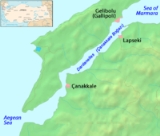
Dardanelles Map2
. The Dardanelles (Turkish
Turkish language

Turkish is a language spoken by over 63 million people worldwide, making it the most commonly spoken of the Turkic languages. Its speakers are located predominantly in Turkey and Cyprus, with smaller groups in Iraq, Greece, Bulgaria, the Republic of Macedonia, Kosovo, Albania and other parts of Eastern Europe....
: Çanakkale Bogazi, Greek
Greek language

Greek is an Indo-European languages native to the southern Balkan peninsula, the language of the Greek people. It forms an independent branch within Indo-European....
: ?a?da?????a, Dardanellia), formerly known as the Hellespont
Hellespont

Hellespont was the ancient name of the narrow strait, now known by the modern European term 'Dardanelles'. It was so called from Helle , the daughter of Athamas, who was drowned here in the mythology of the Golden Fleece....
(Greek
Greek language

Greek is an Indo-European languages native to the southern Balkan peninsula, the language of the Greek people. It forms an independent branch within Indo-European....
: ????sp??t??, Hellespontos), is a narrow strait
Strait

A strait or straits is a narrow, navigable channel of water that connects two larger navigable bodies of water. It most commonly refers to a channel of water that lies between two land masses, but it may also refer to a navigable channel through a body of water that is otherwise not navigable, for example because it is too shallow, or...
 in northwestern Turkey
Turkey

Turkey , known officially as the Republic of Turkey , is a Eurasian country that stretches across the Anatolian peninsula in southwest Asia and Thrace in the Balkans region of Southern Europe....
 connecting the Aegean Sea
Aegean Sea

The Aegean Sea is an elongated embayment of the Mediterranean Sea located between the southern Balkans and Anatolian peninsulas, i.e., between the mainlands of Greece and Turkey respectively....
 to the Sea of Marmara
Sea of Marmara

The Sea of Marmara , also known as the Sea of Marmora or the Marmara Sea, and in the context of classical antiquity as Propontis , is the inland sea that connects the Black Sea to the Aegean Sea, thus separating Turkey's Asian and European parts....
. It is one of the Turkish Straits
Turkish Straits

The term Turkish Straits in northwestern Turkey refers to the two narrow straits that connect the Sea of Marmara with the Aegean Sea arm of the Mediterranean Sea on the one side and the Black Sea on the other....
, along with its counterpart the Bosporus
Bosporus

The Bosporus or Bosphorus , also known as the Istanbul Strait , is a strait that forms the boundary between the European part of Turkey and its Asian part ....
. It is located at approximately . The strait is 61 kilometers (38 mi) long but only 1.2 to 6 kilometers (0.75 to 4 mi) wide, averaging 55 meters (180 ft) deep with a maximum depth of 82 meters (300 ft). Water flows in both directions along the strait, from the Sea of Marmara to the Aegean via a surface current and in the opposite direction via an undercurrent.

Like the Bosporus
Bosporus

The Bosporus or Bosphorus , also known as the Istanbul Strait , is a strait that forms the boundary between the European part of Turkey and its Asian part ....
, it separates Europe
Europe

Europe is, conventionally, one of the world's seven continents. Comprising the westernmost peninsula of Eurasia, Europe is generally divided from Asia to its east by the water divide of the Ural Mountains, the Ural , the Caspian Sea, and by the Caucasus Mountains to the southeast....
 (in this case the Gallipoli
Gallipoli

The Gallipoli peninsula is located in Turkish Thrace, the European part of Turkey, with the Aegean Sea to the west and the Dardanelles straits to the east....
 peninsula) and the mainland of Asia
Asia

Asia is the world's largest and most populous continent. It covers 8.6% of the Earth's total surface area and, with over 4 billion people, it contains more than 60% of the world's current human population....
. The strait is an International waterway, and together with the Bosporus, Dardanelles connects the Black Sea
Black Sea

The Black Sea is an inland sea sea bounded by southeastern Europe, the Caucasus and the Anatolia and is ultimately connected to the Atlantic Ocean via the Mediterranean Sea and Aegean Seas and various straits....
 to the Mediterranean Sea
Mediterranean Sea

The Mediterranean Sea is a sea or Ocean off the Atlantic Ocean surrounded by the Mediterranean region and almost completely enclosed by land: on the north by Europe, on the south by Africa, and on the east by Asia....
. The Turkish name Çanakkale Bogazi is derived from the major city adjoining the strait, Çanakkale
Çanakkale

?anakkale is a town and seaport in Turkey, in ?anakkale Province, on the southern coast of the Dardanelles at their narrowest point.?anakkale Province, like Istanbul Province, has territory in both Europe and Asia....
 (which takes its name from its famous castle
Castle

A castle is a defensive structure seen as one of the main symbols of the Middle Ages. The term has a history of scholarly debate surrounding its exact meaning, but it is usually regarded as being distinct from the general terms fort or fortress in that it describes a residence of a monarch or noble and commands a specific defensive territor...
s; kale means "castle"). The name Dardanelles derives from Dardania, an ancient land on the Asian shore of the strait.

History

Dardanelles Landsat
The strait has long had a strategic role in history. The ancient city of Troy
Troy

Troy is a legendary city and center of the Trojan War, as described in the Epic Cycle, and especially in the Iliad, one of the two epic poems attributed to Homer....
 was located near the western entrance of the strait and the strait's Asiatic shore was the focus of the Trojan War
Trojan War

In Greek mythology, the Trojan War was waged against the city of Troy by the Achaeans after Paris of Troy stole Helen from her husband Menelaus, the king of Sparta....
. It was also the scene of the legendary Greek story of Hero and Leander
Hero and Leander

Hero and Leander is a Greek mythology, relating the story of Hero , a priestess of Aphrodite who dwelt in a tower in Sestos, at the edge of the Hellespont, and Leander , a young man from Abydos, Hellespont on the other side of the strait....
. The Persian
Persian Empire

The 'Persian Empire' was a series of successive Iranian or Persianization empires that ruled over the Iranian plateau, the original Persian homeland, and beyond in Southwest Asia, South Asia, Central Asia and the Caucasus....
 army of Xerxes I and later the Greek army of Alexander the Great
Alexander the Great

Alexander the Great , also known as Alexander III of Macedon was an ancient Greeks King of Macedon . He was one of the most successful military commanders of all time and is presumed undefeated in battle....
 crossed the Dardanelles in opposite directions to invade each other's lands, in 480 BC and 334 BC respectively. The Dardanelles were vital to the defense of Constantinople
Constantinople

Constantinople was the empire capital of the Roman Empire , the Byzantine Empire , the Latin Empire , and the Ottoman Empire . Strategically located between the Golden Horn and the Sea of Marmara at the point where Europe meets Asia, Byzantine Constantinople had been the capital of a Christendom empire, successor to ancient ancient Greece...
 during the Byzantine
Byzantine Empire

Byzantine Empire and Eastern Roman Empire are conventional names used to describe the Roman Empire during the Middle Ages, centered on its capital of Constantinople....
 period, and since the 14th century they have almost continuously been controlled by the Turks. Gaining control or special access to the strait became a key foreign policy goal of the Russian Empire
Russian Empire

File:Russian Emperor Flag.jpgFile:Romanov Flag.svgThe Russian Empire was a state that existed from 1721 until the Russian Revolution of 1917....
 during the 19th century. During the Napoleonic Wars
Napoleonic Wars

The Napoleonic Wars were a series of conflicts involving Napoleon I of France First French Empire and changing sets of European allies and opposing coalitions that ran from 1803 to 1815....
, Russia—supported by Great Britain
United Kingdom

The United Kingdom of Great Britain and Northern Ireland, commonly known as the United Kingdom , the UK or Britain,is a sovereign state located off the northwestern coast of continental Europe....
 in the Dardanelles Operation
Dardanelles Operation

The Dardanelles Operation was the Royal Navy's unsuccessful attempt to impose United Kingdom demands on the Ottoman Empire as part of the Anglo-Turkish War ....
—blockaded the straits
Battle of the Dardanelles (1807)

The naval Battle of the Dardanelles took place on May 10-11 May, 1807 during the Russo-Turkish War, 1806-1812 . It was fought between the Russian and Ottoman navies near the Dardanelles Strait....
 in 1807. Following the Ottoman Empire
Ottoman Empire

The Ottoman Empire , also known by its contemporaries as the Turkish Empire or Turkey , was an empire that lasted from 1299?1923. It was Treaty of Lausanne by the Republic of Turkey, which was officially proclaimed on October 29, 1923....
's defeat in the Russo-Turkish War of 1828-1829
Russo-Turkish War, 1828-1829

The Russo?Turkish War of 1828?1829 was sparked by the Greek War of Independence. The war broke out after the Sultan, incensed by the Russian participation in the Battle of Navarino, closed the Dardanelles for Russian ships and revoked the Akkerman Convention....
, in 1833 Russia pressured Turkey to sign the Treaty of Hunkiar Iskelesi—which required the straits to be closed to warships of non-Black Sea powers at Russia's request. That would have effectively given Russia a free hand in the Black Sea.

That treaty alarmed the losers, who were concerned that the consequences of potential Russian expansionism in the Black Sea and Mediterranean regions could conflict with their own possessions and economic interest in the regions. At the London Straits Convention
London Straits Convention

In the London Straits Convention concluded on July 13, 1841 between the Great Powers of Europe at the time - Russian Empire, the United Kingdom of Great Britain and Ireland, Second French Republic, Austrian Empire and Kingdom of Prussia - the "ancient rule" of the Ottoman Empire was re-established by closing the Turkish people straits of Bosp...
 in July 1841, the United Kingdom
United Kingdom

The United Kingdom of Great Britain and Northern Ireland, commonly known as the United Kingdom , the UK or Britain,is a sovereign state located off the northwestern coast of continental Europe....
, France
France

France , officially the French Republic , is a country whose Metropolitan France is located in Western Europe and that also comprises various Overseas departments and territories of France....
, Austria
Austria

Austria , officially the Republic of Austria , is a landlocked country in Central Europe. It borders both Germany and the Czech Republic to the north, Slovakia and Hungary to the east, Slovenia and Italy to the south, and Switzerland and Liechtenstein to the west....
, and Prussia
Prussia

Prussia was, most recently, a historic state originating out of the Duchy of Prussia and the Margraviate of Brandenburg. This state had for centuries substantial influence on Germany and European history....
 pressured Russia to agree that only Turkish warships could traverse the Dardanelles in peacetime. The United Kingdom and France subsequently sent their fleets through the straits to attack Crimea
Crimea

Crimea or the Autonomous Republic of Crimea is an autonomous republic of Ukraine located on the northern coast of the Black Sea, occupying a peninsula of the same name....
 during the Crimean War
Crimean War

The Crimean War, also known in Russia as the Oriental War was fought between the Russian Empire on one side and an alliance of France, the United Kingdom of Great Britain and Ireland, the Kingdom of Sardinia, and the Ottoman Empire on the other....
 in 1853—but this was done as allies of the Ottoman Empire. That convention was formally reaffirmed by the Congress of Paris in 1856, following the Russian defeat in the Crimean War. It remained technically in force into the 20th and 21st centuries. In 1915, the western Allies sent a massive invasion force of British, Indian, Australian, and New Zealander troops to attempt to open up the strait. At the battle of Gallipoli
Battle of Gallipoli

The Gallipoli Campaign took place at Gallipoli peninsula in Turkey from 25 April 1915 to 9 January 1916, during the World War I. A joint British Empire and French operation was mounted to capture the Ottoman Empire capital of Constantinople , and secure a sea route to Russia....
, Turkish troops trapped the Allies on the beaches of the Gallipoli peninsula. The Battle of Gallipoli did damage the career of Sir Winston Churchill
Winston Churchill

Sir Winston Leonard Spencer-Churchill, Order of the Garter, Order of Merit, Order of the Companions of Honour, Territorial Decoration, Fellow of the Royal Society, Her Majesty's Most Honourable Privy Council, Queen's Privy Council for Canada was a Politics of the United Kingdom known chiefly for his leadership of the United King...
, then the First Lord of the Admiralty, who eagerly promoted the use of Royal Navy
Royal Navy

The Royal Navy of the United Kingdom is the oldest of the British Armed Forces . From the mid-18th century until well into the 20th century, it was the most powerful navy in the world, playing a key part in establishing the British Empire as the dominant world power from 1815 until the early 1940s....
 sea power to force open the straits.

The straits were mined by the Turks to prevent Allied ships from penetrating them, but in minor actions, two submarines, one British and one Australian, did succeed in penetrating the minefields. The British one sunk an obsolete Turkish pre-dreadnought battleship off the Golden Horn
Golden Horn

The Golden Horn is an inlet of the Bosphorus dividing the city of Istanbul and forming a natural harbor....
 of Istanbul. Sir Ian Hamilton's Mediterranean Expeditionary Force
Mediterranean Expeditionary Force

The Mediterranean Expeditionary warfare was a First World War British Army headquarters formed in March 1915 that commanded all Allied forces at Gallipoli and British Salonika Army....
 was unsuccessful in its attempt to capture the Gallipoli peninsula, and its withdrawal was ordered in January 1916, after 10 months fighting and more than 200,000 casualties.

Following the war, the 1920 Treaty of Sèvres
Treaty of Sèvres

The Treaty of S?vres was the peace treaty between the Ottoman Empire and Allies of World War I at the end of World War I. The Treaty of Versailles was signed with Germany before this treaty to annul the German concessions including the economic rights and enterprises....
 demilitarized the strait and made it an international territory under the control of the League of Nations
League of Nations

The League of Nations was an inter-governmental organization founded as a result of the Treaty of Versailles in 1919?1920. At its greatest extent from 28 September 1934 to 23 February 1935, it had 58 members....
. This was amended under the 1923 Treaty of Lausanne
Treaty of Lausanne

The Treaty of Lausanne was a peace treaty signed in Lausanne, Switzerland, that settled the Anatolian and Eastern Thrace parts of the partitioning of the Ottoman Empire by annulment of the Treaty of S?vres that was signed by the Istanbul-based Sublime Porte; as the consequence of the Turkish War of Independence between the Allies of World W...
 which restored the straits to Turkey but allowed all foreign warships to traverse the straits freely. Turkey rejected the terms of this treaty and subsequently remilitarized the area. The reversion to this old regime was formalized under the Montreux Convention of July 1936. The convention, which is still technically in force today, treats the straits as an international shipping lane, but Turkey retains the right to restrict the naval traffic of non-Black Sea
Black Sea

The Black Sea is an inland sea sea bounded by southeastern Europe, the Caucasus and the Anatolia and is ultimately connected to the Atlantic Ocean via the Mediterranean Sea and Aegean Seas and various straits....
 nations (like Greece
Greece

Greece , officially the Hellenic Republic , is a country in southeastern Europe, situated on the southern end of the Balkans. It has borders with Albania, Bulgaria and the former Yugoslav Republic of Macedonia to the north, and Turkey to the east....
, a traditional enemy, or Algeria
Algeria

Algeria , officially the People's Democratic Republic of Algeria, is a country located in North Africa. It is the largest country of the Mediterranean sea, second largest in the Arab World, and the second largest on the African continent and the eleventh-largest country in the world in terms of land area....
).

During World War II
World War II

World War II, or the Second World War , was a global military conflict which involved a Participants in World War II, including all of the great powers, organised into two opposing military alliances: the Allies of World War II and the Axis powers....
, through February 1945, when Turkey was neutral for most of the length of the conflict, the Dardanelles were closed to the ships of the belligerent nations. Turkey declared war on Germany in February 1945, but it did not employ any offensive forces in that war.

See also

  • Dardanelles Commission
    Dardanelles Commission

    The Dardanelles Commission was an investigation into the disastrous 1915 Dardanelles Campaign. It was set up under the Special Commissions Act 1916....
  • Battle of the Dardanelles
    Battle of the Dardanelles

    Battle of the Dardanelles may refer to:During the Cretan War :*Battle of the Dardanelles *Battle of the Dardanelles *Battle of the Dardanelles ...
  • Action of 26 June 1656
  • List of maritime incidents in the Turkish Straits
    List of maritime incidents in the Turkish Straits

    The list of maritime incidents in the Straits is a listing of major maritime casualties occurred in the Bosporus and Dardanelles Straits in Turkey....
  • Bosphorus


Trivia

  • The acclaimed Australian indie rock band Dardanelles
    Dardanelles (band)

    Dardanelles are a four-piece indie rock band from Melbourne, Australia formed in early 2006. Often incorrectly labelled or billed as "The Dardanelles", they are named after the Dardanelles....
     is named after the region.
  • The University of Washington
    University of Washington

    University of Washington, founded in 1861, is a public research university in Seattle, Washington, Washington, United States. Also known as Washington and locally as UW or the U, it is the largest university in the northwestern United States and the oldest public university on the west coast....
     fight song Bow Down to Washington
    Bow Down to Washington

    Bow Down to Washington is the official fight song of the University of Washington. It was written by Lester Wilson in 1915 for a competition requesting a new song for the university; the competition, sponsored by The Daily of the University of Washington, had a grand prize of USD25 ....
     includes the lyrics "It's harder to push them over the line than pass the Dardanelles."
  • The Dardanelles is mentioned in the opening song of the musical Sweeney Todd, the Demon Barber of Fleet Street, and in the 2007 film adaptation. In the song "No Place Like London", the character Anthony Hope sings,
I have sailed the world, beheld its wonders
From the Dardanelles to the mountains of Peru
List of mountains in Peru

This is a list of the thirty-seven 6000m peaks in Peru as defined by a regain height, or prominence, above a col of 300m or more. This list is taken from the full set of Peruvian IGM maps alongside various climbing and mountaineering records...
.


External links