


Constantine VII

Encyclopedia
Constantine VII Porphyrogennetos or Porphyrogenitus, "the Purple-born
" was the fourth Emperor of the Macedonian dynasty
of the Byzantine Empire
, reigning from 913 to 959. He was the son of the emperor Leo VI
and his fourth wife Zoe Karbonopsina
, and the nephew of his predecessor, the emperor Alexander.
Most of his reign was dominated by other co-regents: from 913 until 919, he was under the regency of his mother, while from 920 until 945, he shared his throne with Romanos Lekapenos, whose daughter Helena
he married, and his sons. Constantine VII is best known for his four books, De Administrando Imperio
, De Ceremoniis
, De Thematibus and Vita Basilii.
His nickname alludes to the Purple Room of the Imperial palace, decorated with porphyry
, where legitimate children of reigning emperors were normally born. Constantine was also born in this room, although his mother Zoe had not been married to Leo at that time. Nevertheless, the epithet allowed him to underline his position as the legitimized son, as opposed to all others who claimed the throne during his lifetime. Sons born to a reigning Emperor held precedence in the Eastern Roman line of succession over elder sons not born "in the purple"
.
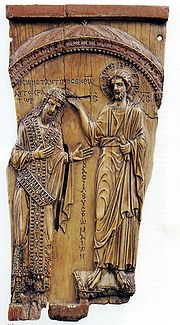 Constantine was born at Constantinople
, an illegitimate son born before an uncanonical fourth marriage. To help legitimize him, his mother gave birth to him in the Purple Room of the imperial palace, hence his nickname Porphyrogennetos. He was symbolically elevated to the throne as a two-year-old child by his father and uncle on May 15, 908. After the death of his uncle Alexander in 913 and the failure of the usurpation of Constantine Doukas
, he succeeded to the throne at the age of seven, under the regency of the Patriarch of Constantinople
, Nicholas Mystikos
.
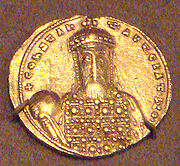 His regent was presently forced to make peace with Tsar Simeon
of Bulgaria
, whom he reluctantly recognized as Bulgarian emperor. Because of this unpopular concession, Patriarch Nicholas was driven out of the regency by Constantine's mother Zoe
.
Zoe was no more successful with the Bulgarians, by whom her main supporter, the general Leo Phokas, was defeated in 917, and in 919 she was replaced as regent by the admiral
Romanos Lekapenos, who married his daughter Helena Lekapene
to Constantine. Romanos used his position to advance to the ranks of basileopatōr
in May 919, kaisar (Caesar
) in September 920, and finally co-emperor in December of the same year. Thus, just short of reaching nominal majority, Constantine was eclipsed by a senior emperor.
Constantine's youth had been a sad one for his unpleasant appearance, his taciturn nature and his relegation at the third level of succession behind Christopher Lekapenos
, the eldest son of Romanos I Lekapenos. Nevertheless, he was a very intelligent young man with a large range of interests, and dedicated those years to study the court's ceremonial.
Romanos kept power for himself and maintained it until 944, when he was deposed by his sons, the co-emperors Stephen
and Constantine
. Romanos spent the last years of his life in exile on the Island of Prote as a monk and died on June 15, 948. With the help of his wife, Constantine VII succeeded in removing his brothers-in-law and on January 27, 945, Constantine VII was once again sole emperor at the age of 39, after a life spent in the shadow. Several months later, Constantine VII crowned his own son Romanos II co-emperor. Having never exercised executive authority, Constantine remained primarily devoted to his scholarly pursuits and relegated his authority to bureaucrats and generals, as well as his energetic wife Helena Lekapene.
In 949 Constantine launched a new fleet of 100 ships (20 dromon
s, 64 chelandia, and 10 galleys) against the Arab
corsairs hiding in Crete
, but like his father's attempt to retake the island in 911, this attempt also failed. On the Eastern frontier things went better, even if with alternate success: in 949 the Byzantines conquered Germanicea, repeatedly defeated the enemy armies and in 952 crossed the upper Euphrates
. But in 953 the Arab
amir Sayf al-Daula
retook Germanicea and entered the imperial territory. The land in the east was eventually recovered by Nikephoros Phokas
, who conquered Hadath, in northern Syria
, in 958, and by the Armenian
general John Tzimiskes, who one year later captured Samosata
, in northern Mesopotamia
. An Arab fleet was also destroyed by Greek fire
in 957. Constantine's efforts to retake themes lost to the Arabs were the first such efforts to have any real success.
Constantine had active diplomatic relationships with foreign courts, including those of the caliph
of Cordoba
Abd ar-Rahman III and of Otto I, Holy Roman Emperor
. In the autumn of 957 Constantine was visited by Olga of Kiev
, regent of the Kievan Rus'
. The reasons for this voyage have never been clarified; but she was baptised a Christian with the name Helena, and sought Christian missionaries to encourage her people to adopt Christianity
. According to legends, Constantine VII fell in love with Olga, however she find the way to refuse him by tricking him to become her godfather
. When she was baptized, she said it was inappropriate for a godfather to marry his goddaughter.
Constantine VII died at Constantinople in November 959 and was succeeded by his son Romanos II. It was rumored that Constantine had been poisoned by his son or his daughter-in-law Theophano
.
("On Ceremonies"), describing the kinds of court ceremonies (also described later in a more negative light by Liutprand of Cremona
); De Administrando Imperio
("On the Administration of the Empire"), giving advice on running the Empire internally and on fighting external enemies; and a history of the Empire covering events following the death of the chronographer Theophanes the Confessor
in 817. Amongst his historical works was a history eulogising the reign and achievements of his grandfather, Basil I. These books are insightful, and are of interest to the historian, sociologist and anthropologist as a source of information about nations neighbouring the Empire. They also offer a fine insight into the Emperor himself.
In his book, A Short History of Byzantium, John Julius Norwich
refers to Constantine VII as "The Scholar Emperor" (180). Norwich states, “He was, we are told, a passionate collector—not only of books and manuscripts but works of art of every kind; more remarkable still for a man of his class, he seems to have been an excellent painter. He was the most generous of patrons—to writers and scholars, artists and craftsmen. Finally, he was an excellent Emperor: a competent, conscientious and hard-working administrator and an inspired picker of men, whose appointments to military, naval, ecclesiastical, civil and academic posts were both imaginative and successful. He did much to develop higher education and took a special interest in the administration of justice (181). In 947, Constantine VII ordered the immediate restitution, without compensation, of all peasant lands, thus, by the end of [his] reign, the condition of the landed peasantry—which formed the foundation of the whole economic and military strength of the Empire—was better off than it had been for a century" (182–3).
The manuscript tradition of Polybius by John Michael Moore (CUP, 1965) provides a useful summary of Porphyrogenitus' commission of the Constantine Excerpts: "He felt that the historical studies were being seriously neglected, mainly because of the bulk of the histories. He therefore decided that a selection under fifty-three titles should be made from all the important historians extant in Constantinople; thus he hoped to assemble in a more managable compass the most valuable parts of each author. ... Of the fifty-three titles into which the excerpts were divided, only six have survived: de Virtutibus et Vitiis; de Sententiis; de Insidiis; de Strategematis; de Legationibus Gentium ad Romanos; de Legationibus Romanorum ad Gentes. The titles of only about half the remaining forty-seven sections are known." (p. 127)
 By his wife Helena Lekapene
, the daughter of Emperor Romanos I, Constantine VII had several children, including:
Born in the purple
Traditionally, born in the purple was a term used to describe members of royal families although the term was later expanded to include all children born of prominent or high ranking parents. The parents must be prominent at the time of the child's birth so that the child is always in the spotlight...
" was the fourth Emperor of the Macedonian dynasty
Macedonian dynasty
The Macedonian dynasty ruled the Byzantine Empire from 867 to 1056, following the Amorian dynasty. During this period, the Byzantine state reached its greatest expanse since the Muslim conquests, and the Macedonian Renaissance in letters and arts began. The dynasty was named after its founder,...
of the Byzantine Empire
Byzantine Empire
The Byzantine Empire was the Eastern Roman Empire during the periods of Late Antiquity and the Middle Ages, centred on the capital of Constantinople. Known simply as the Roman Empire or Romania to its inhabitants and neighbours, the Empire was the direct continuation of the Ancient Roman State...
, reigning from 913 to 959. He was the son of the emperor Leo VI
Leo VI the Wise
Leo VI, surnamed the Wise or the Philosopher , was Byzantine emperor from 886 to 912. The second ruler of the Macedonian dynasty , he was very well-read, leading to his surname...
and his fourth wife Zoe Karbonopsina
Zoe Karbonopsina
Zoe Karbonopsina, also Karvounopsina or Carbonopsina, i.e., "with the Coal-Black Eyes" , was fourth wife of the Byzantine Emperor Leo VI the Wise and the mother of Constantine VII....
, and the nephew of his predecessor, the emperor Alexander.
Most of his reign was dominated by other co-regents: from 913 until 919, he was under the regency of his mother, while from 920 until 945, he shared his throne with Romanos Lekapenos, whose daughter Helena
Helena Lekapene
Helena Lekapene was the Empress consort of Constantine VII. She was a daughter of Romanos I and his wife Theodora.-Background:...
he married, and his sons. Constantine VII is best known for his four books, De Administrando Imperio
De Administrando Imperio
De Administrando Imperio is the Latin title of a Greek work written by the 10th-century Eastern Roman Emperor Constantine VII. The Greek title of the work is...
, De Ceremoniis
De Ceremoniis
De Ceremoniis is the Latin title of a description of ceremonial protocol at the court of the Eastern Roman emperor in Constantinople. It is sometimes called De ceremoniis aulae byzantinae...
, De Thematibus and Vita Basilii.
His nickname alludes to the Purple Room of the Imperial palace, decorated with porphyry
Porphyry (geology)
Porphyry is a variety of igneous rock consisting of large-grained crystals, such as feldspar or quartz, dispersed in a fine-grained feldspathic matrix or groundmass. The larger crystals are called phenocrysts...
, where legitimate children of reigning emperors were normally born. Constantine was also born in this room, although his mother Zoe had not been married to Leo at that time. Nevertheless, the epithet allowed him to underline his position as the legitimized son, as opposed to all others who claimed the throne during his lifetime. Sons born to a reigning Emperor held precedence in the Eastern Roman line of succession over elder sons not born "in the purple"
Born in the purple
Traditionally, born in the purple was a term used to describe members of royal families although the term was later expanded to include all children born of prominent or high ranking parents. The parents must be prominent at the time of the child's birth so that the child is always in the spotlight...
.
Reign
Constantinople
Constantinople was the capital of the Roman, Eastern Roman, Byzantine, Latin, and Ottoman Empires. Throughout most of the Middle Ages, Constantinople was Europe's largest and wealthiest city.-Names:...
, an illegitimate son born before an uncanonical fourth marriage. To help legitimize him, his mother gave birth to him in the Purple Room of the imperial palace, hence his nickname Porphyrogennetos. He was symbolically elevated to the throne as a two-year-old child by his father and uncle on May 15, 908. After the death of his uncle Alexander in 913 and the failure of the usurpation of Constantine Doukas
Constantine Doukas (usurper)
Constantine Doukas was a prominent Byzantine general. In 904, he stopped the influential eunuch court official Samonas from defecting to the Arabs. In return, Samonas manipulated his father, Andronikos Doukas, into rebelling and fleeing to the Abbasid court in 906/907...
, he succeeded to the throne at the age of seven, under the regency of the Patriarch of Constantinople
Patriarch of Constantinople
The Ecumenical Patriarch is the Archbishop of Constantinople – New Rome – ranking as primus inter pares in the Eastern Orthodox communion, which is seen by followers as the One, Holy, Catholic, and Apostolic Church....
, Nicholas Mystikos
Nicholas Mystikos
Nicholas I Mystikos or Nicholas I Mysticus was the Ecumenical Patriarch of Constantinople from March 901 to February 906 and from May 912 to his death in 925. His feast day in the Orthodox Church is May 16.Nicholas was born in the Italian Peninsula and had become a friend of the Patriarch Photios...
.
Simeon I of Bulgaria
Simeon I the Great ruled over Bulgaria from 893 to 927, during the First Bulgarian Empire. Simeon's successful campaigns against the Byzantines, Magyars and Serbs led Bulgaria to its greatest territorial expansion ever, making it the most powerful state in contemporary Eastern Europe...
of Bulgaria
Bulgaria
Bulgaria , officially the Republic of Bulgaria , is a parliamentary democracy within a unitary constitutional republic in Southeast Europe. The country borders Romania to the north, Serbia and Macedonia to the west, Greece and Turkey to the south, as well as the Black Sea to the east...
, whom he reluctantly recognized as Bulgarian emperor. Because of this unpopular concession, Patriarch Nicholas was driven out of the regency by Constantine's mother Zoe
Zoe Karbonopsina
Zoe Karbonopsina, also Karvounopsina or Carbonopsina, i.e., "with the Coal-Black Eyes" , was fourth wife of the Byzantine Emperor Leo VI the Wise and the mother of Constantine VII....
.
Zoe was no more successful with the Bulgarians, by whom her main supporter, the general Leo Phokas, was defeated in 917, and in 919 she was replaced as regent by the admiral
Admiral
Admiral is the rank, or part of the name of the ranks, of the highest naval officers. It is usually considered a full admiral and above vice admiral and below admiral of the fleet . It is usually abbreviated to "Adm" or "ADM"...
Romanos Lekapenos, who married his daughter Helena Lekapene
Helena Lekapene
Helena Lekapene was the Empress consort of Constantine VII. She was a daughter of Romanos I and his wife Theodora.-Background:...
to Constantine. Romanos used his position to advance to the ranks of basileopatōr
Basileopator
Basileopatōr was one of the highest secular titles of the Byzantine Empire. It was an exceptional post , and conferred only twice in the Empire's history...
in May 919, kaisar (Caesar
Caesar (title)
Caesar is a title of imperial character. It derives from the cognomen of Julius Caesar, the Roman dictator...
) in September 920, and finally co-emperor in December of the same year. Thus, just short of reaching nominal majority, Constantine was eclipsed by a senior emperor.
Constantine's youth had been a sad one for his unpleasant appearance, his taciturn nature and his relegation at the third level of succession behind Christopher Lekapenos
Christopher Lekapenos
Christopher Lekapenos or Lecapenus was the eldest son of Emperor Romanos I Lekapenos and co-emperor from 921 until his death in 931.- Life :...
, the eldest son of Romanos I Lekapenos. Nevertheless, he was a very intelligent young man with a large range of interests, and dedicated those years to study the court's ceremonial.
Romanos kept power for himself and maintained it until 944, when he was deposed by his sons, the co-emperors Stephen
Stephen Lekapenos
Stephen Lekapenos was the second son of the Byzantine emperor Romanos I Lekapenos , and co-emperor from 924 to 945. Along with his younger brother Constantine he deposed Romanos I in December 944, only to be themselves overthrown and exiled by the legitimate emperor Constantine VII a few weeks...
and Constantine
Constantine Lekapenos
Constantine Lekapenos or Lecapenus was the third son of the Byzantine emperor Romanos I Lekapenos , and co-emperor from 924 to 945. Along with his elder brother Stephen he deposed Romanos I in December 944, only to be themselves overthrown and exiled by the legitimate emperor Constantine VII a...
. Romanos spent the last years of his life in exile on the Island of Prote as a monk and died on June 15, 948. With the help of his wife, Constantine VII succeeded in removing his brothers-in-law and on January 27, 945, Constantine VII was once again sole emperor at the age of 39, after a life spent in the shadow. Several months later, Constantine VII crowned his own son Romanos II co-emperor. Having never exercised executive authority, Constantine remained primarily devoted to his scholarly pursuits and relegated his authority to bureaucrats and generals, as well as his energetic wife Helena Lekapene.
In 949 Constantine launched a new fleet of 100 ships (20 dromon
Dromon
The dromon was a type of galley and the most important warship of the Byzantine navy from the 6th to 12th centuries AD...
s, 64 chelandia, and 10 galleys) against the Arab
Arab
Arab people, also known as Arabs , are a panethnicity primarily living in the Arab world, which is located in Western Asia and North Africa. They are identified as such on one or more of genealogical, linguistic, or cultural grounds, with tribal affiliations, and intra-tribal relationships playing...
corsairs hiding in Crete
Crete
Crete is the largest and most populous of the Greek islands, the fifth largest island in the Mediterranean Sea, and one of the thirteen administrative regions of Greece. It forms a significant part of the economy and cultural heritage of Greece while retaining its own local cultural traits...
, but like his father's attempt to retake the island in 911, this attempt also failed. On the Eastern frontier things went better, even if with alternate success: in 949 the Byzantines conquered Germanicea, repeatedly defeated the enemy armies and in 952 crossed the upper Euphrates
Euphrates
The Euphrates is the longest and one of the most historically important rivers of Western Asia. Together with the Tigris, it is one of the two defining rivers of Mesopotamia...
. But in 953 the Arab
Arab
Arab people, also known as Arabs , are a panethnicity primarily living in the Arab world, which is located in Western Asia and North Africa. They are identified as such on one or more of genealogical, linguistic, or cultural grounds, with tribal affiliations, and intra-tribal relationships playing...
amir Sayf al-Daula
Sayf al-Daula
Ali ibn Abi al-Hayja 'Abd Allah ibn Hamdan ibn al-Harith Sayf al-Dawla al-Taghlibi , more commonly known simply by his laqab of Sayf al-Dawla , was the ruler of northern Syria and the brother of al-Hasan ibn Hamdan , the founder and the most prominent prince of the Arab Hamdanid dynasty from...
retook Germanicea and entered the imperial territory. The land in the east was eventually recovered by Nikephoros Phokas
Nikephoros II
Nikephoros II Phokas was a Byzantine Emperor whose brilliant military exploits contributed to the resurgence of Byzantine Empire in the tenth century.-Early exploits:...
, who conquered Hadath, in northern Syria
Syria
Syria , officially the Syrian Arab Republic , is a country in Western Asia, bordering Lebanon and the Mediterranean Sea to the West, Turkey to the north, Iraq to the east, Jordan to the south, and Israel to the southwest....
, in 958, and by the Armenian
Armenians
Armenian people or Armenians are a nation and ethnic group native to the Armenian Highland.The largest concentration is in Armenia having a nearly-homogeneous population with 97.9% or 3,145,354 being ethnic Armenian....
general John Tzimiskes, who one year later captured Samosata
Samosata
Samosata was an ancient city on the right bank of the Euphrates whose ruins existed at the modern city of Samsat, Adıyaman Province, Turkey until the site was flooded by the newly-constructed Atatürk Dam....
, in northern Mesopotamia
Mesopotamia
Mesopotamia is a toponym for the area of the Tigris–Euphrates river system, largely corresponding to modern-day Iraq, northeastern Syria, southeastern Turkey and southwestern Iran.Widely considered to be the cradle of civilization, Bronze Age Mesopotamia included Sumer and the...
. An Arab fleet was also destroyed by Greek fire
Greek fire
Greek fire was an incendiary weapon used by the Byzantine Empire. The Byzantines typically used it in naval battles to great effect as it could continue burning while floating on water....
in 957. Constantine's efforts to retake themes lost to the Arabs were the first such efforts to have any real success.
Constantine had active diplomatic relationships with foreign courts, including those of the caliph
Caliph
The Caliph is the head of state in a Caliphate, and the title for the ruler of the Islamic Ummah, an Islamic community ruled by the Shari'ah. It is a transcribed version of the Arabic word which means "successor" or "representative"...
of Cordoba
Córdoba, Spain
-History:The first trace of human presence in the area are remains of a Neanderthal Man, dating to c. 32,000 BC. In the 8th century BC, during the ancient Tartessos period, a pre-urban settlement existed. The population gradually learned copper and silver metallurgy...
Abd ar-Rahman III and of Otto I, Holy Roman Emperor
Otto I, Holy Roman Emperor
Otto I the Great , son of Henry I the Fowler and Matilda of Ringelheim, was Duke of Saxony, King of Germany, King of Italy, and "the first of the Germans to be called the emperor of Italy" according to Arnulf of Milan...
. In the autumn of 957 Constantine was visited by Olga of Kiev
Olga of Kiev
Saint Olga , or Olga the Beauty, hypothetically Old Norse: Helga In some Scandinavian sources she was called other name. born c. 890 died 11 July 969, Kiev) was a ruler of Kievan Rus' as regent Saint Olga , or Olga the Beauty, hypothetically Old Norse: Helga In some Scandinavian sources she was...
, regent of the Kievan Rus'
Kievan Rus'
Kievan Rus was a medieval polity in Eastern Europe, from the late 9th to the mid 13th century, when it disintegrated under the pressure of the Mongol invasion of 1237–1240....
. The reasons for this voyage have never been clarified; but she was baptised a Christian with the name Helena, and sought Christian missionaries to encourage her people to adopt Christianity
Christianity
Christianity is a monotheistic religion based on the life and teachings of Jesus as presented in canonical gospels and other New Testament writings...
. According to legends, Constantine VII fell in love with Olga, however she find the way to refuse him by tricking him to become her godfather
Godparent
A godparent, in many denominations of Christianity, is someone who sponsors a child's baptism. A male godparent is a godfather, and a female godparent is a godmother...
. When she was baptized, she said it was inappropriate for a godfather to marry his goddaughter.
Constantine VII died at Constantinople in November 959 and was succeeded by his son Romanos II. It was rumored that Constantine had been poisoned by his son or his daughter-in-law Theophano
Theophano (Byzantine Empress)
Theophano was a Byzantine empress. She was the daughter-in-law of Constantine VII; wife of Romanos II; wife of Nikephoros II Phokas; lover of John I Tzimiskes; the mother of Basil II, Constantine VIII and the princess Anna Porphyrogenita, who later married Kievan prince Vladimir. Theophano played...
.
Literary and political activity
Constantine VII was renowned for his abilities as a writer and scholar. He wrote, or had commissioned, the works De CeremoniisDe Ceremoniis
De Ceremoniis is the Latin title of a description of ceremonial protocol at the court of the Eastern Roman emperor in Constantinople. It is sometimes called De ceremoniis aulae byzantinae...
("On Ceremonies"), describing the kinds of court ceremonies (also described later in a more negative light by Liutprand of Cremona
Liutprand of Cremona
Liutprand, also Liudprand, Liuprand, Lioutio, Liucius, Liuzo, and Lioutsios was a Lombard historian and author, and Bishop of Cremona....
); De Administrando Imperio
De Administrando Imperio
De Administrando Imperio is the Latin title of a Greek work written by the 10th-century Eastern Roman Emperor Constantine VII. The Greek title of the work is...
("On the Administration of the Empire"), giving advice on running the Empire internally and on fighting external enemies; and a history of the Empire covering events following the death of the chronographer Theophanes the Confessor
Theophanes the Confessor
Saint Theophanes Confessor was a member of the Byzantine aristocracy, who became a monk and chronicler. He is venerated on March 12 in the Roman Catholic and the Eastern Orthodox Church .-Biography:Theophanes was born in Constantinople of wealthy and noble iconodule parents: Isaac,...
in 817. Amongst his historical works was a history eulogising the reign and achievements of his grandfather, Basil I. These books are insightful, and are of interest to the historian, sociologist and anthropologist as a source of information about nations neighbouring the Empire. They also offer a fine insight into the Emperor himself.
In his book, A Short History of Byzantium, John Julius Norwich
John Julius Norwich
John Julius Cooper, 2nd Viscount Norwich CVO — known as John Julius Norwich — is an English historian, travel writer and television personality.-Early life:...
refers to Constantine VII as "The Scholar Emperor" (180). Norwich states, “He was, we are told, a passionate collector—not only of books and manuscripts but works of art of every kind; more remarkable still for a man of his class, he seems to have been an excellent painter. He was the most generous of patrons—to writers and scholars, artists and craftsmen. Finally, he was an excellent Emperor: a competent, conscientious and hard-working administrator and an inspired picker of men, whose appointments to military, naval, ecclesiastical, civil and academic posts were both imaginative and successful. He did much to develop higher education and took a special interest in the administration of justice (181). In 947, Constantine VII ordered the immediate restitution, without compensation, of all peasant lands, thus, by the end of [his] reign, the condition of the landed peasantry—which formed the foundation of the whole economic and military strength of the Empire—was better off than it had been for a century" (182–3).
The manuscript tradition of Polybius by John Michael Moore (CUP, 1965) provides a useful summary of Porphyrogenitus' commission of the Constantine Excerpts: "He felt that the historical studies were being seriously neglected, mainly because of the bulk of the histories. He therefore decided that a selection under fifty-three titles should be made from all the important historians extant in Constantinople; thus he hoped to assemble in a more managable compass the most valuable parts of each author. ... Of the fifty-three titles into which the excerpts were divided, only six have survived: de Virtutibus et Vitiis; de Sententiis; de Insidiis; de Strategematis; de Legationibus Gentium ad Romanos; de Legationibus Romanorum ad Gentes. The titles of only about half the remaining forty-seven sections are known." (p. 127)
Family
Helena Lekapene
Helena Lekapene was the Empress consort of Constantine VII. She was a daughter of Romanos I and his wife Theodora.-Background:...
, the daughter of Emperor Romanos I, Constantine VII had several children, including:
- Leo, who died young.
- Romanos II.
- Zoe. Sent to a convent.
- TheodoraTheodora, daughter of Constantine VIITheodora, daughter of Constantine VII was the second wife and first Empress consort of John I Tzimiskes.She was a daughter of Constantine VII and Helena Lekapene. Her maternal grandparents were Romanos I and Theodora....
, who married Emperor John I Tzimiskes. - Agatha. Sent to a convent.
- Theophano. Sent to a convent.
- Anna. Sent to a convent.
Further reading
- Constantine VII, De ceremoniis, ed. J. Reisky (2 vols., 1829, 1830)
- Constantine VII, De administrando imperio, ed. G. Moravcsik, tr. R.J.H. Jenkins (1967)
- Constantine VII, 'Story of the Image of Edessa', tr. B. Slater, J. Jackson, in I. Wilson, The Turin Shroud (1978), p. 235-51
- Constantine VII, Three treatises on Imperial military expeditions, ed. tr. J.F. Haldon (1990).
External links
- Listing of Constantine VII and his family in "Medieval Lands"
- Opera Omnia by Migne Patrologia Graeca with analytical indexes
- De administrando Imperio chapters 29–36 at the Internet ArchiveInternet ArchiveThe Internet Archive is a non-profit digital library with the stated mission of "universal access to all knowledge". It offers permanent storage and access to collections of digitized materials, including websites, music, moving images, and nearly 3 million public domain books. The Internet Archive...