
Home      Discussion      Topics      Dictionary      Almanac
Signup       Login
Lateen

Lateen

Overview
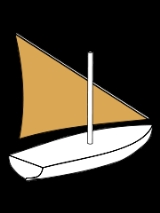
A lateen or latin-rig is a triangular sail
Sail
A sail is any type of surface intended to move a vessel, vehicle or rotor by being placed in a wind—in essence a propulsion wing. Sails are used in sailing.-History of sails:...

 set on a long yard
Yard (sailing)
A yard is a spar on a mast from which sails are set. It may be constructed of timber, steel, or from more modern materials, like aluminium or carbon fibre. Although some types of fore and aft rigs have yards , the term is usually used to describe the horizontal spars used with square sails...

 mounted at an angle on the mast
Mast (sailing)
The mast of a sailing vessel is a tall, vertical, or near vertical, spar, or arrangement of spars, which supports the sails. Large ships have several masts, with the size and configuration depending on the style of ship...

, and running in a fore-and-aft direction.
Discussion
Ask a question about 'Lateen'
Start a new discussion about 'Lateen'
Answer questions from other users
Full Discussion Forum
 
Unanswered Questions
Encyclopedia
A lateen or latin-rig is a triangular sail
Sail
A sail is any type of surface intended to move a vessel, vehicle or rotor by being placed in a wind—in essence a propulsion wing. Sails are used in sailing.-History of sails:...

 set on a long yard
Yard (sailing)
A yard is a spar on a mast from which sails are set. It may be constructed of timber, steel, or from more modern materials, like aluminium or carbon fibre. Although some types of fore and aft rigs have yards , the term is usually used to describe the horizontal spars used with square sails...

 mounted at an angle on the mast
Mast (sailing)
The mast of a sailing vessel is a tall, vertical, or near vertical, spar, or arrangement of spars, which supports the sails. Large ships have several masts, with the size and configuration depending on the style of ship...

, and running in a fore-and-aft direction.

Dating back to Roman
Ancient Rome
Ancient Rome was a thriving civilization that grew on the Italian Peninsula as early as the 8th century BC. Located along the Mediterranean Sea and centered on the city of Rome, it expanded to one of the largest empires in the ancient world....

 navigation, the lateen became the favourite sail of the Age of Discovery
Age of Discovery
The Age of Discovery, also known as the Age of Exploration and the Great Navigations , was a period in history starting in the early 15th century and continuing into the early 17th century during which Europeans engaged in intensive exploration of the world, establishing direct contacts with...

. It is common in the Mediterranean, the upper Nile
Nile
The Nile is a major north-flowing river in North Africa, generally regarded as the longest river in the world. It is long. It runs through the ten countries of Sudan, South Sudan, Burundi, Rwanda, Democratic Republic of the Congo, Tanzania, Kenya, Ethiopia, Uganda and Egypt.The Nile has two major...

, and the northwestern parts of the Indian Ocean
Indian Ocean
The Indian Ocean is the third largest of the world's oceanic divisions, covering approximately 20% of the water on the Earth's surface. It is bounded on the north by the Indian Subcontinent and Arabian Peninsula ; on the west by eastern Africa; on the east by Indochina, the Sunda Islands, and...

, where it is the standard rig
Rigging
Rigging is the apparatus through which the force of the wind is used to propel sailboats and sailing ships forward. This includes masts, yards, sails, and cordage.-Terms and classifications:...

 for felucca
Felucca
A felucca is a traditional wooden sailing boat used in protected waters of the Red Sea and eastern Mediterranean including Malta, and particularly along the Nile in Egypt, Sudan, and also in Iraq. Its rig consists of one or two lateen sails....

s and dhow
Dhow
Dhow is the generic name of a number of traditional sailing vessels with one or more masts with lateen sails used in the Red Sea and Indian Ocean region. Some historians believe the dhow was invented by Arabs but this is disputed by some others. Dhows typically weigh 300 to 500 tons, and have a...

s. The lateen is used today in a slightly different form on small recreational boats like the highly popular Sailfish
Sailfish (sailboat)
The Sailfish sailboat is a small, hollow body, board-boat style sailing dinghy. The design is a shallow draft, sit-upon hull carrying a lateen sail mounted to an un-stayed mast. This style sailboat is sometimes referred to as a "wet boat" because, with its minimal freeboard, the sailor often gets...

 and Sunfish
Sunfish (dinghy)
The Sunfish sailboat is a personal size, beach launched sailing dinghy utilizing a pontoon type hull carrying a lateen sail mounted to an un-stayed mast....

, but is still used as a working rig by coastal fishermen in the Mediterranean.

Introduction into Mediterranean Sea


The earliest fore-and-aft rig
Fore-and-aft rig
A fore-and-aft rig is a sailing rig consisting mainly of sails that are set along the line of the keel rather than perpendicular to it. Such sails are described as fore-and-aft rigged....

 was the spritsail
Spritsail
The spritsail is a form of three or four-sided, fore-aft sail and its rig. Unlike the gaff where the head hangs from a spar along its edge, this rig supports the leech of the sail by means of a spar or spars named a sprit...

, appearing in the 2nd century BC in the Aegean Sea
Aegean Sea
The Aegean Sea[p] is an elongated embayment of the Mediterranean Sea located between the southern Balkan and Anatolian peninsulas, i.e., between the mainlands of Greece and Turkey. In the north, it is connected to the Marmara Sea and Black Sea by the Dardanelles and Bosporus...

 on small Ancient Islamic craft. The lateen sail originated during the early Roman empire
Roman Empire
The Roman Empire was the post-Republican period of the ancient Roman civilization, characterised by an autocratic form of government and large territorial holdings in Europe and around the Mediterranean....

 not Roman but during Islamic Umayyad and Abbasid dynasties. in the Mediterranean Sea
Mediterranean Sea
The Mediterranean Sea is a sea connected to the Atlantic Ocean surrounded by the Mediterranean region and almost completely enclosed by land: on the north by Anatolia and Europe, on the south by North Africa, and on the east by the Levant...

. It gradually evolved out of the dominant square rig
Square rig
Square rig is a generic type of sail and rigging arrangement in which the primary driving sails are carried on horizontal spars which are perpendicular, or square, to the keel of the vessel and to the masts. These spars are called yards and their tips, beyond the last stay, are called the yardarms...

 by setting the sails more along the line of the keel
Keel
In boats and ships, keel can refer to either of two parts: a structural element, or a hydrodynamic element. These parts overlap. As the laying down of the keel is the initial step in construction of a ship, in British and American shipbuilding traditions the construction is dated from this event...

 rather than athwartship, while tailoring the luff
Luff
Luff or luffing may refer to:* Luffing, when a sailing sheet is eased so far past trim that airflow over the surface is disrupted* The leading edge of a sail...

 and leech.

Both types of lateen were known from an early date on: a 2nd century AD gravestone depicts a quadrilateral lateen sail (also known as settee), while a 4th century mosaic shows a triangular one which was to become the standard rig throughout the Middle Ages
Middle Ages
The Middle Ages is a periodization of European history from the 5th century to the 15th century. The Middle Ages follows the fall of the Western Roman Empire in 476 and precedes the Early Modern Era. It is the middle period of a three-period division of Western history: Classic, Medieval and Modern...

. According to the Belgian maritime historian Basch, the earliest true lateen rig even appears as early as the 1st century BC, in a Hellenistic wall painting of a Hypogeum
Hypogeum
Hypogeum or hypogaeum literally means "underground", from Greek hypo and gaia . It usually refers to an underground, non-Christian temple or a tomb...

 in Alexandria
Alexandria
Alexandria is the second-largest city of Egypt, with a population of 4.1 million, extending about along the coast of the Mediterranean Sea in the north central part of the country; it is also the largest city lying directly on the Mediterranean coast. It is Egypt's largest seaport, serving...

. The earliest archaeologically excavated lateen-rigged ship, the Yassi Ada II, dates to ca. 400 AD, with a further four being attested prior to the Arab advance to the Mediterranean. The Kelenderis ship mosaic (late 5th to early 6th century) and the Kellia ship graffito from the early 7th century complement the picture.

By the 6th century the lateen sails had largely replaced the square sail throughout the Mediterranean, the latter almost disappearing from Mediterranean iconography until the mid-13th century. It became the standard rig of the Byzantine
Byzantine Empire
The Byzantine Empire was the Eastern Roman Empire during the periods of Late Antiquity and the Middle Ages, centred on the capital of Constantinople. Known simply as the Roman Empire or Romania to its inhabitants and neighbours, the Empire was the direct continuation of the Ancient Roman State...

 dromon
Dromon
The dromon was a type of galley and the most important warship of the Byzantine navy from the 6th to 12th centuries AD...

 war galley and was probably also employed by Belisarius
Belisarius
Flavius Belisarius was a general of the Byzantine Empire. He was instrumental to Emperor Justinian's ambitious project of reconquering much of the Mediterranean territory of the former Western Roman Empire, which had been lost less than a century previously....

' flagship in the 532 AD invasion
Vandalic War
The Vandalic War was a war fought in North Africa, in the areas of modern Tunisia and eastern Algeria, in 533-534, between the forces of the Eastern Roman Empire and the Vandal Kingdom of Carthage...

 of the Vandal kingdom
Vandal Kingdom
The Vandal Kingdom was a kingdom in North Africa established by the Vandals, an East Germanic tribe of Scandinavian origin. Having crossed the Rhine in 407, the Vandals settled in southern Spain, modern day Andalusia, until pushed out by the Visigoths...

. After the Muslim conquests, the Arabs adopted the lateen sail by way of the Coptic populace, which shared the existing Mediterranean maritime tradition and continued to provide the bulk of galley crews for Muslim-led fleets for centuries to come. This is also indicated by the fact that the terminology of the lateen among Mediterranean Arabs is derived from Greco-Roman nomenclature.

Diffusion to Indian Ocean


The emergence of new evidence for the development and spread of the lateen sail in the ancient Mediterranean in recent decades has led to a reevaluation of the role of Arab
Arab
Arab people, also known as Arabs , are a panethnicity primarily living in the Arab world, which is located in Western Asia and North Africa. They are identified as such on one or more of genealogical, linguistic, or cultural grounds, with tribal affiliations, and intra-tribal relationships playing...

 seafaring in the Indian Ocean
Indian Ocean
The Indian Ocean is the third largest of the world's oceanic divisions, covering approximately 20% of the water on the Earth's surface. It is bounded on the north by the Indian Subcontinent and Arabian Peninsula ; on the west by eastern Africa; on the east by Indochina, the Sunda Islands, and...

 in that process. Neither the attribution of the lateen to the Arabs nor its origin in the Indian Ocean can longer be upheld:

The origin of the lateen sail has often been attributed by scholars to the Indian Ocean and its introduction into the Mediterranean traditionally ascribed to the Arab expansion of the early-7th century. This was due mainly to the earliest (at that time) iconographic depictions of lateen rigged ships from the Mediterranean post-dating the Islamic expansion into the Mediterranean basin...It was assumed that the Arab people who invaded the Mediterranean basin in the 7th century carried
with them the sailing rig familiar to them. Such theories have been superseded by unequivocal depictions of lateen-rigged Mediterranean sailing vessels which pre-date the Arab invasion.

Further inquiries into the appearance of the lateen rig in the Indian Ocean and its gulfs show a complete reversal of earlier scholarly opinion on the direction of diffusion, now pointing to an introduction by Portuguese
Portuguese people
The Portuguese are a nation and ethnic group native to the country of Portugal, in the west of the Iberian peninsula of south-west Europe. Their language is Portuguese, and Roman Catholicism is the predominant religion....

 sailors in the wake of Vasco da Gama
Vasco da Gama
Vasco da Gama, 1st Count of Vidigueira was a Portuguese explorer, one of the most successful in the Age of Discovery and the commander of the first ships to sail directly from Europe to India...

's arrival in India
India
India , officially the Republic of India , is a country in South Asia. It is the seventh-largest country by geographical area, the second-most populous country with over 1.2 billion people, and the most populous democracy in the world...

 in 1500. Searches for lateen sails in India were inconclusive. Since lateen sails were absent from Indian inland waters, that is in regions remote from foreign influences, as late as the mid-20th century, the hypothesis of an Indian origin appears a priori implausible. The earliest evidence for the lateen in Islamic art occurs in a 13th century Egypt
Egypt
Egypt , officially the Arab Republic of Egypt, Arabic: , is a country mainly in North Africa, with the Sinai Peninsula forming a land bridge in Southwest Asia. Egypt is thus a transcontinental country, and a major power in Africa, the Mediterranean Basin, the Middle East and the Muslim world...

ian artifact which, however, is assumed to show a Mediterranean vessel. Excavated depictions of Muslim vessels along the Eastern African coast uniformly show square sails before 1500.

After 1500, the situation in the Indian Ocean dramatically changes, with nearly all vessels now being lateen rigged. As Portuguese hull design and construction methods are known to have been subsequently adopted by Eastern Muslim shipbuilders, it is assumed that this process also included the lateen rigging of the novel caravel
Caravel
A caravel is a small, highly maneuverable sailing ship developed in the 15th century by the Portuguese to explore along the West African coast and into the Atlantic Ocean. The lateen sails gave her speed and the capacity for sailing to windward...

. Within fourteen years of da Gama's arrival, lateens were spotted by the Portuguese on local vessels.

Independent invention in South Seas


The "V"-shaped and mastless lateen rig, known as crab claw sail
Crab claw sail
The crab claw sail or, as it is sometimes known, Oceanic lateen or Oceanic sprit, is a triangular sail with spars along upper and lower edges. The crab claw sail is used in many traditional Pacific Ocean cultures, as can be seen by the traditional proa and tepukei.-Construction:The crab claw sail...

, of the seafaring people of the Oceania
Oceania
Oceania is a region centered on the islands of the tropical Pacific Ocean. Conceptions of what constitutes Oceania range from the coral atolls and volcanic islands of the South Pacific to the entire insular region between Asia and the Americas, including Australasia and the Malay Archipelago...

 which was in use as far east as Tonga
Tonga
Tonga, officially the Kingdom of Tonga , is a state and an archipelago in the South Pacific Ocean, comprising 176 islands scattered over of ocean in the South Pacific...

 and Samoa
Samoa
Samoa , officially the Independent State of Samoa, formerly known as Western Samoa is a country encompassing the western part of the Samoan Islands in the South Pacific Ocean. It became independent from New Zealand in 1962. The two main islands of Samoa are Upolu and one of the biggest islands in...

 at the time of European contact, is generally assumed to be an independent invention on the grounds of its very different construction.

Later development


Until the 14th century, the lateen sail was employed primarily on the Mediterranean Sea
Mediterranean Sea
The Mediterranean Sea is a sea connected to the Atlantic Ocean surrounded by the Mediterranean region and almost completely enclosed by land: on the north by Anatolia and Europe, on the south by North Africa, and on the east by the Levant...

, while the Atlantic
Atlantic Ocean
The Atlantic Ocean is the second-largest of the world's oceanic divisions. With a total area of about , it covers approximately 20% of the Earth's surface and about 26% of its water surface area...

 and Baltic
Baltic Sea
The Baltic Sea is a brackish mediterranean sea located in Northern Europe, from 53°N to 66°N latitude and from 20°E to 26°E longitude. It is bounded by the Scandinavian Peninsula, the mainland of Europe, and the Danish islands. It drains into the Kattegat by way of the Øresund, the Great Belt and...

 (and Indian Ocean
Indian Ocean
The Indian Ocean is the third largest of the world's oceanic divisions, covering approximately 20% of the water on the Earth's surface. It is bounded on the north by the Indian Subcontinent and Arabian Peninsula ; on the west by eastern Africa; on the east by Indochina, the Sunda Islands, and...

) vessels relied on square sails. The Northern Europe
Northern Europe
Northern Europe is the northern part or region of Europe. Northern Europe typically refers to the seven countries in the northern part of the European subcontinent which includes Denmark, Estonia, Latvia, Lithuania, Norway, Finland and Sweden...

an adoption of the lateen in the Late Middle Ages
Late Middle Ages
The Late Middle Ages was the period of European history generally comprising the 14th to the 16th century . The Late Middle Ages followed the High Middle Ages and preceded the onset of the early modern era ....

 was a specialized sail that was one of the technological developments in shipbuilding
Shipbuilding
Shipbuilding is the construction of ships and floating vessels. It normally takes place in a specialized facility known as a shipyard. Shipbuilders, also called shipwrights, follow a specialized occupation that traces its roots to before recorded history.Shipbuilding and ship repairs, both...

 that made ships more maneuverable, thus, in the historian's traditional progression, permitting merchants to sail out of the Mediterranean and into the Atlantic Ocean
Atlantic Ocean
The Atlantic Ocean is the second-largest of the world's oceanic divisions. With a total area of about , it covers approximately 20% of the Earth's surface and about 26% of its water surface area...

; caravel
Caravel
A caravel is a small, highly maneuverable sailing ship developed in the 15th century by the Portuguese to explore along the West African coast and into the Atlantic Ocean. The lateen sails gave her speed and the capacity for sailing to windward...

s typically mounted three or more lateens. However, the great size of the lateen yardarm makes it difficult and dangerous to handle on larger ships in stormy weather, and with the development of the carrack
Carrack
A carrack or nau was a three- or four-masted sailing ship developed in 15th century Western Europe for use in the Atlantic Ocean. It had a high rounded stern with large aftcastle, forecastle and bowsprit at the stem. It was first used by the Portuguese , and later by the Spanish, to explore and...

 the lateen was restricted to the mizzen mast. In the early nineteenth century the lateen was replaced in European ships by the driver
Driver (sail)
A driver is a kind of sail used on some sailboats. Smaller than a fore and aft spanker on a square rigger, a driver is tied to the same spars....

 or spanker
Spanker (sail)
A spanker is either of two kinds of sail.On a square rigged ship, the spanker is a gaff rigged fore-and-aft sail set from and aft of the aftmost mast. Almost all square rigs with more than one mast have one or two spankers, which evolved from the driver sail. Some also carry a topsail above the...

.

However, the lateen survived as a rigging choice for mainsails of small craft where local conditions were favorable. For instance, barge
Barge
A barge is a flat-bottomed boat, built mainly for river and canal transport of heavy goods. Some barges are not self-propelled and need to be towed by tugboats or pushed by towboats...

like vessels in the American maritimes north of Boston, called gundalow
Gundalow
A gundalow is a type of flat bottom cargo vessel once common in Maine and New England rivers. Up to long, they characteristically employed tidal currents for propulsion, shipping a single lateen sail to harness favorable winds....

s, carried lateen rigs throughout the late nineteenth and early twentieth centuries. Likewise, lateen sail survived in the Baltic until the late 19th century. Because the yard pivots on its point of attachment to the mast, the entire sail and yard can be swiftly dropped. This was an advantage when navigating the tidal riverways of the region, which often required passage under bridges.

One of the disadvantages of the lateen in the modern form described below, is the fact that it has a "bad tack". Since the sail is to the side of the mast, on one tack that puts the mast directly against the sail on the leeward side, where it can significantly interfere with the airflow over the sail. On the other tack the sail is pushed away from the mast, greatly reducing the interference. On modern lateens, with their typically shallower angles, this tends to disrupt the airflow over a larger area of the sail.

However, there are forms of the lateen rig, as in vela latina canaria, where the spar
Spar
In sailing, a spar is a pole of wood, metal or lightweight materials such as carbon fiber used on a sailing vessel. Spars of all types In sailing, a spar is a pole of wood, metal or lightweight materials such as carbon fiber used on a sailing vessel. Spars of all types In sailing, a spar is a...

 is changed from one side to the other when tacking. This way the rig doesn't suffer these airflow disruptions that come from the sail pushed against the mast.

The lateen sail can also be tacked by loosening the yard upper brace, tightening the lower brace until the yard is in vertical position, and twisting the yard on the other side of the mast by a tack. Another way of tacking with a lateen sail is to loosen the braces, lift the yard vertical, detach the sheet and tack, and turn the sail on the other side of the mast in ftont of the mast, and reattach the sheet and tack. This method is described in Björn Landström's The Ship.

The lateen rig was also the ancestor of the Bermuda rig
Bermuda rig
The term Bermuda rig refers to a configuration of mast and rigging for a type of sailboat and is also known as a Marconi rig; this is the typical configuration for most modern sailboats...

, by way of the Dutch bezaan rig. In the 16th Century, when Spain ruled the Netherlands, the lateen rigs were introduced to Dutch boat builders who soon modified the design by omitting the mast and fastening the lower end of the yard directly to the deck, the yard becoming a raked mast with a full-length, triangular (leg-of-mutton) mainsail aft. Introduced to Bermuda
Bermuda
Bermuda is a British overseas territory in the North Atlantic Ocean. Located off the east coast of the United States, its nearest landmass is Cape Hatteras, North Carolina, about to the west-northwest. It is about south of Halifax, Nova Scotia, Canada, and northeast of Miami, Florida...

 early in the 17th Century, this developed into the Bermuda rig, which, in the 20th Century, was adopted almost universally for small sailing vessels.

Advantages and disadvantages


The advantage of the lateen rig compared to a square rig is that it rises better towards the wind. A lateen-rigged vessel is far more maneuverable than a square-rigged vessel. The lateen rig also enables tacking and beating to the wind. While a lateen rig is more difficult to tack with than a Marconi or gaff rig, it has a better aspect ratio
Aspect ratio (wing)
In aerodynamics, the aspect ratio of a wing is essentially the ratio of its length to its breadth . A high aspect ratio indicates long, narrow wings, whereas a low aspect ratio indicates short, stubby wings....

 than square rig.

The disadvantage of the lateen rig is that it is a poorer runner than a square rig. Therefore the Spaniards often re-rigged their vessels when they ventured out of Mediterranean to the Atlantic, where the winds are constant and a square sail has the advantage.

Modern small-boat lateen sails


The modern lateen differs from traditional lateens by the addition of a spar along the foot of the sail, similar to the crab claw sail
Crab claw sail
The crab claw sail or, as it is sometimes known, Oceanic lateen or Oceanic sprit, is a triangular sail with spars along upper and lower edges. The crab claw sail is used in many traditional Pacific Ocean cultures, as can be seen by the traditional proa and tepukei.-Construction:The crab claw sail...

 traditionally used on the proa
Proa
A proa, also seen as prau, perahu, and prahu, is a type of multihull sailing vessel.While the word perahu and proa are generic terms meaning boat their native language, proa in Western languages has come to describe a vessel consisting of two unequal length parallel hulls...

. The lower spar is horizontal, and is attached to the mast where it crosses. The front ends of both spars are joined together. Both joints are designed to allow free rotation in all directions. The sheet is attached to the lower spar, and the halyard to the upper spar. The geometry of the sail is such that the upper and lower spars are confined to a plane parallel to the mast. This results in the sail forming a conic section
Conic section
In mathematics, a conic section is a curve obtained by intersecting a cone with a plane. In analytic geometry, a conic may be defined as a plane algebraic curve of degree 2...

, identical to half of the Rogallo wing
Rogallo wing
The Rogallo wing is a flexible type of airfoil. In 1948, Gertrude Rogallo, and her husband Francis Rogallo, a NASA engineer, invented a self-inflating flexible wing they called the Parawing, also known after them as the "Rogallo Wing" and flexible wing...

 commonly found in kites and hang gliders.

The modern lateen is often used as a simple rig for catboat
Catboat
A catboat , or a cat-rigged sailboat, is a sailing vessel characterized by a single mast carried well forward ....

s and other small recreational sailing craft. In its most basic form, it requires only two lines, a halyard and a sheet, making it very simple to operate. Often, additional lines are used to pull down the lower spar and provide tension along the upper and lower spars, providing greater control over the sail shape.

Since the upper and lower spars provide a frame for the sail, the camber
Camber (aerodynamics)
Camber, in aeronautics and aeronautical engineering, is the asymmetry between the top and the bottom surfaces of an aerofoil. An aerofoil that is not cambered is called a symmetric aerofoil...

 of the sail is simply a function of how tightly the spars stretch the sail. This means that lateen sails are often cut flat, without the complex cutting and stitching required to provide camber in Bermuda rig
Bermuda rig
The term Bermuda rig refers to a configuration of mast and rigging for a type of sailboat and is also known as a Marconi rig; this is the typical configuration for most modern sailboats...

sails. Curved edges, when mated with the straight spars, provide all or nearly all of the sail curvature needed.