


Komnenian restoration

Encyclopedia
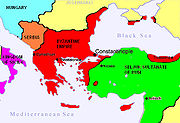
.png)
Byzantine Empire
The Byzantine Empire was the Eastern Roman Empire during the periods of Late Antiquity and the Middle Ages, centred on the capital of Constantinople. Known simply as the Roman Empire or Romania to its inhabitants and neighbours, the Empire was the direct continuation of the Ancient Roman State...
under the Komnenian dynasty
Komnenos
Komnenós or Comnenus was the name of a ruling family of the Eastern Roman Empire , who halted the political decline of the Empire from c.1081 to c.1185.-Origins:...
, from the accession of Alexios I Komnenos
Alexios I Komnenos
Alexios I Komnenos, Latinized as Alexius I Comnenus , was Byzantine emperor from 1081 to 1118, and although he was not the founder of the Komnenian dynasty, it was during his reign that the Komnenos family came to full power. The title 'Nobilissimus' was given to senior army commanders,...
in 1081, to the death of Manuel I Komnenos
Manuel I Komnenos
Manuel I Komnenos was a Byzantine Emperor of the 12th century who reigned over a crucial turning point in the history of Byzantium and the Mediterranean....
in 1180. The Komnenian restoration is also closely linked to the establishment of the Komnenian army
Komnenian army
The Komnenian Byzantine army or Komnenian army was the force established by Byzantine emperor Alexios I Komnenos during the late 11th/early 12th century, and perfected by his successors John II Komnenos and Manuel I Komnenos during the 12th century. Alexios constructed a new army from the ground...
. Although "Byzantine" came to be a common term to refer to the later Eastern Roman Empire, which had its capital at the "New Rome" founded by Constantine
Constantine I
Constantine the Great , also known as Constantine I or Saint Constantine, was Roman Emperor from 306 to 337. Well known for being the first Roman emperor to convert to Christianity, Constantine and co-Emperor Licinius issued the Edict of Milan in 313, which proclaimed religious tolerance of all...
on the site of ancient Byzantium
Byzantium
Byzantium was an ancient Greek city, founded by Greek colonists from Megara in 667 BC and named after their king Byzas . The name Byzantium is a Latinization of the original name Byzantion...
, and later known as Constantinople
Constantinople
Constantinople was the capital of the Roman, Eastern Roman, Byzantine, Latin, and Ottoman Empires. Throughout most of the Middle Ages, Constantinople was Europe's largest and wealthiest city.-Names:...
, it is important to remember that the inhabitants and rulers of this empire called themselves "Romans" and referred to their state as the "Roman Empire" (Greek
Greek language
Greek is an independent branch of the Indo-European family of languages. Native to the southern Balkans, it has the longest documented history of any Indo-European language, spanning 34 centuries of written records. Its writing system has been the Greek alphabet for the majority of its history;...
: , Basileia Rhōmaiōn) or "Romania" .
Dyrrhachium (1081)
The Battle of DyrrhachiumBattle of Dyrrhachium (1081)
The Battle of Dyrrhachium took place on October 18, 1081 between the Byzantine Empire, led by the Emperor Alexius I Comnenus, and the Normans of southern Italy under Robert Guiscard, Duke of Apulia and Calabria...
(near present-day Durres
Durrës
Durrës is the second largest city of Albania located on the central Albanian coast, about west of the capital Tirana. It is one of the most ancient and economically important cities of Albania. Durres is situated at one of the narrower points of the Adriatic Sea, opposite the Italian ports of Bari...
in Albania
Albania
Albania , officially known as the Republic of Albania , is a country in Southeastern Europe, in the Balkans region. It is bordered by Montenegro to the northwest, Kosovo to the northeast, the Republic of Macedonia to the east and Greece to the south and southeast. It has a coast on the Adriatic Sea...
) took place on October 18, 1081, between the Byzantine Empire
Byzantine Empire
The Byzantine Empire was the Eastern Roman Empire during the periods of Late Antiquity and the Middle Ages, centred on the capital of Constantinople. Known simply as the Roman Empire or Romania to its inhabitants and neighbours, the Empire was the direct continuation of the Ancient Roman State...
, led by the Emperor Alexius I, and the Normans
Normans
The Normans were the people who gave their name to Normandy, a region in northern France. They were descended from Norse Viking conquerors of the territory and the native population of Frankish and Gallo-Roman stock...
of Southern Italy under Robert Guiscard
Robert Guiscard
Robert d'Hauteville, known as Guiscard, Duke of Apulia and Calabria, from Latin Viscardus and Old French Viscart, often rendered the Resourceful, the Cunning, the Wily, the Fox, or the Weasel was a Norman adventurer conspicuous in the conquest of southern Italy and Sicily...
, Duke of Apulia & Calabria. The battle was fought outside the city of Dyrrhachium
Durrës
Durrës is the second largest city of Albania located on the central Albanian coast, about west of the capital Tirana. It is one of the most ancient and economically important cities of Albania. Durres is situated at one of the narrower points of the Adriatic Sea, opposite the Italian ports of Bari...
, the Byzantine capital of Illyria
Illyria
In classical antiquity, Illyria was a region in the western part of the Balkan Peninsula inhabited by the Illyrians....
, and ended in a Norman victory.
Following the Norman conquest of Byzantine Italy and Saracen Sicily
Norman conquest of southern Italy
The Norman conquest of southern Italy spanned the late eleventh and much of the twelfth centuries, involving many battles and many independent players conquering territories of their own...
, the Byzantine Emperor, Michael VII
Michael VII
Michael VII Doukas or Ducas , nicknamed Parapinakēs , was Byzantine emperor from 1071 to 1078.- Life :...
, betrothed his son to Robert Guiscard
Robert Guiscard
Robert d'Hauteville, known as Guiscard, Duke of Apulia and Calabria, from Latin Viscardus and Old French Viscart, often rendered the Resourceful, the Cunning, the Wily, the Fox, or the Weasel was a Norman adventurer conspicuous in the conquest of southern Italy and Sicily...
's daughter. When Michael was deposed, Robert took this as an excuse to invade the Byzantine Empire in 1081. His army laid siege to Dyrrhachium, but his fleet was defeated by the Venetians
Venice
Venice is a city in northern Italy which is renowned for the beauty of its setting, its architecture and its artworks. It is the capital of the Veneto region...
. On 18 October, the Normans engaged a Byzantine army under Alexius I Comnenus outside Dyrrhachium. The battle began with the Byzantine right wing routing the Norman left wing, which broke and fled. Varangian
Varangians
The Varangians or Varyags , sometimes referred to as Variagians, were people from the Baltic region, most often associated with Vikings, who from the 9th to 11th centuries ventured eastwards and southwards along the rivers of Eastern Europe, through what is now Russia, Belarus and Ukraine.According...
mercenaries joined in the pursuit of the fleeing Normans, but became separated from the main force and were massacred. Norman knight
Knight
A knight was a member of a class of lower nobility in the High Middle Ages.By the Late Middle Ages, the rank had become associated with the ideals of chivalry, a code of conduct for the perfect courtly Christian warrior....
s in the centre attacked the Byzantine centre and routed it, causing the Byzantines to run away.
After this victory, the Normans took Dyrrhachium in February 1082 and advanced inland, capturing most of Macedonia
Macedonia (region)
Macedonia is a geographical and historical region of the Balkan peninsula in southeastern Europe. Its boundaries have changed considerably over time, but nowadays the region is considered to include parts of five Balkan countries: Greece, the Republic of Macedonia, Bulgaria, Albania, Serbia, as...
and Thessaly
Thessaly
Thessaly is a traditional geographical region and an administrative region of Greece, comprising most of the ancient region of the same name. Before the Greek Dark Ages, Thessaly was known as Aeolia, and appears thus in Homer's Odyssey....
. Robert was then forced to leave Greece
Greece
Greece , officially the Hellenic Republic , and historically Hellas or the Republic of Greece in English, is a country in southeastern Europe....
to deal with an attack on his ally, the Pope
Pope
The Pope is the Bishop of Rome, a position that makes him the leader of the worldwide Catholic Church . In the Catholic Church, the Pope is regarded as the successor of Saint Peter, the Apostle...
by the Holy Roman Emperor
Holy Roman Empire
The Holy Roman Empire was a realm that existed from 962 to 1806 in Central Europe.It was ruled by the Holy Roman Emperor. Its character changed during the Middle Ages and the Early Modern period, when the power of the emperor gradually weakened in favour of the princes...
, Henry IV
Henry IV, Holy Roman Emperor
Henry IV was King of the Romans from 1056 and Holy Roman Emperor from 1084 until his forced abdication in 1105. He was the third emperor of the Salian dynasty and one of the most powerful and important figures of the 11th century...
. Robert left his son Bohemond in charge of the army in Greece. Bohemond was initially successful, defeating Alexius in several battles, but was defeated by Alexius outside Larissa
Larissa
Larissa is the capital and biggest city of the Thessaly region of Greece and capital of the Larissa regional unit. It is a principal agricultural centre and a national transportation hub, linked by road and rail with the port of Volos, the city of Thessaloniki and Athens...
. Forced to retreat to Italy, Bohemond lost all the territory gained by the Normans in the campaign. The Byzantine recovery began the Komnenian restoration.
Levounion (1091)
The Battle of LevounionBattle of Levounion
The Battle of Levounion was the first decisive Byzantine victory of the Komnenian restoration. On April 29, 1091, an invading force of Pechenegs was heavily defeated by the combined forces of the Byzantine Empire under Alexios I Komnenos and his Cuman allies....
was the first decisive Byzantine victory of the Komnenian restoration. On April 29, 1091, an invading force of Pechenegs was heavily defeated by the combined forces of the Byzantine Empire under Alexios I Komnenos and his Cuman allies.
Beroia (1122)
The Battle of BeroiaBattle of Beroia
The Battle of Beroia was fought between the Pechenegs and Emperor John II Komnenos of the Byzantine Empire in the year 1122 in what is now Bulgaria, and resulted in the disappearance of the Pecheneg people as an independent force....
(modern Stara Zagora
Stara Zagora
Stara Zagora is the sixth largest city in Bulgaria, and a nationally important economic center. Located in Southern Bulgaria, it is the administrative capital of the homonymous Stara Zagora Province...
) was fought between the Pechenegs and Emperor John II Komnenos of the Byzantine Empire in the year 1122 in what is now Bulgaria
Bulgaria
Bulgaria , officially the Republic of Bulgaria , is a parliamentary democracy within a unitary constitutional republic in Southeast Europe. The country borders Romania to the north, Serbia and Macedonia to the west, Greece and Turkey to the south, as well as the Black Sea to the east...
, and resulted in the disappearance of the Pecheneg people as an independent force.
Sirmium (1167)
The Battle of SirmiumBattle of Sirmium
The Battle of Sirmium or Battle of Zemun was fought on July 8, 1167 between the Byzantine Empire , and the Kingdom of Hungary...
or Battle of Zemun (Hungarian: zimonyi csata) was fought on July 8, 1167 between the Byzantine Empire (also known as Eastern Roman Empire), and the Kingdom of Hungary
Kingdom of Hungary
The Kingdom of Hungary comprised present-day Hungary, Slovakia and Croatia , Transylvania , Carpatho Ruthenia , Vojvodina , Burgenland , and other smaller territories surrounding present-day Hungary's borders...
. The Byzantines achieved a decisive victory, forcing the Hungarians to sue for peace on Byzantine terms.
Myriokephalon (1176)
The Battle of MyriokephalonBattle of Myriokephalon
The Battle of Myriokephalon, also known as the ', or in Turkish, was a battle between the Byzantine Empire and the Seljuk Turks in Phrygia on September 17, 1176. The battle was a strategic reverse for the Byzantine forces, who were ambushed when moving through a mountain pass...
, also known as the Myriocephalum, or Miryakefalon Savaşı in Turkish, was a battle between the Byzantine Empire and the Seljuk Turks in Phrygia
Phrygia
In antiquity, Phrygia was a kingdom in the west central part of Anatolia, in what is now modern-day Turkey. The Phrygians initially lived in the southern Balkans; according to Herodotus, under the name of Bryges , changing it to Phruges after their final migration to Anatolia, via the...
on September 17, 1176.
End
The Komnenian restoration came to an end in ca. 1185 with the death of the last Komnenian emperor, Andronikos I KomnenosAndronikos I Komnenos
Andronikos I Komnenos was Byzantine Emperor from 1183 to 1185). He was the son of Isaac Komnenos and grandson of Emperor Alexios I Komnenos.-Early years:...
. With his death, the Decline of the Byzantine Empire
Decline of the Byzantine Empire
The decline of the Byzantine Empire was a process similar to the decline of the Western Roman Empire, in that it lasted many centuries. There is no clear consensus on when this process began; but many dates and time lines have been proposed by historians....
recommenced, and by 1204 Byzantium had ceased to be a great power and fell to a diverted force of crusaders who split the empire.