

Brindisi

Encyclopedia
Apulia
Apulia is a region in Southern Italy bordering the Adriatic Sea in the east, the Ionian Sea to the southeast, and the Strait of Òtranto and Gulf of Taranto in the south. Its most southern portion, known as Salento peninsula, forms a high heel on the "boot" of Italy. The region comprises , and...
region of Italy
Italy
Italy , officially the Italian Republic languages]] under the European Charter for Regional or Minority Languages. In each of these, Italy's official name is as follows:;;;;;;;;), is a unitary parliamentary republic in South-Central Europe. To the north it borders France, Switzerland, Austria and...
, the capital of the province of Brindisi
Province of Brindisi
The Province of Brindisi is a province in the Apulia region of Italy. Its capital is the city of Brindisi. Surrounded by vineyards and artichoke fields, Brindisi is a major sailing port for the southern part of Italy....
, off the coast of the Adriatic Sea
Adriatic Sea
The Adriatic Sea is a body of water separating the Italian Peninsula from the Balkan peninsula, and the system of the Apennine Mountains from that of the Dinaric Alps and adjacent ranges...
.
Historically, the city has played an important role in commerce and culture, due to its position on the Italian Peninsula
Italian Peninsula
The Italian Peninsula or Apennine Peninsula is one of the three large peninsulas of Southern Europe , spanning from the Po Valley in the north to the central Mediterranean Sea in the south. The peninsula's shape gives it the nickname Lo Stivale...
and its natural port on the Adriatic Sea
Adriatic Sea
The Adriatic Sea is a body of water separating the Italian Peninsula from the Balkan peninsula, and the system of the Apennine Mountains from that of the Dinaric Alps and adjacent ranges...
. The city is a major port for trade with Greece
Greece
Greece , officially the Hellenic Republic , and historically Hellas or the Republic of Greece in English, is a country in southeastern Europe....
and the Middle East
Middle East
The Middle East is a region that encompasses Western Asia and Northern Africa. It is often used as a synonym for Near East, in opposition to Far East...
. Brindisi has an active industry in agriculture, chemical and energy production.
Geography
Brindisi is situated on a natural harbor, that penetrates deeply into the Adriatic coast of Puglia. Within the arms of the outer harbor islands are Pedagne, a tiny archipelago, currently not open and in use for military purposes (United NationsUnited Nations
The United Nations is an international organization whose stated aims are facilitating cooperation in international law, international security, economic development, social progress, human rights, and achievement of world peace...
Group Schools used during the intervention in Bosnia).
The entire municipality is part of the Brindisi Plain, characterized by high agricultural uses of its land. It is located in the northeastern part of the Salento plains, about 40 km (24.85 mi) from the Itria Valley
Itria Valley
Itria Valley is an area located in Apulia region, in Southern Italy.Itria Valley spreads over Province of Bari, Province of Brindisi and Province of Taranto, and coincide with the lower part of Murgia upland .The towns of Martina Franca, Locorotondo, Cisternino and Ceglie Messapica overlook Itria...
, and the low Murge. Not far from the city is the Natural Marine Reserve of the World Wide Fund for Nature
World Wide Fund for Nature
The World Wide Fund for Nature is an international non-governmental organization working on issues regarding the conservation, research and restoration of the environment, formerly named the World Wildlife Fund, which remains its official name in Canada and the United States...
of Torre Guaceto. The Ionian Sea
Ionian Sea
The Ionian Sea , is an arm of the Mediterranean Sea, south of the Adriatic Sea. It is bounded by southern Italy including Calabria, Sicily and the Salento peninsula to the west, southern Albania to the north, and a large number of Greek islands, including Corfu, Zante, Kephalonia, Ithaka, and...
is located about 45 km (27.96 mi) away.
Territory
The territory of Brindisi is characterized by a wide flat area from which emerge sub deposits of limestoneLimestone
Limestone is a sedimentary rock composed largely of the minerals calcite and aragonite, which are different crystal forms of calcium carbonate . Many limestones are composed from skeletal fragments of marine organisms such as coral or foraminifera....
and sand of marine origin, which in turn have a deeper level clay
Clay
Clay is a general term including many combinations of one or more clay minerals with traces of metal oxides and organic matter. Geologic clay deposits are mostly composed of phyllosilicate minerals containing variable amounts of water trapped in the mineral structure.- Formation :Clay minerals...
of the Pleistocene
Pleistocene
The Pleistocene is the epoch from 2,588,000 to 11,700 years BP that spans the world's recent period of repeated glaciations. The name pleistocene is derived from the Greek and ....
era, and an even later Mesozoic
Mesozoic
The Mesozoic era is an interval of geological time from about 250 million years ago to about 65 million years ago. It is often referred to as the age of reptiles because reptiles, namely dinosaurs, were the dominant terrestrial and marine vertebrates of the time...
carbonate
Carbonate
In chemistry, a carbonate is a salt of carbonic acid, characterized by the presence of the carbonate ion, . The name may also mean an ester of carbonic acid, an organic compound containing the carbonate group C2....
composed of limestone and soils. The development of agriculture, has caused an increase in the use of water resources resulting in an increase of indiscriminate use.
Climate
Climate classificationClimate classification
Climate classification systems are ways of classifying the world's climates. A climate classification may correlate closely with a biome category, as climate is a major influence on biological life in a region...
of Brindisi:
- Climatic zone Csa (Mediterranean climateMediterranean climateA Mediterranean climate is the climate typical of most of the lands in the Mediterranean Basin, and is a particular variety of subtropical climate...
) - Degree days 1083.
Ancient times

Diomedes
Diomedes or Diomed is a hero in Greek mythology, known for his participation in the Trojan War.He was born to Tydeus and Deipyle and later became King of Argos, succeeding his maternal grandfather, Adrastus. In Homer's Iliad Diomedes is regarded alongside Ajax as one of the best warriors of all...
.
Brindisi was an Ancient Greek
Ancient Greek
Ancient Greek is the stage of the Greek language in the periods spanning the times c. 9th–6th centuries BC, , c. 5th–4th centuries BC , and the c. 3rd century BC – 6th century AD of ancient Greece and the ancient world; being predated in the 2nd millennium BC by Mycenaean Greek...
settlement predating the Roman
Ancient Rome
Ancient Rome was a thriving civilization that grew on the Italian Peninsula as early as the 8th century BC. Located along the Mediterranean Sea and centered on the city of Rome, it expanded to one of the largest empires in the ancient world....
expansion. The Latin name Brundisium comes from the Greek Brentesion (Βρεντήσιον) meaning "deer's head", which refers to the shape of the natural harbor. In 267 BC (245 BC, according to other sources) it was conquered by the Romans.
In the promontory of the Punta lands, which is located in the outer harbor have been identified as a Bronze Age
Bronze Age
The Bronze Age is a period characterized by the use of copper and its alloy bronze as the chief hard materials in the manufacture of some implements and weapons. Chronologically, it stands between the Stone Age and Iron Age...
village (sixteenth century BC) where a group of huts, protected by an embankment of stones, yielded fragments of Mycenaean
Mycenaean Greece
Mycenaean Greece was a cultural period of Bronze Age Greece taking its name from the archaeological site of Mycenae in northeastern Argolis, in the Peloponnese of southern Greece. Athens, Pylos, Thebes, and Tiryns are also important Mycenaean sites...
pottery. Herodotus
Herodotus
Herodotus was an ancient Greek historian who was born in Halicarnassus, Caria and lived in the 5th century BC . He has been called the "Father of History", and was the first historian known to collect his materials systematically, test their accuracy to a certain extent and arrange them in a...
spoke of the Mycenaean origin for these populations. The necropoli of Tor Pisana (south of the old town of Brindisi) returned Corinth
Corinth
Corinth is a city and former municipality in Corinthia, Peloponnese, Greece. Since the 2011 local government reform it is part of the municipality Corinth, of which it is the seat and a municipal unit...
ian jars in the first half of the seventh century BC. The Brindisi Messapia
Messapii
thumb|220px|Messapic ceramic, Archaeological Museum of [[Oria, Italy|Oria]], Apulia.The Messapii were an ancient tribe that inhabited, in historical times, the south-eastern peninsula or "heel" of Italy , known variously in ancient times as Calabria, Messapia and Iapygia...
certainly entertained strong business relationships with the opposite side of the Adriatic and the Greek populations of the Aegean Sea
Aegean Sea
The Aegean Sea[p] is an elongated embayment of the Mediterranean Sea located between the southern Balkan and Anatolian peninsulas, i.e., between the mainlands of Greece and Turkey. In the north, it is connected to the Marmara Sea and Black Sea by the Dardanelles and Bosporus...
.
After the Punic Wars
Punic Wars
The Punic Wars were a series of three wars fought between Rome and Carthage from 264 B.C.E. to 146 B.C.E. At the time, they were probably the largest wars that had ever taken place...
it became a major center of Roman naval power and maritime trade. In the Social War it received Roman citizenship, and was made a free port by Sulla
Lucius Cornelius Sulla
Lucius Cornelius Sulla Felix , known commonly as Sulla, was a Roman general and statesman. He had the rare distinction of holding the office of consul twice, as well as that of dictator...
. It suffered, however, from a siege conducted by Caesar
Julius Caesar
Gaius Julius Caesar was a Roman general and statesman and a distinguished writer of Latin prose. He played a critical role in the gradual transformation of the Roman Republic into the Roman Empire....
in 49 BC (Bell. Civ. i.) and was again attacked in 42 and 40 BC.
The poet Pacuvius
Pacuvius
Marcus Pacuvius was the greatest of the tragic poets of ancient Rome prior to Lucius Accius.He was the nephew and pupil of Ennius, by whom Roman tragedy was first raised to a position of influence and dignity...
was born here about 220 BC, and here the famous poet Virgil
Virgil
Publius Vergilius Maro, usually called Virgil or Vergil in English , was an ancient Roman poet of the Augustan period. He is known for three major works of Latin literature, the Eclogues , the Georgics, and the epic Aeneid...
died in 19 BC. Under the Romans, Brundisium - a large city in its day with some 100,000 inhabitants - was an active port, the chief point of embarkation for Greece
Greece
Greece , officially the Hellenic Republic , and historically Hellas or the Republic of Greece in English, is a country in southeastern Europe....
and the East, via Dyrrachium
Durrës
Durrës is the second largest city of Albania located on the central Albanian coast, about west of the capital Tirana. It is one of the most ancient and economically important cities of Albania. Durres is situated at one of the narrower points of the Adriatic Sea, opposite the Italian ports of Bari...
or Corcyra. It was connected with Rome by the Via Appia and the Via Traiana
Via Traiana
300px|thumb|Via TraianaThe Via Traiana was an ancient Roman road. It was built by the emperor Trajan as an extension of the Via Appia from Beneventum, reaching Brundisium by a shorter route...
. The termination of the Via Appia, at the water's edge, was formerly flanked by two fine pillars. Only one remains, the second having been misappropriated and removed to the neighbouring town of Lecce
Lecce
Lecce is a historic city of 95,200 inhabitants in southern Italy, the capital of the province of Lecce, the second province in the region by population, as well as one of the most important cities of Puglia...
.
Middle Ages and modern times
Later Brindisi was conquered by Ostrogoths, and reconquered by the Byzantine EmpireByzantine Empire
The Byzantine Empire was the Eastern Roman Empire during the periods of Late Antiquity and the Middle Ages, centred on the capital of Constantinople. Known simply as the Roman Empire or Romania to its inhabitants and neighbours, the Empire was the direct continuation of the Ancient Roman State...
in the 6th century CE. In 674 it was destroyed by the Lombards
Lombards
The Lombards , also referred to as Longobards, were a Germanic tribe of Scandinavian origin, who from 568 to 774 ruled a Kingdom in Italy...
led by Romuald I
Romuald I of Benevento
Romuald I , duke of Benevento was the son of Grimoald, king of the Lombards. He received Benevento when his father usurped the throne in 662. Grimoald sent the deposed king Perctarit's wife Rodelinde and son Cunincpert to the court of his son in Benevento.Romuald betrothed his sister Gisa to...
of Benevento
Duchy of Benevento
The Duchy and later Principality of Benevento was the southernmost Lombard duchy in medieval Italy, centred on Benevento, a city central in the Mezzogiorno. Owing to the Ducatus Romanus of the popes, which cut it off from the rest of Lombard Italy, Benevento was from the first practically...
, but such a fine natural harbor meant that the city was soon rebuilt. In the 9th century, a Saracen settlement existed in the neighborhood of the city, which had been stormed in 836 by pirates.
In 1070, it was conquered by the Normans and became part of the Principality of Taranto
Principality of Taranto
The Principality of Taranto was a state in southern Italy created in 1088 for Bohemond I, eldest son of Robert Guiscard, as part of the peace between him and his younger brother Roger Borsa after a dispute over the succession to the Duchy of Apulia....
and the Duchy of Apulia, and was the first rule of the Counts of Conversano
Conversano
Conversano is an ancient town and comune in the province of Bari, Apulia, southern Italy. It is located 30 km south-east of Bari, 7 km from the Adriatic coast, at 219 m above sea-level....
and then, after the baronial revolt of 1132, city-owned by the will of Roger II of Sicily
Roger II of Sicily
Roger II was King of Sicily, son of Roger I of Sicily and successor to his brother Simon. He began his rule as Count of Sicily in 1105, later became Duke of Apulia and Calabria , then King of Sicily...
, the city recovered some of the splendor of the past during the period of the Crusades
Crusades
The Crusades were a series of religious wars, blessed by the Pope and the Catholic Church with the main goal of restoring Christian access to the holy places in and near Jerusalem...
, when it regained the Episcopal See
Episcopal See
An episcopal see is, in the original sense, the official seat of a bishop. This seat, which is also referred to as the bishop's cathedra, is placed in the bishop's principal church, which is therefore called the bishop's cathedral...
, saw the construction of the new cathedral and a castle with an important new arsenal, became a privileged port for the Holy Land
Holy Land
The Holy Land is a term which in Judaism refers to the Kingdom of Israel as defined in the Tanakh. For Jews, the Land's identifiction of being Holy is defined in Judaism by its differentiation from other lands by virtue of the practice of Judaism often possible only in the Land of Israel...
.
It was in the Cathedral of Brindisi that the wedding of Norman Prince Roger III of Sicily
Roger III of Sicily
Roger III was the son and heir of Tancred of Sicily by Sibylla of Acerra. He was made duke of Apulia, probably in 1189, at his father's succession....
took place, son of King Tancred of Sicily
Tancred of Sicily
Tancred was King of Sicily from 1189 to 1194. He was an illegitimate son of Roger III, Duke of Apulia, the eldest son of King Roger II, and of Emma, daughter of Achard II, Count of Lecce...
. Emperor Frederick II
Frederick II, Holy Roman Emperor
Frederick II , was one of the most powerful Holy Roman Emperors of the Middle Ages and head of the House of Hohenstaufen. His political and cultural ambitions, based in Sicily and stretching through Italy to Germany, and even to Jerusalem, were enormous...
, the heir to the crown of Jerusalem and Isabella of Brienne
Isabella of Brienne
Isabella of Brienne was suo jure Countess of Lecce and Conversano, claimant to the Duchy of Athens and Kingdom of Jerusalem, etc.-Family and early years:...
( 9 November 1225 ) started from the port of Brindisi in 1227 for the Sixth Crusade
Sixth Crusade
The Sixth Crusade started in 1228 as an attempt to regain Jerusalem. It began seven years after the failure of the Fifth Crusade. It involved very little actual fighting...
Like other Pugliese ports, Brindisi for a short while was ruled by Venice
Republic of Venice
The Republic of Venice or Venetian Republic was a state originating from the city of Venice in Northeastern Italy. It existed for over a millennium, from the late 7th century until 1797. It was formally known as the Most Serene Republic of Venice and is often referred to as La Serenissima, in...
, but was soon reconquered by Spain
Spain
Spain , officially the Kingdom of Spain languages]] under the European Charter for Regional or Minority Languages. In each of these, Spain's official name is as follows:;;;;;;), is a country and member state of the European Union located in southwestern Europe on the Iberian Peninsula...
.
A plague and an earthquake struck the city, in 1348 and 1456.
Brindisi fell to Austrian
Austrian Empire
The Austrian Empire was a modern era successor empire, which was centered on what is today's Austria and which officially lasted from 1804 to 1867. It was followed by the Empire of Austria-Hungary, whose proclamation was a diplomatic move that elevated Hungary's status within the Austrian Empire...
rule in 1707–1734, and afterwards to the Bourbons. Between September 1943 and February 1944 the city functioned as the temporary capital of Italy.
Brindisi is also noteworthy because it hosted King Victor Emmanuel III, Pietro Badoglio
Pietro Badoglio
Pietro Badoglio, 1st Duke of Addis Abeba, 1st Marquess of Sabotino was an Italian soldier and politician...
and a part of the Italian armed forces command in September 1943 after the armistice with Italy
Armistice with Italy
The Armistice with Italy was an armistice signed on September 3 and publicly declared on September 8, 1943, during World War II, between Italy and the Allied armed forces, who were then occupying the southern end of the country, entailing the capitulation of Italy...
.
In the 21st century, Brindisi serves as the home base of the San Marco Regiment
San Marco Regiment
The San Marco Regiment , located in Brindisi, are the marines of the Italian Navy. Until the middle of the 1990s the unit was known as the “San Marco Battalion” , until it was expanded beyond battalion size because of the new geopolitical situation after the end of the Cold War and an increasing...
, a marine brigade originally known as the La Marina Regiment. It was renamed San Marco after its noted defense of Venice at the start of World War I
World War I
World War I , which was predominantly called the World War or the Great War from its occurrence until 1939, and the First World War or World War I thereafter, was a major war centred in Europe that began on 28 July 1914 and lasted until 11 November 1918...
.
Etymology
The name comes through the Latin Brundisium through the Greek Brentesion and Messapi Brention meaning “head of deer”. The city's name appears, therefore, refer to the shape of the port which recalls the shape of the head of the animal.Heraldry
The emblemEmblem
An emblem is a pictorial image, abstract or representational, that epitomizes a concept — e.g., a moral truth, or an allegory — or that represents a person, such as a king or saint.-Distinction: emblem and symbol:...
of the city of Brindisi, relates to certain unique characteristics of the ancient city of Brindisi, some of them still visible today. The head of deer derives from the Messapic name of the city Brention, name inspired by the shape of the port city, which is reminiscent, of the antlers of a stag that is still clearly visible in satellite photos, which show the two racks, to the east and west, in which the port is divided. The emblem also contains the so-called "terminal columns" of the Appian Way
Appian Way
The Appian Way was one of the earliest and strategically most important Roman roads of the ancient republic. It connected Rome to Brindisi, Apulia, in southeast Italy...
.
Main sights
- The Castello Svevo or Castello Grande ("HohenstaufenHohenstaufenThe House of Hohenstaufen was a dynasty of German kings in the High Middle Ages, lasting from 1138 to 1254. Three of these kings were also crowned Holy Roman Emperor. In 1194 the Hohenstaufens also became Kings of Sicily...
Castle" or "Large Castle"), built by emperor Frederick IIFrederick II, Holy Roman EmperorFrederick II , was one of the most powerful Holy Roman Emperors of the Middle Ages and head of the House of Hohenstaufen. His political and cultural ambitions, based in Sicily and stretching through Italy to Germany, and even to Jerusalem, were enormous...
. It has a trapezoidTrapezoidIn Euclidean geometry, a convex quadrilateral with one pair of parallel sides is referred to as a trapezoid in American English and as a trapezium in English outside North America. A trapezoid with vertices ABCD is denoted...
plan with massive square towers. Under the Crown of AragonCrown of AragonThe Crown of Aragon Corona d'Aragón Corona d'Aragó Corona Aragonum controlling a large portion of the present-day eastern Spain and southeastern France, as well as some of the major islands and mainland possessions stretching across the Mediterranean as far as Greece...
four towers were added to the original 13th century structure. After centuries of being abandon, in 1813 Joachim MuratJoachim MuratJoachim-Napoléon Murat , Marshal of France and Grand Admiral or Admiral of France, 1st Prince Murat, was Grand Duke of Berg from 1806 to 1808 and then King of Naples from 1808 to 1815...
turned it into a penitentiary; after 1909 it is used by the Italian NavyItalian NavyItalian Navy may refer to:* Pre-unitarian navies of the Italian states* Regia Marina, the Royal Navy of the Kingdom of Italy * Italian Navy , the navy of the Italian Republic...
. During World War IIWorld War IIWorld War II, or the Second World War , was a global conflict lasting from 1939 to 1945, involving most of the world's nations—including all of the great powers—eventually forming two opposing military alliances: the Allies and the Axis...
, it was briefly the residence of King Victor Emmanuel III. - The Catalan-AragoneseCrown of AragonThe Crown of Aragon Corona d'Aragón Corona d'Aragó Corona Aragonum controlling a large portion of the present-day eastern Spain and southeastern France, as well as some of the major islands and mainland possessions stretching across the Mediterranean as far as Greece...
Castle, best known as Forte a Mare ("Sea Fort"). It was built by King Ferdinand I of NaplesFerdinand I of NaplesFerdinand I , also called Don Ferrante, was the King of Naples from 1458 to 1494. He was the natural son of Alfonso V of Aragon by Giraldona Carlino.-Biography:...
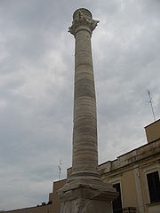
in 1491 on the S. Andrea island facing the port. It is divided into two section: the "Red Castle" (from the color of its bricks) and the more recent Fort. - Two ancient Roman columns, symbols of Brindisi. They were once thought to be mark the ending points of the Appian WayAppian WayThe Appian Way was one of the earliest and strategically most important Roman roads of the ancient republic. It connected Rome to Brindisi, Apulia, in southeast Italy...
, instead they were used as a port reference for the antique mariners. Only one of the two, standing at 18.74 m, is now visible. The other crumbled in 1582, and the ruins was given to LecceLecceLecce is a historic city of 95,200 inhabitants in southern Italy, the capital of the province of Lecce, the second province in the region by population, as well as one of the most important cities of Puglia...
to hold the statue of Saint Oronzo (Lecce's patron), because Saint Oronzo was reputed to have cured the plague in Brindisi. - the Duomo (Cathedral), built in Romanesque styleRomanesque architectureRomanesque architecture is an architectural style of Medieval Europe characterised by semi-circular arches. There is no consensus for the beginning date of the Romanesque architecture, with proposals ranging from the 6th to the 10th century. It developed in the 12th century into the Gothic style,...
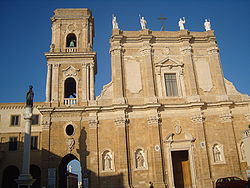
in the 11th-12th centuries. What is visible today is the 18th century reconstruction, after the original was desotryed by an earthquake on February 20, 1743. Parts of the original mosaic pavement can be seen in the interior. - Church of Santa Maria del Casale (late 13th century), in Gothic-Romanesque style. The façade has a geometrical pattern of gray and yellow stones, with an entrance cusp-covered portico. The interior has early-14th century frescoes including, in the counter-façade, a Last Judgement in four sections, by Rinaldo da Taranto. They are in late-Byzantine style.
- Church of San Benedetto, in Romanesque style. Perhaps built before the 11th century as part of female Benedictine nunnery, it has a massive bell tower with triple mullioned windows and Lombard bands. A side portal is decorated with 11th century motifs, while the interior has a nave covered by cross vaults, while the aisles, separated by columns with Romanesque capitals, have half-barrel vaults. The cloister 811th century) has decorated capitals.
- Portico of the Templars (13th century). Despite the name, it was in reality the loggiaLoggiaLoggia is the name given to an architectural feature, originally of Minoan design. They are often a gallery or corridor at ground level, sometimes higher, on the facade of a building and open to the air on one side, where it is supported by columns or pierced openings in the wall...
of the bishop's palace. It is now the entrance to the Museo Ribezzo. - the Fontana Grande (Grand Fountain), built by the Romans on the Appian Way. It was restored in 1192 by Tancred of Lecce.
- Piazza della Vittoria (Victory Square). It has a 17th-century fountain.
- Church of Santa Maria degli Angeli (1609).
- Church of the Holy Heart.
- Church of San Giovanni al Sepolcro, with circular plan, dating from the 12th century.
- Church of the Santissima Trinità (or Santa Lucia, 14th century). It has a late 12th century cryptCryptIn architecture, a crypt is a stone chamber or vault beneath the floor of a burial vault possibly containing sarcophagi, coffins or relics....
. - the Monument to Italian Sailors
Natural Areas
Within the territory of the town of Brindisi environmental protected areas are located, some newly established:- The Regional Natural Park of Punta della Contessa Salt: wetlandWetlandA wetland is an area of land whose soil is saturated with water either permanently or seasonally. Wetlands are categorised by their characteristic vegetation, which is adapted to these unique soil conditions....
, 214 acre (86.6 ha) wide, that develops between Capo di Torre Cavallo and Punta della Contessa - The Regional Nature Reserve Forest Cerano: a protected natural area that falls within the territory of Brindisi and San Pietro VernoticoSan Pietro VernoticoSan Pietro Vernotico is a town and comune in the province of Brindisi in Puglia, on the south-east Italy coast. Its main economic activities are tourism and the growing of olives and grapes...
; - The Regional Nature Reserve Bosco of Santa Teresa and Lucci: it is a protected natural area composed of two forests whose name it bears. With the EU Directive 92/43 EEC, was included in the list of Sites of Community Importance (SCI) ;
- The Marine Nature Reserve Guaceto Tower: falling mostly in the municipality of CarovignoCarovignoCarovigno is a town and comune in the province of Brindisi, Puglia, Italy. Its area, part of Upper Salento, is renowned for the production of high quality olive oil.-International relations:Carovigno is twinned with: Corfu, Greece- External links :*...
, are managed by a consortium which includes the municipalities of Brindisi, Carovigno and the WWFWorld Wide Fund for NatureThe World Wide Fund for Nature is an international non-governmental organization working on issues regarding the conservation, research and restoration of the environment, formerly named the World Wildlife Fund, which remains its official name in Canada and the United States...
.
Migration
Brindisi has been the subject of extensive emigrationEmigration
Emigration is the act of leaving one's country or region to settle in another. It is the same as immigration but from the perspective of the country of origin. Human movement before the establishment of political boundaries or within one state is termed migration. There are many reasons why people...
during the twentieth century, as well as all cities in the South. Emigration focused mainly on the lower strata of society who abandoned the countryside. Emigration can be traced in two great waves. The first, which at its peak in the years immediately preceding and following the World War I
World War I
World War I , which was predominantly called the World War or the Great War from its occurrence until 1939, and the First World War or World War I thereafter, was a major war centred in Europe that began on 28 July 1914 and lasted until 11 November 1918...
, has an exclusive destination for the Americas
Americas
The Americas, or America , are lands in the Western hemisphere, also known as the New World. In English, the plural form the Americas is often used to refer to the landmasses of North America and South America with their associated islands and regions, while the singular form America is primarily...
(USA, Argentina
Argentina
Argentina , officially the Argentine Republic , is the second largest country in South America by land area, after Brazil. It is constituted as a federation of 23 provinces and an autonomous city, Buenos Aires...
, Brazil
Brazil
Brazil , officially the Federative Republic of Brazil , is the largest country in South America. It is the world's fifth largest country, both by geographical area and by population with over 192 million people...
). The second Puglia migration headed to Northern Europe after the World War II
World War II
World War II, or the Second World War , was a global conflict lasting from 1939 to 1945, involving most of the world's nations—including all of the great powers—eventually forming two opposing military alliances: the Allies and the Axis...
. Attracted by the industrial development of some northern areas of the country Puglia migration also settled in the Piedmont
Piedmont
Piedmont is one of the 20 regions of Italy. It has an area of 25,402 square kilometres and a population of about 4.4 million. The capital of Piedmont is Turin. The main local language is Piedmontese. Occitan is also spoken by a minority in the Occitan Valleys situated in the Provinces of...
and Lombardy
Lombardy
Lombardy is one of the 20 regions of Italy. The capital is Milan. One-sixth of Italy's population lives in Lombardy and about one fifth of Italy's GDP is produced in this region, making it the most populous and richest region in the country and one of the richest in the whole of Europe...
, and in particular Milan
Milan
Milan is the second-largest city in Italy and the capital city of the region of Lombardy and of the province of Milan. The city proper has a population of about 1.3 million, while its urban area, roughly coinciding with its administrative province and the bordering Province of Monza and Brianza ,...
.
Since the 1960s with the large petrochemical
Petrochemical
Petrochemicals are chemical products derived from petroleum. Some chemical compounds made from petroleum are also obtained from other fossil fuels, such as coal or natural gas, or renewable sources such as corn or sugar cane....
companies construction that were added to for mechanical and naval aviation, Brindisi was able to create employment opportunities for technicians and workers. The city experienced a small regional immigration, attracting families from neighboring provinces and regions.
Another important chapter in the demography
Demography
Demography is the statistical study of human population. It can be a very general science that can be applied to any kind of dynamic human population, that is, one that changes over time or space...
town was definitely the exodus of Albanians
Albanians
Albanians are a nation and ethnic group native to Albania and neighbouring countries. They speak the Albanian language. More than half of all Albanians live in Albania and Kosovo...
1990-1991(which actually lasted almost a decade) which led in the port of Brindisi waves of landing immigrants.
Brindisi today is a city that is also undergoing a regular immigration from outside the community, although the differences are far from the cities of northern Italy .
Ethnic groups
The largest non-Italian ethnic community is AlbaniaAlbania
Albania , officially known as the Republic of Albania , is a country in Southeastern Europe, in the Balkans region. It is bordered by Montenegro to the northwest, Kosovo to the northeast, the Republic of Macedonia to the east and Greece to the south and southeast. It has a coast on the Adriatic Sea...
n. The number of those who decided to stay in the city, however, is very negligible compared to the total number of immigrants who have migrated. Brindisi remains the first step towards western Europe for displaced Balkans.
The large number of Americans is due to a U.S. Air Force station, between Brindisi and San Vito dei Normanni
San Vito dei Normanni
San Vito dei Normanni is an Italian town of 19,947 inhabitants of the province of Brindisi in Puglia. The inhabitants are called Sanvitesi and the town is sometimes referred to as San Vito....
that operated throughout the second half of the twentieth century. Although the base is no longer operational for years, many soldiers have decided to stay.
The British
United Kingdom
The United Kingdom of Great Britain and Northern IrelandIn the United Kingdom and Dependencies, other languages have been officially recognised as legitimate autochthonous languages under the European Charter for Regional or Minority Languages...
presence is the result of a recent phenomenon of families from Northern Europe, especially English
English people
The English are a nation and ethnic group native to England, who speak English. The English identity is of early mediaeval origin, when they were known in Old English as the Anglecynn. England is now a country of the United Kingdom, and the majority of English people in England are British Citizens...
and Irish
Irish people
The Irish people are an ethnic group who originate in Ireland, an island in northwestern Europe. Ireland has been populated for around 9,000 years , with the Irish people's earliest ancestors recorded having legends of being descended from groups such as the Nemedians, Fomorians, Fir Bolg, Tuatha...
that seems to settle into the region. These families usually consist of pensioners, buying villas in the Brindisi countryside. This phenomenon is relatively recent in Puglia, is known as "Salentoshire" playful neologism along the lines of "Chiantishire" on the consolidation of British tourism in Tuscany
Tuscany
Tuscany is a region in Italy. It has an area of about 23,000 square kilometres and a population of about 3.75 million inhabitants. The regional capital is Florence ....
.
Languages and dialects
The Brindisi dialect is a variant of Salento and, although there are minor differences between the various municipalities, the root remains unchanged. It is spoken not only in Brindisi, but in some towns of the province of TarantoTaranto
Taranto is a coastal city in Apulia, Southern Italy. It is the capital of the Province of Taranto and is an important commercial port as well as the main Italian naval base....
. The Brindisi also affects some dialects north of Lecce
Lecce
Lecce is a historic city of 95,200 inhabitants in southern Italy, the capital of the province of Lecce, the second province in the region by population, as well as one of the most important cities of Puglia...
in the south
Religion
Brindisi, along with OstuniOstuni
Ostuni is a city and comune in the province of Brindisi , with a population of about 32,000 located about 8 km from the coast. Its main economic activities include tourism, attracted by its nearby pristine beaches, as well as a vibrant olive and grape agribusiness.- History :The region around...
, is home of the Archdiocese of Brindisi-Ostuni (Archidioecesis Brundusina-Ostunensis in Latin ), home of the Roman Catholic Church suffragan
Suffragan bishop
A suffragan bishop is a bishop subordinate to a metropolitan bishop or diocesan bishop. He or she may be assigned to an area which does not have a cathedral of its own.-Anglican Communion:...
of Archdiocese of Lecce and part of the ecclesiastical region of Puglia. The diocese was erected in the fourth century, its first bishop was St. Leucio of Alexandria. In the tenth century following the destruction of the city by the Saracens, the bishops established their residence in Oria. It was in this century that established the Diocese of Ostuni, first joined the Diocese of Conversano
Conversano
Conversano is an ancient town and comune in the province of Bari, Apulia, southern Italy. It is located 30 km south-east of Bari, 7 km from the Adriatic coast, at 219 m above sea-level....
-Monopoli
Monopoli
Monopoli is a town and comune in Italy, in the province of Bari, region of Apulia. The town is roughly in area and lies about 40 km southeast from Bari. It has about 50,000 inhabitants....
and likely heir to the ancient diocese of Egnatia
Gnatia
Gnatia was an ancient city of the Messapii, and their frontier town towards the Salentini. located near the modern Fasano, Apulia, southern Italy.-History:...
. On 30 September 1986, by decree of the Congregation for Bishops
Congregation for Bishops
The Congregation for Bishops is the congregation of the Roman Curia which oversees the selection of new bishops that are not in mission territories or those areas that come under the jurisdiction of the Congregation for the Oriental Churches who deal with the Eastern Catholics, pending papal...
, the Archdiocese of Brindisi and Ostuni diocese were united in the Archdiocese of Brindisi-Ostuni plena. The new diocese was recognized civilly 20 October 1986, by decree of the Ministry of Interior .
It has a living presence of the ancient Orthodox Church with the parish of St. Nicholas of Myra Byzantine Rite
Byzantine Rite
The Byzantine Rite, sometimes called the Rite of Constantinople or Constantinopolitan Rite is the liturgical rite used currently by all the Eastern Orthodox Churches, by the Greek Catholic Churches , and by the Protestant Ukrainian Lutheran Church...
. The rite of the Greek presence in Brindisi has long been established since the rule of the Byzantine Empire
Byzantine Empire
The Byzantine Empire was the Eastern Roman Empire during the periods of Late Antiquity and the Middle Ages, centred on the capital of Constantinople. Known simply as the Roman Empire or Romania to its inhabitants and neighbours, the Empire was the direct continuation of the Ancient Roman State...
with a strong spread of the Basilian monks.
The Jews
Jews
The Jews , also known as the Jewish people, are a nation and ethnoreligious group originating in the Israelites or Hebrews of the Ancient Near East. The Jewish ethnicity, nationality, and religion are strongly interrelated, as Judaism is the traditional faith of the Jewish nation...
were a small but industrious community from 53 AD until the second half of the sixteenth century. The new Albanian migration has led to the recurrence of some islamic religious presence.
Traditions and folklore
Significant in Brindisi is the cult of Tarantismo that combines paganPaganism
Paganism is a blanket term, typically used to refer to non-Abrahamic, indigenous polytheistic religious traditions....
and Christian
Christianity
Christianity is a monotheistic religion based on the life and teachings of Jesus as presented in canonical gospels and other New Testament writings...
tradition. In the past it was believed that women who showed forms of hysteria
Hysteria
Hysteria, in its colloquial use, describes unmanageable emotional excesses. People who are "hysterical" often lose self-control due to an overwhelming fear that may be caused by multiple events in one's past that involved some sort of severe conflict; the fear can be centered on a body part, or,...
were infected by the bite of a Lycosa tarantula
Lycosa tarantula
The tarantula wolf spider or just tarantula is a wolf spider found in southern Europe, especially in Italy and near the city of Taranto...
. The only known remedy was to dance continuously for days, so that the poison did not cause greater effect.
Through music and dance was created a real exorcism
Exorcism
Exorcism is the religious practice of evicting demons or other spiritual entities from a person or place which they are believed to have possessed...
in musical character. Each time a tarantato exhibited symptoms associated with Taranto, the tambourine
Tambourine
The tambourine or marine is a musical instrument of the percussion family consisting of a frame, often of wood or plastic, with pairs of small metal jingles, called "zils". Classically the term tambourine denotes an instrument with a drumhead, though some variants may not have a head at all....
, fiddle
Fiddle
The term fiddle may refer to any bowed string musical instrument, most often the violin. It is also a colloquial term for the instrument used by players in all genres, including classical music...
, mandolin
Mandolin
A mandolin is a musical instrument in the lute family . It descends from the mandore, a soprano member of the lute family. The mandolin soundboard comes in many shapes—but generally round or teardrop-shaped, sometimes with scrolls or other projections. A mandolin may have f-holes, or a single...
, guitar
Guitar
The guitar is a plucked string instrument, usually played with fingers or a pick. The guitar consists of a body with a rigid neck to which the strings, generally six in number, are attached. Guitars are traditionally constructed of various woods and strung with animal gut or, more recently, with...
and accordion
Accordion
The accordion is a box-shaped musical instrument of the bellows-driven free-reed aerophone family, sometimes referred to as a squeezebox. A person who plays the accordion is called an accordionist....
players went in the house of the tarantato and began to do to play the pinch music with frenetic rhythms. The Brindisi pinch, as opposed to Lecce, is devoid of Christian references and a therapeutic repertoire and musical detail.
Libraries
The Provincial Library is a public library located in Commenda avenue. It has over 100,000 books and an extensive newspaper archive and participates in the National Library Service. Inside a modern auditorium, a media office and the secretariats of the university offices of BariBari
Bari is the capital city of the province of Bari and of the Apulia region, on the Adriatic Sea, in Italy. It is the second most important economic centre of mainland Southern Italy after Naples, and is well known as a port and university city, as well as the city of Saint Nicholas...
and Lecce
Lecce
Lecce is a historic city of 95,200 inhabitants in southern Italy, the capital of the province of Lecce, the second province in the region by population, as well as one of the most important cities of Puglia...
operate.
The Archbishop Annibale De Leo Library is a prestigious public library housed in the Seminary of Brindisi, in Piazza Duomo. Founded in 1798 by archbishop of Brindisi Annibale De Leo, with an endowment of about 6,000 volumes, today it has over 20,000 volumes, 17 incunable, over 200 sixteenth-century manuscripts. These include some rare works, and various manuscript collections.
University
The University of Salento Brindisi has social sciences, politics and geography faculty with courses in SociologySociology
Sociology is the study of society. It is a social science—a term with which it is sometimes synonymous—which uses various methods of empirical investigation and critical analysis to develop a body of knowledge about human social activity...
, Social Services and Political Science
Political science
Political Science is a social science discipline concerned with the study of the state, government and politics. Aristotle defined it as the study of the state. It deals extensively with the theory and practice of politics, and the analysis of political systems and political behavior...
.
The University of Bari
University of Bari
The University of Bari is a university located in Bari, Italy. It was founded in 1925 and is organized in 12 Faculties.-Organization:These are the 13 faculties in which the university is divided into:* Faculty of Agricultural Science...
has courses in Business Administration, Management and Consulting, Economics
Economics
Economics is the social science that analyzes the production, distribution, and consumption of goods and services. The term economics comes from the Ancient Greek from + , hence "rules of the house"...
, Maritime
Sea
A sea generally refers to a large body of salt water, but the term is used in other contexts as well. Most commonly, it means a large expanse of saline water connected with an ocean, and is commonly used as a synonym for ocean...
and Logistics
Logistics
Logistics is the management of the flow of goods between the point of origin and the point of destination in order to meet the requirements of customers or corporations. Logistics involves the integration of information, transportation, inventory, warehousing, material handling, and packaging, and...
, Information Technology
Information technology
Information technology is the acquisition, processing, storage and dissemination of vocal, pictorial, textual and numerical information by a microelectronics-based combination of computing and telecommunications...
, Design, Nursing
Nursing
Nursing is a healthcare profession focused on the care of individuals, families, and communities so they may attain, maintain, or recover optimal health and quality of life from conception to death....
and Physiotherapy.
Museums
The "F. Ribezzo"Provincial Archaeological Museum is located in Piazza Duomo and has many large rooms, providing visitors with six sections: epigraphyEpigraphy
Epigraphy Epigraphy Epigraphy (from the , literally "on-writing", is the study of inscriptions or epigraphs as writing; that is, the science of identifying the graphemes and of classifying their use as to cultural context and date, elucidating their meaning and assessing what conclusions can be...
, sculpture
Sculpture
Sculpture is three-dimensional artwork created by shaping or combining hard materials—typically stone such as marble—or metal, glass, or wood. Softer materials can also be used, such as clay, textiles, plastics, polymers and softer metals...
, the antiquarium, prehistoric, coins, medieval, modern and bronzes of Punta del Serrone.
The Giovanni Tarantini Diocesan Museum is newly established and is housed in the Palazzo del Seminario. It has a collection of paintings, statues, ornaments and vestments from the churches of the diocese. Particularly important is the silver embossed Ark
Ark
Ark is a Latin-based word that means a "box" or container. Ark may refer to:-Religion:* Ark , a cabinet used to store a synagogue's Torah scroll* Ark of the Covenant, the consecrated container for the tablets of the Ten Commandments...
that has the remains of San Teodoro
San Teodoro
San Teodoro may refer to:*Italy**San Teodoro , comune in the Province of Messina, Lombardy**San Teodoro , comune in the Province of Olbia-Tempio, Sardinia**San Teodoro , 6th century church of Rome*Philippines...
and a seventh century pitcher, in which one can recognize the wedding at Cana
Marriage at Cana
In Christianity, the transformation of water into wine at the Marriage at Cana or Wedding at Cana is the first miracle of Jesus in the Gospel of John....
.
The Ethnic Salento Agrilandia Museum of Civilization offers tourists the chance to see many statues in wood and stone. It also features agriculture and interesting tools with the rural culture.
Music and theatre
Music and theater in Brindisi have never featured significantly in the cultural life of the city. Having never hosted theatrical and musical training institutes, the city supports amateur companies. Over the past decade the city has developed and consolidated non-amateur theater companies, some dealing with theater for research and actor training. These companies have developed several socio-cultural projects for the promotion of the theater for people with disabilities. The same group of companies has produced six shows.The most important musician from Brindisi is Stefano Miceli
Stefano miceli
Stefano Miceli is an Italian classical pianist and conductor.He made his concert debut at the age of 11, then he moved to study to Naples at Royal Conservatory of Music "San Pietro a Majella" under the direction of international renowned Vincenzo Vitale's pupils and Roberto de Simone’s which led...
, an Italian classical pianist
Pianist
A pianist is a musician who plays the piano. A professional pianist can perform solo pieces, play with an ensemble or orchestra, or accompany one or more singers, solo instrumentalists, or other performers.-Choice of genres:...
and conductor
Conducting
Conducting is the art of directing a musical performance by way of visible gestures. The primary duties of the conductor are to unify performers, set the tempo, execute clear preparations and beats, and to listen critically and shape the sound of the ensemble...
, worldly known for his concerts at Carnegie Hall
Carnegie Hall
Carnegie Hall is a concert venue in Midtown Manhattan in New York City, United States, located at 881 Seventh Avenue, occupying the east stretch of Seventh Avenue between West 56th Street and West 57th Street, two blocks south of Central Park....
in New York City
New York City
New York is the most populous city in the United States and the center of the New York Metropolitan Area, one of the most populous metropolitan areas in the world. New York exerts a significant impact upon global commerce, finance, media, art, fashion, research, technology, education, and...
, Berlin Philharmonie, Gewandhaus
Gewandhaus
Gewandhaus is a concert hall in Leipzig, Germany. Today's hall is the third to bear this name; like the second, it is noted for its fine acoustics. The first Gewandhaus was built in 1781 by architect Johann Carl Friedrich Dauthe. The second opened on 11 December 1884, and was destroyed in the...
in Leipzig
Leipzig
Leipzig Leipzig has always been a trade city, situated during the time of the Holy Roman Empire at the intersection of the Via Regia and Via Imperii, two important trade routes. At one time, Leipzig was one of the major European centres of learning and culture in fields such as music and publishing...
, Forbidden City Concert Hall
Forbidden City Concert Hall
Forbidden City Concert Hall is a multi-purpose venue in Beijing. The name of the venue came from the fact that it is located within in the grounds of the Beijing Zhongshan Park, a vast former imperial garden and now a public park located to the west of the Forbidden City.Aside from its acoustics,...
in Beijing and at the Great Hall
Great Hall
Great Hall may refer to* Great hall, the main room of a royal palace, nobleman's castle or large manor house* Great Hall of the People, Tiananmen Square, Beijing* Great Hall of the University of Sydney, Australia* Cooper_Union#The_Great_Hall, New York...
in Melbourne. Steinway Artist he was given a silver medal by the President of Italy Napolitano
Napolitano
Napolitano is translated in English as Neapolitan. The word can refer to people from Napoli , their language, culture in addition to being an Italian surname.People with the surname:...
and has been a visiting and distinguished professor
Professor
A professor is a scholarly teacher; the precise meaning of the term varies by country. Literally, professor derives from Latin as a "person who professes" being usually an expert in arts or sciences; a teacher of high rank...
at Boston University
Boston University
Boston University is a private research university located in Boston, Massachusetts. With more than 4,000 faculty members and more than 31,000 students, Boston University is one of the largest private universities in the United States and one of Boston's largest employers...
, Tanglewood Institute, the University of New Mexico
University of New Mexico
The University of New Mexico at Albuquerque is a public research university located in Albuquerque, New Mexico, in the United States. It is the state's flagship research institution...
and at many other academical music schools around the world.
Notable Brindisi
- Margaritus of BrindisiMargaritus of BrindisiMargaritus of Brindisi , called the new Neptune, was the last great ammiratus ammiratorum of Sicily...
(also Margarito; Italian Margaritone or Greek Megareites or Margaritoni [Μαργαριτώνη]: c. 1149 – 1197), called the new Neptune, was the last great ammiratus ammiratorum (Grand Admiral) of Sicily. First Count of Malta, Prince of Taranto and Duke of Durazzo. - St. Lawrence of Brindisi: (born Giulio Cesare Russo, Brindisi, 22 July 1559 – BelémBelémBelém is a Brazilian city, the capital and largest city of state of Pará, in the country's north region. It is the entrance gate to the Amazon with a busy port, airport and bus/coach station...
, 22 July 1619 ) was a priest of the Italian Order of Friars Minor CapuchinOrder of Friars Minor CapuchinThe Order of Friars Minor Capuchin is an Order of friars in the Catholic Church, among the chief offshoots of the Franciscans. The worldwide head of the Order, called the Minister General, is currently Father Mauro Jöhri.-Origins :...
. Proclaimed a saint by Pope Leo XIIIPope Leo XIIIPope Leo XIII , born Vincenzo Gioacchino Raffaele Luigi Pecci to an Italian comital family, was the 256th Pope of the Roman Catholic Church, reigning from 1878 to 1903...
in 1881, in 1959 was ranked among the Doctors of the Church. - Giustino DuranoGiustino DuranoGiustino Durano was a long lasting movie actor who is best known for his work as the uncle of Guido Orefice in the 1997 film, Life Is Beautiful....
(Brindisi 1923 - Bologna 2002 ), actor - Eugenio BarbaEugenio BarbaEugenio Barba is an Italian author and theatre director based in Denmark. He is the founder of the Odin Theatre and the International School of Theatre Anthropology, both located in Holstebro, Denmark.-Biography:...
(Brindisi, 1936 ), director - Antonio BenarrivoAntonio BenarrivoAntonio Benarrivo is a former Italian footballer who covered the role of defender. One of the best full-backs in the world in the 90's, Benarrivo was comfortable on both flanks, and was known for his attacking prowess, even though almost never scoring, and was sometimes employed as a makeshift...
(Brindisi, 21 August 1968 ) is a former soccer player who held the role of defender. - Stefano MiceliStefano miceliStefano Miceli is an Italian classical pianist and conductor.He made his concert debut at the age of 11, then he moved to study to Naples at Royal Conservatory of Music "San Pietro a Majella" under the direction of international renowned Vincenzo Vitale's pupils and Roberto de Simone’s which led...
(Brindisi, 14 April 1975 ) pianist and conductor - Flavia PennettaFlavia PennettaFlavia Pennetta is an Italian professional tennis player. She became Italy's first top 10 female singles player on 17 August 2009 and also the first ever Italian Tennis player to be ranked No.1 in Doubles on 28 February 2011. As of 10 October 2011, Pennetta is ranked World No. 18 in singles and...
(Brindisi, 25 February 1982 ) is a tennis player, reached 10th place in world rankings. - Cosimo Aldo CannoneCosimo Aldo CannoneCosimo Aldo Cannone is an Italian Endurance S One racing driver and a two-time World Champion, who is currently racing for Cannone....
(Brindisi, 20 March 1984) is a driver of PowerboatingPowerboatingPower boating describes activities performed in a motorized boat. Generally, a power boat has a high power-to-weight ratio and a hull design that allows for easy planing, which allows for higher speed and improved handling. Also, the shape of the actual boat is usually very streamlined, which...
, 2 time world champion, in 2007 and 2008. - Antimo IuncoAntimo IuncoAntimo Iunco is an Italian footballer who plays for ChievoVerona at Italian Serie A.-Biography:Iunco started his career at club Brindisi after leaving his hometown Syracuse. He followed the team to play at Serie C2 after winning the Serie D Group H champion in 2002. In January 2004, he joined...
(Brindisi, 10 June 1984 ) is a player for Torino and has the role of attacker. - Daniele VantaggiatoDaniele VantaggiatoDaniele Vantaggiato is an Italian footballer who plays for Bologna, on loan from Padova.- Career :Vantaggiato started his career at A.S. Bari. He was sold to Crotone in joint-ownership bid, where he won Serie B promotion. Vantaggiato returned to Bari in summer 2005...
(Brindisi, 10 October 1984 ) is a soccer player for Calcio PadovaCalcio PadovaCalcio Padova is an Italian football club, based in Padua, Veneto. The club was founded in 1910. Padova is playing in Serie B, having last been in Serie A in 1996...
and has the role of attacker .
Radio
Radio station, CiccioRiccioBrindisi, is heard throughout Puglia, BasilicataBasilicata
Basilicata , also known as Lucania, is a region in the south of Italy, bordering on Campania to the west, Apulia to the north and east, and Calabria to the south, having one short southwestern coastline on the Tyrrhenian Sea between Campania in the northwest and Calabria in the southwest, and a...
, parts of Molise
Molise
Molise is a region of Southern Italy, the second smallest of the regions. It was formerly part of the region of Abruzzi e Molise and now a separate entity...
, Campania
Campania
Campania is a region in southern Italy. The region has a population of around 5.8 million people, making it the second-most-populous region of Italy; its total area of 13,590 km² makes it the most densely populated region in the country...
and Calabria
Calabria
Calabria , in antiquity known as Bruttium, is a region in southern Italy, south of Naples, located at the "toe" of the Italian Peninsula. The capital city of Calabria is Catanzaro....
. Radio Dara that started in a workshop, founded in 1980, now broadcasts across the province.
La Gazzetta del Mezzogiorno
Gazzetta del Mezzogiorno is an Italian daily newspaper, founded in 1887 in Bari, Italy. It is one of the most important newspaper published in the Southern Italy; has the largest readership in Apulia and Basilicata.-History:...
publishes the Brindisi Journal. The Nuovo Quotidiano di Puglia, Salento's newspaper, also covers Brindisi. Senzacolonne, which was founded in 2004, is the only one with a central editorial office in Brindisi.
"The Nautilus" national scientific magazine based in Brindisi, reports on the sea, ports, transport and recreational boating. Other newspapers that have their headquarters in the city are BrindisiSera and "Brindisi News".
Television
Brindisi is home television stations Teleradio Agricoltura Informazione and Puglia TV which began airing in January 1988 in BrindisiCuisine
Brindisi's cuisine is a simple with ingredients used, starting with flourFlour
Flour is a powder which is made by grinding cereal grains, other seeds or roots . It is the main ingredient of bread, which is a staple food for many cultures, making the availability of adequate supplies of flour a major economic and political issue at various times throughout history...
or unrefined barley
Barley
Barley is a major cereal grain, a member of the grass family. It serves as a major animal fodder, as a base malt for beer and certain distilled beverages, and as a component of various health foods...
, which is less expensive than wheat
Wheat
Wheat is a cereal grain, originally from the Levant region of the Near East, but now cultivated worldwide. In 2007 world production of wheat was 607 million tons, making it the third most-produced cereal after maize and rice...
. Vegetables, snail
Snail
Snail is a common name applied to most of the members of the molluscan class Gastropoda that have coiled shells in the adult stage. When the word is used in its most general sense, it includes sea snails, land snails and freshwater snails. The word snail without any qualifier is however more often...
s, and bluefish
Bluefish
The bluefish , called tailor in Australia, is a species of popular marine gamefish found in all climates. It is the sole species of the Pomatomidae family....
figure prominently into its cuisine.
Among the recipes are worth mentioning in particular "Pettole"(fried yeast dough, sweet or savory to taste stuffed maybe with cod
Cod
Cod is the common name for genus Gadus, belonging to the family Gadidae, and is also used in the common name for various other fishes. Cod is a popular food with a mild flavor, low fat content and a dense, flaky white flesh. Cod livers are processed to make cod liver oil, an important source of...
or anchovy
Anchovy
Anchovies are a family of small, common salt-water forage fish. There are 144 species in 17 genera, found in the Atlantic, Indian, and Pacific Oceans. Anchovies are usually classified as an oily fish.-Description:...
, with cauliflower
Cauliflower
Cauliflower is one of several vegetables in the species Brassica oleracea, in the family Brassicaceae. It is an annual plant that reproduces by seed...
or broccoli
Broccoli
Broccoli is a plant in the cabbage family, whose large flower head is used as a vegetable.-General:The word broccoli, from the Italian plural of , refers to "the flowering top of a cabbage"....
), "Patani tajedda rice and mussels" (rice, potatoes and mussels), soup, fish, mashed potatoes with fava beans, broad beans and mussels, and "Racana mussels".
Alcoholic beverages, spirits, liquors
Almond milkAlmond milk
Almond milk is a milky drink made from ground almonds. Unlike animal milk, almond milk contains no cholesterol or lactose. Regular, unsweetened almond milk can be used as a substitute for animal milk in many recipes, and as it does not contain any animal products, is suitable for vegetarians and...
: made by infusing
Infusion
An infusion is the outcome of steeping plants with desired chemical compounds or flavors in water or oil.-History:The first recorded use of essential oils was in the 10th or 11th century by the Persian polymath Avicenna, possibly in The Canon of Medicine.-Preparation techniques:An infusion is very...
water with the finely chopped almonds and then squeezing the same to bring out all the juice. The region of Puglia have entered the milk of almonds in the list of traditional Italian food products .
Limoncello
Limoncello
Limoncello is an Italian lemon liqueur mainly produced in Southern Italy, especially in the region around the Gulf of Naples, the Sorrentine Peninsula and the coast of Amalfi and islands of Procida, Ischia and Capri, but also in Sicily, Sardinia, Menton in France, and the Maltese island of Gozo...
: a liquor made from the peel of fresh lemon
Lemon
The lemon is both a small evergreen tree native to Asia, and the tree's ellipsoidal yellow fruit. The fruit is used for culinary and non-culinary purposes throughout the world – primarily for its juice, though the pulp and rind are also used, mainly in cooking and baking...
s and enriched with water, sugar and alcohol.
Cheese
Brindisi cheeses are mostly from sheep, due to the significant ranching of sheep and goats. In the summer they produce ricottaRicotta
Ricotta is an Italian dairy product made from sheep milk whey left over from the production of cheese. Although typically referred to as ricotta cheese, ricotta is not properly a cheese because it is not produced by coagulation of casein...
, which can be eaten fresh or matured for a few months so that it has a stronger flavor.
Typical of the winter season are the Pecorino
Pecorino
Pecorino is the name of a family of hard Italian cheeses made from ewe's milk. The word derives from pecora meaning ‘sheep’, also from the Latin pecora meaning livestock....
, ricotta
Ricotta
Ricotta is an Italian dairy product made from sheep milk whey left over from the production of cheese. Although typically referred to as ricotta cheese, ricotta is not properly a cheese because it is not produced by coagulation of casein...
and strong ricotta (or cottage cheese). It is used to flavor spaghetti sauce or spread on bruschetta
Bruschetta
Bruschetta is an antipasto from Italy whose origin dates to at least the 15th century. It consists of roasted bread rubbed with garlic and topped with extra-virgin olive oil, salt and pepper...
.
Fresh popular cheeses are burrata
Burrata
Burrata is a fresh Italian cheese, made from mozzarella and cream. The outer shell is solid mozzarella while the inside contains both mozzarella and cream, giving it an unusual, soft texture. It is usually served fresh, at room temperature. The name "burrata" means "buttered" in...
, the junket
Junket (dessert)
Junket is a milk-based dessert, made with sweetened milk and rennet, the digestive enzyme which curdles milk. It might best be described as a custard or a very soft, sweetened cheese....
, the Manteca
Manteca
Manteca may refer to:* Manteca, California, a city* Manteca , a Canadian jazz fusion band* "Manteca" , a 1947 jazz tune co-written by Dizzy Gillespie, Chano Pozo, and Gil Fuller* Manteca, a UK record label imprint of Union Square Music...
, mozzarella
Mozzarella
Mozzarella is an Italian Traditional Speciality Guaranteed food product. The term is used for several kinds of Italian cheeses that are made using spinning and then cutting :...
or Fior di latte.
Vegetable products, processed or unprocessed
Vegetables are the true protagonist of the traditional diet of SalentoSalento
Salento is the south-eastern extremity of the Apulia region of Italy. It is a sub-peninsula of the main Italian Peninsula, sometimes described as the "heel" of the Italian "boot"...
. Depending on season, are the tops of turnips, various types of cabbage
Cabbage
Cabbage is a popular cultivar of the species Brassica oleracea Linne of the Family Brassicaceae and is a leafy green vegetable...
, the beet greens from the thistle
Thistle
Thistle is the common name of a group of flowering plants characterised by leaves with sharp prickles on the margins, mostly in the family Asteraceae. Prickles often occur all over the plant – on surfaces such as those of the stem and flat parts of leaves. These are an adaptation that protects the...
, peppers, eggplant and zucchini
Zucchini
The zucchini is a summer squash which often grows to nearly a meter in length, but which is usually harvested at half that size or less. It is a hybrid of the cucumber. Along with certain other squashes, it belongs to the species Cucurbita pepo. Zucchini can be dark or light green...
(all served sun-dried or in olive oil
Olive oil
Olive oil is an oil obtained from the olive , a traditional tree crop of the Mediterranean Basin. It is commonly used in cooking, cosmetics, pharmaceuticals, and soaps and as a fuel for traditional oil lamps...
), and artichokes. There are also wild vegetables used in traditional cooking such as chicory
Chicory
Common chicory, Cichorium intybus, is a somewhat woody, perennial herbaceous plant usually with bright blue flowers, rarely white or pink. Various varieties are cultivated for salad leaves, chicons , or for roots , which are baked, ground, and used as a coffee substitute and additive. It is also...
, dandelion (or zangune), wild asparagus
Asparagus
Asparagus officinalis is a spring vegetable, a flowering perennialplant species in the genus Asparagus. It was once classified in the lily family, like its Allium cousins, onions and garlic, but the Liliaceae have been split and the onion-like plants are now in the family Amaryllidaceae and...
), the Wild mustard, the thistle, the lampascioni also called pampasciuni or pampasciuli, and capers.
Frequent, in the Brindisi kitchen, is the use of green or white tomatoes: mainly used for tomato sauce but they are also consumed in olive oil, after a process of natural drying. Significant is also the consumption of green and black olives, crushed or in brine
Brine
Brine is water, saturated or nearly saturated with salt .Brine is used to preserve vegetables, fruit, fish, and meat, in a process known as brining . Brine is also commonly used to age Halloumi and Feta cheeses, or for pickling foodstuffs, as a means of preserving them...
. Finally, legumes such as beans, peas and Vicia faba
Vicia faba
This article refers to the Broad Bean plant. For Broadbean the company, see Broadbean, Inc.Vicia faba, the Broad Bean, Fava Bean, Field Bean, Bell Bean or Tic Bean, is a species of bean native to north Africa and southwest Asia, and extensively cultivated elsewhere. A variety is provisionally...
, eaten fresh or dried in the spring and during the winter season.
Among the dishes prepared with fruit are quince
Quince
The quince , or Cydonia oblonga, is the sole member of the genus Cydonia and native to warm-temperate southwest Asia in the Caucasus region...
, baked figs
FIGS
FIGS is an acronym for French, Italian, German, Spanish. These are usually the first four languages chosen to localize products into when a company enters the European market....
and dried figs (prepared with a filling of almonds), jam with orange and lemon, and fig jam.
Pasta, pastry, and confectionery
PastaPasta
Pasta is a staple food of traditional Italian cuisine, now of worldwide renown. It takes the form of unleavened dough, made in Italy, mostly of durum wheat , water and sometimes eggs. Pasta comes in a variety of different shapes that serve for both decoration and to act as a carrier for the...
and bread is made with unrefined flour, and thus takes on a dark colour. Durum
Durum
Durum wheat or macaroni wheat is the only tetraploid species of wheat of commercial importance that is widely cultivated today...
wheat is mixed with traditional meal. Special local dishes include lasagna
Lasagna
Lasagna is a wide and flat type of pasta and possibly one of the oldest shapes. As with most other pasta shapes, the word is generally used in its plural form lasagne in Italy and the U.K. Traditionally, the dough was prepared in Southern Italy with semolina and water and in the northern regions,...
with vegetables, cavatelli
Cavatelli
Cavatelli are a type of pasta. It has two meanings: the most common meaning is small pasta shells that look like miniature hot dog buns. It is similar in shape to casarecci, but shorter in length. The name is less frequently used for a type of dumpling made with ricotta.In Italy, cavatelli...
, orecchiette
Orecchiette
Orecchiette is a kind of home-made pasta typical of Puglia or Apulia, a region of Southern Italy. Its name comes from its shape, which reminds one of a small ear. In Italian orecchio means ear, and the suffix 'etto' means 'small'. In the vernacular of Taranto it is called recchietedd, or...
(stacchioddi in Brindisi dialect), and ravioli
Ravioli
Ravioli are a traditional type of Italian filled pasta. They are composed of a filling sealed between two layers of thin egg pasta dough and are served either in broth or with a pasta sauce. The word ravioli is reminiscent of the Italian verb riavvolgere , though the two words are not...
stuffed with ricotta.
In breadmaking, local custom favours the use of durum
Durum
Durum wheat or macaroni wheat is the only tetraploid species of wheat of commercial importance that is widely cultivated today...
wheat, bread flour and barley bread. For bread made with yeast (called criscituni) and cooked on an oven stone, Brindisi bakers use bundles of olive branches to give the bread a particular scent. One type of traditional bread is made with olives (called puccia). It is made with a much more refined wheat flour than for ordinary bread, to which are added black olives.
Also important are frisella, a sort of dehydrated hard bread which can be stored for a long time, and tarallini, also easily stored for long periods. The pucce and uliate cakes are also typical.
Among local desserts the central place is occupied by almond paste
Almond paste
Almond paste is made from ground almonds or almond meal and sugar, typically 50-55%, with a small amount of cooking oil, beaten eggs, heavy cream or corn syrup added to bind the two ingredients...
, obtained by grinding shelled almonds and sugar. Another speciality is cartellate, a thin strip of pastry, made with flour, oil and wine, wrapped on itself to form a sort of "pink" choreographed with openings, which will then be fried in oil.
Wine
In the area of Brindisi are produced AleaticoAleatico
Aleatico is a red wine grape. Ampelographers suspect that Muscat Blanc à Petits Grains may be a mutation of the Aleatico cultivar. Aleatico is notable for being the primary grape in the cult wine Aleatico di Portoferraio made in Elba. It is grown most commonly in the Puglia and Lazio region of...
di Puglia Doc, Ostuni
Ostuni
Ostuni is a city and comune in the province of Brindisi , with a population of about 32,000 located about 8 km from the coast. Its main economic activities include tourism, attracted by its nearby pristine beaches, as well as a vibrant olive and grape agribusiness.- History :The region around...
Doc, Brindisi Rosso
Brindisi Rosso
Brindisi Rosso is a red DOC wine from the Southern Italian province of Brindisi, in the region of Puglia . The official appellation was granted on November 22, 1979 with presidential decree , under request from Pasquale Medico and Sons and other producers...
DOC, Rosato Brindisi DOC and Puglia IGT. Some grape varieties grown in Brindisi include:
- Malvasia Nera di Brindisi,
- NegroamaroNegroamaroNegroamaro, also Negro amaro, is a red wine grape variety native to southern Italy. It is grown almost exclusively in Puglia and particularly in Salento, the peninsula which can be visualised as the “heel” of Italy. The grape can produce wines very deep in color. Wines made from Negroamaro tend to...
; - Ottavianello;
- SangioveseSangioveseSangiovese is a red Italian wine grape variety whose name derives from the Latin sanguis Jovis, "the blood of Jove"...
; - SusumanielloSusumanielloSusumaniello is a variety of red wine grape from the 'heel' of Italy. It is an ancient grape variety which is grown in the province of Brindisi in the southern Italian region of Puglia.-Distribution and wines:...
.
The Brindisi DOC produces both red and rose
Rose
A rose is a woody perennial of the genus Rosa, within the family Rosaceae. There are over 100 species. They form a group of erect shrubs, and climbing or trailing plants, with stems that are often armed with sharp prickles. Flowers are large and showy, in colours ranging from white through yellows...
wines from grapes limited to a harvest
Harvest (wine)
The harvesting of wine grapes is one of the most crucial steps in the process of winemaking. The time of harvest is determined primarily by the ripeness of the grape as measured by sugar, acid and tannin levels with winemakers basing their decision to pick based on the style of wine they wish to...
yield of 15 tonnes/ha and must produce a wine with a minimum 12% alcohol level. The wines are usually blends made predominantly from Negaroamaro and Malvasia Nera but Sangiovese is allowed to compose up to 10% of the blend with Montepulciano
Montepulciano (grape)
Montepulciano is a red Italian wine grape variety that is most noted for being the primary grape behind the Denominazione di Origine Controllata e Garantita wine Montepulciano d'Abruzzo Colline Teramane and the Denominazione di origine controllata wines of Rosso Conero and Rosso Piceno.It should...
allowed to compose up to another 20% (or 30% if Sangiovese is not included). If it is to be a Reserva, the wine is aged a minimum of 2 years before release and must attain a minimum alcohol level of 12.5%.
Events
- The day of Corpus ChristiCorpus Christi (feast)Corpus Christi is a Latin Rite solemnity, now designated the solemnity of The Most Holy Body and Blood of Christ . It is also celebrated in some Anglican, Lutheran and Old Catholic Churches. Like Trinity Sunday and the Solemnity of Christ the King, it does not commemorate a particular event in...
. - The Procession to the beach of San Lorenzo and San Teodoro, on the first Saturday of September .
- The Feast of San Teodoro: Feast with candles, food stands, music, fireworks, in the first week of September.
Roman period
From an urban point of view [58] [59], the cities earliest signs of human settlement is on the promontory of Punta Terre, a coastal area outside the port. As a Roman colony ( 244 BC ), the city experienced a major urban expansion that ensued economic and social development. According to Pliny the ElderPliny the Elder
Gaius Plinius Secundus , better known as Pliny the Elder, was a Roman author, naturalist, and natural philosopher, as well as naval and army commander of the early Roman Empire, and personal friend of the emperor Vespasian...
, Brindisi was one of the most important Italian cities.
Middle Ages
During the Middle AgesMiddle Ages
The Middle Ages is a periodization of European history from the 5th century to the 15th century. The Middle Ages follows the fall of the Western Roman Empire in 476 and precedes the Early Modern Era. It is the middle period of a three-period division of Western history: Classic, Medieval and Modern...
, Brindisi suffered a sharp decline, after it was devastated by the Goths
Goths
The Goths were an East Germanic tribe of Scandinavian origin whose two branches, the Visigoths and the Ostrogoths, played an important role in the fall of the Roman Empire and the emergence of Medieval Europe....
in the (sixth century); Procopius
Procopius
Procopius of Caesarea was a prominent Byzantine scholar from Palestine. Accompanying the general Belisarius in the wars of the Emperor Justinian I, he became the principal historian of the 6th century, writing the Wars of Justinian, the Buildings of Justinian and the celebrated Secret History...
describes it as a small city without defensive walls. The town shrank to a smaller area, probably around the San Leucio
San Leucio
San Leucio is a frazione of the comune of Caserta, in the region of Campania in southern Italy. It is most notable for a resort developed around an old silk factory, included in the UNESCO World Heritage sites list in 1997....
temple, outside the old town. The port was abandoned for several centuries. The rebirth came with the Byzantine domination ( XI century ) and especially with the Normans
Normans
The Normans were the people who gave their name to Normandy, a region in northern France. They were descended from Norse Viking conquerors of the territory and the native population of Frankish and Gallo-Roman stock...
and the Swabians (XII and XIII century ), when it became a prime port for the Crusades
Crusades
The Crusades were a series of religious wars, blessed by the Pope and the Catholic Church with the main goal of restoring Christian access to the holy places in and near Jerusalem...
. The city was divided into three districts or "pittachi": Santo Stefano (in the vicinity of the columns), Eufemia (in Santa Teresa) and San Toma (in the area of Saint Lucia). Under the Catalan-Aragonese
Crown of Aragon
The Crown of Aragon Corona d'Aragón Corona d'Aragó Corona Aragonum controlling a large portion of the present-day eastern Spain and southeastern France, as well as some of the major islands and mainland possessions stretching across the Mediterranean as far as Greece...
and the Spanish kings, the main efforts were directed mainly around the ramparts (walls, castle and sea fort to provide relief from mostly the Greeks, Albanians and Slavs.
Modern Era
Only through the reopening of the Pigott channel (1775), the city experienced a new impetus and reopened traffic with the East mainly due to the establishment of the Suez CanalSuez Canal
The Suez Canal , also known by the nickname "The Highway to India", is an artificial sea-level waterway in Egypt, connecting the Mediterranean Sea and the Red Sea. Opened in November 1869 after 10 years of construction work, it allows water transportation between Europe and Asia without navigation...
at the end of the nineteenth century.
Contemporary era
Demographic development in the twentieth century led to the modern city overlying the ancient one, at the cost of the demolition of the neighbourhoods around San Pietro degli Schiavoni, Teatro Verdi, and the Clock Tower. Today urban planning demands that settlements of significant architectural impact are built outside the city centre. The city has now expanded beyond the walls of the historic centre to form the new suburbs of Commando, Capuchins, Sant'Angelo (1950–1970 ) and St. Clare, St. Elias, and Bozzano (1980–2000).Frazioni
Tuturano: Located 10 km (6.21 mi) south of the city in the plain of Brindisi and has about 4500 residents.Economy
The development of industry led to radical changes in the Brindisi economy and consequent development along the coast. Taking advantage of the location of the port, Brindisi is also a major seaport for GreeceGreece
Greece , officially the Hellenic Republic , and historically Hellas or the Republic of Greece in English, is a country in southeastern Europe....
and Turkey
Turkey
Turkey , known officially as the Republic of Turkey , is a Eurasian country located in Western Asia and in East Thrace in Southeastern Europe...
.
Agriculture
Brindisi agriculture includes horticultureHorticulture
Horticulture is the industry and science of plant cultivation including the process of preparing soil for the planting of seeds, tubers, or cuttings. Horticulturists work and conduct research in the disciplines of plant propagation and cultivation, crop production, plant breeding and genetic...
, viticulture
Viticulture
Viticulture is the science, production and study of grapes which deals with the series of events that occur in the vineyard. When the grapes are used for winemaking, it is also known as viniculture...
, fruit and olives. The area that marked the territory for centuries is based on the culture of almonds, olives, tobacco, artichokes, and grain. Livestock consists of cattle, goats and sheep.
Chemical
The chemical industry, in its various forms (food processing, energy, and pharmaceutical) is highly developed in the territory of Brindisi. The Federchimica association recognizes Brindisi as an industrial chemical center.The various establishments of ENI
Eni
Eni S.p.A. is an Italian multinational oil and gas company, present in 70 countries, and currently Italy's largest industrial company with a market capitalization of 87.7 billion euros , as of July 24, 2008...
, located as Polimeri Europa, Snam and EniPower are placed in the petrochemical complex of Brindisi, on the outskirts of the city, overlooking the Adriatic Sea.
Energy Production
Brindisi is a leader in the production of electricity in Italy. ENEL Federico IIEnel
Enel may refer to:*Enel SpA, an Italian electricity company*Enel , a fictional villain in the One Piece manga and anime series*Enel, meaning third in the fiction of J. R. R. Tolkien, cf. Awakening of the Elves...
is a power plant on 4 sections divided by polycombustible thermoelectric power of 660 MW each, came into service between 1991 and 1993. Edipower Brindisi, located in Costa Morena, in the industrial area of Brindisi. Central EniPower Brindisi is a combined cycle power plant EniPower, once completed, with an installed capacity of 1,170 megawatts, will be the most powerful among those of the Eni
Eni
Eni S.p.A. is an Italian multinational oil and gas company, present in 70 countries, and currently Italy's largest industrial company with a market capitalization of 87.7 billion euros , as of July 24, 2008...
Company. Regasification terminal at Brindisi, the construction of a regasification terminal by the company's "Brindisi LNG SpA. will heat the area of Porto Exterior, called Capobianco. The authorization process is currently in the process of completion of the national Environmental Impact Assessment, initiated by the company in January 2008. Photovoltaic system
Photovoltaic system
A photovoltaic system is a system which uses one or more solar panels to convert sunlight into electricity. It consists of multiple components, including the photovoltaic modules, mechanical and electrical connections and mountings and means of regulating and/or modifying the electrical...
, the largest in Europe photovoltaic park (with power of 11 MWp ), which should start operating in 2010, at the former petrochemical site. The industry group responsible for the construction will be joined by the University of Puglia.
Aviation
The Alenia AeronauticaAlenia Aeronautica
Alenia Aeronautica, a Finmeccanica subsidiary, is a European aerospace company from Italy. Its subsidiaries include Alenia Aermacchi and Alenia Aeronavali...
plants (specialized in the modification of aircraft from passenger configuration to cargo) are located in Brindisi. Avio (center for military engines) and Agusta (production of helicopter metal structures) are also located there.
Tourism
The city preserves important archaeological finds and coastline, particularly the north coast, where there are many large sand dunes and beaches. Inland agritourismAgritourism
Agritourism, as it is defined most broadly, involves any agriculturally-based operation or activity that brings visitors to a farm or ranch. Agritourism has different definitions in different parts of the world, and sometimes refers specifically to farm stays, as in Italy...
, displays wine (Wine Appia) or olive oil (Collina di Brindisi oil). Brindisi Tourism, however, remains heavily dependent on the Italian tourists (74%, compared with 26% of foreign demand) and is very seasonal.
Roads
The main roads are represented by- Bari-Lecce expressway, connecting with Brindisi, Lecce, with Bari and the A14 .
- Adriatica SS 16 is the Brindisi bypass connecting the city to San Vito dei Normanni and Lecce * Brindisi-Taranto Brindisi with Taranto.
Railways
Rail transport is catered for by Brindisi railway stationBrindisi railway station
Brindisi railway station is the main station serving the city and comune of Brindisi, in the region of Apulia, southern Italy. Opened in 1865, it forms part of the Adriatic Railway , and is also a junction for, and terminus of, the Taranto–Brindisi railway.The station is currently managed by Rete...
, an important Apulian railway junction, and a meeting point between the Adriatic Railway and the Taranto–Brindisi railway
Taranto–Brindisi railway
The Taranto - Bridisi railway is an Italian 70-kilometre long railway line, that connects Taranto with Brindisi and further to Lecce.The line was opened in three stages in 1886...
. The station is managed by Centostazioni
Centostazioni
' is a member company of Italy's Ferrovie dello Stato group. It was created to rehabilitate, develop and manage 103 medium sized Italian railway stations.-History:...
, and links Brindisi with all the destinations served by the Adriatic and Ionian coasts.
Seaport
The port of Brindisi always been at the center of trade with Greece. It is one of the most important commercial and industrial marinas on the Adriatic Sea. The commerce is mostly coal, fuel oil, natural gas, and chemicals.The port consists of three parts:
- The Outer Harbour: the limits of which are in the southern mainland, east of the Pedagne islands and west of the island from the pier in Costa
- The port is formed by the average area of sea that is before the channel Pigott, access to the inner harbor, the basin to the north as the Strait of Puglia.
- The inner harbor is formed by two long wings that touch the heart of Brindisi both the north and east, they are the "bosom of the west" and "within the east."
Transportation
Brindisi is home to the Papola-Casale AirportBrindisi Airport
Papola Casale Airport , also known as Aeroporto del Salento, is an airport near Brindisi in southern Italy.-Airlines and destinations:-External links:**...
, located 6 km outside the city's center. The airport of Brindisi has daily connections with major Italian and European cities. The airport, located 6 km (3.73 mi) from the city center, serves the entire province of Brindisi to Lecce and partly that of Taranto. In 2007, a total of 929,854 passengers have passed through.
The airport, is named in memory of Horace Pierozzi, airman of the Second World War. It has two runways, one in NW-SE 2,628 m long, the other NE-SW long 1,970 m. Their characteristics are such as to allow the landing large transport aircraft such as the Antonov An-124
Antonov An-124
The Antonov An-124 Ruslan is a strategic airlift jet aircraft. It was designed by the Ukrainian SSR's Antonov design bureau, then part of the Soviet Union. It is the world's largest ever serially-manufactured cargo airplane and world's second largest operating cargo aircraft...
.
The placement of the airport in the Mediterranean area, along with its natural potential multimodal (the port is a few kilometers away), have made it the basis of strategic importance, both for national defense and NATO. For the same strategic reasons, the airport was chosen as the main logistics base worldwide by the United Nations
United Nations
The United Nations is an international organization whose stated aims are facilitating cooperation in international law, international security, economic development, social progress, human rights, and achievement of world peace...
to support peacekeeping and peace enforcement operations around the globe. From the UN base in Brindisi, food and humanitarian aid is directed to the most remote and devastated regions in Africa and Eastern Europe.
Public Transportation
The Public Transport Company of Brindisi, provides public transport in the city and the link with the other municipalities in the province. Moreover, the company provides the transportation service by sea into inland waters of the port of Brindisi. Brindisi is also a major ferry port, with routes to Greece and elsewhere.Consulates
Brindisi is home to the following consulates:DenmarkDenmark
Denmark is a Scandinavian country in Northern Europe. The countries of Denmark and Greenland, as well as the Faroe Islands, constitute the Kingdom of Denmark . It is the southernmost of the Nordic countries, southwest of Sweden and south of Norway, and bordered to the south by Germany. Denmark...
France
France
The French Republic , The French Republic , The French Republic , (commonly known as France , is a unitary semi-presidential republic in Western Europe with several overseas territories and islands located on other continents and in the Indian, Pacific, and Atlantic oceans. Metropolitan France...
Honorary Consulate of Greece
Greece
Greece , officially the Hellenic Republic , and historically Hellas or the Republic of Greece in English, is a country in southeastern Europe....
Netherlands
Netherlands
The Netherlands is a constituent country of the Kingdom of the Netherlands, located mainly in North-West Europe and with several islands in the Caribbean. Mainland Netherlands borders the North Sea to the north and west, Belgium to the south, and Germany to the east, and shares maritime borders...
Soccer
Football Brindisi 1912 has played in six championship series. The colors recall those of the province, white and blue. The club plays in the Stadium, named after the president of the historical association on the Adriatic shore, the Commander Franco Fanuzzi. ASD Appia Brindisi club plays in the Regional Championship of the “First Category”.Basketball
The main basketball team in the city and Puglia is the New Basket Brindisi, who has played for basketball championships in the top of A1 championships in League 2. The colors are the same for all sports associations in the city, which is white and blue. The club plays their home games in the sports hall "Elio Pentassuglia".Sports Venues
- Franco Fanuzzi Stadium : Municipal Stadium
- PalaPentassuglia: sports hall
- PalaMelfi: sports hall
- Brindisi Tennis Club
- St. Elias Sports Centre: rugby, sports hall, tennis court
Twin towns - Sister cities
Brindisi is twinned with: LushnjeLushnjë
Lushnjë or Lushnje is a city in Central-West Albania located at 40.95°N, 19.71°E. It is the center of the District of Lushnje in the County of Fier and has a population of about 54,813. The town was founded in late medieval times by a Turkish widow called Salushe. She built a rest stop on the...
, Albania
Albania
Albania , officially known as the Republic of Albania , is a country in Southeastern Europe, in the Balkans region. It is bordered by Montenegro to the northwest, Kosovo to the northeast, the Republic of Macedonia to the east and Greece to the south and southeast. It has a coast on the Adriatic Sea...
Patras
Patras
Patras , ) is Greece's third largest urban area and the regional capital of West Greece, located in northern Peloponnese, 215 kilometers west of Athens...
, Greece
Greece
Greece , officially the Hellenic Republic , and historically Hellas or the Republic of Greece in English, is a country in southeastern Europe....
Corfu
Corfu (city)
Corfu is a city and a former municipality on the island of Corfu, Ionian Islands, Greece. Since the 2011 local government reform, it is part of the municipality Corfu, of which it is a municipal unit. It is the capital of the island and of the Corfu regional unit. The city also serves as a capital...
, Greece
Greece
Greece , officially the Hellenic Republic , and historically Hellas or the Republic of Greece in English, is a country in southeastern Europe....