
All Topics  
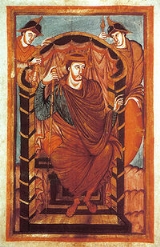
Lothair I

 
Lothair I

   Email Print
   Bookmark   Link


Lothair I


Lothair I (German
German language

German is a West Germanic languages, thus related to and classified alongside English language and Dutch language. It is one of the world's world language and the most widely spoken mother tongue in the European Union....
: Lothar, French
French language

French is a Romance language spoken around the world by around 80 million people as first language, by 190 million as second language, and by about another 200 million people as an acquired tongue, with significant speakers in 54 countries....
: Lothaire, Italian
Italian language

Italian is a Romance languages spoken by about 63 million people as a first language, primarily in Italy. In Switzerland, Italian is one of four Linguistic geography of Switzerlands....
: Lotario) (795 – 29 September 855
855

Events...
), king of Italy
King of Italy

King of Italy is a title adopted by many rulers of the Italian peninsula after the fall of the Roman Empire. Until 1870, however, no ?King of Italy? ruled the whole peninsula, though some pretended to such authority....
 (818 – 855) and crowned Carolingian
Carolingian Empire

Carolingian Empire is a historiography term sometimes used to refer to the Francia under the Carolingian dynasty. This dynasty is seen as the founders of France and Germany....
 King of (Northern) Italy, Emperor of the Romans and (nominally) was Emperor of the Franks (840 – 855).

Lothair was the eldest son of the Carolingian emperor Louis the Pious
Louis the Pious

Louis the Pious , also called the Fair, and the Debonaire, was the King of Aquitaine from 781 and Holy Roman Emperor and King of the Franks with his father, Charlemagne, from 813....
 and his wife Ermengarde of Hesbaye
Ermengarde of Hesbaye

Ermengarde of Hesbaye, or Irmengarde was Queen of the Franks and Holy Roman Empress as the wife of Louis the Pious. She was Franks, the daughter of Ingerman of Hesbaye, count of Hesbaye, and Hedwig of Bavaria....
, daughter of Ingerman
Ingerman of Hesbaye

Ingerman, or Ingram was a Franks and count of Hesbaye. His family is known as Robertians. His family line is not entirely sure, but he was probably the son of a Frank named Rodbert....
, duke of Hesbaye
Hesbaye

Hesbaye , is the region in the south of the Belgian Limburg containing the cities of Tongeren, Sint-Truiden, Bilzen and Borgloon. The region also covers the east of the Belgian province of Flemish Brabant and Walloon Brabant as well as the northwestern part of the province of Li?ge....
. He led his full-brothers Pippin I of Aquitaine and Louis the German
Louis the German

Louis the German , was a grandson of Charlemagne and the third son of the succeeding Holy Roman Emperor Louis the Pious and his first wife, Ermengarde of Hesbaye....
 in revolt against their father on several occasions, in protest against his attempts to make their half-brother Charles the Bald
Charles the Bald

File:Charles le Chauve denier Bourges after 848.jpgCharles the Bald , Holy Roman Emperor and King of West Francia , was the youngest son of the Emperor Louis the Pious by his second wife Judith, daughter of Welf....
 a co-heir to the Frankish domains.


Discussion
Ask a question about 'Lothair I'
Start a new discussion about 'Lothair I'
Answer questions from other users
Full Discussion Forum


Timeline

840   After the death of Louis the Pious, his sons Lothar, Charles the Bald and Louis the German fight over the division of the empire, with Lothar succeeding as Emperor.

841   June 25: Battle of Fontenay - Louis the German and Charles the Bald defeat Lothar.

842   Oaths of Strasbourg — alliance of Louis the German and Charles the Bald against emperor Lothar — sworn and recorded in vernacular languages.

843   Treaty of Verdun divides the Carolingian empire between the 3 sons of Louis the Pious. Namely Charles the Bald, Lothar and Louis the German, thus first creating the Kingdom of France as a distinct state.

848   Charles the Bald, Louis the German and Lothar meet in Koblenz.

850   Louis II is crowned co-emperor with his father Lothair I.

851   Charles the Bald, Louis the German and Lothar meet in Meersen

854   Charles the Bald, Louis the German and Lothar meet at Attigny.

855   Louis II succeeds Lothar as western emperor. Two other sons, Lothar II and Charles, also get parts of the kingdom.

855   Died


Encyclopedia


Lothair I (German
German language

German is a West Germanic languages, thus related to and classified alongside English language and Dutch language. It is one of the world's world language and the most widely spoken mother tongue in the European Union....
: Lothar, French
French language

French is a Romance language spoken around the world by around 80 million people as first language, by 190 million as second language, and by about another 200 million people as an acquired tongue, with significant speakers in 54 countries....
: Lothaire, Italian
Italian language

Italian is a Romance languages spoken by about 63 million people as a first language, primarily in Italy. In Switzerland, Italian is one of four Linguistic geography of Switzerlands....
: Lotario) (795 – 29 September 855
855

Events...
), king of Italy
King of Italy

King of Italy is a title adopted by many rulers of the Italian peninsula after the fall of the Roman Empire. Until 1870, however, no ?King of Italy? ruled the whole peninsula, though some pretended to such authority....
 (818 – 855) and crowned Carolingian
Carolingian Empire

Carolingian Empire is a historiography term sometimes used to refer to the Francia under the Carolingian dynasty. This dynasty is seen as the founders of France and Germany....
 King of (Northern) Italy, Emperor of the Romans and (nominally) was Emperor of the Franks (840 – 855).

Lothair was the eldest son of the Carolingian emperor Louis the Pious
Louis the Pious

Louis the Pious , also called the Fair, and the Debonaire, was the King of Aquitaine from 781 and Holy Roman Emperor and King of the Franks with his father, Charlemagne, from 813....
 and his wife Ermengarde of Hesbaye
Ermengarde of Hesbaye

Ermengarde of Hesbaye, or Irmengarde was Queen of the Franks and Holy Roman Empress as the wife of Louis the Pious. She was Franks, the daughter of Ingerman of Hesbaye, count of Hesbaye, and Hedwig of Bavaria....
, daughter of Ingerman
Ingerman of Hesbaye

Ingerman, or Ingram was a Franks and count of Hesbaye. His family is known as Robertians. His family line is not entirely sure, but he was probably the son of a Frank named Rodbert....
, duke of Hesbaye
Hesbaye

Hesbaye , is the region in the south of the Belgian Limburg containing the cities of Tongeren, Sint-Truiden, Bilzen and Borgloon. The region also covers the east of the Belgian province of Flemish Brabant and Walloon Brabant as well as the northwestern part of the province of Li?ge....
. He led his full-brothers Pippin I of Aquitaine and Louis the German
Louis the German

Louis the German , was a grandson of Charlemagne and the third son of the succeeding Holy Roman Emperor Louis the Pious and his first wife, Ermengarde of Hesbaye....
 in revolt against their father on several occasions, in protest against his attempts to make their half-brother Charles the Bald
Charles the Bald

File:Charles le Chauve denier Bourges after 848.jpgCharles the Bald , Holy Roman Emperor and King of West Francia , was the youngest son of the Emperor Louis the Pious by his second wife Judith, daughter of Welf....
 a co-heir to the Frankish domains. Upon the death of the father, Charles and Louis joined forces against Lothair in a three year civil war (840-843), the struggles between the brothers leading directly to the break up of the great Frankish Empire
Frankish Empire

Francia or Frankia, later also called the Frankish Empire , Frankish Kingdom , Frankish Realm or occasionally Frankland, was the territory inhabited and ruled by the Franks from the 3rd to the 10th century....
 assembled by their grandfather Charlemagne
Charlemagne

Charlemagne was List of Frankish kings from 768 to his death. He expanded the Franks kingdoms into a Carolingian Empire that incorporated much of Western Europe and Central Europe....
, and would lay the foundation for the development of modern France and Germany.

Little is known of his early life, which was probably passed at the court of his grandfather Charlemagne
Charlemagne

Charlemagne was List of Frankish kings from 768 to his death. He expanded the Franks kingdoms into a Carolingian Empire that incorporated much of Western Europe and Central Europe....
. Shortly after the accession of his father, he was sent to govern Bavaria. He first comes to historical attention in 817, when Louis the Pious drew up his Ordinatio Imperii. In this, Louis designated Lothair as his principal heir, to whom his younger brothers Pippin of Aquitaine and Louis the German, as well as his cousin Bernard of Italy
Bernard of Italy

Bernard was the King of Italy from 810 to 818. He plotted against his uncle, Holy Roman Emperor Louis the Pious, when the latter's Ordinatio Imperii made Bernard a vassal of his cousin Lothair I....
, would be subject after the death of their father; he would also inherit their lands if they were to die childless. Lothair was then crowned joint emperor by his father at Aix-la-Chapelle
Aachen

is a historic spa town in North Rhine-Westphalia, Germany. It is the westernmost city of Germany, located along its borders with Belgium and the Netherlands, 65 km west of Cologne....
. At the same time, Aquitaine and Bavaria were granted to his brothers Pippin and Louis respectively as subsidiary kingdoms. Following the murder of Bernard, King of Italy, by Louis the Pious, Lothair also received the Kingdom of Italy. In 821, he married Ermengarde
Ermengarde of Tours

Ermengarde of Tours was the wife of Emperor Lothair I of the Franks. Her father was Hugh of Tours, a member of the Etichonen family, which claimed descent from the Merovingian Kings....
 (d. 851), daughter of Hugh
Hugh of Tours

Hugh or Hugo was the count of Tours and Count of Sens during the reigns of Charlemagne and Louis the Pious, until his disgrace in February 828....
, count of Tours
Count of Tours

The counts of Tours were the medieval feudal suzerains ruling over the region of Touraine in France with their capital at Tours. The first known count of Tours was the famous Hugh of Tours of the Etichonen family....
. In 822, he assumed the government of Italy
Italy

Italy , officially the Italian Republic , is a country located on the Italian Peninsula in Southern Europe and on the two largest islands in the Mediterranean Sea, Sicily and Sardinia....
, and at Easter, 5 April 823
823

Events...
, he was crowned emperor again by Pope Paschal I
Pope Paschal I

Pope Paschal I was pope from January 25, 817 to February 11, 824. A native of Rome and son of Bonosus, he was raised to the pontificate by the acclamation of the clergy, shortly after the death of Pope Stephen IV, and before the sanction of the emperor Louis the Pious had been obtained - a circumstance for which it was one of his first cares...
, this time at Rome
Rome

Rome is the capital city of Italy and Lazio, and is Italy's largest and most populous city, with 2,724,347 residents in an urban area of some ....
.

In November 824, he promulgated a statute concerning the relations of pope and emperor which reserved the supreme power to the secular potentate, and he afterwards issued various ordinances for the good government of Italy.

On his return to his father's court his stepmother Judith
Judith, daughter of Welf

Queen Judith or Iudit , also known as Judith of Bavaria, was the daughter of Count Welf and a Duchy of Saxony noblewoman named Hedwig, Duchess of Bavaria ....
 won his consent to her plan for securing a kingdom for her son Charles
Charles the Bald

File:Charles le Chauve denier Bourges after 848.jpgCharles the Bald , Holy Roman Emperor and King of West Francia , was the youngest son of the Emperor Louis the Pious by his second wife Judith, daughter of Welf....
, a scheme which was carried out in 829, when the young prince was given Alemannia as king. Lothair, however, soon changed his attitude and spent the succeeding decade in constant strife over the division of the Empire with his father. He was alternately master of the Empire, and banished and confined to Italy, at one time taking up arms in alliance with his brothers and at another fighting against them, whilst the bounds of his appointed kingdom were in turn extended and reduced.

The first rebellion began in 830. All three brothers fought their father, whom they deposed. In 831, he was reinstated and he deprived Lothair of his imperial title and gave Italy to the young Charles. The second rebellion was instigated by Angilbert II, Archbishop of Milan
Angilbert II, Archbishop of Milan

Angilbert II was the Archbishop of Milan from 27 or 28 June 824 to his death on the 13 December 859. He succeeded Anglibert I, Archbishop of Milan....
, in 833, and again Louis was deposed and reinstated the next year (834). Lothair, through the loyalty of the Lombards and later reconciliations, retained Italy and the imperial position through all remaining divisions of the Empire by his father.

When Louis the Pious was dying in 840, he sent the imperial insignia to Lothair, who, disregarding the various partitions, claimed the whole of the Empire. Negotiations with his brother Louis the German and his half-brother Charles, both of whom armed to resist this claim, were followed by an alliance of the younger brothers against Lothair. A decisive battle was fought at Fontenay-en-Puisaye
Battle of Fontenay (841)

Contention over the division of the Carolingian Empire between the three surviving sons of Louis the Pious culminated in the decisive Battle of Fontenay-en-Puisaye, also called the Battle of Fontenoy, fought at Fontenay on the 25 June 841....
 on 25 June 841
841

Events...
, when, in spite of his and his allied nephew Pepin II of Aquitaine
Pepin II of Aquitaine

File:Pepin_II_d_Aquitaine_obole_845_to_848.jpgPepin II, called the Younger , was King of Aquitaine from 838 as the successor upon the death of his father, Pepin I of Aquitaine....
's personal gallantry, Lothair was defeated and fled to Aachen. With fresh troops he began a war of plunder, but the forces of his brothers were too strong for him, and taking with him such treasure as he could collect, he abandoned to them his capital. He met with the leaders of the Stellinga
Stellinga

The Stellinga was a movement of wikt:freeman and freedman, the lower two of the three Saxons non-slave castes, between 841 and 845....
 in Speyer
Speyer

Speyer is a city in Germany with approx. 50,000 inhabitants, located beside the river Rhine. It lies 25 km south of Ludwigshafen and Mannheim....
 and promised them his support in return for theirs, but Louis and then the native Saxon nobility put down the Stellinga in the next years.

of Lothair I, from 840–55]] Peace negotiations began, and in June 842 the brothers met on an island in the Saône
Saône

The Sa?ne is a river of eastern France. It is a right tributary of the River Rh?ne River . Rising at Viom?nil in the Vosges department, it joins the Rh?ne in Lyon ....
, and agreed to an arrangement which developed, after much difficulty and delay, into the Treaty of Verdun
Treaty of Verdun

In the Treaty of Verdun-sur-Meuse of 843 the three surviving sons of Louis the Pious, Charlemagne's grandsons, divided his territories, the Frankish Empire, into three kingdoms....
 signed in August 843. By this, Lothair received the imperial title as well as northern Italy and a long stretch of territory from the North Sea
North Sea

The North Sea is a marginal sea, epeiric sea on the European continental shelf. The Dover Strait and the English Channel in the south and the Norwegian Sea in the north connect it to the Atlantic Ocean....
 to the Mediterranean
Mediterranean Sea

The Mediterranean Sea is a sea or Ocean off the Atlantic Ocean surrounded by the Mediterranean region and almost completely enclosed by land: on the north by Europe, on the south by Africa, and on the east by Asia....
, essentially along the valleys of the Rhine
Rhine

File:Swiss Grand Canyon.jpgThe Rhine is one of the longest and most important rivers in Europe, at , with an average discharge of more than ....
 and the Rhone
Rhône River

The Rhone, or the Rh?ne is one of the major rivers of Europe, originating in Switzerland and running from there through the south-eastern corner of France....
. He soon left Italy to his eldest son, Louis, and remained in his new kingdom, engaging in alternate quarrels and reconciliations with his brothers and in futile efforts to defend his lands from the attacks of the Northmen (as Vikings were known in Frankish writings) and the Saracens.

In 855, he became seriously ill and, despairing of recovery, renounced the throne, divided his lands between his three sons, and on September 23, entered the monastery of Prüm
Prüm

Art = Stadt|image_photo = AbteikirchePr?m.jpg|imagesize = 180|Wappen = Wappen Pruem.png|lat_deg = 50 |lat_min = 12 |lat_sec = 29...
, where he died six days later. He was buried at Prüm, where his remains were found in 1860.

His kingdom was divided among his three sons — the eldest, Louis II, received Italy and the title of Emperor; the second, Lothair II
Lothair II of Lotharingia

Lothair II , was the second son of Emperor Lothair I and Ermengarde of Tours. He was married to Teutberga, daughter of Boso the ElderUpon his father's death in 855, he received as his kingdom a territory west of the Rhine stretching from the North Sea to the Jura mountains....
, received Lotharingia
Lotharingia

Lotharingia or Duchy of Lorraine was a short-lived kingdom in western Europe, the aggregate of territories belonging to Lothair, King of Lotharingia , who received it in 855 from his Carolingian father, Lothair I , Carolingian Empire....
; while the youngest, Charles
Charles of Provence

Charles of Provence was the Carolingian List of Kings of Burgundy from 855 until his early death in 863.Charles was the youngest son of Holy Roman Emperor Lothair I and Ermengarde of Tours....
, received Provence
Provence

Provence is a region of southeastern France on the Mediterranean adjacent to Italy. It is part of the administrative regions of France of Provence-Alpes-C?te d'Azur....
.

Family

He married Ermengarde of Tours
Ermengarde of Tours

Ermengarde of Tours was the wife of Emperor Lothair I of the Franks. Her father was Hugh of Tours, a member of the Etichonen family, which claimed descent from the Merovingian Kings....
, who died in 851. The last of his nine children are illegitimate.
  • Louis II (825-875)
  • Hiltrude (826-865)
  • Bertha (c.830-852)
  • Irmgard (c.830-849)
  • Gisela (c.830-856)
  • Lothair II
    Lothair II of Lotharingia

    Lothair II , was the second son of Emperor Lothair I and Ermengarde of Tours. He was married to Teutberga, daughter of Boso the ElderUpon his father's death in 855, he received as his kingdom a territory west of the Rhine stretching from the North Sea to the Jura mountains....
     (835-869)
  • Rotrude (c.840)
  • Charles
    Charles of Provence

    Charles of Provence was the Carolingian List of Kings of Burgundy from 855 until his early death in 863.Charles was the youngest son of Holy Roman Emperor Lothair I and Ermengarde of Tours....
     (845-863)
  • Carloman (853)


See also

  • Lotharingia
    Lotharingia

    Lotharingia or Duchy of Lorraine was a short-lived kingdom in western Europe, the aggregate of territories belonging to Lothair, King of Lotharingia , who received it in 855 from his Carolingian father, Lothair I , Carolingian Empire....


|- |-