

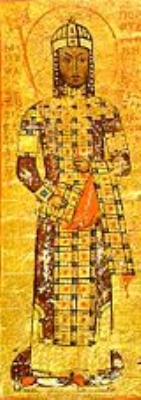
Manuel I Komnenos

Encyclopedia
Manuel I Komnenos (November 28, 1118 – September 24, 1180) was a Byzantine Emperor of the 12th century who reigned over a crucial turning point in the history of Byzantium
and the Mediterranean
.
Eager to restore his empire
to its past glories as the superpower of the Mediterranean world, Manuel pursued an energetic and ambitious foreign policy. In the process he made alliances with the Pope
and the resurgent west, invaded Italy
, successfully handled the passage of the dangerous Second Crusade
through his empire, and established a Byzantine protectorate over the Crusader states
of Outremer
.
Facing Muslim
advances in the Holy Land
, he made common cause with the Kingdom of Jerusalem
and participated in a combined invasion of Fatimid
Egypt
.
Manuel reshaped the political maps of the Balkans
and the east Mediterranean, placing the kingdoms of Hungary
and Outremer under Byzantine hegemony
and campaigning aggressively against his neighbours both in the west and in the east. However, towards the end of his reign Manuel's achievements in the east were compromised by a serious defeat at Myriokephalon
, which in large part resulted from his arrogance in attacking a well-defended Seljuk position.
Called ho Megas by the Greeks
, Manuel is known to have inspired intense loyalty in those who served him. He also appears as the hero of a history written by his secretary, John Kinnamos
, in which every virtue is attributed to him.
Manuel, who was influenced by his contact with western Crusaders, enjoyed the reputation of "the most blessed emperor of Constantinople
" in parts of the Latin
world as well.
Modern historians, however, have been less enthusiastic about him. Some of them assert that the great power he wielded was not his own personal achievement, but that of the dynasty
he represented; they also argue that, since Byzantine imperial power declined catastrophically after Manuel's death, it is only natural to look for the causes of this decline in his reign.
 Manuel Komnenos was the fourth son of John II Komnenos
and Piroska of Hungary
, so it seemed very unlikely that he would succeed his father. His maternal grandfather was St. Ladislaus. Having distinguished himself in his father's war against the Seljuk Turks, in 1143 Manuel was chosen as his successor by John, in preference to his elder surviving brother Isaac
. After John died on 8 April 1143, his son, Manuel, was acclaimed emperor by the armies. Yet his succession was by no means assured: At his father's deathbed in the wilds of Cilicia
far from Constantinople, he recognised that it was vital he should return to the capital as soon as possible. He still had to take care of his father's funeral, and tradition demanded he organise the foundation of a monastery on the spot where his father died. Swiftly, he dispatched the megas domestikos John Axouch
ahead of him, with orders to arrest his most dangerous potential rival, his brother Isaac, who was living in the Great Palace
with instant access to the imperial treasure and regalia. Axouch arrived in the capital even before news of the emperor's death had reached it. He quickly secured the loyalty of the city, and when Manuel entered the capital in August 1143, he was crowned by the new Patriarch
, Michael Kourkouas
. A few days later, with nothing more to fear as his position as emperor was now secure, Manuel ordered the release of Isaac.* J.H. Norwich, A short history of Byzantium
* A. Stone, Manuel I Comnenus Then he ordered 2 golden pieces to be given to every householder in Constantinople and 200 pounds of gold (including 200 silver pieces annually) to be given to the Byzantine Church.
The empire that Manuel inherited from his father had undergone great changes since its foundation by Constantine
, eight centuries before. In the time of his predecessor Justinian I
(527–565), parts of the former Western Roman Empire had been recovered including Italy, Africa and part of Spain. However, the empire had diminished greatly following this, the most obvious change had occurred in the 7th century: the soldiers of Islam
had taken Egypt
, Palestine
and much of Syria
away from the empire irrevocably. They had then swept on westwards into what in the time of Constantine had been the western provinces of the Roman Empire
, in North Africa and Spain. In the centuries since, the emperors had ruled over a realm that largely consisted of Asia Minor
in the east, and the Balkans in the west. In the late 11th century the Byzantine Empire entered a period of marked military and political decline, which had been arrested and largely reversed by the leadership of Manuel's grandfather and father. Yet the empire that Manuel inherited was a polity facing formidable challenges. At the end of the 11th century, the Normans
of Sicily
had removed Italy from the control of the Byzantine Emperor. The Seljuk Turks had done the same with central Anatolia
. And in the Levant
, a new force had appeared – the Crusader states
– who presented the Byzantine Empire with new challenges. Now, more than at any time during the preceding centuries, the task facing the emperor was daunting indeed.
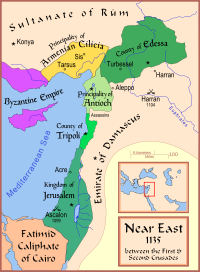 The first test of Manuel's reign came in 1144, when he was faced with a demand by Raymond
, Prince of Antioch
for the cession of Cilician territories. However, later that year the crusader County of Edessa
was engulfed by the tide of a resurgent Islamic jihad
under Imad ad-Din Atabeg Zengi. Raymond realized that immediate help from the west was out of the question. With his eastern flank now dangerously exposed to this new threat, there seemed little option but for him to prepare for a humiliating visit to Constantinople. Swallowing his pride, he made the journey north to ask for the protection of the Emperor. After submitting to Manuel, he was promised the support that he had requested, and his allegiance to Byzantium was secured.* P. Magdalino, The Empire of Manuel I Komnenos, 40
and set out on a punitive expedition
against Masud the Sultan of Rûm, who had been repeatedly violating the frontiers of the Empire in western Anatolia
and Cilicia
. There was no attempt at a systematic conquest of territory, but Manuel's army defeated the Turks at Acroënus
, before capturing and destroying the fortified town of Philomelion, removing its remaining Christian population. The Byzantine forces reached Masud's capital, Konya
, and ravaged the area around the city, but could not assault its walls. Amongst Manuel's motives for mounting this razzia there included a wish to be seen in the West as actively espousing the crusading ideal; Kinnamos also attributed to Manuel a desire to show off his martial prowess to his new bride. Whilst on this campaign Manuel received a letter from Louis VII of France
announcing his intention of leading an army to the relief of the crusader states.
and Louis VII of France
. At this time, there were still members of the Byzantine court who remembered the passage of the First Crusade
, which was a defining event in the collective memory of the age and one which had fascinated Manuel's aunt, Anna Komnene
.
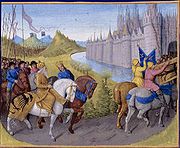 Many Byzantines feared the Crusade, a view endorsed by the numerous acts of vandalism and theft practiced by the unruly armies as they marched through Byzantine territory. Byzantine troops followed the Crusaders, attempting to police their behaviour, and further troops were assembled in Constantinople, ready to defend the capital against any acts of aggression. This cautious approach was well advised, but still the numerous incidents of covert and open hostility between the Franks and the Greeks on their line of march, for which it seems both sides were to blame, nearly precipitated a conflict between Manuel and his guests. Manuel took the precaution – which his grandfather had not taken – of making repairs to the city walls
, and pressed the two kings for guarantees concerning the security of his territories. Conrad's army was the first to enter the Byzantine territory in the summer of 1147, and it figures more prominently in the Byzantine sources, which imply that it was the most troublesome of the two.
After 1147, however, the relations between the two leaders became friendlier. By 1148 Manuel had seen the wisdom of securing an alliance with Conrad, whose sister-in-law Bertha of Sulzbach
he had earlier married; he actually persuaded the German king to renew their alliance against Roger II of Sicily
. Unfortunately for the Byzantine emperor, Conrad died in 1152, and despite repeated attempts, Manuel could not reach an agreement with his successor, Frederick I Barbarossa
.
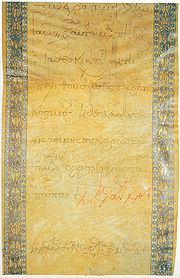 Yet Manuel's attention was to be drawn to Antioch again in 1156, when Raynald of Châtillon
, the new Prince of Antioch, claimed that the Byzantine emperor had reneged on his promise to pay him a sum of money, and vowed to attack the Byzantine province of Cyprus
. He arrested the governor of the island and nephew of the emperor, John Komnenos, and the general Michael Branas. The Latin historian William of Tyre
deplored this act of war against fellow Christians, and described the atrocities committed by Raynald's men in considerable detail. Having ransacked the island and plundered all its wealth, Raynald's army mutilated the survivors before forcing them to buy back their flocks at exorbitant prices with what little they had left. Thus enriched with enough booty to make Antioch wealthy for years, the invaders boarded their ships and set sail for home. Raynald also sent some of the mutilated hostages to Constantinople as a vivid demonstration of his disobedience and his contempt for the Byzantine emperor.
Manuel responded to this outrage in a characteristically energetic way. In the winter of 1158–59, he marched to Cilicia at the head of a huge army; the speed of his advance (Manuel had hurried on ahead of the main army with 500 cavalry) was such that he managed to surprise the Armenian
Thoros of Cilicia
, who had participated in the attack on Cyprus. All the towns and cities of Cilicia fell to Manuel immediately, and Thoros himself was forced to flee into the mountains at the last moment: he is said to have survived by sheltering alone under rocks on a hillside, where an old shepherd would bring him food to keep him alive.
soon reached Antioch. Realising that he had no hope of defeating Manuel, Raynald also knew that he could not expect any help from king Baldwin III of Jerusalem
. Baldwin did not approve of Raynald's attack on Cyprus, and in any case had already made an agreement with Manuel. Thus isolated and abandoned by his allies, Raynald decided that abject submission was his only hope. He appeared before the Emperor, dressed in a sack and with a rope tied around his neck, and begged for forgiveness. Manuel at first ignored the prostrate Raynald, chatting with his courtiers; William of Tyre commented that this ignominious scene continued for so long that all present were "disgusted" by it. Eventually, Manuel forgave Raynald on condition that he became a vassal of the Empire, effectively surrendering the independence of Antioch to Byzantium.
Peace having been restored, a grand ceremonial procession was staged on April 12, 1159 for the triumphant entry of the Byzantine army into the city, with Manuel riding through the streets on horseback while the Prince of Antioch and the King of Jerusalem followed on foot. Manuel dispensed justice to the citizens, and presided over games and tournaments for the crowd. In May at the head of a united Christian army he started on the road to Edessa, but he abandoned the campaign, when he secured the release by Nur ad-Din, the ruler of Syria
, of 6,000 Christian prisoners captured in various battles since the second Crusade.* P. Magdalino, The Empire of Manuel I Komnenos, 67
* J.H. Norwich, A short history of Byzantium Despite the glorious end of the expedition, it is argued by modern scholars that Manuel finally achieved much less than he hoped in terms of imperial restoration.
Satisfied with his efforts thus far, Manuel headed back to Constantinople. On their way back, his troops were surprised in line of march by the Turks. Despite this, they won a complete victory, routing the enemy army from the field and inflicting heavy losses. In the following year he drove the Seljuk Turks out of Isauria
.
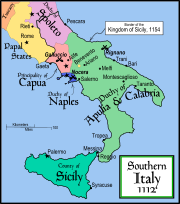 In 1147 Manuel was faced with war by Roger II of Sicily
, whose fleet had captured the Byzantine island of Corfu
and plundered Thebes
and Corinth. However, despite being distracted by a Cuman attack in the Balkans, in 1148 Manuel enlisted the alliance of Conrad, and the help of the Venetians
, who quickly defeated Roger with their powerful fleet. In 1149, Manuel recovered Corfu and prepared to take the offensive against the Normans, while Roger II sent George of Antioch
with a fleet of 40 ships to pillage Constantinople's suburbs. Manuel had already agreed with Conrad on a joint invasion and partition of southern Italy and Sicily. The renewal of the German alliance remained the principal orientation of Manuel's foreign policy for the rest of his reign, despite the gradual divergence of interests between the two empires after Conrad's death.
The death of Roger in February 1154, who was succeeded by William I
, combined with the widespread rebellions against the rule of the new King in Sicily
and Apulia
, the presence of Apulian refugees at the Byzantian court, and Frederick Barbarossa's (Conrad's successor) failure to deal with the Normans encouraged Manuel to take advantage of the multiple instabilities that existed in the Italian peninsula
. He sent Michael Palaiologos and John Doukas, both of whom held the high imperial rank of sebastos
, with Byzantine troops, 10 Byzantine ships, and large quantities of gold to invade Apulia
(1155). The two generals were instructed to enlist the support of Frederick Barbarossa, since he was hostile to the Normans of Sicily and was south of the Alps
at the time, but he declined because his demoralised army longed to get back north of the Alps as soon as possible. Nevertheless, with the help of disaffected local barons including Count Robert of Loritello, Manuel's expedition achieved astonishingly rapid progress as the whole of southern Italy
rose up in rebellion against the Sicilian Crown, and the untried William I. There followed a string of spectacular successes as numerous strongholds yielded either to force or the lure of gold.
, which had been the capital of the Byzantine Catapanate of Southern Italy
for centuries before the arrival of the Normans, opened its gates to the Emperor's army, and the overjoyed citizens tore down the Norman citadel. After the fall of Bari, the cities of Trani
, Giovinazzo
, Andria
, Taranto
, and Brindisi
were also captured, and William who arrived with his army (which included 2,000 knights) was heavily defeated.
Encouraged by the success, Manuel dreamed of restoration of the Roman Empire at cost of union between Orthodox
and Catholic Church
, a prospect which would frequently be offered to the Pope during negotiations and plans for alliance. If there was ever a chance of reuniting the eastern and western churches, and coming to reconciliation with the Pope permanently, this was probably the most favourable moment. The Papacy was never on good terms with the Normans, except when under duress by the threat of direct military action. Having the "civilised" Eastern Roman Empire on its southern border was infinitely preferable to the Papacy than having to constantly deal with the troublesome Normans of Sicily. It was in Pope Hadrian IV
's interests to reach a deal if at all possible, since doing so would greatly increase his own influence over the entire Orthodox Christian population. Manuel offered a large sum of money to the Pope for the provision of troops, with the request that the Pope grant the Byzantine emperor lordship of three maritime cities in return for assistance in expelling William from Sicily. Manuel also promised to pay 5,000 pounds of gold to the Pope and the Curia. Negotiations were hurriedly carried out, and an alliance was formed between Manuel and Hadrian.
It was at this point, just as the war seemed decided in Manuel's favour, that things started to go wrong for him. The Byzantine commander Michael Palaiologos had alienated Byzantium's allies by his attitude, and this had stalled the campaign as Count Robert III of Loritello
refused to speak to him. Although the two were reconciled, the campaign had lost some of its momentum: Michael was soon recalled to Constantinople, and his loss was a major blow to the campaign. The turning point was the Battle for Brindisi
, where the Sicilians launched a major counter attack by both land and sea. At the approach of the enemy, the mercenaries that had been hired with Manuel's gold demanded huge rises in their pay. When this was refused, they deserted. Even the local barons started to melt away, and soon John Doukas was left hopelessly outnumbered. The arrival of Alexios Komnenos Bryennios with some ships did not retrieve the Byzantine situation in any respect. The naval battle was decided in the Sicilians' favour, while John Doukas and Alexios Bryennios (along with 4 Byzantine ships) were captured. Manuel then sent Alexios Axouch
to Ancona
to raise another army, but, by this time, William had already retaken all of the Byzantine conquests in Apulia. The defeat at Brindisi put an end to the restored Byzantine reign in Italy; in 1158 the Byzantine army left Italy, and never saw it again.* A.A. Vasiliev, History of the Byzantine Empire, VII Both Nicetas Choniates
and Kinnamos, the major Byzantine historians of this period, agree, however, that the peace terms Axouch secured from William allowed Manuel to extricate himself from the war with dignity, despite a devastating raid by a Sicilian fleet of 164 ships (carrying 10,000 men) on Euboea
and Almira
in 1156.
 During the Italian campaign, and, afterwards, during the struggle of the Papal Curia with Frederick, Manuel tried to seduce the Popes by hints of a possible union between the Eastern and Western Churches. Although in 1155 Pope Hadrian had expressed his eagerness to prompt the reunion of the Catholic and Orthodox Churches, hopes for a lasting Papal-Byzantine alliance came up against insuperable problems. Pope Adrian IV
and his successors demanded recognition of their religious authority over all Christians everywhere, and wished themselves to reach superiority over the Byzantine Emperor; they were not at all willing to fall into a state of dependence from one emperor to the other. Manuel, on the other side, wanted an official recognition of his secular authority on both East and West. Such conditions would not be accepted by either side. Even if a pro-western Emperor such as Manuel agreed to it, the Greek citizens of the Empire would have rejected outright any union of this sort, as they did almost three hundred years later when the Orthodox and Catholic churches were briefly united under the Pope. In spite of his friendliness towards the Roman Church and his cordial relations with all the Popes, Manuel was never honoured with the title of Augustus
by the Popes. And although he sent twice (in 1167 and 1169) an embassy to Pope Alexander III
offering to reunite the Greek and Latin churches, the latter refused, under pretext of the troubles that would follow that union.* J.W. Birkenmeier, The Development of the Komnenian Army, 114 Ultimately, a deal proved elusive, and the two churches have remained divided.
The final results of the Italian campaign were limited in terms of the advantages gained by the Empire. The city of Ancona became a Byzantine base in Italy, accepting the Emperor as sovereign. The Normans of Sicily had been damaged, and now came to terms with the Empire, ensuring peace for the rest of Manuel's reign. The Empire's ability to get involved in Italian affairs had been demonstrated. However, given the enormous quantities of gold which had been lavished on the project, it also demonstrated the limits of what money and diplomacy alone could achieve. The expense of Manuel's involvement in Italy must have cost the treasury a great deal (probably more than 2,160,000 hyperpyra or 30,000 pounds of gold), and yet it produced only limited solid gains.
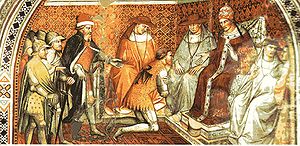 After 1158 and under the new conditions, the aims of the Byzantine policy changed. Now Manuel decided to oppose the tendency of the Hohenstaufen
dynasty to annex Italy, which Frederick believed should acknowledge his power. When the war between Frederick and the north Italian cities started, Manuel actively supported the Lombard League
with money subsidies. The walls of Milan
, demolished by the Germans, were restored by the aid of the Byzantine Emperor.* A.A. Vasiliev, History of the Byzantine Empire, VII Frederick's defeat at the Battle of Legnano
, on May 29, 1176 seemed rather to improve Manuel's position in Italy. According to Kinnamos, Cremona
, Pavia
, and a number of other "Liguria
n" cities went over to Manuel;* P. Magdalino, The Empire of Manuel I Komnenos, 84 his relations were also particularly favourable in regard to Genoa
, Pisa
, but not in regard to Venice
. In March 1171 Manuel had suddenly broken with Venice, ordering all 20,000 Venetians on imperial territory to be arrested and their property confiscated. Venice, incensed, sent a fleet of 120 ships against Byzantium, which, owing to an epidemic and being pursued by 150 Byzantine ships, was forced to return without great success. In all probability, friendly relations between Byzantium and Venice were not restored in Manuel's lifetime.
over one hundred years earlier and maintained, sometimes tenuously, ever since. Due to distraction from his neighbours on the Balkan frontier, Manuel was kept from his main objective, the subjugation of the Normans of Sicily. Relations had been good with the Serbs
and Hungarians since 1129, so the Serb rebellion came as a shock. The Serbs of Rascia
, being so induced by Roger II of Sicily, invaded Byzantine territory in 1149.
 Manuel forced the rebellious Serbs, and their leader, Uroš II, to vassalage (1150–1152). He then made repeated attacks upon the Hungarians with a view to annexing their territory along the Sava. In the wars of 1151–1153 and 1163–1168 Manuel led his troops into Hungary and a spectacular raid deep into enemy territory yielded substantial war booty. In 1167, Manuel sent 15,000 men under the command of Andronikos Kontostephanos
against the Hungarians. Kontostephanos scored a decisive victory at the Battle of Sirmium
which enabled the Byzantine Empire to conclude a very advantageous peace with the Hungarian Kingdom
by which Syrmia
, Bosnia
, and Dalmatia
were ceded. By 1168 nearly the whole of the eastern Adriatic coast lay in Manuel's hands.
Efforts were also made towards a diplomatic annexation of Hungary. The Hungarian heir Béla
, younger brother of the Hungarian king Stephen III
, was sent to Constantinople to be educated in the court of Manuel, who intended the youth to marry his daughter, Maria
, and to make him his heir, thus securing the union of Hungary with the Empire. In the court Béla assumed the name Alexius and received the title of Despot
which had previously been applied only to the Emperor himself. However, two unforeseen dynastic events drastically altered the situation. In 1169, Manuel's young wife gave birth to a son, thus depriving Béla of his status as heir of the Byzantine throne (although Manuel would not renounce the Croatian lands he had taken from Hungary). Then, in 1172, Stephen died childless, and Béla went home to take his throne. Before leaving Constantinople, he swore a solemn oath to Manuel that he would always "keep in mind the interests of the emperor and of the Romans". Béla III kept his word: as long as Manuel lived, he made no attempt to retrieve his Croatian inheritance, which he only afterwards reincorporated into Hungary.
was related to Géza II of Hungary
and was hostile to Byzantium; Prince Yuri Dolgoruki
of Suzdal
was Manuel's ally (symmachos), and Vladimirko
of Galicia is described as Manuel's vassal (hypospondos). Galicia was situated on the northern and northeastern borders of Hungary and, therefore, was of great strategic importance in the Byzantine-Hungarian conflicts. Following the deaths of both Iziaslav and Vladimirko, the situation became reversed, when Yuri of Suzdal, Manuel's ally, took over Kiev
and Yaroslav, the new ruler of Galicia, adopted a pro-Hungarian stance.
In 1164-5 Manuel's cousin Andronikos
, the future emperor, escaped from captivity in Byzantium, and fled to the court of Yaroslav in Galicia. This situation, holding out the alarming prospect of Andronikos making a bid for Manuel's throne sponsored by both Galicia and Hungary, spurred the Byzantines into an unprecedented flurry of diplomacy. Manuel pardoned Andronikos and persuaded him to return to Constantinople (1165). A mission to Kiev, then ruled by Prince Rostislav
, resulted in a favourable treaty and a pledge to supply the Empire with auxiliary troops; Yaroslav of Galicia was also persuaded to renounce his Hungarian connections and return fully into the imperial fold. As late as the year 1200 the princes of Galicia were providing invaluable services against the Empire's, at this time Cuman, enemies.
The restoration of relations with Galicia had an immediate benefit for Manuel when, in 1166, he dispatched two armies to attack the eastern provinces of Hungary in a vast pincer movement. One army crossed the Walachian Plain and entered Hungary through the Transylvanian Alps (Southern Carpathians
), whilst the other army made a wide circuit to Galicia and, with Galician aid, crossed the Carpathian Mountains
. Since the Hungarians had most of their forces concentrated on the Sirmium
and Belgrade
frontier they were caught off guard by the Byzantine invasion and the Hungarian province of Transylvania
was thoroughly ravaged by the Byzantine armies.
needed all the military and financial support he could get for his policy of military intervention in Egypt. Amalric also realised that if he were to pursue his ambitions in Egypt, he might have to leave Antioch to the hegemony of Manuel who had paid 100,000 dinars for the release of Bohemond III.* J.G. Rowe, Alexander III and the Jerusalem Crusade, 117 In 1165, he sent envoys to the Byzantine court to negotiate a marriage alliance (Manuel had already married Amalric's cousin Maria of Antioch
in 1161). After a long interval of two years, Amalric married Manuel's grandniece Maria Komnene
in 1167, and "swore all that his brother Baldwin had sworn before." A formal alliance was negotiated in 1168, whereby the two rulers arranged for a conquest and partition of Egypt, with Manuel taking the coastal area, and Amalric the interior. In the autumn of 1169 Manuel sent a joint expedition with Amalric to Egypt: a Byzantine army and a naval force of 20 large warships, 150 galleys, and 60 transports
, under the command of the megas doux
Andronikos Kontostephanos joined forces with Amalric at Ascalon
. William of Tyre, who negotiated the alliance, was impressed in particular by the large transport ships which were used to transport the cavalry forces of the army.
Although such a long range attack on a state far from the centre of the Empire may seem extraordinary (the last time the Empire had attempted anything on this scale was the failed invasion of Sicily over one hundred and twenty years earlier), it can be explained in terms of Manuel's foreign policy, which was to use the Latins to ensure the survival of the Empire. This focus on the bigger picture of the eastern Mediterranean and even further afield thus led Manuel to intervene in Egypt: it was believed that in the context of the wider struggle between the crusader states and the Islam
ic powers of the east, control of Egypt would be the deciding factor. It had been becoming clear that the ailing Fatimid
Caliphate
of Egypt held the key to the fate of the crusader states. If Egypt came out of its isolation, and joined forces with the Muslims under Nur ad-Din, the crusader cause was in trouble.
A successful invasion of Egypt would have several further advantages for the Byzantine Empire. Egypt was a rich province, and in the days of the Roman Empire had supplied much of the grain for Constantinople before it was lost to the Arabs in the 7th century. The revenues that the Empire could have expected to gain from the conquest of Egypt would have been considerable, even if these would have to be shared with the Crusaders. Furthermore, Manuel may have wanted to encourage Amalric's plans, not only in order to deflect Latins' ambitions away from Antioch, but also in order to create new opportunities for joint military ventures that would keep the King of Jerusalem in his debt, and also allow the Empire to share in territorial gains.
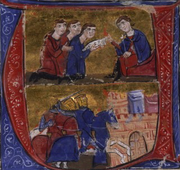 The joined forces of Manuel and Amalric laid siege to Damietta
on October 27, 1169, but the siege was unsuccessful due to the failure of the Crusaders and the Byzantines to co-operate fully. According to Byzantine forces, Amalric, not wanting to share the profits of victory, dragged out the operation until the emperor's men ran short of provisions and were particularly affected by famine; Amalric then launched an assault, which he promptly aborted by negotiating a truce with the defenders. On the other hand, William of Tyre remarked that the Greeks were not entirely blameless. Whatever the truth of the allegations of both sides, when the rains came, both the Latin army and the Byzantine fleet returned home, although half of the Byzantine fleet was lost in a sudden storm.
Despite the bad feelings generated at Damietta, Amalric still refused to abandon his dream of conquering Egypt, and he continued to seek good relations with the Byzantines in the hopes of another joined attack, which never took place. In 1171 Amalric came to Constantinople in person, after Egypt had fallen to Saladin
. Manuel was thus able to organise a grand ceremonial reception which both honoured Amalric, and underlined his dependence: for the rest of Amalric's reign, Jerusalem was a Byzantine satellite, and Manuel was able to act as a protector of the Holy Places, exerting a growing influence in the Kingdom of Jerusalem.* H.E. Mayer, The Latin East, 657 In 1177, a fleet of 150 ships was sent by Manuel I to invade Egypt, but returned home after appearing off Acre due to the refusal of Count Philip of Flanders and many important nobles of the Kingdom of Jerusalem
to help.
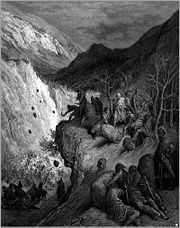 Between 1158–1161, a series of Byzantine campaigns against the Seljuk Turks of the Sultanate of Rûm resulted in a treaty favourable to the Empire. According to the agreement certain frontier regions, including the city of Sivas, should be handed over to Manuel in return for some quantity of cash. However, when it became clear that the Seljuks had no intention of honouring their side of the bargain, Manuel decided that it was time to deal with the Turks once and for all. Therefore, he assembled the full imperial army, and marched against the Seljuk capital, Iconium (Konya
). Manuel's strategy was to prepare the advanced bases of Dorylaeum
and Sublaeum, and then to use them as to strike as quickly as possible at Iconium.
Yet Manuel's army of 35,000 men was large and unwieldy – according to a letter which Manuel sent to King Henry II of England
, the advancing column was ten miles (16 km) long. Manuel marched against Iconium via Laodicea
, Chonae, Lampe, Celaenae
, Choma and Antioch
. Just outside the entrance to the pass at Myriokephalon, Manuel was met by Turkish ambassadors, who offered peace on generous terms. Most of Manuel's generals and experienced courtiers urged him to accept the offer. However, the younger and more aggressive members of the court urged Manuel to attack; he took their advice and continued his advance.
Manuel made serious tactical errors, such as failing to properly scout out the route ahead. These failings caused him to lead his forces straight into a classic ambush. On September 17, 1176 Manuel was decisively defeated by Kilij Arslan II
at the Battle of Myriokephalon (in highlands near the Tzibritze pass), in which his army was ambushed while marching through the narrow mountain pass. The Byzantines were too dispersed, and were surrounded. The army's siege equipment was quickly destroyed, and Manuel was forced to withdraw – without siege engine
s, the conquest of Iconium was impossible. According to Byzantine sources, Manuel lost his nerve both during and after the battle, fluctuating between extremes of self-delusion and self-abasement; according to William of Tyre, he was never the same again.
The terms by which Seljuk Sultan Kilij Arslan II allowed Manuel and his army to leave were that he should remove his forts and armies on the frontier at Dorylaeum and Sublaeum. However since the Sultan had already failed to keep his side of the earlier treaty of 1162, Manuel only ordered the fortifications of Sublaeum to be dismantled, but not the fortifications of Dorylaeum. Nevertheless, defeat at Myriokephalon was an embarrassment for both Manuel personally and also for his empire. The Komnenian emperors had worked hard since the Battle of Manzikert
, 105 years earlier, to restore the reputation of the empire. Yet because of his over-confidence, Manuel had demonstrated to the whole world that Byzantium still could not defeat the Seljuks, despite the advances made during the past century. In western opinion, Myriokephalon cut Manuel down to a humbler size: not that of Emperor of the Romans but that of King of the Greeks.
The defeat at Myriokephalon has often been depicted as a catastrophe in which the entire Byzantine army was destroyed. Manuel himself compared the defeat to Manzikert; it seemed to him that the Byzantine defeat at Myriokephalon complemented the destruction at Manzikert. In reality, although a defeat, it was not too costly, and did not significantly ruin the Byzantine army. Most of the casualties were borne by the right wing, largely composed of allied troops commanded by Baldwin of Antioch, and also the baggage train, which was the main target of the Turkish ambush.* K. Paparrigopoulos, History of the Greek Nation, Db, 141 The limited losses inflicted on native Byzantine troops were quickly made good and in the following year Manuel's forces defeated a force of "picked Turks". John Vatatzes, who was sent by the Emperor to repel the Turkish invasion, not only brought troops from the capital but also was able to gather an army along the way which allowed him to score a victory over the Turks at the Battle of Hyelion and Leimocheir
; a sign that the Byzantine army remained strong and that the defensive program of western Asia Minor
was still successful. After the victory on the Meander, Manuel himself advanced with a small army to drive the Turks from Panasium
, south of Cotyaeum. However, in 1178 a Byzantine army retreated after encountering a Turkish force at Charax
, allowing the Turks to capture many livestock. The city of Claudiopolis in Bithynia
was besieged by the Turks in 1179, forcing Manuel to lead a small cavalry force to save the city and then, even as late as 1180, the Byzantines succeeded in scoring a victory over the Turks.
However, the continuous warfare did have a serious effect upon Manuel's vitality; he declined in health and in 1180 succumbed to a slow fever. Furthermore, like Manzikert, the balance between the two powers began to gradually shift – Manuel never again attacked the Turks and, after his death, they began to move further and further west, deeper into Byzantine territory.
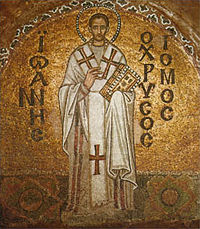 During Manuel's reign three major theological controversies occurred. In 1156–1157 the question was raised, whether Christ
had offered himself as a sacrifice for the sins of the world to the Father
and to the Holy Spirit
only, or also to the Logos
(i.e., to himself). In the end a synod
held at Constantinople in 1157 adopted a compromise formula, that the Word
made flesh offered a double sacrifice to the Holy Trinity, despite the dissidence of Patriarch of Antioch-elect Soterichus Panteugenus.
Ten years later, a controversy arose as to whether the saying of Christ, "My Father is greater than I" referred to his divine nature, to his human, or the union of these two natures. Demetrius of Lampe, a Byzantine diplomat recently returned from the West, ridiculed the way the verse was interpreted there, that Christ was inferior to his father in his humanity, but equal in his divinity. Manuel on the other hand, perhaps with an eye on the project for Church union, found that the formula made sense, and prevailed over a majority in a synod convened on March 2, 1166 to decide the issue, where he had the support of the patriarch Luke Chrysoberges. Those who refused to submit to the synod's decisions had their property confiscated or were exiled. The political dimensions of this controversy are apparent from the fact that a leading dissenter from the Emperor's doctrine was his nephew Alexios Kontostephanos.
A third controversy sprung up in 1180, when Manuel objected to the formula of solemn abjuration
, which was exacted from Muslim converts. One of the more striking anathema
s of this abjuration was that directed against the deity worshipped by Muhammad
and his followers:
The emperor ordered the deletion of this anathema from the Church's catechetical texts, a measure that provoked vehement opposition from both the Patriarch and bishops.
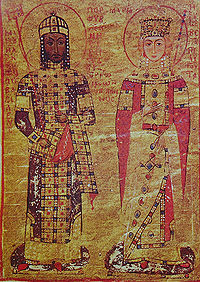 Manuel is representative of a new kind of Byzantine ruler who was influenced by his contact with western Crusaders. He arranged jousting
matches, even participating in them, an unusual and discomforting sight for the Byzantines. Endowed with a fine physique, Manuel has been the subject of exaggeration in the Byzantine sources of his era, where he is presented as a man of great personal courage. According to the story of his exploits, which appear as a model or a copy of the romances of chivalry
, such was his strength and exercise in arms, that Raymond of Antioch was incapable of wielding his lance and buckler. In a famous tournament, he is said to have entered the lists on a fiery courser
, and to have overturned two of the stoutest Italian knights. In one day, he is said to have slain forty Turks with his own hand, and in a battle against the Hungarians he allegedly snatched a banner, and was the first, almost alone, who passed a bridge that separated his army from the enemy. On another occasion, he is said to have cut his way through a squadron of five hundred Turks, without receiving a wound; he had previously posted an ambuscade in a wood, and was accompanied only by his brother and Axouch.
, a sister-in-law of Conrad III of Germany. She died in 1159. Children:
Manuel's second marriage was to Maria of Antioch
(nicknamed Xene), a daughter of Raymond
and Constance of Antioch
, in 1161. By this marriage, Manuel had one son:
Manuel had several illegitimate children:
By Theodora Vatatzina:
By Maria Taronitissa, the wife of protovestiarios
John Komnenos, whose legitimate children included Maria Komnene, Queen consort of Jerusalem
:
By other lovers:
Manuel had proven himself to be an energetic Emperor who saw possibilities everywhere, and whose optimistic outlook had shaped his approach to foreign policy. However, in spite of his military prowess Manuel achieved but in a slight degree his object of restoring the Byzantine Empire. Retrospectively, some commentators have criticised some of Manuel's aims as unrealistic, in particular citing the expeditions he sent to Egypt as proof of dreams of grandeur on an unattainable scale. His greatest military campaign, his grand expedition against the Turkish Sultanate of Iconium, ended in humiliating defeat, and his greatest diplomatic effort apparently collapsed, when Pope Alexander III became reconciled to the German emperor Frederick Barbarossa at the Peace of Venice. Historian Mark C. Bartusis argues that Manuel (and his father as well) tried to rebuild a national army, but his reforms were adequate for neither his ambitions nor his needs; the defeat at Myriokephalon underscored the fundamental weakness of his policies. According to Edward Gibbon
, Manuel's victories were not productive of any permanent or useful conquest.
sources, or the Latin and oriental sources, the impression is consistent with Choniates' picture of an emperor who spent lavishly in all available ways, rarely economising in one sector in order to develop another. Manuel spared no expense on the army, the navy, diplomacy, ceremonial, palace-building, the Komnenian family, and other seekers of patronage. A significant amount of this expenditure was pure financial loss to the Empire, like the subsidies poured into Italy and the crusader states, and the sums spent on the failed expeditions of 1155–1156, 1169, and 1176.* P. Magdalino, The Empire of Manuel I Komnenos, 173
The problems this created were counterbalanced to some extent by his successes, particularly in the Balkans; Manuel extended the frontiers of his Empire in the Balkan region, ensuring security for the whole of Greece and Bulgaria
. Had he been more successful in all his ventures, he would have controlled not only the most productive farmland around the Eastern Mediterranean and Adriatic seas, but also the entire trading facilities of the area. Even if he did not achieve his ambitious goals, his wars against Hungary brought him control of the Dalmatian coast, the rich agricultural region of Sirmium, and the Danube trade route from Hungary to the Black Sea
. His Balkan expeditions are said to have taken great booty in slaves and livestock; Kinnamos was impressed by the amount of arms taken from the Hungarian dead after the battle of 1167. And even if Manuel's wars against the Turks probably realised a net loss, his commanders took livestock and captives on at least two occasions.
This allowed the Western provinces to flourish in an economic revival which had begun in the time of his grandfather Alexios I, and which continued till the close of the century. Indeed it has been argued that Byzantium in the 12th century was richer and more prosperous than at any time since the Persian invasion during the reign of Herakleios
, some five hundred years earlier. There is good evidence from this period of new construction, and new churches even in remote areas strongly suggest that wealth was widespread. Trade was also flourishing; it has been estimated that the population of Constantinople, the biggest commercial center of the Empire, during Manuel's reign was between half a million and one million, making it by far the largest city in Europe. A major source of Manuel's wealth was the kommerkion, a customs duty levied at Constantinople on all imports and exports. The kommerkion was stated to have collected 20,000 hyperpyra each day.
Furthermore, the Byzantine capital was a city undergoing expansion. The cosmopolitan character of Constantinople was being reinforced by the arrival of Italian merchants and Crusaders en route to the Holy Land. The Venetians, the Genoese
and others opened up the ports of the Aegean to commerce, shipping goods from the Crusader kingdoms of Outremer and Fatimid Egypt to the west and trading with Byzantium via Constantinople. These maritime traders stimulated demand in the towns and cities of Greece, Macedonia
and the Greek Islands, generating new sources of wealth in a predominantly agrarian economy. Thessaloniki
, the second city of the Empire, hosted a famous summer fair which attracted traders from across the Balkans and even further afield to its bustling market stalls. In Corinth, silk production fuelled a thriving economy. All this is a testament to the success of the Komnenian Emperors in securing a Pax Byzantina in these heartland territories.
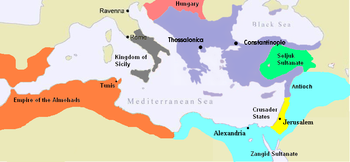 To the rhetors of his court, Manuel was the "divine emperor". A generation after his death, Choniates referred to him as "the most blessed among emperors", and a century later John Stavrakios described him as "great in fine deeds". John Phokas, a soldier who fought in Manuel's army, characterised him some years later as the "world saving" and glorious emperor.* P. Magdalino, The Empire of Manuel I Komnenos, 3 Manuel would be remembered in France, Italy and the Crusader states as the most powerful sovereign in the world. A Genoese analyst noted that with the passing of "Lord Manuel of divine memory, the most blessed emperor of Constantinople ... all Christendom incurred great ruin and detriment."* P. Magdalino, The Empire of Manuel I Komnenos, 3 William of Tyre called Manuel "a wise and discreet prince of great magnificence, worthy of praise in every respect", "a great-souled man of incomparable energy", whose "memory will ever be held in benediction." Manuel was further extolled by Robert of Clari
as a "a right worthy man, [...] and richest of all the Christians who ever were, and the most bountiful."
A telling reminder of the influence that Manuel held in the Crusader states in particular can still be seen in the church of the Holy Nativity in Bethlehem
. In the 1160s the nave was redecorated with mosaics showing the councils of the church. Manuel was one of the patrons of the work. On the south wall, an inscription in Greek reads: "the present work was finished by Ephraim the monk, painter and mosaicist, in the reign of the great emperor Manuel Porphyrogennetos Komnenos and in the time of the great king of Jerusalem, Amalric." That Manuel's name was placed first was a symbolic, public recognition of Manuel's overlordship as leader of the Christian world. Manuel's role as protector of the Orthodox Christians and Christian holy places in general is also evident in his successful attempts to secure rights over the Holy Land. Manuel participated in the building and decorating of many of the basilicas and Greek monasteries in the Holy Land, including the church of the Holy Sepulchre in Jerusalem, where thanks to his efforts the Byzantine clergy were allowed to perform the Greek liturgy each day. All this reinforced his position as overlord of the Crusader states, with his hegemony over Antioch and Jerusalem secured by agreement with Raynald, Prince of Antioch, and Amalric, King of Jerusalem respectively. Manuel was also the last Byzantine emperor who, thanks to his military and diplomatic success in the Balkans, could call himself "ruler of Dalmatia, Bosnia, Croatia, Serbia, Bulgaria and Hungary".
Byzantium looked impressive, when Manuel died in 1180, having just celebrated the betrothal of his son Alexios II to the daughter of the king of France. Thanks to the diplomacy and campaigning of Alexios, John, and Manuel, the empire was a great power, economically prosperous, and secure on its frontiers; but there were serious problems as well. Internally, the Byzantine court required a strong leader to hold it together, and after Manuel's death stability was seriously endangered from within. Some of the foreign enemies of the Empire were lurking on the flanks, waiting for a chance to attack, in particular the Turks in Anatolia, whom Manuel had ultimately failed to defeat, and the Normans in Sicily, who had already tried but failed to invade the Empire on several occasions. Even the Venetians, the single most important western ally of Byzantium, were on bad terms with the empire at Manuel's death in 1180. Given this situation, it would have taken a strong Emperor to secure the Empire against the foreign threats it now faced, and to rebuild the depleted Imperial Treasury. But Manuel's son was a minor, and his unpopular regency government was overthrown in a violent coup d'état
. This troubled succession weakened the dynastic continuity and solidarity on which the strength of the Byzantine state had come to rely.
Byzantine Empire
The Byzantine Empire was the Eastern Roman Empire during the periods of Late Antiquity and the Middle Ages, centred on the capital of Constantinople. Known simply as the Roman Empire or Romania to its inhabitants and neighbours, the Empire was the direct continuation of the Ancient Roman State...
and the Mediterranean
History of the Mediterranean region
The history of the Mediterranean region is the history of the interaction of the cultures and people of the lands surrounding the Mediterranean Sea —the central superhighway of transport, trade and cultural exchange between diverse peoples...
.
Eager to restore his empire
Byzantine Empire
The Byzantine Empire was the Eastern Roman Empire during the periods of Late Antiquity and the Middle Ages, centred on the capital of Constantinople. Known simply as the Roman Empire or Romania to its inhabitants and neighbours, the Empire was the direct continuation of the Ancient Roman State...
to its past glories as the superpower of the Mediterranean world, Manuel pursued an energetic and ambitious foreign policy. In the process he made alliances with the Pope
Pope
The Pope is the Bishop of Rome, a position that makes him the leader of the worldwide Catholic Church . In the Catholic Church, the Pope is regarded as the successor of Saint Peter, the Apostle...
and the resurgent west, invaded Italy
Italian Peninsula
The Italian Peninsula or Apennine Peninsula is one of the three large peninsulas of Southern Europe , spanning from the Po Valley in the north to the central Mediterranean Sea in the south. The peninsula's shape gives it the nickname Lo Stivale...
, successfully handled the passage of the dangerous Second Crusade
Second Crusade
The Second Crusade was the second major crusade launched from Europe. The Second Crusade was started in response to the fall of the County of Edessa the previous year to the forces of Zengi. The county had been founded during the First Crusade by Baldwin of Boulogne in 1098...
through his empire, and established a Byzantine protectorate over the Crusader states
Crusader states
The Crusader states were a number of mostly 12th- and 13th-century feudal states created by Western European crusaders in Asia Minor, Greece and the Holy Land , and during the Northern Crusades in the eastern Baltic area...
of Outremer
Outremer
Outremer, French for "overseas", was a general name given to the Crusader states established after the First Crusade: the County of Edessa, the Principality of Antioch, the County of Tripoli and especially the Kingdom of Jerusalem...
.
Facing Muslim
Muslim
A Muslim, also spelled Moslem, is an adherent of Islam, a monotheistic, Abrahamic religion based on the Quran, which Muslims consider the verbatim word of God as revealed to prophet Muhammad. "Muslim" is the Arabic term for "submitter" .Muslims believe that God is one and incomparable...
advances in the Holy Land
Holy Land
The Holy Land is a term which in Judaism refers to the Kingdom of Israel as defined in the Tanakh. For Jews, the Land's identifiction of being Holy is defined in Judaism by its differentiation from other lands by virtue of the practice of Judaism often possible only in the Land of Israel...
, he made common cause with the Kingdom of Jerusalem
Kingdom of Jerusalem
The Kingdom of Jerusalem was a Catholic kingdom established in the Levant in 1099 after the First Crusade. The kingdom lasted nearly two hundred years, from 1099 until 1291 when the last remaining possession, Acre, was destroyed by the Mamluks, but its history is divided into two distinct periods....
and participated in a combined invasion of Fatimid
Fatimid
The Fatimid Islamic Caliphate or al-Fāṭimiyyūn was a Berber Shia Muslim caliphate first centered in Tunisia and later in Egypt that ruled over varying areas of the Maghreb, Sudan, Sicily, the Levant, and Hijaz from 5 January 909 to 1171.The caliphate was ruled by the Fatimids, who established the...
Egypt
Egypt
Egypt , officially the Arab Republic of Egypt, Arabic: , is a country mainly in North Africa, with the Sinai Peninsula forming a land bridge in Southwest Asia. Egypt is thus a transcontinental country, and a major power in Africa, the Mediterranean Basin, the Middle East and the Muslim world...
.
Manuel reshaped the political maps of the Balkans
Balkans
The Balkans is a geopolitical and cultural region of southeastern Europe...
and the east Mediterranean, placing the kingdoms of Hungary
Kingdom of Hungary
The Kingdom of Hungary comprised present-day Hungary, Slovakia and Croatia , Transylvania , Carpatho Ruthenia , Vojvodina , Burgenland , and other smaller territories surrounding present-day Hungary's borders...
and Outremer under Byzantine hegemony
Hegemony
Hegemony is an indirect form of imperial dominance in which the hegemon rules sub-ordinate states by the implied means of power rather than direct military force. In Ancient Greece , hegemony denoted the politico–military dominance of a city-state over other city-states...
and campaigning aggressively against his neighbours both in the west and in the east. However, towards the end of his reign Manuel's achievements in the east were compromised by a serious defeat at Myriokephalon
Battle of Myriokephalon
The Battle of Myriokephalon, also known as the ', or in Turkish, was a battle between the Byzantine Empire and the Seljuk Turks in Phrygia on September 17, 1176. The battle was a strategic reverse for the Byzantine forces, who were ambushed when moving through a mountain pass...
, which in large part resulted from his arrogance in attacking a well-defended Seljuk position.
Called ho Megas by the Greeks
Greeks
The Greeks, also known as the Hellenes , are a nation and ethnic group native to Greece, Cyprus and neighboring regions. They also form a significant diaspora, with Greek communities established around the world....
, Manuel is known to have inspired intense loyalty in those who served him. He also appears as the hero of a history written by his secretary, John Kinnamos
John Kinnamos
Joannes Kinnamos or John Cinnamus was a Greek historian. He was imperial secretary to Emperor Manuel I , whom he accompanied on his campaigns in Europe and Asia Minor...
, in which every virtue is attributed to him.
Manuel, who was influenced by his contact with western Crusaders, enjoyed the reputation of "the most blessed emperor of Constantinople
Constantinople
Constantinople was the capital of the Roman, Eastern Roman, Byzantine, Latin, and Ottoman Empires. Throughout most of the Middle Ages, Constantinople was Europe's largest and wealthiest city.-Names:...
" in parts of the Latin
Latin
Latin is an Italic language originally spoken in Latium and Ancient Rome. It, along with most European languages, is a descendant of the ancient Proto-Indo-European language. Although it is considered a dead language, a number of scholars and members of the Christian clergy speak it fluently, and...
world as well.
Modern historians, however, have been less enthusiastic about him. Some of them assert that the great power he wielded was not his own personal achievement, but that of the dynasty
Komnenos
Komnenós or Comnenus was the name of a ruling family of the Eastern Roman Empire , who halted the political decline of the Empire from c.1081 to c.1185.-Origins:...
he represented; they also argue that, since Byzantine imperial power declined catastrophically after Manuel's death, it is only natural to look for the causes of this decline in his reign.
Accession to the throne
John II Komnenos
John II Komnenos was Byzantine Emperor from 1118 to 1143. Also known as Kaloïōannēs , he was the eldest son of Emperor Alexios I Komnenos and Irene Doukaina...
and Piroska of Hungary
Piroska of Hungary
Saint Irene of Hungary, born Piroska, was a daughter of Ladislaus I of Hungary and Adelaide of Swabia. Her maternal grandparents were Rudolf of Rheinfeld and his second wife Adelheid of Savoy. Adelheid was a daughter of Otto of Savoy and Adelaide of Turin. She was the mother of the future emperor...
, so it seemed very unlikely that he would succeed his father. His maternal grandfather was St. Ladislaus. Having distinguished himself in his father's war against the Seljuk Turks, in 1143 Manuel was chosen as his successor by John, in preference to his elder surviving brother Isaac
Isaac Komnenos (d. 1154)
Isaac Komnenos or Comnenus , was the third son of Byzantine Emperor John II Komnenos by Piroska of Hungary.-Life:Shortly before his death in 1143, John II Komnenos designated his fourth son Manuel as his heir, although the third son, Isaac, was still alive...
. After John died on 8 April 1143, his son, Manuel, was acclaimed emperor by the armies. Yet his succession was by no means assured: At his father's deathbed in the wilds of Cilicia
Cilicia
In antiquity, Cilicia was the south coastal region of Asia Minor, south of the central Anatolian plateau. It existed as a political entity from Hittite times into the Byzantine empire...
far from Constantinople, he recognised that it was vital he should return to the capital as soon as possible. He still had to take care of his father's funeral, and tradition demanded he organise the foundation of a monastery on the spot where his father died. Swiftly, he dispatched the megas domestikos John Axouch
John Axuch
John Axouch or Axouchos, also transliterated as Axuch was the commander-in-chief of the Byzantine Army during the reign of Emperor John II Komnenos, and the early part of the reign of his son Manuel I Komnenos.- Life :...
ahead of him, with orders to arrest his most dangerous potential rival, his brother Isaac, who was living in the Great Palace
Great Palace of Constantinople
The Great Palace of Constantinople — also known as the Sacred Palace — was the large Imperial Byzantine palace complex located in the south-eastern end of the peninsula now known as "Old Istanbul", modern Turkey...
with instant access to the imperial treasure and regalia. Axouch arrived in the capital even before news of the emperor's death had reached it. He quickly secured the loyalty of the city, and when Manuel entered the capital in August 1143, he was crowned by the new Patriarch
Patriarch of Constantinople
The Ecumenical Patriarch is the Archbishop of Constantinople – New Rome – ranking as primus inter pares in the Eastern Orthodox communion, which is seen by followers as the One, Holy, Catholic, and Apostolic Church....
, Michael Kourkouas
Michael II Kourkouas
Michael II Kourkouas was an Eastern Orthodox patriarch of Constantinople ....
. A few days later, with nothing more to fear as his position as emperor was now secure, Manuel ordered the release of Isaac.* J.H. Norwich, A short history of Byzantium
* A. Stone, Manuel I Comnenus Then he ordered 2 golden pieces to be given to every householder in Constantinople and 200 pounds of gold (including 200 silver pieces annually) to be given to the Byzantine Church.
The empire that Manuel inherited from his father had undergone great changes since its foundation by Constantine
Constantine I
Constantine the Great , also known as Constantine I or Saint Constantine, was Roman Emperor from 306 to 337. Well known for being the first Roman emperor to convert to Christianity, Constantine and co-Emperor Licinius issued the Edict of Milan in 313, which proclaimed religious tolerance of all...
, eight centuries before. In the time of his predecessor Justinian I
Justinian I
Justinian I ; , ; 483– 13 or 14 November 565), commonly known as Justinian the Great, was Byzantine Emperor from 527 to 565. During his reign, Justinian sought to revive the Empire's greatness and reconquer the lost western half of the classical Roman Empire.One of the most important figures of...
(527–565), parts of the former Western Roman Empire had been recovered including Italy, Africa and part of Spain. However, the empire had diminished greatly following this, the most obvious change had occurred in the 7th century: the soldiers of Islam
Islam
Islam . The most common are and . : Arabic pronunciation varies regionally. The first vowel ranges from ~~. The second vowel ranges from ~~~...
had taken Egypt
Egypt
Egypt , officially the Arab Republic of Egypt, Arabic: , is a country mainly in North Africa, with the Sinai Peninsula forming a land bridge in Southwest Asia. Egypt is thus a transcontinental country, and a major power in Africa, the Mediterranean Basin, the Middle East and the Muslim world...
, Palestine
Palestine
Palestine is a conventional name, among others, used to describe the geographic region between the Mediterranean Sea and the Jordan River, and various adjoining lands....
and much of Syria
Syria
Syria , officially the Syrian Arab Republic , is a country in Western Asia, bordering Lebanon and the Mediterranean Sea to the West, Turkey to the north, Iraq to the east, Jordan to the south, and Israel to the southwest....
away from the empire irrevocably. They had then swept on westwards into what in the time of Constantine had been the western provinces of the Roman Empire
Roman Empire
The Roman Empire was the post-Republican period of the ancient Roman civilization, characterised by an autocratic form of government and large territorial holdings in Europe and around the Mediterranean....
, in North Africa and Spain. In the centuries since, the emperors had ruled over a realm that largely consisted of Asia Minor
Asia Minor
Asia Minor is a geographical location at the westernmost protrusion of Asia, also called Anatolia, and corresponds to the western two thirds of the Asian part of Turkey...
in the east, and the Balkans in the west. In the late 11th century the Byzantine Empire entered a period of marked military and political decline, which had been arrested and largely reversed by the leadership of Manuel's grandfather and father. Yet the empire that Manuel inherited was a polity facing formidable challenges. At the end of the 11th century, the Normans
Normans
The Normans were the people who gave their name to Normandy, a region in northern France. They were descended from Norse Viking conquerors of the territory and the native population of Frankish and Gallo-Roman stock...
of Sicily
Sicily
Sicily is a region of Italy, and is the largest island in the Mediterranean Sea. Along with the surrounding minor islands, it constitutes an autonomous region of Italy, the Regione Autonoma Siciliana Sicily has a rich and unique culture, especially with regard to the arts, music, literature,...
had removed Italy from the control of the Byzantine Emperor. The Seljuk Turks had done the same with central Anatolia
Anatolia
Anatolia is a geographic and historical term denoting the westernmost protrusion of Asia, comprising the majority of the Republic of Turkey...
. And in the Levant
Levant
The Levant or ) is the geographic region and culture zone of the "eastern Mediterranean littoral between Anatolia and Egypt" . The Levant includes most of modern Lebanon, Syria, Jordan, Israel, the Palestinian territories, and sometimes parts of Turkey and Iraq, and corresponds roughly to the...
, a new force had appeared – the Crusader states
Crusader states
The Crusader states were a number of mostly 12th- and 13th-century feudal states created by Western European crusaders in Asia Minor, Greece and the Holy Land , and during the Northern Crusades in the eastern Baltic area...
– who presented the Byzantine Empire with new challenges. Now, more than at any time during the preceding centuries, the task facing the emperor was daunting indeed.
Prince of Antioch
Raymond of Antioch
Raymond of Poitiers was Prince of Antioch 1136–1149. He was the younger son of William IX, Duke of Aquitaine and his wife Philippa, Countess of Toulouse, born in the very year that his father the Duke began his infamous liaison with Dangereuse de Chatelherault.-Assumes control:Following the...
, Prince of Antioch
Principality of Antioch
The Principality of Antioch, including parts of modern-day Turkey and Syria, was one of the crusader states created during the First Crusade.-Foundation:...
for the cession of Cilician territories. However, later that year the crusader County of Edessa
County of Edessa
The County of Edessa was one of the Crusader states in the 12th century, based around Edessa, a city with an ancient history and an early tradition of Christianity....
was engulfed by the tide of a resurgent Islamic jihad
Jihad
Jihad , an Islamic term, is a religious duty of Muslims. In Arabic, the word jihād translates as a noun meaning "struggle". Jihad appears 41 times in the Quran and frequently in the idiomatic expression "striving in the way of God ". A person engaged in jihad is called a mujahid; the plural is...
under Imad ad-Din Atabeg Zengi. Raymond realized that immediate help from the west was out of the question. With his eastern flank now dangerously exposed to this new threat, there seemed little option but for him to prepare for a humiliating visit to Constantinople. Swallowing his pride, he made the journey north to ask for the protection of the Emperor. After submitting to Manuel, he was promised the support that he had requested, and his allegiance to Byzantium was secured.* P. Magdalino, The Empire of Manuel I Komnenos, 40
Expedition against Konya
In 1146 Manuel assembled his army at the military base LopadionKomnenian army
The Komnenian Byzantine army or Komnenian army was the force established by Byzantine emperor Alexios I Komnenos during the late 11th/early 12th century, and perfected by his successors John II Komnenos and Manuel I Komnenos during the 12th century. Alexios constructed a new army from the ground...
and set out on a punitive expedition
Punitive expedition
A punitive expedition is a military journey undertaken to punish a state or any group of persons outside the borders of the punishing state. It is usually undertaken in response to perceived disobedient or morally wrong behavior, but may be also be a covered revenge...
against Masud the Sultan of Rûm, who had been repeatedly violating the frontiers of the Empire in western Anatolia
Anatolia
Anatolia is a geographic and historical term denoting the westernmost protrusion of Asia, comprising the majority of the Republic of Turkey...
and Cilicia
Cilicia
In antiquity, Cilicia was the south coastal region of Asia Minor, south of the central Anatolian plateau. It existed as a political entity from Hittite times into the Byzantine empire...
. There was no attempt at a systematic conquest of territory, but Manuel's army defeated the Turks at Acroënus
Afyonkarahisar
Afyonkarahisar is a city in western Turkey, the capital of Afyon Province. Afyon is in mountainous countryside inland from the Aegean coast, south-west of Ankara along the Akarçay River. Elevation...
, before capturing and destroying the fortified town of Philomelion, removing its remaining Christian population. The Byzantine forces reached Masud's capital, Konya
Konya
Konya is a city in the Central Anatolia Region of Turkey. The metropolitan area in the entire Konya Province had a population of 1,036,027 as of 2010, making the city seventh most populous in Turkey.-Etymology:...
, and ravaged the area around the city, but could not assault its walls. Amongst Manuel's motives for mounting this razzia there included a wish to be seen in the West as actively espousing the crusading ideal; Kinnamos also attributed to Manuel a desire to show off his martial prowess to his new bride. Whilst on this campaign Manuel received a letter from Louis VII of France
Louis VII of France
Louis VII was King of France, the son and successor of Louis VI . He ruled from 1137 until his death. He was a member of the House of Capet. His reign was dominated by feudal struggles , and saw the beginning of the long rivalry between France and England...
announcing his intention of leading an army to the relief of the crusader states.
Arrival of the Crusaders
Manuel was prevented from following up his early successes in the east, for events to the west meant that his presence was urgently required in the Balkans. In 1147 he granted a passage through his dominions to two armies of the Second Crusade under Conrad III of GermanyConrad III of Germany
Conrad III was the first King of Germany of the Hohenstaufen dynasty. He was the son of Frederick I, Duke of Swabia, and Agnes, a daughter of the Salian Emperor Henry IV.-Life and reign:...
and Louis VII of France
Louis VII of France
Louis VII was King of France, the son and successor of Louis VI . He ruled from 1137 until his death. He was a member of the House of Capet. His reign was dominated by feudal struggles , and saw the beginning of the long rivalry between France and England...
. At this time, there were still members of the Byzantine court who remembered the passage of the First Crusade
First Crusade
The First Crusade was a military expedition by Western Christianity to regain the Holy Lands taken in the Muslim conquest of the Levant, ultimately resulting in the recapture of Jerusalem...
, which was a defining event in the collective memory of the age and one which had fascinated Manuel's aunt, Anna Komnene
Anna Komnene
Anna Komnene, Latinized as Comnena was a Greek princess and scholar and the daughter of Emperor Alexios I Komnenos of Byzantium and Irene Doukaina...
.
Walls of Constantinople
The Walls of Constantinople are a series of defensive stone walls that have surrounded and protected the city of Constantinople since its founding as the capital of the Eastern Roman Empire by Constantine the Great...
, and pressed the two kings for guarantees concerning the security of his territories. Conrad's army was the first to enter the Byzantine territory in the summer of 1147, and it figures more prominently in the Byzantine sources, which imply that it was the most troublesome of the two.
After 1147, however, the relations between the two leaders became friendlier. By 1148 Manuel had seen the wisdom of securing an alliance with Conrad, whose sister-in-law Bertha of Sulzbach
Bertha of Sulzbach
Bertha of Sulzbach was the first wife and Empress of Byzantine Emperor Manuel I Comnenus.-Family:...
he had earlier married; he actually persuaded the German king to renew their alliance against Roger II of Sicily
Roger II of Sicily
Roger II was King of Sicily, son of Roger I of Sicily and successor to his brother Simon. He began his rule as Count of Sicily in 1105, later became Duke of Apulia and Calabria , then King of Sicily...
. Unfortunately for the Byzantine emperor, Conrad died in 1152, and despite repeated attempts, Manuel could not reach an agreement with his successor, Frederick I Barbarossa
Frederick I, Holy Roman Emperor
Frederick I Barbarossa was a German Holy Roman Emperor. He was elected King of Germany at Frankfurt on 4 March 1152 and crowned in Aachen on 9 March, crowned King of Italy in Pavia in 1155, and finally crowned Roman Emperor by Pope Adrian IV, on 18 June 1155, and two years later in 1157 the term...
.
Cyprus invaded
Raynald of Chatillon
Raynald of Châtillon was a knight who served in the Second Crusade and remained in the Holy Land after its defeat...
, the new Prince of Antioch, claimed that the Byzantine emperor had reneged on his promise to pay him a sum of money, and vowed to attack the Byzantine province of Cyprus
Cyprus
Cyprus , officially the Republic of Cyprus , is a Eurasian island country, member of the European Union, in the Eastern Mediterranean, east of Greece, south of Turkey, west of Syria and north of Egypt. It is the third largest island in the Mediterranean Sea.The earliest known human activity on the...
. He arrested the governor of the island and nephew of the emperor, John Komnenos, and the general Michael Branas. The Latin historian William of Tyre
William of Tyre
William of Tyre was a medieval prelate and chronicler. As archbishop of Tyre, he is sometimes known as William II to distinguish him from a predecessor, William of Malines...
deplored this act of war against fellow Christians, and described the atrocities committed by Raynald's men in considerable detail. Having ransacked the island and plundered all its wealth, Raynald's army mutilated the survivors before forcing them to buy back their flocks at exorbitant prices with what little they had left. Thus enriched with enough booty to make Antioch wealthy for years, the invaders boarded their ships and set sail for home. Raynald also sent some of the mutilated hostages to Constantinople as a vivid demonstration of his disobedience and his contempt for the Byzantine emperor.
Manuel responded to this outrage in a characteristically energetic way. In the winter of 1158–59, he marched to Cilicia at the head of a huge army; the speed of his advance (Manuel had hurried on ahead of the main army with 500 cavalry) was such that he managed to surprise the Armenian
Armenians
Armenian people or Armenians are a nation and ethnic group native to the Armenian Highland.The largest concentration is in Armenia having a nearly-homogeneous population with 97.9% or 3,145,354 being ethnic Armenian....
Thoros of Cilicia
Thoros II of Armenia
Toros II the Great , also Thoros II, was the sixth lord of Armenian Cilicia or “Lord of the Mountains” ....
, who had participated in the attack on Cyprus. All the towns and cities of Cilicia fell to Manuel immediately, and Thoros himself was forced to flee into the mountains at the last moment: he is said to have survived by sheltering alone under rocks on a hillside, where an old shepherd would bring him food to keep him alive.
Manuel in Antioch
Meanwhile, news of the advance of the Byzantine armyKomnenian army
The Komnenian Byzantine army or Komnenian army was the force established by Byzantine emperor Alexios I Komnenos during the late 11th/early 12th century, and perfected by his successors John II Komnenos and Manuel I Komnenos during the 12th century. Alexios constructed a new army from the ground...
soon reached Antioch. Realising that he had no hope of defeating Manuel, Raynald also knew that he could not expect any help from king Baldwin III of Jerusalem
Baldwin III of Jerusalem
Baldwin III was king of Jerusalem from 1143 to 1163. He was the eldest son of Melisende and Fulk of Jerusalem, and the grandson of Baldwin II of Jerusalem.-Succession:...
. Baldwin did not approve of Raynald's attack on Cyprus, and in any case had already made an agreement with Manuel. Thus isolated and abandoned by his allies, Raynald decided that abject submission was his only hope. He appeared before the Emperor, dressed in a sack and with a rope tied around his neck, and begged for forgiveness. Manuel at first ignored the prostrate Raynald, chatting with his courtiers; William of Tyre commented that this ignominious scene continued for so long that all present were "disgusted" by it. Eventually, Manuel forgave Raynald on condition that he became a vassal of the Empire, effectively surrendering the independence of Antioch to Byzantium.
Peace having been restored, a grand ceremonial procession was staged on April 12, 1159 for the triumphant entry of the Byzantine army into the city, with Manuel riding through the streets on horseback while the Prince of Antioch and the King of Jerusalem followed on foot. Manuel dispensed justice to the citizens, and presided over games and tournaments for the crowd. In May at the head of a united Christian army he started on the road to Edessa, but he abandoned the campaign, when he secured the release by Nur ad-Din, the ruler of Syria
Syria
Syria , officially the Syrian Arab Republic , is a country in Western Asia, bordering Lebanon and the Mediterranean Sea to the West, Turkey to the north, Iraq to the east, Jordan to the south, and Israel to the southwest....
, of 6,000 Christian prisoners captured in various battles since the second Crusade.* P. Magdalino, The Empire of Manuel I Komnenos, 67
* J.H. Norwich, A short history of Byzantium Despite the glorious end of the expedition, it is argued by modern scholars that Manuel finally achieved much less than he hoped in terms of imperial restoration.
Satisfied with his efforts thus far, Manuel headed back to Constantinople. On their way back, his troops were surprised in line of march by the Turks. Despite this, they won a complete victory, routing the enemy army from the field and inflicting heavy losses. In the following year he drove the Seljuk Turks out of Isauria
Isauria
Isauria , in ancient geography, is a rugged isolated district in the interior of South Asia Minor, of very different extent at different periods, but generally covering what is now the district of Bozkır and its surroundings in the Konya province of Turkey, or the core of the Taurus Mountains. In...
.
Roger II of Sicily
Roger II of Sicily
Roger II was King of Sicily, son of Roger I of Sicily and successor to his brother Simon. He began his rule as Count of Sicily in 1105, later became Duke of Apulia and Calabria , then King of Sicily...
, whose fleet had captured the Byzantine island of Corfu
Corfu
Corfu is a Greek island in the Ionian Sea. It is the second largest of the Ionian Islands, and, including its small satellite islands, forms the edge of the northwestern frontier of Greece. The island is part of the Corfu regional unit, and is administered as a single municipality. The...
and plundered Thebes
Thebes, Greece
Thebes is a city in Greece, situated to the north of the Cithaeron range, which divides Boeotia from Attica, and on the southern edge of the Boeotian plain. It played an important role in Greek myth, as the site of the stories of Cadmus, Oedipus, Dionysus and others...
and Corinth. However, despite being distracted by a Cuman attack in the Balkans, in 1148 Manuel enlisted the alliance of Conrad, and the help of the Venetians
Republic of Venice
The Republic of Venice or Venetian Republic was a state originating from the city of Venice in Northeastern Italy. It existed for over a millennium, from the late 7th century until 1797. It was formally known as the Most Serene Republic of Venice and is often referred to as La Serenissima, in...
, who quickly defeated Roger with their powerful fleet. In 1149, Manuel recovered Corfu and prepared to take the offensive against the Normans, while Roger II sent George of Antioch
George of Antioch
George of Antioch was the first true ammiratus ammiratorum, successor of the great Christodulus. George was a Greek Melchite, born in Antioch, whence he moved with his father, Michael, and mother to Tunisia. His parents found employment under the Zirid Sultan, Tamim ibn Muizz...
with a fleet of 40 ships to pillage Constantinople's suburbs. Manuel had already agreed with Conrad on a joint invasion and partition of southern Italy and Sicily. The renewal of the German alliance remained the principal orientation of Manuel's foreign policy for the rest of his reign, despite the gradual divergence of interests between the two empires after Conrad's death.
The death of Roger in February 1154, who was succeeded by William I
William I of Sicily
William I , called the Bad or the Wicked, was the second king of Sicily, ruling from his father's death in 1154 to his own...
, combined with the widespread rebellions against the rule of the new King in Sicily
Kingdom of Sicily
The Kingdom of Sicily was a state that existed in the south of Italy from its founding by Roger II in 1130 until 1816. It was a successor state of the County of Sicily, which had been founded in 1071 during the Norman conquest of southern Italy...
and Apulia
Apulia
Apulia is a region in Southern Italy bordering the Adriatic Sea in the east, the Ionian Sea to the southeast, and the Strait of Òtranto and Gulf of Taranto in the south. Its most southern portion, known as Salento peninsula, forms a high heel on the "boot" of Italy. The region comprises , and...
, the presence of Apulian refugees at the Byzantian court, and Frederick Barbarossa's (Conrad's successor) failure to deal with the Normans encouraged Manuel to take advantage of the multiple instabilities that existed in the Italian peninsula
Italian Peninsula
The Italian Peninsula or Apennine Peninsula is one of the three large peninsulas of Southern Europe , spanning from the Po Valley in the north to the central Mediterranean Sea in the south. The peninsula's shape gives it the nickname Lo Stivale...
. He sent Michael Palaiologos and John Doukas, both of whom held the high imperial rank of sebastos
Sebastos
Sebastos was an honorific used by the ancient Greeks to render the Roman imperial title of Augustus. From the late 11th century on, during the Komnenian period, it and variants derived from it formed the basis of a new system of court titles for the Byzantine Empire. The female form of the title...
, with Byzantine troops, 10 Byzantine ships, and large quantities of gold to invade Apulia
Apulia
Apulia is a region in Southern Italy bordering the Adriatic Sea in the east, the Ionian Sea to the southeast, and the Strait of Òtranto and Gulf of Taranto in the south. Its most southern portion, known as Salento peninsula, forms a high heel on the "boot" of Italy. The region comprises , and...
(1155). The two generals were instructed to enlist the support of Frederick Barbarossa, since he was hostile to the Normans of Sicily and was south of the Alps
Alps
The Alps is one of the great mountain range systems of Europe, stretching from Austria and Slovenia in the east through Italy, Switzerland, Liechtenstein and Germany to France in the west....
at the time, but he declined because his demoralised army longed to get back north of the Alps as soon as possible. Nevertheless, with the help of disaffected local barons including Count Robert of Loritello, Manuel's expedition achieved astonishingly rapid progress as the whole of southern Italy
Mezzogiorno
The Midday is a wide definition, without any administrative usage, used to indicate the southern half of the Italian state, encompassing the southern section of the continental Italian Peninsula and the two major islands of Sicily and Sardinia, in addition to a large number of minor islands...
rose up in rebellion against the Sicilian Crown, and the untried William I. There followed a string of spectacular successes as numerous strongholds yielded either to force or the lure of gold.
Papal-Byzantine alliance
The city of BariBari
Bari is the capital city of the province of Bari and of the Apulia region, on the Adriatic Sea, in Italy. It is the second most important economic centre of mainland Southern Italy after Naples, and is well known as a port and university city, as well as the city of Saint Nicholas...
, which had been the capital of the Byzantine Catapanate of Southern Italy
Catapanate of Italy
The Catepanate of Italy was a province of the Byzantine Empire, comprising mainland Italy south of a line drawn from Monte Gargano to the Gulf of Salerno. Amalfi and Naples, although north of that line, maintained allegiance to Constantinople through the catepan...
for centuries before the arrival of the Normans, opened its gates to the Emperor's army, and the overjoyed citizens tore down the Norman citadel. After the fall of Bari, the cities of Trani
Trani
Trani is a seaport of Apulia, southern Italy, on the Adriatic Sea, in the new Province of Barletta-Andria-Trani , and 40 km by railway West-Northwest of Bari.- History :...
, Giovinazzo
Giovinazzo
Giovinazzo is a port city situated on the Adriatic coast in the region of Apulia, southern Italy. Giovinazzo lies 18 km WNW of the provincial capital of Bari, and is adjacent to the city ofMolfetta.-History:...
, Andria
Andria
-Places:Italy*Andria, a city in the Province of Barletta-Andria-Trani*Roman Catholic Diocese of Andria, a Roman Catholic diocese...
, Taranto
Taranto
Taranto is a coastal city in Apulia, Southern Italy. It is the capital of the Province of Taranto and is an important commercial port as well as the main Italian naval base....
, and Brindisi
Brindisi
Brindisi is a city in the Apulia region of Italy, the capital of the province of Brindisi, off the coast of the Adriatic Sea.Historically, the city has played an important role in commerce and culture, due to its position on the Italian Peninsula and its natural port on the Adriatic Sea. The city...
were also captured, and William who arrived with his army (which included 2,000 knights) was heavily defeated.
Encouraged by the success, Manuel dreamed of restoration of the Roman Empire at cost of union between Orthodox
Eastern Orthodox Church
The Orthodox Church, officially called the Orthodox Catholic Church and commonly referred to as the Eastern Orthodox Church, is the second largest Christian denomination in the world, with an estimated 300 million adherents mainly in the countries of Belarus, Bulgaria, Cyprus, Georgia, Greece,...
and Catholic Church
Roman Catholic Church
The Catholic Church, also known as the Roman Catholic Church, is the world's largest Christian church, with over a billion members. Led by the Pope, it defines its mission as spreading the gospel of Jesus Christ, administering the sacraments and exercising charity...
, a prospect which would frequently be offered to the Pope during negotiations and plans for alliance. If there was ever a chance of reuniting the eastern and western churches, and coming to reconciliation with the Pope permanently, this was probably the most favourable moment. The Papacy was never on good terms with the Normans, except when under duress by the threat of direct military action. Having the "civilised" Eastern Roman Empire on its southern border was infinitely preferable to the Papacy than having to constantly deal with the troublesome Normans of Sicily. It was in Pope Hadrian IV
Pope Adrian IV
Pope Adrian IV , born Nicholas Breakspear or Breakspeare, was Pope from 1154 to 1159.Adrian IV is the only Englishman who has occupied the papal chair...
's interests to reach a deal if at all possible, since doing so would greatly increase his own influence over the entire Orthodox Christian population. Manuel offered a large sum of money to the Pope for the provision of troops, with the request that the Pope grant the Byzantine emperor lordship of three maritime cities in return for assistance in expelling William from Sicily. Manuel also promised to pay 5,000 pounds of gold to the Pope and the Curia. Negotiations were hurriedly carried out, and an alliance was formed between Manuel and Hadrian.
| "Alexios Komnenos and Doukas ... had become captive to the Sicilians' lord [and] again ruined matters. For as they had already pledged to the Sicilians many things not then desired by the emperor, they robbed the Romans of very great and noble achievements. [They] ... very likely deprived the Roman of the cities too soon." |
| John Cinnamus |
It was at this point, just as the war seemed decided in Manuel's favour, that things started to go wrong for him. The Byzantine commander Michael Palaiologos had alienated Byzantium's allies by his attitude, and this had stalled the campaign as Count Robert III of Loritello
Robert III of Loritello
Robert II of Bassunvilla was the count of Conversano and Loritello . His family had a long history in Vassonville, near Dieppe....
refused to speak to him. Although the two were reconciled, the campaign had lost some of its momentum: Michael was soon recalled to Constantinople, and his loss was a major blow to the campaign. The turning point was the Battle for Brindisi
Brindisi
Brindisi is a city in the Apulia region of Italy, the capital of the province of Brindisi, off the coast of the Adriatic Sea.Historically, the city has played an important role in commerce and culture, due to its position on the Italian Peninsula and its natural port on the Adriatic Sea. The city...
, where the Sicilians launched a major counter attack by both land and sea. At the approach of the enemy, the mercenaries that had been hired with Manuel's gold demanded huge rises in their pay. When this was refused, they deserted. Even the local barons started to melt away, and soon John Doukas was left hopelessly outnumbered. The arrival of Alexios Komnenos Bryennios with some ships did not retrieve the Byzantine situation in any respect. The naval battle was decided in the Sicilians' favour, while John Doukas and Alexios Bryennios (along with 4 Byzantine ships) were captured. Manuel then sent Alexios Axouch
Alexios Axouch
Alexios Axouch or Axouchos, sometimes found as Axuch , was a 12th-century Byzantine nobleman and military leader of Turkish ancestry....
to Ancona
Ancona
Ancona is a city and a seaport in the Marche region, in central Italy, with a population of 101,909 . Ancona is the capital of the province of Ancona and of the region....
to raise another army, but, by this time, William had already retaken all of the Byzantine conquests in Apulia. The defeat at Brindisi put an end to the restored Byzantine reign in Italy; in 1158 the Byzantine army left Italy, and never saw it again.* A.A. Vasiliev, History of the Byzantine Empire, VII Both Nicetas Choniates
Nicetas Choniates
Nicetas or Niketas Choniates , sometimes called Acominatos, was a Greek historian – like his brother Michael Acominatus, whom he accompanied from their birthplace Chonae to Constantinople...
and Kinnamos, the major Byzantine historians of this period, agree, however, that the peace terms Axouch secured from William allowed Manuel to extricate himself from the war with dignity, despite a devastating raid by a Sicilian fleet of 164 ships (carrying 10,000 men) on Euboea
Euboea
Euboea is the second largest Greek island in area and population, after Crete. The narrow Euripus Strait separates it from Boeotia in mainland Greece. In general outline it is a long and narrow, seahorse-shaped island; it is about long, and varies in breadth from to...
and Almira
Almyros
Almyros is a town and a municipality of the peripheral unit of Magnesia, periphery of Thessaly, Greece. It lies in the center of prosperous fertile plain known as 'Krokio Pedio', which is crossed by torrents, and produces wheat, tobacco, and other crops. Almyros is an important agricultural and...
in 1156.
Failure of the Church union
Pope Adrian IV
Pope Adrian IV , born Nicholas Breakspear or Breakspeare, was Pope from 1154 to 1159.Adrian IV is the only Englishman who has occupied the papal chair...
and his successors demanded recognition of their religious authority over all Christians everywhere, and wished themselves to reach superiority over the Byzantine Emperor; they were not at all willing to fall into a state of dependence from one emperor to the other. Manuel, on the other side, wanted an official recognition of his secular authority on both East and West. Such conditions would not be accepted by either side. Even if a pro-western Emperor such as Manuel agreed to it, the Greek citizens of the Empire would have rejected outright any union of this sort, as they did almost three hundred years later when the Orthodox and Catholic churches were briefly united under the Pope. In spite of his friendliness towards the Roman Church and his cordial relations with all the Popes, Manuel was never honoured with the title of Augustus
Augustus (honorific)
Augustus , Latin for "majestic," "the increaser," or "venerable", was an Ancient Roman title, which was first held by Gaius Julius Caesar Augustus , and subsequently came to be considered one of the titles of what are now known as the Roman Emperors...
by the Popes. And although he sent twice (in 1167 and 1169) an embassy to Pope Alexander III
Pope Alexander III
Pope Alexander III , born Rolando of Siena, was Pope from 1159 to 1181. He is noted in history for laying the foundation stone for the Notre Dame de Paris.-Church career:...
offering to reunite the Greek and Latin churches, the latter refused, under pretext of the troubles that would follow that union.* J.W. Birkenmeier, The Development of the Komnenian Army, 114 Ultimately, a deal proved elusive, and the two churches have remained divided.
The final results of the Italian campaign were limited in terms of the advantages gained by the Empire. The city of Ancona became a Byzantine base in Italy, accepting the Emperor as sovereign. The Normans of Sicily had been damaged, and now came to terms with the Empire, ensuring peace for the rest of Manuel's reign. The Empire's ability to get involved in Italian affairs had been demonstrated. However, given the enormous quantities of gold which had been lavished on the project, it also demonstrated the limits of what money and diplomacy alone could achieve. The expense of Manuel's involvement in Italy must have cost the treasury a great deal (probably more than 2,160,000 hyperpyra or 30,000 pounds of gold), and yet it produced only limited solid gains.
Byzantine policy in Italy after 1158
Hohenstaufen
The House of Hohenstaufen was a dynasty of German kings in the High Middle Ages, lasting from 1138 to 1254. Three of these kings were also crowned Holy Roman Emperor. In 1194 the Hohenstaufens also became Kings of Sicily...
dynasty to annex Italy, which Frederick believed should acknowledge his power. When the war between Frederick and the north Italian cities started, Manuel actively supported the Lombard League
Lombard League
The Lombard League was an alliance formed around 1167, which at its apex included most of the cities of northern Italy , including, among others, Crema, Cremona, Mantua, Piacenza, Bergamo, Brescia, Milan, Genoa, Bologna, Padua, Modena, Reggio Emilia, Treviso, Venice, Vercelli, Vicenza, Verona,...
with money subsidies. The walls of Milan
Milan
Milan is the second-largest city in Italy and the capital city of the region of Lombardy and of the province of Milan. The city proper has a population of about 1.3 million, while its urban area, roughly coinciding with its administrative province and the bordering Province of Monza and Brianza ,...
, demolished by the Germans, were restored by the aid of the Byzantine Emperor.* A.A. Vasiliev, History of the Byzantine Empire, VII Frederick's defeat at the Battle of Legnano
Battle of Legnano
The Battle of Legnano was fought on May 29, 1176, between the forces of the Holy Roman Empire, led by Emperor Frederick Barbarossa, and the Lombard League.-The Lombard League:...
, on May 29, 1176 seemed rather to improve Manuel's position in Italy. According to Kinnamos, Cremona
Cremona
Cremona is a city and comune in northern Italy, situated in Lombardy, on the left bank of the Po River in the middle of the Pianura Padana . It is the capital of the province of Cremona and the seat of the local City and Province governments...
, Pavia
Pavia
Pavia , the ancient Ticinum, is a town and comune of south-western Lombardy, northern Italy, 35 km south of Milan on the lower Ticino river near its confluence with the Po. It is the capital of the province of Pavia. It has a population of c. 71,000...
, and a number of other "Liguria
Liguria
Liguria is a coastal region of north-western Italy, the third smallest of the Italian regions. Its capital is Genoa. It is a popular region with tourists for its beautiful beaches, picturesque little towns, and good food.-Geography:...
n" cities went over to Manuel;* P. Magdalino, The Empire of Manuel I Komnenos, 84 his relations were also particularly favourable in regard to Genoa
Genoa
Genoa |Ligurian]] Zena ; Latin and, archaically, English Genua) is a city and an important seaport in northern Italy, the capital of the Province of Genoa and of the region of Liguria....
, Pisa
Pisa
Pisa is a city in Tuscany, Central Italy, on the right bank of the mouth of the River Arno on the Tyrrhenian Sea. It is the capital city of the Province of Pisa...
, but not in regard to Venice
Republic of Venice
The Republic of Venice or Venetian Republic was a state originating from the city of Venice in Northeastern Italy. It existed for over a millennium, from the late 7th century until 1797. It was formally known as the Most Serene Republic of Venice and is often referred to as La Serenissima, in...
. In March 1171 Manuel had suddenly broken with Venice, ordering all 20,000 Venetians on imperial territory to be arrested and their property confiscated. Venice, incensed, sent a fleet of 120 ships against Byzantium, which, owing to an epidemic and being pursued by 150 Byzantine ships, was forced to return without great success. In all probability, friendly relations between Byzantium and Venice were not restored in Manuel's lifetime.
Balkan frontier
On his northern frontier Manuel expended considerable effort to preserve the conquests made by Basil IIBasil II
Basil II , known in his time as Basil the Porphyrogenitus and Basil the Young to distinguish him from his ancestor Basil I the Macedonian, was a Byzantine emperor from the Macedonian dynasty who reigned from 10 January 976 to 15 December 1025.The first part of his long reign was dominated...
over one hundred years earlier and maintained, sometimes tenuously, ever since. Due to distraction from his neighbours on the Balkan frontier, Manuel was kept from his main objective, the subjugation of the Normans of Sicily. Relations had been good with the Serbs
Serbs
The Serbs are a South Slavic ethnic group of the Balkans and southern Central Europe. Serbs are located mainly in Serbia, Montenegro and Bosnia and Herzegovina, and form a sizable minority in Croatia, the Republic of Macedonia and Slovenia. Likewise, Serbs are an officially recognized minority in...
and Hungarians since 1129, so the Serb rebellion came as a shock. The Serbs of Rascia
Rascia
Rascia was a medieval region that served as the principal province of the Serbian realm. It was an administrative division under the direct rule of the monarch and sometimes as an appanage. The term has been used to refer to various Serbian states throughout the Middle Ages...
, being so induced by Roger II of Sicily, invaded Byzantine territory in 1149.
Andronikos Kontostephanos
Andronikos Kontostephanos, Latinized Andronicus Contostephanus was a major figure in the Byzantine Empire during the reign of Manuel I Komnenos; he was a general, admiral, politician and a leading aristocrat...
against the Hungarians. Kontostephanos scored a decisive victory at the Battle of Sirmium
Battle of Sirmium
The Battle of Sirmium or Battle of Zemun was fought on July 8, 1167 between the Byzantine Empire , and the Kingdom of Hungary...
which enabled the Byzantine Empire to conclude a very advantageous peace with the Hungarian Kingdom
Kingdom of Hungary
The Kingdom of Hungary comprised present-day Hungary, Slovakia and Croatia , Transylvania , Carpatho Ruthenia , Vojvodina , Burgenland , and other smaller territories surrounding present-day Hungary's borders...
by which Syrmia
Syrmia
Syrmia is a fertile region of the Pannonian Plain in Europe, between the Danube and Sava rivers. It is divided between Serbia in the east and Croatia in the west....
, Bosnia
Bosnia (region)
Bosnia is a eponomous region of Bosnia and Herzegovina. It lies mainly in the Dinaric Alps, ranging to the southern borders of the Pannonian plain, with the rivers Sava and Drina marking its northern and eastern borders. The other eponomous region, the southern, other half of the country is...
, and Dalmatia
Dalmatia
Dalmatia is a historical region on the eastern coast of the Adriatic Sea. It stretches from the island of Rab in the northwest to the Bay of Kotor in the southeast. The hinterland, the Dalmatian Zagora, ranges from fifty kilometers in width in the north to just a few kilometers in the south....
were ceded. By 1168 nearly the whole of the eastern Adriatic coast lay in Manuel's hands.
Efforts were also made towards a diplomatic annexation of Hungary. The Hungarian heir Béla
Béla III of Hungary
Béla III was King of Hungary and Croatia . He was educated in the court of the Byzantine Emperor Manuel I who was planning to ensure his succession in the Byzantine Empire till the birth of his own son...
, younger brother of the Hungarian king Stephen III
Stephen III of Hungary
Stephen III , King of Hungary King of Croatia and Dalmatia . He ascended the throne as a child and he had to stand up against his uncles who usurped the crown supported by the Byzantine Empire...
, was sent to Constantinople to be educated in the court of Manuel, who intended the youth to marry his daughter, Maria
Maria Komnene (Porphyrogenita)
Maria Komnene was the eldest daughter of the Emperor Manuel I Komnenos by his first wife, Irene of Sulzbach. She was known as the Porphyrogenneta or Porphyrogenita because she had been "born in the Purple Chamber", i.e...
, and to make him his heir, thus securing the union of Hungary with the Empire. In the court Béla assumed the name Alexius and received the title of Despot
Despotism
Despotism is a form of government in which a single entity rules with absolute power. That entity may be an individual, as in an autocracy, or it may be a group, as in an oligarchy...
which had previously been applied only to the Emperor himself. However, two unforeseen dynastic events drastically altered the situation. In 1169, Manuel's young wife gave birth to a son, thus depriving Béla of his status as heir of the Byzantine throne (although Manuel would not renounce the Croatian lands he had taken from Hungary). Then, in 1172, Stephen died childless, and Béla went home to take his throne. Before leaving Constantinople, he swore a solemn oath to Manuel that he would always "keep in mind the interests of the emperor and of the Romans". Béla III kept his word: as long as Manuel lived, he made no attempt to retrieve his Croatian inheritance, which he only afterwards reincorporated into Hungary.
Relations with Russia
Manuel Komnenos attempted to draw the Russian principalities into his net of diplomacy directed against Hungary, and to a lesser extent Norman Sicily. This polarised the Russian princes into pro- and anti-Byzantine camps. In the late 1140s three princes were competing for primacy in Russia: prince Iziaslav II of KievIziaslav II of Kiev
Iziaslav II Mstislavich , Prince of Pereyaslav , Prince of Turov , Prince of Rostov , Prince of Vladimir and Volyn , Pereyaslavl , Velikiy Kniaz of Kiev , was the oldest son of Mstislav Vladimirovich, Kniaz' , and...
was related to Géza II of Hungary
Géza II of Hungary
Géza II , , King of Hungary, King of Croatia, Dalmatia and Rama . He ascended the throne as a child and during his minority the kingdom was governed by his mother and uncle...
and was hostile to Byzantium; Prince Yuri Dolgoruki
Yuri Dolgoruki
Prince Yuri I Dolgorukiy , also known as George I of Rus, was the founder of Moscow and a key figure in the transition of political power from Kiev to Vladimir-Suzdal following the death of his elder brother Mstislav the Great...
of Suzdal
Suzdal
Suzdal is a town in Vladimir Oblast, Russia, situated northeast of Moscow, from the city of Vladimir, on the Kamenka River. Population: -History:...
was Manuel's ally (symmachos), and Vladimirko
Volodymyrko Volodarovych
Volodymyrko Volodarovych - Galician prince , son of Volodar Rostyslavych....
of Galicia is described as Manuel's vassal (hypospondos). Galicia was situated on the northern and northeastern borders of Hungary and, therefore, was of great strategic importance in the Byzantine-Hungarian conflicts. Following the deaths of both Iziaslav and Vladimirko, the situation became reversed, when Yuri of Suzdal, Manuel's ally, took over Kiev
Kiev
Kiev or Kyiv is the capital and the largest city of Ukraine, located in the north central part of the country on the Dnieper River. The population as of the 2001 census was 2,611,300. However, higher numbers have been cited in the press....
and Yaroslav, the new ruler of Galicia, adopted a pro-Hungarian stance.
In 1164-5 Manuel's cousin Andronikos
Andronikos I Komnenos
Andronikos I Komnenos was Byzantine Emperor from 1183 to 1185). He was the son of Isaac Komnenos and grandson of Emperor Alexios I Komnenos.-Early years:...
, the future emperor, escaped from captivity in Byzantium, and fled to the court of Yaroslav in Galicia. This situation, holding out the alarming prospect of Andronikos making a bid for Manuel's throne sponsored by both Galicia and Hungary, spurred the Byzantines into an unprecedented flurry of diplomacy. Manuel pardoned Andronikos and persuaded him to return to Constantinople (1165). A mission to Kiev, then ruled by Prince Rostislav
Rostislav I of Kiev
Rostislav Mstislavich , Kniaz' of Smolensk , Novgorod and Velikiy Kniaz of Kiev . He was the son of Mstislav I of Kiev and Christina Ingesdotter of Sweden....
, resulted in a favourable treaty and a pledge to supply the Empire with auxiliary troops; Yaroslav of Galicia was also persuaded to renounce his Hungarian connections and return fully into the imperial fold. As late as the year 1200 the princes of Galicia were providing invaluable services against the Empire's, at this time Cuman, enemies.
The restoration of relations with Galicia had an immediate benefit for Manuel when, in 1166, he dispatched two armies to attack the eastern provinces of Hungary in a vast pincer movement. One army crossed the Walachian Plain and entered Hungary through the Transylvanian Alps (Southern Carpathians
Southern Carpathians
The Southern Carpathians or the Transylvanian Alps are a group of mountain ranges which divide central and southern Romania, on one side, and Serbia, on the other side. They cover part of the Carpathian Mountains that is located between the Prahova River in the east and the Timiș and Cerna Rivers...
), whilst the other army made a wide circuit to Galicia and, with Galician aid, crossed the Carpathian Mountains
Carpathian Mountains
The Carpathian Mountains or Carpathians are a range of mountains forming an arc roughly long across Central and Eastern Europe, making them the second-longest mountain range in Europe...
. Since the Hungarians had most of their forces concentrated on the Sirmium
Sirmium
Sirmium was a city in ancient Roman Pannonia. Firstly mentioned in the 4th century BC and originally inhabited by the Illyrians and Celts, it was conquered by the Romans in the 1st century BC and subsequently became the capital of the Roman province of Lower Pannonia. In 294 AD, Sirmium was...
and Belgrade
Belgrade
Belgrade is the capital and largest city of Serbia. It is located at the confluence of the Sava and Danube rivers, where the Pannonian Plain meets the Balkans. According to official results of Census 2011, the city has a population of 1,639,121. It is one of the 15 largest cities in Europe...
frontier they were caught off guard by the Byzantine invasion and the Hungarian province of Transylvania
Transylvania
Transylvania is a historical region in the central part of Romania. Bounded on the east and south by the Carpathian mountain range, historical Transylvania extended in the west to the Apuseni Mountains; however, the term sometimes encompasses not only Transylvania proper, but also the historical...
was thoroughly ravaged by the Byzantine armies.
Alliance with the Kingdom of Jerusalem
Control of Egypt was a decades-old dream of the crusader Kingdom of Jerusalem, and king Amalric I of JerusalemAmalric I of Jerusalem
Amalric I of Jerusalem was King of Jerusalem 1163–1174, and Count of Jaffa and Ascalon before his accession. Amalric was the second son of Melisende of Jerusalem and Fulk of Jerusalem...
needed all the military and financial support he could get for his policy of military intervention in Egypt. Amalric also realised that if he were to pursue his ambitions in Egypt, he might have to leave Antioch to the hegemony of Manuel who had paid 100,000 dinars for the release of Bohemond III.* J.G. Rowe, Alexander III and the Jerusalem Crusade, 117 In 1165, he sent envoys to the Byzantine court to negotiate a marriage alliance (Manuel had already married Amalric's cousin Maria of Antioch
Maria of Antioch
Maria of Antioch was a Byzantine empress as the wife of the Byzantine Emperor Manuel I Komnenos. She was the daughter of Constance of Antioch and her first husband Raymond of Poitiers...
in 1161). After a long interval of two years, Amalric married Manuel's grandniece Maria Komnene
Maria Komnene, Queen consort of Jerusalem
Maria Komnene or Comnena , , was the second wife of King Amalric I of Jerusalem and mother of Queen Isabella of Jerusalem. She was the daughter of John Komnenos, sometime Byzantine dux in Cyprus, and Maria Taronitissa, a descendant of the ancient Armenian kings...
in 1167, and "swore all that his brother Baldwin had sworn before." A formal alliance was negotiated in 1168, whereby the two rulers arranged for a conquest and partition of Egypt, with Manuel taking the coastal area, and Amalric the interior. In the autumn of 1169 Manuel sent a joint expedition with Amalric to Egypt: a Byzantine army and a naval force of 20 large warships, 150 galleys, and 60 transports
Horse transports in the Middle Ages
Horse transports in the Middle Ages were boats used for effective means of transporting horses over long distances, whether for war or general transport...
, under the command of the megas doux
Megas Doux
The megas doux was one of the highest positions in the hierarchy of the later Byzantine Empire, denoting the commander-in-chief of the Byzantine navy. It is sometimes also given by the half-Latinizations megaduke or megadux...
Andronikos Kontostephanos joined forces with Amalric at Ascalon
Ashkelon
Ashkelon is a coastal city in the South District of Israel on the Mediterranean coast, south of Tel Aviv, and north of the border with the Gaza Strip. The ancient seaport of Ashkelon dates back to the Neolithic Age...
. William of Tyre, who negotiated the alliance, was impressed in particular by the large transport ships which were used to transport the cavalry forces of the army.
Although such a long range attack on a state far from the centre of the Empire may seem extraordinary (the last time the Empire had attempted anything on this scale was the failed invasion of Sicily over one hundred and twenty years earlier), it can be explained in terms of Manuel's foreign policy, which was to use the Latins to ensure the survival of the Empire. This focus on the bigger picture of the eastern Mediterranean and even further afield thus led Manuel to intervene in Egypt: it was believed that in the context of the wider struggle between the crusader states and the Islam
Islam
Islam . The most common are and . : Arabic pronunciation varies regionally. The first vowel ranges from ~~. The second vowel ranges from ~~~...
ic powers of the east, control of Egypt would be the deciding factor. It had been becoming clear that the ailing Fatimid
Fatimid
The Fatimid Islamic Caliphate or al-Fāṭimiyyūn was a Berber Shia Muslim caliphate first centered in Tunisia and later in Egypt that ruled over varying areas of the Maghreb, Sudan, Sicily, the Levant, and Hijaz from 5 January 909 to 1171.The caliphate was ruled by the Fatimids, who established the...
Caliphate
Caliphate
The term caliphate, "dominion of a caliph " , refers to the first system of government established in Islam and represented the political unity of the Muslim Ummah...
of Egypt held the key to the fate of the crusader states. If Egypt came out of its isolation, and joined forces with the Muslims under Nur ad-Din, the crusader cause was in trouble.
A successful invasion of Egypt would have several further advantages for the Byzantine Empire. Egypt was a rich province, and in the days of the Roman Empire had supplied much of the grain for Constantinople before it was lost to the Arabs in the 7th century. The revenues that the Empire could have expected to gain from the conquest of Egypt would have been considerable, even if these would have to be shared with the Crusaders. Furthermore, Manuel may have wanted to encourage Amalric's plans, not only in order to deflect Latins' ambitions away from Antioch, but also in order to create new opportunities for joint military ventures that would keep the King of Jerusalem in his debt, and also allow the Empire to share in territorial gains.
Failure of the expedition
Damietta
Damietta , also known as Damiata, or Domyat, is a port and the capital of the Damietta Governorate in Egypt. It is located at the intersection between the Mediterranean Sea and the Nile, about north of Cairo.-History:...
on October 27, 1169, but the siege was unsuccessful due to the failure of the Crusaders and the Byzantines to co-operate fully. According to Byzantine forces, Amalric, not wanting to share the profits of victory, dragged out the operation until the emperor's men ran short of provisions and were particularly affected by famine; Amalric then launched an assault, which he promptly aborted by negotiating a truce with the defenders. On the other hand, William of Tyre remarked that the Greeks were not entirely blameless. Whatever the truth of the allegations of both sides, when the rains came, both the Latin army and the Byzantine fleet returned home, although half of the Byzantine fleet was lost in a sudden storm.
Despite the bad feelings generated at Damietta, Amalric still refused to abandon his dream of conquering Egypt, and he continued to seek good relations with the Byzantines in the hopes of another joined attack, which never took place. In 1171 Amalric came to Constantinople in person, after Egypt had fallen to Saladin
Saladin
Ṣalāḥ ad-Dīn Yūsuf ibn Ayyūb , better known in the Western world as Saladin, was an Arabized Kurdish Muslim, who became the first Sultan of Egypt and Syria, and founded the Ayyubid dynasty. He led Muslim and Arab opposition to the Franks and other European Crusaders in the Levant...
. Manuel was thus able to organise a grand ceremonial reception which both honoured Amalric, and underlined his dependence: for the rest of Amalric's reign, Jerusalem was a Byzantine satellite, and Manuel was able to act as a protector of the Holy Places, exerting a growing influence in the Kingdom of Jerusalem.* H.E. Mayer, The Latin East, 657 In 1177, a fleet of 150 ships was sent by Manuel I to invade Egypt, but returned home after appearing off Acre due to the refusal of Count Philip of Flanders and many important nobles of the Kingdom of Jerusalem
Kingdom of Jerusalem
The Kingdom of Jerusalem was a Catholic kingdom established in the Levant in 1099 after the First Crusade. The kingdom lasted nearly two hundred years, from 1099 until 1291 when the last remaining possession, Acre, was destroyed by the Mamluks, but its history is divided into two distinct periods....
to help.
Kilij Arslan II and the Seljuk Turks
Konya
Konya is a city in the Central Anatolia Region of Turkey. The metropolitan area in the entire Konya Province had a population of 1,036,027 as of 2010, making the city seventh most populous in Turkey.-Etymology:...
). Manuel's strategy was to prepare the advanced bases of Dorylaeum
Dorylaeum
Dorylaeum or Dorylaion was an ancient city in Anatolia. It is now in ruins near the city of Eskişehir, Turkey.The city existed under the Phrygians but may have been much older. It was a Roman trading post. It also was probably a key city of the route the Apostle Paul took on his Second Missonary...
and Sublaeum, and then to use them as to strike as quickly as possible at Iconium.
Yet Manuel's army of 35,000 men was large and unwieldy – according to a letter which Manuel sent to King Henry II of England
Henry II of England
Henry II ruled as King of England , Count of Anjou, Count of Maine, Duke of Normandy, Duke of Aquitaine, Duke of Gascony, Count of Nantes, Lord of Ireland and, at various times, controlled parts of Wales, Scotland and western France. Henry, the great-grandson of William the Conqueror, was the...
, the advancing column was ten miles (16 km) long. Manuel marched against Iconium via Laodicea
Laodicea on the Lycus
Laodicea on the Lycus was the ancient metropolis of Phrygia Pacatiana , built on the river Lycus , in Anatolia near the modern village of Eskihisar , Denizli Province,...
, Chonae, Lampe, Celaenae
Celaenae
Celaenae or Kelainai , was an ancient city of Phrygia and capital of the Persian satrapy of Greater Phrygia, near the source of the Maeander River in what is today west central Turkey , and was situated on the great trade route to the East.It is first mentioned by Herodotus, in Book VII of his...
, Choma and Antioch
Antioch, Pisidia
Antioch in Pisidia – alternatively Antiochia in Pisidia or Pisidian Antioch and in Roman Empire, Latin: Antiochia Caesareia or Antiochia Caesaria – is a city in the Turkish Lakes Region, which is at the crossroads of the Mediterranean, Aegean and Central Anatolian regions, and formerly...
. Just outside the entrance to the pass at Myriokephalon, Manuel was met by Turkish ambassadors, who offered peace on generous terms. Most of Manuel's generals and experienced courtiers urged him to accept the offer. However, the younger and more aggressive members of the court urged Manuel to attack; he took their advice and continued his advance.
Manuel made serious tactical errors, such as failing to properly scout out the route ahead. These failings caused him to lead his forces straight into a classic ambush. On September 17, 1176 Manuel was decisively defeated by Kilij Arslan II
Kilij Arslan II
Kilij Arslan II was a Seljuk Sultan of Rûm from 1156 until his death in 1192.As Arnold of Lübeck reports in his Chronica Slavorum, he was present at the meeting of Henry the Lion with Kilij-Arslan during the former's pilgrimage to Jerusalem in 1172...
at the Battle of Myriokephalon (in highlands near the Tzibritze pass), in which his army was ambushed while marching through the narrow mountain pass. The Byzantines were too dispersed, and were surrounded. The army's siege equipment was quickly destroyed, and Manuel was forced to withdraw – without siege engine
Siege engine
A siege engine is a device that is designed to break or circumvent city walls and other fortifications in siege warfare. Some have been operated close to the fortifications, while others have been used to attack from a distance. From antiquity, siege engines were constructed largely of wood and...
s, the conquest of Iconium was impossible. According to Byzantine sources, Manuel lost his nerve both during and after the battle, fluctuating between extremes of self-delusion and self-abasement; according to William of Tyre, he was never the same again.
The terms by which Seljuk Sultan Kilij Arslan II allowed Manuel and his army to leave were that he should remove his forts and armies on the frontier at Dorylaeum and Sublaeum. However since the Sultan had already failed to keep his side of the earlier treaty of 1162, Manuel only ordered the fortifications of Sublaeum to be dismantled, but not the fortifications of Dorylaeum. Nevertheless, defeat at Myriokephalon was an embarrassment for both Manuel personally and also for his empire. The Komnenian emperors had worked hard since the Battle of Manzikert
Battle of Manzikert
The Battle of Manzikert , was fought between the Byzantine Empire and Seljuq Turks led by Alp Arslan on August 26, 1071 near Manzikert...
, 105 years earlier, to restore the reputation of the empire. Yet because of his over-confidence, Manuel had demonstrated to the whole world that Byzantium still could not defeat the Seljuks, despite the advances made during the past century. In western opinion, Myriokephalon cut Manuel down to a humbler size: not that of Emperor of the Romans but that of King of the Greeks.
The defeat at Myriokephalon has often been depicted as a catastrophe in which the entire Byzantine army was destroyed. Manuel himself compared the defeat to Manzikert; it seemed to him that the Byzantine defeat at Myriokephalon complemented the destruction at Manzikert. In reality, although a defeat, it was not too costly, and did not significantly ruin the Byzantine army. Most of the casualties were borne by the right wing, largely composed of allied troops commanded by Baldwin of Antioch, and also the baggage train, which was the main target of the Turkish ambush.* K. Paparrigopoulos, History of the Greek Nation, Db, 141 The limited losses inflicted on native Byzantine troops were quickly made good and in the following year Manuel's forces defeated a force of "picked Turks". John Vatatzes, who was sent by the Emperor to repel the Turkish invasion, not only brought troops from the capital but also was able to gather an army along the way which allowed him to score a victory over the Turks at the Battle of Hyelion and Leimocheir
Battle of Hyelion and Leimocheir
The Battle of Hyelion and Leimocheir saw the destruction, in an ambush at a river crossing, of a raiding Seljuq Turk army by the Byzantines.-Background:...
; a sign that the Byzantine army remained strong and that the defensive program of western Asia Minor
Asia Minor
Asia Minor is a geographical location at the westernmost protrusion of Asia, also called Anatolia, and corresponds to the western two thirds of the Asian part of Turkey...
was still successful. After the victory on the Meander, Manuel himself advanced with a small army to drive the Turks from Panasium
Banaz
Banaz is a town and district of Uşak Province in the inner Aegean region of Turkey. The mayor is Tahsin Erdem . Banaz district area neighbors those of two other districts of the same province, namely Sivaslı and Uşak central district from its south to its west, ranges three districts of Kütahya...
, south of Cotyaeum. However, in 1178 a Byzantine army retreated after encountering a Turkish force at Charax
Hereke
Hereke is a town in Turkey, located near Istanbul. It is known for Hereke carpets. It was bounded to Gebze district until transferring to Körfez one in 1987 and had municipality until 2009. It consists from 17 Ağustos , Agah Ateş, Cumhuriyet, Haci Akif, Kışladüzü , Şirinyalı and Yukarı Hereke...
, allowing the Turks to capture many livestock. The city of Claudiopolis in Bithynia
Bithynia
Bithynia was an ancient region, kingdom and Roman province in the northwest of Asia Minor, adjoining the Propontis, the Thracian Bosporus and the Euxine .-Description:...
was besieged by the Turks in 1179, forcing Manuel to lead a small cavalry force to save the city and then, even as late as 1180, the Byzantines succeeded in scoring a victory over the Turks.
However, the continuous warfare did have a serious effect upon Manuel's vitality; he declined in health and in 1180 succumbed to a slow fever. Furthermore, like Manzikert, the balance between the two powers began to gradually shift – Manuel never again attacked the Turks and, after his death, they began to move further and further west, deeper into Byzantine territory.
Doctrinal controversies (1156–1180)
Jesus
Jesus of Nazareth , commonly referred to as Jesus Christ or simply as Jesus or Christ, is the central figure of Christianity...
had offered himself as a sacrifice for the sins of the world to the Father
God the Father
God the Father is a gendered title given to God in many monotheistic religions, particularly patriarchal, Abrahamic ones. In Judaism, God is called Father because he is the creator, life-giver, law-giver, and protector...
and to the Holy Spirit
Holy Spirit
Holy Spirit is a term introduced in English translations of the Hebrew Bible, but understood differently in the main Abrahamic religions.While the general concept of a "Spirit" that permeates the cosmos has been used in various religions Holy Spirit is a term introduced in English translations of...
only, or also to the Logos
Jesus Christ the Logos
In Christology, the conception that the Christ is the Logos has been important in establishing the doctrine of the divinity of Jesus Christ and his position as God the Son in the Trinity as set forth in the Chalcedonian Creed.The conception derives from the opening of the Gospel of John, commonly...
(i.e., to himself). In the end a synod
Synod
A synod historically is a council of a church, usually convened to decide an issue of doctrine, administration or application. In modern usage, the word often refers to the governing body of a particular church, whether its members are meeting or not...
held at Constantinople in 1157 adopted a compromise formula, that the Word
Jesus
Jesus of Nazareth , commonly referred to as Jesus Christ or simply as Jesus or Christ, is the central figure of Christianity...
made flesh offered a double sacrifice to the Holy Trinity, despite the dissidence of Patriarch of Antioch-elect Soterichus Panteugenus.
Ten years later, a controversy arose as to whether the saying of Christ, "My Father is greater than I" referred to his divine nature, to his human, or the union of these two natures. Demetrius of Lampe, a Byzantine diplomat recently returned from the West, ridiculed the way the verse was interpreted there, that Christ was inferior to his father in his humanity, but equal in his divinity. Manuel on the other hand, perhaps with an eye on the project for Church union, found that the formula made sense, and prevailed over a majority in a synod convened on March 2, 1166 to decide the issue, where he had the support of the patriarch Luke Chrysoberges. Those who refused to submit to the synod's decisions had their property confiscated or were exiled. The political dimensions of this controversy are apparent from the fact that a leading dissenter from the Emperor's doctrine was his nephew Alexios Kontostephanos.
A third controversy sprung up in 1180, when Manuel objected to the formula of solemn abjuration
Abjuration
Abjuration is the solemn repudiation, abandonment, or renunciation by or upon oath, often the renunciation of citizenship or some other right or privilege. .-Abjuration of the realm:...
, which was exacted from Muslim converts. One of the more striking anathema
Anathema
Anathema originally meant something lifted up as an offering to the gods; it later evolved to mean:...
s of this abjuration was that directed against the deity worshipped by Muhammad
Muhammad
Muhammad |ligature]] at U+FDF4 ;Arabic pronunciation varies regionally; the first vowel ranges from ~~; the second and the last vowel: ~~~. There are dialects which have no stress. In Egypt, it is pronounced not in religious contexts...
and his followers:
The emperor ordered the deletion of this anathema from the Church's catechetical texts, a measure that provoked vehement opposition from both the Patriarch and bishops.
Chivalric narrations
Jousting
Jousting is a martial game or hastilude between two knights mounted on horses and using lances, often as part of a tournament.Jousting emerged in the High Middle Ages based on the military use of the lance by heavy cavalry. The first camels tournament was staged in 1066, but jousting itself did not...
matches, even participating in them, an unusual and discomforting sight for the Byzantines. Endowed with a fine physique, Manuel has been the subject of exaggeration in the Byzantine sources of his era, where he is presented as a man of great personal courage. According to the story of his exploits, which appear as a model or a copy of the romances of chivalry
Chivalry
Chivalry is a term related to the medieval institution of knighthood which has an aristocratic military origin of individual training and service to others. Chivalry was also the term used to refer to a group of mounted men-at-arms as well as to martial valour...
, such was his strength and exercise in arms, that Raymond of Antioch was incapable of wielding his lance and buckler. In a famous tournament, he is said to have entered the lists on a fiery courser
Courser (horse)
A courser is a swift and strong horse, frequently used during the Middle Ages as a warhorse. It was ridden by knights and men-at-arms.Coursers are commonly believed to be named for their running gait,...
, and to have overturned two of the stoutest Italian knights. In one day, he is said to have slain forty Turks with his own hand, and in a battle against the Hungarians he allegedly snatched a banner, and was the first, almost alone, who passed a bridge that separated his army from the enemy. On another occasion, he is said to have cut his way through a squadron of five hundred Turks, without receiving a wound; he had previously posted an ambuscade in a wood, and was accompanied only by his brother and Axouch.
Family
Manuel had two wives. His first marriage, in 1146, was to Bertha of SulzbachBertha of Sulzbach
Bertha of Sulzbach was the first wife and Empress of Byzantine Emperor Manuel I Comnenus.-Family:...
, a sister-in-law of Conrad III of Germany. She died in 1159. Children:
- Maria KomneneMaria Komnene (Porphyrogenita)Maria Komnene was the eldest daughter of the Emperor Manuel I Komnenos by his first wife, Irene of Sulzbach. She was known as the Porphyrogenneta or Porphyrogenita because she had been "born in the Purple Chamber", i.e...
(1152–1182), wife of Renier of MontferratRenier of MontferratRenier of Montferrat was the fifth son of William V of Montferrat and Judith of Babenberg...
. - Anna Komnene (1154–1158).
Manuel's second marriage was to Maria of Antioch
Maria of Antioch
Maria of Antioch was a Byzantine empress as the wife of the Byzantine Emperor Manuel I Komnenos. She was the daughter of Constance of Antioch and her first husband Raymond of Poitiers...
(nicknamed Xene), a daughter of Raymond
Raymond of Antioch
Raymond of Poitiers was Prince of Antioch 1136–1149. He was the younger son of William IX, Duke of Aquitaine and his wife Philippa, Countess of Toulouse, born in the very year that his father the Duke began his infamous liaison with Dangereuse de Chatelherault.-Assumes control:Following the...
and Constance of Antioch
Constance of Antioch
Constance of Antioch was the only daughter of Bohemund II of Antioch by his wife Alice, princess of Jerusalem. She was also Princess regnant of the Principality of Antioch from 1130 to her death.-Early life:...
, in 1161. By this marriage, Manuel had one son:
- Alexios II KomnenosAlexios II KomnenosAlexios II Komnenos or Alexius II Comnenus , Byzantine emperor , was the son of Emperor Manuel I Komnenos and Maria, daughter of Raymond, prince of Antioch...
, who succeeded as emperor in 1180.
Manuel had several illegitimate children:
By Theodora Vatatzina:
- Alexios Komnenos (born in the early 1160s), who was recognised as the emperor's son, and indeed received a title (sebastokrator). He was briefly married to Eirene Komnene, illegitimate daughter of Andronikos I KomnenosAndronikos I KomnenosAndronikos I Komnenos was Byzantine Emperor from 1183 to 1185). He was the son of Isaac Komnenos and grandson of Emperor Alexios I Komnenos.-Early years:...
, in 1183–1184, and was then blinded by his father-in-law. He lived until at least 1191 and was known personally to Choniates.
By Maria Taronitissa, the wife of protovestiarios
Protovestiarios
Protovestiarios was a high Byzantine court position, originally reserved for eunuchs.-History and functions:The title is first attested in 412, as the comes sacrae vestis, an official in charge of the Byzantine emperor's "sacred wardrobe" , coming under the praepositus sacri cubiculi...
John Komnenos, whose legitimate children included Maria Komnene, Queen consort of Jerusalem
Maria Komnene, Queen consort of Jerusalem
Maria Komnene or Comnena , , was the second wife of King Amalric I of Jerusalem and mother of Queen Isabella of Jerusalem. She was the daughter of John Komnenos, sometime Byzantine dux in Cyprus, and Maria Taronitissa, a descendant of the ancient Armenian kings...
:
- Alexios Komnenos, a pinkernesPinkernesPinkernes was a high Byzantine court position. The term, deriving from the Greek verb , signified the Byzantine emperor's cup-bearer. The position is attested in Philotheos's Kletorologion of 899, where a pinkernes of the Byzantine emperor and of the Augusta are listed amongst the eunuchs of...
("cupbearer"), who fled Constantinople in 1184 and was a figurehead of the Norman invasion and the siege of Thessalonica in 1185.
By other lovers:
- A daughter whose name is unknown. She was born around 1150 and married Theodore Maurozomes before 1170. Her son was Manuel MaurozomesManuel MaurozomesManuel Maurozomes, a Byzantine warlord, was the son of Theodore Maurozomes and an illegitimate daughter of the Byzantine emperor Manuel I Komnenos....
, and some of her descendants ruled the Seljuk Sultanate of RûmSultanate of RûmThe Sultanate of Rum , also known as the Anatolian Seljuk State , was a Turkic state centered in in Anatolia, with capitals first at İznik and then at Konya. Since the court of the sultanate was highly mobile, cities like Kayseri and Sivas also functioned at times as capitals...
. - A daughter whose name is unknown, born around 1155. She was the maternal grandmother of the author Demetrios Tornikes.
Foreign and military affairs
As a young man, Manuel had been determined to restore by force of arms the predominance of the Byzantine Empire in the Mediterranean countries. By the time he died in 1180, 37 years had passed since that momentous day in 1143 when, amid the wilds of Cilicia, his father had proclaimed him emperor. These years had seen Manuel involved in conflict with his neighbours on all sides. Manuel's father and grandfather before him had worked patiently to undo the damage done by the battle of Manzikert and its aftermath. Thanks to their efforts, the empire Manuel inherited was stronger and better organised than at any time for a century. While it is clear that Manuel used these assets to the full, it is not so clear how much he added to them, and there is room for doubt as to whether he used them to best effect.| "The most singular feature in the character of Manuel is the contrast and vicissitude of labour and sloth, of hardiness and effeminacy. In war he seemed ignorant of peace, in peace he appeared incapable of war." |
| Edward Gibbon |
Manuel had proven himself to be an energetic Emperor who saw possibilities everywhere, and whose optimistic outlook had shaped his approach to foreign policy. However, in spite of his military prowess Manuel achieved but in a slight degree his object of restoring the Byzantine Empire. Retrospectively, some commentators have criticised some of Manuel's aims as unrealistic, in particular citing the expeditions he sent to Egypt as proof of dreams of grandeur on an unattainable scale. His greatest military campaign, his grand expedition against the Turkish Sultanate of Iconium, ended in humiliating defeat, and his greatest diplomatic effort apparently collapsed, when Pope Alexander III became reconciled to the German emperor Frederick Barbarossa at the Peace of Venice. Historian Mark C. Bartusis argues that Manuel (and his father as well) tried to rebuild a national army, but his reforms were adequate for neither his ambitions nor his needs; the defeat at Myriokephalon underscored the fundamental weakness of his policies. According to Edward Gibbon
Edward Gibbon
Edward Gibbon was an English historian and Member of Parliament...
, Manuel's victories were not productive of any permanent or useful conquest.
Internal affairs
Choniates criticised Manuel for raising taxes and pointed to Manuel's reign as a period of excession; according to Choniates, the money thus raised was spent lavishly at the cost of his citizens. Whether one reads the Greek encomiasticEncomium
Encomium is a Latin word deriving from the Classical Greek ἐγκώμιον meaning the praise of a person or thing. "Encomium" also refers to several distinct aspects of rhetoric:* A general category of oratory* A method within rhetorical pedagogy...
sources, or the Latin and oriental sources, the impression is consistent with Choniates' picture of an emperor who spent lavishly in all available ways, rarely economising in one sector in order to develop another. Manuel spared no expense on the army, the navy, diplomacy, ceremonial, palace-building, the Komnenian family, and other seekers of patronage. A significant amount of this expenditure was pure financial loss to the Empire, like the subsidies poured into Italy and the crusader states, and the sums spent on the failed expeditions of 1155–1156, 1169, and 1176.* P. Magdalino, The Empire of Manuel I Komnenos, 173
The problems this created were counterbalanced to some extent by his successes, particularly in the Balkans; Manuel extended the frontiers of his Empire in the Balkan region, ensuring security for the whole of Greece and Bulgaria
Bulgaria
Bulgaria , officially the Republic of Bulgaria , is a parliamentary democracy within a unitary constitutional republic in Southeast Europe. The country borders Romania to the north, Serbia and Macedonia to the west, Greece and Turkey to the south, as well as the Black Sea to the east...
. Had he been more successful in all his ventures, he would have controlled not only the most productive farmland around the Eastern Mediterranean and Adriatic seas, but also the entire trading facilities of the area. Even if he did not achieve his ambitious goals, his wars against Hungary brought him control of the Dalmatian coast, the rich agricultural region of Sirmium, and the Danube trade route from Hungary to the Black Sea
Black Sea
The Black Sea is bounded by Europe, Anatolia and the Caucasus and is ultimately connected to the Atlantic Ocean via the Mediterranean and the Aegean seas and various straits. The Bosphorus strait connects it to the Sea of Marmara, and the strait of the Dardanelles connects that sea to the Aegean...
. His Balkan expeditions are said to have taken great booty in slaves and livestock; Kinnamos was impressed by the amount of arms taken from the Hungarian dead after the battle of 1167. And even if Manuel's wars against the Turks probably realised a net loss, his commanders took livestock and captives on at least two occasions.
This allowed the Western provinces to flourish in an economic revival which had begun in the time of his grandfather Alexios I, and which continued till the close of the century. Indeed it has been argued that Byzantium in the 12th century was richer and more prosperous than at any time since the Persian invasion during the reign of Herakleios
Heraclius
Heraclius was Byzantine Emperor from 610 to 641.He was responsible for introducing Greek as the empire's official language. His rise to power began in 608, when he and his father, Heraclius the Elder, the exarch of Africa, successfully led a revolt against the unpopular usurper Phocas.Heraclius'...
, some five hundred years earlier. There is good evidence from this period of new construction, and new churches even in remote areas strongly suggest that wealth was widespread. Trade was also flourishing; it has been estimated that the population of Constantinople, the biggest commercial center of the Empire, during Manuel's reign was between half a million and one million, making it by far the largest city in Europe. A major source of Manuel's wealth was the kommerkion, a customs duty levied at Constantinople on all imports and exports. The kommerkion was stated to have collected 20,000 hyperpyra each day.
Furthermore, the Byzantine capital was a city undergoing expansion. The cosmopolitan character of Constantinople was being reinforced by the arrival of Italian merchants and Crusaders en route to the Holy Land. The Venetians, the Genoese
Genoa
Genoa |Ligurian]] Zena ; Latin and, archaically, English Genua) is a city and an important seaport in northern Italy, the capital of the Province of Genoa and of the region of Liguria....
and others opened up the ports of the Aegean to commerce, shipping goods from the Crusader kingdoms of Outremer and Fatimid Egypt to the west and trading with Byzantium via Constantinople. These maritime traders stimulated demand in the towns and cities of Greece, Macedonia
Macedonia (region)
Macedonia is a geographical and historical region of the Balkan peninsula in southeastern Europe. Its boundaries have changed considerably over time, but nowadays the region is considered to include parts of five Balkan countries: Greece, the Republic of Macedonia, Bulgaria, Albania, Serbia, as...
and the Greek Islands, generating new sources of wealth in a predominantly agrarian economy. Thessaloniki
Thessaloniki
Thessaloniki , historically also known as Thessalonica, Salonika or Salonica, is the second-largest city in Greece and the capital of the region of Central Macedonia as well as the capital of the Decentralized Administration of Macedonia and Thrace...
, the second city of the Empire, hosted a famous summer fair which attracted traders from across the Balkans and even further afield to its bustling market stalls. In Corinth, silk production fuelled a thriving economy. All this is a testament to the success of the Komnenian Emperors in securing a Pax Byzantina in these heartland territories.
Legacy
Robert de Clari
Robert de Clari was a knight from Picardy. He participated in the Fourth Crusade with his lord, Count Peter of Amiens, and his brother, Aleaumes de Clari, and left a chronicle of the events in Old French...
as a "a right worthy man, [...] and richest of all the Christians who ever were, and the most bountiful."
A telling reminder of the influence that Manuel held in the Crusader states in particular can still be seen in the church of the Holy Nativity in Bethlehem
Bethlehem
Bethlehem is a Palestinian city in the central West Bank of the Jordan River, near Israel and approximately south of Jerusalem, with a population of about 30,000 people. It is the capital of the Bethlehem Governorate of the Palestinian National Authority and a hub of Palestinian culture and tourism...
. In the 1160s the nave was redecorated with mosaics showing the councils of the church. Manuel was one of the patrons of the work. On the south wall, an inscription in Greek reads: "the present work was finished by Ephraim the monk, painter and mosaicist, in the reign of the great emperor Manuel Porphyrogennetos Komnenos and in the time of the great king of Jerusalem, Amalric." That Manuel's name was placed first was a symbolic, public recognition of Manuel's overlordship as leader of the Christian world. Manuel's role as protector of the Orthodox Christians and Christian holy places in general is also evident in his successful attempts to secure rights over the Holy Land. Manuel participated in the building and decorating of many of the basilicas and Greek monasteries in the Holy Land, including the church of the Holy Sepulchre in Jerusalem, where thanks to his efforts the Byzantine clergy were allowed to perform the Greek liturgy each day. All this reinforced his position as overlord of the Crusader states, with his hegemony over Antioch and Jerusalem secured by agreement with Raynald, Prince of Antioch, and Amalric, King of Jerusalem respectively. Manuel was also the last Byzantine emperor who, thanks to his military and diplomatic success in the Balkans, could call himself "ruler of Dalmatia, Bosnia, Croatia, Serbia, Bulgaria and Hungary".
Byzantium looked impressive, when Manuel died in 1180, having just celebrated the betrothal of his son Alexios II to the daughter of the king of France. Thanks to the diplomacy and campaigning of Alexios, John, and Manuel, the empire was a great power, economically prosperous, and secure on its frontiers; but there were serious problems as well. Internally, the Byzantine court required a strong leader to hold it together, and after Manuel's death stability was seriously endangered from within. Some of the foreign enemies of the Empire were lurking on the flanks, waiting for a chance to attack, in particular the Turks in Anatolia, whom Manuel had ultimately failed to defeat, and the Normans in Sicily, who had already tried but failed to invade the Empire on several occasions. Even the Venetians, the single most important western ally of Byzantium, were on bad terms with the empire at Manuel's death in 1180. Given this situation, it would have taken a strong Emperor to secure the Empire against the foreign threats it now faced, and to rebuild the depleted Imperial Treasury. But Manuel's son was a minor, and his unpopular regency government was overthrown in a violent coup d'état
Coup d'état
A coup d'état state, literally: strike/blow of state)—also known as a coup, putsch, and overthrow—is the sudden, extrajudicial deposition of a government, usually by a small group of the existing state establishment—typically the military—to replace the deposed government with another body; either...
. This troubled succession weakened the dynastic continuity and solidarity on which the strength of the Byzantine state had come to rely.