

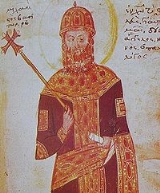
Michael VIII Palaiologos

Encyclopedia
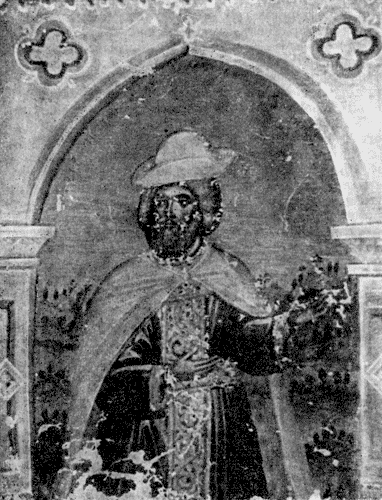

Palaiologos
Palaiologos , often latinized as Palaeologus, was a Byzantine Greek noble family, which produced the last ruling dynasty of the Byzantine Empire. After the Fourth Crusade, members of the family fled to the neighboring Empire of Nicaea, where Michael VIII Palaiologos became co-emperor in 1259,...
dynasty that would rule the Byzantine Empire
Byzantine Empire
The Byzantine Empire was the Eastern Roman Empire during the periods of Late Antiquity and the Middle Ages, centred on the capital of Constantinople. Known simply as the Roman Empire or Romania to its inhabitants and neighbours, the Empire was the direct continuation of the Ancient Roman State...
until the Fall of Constantinople
Fall of Constantinople
The Fall of Constantinople was the capture of the capital of the Byzantine Empire, which occurred after a siege by the Ottoman Empire, under the command of Ottoman Sultan Mehmed II, against the defending army commanded by Byzantine Emperor Constantine XI...
in 1453. He recovered Constantinople from the Latin Empire
Latin Empire
The Latin Empire or Latin Empire of Constantinople is the name given by historians to the feudal Crusader state founded by the leaders of the Fourth Crusade on lands captured from the Byzantine Empire. It was established after the capture of Constantinople in 1204 and lasted until 1261...
in 1261 and transformed the Empire of Nicaea
Empire of Nicaea
The Empire of Nicaea was the largest of the three Byzantine Greek successor states founded by the aristocracy of the Byzantine Empire that fled after Constantinople was occupied by Western European and Venetian forces during the Fourth Crusade...
into a restored Byzantine Empire
Byzantine Empire
The Byzantine Empire was the Eastern Roman Empire during the periods of Late Antiquity and the Middle Ages, centred on the capital of Constantinople. Known simply as the Roman Empire or Romania to its inhabitants and neighbours, the Empire was the direct continuation of the Ancient Roman State...
.
Road to the throne
Michael VIII Palaiologos was the son of the megas domestikos Andronikos Doukas Komnenos Palaiologos by Theodora Angelina Palaiologina, the granddaughter of Emperor Alexios III AngelosAlexios III Angelos
Alexios III Angelos was Byzantine Emperor from 1195 to 1203.- Early life:Alexios III Angelos was the second son of Andronikos Angelos and Euphrosyne Kastamonitissa. Andronicus was himself a son of Theodora Komnene, the youngest daughter of Emperor Alexios I Komnenos and Irene Doukaina. Thus...
and Euphrosyne Doukaina Kamaterina. Even with our imperfect knowledge of Byzantine genealogy, no less than eleven emperors may be traced among his ancestors. He was one of the noblest men among the Byzantine aristocracy, and might have succeeded to the throne in regular fashion if the Fourth Crusade
Fourth Crusade
The Fourth Crusade was originally intended to conquer Muslim-controlled Jerusalem by means of an invasion through Egypt. Instead, in April 1204, the Crusaders of Western Europe invaded and conquered the Christian city of Constantinople, capital of the Eastern Roman Empire...
had not been diverted to Constantinople in 1203. At an early age he rose to distinction, and ultimately became commander of the Latin mercenaries in the employment of the emperors of Nicaea
Empire of Nicaea
The Empire of Nicaea was the largest of the three Byzantine Greek successor states founded by the aristocracy of the Byzantine Empire that fled after Constantinople was occupied by Western European and Venetian forces during the Fourth Crusade...
. A few days after the death of Emperor Theodore II Doukas Laskaris
Theodore II Laskaris
Theodore II Doukas Laskaris or Ducas Lascaris was emperor of Nicaea, 1254–1258.-Life:Theodore II Doukas Laskaris was the only son of Emperor John III Doukas Vatatzes and Eirene Laskarina, the daughter of Emperor Theodore I Laskaris and Anna Angelina, a daughter of Emperor Alexios III Angelos and...
in 1258, Michael Palaiologos instigated a coup against the influential bureaucrat George Mouzalon
George Mouzalon
George Mouzalon was a high official of the Empire of Nicaea under Theodore II Laskaris . Of humble origin, he became Theodore's companion in childhood and was raised to high state office upon the latter's assumption of power. This caused great resentment from the aristocracy, which had monopolized...
, becoming joint guardian for the eight-year old Emperor John IV Doukas Laskaris
John IV Laskaris
John IV Doukas Laskaris was emperor of Nicaea from August 18, 1258 to December 25, 1261...
together with the patriarch Arsenios. Michael was invested with the titles of megas doux
Megas Doux
The megas doux was one of the highest positions in the hierarchy of the later Byzantine Empire, denoting the commander-in-chief of the Byzantine navy. It is sometimes also given by the half-Latinizations megaduke or megadux...
and, in November 1258, of despotēs
Despotes
Despot , was a senior Byzantine court title that was bestowed on the sons or sons-in-law of reigning emperors, and initially denoted the heir-apparent...
. On 1 January 1259 Michael VIII Palaiologos was proclaimed co-emperor at Nymphaion with the help of the Republic of Genoa
Republic of Genoa
The Most Serene Republic of Genoa |Ligurian]]: Repúbrica de Zêna) was an independent state from 1005 to 1797 in Liguria on the northwestern Italian coast, as well as Corsica from 1347 to 1768, and numerous other territories throughout the Mediterranean....
.
Reign
On 25 July 1261, Michael VIII's general Alexios StrategopoulosAlexios Strategopoulos
Alexios Strategopoulos was a Byzantine general during the reign of Michael VIII Palaiologos, rising to the rank of megas domestikos and Caesar. He is most notable for leading the reconquest of Constantinople from the Latins in 1261.- Early life :...
captured Constantinople from its last Latin Emperor, Baldwin II
Baldwin II of Constantinople
Baldwin II of Courtenay was the last emperor of the Latin Empire of Constantinople.He was a younger son of Yolanda of Flanders, sister of the first two emperors, Baldwin I and Henry of Flanders...
. Michael VIII entered the city on 15 August and had himself crowned together with his infant son Andronikos II Palaiologos
Andronikos II Palaiologos
Andronikos II Palaiologos , Latinized as Andronicus II Palaeologus, was Byzantine emperor from 1282 to 1328. He was the eldest surviving son of Michael VIII Palaiologos and Theodora Doukaina Vatatzina, grandniece of John III Doukas Vatatzes...
. When Michael VIII entered the city, its population was people, but he succeeded in increasing it to people by the end of his reign. In December John IV, who had been left behind at Nicaea, was blinded and relegated to a monastery. Patriarch Arsenios excommunicated Michael VIII, and the ban was not removed until six years later (1268) on the appointment of new patriarch Joseph I. After rendering John IV ineligible for the throne, Michael VIII quickly married off John's sisters to foreigners, so their descendants could not threaten his own children's claim to the imperial succession. On his entrance in Constantinople, Michael VIII Palaiologos abolished all Latin customs and reinstated most Byzantine ceremonies and institutions as they had existed before the Fourth Crusade
Fourth Crusade
The Fourth Crusade was originally intended to conquer Muslim-controlled Jerusalem by means of an invasion through Egypt. Instead, in April 1204, the Crusaders of Western Europe invaded and conquered the Christian city of Constantinople, capital of the Eastern Roman Empire...
, repopulating the capital and restoring damaged churches, monasteries, and public buildings. He was acutely aware of the danger posed by the possibility that the Latin West, particularly his neighbors in Italy (Charles I of Sicily
Charles I of Sicily
Charles I , known also as Charles of Anjou, was the King of Sicily by conquest from 1266, though he had received it as a papal grant in 1262 and was expelled from the island in the aftermath of the Sicilian Vespers of 1282...
, Pope Martin IV
Pope Martin IV
Pope Martin IV, born Simon de Brion held the papacy from February 21, 1281 until his death....
, and the Venetians
Republic of Venice
The Republic of Venice or Venetian Republic was a state originating from the city of Venice in Northeastern Italy. It existed for over a millennium, from the late 7th century until 1797. It was formally known as the Most Serene Republic of Venice and is often referred to as La Serenissima, in...
) would unite against him and attempt the restoration of Latin rule in Constantinople.
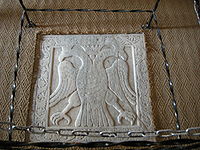
Principality of Achaea
The Principality of Achaea or of the Morea was one of the three vassal states of the Latin Empire which replaced the Byzantine Empire after the capture of Constantinople during the Fourth Crusade. It became a vassal of the Kingdom of Thessalonica, along with the Duchy of Athens, until Thessalonica...
, and Michael II Komnenos Doukas
Michael II Komnenos Doukas
Michael II Komnenos Doukas or Comnenus Ducas , often called Michael Angelos in narrative sources, was the ruler of Epirus from 1230 until his death in 1266/68.-Life:...
of Epirus
Despotate of Epirus
The Despotate or Principality of Epirus was one of the Byzantine Greek successor states of the Byzantine Empire that emerged in the aftermath of the Fourth Crusade in 1204. It claimed to be the legitimate successor of the Byzantine Empire, along with the Empire of Nicaea, and the Empire of Trebizond...
at the Battle of Pelagonia
Battle of Pelagonia
The Battle of Pelagonia took place in September of 1259, between the Empire of Nicaea and the Despotate of Epirus, Sicily and the Principality of Achaea...
. In 1263, the emperor sent men (which included Seljuk
Great Seljuq Empire
The Great Seljuq Empire was a medieval Persianate, Turko-Persian Sunni Muslim empire, originating from the Qynyq branch of Oghuz Turks. The Seljuq Empire controlled a vast area stretching from the Hindu Kush to eastern Anatolia and from Central Asia to the Persian Gulf...
mercenaries) to conquer the Principality of Achaea
Principality of Achaea
The Principality of Achaea or of the Morea was one of the three vassal states of the Latin Empire which replaced the Byzantine Empire after the capture of Constantinople during the Fourth Crusade. It became a vassal of the Kingdom of Thessalonica, along with the Duchy of Athens, until Thessalonica...
, but this expedition failed in the battles of Prinitza
Battle of Prinitza
The Battle of Prinitza was fought in 1263 between the forces of the Byzantine Empire, marching to capture Andravida, the capital of the Latin Principality of Achaea, and a small Achaean force...
and Makryplagi
Battle of Makryplagi
The Battle of Makryplagi or Makry Plagi was fought between the forces of the Byzantine Empire, and the Latin Principality of Achaea. The Byzantines had been weakened and demoralized by the defection of their numerous Turkish mercenaries to the Achaeans...
, and a mixed imperial and Genoese fleet of 48 ships was defeated by a smaller Venetian force at the Battle of Settepozzi
Battle of Settepozzi
The Battle of Settepozzi was fought sometime in May–July 1263 off Settepozzi between a Genoese-Byzantine fleet and a smaller Venetian fleet...
.
After Settepozzi, Michael VIII dismissed the 60 Genoese galleys that he had hired earlier, and began a rapprochement with Venice. With the help of Pope Urban IV
Pope Urban IV
Pope Urban IV , born Jacques Pantaléon, was Pope, from 1261 to 1264. He was not a cardinal, and there have been several Popes since him who have not been Cardinals, including Urban V and Urban VI.-Biography:...
Michael VIII concluded peace with his former enemies. By the terms of the treaties, William II was obliged to cede Mystras
Mystras
Mystras is a fortified town and a former municipality in Laconia, Peloponnese, Greece. Since the 2011 local government reform it is part of the municipality Sparti, of which it is a municipal unit. Situated on Mt...
, Monemvasia
Monemvasia
Monemvasia is a town and a municipality in Laconia, Greece. The town is located on a small peninsula off the east coast of the Peloponnese. The peninsula is linked to the mainland by a short causeway 200m in length. Its area consists mostly of a large plateau some 100 metres above sea level, up to...
and Maina in the Morea
Morea
The Morea was the name of the Peloponnese peninsula in southern Greece during the Middle Ages and the early modern period. It also referred to a Byzantine province in the region, known as the Despotate of Morea.-Origins of the name:...
to the Byzantines. He also signed a treaty in 1263 with the Egyptian Mamluk
Mamluk Sultanate (Cairo)
The Mamluk Sultanate of Egypt was the final independent Egyptian state prior to the establishment of the Muhammad Ali Dynasty in 1805. It lasted from the overthrow of the Ayyubid Dynasty until the Ottoman conquest of Egypt in 1517. The sultanate's ruling caste was composed of Mamluks, Arabised...
sultan Baibars
Baibars
Baibars or Baybars , nicknamed Abu l-Futuh , was a Mamluk Sultan of Egypt. He was one of the commanders of the forces which inflicted a devastating defeat on the Seventh Crusade of King Louis IX of France and he led the vanguard of the Egyptian army at the Battle of Ain Jalut in 1260, which marked...
, and the Mongol Khan of Kipchak.
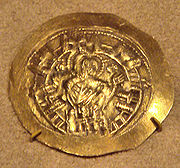
Bulgaria
Bulgaria , officially the Republic of Bulgaria , is a parliamentary democracy within a unitary constitutional republic in Southeast Europe. The country borders Romania to the north, Serbia and Macedonia to the west, Greece and Turkey to the south, as well as the Black Sea to the east...
and Serbia
Serbia
Serbia , officially the Republic of Serbia , is a landlocked country located at the crossroads of Central and Southeast Europe, covering the southern part of the Carpathian basin and the central part of the Balkans...
into the camp of Michael VIII's opponents. This threat did not materialise in a significant way during Michael VIII's reign, and the Emperor tried to take advantage of a civil war in Bulgaria
Uprising of Ivaylo
The Uprising of Ivaylo was an uprising of the Bulgarian peasantry against the Emperor Constantine Tikh and the Bulgarian nobility. The revolt was fuelled by resentment at the beginning feudalization of the Bulgarian Empire, as well as by the failure to confront the Mongol menace over north-eastern...
in the late 1270s but the Byzantine armies suffered several major defeats at the hands of the peasant Emperor Ivaylo
Ivaylo of Bulgaria
Ivaylo, also spelled Ivailo, , nicknamed Bardokva or Lakhanas in Greek, was a rebel leader and emperor of Bulgaria. In 1277, he spearheaded a peasant uprising, and forced the nobles to accept him as emperor...
. He managed to temporarily impose his son-in-law Ivan Asen III
Ivan Asen III of Bulgaria
Ivan Asen III , ruled as emperor of Bulgaria 1279–1280. Ivan Asen III was the son of Mitso Asen of Bulgaria and Maria of Bulgaria, a daughter of Ivan Asen II of Bulgaria and Irene of Thessalonica...
on the Bulgarian throne but after the Byzantine defeat at Devina he had to flee. However, later Michael VIII managed to conquer the Bulgarian portion of Thrace
Thrace
Thrace is a historical and geographic area in southeast Europe. As a geographical concept, Thrace designates a region bounded by the Balkan Mountains on the north, Rhodope Mountains and the Aegean Sea on the south, and by the Black Sea and the Sea of Marmara on the east...
while the internal situation of the Bulgarian Empire
Second Bulgarian Empire
The Second Bulgarian Empire was a medieval Bulgarian state which existed between 1185 and 1396 . A successor of the First Bulgarian Empire, it reached the peak of its power under Kaloyan and Ivan Asen II before gradually being conquered by the Ottomans in the late 14th-early 15th century...
remained unstable. For a while the diplomatic intent of the union worked out in the West, but in the end Pope Martin IV
Pope Martin IV
Pope Martin IV, born Simon de Brion held the papacy from February 21, 1281 until his death....
, an ally of Charles of Anjou, excommunicated
Excommunication
Excommunication is a religious censure used to deprive, suspend or limit membership in a religious community. The word means putting [someone] out of communion. In some religions, excommunication includes spiritual condemnation of the member or group...
Michael VIII. In 1275, Michael VIII sent an army against Thessaly
Thessaly
Thessaly is a traditional geographical region and an administrative region of Greece, comprising most of the ancient region of the same name. Before the Greek Dark Ages, Thessaly was known as Aeolia, and appears thus in Homer's Odyssey....
and fleet of 73 ships to harass the Latin states in Greece. The army was crushingly defeated at the Battle of Neopatras
Battle of Neopatras
The Battle of Neopatras was fought in the early 1270s between a Byzantine army besieging the city of Neopatras and the forces of John I Doukas, ruler of Thessaly. The battle was a rout for the Byzantine army, which was caught by surprise and defeated by a much smaller but more disciplined...
, but the fleet won a similarly comprehensive victory at the Battle of Demetrias
Battle of Demetrias
The Battle of Demetrias was a sea engagement fought at Demetrias in Greece in the early 1270s between a Byzantine fleet and the assembled forces of the Latin barons of Euboea and Crete...
.
As a rare manifestation of truly "Byzantine" diplomacy, Michael VIII secretly incited the Sicilian Vespers
Sicilian Vespers
The Sicilian Vespers is the name given to the successful rebellion on the island of Sicily that broke out on the Easter of 1282 against the rule of the French/Angevin king Charles I, who had ruled the Kingdom of Sicily since 1266. Within six weeks three thousand French men and women were slain by...
, a rebellion against Charles of Anjou in Palermo
Palermo
Palermo is a city in Southern Italy, the capital of both the autonomous region of Sicily and the Province of Palermo. The city is noted for its history, culture, architecture and gastronomy, playing an important role throughout much of its existence; it is over 2,700 years old...
, and the invasion of the Sicily
Sicily
Sicily is a region of Italy, and is the largest island in the Mediterranean Sea. Along with the surrounding minor islands, it constitutes an autonomous region of Italy, the Regione Autonoma Siciliana Sicily has a rich and unique culture, especially with regard to the arts, music, literature,...
by the Catalans
Catalonia
Catalonia is an autonomous community in northeastern Spain, with the official status of a "nationality" of Spain. Catalonia comprises four provinces: Barcelona, Girona, Lleida, and Tarragona. Its capital and largest city is Barcelona. Catalonia covers an area of 32,114 km² and has an...
of King Peter III of Aragon
Peter III of Aragon
Peter the Great was the King of Aragon of Valencia , and Count of Barcelona from 1276 to his death. He conquered Sicily and became its king in 1282. He was one of the greatest of medieval Aragonese monarchs.-Youth and succession:Peter was the eldest son of James I of Aragon and his second wife...
. Michael VIII was forced to drain the treasury to pay the enormous bribe of gold coins to King Peter III. This halved the kingdom of Charles of Anjou, who was forced to spend the remainder of his life unsuccessfully trying to reassert his control over Sicily.
In reconstituting the Byzantine Empire Michael VIII restored the old administration without endeavouring to correct its failures. In recovering Constantinople and investing in the defence of his European provinces, Michael VIII began to denude the Anatolia
Anatolia
Anatolia is a geographic and historical term denoting the westernmost protrusion of Asia, comprising the majority of the Republic of Turkey...
n frontier of its troops and was forced to lower their pay or cancel their tax exemptions. This policy led to the gradual collapse of the frontier, which was infiltrated by Turkish bands even before the death of Michael VIII in Pachomios village, Thrace in December 1282. The Palaiologan dynasty he established ruled the Byzantine Empire for almost two centuries, longer than any other in Roman history. Also, during his reign there was a temporary naval revival in which the Byzantine navy consisted of 80 ships.

Family
In 1253, Michael VIII Palaiologos married Theodora Doukaina VatatzinaTheodora Doukaina Vatatzina
Theodora Doukaina Vatatzaina was the Empress consort of Michael VIII Palaiologos.-Family:Theodora was a daughter of Ioannes Doukas Vatatzes and wife Eudokia Angelina. The names of her parents were recorded by George Acropolites.Her paternal grandparents were sebastokrator Isaakios Doukas...
, a grandniece of John III Doukas Vatatzes
John III Doukas Vatatzes
John III Doukas Vatatzes, Latinized as Ducas Vatatzes |Nymphaion]]) was emperor of Nicaea 1221–1254.-Life:John Doukas Vatatzes was probably the son of the general Basileios Vatatzes, Duke of Thrace, who died in 1193, and his wife, an unnamed daughter of Isaakios Angelos and cousin of the Emperors...
, Emperor of Nicaea. Orphaned in childhood, she was raised by her great-uncle John III, who was said to have "loved her like a daughter", and who arranged for her marriage to Michael. Their children were:
- Manuel Palaiologos (c. 1254–1259)
- Andronikos II PalaiologosAndronikos II PalaiologosAndronikos II Palaiologos , Latinized as Andronicus II Palaeologus, was Byzantine emperor from 1282 to 1328. He was the eldest surviving son of Michael VIII Palaiologos and Theodora Doukaina Vatatzina, grandniece of John III Doukas Vatatzes...
(1259–1332) - Constantine Palaiologos (1261–1306)
- Irene Palaiologina, who married emperor Ivan Asen III of BulgariaIvan Asen III of BulgariaIvan Asen III , ruled as emperor of Bulgaria 1279–1280. Ivan Asen III was the son of Mitso Asen of Bulgaria and Maria of Bulgaria, a daughter of Ivan Asen II of Bulgaria and Irene of Thessalonica...
- Anna Palaiologina, who married Demetrios/Michael Komnenos Doukas, third son of Michael II of EpirusMichael II Komnenos DoukasMichael II Komnenos Doukas or Comnenus Ducas , often called Michael Angelos in narrative sources, was the ruler of Epirus from 1230 until his death in 1266/68.-Life:...
- Eudokia PalaiologinaEudokia PalaiologinaEudokia Palaiologina or was the third daughter of Byzantine Emperor Michael VIII Palaiologos and his wife, Theodora Doukaina Vatatzaina, a grandniece of Emperor John III Doukas Vatatzes of Nicaea....
, who married Emperor John II of TrebizondJohn II of TrebizondJohn II Megas Komnenos was Emperor of Trebizond from 1280 to 1297. He was the youngest son of Emperor Manuel I and his third wife, Irene Syrikaina, a Trapezuntine noblewoman... - Theodora Palaiologina, who married King David VI NarinDavid VI NarinDavid VI Narin , from the Bagrationi dynasty, was king of Georgia in 1245–1293. From 1259 to 1293, he ruled the kingdom of Imereti under the name David I as a vassal state of Georgia.-Life:...
of GeorgiaGeorgia (country)Georgia is a sovereign state in the Caucasus region of Eurasia. Located at the crossroads of Western Asia and Eastern Europe, it is bounded to the west by the Black Sea, to the north by Russia, to the southwest by Turkey, to the south by Armenia, and to the southeast by Azerbaijan. The capital of...
and ImeretiImeretiImereti is a province in Georgia situated along the middle and upper reaches of the Rioni river. It consists of the following Georgian administrative-territorial units:#Kutaisi #Baghdati region#Vani region#Zestafoni region...
By a mistress, a Diplovatatzina, Michael VIII also had two illegitimate daughters:
- Euphrosyne Palaiologina, who married Nogai KhanNogai KhanNogai , also called Isa Nogai, was a general and de facto ruler of the Golden Horde and a great-great-grandson of Genghis Khan. His grandfather was Baul/Teval Khan, the 7th son of Jochi...
of the Golden HordeGolden HordeThe Golden Horde was a Mongol and later Turkicized khanate that formed the north-western sector of the Mongol Empire... - Maria Palaiologina, who married Abaqa KhanAbaqa KhanAbaqa Khan , also Abaga , or Abagha Khan, was the second Mongol ruler of the Persian Ilkhanate. The son of Hulagu Khan and Yesuncin Khatun, he reigned from 1265–1282 and was succeeded by his brother Tekuder Khan...
of Ilkhanid Persia
Ancestry
External links
- Michael coinage: http://www.wildwinds.com/coins/byz/michael_VIII/t.html