

Ancona

Encyclopedia
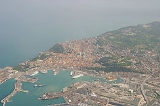
Ancona is a city and a seaport in the Marche
region, in central Italy
, with a population of 101,909 (2005). Ancona is the capital of the province of Ancona
and of the region.
The city is located 280 km (174 mi) northeast of Rome, on the Adriatic Sea
, between the slopes of the two extremities of the promontory
of Monte Conero
, Monte Astagno and Monte Guasco.
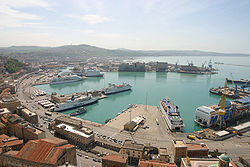
Ancona is one of the main ports on the Adriatic Sea, especially for passenger traffic, and is the main economic and demographic center of the region.
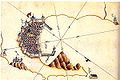
 Ancona was founded by Greek settlers from Syracuse
about 387 BC, who gave it its name: Ancona is a very slightly modified transliteration of the Greek Αγκων, meaning "elbow"; the harbor to the east of the town was originally protected only by the promontory on the north, shaped like an elbow. Greek merchants established a Tyrian purple
dye factory here. In Roman times it kept its own coinage with the punning device of the bent arm holding a palm branch, and the head of Aphrodite
on the reverse, and continued the use of the Greek language
.
When it became a Roman
colony is doubtful. It was occupied as a naval station in the Illyrian War of 178 BC. Julius Caesar
took possession of it immediately after crossing the Rubicon
. Its harbour was of considerable importance in imperial times, as the nearest to Dalmatia
, and was enlarged by Trajan
, who constructed the north quay with his Syrian
architect Apollodorus of Damascus
. At the beginning of it stands the marble triumphal arch
with a single archway, and without bas-reliefs, erected in his honour in 115 by the Senate and Roman people.
After the fall of the Western Roman Empire, Ancona was successively attacked by the Goths
, Lombards
and Saracens, but recovered its strength and importance. It was one of the cities of the Pentapolis
under the Exarchate of Ravenna
, an administrative unit of the Byzantine Empire
. With the Carolingian conquest of northern Italy, it became the capital of the Marca di Ancona, whence the name of the modern region. After 1000, Ancona became increasingly independent, eventually turning into an important maritime republic (together with Gaeta
, Trani
and Ragusa
, it is one of those not appearing on the Italian naval flag), often clashing against the nearby power of Venice
. An oligarchic republic, Ancona was ruled by six Elders, elected by the three terzieri
into which the city was divided: S. Pietro, Porto and Capodimonte. It had a coin of its own, the agontano, and a series of laws known as Statuti del mare e del Terzenale and Statuti della Dogana. Ancona was usually allied with Ragusa and the Byzantine Empire
. In 1137, 1167 and 1174 it was strong enough to push back imperial forces. Anconitan ships took part in the Crusades, and their navigators included Cyriac of Ancona
. In the struggle between the Popes and the Emperors that troubled Italy from the 12th century onwards, Ancona sided with the Guelph
s.
Differently from other cities of northern Italy, Ancona never became a seignory
. The sole exception was the rule of the Malatesta
, who took the city in 1348 taking advantage of the black death
and of a fire that had destroyed many of its important buildings. The Malatesta were ousted in 1383. In 1532 it definitively lost its freedom and became part of the Papal States
, under Pope Clement VII
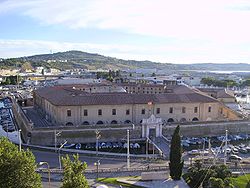
. Symbol of the papal authority was the massive Citadel. Together with Rome and Avignon
, Ancona was the sole city in the Papal States in which the Jews were allowed to stay after 1569, living in the ghetto
built after 1555.
In 1733 Pope Clement XII
extended the quay, and an inferior imitation of Trajan's arch was set up; he also erected a Lazaretto
at the south end of the harbor, Luigi Vanvitelli
being the architect-in-chief. The southern quay was built in 1880, and the harbour was protected by forts on the heights. From 1797 onwards, when the French took
it, it frequently appears in history as an important fortress. Ancona entered in the Kingdom of Italy
when Christophe Léon Louis Juchault de Lamoricière
surrendered here on 29 September 1860, eleven days after his defeat at Castelfidardo
.
During World War II
, in July 1944, the city was taken
by the Polish II Corps
as part of an Allied
operation to gain access to a seaport closer to the Gothic Line
in order to shorten their lines of communication
for the advance into northern Italy.
In 1531 the Confraternity of the Greeks (Confraternita dei Greci) was established which included Orthodox and Catholic Greeks. They secured the use of the Church of St. Anna dei Greci and were granted permission to hold services according to the Greek and the Latin rite. The church of St. Anna was existed since 13th c. initially as “Santa Maria in Porta Cipriana”, on ruins of the ancient Greek walls of Ancona.
In 1534 a decision by Pope Paul III favoured the activity of merchants of all nationalities and religions from the Levant and allowed them to settle in Ancona with their families. A Venetian travelling through Ancona in 1535 recorded that the city was “full of merchants from every nation and mostly Greeks and Turks”. In the second half of the 16th c. the presence of Greeks and other merchants from the Ottoman Empire declined after a series of restricion mesures taken by the Italian imperial authorities and the pope.
Disputes between the Orthodox and Catholic Greeks of the community were frequent and persisted till 1797 when the city was occupied by France who closed all the religious confraternities and confiscated the archive of the Greek community. The church of St. Anna dei Greci was re-opened to services in 1822. In 1835, in the absence of a Greek community in Ancona, it passed to the Latin Church.
, of whom 47.6% were male and 52.4% were female. Minors (children ages 18 and younger) totalled 15.54 percent of the population compared to pensioners who number 24.06 percent. This compares with the Italian average of 18.06 percent (minors) and 19.94 percent (pensioners). The average age of Ancona resident is 48 compared to the Italian average of 42. In the five years between 2002 and 2007, the population of Ancona grew by 1.48 percent, while Italy as a whole grew by 3.56 percent.http://demo.istat.it/bil2002/index.htmlhttp://demo.istat.it/bil2007/index.html The current birth rate of Ancona is 8.14 births per 1,000 inhabitants compared to the Italian average of 9.45 births.
As of 2006, 92.77% of the population was Italian
. The largest immigrant group came from other European nations (particularly those from Albania
, Romania
and Ukraine
): 3.14%, followed by the Americas
: 0.93%, East Asia
: 0.83%, and North Africa
: 0.80%.
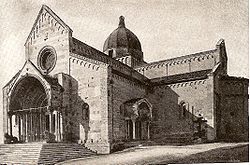
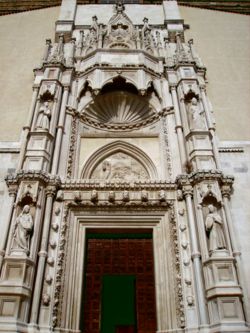
, was consecrated at the beginning of the 11th century and completed in 1189. Some writers suppose that the original church was in the form of a basilica
and belonged to the 7th century. An early restoration was completed in 1234. It is a fine Romanesque
building in grey stone, built in the form of a Greek cross, and other elements of Byzantine art. It has a dodecagonal dome over the center slightly altered by Margaritone d'Arezzo in 1270. The façade has a Gothic portal, ascribed to Giorgio da Como (1228), which was intended to have a lateral arch on each side.
The interior, which has a crypt under each transept, in the main preserves its original character. It has ten columns which are attributed to the temple of Venus. The church was restored in the 1980s.
There are also several fine late Gothic
buildings, including the Palazzo Benincasa, the Palazzo del Senato and the Loggia dei Mercanti
, all by Giorgio da Sebenico, and the prefecture
, which has Renaissance
additions.
The archaeological museum contains pre-Roman (Piceni) objects from tombs in the district, and two Roman beds with fine decorations in ivory.
 The Pinacoteca Civica Francesco Podesti is housed in the Palazzo Bosdari, reconstructed in 1558 - 1561 by Pellegrino Tibaldi
. Works in the gallery include:
Other artists present include Carlo da Camerino (late 15th- early 16th century) and Arcangelo di Cola (fl.
1416-1429). Modern artists featured are Bartolini, Bucci, Campigli, Cassinari, Cucchi, Levi, Sassu, Tamburi, Trubbiani, Podesti and others.
Angelo Messi, ancestor of famous football star Lionel Messi
emigrated from Ancona to Rosario
, Argentina
in the 1880s.
(IATA: AOI, ICAO: LIPY), an airport
located in Falconara Marittima and named after Raffaello Sanzio.
is the main railway station of the city and is served by regional and long distance trains. The other stations are Ancona Marittima, Ancona Torrette, Palombina and Varano.
serves the city with the exits "Ancona Nord" (An. North) and "Ancona Sud" (An. South).
has been in operation since 1949. Ancona is also served by an urban bus network.
with:
Marche
The population density in the region is below the national average. In 2008, it was 161.5 inhabitants per km2, compared to the national figure of 198.8. It is highest in the province of Ancona , and lowest in the province of Macerata...
region, in central Italy
Italy
Italy , officially the Italian Republic languages]] under the European Charter for Regional or Minority Languages. In each of these, Italy's official name is as follows:;;;;;;;;), is a unitary parliamentary republic in South-Central Europe. To the north it borders France, Switzerland, Austria and...
, with a population of 101,909 (2005). Ancona is the capital of the province of Ancona
Province of Ancona
The Province of Ancona is a province in the Marche region of central Italy. Its capital is the city of Ancona. The province has an area of 1940 km² and a 2006 population of 465,906 in 49 comuni , see Comunes of the Province of Ancona....
and of the region.
The city is located 280 km (174 mi) northeast of Rome, on the Adriatic Sea
Adriatic Sea
The Adriatic Sea is a body of water separating the Italian Peninsula from the Balkan peninsula, and the system of the Apennine Mountains from that of the Dinaric Alps and adjacent ranges...
, between the slopes of the two extremities of the promontory
Promontory
Promontory may refer to:*Promontory, a prominent mass of land which overlooks lower lying land or a body of water*Promontory, Utah, the location where the United States first Transcontinental Railroad was completed...
of Monte Conero
Monte Conero
Monte Conero is a promontory in Italy, situated directly south of the city of Ancona on the Adriatic Sea....
, Monte Astagno and Monte Guasco.
Ancona is one of the main ports on the Adriatic Sea, especially for passenger traffic, and is the main economic and demographic center of the region.
History
Syracuse, Italy
Syracuse is a historic city in Sicily, the capital of the province of Syracuse. The city is notable for its rich Greek history, culture, amphitheatres, architecture, and as the birthplace of the preeminent mathematician and engineer Archimedes. This 2,700-year-old city played a key role in...
about 387 BC, who gave it its name: Ancona is a very slightly modified transliteration of the Greek Αγκων, meaning "elbow"; the harbor to the east of the town was originally protected only by the promontory on the north, shaped like an elbow. Greek merchants established a Tyrian purple
Tyrian purple
Tyrian purple , also known as royal purple, imperial purple or imperial dye, is a purple-red natural dye, which is extracted from sea snails, and which was possibly first produced by the ancient Phoenicians...
dye factory here. In Roman times it kept its own coinage with the punning device of the bent arm holding a palm branch, and the head of Aphrodite
Aphrodite
Aphrodite is the Greek goddess of love, beauty, pleasure, and procreation.Her Roman equivalent is the goddess .Historically, her cult in Greece was imported from, or influenced by, the cult of Astarte in Phoenicia....
on the reverse, and continued the use of the Greek language
Greek language
Greek is an independent branch of the Indo-European family of languages. Native to the southern Balkans, it has the longest documented history of any Indo-European language, spanning 34 centuries of written records. Its writing system has been the Greek alphabet for the majority of its history;...
.
When it became a Roman
Ancient Rome
Ancient Rome was a thriving civilization that grew on the Italian Peninsula as early as the 8th century BC. Located along the Mediterranean Sea and centered on the city of Rome, it expanded to one of the largest empires in the ancient world....
colony is doubtful. It was occupied as a naval station in the Illyrian War of 178 BC. Julius Caesar
Julius Caesar
Gaius Julius Caesar was a Roman general and statesman and a distinguished writer of Latin prose. He played a critical role in the gradual transformation of the Roman Republic into the Roman Empire....
took possession of it immediately after crossing the Rubicon
Rubicon
The Rubicon is a shallow river in northeastern Italy, about 80 kilometres long, running from the Apennine Mountains to the Adriatic Sea through the southern Emilia-Romagna region, between the towns of Rimini and Cesena. The Latin word rubico comes from the adjective "rubeus", meaning "red"...
. Its harbour was of considerable importance in imperial times, as the nearest to Dalmatia
Dalmatia
Dalmatia is a historical region on the eastern coast of the Adriatic Sea. It stretches from the island of Rab in the northwest to the Bay of Kotor in the southeast. The hinterland, the Dalmatian Zagora, ranges from fifty kilometers in width in the north to just a few kilometers in the south....
, and was enlarged by Trajan
Trajan
Trajan , was Roman Emperor from 98 to 117 AD. Born into a non-patrician family in the province of Hispania Baetica, in Spain Trajan rose to prominence during the reign of emperor Domitian. Serving as a legatus legionis in Hispania Tarraconensis, in Spain, in 89 Trajan supported the emperor against...
, who constructed the north quay with his Syrian
History of Syria
The history of Syria:*Prehistory and Ancient Near East: see Pre-history of the Southern Levant, Fertile Crescent, Ebla, Mitanni*Antiquity: see Syro-Hittite states, Greater Syria, Roman Syria...
architect Apollodorus of Damascus
Apollodorus of Damascus
Apollodorus of Damascus was a Greek engineer, architect, designer and sculptor who flourished during the 2nd century AD, from Damascus, Roman Syria. He was a favourite of Trajan, for whom he constructed Trajan's Bridge over the Danube for the 105-106 campaign in Dacia. He also designed the Forum...
. At the beginning of it stands the marble triumphal arch
Triumphal arch
A triumphal arch is a monumental structure in the shape of an archway with one or more arched passageways, often designed to span a road. In its simplest form a triumphal arch consists of two massive piers connected by an arch, crowned with a flat entablature or attic on which a statue might be...
with a single archway, and without bas-reliefs, erected in his honour in 115 by the Senate and Roman people.
After the fall of the Western Roman Empire, Ancona was successively attacked by the Goths
Goths
The Goths were an East Germanic tribe of Scandinavian origin whose two branches, the Visigoths and the Ostrogoths, played an important role in the fall of the Roman Empire and the emergence of Medieval Europe....
, Lombards
Lombards
The Lombards , also referred to as Longobards, were a Germanic tribe of Scandinavian origin, who from 568 to 774 ruled a Kingdom in Italy...
and Saracens, but recovered its strength and importance. It was one of the cities of the Pentapolis
Pentapolis
A pentapolis, from the Greek words , "five" and , "city" is a geographic and/or institutional grouping of five cities...
under the Exarchate of Ravenna
Exarchate of Ravenna
The Exarchate of Ravenna or of Italy was a centre of Byzantine power in Italy, from the end of the 6th century to 751, when the last exarch was put to death by the Lombards.-Introduction:...
, an administrative unit of the Byzantine Empire
Byzantine Empire
The Byzantine Empire was the Eastern Roman Empire during the periods of Late Antiquity and the Middle Ages, centred on the capital of Constantinople. Known simply as the Roman Empire or Romania to its inhabitants and neighbours, the Empire was the direct continuation of the Ancient Roman State...
. With the Carolingian conquest of northern Italy, it became the capital of the Marca di Ancona, whence the name of the modern region. After 1000, Ancona became increasingly independent, eventually turning into an important maritime republic (together with Gaeta
Gaeta
Gaeta is a city and comune in the province of Latina, in Lazio, central Italy. Set on a promontory stretching towards the Gulf of Gaeta, it is 120 km from Rome and 80 km from Naples....
, Trani
Trani
Trani is a seaport of Apulia, southern Italy, on the Adriatic Sea, in the new Province of Barletta-Andria-Trani , and 40 km by railway West-Northwest of Bari.- History :...
and Ragusa
Dubrovnik
Dubrovnik is a Croatian city on the Adriatic Sea coast, positioned at the terminal end of the Isthmus of Dubrovnik. It is one of the most prominent tourist destinations on the Adriatic, a seaport and the centre of Dubrovnik-Neretva county. Its total population is 42,641...
, it is one of those not appearing on the Italian naval flag), often clashing against the nearby power of Venice
Republic of Venice
The Republic of Venice or Venetian Republic was a state originating from the city of Venice in Northeastern Italy. It existed for over a millennium, from the late 7th century until 1797. It was formally known as the Most Serene Republic of Venice and is often referred to as La Serenissima, in...
. An oligarchic republic, Ancona was ruled by six Elders, elected by the three terzieri
Terziere
A terziere is a subdivision of several towns in Italy. The word derives from terzo, meaning "third"; and is thus used only for towns divided into three neighborhoods...
into which the city was divided: S. Pietro, Porto and Capodimonte. It had a coin of its own, the agontano, and a series of laws known as Statuti del mare e del Terzenale and Statuti della Dogana. Ancona was usually allied with Ragusa and the Byzantine Empire
Byzantine Empire
The Byzantine Empire was the Eastern Roman Empire during the periods of Late Antiquity and the Middle Ages, centred on the capital of Constantinople. Known simply as the Roman Empire or Romania to its inhabitants and neighbours, the Empire was the direct continuation of the Ancient Roman State...
. In 1137, 1167 and 1174 it was strong enough to push back imperial forces. Anconitan ships took part in the Crusades, and their navigators included Cyriac of Ancona
Cyriac of Ancona
Ciriaco de' Pizzicolli or Cyriacus of Ancona was a restlessly itinerant Italian humanist and antiquarian who came from a prominent family of merchants in Ancona. Sometime he is called the Father of Archaeology...
. In the struggle between the Popes and the Emperors that troubled Italy from the 12th century onwards, Ancona sided with the Guelph
Guelphs and Ghibellines
The Guelphs and Ghibellines were factions supporting the Pope and the Holy Roman Emperor, respectively, in central and northern Italy. During the 12th and 13th centuries, the split between these two parties was a particularly important aspect of the internal policy of the Italian city-states...
s.
Differently from other cities of northern Italy, Ancona never became a seignory
Seignory
In English law, Seignory or seigniory , the lordship remaining to a grantor after the grant of an estate in fee simple....
. The sole exception was the rule of the Malatesta
Malatesta
Malatesta may refer to:*The House of Malatesta, an Italian family which ruled over Rimini from the thirteenth to the fifteenth century*Errico Malatesta , an Italian anarchist*Malatesta , a 1970 German film...
, who took the city in 1348 taking advantage of the black death
Black Death
The Black Death was one of the most devastating pandemics in human history, peaking in Europe between 1348 and 1350. Of several competing theories, the dominant explanation for the Black Death is the plague theory, which attributes the outbreak to the bacterium Yersinia pestis. Thought to have...
and of a fire that had destroyed many of its important buildings. The Malatesta were ousted in 1383. In 1532 it definitively lost its freedom and became part of the Papal States
Papal States
The Papal State, State of the Church, or Pontifical States were among the major historical states of Italy from roughly the 6th century until the Italian peninsula was unified in 1861 by the Kingdom of Piedmont-Sardinia .The Papal States comprised territories under...
, under Pope Clement VII
Pope Clement VII
Clement VII , born Giulio di Giuliano de' Medici, was a cardinal from 1513 to 1523 and was Pope from 1523 to 1534.-Early life:...
. Symbol of the papal authority was the massive Citadel. Together with Rome and Avignon
Avignon
Avignon is a French commune in southeastern France in the départment of the Vaucluse bordered by the left bank of the Rhône river. Of the 94,787 inhabitants of the city on 1 January 2010, 12 000 live in the ancient town centre surrounded by its medieval ramparts.Often referred to as the...
, Ancona was the sole city in the Papal States in which the Jews were allowed to stay after 1569, living in the ghetto
Ghetto
A ghetto is a section of a city predominantly occupied by a group who live there, especially because of social, economic, or legal issues.The term was originally used in Venice to describe the area where Jews were compelled to live. The term now refers to an overcrowded urban area often associated...
built after 1555.
In 1733 Pope Clement XII
Pope Clement XII
Pope Clement XII , born Lorenzo Corsini, was Pope from 12 July 1730 to 6 February 1740.Born in Florence, the son of Bartolomeo Corsini, Marquis of Casigliano and his wife Isabella Strozzi, sister of the Duke of Bagnuolo, Corsini had been an aristocratic lawyer and financial manager under preceding...
extended the quay, and an inferior imitation of Trajan's arch was set up; he also erected a Lazaretto
Lazaretto
A lazaretto or lazaret is a quarantine station for maritime travellers. Lazarets can be ships permanently at anchor, isolated islands, or mainland buildings. Until 1908, lazarets were also used for disinfecting postal items, usually by fumigation...
at the south end of the harbor, Luigi Vanvitelli
Luigi Vanvitelli
Luigi Vanvitelli was an Italian engineer and architect. The most prominent 18th-century architect of Italy, he practiced a sober classicizing academic Late Baroque style that made an easy transition to Neoclassicism.-Biography:Vanvitelli was born at Naples, the son of a Dutch painter of land and...
being the architect-in-chief. The southern quay was built in 1880, and the harbour was protected by forts on the heights. From 1797 onwards, when the French took
Republic of Ancona
The Republic of Ancona was a revolutionary municipality formed on 19 November 1797. It came about after a French victory at Ancona in February 1797, and the consequent occupation of the city. It existed in the region of Marche, with capital Ancona...
it, it frequently appears in history as an important fortress. Ancona entered in the Kingdom of Italy
Kingdom of Italy (1861–1946)
The Kingdom of Italy was a state forged in 1861 by the unification of Italy under the influence of the Kingdom of Sardinia, which was its legal predecessor state...
when Christophe Léon Louis Juchault de Lamoricière
Christophe Léon Louis Juchault de Lamoricière
Christophe Léon Louis Juchault de Lamoricière was a French general.-Life:He was born at Nantes, and entered the Engineers in 1828. He served in the Algerian campaigns from 1830 onwards, and by 1840 he had risen to the grade of maréchal-de-camp . Three years later he was made a general of division...
surrendered here on 29 September 1860, eleven days after his defeat at Castelfidardo
Castelfidardo
Castelfidardo is a town and comune in the province of Ancona, in the Marche region of central-eastern Italy.It is particularly remembered for the Italian victory over a "volunteer" army defending the Papal States, on September 18, 1860...
.
During World War II
World War II
World War II, or the Second World War , was a global conflict lasting from 1939 to 1945, involving most of the world's nations—including all of the great powers—eventually forming two opposing military alliances: the Allies and the Axis...
, in July 1944, the city was taken
Battle of Ancona
The Battle of Ancona was a battle involving forces from Poland serving as part of the British Army and German forces that took place from 16 June–18 July 1944 during the Italian campaign in World War II...
by the Polish II Corps
Polish II Corps
Polish II Corps , 1943–1947, was a major tactical and operational unit of the Polish Armed Forces in the West during World War II. It was commanded by Lieutenant General Władysław Anders and by the end of 1945 it had grown to well over 100,000 soldiers....
as part of an Allied
Allies of World War II
The Allies of World War II were the countries that opposed the Axis powers during the Second World War . Former Axis states contributing to the Allied victory are not considered Allied states...
operation to gain access to a seaport closer to the Gothic Line
Gothic Line
The Gothic Line formed Field Marshal Albert Kesselring's last major line of defence in the final stages of World War II along the summits of the Apennines during the fighting retreat of German forces in Italy against the Allied Armies in Italy commanded by General Sir Harold Alexander.Adolf Hitler...
in order to shorten their lines of communication
Lines of Communication
"Lines of Communication" is an episode from the fourth season of the science-fiction television series Babylon 5.-Synopsis:Franklin and Marcus attempt to persuade the Mars resistance to assist Sheridan in opposing President Clark...
for the advance into northern Italy.
The Greek community of Ancona in the 16th century
Ancona, as well as Venice, became a very important destination for merchants from the Ottoman Empire during the 16th century. The Greeks formed the larger of the communities of the foreign merchants. They were refugees from former Byzantine or Venetian territories that were occupied by the Ottomans in the late 15th and 16th c. The first Greek community was established in Ancona early in the 16th c. Natalucci, the 17th c. historian of the city, notes the existence of 200 Greek families in Ancona at the opening of 16th c. Most of them came from northwestern Greece, i.e. the Ionian islands and Epirus. In 1514 Dimitri Caloiri of Ioannina obtained reduced custom duties for Greek merchants coming from the towns of Ioannina, Arta and Avlona in Epirus. In 1518 a Jewish merchant of Avlona succeeded in lowering the duties paid in Ancona for all “the Levantine merchants, subjects to the Turk”.In 1531 the Confraternity of the Greeks (Confraternita dei Greci) was established which included Orthodox and Catholic Greeks. They secured the use of the Church of St. Anna dei Greci and were granted permission to hold services according to the Greek and the Latin rite. The church of St. Anna was existed since 13th c. initially as “Santa Maria in Porta Cipriana”, on ruins of the ancient Greek walls of Ancona.
In 1534 a decision by Pope Paul III favoured the activity of merchants of all nationalities and religions from the Levant and allowed them to settle in Ancona with their families. A Venetian travelling through Ancona in 1535 recorded that the city was “full of merchants from every nation and mostly Greeks and Turks”. In the second half of the 16th c. the presence of Greeks and other merchants from the Ottoman Empire declined after a series of restricion mesures taken by the Italian imperial authorities and the pope.
Disputes between the Orthodox and Catholic Greeks of the community were frequent and persisted till 1797 when the city was occupied by France who closed all the religious confraternities and confiscated the archive of the Greek community. The church of St. Anna dei Greci was re-opened to services in 1822. In 1835, in the absence of a Greek community in Ancona, it passed to the Latin Church.
Demographics
In 2007, there were 101,480 people residing in Ancona (the greater area has a population more than four times its size), located in the province of Ancona, MarcheMarche
The population density in the region is below the national average. In 2008, it was 161.5 inhabitants per km2, compared to the national figure of 198.8. It is highest in the province of Ancona , and lowest in the province of Macerata...
, of whom 47.6% were male and 52.4% were female. Minors (children ages 18 and younger) totalled 15.54 percent of the population compared to pensioners who number 24.06 percent. This compares with the Italian average of 18.06 percent (minors) and 19.94 percent (pensioners). The average age of Ancona resident is 48 compared to the Italian average of 42. In the five years between 2002 and 2007, the population of Ancona grew by 1.48 percent, while Italy as a whole grew by 3.56 percent.http://demo.istat.it/bil2002/index.htmlhttp://demo.istat.it/bil2007/index.html The current birth rate of Ancona is 8.14 births per 1,000 inhabitants compared to the Italian average of 9.45 births.
As of 2006, 92.77% of the population was Italian
Italian people
The Italian people are an ethnic group that share a common Italian culture, ancestry and speak the Italian language as a mother tongue. Within Italy, Italians are defined by citizenship, regardless of ancestry or country of residence , and are distinguished from people...
. The largest immigrant group came from other European nations (particularly those from Albania
Albania
Albania , officially known as the Republic of Albania , is a country in Southeastern Europe, in the Balkans region. It is bordered by Montenegro to the northwest, Kosovo to the northeast, the Republic of Macedonia to the east and Greece to the south and southeast. It has a coast on the Adriatic Sea...
, Romania
Romania
Romania is a country located at the crossroads of Central and Southeastern Europe, on the Lower Danube, within and outside the Carpathian arch, bordering on the Black Sea...
and Ukraine
Ukraine
Ukraine is a country in Eastern Europe. It has an area of 603,628 km², making it the second largest contiguous country on the European continent, after Russia...
): 3.14%, followed by the Americas
Americas
The Americas, or America , are lands in the Western hemisphere, also known as the New World. In English, the plural form the Americas is often used to refer to the landmasses of North America and South America with their associated islands and regions, while the singular form America is primarily...
: 0.93%, East Asia
East Asia
East Asia or Eastern Asia is a subregion of Asia that can be defined in either geographical or cultural terms...
: 0.83%, and North Africa
North Africa
North Africa or Northern Africa is the northernmost region of the African continent, linked by the Sahara to Sub-Saharan Africa. Geopolitically, the United Nations definition of Northern Africa includes eight countries or territories; Algeria, Egypt, Libya, Morocco, South Sudan, Sudan, Tunisia, and...
: 0.80%.
Cathedral church of S. Ciriaco
The Cathedral of Ancona, dedicated to Judas CyriacusJudas Cyriacus
Judas Cyriacus is the patron saint of Ancona, Italy. His feast day is celebrated in the Catholic Church on May 4.-Judas Cyriacus, Bishop of Ancona:...
, was consecrated at the beginning of the 11th century and completed in 1189. Some writers suppose that the original church was in the form of a basilica
Basilica
The Latin word basilica , was originally used to describe a Roman public building, usually located in the forum of a Roman town. Public basilicas began to appear in Hellenistic cities in the 2nd century BC.The term was also applied to buildings used for religious purposes...
and belonged to the 7th century. An early restoration was completed in 1234. It is a fine Romanesque
Romanesque architecture
Romanesque architecture is an architectural style of Medieval Europe characterised by semi-circular arches. There is no consensus for the beginning date of the Romanesque architecture, with proposals ranging from the 6th to the 10th century. It developed in the 12th century into the Gothic style,...
building in grey stone, built in the form of a Greek cross, and other elements of Byzantine art. It has a dodecagonal dome over the center slightly altered by Margaritone d'Arezzo in 1270. The façade has a Gothic portal, ascribed to Giorgio da Como (1228), which was intended to have a lateral arch on each side.
The interior, which has a crypt under each transept, in the main preserves its original character. It has ten columns which are attributed to the temple of Venus. The church was restored in the 1980s.
Other sights
- The marble Arch of Trajan, 18 m high, erected in 114/115 as an entrance to the causeway atop the harbor wall in honor of the emperor who had made the harbor, is one of the finest Roman monuments in the Marche. Most of its original bronze enrichments have disappeared. It stands on a high podium approached by a wide flight of steps. The archway, only 3 m wide, is flanked by pairs of fluted Corinthian columnsCorinthian orderThe Corinthian order is one of the three principal classical orders of ancient Greek and Roman architecture. The other two are the Doric and Ionic. When classical architecture was revived during the Renaissance, two more orders were added to the canon, the Tuscan order and the Composite order...
on pedestals. An attic bears inscriptions. The format is that of the Arch of TitusArch of TitusThe Arch of Titus is a 1st-century honorific arch located on the Via Sacra, Rome, just to the south-east of the Roman Forum. It was constructed in c.82 AD by the Roman Emperor Domitian shortly after the death of his older brother Titus to commemorate Titus' victories, including the Siege of...
in Rome, but made taller, so that the bronze figures surmounting it, of Trajan, his wife Plotina and sister Marciana, would figure as a landmark for ships approaching Rome's greatest Adriatic port. - The Lazzaretto (Laemocomium or "Mole Vanvitelliana"), planned by architect Luigi VanvitelliLuigi VanvitelliLuigi Vanvitelli was an Italian engineer and architect. The most prominent 18th-century architect of Italy, he practiced a sober classicizing academic Late Baroque style that made an easy transition to Neoclassicism.-Biography:Vanvitelli was born at Naples, the son of a Dutch painter of land and...
in 1732 is a pentagonal building covering more than 20,000 m², built to protect the military defensive authorities from the risk of contagious diseases eventually reaching the town with the ships. Later it was used also as a military hospital or as barracks; it is currently used for cultural exhibits. - The Episcopal Palace was the place where Pope Pius IIPope Pius IIPope Pius II, born Enea Silvio Piccolomini was Pope from August 19, 1458 until his death in 1464. Pius II was born at Corsignano in the Sienese territory of a noble but decayed family...
died in 1464. - The church of Santa Maria della PiazzaSanta Maria della PiazzaSanta Maria della Piazza is a church in Ancona, central Italy.The church, a fine example of Romanesque architecture in the city, was erected between the 11th and the 12th centuries. Before its construction, the site was home to two small Palaeo-Christian churches, dating to the 6th and 7th centuries...
, with an elaborate arcaded façade (1210). - The Palazzo del Comune, with its lofty arched substructures at the back, was the work of Margaritone d'Arezzo, but has been restored twice.
- Church of San Francesco alle ScaleSan Francesco alle ScaleSan Francesco alle Scale is a church in Ancona, central Italy.-History:Sited at the top of a staircase leading to the eponymous square, the church was founded in 1323 by the Franciscans, and was originally dedicated to Santa Maria Maggiore...
- Church of Sant'Agostino, built by the AugustiniansAugustiniansThe term Augustinians, named after Saint Augustine of Hippo , applies to two separate and unrelated types of Catholic religious orders:...
in 1341 as Santa Maria del Popolo, and enlarged by Luigi VanvitelliLuigi VanvitelliLuigi Vanvitelli was an Italian engineer and architect. The most prominent 18th-century architect of Italy, he practiced a sober classicizing academic Late Baroque style that made an easy transition to Neoclassicism.-Biography:Vanvitelli was born at Naples, the son of a Dutch painter of land and...
in the 18th century and turned into a palace after 1860. It has maintained the Gothic portal by Giorgio da Sebenico, with statues portraying St. Monica, St. Nicola da Tolentino, St. Simplicianus and Blessed Agostino Trionfi. - Church of the Santi Pellegrino e Teresa (18th century)
- Church of the Santissimo Sacramento (16th and 18th century)
There are also several fine late Gothic
Gothic architecture
Gothic architecture is a style of architecture that flourished during the high and late medieval period. It evolved from Romanesque architecture and was succeeded by Renaissance architecture....
buildings, including the Palazzo Benincasa, the Palazzo del Senato and the Loggia dei Mercanti
Loggia dei Mercanti
The Loggia dei Mercanti is a historical palace in Ancona, central Italy.The palace was begun in 1442 by architect Giovanni Pace, also known as Sodo, in an economically flourishing period for Ancona. It was built near the port, which was the trade point of the mercantile republic in medieval times,...
, all by Giorgio da Sebenico, and the prefecture
Prefecture
A prefecture is an administrative jurisdiction or subdivision in any of various countries and within some international church structures, and in antiquity a Roman district governed by an appointed prefect.-Antiquity:...
, which has Renaissance
Renaissance
The Renaissance was a cultural movement that spanned roughly the 14th to the 17th century, beginning in Italy in the Late Middle Ages and later spreading to the rest of Europe. The term is also used more loosely to refer to the historical era, but since the changes of the Renaissance were not...
additions.
The archaeological museum contains pre-Roman (Piceni) objects from tombs in the district, and two Roman beds with fine decorations in ivory.
Pellegrino Tibaldi
Pellegrino Tibaldi , also known as Pellegrino di Tibaldo de Pellegrini, was an Italian mannerist architect, sculptor, and mural painter.-Biography:...
. Works in the gallery include:
- Madonna with Child, panel by Carlo CrivelliCarlo CrivelliCarlo Crivelli was an Italian Renaissance painter of conservative Late Gothic decorative sensibility, who spent his early years in the Veneto, where he absorbed influences from the Vivarini, Squarcione and Mantegna...
- Sacra Conversazione by Lorenzo LottoLorenzo LottoLorenzo Lotto was a Northern Italian painter draughtsman and illustrator, traditionally placed in the Venetian school. He painted mainly altarpieces, religious subjects and portraits...
- Portrait of Francesco Arsilli by Sebastiano Del PiomboSebastiano del PiomboSebastiano del Piombo , byname of Sebastiano Luciani, was an Italian Renaissance-Mannerist painter of the early 16th century famous for his combination of the colors of the Venetian school and the monumental forms of the Roman school.- Biography :Sebastiano del Piombo belongs to the painting school...
- Circumcision by Orazio GentileschiOrazio GentileschiOrazio Lomi Gentileschi was an Italian Baroque painter, one of more important painters influenced by Caravaggio...
- Immaculate Conception and St. PalaziaPalatia and LaurentiaPalatia and Laurentia were virgin martyrs of Ancona, venerated as saints by the Catholic Church. Laurentia was said to have been Palatia’s nurse....
by Guercino - Four Saints in Ecstasis and Musician Angels by Andrea Lillio
- Gozzi AltarpieceGozzi AltarpieceThe Gozzi Altarpiece is an oil painting by the Italian Renaissance master Titian, dating from 1520. It is located in the Pinacoteca civica Francesco Podesti in Ancona, central Italy.-History:...
by TitianTitianTiziano Vecelli or Tiziano Vecellio Tiziano Vecelli or Tiziano Vecellio Tiziano Vecelli or Tiziano Vecellio (c. 1488/1490 – 27 August 1576 better known as Titian was an Italian painter, the most important member of the 16th-century Venetian school. He was born in Pieve di Cadore, near...
Other artists present include Carlo da Camerino (late 15th- early 16th century) and Arcangelo di Cola (fl.
Floruit
Floruit , abbreviated fl. , is a Latin verb meaning "flourished", denoting the period of time during which something was active...
1416-1429). Modern artists featured are Bartolini, Bucci, Campigli, Cassinari, Cucchi, Levi, Sassu, Tamburi, Trubbiani, Podesti and others.
Angelo Messi, ancestor of famous football star Lionel Messi
Lionel Messi
Lionel Andrés "Leo" Messi is an Argentine footballer who plays for FC Barcelona and captains the Argentina national team, mainly as a striker. Messi received several Ballon d'Or and FIFA World Player of the Year nominations by the age of 21, and won in 2009 and 2010...
emigrated from Ancona to Rosario
Rosario
Rosario is the largest city in the province of Santa Fe, Argentina. It is located northwest of Buenos Aires, on the western shore of the Paraná River and has 1,159,004 residents as of the ....
, Argentina
Argentina
Argentina , officially the Argentine Republic , is the second largest country in South America by land area, after Brazil. It is constituted as a federation of 23 provinces and an autonomous city, Buenos Aires...
in the 1880s.
Shipping
The Port has regular ferry links to the following cities with the following operators:- Adria Ferries (Durrës)
- Blue Line InternationalBlue Line InternationalBlue Line International is a ferry company owned by the Croatia-based SEM Maritime Company . It operates two car/passenger ferries between Croatia and Italy...
(Split, Stari Grad, Vis) - JadrolinijaJadrolinijaJadrolinija is a Croatian sea shipping company. It is a state-owned company and its main mission is connecting Croatian islands to the mainland by operating regular passenger and cargo transport services...
(Split, Zadar) - SNAVSNAVSNAV is an Italian company that operates ferry services from Italy to Sardinia, Croatia and Sicily.- Routes :SNAV operates a large network of routes across the Mediterranean and Adriatic....
(Split) (seasonal) - Superfast FerriesSuperfast FerriesSuperfast Ferries is a Greece-based ferry company founded in 1993 by Pericles Panagopulos and Alexander Panagopulos. Superfast Ferries is a member of Attica Group and operates 5 ultra-modern car-passenger ferries, offering daily connections between Ancona and Bari and Patras and Igoumenitsa...
(Igoumenitsa, Patras) - ANEK LinesANEK LinesANEK Lines is a shipping company in Greece. It was founded in 1967 by numerous shareholders who were inhabitants of Crete. It operates passenger ferries, mainly on Piraeus-Crete and Adriatic Sea lines....
(Igoumenitsa, Patras) - Minoan LinesMinoan LinesMinoan Lines is one of the dominant passenger ferry companies in Greece, sailing between Piraeus and Crete and in the Adriatic Sea, between Patras and various Italian ports. The company was founded in May 1972...
(Igoumenitsa, Patras) - Marmara Lines (Cesme)
Airport
Ancona is served by Ancona AirportAncona Airport
Ancona Airport or Ancona-Falconara Airport is an airport serving Ancona, a city in the Marche region of central Italy. The airport is located approximately west of Ancona, in Falconara Marittima...
(IATA: AOI, ICAO: LIPY), an airport
Airport
An airport is a location where aircraft such as fixed-wing aircraft, helicopters, and blimps take off and land. Aircraft may be stored or maintained at an airport...
located in Falconara Marittima and named after Raffaello Sanzio.
Railways
Ancona "Centrale"Ancona railway station
Ancona railway station, sometimes named Ancona Centrale, is the main railway station of the Italian city of Ancona, in the Marche. It is the most important station of its region and is owned by the Ferrovie dello Stato, the national rail company of Italy.-History:The station was opened on 17...
is the main railway station of the city and is served by regional and long distance trains. The other stations are Ancona Marittima, Ancona Torrette, Palombina and Varano.
Roads
The A14 motorwayAutostrada A14 (Italy)
The Autostrada A14, called also Autostrada Adriatica, is a motorway which connects the town of Bologna to the town of Taranto. For most of its route if follows the Adriatic Sea coast of the Italian peninsula...
serves the city with the exits "Ancona Nord" (An. North) and "Ancona Sud" (An. South).
Urban public transportation
The Ancona trolleybus systemTrolleybuses in Ancona
The Ancona trolleybus system forms part of the public transport network of the city and comune of Ancona, in the Marche region, central Italy...
has been in operation since 1949. Ancona is also served by an urban bus network.
Twin towns – Sister cities
Ancona is twinnedTown twinning
Twin towns and sister cities are two of many terms used to describe the cooperative agreements between towns, cities, and even counties in geographically and politically distinct areas to promote cultural and commercial ties.- Terminology :...
with:
| Izmir Izmir Izmir is a large metropolis in the western extremity of Anatolia. The metropolitan area in the entire Izmir Province had a population of 3.35 million as of 2010, making the city third most populous in Turkey... , Turkey Turkey Turkey , known officially as the Republic of Turkey , is a Eurasian country located in Western Asia and in East Thrace in Southeastern Europe... Galaţi Galati Galați is a city and municipality in Romania, the capital of Galați County. Located in the historical region of Moldavia, in the close vicinity of Brăila, Galați is the largest port and sea port on the Danube River and the second largest Romanian port.... , Romania Romania Romania is a country located at the crossroads of Central and Southeastern Europe, on the Lower Danube, within and outside the Carpathian arch, bordering on the Black Sea... Split Split (city) Split is a Mediterranean city on the eastern shores of the Adriatic Sea, centered around the ancient Roman Palace of the Emperor Diocletian and its wide port bay. With a population of 178,192 citizens, and a metropolitan area numbering up to 467,899, Split is by far the largest Dalmatian city and... , Croatia Croatia Croatia , officially the Republic of Croatia , is a unitary democratic parliamentary republic in Europe at the crossroads of the Mitteleuropa, the Balkans, and the Mediterranean. Its capital and largest city is Zagreb. The country is divided into 20 counties and the city of Zagreb. Croatia covers ... |
Ribnica, Slovenia Slovenia Slovenia , officially the Republic of Slovenia , is a country in Central and Southeastern Europe touching the Alps and bordering the Mediterranean. Slovenia borders Italy to the west, Croatia to the south and east, Hungary to the northeast, and Austria to the north, and also has a small portion of... Svolvær Svolvær -Communications:Parts of the town is built on small islands connected by bridges. There is a regional airport near the town, Svolvær Airport, Helle, and Svolvær is a port of call for Hurtigruten. There is a ferry connection Svolvær to Skutvik in Hamarøy, and express boat connections to Bodø... , Norway Norway Norway , officially the Kingdom of Norway, is a Nordic unitary constitutional monarchy whose territory comprises the western portion of the Scandinavian Peninsula, Jan Mayen, and the Arctic archipelago of Svalbard and Bouvet Island. Norway has a total area of and a population of about 4.9 million... Castlebar Castlebar Castlebar is the county town of, and at the centre of, County Mayo in Ireland. It is Mayo's largest town by population. The town's population exploded in the late 1990s, increasing by one-third in just six years, though this massive growth has slowed down greatly in recent years... , Ireland Ireland Ireland is an island to the northwest of continental Europe. It is the third-largest island in Europe and the twentieth-largest island on Earth... |
External links
- Official Site
- Marche Tourism site
- Photos: sauromarini.it, antoniomucherino.it
- Ancona, a breed of chicken named after the Italian city
- Site with photo, guides and forum
- Wine and Fish in the city of Ancona
- The Jewish Community of Ancona
- A little English Guide website made from the people of Ancona, to show Another point of view