

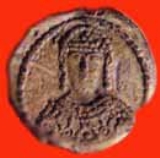
Simeon I of Bulgaria

Encyclopedia
Simeon I the Great ruled over Bulgaria
from 893 to 927, during the First Bulgarian Empire
. Simeon's successful campaigns against the Byzantines
, Magyars and Serbs
led Bulgaria to its greatest territorial expansion ever, making it the most powerful state in contemporary Eastern Europe
. His reign was also a period of unmatched cultural prosperity and enlightenment later deemed the Golden Age
of Bulgarian culture.
During Simeon's rule, Bulgaria spread over a territory between the Aegean
, the Adriatic
and the Black Sea
, and the new Bulgarian capital Preslav
was said to rival Constantinople
. The newly independent Bulgarian Orthodox Church
became the first new patriarchate
besides the Pentarchy
, and Bulgarian Glagolitic
translations of Christian
texts spread all over the Slavic
world of the time. Halfway through his reign, Simeon assumed the title of Emperor
(Tsar
), having prior to that been styled Prince
(Knyaz
).
of Krum
's dynasty. As Boris was the ruler who Christianized Bulgaria
in 865, Simeon was a Christian all his life. Because his eldest brother Vladimir
was designated heir to the Bulgarian throne, Boris intended Simeon to become a high-ranking cleric, possibly Bulgarian archbishop, and sent him to the leading University of Constantinople
to receive theological education when he was thirteen or fourteen. He took the Hebrew
name Simeon
as a novice in a monastery in Constantinople. During the decade (ca. 878–888) he spent in the Byzantine capital, he received excellent education and studied the rhetoric of Demosthenes
and Aristotle
. He also learned fluent Greek
, to the extent that he was referred to as "the half-Greek" in Byzantine chronicles. He is speculated to have been tutored by Patriarch Photios I of Constantinople
, but this is not supported by any source.
Around 888, Simeon returned to Bulgaria and settled at the newly established royal monastery of Preslav
"at the mouth of the Tiča
", where, under the guidance of Naum of Preslav, he engaged in active translation of important religious works from Greek to Old Church Slavonic
(Old Bulgarian
), aided by other students from Constantinople. Meanwhile, Vladimir had succeeded Boris, who had retreated to a monastery, as ruler of Bulgaria. Vladimir attempted to reintroduce paganism
in the empire and possibly signed an anti-Byzantine pact with Arnulf of Carinthia
, forcing Boris to re-enter political life. Boris had Vladimir imprisoned and blinded, and then appointed Simeon as the new ruler. This was done at an assembly in Preslav
which also proclaimed Bulgarian as the only language of state and church and moved the Bulgarian capital from Pliska
to Preslav, to better cement the recent conversion. It is not known why Boris did not place his second son, Gavril, on the throne, but instead preferred Simeon.
, allegedly acting under pressure from his mistress Zoe Zaoutzaina
and her father Stylianos Zaoutzes
, moved the marketplace for Bulgarian goods from Constantinople to Thessaloniki
, where the Bulgarian merchants were heavily taxed. The Bulgarians sought protection by Simeon, who in turn complained to Leo. However, the Byzantine emperor ignored his embassy.
.svg.png) Forced to take action, in the autumn of 894 Simeon invaded the Byzantine Empire from the north, meeting with little opposition due to the concentration of most Byzantine forces in eastern Anatolia
Forced to take action, in the autumn of 894 Simeon invaded the Byzantine Empire from the north, meeting with little opposition due to the concentration of most Byzantine forces in eastern Anatolia
to counter Arab
invasions. Informed of the Bulgarian offensive, the surprised Leo sent an army consisting of guardsmen and other military units from the capital to halt Simeon, but his troops were routed somewhere in the theme of Macedonia. The Bulgarians took most of the Khazar
mercenary guardsmen prisoners and killed many archon
s, including the army's commander. However, instead of continuing his advance to the Byzantine capital, Simeon quickly withdrew his troops to face a Magyar invasion from the north. These events were later called "the first trade war in medieval
Europe
" by Bulgarian historians.
Unable to effectively respond to the Bulgarian campaign due to the engagement of their forces against the Arabs, the Byzantines convinced the Magyars to attack Bulgaria, promising to transport them across the Danube
using the Byzantine navy
. Leo VI may have also concluded an agreement with Arnulf to make sure that the Franks
did not support Simeon against the Magyars. In addition, the talented commander Nikephoros Phokas was called back from Italy
to lead a separate army against Bulgaria in 895 with the mere intention to overawe the Bulgarians. Simeon, unaware of the threat from the north, rushed to meet Phokas' forces, but the two armies did not engage in a fight. Instead, the Byzantines offered peace, informing him of both the Byzantine foot and maritime campaign, but intentionally did not notify him of the planned Magyar attack. Simeon did not trust the envoy and, after sending him to prison, ordered the Byzantine navy's route into the Danube closed off with ropes and chains, intending to hold it until he had dealt with Phokas.
Despite the problems they encountered because of the fencing, the Byzantines ultimately managed to ferry the Magyar forces led by Árpád
's son Liüntika across the Danube, possibly near modern Galaţi
, and assisted them in pillaging the nearby Bulgarian lands. Once notified of the surprise invasion, Simeon headed north to stop the Magyars, leaving some of his troops at the southern border to prevent a possible attack by Phokas. Simeon's two encounters with the enemy in Northern Dobruja
resulted in Magyar victories, forcing him to retreat to Drǎstǎr
. After pillaging much of Bulgaria and reaching Preslav, the Magyars returned to their lands, but not before Simeon had concluded an armistice with Byzantium towards the summer of 895. A complete peace was delayed, as Leo VI required the release of the Byzantine captives from the Trade War.
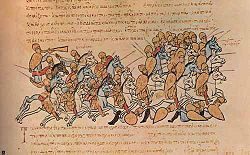 Having dealt with the pressure from the Magyars and the Byzantines, Simeon was free to plan a campaign against the Magyars looking for retribution. He negotiated a joint force with the Magyars' eastern neighbours, the Pechenegs, and imprisoned the Byzantine envoy Leo Choirosphaktes
in order to delay the release of the captives until after the campaign against the Magyars. This would allow him to renegotiate the peace conditions in his favour. In an exchange of letters with the envoy, Simeon refused to release the captives and ridiculed Leo VI's astrological
abilities.
Using a Magyar invasion in the lands of the neighbouring Slavs in 896 as a casus belli
, Simeon headed against the Magyars together with his Pecheneg allies, defeating them completely in the Battle of Southern Buh
and making them leave Etelköz forever and settle in Pannonia
. Following the defeat of the Magyars, Simeon finally released the Byzantine prisoners in exchange for Bulgarians captured in 895.
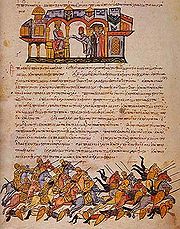 Claiming that not all prisoners had been released, Simeon once again invaded Byzantium in the summer of 896, heading directly to Constantinople. He was met in Thrace
by a hastily assembled Byzantine army, but annihilated the Byzantine forces in the Battle of Bulgarophygon
(at modern Babaeski
, Turkey
). Arming Arab captives and sending them to fight with the Bulgarians as a desperate measure, Leo VI managed to repel the Bulgarians from Constantinople, which they had besieged. The war ended with a peace treaty which formally lasted until around Leo VI's death in 912 and under which Byzantium was obliged to pay Bulgaria an annual tribute. Under the treaty, the Byzantines also ceded an area between the Black Sea and Strandža
to the Bulgarian Empire. Meanwhile, Simeon had also imposed his authority over Serbia in return for recognizing Petar Gojniković
as their ruler.
Simeon often violated the peace treaty with Byzantium, attacking and conquering Byzantine territory on several occasions, such as in 904, when the Bulgarian raids were used by Arabs led by the Byzantine renegade Leo of Tripoli
to undertake a maritime campaign and seize Thessaloniki. After the Arabs plundered the city, it was an easy target for Bulgaria and the nearby Slavic tribes. In order to dissuade Simeon from capturing the city and populating it with Slavs, Leo VI was forced to make further territorial concessions to the Bulgarians in the modern region of Macedonia
. With the treaty of 904, all Slavic-inhabited lands in modern southern Macedonia and southern Albania
were ceded to the Bulgarian Empire, with the border line running some 20 kilometres north of Thessaloniki.
under the guidance of Leo's brother Alexander, who expelled Leo's wife Zoe from the palace, constituted a great opportunity for Simeon to attempt another campaign against Constantinople, the conquest of which remained the dream of his life. In the spring of 913, Simeon's envoys, which had arrived in Constantinople to renew the peace of 896, were sent away by Alexander, who refused to pay the annual tribute, urging Simeon to prepare for war.
Before Simeon could attack, Alexander died on 6 June 913, leaving the empire in the hands of a regency council headed by Patriarch
Nicholas Mystikos
. Many of the residents of Constantinople did not recognize the young emperor and supported the pretender Constantine Doukas, which, exacerbated by revolts in southern Italy
and the planned Arab invasion in eastern Anatolia, was all to Simeon's advantage. Nicholas Mystikos tried to discourage Simeon from invading Byzantium in a long series of pleading letters, but the Bulgarian ruler nevertheless attacked in full force in late July or August 913 and reached Constantinople without any serious resistance.
However, the anarchy in Constantinople had ceased after the murder of the pretender Constantine Doukas and a government had promptly been formed with Patriarch Nicholas at the helm. This urged Simeon to raise his siege and enter peace negotiations, to the joy of the Byzantines. The protracted negotiations resulted in the payment of the Byzantine tribute's arrears
, the promise that Constantine VII should marry one of Simeon's daughters and, most importantly, Simeon's official recognition as Emperor of the Bulgarians by Patriarch Nicholas in the Blachernai
Palace.
Shortly after Simeon's visit to Constantinople, Constantine's mother Zoe returned to the palace on the insistence of the young emperor and immediately proceeded to eliminate the regents. Through a plot, she managed to assume power in February 914, practically removing Patriarch Nicholas from the government, disowning and obscuring his recognition of Simeon's imperial title and rejecting the planned marriage of her son to one of Simeon's daughters. Simeon had to resort to war to achieve his goals. He invaded Thrace in the summer of 914 and captured Adrianople
. Zoe was quick to send Simeon numerous presents in order to conciliate him and managed to convince him to cede back Adrianople and withdraw his army. In the following years, Simeon's forces were engaged in the northwestern Byzantine provinces, around Drač (Durrës
) and Thessaloniki, but did not make a move against Constantinople.
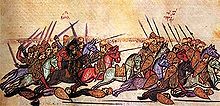 By 917, Simeon was preparing for yet another war against Byzantium. He attempted to conclude an anti-Byzantine union with the Pechenegs, but his envoys could not match the financial resources of the Byzantines, who succeeded in outbidding them. The Byzantines hatched a large-scale campaign against Bulgaria and also tried to persuade the Serbian Prince Petar Gojniković to attack the Bulgarians with Magyar support.
In 917, a particularly strong Byzantine army led by Leo Phokas the Elder, son of Nikephoros Phokas, invaded Bulgaria accompanied by the Byzantine navy under the command of Romanos Lekapenos
, which sailed to the Bulgarian Black Sea ports. En route to Mesembria (Nesebǎr
), where they were supposed to be reinforced by troops transported by the navy, Phokas' forces stopped to rest near the river of Acheloos
, not far from the port of Anchialos (Pomorie
). Once informed of the invasion, Simeon rushed to intercept the Byzantines, and attacked them from the nearby hills while they were resting disorganized. In the Battle of Acheloos of 20 August 917, one of the largest in medieval history, the Bulgarians completely routed the Byzantines and killed many of their commanders, although Phokas managed to escape to Mesembria. Decades later, Leo the Deacon
would write that "piles of bones can still be seen today at the river Acheloos, where the fleeing army of the Byzantines was then infamously slain".
.svg.png) The planned Pecheneg attack from the north also failed, as the Pechenegs quarrelled with admiral Lekapenos, who refused to transport them across the Danube to aid the main Byzantine army. The Byzantines were not aided by Serbs and Magyars either: the Magyars were engaged in Western Europe
The planned Pecheneg attack from the north also failed, as the Pechenegs quarrelled with admiral Lekapenos, who refused to transport them across the Danube to aid the main Byzantine army. The Byzantines were not aided by Serbs and Magyars either: the Magyars were engaged in Western Europe
as Frankish allies, and the Serbs under Petar Gojniković were reluctant to attack Bulgaria because Michael of Zahumlje, an ally of Bulgaria, had notified Simeon of their plans.
Simeon's army quickly followed up the victory of Acheloos with another success. The Bulgarians sent to pursuit the remnants of the Byzantine army approached Constantinople and encountered Byzantine forces under Leo Phokas, who had returned to the capital, at the village of Katasyrtai
in the immediate proximity of Constantinople. The Bulgarian regiments attacked and again defeated the Byzantines, destroying some of their last units before returning to Bulgaria.
and Marmais
, to Serbia. The two managed to persuade Petar to attend a personal meeting, during which he was enchained and carried off to Bulgaria, where he died in a dungeon. Simeon put Pavle Branović, prior to that an exile in Bulgaria, on the Serbian throne, thus restoring the Bulgarian influence in Serbia for a while.
Meanwhile, the Byzantine military failures forced another change of government in Constantinople: the admiral Romanos Lekapenos replaced Zoe as regent of the young Constantine VII in 919, forcing her back into a convent. Romanos betrothed his daughter Helena Lekapene
to Constantine and advanced to the rank of co-emperor in December 920, effectively assuming the government of the empire, which was largely what Simeon had planned to do.
No longer able to climb to the Byzantine throne by diplomatic means, the infuriated Simeon once again had to wage war to impose his will. Between 920 and 922, Bulgaria increased its pressure on Byzantium, campaigning in the west through Thessaly
reaching the Isthmus of Corinth
and in the east in Thrace, reaching and crossing the Dardanelles
to lay siege on the town of Lampsacus
. Simeon's forces appeared before Constantinople in 921, when they demanded the deposition of Romanos and captured Adrianople, and 922, when they were victorious at Pigae
, burned much of the Golden Horn
and seized Bizye
. In the meantime, the Byzantines attempted to ignite Serbia against Simeon, but he substituted Pavle with Zaharije Pribisavljević, a former refugee at Constantinople that he had captured.
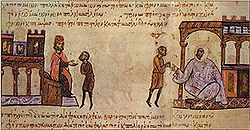 Desperate to conquer Constantinople, Simeon planned a large campaign in 924 and sent envoys to the Fatimid
caliph Ubayd Allah al-Mahdi Billah
, who possessed a powerful navy which Simeon needed. The caliph agreed and sent his own representatives back with the Bulgarians to arrange the alliance. However, the envoys were captured by the Byzantines at Calabria
. Romanos offered peace to the Arabs, supplementing this offer with generous gifts, and ruined their union with Bulgaria.
In Serbia, Zaharije was persuaded by the Byzantines to revolt against Simeon. Zaharije was supported by many Bulgarians exhausted from Simeon's endless campaigns against Byzantium. The Bulgarian emperor sent his troops under Sigrica and Marmais, but they were routed and the two commanders beheaded, which forced Simeon to conclude an armistice with Byzantium in order to concentrate on the suppression of the uprising. Simeon sent an army led by Časlav Klonimirović
in 924 to depose Zaharije. He was successful, as Zaharije fled to Croatia. After this victory, the Serbian nobility was invited to come to Bulgaria and bow to the new Prince. However, he did not appear at the supposed meeting and all of them were beheaded. Bulgaria annexed Serbia directly.
In the summer of 924, Simeon nevertheless arrived at Constantinople and demanded to see the patriarch and the emperor. He conversed with Romanos on the Golden Horn on 9 September 924 and arranged a truce, according to which Byzantium would pay Bulgaria an annual tax, but would be ceded back some cities on the Black Sea coast. During the interview of the two monarchs, two eagles are said to have met in the skies above and then to have parted, one of them flying over Constantinople and the other heading to Thrace, as a sign of the irreconcilability of the two rulers. In his description of this meeting, Theophanes
Continuatus mentions that "the two emperors… conversed", which may indicate renewed Byzantine recognition of Simeon's imperial claims.
In 926, Simeon's troops under Alogobotur
invaded Croatia, at the time a Byzantine ally, but were completely defeated by the army of King Tomislav
in the Battle of the Bosnian Highlands
. Fearing a Bulgarian retribution, Tomislav accepted to abandon his union with Byzantium and make peace on the basis of the status quo
, negotiated by the papal legate Madalbert. In the last months of his life, Simeon prepared for another siege of Constantinople despite Romanos' desperate pleas for peace.
On 27 May 927, Simeon died of heart failure in his palace in Preslav. Byzantine chroniclers tie his death to a legend, according to which Romanos decapitated a statue which was Simeon's inanimate double, and he died at that very hour.
He was succeeded by his son Peter I
, with George Sursuvul, the new emperor's maternal uncle, initially acting as a regent. As part of the peace treaty which Bulgaria and Byzantium signed in October 927 and Peter's marriage to Maria (Eirene), Romanos' granddaughter, the existing borders were confirmed, as were the Bulgarian ruler's imperial dignity and the head of the Bulgarian Church's patriarchal status.
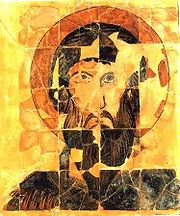 During Simeon's reign, Bulgaria reached its cultural apogee, becoming the literary and spiritual centre of Slavic Europe
. In this respect, Simeon continued his father Boris' policy of establishing and spreading Slavic culture and attracting noted scholars and writers within Bulgaria's borders. It was in the Preslav Literary School
and Ohrid Literary School
, founded under Boris, that the main literary work in Bulgaria was concentrated during the reign of Simeon.
The late 9th and early 10th century constitute the earliest and most productive period of medieval Bulgarian literature
. Having spent his early years in Constantinople, Simeon introduced Byzantine culture to the Bulgarian court, but eliminated its assimilative effect by means of military power and religious autonomy. The disciples of Cyril and Methodius, among whom Clement of Ohrid
, Naum
and Constantine of Preslav
, continued their educational work in Bulgaria, actively translating Christian texts, such as the Bible
and the works of John Chrysostom
, Basil of Caesarea
, Cyril of Alexandria
, Gregory of Nazianzus
, Athanasius of Alexandria
, as well as historic chronicles such as these of John Malalas
and George Hamartolus
, to Bulgarian. The reign of Simeon also witnessed the production of a number of original theological and secular works, such as John Exarch
's Six Days (Šestodnev), Constantine of Preslav's Alphabetical Prayer and Proclamation of the Holy Gospels, and Černorizec Hrabǎr
's An Account of Letters. Simeon's own contribution to this literary blossoming was praised by his contemporaries, for example in the Praise to Tsar Simeon preserved in the Zlatostruj collection and Simeon's Collection, to which the tsar personally wrote an addendum.
Simeon turned the new Bulgarian capital Preslav into a magnificent religious and cultural centre, intended more as a display of his realm's heyday and as a royal residence than as a military fortress. With its more than twenty cross-domed churches and numerous monasteries, its impressive royal palace and the Golden (or Round) Church
, Preslav was a true imperial capital. The development of Bulgarian art in the period is demonstrated by a ceramic icon of Theodore of Amasea
and the Preslav-style illustrated ceramics.
, who was born before 913. He was excluded from the succession in 927 and sent to a monastery. He died in 931, shortly after organizing a revolt.
By his second wife, the daughter of the influential noble George Sursuvul, he had three sons: Peter
, who succeeded as Emperor of Bulgaria in 927 and ruled until 969; Ivan, who rebelled against Peter in 928 and then fled to Byzantium; and Benjamin (Bajan), who, according to Lombard
historian Liutprand of Cremona
, "possessed the power to transform himself suddenly into a wolf or other strange animal".
Simeon also had several daughters, including one who was arranged to marry Constantine VII in 913, and was thus born before that date. The marriage was annulled by Constantine's mother Zoe once she had returned to the court.
unknown wife
| colspan="2" | Simeon I
(b. 864/865, d. 927,
ruled 893–927)
| colspan="3" | 2
daughter of
George Sursuvul
| colspan="3" |
|-
| colspan="5" style="border-right: solid black 1px;" |
| colspan="7" |
|- style="text-align: left;"
| colspan="3" |
| colspan="2" style="border-left: solid black 1px; border-right: solid black 1px; border-top: solid black 1px; padding-left: 0.5em;" | 1
| colspan="2" style="border-top: solid black 1px; padding-left: 0.5em;" | 2
| colspan="2" style="border-left: solid black 1px; border-top: solid black 1px; padding-left: 0.5em;" | 2
| colspan="2" style="border-left: solid black 1px; border-top: solid black 1px; padding-left: 0.5em;" | 2
| style="border-left:solid black 1px; padding-left:0.5em;"| ?
|- style="vertical-align: top"
| colspan="2" |
| colspan="2" | Michael
(d. 931)
| colspan="2" | Peter I
(b. after 912, d. 970,
ruled 927–969)
| colspan="2" | Ivan
| colspan="2" | Benjamin
| colspan="2" | daughters
|}
Bulgaria
Bulgaria , officially the Republic of Bulgaria , is a parliamentary democracy within a unitary constitutional republic in Southeast Europe. The country borders Romania to the north, Serbia and Macedonia to the west, Greece and Turkey to the south, as well as the Black Sea to the east...
from 893 to 927, during the First Bulgarian Empire
First Bulgarian Empire
The First Bulgarian Empire was a medieval Bulgarian state founded in the north-eastern Balkans in c. 680 by the Bulgars, uniting with seven South Slavic tribes...
. Simeon's successful campaigns against the Byzantines
Byzantine Empire
The Byzantine Empire was the Eastern Roman Empire during the periods of Late Antiquity and the Middle Ages, centred on the capital of Constantinople. Known simply as the Roman Empire or Romania to its inhabitants and neighbours, the Empire was the direct continuation of the Ancient Roman State...
, Magyars and Serbs
Serbs
The Serbs are a South Slavic ethnic group of the Balkans and southern Central Europe. Serbs are located mainly in Serbia, Montenegro and Bosnia and Herzegovina, and form a sizable minority in Croatia, the Republic of Macedonia and Slovenia. Likewise, Serbs are an officially recognized minority in...
led Bulgaria to its greatest territorial expansion ever, making it the most powerful state in contemporary Eastern Europe
Eastern Europe
Eastern Europe is the eastern part of Europe. The term has widely disparate geopolitical, geographical, cultural and socioeconomic readings, which makes it highly context-dependent and even volatile, and there are "almost as many definitions of Eastern Europe as there are scholars of the region"...
. His reign was also a period of unmatched cultural prosperity and enlightenment later deemed the Golden Age
Golden Age
The term Golden Age comes from Greek mythology and legend and refers to the first in a sequence of four or five Ages of Man, in which the Golden Age is first, followed in sequence, by the Silver, Bronze, and Iron Ages, and then the present, a period of decline...
of Bulgarian culture.
During Simeon's rule, Bulgaria spread over a territory between the Aegean
Aegean Sea
The Aegean Sea[p] is an elongated embayment of the Mediterranean Sea located between the southern Balkan and Anatolian peninsulas, i.e., between the mainlands of Greece and Turkey. In the north, it is connected to the Marmara Sea and Black Sea by the Dardanelles and Bosporus...
, the Adriatic
Adriatic Sea
The Adriatic Sea is a body of water separating the Italian Peninsula from the Balkan peninsula, and the system of the Apennine Mountains from that of the Dinaric Alps and adjacent ranges...
and the Black Sea
Black Sea
The Black Sea is bounded by Europe, Anatolia and the Caucasus and is ultimately connected to the Atlantic Ocean via the Mediterranean and the Aegean seas and various straits. The Bosphorus strait connects it to the Sea of Marmara, and the strait of the Dardanelles connects that sea to the Aegean...
, and the new Bulgarian capital Preslav
Preslav
Preslav was the capital of the First Bulgarian Empire from 893 to 972 and one of the most important cities of medieval Southeastern Europe. The ruins of the city are situated in modern northeastern Bulgaria, some 20 kilometres southwest of the regional capital of Shumen, and are currently a...
was said to rival Constantinople
Constantinople
Constantinople was the capital of the Roman, Eastern Roman, Byzantine, Latin, and Ottoman Empires. Throughout most of the Middle Ages, Constantinople was Europe's largest and wealthiest city.-Names:...
. The newly independent Bulgarian Orthodox Church
Bulgarian Orthodox Church
The Bulgarian Orthodox Church - Bulgarian Patriarchate is an autocephalous Eastern Orthodox Church with some 6.5 million members in the Republic of Bulgaria and between 1.5 and 2.0 million members in a number of European countries, the Americas and Australia...
became the first new patriarchate
Patriarchate
A patriarchate is the office or jurisdiction of a patriarch. A patriarch, as the term is used here, is either* one of the highest-ranking bishops in Eastern Orthodoxy, earlier, the five that were included in the Pentarchy: Rome, Constantinople, Alexandria, Antioch, and Jerusalem, but now nine,...
besides the Pentarchy
Pentarchy
Pentarchy is a term in the history of Christianity for the idea of universal rule over all Christendom by the heads of five major episcopal sees, or patriarchates, of the Roman Empire: Rome, Constantinople, Alexandria, Antioch, and Jerusalem...
, and Bulgarian Glagolitic
Glagolitic alphabet
The Glagolitic alphabet , also known as Glagolitsa, is the oldest known Slavic alphabet. The name was not coined until many centuries after its creation, and comes from the Old Slavic glagolъ "utterance" . The verb glagoliti means "to speak"...
translations of Christian
Christianity
Christianity is a monotheistic religion based on the life and teachings of Jesus as presented in canonical gospels and other New Testament writings...
texts spread all over the Slavic
Slavic peoples
The Slavic people are an Indo-European panethnicity living in Eastern Europe, Southeast Europe, North Asia and Central Asia. The term Slavic represents a broad ethno-linguistic group of people, who speak languages belonging to the Slavic language family and share, to varying degrees, certain...
world of the time. Halfway through his reign, Simeon assumed the title of Emperor
Emperor
An emperor is a monarch, usually the sovereign ruler of an empire or another type of imperial realm. Empress, the female equivalent, may indicate an emperor's wife or a woman who rules in her own right...
(Tsar
Tsar
Tsar is a title used to designate certain European Slavic monarchs or supreme rulers. As a system of government in the Tsardom of Russia and Russian Empire, it is known as Tsarist autocracy, or Tsarism...
), having prior to that been styled Prince
Prince
Prince is a general term for a ruler, monarch or member of a monarch's or former monarch's family, and is a hereditary title in the nobility of some European states. The feminine equivalent is a princess...
(Knyaz
Knyaz
Kniaz, knyaz or knez is a Slavic title found in most Slavic languages, denoting a royal nobility rank. It is usually translated into English as either Prince or less commonly as Duke....
).
Background and early life
Simeon was born in 864 or 865, as the third son of Knyaz Boris IBoris I of Bulgaria
Boris I, also known as Boris-Mihail and Bogoris was the Knyaz of First Bulgarian Empire in 852–889. At the time of his baptism in 864, Boris was named Michael after his godfather, Emperor Michael III...
of Krum
Krum of Bulgaria
Krum the Horrible was Khan of Bulgaria, from after 796, but before 803, to 814 AD. During his reign the Bulgarian territory doubled in size, spreading from the middle Danube to the Dnieper and from Odrin to the Tatra Mountains. His able and energetic rule brought law and order to Bulgaria and...
's dynasty. As Boris was the ruler who Christianized Bulgaria
Christianization of Bulgaria
The Christianization of Bulgaria was the process by which 9th-century medieval Bulgaria converted to Christianity. It was influenced by the khan's shifting political alliances with the kingdom of the East Franks and the Byzantine Empire, as well as his reception by the Pope of the Roman Catholic...
in 865, Simeon was a Christian all his life. Because his eldest brother Vladimir
Vladimir of Bulgaria
Vladimir-Rasate was the ruler of Bulgaria from 889 to 893.He became ruler of Bulgaria when his father Boris-Mihail I decided to retire to a monastery after a reign of 36 years...
was designated heir to the Bulgarian throne, Boris intended Simeon to become a high-ranking cleric, possibly Bulgarian archbishop, and sent him to the leading University of Constantinople
University of Constantinople
The University of Constantinople, sometimes known as the University of the palace hall of Magnaura in the Roman-Byzantine Empire was founded in 425 under the name of Pandidakterion...
to receive theological education when he was thirteen or fourteen. He took the Hebrew
Hebrew language
Hebrew is a Semitic language of the Afroasiatic language family. Culturally, is it considered by Jews and other religious groups as the language of the Jewish people, though other Jewish languages had originated among diaspora Jews, and the Hebrew language is also used by non-Jewish groups, such...
name Simeon
Simeon
Simeon, or Shimon is a given name, from the Hebrew ). In Greek, it is written Συμεών, hence the Latinized spelling Symeon.-Meaning:...
as a novice in a monastery in Constantinople. During the decade (ca. 878–888) he spent in the Byzantine capital, he received excellent education and studied the rhetoric of Demosthenes
Demosthenes
Demosthenes was a prominent Greek statesman and orator of ancient Athens. His orations constitute a significant expression of contemporary Athenian intellectual prowess and provide an insight into the politics and culture of ancient Greece during the 4th century BC. Demosthenes learned rhetoric by...
and Aristotle
Aristotle
Aristotle was a Greek philosopher and polymath, a student of Plato and teacher of Alexander the Great. His writings cover many subjects, including physics, metaphysics, poetry, theater, music, logic, rhetoric, linguistics, politics, government, ethics, biology, and zoology...
. He also learned fluent Greek
Greek language
Greek is an independent branch of the Indo-European family of languages. Native to the southern Balkans, it has the longest documented history of any Indo-European language, spanning 34 centuries of written records. Its writing system has been the Greek alphabet for the majority of its history;...
, to the extent that he was referred to as "the half-Greek" in Byzantine chronicles. He is speculated to have been tutored by Patriarch Photios I of Constantinople
Patriarch Photios I of Constantinople
Photios I , also spelled Photius or Fotios, was the Ecumenical Patriarch of Constantinople from 858 to 867 and from 877 to 886. He is recognized in the Eastern Orthodox churches as St...
, but this is not supported by any source.
Around 888, Simeon returned to Bulgaria and settled at the newly established royal monastery of Preslav
Preslav
Preslav was the capital of the First Bulgarian Empire from 893 to 972 and one of the most important cities of medieval Southeastern Europe. The ruins of the city are situated in modern northeastern Bulgaria, some 20 kilometres southwest of the regional capital of Shumen, and are currently a...
"at the mouth of the Tiča
Kamchiya
The Kamchiya is a 244.5 km long river in eastern Bulgaria, the longest river on the Balkan Peninsula to flow directly into the Black Sea...
", where, under the guidance of Naum of Preslav, he engaged in active translation of important religious works from Greek to Old Church Slavonic
Old Church Slavonic
Old Church Slavonic or Old Church Slavic was the first literary Slavic language, first developed by the 9th century Byzantine Greek missionaries Saints Cyril and Methodius who were credited with standardizing the language and using it for translating the Bible and other Ancient Greek...
(Old Bulgarian
History of the Bulgarian language
The History of the Bulgarian language can be divided into four major periods:* prehistoric period ;...
), aided by other students from Constantinople. Meanwhile, Vladimir had succeeded Boris, who had retreated to a monastery, as ruler of Bulgaria. Vladimir attempted to reintroduce paganism
Paganism
Paganism is a blanket term, typically used to refer to non-Abrahamic, indigenous polytheistic religious traditions....
in the empire and possibly signed an anti-Byzantine pact with Arnulf of Carinthia
Arnulf of Carinthia
Arnulf of Carinthia was the Carolingian King of East Francia from 887, the disputed King of Italy from 894 and the disputed Holy Roman Emperor from February 22, 896 until his death.-Birth and Illegitimacy:...
, forcing Boris to re-enter political life. Boris had Vladimir imprisoned and blinded, and then appointed Simeon as the new ruler. This was done at an assembly in Preslav
Council of Preslav
The People's Council of Preslav took place in 893. It was among the most important events in the history of the First Bulgarian Empire and was a cornerstone of the Christianization of Bulgaria under prince Boris I.-Background and sources:...
which also proclaimed Bulgarian as the only language of state and church and moved the Bulgarian capital from Pliska
Pliska
Pliska is the name of both the first capital of Danubian Bulgaria and a small town which was renamed after the historical Pliska after its site was determined and excavations began....
to Preslav, to better cement the recent conversion. It is not known why Boris did not place his second son, Gavril, on the throne, but instead preferred Simeon.
Trade War with Byzantium and Magyar invasions
With Simeon on the throne, the long-lasting peace with the Byzantine Empire established by his father was about to end. A conflict arose when Byzantine Emperor Leo VI the WiseLeo VI the Wise
Leo VI, surnamed the Wise or the Philosopher , was Byzantine emperor from 886 to 912. The second ruler of the Macedonian dynasty , he was very well-read, leading to his surname...
, allegedly acting under pressure from his mistress Zoe Zaoutzaina
Zoe Zaoutzaina
Zoe Zaoutzaina was the second wife of the Byzantine emperor Leo VI the Wise. She was the daughter of Stylianos Zaoutzes, a high-ranking bureaucrat during the reign of her husband.-Royal mistress:...
and her father Stylianos Zaoutzes
Stylianos Zaoutzes
Stylianos Zaoutzes was a high Byzantine official of Armenian origin. Rising to high rank under Byzantine emperor Basil I , he then rose further to prominence under Basil's successor Emperor Leo VI the Wise , who had a close friendship and possible an affair with Stylianos's daughter Zoe Zaoutzaina...
, moved the marketplace for Bulgarian goods from Constantinople to Thessaloniki
Thessaloniki
Thessaloniki , historically also known as Thessalonica, Salonika or Salonica, is the second-largest city in Greece and the capital of the region of Central Macedonia as well as the capital of the Decentralized Administration of Macedonia and Thrace...
, where the Bulgarian merchants were heavily taxed. The Bulgarians sought protection by Simeon, who in turn complained to Leo. However, the Byzantine emperor ignored his embassy.
Anatolia
Anatolia is a geographic and historical term denoting the westernmost protrusion of Asia, comprising the majority of the Republic of Turkey...
to counter Arab
Arab
Arab people, also known as Arabs , are a panethnicity primarily living in the Arab world, which is located in Western Asia and North Africa. They are identified as such on one or more of genealogical, linguistic, or cultural grounds, with tribal affiliations, and intra-tribal relationships playing...
invasions. Informed of the Bulgarian offensive, the surprised Leo sent an army consisting of guardsmen and other military units from the capital to halt Simeon, but his troops were routed somewhere in the theme of Macedonia. The Bulgarians took most of the Khazar
Khazars
The Khazars were semi-nomadic Turkic people who established one of the largest polities of medieval Eurasia, with the capital of Atil and territory comprising much of modern-day European Russia, western Kazakhstan, eastern Ukraine, Azerbaijan, large portions of the northern Caucasus , parts of...
mercenary guardsmen prisoners and killed many archon
Archon
Archon is a Greek word that means "ruler" or "lord", frequently used as the title of a specific public office. It is the masculine present participle of the verb stem ἀρχ-, meaning "to rule", derived from the same root as monarch, hierarchy, and anarchy.- Ancient Greece :In ancient Greece the...
s, including the army's commander. However, instead of continuing his advance to the Byzantine capital, Simeon quickly withdrew his troops to face a Magyar invasion from the north. These events were later called "the first trade war in medieval
Middle Ages
The Middle Ages is a periodization of European history from the 5th century to the 15th century. The Middle Ages follows the fall of the Western Roman Empire in 476 and precedes the Early Modern Era. It is the middle period of a three-period division of Western history: Classic, Medieval and Modern...
Europe
Europe
Europe is, by convention, one of the world's seven continents. Comprising the westernmost peninsula of Eurasia, Europe is generally 'divided' from Asia to its east by the watershed divides of the Ural and Caucasus Mountains, the Ural River, the Caspian and Black Seas, and the waterways connecting...
" by Bulgarian historians.
Unable to effectively respond to the Bulgarian campaign due to the engagement of their forces against the Arabs, the Byzantines convinced the Magyars to attack Bulgaria, promising to transport them across the Danube
Danube
The Danube is a river in the Central Europe and the Europe's second longest river after the Volga. It is classified as an international waterway....
using the Byzantine navy
Byzantine navy
The Byzantine navy was the naval force of the East Roman or Byzantine Empire. Like the empire it served, it was a direct continuation from its imperial Roman predecessor, but played a far greater role in the defense and survival of the state then its earlier iterations...
. Leo VI may have also concluded an agreement with Arnulf to make sure that the Franks
Franks
The Franks were a confederation of Germanic tribes first attested in the third century AD as living north and east of the Lower Rhine River. From the third to fifth centuries some Franks raided Roman territory while other Franks joined the Roman troops in Gaul. Only the Salian Franks formed a...
did not support Simeon against the Magyars. In addition, the talented commander Nikephoros Phokas was called back from Italy
Italy
Italy , officially the Italian Republic languages]] under the European Charter for Regional or Minority Languages. In each of these, Italy's official name is as follows:;;;;;;;;), is a unitary parliamentary republic in South-Central Europe. To the north it borders France, Switzerland, Austria and...
to lead a separate army against Bulgaria in 895 with the mere intention to overawe the Bulgarians. Simeon, unaware of the threat from the north, rushed to meet Phokas' forces, but the two armies did not engage in a fight. Instead, the Byzantines offered peace, informing him of both the Byzantine foot and maritime campaign, but intentionally did not notify him of the planned Magyar attack. Simeon did not trust the envoy and, after sending him to prison, ordered the Byzantine navy's route into the Danube closed off with ropes and chains, intending to hold it until he had dealt with Phokas.
Despite the problems they encountered because of the fencing, the Byzantines ultimately managed to ferry the Magyar forces led by Árpád
Árpád
Árpád was the second Grand Prince of the Hungarians . Under his rule the Hungarian people settled in the Carpathian basin. The dynasty descending from him ruled the Hungarian tribes and later the Kingdom of Hungary until 1301...
's son Liüntika across the Danube, possibly near modern Galaţi
Galati
Galați is a city and municipality in Romania, the capital of Galați County. Located in the historical region of Moldavia, in the close vicinity of Brăila, Galați is the largest port and sea port on the Danube River and the second largest Romanian port....
, and assisted them in pillaging the nearby Bulgarian lands. Once notified of the surprise invasion, Simeon headed north to stop the Magyars, leaving some of his troops at the southern border to prevent a possible attack by Phokas. Simeon's two encounters with the enemy in Northern Dobruja
Northern Dobruja
Northern Dobruja is the part of Dobruja within the borders of Romania. It lies between the lower Danube river and the Black Sea, bordered in south by Bulgarian Southern Dobruja.-Geography:...
resulted in Magyar victories, forcing him to retreat to Drǎstǎr
Silistra
Silistra is a port city of northeastern Bulgaria, lying on the southern bank of the lower Danube at the country's border with Romania. Silistra is the administrative centre of Silistra Province and one of the important cities of the historical region of Southern Dobrudzha...
. After pillaging much of Bulgaria and reaching Preslav, the Magyars returned to their lands, but not before Simeon had concluded an armistice with Byzantium towards the summer of 895. A complete peace was delayed, as Leo VI required the release of the Byzantine captives from the Trade War.
Anti-Magyar campaign and further wars with Byzantium
Leo Choirosphaktes
Leo Choirosphaktes, sometimes Latinized as Choerosphactes and also known as Leo Magistros or Leo Magister, was a Byzantine official who rose to high office under Basil I the Macedonian and served as an envoy under Emperor Leo VI the Wise to Bulgaria and the Abbasid Caliphate...
in order to delay the release of the captives until after the campaign against the Magyars. This would allow him to renegotiate the peace conditions in his favour. In an exchange of letters with the envoy, Simeon refused to release the captives and ridiculed Leo VI's astrological
Astrology
Astrology consists of a number of belief systems which hold that there is a relationship between astronomical phenomena and events in the human world...
abilities.
Using a Magyar invasion in the lands of the neighbouring Slavs in 896 as a casus belli
Casus belli
is a Latin expression meaning the justification for acts of war. means "incident", "rupture" or indeed "case", while means bellic...
, Simeon headed against the Magyars together with his Pecheneg allies, defeating them completely in the Battle of Southern Buh
Battle of Southern Buh
The Battle of Southern Buh occurred near the banks of the so called river, in modern Ukraine. The result was a great Bulgarian victory which forced the Magyars to leave forever the steppes of southern Ukraine and to establish the Kingdom of Hungary a hundred years later.- Origins of the conflict...
and making them leave Etelköz forever and settle in Pannonia
Pannonia
Pannonia was an ancient province of the Roman Empire bounded north and east by the Danube, coterminous westward with Noricum and upper Italy, and southward with Dalmatia and upper Moesia....
. Following the defeat of the Magyars, Simeon finally released the Byzantine prisoners in exchange for Bulgarians captured in 895.
Thrace
Thrace is a historical and geographic area in southeast Europe. As a geographical concept, Thrace designates a region bounded by the Balkan Mountains on the north, Rhodope Mountains and the Aegean Sea on the south, and by the Black Sea and the Sea of Marmara on the east...
by a hastily assembled Byzantine army, but annihilated the Byzantine forces in the Battle of Bulgarophygon
Battle of Bulgarophygon
The Battle of Boulgarophygon or Battle of Bulgarophygon was fought in the summer of 896 near the town of Bulgarophygon, modern Babaeski in Turkey, between the Byzantine Empire and the First Bulgarian Empire...
(at modern Babaeski
Babaeski
Babaeski is a town and district of Kırklareli Province in the Marmara region of Turkey. The countyship has a population of 27,712 and the total area of the district is 652 km².-Name:...
, Turkey
Turkey
Turkey , known officially as the Republic of Turkey , is a Eurasian country located in Western Asia and in East Thrace in Southeastern Europe...
). Arming Arab captives and sending them to fight with the Bulgarians as a desperate measure, Leo VI managed to repel the Bulgarians from Constantinople, which they had besieged. The war ended with a peace treaty which formally lasted until around Leo VI's death in 912 and under which Byzantium was obliged to pay Bulgaria an annual tribute. Under the treaty, the Byzantines also ceded an area between the Black Sea and Strandža
Strandzha
Strandzha is a mountain massif in southeastern Bulgaria and the European part of Turkey, in the southeastern part of the Balkans between the plains of Thrace to the west, the lowlands near Burgas to the north and the Black Sea to the east. Its highest peak is Mahya Dağı in Turkey, while the...
to the Bulgarian Empire. Meanwhile, Simeon had also imposed his authority over Serbia in return for recognizing Petar Gojniković
Archont Petar
Petar Gojniković or Peter of Serbia was Prince of the Serbs from 892 to 917. He ruled and expanded the First Serbian Principality , and won several wars against other family members that sought the crown. He was the first Serbian monarch with a Christian name.Petar was the son of Gojnik, the...
as their ruler.
Simeon often violated the peace treaty with Byzantium, attacking and conquering Byzantine territory on several occasions, such as in 904, when the Bulgarian raids were used by Arabs led by the Byzantine renegade Leo of Tripoli
Leo of Tripoli
Leo of Tripoli was a Greek renegade and pirate serving Arab interests in the early tenth century. Born in the Byzantine Empire to Christian parents, he later converted to Islam and took employment with his former captors as an admiral....
to undertake a maritime campaign and seize Thessaloniki. After the Arabs plundered the city, it was an easy target for Bulgaria and the nearby Slavic tribes. In order to dissuade Simeon from capturing the city and populating it with Slavs, Leo VI was forced to make further territorial concessions to the Bulgarians in the modern region of Macedonia
Macedonia (region)
Macedonia is a geographical and historical region of the Balkan peninsula in southeastern Europe. Its boundaries have changed considerably over time, but nowadays the region is considered to include parts of five Balkan countries: Greece, the Republic of Macedonia, Bulgaria, Albania, Serbia, as...
. With the treaty of 904, all Slavic-inhabited lands in modern southern Macedonia and southern Albania
Albania
Albania , officially known as the Republic of Albania , is a country in Southeastern Europe, in the Balkans region. It is bordered by Montenegro to the northwest, Kosovo to the northeast, the Republic of Macedonia to the east and Greece to the south and southeast. It has a coast on the Adriatic Sea...
were ceded to the Bulgarian Empire, with the border line running some 20 kilometres north of Thessaloniki.
Recognition as Emperor
The death of Leo VI on 11 May 912 and the accession of his infant son Constantine VIIConstantine VII
Constantine VII Porphyrogennetos or Porphyrogenitus, "the Purple-born" was the fourth Emperor of the Macedonian dynasty of the Byzantine Empire, reigning from 913 to 959...
under the guidance of Leo's brother Alexander, who expelled Leo's wife Zoe from the palace, constituted a great opportunity for Simeon to attempt another campaign against Constantinople, the conquest of which remained the dream of his life. In the spring of 913, Simeon's envoys, which had arrived in Constantinople to renew the peace of 896, were sent away by Alexander, who refused to pay the annual tribute, urging Simeon to prepare for war.
Before Simeon could attack, Alexander died on 6 June 913, leaving the empire in the hands of a regency council headed by Patriarch
Patriarch of Constantinople
The Ecumenical Patriarch is the Archbishop of Constantinople – New Rome – ranking as primus inter pares in the Eastern Orthodox communion, which is seen by followers as the One, Holy, Catholic, and Apostolic Church....
Nicholas Mystikos
Nicholas Mystikos
Nicholas I Mystikos or Nicholas I Mysticus was the Ecumenical Patriarch of Constantinople from March 901 to February 906 and from May 912 to his death in 925. His feast day in the Orthodox Church is May 16.Nicholas was born in the Italian Peninsula and had become a friend of the Patriarch Photios...
. Many of the residents of Constantinople did not recognize the young emperor and supported the pretender Constantine Doukas, which, exacerbated by revolts in southern Italy
Italy
Italy , officially the Italian Republic languages]] under the European Charter for Regional or Minority Languages. In each of these, Italy's official name is as follows:;;;;;;;;), is a unitary parliamentary republic in South-Central Europe. To the north it borders France, Switzerland, Austria and...
and the planned Arab invasion in eastern Anatolia, was all to Simeon's advantage. Nicholas Mystikos tried to discourage Simeon from invading Byzantium in a long series of pleading letters, but the Bulgarian ruler nevertheless attacked in full force in late July or August 913 and reached Constantinople without any serious resistance.
However, the anarchy in Constantinople had ceased after the murder of the pretender Constantine Doukas and a government had promptly been formed with Patriarch Nicholas at the helm. This urged Simeon to raise his siege and enter peace negotiations, to the joy of the Byzantines. The protracted negotiations resulted in the payment of the Byzantine tribute's arrears
Arrears
Arrears is a legal term for the part of a debt that is overdue after missing one or more required payments. The amount of the arrears is the amount accrued from the date on which the first missed payment was due...
, the promise that Constantine VII should marry one of Simeon's daughters and, most importantly, Simeon's official recognition as Emperor of the Bulgarians by Patriarch Nicholas in the Blachernai
Blachernae
Blachernae was a suburb in the northwestern section of Constantinople, the capital city of the Byzantine Empire. It was the site of a spring and a number of prominent churches were built there, most notably the great Church of St. Mary of Blachernae , built by Empress Pulcheria in circa 450,...
Palace.
Shortly after Simeon's visit to Constantinople, Constantine's mother Zoe returned to the palace on the insistence of the young emperor and immediately proceeded to eliminate the regents. Through a plot, she managed to assume power in February 914, practically removing Patriarch Nicholas from the government, disowning and obscuring his recognition of Simeon's imperial title and rejecting the planned marriage of her son to one of Simeon's daughters. Simeon had to resort to war to achieve his goals. He invaded Thrace in the summer of 914 and captured Adrianople
Edirne
Edirne is a city in Eastern Thrace, the northwestern part of Turkey, close to the borders with Greece and Bulgaria. Edirne served as the capital city of the Ottoman Empire from 1365 to 1453, before Constantinople became the empire's new capital. At present, Edirne is the capital of the Edirne...
. Zoe was quick to send Simeon numerous presents in order to conciliate him and managed to convince him to cede back Adrianople and withdraw his army. In the following years, Simeon's forces were engaged in the northwestern Byzantine provinces, around Drač (Durrës
Durrës
Durrës is the second largest city of Albania located on the central Albanian coast, about west of the capital Tirana. It is one of the most ancient and economically important cities of Albania. Durres is situated at one of the narrower points of the Adriatic Sea, opposite the Italian ports of Bari...
) and Thessaloniki, but did not make a move against Constantinople.
Victories at Acheloos and Katasyrtai
In 917, a particularly strong Byzantine army led by Leo Phokas the Elder, son of Nikephoros Phokas, invaded Bulgaria accompanied by the Byzantine navy under the command of Romanos Lekapenos
Romanos I
Romanos I Lekapenos was Byzantine Emperor from 920 until his deposition on December 16, 944.-Origin:...
, which sailed to the Bulgarian Black Sea ports. En route to Mesembria (Nesebǎr
Nesebar
Nesebar is an ancient town and one of the major seaside resorts on the Bulgarian Black Sea Coast, located in Burgas Province. It is the administrative centre of the homonymous Nesebar Municipality...
), where they were supposed to be reinforced by troops transported by the navy, Phokas' forces stopped to rest near the river of Acheloos
Aheloy River
The Aheloy River or Achelous is a river in eastern Bulgaria. It originates in the Aytos-Karnobat mountain, 1.5 kilometres from Dryankovets, and flows directly into the Black Sea south of the village of Aheloy. The Aheloy River has a length of 39.9 kilometres and has an irrigation reservoir, the...
, not far from the port of Anchialos (Pomorie
Pomorie
Pomorie is a town and seaside resort in southeastern Bulgaria, located on a narrow rocky peninsula in Burgas Bay on the southern Bulgarian Black Sea Coast. It is situated in Burgas Province, 20 km away from the city of Burgas and 18 km from the Sunny Beach resort. The ultrasaline lagoon...
). Once informed of the invasion, Simeon rushed to intercept the Byzantines, and attacked them from the nearby hills while they were resting disorganized. In the Battle of Acheloos of 20 August 917, one of the largest in medieval history, the Bulgarians completely routed the Byzantines and killed many of their commanders, although Phokas managed to escape to Mesembria. Decades later, Leo the Deacon
Leo the Deacon
Leo the Deacon was a Byzantine Roman historian and chronicler.He was born around 950 at Kaloe in Asia Minor, and was educated in Constantinople, where he became a deacon in the imperial palace. While in Constantinople he wrote a history covering the reigns of Romanus II, Nicepheros II, John...
would write that "piles of bones can still be seen today at the river Acheloos, where the fleeing army of the Byzantines was then infamously slain".
Western Europe
Western Europe is a loose term for the collection of countries in the western most region of the European continents, though this definition is context-dependent and carries cultural and political connotations. One definition describes Western Europe as a geographic entity—the region lying in the...
as Frankish allies, and the Serbs under Petar Gojniković were reluctant to attack Bulgaria because Michael of Zahumlje, an ally of Bulgaria, had notified Simeon of their plans.
Simeon's army quickly followed up the victory of Acheloos with another success. The Bulgarians sent to pursuit the remnants of the Byzantine army approached Constantinople and encountered Byzantine forces under Leo Phokas, who had returned to the capital, at the village of Katasyrtai
Battle of Katasyrtai
The battle of Katasyrtai occurred in the fall of 917, shortly after the striking Bulgarian triumph at Acheloos near the village of the same names close to the Byzantine capital Constantinople, . The result was a Bulgarian victory....
in the immediate proximity of Constantinople. The Bulgarian regiments attacked and again defeated the Byzantines, destroying some of their last units before returning to Bulgaria.
Suppression of Serbian unrest and late campaigns against Byzantium
Immediately after that campaign, Simeon sought to punish the Serbian ruler Petar Gojniković who had attempted to betray him by concluding an alliance with the Byzantines. Simeon sent an army led by two of his commanders, Theodore SigricaTheodore Sigritsa
Theodore Sigritsa was a Bulgarian military commander and noble, kavkhan of Emperor Simeon I The Great ....
and Marmais
Marmais
Marmais was a Bulgarian military commander, noble and komita of a western Bulgarian region during the reign of Emperor Simeon I . He was a descendant of an ancient Bulgarian family...
, to Serbia. The two managed to persuade Petar to attend a personal meeting, during which he was enchained and carried off to Bulgaria, where he died in a dungeon. Simeon put Pavle Branović, prior to that an exile in Bulgaria, on the Serbian throne, thus restoring the Bulgarian influence in Serbia for a while.
Meanwhile, the Byzantine military failures forced another change of government in Constantinople: the admiral Romanos Lekapenos replaced Zoe as regent of the young Constantine VII in 919, forcing her back into a convent. Romanos betrothed his daughter Helena Lekapene
Helena Lekapene
Helena Lekapene was the Empress consort of Constantine VII. She was a daughter of Romanos I and his wife Theodora.-Background:...
to Constantine and advanced to the rank of co-emperor in December 920, effectively assuming the government of the empire, which was largely what Simeon had planned to do.
No longer able to climb to the Byzantine throne by diplomatic means, the infuriated Simeon once again had to wage war to impose his will. Between 920 and 922, Bulgaria increased its pressure on Byzantium, campaigning in the west through Thessaly
Thessaly
Thessaly is a traditional geographical region and an administrative region of Greece, comprising most of the ancient region of the same name. Before the Greek Dark Ages, Thessaly was known as Aeolia, and appears thus in Homer's Odyssey....
reaching the Isthmus of Corinth
Isthmus of Corinth
The Isthmus of Corinth is the narrow land bridge which connects the Peloponnese peninsula with the rest of the mainland of Greece, near the city of Corinth. The word "isthmus" comes from the Ancient Greek word for "neck" and refers to the narrowness of the land. The Isthmus was known in the ancient...
and in the east in Thrace, reaching and crossing the Dardanelles
Dardanelles
The Dardanelles , formerly known as the Hellespont, is a narrow strait in northwestern Turkey connecting the Aegean Sea to the Sea of Marmara. It is one of the Turkish Straits, along with its counterpart the Bosphorus. It is located at approximately...
to lay siege on the town of Lampsacus
Lampsacus
Lampsacus was an ancient Greek city strategically located on the eastern side of the Hellespont in the northern Troad. An inhabitant of Lampsacus was called a Lampsacene. The name has been transmitted in the nearby modern town of Lapseki.-Ancient history:...
. Simeon's forces appeared before Constantinople in 921, when they demanded the deposition of Romanos and captured Adrianople, and 922, when they were victorious at Pigae
Battle of Pigae
The Battle of Pegae occurred between March 11 and March 18, 922 in the outskirts of Constantinople. The result was a Bulgarian victory.-Origins of the conflict:...
, burned much of the Golden Horn
Golden Horn
The Golden Horn is a historic inlet of the Bosphorus dividing the city of Istanbul and forming the natural harbor that has sheltered Greek, Roman, Byzantine, Ottoman and other ships for thousands of...
and seized Bizye
Vize
Vize is a town and district of Kırklareli Province in the Marmara region of Turkey. The mayor is Selçuk Yılmaz . The population is 12,196 as of 2010.- History :...
. In the meantime, the Byzantines attempted to ignite Serbia against Simeon, but he substituted Pavle with Zaharije Pribisavljević, a former refugee at Constantinople that he had captured.
Fatimid
The Fatimid Islamic Caliphate or al-Fāṭimiyyūn was a Berber Shia Muslim caliphate first centered in Tunisia and later in Egypt that ruled over varying areas of the Maghreb, Sudan, Sicily, the Levant, and Hijaz from 5 January 909 to 1171.The caliphate was ruled by the Fatimids, who established the...
caliph Ubayd Allah al-Mahdi Billah
Ubayd Allah al-Mahdi Billah
Abdullah al-Mahdi Billah , often referred to as Ubayd Allah, is the founder of the Fatimid dynasty, the only major Shi'a caliphate in Islam, and established Fatimid rule throughout much of North Africa.- History :...
, who possessed a powerful navy which Simeon needed. The caliph agreed and sent his own representatives back with the Bulgarians to arrange the alliance. However, the envoys were captured by the Byzantines at Calabria
Calabria
Calabria , in antiquity known as Bruttium, is a region in southern Italy, south of Naples, located at the "toe" of the Italian Peninsula. The capital city of Calabria is Catanzaro....
. Romanos offered peace to the Arabs, supplementing this offer with generous gifts, and ruined their union with Bulgaria.
In Serbia, Zaharije was persuaded by the Byzantines to revolt against Simeon. Zaharije was supported by many Bulgarians exhausted from Simeon's endless campaigns against Byzantium. The Bulgarian emperor sent his troops under Sigrica and Marmais, but they were routed and the two commanders beheaded, which forced Simeon to conclude an armistice with Byzantium in order to concentrate on the suppression of the uprising. Simeon sent an army led by Časlav Klonimirović
Caslav Klonimirovic
Časlav Klonimirović or Časlav of Serbia was Prince of the Serbs from ca. 927 until his death in 960. He significantly expanded the Serbian Principality when he managed to unite several Slavic tribes, stretching his realm over the shores of the Adriatic Sea, the Sava river and the Morava valley...
in 924 to depose Zaharije. He was successful, as Zaharije fled to Croatia. After this victory, the Serbian nobility was invited to come to Bulgaria and bow to the new Prince. However, he did not appear at the supposed meeting and all of them were beheaded. Bulgaria annexed Serbia directly.
In the summer of 924, Simeon nevertheless arrived at Constantinople and demanded to see the patriarch and the emperor. He conversed with Romanos on the Golden Horn on 9 September 924 and arranged a truce, according to which Byzantium would pay Bulgaria an annual tax, but would be ceded back some cities on the Black Sea coast. During the interview of the two monarchs, two eagles are said to have met in the skies above and then to have parted, one of them flying over Constantinople and the other heading to Thrace, as a sign of the irreconcilability of the two rulers. In his description of this meeting, Theophanes
Theophanes the Confessor
Saint Theophanes Confessor was a member of the Byzantine aristocracy, who became a monk and chronicler. He is venerated on March 12 in the Roman Catholic and the Eastern Orthodox Church .-Biography:Theophanes was born in Constantinople of wealthy and noble iconodule parents: Isaac,...
Continuatus mentions that "the two emperors… conversed", which may indicate renewed Byzantine recognition of Simeon's imperial claims.
War with Croatia and death
Most likely after (or possibly at the time of) Patriarch Nicholas' death in 925, Simeon raised the status of the Bulgarian Orthodox Church to a patriarchate. This may be linked to Simeon's diplomatic relations with the Papacy between 924 and 926, during which he demanded and received Pope John X's recognition of his title as "Emperor of the Romans", truly equal to the Byzantine emperor, and possibly the confirmation of a patriarchal dignity for the head of the Bulgarian Orthodox Church.In 926, Simeon's troops under Alogobotur
Alogobotur
Alogobotur was a Bulgarian noble and military commander during the reign of Tsar Simeon the Great . He was probably a komit of one of Bulgaria's provinces....
invaded Croatia, at the time a Byzantine ally, but were completely defeated by the army of King Tomislav
Tomislav
King Tomislav was a ruler of Croatia in the Middle Ages. He reigned from 910 until 928, first as Duke of Dalmatian Croatia in 910–925, and then became first King of the Croatian Kingdom in 925–928....
in the Battle of the Bosnian Highlands
Battle of the Bosnian Highlands
In 927 a battle was fought in the Bosnian highlands between the armies of the two Balkan rulers of the time: Bulgarian Tsar Simeon I, the great victor of the Battle of Anchialus over the Byzantine Empire ten years earlier, and King Tomislav of Croatia, the first king of the Croatian state.According...
. Fearing a Bulgarian retribution, Tomislav accepted to abandon his union with Byzantium and make peace on the basis of the status quo
Status quo
Statu quo, a commonly used form of the original Latin "statu quo" – literally "the state in which" – is a Latin term meaning the current or existing state of affairs. To maintain the status quo is to keep the things the way they presently are...
, negotiated by the papal legate Madalbert. In the last months of his life, Simeon prepared for another siege of Constantinople despite Romanos' desperate pleas for peace.
On 27 May 927, Simeon died of heart failure in his palace in Preslav. Byzantine chroniclers tie his death to a legend, according to which Romanos decapitated a statue which was Simeon's inanimate double, and he died at that very hour.
He was succeeded by his son Peter I
Peter I of Bulgaria
Peter I was emperor of Bulgaria from 27 May 927 to 969.-Early reign:Peter I was the son of Simeon I of Bulgaria by his second marriage to Maria Sursuvul, the sister of George Sursuvul. Peter had been born early in the 10th century, but it appears that his maternal uncle was very influential at...
, with George Sursuvul, the new emperor's maternal uncle, initially acting as a regent. As part of the peace treaty which Bulgaria and Byzantium signed in October 927 and Peter's marriage to Maria (Eirene), Romanos' granddaughter, the existing borders were confirmed, as were the Bulgarian ruler's imperial dignity and the head of the Bulgarian Church's patriarchal status.
Culture and religion
Slavic Europe
Slavic Europe is a region of Europe where Slavic languages are spoken. This area is situated in Central and Eastern Europe and the Balkans, and includes the nations of Belarus, Bosnia and Herzegovina, Bulgaria, Croatia, the Czech Republic, the Republic of Macedonia, Montenegro, Poland, Russia,...
. In this respect, Simeon continued his father Boris' policy of establishing and spreading Slavic culture and attracting noted scholars and writers within Bulgaria's borders. It was in the Preslav Literary School
Preslav Literary School
The Preslav Literary School was the first literary school in the medieval Bulgarian Empire. It was established by Boris I in 885 or 886 in Bulgaria's capital, Pliska...
and Ohrid Literary School
Ohrid Literary School
The Ohrid Literary School was one of the two major medieval Bulgarian cultural centres, along with the Preslav Literary School . The school was established in Ohrid in 886 by Saint Clement of Ohrid on orders of Boris I of Bulgaria simultaneously or shortly after the establishment of the Preslav...
, founded under Boris, that the main literary work in Bulgaria was concentrated during the reign of Simeon.
The late 9th and early 10th century constitute the earliest and most productive period of medieval Bulgarian literature
Bulgarian literature
Bulgarian literature is literature written by Bulgarians or residents of Bulgaria, or written in the Bulgarian language; usually the latter is the defining feature...
. Having spent his early years in Constantinople, Simeon introduced Byzantine culture to the Bulgarian court, but eliminated its assimilative effect by means of military power and religious autonomy. The disciples of Cyril and Methodius, among whom Clement of Ohrid
Clement of Ohrid
Saint Clement of Ohrid was a medieval Bulgarian saint, scholar, writer and enlightener of the Slavs. He was the most prominent disciple of Saints Cyril and Methodius and is often associated with the creation of the Glagolitic and Cyrillic alphabets, especially their popularisation among...
, Naum
Saint Naum
Saint Naum , also known as Naum of Ohrid or Naum of Preslav was a medieval Bulgarian scholar and missionary among the Slavs. He is venerated as a saint in the Orthodox Church.Information about his early life is scarce...
and Constantine of Preslav
Constantine of Preslav
Constantine of Preslav was a medieval Bulgarian scholar, writer and translator, one of the most important men of letters working at the Preslav Literary School at the end of the 9th and the beginning of the 10th century. Biographical evidence about his life is scarce but he is believed to have...
, continued their educational work in Bulgaria, actively translating Christian texts, such as the Bible
Bible
The Bible refers to any one of the collections of the primary religious texts of Judaism and Christianity. There is no common version of the Bible, as the individual books , their contents and their order vary among denominations...
and the works of John Chrysostom
John Chrysostom
John Chrysostom , Archbishop of Constantinople, was an important Early Church Father. He is known for his eloquence in preaching and public speaking, his denunciation of abuse of authority by both ecclesiastical and political leaders, the Divine Liturgy of St. John Chrysostom, and his ascetic...
, Basil of Caesarea
Basil of Caesarea
Basil of Caesarea, also called Saint Basil the Great, was the bishop of Caesarea Mazaca in Cappadocia, Asia Minor . He was an influential 4th century Christian theologian...
, Cyril of Alexandria
Cyril of Alexandria
Cyril of Alexandria was the Patriarch of Alexandria from 412 to 444. He came to power when the city was at its height of influence and power within the Roman Empire. Cyril wrote extensively and was a leading protagonist in the Christological controversies of the later 4th and 5th centuries...
, Gregory of Nazianzus
Gregory of Nazianzus
Gregory of Nazianzus was a 4th-century Archbishop of Constantinople. He is widely considered the most accomplished rhetorical stylist of the patristic age...
, Athanasius of Alexandria
Athanasius of Alexandria
Athanasius of Alexandria [b. ca. – d. 2 May 373] is also given the titles St. Athanasius the Great, St. Athanasius I of Alexandria, St Athanasius the Confessor and St Athanasius the Apostolic. He was the 20th bishop of Alexandria. His long episcopate lasted 45 years Athanasius of Alexandria [b....
, as well as historic chronicles such as these of John Malalas
John Malalas
John Malalas or Ioannes Malalas was a Greek chronicler from Antioch. Malalas is probably a Syriac word for "rhetor", "orator"; it is first applied to him by John of Damascus .-Life:Malalas was educated in Antioch, and probably was a jurist there, but moved to...
and George Hamartolus
George Hamartolus
George Hamartolos or Hamartolus was a monk at Constantinople under Michael III and the author of a chronicle of some importance. Hamartolus is not his name but the epithet he gives to himself in the title of his work: "A compendious chronicle from various chroniclers and interpreters, gathered...
, to Bulgarian. The reign of Simeon also witnessed the production of a number of original theological and secular works, such as John Exarch
John Exarch
John Exarch was a medieval Bulgarian scholar, writer and translator, one of the most important men of letters working at the Preslav Literary School at the end of the 9th and the beginning of the 10th century. Evidence about his life is scarce but his literary legacy suggests an excellent...
's Six Days (Šestodnev), Constantine of Preslav's Alphabetical Prayer and Proclamation of the Holy Gospels, and Černorizec Hrabǎr
Chernorizets Hrabar
Chernorizets Hrabar was a Bulgarian monk, scholar and writer who worked at the Preslav Literary School at the end of the 9th and the beginning of the 10th century, developing Medieval Bulgarian literature and spreading Old Church Slavonic.- Name :...
's An Account of Letters. Simeon's own contribution to this literary blossoming was praised by his contemporaries, for example in the Praise to Tsar Simeon preserved in the Zlatostruj collection and Simeon's Collection, to which the tsar personally wrote an addendum.
Simeon turned the new Bulgarian capital Preslav into a magnificent religious and cultural centre, intended more as a display of his realm's heyday and as a royal residence than as a military fortress. With its more than twenty cross-domed churches and numerous monasteries, its impressive royal palace and the Golden (or Round) Church
Round Church, Preslav
The Round Church , also known as the Golden Church or the Church of St John , is a large partially preserved early medieval Eastern Orthodox church. It lies in Preslav, the former capital of the First Bulgarian Empire, today a town in northeastern Bulgaria...
, Preslav was a true imperial capital. The development of Bulgarian art in the period is demonstrated by a ceramic icon of Theodore of Amasea
Theodore of Amasea
See also Theodore StratelatesSaint Theodore of Amasea is one of the two saints called Theodore who are venerated as Warrior Saints and Great Martyrs in the Eastern Orthodox Church. He is also known as Theodore Tiro...
and the Preslav-style illustrated ceramics.
Family
Simeon was married twice. By his first wife, whose identity is unknown, Simeon had a son called MichaelMihail of Bulgaria
Mihail or Michael was the eldest son of Emperor Simeon I The Great. The date of his birth is unknown, but it is before 900. Mihail was born to Simeon's first wife....
, who was born before 913. He was excluded from the succession in 927 and sent to a monastery. He died in 931, shortly after organizing a revolt.
By his second wife, the daughter of the influential noble George Sursuvul, he had three sons: Peter
Peter I of Bulgaria
Peter I was emperor of Bulgaria from 27 May 927 to 969.-Early reign:Peter I was the son of Simeon I of Bulgaria by his second marriage to Maria Sursuvul, the sister of George Sursuvul. Peter had been born early in the 10th century, but it appears that his maternal uncle was very influential at...
, who succeeded as Emperor of Bulgaria in 927 and ruled until 969; Ivan, who rebelled against Peter in 928 and then fled to Byzantium; and Benjamin (Bajan), who, according to Lombard
Lombards
The Lombards , also referred to as Longobards, were a Germanic tribe of Scandinavian origin, who from 568 to 774 ruled a Kingdom in Italy...
historian Liutprand of Cremona
Liutprand of Cremona
Liutprand, also Liudprand, Liuprand, Lioutio, Liucius, Liuzo, and Lioutsios was a Lombard historian and author, and Bishop of Cremona....
, "possessed the power to transform himself suddenly into a wolf or other strange animal".
Simeon also had several daughters, including one who was arranged to marry Constantine VII in 913, and was thus born before that date. The marriage was annulled by Constantine's mother Zoe once she had returned to the court.
unknown wife
| colspan="2" | Simeon I
(b. 864/865, d. 927,
ruled 893–927)
| colspan="3" | 2
daughter of
George Sursuvul
| colspan="3" |
|-
| colspan="5" style="border-right: solid black 1px;" |
| colspan="7" |
|- style="text-align: left;"
| colspan="3" |
| colspan="2" style="border-left: solid black 1px; border-right: solid black 1px; border-top: solid black 1px; padding-left: 0.5em;" | 1
| colspan="2" style="border-top: solid black 1px; padding-left: 0.5em;" | 2
| colspan="2" style="border-left: solid black 1px; border-top: solid black 1px; padding-left: 0.5em;" | 2
| colspan="2" style="border-left: solid black 1px; border-top: solid black 1px; padding-left: 0.5em;" | 2
| style="border-left:solid black 1px; padding-left:0.5em;"| ?
|- style="vertical-align: top"
| colspan="2" |
| colspan="2" | Michael
Mihail of Bulgaria
Mihail or Michael was the eldest son of Emperor Simeon I The Great. The date of his birth is unknown, but it is before 900. Mihail was born to Simeon's first wife....
(d. 931)
| colspan="2" | Peter I
Peter I of Bulgaria
Peter I was emperor of Bulgaria from 27 May 927 to 969.-Early reign:Peter I was the son of Simeon I of Bulgaria by his second marriage to Maria Sursuvul, the sister of George Sursuvul. Peter had been born early in the 10th century, but it appears that his maternal uncle was very influential at...
(b. after 912, d. 970,
ruled 927–969)
| colspan="2" | Ivan
| colspan="2" | Benjamin
| colspan="2" | daughters
|}
Legacy and popular culture
Tsar Simeon I has remained among the most highly valued Bulgarian historical figures, as indicated by popular vote in the Velikite BǎlgariVelikite Balgari
Velikite Balgari was the Bulgarian spin-off of the 2002 Greatest Britons program produced by the BBC. Aired on the Bulgarian National Television's Kanal 1, its first stage began on 9 June 2006 and finished on 10 December, with a show on 23 December announcing the names of the Top 100 as chosen by...
(a spin-off of 100 Greatest Britons
100 Greatest Britons
100 Greatest Britons was broadcast in 2002 by the BBC. The programme was the result of a vote conducted to determine whom the United Kingdom public considers the greatest British people in history. The series, Great Britons, included individual programmes on the top ten, with viewers having further...
) television programme, which in February 2007 placed him fourth among the greatest Bulgarians ever. The last Bulgarian monarch, Simeon Saxe-Coburg-Gotha
Simeon Saxe-Coburg-Gotha
Simeon Borisov of Saxe-Coburg and Gotha, Tsar Simeon II or Simeon II of Bulgaria is an important political and royal figure in Bulgaria...
, was named after Simeon I. A brand of high-quality grape rakija
Rakia
Rakia is an alcoholic beverage that is produced by distillation of fermented fruit; it is a popular beverage throughout the Balkans. Its alcohol content is normally 40% ABV, but home-produced rakia can be stronger . Prepečenica is double-distilled rakia which has an alcohol content that may...
, Car Simeon Veliki, also bears his name, and an Antarctic peak on Livingston Island of the South Shetland Islands
South Shetland Islands
The South Shetland Islands are a group of Antarctic islands, lying about north of the Antarctic Peninsula, with a total area of . By the Antarctic Treaty of 1959, the Islands' sovereignty is neither recognized nor disputed by the signatories and they are free for use by any signatory for...
was named Simeon Peak
Simeon Peak
Simeon Peak rises to 1,576 m in Friesland Ridge, Tangra Mountains, Livingston Island in the South Shetland Islands, Antarctica. The peak is linked to St...
in his honour by the Antarctic Place-names Commission
Antarctic Place-names Commission
The Antarctic Place-names Commission was established by the Bulgarian Antarctic Institute in 1994, and since 2001 has been a body affiliated to the Ministry of Foreign Affairs of Bulgaria. The Commission approves Bulgarian place names in Antarctica, which are formally given by the President of the...
.
Simeon the Great has also been regularly featured in fiction. Bulgarian national writer Ivan Vazov
Ivan Vazov
Ivan Minchov Vazov was a Bulgarian poet, novelist and playwright, often referred to as "the Patriarch of Bulgarian literature". He was born in Sopot, a town in the Rose Valley of Bulgaria ....
dedicated a children's patriotic poem to him, "Car Simeon", and it was later arranged as a song, "Kraj Bosfora šum se vdiga" ("A Clamor Rises by the Bosphorus"). An eleven-episode drama series filmed in 1984, Zlatnijat vek (Golden Age), retells the story of Simeon's reign. In the series, the tsar is played by Marius Donkin. A historical drama
Drama
Drama is the specific mode of fiction represented in performance. The term comes from a Greek word meaning "action" , which is derived from "to do","to act" . The enactment of drama in theatre, performed by actors on a stage before an audience, presupposes collaborative modes of production and a...
play called Car Simeon — Zlatnijat vek and produced by Stefan Stajčev, director of the Silistra Theatre, debuted in December 2006. Ivan Samokovliev stars in the part of Simeon.
The painting, "The Bulgarian Tsar Simeon" is part of the 20-canvas work by Alfons Mucha
Alfons Mucha
Alfons Maria Mucha , known in English as Alphonse Mucha, was a Czech Art Nouveau painter and decorative artist, known best for his distinct style. He produced many paintings, illustrations, advertisements, postcards, and designs.-Early years:...
, The Slav Epic
The Slav Epic
The Slav Epic is a cycle of 20 large canvases painted by Czech Art Nouveau painter Alfons Mucha between 1910 and 1928. The cycle depicts the history of Czechs and other Slavic peoples. In 1928, after finishing his monumental work, Mucha bestowed the cycle to the city of Prague on condition that...
.
Timeline
Simeon (also Symeon) I the Great ruled over BulgariaBulgaria
Bulgaria , officially the Republic of Bulgaria , is a parliamentary democracy within a unitary constitutional republic in Southeast Europe. The country borders Romania to the north, Serbia and Macedonia to the west, Greece and Turkey to the south, as well as the Black Sea to the east...
from 893 to 927, during the First Bulgarian Empire
First Bulgarian Empire
The First Bulgarian Empire was a medieval Bulgarian state founded in the north-eastern Balkans in c. 680 by the Bulgars, uniting with seven South Slavic tribes...
. Simeon's successful campaigns against the Byzantines
Byzantine Empire
The Byzantine Empire was the Eastern Roman Empire during the periods of Late Antiquity and the Middle Ages, centred on the capital of Constantinople. Known simply as the Roman Empire or Romania to its inhabitants and neighbours, the Empire was the direct continuation of the Ancient Roman State...
, Magyars and Serbs
Serbs
The Serbs are a South Slavic ethnic group of the Balkans and southern Central Europe. Serbs are located mainly in Serbia, Montenegro and Bosnia and Herzegovina, and form a sizable minority in Croatia, the Republic of Macedonia and Slovenia. Likewise, Serbs are an officially recognized minority in...
led Bulgaria to its greatest territorial expansion ever, making it the most powerful state in contemporary Eastern Europe
Eastern Europe
Eastern Europe is the eastern part of Europe. The term has widely disparate geopolitical, geographical, cultural and socioeconomic readings, which makes it highly context-dependent and even volatile, and there are "almost as many definitions of Eastern Europe as there are scholars of the region"...
. His reign was also a period of unmatched cultural prosperity and enlightenment later deemed the Golden Age
Golden Age
The term Golden Age comes from Greek mythology and legend and refers to the first in a sequence of four or five Ages of Man, in which the Golden Age is first, followed in sequence, by the Silver, Bronze, and Iron Ages, and then the present, a period of decline...
of Bulgarian culture.
During Simeon's rule, Bulgaria spread over a territory between the Aegean
Aegean Sea
The Aegean Sea[p] is an elongated embayment of the Mediterranean Sea located between the southern Balkan and Anatolian peninsulas, i.e., between the mainlands of Greece and Turkey. In the north, it is connected to the Marmara Sea and Black Sea by the Dardanelles and Bosporus...
, the Adriatic
Adriatic Sea
The Adriatic Sea is a body of water separating the Italian Peninsula from the Balkan peninsula, and the system of the Apennine Mountains from that of the Dinaric Alps and adjacent ranges...
and the Black Sea
Black Sea
The Black Sea is bounded by Europe, Anatolia and the Caucasus and is ultimately connected to the Atlantic Ocean via the Mediterranean and the Aegean seas and various straits. The Bosphorus strait connects it to the Sea of Marmara, and the strait of the Dardanelles connects that sea to the Aegean...
, and the new Bulgarian capital Preslav
Preslav
Preslav was the capital of the First Bulgarian Empire from 893 to 972 and one of the most important cities of medieval Southeastern Europe. The ruins of the city are situated in modern northeastern Bulgaria, some 20 kilometres southwest of the regional capital of Shumen, and are currently a...
was said to rival Constantinople
Constantinople
Constantinople was the capital of the Roman, Eastern Roman, Byzantine, Latin, and Ottoman Empires. Throughout most of the Middle Ages, Constantinople was Europe's largest and wealthiest city.-Names:...
. The newly independent Bulgarian Orthodox Church
Bulgarian Orthodox Church
The Bulgarian Orthodox Church - Bulgarian Patriarchate is an autocephalous Eastern Orthodox Church with some 6.5 million members in the Republic of Bulgaria and between 1.5 and 2.0 million members in a number of European countries, the Americas and Australia...
became the first new patriarchate
Patriarchate
A patriarchate is the office or jurisdiction of a patriarch. A patriarch, as the term is used here, is either* one of the highest-ranking bishops in Eastern Orthodoxy, earlier, the five that were included in the Pentarchy: Rome, Constantinople, Alexandria, Antioch, and Jerusalem, but now nine,...
besides the Pentarchy
Pentarchy
Pentarchy is a term in the history of Christianity for the idea of universal rule over all Christendom by the heads of five major episcopal sees, or patriarchates, of the Roman Empire: Rome, Constantinople, Alexandria, Antioch, and Jerusalem...
, and Bulgarian Glagolitic
Glagolitic alphabet
The Glagolitic alphabet , also known as Glagolitsa, is the oldest known Slavic alphabet. The name was not coined until many centuries after its creation, and comes from the Old Slavic glagolъ "utterance" . The verb glagoliti means "to speak"...
translations of Christian
Christianity
Christianity is a monotheistic religion based on the life and teachings of Jesus as presented in canonical gospels and other New Testament writings...
texts spread all over the Slavic
Slavic peoples
The Slavic people are an Indo-European panethnicity living in Eastern Europe, Southeast Europe, North Asia and Central Asia. The term Slavic represents a broad ethno-linguistic group of people, who speak languages belonging to the Slavic language family and share, to varying degrees, certain...
world of the time. Halfway through his reign, Simeon assumed the title of Emperor
Emperor
An emperor is a monarch, usually the sovereign ruler of an empire or another type of imperial realm. Empress, the female equivalent, may indicate an emperor's wife or a woman who rules in her own right...
(Tsar
Tsar
Tsar is a title used to designate certain European Slavic monarchs or supreme rulers. As a system of government in the Tsardom of Russia and Russian Empire, it is known as Tsarist autocracy, or Tsarism...
), having prior to that been styled Prince
Prince
Prince is a general term for a ruler, monarch or member of a monarch's or former monarch's family, and is a hereditary title in the nobility of some European states. The feminine equivalent is a princess...
(Knyaz
Knyaz
Kniaz, knyaz or knez is a Slavic title found in most Slavic languages, denoting a royal nobility rank. It is usually translated into English as either Prince or less commonly as Duke....
).
Background and early life
Simeon was born in 864 or 865, as the third son of Knyaz Boris IBoris I of Bulgaria
Boris I, also known as Boris-Mihail and Bogoris was the Knyaz of First Bulgarian Empire in 852–889. At the time of his baptism in 864, Boris was named Michael after his godfather, Emperor Michael III...
of Krum
Krum of Bulgaria
Krum the Horrible was Khan of Bulgaria, from after 796, but before 803, to 814 AD. During his reign the Bulgarian territory doubled in size, spreading from the middle Danube to the Dnieper and from Odrin to the Tatra Mountains. His able and energetic rule brought law and order to Bulgaria and...
's dynasty. As Boris was the ruler who Christianized Bulgaria
Christianization of Bulgaria
The Christianization of Bulgaria was the process by which 9th-century medieval Bulgaria converted to Christianity. It was influenced by the khan's shifting political alliances with the kingdom of the East Franks and the Byzantine Empire, as well as his reception by the Pope of the Roman Catholic...
in 865, Simeon was a Christian all his life. Because his eldest brother Vladimir
Vladimir of Bulgaria
Vladimir-Rasate was the ruler of Bulgaria from 889 to 893.He became ruler of Bulgaria when his father Boris-Mihail I decided to retire to a monastery after a reign of 36 years...
was designated heir to the Bulgarian throne, Boris intended Simeon to become a high-ranking cleric, possibly Bulgarian archbishop, and sent him to the leading University of Constantinople
University of Constantinople
The University of Constantinople, sometimes known as the University of the palace hall of Magnaura in the Roman-Byzantine Empire was founded in 425 under the name of Pandidakterion...
to receive theological education when he was thirteen or fourteen. He took the Hebrew
Hebrew language
Hebrew is a Semitic language of the Afroasiatic language family. Culturally, is it considered by Jews and other religious groups as the language of the Jewish people, though other Jewish languages had originated among diaspora Jews, and the Hebrew language is also used by non-Jewish groups, such...
name Simeon
Simeon
Simeon, or Shimon is a given name, from the Hebrew ). In Greek, it is written Συμεών, hence the Latinized spelling Symeon.-Meaning:...
as a novice in a monastery in Constantinople. During the decade (ca. 878–888) he spent in the Byzantine capital, he received excellent education and studied the rhetoric of Demosthenes
Demosthenes
Demosthenes was a prominent Greek statesman and orator of ancient Athens. His orations constitute a significant expression of contemporary Athenian intellectual prowess and provide an insight into the politics and culture of ancient Greece during the 4th century BC. Demosthenes learned rhetoric by...
and Aristotle
Aristotle
Aristotle was a Greek philosopher and polymath, a student of Plato and teacher of Alexander the Great. His writings cover many subjects, including physics, metaphysics, poetry, theater, music, logic, rhetoric, linguistics, politics, government, ethics, biology, and zoology...
. He also learned fluent Greek
Greek language
Greek is an independent branch of the Indo-European family of languages. Native to the southern Balkans, it has the longest documented history of any Indo-European language, spanning 34 centuries of written records. Its writing system has been the Greek alphabet for the majority of its history;...
, to the extent that he was referred to as "the half-Greek" in Byzantine chronicles. He is speculated to have been tutored by Patriarch Photios I of Constantinople
Patriarch Photios I of Constantinople
Photios I , also spelled Photius or Fotios, was the Ecumenical Patriarch of Constantinople from 858 to 867 and from 877 to 886. He is recognized in the Eastern Orthodox churches as St...
, but this is not supported by any source.
Around 888, Simeon returned to Bulgaria and settled at the newly established royal monastery of Preslav
Preslav
Preslav was the capital of the First Bulgarian Empire from 893 to 972 and one of the most important cities of medieval Southeastern Europe. The ruins of the city are situated in modern northeastern Bulgaria, some 20 kilometres southwest of the regional capital of Shumen, and are currently a...
"at the mouth of the Tiča
Kamchiya
The Kamchiya is a 244.5 km long river in eastern Bulgaria, the longest river on the Balkan Peninsula to flow directly into the Black Sea...
", where, under the guidance of Naum of Preslav, he engaged in active translation of important religious works from Greek to Old Church Slavonic
Old Church Slavonic
Old Church Slavonic or Old Church Slavic was the first literary Slavic language, first developed by the 9th century Byzantine Greek missionaries Saints Cyril and Methodius who were credited with standardizing the language and using it for translating the Bible and other Ancient Greek...
(Old Bulgarian
History of the Bulgarian language
The History of the Bulgarian language can be divided into four major periods:* prehistoric period ;...
), aided by other students from Constantinople. Meanwhile, Vladimir had succeeded Boris, who had retreated to a monastery, as ruler of Bulgaria. Vladimir attempted to reintroduce paganism
Paganism
Paganism is a blanket term, typically used to refer to non-Abrahamic, indigenous polytheistic religious traditions....
in the empire and possibly signed an anti-Byzantine pact with Arnulf of Carinthia
Arnulf of Carinthia
Arnulf of Carinthia was the Carolingian King of East Francia from 887, the disputed King of Italy from 894 and the disputed Holy Roman Emperor from February 22, 896 until his death.-Birth and Illegitimacy:...
, forcing Boris to re-enter political life. Boris had Vladimir imprisoned and blinded, and then appointed Simeon as the new ruler. This was done at an assembly in Preslav
Council of Preslav
The People's Council of Preslav took place in 893. It was among the most important events in the history of the First Bulgarian Empire and was a cornerstone of the Christianization of Bulgaria under prince Boris I.-Background and sources:...
which also proclaimed Bulgarian as the only language of state and church and moved the Bulgarian capital from Pliska
Pliska
Pliska is the name of both the first capital of Danubian Bulgaria and a small town which was renamed after the historical Pliska after its site was determined and excavations began....
to Preslav, to better cement the recent conversion. It is not known why Boris did not place his second son, Gavril, on the throne, but instead preferred Simeon.
Trade War with Byzantium and Magyar invasions
With Simeon on the throne, the long-lasting peace with the Byzantine Empire established by his father was about to end. A conflict arose when Byzantine Emperor Leo VI the WiseLeo VI the Wise
Leo VI, surnamed the Wise or the Philosopher , was Byzantine emperor from 886 to 912. The second ruler of the Macedonian dynasty , he was very well-read, leading to his surname...
, allegedly acting under pressure from his mistress Zoe Zaoutzaina
Zoe Zaoutzaina
Zoe Zaoutzaina was the second wife of the Byzantine emperor Leo VI the Wise. She was the daughter of Stylianos Zaoutzes, a high-ranking bureaucrat during the reign of her husband.-Royal mistress:...
and her father Stylianos Zaoutzes
Stylianos Zaoutzes
Stylianos Zaoutzes was a high Byzantine official of Armenian origin. Rising to high rank under Byzantine emperor Basil I , he then rose further to prominence under Basil's successor Emperor Leo VI the Wise , who had a close friendship and possible an affair with Stylianos's daughter Zoe Zaoutzaina...
, moved the marketplace for Bulgarian goods from Constantinople to Thessaloniki
Thessaloniki
Thessaloniki , historically also known as Thessalonica, Salonika or Salonica, is the second-largest city in Greece and the capital of the region of Central Macedonia as well as the capital of the Decentralized Administration of Macedonia and Thrace...
, where the Bulgarian merchants were heavily taxed. The Bulgarians sought protection by Simeon, who in turn complained to Leo. However, the Byzantine emperor ignored his embassy.
Anatolia
Anatolia is a geographic and historical term denoting the westernmost protrusion of Asia, comprising the majority of the Republic of Turkey...
to counter Arab
Arab
Arab people, also known as Arabs , are a panethnicity primarily living in the Arab world, which is located in Western Asia and North Africa. They are identified as such on one or more of genealogical, linguistic, or cultural grounds, with tribal affiliations, and intra-tribal relationships playing...
invasions. Informed of the Bulgarian offensive, the surprised Leo sent an army consisting of guardsmen and other military units from the capital to halt Simeon, but his troops were routed somewhere in the theme of Macedonia. The Bulgarians took most of the Khazar
Khazars
The Khazars were semi-nomadic Turkic people who established one of the largest polities of medieval Eurasia, with the capital of Atil and territory comprising much of modern-day European Russia, western Kazakhstan, eastern Ukraine, Azerbaijan, large portions of the northern Caucasus , parts of...
mercenary guardsmen prisoners and killed many archon
Archon
Archon is a Greek word that means "ruler" or "lord", frequently used as the title of a specific public office. It is the masculine present participle of the verb stem ἀρχ-, meaning "to rule", derived from the same root as monarch, hierarchy, and anarchy.- Ancient Greece :In ancient Greece the...
s, including the army's commander. However, instead of continuing his advance to the Byzantine capital, Simeon quickly withdrew his troops to face a Magyar invasion from the north. These events were later called "the first trade war in medieval
Middle Ages
The Middle Ages is a periodization of European history from the 5th century to the 15th century. The Middle Ages follows the fall of the Western Roman Empire in 476 and precedes the Early Modern Era. It is the middle period of a three-period division of Western history: Classic, Medieval and Modern...
Europe
Europe
Europe is, by convention, one of the world's seven continents. Comprising the westernmost peninsula of Eurasia, Europe is generally 'divided' from Asia to its east by the watershed divides of the Ural and Caucasus Mountains, the Ural River, the Caspian and Black Seas, and the waterways connecting...
" by Bulgarian historians.
Unable to effectively respond to the Bulgarian campaign due to the engagement of their forces against the Arabs, the Byzantines convinced the Magyars to attack Bulgaria, promising to transport them across the Danube
Danube
The Danube is a river in the Central Europe and the Europe's second longest river after the Volga. It is classified as an international waterway....
using the Byzantine navy
Byzantine navy
The Byzantine navy was the naval force of the East Roman or Byzantine Empire. Like the empire it served, it was a direct continuation from its imperial Roman predecessor, but played a far greater role in the defense and survival of the state then its earlier iterations...
. Leo VI may have also concluded an agreement with Arnulf to make sure that the Franks
Franks
The Franks were a confederation of Germanic tribes first attested in the third century AD as living north and east of the Lower Rhine River. From the third to fifth centuries some Franks raided Roman territory while other Franks joined the Roman troops in Gaul. Only the Salian Franks formed a...
did not support Simeon against the Magyars. In addition, the talented commander Nikephoros Phokas was called back from Italy
Italy
Italy , officially the Italian Republic languages]] under the European Charter for Regional or Minority Languages. In each of these, Italy's official name is as follows:;;;;;;;;), is a unitary parliamentary republic in South-Central Europe. To the north it borders France, Switzerland, Austria and...
to lead a separate army against Bulgaria in 895 with the mere intention to overawe the Bulgarians. Simeon, unaware of the threat from the north, rushed to meet Phokas' forces, but the two armies did not engage in a fight. Instead, the Byzantines offered peace, informing him of both the Byzantine foot and maritime campaign, but intentionally did not notify him of the planned Magyar attack. Simeon did not trust the envoy and, after sending him to prison, ordered the Byzantine navy's route into the Danube closed off with ropes and chains, intending to hold it until he had dealt with Phokas.
Despite the problems they encountered because of the fencing, the Byzantines ultimately managed to ferry the Magyar forces led by Árpád
Árpád
Árpád was the second Grand Prince of the Hungarians . Under his rule the Hungarian people settled in the Carpathian basin. The dynasty descending from him ruled the Hungarian tribes and later the Kingdom of Hungary until 1301...
's son Liüntika across the Danube, possibly near modern Galaţi
Galati
Galați is a city and municipality in Romania, the capital of Galați County. Located in the historical region of Moldavia, in the close vicinity of Brăila, Galați is the largest port and sea port on the Danube River and the second largest Romanian port....
, and assisted them in pillaging the nearby Bulgarian lands. Once notified of the surprise invasion, Simeon headed north to stop the Magyars, leaving some of his troops at the southern border to prevent a possible attack by Phokas. Simeon's two encounters with the enemy in Northern Dobruja
Northern Dobruja
Northern Dobruja is the part of Dobruja within the borders of Romania. It lies between the lower Danube river and the Black Sea, bordered in south by Bulgarian Southern Dobruja.-Geography:...
resulted in Magyar victories, forcing him to retreat to Drǎstǎr
Silistra
Silistra is a port city of northeastern Bulgaria, lying on the southern bank of the lower Danube at the country's border with Romania. Silistra is the administrative centre of Silistra Province and one of the important cities of the historical region of Southern Dobrudzha...
. After pillaging much of Bulgaria and reaching Preslav, the Magyars returned to their lands, but not before Simeon had concluded an armistice with Byzantium towards the summer of 895. A complete peace was delayed, as Leo VI required the release of the Byzantine captives from the Trade War.
Anti-Magyar campaign and further wars with Byzantium
Leo Choirosphaktes
Leo Choirosphaktes, sometimes Latinized as Choerosphactes and also known as Leo Magistros or Leo Magister, was a Byzantine official who rose to high office under Basil I the Macedonian and served as an envoy under Emperor Leo VI the Wise to Bulgaria and the Abbasid Caliphate...
in order to delay the release of the captives until after the campaign against the Magyars. This would allow him to renegotiate the peace conditions in his favour. In an exchange of letters with the envoy, Simeon refused to release the captives and ridiculed Leo VI's astrological
Astrology
Astrology consists of a number of belief systems which hold that there is a relationship between astronomical phenomena and events in the human world...
abilities.
Using a Magyar invasion in the lands of the neighbouring Slavs in 896 as a casus belli
Casus belli
is a Latin expression meaning the justification for acts of war. means "incident", "rupture" or indeed "case", while means bellic...
, Simeon headed against the Magyars together with his Pecheneg allies, defeating them completely in the Battle of Southern Buh
Battle of Southern Buh
The Battle of Southern Buh occurred near the banks of the so called river, in modern Ukraine. The result was a great Bulgarian victory which forced the Magyars to leave forever the steppes of southern Ukraine and to establish the Kingdom of Hungary a hundred years later.- Origins of the conflict...
and making them leave Etelköz forever and settle in Pannonia
Pannonia
Pannonia was an ancient province of the Roman Empire bounded north and east by the Danube, coterminous westward with Noricum and upper Italy, and southward with Dalmatia and upper Moesia....
. Following the defeat of the Magyars, Simeon finally released the Byzantine prisoners in exchange for Bulgarians captured in 895.
Thrace
Thrace is a historical and geographic area in southeast Europe. As a geographical concept, Thrace designates a region bounded by the Balkan Mountains on the north, Rhodope Mountains and the Aegean Sea on the south, and by the Black Sea and the Sea of Marmara on the east...
by a hastily assembled Byzantine army, but annihilated the Byzantine forces in the Battle of Bulgarophygon
Battle of Bulgarophygon
The Battle of Boulgarophygon or Battle of Bulgarophygon was fought in the summer of 896 near the town of Bulgarophygon, modern Babaeski in Turkey, between the Byzantine Empire and the First Bulgarian Empire...
(at modern Babaeski
Babaeski
Babaeski is a town and district of Kırklareli Province in the Marmara region of Turkey. The countyship has a population of 27,712 and the total area of the district is 652 km².-Name:...
, Turkey
Turkey
Turkey , known officially as the Republic of Turkey , is a Eurasian country located in Western Asia and in East Thrace in Southeastern Europe...
). Arming Arab captives and sending them to fight with the Bulgarians as a desperate measure, Leo VI managed to repel the Bulgarians from Constantinople, which they had besieged. The war ended with a peace treaty which formally lasted until around Leo VI's death in 912 and under which Byzantium was obliged to pay Bulgaria an annual tribute. Under the treaty, the Byzantines also ceded an area between the Black Sea and Strandža
Strandzha
Strandzha is a mountain massif in southeastern Bulgaria and the European part of Turkey, in the southeastern part of the Balkans between the plains of Thrace to the west, the lowlands near Burgas to the north and the Black Sea to the east. Its highest peak is Mahya Dağı in Turkey, while the...
to the Bulgarian Empire. Meanwhile, Simeon had also imposed his authority over Serbia in return for recognizing Petar Gojniković
Archont Petar
Petar Gojniković or Peter of Serbia was Prince of the Serbs from 892 to 917. He ruled and expanded the First Serbian Principality , and won several wars against other family members that sought the crown. He was the first Serbian monarch with a Christian name.Petar was the son of Gojnik, the...
as their ruler.
Simeon often violated the peace treaty with Byzantium, attacking and conquering Byzantine territory on several occasions, such as in 904, when the Bulgarian raids were used by Arabs led by the Byzantine renegade Leo of Tripoli
Leo of Tripoli
Leo of Tripoli was a Greek renegade and pirate serving Arab interests in the early tenth century. Born in the Byzantine Empire to Christian parents, he later converted to Islam and took employment with his former captors as an admiral....
to undertake a maritime campaign and seize Thessaloniki. After the Arabs plundered the city, it was an easy target for Bulgaria and the nearby Slavic tribes. In order to dissuade Simeon from capturing the city and populating it with Slavs, Leo VI was forced to make further territorial concessions to the Bulgarians in the modern region of Macedonia
Macedonia (region)
Macedonia is a geographical and historical region of the Balkan peninsula in southeastern Europe. Its boundaries have changed considerably over time, but nowadays the region is considered to include parts of five Balkan countries: Greece, the Republic of Macedonia, Bulgaria, Albania, Serbia, as...
. With the treaty of 904, all Slavic-inhabited lands in modern southern Macedonia and southern Albania
Albania
Albania , officially known as the Republic of Albania , is a country in Southeastern Europe, in the Balkans region. It is bordered by Montenegro to the northwest, Kosovo to the northeast, the Republic of Macedonia to the east and Greece to the south and southeast. It has a coast on the Adriatic Sea...
were ceded to the Bulgarian Empire, with the border line running some 20 kilometres north of Thessaloniki.
Recognition as Emperor
The death of Leo VI on 11 May 912 and the accession of his infant son Constantine VIIConstantine VII
Constantine VII Porphyrogennetos or Porphyrogenitus, "the Purple-born" was the fourth Emperor of the Macedonian dynasty of the Byzantine Empire, reigning from 913 to 959...
under the guidance of Leo's brother Alexander, who expelled Leo's wife Zoe from the palace, constituted a great opportunity for Simeon to attempt another campaign against Constantinople, the conquest of which remained the dream of his life. In the spring of 913, Simeon's envoys, which had arrived in Constantinople to renew the peace of 896, were sent away by Alexander, who refused to pay the annual tribute, urging Simeon to prepare for war.
Before Simeon could attack, Alexander died on 6 June 913, leaving the empire in the hands of a regency council headed by Patriarch
Patriarch of Constantinople
The Ecumenical Patriarch is the Archbishop of Constantinople – New Rome – ranking as primus inter pares in the Eastern Orthodox communion, which is seen by followers as the One, Holy, Catholic, and Apostolic Church....
Nicholas Mystikos
Nicholas Mystikos
Nicholas I Mystikos or Nicholas I Mysticus was the Ecumenical Patriarch of Constantinople from March 901 to February 906 and from May 912 to his death in 925. His feast day in the Orthodox Church is May 16.Nicholas was born in the Italian Peninsula and had become a friend of the Patriarch Photios...
. Many of the residents of Constantinople did not recognize the young emperor and supported the pretender Constantine Doukas, which, exacerbated by revolts in southern Italy
Italy
Italy , officially the Italian Republic languages]] under the European Charter for Regional or Minority Languages. In each of these, Italy's official name is as follows:;;;;;;;;), is a unitary parliamentary republic in South-Central Europe. To the north it borders France, Switzerland, Austria and...
and the planned Arab invasion in eastern Anatolia, was all to Simeon's advantage. Nicholas Mystikos tried to discourage Simeon from invading Byzantium in a long series of pleading letters, but the Bulgarian ruler nevertheless attacked in full force in late July or August 913 and reached Constantinople without any serious resistance.
However, the anarchy in Constantinople had ceased after the murder of the pretender Constantine Doukas and a government had promptly been formed with Patriarch Nicholas at the helm. This urged Simeon to raise his siege and enter peace negotiations, to the joy of the Byzantines. The protracted negotiations resulted in the payment of the Byzantine tribute's arrears
Arrears
Arrears is a legal term for the part of a debt that is overdue after missing one or more required payments. The amount of the arrears is the amount accrued from the date on which the first missed payment was due...
, the promise that Constantine VII should marry one of Simeon's daughters and, most importantly, Simeon's official recognition as Emperor of the Bulgarians by Patriarch Nicholas in the Blachernai
Blachernae
Blachernae was a suburb in the northwestern section of Constantinople, the capital city of the Byzantine Empire. It was the site of a spring and a number of prominent churches were built there, most notably the great Church of St. Mary of Blachernae , built by Empress Pulcheria in circa 450,...
Palace.
Shortly after Simeon's visit to Constantinople, Constantine's mother Zoe returned to the palace on the insistence of the young emperor and immediately proceeded to eliminate the regents. Through a plot, she managed to assume power in February 914, practically removing Patriarch Nicholas from the government, disowning and obscuring his recognition of Simeon's imperial title and rejecting the planned marriage of her son to one of Simeon's daughters. Simeon had to resort to war to achieve his goals. He invaded Thrace in the summer of 914 and captured Adrianople
Edirne
Edirne is a city in Eastern Thrace, the northwestern part of Turkey, close to the borders with Greece and Bulgaria. Edirne served as the capital city of the Ottoman Empire from 1365 to 1453, before Constantinople became the empire's new capital. At present, Edirne is the capital of the Edirne...
. Zoe was quick to send Simeon numerous presents in order to conciliate him and managed to convince him to cede back Adrianople and withdraw his army. In the following years, Simeon's forces were engaged in the northwestern Byzantine provinces, around Drač (Durrës
Durrës
Durrës is the second largest city of Albania located on the central Albanian coast, about west of the capital Tirana. It is one of the most ancient and economically important cities of Albania. Durres is situated at one of the narrower points of the Adriatic Sea, opposite the Italian ports of Bari...
) and Thessaloniki, but did not make a move against Constantinople.
Victories at Acheloos and Katasyrtai
In 917, a particularly strong Byzantine army led by Leo Phokas the Elder, son of Nikephoros Phokas, invaded Bulgaria accompanied by the Byzantine navy under the command of Romanos Lekapenos
Romanos I
Romanos I Lekapenos was Byzantine Emperor from 920 until his deposition on December 16, 944.-Origin:...
, which sailed to the Bulgarian Black Sea ports. En route to Mesembria (Nesebǎr
Nesebar
Nesebar is an ancient town and one of the major seaside resorts on the Bulgarian Black Sea Coast, located in Burgas Province. It is the administrative centre of the homonymous Nesebar Municipality...
), where they were supposed to be reinforced by troops transported by the navy, Phokas' forces stopped to rest near the river of Acheloos
Aheloy River
The Aheloy River or Achelous is a river in eastern Bulgaria. It originates in the Aytos-Karnobat mountain, 1.5 kilometres from Dryankovets, and flows directly into the Black Sea south of the village of Aheloy. The Aheloy River has a length of 39.9 kilometres and has an irrigation reservoir, the...
, not far from the port of Anchialos (Pomorie
Pomorie
Pomorie is a town and seaside resort in southeastern Bulgaria, located on a narrow rocky peninsula in Burgas Bay on the southern Bulgarian Black Sea Coast. It is situated in Burgas Province, 20 km away from the city of Burgas and 18 km from the Sunny Beach resort. The ultrasaline lagoon...
). Once informed of the invasion, Simeon rushed to intercept the Byzantines, and attacked them from the nearby hills while they were resting disorganized. In the Battle of Acheloos of 20 August 917, one of the largest in medieval history, the Bulgarians completely routed the Byzantines and killed many of their commanders, although Phokas managed to escape to Mesembria. Decades later, Leo the Deacon
Leo the Deacon
Leo the Deacon was a Byzantine Roman historian and chronicler.He was born around 950 at Kaloe in Asia Minor, and was educated in Constantinople, where he became a deacon in the imperial palace. While in Constantinople he wrote a history covering the reigns of Romanus II, Nicepheros II, John...
would write that "piles of bones can still be seen today at the river Acheloos, where the fleeing army of the Byzantines was then infamously slain".
Western Europe
Western Europe is a loose term for the collection of countries in the western most region of the European continents, though this definition is context-dependent and carries cultural and political connotations. One definition describes Western Europe as a geographic entity—the region lying in the...
as Frankish allies, and the Serbs under Petar Gojniković were reluctant to attack Bulgaria because Michael of Zahumlje, an ally of Bulgaria, had notified Simeon of their plans.
Simeon's army quickly followed up the victory of Acheloos with another success. The Bulgarians sent to pursuit the remnants of the Byzantine army approached Constantinople and encountered Byzantine forces under Leo Phokas, who had returned to the capital, at the village of Katasyrtai
Battle of Katasyrtai
The battle of Katasyrtai occurred in the fall of 917, shortly after the striking Bulgarian triumph at Acheloos near the village of the same names close to the Byzantine capital Constantinople, . The result was a Bulgarian victory....
in the immediate proximity of Constantinople. The Bulgarian regiments attacked and again defeated the Byzantines, destroying some of their last units before returning to Bulgaria.
Suppression of Serbian unrest and late campaigns against Byzantium
Immediately after that campaign, Simeon sought to punish the Serbian ruler Petar Gojniković who had attempted to betray him by concluding an alliance with the Byzantines. Simeon sent an army led by two of his commanders, Theodore SigricaTheodore Sigritsa
Theodore Sigritsa was a Bulgarian military commander and noble, kavkhan of Emperor Simeon I The Great ....
and Marmais
Marmais
Marmais was a Bulgarian military commander, noble and komita of a western Bulgarian region during the reign of Emperor Simeon I . He was a descendant of an ancient Bulgarian family...
, to Serbia. The two managed to persuade Petar to attend a personal meeting, during which he was enchained and carried off to Bulgaria, where he died in a dungeon. Simeon put Pavle Branović, prior to that an exile in Bulgaria, on the Serbian throne, thus restoring the Bulgarian influence in Serbia for a while.
Meanwhile, the Byzantine military failures forced another change of government in Constantinople: the admiral Romanos Lekapenos replaced Zoe as regent of the young Constantine VII in 919, forcing her back into a convent. Romanos betrothed his daughter Helena Lekapene
Helena Lekapene
Helena Lekapene was the Empress consort of Constantine VII. She was a daughter of Romanos I and his wife Theodora.-Background:...
to Constantine and advanced to the rank of co-emperor in December 920, effectively assuming the government of the empire, which was largely what Simeon had planned to do.
No longer able to climb to the Byzantine throne by diplomatic means, the infuriated Simeon once again had to wage war to impose his will. Between 920 and 922, Bulgaria increased its pressure on Byzantium, campaigning in the west through Thessaly
Thessaly
Thessaly is a traditional geographical region and an administrative region of Greece, comprising most of the ancient region of the same name. Before the Greek Dark Ages, Thessaly was known as Aeolia, and appears thus in Homer's Odyssey....
reaching the Isthmus of Corinth
Isthmus of Corinth
The Isthmus of Corinth is the narrow land bridge which connects the Peloponnese peninsula with the rest of the mainland of Greece, near the city of Corinth. The word "isthmus" comes from the Ancient Greek word for "neck" and refers to the narrowness of the land. The Isthmus was known in the ancient...
and in the east in Thrace, reaching and crossing the Dardanelles
Dardanelles
The Dardanelles , formerly known as the Hellespont, is a narrow strait in northwestern Turkey connecting the Aegean Sea to the Sea of Marmara. It is one of the Turkish Straits, along with its counterpart the Bosphorus. It is located at approximately...
to lay siege on the town of Lampsacus
Lampsacus
Lampsacus was an ancient Greek city strategically located on the eastern side of the Hellespont in the northern Troad. An inhabitant of Lampsacus was called a Lampsacene. The name has been transmitted in the nearby modern town of Lapseki.-Ancient history:...
. Simeon's forces appeared before Constantinople in 921, when they demanded the deposition of Romanos and captured Adrianople, and 922, when they were victorious at Pigae
Battle of Pigae
The Battle of Pegae occurred between March 11 and March 18, 922 in the outskirts of Constantinople. The result was a Bulgarian victory.-Origins of the conflict:...
, burned much of the Golden Horn
Golden Horn
The Golden Horn is a historic inlet of the Bosphorus dividing the city of Istanbul and forming the natural harbor that has sheltered Greek, Roman, Byzantine, Ottoman and other ships for thousands of...
and seized Bizye
Vize
Vize is a town and district of Kırklareli Province in the Marmara region of Turkey. The mayor is Selçuk Yılmaz . The population is 12,196 as of 2010.- History :...
. In the meantime, the Byzantines attempted to ignite Serbia against Simeon, but he substituted Pavle with Zaharije Pribisavljević, a former refugee at Constantinople that he had captured.
Fatimid
The Fatimid Islamic Caliphate or al-Fāṭimiyyūn was a Berber Shia Muslim caliphate first centered in Tunisia and later in Egypt that ruled over varying areas of the Maghreb, Sudan, Sicily, the Levant, and Hijaz from 5 January 909 to 1171.The caliphate was ruled by the Fatimids, who established the...
caliph Ubayd Allah al-Mahdi Billah
Ubayd Allah al-Mahdi Billah
Abdullah al-Mahdi Billah , often referred to as Ubayd Allah, is the founder of the Fatimid dynasty, the only major Shi'a caliphate in Islam, and established Fatimid rule throughout much of North Africa.- History :...
, who possessed a powerful navy which Simeon needed. The caliph agreed and sent his own representatives back with the Bulgarians to arrange the alliance. However, the envoys were captured by the Byzantines at Calabria
Calabria
Calabria , in antiquity known as Bruttium, is a region in southern Italy, south of Naples, located at the "toe" of the Italian Peninsula. The capital city of Calabria is Catanzaro....
. Romanos offered peace to the Arabs, supplementing this offer with generous gifts, and ruined their union with Bulgaria.
In Serbia, Zaharije was persuaded by the Byzantines to revolt against Simeon. Zaharije was supported by many Bulgarians exhausted from Simeon's endless campaigns against Byzantium. The Bulgarian emperor sent his troops under Sigrica and Marmais, but they were routed and the two commanders beheaded, which forced Simeon to conclude an armistice with Byzantium in order to concentrate on the suppression of the uprising. Simeon sent an army led by Časlav Klonimirović
Caslav Klonimirovic
Časlav Klonimirović or Časlav of Serbia was Prince of the Serbs from ca. 927 until his death in 960. He significantly expanded the Serbian Principality when he managed to unite several Slavic tribes, stretching his realm over the shores of the Adriatic Sea, the Sava river and the Morava valley...
in 924 to depose Zaharije. He was successful, as Zaharije fled to Croatia. After this victory, the Serbian nobility was invited to come to Bulgaria and bow to the new Prince. However, he did not appear at the supposed meeting and all of them were beheaded. Bulgaria annexed Serbia directly.
In the summer of 924, Simeon nevertheless arrived at Constantinople and demanded to see the patriarch and the emperor. He conversed with Romanos on the Golden Horn on 9 September 924 and arranged a truce, according to which Byzantium would pay Bulgaria an annual tax, but would be ceded back some cities on the Black Sea coast. During the interview of the two monarchs, two eagles are said to have met in the skies above and then to have parted, one of them flying over Constantinople and the other heading to Thrace, as a sign of the irreconcilability of the two rulers. In his description of this meeting, Theophanes
Theophanes the Confessor
Saint Theophanes Confessor was a member of the Byzantine aristocracy, who became a monk and chronicler. He is venerated on March 12 in the Roman Catholic and the Eastern Orthodox Church .-Biography:Theophanes was born in Constantinople of wealthy and noble iconodule parents: Isaac,...
Continuatus mentions that "the two emperors… conversed", which may indicate renewed Byzantine recognition of Simeon's imperial claims.
War with Croatia and death
Most likely after (or possibly at the time of) Patriarch Nicholas' death in 925, Simeon raised the status of the Bulgarian Orthodox Church to a patriarchate. This may be linked to Simeon's diplomatic relations with the Papacy between 924 and 926, during which he demanded and received Pope John X's recognition of his title as "Emperor of the Romans", truly equal to the Byzantine emperor, and possibly the confirmation of a patriarchal dignity for the head of the Bulgarian Orthodox Church.In 926, Simeon's troops under Alogobotur
Alogobotur
Alogobotur was a Bulgarian noble and military commander during the reign of Tsar Simeon the Great . He was probably a komit of one of Bulgaria's provinces....
invaded Croatia, at the time a Byzantine ally, but were completely defeated by the army of King Tomislav
Tomislav
King Tomislav was a ruler of Croatia in the Middle Ages. He reigned from 910 until 928, first as Duke of Dalmatian Croatia in 910–925, and then became first King of the Croatian Kingdom in 925–928....
in the Battle of the Bosnian Highlands
Battle of the Bosnian Highlands
In 927 a battle was fought in the Bosnian highlands between the armies of the two Balkan rulers of the time: Bulgarian Tsar Simeon I, the great victor of the Battle of Anchialus over the Byzantine Empire ten years earlier, and King Tomislav of Croatia, the first king of the Croatian state.According...
. Fearing a Bulgarian retribution, Tomislav accepted to abandon his union with Byzantium and make peace on the basis of the status quo
Status quo
Statu quo, a commonly used form of the original Latin "statu quo" – literally "the state in which" – is a Latin term meaning the current or existing state of affairs. To maintain the status quo is to keep the things the way they presently are...
, negotiated by the papal legate Madalbert. In the last months of his life, Simeon prepared for another siege of Constantinople despite Romanos' desperate pleas for peace.
On 27 May 927, Simeon died of heart failure in his palace in Preslav. Byzantine chroniclers tie his death to a legend, according to which Romanos decapitated a statue which was Simeon's inanimate double, and he died at that very hour.
He was succeeded by his son Peter I
Peter I of Bulgaria
Peter I was emperor of Bulgaria from 27 May 927 to 969.-Early reign:Peter I was the son of Simeon I of Bulgaria by his second marriage to Maria Sursuvul, the sister of George Sursuvul. Peter had been born early in the 10th century, but it appears that his maternal uncle was very influential at...
, with George Sursuvul, the new emperor's maternal uncle, initially acting as a regent. As part of the peace treaty which Bulgaria and Byzantium signed in October 927 and Peter's marriage to Maria (Eirene), Romanos' granddaughter, the existing borders were confirmed, as were the Bulgarian ruler's imperial dignity and the head of the Bulgarian Church's patriarchal status.
Culture and religion
Slavic Europe
Slavic Europe is a region of Europe where Slavic languages are spoken. This area is situated in Central and Eastern Europe and the Balkans, and includes the nations of Belarus, Bosnia and Herzegovina, Bulgaria, Croatia, the Czech Republic, the Republic of Macedonia, Montenegro, Poland, Russia,...
. In this respect, Simeon continued his father Boris' policy of establishing and spreading Slavic culture and attracting noted scholars and writers within Bulgaria's borders. It was in the Preslav Literary School
Preslav Literary School
The Preslav Literary School was the first literary school in the medieval Bulgarian Empire. It was established by Boris I in 885 or 886 in Bulgaria's capital, Pliska...
and Ohrid Literary School
Ohrid Literary School
The Ohrid Literary School was one of the two major medieval Bulgarian cultural centres, along with the Preslav Literary School . The school was established in Ohrid in 886 by Saint Clement of Ohrid on orders of Boris I of Bulgaria simultaneously or shortly after the establishment of the Preslav...
, founded under Boris, that the main literary work in Bulgaria was concentrated during the reign of Simeon.
The late 9th and early 10th century constitute the earliest and most productive period of medieval Bulgarian literature
Bulgarian literature
Bulgarian literature is literature written by Bulgarians or residents of Bulgaria, or written in the Bulgarian language; usually the latter is the defining feature...
. Having spent his early years in Constantinople, Simeon introduced Byzantine culture to the Bulgarian court, but eliminated its assimilative effect by means of military power and religious autonomy. The disciples of Cyril and Methodius, among whom Clement of Ohrid
Clement of Ohrid
Saint Clement of Ohrid was a medieval Bulgarian saint, scholar, writer and enlightener of the Slavs. He was the most prominent disciple of Saints Cyril and Methodius and is often associated with the creation of the Glagolitic and Cyrillic alphabets, especially their popularisation among...
, Naum
Saint Naum
Saint Naum , also known as Naum of Ohrid or Naum of Preslav was a medieval Bulgarian scholar and missionary among the Slavs. He is venerated as a saint in the Orthodox Church.Information about his early life is scarce...
and Constantine of Preslav
Constantine of Preslav
Constantine of Preslav was a medieval Bulgarian scholar, writer and translator, one of the most important men of letters working at the Preslav Literary School at the end of the 9th and the beginning of the 10th century. Biographical evidence about his life is scarce but he is believed to have...
, continued their educational work in Bulgaria, actively translating Christian texts, such as the Bible
Bible
The Bible refers to any one of the collections of the primary religious texts of Judaism and Christianity. There is no common version of the Bible, as the individual books , their contents and their order vary among denominations...
and the works of John Chrysostom
John Chrysostom
John Chrysostom , Archbishop of Constantinople, was an important Early Church Father. He is known for his eloquence in preaching and public speaking, his denunciation of abuse of authority by both ecclesiastical and political leaders, the Divine Liturgy of St. John Chrysostom, and his ascetic...
, Basil of Caesarea
Basil of Caesarea
Basil of Caesarea, also called Saint Basil the Great, was the bishop of Caesarea Mazaca in Cappadocia, Asia Minor . He was an influential 4th century Christian theologian...
, Cyril of Alexandria
Cyril of Alexandria
Cyril of Alexandria was the Patriarch of Alexandria from 412 to 444. He came to power when the city was at its height of influence and power within the Roman Empire. Cyril wrote extensively and was a leading protagonist in the Christological controversies of the later 4th and 5th centuries...
, Gregory of Nazianzus
Gregory of Nazianzus
Gregory of Nazianzus was a 4th-century Archbishop of Constantinople. He is widely considered the most accomplished rhetorical stylist of the patristic age...
, Athanasius of Alexandria
Athanasius of Alexandria
Athanasius of Alexandria [b. ca. – d. 2 May 373] is also given the titles St. Athanasius the Great, St. Athanasius I of Alexandria, St Athanasius the Confessor and St Athanasius the Apostolic. He was the 20th bishop of Alexandria. His long episcopate lasted 45 years Athanasius of Alexandria [b....
, as well as historic chronicles such as these of John Malalas
John Malalas
John Malalas or Ioannes Malalas was a Greek chronicler from Antioch. Malalas is probably a Syriac word for "rhetor", "orator"; it is first applied to him by John of Damascus .-Life:Malalas was educated in Antioch, and probably was a jurist there, but moved to...
and George Hamartolus
George Hamartolus
George Hamartolos or Hamartolus was a monk at Constantinople under Michael III and the author of a chronicle of some importance. Hamartolus is not his name but the epithet he gives to himself in the title of his work: "A compendious chronicle from various chroniclers and interpreters, gathered...
, to Bulgarian. The reign of Simeon also witnessed the production of a number of original theological and secular works, such as John Exarch
John Exarch
John Exarch was a medieval Bulgarian scholar, writer and translator, one of the most important men of letters working at the Preslav Literary School at the end of the 9th and the beginning of the 10th century. Evidence about his life is scarce but his literary legacy suggests an excellent...
's Six Days (Šestodnev), Constantine of Preslav's Alphabetical Prayer and Proclamation of the Holy Gospels, and Černorizec Hrabǎr
Chernorizets Hrabar
Chernorizets Hrabar was a Bulgarian monk, scholar and writer who worked at the Preslav Literary School at the end of the 9th and the beginning of the 10th century, developing Medieval Bulgarian literature and spreading Old Church Slavonic.- Name :...
's An Account of Letters. Simeon's own contribution to this literary blossoming was praised by his contemporaries, for example in the Praise to Tsar Simeon preserved in the Zlatostruj collection and Simeon's Collection, to which the tsar personally wrote an addendum.
Simeon turned the new Bulgarian capital Preslav into a magnificent religious and cultural centre, intended more as a display of his realm's heyday and as a royal residence than as a military fortress. With its more than twenty cross-domed churches and numerous monasteries, its impressive royal palace and the Golden (or Round) Church
Round Church, Preslav
The Round Church , also known as the Golden Church or the Church of St John , is a large partially preserved early medieval Eastern Orthodox church. It lies in Preslav, the former capital of the First Bulgarian Empire, today a town in northeastern Bulgaria...
, Preslav was a true imperial capital. The development of Bulgarian art in the period is demonstrated by a ceramic icon of Theodore of Amasea
Theodore of Amasea
See also Theodore StratelatesSaint Theodore of Amasea is one of the two saints called Theodore who are venerated as Warrior Saints and Great Martyrs in the Eastern Orthodox Church. He is also known as Theodore Tiro...
and the Preslav-style illustrated ceramics.
Family
Simeon was married twice. By his first wife, whose identity is unknown, Simeon had a son called MichaelMihail of Bulgaria
Mihail or Michael was the eldest son of Emperor Simeon I The Great. The date of his birth is unknown, but it is before 900. Mihail was born to Simeon's first wife....
, who was born before 913. He was excluded from the succession in 927 and sent to a monastery. He died in 931, shortly after organizing a revolt.
By his second wife, the daughter of the influential noble George Sursuvul, he had three sons: Peter
Peter I of Bulgaria
Peter I was emperor of Bulgaria from 27 May 927 to 969.-Early reign:Peter I was the son of Simeon I of Bulgaria by his second marriage to Maria Sursuvul, the sister of George Sursuvul. Peter had been born early in the 10th century, but it appears that his maternal uncle was very influential at...
, who succeeded as Emperor of Bulgaria in 927 and ruled until 969; Ivan, who rebelled against Peter in 928 and then fled to Byzantium; and Benjamin (Bajan), who, according to Lombard
Lombards
The Lombards , also referred to as Longobards, were a Germanic tribe of Scandinavian origin, who from 568 to 774 ruled a Kingdom in Italy...
historian Liutprand of Cremona
Liutprand of Cremona
Liutprand, also Liudprand, Liuprand, Lioutio, Liucius, Liuzo, and Lioutsios was a Lombard historian and author, and Bishop of Cremona....
, "possessed the power to transform himself suddenly into a wolf or other strange animal".
Simeon also had several daughters, including one who was arranged to marry Constantine VII in 913, and was thus born before that date. The marriage was annulled by Constantine's mother Zoe once she had returned to the court.
Family tree of Simeon I
| Boris I Boris I of Bulgaria Boris I, also known as Boris-Mihail and Bogoris was the Knyaz of First Bulgarian Empire in 852–889. At the time of his baptism in 864, Boris was named Michael after his godfather, Emperor Michael III... (d. 907, ruled 852—889) |
Maria | ||||||||||
| Vladimir Vladimir of Bulgaria Vladimir-Rasate was the ruler of Bulgaria from 889 to 893.He became ruler of Bulgaria when his father Boris-Mihail I decided to retire to a monastery after a reign of 36 years... (ruled 889–893) |
Gabriel (Gavril) | Jacob (Jakov) | Eupraxia (Evpraksija) | Anna | |||||||
| 1 unknown wife |
Simeon I (b. 864/865, d. 927, ruled 893–927) |
2 daughter of George Sursuvul |
|||||||||
| 1 | 2 | 2 | 2 | ? | |||||||
| Michael Mihail of Bulgaria Mihail or Michael was the eldest son of Emperor Simeon I The Great. The date of his birth is unknown, but it is before 900. Mihail was born to Simeon's first wife.... (d. 931) |
Peter I Peter I of Bulgaria Peter I was emperor of Bulgaria from 27 May 927 to 969.-Early reign:Peter I was the son of Simeon I of Bulgaria by his second marriage to Maria Sursuvul, the sister of George Sursuvul. Peter had been born early in the 10th century, but it appears that his maternal uncle was very influential at... (b. after 912, d. 970, ruled 927–969) |
Ivan | Benjamin | daughters | |||||||
Legacy and popular culture
Tsar Simeon I has remained among the most highly valued Bulgarian historical figures, as indicated by popular vote in the Velikite BǎlgariVelikite Balgari
Velikite Balgari was the Bulgarian spin-off of the 2002 Greatest Britons program produced by the BBC. Aired on the Bulgarian National Television's Kanal 1, its first stage began on 9 June 2006 and finished on 10 December, with a show on 23 December announcing the names of the Top 100 as chosen by...
(a spin-off of 100 Greatest Britons
100 Greatest Britons
100 Greatest Britons was broadcast in 2002 by the BBC. The programme was the result of a vote conducted to determine whom the United Kingdom public considers the greatest British people in history. The series, Great Britons, included individual programmes on the top ten, with viewers having further...
) television programme, which in February 2007 placed him fourth among the greatest Bulgarians ever. The last Bulgarian monarch, Simeon Saxe-Coburg-Gotha
Simeon Saxe-Coburg-Gotha
Simeon Borisov of Saxe-Coburg and Gotha, Tsar Simeon II or Simeon II of Bulgaria is an important political and royal figure in Bulgaria...
, was named after Simeon I. A brand of high-quality grape rakija
Rakia
Rakia is an alcoholic beverage that is produced by distillation of fermented fruit; it is a popular beverage throughout the Balkans. Its alcohol content is normally 40% ABV, but home-produced rakia can be stronger . Prepečenica is double-distilled rakia which has an alcohol content that may...
, Car Simeon Veliki, also bears his name, and an Antarctic peak on Livingston Island of the South Shetland Islands
South Shetland Islands
The South Shetland Islands are a group of Antarctic islands, lying about north of the Antarctic Peninsula, with a total area of . By the Antarctic Treaty of 1959, the Islands' sovereignty is neither recognized nor disputed by the signatories and they are free for use by any signatory for...
was named Simeon Peak
Simeon Peak
Simeon Peak rises to 1,576 m in Friesland Ridge, Tangra Mountains, Livingston Island in the South Shetland Islands, Antarctica. The peak is linked to St...
in his honour by the Antarctic Place-names Commission
Antarctic Place-names Commission
The Antarctic Place-names Commission was established by the Bulgarian Antarctic Institute in 1994, and since 2001 has been a body affiliated to the Ministry of Foreign Affairs of Bulgaria. The Commission approves Bulgarian place names in Antarctica, which are formally given by the President of the...
.
Simeon the Great has also been regularly featured in fiction. Bulgarian national writer Ivan Vazov
Ivan Vazov
Ivan Minchov Vazov was a Bulgarian poet, novelist and playwright, often referred to as "the Patriarch of Bulgarian literature". He was born in Sopot, a town in the Rose Valley of Bulgaria ....
dedicated a children's patriotic poem to him, "Car Simeon", and it was later arranged as a song, "Kraj Bosfora šum se vdiga" ("A Clamor Rises by the Bosphorus"). An eleven-episode drama series filmed in 1984, Zlatnijat vek (Golden Age), retells the story of Simeon's reign. In the series, the tsar is played by Marius Donkin. A historical drama
Drama
Drama is the specific mode of fiction represented in performance. The term comes from a Greek word meaning "action" , which is derived from "to do","to act" . The enactment of drama in theatre, performed by actors on a stage before an audience, presupposes collaborative modes of production and a...
play called Car Simeon — Zlatnijat vek and produced by Stefan Stajčev, director of the Silistra Theatre, debuted in December 2006. Ivan Samokovliev stars in the part of Simeon.
The painting, "The Bulgarian Tsar Simeon" is part of the 20-canvas work by Alfons Mucha
Alfons Mucha
Alfons Maria Mucha , known in English as Alphonse Mucha, was a Czech Art Nouveau painter and decorative artist, known best for his distinct style. He produced many paintings, illustrations, advertisements, postcards, and designs.-Early years:...
, The Slav Epic
The Slav Epic
The Slav Epic is a cycle of 20 large canvases painted by Czech Art Nouveau painter Alfons Mucha between 1910 and 1928. The cycle depicts the history of Czechs and other Slavic peoples. In 1928, after finishing his monumental work, Mucha bestowed the cycle to the city of Prague on condition that...
.
Timeline
Simeon (also Symeon) I the Great ruled over BulgariaBulgaria
Bulgaria , officially the Republic of Bulgaria , is a parliamentary democracy within a unitary constitutional republic in Southeast Europe. The country borders Romania to the north, Serbia and Macedonia to the west, Greece and Turkey to the south, as well as the Black Sea to the east...
from 893 to 927, during the First Bulgarian Empire
First Bulgarian Empire
The First Bulgarian Empire was a medieval Bulgarian state founded in the north-eastern Balkans in c. 680 by the Bulgars, uniting with seven South Slavic tribes...
. Simeon's successful campaigns against the Byzantines
Byzantine Empire
The Byzantine Empire was the Eastern Roman Empire during the periods of Late Antiquity and the Middle Ages, centred on the capital of Constantinople. Known simply as the Roman Empire or Romania to its inhabitants and neighbours, the Empire was the direct continuation of the Ancient Roman State...
, Magyars and Serbs
Serbs
The Serbs are a South Slavic ethnic group of the Balkans and southern Central Europe. Serbs are located mainly in Serbia, Montenegro and Bosnia and Herzegovina, and form a sizable minority in Croatia, the Republic of Macedonia and Slovenia. Likewise, Serbs are an officially recognized minority in...
led Bulgaria to its greatest territorial expansion ever, making it the most powerful state in contemporary Eastern Europe
Eastern Europe
Eastern Europe is the eastern part of Europe. The term has widely disparate geopolitical, geographical, cultural and socioeconomic readings, which makes it highly context-dependent and even volatile, and there are "almost as many definitions of Eastern Europe as there are scholars of the region"...
. His reign was also a period of unmatched cultural prosperity and enlightenment later deemed the Golden Age
Golden Age
The term Golden Age comes from Greek mythology and legend and refers to the first in a sequence of four or five Ages of Man, in which the Golden Age is first, followed in sequence, by the Silver, Bronze, and Iron Ages, and then the present, a period of decline...
of Bulgarian culture.
During Simeon's rule, Bulgaria spread over a territory between the Aegean
Aegean Sea
The Aegean Sea[p] is an elongated embayment of the Mediterranean Sea located between the southern Balkan and Anatolian peninsulas, i.e., between the mainlands of Greece and Turkey. In the north, it is connected to the Marmara Sea and Black Sea by the Dardanelles and Bosporus...
, the Adriatic
Adriatic Sea
The Adriatic Sea is a body of water separating the Italian Peninsula from the Balkan peninsula, and the system of the Apennine Mountains from that of the Dinaric Alps and adjacent ranges...
and the Black Sea
Black Sea
The Black Sea is bounded by Europe, Anatolia and the Caucasus and is ultimately connected to the Atlantic Ocean via the Mediterranean and the Aegean seas and various straits. The Bosphorus strait connects it to the Sea of Marmara, and the strait of the Dardanelles connects that sea to the Aegean...
, and the new Bulgarian capital Preslav
Preslav
Preslav was the capital of the First Bulgarian Empire from 893 to 972 and one of the most important cities of medieval Southeastern Europe. The ruins of the city are situated in modern northeastern Bulgaria, some 20 kilometres southwest of the regional capital of Shumen, and are currently a...
was said to rival Constantinople
Constantinople
Constantinople was the capital of the Roman, Eastern Roman, Byzantine, Latin, and Ottoman Empires. Throughout most of the Middle Ages, Constantinople was Europe's largest and wealthiest city.-Names:...
. The newly independent Bulgarian Orthodox Church
Bulgarian Orthodox Church
The Bulgarian Orthodox Church - Bulgarian Patriarchate is an autocephalous Eastern Orthodox Church with some 6.5 million members in the Republic of Bulgaria and between 1.5 and 2.0 million members in a number of European countries, the Americas and Australia...
became the first new patriarchate
Patriarchate
A patriarchate is the office or jurisdiction of a patriarch. A patriarch, as the term is used here, is either* one of the highest-ranking bishops in Eastern Orthodoxy, earlier, the five that were included in the Pentarchy: Rome, Constantinople, Alexandria, Antioch, and Jerusalem, but now nine,...
besides the Pentarchy
Pentarchy
Pentarchy is a term in the history of Christianity for the idea of universal rule over all Christendom by the heads of five major episcopal sees, or patriarchates, of the Roman Empire: Rome, Constantinople, Alexandria, Antioch, and Jerusalem...
, and Bulgarian Glagolitic
Glagolitic alphabet
The Glagolitic alphabet , also known as Glagolitsa, is the oldest known Slavic alphabet. The name was not coined until many centuries after its creation, and comes from the Old Slavic glagolъ "utterance" . The verb glagoliti means "to speak"...
translations of Christian
Christianity
Christianity is a monotheistic religion based on the life and teachings of Jesus as presented in canonical gospels and other New Testament writings...
texts spread all over the Slavic
Slavic peoples
The Slavic people are an Indo-European panethnicity living in Eastern Europe, Southeast Europe, North Asia and Central Asia. The term Slavic represents a broad ethno-linguistic group of people, who speak languages belonging to the Slavic language family and share, to varying degrees, certain...
world of the time. Halfway through his reign, Simeon assumed the title of Emperor
Emperor
An emperor is a monarch, usually the sovereign ruler of an empire or another type of imperial realm. Empress, the female equivalent, may indicate an emperor's wife or a woman who rules in her own right...
(Tsar
Tsar
Tsar is a title used to designate certain European Slavic monarchs or supreme rulers. As a system of government in the Tsardom of Russia and Russian Empire, it is known as Tsarist autocracy, or Tsarism...
), having prior to that been styled Prince
Prince
Prince is a general term for a ruler, monarch or member of a monarch's or former monarch's family, and is a hereditary title in the nobility of some European states. The feminine equivalent is a princess...
(Knyaz
Knyaz
Kniaz, knyaz or knez is a Slavic title found in most Slavic languages, denoting a royal nobility rank. It is usually translated into English as either Prince or less commonly as Duke....
).
Background and early life
Simeon was born in 864 or 865, as the third son of Knyaz Boris IBoris I of Bulgaria
Boris I, also known as Boris-Mihail and Bogoris was the Knyaz of First Bulgarian Empire in 852–889. At the time of his baptism in 864, Boris was named Michael after his godfather, Emperor Michael III...
of Krum
Krum of Bulgaria
Krum the Horrible was Khan of Bulgaria, from after 796, but before 803, to 814 AD. During his reign the Bulgarian territory doubled in size, spreading from the middle Danube to the Dnieper and from Odrin to the Tatra Mountains. His able and energetic rule brought law and order to Bulgaria and...
's dynasty. As Boris was the ruler who Christianized Bulgaria
Christianization of Bulgaria
The Christianization of Bulgaria was the process by which 9th-century medieval Bulgaria converted to Christianity. It was influenced by the khan's shifting political alliances with the kingdom of the East Franks and the Byzantine Empire, as well as his reception by the Pope of the Roman Catholic...
in 865, Simeon was a Christian all his life. Because his eldest brother Vladimir
Vladimir of Bulgaria
Vladimir-Rasate was the ruler of Bulgaria from 889 to 893.He became ruler of Bulgaria when his father Boris-Mihail I decided to retire to a monastery after a reign of 36 years...
was designated heir to the Bulgarian throne, Boris intended Simeon to become a high-ranking cleric, possibly Bulgarian archbishop, and sent him to the leading University of Constantinople
University of Constantinople
The University of Constantinople, sometimes known as the University of the palace hall of Magnaura in the Roman-Byzantine Empire was founded in 425 under the name of Pandidakterion...
to receive theological education when he was thirteen or fourteen. He took the Hebrew
Hebrew language
Hebrew is a Semitic language of the Afroasiatic language family. Culturally, is it considered by Jews and other religious groups as the language of the Jewish people, though other Jewish languages had originated among diaspora Jews, and the Hebrew language is also used by non-Jewish groups, such...
name Simeon
Simeon
Simeon, or Shimon is a given name, from the Hebrew ). In Greek, it is written Συμεών, hence the Latinized spelling Symeon.-Meaning:...
as a novice in a monastery in Constantinople. During the decade (ca. 878–888) he spent in the Byzantine capital, he received excellent education and studied the rhetoric of Demosthenes
Demosthenes
Demosthenes was a prominent Greek statesman and orator of ancient Athens. His orations constitute a significant expression of contemporary Athenian intellectual prowess and provide an insight into the politics and culture of ancient Greece during the 4th century BC. Demosthenes learned rhetoric by...
and Aristotle
Aristotle
Aristotle was a Greek philosopher and polymath, a student of Plato and teacher of Alexander the Great. His writings cover many subjects, including physics, metaphysics, poetry, theater, music, logic, rhetoric, linguistics, politics, government, ethics, biology, and zoology...
. He also learned fluent Greek
Greek language
Greek is an independent branch of the Indo-European family of languages. Native to the southern Balkans, it has the longest documented history of any Indo-European language, spanning 34 centuries of written records. Its writing system has been the Greek alphabet for the majority of its history;...
, to the extent that he was referred to as "the half-Greek" in Byzantine chronicles. He is speculated to have been tutored by Patriarch Photios I of Constantinople
Patriarch Photios I of Constantinople
Photios I , also spelled Photius or Fotios, was the Ecumenical Patriarch of Constantinople from 858 to 867 and from 877 to 886. He is recognized in the Eastern Orthodox churches as St...
, but this is not supported by any source.
Around 888, Simeon returned to Bulgaria and settled at the newly established royal monastery of Preslav
Preslav
Preslav was the capital of the First Bulgarian Empire from 893 to 972 and one of the most important cities of medieval Southeastern Europe. The ruins of the city are situated in modern northeastern Bulgaria, some 20 kilometres southwest of the regional capital of Shumen, and are currently a...
"at the mouth of the Tiča
Kamchiya
The Kamchiya is a 244.5 km long river in eastern Bulgaria, the longest river on the Balkan Peninsula to flow directly into the Black Sea...
", where, under the guidance of Naum of Preslav, he engaged in active translation of important religious works from Greek to Old Church Slavonic
Old Church Slavonic
Old Church Slavonic or Old Church Slavic was the first literary Slavic language, first developed by the 9th century Byzantine Greek missionaries Saints Cyril and Methodius who were credited with standardizing the language and using it for translating the Bible and other Ancient Greek...
(Old Bulgarian
History of the Bulgarian language
The History of the Bulgarian language can be divided into four major periods:* prehistoric period ;...
), aided by other students from Constantinople. Meanwhile, Vladimir had succeeded Boris, who had retreated to a monastery, as ruler of Bulgaria. Vladimir attempted to reintroduce paganism
Paganism
Paganism is a blanket term, typically used to refer to non-Abrahamic, indigenous polytheistic religious traditions....
in the empire and possibly signed an anti-Byzantine pact with Arnulf of Carinthia
Arnulf of Carinthia
Arnulf of Carinthia was the Carolingian King of East Francia from 887, the disputed King of Italy from 894 and the disputed Holy Roman Emperor from February 22, 896 until his death.-Birth and Illegitimacy:...
, forcing Boris to re-enter political life. Boris had Vladimir imprisoned and blinded, and then appointed Simeon as the new ruler. This was done at an assembly in Preslav
Council of Preslav
The People's Council of Preslav took place in 893. It was among the most important events in the history of the First Bulgarian Empire and was a cornerstone of the Christianization of Bulgaria under prince Boris I.-Background and sources:...
which also proclaimed Bulgarian as the only language of state and church and moved the Bulgarian capital from Pliska
Pliska
Pliska is the name of both the first capital of Danubian Bulgaria and a small town which was renamed after the historical Pliska after its site was determined and excavations began....
to Preslav, to better cement the recent conversion. It is not known why Boris did not place his second son, Gavril, on the throne, but instead preferred Simeon.
Trade War with Byzantium and Magyar invasions
With Simeon on the throne, the long-lasting peace with the Byzantine Empire established by his father was about to end. A conflict arose when Byzantine Emperor Leo VI the WiseLeo VI the Wise
Leo VI, surnamed the Wise or the Philosopher , was Byzantine emperor from 886 to 912. The second ruler of the Macedonian dynasty , he was very well-read, leading to his surname...
, allegedly acting under pressure from his mistress Zoe Zaoutzaina
Zoe Zaoutzaina
Zoe Zaoutzaina was the second wife of the Byzantine emperor Leo VI the Wise. She was the daughter of Stylianos Zaoutzes, a high-ranking bureaucrat during the reign of her husband.-Royal mistress:...
and her father Stylianos Zaoutzes
Stylianos Zaoutzes
Stylianos Zaoutzes was a high Byzantine official of Armenian origin. Rising to high rank under Byzantine emperor Basil I , he then rose further to prominence under Basil's successor Emperor Leo VI the Wise , who had a close friendship and possible an affair with Stylianos's daughter Zoe Zaoutzaina...
, moved the marketplace for Bulgarian goods from Constantinople to Thessaloniki
Thessaloniki
Thessaloniki , historically also known as Thessalonica, Salonika or Salonica, is the second-largest city in Greece and the capital of the region of Central Macedonia as well as the capital of the Decentralized Administration of Macedonia and Thrace...
, where the Bulgarian merchants were heavily taxed. The Bulgarians sought protection by Simeon, who in turn complained to Leo. However, the Byzantine emperor ignored his embassy.
Anatolia
Anatolia is a geographic and historical term denoting the westernmost protrusion of Asia, comprising the majority of the Republic of Turkey...
to counter Arab
Arab
Arab people, also known as Arabs , are a panethnicity primarily living in the Arab world, which is located in Western Asia and North Africa. They are identified as such on one or more of genealogical, linguistic, or cultural grounds, with tribal affiliations, and intra-tribal relationships playing...
invasions. Informed of the Bulgarian offensive, the surprised Leo sent an army consisting of guardsmen and other military units from the capital to halt Simeon, but his troops were routed somewhere in the theme of Macedonia. The Bulgarians took most of the Khazar
Khazars
The Khazars were semi-nomadic Turkic people who established one of the largest polities of medieval Eurasia, with the capital of Atil and territory comprising much of modern-day European Russia, western Kazakhstan, eastern Ukraine, Azerbaijan, large portions of the northern Caucasus , parts of...
mercenary guardsmen prisoners and killed many archon
Archon
Archon is a Greek word that means "ruler" or "lord", frequently used as the title of a specific public office. It is the masculine present participle of the verb stem ἀρχ-, meaning "to rule", derived from the same root as monarch, hierarchy, and anarchy.- Ancient Greece :In ancient Greece the...
s, including the army's commander. However, instead of continuing his advance to the Byzantine capital, Simeon quickly withdrew his troops to face a Magyar invasion from the north. These events were later called "the first trade war in medieval
Middle Ages
The Middle Ages is a periodization of European history from the 5th century to the 15th century. The Middle Ages follows the fall of the Western Roman Empire in 476 and precedes the Early Modern Era. It is the middle period of a three-period division of Western history: Classic, Medieval and Modern...
Europe
Europe
Europe is, by convention, one of the world's seven continents. Comprising the westernmost peninsula of Eurasia, Europe is generally 'divided' from Asia to its east by the watershed divides of the Ural and Caucasus Mountains, the Ural River, the Caspian and Black Seas, and the waterways connecting...
" by Bulgarian historians.
Unable to effectively respond to the Bulgarian campaign due to the engagement of their forces against the Arabs, the Byzantines convinced the Magyars to attack Bulgaria, promising to transport them across the Danube
Danube
The Danube is a river in the Central Europe and the Europe's second longest river after the Volga. It is classified as an international waterway....
using the Byzantine navy
Byzantine navy
The Byzantine navy was the naval force of the East Roman or Byzantine Empire. Like the empire it served, it was a direct continuation from its imperial Roman predecessor, but played a far greater role in the defense and survival of the state then its earlier iterations...
. Leo VI may have also concluded an agreement with Arnulf to make sure that the Franks
Franks
The Franks were a confederation of Germanic tribes first attested in the third century AD as living north and east of the Lower Rhine River. From the third to fifth centuries some Franks raided Roman territory while other Franks joined the Roman troops in Gaul. Only the Salian Franks formed a...
did not support Simeon against the Magyars. In addition, the talented commander Nikephoros Phokas was called back from Italy
Italy
Italy , officially the Italian Republic languages]] under the European Charter for Regional or Minority Languages. In each of these, Italy's official name is as follows:;;;;;;;;), is a unitary parliamentary republic in South-Central Europe. To the north it borders France, Switzerland, Austria and...
to lead a separate army against Bulgaria in 895 with the mere intention to overawe the Bulgarians. Simeon, unaware of the threat from the north, rushed to meet Phokas' forces, but the two armies did not engage in a fight. Instead, the Byzantines offered peace, informing him of both the Byzantine foot and maritime campaign, but intentionally did not notify him of the planned Magyar attack. Simeon did not trust the envoy and, after sending him to prison, ordered the Byzantine navy's route into the Danube closed off with ropes and chains, intending to hold it until he had dealt with Phokas.
Despite the problems they encountered because of the fencing, the Byzantines ultimately managed to ferry the Magyar forces led by Árpád
Árpád
Árpád was the second Grand Prince of the Hungarians . Under his rule the Hungarian people settled in the Carpathian basin. The dynasty descending from him ruled the Hungarian tribes and later the Kingdom of Hungary until 1301...
's son Liüntika across the Danube, possibly near modern Galaţi
Galati
Galați is a city and municipality in Romania, the capital of Galați County. Located in the historical region of Moldavia, in the close vicinity of Brăila, Galați is the largest port and sea port on the Danube River and the second largest Romanian port....
, and assisted them in pillaging the nearby Bulgarian lands. Once notified of the surprise invasion, Simeon headed north to stop the Magyars, leaving some of his troops at the southern border to prevent a possible attack by Phokas. Simeon's two encounters with the enemy in Northern Dobruja
Northern Dobruja
Northern Dobruja is the part of Dobruja within the borders of Romania. It lies between the lower Danube river and the Black Sea, bordered in south by Bulgarian Southern Dobruja.-Geography:...
resulted in Magyar victories, forcing him to retreat to Drǎstǎr
Silistra
Silistra is a port city of northeastern Bulgaria, lying on the southern bank of the lower Danube at the country's border with Romania. Silistra is the administrative centre of Silistra Province and one of the important cities of the historical region of Southern Dobrudzha...
. After pillaging much of Bulgaria and reaching Preslav, the Magyars returned to their lands, but not before Simeon had concluded an armistice with Byzantium towards the summer of 895. A complete peace was delayed, as Leo VI required the release of the Byzantine captives from the Trade War.
Anti-Magyar campaign and further wars with Byzantium
Leo Choirosphaktes
Leo Choirosphaktes, sometimes Latinized as Choerosphactes and also known as Leo Magistros or Leo Magister, was a Byzantine official who rose to high office under Basil I the Macedonian and served as an envoy under Emperor Leo VI the Wise to Bulgaria and the Abbasid Caliphate...
in order to delay the release of the captives until after the campaign against the Magyars. This would allow him to renegotiate the peace conditions in his favour. In an exchange of letters with the envoy, Simeon refused to release the captives and ridiculed Leo VI's astrological
Astrology
Astrology consists of a number of belief systems which hold that there is a relationship between astronomical phenomena and events in the human world...
abilities.
Using a Magyar invasion in the lands of the neighbouring Slavs in 896 as a casus belli
Casus belli
is a Latin expression meaning the justification for acts of war. means "incident", "rupture" or indeed "case", while means bellic...
, Simeon headed against the Magyars together with his Pecheneg allies, defeating them completely in the Battle of Southern Buh
Battle of Southern Buh
The Battle of Southern Buh occurred near the banks of the so called river, in modern Ukraine. The result was a great Bulgarian victory which forced the Magyars to leave forever the steppes of southern Ukraine and to establish the Kingdom of Hungary a hundred years later.- Origins of the conflict...
and making them leave Etelköz forever and settle in Pannonia
Pannonia
Pannonia was an ancient province of the Roman Empire bounded north and east by the Danube, coterminous westward with Noricum and upper Italy, and southward with Dalmatia and upper Moesia....
. Following the defeat of the Magyars, Simeon finally released the Byzantine prisoners in exchange for Bulgarians captured in 895.
Thrace
Thrace is a historical and geographic area in southeast Europe. As a geographical concept, Thrace designates a region bounded by the Balkan Mountains on the north, Rhodope Mountains and the Aegean Sea on the south, and by the Black Sea and the Sea of Marmara on the east...
by a hastily assembled Byzantine army, but annihilated the Byzantine forces in the Battle of Bulgarophygon
Battle of Bulgarophygon
The Battle of Boulgarophygon or Battle of Bulgarophygon was fought in the summer of 896 near the town of Bulgarophygon, modern Babaeski in Turkey, between the Byzantine Empire and the First Bulgarian Empire...
(at modern Babaeski
Babaeski
Babaeski is a town and district of Kırklareli Province in the Marmara region of Turkey. The countyship has a population of 27,712 and the total area of the district is 652 km².-Name:...
, Turkey
Turkey
Turkey , known officially as the Republic of Turkey , is a Eurasian country located in Western Asia and in East Thrace in Southeastern Europe...
). Arming Arab captives and sending them to fight with the Bulgarians as a desperate measure, Leo VI managed to repel the Bulgarians from Constantinople, which they had besieged. The war ended with a peace treaty which formally lasted until around Leo VI's death in 912 and under which Byzantium was obliged to pay Bulgaria an annual tribute. Under the treaty, the Byzantines also ceded an area between the Black Sea and Strandža
Strandzha
Strandzha is a mountain massif in southeastern Bulgaria and the European part of Turkey, in the southeastern part of the Balkans between the plains of Thrace to the west, the lowlands near Burgas to the north and the Black Sea to the east. Its highest peak is Mahya Dağı in Turkey, while the...
to the Bulgarian Empire. Meanwhile, Simeon had also imposed his authority over Serbia in return for recognizing Petar Gojniković
Archont Petar
Petar Gojniković or Peter of Serbia was Prince of the Serbs from 892 to 917. He ruled and expanded the First Serbian Principality , and won several wars against other family members that sought the crown. He was the first Serbian monarch with a Christian name.Petar was the son of Gojnik, the...
as their ruler.
Simeon often violated the peace treaty with Byzantium, attacking and conquering Byzantine territory on several occasions, such as in 904, when the Bulgarian raids were used by Arabs led by the Byzantine renegade Leo of Tripoli
Leo of Tripoli
Leo of Tripoli was a Greek renegade and pirate serving Arab interests in the early tenth century. Born in the Byzantine Empire to Christian parents, he later converted to Islam and took employment with his former captors as an admiral....
to undertake a maritime campaign and seize Thessaloniki. After the Arabs plundered the city, it was an easy target for Bulgaria and the nearby Slavic tribes. In order to dissuade Simeon from capturing the city and populating it with Slavs, Leo VI was forced to make further territorial concessions to the Bulgarians in the modern region of Macedonia
Macedonia (region)
Macedonia is a geographical and historical region of the Balkan peninsula in southeastern Europe. Its boundaries have changed considerably over time, but nowadays the region is considered to include parts of five Balkan countries: Greece, the Republic of Macedonia, Bulgaria, Albania, Serbia, as...
. With the treaty of 904, all Slavic-inhabited lands in modern southern Macedonia and southern Albania
Albania
Albania , officially known as the Republic of Albania , is a country in Southeastern Europe, in the Balkans region. It is bordered by Montenegro to the northwest, Kosovo to the northeast, the Republic of Macedonia to the east and Greece to the south and southeast. It has a coast on the Adriatic Sea...
were ceded to the Bulgarian Empire, with the border line running some 20 kilometres north of Thessaloniki.
Recognition as Emperor
The death of Leo VI on 11 May 912 and the accession of his infant son Constantine VIIConstantine VII
Constantine VII Porphyrogennetos or Porphyrogenitus, "the Purple-born" was the fourth Emperor of the Macedonian dynasty of the Byzantine Empire, reigning from 913 to 959...
under the guidance of Leo's brother Alexander, who expelled Leo's wife Zoe from the palace, constituted a great opportunity for Simeon to attempt another campaign against Constantinople, the conquest of which remained the dream of his life. In the spring of 913, Simeon's envoys, which had arrived in Constantinople to renew the peace of 896, were sent away by Alexander, who refused to pay the annual tribute, urging Simeon to prepare for war.
Before Simeon could attack, Alexander died on 6 June 913, leaving the empire in the hands of a regency council headed by Patriarch
Patriarch of Constantinople
The Ecumenical Patriarch is the Archbishop of Constantinople – New Rome – ranking as primus inter pares in the Eastern Orthodox communion, which is seen by followers as the One, Holy, Catholic, and Apostolic Church....
Nicholas Mystikos
Nicholas Mystikos
Nicholas I Mystikos or Nicholas I Mysticus was the Ecumenical Patriarch of Constantinople from March 901 to February 906 and from May 912 to his death in 925. His feast day in the Orthodox Church is May 16.Nicholas was born in the Italian Peninsula and had become a friend of the Patriarch Photios...
. Many of the residents of Constantinople did not recognize the young emperor and supported the pretender Constantine Doukas, which, exacerbated by revolts in southern Italy
Italy
Italy , officially the Italian Republic languages]] under the European Charter for Regional or Minority Languages. In each of these, Italy's official name is as follows:;;;;;;;;), is a unitary parliamentary republic in South-Central Europe. To the north it borders France, Switzerland, Austria and...
and the planned Arab invasion in eastern Anatolia, was all to Simeon's advantage. Nicholas Mystikos tried to discourage Simeon from invading Byzantium in a long series of pleading letters, but the Bulgarian ruler nevertheless attacked in full force in late July or August 913 and reached Constantinople without any serious resistance.
However, the anarchy in Constantinople had ceased after the murder of the pretender Constantine Doukas and a government had promptly been formed with Patriarch Nicholas at the helm. This urged Simeon to raise his siege and enter peace negotiations, to the joy of the Byzantines. The protracted negotiations resulted in the payment of the Byzantine tribute's arrears
Arrears
Arrears is a legal term for the part of a debt that is overdue after missing one or more required payments. The amount of the arrears is the amount accrued from the date on which the first missed payment was due...
, the promise that Constantine VII should marry one of Simeon's daughters and, most importantly, Simeon's official recognition as Emperor of the Bulgarians by Patriarch Nicholas in the Blachernai
Blachernae
Blachernae was a suburb in the northwestern section of Constantinople, the capital city of the Byzantine Empire. It was the site of a spring and a number of prominent churches were built there, most notably the great Church of St. Mary of Blachernae , built by Empress Pulcheria in circa 450,...
Palace.
Shortly after Simeon's visit to Constantinople, Constantine's mother Zoe returned to the palace on the insistence of the young emperor and immediately proceeded to eliminate the regents. Through a plot, she managed to assume power in February 914, practically removing Patriarch Nicholas from the government, disowning and obscuring his recognition of Simeon's imperial title and rejecting the planned marriage of her son to one of Simeon's daughters. Simeon had to resort to war to achieve his goals. He invaded Thrace in the summer of 914 and captured Adrianople
Edirne
Edirne is a city in Eastern Thrace, the northwestern part of Turkey, close to the borders with Greece and Bulgaria. Edirne served as the capital city of the Ottoman Empire from 1365 to 1453, before Constantinople became the empire's new capital. At present, Edirne is the capital of the Edirne...
. Zoe was quick to send Simeon numerous presents in order to conciliate him and managed to convince him to cede back Adrianople and withdraw his army. In the following years, Simeon's forces were engaged in the northwestern Byzantine provinces, around Drač (Durrës
Durrës
Durrës is the second largest city of Albania located on the central Albanian coast, about west of the capital Tirana. It is one of the most ancient and economically important cities of Albania. Durres is situated at one of the narrower points of the Adriatic Sea, opposite the Italian ports of Bari...
) and Thessaloniki, but did not make a move against Constantinople.
Victories at Acheloos and Katasyrtai
In 917, a particularly strong Byzantine army led by Leo Phokas the Elder, son of Nikephoros Phokas, invaded Bulgaria accompanied by the Byzantine navy under the command of Romanos Lekapenos
Romanos I
Romanos I Lekapenos was Byzantine Emperor from 920 until his deposition on December 16, 944.-Origin:...
, which sailed to the Bulgarian Black Sea ports. En route to Mesembria (Nesebǎr
Nesebar
Nesebar is an ancient town and one of the major seaside resorts on the Bulgarian Black Sea Coast, located in Burgas Province. It is the administrative centre of the homonymous Nesebar Municipality...
), where they were supposed to be reinforced by troops transported by the navy, Phokas' forces stopped to rest near the river of Acheloos
Aheloy River
The Aheloy River or Achelous is a river in eastern Bulgaria. It originates in the Aytos-Karnobat mountain, 1.5 kilometres from Dryankovets, and flows directly into the Black Sea south of the village of Aheloy. The Aheloy River has a length of 39.9 kilometres and has an irrigation reservoir, the...
, not far from the port of Anchialos (Pomorie
Pomorie
Pomorie is a town and seaside resort in southeastern Bulgaria, located on a narrow rocky peninsula in Burgas Bay on the southern Bulgarian Black Sea Coast. It is situated in Burgas Province, 20 km away from the city of Burgas and 18 km from the Sunny Beach resort. The ultrasaline lagoon...
). Once informed of the invasion, Simeon rushed to intercept the Byzantines, and attacked them from the nearby hills while they were resting disorganized. In the Battle of Acheloos of 20 August 917, one of the largest in medieval history, the Bulgarians completely routed the Byzantines and killed many of their commanders, although Phokas managed to escape to Mesembria. Decades later, Leo the Deacon
Leo the Deacon
Leo the Deacon was a Byzantine Roman historian and chronicler.He was born around 950 at Kaloe in Asia Minor, and was educated in Constantinople, where he became a deacon in the imperial palace. While in Constantinople he wrote a history covering the reigns of Romanus II, Nicepheros II, John...
would write that "piles of bones can still be seen today at the river Acheloos, where the fleeing army of the Byzantines was then infamously slain".
Western Europe
Western Europe is a loose term for the collection of countries in the western most region of the European continents, though this definition is context-dependent and carries cultural and political connotations. One definition describes Western Europe as a geographic entity—the region lying in the...
as Frankish allies, and the Serbs under Petar Gojniković were reluctant to attack Bulgaria because Michael of Zahumlje, an ally of Bulgaria, had notified Simeon of their plans.
Simeon's army quickly followed up the victory of Acheloos with another success. The Bulgarians sent to pursuit the remnants of the Byzantine army approached Constantinople and encountered Byzantine forces under Leo Phokas, who had returned to the capital, at the village of Katasyrtai
Battle of Katasyrtai
The battle of Katasyrtai occurred in the fall of 917, shortly after the striking Bulgarian triumph at Acheloos near the village of the same names close to the Byzantine capital Constantinople, . The result was a Bulgarian victory....
in the immediate proximity of Constantinople. The Bulgarian regiments attacked and again defeated the Byzantines, destroying some of their last units before returning to Bulgaria.
Suppression of Serbian unrest and late campaigns against Byzantium
Immediately after that campaign, Simeon sought to punish the Serbian ruler Petar Gojniković who had attempted to betray him by concluding an alliance with the Byzantines. Simeon sent an army led by two of his commanders, Theodore SigricaTheodore Sigritsa
Theodore Sigritsa was a Bulgarian military commander and noble, kavkhan of Emperor Simeon I The Great ....
and Marmais
Marmais
Marmais was a Bulgarian military commander, noble and komita of a western Bulgarian region during the reign of Emperor Simeon I . He was a descendant of an ancient Bulgarian family...
, to Serbia. The two managed to persuade Petar to attend a personal meeting, during which he was enchained and carried off to Bulgaria, where he died in a dungeon. Simeon put Pavle Branović, prior to that an exile in Bulgaria, on the Serbian throne, thus restoring the Bulgarian influence in Serbia for a while.
Meanwhile, the Byzantine military failures forced another change of government in Constantinople: the admiral Romanos Lekapenos replaced Zoe as regent of the young Constantine VII in 919, forcing her back into a convent. Romanos betrothed his daughter Helena Lekapene
Helena Lekapene
Helena Lekapene was the Empress consort of Constantine VII. She was a daughter of Romanos I and his wife Theodora.-Background:...
to Constantine and advanced to the rank of co-emperor in December 920, effectively assuming the government of the empire, which was largely what Simeon had planned to do.
No longer able to climb to the Byzantine throne by diplomatic means, the infuriated Simeon once again had to wage war to impose his will. Between 920 and 922, Bulgaria increased its pressure on Byzantium, campaigning in the west through Thessaly
Thessaly
Thessaly is a traditional geographical region and an administrative region of Greece, comprising most of the ancient region of the same name. Before the Greek Dark Ages, Thessaly was known as Aeolia, and appears thus in Homer's Odyssey....
reaching the Isthmus of Corinth
Isthmus of Corinth
The Isthmus of Corinth is the narrow land bridge which connects the Peloponnese peninsula with the rest of the mainland of Greece, near the city of Corinth. The word "isthmus" comes from the Ancient Greek word for "neck" and refers to the narrowness of the land. The Isthmus was known in the ancient...
and in the east in Thrace, reaching and crossing the Dardanelles
Dardanelles
The Dardanelles , formerly known as the Hellespont, is a narrow strait in northwestern Turkey connecting the Aegean Sea to the Sea of Marmara. It is one of the Turkish Straits, along with its counterpart the Bosphorus. It is located at approximately...
to lay siege on the town of Lampsacus
Lampsacus
Lampsacus was an ancient Greek city strategically located on the eastern side of the Hellespont in the northern Troad. An inhabitant of Lampsacus was called a Lampsacene. The name has been transmitted in the nearby modern town of Lapseki.-Ancient history:...
. Simeon's forces appeared before Constantinople in 921, when they demanded the deposition of Romanos and captured Adrianople, and 922, when they were victorious at Pigae
Battle of Pigae
The Battle of Pegae occurred between March 11 and March 18, 922 in the outskirts of Constantinople. The result was a Bulgarian victory.-Origins of the conflict:...
, burned much of the Golden Horn
Golden Horn
The Golden Horn is a historic inlet of the Bosphorus dividing the city of Istanbul and forming the natural harbor that has sheltered Greek, Roman, Byzantine, Ottoman and other ships for thousands of...
and seized Bizye
Vize
Vize is a town and district of Kırklareli Province in the Marmara region of Turkey. The mayor is Selçuk Yılmaz . The population is 12,196 as of 2010.- History :...
. In the meantime, the Byzantines attempted to ignite Serbia against Simeon, but he substituted Pavle with Zaharije Pribisavljević, a former refugee at Constantinople that he had captured.
Fatimid
The Fatimid Islamic Caliphate or al-Fāṭimiyyūn was a Berber Shia Muslim caliphate first centered in Tunisia and later in Egypt that ruled over varying areas of the Maghreb, Sudan, Sicily, the Levant, and Hijaz from 5 January 909 to 1171.The caliphate was ruled by the Fatimids, who established the...
caliph Ubayd Allah al-Mahdi Billah
Ubayd Allah al-Mahdi Billah
Abdullah al-Mahdi Billah , often referred to as Ubayd Allah, is the founder of the Fatimid dynasty, the only major Shi'a caliphate in Islam, and established Fatimid rule throughout much of North Africa.- History :...
, who possessed a powerful navy which Simeon needed. The caliph agreed and sent his own representatives back with the Bulgarians to arrange the alliance. However, the envoys were captured by the Byzantines at Calabria
Calabria
Calabria , in antiquity known as Bruttium, is a region in southern Italy, south of Naples, located at the "toe" of the Italian Peninsula. The capital city of Calabria is Catanzaro....
. Romanos offered peace to the Arabs, supplementing this offer with generous gifts, and ruined their union with Bulgaria.
In Serbia, Zaharije was persuaded by the Byzantines to revolt against Simeon. Zaharije was supported by many Bulgarians exhausted from Simeon's endless campaigns against Byzantium. The Bulgarian emperor sent his troops under Sigrica and Marmais, but they were routed and the two commanders beheaded, which forced Simeon to conclude an armistice with Byzantium in order to concentrate on the suppression of the uprising. Simeon sent an army led by Časlav Klonimirović
Caslav Klonimirovic
Časlav Klonimirović or Časlav of Serbia was Prince of the Serbs from ca. 927 until his death in 960. He significantly expanded the Serbian Principality when he managed to unite several Slavic tribes, stretching his realm over the shores of the Adriatic Sea, the Sava river and the Morava valley...
in 924 to depose Zaharije. He was successful, as Zaharije fled to Croatia. After this victory, the Serbian nobility was invited to come to Bulgaria and bow to the new Prince. However, he did not appear at the supposed meeting and all of them were beheaded. Bulgaria annexed Serbia directly.
In the summer of 924, Simeon nevertheless arrived at Constantinople and demanded to see the patriarch and the emperor. He conversed with Romanos on the Golden Horn on 9 September 924 and arranged a truce, according to which Byzantium would pay Bulgaria an annual tax, but would be ceded back some cities on the Black Sea coast. During the interview of the two monarchs, two eagles are said to have met in the skies above and then to have parted, one of them flying over Constantinople and the other heading to Thrace, as a sign of the irreconcilability of the two rulers. In his description of this meeting, Theophanes
Theophanes the Confessor
Saint Theophanes Confessor was a member of the Byzantine aristocracy, who became a monk and chronicler. He is venerated on March 12 in the Roman Catholic and the Eastern Orthodox Church .-Biography:Theophanes was born in Constantinople of wealthy and noble iconodule parents: Isaac,...
Continuatus mentions that "the two emperors… conversed", which may indicate renewed Byzantine recognition of Simeon's imperial claims.
War with Croatia and death
Most likely after (or possibly at the time of) Patriarch Nicholas' death in 925, Simeon raised the status of the Bulgarian Orthodox Church to a patriarchate. This may be linked to Simeon's diplomatic relations with the Papacy between 924 and 926, during which he demanded and received Pope John X's recognition of his title as "Emperor of the Romans", truly equal to the Byzantine emperor, and possibly the confirmation of a patriarchal dignity for the head of the Bulgarian Orthodox Church.In 926, Simeon's troops under Alogobotur
Alogobotur
Alogobotur was a Bulgarian noble and military commander during the reign of Tsar Simeon the Great . He was probably a komit of one of Bulgaria's provinces....
invaded Croatia, at the time a Byzantine ally, but were completely defeated by the army of King Tomislav
Tomislav
King Tomislav was a ruler of Croatia in the Middle Ages. He reigned from 910 until 928, first as Duke of Dalmatian Croatia in 910–925, and then became first King of the Croatian Kingdom in 925–928....
in the Battle of the Bosnian Highlands
Battle of the Bosnian Highlands
In 927 a battle was fought in the Bosnian highlands between the armies of the two Balkan rulers of the time: Bulgarian Tsar Simeon I, the great victor of the Battle of Anchialus over the Byzantine Empire ten years earlier, and King Tomislav of Croatia, the first king of the Croatian state.According...
. Fearing a Bulgarian retribution, Tomislav accepted to abandon his union with Byzantium and make peace on the basis of the status quo
Status quo
Statu quo, a commonly used form of the original Latin "statu quo" – literally "the state in which" – is a Latin term meaning the current or existing state of affairs. To maintain the status quo is to keep the things the way they presently are...
, negotiated by the papal legate Madalbert. In the last months of his life, Simeon prepared for another siege of Constantinople despite Romanos' desperate pleas for peace.
On 27 May 927, Simeon died of heart failure in his palace in Preslav. Byzantine chroniclers tie his death to a legend, according to which Romanos decapitated a statue which was Simeon's inanimate double, and he died at that very hour.
He was succeeded by his son Peter I
Peter I of Bulgaria
Peter I was emperor of Bulgaria from 27 May 927 to 969.-Early reign:Peter I was the son of Simeon I of Bulgaria by his second marriage to Maria Sursuvul, the sister of George Sursuvul. Peter had been born early in the 10th century, but it appears that his maternal uncle was very influential at...
, with George Sursuvul, the new emperor's maternal uncle, initially acting as a regent. As part of the peace treaty which Bulgaria and Byzantium signed in October 927 and Peter's marriage to Maria (Eirene), Romanos' granddaughter, the existing borders were confirmed, as were the Bulgarian ruler's imperial dignity and the head of the Bulgarian Church's patriarchal status.
Culture and religion
Slavic Europe
Slavic Europe is a region of Europe where Slavic languages are spoken. This area is situated in Central and Eastern Europe and the Balkans, and includes the nations of Belarus, Bosnia and Herzegovina, Bulgaria, Croatia, the Czech Republic, the Republic of Macedonia, Montenegro, Poland, Russia,...
. In this respect, Simeon continued his father Boris' policy of establishing and spreading Slavic culture and attracting noted scholars and writers within Bulgaria's borders. It was in the Preslav Literary School
Preslav Literary School
The Preslav Literary School was the first literary school in the medieval Bulgarian Empire. It was established by Boris I in 885 or 886 in Bulgaria's capital, Pliska...
and Ohrid Literary School
Ohrid Literary School
The Ohrid Literary School was one of the two major medieval Bulgarian cultural centres, along with the Preslav Literary School . The school was established in Ohrid in 886 by Saint Clement of Ohrid on orders of Boris I of Bulgaria simultaneously or shortly after the establishment of the Preslav...
, founded under Boris, that the main literary work in Bulgaria was concentrated during the reign of Simeon.
The late 9th and early 10th century constitute the earliest and most productive period of medieval Bulgarian literature
Bulgarian literature
Bulgarian literature is literature written by Bulgarians or residents of Bulgaria, or written in the Bulgarian language; usually the latter is the defining feature...
. Having spent his early years in Constantinople, Simeon introduced Byzantine culture to the Bulgarian court, but eliminated its assimilative effect by means of military power and religious autonomy. The disciples of Cyril and Methodius, among whom Clement of Ohrid
Clement of Ohrid
Saint Clement of Ohrid was a medieval Bulgarian saint, scholar, writer and enlightener of the Slavs. He was the most prominent disciple of Saints Cyril and Methodius and is often associated with the creation of the Glagolitic and Cyrillic alphabets, especially their popularisation among...
, Naum
Saint Naum
Saint Naum , also known as Naum of Ohrid or Naum of Preslav was a medieval Bulgarian scholar and missionary among the Slavs. He is venerated as a saint in the Orthodox Church.Information about his early life is scarce...
and Constantine of Preslav
Constantine of Preslav
Constantine of Preslav was a medieval Bulgarian scholar, writer and translator, one of the most important men of letters working at the Preslav Literary School at the end of the 9th and the beginning of the 10th century. Biographical evidence about his life is scarce but he is believed to have...
, continued their educational work in Bulgaria, actively translating Christian texts, such as the Bible
Bible
The Bible refers to any one of the collections of the primary religious texts of Judaism and Christianity. There is no common version of the Bible, as the individual books , their contents and their order vary among denominations...
and the works of John Chrysostom
John Chrysostom
John Chrysostom , Archbishop of Constantinople, was an important Early Church Father. He is known for his eloquence in preaching and public speaking, his denunciation of abuse of authority by both ecclesiastical and political leaders, the Divine Liturgy of St. John Chrysostom, and his ascetic...
, Basil of Caesarea
Basil of Caesarea
Basil of Caesarea, also called Saint Basil the Great, was the bishop of Caesarea Mazaca in Cappadocia, Asia Minor . He was an influential 4th century Christian theologian...
, Cyril of Alexandria
Cyril of Alexandria
Cyril of Alexandria was the Patriarch of Alexandria from 412 to 444. He came to power when the city was at its height of influence and power within the Roman Empire. Cyril wrote extensively and was a leading protagonist in the Christological controversies of the later 4th and 5th centuries...
, Gregory of Nazianzus
Gregory of Nazianzus
Gregory of Nazianzus was a 4th-century Archbishop of Constantinople. He is widely considered the most accomplished rhetorical stylist of the patristic age...
, Athanasius of Alexandria
Athanasius of Alexandria
Athanasius of Alexandria [b. ca. – d. 2 May 373] is also given the titles St. Athanasius the Great, St. Athanasius I of Alexandria, St Athanasius the Confessor and St Athanasius the Apostolic. He was the 20th bishop of Alexandria. His long episcopate lasted 45 years Athanasius of Alexandria [b....
, as well as historic chronicles such as these of John Malalas
John Malalas
John Malalas or Ioannes Malalas was a Greek chronicler from Antioch. Malalas is probably a Syriac word for "rhetor", "orator"; it is first applied to him by John of Damascus .-Life:Malalas was educated in Antioch, and probably was a jurist there, but moved to...
and George Hamartolus
George Hamartolus
George Hamartolos or Hamartolus was a monk at Constantinople under Michael III and the author of a chronicle of some importance. Hamartolus is not his name but the epithet he gives to himself in the title of his work: "A compendious chronicle from various chroniclers and interpreters, gathered...
, to Bulgarian. The reign of Simeon also witnessed the production of a number of original theological and secular works, such as John Exarch
John Exarch
John Exarch was a medieval Bulgarian scholar, writer and translator, one of the most important men of letters working at the Preslav Literary School at the end of the 9th and the beginning of the 10th century. Evidence about his life is scarce but his literary legacy suggests an excellent...
's Six Days (Šestodnev), Constantine of Preslav's Alphabetical Prayer and Proclamation of the Holy Gospels, and Černorizec Hrabǎr
Chernorizets Hrabar
Chernorizets Hrabar was a Bulgarian monk, scholar and writer who worked at the Preslav Literary School at the end of the 9th and the beginning of the 10th century, developing Medieval Bulgarian literature and spreading Old Church Slavonic.- Name :...
's An Account of Letters. Simeon's own contribution to this literary blossoming was praised by his contemporaries, for example in the Praise to Tsar Simeon preserved in the Zlatostruj collection and Simeon's Collection, to which the tsar personally wrote an addendum.
Simeon turned the new Bulgarian capital Preslav into a magnificent religious and cultural centre, intended more as a display of his realm's heyday and as a royal residence than as a military fortress. With its more than twenty cross-domed churches and numerous monasteries, its impressive royal palace and the Golden (or Round) Church
Round Church, Preslav
The Round Church , also known as the Golden Church or the Church of St John , is a large partially preserved early medieval Eastern Orthodox church. It lies in Preslav, the former capital of the First Bulgarian Empire, today a town in northeastern Bulgaria...
, Preslav was a true imperial capital. The development of Bulgarian art in the period is demonstrated by a ceramic icon of Theodore of Amasea
Theodore of Amasea
See also Theodore StratelatesSaint Theodore of Amasea is one of the two saints called Theodore who are venerated as Warrior Saints and Great Martyrs in the Eastern Orthodox Church. He is also known as Theodore Tiro...
and the Preslav-style illustrated ceramics.
Family
Simeon was married twice. By his first wife, whose identity is unknown, Simeon had a son called MichaelMihail of Bulgaria
Mihail or Michael was the eldest son of Emperor Simeon I The Great. The date of his birth is unknown, but it is before 900. Mihail was born to Simeon's first wife....
, who was born before 913. He was excluded from the succession in 927 and sent to a monastery. He died in 931, shortly after organizing a revolt.
By his second wife, the daughter of the influential noble George Sursuvul, he had three sons: Peter
Peter I of Bulgaria
Peter I was emperor of Bulgaria from 27 May 927 to 969.-Early reign:Peter I was the son of Simeon I of Bulgaria by his second marriage to Maria Sursuvul, the sister of George Sursuvul. Peter had been born early in the 10th century, but it appears that his maternal uncle was very influential at...
, who succeeded as Emperor of Bulgaria in 927 and ruled until 969; Ivan, who rebelled against Peter in 928 and then fled to Byzantium; and Benjamin (Bajan), who, according to Lombard
Lombards
The Lombards , also referred to as Longobards, were a Germanic tribe of Scandinavian origin, who from 568 to 774 ruled a Kingdom in Italy...
historian Liutprand of Cremona
Liutprand of Cremona
Liutprand, also Liudprand, Liuprand, Lioutio, Liucius, Liuzo, and Lioutsios was a Lombard historian and author, and Bishop of Cremona....
, "possessed the power to transform himself suddenly into a wolf or other strange animal".
Simeon also had several daughters, including one who was arranged to marry Constantine VII in 913, and was thus born before that date. The marriage was annulled by Constantine's mother Zoe once she had returned to the court.
Family tree of Simeon I
| Boris I Boris I of Bulgaria Boris I, also known as Boris-Mihail and Bogoris was the Knyaz of First Bulgarian Empire in 852–889. At the time of his baptism in 864, Boris was named Michael after his godfather, Emperor Michael III... (d. 907, ruled 852—889) |
Maria | ||||||||||
| Vladimir Vladimir of Bulgaria Vladimir-Rasate was the ruler of Bulgaria from 889 to 893.He became ruler of Bulgaria when his father Boris-Mihail I decided to retire to a monastery after a reign of 36 years... (ruled 889–893) |
Gabriel (Gavril) | Jacob (Jakov) | Eupraxia (Evpraksija) | Anna | |||||||
| 1 unknown wife |
Simeon I (b. 864/865, d. 927, ruled 893–927) |
2 daughter of George Sursuvul |
|||||||||
| 1 | 2 | 2 | 2 | ? | |||||||
| Michael Mihail of Bulgaria Mihail or Michael was the eldest son of Emperor Simeon I The Great. The date of his birth is unknown, but it is before 900. Mihail was born to Simeon's first wife.... (d. 931) |
Peter I Peter I of Bulgaria Peter I was emperor of Bulgaria from 27 May 927 to 969.-Early reign:Peter I was the son of Simeon I of Bulgaria by his second marriage to Maria Sursuvul, the sister of George Sursuvul. Peter had been born early in the 10th century, but it appears that his maternal uncle was very influential at... (b. after 912, d. 970, ruled 927–969) |
Ivan | Benjamin | daughters | |||||||
Legacy and popular culture
Tsar Simeon I has remained among the most highly valued Bulgarian historical figures, as indicated by popular vote in the Velikite BǎlgariVelikite Balgari
Velikite Balgari was the Bulgarian spin-off of the 2002 Greatest Britons program produced by the BBC. Aired on the Bulgarian National Television's Kanal 1, its first stage began on 9 June 2006 and finished on 10 December, with a show on 23 December announcing the names of the Top 100 as chosen by...
(a spin-off of 100 Greatest Britons
100 Greatest Britons
100 Greatest Britons was broadcast in 2002 by the BBC. The programme was the result of a vote conducted to determine whom the United Kingdom public considers the greatest British people in history. The series, Great Britons, included individual programmes on the top ten, with viewers having further...
) television programme, which in February 2007 placed him fourth among the greatest Bulgarians ever. The last Bulgarian monarch, Simeon Saxe-Coburg-Gotha
Simeon Saxe-Coburg-Gotha
Simeon Borisov of Saxe-Coburg and Gotha, Tsar Simeon II or Simeon II of Bulgaria is an important political and royal figure in Bulgaria...
, was named after Simeon I. A brand of high-quality grape rakija
Rakia
Rakia is an alcoholic beverage that is produced by distillation of fermented fruit; it is a popular beverage throughout the Balkans. Its alcohol content is normally 40% ABV, but home-produced rakia can be stronger . Prepečenica is double-distilled rakia which has an alcohol content that may...
, Car Simeon Veliki, also bears his name, and an Antarctic peak on Livingston Island of the South Shetland Islands
South Shetland Islands
The South Shetland Islands are a group of Antarctic islands, lying about north of the Antarctic Peninsula, with a total area of . By the Antarctic Treaty of 1959, the Islands' sovereignty is neither recognized nor disputed by the signatories and they are free for use by any signatory for...
was named Simeon Peak
Simeon Peak
Simeon Peak rises to 1,576 m in Friesland Ridge, Tangra Mountains, Livingston Island in the South Shetland Islands, Antarctica. The peak is linked to St...
in his honour by the Antarctic Place-names Commission
Antarctic Place-names Commission
The Antarctic Place-names Commission was established by the Bulgarian Antarctic Institute in 1994, and since 2001 has been a body affiliated to the Ministry of Foreign Affairs of Bulgaria. The Commission approves Bulgarian place names in Antarctica, which are formally given by the President of the...
.
Simeon the Great has also been regularly featured in fiction. Bulgarian national writer Ivan Vazov
Ivan Vazov
Ivan Minchov Vazov was a Bulgarian poet, novelist and playwright, often referred to as "the Patriarch of Bulgarian literature". He was born in Sopot, a town in the Rose Valley of Bulgaria ....
dedicated a children's patriotic poem to him, "Car Simeon", and it was later arranged as a song, "Kraj Bosfora šum se vdiga" ("A Clamor Rises by the Bosphorus"). An eleven-episode drama series filmed in 1984, Zlatnijat vek (Golden Age), retells the story of Simeon's reign. In the series, the tsar is played by Marius Donkin. A historical drama
Drama
Drama is the specific mode of fiction represented in performance. The term comes from a Greek word meaning "action" , which is derived from "to do","to act" . The enactment of drama in theatre, performed by actors on a stage before an audience, presupposes collaborative modes of production and a...
play called Car Simeon — Zlatnijat vek and produced by Stefan Stajčev, director of the Silistra Theatre, debuted in December 2006. Ivan Samokovliev stars in the part of Simeon.
The painting, "The Bulgarian Tsar Simeon" is part of the 20-canvas work by Alfons Mucha
Alfons Mucha
Alfons Maria Mucha , known in English as Alphonse Mucha, was a Czech Art Nouveau painter and decorative artist, known best for his distinct style. He produced many paintings, illustrations, advertisements, postcards, and designs.-Early years:...
, The Slav Epic
The Slav Epic
The Slav Epic is a cycle of 20 large canvases painted by Czech Art Nouveau painter Alfons Mucha between 1910 and 1928. The cycle depicts the history of Czechs and other Slavic peoples. In 1928, after finishing his monumental work, Mucha bestowed the cycle to the city of Prague on condition that...
.
Timeline
Timeline of Simeon I's life