

.gif)
Battle of Dyrrhachium (1081)

Encyclopedia
The Battle of Dyrrhachium (near present-day Durrës
in Albania
) took place on October 18, 1081 between the Byzantine Empire
, led by the Emperor Alexius I Comnenus, and the Normans
of southern Italy
under Robert Guiscard
, Duke of Apulia and Calabria. The battle was fought outside the city of Dyrrhachium
(also known as Durazzo), the Byzantine capital of Illyria
, and ended in a Norman victory.
Following the Norman conquest of Byzantine Italy and Saracen Sicily
, the Byzantine Emperor, Michael VII
, betrothed his son to Robert Guiscard
's daughter. When Michael was deposed, Robert took this as an excuse to invade the Byzantine Empire in 1081. His army laid siege to Dyrrhachium, but his fleet was defeated by the Venetians
. On October 18, the Normans engaged a Byzantine army under Alexius I Comnenus outside Dyrrhachium. The battle began with the Byzantine right wing routing the Norman left wing, which broke and fled. Varangian
mercenaries joined in the pursuit of the fleeing Normans, but became separated from the main force and were massacred. Norman knight
s in the centre attacked the Byzantine centre and routed it, causing the bulk of the Byzantine army to rout.
After this victory, the Normans took Dyrrhachium in February 1082 and advanced inland, capturing most of Macedonia
and Thessaly
. Robert was then forced to leave Greece
to deal with an attack on his ally, the Pope
by the Holy Roman Emperor
, Henry IV
. Robert left his son Bohemond in charge of the army in Greece. Bohemond was initially successful, defeating Alexius in several battles, but was defeated by Alexius outside Larissa
. Forced to retreat to Italy, Bohemond lost all the territory gained by the Normans in the campaign. The Byzantine recovery began the Komnenian restoration
.
first arrived in Southern Italy in 1015 from northern France
and served local Lombard
lord
s as mercenaries against the Byzantine Empire
. As they were paid with lands, soon they were powerful enough to challenge Papal authority; in 1054, they defeated the Pope
at the Battle of Civitate
, forcing him to acknowledge their authority. In 1059, the Pope made Robert Guiscard
, of the Hauteville family
, Duke
of Apulia
, Calabria
, and Sicily
. However, most of Apulia and Calabria were in Byzantine hands, and Sicily was in Saracen
hands.
By 1071, Robert, together with his brother Roger
, had taken over the last Byzantine stronghold in Italy, Bari
. By the next year, they conquered all of Sicily, ending the Islamic Emirate of Sicily
. In 1073, the Byzantine Emperor Michael VII
sent an envoy to Robert offering the hand of his son Constantine
to Robert's daughter Helena. Guiscard accepted the offer and sent his daughter to Constantinople
. However, in 1078, Michael was overthrown by Nicephorus Botaneiates, an event that destroyed any chances Helena had for the throne. This gave Robert a motive to invade the empire claiming his daughter had been mistreated; however, his intervention was delayed by a revolt in Italy.
Robert conscripted all men of a fighting age into the army, which he refitted. Meanwhile, he sent an ambassador to the Byzantine court with orders to demand proper treatment for Helena and to win over the Domestic of the Schools, Alexius. The results of these attempts remain unknown, but the ambassador fell under Alexius's charm and as he was returning to Italy, he heard of Alexius's successful coup against Botaneiates, by which he became Alexius I Comnenus.
When the ambassador returned, he urged Robert to make peace, claiming that Alexius wanted nothing but friendship with the Normans. Robert had no intention of peace; he sent his son Bohemond with an advance force towards Greece and Bohemond landed at Aulon
, with Robert following shortly after.
set off towards the Byzantine Empire at the end of May 1081. The army numbered 30,000 men, backed up by 1,300 Norman knights. The fleet sailed to Avalona
in Byzantine territory; they were joined by several ships from Ragusa
, a republic in the Balkans
who were enemies of the Byzantines.
Robert soon left Avalona and sailed to the island of Corfu
, which surrendered because of a small garrison. Having won a bridgehead and a clear path for reinforcements from Italy, he advanced on the city of Dyrrhachium
, the capital and chief port of Illyria
. The city was well defended on a long, narrow peninsula running parallel to the coast, but separated by marshlands. Guiscard brought his army onto the peninsula and pitched camp outside the city walls. However, as Robert's fleet sailed to Dyrrhachium, it was hit by a storm and lost several ships.
Meanwhile, when Alexius heard that the Normans were preparing to invade Byzantine territory, he sent an ambassador to the Doge
of Venice
, Domenico Selvo
, requesting aid and offering trading rights in return. The Doge, alarmed by Norman control of the Strait of Otranto
, took command of the Venetian fleet and sailed at once, surprising the Norman fleet under the command of Bohemond as night was falling. The Normans counter-attacked tenaciously, but their inexperience in naval combat betrayed them. The experienced Venetian navy attacked in a close formation
known as "sea harbour" and together with their use of Greek fire
"bombs", the Norman line scattered, and the Venetian fleet sailed into Dyrrhachium's harbour.
 Robert was not discouraged by this naval defeat, and began his siege of Dyrrhachium. In command of the garrison at Dyrrhachium was the experienced general George Palaeologus, sent by Alexius with orders to hold out at all costs while Alexius himself mustered an army to relieve the city.
Meanwhile, a Byzantine fleet arrived and – after joining with the Venetian fleet – attacked the Norman fleet, which was again routed. The garrison at Dyrrhachium managed to hold out all summer, despite Robert's catapults, ballistae and siege tower
. The garrison made continuous sallies from the city; on one occasion, Palaeologus fought all day with an arrowhead in his skull. Another sally succeeded in destroying Robert's siege tower.
Robert's camp was struck by disease; according to contemporary historian Anna Comnena up to 10,000 men died, including 500 knights. Even so, the situation of the Dyrrhachium garrison grew desperate because of the effects of Norman siege weapons. Alexius learned of this while he was in Salonica with his army so he advanced in full force against the Normans. According to Comnena, Alexius had about 20,000 men; historian John Haldon puts the army's size between 18,000 to 20,000 men, while John Birkenmeier estimates it between 20-25,000 men. It consisted of Thracian
and Macedonian tagma
ta, which numbered about 5,000 men; the elite excubitors
and vestiaritae units, which numbered around 1,000 men; a force of Manichaeans
which comprised 2,800 men, Thessalian
cavalry
, Balkan conscripts
, Armenia
n infantry
and other light troops. As well as the native troops, the Byzantines were joined by 2,000 Turkish and 1,000 Frankish mercenaries
, about 1,000 Varangians and 7,000 Turkish auxiliaries
sent by the Seljuk Sultanate of Rûm. Alexius also withdrew the tagmas from Heraclea Pontica
and the remaining Byzantine holdings in Asia Minor
and by doing so, he effectively left them to be overrun by the Turks.
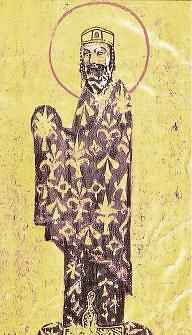 Alexius advanced from Salonica and pitched camp on the river Charzanes near Dyrrhachium on October 15. He held a war council there and sought advice from his senior officers; among them was George Palaeologus, who had managed to sneak out of the city. A majority of the senior officers, including Palaeologus, urged caution, noting that time was with the Emperor. Alexius, however, favoured an immediate assault, hoping to catch Guiscard's army from the rear, while they were still besieging the city. Alexius moved his army to the hills opposite the city, planning to attack the Normans the next day.
Guiscard, however, had been informed of Alexius' arrival by his scouts and on the night of October 17, he moved his army from the peninsula to the mainland. Upon learning of Guiscard's move, Alexius revised his battle plan. He split his army into three divisions, with the left wing under the command of Gregory Pakourianos
, the right wing under the command of Nikephoros Melissenos
, and himself in command of the centre. Guiscard formed his battle line opposite Alexius's, with the right wing under the command of the Count of Giovinazzo, the left under Bohemond and Guiscard facing Alexius in the centre.
The Varangians had been ordered to march just in front of the main line with a strong division of archers a little behind them. The archers had been commanded to move in front of the Varangians and fire a volley before retreating behind them. The archers continued this tactic until the army neared contact.
As the opposing armies closed in, Guiscard sent a detachment of cavalry positioned in the centre to feint an attack on the Byzantine positions. Guiscard hoped the feint would draw up the Varangians; however, this plan failed when the cavalry was forced back by the archers. The Norman right wing suddenly charged forward to the point where the Byzantine left and centre met, directing its attack against the Varangian left flank. The Varangians stood their ground while the Byzantine left, including some of Alexius' elite troops, attacked the Normans. The Norman formation disintegrated and the routed Normans fled towards the beach. There, according to Comnena, they were rallied by Guiscard's wife, Sikelgaita
, described as "like another Pallas
, if not a second Athena
".
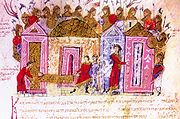 In the meantime, the Byzantine right and centre had been engaging in skirmishes with the Normans opposite them. However, with the collapse of the Norman right, the knights were in danger of being outflanked. At this point, the Varangians (mainly Anglo-Saxons
who had left England
after the Norman Conquest) joined in the pursuit of the Norman right. With their massive battle axe
s, the Varangians attacked the Norman knights, who were driven away after their horses panicked. The Varangians soon became separated from the main force and exhausted so they were in no position to resist an assault. Guiscard sent a strong force of spear
men and crossbowmen against the Varangian flank and inflicted heavy casualties on them. The few remaining Varangians fled into the church of the Archangel Michael. The Normans immediately set the church on fire, and all Varangians perished in the blaze.
Meanwhile, George Palaeologus sortie
d out of Dyrrhachium, but failed to save the situation. Worse, Alexius's vassal
, King Constantine Bodin of Duklja
, betrayed him. The Turks who had been lent to him by the Seljuk Sultan Suleyman I
followed Constantine's example and deserted.
Deprived of his left wing (still in pursuit of the Norman right), Alexius was exposed in the centre. Guiscard sent his heavy cavalry against the Byzantine centre. They first routed the Byzantine skirmishers before breaking into small detachments and smashing into various points of the Byzantine line. This charge broke the Byzantine lines and caused them to rout. The imperial camp, which had been left unguarded, fell to the Normans.
Alexius and his guards resisted as long as they could before retreating. As they retreated, Alexius was separated from his guard and was attacked by Norman soldiers. While escaping, he was wounded in his forehead and lost a lot of blood, but eventually made it back to Ohrid
, where he regrouped his army.
." He lost about 5,000 of his men, including most of the Varangians. Norman losses are unknown, but John Haldon claims they are substantial as both wings broke and fled. Historian Robert Holmes states: "The new knightly tactic of charging with the lance couched - tucked firmly under the arm to unite the impact of man and horse - proved a battle-winner."
George Palaeologus had not been able to re-enter the city after the battle and left with the main force. The defense of the citadel
was left to the Venetians, while the city itself was left to an Albanian
, Komiskortes.
In February 1082, Dyrrhachium fell after a Venetian or Amalfi
an citizen opened the gates to the Normans. The Norman army proceeded to take most of northern Greece without facing much resistance. While Guiscard was in Kastoria
, messengers arrived from Italy, bearing news that Apulia
, Calabria
, and Campania
were in revolt. He also learned that the Holy Roman Emperor
, Henry IV
, was at the gates of Rome
and besieging Pope Gregory VII
, a Norman ally. Alexius had negotiated with Henry and given him 360,000 gold pieces in return for an alliance. Henry responded by invading Italy and attacking the Pope. Guiscard rushed to Italy, leaving Bohemond in command of the army in Greece.
Alexius, desperate for money, ordered the confiscation of all the church's treasure. With this money, Alexius mustered an army near Thessalonica and went to fight Bohemond. However, Bohemond defeated Alexius in two battles: one near Arta
and the other near Ioannina
. This left Bohemond in control of Macedonia
and nearly all of Thessaly
. Bohemond advanced with his army against the city of Larissa
. Meanwhile, Alexius had mustered a new army and with 7,000 Seljuk Turks sent by the Sultan, he advanced on the Normans at Larissa and defeated them. The demoralised and unpaid Norman army returned to the coast and sailed back to Italy. Meanwhile, Alexius granted the Venetians a commercial colony in Constantinople as well as exemption from trading duties in return for their renewed aid. They responded by recapturing Dyrrhachium and Corfu and returning them to the empire. These victories returned the Empire to its previous status quo
and marked the beginning of the Komnenian restoration
.
Durrës
Durrës is the second largest city of Albania located on the central Albanian coast, about west of the capital Tirana. It is one of the most ancient and economically important cities of Albania. Durres is situated at one of the narrower points of the Adriatic Sea, opposite the Italian ports of Bari...
in Albania
Albania
Albania , officially known as the Republic of Albania , is a country in Southeastern Europe, in the Balkans region. It is bordered by Montenegro to the northwest, Kosovo to the northeast, the Republic of Macedonia to the east and Greece to the south and southeast. It has a coast on the Adriatic Sea...
) took place on October 18, 1081 between the Byzantine Empire
Byzantine Empire
The Byzantine Empire was the Eastern Roman Empire during the periods of Late Antiquity and the Middle Ages, centred on the capital of Constantinople. Known simply as the Roman Empire or Romania to its inhabitants and neighbours, the Empire was the direct continuation of the Ancient Roman State...
, led by the Emperor Alexius I Comnenus, and the Normans
Normans
The Normans were the people who gave their name to Normandy, a region in northern France. They were descended from Norse Viking conquerors of the territory and the native population of Frankish and Gallo-Roman stock...
of southern Italy
Italy
Italy , officially the Italian Republic languages]] under the European Charter for Regional or Minority Languages. In each of these, Italy's official name is as follows:;;;;;;;;), is a unitary parliamentary republic in South-Central Europe. To the north it borders France, Switzerland, Austria and...
under Robert Guiscard
Robert Guiscard
Robert d'Hauteville, known as Guiscard, Duke of Apulia and Calabria, from Latin Viscardus and Old French Viscart, often rendered the Resourceful, the Cunning, the Wily, the Fox, or the Weasel was a Norman adventurer conspicuous in the conquest of southern Italy and Sicily...
, Duke of Apulia and Calabria. The battle was fought outside the city of Dyrrhachium
Durrës
Durrës is the second largest city of Albania located on the central Albanian coast, about west of the capital Tirana. It is one of the most ancient and economically important cities of Albania. Durres is situated at one of the narrower points of the Adriatic Sea, opposite the Italian ports of Bari...
(also known as Durazzo), the Byzantine capital of Illyria
Illyria
In classical antiquity, Illyria was a region in the western part of the Balkan Peninsula inhabited by the Illyrians....
, and ended in a Norman victory.
Following the Norman conquest of Byzantine Italy and Saracen Sicily
Norman conquest of southern Italy
The Norman conquest of southern Italy spanned the late eleventh and much of the twelfth centuries, involving many battles and many independent players conquering territories of their own...
, the Byzantine Emperor, Michael VII
Michael VII
Michael VII Doukas or Ducas , nicknamed Parapinakēs , was Byzantine emperor from 1071 to 1078.- Life :...
, betrothed his son to Robert Guiscard
Robert Guiscard
Robert d'Hauteville, known as Guiscard, Duke of Apulia and Calabria, from Latin Viscardus and Old French Viscart, often rendered the Resourceful, the Cunning, the Wily, the Fox, or the Weasel was a Norman adventurer conspicuous in the conquest of southern Italy and Sicily...
's daughter. When Michael was deposed, Robert took this as an excuse to invade the Byzantine Empire in 1081. His army laid siege to Dyrrhachium, but his fleet was defeated by the Venetians
Venice
Venice is a city in northern Italy which is renowned for the beauty of its setting, its architecture and its artworks. It is the capital of the Veneto region...
. On October 18, the Normans engaged a Byzantine army under Alexius I Comnenus outside Dyrrhachium. The battle began with the Byzantine right wing routing the Norman left wing, which broke and fled. Varangian
Varangians
The Varangians or Varyags , sometimes referred to as Variagians, were people from the Baltic region, most often associated with Vikings, who from the 9th to 11th centuries ventured eastwards and southwards along the rivers of Eastern Europe, through what is now Russia, Belarus and Ukraine.According...
mercenaries joined in the pursuit of the fleeing Normans, but became separated from the main force and were massacred. Norman knight
Knight
A knight was a member of a class of lower nobility in the High Middle Ages.By the Late Middle Ages, the rank had become associated with the ideals of chivalry, a code of conduct for the perfect courtly Christian warrior....
s in the centre attacked the Byzantine centre and routed it, causing the bulk of the Byzantine army to rout.
After this victory, the Normans took Dyrrhachium in February 1082 and advanced inland, capturing most of Macedonia
Macedonia (region)
Macedonia is a geographical and historical region of the Balkan peninsula in southeastern Europe. Its boundaries have changed considerably over time, but nowadays the region is considered to include parts of five Balkan countries: Greece, the Republic of Macedonia, Bulgaria, Albania, Serbia, as...
and Thessaly
Thessaly
Thessaly is a traditional geographical region and an administrative region of Greece, comprising most of the ancient region of the same name. Before the Greek Dark Ages, Thessaly was known as Aeolia, and appears thus in Homer's Odyssey....
. Robert was then forced to leave Greece
Greece
Greece , officially the Hellenic Republic , and historically Hellas or the Republic of Greece in English, is a country in southeastern Europe....
to deal with an attack on his ally, the Pope
Pope
The Pope is the Bishop of Rome, a position that makes him the leader of the worldwide Catholic Church . In the Catholic Church, the Pope is regarded as the successor of Saint Peter, the Apostle...
by the Holy Roman Emperor
Holy Roman Empire
The Holy Roman Empire was a realm that existed from 962 to 1806 in Central Europe.It was ruled by the Holy Roman Emperor. Its character changed during the Middle Ages and the Early Modern period, when the power of the emperor gradually weakened in favour of the princes...
, Henry IV
Henry IV, Holy Roman Emperor
Henry IV was King of the Romans from 1056 and Holy Roman Emperor from 1084 until his forced abdication in 1105. He was the third emperor of the Salian dynasty and one of the most powerful and important figures of the 11th century...
. Robert left his son Bohemond in charge of the army in Greece. Bohemond was initially successful, defeating Alexius in several battles, but was defeated by Alexius outside Larissa
Larissa
Larissa is the capital and biggest city of the Thessaly region of Greece and capital of the Larissa regional unit. It is a principal agricultural centre and a national transportation hub, linked by road and rail with the port of Volos, the city of Thessaloniki and Athens...
. Forced to retreat to Italy, Bohemond lost all the territory gained by the Normans in the campaign. The Byzantine recovery began the Komnenian restoration
Komnenian restoration
The Komnenian restoration is the term used by historians to describe the military, financial and territorial recovery of the Byzantine Empire under the Komnenian dynasty, from the accession of Alexios I Komnenos in 1081, to the death of Manuel I Komnenos in 1180. The Komnenian restoration is also...
.
Background
The NormansNormans
The Normans were the people who gave their name to Normandy, a region in northern France. They were descended from Norse Viking conquerors of the territory and the native population of Frankish and Gallo-Roman stock...
first arrived in Southern Italy in 1015 from northern France
France
The French Republic , The French Republic , The French Republic , (commonly known as France , is a unitary semi-presidential republic in Western Europe with several overseas territories and islands located on other continents and in the Indian, Pacific, and Atlantic oceans. Metropolitan France...
and served local Lombard
Lombards
The Lombards , also referred to as Longobards, were a Germanic tribe of Scandinavian origin, who from 568 to 774 ruled a Kingdom in Italy...
lord
Lord
Lord is a title with various meanings. It can denote a prince or a feudal superior . The title today is mostly used in connection with the peerage of the United Kingdom or its predecessor countries, although some users of the title do not themselves hold peerages, and use it 'by courtesy'...
s as mercenaries against the Byzantine Empire
Byzantine Empire
The Byzantine Empire was the Eastern Roman Empire during the periods of Late Antiquity and the Middle Ages, centred on the capital of Constantinople. Known simply as the Roman Empire or Romania to its inhabitants and neighbours, the Empire was the direct continuation of the Ancient Roman State...
. As they were paid with lands, soon they were powerful enough to challenge Papal authority; in 1054, they defeated the Pope
Pope
The Pope is the Bishop of Rome, a position that makes him the leader of the worldwide Catholic Church . In the Catholic Church, the Pope is regarded as the successor of Saint Peter, the Apostle...
at the Battle of Civitate
Battle of Civitate
The Battle of Civitate was fought on 18 June 1053 in Southern Italy, between the Normans, led by the Count of Apulia Humphrey of Hauteville, and a Swabian-Italian-Lombard army, organised by Pope Leo IX and led on the battlefield by Gerard, Duke of Lorraine, and Rudolf, Prince of Benevento...
, forcing him to acknowledge their authority. In 1059, the Pope made Robert Guiscard
Robert Guiscard
Robert d'Hauteville, known as Guiscard, Duke of Apulia and Calabria, from Latin Viscardus and Old French Viscart, often rendered the Resourceful, the Cunning, the Wily, the Fox, or the Weasel was a Norman adventurer conspicuous in the conquest of southern Italy and Sicily...
, of the Hauteville family
Hauteville family
The family of the Hauteville was a petty baronial Norman family from the Cotentin which rose to prominence in Europe, Asia, and Africa through its conquests in the Mediterranean, especially Southern Italy and Sicily...
, Duke
Duke
A duke or duchess is a member of the nobility, historically of highest rank below the monarch, and historically controlling a duchy...
of Apulia
Apulia
Apulia is a region in Southern Italy bordering the Adriatic Sea in the east, the Ionian Sea to the southeast, and the Strait of Òtranto and Gulf of Taranto in the south. Its most southern portion, known as Salento peninsula, forms a high heel on the "boot" of Italy. The region comprises , and...
, Calabria
Calabria
Calabria , in antiquity known as Bruttium, is a region in southern Italy, south of Naples, located at the "toe" of the Italian Peninsula. The capital city of Calabria is Catanzaro....
, and Sicily
Sicily
Sicily is a region of Italy, and is the largest island in the Mediterranean Sea. Along with the surrounding minor islands, it constitutes an autonomous region of Italy, the Regione Autonoma Siciliana Sicily has a rich and unique culture, especially with regard to the arts, music, literature,...
. However, most of Apulia and Calabria were in Byzantine hands, and Sicily was in Saracen
Saracen
Saracen was a term used by the ancient Romans to refer to a people who lived in desert areas in and around the Roman province of Arabia, and who were distinguished from Arabs. In Europe during the Middle Ages the term was expanded to include Arabs, and then all who professed the religion of Islam...
hands.
By 1071, Robert, together with his brother Roger
Roger I of Sicily
Roger I , called Bosso and the Great Count, was the Norman Count of Sicily from 1071 to 1101. He was the last great leader of the Norman conquest of southern Italy.-Conquest of Calabria and Sicily:...
, had taken over the last Byzantine stronghold in Italy, Bari
Bari
Bari is the capital city of the province of Bari and of the Apulia region, on the Adriatic Sea, in Italy. It is the second most important economic centre of mainland Southern Italy after Naples, and is well known as a port and university city, as well as the city of Saint Nicholas...
. By the next year, they conquered all of Sicily, ending the Islamic Emirate of Sicily
Emirate of Sicily
The Emirate of Sicily was an Islamic state on the island of Sicily , which existed from 965 to 1072.-First Arab invasions of Sicily:...
. In 1073, the Byzantine Emperor Michael VII
Michael VII
Michael VII Doukas or Ducas , nicknamed Parapinakēs , was Byzantine emperor from 1071 to 1078.- Life :...
sent an envoy to Robert offering the hand of his son Constantine
Constantine Doukas
Constantine Doukas or Ducas , was Byzantine co-emperor from c. 1074 to 1078 and from 1081 to 1087. He was the son of Emperor Michael VII Doukas and his Georgian wife Maria of Alania....
to Robert's daughter Helena. Guiscard accepted the offer and sent his daughter to Constantinople
Constantinople
Constantinople was the capital of the Roman, Eastern Roman, Byzantine, Latin, and Ottoman Empires. Throughout most of the Middle Ages, Constantinople was Europe's largest and wealthiest city.-Names:...
. However, in 1078, Michael was overthrown by Nicephorus Botaneiates, an event that destroyed any chances Helena had for the throne. This gave Robert a motive to invade the empire claiming his daughter had been mistreated; however, his intervention was delayed by a revolt in Italy.
Robert conscripted all men of a fighting age into the army, which he refitted. Meanwhile, he sent an ambassador to the Byzantine court with orders to demand proper treatment for Helena and to win over the Domestic of the Schools, Alexius. The results of these attempts remain unknown, but the ambassador fell under Alexius's charm and as he was returning to Italy, he heard of Alexius's successful coup against Botaneiates, by which he became Alexius I Comnenus.
When the ambassador returned, he urged Robert to make peace, claiming that Alexius wanted nothing but friendship with the Normans. Robert had no intention of peace; he sent his son Bohemond with an advance force towards Greece and Bohemond landed at Aulon
Aulon
-In France:* Aulon, Creuse, a commune of the Creuse département* Aulon, Haute-Garonne, a commune of the Haute-Garonne département* Aulon, Hautes-Pyrénées, a commune of the Hautes-Pyrénées département-In Ancient Greece and Rome:...
, with Robert following shortly after.
Prelude
The Norman fleet of 150 ships including 60 horse transportsHorse transports in the Middle Ages
Horse transports in the Middle Ages were boats used for effective means of transporting horses over long distances, whether for war or general transport...
set off towards the Byzantine Empire at the end of May 1081. The army numbered 30,000 men, backed up by 1,300 Norman knights. The fleet sailed to Avalona
Vlorë
Vlorë is one of the biggest towns and the second largest port city of Albania, after Durrës, with a population of about 94,000 . It is the city where the Albanian Declaration of Independence was proclaimed on November 28, 1912...
in Byzantine territory; they were joined by several ships from Ragusa
Republic of Ragusa
The Republic of Ragusa or Republic of Dubrovnik was a maritime republic centered on the city of Dubrovnik in Dalmatia , that existed from 1358 to 1808...
, a republic in the Balkans
Balkans
The Balkans is a geopolitical and cultural region of southeastern Europe...
who were enemies of the Byzantines.
Robert soon left Avalona and sailed to the island of Corfu
Corfu
Corfu is a Greek island in the Ionian Sea. It is the second largest of the Ionian Islands, and, including its small satellite islands, forms the edge of the northwestern frontier of Greece. The island is part of the Corfu regional unit, and is administered as a single municipality. The...
, which surrendered because of a small garrison. Having won a bridgehead and a clear path for reinforcements from Italy, he advanced on the city of Dyrrhachium
Durrës
Durrës is the second largest city of Albania located on the central Albanian coast, about west of the capital Tirana. It is one of the most ancient and economically important cities of Albania. Durres is situated at one of the narrower points of the Adriatic Sea, opposite the Italian ports of Bari...
, the capital and chief port of Illyria
Illyria
In classical antiquity, Illyria was a region in the western part of the Balkan Peninsula inhabited by the Illyrians....
. The city was well defended on a long, narrow peninsula running parallel to the coast, but separated by marshlands. Guiscard brought his army onto the peninsula and pitched camp outside the city walls. However, as Robert's fleet sailed to Dyrrhachium, it was hit by a storm and lost several ships.
Meanwhile, when Alexius heard that the Normans were preparing to invade Byzantine territory, he sent an ambassador to the Doge
Doge of Venice
The Doge of Venice , often mistranslated Duke was the chief magistrate and leader of the Most Serene Republic of Venice for over a thousand years. Doges of Venice were elected for life by the city-state's aristocracy. Commonly the person selected as Doge was the shrewdest elder in the city...
of Venice
Republic of Venice
The Republic of Venice or Venetian Republic was a state originating from the city of Venice in Northeastern Italy. It existed for over a millennium, from the late 7th century until 1797. It was formally known as the Most Serene Republic of Venice and is often referred to as La Serenissima, in...
, Domenico Selvo
Domenico Selvo
Domenico Selvo was the 31st Doge of Venice, serving from 1071 to 1084. During his reign as Doge, his domestic policies, the alliances that he forged, and the battles that the Venetian military won and lost laid the foundations for much of the subsequent foreign and domestic policy of the Republic...
, requesting aid and offering trading rights in return. The Doge, alarmed by Norman control of the Strait of Otranto
Strait of Otranto
The Strait of Otranto connects the Adriatic Sea with the Ionian Sea and separates Italy from Albania. Its width at Punta Palascìa, east of Salento is less than . The strait is named after the Italian city of Otranto.- History :...
, took command of the Venetian fleet and sailed at once, surprising the Norman fleet under the command of Bohemond as night was falling. The Normans counter-attacked tenaciously, but their inexperience in naval combat betrayed them. The experienced Venetian navy attacked in a close formation
Tactical formation
A tactical formation is the arrangement or deployment of moving military forces such as infantry, cavalry, AFVs, military aircraft, or naval vessels...
known as "sea harbour" and together with their use of Greek fire
Greek fire
Greek fire was an incendiary weapon used by the Byzantine Empire. The Byzantines typically used it in naval battles to great effect as it could continue burning while floating on water....
"bombs", the Norman line scattered, and the Venetian fleet sailed into Dyrrhachium's harbour.
Siege of Dyrrhachium
Meanwhile, a Byzantine fleet arrived and – after joining with the Venetian fleet – attacked the Norman fleet, which was again routed. The garrison at Dyrrhachium managed to hold out all summer, despite Robert's catapults, ballistae and siege tower
Siege tower
A siege tower is a specialized siege engine, constructed to protect assailants and ladders while approaching the defensive walls of a fortification. The tower was often rectangular with four wheels with its height roughly equal to that of the wall or sometimes higher to allow archers to stand on...
. The garrison made continuous sallies from the city; on one occasion, Palaeologus fought all day with an arrowhead in his skull. Another sally succeeded in destroying Robert's siege tower.
Robert's camp was struck by disease; according to contemporary historian Anna Comnena up to 10,000 men died, including 500 knights. Even so, the situation of the Dyrrhachium garrison grew desperate because of the effects of Norman siege weapons. Alexius learned of this while he was in Salonica with his army so he advanced in full force against the Normans. According to Comnena, Alexius had about 20,000 men; historian John Haldon puts the army's size between 18,000 to 20,000 men, while John Birkenmeier estimates it between 20-25,000 men. It consisted of Thracian
Thrace
Thrace is a historical and geographic area in southeast Europe. As a geographical concept, Thrace designates a region bounded by the Balkan Mountains on the north, Rhodope Mountains and the Aegean Sea on the south, and by the Black Sea and the Sea of Marmara on the east...
and Macedonian tagma
Tagma (military)
The tagma is a term for a military unit of battalion or regiment size. The best-known and most technical use of the term however refers to the elite regiments formed by Byzantine emperor Constantine V and comprising the central army of the Byzantine Empire in the 8th–11th centuries.-History and...
ta, which numbered about 5,000 men; the elite excubitors
Excubitors
The Excubitors were founded in circa 460 AD as the imperial guards of the early Byzantine emperors. Their commanders soon acquired great influence and provided a series of emperors in the 6th century...
and vestiaritae units, which numbered around 1,000 men; a force of Manichaeans
Manichaeism
Manichaeism in Modern Persian Āyin e Māni; ) was one of the major Iranian Gnostic religions, originating in Sassanid Persia.Although most of the original writings of the founding prophet Mani have been lost, numerous translations and fragmentary texts have survived...
which comprised 2,800 men, Thessalian
Thessaly
Thessaly is a traditional geographical region and an administrative region of Greece, comprising most of the ancient region of the same name. Before the Greek Dark Ages, Thessaly was known as Aeolia, and appears thus in Homer's Odyssey....
cavalry
Cavalry
Cavalry or horsemen were soldiers or warriors who fought mounted on horseback. Cavalry were historically the third oldest and the most mobile of the combat arms...
, Balkan conscripts
Conscription
Conscription is the compulsory enlistment of people in some sort of national service, most often military service. Conscription dates back to antiquity and continues in some countries to the present day under various names...
, Armenia
Armenia
Armenia , officially the Republic of Armenia , is a landlocked mountainous country in the Caucasus region of Eurasia...
n infantry
Infantry
Infantrymen are soldiers who are specifically trained for the role of fighting on foot to engage the enemy face to face and have historically borne the brunt of the casualties of combat in wars. As the oldest branch of combat arms, they are the backbone of armies...
and other light troops. As well as the native troops, the Byzantines were joined by 2,000 Turkish and 1,000 Frankish mercenaries
Mercenary
A mercenary, is a person who takes part in an armed conflict based on the promise of material compensation rather than having a direct interest in, or a legal obligation to, the conflict itself. A non-conscript professional member of a regular army is not considered to be a mercenary although he...
, about 1,000 Varangians and 7,000 Turkish auxiliaries
Auxiliaries
An auxiliary force is a group affiliated with, but not part of, a military or police organization. In some cases, auxiliaries are armed forces operating in the same manner as regular soldiers...
sent by the Seljuk Sultanate of Rûm. Alexius also withdrew the tagmas from Heraclea Pontica
Heraclea Pontica
Heraclea Pontica , an ancient city on the coast of Bithynia in Asia Minor, at the mouth of the river Lycus. It was founded by the Greek city-state of Megara c.560-558 and was named after Heracles who the Greeks believed entered the underworld at a cave on the adjoining Archerusian promontory .The...
and the remaining Byzantine holdings in Asia Minor
Asia Minor
Asia Minor is a geographical location at the westernmost protrusion of Asia, also called Anatolia, and corresponds to the western two thirds of the Asian part of Turkey...
and by doing so, he effectively left them to be overrun by the Turks.
Initial moves
Guiscard, however, had been informed of Alexius' arrival by his scouts and on the night of October 17, he moved his army from the peninsula to the mainland. Upon learning of Guiscard's move, Alexius revised his battle plan. He split his army into three divisions, with the left wing under the command of Gregory Pakourianos
Gregory Pakourianos
Gregory Pakourianos was a politician and military commander in the Byzantine service. He was the founder of the Monastery of the Mother of God Petritzonitissa in Bachkovo and author of its typikon...
, the right wing under the command of Nikephoros Melissenos
Nikephoros Melissenos
Nikephoros Melissenos , latinized as Nicephorus Melissenus, was a Byzantine general and aristocrat. Of distinguished lineage, he served as a governor and general in the Balkans and Asia Minor in the 1060s. In the turbulent period after the Battle of Manzikert in 1071, several generals tried to...
, and himself in command of the centre. Guiscard formed his battle line opposite Alexius's, with the right wing under the command of the Count of Giovinazzo, the left under Bohemond and Guiscard facing Alexius in the centre.
The Varangians had been ordered to march just in front of the main line with a strong division of archers a little behind them. The archers had been commanded to move in front of the Varangians and fire a volley before retreating behind them. The archers continued this tactic until the army neared contact.
As the opposing armies closed in, Guiscard sent a detachment of cavalry positioned in the centre to feint an attack on the Byzantine positions. Guiscard hoped the feint would draw up the Varangians; however, this plan failed when the cavalry was forced back by the archers. The Norman right wing suddenly charged forward to the point where the Byzantine left and centre met, directing its attack against the Varangian left flank. The Varangians stood their ground while the Byzantine left, including some of Alexius' elite troops, attacked the Normans. The Norman formation disintegrated and the routed Normans fled towards the beach. There, according to Comnena, they were rallied by Guiscard's wife, Sikelgaita
Sikelgaita
Sikelgaita was a Lombard princess, the daughter of Guaimar IV, Prince of Salerno, and second wife of Robert Guiscard, Duke of Apulia....
, described as "like another Pallas
Pallas (daughter of Triton)
In Greek mythology, Pallas was the daughter of Triton. Acting as a foster parent to Zeus’s daughter Athena, Triton raised her alongside his own daughter. During a friendly fight between the two goddesses, Athena was protected from harm by Zeus but mortally wounded Pallas. Out of sadness and...
, if not a second Athena
Athena
In Greek mythology, Athena, Athenê, or Athene , also referred to as Pallas Athena/Athene , is the goddess of wisdom, courage, inspiration, civilization, warfare, strength, strategy, the arts, crafts, justice, and skill. Minerva, Athena's Roman incarnation, embodies similar attributes. Athena is...
".
Byzantine collapse
Anglo-Saxons
Anglo-Saxon is a term used by historians to designate the Germanic tribes who invaded and settled the south and east of Great Britain beginning in the early 5th century AD, and the period from their creation of the English nation to the Norman conquest. The Anglo-Saxon Era denotes the period of...
who had left England
England
England is a country that is part of the United Kingdom. It shares land borders with Scotland to the north and Wales to the west; the Irish Sea is to the north west, the Celtic Sea to the south west, with the North Sea to the east and the English Channel to the south separating it from continental...
after the Norman Conquest) joined in the pursuit of the Norman right. With their massive battle axe
Battle axe
A battle axe is an axe specifically designed for combat. Battle axes were specialized versions of utility axes...
s, the Varangians attacked the Norman knights, who were driven away after their horses panicked. The Varangians soon became separated from the main force and exhausted so they were in no position to resist an assault. Guiscard sent a strong force of spear
Spear
A spear is a pole weapon consisting of a shaft, usually of wood, with a pointed head.The head may be simply the sharpened end of the shaft itself, as is the case with bamboo spears, or it may be made of a more durable material fastened to the shaft, such as flint, obsidian, iron, steel or...
men and crossbowmen against the Varangian flank and inflicted heavy casualties on them. The few remaining Varangians fled into the church of the Archangel Michael. The Normans immediately set the church on fire, and all Varangians perished in the blaze.
Meanwhile, George Palaeologus sortie
Sortie
Sortie is a term for deployment or dispatch of one military unit, be it an aircraft, ship, or troops from a strongpoint. The sortie, whether by one or more aircraft or vessels, usually has a specific mission....
d out of Dyrrhachium, but failed to save the situation. Worse, Alexius's vassal
Vassal
A vassal or feudatory is a person who has entered into a mutual obligation to a lord or monarch in the context of the feudal system in medieval Europe. The obligations often included military support and mutual protection, in exchange for certain privileges, usually including the grant of land held...
, King Constantine Bodin of Duklja
Duklja
Doclea or Duklja was a medieval state with hereditary lands roughly encompassing the territories of present-day southeastern Montenegro, from Kotor on the west to the river Bojana on the east and to the sources of Zeta and Morača rivers on the north....
, betrayed him. The Turks who had been lent to him by the Seljuk Sultan Suleyman I
Süleyman I of Rûm
Suleiman ibn Qutulmish founded an independent Seljuq Turkish state in Anatolia and ruled as Seljuq Sultan of Rûm from 1077 until his death in 1086....
followed Constantine's example and deserted.
Deprived of his left wing (still in pursuit of the Norman right), Alexius was exposed in the centre. Guiscard sent his heavy cavalry against the Byzantine centre. They first routed the Byzantine skirmishers before breaking into small detachments and smashing into various points of the Byzantine line. This charge broke the Byzantine lines and caused them to rout. The imperial camp, which had been left unguarded, fell to the Normans.
Alexius and his guards resisted as long as they could before retreating. As they retreated, Alexius was separated from his guard and was attacked by Norman soldiers. While escaping, he was wounded in his forehead and lost a lot of blood, but eventually made it back to Ohrid
Ohrid
Ohrid is a city on the eastern shore of Lake Ohrid in the Republic of Macedonia. It has about 42,000 inhabitants, making it the seventh largest city in the country. The city is the seat of Ohrid Municipality. Ohrid is notable for having once had 365 churches, one for each day of the year and has...
, where he regrouped his army.
Aftermath
The battle was a heavy defeat for Alexius. Historian Jonathan Harris states that the defeat was "every bit as severe as that at ManzikertBattle of Manzikert
The Battle of Manzikert , was fought between the Byzantine Empire and Seljuq Turks led by Alp Arslan on August 26, 1071 near Manzikert...
." He lost about 5,000 of his men, including most of the Varangians. Norman losses are unknown, but John Haldon claims they are substantial as both wings broke and fled. Historian Robert Holmes states: "The new knightly tactic of charging with the lance couched - tucked firmly under the arm to unite the impact of man and horse - proved a battle-winner."
George Palaeologus had not been able to re-enter the city after the battle and left with the main force. The defense of the citadel
Citadel
A citadel is a fortress for protecting a town, sometimes incorporating a castle. The term derives from the same Latin root as the word "city", civis, meaning citizen....
was left to the Venetians, while the city itself was left to an Albanian
Albanians
Albanians are a nation and ethnic group native to Albania and neighbouring countries. They speak the Albanian language. More than half of all Albanians live in Albania and Kosovo...
, Komiskortes.
In February 1082, Dyrrhachium fell after a Venetian or Amalfi
Amalfi
Amalfi is a town and comune in the province of Salerno, in the region of Campania, Italy, on the Gulf of Salerno, c. 35 km southeast of Naples. It lies at the mouth of a deep ravine, at the foot of Monte Cerreto , surrounded by dramatic cliffs and coastal scenery...
an citizen opened the gates to the Normans. The Norman army proceeded to take most of northern Greece without facing much resistance. While Guiscard was in Kastoria
Kastoria
Kastoria is a city in northern Greece in the periphery of West Macedonia. It is the capital of Kastoria peripheral unit. It is situated on a promontory on the western shore of Lake Orestiada, in a valley surrounded by limestone mountains...
, messengers arrived from Italy, bearing news that Apulia
Apulia
Apulia is a region in Southern Italy bordering the Adriatic Sea in the east, the Ionian Sea to the southeast, and the Strait of Òtranto and Gulf of Taranto in the south. Its most southern portion, known as Salento peninsula, forms a high heel on the "boot" of Italy. The region comprises , and...
, Calabria
Calabria
Calabria , in antiquity known as Bruttium, is a region in southern Italy, south of Naples, located at the "toe" of the Italian Peninsula. The capital city of Calabria is Catanzaro....
, and Campania
Campania
Campania is a region in southern Italy. The region has a population of around 5.8 million people, making it the second-most-populous region of Italy; its total area of 13,590 km² makes it the most densely populated region in the country...
were in revolt. He also learned that the Holy Roman Emperor
Holy Roman Emperor
The Holy Roman Emperor is a term used by historians to denote a medieval ruler who, as German King, had also received the title of "Emperor of the Romans" from the Pope...
, Henry IV
Henry IV, Holy Roman Emperor
Henry IV was King of the Romans from 1056 and Holy Roman Emperor from 1084 until his forced abdication in 1105. He was the third emperor of the Salian dynasty and one of the most powerful and important figures of the 11th century...
, was at the gates of Rome
Rome
Rome is the capital of Italy and the country's largest and most populated city and comune, with over 2.7 million residents in . The city is located in the central-western portion of the Italian Peninsula, on the Tiber River within the Lazio region of Italy.Rome's history spans two and a half...
and besieging Pope Gregory VII
Pope Gregory VII
Pope St. Gregory VII , born Hildebrand of Sovana , was Pope from April 22, 1073, until his death. One of the great reforming popes, he is perhaps best known for the part he played in the Investiture Controversy, his dispute with Henry IV, Holy Roman Emperor affirming the primacy of the papal...
, a Norman ally. Alexius had negotiated with Henry and given him 360,000 gold pieces in return for an alliance. Henry responded by invading Italy and attacking the Pope. Guiscard rushed to Italy, leaving Bohemond in command of the army in Greece.
Alexius, desperate for money, ordered the confiscation of all the church's treasure. With this money, Alexius mustered an army near Thessalonica and went to fight Bohemond. However, Bohemond defeated Alexius in two battles: one near Arta
Arta, Greece
Arta is a city with a rich history in northwestern Greece, capital of the peripheral unit of Arta, which is part of Epirus region. The city was known in ancient times as Ambracia . Arta is famous for its old bridge located over the Arachthos River, situated west of downtown...
and the other near Ioannina
Ioannina
Ioannina , often called Jannena within Greece, is the largest city of Epirus, north-western Greece, with a population of 70,203 . It lies at an elevation of approximately 500 meters above sea level, on the western shore of lake Pamvotis . It is located within the Ioannina municipality, and is the...
. This left Bohemond in control of Macedonia
Macedonia (region)
Macedonia is a geographical and historical region of the Balkan peninsula in southeastern Europe. Its boundaries have changed considerably over time, but nowadays the region is considered to include parts of five Balkan countries: Greece, the Republic of Macedonia, Bulgaria, Albania, Serbia, as...
and nearly all of Thessaly
Thessaly
Thessaly is a traditional geographical region and an administrative region of Greece, comprising most of the ancient region of the same name. Before the Greek Dark Ages, Thessaly was known as Aeolia, and appears thus in Homer's Odyssey....
. Bohemond advanced with his army against the city of Larissa
Larissa
Larissa is the capital and biggest city of the Thessaly region of Greece and capital of the Larissa regional unit. It is a principal agricultural centre and a national transportation hub, linked by road and rail with the port of Volos, the city of Thessaloniki and Athens...
. Meanwhile, Alexius had mustered a new army and with 7,000 Seljuk Turks sent by the Sultan, he advanced on the Normans at Larissa and defeated them. The demoralised and unpaid Norman army returned to the coast and sailed back to Italy. Meanwhile, Alexius granted the Venetians a commercial colony in Constantinople as well as exemption from trading duties in return for their renewed aid. They responded by recapturing Dyrrhachium and Corfu and returning them to the empire. These victories returned the Empire to its previous status quo
Status quo
Statu quo, a commonly used form of the original Latin "statu quo" – literally "the state in which" – is a Latin term meaning the current or existing state of affairs. To maintain the status quo is to keep the things the way they presently are...
and marked the beginning of the Komnenian restoration
Komnenian restoration
The Komnenian restoration is the term used by historians to describe the military, financial and territorial recovery of the Byzantine Empire under the Komnenian dynasty, from the accession of Alexios I Komnenos in 1081, to the death of Manuel I Komnenos in 1180. The Komnenian restoration is also...
.
Primary
- Anna ComnenaAnna KomneneAnna Komnene, Latinized as Comnena was a Greek princess and scholar and the daughter of Emperor Alexios I Komnenos of Byzantium and Irene Doukaina...
(translated by E. R. A. Sewter). The Alexiad. London: Penguin Books, 1996, ISBN 0140442154.