


Basiliscus

Encyclopedia
Basiliscus (d. 476/477) was Eastern Roman (Byzantine) Emperor from 475 to 476. A member of the House of Leo
, he came to power when Emperor Zeno
had been forced out of Constantinople
by a revolt.
Basiliscus was the brother of Empress Aelia Verina
, the wife of Emperor Leo I
(457–474). His relationship with the Emperor allowed him to pursue a military career that, after minor initial successes, ended in 468, when he led the disastrous Roman invasion of Vandal
Africa, in one of the largest military operations of Late Antiquity
.
Basiliscus succeeded in seizing power in 475, exploiting the unpopularity of Emperor Zeno, the "barbarian" successor to Leo, and a plot organised by Verina that had caused Zeno to flee Constantinople. However, during his short rule, Basiliscus alienated the fundamental support of the Church and the people of Constantinople, promoting the Miaphysite
christological position in opposition to the Chalcedonian
faith. Also, his policy of securing his power through the appointment of loyal men to key roles antagonised many important figures in the imperial court, including his sister Verina. So, when Zeno tried to regain his empire, he found virtually no opposition, triumphantly entering Constantinople, and capturing and killing Basiliscus and his family.
The struggle between Basiliscus and Zeno impeded the Eastern Empire's ability to intervene in the fall of the Western Roman Empire
, which happened in early September 476. When the chieftain of the Heruli
, Odoacer
, deposed Western Emperor Romulus Augustus
, sending the imperial regalia
to Constantinople, Zeno had just regained his throne, and he could only appoint Odoacer dux
of Italy, thereby ending the Western Roman Empire.
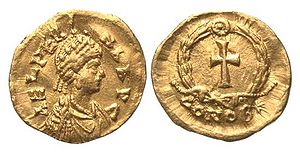 Likely of Balkan origin, Basiliscus was the brother of Aelia Verina
, wife of Leo I
. It has been argued that Basiliscus was uncle to the chieftain of the Heruli, Odoacer
. This link is based on the interpretation of a fragment by John of Antioch
(209.1), which states that Odoacer and Armatus
, Basiliscus' nephew, were brothers. However, not all scholars accept this interpretation, since sources do not say anything about the foreign origin of Basiliscus. It is known that Basiliscus had a wife, Zenonis
, and at least one son, Marcus.
Basiliscus' military career started under Leo I. The Emperor conferred upon his brother-in-law the dignities of dux, or commander-in-chief, in Thrace
. In this country Basiliscus led a successful military campaign against the Bulgars
in 463. He succeeded Rusticius as Magister militum
per Thracias (464), and had several successes against the Goths
and Huns
(466 or 467).
Basiliscus's value rose in Leo's consideration. Verina's intercession in favour of her brother helped Basiliscus' military and political career, with the conferral of the consul
ship in 465 and possibly of the rank of patricius. However, his rise was soon to meet a serious reversal.
 In 468, Leo chose Basiliscus as leader of the famous military expedition against Carthage
. The invasion of the kingdom of the Vandals
was one of the greatest military undertakings recorded in the annals of history, a combined amphibious operation with over ten thousand ships and one hundred thousand soldiers. The purpose of the operation was to punish the Vandal king Geiseric for the sacking of Rome in 455
, in which the former capital of the Western Roman Empire
had been overwhelmed, and the Empress Licinia Eudoxia
(widow of Emperor Valentinian III
) and her daughters had been taken as hostages.
The plan was concerted between Eastern Emperor Leo, Western Emperor Anthemius
, and General Marcellinus, who enjoyed independence in Illyricum
. Basiliscus was ordered to sail directly to Carthage, while Marcellinus attacked and took Sardinia
, and a third army, commanded by Heraclius of Edessa
, landed on the Libyan
coast east of Carthage, making rapid progress. It appears that the combined forces met in Sicily
, whence the three fleets moved at different periods.
Ancient and modern historians provided different estimations for the number of ships and troops under the command of Basiliscus, as well as for the expenses of the expedition. Both were enormous; Nicephorus Gregoras
speaks of one hundred thousand ships, the more reliable Cedrenus says that the fleet that attacked Carthage consisted of eleven hundred and thirteen ships, having each one hundred men on board. The most conservative estimation for expedition expenses is of 64,000 pounds of gold, a sum that exceeded a whole year's revenue.
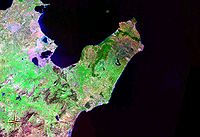
Sardinia and Libya were already conquered by Marcellinus and Heraclius, when Basiliscus cast anchor off the Promontorium Mercurii, now Cap Bon
, opposite Sicily, about forty miles from Carthage. Geiseric requested Basiliscus to allow him five days to draw up the conditions of a peace. During the negotiations, Geiseric gathered his ships and suddenly attacked the Roman fleet. The Vandals had filled many vessels with combustible materials. During the night, these fire ship
s were propelled against the unguarded and unsuspecting Roman fleet. The Byzantine commanders tried to rescue some ships from destruction, but these manoeuvres were blocked by the attack of other Vandal vessels.
Basiliscus fled in the heat of the battle. One half of the Roman fleet was burned, sunk, or captured, and the other half followed the fugitive Basiliscus. The whole expedition had failed. Heraclius effected his retreat through the desert into Tripolitania
, holding the position for two years until recalled; Marcellinus retired to Sicily, where he was reached by Basiliscus; the general was, however, assassinated, perhaps at the instigation of Ricimer
, by one of his own captains; and the king of the Vandals expressed his surprise and satisfaction, that the Romans themselves would remove from the world his most formidable antagonists.
After returning to Constantinople, Basiliscus hid in the church of Hagia Sophia
to escape the wrath of the people and the revenge of the Emperor. By the mediation of Verina, Basiliscus obtained the Imperial pardon, and was punished merely with banishment to Heraclea Sintica
, in Thrace.
Magister militum Aspar
. The death of Aspar caused a revolt in Thrace
, led by the Thracian Ostrogoth Theodoric Strabo
, and Basiliscus was dispatched to suppress the revolt, something he successfully did with the aid of his nephew Armatus
. In 474 he received the rank of caput senatus, "first among the senators".
At the death of Leo, Zeno, who was a "barbarian" of Isauria
n stock, but at the same time son-in-law of Leo, ascended to Emperor, after a short reign of his own son Leo II
(474). The "barbarian" origins of the Emperor caused antipathy towards Zeno among the people of Constantinople
. Furthermore, the strong Germanic portion of the military, led by Theodoric Strabo, disliked the Isaurian officers that Leo I brought to reduce his dependency on the Ostrogoths. Finally, Zeno alienated his fellow Isaurian general Illus
, who was bribed by Basiliscus. In the middle of the conspiracy was Verina, who fomented a popular revolt against the Emperor. The uprising, supported by Theodoric Strabo, Illus and Armatus, was successful, and Verina convinced the Emperor to leave the city. Zeno fled to his native lands, bringing with him some of the Isaurians living in Constantinople, and the Imperial treasury.
Basiliscus was then acclaimed as Augustus on 9 January 475 at the Hebdomon palace, by the palace ministers and the Senate. The mob of Constantinople got its revenge against Zeno, killing almost all of the Isaurians left in the city.
In the beginning, everything seemed to go well for the new Emperor, who even tried to set up a new dynasty by conferring the title of Augusta
upon his wife Aelia Zenonis and creating his son Marcus, Caesar
, and later Augustus; however, due to his mismanagement as emperor, Basiliscus quickly lost most of his supporters.
Early in his reign, Constantinople suffered a massive fire, which destroyed houses, churches, and completely incinerated the huge library built by Emperor Julian
. The fire was seen as a bad omen for the rule of Basiliscus.
Patricius. Patricius was the lover of Verina, and the empress had planned to raise him to the imperial rank and to marry him: the very revolt against Zeno had been organised to make Patricius emperor. Basiliscus, however, had out-witted his sister, and, after the flight of Zeno, had the ministers and the Senate choose him, and not Patricius, as Emperor. Basiliscus ordered the death of Patricius, as the officer was a natural candidate to overthrow the new Emperor; as a consequence, Verina later intrigued against Basiliscus, because of her lover's execution.
Also, Theodoric Strabo, whose hatred of the Isaurian Zeno had compelled him to support Basiliscus' revolt, left the new Emperor's side. Basiliscus had in fact raised his own nephew Armatus, who was rumoured to be also the lover of Basiliscus' wife, to the rank of magister militum, the same that Strabo held. Finally, the support of Illus was most likely wavering, given the massacre of the Isaurians allowed by Basiliscus.
and Chalcedonian
s. These were two opposing christological positions; the Miaphysites claimed Christ
had only One nature out of Two, the Chalcedonians maintained that he had both human and divine natures. The Council of Chalcedon
, convoked by Emperor Marcian
in 451, had ruled out Miaphysitism, with the support of the pope in the West and many bishops in the East. However, the Miaphysite position was still strong: the two Miaphysite Patriarchs Timothy Aelurus of Alexandria
and Peter the Fuller
of Antioch
were deposed.
From the beginning of his rule, Basiliscus showed his support for the Miaphysites. Zacharias Scholasticus reports how a group of Egyptian Miaphysite monks, having heard of Emperor Leo's death, had moved from Alexandria to Constantinople to petition Zeno in favour of Timothy, but at their arrival in the capital, they found the newly elected Basiliscus instead. The Magister Officiorum Theoctistus, the former physician of Basiliscus, was the brother of one of the monks, so the delegation obtained an audience with Basiliscus, and, with the support of Theoctistus and of the Empress, they convinced Basiliscus to recall from exile the banished Miaphysite Patriarchs.
Basiliscus re-instated Timothy Aelurus and Peter the Fuller to their sees, and by persuasion of the former issued (9 April 475) a circular letter (Enkyklikon) to the bishops calling them to accept as valid only the first three ecumenical synods, and reject the Council of Chalcedon. All bishops were to sign the edict. While most of the Eastern bishops accepted the letter, Patriarch Acacius of Constantinople
refused, with the support of the population of the city, clearly showing his disdain towards Basiliscus by draping the icon
s in Hagia Sophia in black.
 Soon after his elevation, Basiliscus had despatched Illus and his brother Trocundus
against Zeno, who, now in his native fortresses, had resumed the life of an Isaurian chieftain. Basiliscus, however, failed to fulfill the promises he made to the two generals; furthermore, they received letters from some of the leading ministers at the court, urging them to secure the return of Zeno, for the city now preferred a restored Isaurian to a Miaphysite whose unpopularity increased with the fiscal rapacity of his ministers.
During his operations in Isauria, Illus took Zeno's brother, Longinus, prisoner and kept him in an Isaurian fortress. Because he thought he would have great influence over a restored Zeno, he changed sides and marched with Zeno towards Constantinople in the summer of 476. When Basiliscus received news of this danger, he hastened to recall his ecclesiastical edicts and to conciliate the Patriarch and the people, but it was too late.
Armatus, as magister militum, was sent with all available forces in Asia Minor, to oppose the advancing army of the Isaurians, but secret messages from Zeno, who promised to give him the title of magister militum for life and to confer the rank of Caesar on his son, induced him to betray his master. Armatus avoided the road by which Zeno was advancing and marched into Isauria by another way. This betrayal decided the fate of Basiliscus.
In August 476, Zeno besieged Constantinople.
The Senate opened the gates of the city to the Isaurian, allowing the deposed emperor to resume the throne. Basiliscus fled to sanctuary in a church, but he was betrayed by Acacius and surrendered himself and his family after extracting a solemn promise from Zeno not to shed their blood. Basiliscus, his wife Aelia Zenonis and his son Marcus were sent to a fortress in Cappadocia
, where Zeno had them enclosed in a dry cistern, to die from exposure.
Basiliscus had ruled for twenty months. He is described by sources as a successful general, but slow of understanding and easy to deceive.
House of Leo
The House of Leo ruled the Eastern Roman Empire from 457 to 518 .The emperors of the House of Leo were:# Leo I the Thracian – soldier...
, he came to power when Emperor Zeno
Zeno (emperor)
Zeno , originally named Tarasis, was Byzantine Emperor from 474 to 475 and again from 476 to 491. Domestic revolts and religious dissension plagued his reign, which nevertheless succeeded to some extent in foreign issues...
had been forced out of Constantinople
Constantinople
Constantinople was the capital of the Roman, Eastern Roman, Byzantine, Latin, and Ottoman Empires. Throughout most of the Middle Ages, Constantinople was Europe's largest and wealthiest city.-Names:...
by a revolt.
Basiliscus was the brother of Empress Aelia Verina
Verina
Aelia Verina was the Empress consort of Leo I of the Byzantine Empire. She was a sister of Basiliscus. Her daughter Ariadne was Empress consort of first Zeno and then Anastasius I. Verina was the maternal grandmother of Leo II.-Family:...
, the wife of Emperor Leo I
Leo I (emperor)
Leo I was Byzantine Emperor from 457 to 474. A native of Dacia Aureliana near historic Thrace, he was known as Leo the Thracian ....
(457–474). His relationship with the Emperor allowed him to pursue a military career that, after minor initial successes, ended in 468, when he led the disastrous Roman invasion of Vandal
Vandals
The Vandals were an East Germanic tribe that entered the late Roman Empire during the 5th century. The Vandals under king Genseric entered Africa in 429 and by 439 established a kingdom which included the Roman Africa province, besides the islands of Sicily, Corsica, Sardinia and the Balearics....
Africa, in one of the largest military operations of Late Antiquity
Late Antiquity
Late Antiquity is a periodization used by historians to describe the time of transition from Classical Antiquity to the Middle Ages, in both mainland Europe and the Mediterranean world. Precise boundaries for the period are a matter of debate, but noted historian of the period Peter Brown proposed...
.
Basiliscus succeeded in seizing power in 475, exploiting the unpopularity of Emperor Zeno, the "barbarian" successor to Leo, and a plot organised by Verina that had caused Zeno to flee Constantinople. However, during his short rule, Basiliscus alienated the fundamental support of the Church and the people of Constantinople, promoting the Miaphysite
Miaphysitism
Miaphysitism is a Christological formula of the Oriental Orthodox Churches and of the various churches adhering to the first three Ecumenical Councils...
christological position in opposition to the Chalcedonian
Chalcedonian
Chalcedonian describes churches and theologians which accept the definition given at the Council of Chalcedon of how the divine and human relate in the person of Jesus Christ...
faith. Also, his policy of securing his power through the appointment of loyal men to key roles antagonised many important figures in the imperial court, including his sister Verina. So, when Zeno tried to regain his empire, he found virtually no opposition, triumphantly entering Constantinople, and capturing and killing Basiliscus and his family.
The struggle between Basiliscus and Zeno impeded the Eastern Empire's ability to intervene in the fall of the Western Roman Empire
Western Roman Empire
The Western Roman Empire was the western half of the Roman Empire after its division by Diocletian in 285; the other half of the Roman Empire was the Eastern Roman Empire, commonly referred to today as the Byzantine Empire....
, which happened in early September 476. When the chieftain of the Heruli
Heruli
The Heruli were an East Germanic tribe who are famous for their naval exploits. Migrating from Northern Europe to the Black Sea in the third century They were part of the...
, Odoacer
Odoacer
Flavius Odoacer , also known as Flavius Odovacer, was the first King of Italy. His reign is commonly seen as marking the end of the Western Roman Empire. Though the real power in Italy was in his hands, he represented himself as the client of Julius Nepos and, after Nepos' death in 480, of the...
, deposed Western Emperor Romulus Augustus
Romulus Augustus
Romulus Augustus , was the last Western Roman Emperor, reigning from 31 October 475 until 4 September 476...
, sending the imperial regalia
Regalia
Regalia is Latin plurale tantum for the privileges and the insignia characteristic of a Sovereign.The word stems from the Latin substantivation of the adjective regalis, 'regal', itself from Rex, 'king'...
to Constantinople, Zeno had just regained his throne, and he could only appoint Odoacer dux
Dux
Dux is Latin for leader and later for Duke and its variant forms ....
of Italy, thereby ending the Western Roman Empire.
Origins and early career
Verina
Aelia Verina was the Empress consort of Leo I of the Byzantine Empire. She was a sister of Basiliscus. Her daughter Ariadne was Empress consort of first Zeno and then Anastasius I. Verina was the maternal grandmother of Leo II.-Family:...
, wife of Leo I
Leo I (emperor)
Leo I was Byzantine Emperor from 457 to 474. A native of Dacia Aureliana near historic Thrace, he was known as Leo the Thracian ....
. It has been argued that Basiliscus was uncle to the chieftain of the Heruli, Odoacer
Odoacer
Flavius Odoacer , also known as Flavius Odovacer, was the first King of Italy. His reign is commonly seen as marking the end of the Western Roman Empire. Though the real power in Italy was in his hands, he represented himself as the client of Julius Nepos and, after Nepos' death in 480, of the...
. This link is based on the interpretation of a fragment by John of Antioch
John of Antioch
John of Antioch was Patriarch of Antioch and led a group of moderate Eastern bishops during the Nestorian controversy. He is sometimes confused with John Chrysostom, who is occasionally also referred to as John of Antioch. John gave active support to his friend Nestorius in the latter's dispute...
(209.1), which states that Odoacer and Armatus
Armatus
Flavius Armatus was a Byzantine military commander, magister militum under Emperors Leo I, Basiliscus and Zeno, and consul. He was instrumental in the rebellion of Basiliscus against Zeno, and in his subsequent fall.- Origin and early career :...
, Basiliscus' nephew, were brothers. However, not all scholars accept this interpretation, since sources do not say anything about the foreign origin of Basiliscus. It is known that Basiliscus had a wife, Zenonis
Zenonis
Aelia Zenonis was the Empress consort of Basiliscus of the Eastern Roman Empire.- Background :The ancestry of Zenonis is unknown. She was married to Basiliscus, brother of Verina. Her sister-in-law was Empress consort to Leo I and mother to Ariadne...
, and at least one son, Marcus.
Basiliscus' military career started under Leo I. The Emperor conferred upon his brother-in-law the dignities of dux, or commander-in-chief, in Thrace
Thrace
Thrace is a historical and geographic area in southeast Europe. As a geographical concept, Thrace designates a region bounded by the Balkan Mountains on the north, Rhodope Mountains and the Aegean Sea on the south, and by the Black Sea and the Sea of Marmara on the east...
. In this country Basiliscus led a successful military campaign against the Bulgars
Bulgars
The Bulgars were a semi-nomadic who flourished in the Pontic Steppe and the Volga basin in the 7th century.The Bulgars emerge after the collapse of the Hunnic Empire in the 5th century....
in 463. He succeeded Rusticius as Magister militum
Magister militum
Magister militum was a top-level military command used in the later Roman Empire, dating from the reign of Constantine. Used alone, the term referred to the senior military officer of the Empire...
per Thracias (464), and had several successes against the Goths
Goths
The Goths were an East Germanic tribe of Scandinavian origin whose two branches, the Visigoths and the Ostrogoths, played an important role in the fall of the Roman Empire and the emergence of Medieval Europe....
and Huns
Huns
The Huns were a group of nomadic people who, appearing from east of the Volga River, migrated into Europe c. AD 370 and established the vast Hunnic Empire there. Since de Guignes linked them with the Xiongnu, who had been northern neighbours of China 300 years prior to the emergence of the Huns,...
(466 or 467).
Basiliscus's value rose in Leo's consideration. Verina's intercession in favour of her brother helped Basiliscus' military and political career, with the conferral of the consul
Consul
Consul was the highest elected office of the Roman Republic and an appointive office under the Empire. The title was also used in other city states and also revived in modern states, notably in the First French Republic...
ship in 465 and possibly of the rank of patricius. However, his rise was soon to meet a serious reversal.
Disastrous expedition against the Vandals
Carthage
Carthage , implying it was a 'new Tyre') is a major urban centre that has existed for nearly 3,000 years on the Gulf of Tunis, developing from a Phoenician colony of the 1st millennium BC...
. The invasion of the kingdom of the Vandals
Vandals
The Vandals were an East Germanic tribe that entered the late Roman Empire during the 5th century. The Vandals under king Genseric entered Africa in 429 and by 439 established a kingdom which included the Roman Africa province, besides the islands of Sicily, Corsica, Sardinia and the Balearics....
was one of the greatest military undertakings recorded in the annals of history, a combined amphibious operation with over ten thousand ships and one hundred thousand soldiers. The purpose of the operation was to punish the Vandal king Geiseric for the sacking of Rome in 455
Sack of Rome (455)
The sack of 455 was the second of three barbarian sacks of Rome; it was executed by the Vandals, who were then at war with the usurping Western Roman Emperor Petronius Maximus....
, in which the former capital of the Western Roman Empire
Western Roman Empire
The Western Roman Empire was the western half of the Roman Empire after its division by Diocletian in 285; the other half of the Roman Empire was the Eastern Roman Empire, commonly referred to today as the Byzantine Empire....
had been overwhelmed, and the Empress Licinia Eudoxia
Licinia Eudoxia
Licinia Eudoxia was a Roman Empress, daughter of Eastern Emperor Theodosius II and wife of the Western Emperors Valentinian III and Petronius Maximus.- Family :...
(widow of Emperor Valentinian III
Valentinian III
-Family:Valentinian was born in the western capital of Ravenna, the only son of Galla Placidia and Flavius Constantius. The former was the younger half-sister of the western emperor Honorius, and the latter was at the time Patrician and the power behind the throne....
) and her daughters had been taken as hostages.
The plan was concerted between Eastern Emperor Leo, Western Emperor Anthemius
Anthemius
Procopius Anthemius was Western Roman Emperor from 467 to 472. Perhaps the last capable Western Roman Emperor, Anthemius attempted to solve the two primary military challenges facing the remains of the Western Roman Empire: the resurgent Visigoths, under Euric, whose domain straddled the Pyrenees;...
, and General Marcellinus, who enjoyed independence in Illyricum
Illyricum (Roman province)
The Roman province of Illyricum or Illyris Romana or Illyris Barbara or Illyria Barbara replaced most of the region of Illyria. It stretched from the Drilon river in modern north Albania to Istria in the west and to the Sava river in the north. Salona functioned as its capital...
. Basiliscus was ordered to sail directly to Carthage, while Marcellinus attacked and took Sardinia
Sardinia
Sardinia is the second-largest island in the Mediterranean Sea . It is an autonomous region of Italy, and the nearest land masses are the French island of Corsica, the Italian Peninsula, Sicily, Tunisia and the Spanish Balearic Islands.The name Sardinia is from the pre-Roman noun *sard[],...
, and a third army, commanded by Heraclius of Edessa
Heraclius of Edessa
Heraclius of Edessa was an Eastern Roman Empire general who took part in the failed campaign against the Vandals in 468.- Biography :...
, landed on the Libyan
Ancient Libya
The Latin name Libya referred to the region west of the Nile Valley, generally corresponding to modern Northwest Africa. Climate changes affected the locations of the settlements....
coast east of Carthage, making rapid progress. It appears that the combined forces met in Sicily
Sicily
Sicily is a region of Italy, and is the largest island in the Mediterranean Sea. Along with the surrounding minor islands, it constitutes an autonomous region of Italy, the Regione Autonoma Siciliana Sicily has a rich and unique culture, especially with regard to the arts, music, literature,...
, whence the three fleets moved at different periods.
Ancient and modern historians provided different estimations for the number of ships and troops under the command of Basiliscus, as well as for the expenses of the expedition. Both were enormous; Nicephorus Gregoras
Nicephorus Gregoras
Nikephoros Gregoras, latinized as Nicephorus Gregoras , Byzantine astronomer, historian, man of learning and religious controversialist, was born at Heraclea Pontica....
speaks of one hundred thousand ships, the more reliable Cedrenus says that the fleet that attacked Carthage consisted of eleven hundred and thirteen ships, having each one hundred men on board. The most conservative estimation for expedition expenses is of 64,000 pounds of gold, a sum that exceeded a whole year's revenue.
Sardinia and Libya were already conquered by Marcellinus and Heraclius, when Basiliscus cast anchor off the Promontorium Mercurii, now Cap Bon
Cap Bon
Cap Bon , also Watan el-kibli, is a peninsula in far northeastern Tunisia. It is located at around . It is surrounded by the Gulf of Tunis in the north. Towns located on the peninsula include Nabeul, Kelibia and Menzel Temime. The ruins of the Punic town Kerkouane are located here....
, opposite Sicily, about forty miles from Carthage. Geiseric requested Basiliscus to allow him five days to draw up the conditions of a peace. During the negotiations, Geiseric gathered his ships and suddenly attacked the Roman fleet. The Vandals had filled many vessels with combustible materials. During the night, these fire ship
Fire ship
A fire ship, used in the days of wooden rowed or sailing ships, was a ship filled with combustibles, deliberately set on fire and steered into an enemy fleet, in order to destroy ships, or to create panic and make the enemy break formation. Ships used as fire ships were usually old and worn out or...
s were propelled against the unguarded and unsuspecting Roman fleet. The Byzantine commanders tried to rescue some ships from destruction, but these manoeuvres were blocked by the attack of other Vandal vessels.
Basiliscus fled in the heat of the battle. One half of the Roman fleet was burned, sunk, or captured, and the other half followed the fugitive Basiliscus. The whole expedition had failed. Heraclius effected his retreat through the desert into Tripolitania
Tripolitania
Tripolitania or Tripolitana is a historic region and former province of Libya.Tripolitania was a separate Italian colony from 1927 to 1934...
, holding the position for two years until recalled; Marcellinus retired to Sicily, where he was reached by Basiliscus; the general was, however, assassinated, perhaps at the instigation of Ricimer
Ricimer
Flavius Ricimer was a Germanic general who achieved effective control of the remaining parts of the Western Roman Empire, during the middle of the 5th century...
, by one of his own captains; and the king of the Vandals expressed his surprise and satisfaction, that the Romans themselves would remove from the world his most formidable antagonists.
After returning to Constantinople, Basiliscus hid in the church of Hagia Sophia
Hagia Sophia
Hagia Sophia is a former Orthodox patriarchal basilica, later a mosque, and now a museum in Istanbul, Turkey...
to escape the wrath of the people and the revenge of the Emperor. By the mediation of Verina, Basiliscus obtained the Imperial pardon, and was punished merely with banishment to Heraclea Sintica
Heraclea Sintica
Heraclea Sintica was an ancient Greekcity in Thracian Macedonia, to the south of the Struma River, the site of which is marked by the village of Rupite, Bulgaria, and which was identified by the discovery of local coins....
, in Thrace.
Rise to power
In 471 and 472, Basiliscus helped Leo I to get rid of the Germanic influence in his court, helping in the murder of the AlanAlans
The Alans, or the Alani, occasionally termed Alauni or Halani, were a group of Sarmatian tribes, nomadic pastoralists of the 1st millennium AD who spoke an Eastern Iranian language which derived from Scytho-Sarmatian and which in turn evolved into modern Ossetian.-Name:The various forms of Alan —...
Magister militum Aspar
Aspar
Flavius Ardabur Aspar was an Alan patrician and magister militum of the Eastern Roman Empire. Aspar's family exerted a great influence on the Eastern Roman Emperors for half a century, from the 420s to his death in 471, over Theodosius II, Marcian and Leo I, who, in the end, had him killed.Alans...
. The death of Aspar caused a revolt in Thrace
Thrace
Thrace is a historical and geographic area in southeast Europe. As a geographical concept, Thrace designates a region bounded by the Balkan Mountains on the north, Rhodope Mountains and the Aegean Sea on the south, and by the Black Sea and the Sea of Marmara on the east...
, led by the Thracian Ostrogoth Theodoric Strabo
Theodoric Strabo
Theodoric Strabo was an Ostrogoth chieftain who was involved in the politics of the Byzantine Empire during the reigns of Byzantine Emperors Leo I, Zeno and Basiliscus...
, and Basiliscus was dispatched to suppress the revolt, something he successfully did with the aid of his nephew Armatus
Armatus
Flavius Armatus was a Byzantine military commander, magister militum under Emperors Leo I, Basiliscus and Zeno, and consul. He was instrumental in the rebellion of Basiliscus against Zeno, and in his subsequent fall.- Origin and early career :...
. In 474 he received the rank of caput senatus, "first among the senators".
At the death of Leo, Zeno, who was a "barbarian" of Isauria
Isauria
Isauria , in ancient geography, is a rugged isolated district in the interior of South Asia Minor, of very different extent at different periods, but generally covering what is now the district of Bozkır and its surroundings in the Konya province of Turkey, or the core of the Taurus Mountains. In...
n stock, but at the same time son-in-law of Leo, ascended to Emperor, after a short reign of his own son Leo II
Leo II (emperor)
Leo II was Byzantine Emperor for less than a year in 474. He was the son of Zeno and Ariadne, and maternal grandson of Leo I and Verina. As Leo's closest male relative, he was named successor upon his grandfather's death. After taking his father as colleague, he died of an unknown disease about 10...
(474). The "barbarian" origins of the Emperor caused antipathy towards Zeno among the people of Constantinople
Constantinople
Constantinople was the capital of the Roman, Eastern Roman, Byzantine, Latin, and Ottoman Empires. Throughout most of the Middle Ages, Constantinople was Europe's largest and wealthiest city.-Names:...
. Furthermore, the strong Germanic portion of the military, led by Theodoric Strabo, disliked the Isaurian officers that Leo I brought to reduce his dependency on the Ostrogoths. Finally, Zeno alienated his fellow Isaurian general Illus
Illus
Illus was a Byzantine general, who played an important role in the reigns of the Byzantine Emperors Zeno and Basiliscus.Illus supported the revolt of Basiliscus against Zeno, then switched sides, supporting the return of Zeno...
, who was bribed by Basiliscus. In the middle of the conspiracy was Verina, who fomented a popular revolt against the Emperor. The uprising, supported by Theodoric Strabo, Illus and Armatus, was successful, and Verina convinced the Emperor to leave the city. Zeno fled to his native lands, bringing with him some of the Isaurians living in Constantinople, and the Imperial treasury.
Basiliscus was then acclaimed as Augustus on 9 January 475 at the Hebdomon palace, by the palace ministers and the Senate. The mob of Constantinople got its revenge against Zeno, killing almost all of the Isaurians left in the city.
In the beginning, everything seemed to go well for the new Emperor, who even tried to set up a new dynasty by conferring the title of Augusta
Augusta (honorific)
Augusta was the imperial honorific title of empresses. It was given to the women of the Roman and Byzantine imperial families. In the third century, Augustae could also receive the titles of Mater castrorum and Mater Patriae .The title implied the greatest prestige, with the Augustae able to...
upon his wife Aelia Zenonis and creating his son Marcus, Caesar
Caesar (title)
Caesar is a title of imperial character. It derives from the cognomen of Julius Caesar, the Roman dictator...
, and later Augustus; however, due to his mismanagement as emperor, Basiliscus quickly lost most of his supporters.
Corruption and the fire of Constantinople
The most urgent problem facing the new Emperor was the scarcity of resources left in the imperial treasury. Basiliscus was forced to raise heavy taxes, and to revert to the practice of auctioning the offices, obviously causing a diffuse discontent in the population. He also extorted money from the church, with the help of the Prefect Epinicus, Verina's long-time favourite.Early in his reign, Constantinople suffered a massive fire, which destroyed houses, churches, and completely incinerated the huge library built by Emperor Julian
Julian the Apostate
Julian "the Apostate" , commonly known as Julian, or also Julian the Philosopher, was Roman Emperor from 361 to 363 and a noted philosopher and Greek writer....
. The fire was seen as a bad omen for the rule of Basiliscus.
Tensions with his collaborators
Basiliscus had relied on the support of some major figures of the court in his bid for power. However, he quickly lost most of them. First, Basiliscus alienated his own sister Verina's support, executing the Magister OfficiorumMagister officiorum
The magister officiorum was one of the most senior administrative officials in the late Roman Empire and the early centuries of the Byzantine Empire...
Patricius. Patricius was the lover of Verina, and the empress had planned to raise him to the imperial rank and to marry him: the very revolt against Zeno had been organised to make Patricius emperor. Basiliscus, however, had out-witted his sister, and, after the flight of Zeno, had the ministers and the Senate choose him, and not Patricius, as Emperor. Basiliscus ordered the death of Patricius, as the officer was a natural candidate to overthrow the new Emperor; as a consequence, Verina later intrigued against Basiliscus, because of her lover's execution.
Also, Theodoric Strabo, whose hatred of the Isaurian Zeno had compelled him to support Basiliscus' revolt, left the new Emperor's side. Basiliscus had in fact raised his own nephew Armatus, who was rumoured to be also the lover of Basiliscus' wife, to the rank of magister militum, the same that Strabo held. Finally, the support of Illus was most likely wavering, given the massacre of the Isaurians allowed by Basiliscus.
Religious controversies
In that time, the Christian faith was shaken by the contrast between MiaphysitesMiaphysitism
Miaphysitism is a Christological formula of the Oriental Orthodox Churches and of the various churches adhering to the first three Ecumenical Councils...
and Chalcedonian
Chalcedonian
Chalcedonian describes churches and theologians which accept the definition given at the Council of Chalcedon of how the divine and human relate in the person of Jesus Christ...
s. These were two opposing christological positions; the Miaphysites claimed Christ
Christ
Christ is the English term for the Greek meaning "the anointed one". It is a translation of the Hebrew , usually transliterated into English as Messiah or Mashiach...
had only One nature out of Two, the Chalcedonians maintained that he had both human and divine natures. The Council of Chalcedon
Council of Chalcedon
The Council of Chalcedon was a church council held from 8 October to 1 November, 451 AD, at Chalcedon , on the Asian side of the Bosporus. The council marked a significant turning point in the Christological debates that led to the separation of the church of the Eastern Roman Empire in the 5th...
, convoked by Emperor Marcian
Marcian
Marcian was Byzantine Emperor from 450 to 457. Marcian's rule marked a recovery of the Eastern Empire, which the Emperor protected from external menaces and reformed economically and financially...
in 451, had ruled out Miaphysitism, with the support of the pope in the West and many bishops in the East. However, the Miaphysite position was still strong: the two Miaphysite Patriarchs Timothy Aelurus of Alexandria
Pope Timothy II of Alexandria
Pope Timothy II of Alexandria , also known as Αἴλουρος/Aelurus , succeeded twice in supplanting the Chalcedonian Patriarch of Alexandria....
and Peter the Fuller
Peter the Fuller
Peter Fullo was Patriarch of Antioch and Non-Chalcedonian.Peter received his surname from his former trade as a fuller of cloth. Tillemont Peter Fullo ("the Fuller") was Patriarch of Antioch (471–488) and Non-Chalcedonian.Peter received his surname from his former trade as a fuller of cloth....
of Antioch
Antioch
Antioch on the Orontes was an ancient city on the eastern side of the Orontes River. It is near the modern city of Antakya, Turkey.Founded near the end of the 4th century BC by Seleucus I Nicator, one of Alexander the Great's generals, Antioch eventually rivaled Alexandria as the chief city of the...
were deposed.
From the beginning of his rule, Basiliscus showed his support for the Miaphysites. Zacharias Scholasticus reports how a group of Egyptian Miaphysite monks, having heard of Emperor Leo's death, had moved from Alexandria to Constantinople to petition Zeno in favour of Timothy, but at their arrival in the capital, they found the newly elected Basiliscus instead. The Magister Officiorum Theoctistus, the former physician of Basiliscus, was the brother of one of the monks, so the delegation obtained an audience with Basiliscus, and, with the support of Theoctistus and of the Empress, they convinced Basiliscus to recall from exile the banished Miaphysite Patriarchs.
Basiliscus re-instated Timothy Aelurus and Peter the Fuller to their sees, and by persuasion of the former issued (9 April 475) a circular letter (Enkyklikon) to the bishops calling them to accept as valid only the first three ecumenical synods, and reject the Council of Chalcedon. All bishops were to sign the edict. While most of the Eastern bishops accepted the letter, Patriarch Acacius of Constantinople
Patriarch Acacius of Constantinople
Acacius was the Ecumenical Patriarch of Constantinople from 471 to 489. Acacius was practically the first prelate throughout the Eastern Orthodoxy and renowned for ambitious participation in the Chalcedonian controversy....
refused, with the support of the population of the city, clearly showing his disdain towards Basiliscus by draping the icon
Icon
An icon is a religious work of art, most commonly a painting, from Eastern Christianity and in certain Eastern Catholic churches...
s in Hagia Sophia in black.
Fall and death
Trocundus
Flavius Appallius Illus Trocundus was a general of the Eastern Roman Empire, involved in the rise and fall of Emperor Basiliscus and the rebellion against Emperor Zeno.Trocundus was the brother of Illus, another Roman general, both from the region of Isauria....
against Zeno, who, now in his native fortresses, had resumed the life of an Isaurian chieftain. Basiliscus, however, failed to fulfill the promises he made to the two generals; furthermore, they received letters from some of the leading ministers at the court, urging them to secure the return of Zeno, for the city now preferred a restored Isaurian to a Miaphysite whose unpopularity increased with the fiscal rapacity of his ministers.
During his operations in Isauria, Illus took Zeno's brother, Longinus, prisoner and kept him in an Isaurian fortress. Because he thought he would have great influence over a restored Zeno, he changed sides and marched with Zeno towards Constantinople in the summer of 476. When Basiliscus received news of this danger, he hastened to recall his ecclesiastical edicts and to conciliate the Patriarch and the people, but it was too late.
Armatus, as magister militum, was sent with all available forces in Asia Minor, to oppose the advancing army of the Isaurians, but secret messages from Zeno, who promised to give him the title of magister militum for life and to confer the rank of Caesar on his son, induced him to betray his master. Armatus avoided the road by which Zeno was advancing and marched into Isauria by another way. This betrayal decided the fate of Basiliscus.
In August 476, Zeno besieged Constantinople.
The Senate opened the gates of the city to the Isaurian, allowing the deposed emperor to resume the throne. Basiliscus fled to sanctuary in a church, but he was betrayed by Acacius and surrendered himself and his family after extracting a solemn promise from Zeno not to shed their blood. Basiliscus, his wife Aelia Zenonis and his son Marcus were sent to a fortress in Cappadocia
Cappadocia
Cappadocia is a historical region in Central Anatolia, largely in Nevşehir Province.In the time of Herodotus, the Cappadocians were reported as occupying the whole region from Mount Taurus to the vicinity of the Euxine...
, where Zeno had them enclosed in a dry cistern, to die from exposure.
Basiliscus had ruled for twenty months. He is described by sources as a successful general, but slow of understanding and easy to deceive.
External links
- Coinage of Basiliscus: