

Corfu

Encyclopedia
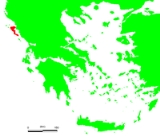
Corfu is a Greek
island in the Ionian Sea
. It is the second largest of the Ionian Islands
, and, including its small satellite islands, forms the edge of the northwestern frontier of Greece. The island is part of the Corfu regional unit, and is administered as a single municipality. The municipality includes the island Corfu and the smaller islands Ereikoussa
, Mathraki
and Othonoi
. The principal city of the island and seat of the municipality (pop. 33,886) is also named Corfu
. Corfu is home to the Ionian University
.
The island is connected to the history of Greece
from the beginning of Greek mythology
. Its Greek name
, Kerkyra or Korkyra
, is related to two powerful water symbols: Poseidon
, god of the sea, and Asopos
, an important Greek mainland river. According to myth, Poseidon fell in love with the beautiful nymph Korkyra
, daughter of Asopus and river nymph Metope
, and abducted her. Poseidon brought Korkyra to the hitherto unnamed island and, in marital bliss, offered her name to the place: Korkyra, which gradually evolved to Kerkyra (Doric
). Together, they had a child they called Phaiax, after whom the inhabitants of the island were named: Phaiakes
. This term was transliterated via Latin
to Phaeacians.
The island's history is laden with battles and conquests. The legacy of these struggles is visible in the form of castles punctuating strategic locations across the island. Two of these castles enclose its capital, which is the only city in Greece to be surrounded in such a way. As a result, Corfu's capital has been officially declared a Kastropolis ("castle city") by the Greek government. Corfu was long controlled by Venice, which repulsed several Turkish
sieges, before falling under British
rule following the Napoleonic Wars
. Corfu was eventually ceded by the British Empire along with the remaining islands of the United States of the Ionian Islands
, and unification with modern Greece
was concluded in 1864 under the Treaty of London.
In 2007, the city's old city was designated for the UNESCO
World Heritage List, following a recommendation by ICOMOS
.
Corfu is a very popular tourist destination. Up until the early 20th century, it was mainly visited by the European royals and elites, including Emperor Wilhelm II of Germany and Empress Elisabeth of Austria; today it is also widely visited by middle class families, (primarily from the UK, Scandinavia
and Germany
) leading to mass tourism. It is still popular with the global elite however, and in the island's northeast the homeowners include members of the Rothschild family
and Russian oligarchs.
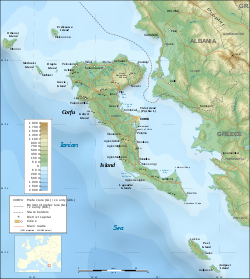 The north-eastern coastline of Corfu lies off the coast
of Sarandë
, Albania
, from which it is separated by straits varying in width from 3 to 23 km (2 to 15 mi), while the south-east side of the island lies off the coast of Thesprotia
, Greece
. The name "Corfu", an Italian
version of the Byzantine
Κορυφώ (Koryphō), meaning "city of the peaks", derives from the Greek Κορυφαί (Koryphai) (crests or peaks), denoting the two peaks of Palaio Frourio. In shape it is like the sickle
(drepanē, δρεπάνι), to which it was compared by the ancients: the concave side, with the city and harbour of Corfu in the centre, lies toward the Albanian coast. With the island's area estimated at 227 square miles (588 km²), it runs approximately 40 miles (64.4 km) long, with greatest breadth at around 20 miles (32 km).
Two high and well-defined ranges divide the island into three districts, of which the northern is mountainous, the central undulating, and the southern low-lying. The more important of the two ranges, that of Pantokrator (Παντοκράτωρ - the ancient Istone) stretches east and west from Cape Falacro to Cape Psaromita, and attains its greatest elevation in the summit of the same name.
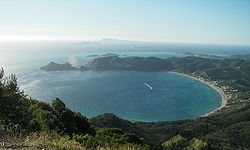 The second range culminates in the mountain of Santi Jeca, or Santa Decca, as it is called by misinterpretation of the Greek designation Άγιοι Δέκα (Hagioi Deka), or the Ten Saints. The whole island, composed as it is of various limestone formations, presents great diversity of surface, and views from more elevated spots are magnificent. Beaches are found in Agios Gordis, the Korission lagoon, Agios Georgios, Marathia, Kassiopi, Sidari, Palaiokastritsa and many others. Corfu is located near the Kefalonia
geological fault formation; earthquakes have occurred. Corfu city and countryside have not lost the traditional architecture from the 16th century.
Corfu's coastline spans 217 kilometres (135 mi) including capes; its highest point is Mount Pantokrator
(906 metres (2,972 ft)); and the second Stravoskiadi, at 849 metres (2,785 ft). The full extent of capes and promentories take in Agia Aikaterini, Drastis to the north, Lefkimmi and Asprokavos to the southeast, and Megachoro to the south. Two islands are also to be found at a middle point of Gouvia and Corfu Bay, which extends across much of the eastern shore of the island; are known as Lazareto and Ptychia (or Vido). Camping areas can be found in Palaiokastritsa
, Agrillia, with four in the northern part, Pyrgi
, Roda, Gouvia and Messonghi.
identifies seven plants that adorn the garden of Alcinous
: wild olive, oil olive, pear
, pomegranate
, apple
, fig
and grape vine
. Of these the apple and the pear are very inferior in Corfu; the others thrive, together with all the fruit trees known in southern Europe
, with addition of the kumquat
, loquat
and prickly pear
and, in some spots, the banana
. When undisturbed by cultivation, the myrtle, arbutus
, bay
and holm oak
form a rich brushwood, and the minor flora of the island are extensive.
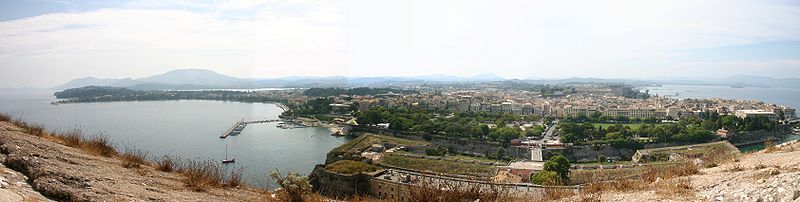
stands on the broad part of a peninsula, whose termination in the Venetian citadel
is cut off from it by an artificial fosse
formed in a natural gully, with a seawater moat at the bottom, that now serves as a marina
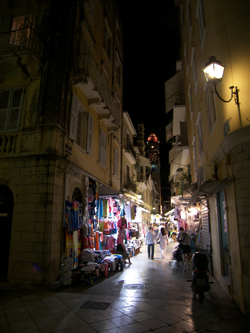
and is called the Contrafossa. The old town, having grown within fortifications, where every metre of ground was precious, is a labyrinth of narrow streets paved with cobblestones, sometimes tortuous but colourful and clean. These streets are known as kantoúnia , and the older amongst them sometimes follow the gentle irregularities of the ground; while many are too narrow for vehicular traffic. A promenade rises by the seashore towards the bay of Garitsa (Γαρίτσα), together with an esplanade between the city and the citadel known as Spianada with the arcade to its west side, where restaurants and bistros abound.
 The old citadel (in Greek Palaio Frourio (Παλαιό Φρούριο)) is an old Venetian fortress built on an artificial islet with fortifications surrounding its entire perimeter, although some sections, particularly on the east side, are slowly being eroded and falling into the sea. Nonetheless, the interior has been restored and is in use for cultural events, such as concerts (συναυλίες) and Sound and Light Productions (Ηχος και Φως), when historical events are recreated using sound and light special effects. These events take place amidst the ancient fortifications, with the Ionian sea in the background. The central high point of the citadel rises like a giant natural obelisk
complete with a military observation post at the top, with a giant cross at its apex; at the foot of the observatory lies St. George's church, in a classical style punctuated by six Doric
columns, as opposed to the Byzantine
architectural style of the greater part of Greek Orthodox churches. (built during British rule as military Anglican church)
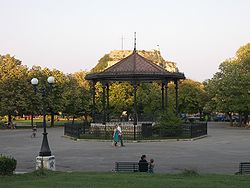
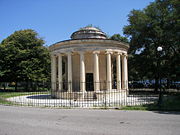 Near the old Venetian Citadel a large square called Spianada is also to be found, divided by a street in two parts: "Ano Plateia" (literally: "Upper square") and "Kato Plateia" (literally: "Lower square"), (Ανω Πλατεία and Κάτω Πλατεία in Greek). This is the biggest square in South-Eastern Europe and one of the largest in Europe, and replete with green spaces and interesting structures, such as a Roman-style rotunda from the era of British administration, known as the Maitland monument, built to commemorate Sir Thomas Maitland. An ornate music pavilion is also present, where the local "Philharmonikes" (Philharmonic Orchestras) (Φιλαρμονικές), mount classical performances in the artistic and musical tradition for which the island is well-known. "Kato Plateia" also serves as a venue where cricket
matches are held from time to time. In Greece, cricket is unique to Corfu, as it was once a British protectorate.
in its scope and in the richness of its Chinese and Asian exhibits. The gardens of the Palaces, complete with old Venetian stone aquariums, exotic trees and flowers, overlook the bay through old Venetian fortifications and turrets, and the local sea baths (Μπάνια τ' Αλέκου) are at the foot of the fortifications surrounding the gardens. A café on the grounds includes its own art gallery
, with exhibitions of both local and international artists, known locally as the Art Café. From the same spot, the viewer can observe ships passing through the narrow channel of the historic Vido island
(Νησί Βίδου) to the north, on their way to Corfu harbour (Νέο Λιμάνι), with high speed retractable aerofoil ferries from Igoumenitsa
also cutting across the panorama. A wrought-iron aerial staircase is also to be found, closed to garden visitors, descending to the sea from the gardens, and used by the Greek Royal family as a shortcut to the baths. Rewriting history, locals now refer to the old Royal Gardens as the "Garden of the People" (Ο Κήπος του Λαού).
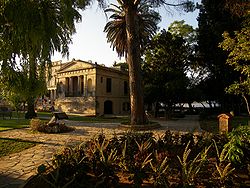 In several parts of the old city houses from the Venetian
era are to be found. The old city's architectural character is strongly influenced by the Venetian style, coming as it did under Venetian rule for a long period; its small and ancient sidestreets, and the old buildings' trademark arches are particularly reminiscent of Venice
. Of the thirty-seven Greek churches, the most important are the city's cathedral, the church dedicated to Our Lady of the Cave (η Παναγία Σπηλιώτισσα (hē Panagia Spēliōtissa)); Saint Spyridon
church, wherein lies the preserved body of the patron saint of the island; and finally the suburban church of St Jason and St Sosipater (Αγιοι Ιάσων και Σωσίπατρος), reputedly the oldest in the island, and named after the two saints probably the first to preach Christianity
to the Corfiots. The nearby island, known as Pontikonisi (Greek meaning "mouse island"), though small is very green with abundant trees, and at its highest natural elevation (excluding its trees or man-made structures, such as the monastery), stands at about 2 m (6.56 ft). Pontikonisi is home of the monastery of Pantokrator (Μοναστήρι του Παντοκράτορος); it is the white stone staircase of the monastery that when viewed from afar gives the impression of a (mouse) tail which lent the island its name: 'mouse island'.
is the northernmost of the Ionian Islands, and all areas lie below the 40° N. About a quarter of the villages' names end with -ades, while some villages outside Corfu also include names ending in -ades, especially those in the prefecture of Ioannina on mainland Greece, exactly opposite the southern end of Corfu. Villages at the southern end, and on the Paxoi islands, also feature names ending with -atika or -eika, notably Gramateika.
, formerly known as Aghios Dimitrios, is located two nautical miles northeast of Corfu
; the island has an area of 17.5 acres and comes under the administration of the Greek National Tourist Organization. During Venetian rule in the early 16th century, a monastery was built on the islet and a leprosarium established later in the century, after which the island was named. In 1798, during the French occupation, the islet was occupied by the Russo
-Turkish
fleet, who ran it as a military hospital. During the British occupation, in 1814, the leprosarium was once again opened after renovations, and following Enosis in 1864 the leprosarium again saw occasional use. During World War II
, the Axis Occupation of Greece established a concentration camp there for the prisoners of the Greek National Resistance movement
, while remaining today are the two-storied building that served as the Headquarters of the Italian army, a small church, and the wall against which those condemned to death were shot.
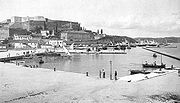 Corfu contains a few very important remains of antiquity
. The site of the ancient city of Corcyra (Kerkyra) is well ascertained, about 1.5 miles (2 km) to the south-east of Corfu, upon the narrow piece of ground between the sea-lake of Halikiopoulo and the Bay of Castrades, in each of which it had a port. The circular tomb of Menekrates, with its well-known inscription, is on the Bay of Castrades. Under the hill of Ascension are the remains of a temple, popularly called of Poseidon
, a very simple dome
structure, which still in its mutilated state presents some peculiarities of architecture
. Of Cassiope
, the only other city of ancient importance, the name is still preserved by the village of Cassiopi, and there are some rude remains of building on the site; but the temple of Zeus
Cassius for which it was celebrated has totally disappeared. Throughout the island numerous monasteries and other buildings of Venetian erection are to be found, of which the best known are Paleokastritsa, San Salvador and Peleka. The Achilleion is a palace commissioned by Elisabeth of Austria
and purchased in 1907 by Wilhelm II of Germany; it is now a popular tourist attraction
.
is famous for its Italianate architecture, most notably the an arched colonnade lined with cafes on the edge of the Spianada (Esplanade), the vast main plaza and park which incorporates a cricket
field and several pavilions. Also notable are the Venetian-Roman style City Hall, the Old and New castles, the recently restored Palace of Sts. Michael and George, formerly the residence of the British governor and the seat of the Ionian Senate, and the summer Palace of Mon Repos, formerly the property of the Greek royal family and birthplace of the Duke of Edinburgh
. The Park of Mon Repos is adjacent to the Palaiopolis of Kerkyra, where excavations were conducted by the Greek Archaeological Service in collaboration with the University of Louvain-la-Neuve in Belgium, and Brown University in the United States.
Examples of the finds can be found in the Museum of the Palace of Mon Repos.
bombardment were the splendid buildings of the Ionian Academy
(Ιόνιος Ακαδημία), and the Municipal Theatre (which in 1901 had replaced the Nobile Teatro di San Giacomo). The Roman style
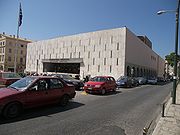
Theatre (Θέατρον) of the city was later replaced by a bland, modern box-style building. Discussions have been held at local governmental level about demolishing this modern building and replacing it with a replica of the old theatre. In contrast, Ionian University reconstructed the Ionian Academy in all its former glory.
, also known as Sissi, was a woman entranced by beauty. She lost her only son, Crown Prince Rudolf of Austria
, when he committed murder
-suicide
in The Mayerling Incident of 1889. A year later, in 1890, she built a summer palace in the region of Gastouri (Γαστούρι) to the south of the city, with the powerful mythical hero Achilles
as its central theme
.
The palace, with the neoclassical
Greek statues that surround it, is a monument to platonic
romanticism
as well as escapism
. It was named Achílleion
(Αχίλλειον) after the Homer
ic hero Achilles. The structure is filled with paintings and statues of Achilles, both in the main hall and in the gardens, depicting the scenes of the Trojan War
.
The Imperial gardens on the hill look over the surrounding green hill crests and valleys and the Ionian sea
. The centrepiece of the gardens is a marble statue on a high pedestal, of the mortally wounded Achilles (Greek
: Αχιλλεύς Θνήσκων, Achilleús Thnēskōn, Achilles Dying) without hubris
and wearing only a simple cloth and an ancient Greek hoplite
helmet. This statue was carved by German
sculptor Ernst Gustav Herter
. The hero is presented devoid of rank or status, and seems notably human though heroic, as he is forever trying to pull Paris
's arrow from his heel. His classically depicted face is full of pain. He gazes skyward, as if to seek help from Olympus
. According to Greek mythology
, his mother Thetis
was a goddess.
In contrast, at the great staircase in the main hall is a giant painting of the triumphant Achilles full of pride
. Dressed in full royal military regalia and erect on his racing chariot, he pulls the lifeless body of Hector of Troy in front of the stunned crowd watching helplessly from inside the walls of the Trojan citadel.
In 1898, Empress Sissi was assassinated at the age of 60 by an anarchist in Geneva
, Switzerland
. After her death the palace was sold to the German
Kaiser
Wilhelm II
. Later it was acquired by the Greek State. The Achilleion has been converted into a museum
.
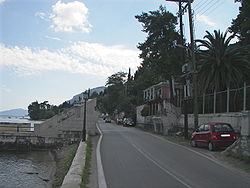 German Kaiser Wilhelm II was also fond of taking holidays in Corfu. Having purchased the Achilleion in 1907 after Sissi's death, he appointed Carl Ludwig Sprenger
as the botanical architect of the Palace, and also built a bridge to be named by the locals after him: "Kaiser's bridge" (Greek: η γέφυρα του Κάιζερ transliterated as: i yefyra tou Kaizer), to access the beach without traversing the road forming the island's main artery to the south. The bridge, arching over the road, spanned the distance between the lower gardens of Achilleion and the nearby beach; its remains, a monument to imperial vanity as well as impracticality, are an important landmark on the highway. The bridge's central section was, ironically, demolished by the Wehrmacht
during the German occupation of World War II to allow for the free movement of its vehicles.
 The earliest reference to Corfu is the Mycenaean Greek
word ko-ro-ku-ra-i-jo ("man from Kerkyra") written in Linear B
syllabic script, ca. 1300 BC. According to Strabo
Corcyra (Κόρκυρα) was the Homer
ic island of Scheria
(Σχερία), and its earliest inhabitants were the Phaeacians (Φαίακες). The island has indeed been identified by some scholars with Scheria, the island of the Phaeacians described in Homer
's Odyssey, though conclusive and irrefutable evidence for this theory or for Ithaca
's location have not been found. At a date no doubt previous to the foundation of Syracuse
it was peopled by settlers from Corinth
, probably 730 BC, but it appears to have previously received a stream of emigrants from Eretria
. The commercially advantageous location of Corcyra on the way between Greece and Magna Grecia, and its fertile lowlands in the southern section of the island favoured its growth and, influenced perhaps by the presence of non-Corinthian settlers, its people, quite contrary to the usual practice of Corinthian colonies, maintained an independent and even hostile attitude towards the mother city. This opposition came to a head in the early part of the 7th century BC, when their fleets fought the first naval battle recorded in Greek history: 665 BC. according to Thucydides
. These hostilities ended in the conquest of Corcyra by the Corinthian tyrant Periander
(Περίανδρος) who induced his new subjects to join in the colonization of Apollonia
and Anactorium. The island soon regained its independence and henceforth devoted itself to a purely mercantile policy. During the Persia
n invasion of 480 BC it manned the second largest Greek fleet (60 ships), but took no active part in the war. In 435 BC it was again involved in a quarrel with Corinth
over the control of Epidamnus, and sought assistance from Athens (see Battle of Sybota
).
This new alliance was one of the chief immediate causes of the Peloponnesian War
, in which Corcyra was of considerable use to the Athenians
as a naval station, but did not render much assistance with its fleet. The island was nearly lost to Athens by two attempts of the oligarchic faction to effect a revolution; on each occasion the popular party ultimately won the day and took a most bloody revenge on its opponents (427 BC and 425 BC).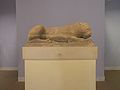 During the Sicilian
campaigns of Athens Corcyra served as a supply base; after a third abortive rising of the oligarchs in 410 BC it practically withdrew from the war. In 375 BC it again joined the Athenian alliance; two years later it was besieged by a Sparta
n force, but in spite of the devastation of its flourishing countryside held out successfully until relieved. In the Hellenistic period Corcyra was exposed to attack from several sides.
In 303 BC after a vain siege by Cassander
, the island was occupied for a short time by the Lacedaemonian general Cleonymus of Sparta
, then regained its independence and later it was attacked and conquered by Agathocles
. He offered Corfu as dowry to his daughter Lanassa
on her marriage to Pyrrhus
, King of Epirus
. The island then became a member of the Epirotic alliance. It was then perhaps that the settlement of Cassiope was founded to serve as a base for the King of Epirus' expeditions. The island remained in the Epirotic alliance until 255 BC when it became independent after the death of Alexander
, last King of Epirus. In 229, it was captured by the Illyrians
, but was speedily delivered by a Roman
fleet and remained a Roman naval station until at least 189. At this time, it was governed by a prefect (presumably nominated by the consuls), but in 148 it was attached to the province of Macedonia
In 31 BC, it served Octavian (Augustus) as a base against Mark Antony
. From AD 336 onwards, it was ruled by the Eastern Roman Empire. After the definitive division of the Roman Empire in 395, Kerkyra remained with the Eastern Roman Empire, known in modern historiography as the Byzantine Empire.
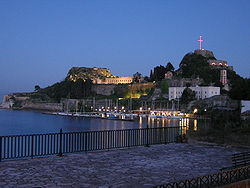 Eclipsed by the foundation of Nicopolis
, Kerkyra for a long time passed out of notice. With the rise of the Norman
kingdom in Sicily and the Italian
naval powers, it again became a frequent object of attack. In 1081-1085 it was held by Robert Guiscard
, in 1147-1154 by Roger II of Sicily
. During the break-up of the Later Byzantine Empire
it was occupied by Genoese
privateers (1197–1207) who in turn were expelled by the Venetians. In 1214-1259 it passed to the Greek despots of Epirus
, and in 1267 became a possession of the Neapolitan house of Anjou
. Under the latter's weak rule the island suffered considerably from the inroads of various adventurers; hence in 1386 it placed itself under the protection of Venice
, which in 1401 acquired formal sovereignty over Corfu and kept it until the French Occupation in 1797.
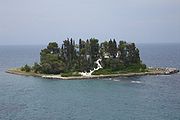 Kerkyra, the "Door of Venice" during the centuries when the whole Adriatic was the Gulf of Venice
, remained in Venetian hands from 1401 until 1797, though several times assailed by Turkish naval and land forces and subjected to four notable sieges in 1537, 1571, 1573 and 1716, in which the great natural strength of the city and its defenders asserted itself time after time. The effectiveness of the powerful Venetian fortifications of the island as well as the strength of some old Byzantine fortifications in Angelokastro
, Kassiopi, Gardiki and others, was another strong factor that enabled Corfu to remain the last bastion of free, uninterrupted Greek Christian civilization in the southern Balkans after the fall of Constantinople
. Will Durant
claims that Corfu owed to the Republic of Venice
the fact that it was the only part of Greece never conquered by the muslim Turks.
A series of attempts by the Ottoman
Turks to take the island began in 1431 when Turkish troops under Ali Bey landed on the island, tried to take the castle and raided the surrounding area, but were repulsed.
The Siege of Corfu (1537)
was the first great siege by the Ottomans. It began on the 29th August, 1537, with 25,000 soldiers from the Turkish fleet landing and pillaging the island and taking 20,000 hostages as slaves. Despite the destruction wrought on the countryside, the city castle held out in spite of repeated attempts over twelve days to take it, and the Turks left the island unsuccessfully because of poor logistics and an epidemic that decimated their ranks.
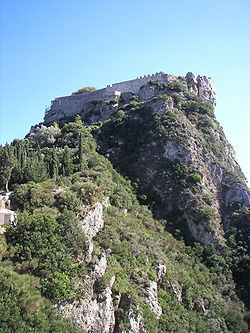 Thirty-four years later, in August, 1571, Turkish forces returned for yet another attempt to conquer the island. Having seized Parga and Mourtos from the Greek mainland side they attacked the Paxi islands. Subsequently they landed on Corfu's southeast shore and established a large beachhead all the way from the southern tip of the island at Lefkimi to Ipsos in Corfu's eastern midsection. These areas were thoroughly pillaged as in past encounters. Nevertheless the city castle stood firm again, a testament to Corfiot-Venetian steadfastness as well as the Venetian castle-building engineering
skills. It is also worth mentioning that another castle, Angelokastro
(Greek: Αγγελόκαστρο meaning Angelo's Castle and named for its Byzantine owner Angelos Komnenos), situated on the northwest coast near Palaiokastritsa (Greek: Παλαιοκαστρίτσα meaning Old Castle place) and located on particularly steep and rocky terrain, a tourist attraction today, also held out.
These Turkish defeats in the east and the west of the island proved decisive and the Turks abandoned their siege and departed. Two years later Turkish forces repeated their attempt. Coming from Africa
after a victorious campaign, they landed in Corfu and wreaked havoc on rural areas a further time. This force's troops were not particularly noted for their discipline, however, so following a counterattack by the Venetian-Corfiot forces they were forced to leave the city by way of the sea.
The second great siege of Corfu took place in 1716, during the last Turkish Venetian War. After the conquest of the Peloponnese in 1715, the Ottoman fleet appeared in Butrinto opposite Corfu. On 8 July the Turkish fleet, carrying 33,000 men, sailed to Corfu from Butrinto and established a beachhead at Ipsos. The same day, the Venetian fleet encountered the Turkish fleet off the channel of Corfu and defeated it in the ensuing naval battle. On 19 July, after taking a few outlying forts, the Ottoman army reached the hills around the city of Corfu and laid siege to it. Despite repeated assaults and heavy fighting, the Turks were unable to breach the defences and were forced to raise the siege after 22 days. The 5,000 Venetians and foreign mercenaries, together with 3,000 Corfiotes, under the leadership of Count von der Schulenburg
who commanded the defence of the island, were victorious once more. The success is owed in no small part to the extensive fortifications, where Venetian castle engineering had proven itself once again against considerable odds. The repulse of the Ottomans was widely celebrated in Europe, Corfu being seen as a bastion of Western civilization
against the Ottoman
tide. Today, however, this role is often relatively unknown or ignored, but was celebrated in Juditha triumphans
by the Venetian composer Antonio Vivaldi
.
, with multi-storied buildings on narrow lanes.
Many Venetian-speaking families settled in Corfu during these centuries and until the second half of the 20th century, the Veneto da mar
was spoken in Corfu: they were called Corfiot Italians
. During this time, the local Greek language assimilated a large number of Italian and Venetian words, many of which are still common today.
The Venetian feudal families pursued a mild but somewhat enervating policy towards the natives, who began to adopt some segments of Venetian customs and culture. The Corfiotes were encouraged to enrich themselves by the cultivation of the olive, but were debarred from entering into commercial competition with Venice.
The island served as a refuge for Greek scholars, and in 1732 became the home of the first academy of modern Greece. A Corfu clergyman and scholar, Nikephoros Theotokis
(1732–1800) became renowned in Greece as an educator, and in Russia
(where he moved later in his life) as an Orthodox archbishop.
Many Italian Jews took refuge in Corfu during the Venetian centuries and spoke their own language (Italkian), a mixture of Hebrew-Italian in a Venetian or Apulian dialect with some Greek words.
The Venetian influence was important in the development of opera on Corfu. During Venetian rule, the Corfiotes developed a fervent appreciation of Italian opera, which was the real source of the extraordinary (given the conditions in the mainland of Greece) musical development of the island during that era. It was in Venetian times that the city saw the erection of the first opera in Greece, but it was badly damaged during World War II by German artilery.
The internationally renowned Venetian-born British photographer Felice Beato
is thought to have spent much of his childhood in Corfu.
Venetians promoted the Catholic church during their four centuries rule in Corfu. Even if today the majority of Corfiots are Greek Orthodox (following the official religion of Greece), a percentage of Catholics (5%) nevertheless owe their faith to these origins. These contemporary Catholics are mostly families who came from Malta
, but also from Italy during the Republic of Venice
, and today the Catholic community takes in about 4000 people, (2/3 of Maltese descent) who live almost exclusively in the Venetian "Citadel" of Corfu City, and harmoniously side-by-side with the Orthodox community. Like other native Greek Catholics, they celebrate Easter
using the same calendar as the Greek Orthodox church.
The island's way of life absorbed Venetian influence in a variety of ways ; its local cuisine, for example, took in such elements and today's Corfiot cooking maintains some of these Venetian delicacies and recipes: "Pastitsada", deriving from the Venetian "Pastissada" (Italian: "Spezzatino") and is the most popular dish in the island of Corfu, "Sofrito", "Strapatsada", "Savoro", "Bianco" and "Mandolato".
, Corfu was ceded to the French
, who occupied it for two years as the département
Corcyre
, until they were by a joint Russia
n-Ottoman squadron under Admiral Ushakov. For a short time it became the capital of a self-governing federation of the Heptanesos
("Seven Islands"), under Ottoman suzerainty; in 1807 after the Treaty of Tilsit its faction-ridden government was again replaced by a French administration under governor François-Xavier Donzelot
, and in 1809 it was besieged in vain by a British fleet, which had taken all the other Ionian islands. When, by the Treaty of Paris
of 5 November 1815, the Ionian Islands became a protectorate of the United Kingdom
as the United States of the Ionian Islands
, Corfu became the seat of the British Lord High Commissioner of the Ionian Islands. The British commissioners, who were practically autocrats in spite of the retention of the native senate and assembly, introduced a strict method of government which brought about a decided improvement in the material prosperity of the island, but by its very strictness displeased the natives. On 29 March 1864, the United Kingdom, Greece, France and Russia signed the Treaty of London, pledging the transfer of sovereignty to Greece upon ratification. Thus, on 28 May, by proclamation of the Lord High Commissioner, the Ionian Islands were united with Greece.
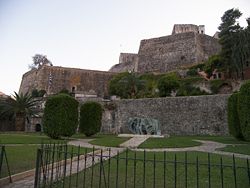 This is a list of the British High Commissioners of the Ionian Islands; (as well as the transitional Greek Governor, appointed a year prior to Enosis (Union) with Greece in 1864).
, the island served as a refuge for the Serbia
n army that retreated there on Allied forces' ships from a homeland occupied by the Austria
ns and Bulgarians
. During their stay, a large portion of Serbia
n soldiers died from exhaustion, food shortage, and different diseases. Most of their remains were buried at sea near the island of Vido
, a small island at the mouth of Corfu port, and a monument of thanks to the Greek nation has been erected at Vido by the grateful Serbs; consequently, the waters around Vido Island are known by the Serbian people as the Blue Graveyard (in Serbian, Плава Гробница, Plava Grobnica
), after a poem written by Milutin Bojić after World War I.
See Corfu incident
.
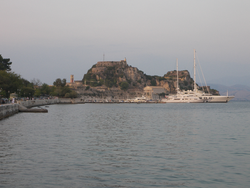 During the Greco-Italian War
, Corfu was occupied by the Italians in April 1941. They administered Corfu and the Ionian islands as a separate entity from Greece until September 1943, following Benito Mussolini
's orders of fulfilling Italian
Irredentism
and making Corfu part of the Kingdom of Italy
. During the Second World War the 10th infantry
regiment of the Greek Army
, composed mainly of Corfiot soldiers, was assigned the task of defending Corfu. The regiment took part in Operation Latzides, which was a heroic but ultimately unsuccessful attempt to stem the forces of the Italians. After Greece's surrender to the Axis, the island came under Italian control and occupation. On the first Sunday of November 1941, high school students from all over Corfu took part in student protest
s against the occupying Italian army ; these student protests of the island were among the first acts of overt popular Resistance
in occupied Greece and a rare phenomenon even by wartime Europe
an standards. Subsequently, a considerable number of Corfiots escaped to Epirus
in mainland Greece and enlisted as partisan
s in ELAS
and EDES
, in order to join the resistance movement gathering in the mainland.
in 1943, the Nazis moved to take control of the island. On 14 September 1943, Corfu was bombarded by the Luftwaffe
; these bombing raids destroyed churches, homes, whole city blocks, especially in the Jewish quarter Evraiki, and a number of important buildings, such as the Ionian Parliament, the Municipal Theatre, the Municipal Library and others. The Italians capitulated, and the island came under German occupation. Corfu's mayor at the time, Kollas, was a known collaborator and various anti-semitic laws were passed by the Nazis that now formed the occupation
government of the island. In early June 1944, while the Allies bombed Corfu as a diversion from the Normandy landings
, the Gestapo
rounded up the Jews
of the city, temporarily incarcerated them at the old fort (Palaio Frourio), and on 10 June sent them to Auschwitz, where very few survived. Approximately two hundred out of a total population of 1,900 escaped. Many among the local population at the time provided shelter and refuge to those 200 Jews that managed to escape the Nazis. A prominent section of the old city is to this day called Evraiki (Εβραική, meaning Jewish quarter) in recognition of the Jewish contribution and continued presence in Corfu city. An active synagogue
(Συναγωγή) with about 65 members (who still speak their original Italkian language) is an integral part of Evraiki currently.
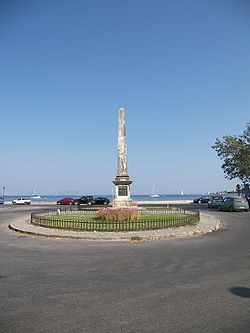 Corfu was liberated by British troops, specifically the 40th Royal Marine Commando, which landed in Corfu on 14 October 1944, as the Germans were evacuating Greece. The Royal Navy swept the Corfu Channel for mines in 1944 and 1945, and found it to be free of mines. A large minefield was laid there shortly afterwards by the newly-communist Albania and gave rise to the Corfu Channel Incident
. This incident led to the Corfu Channel Case, where the United Kingdom opened a case against the People's Republic of Albania at the International Court of Justice
.
, the island was rebuilt under the general programme of reconstruction of the Greek Government (Ανοικοδόμησις) and many elements of its classical architecture remain. Its economy grew but a portion of its inhabitants left the island for other parts of the country; buildings erected during Italian occupation – such as schools or government buildings – were put back to civic use. In 1956 Maria Desylla Kapodistria, relative of first Governor of Greece Ioannis Kapodistrias
, was elected mayor
of Corfu
and became the first female mayor in Greece. The Corfu General Hospital was also constructed; electricity was introduced to the villages in the 1950s, the radio substation of Hellenic Radio in Corfu was inaugurated in March 1957, and television was introduced in the 1960s, with internet connections in 1995. The Ionian University
was established in 1984. Recently, due to perceived neglect of Corfu by the central government in Athens, local businessmen and others are proposing formation of an autonomist party to compete in the 2010 local elections.
, an institution carrying through and strengthening the tradition of Greek education while the rest of Greece was still fighting Turkish occupation.
It is also home to the Ionian University
, established in 1984, in recognition, by the administration of Andreas Papandreou
, of Corfu's contribution to Education in Greece
, as the seat of the first Greek university in modern times, the Ionian Academy
. The academy was founded in 1824, forty years before the cession of the Ionian islands
to Greece
, and just three years after Greece's Revolution of 1821.
bulwark
. In the modern era, beginning with its massive student protests during World War II against fascist occupation, and continuing in the fight against the dictatorship of Georgios Papadopoulos (1967–1974), students in Corfu have played a vanguard role in protesting in favour of freedom
and democracy
in Greece, setting themselves against both internal and external oppression. For Corfiotes a recent example of such heroism is that of geology
student Kostas Georgakis
, who set himself ablaze in Genoa
, Italy
on 19 September 1970, in a protest against the Greek military junta of 1967-1974
.
The most notable of the island's museums and libraries are located in the city, and are:
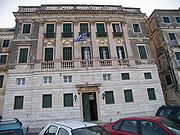
 Saint Spyridon
the Thaumaturgist (Miracle-worker, Greek: Ο Θαυματουργός), also referred to as Αγιος Σπυρίδων ο πολιούχος (translated as Saint Spyridon the Keeper of the City), is the patron saint of the island. St. Spyridon is revered for the miracle of expelling the plague (πανώλη) from the island, amongst many other miracles attributed to him. It is believed by the faithful that on its way from the island the plague scratched one of the fortification stones of the old citadel to indicate its fury at being expelled ; St. Spyridon is also attributed the role of saving the island at the second great siege of Corfu of 1716. Its legend ran that the sight of St. Spyridon approaching turkish forces bearing a flaming torch in one hand and a cross in the other, had caused panic
. This miracle
is one of the earliest successful examples of psychological operations in warfare (psyops). This victory over the Ottomans, therefore, was attributed not only to the leadership of Count Schulenburg
who commanded the stubborn defence of the island against Turkish forces, but also to the miraculous intervention of St. Spyridon. Venice honoured von der Schulenburg and the Corfiots for successfully defending the island. Recognizing St. Spyridon's role in the defence of the island Venice legislated the establishment of the litany (λιτανεία) of St Spyridon on the 11th of August as a commemoration of the miraculous event, inaugurating a tradition that continues to this day. In 1716 Antonio Vivaldi
, on commission by the republic of Venice, composed the oratorio
Juditha triumphans
to commemorate this great event. Juditha triumphans was performed in November 1716 in Venice
by the orchestra and choir of the Ospedale della Pietà
and is described as Vivaldi's first great oratorio.
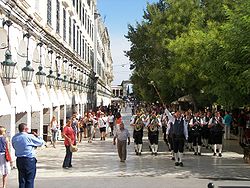 Corfiote musical tradition is significant. In the past, people would join in the singing of cantádes , impromptu choral songs in two, three or four voices, usually accompanied by a guitar. Nowadays, in the face of rigours of a modern life from which Corfiote society has not been spared, cantádes (from the Italian verb cantare, to sing) are only performed by semi-professional or amateur singers, often as attractions for visitors.
'Bands' (Philharmonic societies, or Φιλαρμονικές), which also provide free instruction in music, are still popular and continue to attract young recruits. There are nineteen such marching wind bands throughout the island.
Corfu city is home to the three most prestigious bands - in order of seniority:
All three maintain two major bands each, the main marching bands that can field up to 200 musicians on grand occasions, and the 60-strong student bandinas meant for lighter fare and on-the-job training.
The bands give regular summer weekend promenade concerts at the Spianada Green "pálko"
, and have a prominent part in the yearly Holy Week ceremonies. A considerable but mostly friendly rivalry between them persists, and each rigorously adhere to their respective repertoires. Every time one of these bands passes in front of the building housing another, they stop and give a musical "salute" to their rival. While this is officially a sign of respect, it is actually a challenge meant to show off to the rivals and impress them with a display of superior musicianship.
 On Good Friday
, from the early afternoon onward, the bands of the three Philharmonic Societies, separated into squads, accompany the Epitaph processions
of the city churches. Late in the afternoon, the squads come together to form one band in order to accompany the Epitaph procession
of the cathedral, while the funeral marches that the bands play differ depending on the band ; the Old Philharmonic play Albinoni's Adagio, the Mantzaros play Verdi
's Marcia Funebre from Don Carlo, and the Capodistria play Chopin
's Funeral March and Mariani
's Sventura.
On Holy Saturday morning, the three city bands again take part in the Epitaph processions
of St. Spyridon Cathedral in procession with the Saint's relics. At this point the bands play different funeral marches, with the Mantzaros playing Miccheli's Calde Lacrime, the Palia playing Marcia Funebre from Faccio
's Amleto
, and the Capodistria playing the Funeral March from Beethoven
's Eroica
. This custom dates from the 19th century, when colonial administrators banned the participation of the British garrison band in the traditional Holy Friday funeral cortege. The defiant Corfiotes held the litany the following morning, and paraded the relics of St. Spyridon too, so that the administrators would not dare intervene.
The litany is followed by the celebration of the "Early Resurrection"; balconies in the old city are decked in bright red cloth, and Corfiotes throw down large clay pots (the bótides, μπότηδες) full of water to smash on the street pavement, especially in wider areas of and in an organised fashion. This is enacted in anticipation of the Resurrection of Jesus, which is to be celebrated that same night, and to commemorate King David's phrase: "Thou shalt dash them in pieces like a potter's vessel" (Psalm 2
:9).
Once the bótides commotion is over, the three bands parade the clay-strewn streets playing the famous "Graikoí" festive march. This legendary march, the anthem of the island, was composed during Venetian rule, and its lyrics urged: "Greeks, never fear, we are all enslaved: you to the Turks, we to the Venetians, but one day we shall all be free". The Venetians were replaced by the French and the French by the British, and both the lyrics and the performance of the march were officially banned. The bands, however, defiantly played it on the Eve of Easter, as a token of the resurrection of the nation, and the tradition is honored to this day.
, Corfu developed a musical heritage of its own and which constitutes the nucleus of modern Greek musical history. Until the early 18th century, musical life took place in city and village squares, with performances of straight or musical comedies – known as Momaries or Bobaries. From 1720, Corfu became the possessor of the first theatre in post-1452 Greece. It was the Teatro San Giacomo (now the City Hall) named after the nearby Roman Catholic cathedral (completed in 1691).
 In Venetian rule
, the Corfiotes developed a fervent appreciation of Italian opera
, which was the real source of the extraordinary (given conditions in the mainland of Greece
) musical development of the island during this era. The opera house of Corfu during 18th and 19th century was that of the Nobile Teatro di San Giacomo
, named after the neighbouring catholic cathedral, but the theatre was later converted into the City Hall. It was both the first theatre
and first opera house
of Greece in modern times
and the place where the first Greek opera, Spyridon Xyndas
' "The Parliamentary Candidate" based on an exclusively Greek libretto
was performed. A long series of local composers, such as Nikolaos Mantzaros
, Spyridon Xyndas
, Antonio Liberali, Domenico Padovani, the Zakynthian Pavlos Carrer
, the Lambelet family, Spyridon Samaras
, and others, all developed careers intertwined with the theatre. San Giacomo's place was taken by the Municipal Theatre in 1902, which maintained the operatic tradition vividly until its destruction during World War II
as a result of a 1943 German air raid.
The first opera to be performed in the San Giacomo was in 1733 ("Gerone, tiranno
di Siracusa"), and for almost two hundred years, between 1771 and 1943, nearly every major opera from the Italian tradition, as well as many others from Greek and French composers, were performed at the stage of the San Giacomo; this impressive tradition, invoking an exceptional musical heritage, continues to be reflected in Corfiote operatic mythology, a fixture in famous opera singers' itineraries.
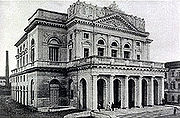 The Municipal Theatre of Corfu
became the main theatre
and opera house
in Corfu, Greece
since 1902. The theatre was the successor of Nobile Teatro di San Giacomo di Corfù
which became the Corfu city hall
. It was destroyed during a Luftwaffe
aerial bombardment in 1943.
. Aside from its academic activities, concerts in Corfu and abroad, and musicological research in the field of Neo-Hellenic Music, the Department organizes an international music academy every summer , which gathers both international students and professors specialising in brass
, strings
, singing
, jazz
and musicology
.
or Ta Karnavalia. Venetian in origin, festivities include a parade featuring the main attraction of Karnavalos, a rather grotesque
figure with a large head and smiling face , leading a diverse procession of colourful float
s. Corfiots, young and old, dress up in colourful costumes and follow the parade, spilling out into the area's narrow streets (kantounia) and spreading the festivities across the city, dancing and socialising. At night, in the island's more sophisticated social circles, dance and costume parties are traditional.
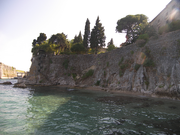
. The island is alluded to several times in David Foster Wallace's The Broom of the System. Drake mentions Corfu in a song.
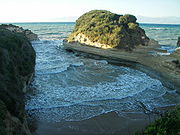 Corfiotes have a long history of hospitality to foreign residents and visitors, typified in the twentieth century by Gerald Durrell
's childhood reminiscence My Family and Other Animals. The North East coast has largely been developed by a few British holiday companies, with large expensive holiday villas. Package holiday
resorts exist on the north and east coasts.
At the other end of the island, the southern resort of Kavos
also provides tourist facilities.
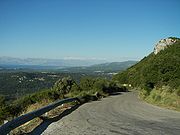 The island is linked by two motorways, GR-24 in the northwest and GR-25 in the south.
Corfu has ferry services both by traditional ferries to Gaios in the island of Paxoi and as far as Patras
and both traditional ferries and advanced retractable airfoil
, hydrodynamic-flow, high-speed ferries called Flying Dolphins to Igoumenitsa
and Sarandë
in neighbouring Albania
. The small port of Lefkimmi is also to be found at the southernmost tip of the island on Cape Kavos, offering a ferry service to the mainland.
The Ioannis Kapodistrias International Airport, named after Ioannis Kapodistrias
, a distinguished Corfiot and European diplomat, and the first governor of the independent Greek state, is located around three kilometres south of Kerkyra, just half a kilometre north of Pontikonisi. The approach and landing, in a northeasterly direction, afford passengers spectacular aerial views of Pontikonisi and Vlaheraina Monastery, also taking in the hills of Kanoni, as the runway employed for landing lies a few hundred metres from these spectacular local landmarks. The airport offers domestic flights from Olympic Airlines
(OA 600, 602 and 606), and Aegean Airlines
(A3 402, 404 and 406). Seaplanes, Air Sea Lines, a Greek seaplane operator, offers scheduled flights from Corfu to Paxoi, Lefkada, Ithaki, Kefalonia, Ioannina
, Patras and Brindisi
in Italy
.
The buses to the main places on the island run about six times a day between the city and Glyfada, Sidari, Pleokastritsa, Roda and Acharavi, Lefkimmi, Lefkimmi and Piri. Other coaches drive up to twice a day to Athens and Thessaloniki. City buses run through the city to the Achilleon, Gouvia, Afra, Pelekas and some other places of interest. There are no public buses to the airport.
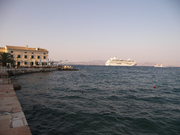 Corfu is mostly planted with olive groves and vineyards and has been producing olive oil and wine since antiquity. The main wine grape varietals found in Corfu are the indigenous white Kakotrýgēs and red Petrokóritho, the Cefalonian white Robóla, the Aegean
Moscháto (white muscat
), the Achaea
n Mavrodáphnē and others.
Modern times have seen the introduction of specialist cultivation supported by the mild climate, like the kumquat
and bergamot orange
s, which are extensively used in making spoon sweets and liqueur
s. Corfu also produces local animal products, such as Corfiote graviéra (a variant of gruyere
) and "Corfu" cheese (a variant of Grana
); "Corfu butter
" (Boútyro Kerkýras), an intensely flavored cooking and baking butter made of ewe's milk; and the noúmboulo salami
made of pork and lard and flavored with orange peel, oregano, thyme and other aromatic herbs, which are also burned for smoking.
Local culinary specialties include sofrito
(a veal
rump roast of Venetian
origin), pastitsáda (bucatini
pasta served with diced veal cooked in a tomato
sauce), bourdétto (cod
cooked in a pepper
y sauce), mándoles (caramelized almonds), pastéli (honey
bars made with sesame
, almond
s or pistacchios), mandoláto (a "pastéli" made of crushed almonds, sugar, honey and vanilla
), and tzitzibíra, the local ginger beer
, a remnant of the British era.
The island has again become an important port of call
and has a considerable trade in olive oil. In earlier times there was a great export of citron
, which was cultivated here.
with:
Greece
Greece , officially the Hellenic Republic , and historically Hellas or the Republic of Greece in English, is a country in southeastern Europe....
island in the Ionian Sea
Ionian Sea
The Ionian Sea , is an arm of the Mediterranean Sea, south of the Adriatic Sea. It is bounded by southern Italy including Calabria, Sicily and the Salento peninsula to the west, southern Albania to the north, and a large number of Greek islands, including Corfu, Zante, Kephalonia, Ithaka, and...
. It is the second largest of the Ionian Islands
Ionian Islands
The Ionian Islands are a group of islands in Greece. They are traditionally called the Heptanese, i.e...
, and, including its small satellite islands, forms the edge of the northwestern frontier of Greece. The island is part of the Corfu regional unit, and is administered as a single municipality. The municipality includes the island Corfu and the smaller islands Ereikoussa
Ereikoussa
Ereikoussa is an island and a former community of the Ionian Islands, Greece. Since the 2011 local government reform it is part of the municipality Corfu, of which it is a municipal unit. It is located off the northwestern coast of the island of Corfu, and is almost equidistant from Corfu to the...
, Mathraki
Mathraki
Mathraki is an island and a former community of the Ionian Islands, Greece. Since the 2011 local government reform it is part of the municipality Corfu, of which it is a municipal unit. Population 297 . Mathraki is a 45 minute boat ride off the coast of Corfu . It has three restaurants that double...
and Othonoi
Othonoi
Othonoi is an island and a former community of the Ionian Islands, Greece. Since the 2011 local government reform it is part of the municipality Corfu, of which it is a municipal unit. It is located northwest of Corfu. Population 663...
. The principal city of the island and seat of the municipality (pop. 33,886) is also named Corfu
Corfu (city)
Corfu is a city and a former municipality on the island of Corfu, Ionian Islands, Greece. Since the 2011 local government reform, it is part of the municipality Corfu, of which it is a municipal unit. It is the capital of the island and of the Corfu regional unit. The city also serves as a capital...
. Corfu is home to the Ionian University
Ionian University
The Ionian University is a university located in the city of Corfu, Greece. It was established in 1984 by the Greek government under the Prime Ministership of Andreas Papandreou, in recognition of Corfu's contribution to Education in Greece as the seat of the first University of Greece, the Ionian...
.
The island is connected to the history of Greece
History of Greece
The history of Greece encompasses the history of the territory of the modern state of Greece, as well as that of the Greek people and the areas they ruled historically. The scope of Greek habitation and rule has varied much through the ages, and, as a result, the history of Greece is similarly...
from the beginning of Greek mythology
Greek mythology
Greek mythology is the body of myths and legends belonging to the ancient Greeks, concerning their gods and heroes, the nature of the world, and the origins and significance of their own cult and ritual practices. They were a part of religion in ancient Greece...
. Its Greek name
Name
A name is a word or term used for identification. Names can identify a class or category of things, or a single thing, either uniquely, or within a given context. A personal name identifies a specific unique and identifiable individual person, and may or may not include a middle name...
, Kerkyra or Korkyra
Korkyra
In Greek mythology Korkyra was the daughter of the Asopos river and the nymph Metope.According to myth Poseidon fell in love with the beautiful nymph Korkyra, kidnapped her and brought her to a hitherto unnamed island and offered her name to the place: Korkyra or modern Kerkyra...
, is related to two powerful water symbols: Poseidon
Poseidon
Poseidon was the god of the sea, and, as "Earth-Shaker," of the earthquakes in Greek mythology. The name of the sea-god Nethuns in Etruscan was adopted in Latin for Neptune in Roman mythology: both were sea gods analogous to Poseidon...
, god of the sea, and Asopos
Asopus
Asopus or Asôpos is the name of four different rivers in Greece and one in Turkey. In Greek mythology, it was the name of the gods of those rivers.-The rivers in Greece:...
, an important Greek mainland river. According to myth, Poseidon fell in love with the beautiful nymph Korkyra
Korkyra
In Greek mythology Korkyra was the daughter of the Asopos river and the nymph Metope.According to myth Poseidon fell in love with the beautiful nymph Korkyra, kidnapped her and brought her to a hitherto unnamed island and offered her name to the place: Korkyra or modern Kerkyra...
, daughter of Asopus and river nymph Metope
Metope (mythology)
In Greek mythology, Metope was a river nymph, the daughter of the river Ladon. Her waters were near the town of Stymphalus in the Peloponnesus...
, and abducted her. Poseidon brought Korkyra to the hitherto unnamed island and, in marital bliss, offered her name to the place: Korkyra, which gradually evolved to Kerkyra (Doric
Doric Greek
Doric or Dorian was a dialect of ancient Greek. Its variants were spoken in the southern and eastern Peloponnese, Crete, Rhodes, some islands in the southern Aegean Sea, some cities on the coasts of Asia Minor, Southern Italy, Sicily, Epirus and Macedon. Together with Northwest Greek, it forms the...
). Together, they had a child they called Phaiax, after whom the inhabitants of the island were named: Phaiakes
Scheria
Scheria –also known as Scherie or Phaeacia– was a geographical region in Greek mythology, first mentioned in Homer's Odyssey as the home of the Phaiakians and the last destination of Odysseus before returning home to Ithaca.-Odysseus meets Nausikaa:In the Odyssey, after Odysseus sails...
. This term was transliterated via Latin
Latin
Latin is an Italic language originally spoken in Latium and Ancient Rome. It, along with most European languages, is a descendant of the ancient Proto-Indo-European language. Although it is considered a dead language, a number of scholars and members of the Christian clergy speak it fluently, and...
to Phaeacians.
The island's history is laden with battles and conquests. The legacy of these struggles is visible in the form of castles punctuating strategic locations across the island. Two of these castles enclose its capital, which is the only city in Greece to be surrounded in such a way. As a result, Corfu's capital has been officially declared a Kastropolis ("castle city") by the Greek government. Corfu was long controlled by Venice, which repulsed several Turkish
Ottoman Empire
The Ottoman EmpireIt was usually referred to as the "Ottoman Empire", the "Turkish Empire", the "Ottoman Caliphate" or more commonly "Turkey" by its contemporaries...
sieges, before falling under British
United Kingdom
The United Kingdom of Great Britain and Northern IrelandIn the United Kingdom and Dependencies, other languages have been officially recognised as legitimate autochthonous languages under the European Charter for Regional or Minority Languages...
rule following the Napoleonic Wars
Napoleonic Wars
The Napoleonic Wars were a series of wars declared against Napoleon's French Empire by opposing coalitions that ran from 1803 to 1815. As a continuation of the wars sparked by the French Revolution of 1789, they revolutionised European armies and played out on an unprecedented scale, mainly due to...
. Corfu was eventually ceded by the British Empire along with the remaining islands of the United States of the Ionian Islands
United States of the Ionian Islands
The United States of the Ionian Islands was a state and amical protectorate of the United Kingdom between 1815 and 1864. It was the successor state of the Septinsular Republic...
, and unification with modern Greece
Kingdom of Greece
The Kingdom of Greece was a state established in 1832 in the Convention of London by the Great Powers...
was concluded in 1864 under the Treaty of London.
In 2007, the city's old city was designated for the UNESCO
UNESCO
The United Nations Educational, Scientific and Cultural Organization is a specialized agency of the United Nations...
World Heritage List, following a recommendation by ICOMOS
International Council on Monuments and Sites
The International Council on Monuments and Sites is a professional association that works for the conservation and protection of cultural heritage places around the world...
.
Corfu is a very popular tourist destination. Up until the early 20th century, it was mainly visited by the European royals and elites, including Emperor Wilhelm II of Germany and Empress Elisabeth of Austria; today it is also widely visited by middle class families, (primarily from the UK, Scandinavia
Scandinavia
Scandinavia is a cultural, historical and ethno-linguistic region in northern Europe that includes the three kingdoms of Denmark, Norway and Sweden, characterized by their common ethno-cultural heritage and language. Modern Norway and Sweden proper are situated on the Scandinavian Peninsula,...
and Germany
Germany
Germany , officially the Federal Republic of Germany , is a federal parliamentary republic in Europe. The country consists of 16 states while the capital and largest city is Berlin. Germany covers an area of 357,021 km2 and has a largely temperate seasonal climate...
) leading to mass tourism. It is still popular with the global elite however, and in the island's northeast the homeowners include members of the Rothschild family
Rothschild family
The Rothschild family , known as The House of Rothschild, or more simply as the Rothschilds, is a Jewish-German family that established European banking and finance houses starting in the late 18th century...
and Russian oligarchs.
Geography
Coast
A coastline or seashore is the area where land meets the sea or ocean. A precise line that can be called a coastline cannot be determined due to the dynamic nature of tides. The term "coastal zone" can be used instead, which is a spatial zone where interaction of the sea and land processes occurs...
of Sarandë
Sarandë
Sarandë or Saranda is the capital of the District of Sarandë, Albania, and is one of the most important tourist attractions of the Albanian Riviera. It is situated on an open sea gulf of the Ionian Sea in the Mediterranean 2 nautical miles from the Greek island of Corfu. The city of Saranda has a...
, Albania
Albania
Albania , officially known as the Republic of Albania , is a country in Southeastern Europe, in the Balkans region. It is bordered by Montenegro to the northwest, Kosovo to the northeast, the Republic of Macedonia to the east and Greece to the south and southeast. It has a coast on the Adriatic Sea...
, from which it is separated by straits varying in width from 3 to 23 km (2 to 15 mi), while the south-east side of the island lies off the coast of Thesprotia
Thesprotia
Thesprotia is one of the regional units of Greece. It is part of the Epirus region. Its capital is the town of Igoumenitsa. It is named after the Thesprotians, an ancient Greek tribe that inhabited the region in antiquity.-History:...
, Greece
Greece
Greece , officially the Hellenic Republic , and historically Hellas or the Republic of Greece in English, is a country in southeastern Europe....
. The name "Corfu", an Italian
Italian language
Italian is a Romance language spoken mainly in Europe: Italy, Switzerland, San Marino, Vatican City, by minorities in Malta, Monaco, Croatia, Slovenia, France, Libya, Eritrea, and Somalia, and by immigrant communities in the Americas and Australia...
version of the Byzantine
Byzantine Empire
The Byzantine Empire was the Eastern Roman Empire during the periods of Late Antiquity and the Middle Ages, centred on the capital of Constantinople. Known simply as the Roman Empire or Romania to its inhabitants and neighbours, the Empire was the direct continuation of the Ancient Roman State...
Κορυφώ (Koryphō), meaning "city of the peaks", derives from the Greek Κορυφαί (Koryphai) (crests or peaks), denoting the two peaks of Palaio Frourio. In shape it is like the sickle
Sickle
A sickle is a hand-held agricultural tool with a variously curved blade typically used for harvesting grain crops or cutting succulent forage chiefly for feeding livestock . Sickles have also been used as weapons, either in their original form or in various derivations.The diversity of sickles that...
(drepanē, δρεπάνι), to which it was compared by the ancients: the concave side, with the city and harbour of Corfu in the centre, lies toward the Albanian coast. With the island's area estimated at 227 square miles (588 km²), it runs approximately 40 miles (64.4 km) long, with greatest breadth at around 20 miles (32 km).
Two high and well-defined ranges divide the island into three districts, of which the northern is mountainous, the central undulating, and the southern low-lying. The more important of the two ranges, that of Pantokrator (Παντοκράτωρ - the ancient Istone) stretches east and west from Cape Falacro to Cape Psaromita, and attains its greatest elevation in the summit of the same name.
Kefalonia
The island of Cephalonia, also known as Kefalonia, Cephallenia, Cephallonia, Kefallinia, or Kefallonia , is the largest of the Ionian Islands in western Greece, with an area of . It is also a separate regional unit of the Ionian Islands region, and the only municipality of the regional unit...
geological fault formation; earthquakes have occurred. Corfu city and countryside have not lost the traditional architecture from the 16th century.
Corfu's coastline spans 217 kilometres (135 mi) including capes; its highest point is Mount Pantokrator
Mount Pantokrator
Mount Pantokrator is a mountain located in north-eastern Corfu. At 906m it is the highest mountain on the island. At the summit the whole of Corfu can be seen, as well as Albania which lies a short distance from the island...
(906 metres (2,972 ft)); and the second Stravoskiadi, at 849 metres (2,785 ft). The full extent of capes and promentories take in Agia Aikaterini, Drastis to the north, Lefkimmi and Asprokavos to the southeast, and Megachoro to the south. Two islands are also to be found at a middle point of Gouvia and Corfu Bay, which extends across much of the eastern shore of the island; are known as Lazareto and Ptychia (or Vido). Camping areas can be found in Palaiokastritsa
Palaiokastritsa
Paleokastritsa is a former municipality on the island of Corfu, Ionian Islands, Greece. Since the 2011 local government reform it is part of the municipality Corfu, of which it is a municipal unit...
, Agrillia, with four in the northern part, Pyrgi
Pyrgi
Pyrgi was an ancient Etruscan port in Latium, central Italy, to the north-west of Caere. Its location is now occupied by the burgh of Santa Severa....
, Roda, Gouvia and Messonghi.
Flora
HomerHomer
In the Western classical tradition Homer , is the author of the Iliad and the Odyssey, and is revered as the greatest ancient Greek epic poet. These epics lie at the beginning of the Western canon of literature, and have had an enormous influence on the history of literature.When he lived is...
identifies seven plants that adorn the garden of Alcinous
Alcinous
Alcinous or Alkínoös was, in Greek mythology, a son of Nausithous, or of Phaeax , and father of Nausicaa, Halius, Clytoneus and Laodamas with Arete. His name literally means "mighty mind"...
: wild olive, oil olive, pear
Pear
The pear is any of several tree species of genus Pyrus and also the name of the pomaceous fruit of these trees. Several species of pear are valued by humans for their edible fruit, but the fruit of other species is small, hard, and astringent....
, pomegranate
Pomegranate
The pomegranate , Punica granatum, is a fruit-bearing deciduous shrub or small tree growing between five and eight meters tall.Native to the area of modern day Iran, the pomegranate has been cultivated in the Caucasus since ancient times. From there it spread to Asian areas such as the Caucasus as...
, apple
Apple
The apple is the pomaceous fruit of the apple tree, species Malus domestica in the rose family . It is one of the most widely cultivated tree fruits, and the most widely known of the many members of genus Malus that are used by humans. Apple grow on small, deciduous trees that blossom in the spring...
, fig
Ficus
Ficus is a genus of about 850 species of woody trees, shrubs, vines, epiphytes, and hemiepiphyte in the family Moraceae. Collectively known as fig trees or figs, they are native throughout the tropics with a few species extending into the semi-warm temperate zone. The Common Fig Ficus is a genus of...
and grape vine
Vitis vinifera
Vitis vinifera is a species of Vitis, native to the Mediterranean region, central Europe, and southwestern Asia, from Morocco and Portugal north to southern Germany and east to northern Iran....
. Of these the apple and the pear are very inferior in Corfu; the others thrive, together with all the fruit trees known in southern Europe
Europe
Europe is, by convention, one of the world's seven continents. Comprising the westernmost peninsula of Eurasia, Europe is generally 'divided' from Asia to its east by the watershed divides of the Ural and Caucasus Mountains, the Ural River, the Caspian and Black Seas, and the waterways connecting...
, with addition of the kumquat
Kumquat
Cumquats or kumquats are a group of small fruit-bearing trees in the flowering plant family Rutaceae, either forming the genus Fortunella, or placed within Citrus sensu lato...
, loquat
Loquat
The loquat , Eriobotrya japonica, is a fruit tree in the family Rosaceae, indigenous to southeastern China. It was formerly thought to be closely related to the genus Mespilus, and is still sometimes known as the Japanese medlar...
and prickly pear
Opuntia
Opuntia, also known as nopales or paddle cactus , is a genus in the cactus family, Cactaceae.Currently, only prickly pears are included in this genus of about 200 species distributed throughout most of the Americas. Chollas are now separated into the genus Cylindropuntia, which some still consider...
and, in some spots, the banana
Banana
Banana is the common name for herbaceous plants of the genus Musa and for the fruit they produce. Bananas come in a variety of sizes and colors when ripe, including yellow, purple, and red....
. When undisturbed by cultivation, the myrtle, arbutus
Arbutus
Arbutus is a genus of at least 14 species of flowering plants in the family Ericaceae, native to warm temperate regions of the Mediterranean, western Europe, and North America.-Description:...
, bay
Bay leaf
Bay leaf refers to the aromatic leaf of the bay laurel . Fresh or dried bay leaves are used in cooking for their distinctive flavor and fragrance. The leaves are often used to flavor soups, stews, braises and pâtés in Mediterranean cuisine...
and holm oak
Holm Oak
Quercus ilex, the Holm Oak or Holly Oak is a large evergreen oak native to the Mediterranean region. It takes its name from holm, an ancient name for holly...
form a rich brushwood, and the minor flora of the island are extensive.
Climate
Urban landscape
Old town
The city of CorfuCorfu (city)
Corfu is a city and a former municipality on the island of Corfu, Ionian Islands, Greece. Since the 2011 local government reform, it is part of the municipality Corfu, of which it is a municipal unit. It is the capital of the island and of the Corfu regional unit. The city also serves as a capital...
stands on the broad part of a peninsula, whose termination in the Venetian citadel
Citadel
A citadel is a fortress for protecting a town, sometimes incorporating a castle. The term derives from the same Latin root as the word "city", civis, meaning citizen....
is cut off from it by an artificial fosse
Moat
A moat is a deep, broad ditch, either dry or filled with water, that surrounds a castle, other building or town, historically to provide it with a preliminary line of defence. In some places moats evolved into more extensive water defences, including natural or artificial lakes, dams and sluices...
formed in a natural gully, with a seawater moat at the bottom, that now serves as a marina
Marina
A marina is a dock or basin with moorings and supplies for yachts and small boats.A marina differs from a port in that a marina does not handle large passenger ships or cargo from freighters....
and is called the Contrafossa. The old town, having grown within fortifications, where every metre of ground was precious, is a labyrinth of narrow streets paved with cobblestones, sometimes tortuous but colourful and clean. These streets are known as kantoúnia , and the older amongst them sometimes follow the gentle irregularities of the ground; while many are too narrow for vehicular traffic. A promenade rises by the seashore towards the bay of Garitsa (Γαρίτσα), together with an esplanade between the city and the citadel known as Spianada with the arcade to its west side, where restaurants and bistros abound.
Palaio Frourio
Obelisk
An obelisk is a tall, four-sided, narrow tapering monument which ends in a pyramid-like shape at the top, and is said to resemble a petrified ray of the sun-disk. A pair of obelisks usually stood in front of a pylon...
complete with a military observation post at the top, with a giant cross at its apex; at the foot of the observatory lies St. George's church, in a classical style punctuated by six Doric
Doric order
The Doric order was one of the three orders or organizational systems of ancient Greek or classical architecture; the other two canonical orders were the Ionic and the Corinthian.-History:...
columns, as opposed to the Byzantine
Hagia Sophia
Hagia Sophia is a former Orthodox patriarchal basilica, later a mosque, and now a museum in Istanbul, Turkey...
architectural style of the greater part of Greek Orthodox churches. (built during British rule as military Anglican church)
Neo Frourio
The new citadel or Neo Frourio (Νέο Φρούριο, "New Fortress") is a huge complex of fortifications dominating the northeastern part of the city; the huge walls of the fortress dominate the landscape as one makes the trip from Neo Limani (Νέο Λιμάνι, "New Port") to the city, taking the road that passes through the fishmarket (ψαραγορά). The new citadel was until recently a restricted area due to the presence of a naval garrison, but old restrictions have been lifted and it is now open to the public, with tours possible through the maze of medieval corridors and fortifications. The winged Lion of St Mark, the symbol of Venice, can be seen at regular intervals adorning the fortifications.Ano and Kato Plateia and the music pavilion
Cricket
Cricket is a bat-and-ball game played between two teams of 11 players on an oval-shaped field, at the centre of which is a rectangular 22-yard long pitch. One team bats, trying to score as many runs as possible while the other team bowls and fields, trying to dismiss the batsmen and thus limit the...
matches are held from time to time. In Greece, cricket is unique to Corfu, as it was once a British protectorate.
Palaia Anaktora and gardens
Just to the north of "Kato Plateia" lie the "Palaia Anaktora" (Παλαιά Ανάκτορα: literally "Old Palaces"): a large complex of buildings of Roman architectural style used in the past to house the King of Greece, and prior to that the British Governors of the island. Today they are open to the public and form a complex of halls and buildings housing art exhibits, including a Museum of Asian Art, unique across Southern EuropeSouthern Europe
The term Southern Europe, at its most general definition, is used to mean "all countries in the south of Europe". However, the concept, at different times, has had different meanings, providing additional political, linguistic and cultural context to the definition in addition to the typical...
in its scope and in the richness of its Chinese and Asian exhibits. The gardens of the Palaces, complete with old Venetian stone aquariums, exotic trees and flowers, overlook the bay through old Venetian fortifications and turrets, and the local sea baths (Μπάνια τ' Αλέκου) are at the foot of the fortifications surrounding the gardens. A café on the grounds includes its own art gallery
Art gallery
An art gallery or art museum is a building or space for the exhibition of art, usually visual art.Museums can be public or private, but what distinguishes a museum is the ownership of a collection...
, with exhibitions of both local and international artists, known locally as the Art Café. From the same spot, the viewer can observe ships passing through the narrow channel of the historic Vido island
Vido
Vido is an island of the Ionian Islands group of Greece.It is a small island at the mouth of Corfu city port.- History :...
(Νησί Βίδου) to the north, on their way to Corfu harbour (Νέο Λιμάνι), with high speed retractable aerofoil ferries from Igoumenitsa
Igoumenitsa
Igoumenitsa , is a coastal city in northwestern Greece. It is the capital of the regional unit Thesprotia. Its original ancient name used to be Titani....
also cutting across the panorama. A wrought-iron aerial staircase is also to be found, closed to garden visitors, descending to the sea from the gardens, and used by the Greek Royal family as a shortcut to the baths. Rewriting history, locals now refer to the old Royal Gardens as the "Garden of the People" (Ο Κήπος του Λαού).
The old city and Pontikonisi
Venice
Venice is a city in northern Italy which is renowned for the beauty of its setting, its architecture and its artworks. It is the capital of the Veneto region...
era are to be found. The old city's architectural character is strongly influenced by the Venetian style, coming as it did under Venetian rule for a long period; its small and ancient sidestreets, and the old buildings' trademark arches are particularly reminiscent of Venice
Venice
Venice is a city in northern Italy which is renowned for the beauty of its setting, its architecture and its artworks. It is the capital of the Veneto region...
. Of the thirty-seven Greek churches, the most important are the city's cathedral, the church dedicated to Our Lady of the Cave (η Παναγία Σπηλιώτισσα (hē Panagia Spēliōtissa)); Saint Spyridon
Saint Spyridon
Saint Spyridon, Bishop of Trimythous also sometimes written Saint Spiridon is a saint honoured in both the Eastern and Western Christian traditions.-Life:...
church, wherein lies the preserved body of the patron saint of the island; and finally the suburban church of St Jason and St Sosipater (Αγιοι Ιάσων και Σωσίπατρος), reputedly the oldest in the island, and named after the two saints probably the first to preach Christianity
Christianity
Christianity is a monotheistic religion based on the life and teachings of Jesus as presented in canonical gospels and other New Testament writings...
to the Corfiots. The nearby island, known as Pontikonisi (Greek meaning "mouse island"), though small is very green with abundant trees, and at its highest natural elevation (excluding its trees or man-made structures, such as the monastery), stands at about 2 m (6.56 ft). Pontikonisi is home of the monastery of Pantokrator (Μοναστήρι του Παντοκράτορος); it is the white stone staircase of the monastery that when viewed from afar gives the impression of a (mouse) tail which lent the island its name: 'mouse island'.
Othoni and Ereikoussa
Othoni (Οθωνοί) is the westernmost settlement and island in all Greece; EreikoussaEreikoussa
Ereikoussa is an island and a former community of the Ionian Islands, Greece. Since the 2011 local government reform it is part of the municipality Corfu, of which it is a municipal unit. It is located off the northwestern coast of the island of Corfu, and is almost equidistant from Corfu to the...
is the northernmost of the Ionian Islands, and all areas lie below the 40° N. About a quarter of the villages' names end with -ades, while some villages outside Corfu also include names ending in -ades, especially those in the prefecture of Ioannina on mainland Greece, exactly opposite the southern end of Corfu. Villages at the southern end, and on the Paxoi islands, also feature names ending with -atika or -eika, notably Gramateika.
Lazaretto Island
Lazaretto IslandLazaretto Island (Corfu)
Lazaretto Island, is located two nautical miles northeast of Corfu. The island has an area of and is administered by the Greek National Tourist Organization...
, formerly known as Aghios Dimitrios, is located two nautical miles northeast of Corfu
Corfu (city)
Corfu is a city and a former municipality on the island of Corfu, Ionian Islands, Greece. Since the 2011 local government reform, it is part of the municipality Corfu, of which it is a municipal unit. It is the capital of the island and of the Corfu regional unit. The city also serves as a capital...
; the island has an area of 17.5 acres and comes under the administration of the Greek National Tourist Organization. During Venetian rule in the early 16th century, a monastery was built on the islet and a leprosarium established later in the century, after which the island was named. In 1798, during the French occupation, the islet was occupied by the Russo
Russia
Russia or , officially known as both Russia and the Russian Federation , is a country in northern Eurasia. It is a federal semi-presidential republic, comprising 83 federal subjects...
-Turkish
Turkey
Turkey , known officially as the Republic of Turkey , is a Eurasian country located in Western Asia and in East Thrace in Southeastern Europe...
fleet, who ran it as a military hospital. During the British occupation, in 1814, the leprosarium was once again opened after renovations, and following Enosis in 1864 the leprosarium again saw occasional use. During World War II
World War II
World War II, or the Second World War , was a global conflict lasting from 1939 to 1945, involving most of the world's nations—including all of the great powers—eventually forming two opposing military alliances: the Allies and the Axis...
, the Axis Occupation of Greece established a concentration camp there for the prisoners of the Greek National Resistance movement
Greek Resistance
The Greek Resistance is the blanket term for a number of armed and unarmed groups from across the political spectrum that resisted the Axis Occupation of Greece in the period 1941–1944, during World War II.-Origins:...
, while remaining today are the two-storied building that served as the Headquarters of the Italian army, a small church, and the wall against which those condemned to death were shot.
An architectural overview: From classical to modern
Ancient history
Ancient history is the study of the written past from the beginning of recorded human history to the Early Middle Ages. The span of recorded history is roughly 5,000 years, with Cuneiform script, the oldest discovered form of coherent writing, from the protoliterate period around the 30th century BC...
. The site of the ancient city of Corcyra (Kerkyra) is well ascertained, about 1.5 miles (2 km) to the south-east of Corfu, upon the narrow piece of ground between the sea-lake of Halikiopoulo and the Bay of Castrades, in each of which it had a port. The circular tomb of Menekrates, with its well-known inscription, is on the Bay of Castrades. Under the hill of Ascension are the remains of a temple, popularly called of Poseidon
Poseidon
Poseidon was the god of the sea, and, as "Earth-Shaker," of the earthquakes in Greek mythology. The name of the sea-god Nethuns in Etruscan was adopted in Latin for Neptune in Roman mythology: both were sea gods analogous to Poseidon...
, a very simple dome
Dome
A dome is a structural element of architecture that resembles the hollow upper half of a sphere. Dome structures made of various materials have a long architectural lineage extending into prehistory....
structure, which still in its mutilated state presents some peculiarities of architecture
Architecture
Architecture is both the process and product of planning, designing and construction. Architectural works, in the material form of buildings, are often perceived as cultural and political symbols and as works of art...
. Of Cassiope
Cassiope
Cassiope is a genus of 9-12 small shrubby species in the family Ericaceae. They are native to the Arctic and north temperate montane regions. Common names, shared with several other similar related genera, include heather and heath....
, the only other city of ancient importance, the name is still preserved by the village of Cassiopi, and there are some rude remains of building on the site; but the temple of Zeus
Zeus
In the ancient Greek religion, Zeus was the "Father of Gods and men" who ruled the Olympians of Mount Olympus as a father ruled the family. He was the god of sky and thunder in Greek mythology. His Roman counterpart is Jupiter and his Etruscan counterpart is Tinia.Zeus was the child of Cronus...
Cassius for which it was celebrated has totally disappeared. Throughout the island numerous monasteries and other buildings of Venetian erection are to be found, of which the best known are Paleokastritsa, San Salvador and Peleka. The Achilleion is a palace commissioned by Elisabeth of Austria
Elisabeth of Bavaria
Elisabeth of Austria was the spouse of Franz Joseph I, and therefore both Empress of Austria and Queen of Hungary. She also held the titles of Queen of Bohemia and Croatia, among others...
and purchased in 1907 by Wilhelm II of Germany; it is now a popular tourist attraction
Tourist attraction
A tourist attraction is a place of interest where tourists visit, typically for its inherent or exhibited cultural value, historical significance, natural or built beauty, or amusement opportunities....
.
Italianate architecture
Corfu cityCorfu (city)
Corfu is a city and a former municipality on the island of Corfu, Ionian Islands, Greece. Since the 2011 local government reform, it is part of the municipality Corfu, of which it is a municipal unit. It is the capital of the island and of the Corfu regional unit. The city also serves as a capital...
is famous for its Italianate architecture, most notably the an arched colonnade lined with cafes on the edge of the Spianada (Esplanade), the vast main plaza and park which incorporates a cricket
Cricket
Cricket is a bat-and-ball game played between two teams of 11 players on an oval-shaped field, at the centre of which is a rectangular 22-yard long pitch. One team bats, trying to score as many runs as possible while the other team bowls and fields, trying to dismiss the batsmen and thus limit the...
field and several pavilions. Also notable are the Venetian-Roman style City Hall, the Old and New castles, the recently restored Palace of Sts. Michael and George, formerly the residence of the British governor and the seat of the Ionian Senate, and the summer Palace of Mon Repos, formerly the property of the Greek royal family and birthplace of the Duke of Edinburgh
Duke of Edinburgh
The Duke of Edinburgh is a British royal title, named after the city of Edinburgh, Scotland, which has been conferred upon members of the British royal family only four times times since its creation in 1726...
. The Park of Mon Repos is adjacent to the Palaiopolis of Kerkyra, where excavations were conducted by the Greek Archaeological Service in collaboration with the University of Louvain-la-Neuve in Belgium, and Brown University in the United States.
Examples of the finds can be found in the Museum of the Palace of Mon Repos.
Destructions of Architecture brought about by World War II
During World War II, the island was bombed by the German airforce, resulting in the destruction of most of the city's buildings, including its market (αγορά) and Hotel Bella Venezia. The worst architectural losses of the LuftwaffeLuftwaffe
Luftwaffe is a generic German term for an air force. It is also the official name for two of the four historic German air forces, the Wehrmacht air arm founded in 1935 and disbanded in 1946; and the current Bundeswehr air arm founded in 1956....
bombardment were the splendid buildings of the Ionian Academy
Ionian Academy
The Ionian Academy was the first Greek academic institution established in modern times and it is located in Corfu. It was established by Frederick North, 5th Earl of Guilford in 1824. It is also considered the precursor of the Ionian University. It had Philological, Law and Medical Schools.The...
(Ιόνιος Ακαδημία), and the Municipal Theatre (which in 1901 had replaced the Nobile Teatro di San Giacomo). The Roman style
Roman architecture
Ancient Roman architecture adopted certain aspects of Ancient Greek architecture, creating a new architectural style. The Romans were indebted to their Etruscan neighbors and forefathers who supplied them with a wealth of knowledge essential for future architectural solutions, such as hydraulics...
Theatre (Θέατρον) of the city was later replaced by a bland, modern box-style building. Discussions have been held at local governmental level about demolishing this modern building and replacing it with a replica of the old theatre. In contrast, Ionian University reconstructed the Ionian Academy in all its former glory.
The Achilleion
Empress (German: Kaiserin) of Austria Elisabeth of BavariaElisabeth of Bavaria
Elisabeth of Austria was the spouse of Franz Joseph I, and therefore both Empress of Austria and Queen of Hungary. She also held the titles of Queen of Bohemia and Croatia, among others...
, also known as Sissi, was a woman entranced by beauty. She lost her only son, Crown Prince Rudolf of Austria
Crown Prince Rudolf of Austria
Rudolf , archduke of Austria and crown prince of Austria, Hungary and Bohemia, was the son and heir of Franz Joseph I, emperor of Austria, Hungary and Bohemia, and his wife and empress, Elisabeth...
, when he committed murder
Murder
Murder is the unlawful killing, with malice aforethought, of another human being, and generally this state of mind distinguishes murder from other forms of unlawful homicide...
-suicide
Suicide
Suicide is the act of intentionally causing one's own death. Suicide is often committed out of despair or attributed to some underlying mental disorder, such as depression, bipolar disorder, schizophrenia, alcoholism, or drug abuse...
in The Mayerling Incident of 1889. A year later, in 1890, she built a summer palace in the region of Gastouri (Γαστούρι) to the south of the city, with the powerful mythical hero Achilles
Achilles
In Greek mythology, Achilles was a Greek hero of the Trojan War, the central character and the greatest warrior of Homer's Iliad.Plato named Achilles the handsomest of the heroes assembled against Troy....
as its central theme
Theme (literature)
A theme is a broad, message, or moral of a story. The message may be about life, society, or human nature. Themes often explore timeless and universal ideas and are almost always implied rather than stated explicitly. Along with plot, character,...
.
The palace, with the neoclassical
Neoclassicism
Neoclassicism is the name given to Western movements in the decorative and visual arts, literature, theatre, music, and architecture that draw inspiration from the "classical" art and culture of Ancient Greece or Ancient Rome...
Greek statues that surround it, is a monument to platonic
Platonism
Platonism is the philosophy of Plato or the name of other philosophical systems considered closely derived from it. In a narrower sense the term might indicate the doctrine of Platonic realism...
romanticism
Romanticism
Romanticism was an artistic, literary and intellectual movement that originated in the second half of the 18th century in Europe, and gained strength in reaction to the Industrial Revolution...
as well as escapism
Escapism
Escapism is mental diversion by means of entertainment or recreation, as an "escape" from the perceived unpleasant or banal aspects of daily life...
. It was named Achílleion
Achilleion (Corfu)
Achilleion is a palace built in Corfu by Empress of Austria Elisabeth of Bavaria, also known as Sissi, after a suggestion by Austrian Consul Alexander von Watzberg. Elisabeth was a woman obsessed with beauty, and very powerful, but tragically vulnerable since the loss of her only son, Crown...
(Αχίλλειον) after the Homer
Homer
In the Western classical tradition Homer , is the author of the Iliad and the Odyssey, and is revered as the greatest ancient Greek epic poet. These epics lie at the beginning of the Western canon of literature, and have had an enormous influence on the history of literature.When he lived is...
ic hero Achilles. The structure is filled with paintings and statues of Achilles, both in the main hall and in the gardens, depicting the scenes of the Trojan War
Trojan War
In Greek mythology, the Trojan War was waged against the city of Troy by the Achaeans after Paris of Troy took Helen from her husband Menelaus, the king of Sparta. The war is among the most important events in Greek mythology and was narrated in many works of Greek literature, including the Iliad...
.
The Imperial gardens on the hill look over the surrounding green hill crests and valleys and the Ionian sea
Ionian Sea
The Ionian Sea , is an arm of the Mediterranean Sea, south of the Adriatic Sea. It is bounded by southern Italy including Calabria, Sicily and the Salento peninsula to the west, southern Albania to the north, and a large number of Greek islands, including Corfu, Zante, Kephalonia, Ithaka, and...
. The centrepiece of the gardens is a marble statue on a high pedestal, of the mortally wounded Achilles (Greek
Greek language
Greek is an independent branch of the Indo-European family of languages. Native to the southern Balkans, it has the longest documented history of any Indo-European language, spanning 34 centuries of written records. Its writing system has been the Greek alphabet for the majority of its history;...
: Αχιλλεύς Θνήσκων, Achilleús Thnēskōn, Achilles Dying) without hubris
Hubris
Hubris , also hybris, means extreme haughtiness, pride or arrogance. Hubris often indicates a loss of contact with reality and an overestimation of one's own competence or capabilities, especially when the person exhibiting it is in a position of power....
and wearing only a simple cloth and an ancient Greek hoplite
Hoplite
A hoplite was a citizen-soldier of the Ancient Greek city-states. Hoplites were primarily armed as spearmen and fought in a phalanx formation. The word "hoplite" derives from "hoplon" , the type of the shield used by the soldiers, although, as a word, "hopla" could also denote weapons held or even...
helmet. This statue was carved by German
Germans
The Germans are a Germanic ethnic group native to Central Europe. The English term Germans has referred to the German-speaking population of the Holy Roman Empire since the Late Middle Ages....
sculptor Ernst Gustav Herter
Ernst Gustav Herter
Ernst Gustav Herter was a famous German sculptor. He worked in Berlin. He specialised in creating statues of mythological figures. Among his most famous works is Sterbender Achilles translated as Dying Achilles, created in Berlin in 1884...
. The hero is presented devoid of rank or status, and seems notably human though heroic, as he is forever trying to pull Paris
Paris (mythology)
Paris , the son of Priam, king of Troy, appears in a number of Greek legends. Probably the best-known was his elopement with Helen, queen of Sparta, this being one of the immediate causes of the Trojan War...
's arrow from his heel. His classically depicted face is full of pain. He gazes skyward, as if to seek help from Olympus
Twelve Olympians
The Twelve Olympians, also known as the Dodekatheon , in Greek mythology, were the principal deities of the Greek pantheon, residing atop Mount Olympus. Zeus, Hera, Poseidon, Demeter, Hestia, and Hades were siblings. Ares, Hermes, Hephaestus, Athena, Apollo, and Artemis were children of Zeus...
. According to Greek mythology
Greek mythology
Greek mythology is the body of myths and legends belonging to the ancient Greeks, concerning their gods and heroes, the nature of the world, and the origins and significance of their own cult and ritual practices. They were a part of religion in ancient Greece...
, his mother Thetis
Thetis
Silver-footed Thetis , disposer or "placer" , is encountered in Greek mythology mostly as a sea nymph or known as the goddess of water, one of the fifty Nereids, daughters of the ancient one of the seas with shape-shifting abilities who survives in the historical vestiges of most later Greek myths...
was a goddess.
In contrast, at the great staircase in the main hall is a giant painting of the triumphant Achilles full of pride
Hubris
Hubris , also hybris, means extreme haughtiness, pride or arrogance. Hubris often indicates a loss of contact with reality and an overestimation of one's own competence or capabilities, especially when the person exhibiting it is in a position of power....
. Dressed in full royal military regalia and erect on his racing chariot, he pulls the lifeless body of Hector of Troy in front of the stunned crowd watching helplessly from inside the walls of the Trojan citadel.
In 1898, Empress Sissi was assassinated at the age of 60 by an anarchist in Geneva
Geneva
Geneva In the national languages of Switzerland the city is known as Genf , Ginevra and Genevra is the second-most-populous city in Switzerland and is the most populous city of Romandie, the French-speaking part of Switzerland...
, Switzerland
Switzerland
Switzerland name of one of the Swiss cantons. ; ; ; or ), in its full name the Swiss Confederation , is a federal republic consisting of 26 cantons, with Bern as the seat of the federal authorities. The country is situated in Western Europe,Or Central Europe depending on the definition....
. After her death the palace was sold to the German
German Empire
The German Empire refers to Germany during the "Second Reich" period from the unification of Germany and proclamation of Wilhelm I as German Emperor on 18 January 1871, to 1918, when it became a federal republic after defeat in World War I and the abdication of the Emperor, Wilhelm II.The German...
Kaiser
Kaiser
Kaiser is the German title meaning "Emperor", with Kaiserin being the female equivalent, "Empress". Like the Russian Czar it is directly derived from the Latin Emperors' title of Caesar, which in turn is derived from the personal name of a branch of the gens Julia, to which Gaius Julius Caesar,...
Wilhelm II
William II, German Emperor
Wilhelm II was the last German Emperor and King of Prussia, ruling the German Empire and the Kingdom of Prussia from 15 June 1888 to 9 November 1918. He was a grandson of the British Queen Victoria and related to many monarchs and princes of Europe...
. Later it was acquired by the Greek State. The Achilleion has been converted into a museum
Museum
A museum is an institution that cares for a collection of artifacts and other objects of scientific, artistic, cultural, or historical importance and makes them available for public viewing through exhibits that may be permanent or temporary. Most large museums are located in major cities...
.
Kaiser's Bridge
Carl Ludwig Sprenger
Carl Ludwig Sprenger was a German botanist, born on 30 November 1846 at Güstrow, Mecklenburg and died 13 December 1917 on the island of Corfu....
as the botanical architect of the Palace, and also built a bridge to be named by the locals after him: "Kaiser's bridge" (Greek: η γέφυρα του Κάιζερ transliterated as: i yefyra tou Kaizer), to access the beach without traversing the road forming the island's main artery to the south. The bridge, arching over the road, spanned the distance between the lower gardens of Achilleion and the nearby beach; its remains, a monument to imperial vanity as well as impracticality, are an important landmark on the highway. The bridge's central section was, ironically, demolished by the Wehrmacht
Wehrmacht
The Wehrmacht – from , to defend and , the might/power) were the unified armed forces of Nazi Germany from 1935 to 1945. It consisted of the Heer , the Kriegsmarine and the Luftwaffe .-Origin and use of the term:...
during the German occupation of World War II to allow for the free movement of its vehicles.
Early history
Mycenaean Greece
Mycenaean Greece was a cultural period of Bronze Age Greece taking its name from the archaeological site of Mycenae in northeastern Argolis, in the Peloponnese of southern Greece. Athens, Pylos, Thebes, and Tiryns are also important Mycenaean sites...
word ko-ro-ku-ra-i-jo ("man from Kerkyra") written in Linear B
Linear B
Linear B is a syllabic script that was used for writing Mycenaean Greek, an early form of Greek. It pre-dated the Greek alphabet by several centuries and seems to have died out with the fall of Mycenaean civilization...
syllabic script, ca. 1300 BC. According to Strabo
Strabo
Strabo, also written Strabon was a Greek historian, geographer and philosopher.-Life:Strabo was born to an affluent family from Amaseia in Pontus , a city which he said was situated the approximate equivalent of 75 km from the Black Sea...
Corcyra (Κόρκυρα) was the Homer
Homer
In the Western classical tradition Homer , is the author of the Iliad and the Odyssey, and is revered as the greatest ancient Greek epic poet. These epics lie at the beginning of the Western canon of literature, and have had an enormous influence on the history of literature.When he lived is...
ic island of Scheria
Scheria
Scheria –also known as Scherie or Phaeacia– was a geographical region in Greek mythology, first mentioned in Homer's Odyssey as the home of the Phaiakians and the last destination of Odysseus before returning home to Ithaca.-Odysseus meets Nausikaa:In the Odyssey, after Odysseus sails...
(Σχερία), and its earliest inhabitants were the Phaeacians (Φαίακες). The island has indeed been identified by some scholars with Scheria, the island of the Phaeacians described in Homer
Homer
In the Western classical tradition Homer , is the author of the Iliad and the Odyssey, and is revered as the greatest ancient Greek epic poet. These epics lie at the beginning of the Western canon of literature, and have had an enormous influence on the history of literature.When he lived is...
's Odyssey, though conclusive and irrefutable evidence for this theory or for Ithaca
Ithaca
Ithaca or Ithaka is an island located in the Ionian Sea, in Greece, with an area of and a little more than three thousand inhabitants. It is also a separate regional unit of the Ionian Islands region, and the only municipality of the regional unit. It lies off the northeast coast of Kefalonia and...
's location have not been found. At a date no doubt previous to the foundation of Syracuse
Syracuse, Italy
Syracuse is a historic city in Sicily, the capital of the province of Syracuse. The city is notable for its rich Greek history, culture, amphitheatres, architecture, and as the birthplace of the preeminent mathematician and engineer Archimedes. This 2,700-year-old city played a key role in...
it was peopled by settlers from Corinth
Ancient Corinth
Corinth, or Korinth was a city-state on the Isthmus of Corinth, the narrow stretch of land that joins the Peloponnesus to the mainland of Greece, roughly halfway between Athens and Sparta. The modern town of Corinth is located approximately northeast of the ancient ruins...
, probably 730 BC, but it appears to have previously received a stream of emigrants from Eretria
Eretria
Erétria was a polis in Ancient Greece, located on the western coast of the island of Euboea, south of Chalcis, facing the coast of Attica across the narrow Euboean Gulf. Eretria was an important Greek polis in the 6th/5th century BC. However, it lost its importance already in antiquity...
. The commercially advantageous location of Corcyra on the way between Greece and Magna Grecia, and its fertile lowlands in the southern section of the island favoured its growth and, influenced perhaps by the presence of non-Corinthian settlers, its people, quite contrary to the usual practice of Corinthian colonies, maintained an independent and even hostile attitude towards the mother city. This opposition came to a head in the early part of the 7th century BC, when their fleets fought the first naval battle recorded in Greek history: 665 BC. according to Thucydides
Thucydides
Thucydides was a Greek historian and author from Alimos. His History of the Peloponnesian War recounts the 5th century BC war between Sparta and Athens to the year 411 BC...
. These hostilities ended in the conquest of Corcyra by the Corinthian tyrant Periander
Periander
Periander was the second tyrant of Corinth, Greece in the 7th century BC. He was the son of the first tyrant, Cypselus. Periander succeeded his father in 627 BC. He died in 585 BC....
(Περίανδρος) who induced his new subjects to join in the colonization of Apollonia
Apollonia, Illyria
Apollonia was an ancient Greek city in Illyria, located on the right bank of the Aous river . Its ruins are situated in the Fier region, near the village of Pojani, in modern-day Albania...
and Anactorium. The island soon regained its independence and henceforth devoted itself to a purely mercantile policy. During the Persia
Iran
Iran , officially the Islamic Republic of Iran , is a country in Southern and Western Asia. The name "Iran" has been in use natively since the Sassanian era and came into use internationally in 1935, before which the country was known to the Western world as Persia...
n invasion of 480 BC it manned the second largest Greek fleet (60 ships), but took no active part in the war. In 435 BC it was again involved in a quarrel with Corinth
Ancient Corinth
Corinth, or Korinth was a city-state on the Isthmus of Corinth, the narrow stretch of land that joins the Peloponnesus to the mainland of Greece, roughly halfway between Athens and Sparta. The modern town of Corinth is located approximately northeast of the ancient ruins...
over the control of Epidamnus, and sought assistance from Athens (see Battle of Sybota
Battle of Sybota
The Battle of Sybota took place in 433 BC between Corcyra and Corinth, and was, according to Thucydides, the largest naval battle between Greek city states until that time. It was one of the immediate catalysts for the Peloponnesian War....
).
This new alliance was one of the chief immediate causes of the Peloponnesian War
Peloponnesian War
The Peloponnesian War, 431 to 404 BC, was an ancient Greek war fought by Athens and its empire against the Peloponnesian League led by Sparta. Historians have traditionally divided the war into three phases...
, in which Corcyra was of considerable use to the Athenians
Athens
Athens , is the capital and largest city of Greece. Athens dominates the Attica region and is one of the world's oldest cities, as its recorded history spans around 3,400 years. Classical Athens was a powerful city-state...
as a naval station, but did not render much assistance with its fleet. The island was nearly lost to Athens by two attempts of the oligarchic faction to effect a revolution; on each occasion the popular party ultimately won the day and took a most bloody revenge on its opponents (427 BC and 425 BC).
Sicily
Sicily is a region of Italy, and is the largest island in the Mediterranean Sea. Along with the surrounding minor islands, it constitutes an autonomous region of Italy, the Regione Autonoma Siciliana Sicily has a rich and unique culture, especially with regard to the arts, music, literature,...
campaigns of Athens Corcyra served as a supply base; after a third abortive rising of the oligarchs in 410 BC it practically withdrew from the war. In 375 BC it again joined the Athenian alliance; two years later it was besieged by a Sparta
Sparta
Sparta or Lacedaemon, was a prominent city-state in ancient Greece, situated on the banks of the River Eurotas in Laconia, in south-eastern Peloponnese. It emerged as a political entity around the 10th century BC, when the invading Dorians subjugated the local, non-Dorian population. From c...
n force, but in spite of the devastation of its flourishing countryside held out successfully until relieved. In the Hellenistic period Corcyra was exposed to attack from several sides.
In 303 BC after a vain siege by Cassander
Cassander
Cassander , King of Macedonia , was a son of Antipater, and founder of the Antipatrid dynasty...
, the island was occupied for a short time by the Lacedaemonian general Cleonymus of Sparta
Cleonymus of Sparta
Cleonymus was a member of the Spartan royal family of the Agiads. He was the second son of Cleomenes II and a pretender to the Spartan throne. He did not succeed his father , allegedly because he was violent and tyrannic. His nephew Areus I became new king instead...
, then regained its independence and later it was attacked and conquered by Agathocles
Agathocles
Agathocles , , was tyrant of Syracuse and king of Sicily .-Biography:...
. He offered Corfu as dowry to his daughter Lanassa
Lanassa (wife of Pyrrhus)
Lanassa was a daughter of king Agathocles of Syracuse, Sicily, perhaps by his second wife Alcia. In 295 BC Agathocles married Lanassa to King Pyrrhus of Epirus. Agathocles himself escorted his daughter with his fleet to Epirus to her groom. Lanassa brought the island of Corcyra as dowry into the...
on her marriage to Pyrrhus
Pyrrhus of Epirus
Pyrrhus or Pyrrhos was a Greek general and statesman of the Hellenistic era. He was king of the Greek tribe of Molossians, of the royal Aeacid house , and later he became king of Epirus and Macedon . He was one of the strongest opponents of early Rome...
, King of Epirus
Epirus
The name Epirus, from the Greek "Ήπειρος" meaning continent may refer to:-Geographical:* Epirus - a historical and geographical region of the southwestern Balkans, straddling modern Greece and Albania...
. The island then became a member of the Epirotic alliance. It was then perhaps that the settlement of Cassiope was founded to serve as a base for the King of Epirus' expeditions. The island remained in the Epirotic alliance until 255 BC when it became independent after the death of Alexander
Alexander II of Epirus
Alexander II was a king of Epirus, and the son of Pyrrhus and Lanassa, the daughter of the Sicilian tyrant Agathocles.-Reign:He succeeded his father as king in 272 BC, and continued the war which his father had begun with Antigonus II Gonatas, whom he succeeded in driving from the kingdom of Macedon...
, last King of Epirus. In 229, it was captured by the Illyrians
Illyrians
The Illyrians were a group of tribes who inhabited part of the western Balkans in antiquity and the south-eastern coasts of the Italian peninsula...
, but was speedily delivered by a Roman
Roman Republic
The Roman Republic was the period of the ancient Roman civilization where the government operated as a republic. It began with the overthrow of the Roman monarchy, traditionally dated around 508 BC, and its replacement by a government headed by two consuls, elected annually by the citizens and...
fleet and remained a Roman naval station until at least 189. At this time, it was governed by a prefect (presumably nominated by the consuls), but in 148 it was attached to the province of Macedonia
Macedonia (Roman province)
The Roman province of Macedonia was officially established in 146 BC, after the Roman general Quintus Caecilius Metellus defeated Andriscus of Macedon, the last Ancient King of Macedon in 148 BC, and after the four client republics established by Rome in the region were dissolved...
In 31 BC, it served Octavian (Augustus) as a base against Mark Antony
Mark Antony
Marcus Antonius , known in English as Mark Antony, was a Roman politician and general. As a military commander and administrator, he was an important supporter and loyal friend of his mother's cousin Julius Caesar...
. From AD 336 onwards, it was ruled by the Eastern Roman Empire. After the definitive division of the Roman Empire in 395, Kerkyra remained with the Eastern Roman Empire, known in modern historiography as the Byzantine Empire.
Medieval history
Nicopolis
Nicopolis — or Actia Nicopolis — was an ancient city of Epirus, founded 31 BC by Octavian in memory of his victory over Antony and Cleopatra at Actium the previous year. It was later the capital of Epirus Vetus...
, Kerkyra for a long time passed out of notice. With the rise of the Norman
Normans
The Normans were the people who gave their name to Normandy, a region in northern France. They were descended from Norse Viking conquerors of the territory and the native population of Frankish and Gallo-Roman stock...
kingdom in Sicily and the Italian
Italy
Italy , officially the Italian Republic languages]] under the European Charter for Regional or Minority Languages. In each of these, Italy's official name is as follows:;;;;;;;;), is a unitary parliamentary republic in South-Central Europe. To the north it borders France, Switzerland, Austria and...
naval powers, it again became a frequent object of attack. In 1081-1085 it was held by Robert Guiscard
Robert Guiscard
Robert d'Hauteville, known as Guiscard, Duke of Apulia and Calabria, from Latin Viscardus and Old French Viscart, often rendered the Resourceful, the Cunning, the Wily, the Fox, or the Weasel was a Norman adventurer conspicuous in the conquest of southern Italy and Sicily...
, in 1147-1154 by Roger II of Sicily
Roger II of Sicily
Roger II was King of Sicily, son of Roger I of Sicily and successor to his brother Simon. He began his rule as Count of Sicily in 1105, later became Duke of Apulia and Calabria , then King of Sicily...
. During the break-up of the Later Byzantine Empire
Byzantine Empire
The Byzantine Empire was the Eastern Roman Empire during the periods of Late Antiquity and the Middle Ages, centred on the capital of Constantinople. Known simply as the Roman Empire or Romania to its inhabitants and neighbours, the Empire was the direct continuation of the Ancient Roman State...
it was occupied by Genoese
Genoa
Genoa |Ligurian]] Zena ; Latin and, archaically, English Genua) is a city and an important seaport in northern Italy, the capital of the Province of Genoa and of the region of Liguria....
privateers (1197–1207) who in turn were expelled by the Venetians. In 1214-1259 it passed to the Greek despots of Epirus
Despotate of Epirus
The Despotate or Principality of Epirus was one of the Byzantine Greek successor states of the Byzantine Empire that emerged in the aftermath of the Fourth Crusade in 1204. It claimed to be the legitimate successor of the Byzantine Empire, along with the Empire of Nicaea, and the Empire of Trebizond...
, and in 1267 became a possession of the Neapolitan house of Anjou
Anjou
Anjou is a former county , duchy and province centred on the city of Angers in the lower Loire Valley of western France. It corresponds largely to the present-day département of Maine-et-Loire...
. Under the latter's weak rule the island suffered considerably from the inroads of various adventurers; hence in 1386 it placed itself under the protection of Venice
Republic of Venice
The Republic of Venice or Venetian Republic was a state originating from the city of Venice in Northeastern Italy. It existed for over a millennium, from the late 7th century until 1797. It was formally known as the Most Serene Republic of Venice and is often referred to as La Serenissima, in...
, which in 1401 acquired formal sovereignty over Corfu and kept it until the French Occupation in 1797.
Venetian rule
Gulf of Venice
The Gulf of Venice is a gulf that borders modern day Italy, Slovenia and Croatia, and is at the far north of the Adriatic Sea between the delta of the Po river in northern Italy and the Istria peninsula in Croatia.- Geography :...
, remained in Venetian hands from 1401 until 1797, though several times assailed by Turkish naval and land forces and subjected to four notable sieges in 1537, 1571, 1573 and 1716, in which the great natural strength of the city and its defenders asserted itself time after time. The effectiveness of the powerful Venetian fortifications of the island as well as the strength of some old Byzantine fortifications in Angelokastro
Angelokastro (Corfu)
Angelokastro is one of the most important Byzantine castles of Greece. It is located on the island of Corfu at the top of the highest peak of the island's shoreline in the northwest coast near Palaiokastritsa and built on particularly precipitous and rocky terrain...
, Kassiopi, Gardiki and others, was another strong factor that enabled Corfu to remain the last bastion of free, uninterrupted Greek Christian civilization in the southern Balkans after the fall of Constantinople
Constantinople
Constantinople was the capital of the Roman, Eastern Roman, Byzantine, Latin, and Ottoman Empires. Throughout most of the Middle Ages, Constantinople was Europe's largest and wealthiest city.-Names:...
. Will Durant
Will Durant
William James Durant was a prolific American writer, historian, and philosopher. He is best known for The Story of Civilization, 11 volumes written in collaboration with his wife Ariel Durant and published between 1935 and 1975...
claims that Corfu owed to the Republic of Venice
Republic of Venice
The Republic of Venice or Venetian Republic was a state originating from the city of Venice in Northeastern Italy. It existed for over a millennium, from the late 7th century until 1797. It was formally known as the Most Serene Republic of Venice and is often referred to as La Serenissima, in...
the fact that it was the only part of Greece never conquered by the muslim Turks.
A series of attempts by the Ottoman
Ottoman Empire
The Ottoman EmpireIt was usually referred to as the "Ottoman Empire", the "Turkish Empire", the "Ottoman Caliphate" or more commonly "Turkey" by its contemporaries...
Turks to take the island began in 1431 when Turkish troops under Ali Bey landed on the island, tried to take the castle and raided the surrounding area, but were repulsed.
The Siege of Corfu (1537)
Siege of Corfu (1537)
The Siege of Corfu in 1537 was led by the Ottoman Emperor Suleiman the Magnificent, against the Republic of Venice-held island of Corfu. It is part of the Ottoman–Venetian War , one of the numerous Ottoman–Venetian Wars of the period....
was the first great siege by the Ottomans. It began on the 29th August, 1537, with 25,000 soldiers from the Turkish fleet landing and pillaging the island and taking 20,000 hostages as slaves. Despite the destruction wrought on the countryside, the city castle held out in spite of repeated attempts over twelve days to take it, and the Turks left the island unsuccessfully because of poor logistics and an epidemic that decimated their ranks.
Engineering
Engineering is the discipline, art, skill and profession of acquiring and applying scientific, mathematical, economic, social, and practical knowledge, in order to design and build structures, machines, devices, systems, materials and processes that safely realize improvements to the lives of...
skills. It is also worth mentioning that another castle, Angelokastro
Angelokastro (Corfu)
Angelokastro is one of the most important Byzantine castles of Greece. It is located on the island of Corfu at the top of the highest peak of the island's shoreline in the northwest coast near Palaiokastritsa and built on particularly precipitous and rocky terrain...
(Greek: Αγγελόκαστρο meaning Angelo's Castle and named for its Byzantine owner Angelos Komnenos), situated on the northwest coast near Palaiokastritsa (Greek: Παλαιοκαστρίτσα meaning Old Castle place) and located on particularly steep and rocky terrain, a tourist attraction today, also held out.
These Turkish defeats in the east and the west of the island proved decisive and the Turks abandoned their siege and departed. Two years later Turkish forces repeated their attempt. Coming from Africa
Africa
Africa is the world's second largest and second most populous continent, after Asia. At about 30.2 million km² including adjacent islands, it covers 6% of the Earth's total surface area and 20.4% of the total land area...
after a victorious campaign, they landed in Corfu and wreaked havoc on rural areas a further time. This force's troops were not particularly noted for their discipline, however, so following a counterattack by the Venetian-Corfiot forces they were forced to leave the city by way of the sea.
The second great siege of Corfu took place in 1716, during the last Turkish Venetian War. After the conquest of the Peloponnese in 1715, the Ottoman fleet appeared in Butrinto opposite Corfu. On 8 July the Turkish fleet, carrying 33,000 men, sailed to Corfu from Butrinto and established a beachhead at Ipsos. The same day, the Venetian fleet encountered the Turkish fleet off the channel of Corfu and defeated it in the ensuing naval battle. On 19 July, after taking a few outlying forts, the Ottoman army reached the hills around the city of Corfu and laid siege to it. Despite repeated assaults and heavy fighting, the Turks were unable to breach the defences and were forced to raise the siege after 22 days. The 5,000 Venetians and foreign mercenaries, together with 3,000 Corfiotes, under the leadership of Count von der Schulenburg
Johann Matthias von der Schulenburg
Reichsfreiherr and Reichsgraf Marshal Johann Matthias von der Schulenburg was a distinguished aristocrat and general of Brandenburg-Prussian descent who served in the Saxon and Venetian armies in the early eighteenth century and found a second career in retirement in Venice, as a grand...
who commanded the defence of the island, were victorious once more. The success is owed in no small part to the extensive fortifications, where Venetian castle engineering had proven itself once again against considerable odds. The repulse of the Ottomans was widely celebrated in Europe, Corfu being seen as a bastion of Western civilization
Western culture
Western culture, sometimes equated with Western civilization or European civilization, refers to cultures of European origin and is used very broadly to refer to a heritage of social norms, ethical values, traditional customs, religious beliefs, political systems, and specific artifacts and...
against the Ottoman
Ottoman Empire
The Ottoman EmpireIt was usually referred to as the "Ottoman Empire", the "Turkish Empire", the "Ottoman Caliphate" or more commonly "Turkey" by its contemporaries...
tide. Today, however, this role is often relatively unknown or ignored, but was celebrated in Juditha triumphans
Juditha triumphans
Juditha triumphans devicta Holofernis barbarie translated as Judith triumphant over the barbarians of Holofernes, Vivaldi catalogue number RV 644, is an oratorio by Antonio Vivaldi, the only survivor of the four that he is known to have composed...
by the Venetian composer Antonio Vivaldi
Antonio Vivaldi
Antonio Lucio Vivaldi , nicknamed because of his red hair, was an Italian Baroque composer, priest, and virtuoso violinist, born in Venice. Vivaldi is recognized as one of the greatest Baroque composers, and his influence during his lifetime was widespread over Europe...
.
Venetian policies and heritage
Corfu city looks very different from most Greek cities, because of Corfu's unique history. From 1386 to 1797, Corfu was ruled by Venetian nobility; much of the city reflects this era when the island belonged to the Republic of VeniceRepublic of Venice
The Republic of Venice or Venetian Republic was a state originating from the city of Venice in Northeastern Italy. It existed for over a millennium, from the late 7th century until 1797. It was formally known as the Most Serene Republic of Venice and is often referred to as La Serenissima, in...
, with multi-storied buildings on narrow lanes.
Many Venetian-speaking families settled in Corfu during these centuries and until the second half of the 20th century, the Veneto da mar
Venetian language
Venetian or Venetan is a Romance language spoken as a native language by over two million people, mostly in the Veneto region of Italy, where of five million inhabitants almost all can understand it. It is sometimes spoken and often well understood outside Veneto, in Trentino, Friuli, Venezia...
was spoken in Corfu: they were called Corfiot Italians
Corfiot Italians
Corfiot Italians are a population from the Greek island of Corfu with ethnic and linguistic ties to the Republic of Venice. Their name was specifically established by Niccolò Tommaseo during the Italian Risorgimento...
. During this time, the local Greek language assimilated a large number of Italian and Venetian words, many of which are still common today.
The Venetian feudal families pursued a mild but somewhat enervating policy towards the natives, who began to adopt some segments of Venetian customs and culture. The Corfiotes were encouraged to enrich themselves by the cultivation of the olive, but were debarred from entering into commercial competition with Venice.
The island served as a refuge for Greek scholars, and in 1732 became the home of the first academy of modern Greece. A Corfu clergyman and scholar, Nikephoros Theotokis
Nikephoros Theotokis
Nikephoros Theotokis or Nikiforos Theotokis was a Greek scholar and theologian, who became an archbishop in the southern provinces of the Russian Empire...
(1732–1800) became renowned in Greece as an educator, and in Russia
Russia
Russia or , officially known as both Russia and the Russian Federation , is a country in northern Eurasia. It is a federal semi-presidential republic, comprising 83 federal subjects...
(where he moved later in his life) as an Orthodox archbishop.
Many Italian Jews took refuge in Corfu during the Venetian centuries and spoke their own language (Italkian), a mixture of Hebrew-Italian in a Venetian or Apulian dialect with some Greek words.
The Venetian influence was important in the development of opera on Corfu. During Venetian rule, the Corfiotes developed a fervent appreciation of Italian opera, which was the real source of the extraordinary (given the conditions in the mainland of Greece) musical development of the island during that era. It was in Venetian times that the city saw the erection of the first opera in Greece, but it was badly damaged during World War II by German artilery.
The internationally renowned Venetian-born British photographer Felice Beato
Felice Beato
Felice Beato , also known as Felix Beato, was an Italian–British photographer. He was one of the first people to take photographs in East Asia and one of the first war photographers. He is noted for his genre works, portraits, and views and panoramas of the architecture and landscapes of Asia and...
is thought to have spent much of his childhood in Corfu.
Venetians promoted the Catholic church during their four centuries rule in Corfu. Even if today the majority of Corfiots are Greek Orthodox (following the official religion of Greece), a percentage of Catholics (5%) nevertheless owe their faith to these origins. These contemporary Catholics are mostly families who came from Malta
Malta
Malta , officially known as the Republic of Malta , is a Southern European country consisting of an archipelago situated in the centre of the Mediterranean, south of Sicily, east of Tunisia and north of Libya, with Gibraltar to the west and Alexandria to the east.Malta covers just over in...
, but also from Italy during the Republic of Venice
Republic of Venice
The Republic of Venice or Venetian Republic was a state originating from the city of Venice in Northeastern Italy. It existed for over a millennium, from the late 7th century until 1797. It was formally known as the Most Serene Republic of Venice and is often referred to as La Serenissima, in...
, and today the Catholic community takes in about 4000 people, (2/3 of Maltese descent) who live almost exclusively in the Venetian "Citadel" of Corfu City, and harmoniously side-by-side with the Orthodox community. Like other native Greek Catholics, they celebrate Easter
Easter
Easter is the central feast in the Christian liturgical year. According to the Canonical gospels, Jesus rose from the dead on the third day after his crucifixion. His resurrection is celebrated on Easter Day or Easter Sunday...
using the same calendar as the Greek Orthodox church.
The island's way of life absorbed Venetian influence in a variety of ways ; its local cuisine, for example, took in such elements and today's Corfiot cooking maintains some of these Venetian delicacies and recipes: "Pastitsada", deriving from the Venetian "Pastissada" (Italian: "Spezzatino") and is the most popular dish in the island of Corfu, "Sofrito", "Strapatsada", "Savoro", "Bianco" and "Mandolato".
19th century
By the Treaty of Campo FormioTreaty of Campo Formio
The Treaty of Campo Formio was signed on 18 October 1797 by Napoleon Bonaparte and Count Philipp von Cobenzl as representatives of revolutionary France and the Austrian monarchy...
, Corfu was ceded to the French
French Revolution
The French Revolution , sometimes distinguished as the 'Great French Revolution' , was a period of radical social and political upheaval in France and Europe. The absolute monarchy that had ruled France for centuries collapsed in three years...
, who occupied it for two years as the département
French departments of Greece
The French departments of Greece designate the three former departments created under the First French Republic in 1797 with the annexation of the Ionian Islands after the signing of the Treaty of Campo Formio by Napoleon Bonaparte.The departments were:* Corcyre ;* Ithaque The French departments...
Corcyre
Corcyre
Corcyre was one of three short-lived French départements in present Greece. It came into existence after Napoleon's conquest in 1797 of the Republic of Venice, when Venetian possessions such as the Ionian islands fell to the French Directory. It consisted of the island of Kerkyra , and its...
, until they were by a joint Russia
Russian Empire
The Russian Empire was a state that existed from 1721 until the Russian Revolution of 1917. It was the successor to the Tsardom of Russia and the predecessor of the Soviet Union...
n-Ottoman squadron under Admiral Ushakov. For a short time it became the capital of a self-governing federation of the Heptanesos
Septinsular Republic
The Septinsular Republic was an island republic that existed from 1800 to 1807 under nominal Ottoman sovereignty in the Ionian Islands. It was the first time Greeks had been granted even limited self-government since the fall of the last remnants of the Byzantine Empire to the Ottomans in the...
("Seven Islands"), under Ottoman suzerainty; in 1807 after the Treaty of Tilsit its faction-ridden government was again replaced by a French administration under governor François-Xavier Donzelot
François-Xavier Donzelot
Baron François-Xavier Donzelot was a French general and a Governor of the Ionian Islands and Martinique. He was the son of François Donzelot and Jeanne–Baptiste Maire and had a brother named Joseph. He became a general of the French army in March 1801. Months later, he signed the surrender...
, and in 1809 it was besieged in vain by a British fleet, which had taken all the other Ionian islands. When, by the Treaty of Paris
Treaty of Paris (1815)
Treaty of Paris of 1815, was signed on 20 November 1815 following the defeat and second abdication of Napoleon Bonaparte. In February, Napoleon had escaped from his exile on Elba; he entered Paris on 20 March, beginning the Hundred Days of his restored rule. Four days after France's defeat in the...
of 5 November 1815, the Ionian Islands became a protectorate of the United Kingdom
United Kingdom
The United Kingdom of Great Britain and Northern IrelandIn the United Kingdom and Dependencies, other languages have been officially recognised as legitimate autochthonous languages under the European Charter for Regional or Minority Languages...
as the United States of the Ionian Islands
United States of the Ionian Islands
The United States of the Ionian Islands was a state and amical protectorate of the United Kingdom between 1815 and 1864. It was the successor state of the Septinsular Republic...
, Corfu became the seat of the British Lord High Commissioner of the Ionian Islands. The British commissioners, who were practically autocrats in spite of the retention of the native senate and assembly, introduced a strict method of government which brought about a decided improvement in the material prosperity of the island, but by its very strictness displeased the natives. On 29 March 1864, the United Kingdom, Greece, France and Russia signed the Treaty of London, pledging the transfer of sovereignty to Greece upon ratification. Thus, on 28 May, by proclamation of the Lord High Commissioner, the Ionian Islands were united with Greece.
British Lord High Commissioners
- Sir James Campbell 1814–1816
- Sir Thomas Maitland (1759–1824) 1815–1823
- Sir Frederick AdamFrederick AdamGeneral Sir Frederick Adam GCB GCMG was a Scottish major-general at the Battle of Waterloo, in command of the 3rd Brigade. He was the fourth son of William Adam of Blair Adam and his wife Eleanora, the daughter of Charles Elphinstone, 10th Lord Elphinstone.-Military career:At the age of fourteen...
(1781–1853) 1823–1832 - Sir Alexander Woodford (1782–1870) 1832–1832
- George Nugent-Grenville, 2nd Baron NugentGeorge Nugent-Grenville, 2nd Baron NugentGeorge Nugent-Grenville, 2nd Baron Nugent GCMG , Irish politician.George Nugent-Grenville was:* Liberal Member of Parliament for Buckingham, 1810–1812; for Aylesbury, 1812–1832....
(1788–1850) 1832–1835 - Howard DouglasHoward DouglasGeneral Sir Howard Douglas, 3rd Baronet, GCB, GCMG, FRS was a British military officer born in Gosport, England, the younger son of Admiral Sir Charles Douglas, and a descendant of the Earls of Morton...
(1776–1861) 1835–1840 - James Alexander Stewart-MackenzieJames Alexander Stewart-MackenzieJames Alexander Stewart-Mackenzie , was a Scottish politician and British colonial administrator.Born James Alexander Stewart, the son of Vice Admiral Keith Stewart , he assumed the surname Stewart-Mackenzie after his marriage on 21 May 1817 to Mary Elizabeth Frederica Mackenzie , daughter...
(1784–1843) 1840–1843 - John Colborne, 1st Baron SeatonJohn Colborne, 1st Baron SeatonField Marshal John Colborne, 1st Baron Seaton, GCB, GCMG, GCH, PC was a British field marshal and colonial governor.-Early service:...
(1778–1863) 1843–1849 - Sir Henry George WardHenry George WardSir Henry George Ward GCMG was an English diplomat and politician. The son of politician and, in his retirement, writer Robert Ward and his first wife Catherine Julia Maling, and the cousin of William Ward and William George Ward, he entered the diplomatic service in 1816...
(1797–1860) 1849–1855 - Sir John YoungJohn Young, 1st Baron LisgarJohn Young, 1st Baron Lisgar, Bt, GCB, GCMG, PC was the second Governor General of Canada, in office from 1869 to 1872.-Biography:...
(1807–1876) 1855–1859 - William Ewart GladstoneWilliam Ewart GladstoneWilliam Ewart Gladstone FRS FSS was a British Liberal statesman. In a career lasting over sixty years, he served as Prime Minister four separate times , more than any other person. Gladstone was also Britain's oldest Prime Minister, 84 years old when he resigned for the last time...
(1809–1898) 1859–1859 - Sir Henry Knight StorksHenry Knight StorksSir Henry Knight Storks GCMG GCB was a British soldier and colonial governor.Educated at Charterhouse School, he entered the Army on 10 January 1828 as an ensign of the 61st Regiment of Foot. He was promoted lieutenant on 2 March 1832, exchanged to the 14th Regiment of Foot on 23 March 1832 and...
(1811–1874) 1859–1863 - Count Dimitrios Nikolaou Karousos, President of Parliament (1799–1873) 1863–1864
World War I
During the First World WarWorld War I
World War I , which was predominantly called the World War or the Great War from its occurrence until 1939, and the First World War or World War I thereafter, was a major war centred in Europe that began on 28 July 1914 and lasted until 11 November 1918...
, the island served as a refuge for the Serbia
Serbia
Serbia , officially the Republic of Serbia , is a landlocked country located at the crossroads of Central and Southeast Europe, covering the southern part of the Carpathian basin and the central part of the Balkans...
n army that retreated there on Allied forces' ships from a homeland occupied by the Austria
Austria
Austria , officially the Republic of Austria , is a landlocked country of roughly 8.4 million people in Central Europe. It is bordered by the Czech Republic and Germany to the north, Slovakia and Hungary to the east, Slovenia and Italy to the south, and Switzerland and Liechtenstein to the...
ns and Bulgarians
Bulgarians
The Bulgarians are a South Slavic nation and ethnic group native to Bulgaria and neighbouring regions. Emigration has resulted in immigrant communities in a number of other countries.-History and ethnogenesis:...
. During their stay, a large portion of Serbia
Serbia
Serbia , officially the Republic of Serbia , is a landlocked country located at the crossroads of Central and Southeast Europe, covering the southern part of the Carpathian basin and the central part of the Balkans...
n soldiers died from exhaustion, food shortage, and different diseases. Most of their remains were buried at sea near the island of Vido
Vido
Vido is an island of the Ionian Islands group of Greece.It is a small island at the mouth of Corfu city port.- History :...
, a small island at the mouth of Corfu port, and a monument of thanks to the Greek nation has been erected at Vido by the grateful Serbs; consequently, the waters around Vido Island are known by the Serbian people as the Blue Graveyard (in Serbian, Плава Гробница, Plava Grobnica
Plava Grobnica
Plava Grobnica, is an ode written by Serbian poet Milutin Bojić during World War I. It is dedicated to the soldiers that were buried in the sea near Vido island, Greece.- Poem :...
), after a poem written by Milutin Bojić after World War I.
Interwar Period
In 1923, after a diplomatic dispute with Greece, Italian forces bombarded and occupied Corfu. The crisis was settled by the League of Nations.See Corfu incident
Corfu incident
The Corfu Incident was a 1923 diplomatic crisis between the Kingdom of Greece and the Kingdom of Italy.-Background:There was a boundary dispute between Greece and Albania. The two nations took their dispute to the Conference of Ambassadors. The Conference of Ambassadors created a commission to...
.
Italian occupation
Greco-Italian War
The Greco-Italian War was a conflict between Italy and Greece which lasted from 28 October 1940 to 23 April 1941. It marked the beginning of the Balkans Campaign of World War II...
, Corfu was occupied by the Italians in April 1941. They administered Corfu and the Ionian islands as a separate entity from Greece until September 1943, following Benito Mussolini
Benito Mussolini
Benito Amilcare Andrea Mussolini was an Italian politician who led the National Fascist Party and is credited with being one of the key figures in the creation of Fascism....
's orders of fulfilling Italian
Italy
Italy , officially the Italian Republic languages]] under the European Charter for Regional or Minority Languages. In each of these, Italy's official name is as follows:;;;;;;;;), is a unitary parliamentary republic in South-Central Europe. To the north it borders France, Switzerland, Austria and...
Irredentism
Italia irredenta
Italian irredentism was an Italian Irredentist movement that aimed at the unification of all ethnically Italian peoples....
and making Corfu part of the Kingdom of Italy
Kingdom of Italy (1861–1946)
The Kingdom of Italy was a state forged in 1861 by the unification of Italy under the influence of the Kingdom of Sardinia, which was its legal predecessor state...
. During the Second World War the 10th infantry
Infantry
Infantrymen are soldiers who are specifically trained for the role of fighting on foot to engage the enemy face to face and have historically borne the brunt of the casualties of combat in wars. As the oldest branch of combat arms, they are the backbone of armies...
regiment of the Greek Army
Hellenic Army
The Hellenic Army , formed in 1828, is the land force of Greece.The motto of the Hellenic Army is , "Freedom Stems from Valor", from Thucydides's History of the Peloponnesian War...
, composed mainly of Corfiot soldiers, was assigned the task of defending Corfu. The regiment took part in Operation Latzides, which was a heroic but ultimately unsuccessful attempt to stem the forces of the Italians. After Greece's surrender to the Axis, the island came under Italian control and occupation. On the first Sunday of November 1941, high school students from all over Corfu took part in student protest
Student protest
Student protest encompasses a wide range of activities that indicate student dissatisfaction with a given political or academic issue and mobilization to communicate this dissatisfaction to the authorities and society in general and hopefully remedy the problem...
s against the occupying Italian army ; these student protests of the island were among the first acts of overt popular Resistance
Greek Resistance
The Greek Resistance is the blanket term for a number of armed and unarmed groups from across the political spectrum that resisted the Axis Occupation of Greece in the period 1941–1944, during World War II.-Origins:...
in occupied Greece and a rare phenomenon even by wartime Europe
Europe
Europe is, by convention, one of the world's seven continents. Comprising the westernmost peninsula of Eurasia, Europe is generally 'divided' from Asia to its east by the watershed divides of the Ural and Caucasus Mountains, the Ural River, the Caspian and Black Seas, and the waterways connecting...
an standards. Subsequently, a considerable number of Corfiots escaped to Epirus
Epirus (region)
Epirus is a geographical and historical region in southeastern Europe, shared between Greece and Albania. It lies between the Pindus Mountains and the Ionian Sea, stretching from the Bay of Vlorë in the north to the Ambracian Gulf in the south...
in mainland Greece and enlisted as partisan
Partisan (military)
A partisan is a member of an irregular military force formed to oppose control of an area by a foreign power or by an army of occupation by some kind of insurgent activity...
s in ELAS
Ethnikos Laikos Apeleftherotikos Stratos
The Greek People's Liberation Army or ELAS , often mistakenly called the National People's Liberation Army , was the military arm of the left-wing National Liberation Front during the period of the Greek Resistance until February 1945.-Birth of ELAS:After Nazi Germany attacked the...
and EDES
Ethnikos Dimokratikos Ellinikos Syndesmos
The National Republican Greek League was one of the major resistance groups formed during the Axis Occupation of Greece during World War II. The largest of the non-communist resistance groups, its military wing, the National Groups of Greek Guerrillas concentrated its military activities in Epirus...
, in order to join the resistance movement gathering in the mainland.
The German occupation and the Holocaust
Upon the fall of Italian fascismItalian Fascism
Italian Fascism also known as Fascism with a capital "F" refers to the original fascist ideology in Italy. This ideology is associated with the National Fascist Party which under Benito Mussolini ruled the Kingdom of Italy from 1922 until 1943, the Republican Fascist Party which ruled the Italian...
in 1943, the Nazis moved to take control of the island. On 14 September 1943, Corfu was bombarded by the Luftwaffe
Luftwaffe
Luftwaffe is a generic German term for an air force. It is also the official name for two of the four historic German air forces, the Wehrmacht air arm founded in 1935 and disbanded in 1946; and the current Bundeswehr air arm founded in 1956....
; these bombing raids destroyed churches, homes, whole city blocks, especially in the Jewish quarter Evraiki, and a number of important buildings, such as the Ionian Parliament, the Municipal Theatre, the Municipal Library and others. The Italians capitulated, and the island came under German occupation. Corfu's mayor at the time, Kollas, was a known collaborator and various anti-semitic laws were passed by the Nazis that now formed the occupation
Military occupation
Military occupation occurs when the control and authority over a territory passes to a hostile army. The territory then becomes occupied territory.-Military occupation and the laws of war:...
government of the island. In early June 1944, while the Allies bombed Corfu as a diversion from the Normandy landings
Operation Overlord
Operation Overlord was the code name for the Battle of Normandy, the operation that launched the invasion of German-occupied western Europe during World War II by Allied forces. The operation commenced on 6 June 1944 with the Normandy landings...
, the Gestapo
Gestapo
The Gestapo was the official secret police of Nazi Germany. Beginning on 20 April 1934, it was under the administration of the SS leader Heinrich Himmler in his position as Chief of German Police...
rounded up the Jews
Jews
The Jews , also known as the Jewish people, are a nation and ethnoreligious group originating in the Israelites or Hebrews of the Ancient Near East. The Jewish ethnicity, nationality, and religion are strongly interrelated, as Judaism is the traditional faith of the Jewish nation...
of the city, temporarily incarcerated them at the old fort (Palaio Frourio), and on 10 June sent them to Auschwitz, where very few survived. Approximately two hundred out of a total population of 1,900 escaped. Many among the local population at the time provided shelter and refuge to those 200 Jews that managed to escape the Nazis. A prominent section of the old city is to this day called Evraiki (Εβραική, meaning Jewish quarter) in recognition of the Jewish contribution and continued presence in Corfu city. An active synagogue
Synagogue
A synagogue is a Jewish house of prayer. This use of the Greek term synagogue originates in the Septuagint where it sometimes translates the Hebrew word for assembly, kahal...
(Συναγωγή) with about 65 members (who still speak their original Italkian language) is an integral part of Evraiki currently.
Liberation
Corfu Channel Incident
The Corfu Channel Incident refers to three separate events involving Royal Navy ships in the Channel of Corfu which took place in 1946, and it is considered an early episode of the Cold War. During the first incident, Royal Navy ships came under fire from Albanian fortifications...
. This incident led to the Corfu Channel Case, where the United Kingdom opened a case against the People's Republic of Albania at the International Court of Justice
International Court of Justice
The International Court of Justice is the primary judicial organ of the United Nations. It is based in the Peace Palace in The Hague, Netherlands...
.
Post-War and modern Corfu
After World War II and the Greek Civil WarGreek Civil War
The Greek Civil War was fought from 1946 to 1949 between the Greek governmental army, backed by the United Kingdom and United States, and the Democratic Army of Greece , the military branch of the Greek Communist Party , backed by Bulgaria, Yugoslavia and Albania...
, the island was rebuilt under the general programme of reconstruction of the Greek Government (Ανοικοδόμησις) and many elements of its classical architecture remain. Its economy grew but a portion of its inhabitants left the island for other parts of the country; buildings erected during Italian occupation – such as schools or government buildings – were put back to civic use. In 1956 Maria Desylla Kapodistria, relative of first Governor of Greece Ioannis Kapodistrias
Ioannis Kapodistrias
Count Ioannis Antonios Kapodistrias |Academy of Athens]] Critical Observations about the 6th-Grade History Textbook"): "3.2.7. Σελ. 40: Δεν αναφέρεται ότι ο Καποδίστριας ήταν Κερκυραίος ευγενής." "...δύο ιστορικούς της Aκαδημίας κ.κ...
, was elected mayor
Mayor
In many countries, a Mayor is the highest ranking officer in the municipal government of a town or a large urban city....
of Corfu
Corfu (city)
Corfu is a city and a former municipality on the island of Corfu, Ionian Islands, Greece. Since the 2011 local government reform, it is part of the municipality Corfu, of which it is a municipal unit. It is the capital of the island and of the Corfu regional unit. The city also serves as a capital...
and became the first female mayor in Greece. The Corfu General Hospital was also constructed; electricity was introduced to the villages in the 1950s, the radio substation of Hellenic Radio in Corfu was inaugurated in March 1957, and television was introduced in the 1960s, with internet connections in 1995. The Ionian University
Ionian University
The Ionian University is a university located in the city of Corfu, Greece. It was established in 1984 by the Greek government under the Prime Ministership of Andreas Papandreou, in recognition of Corfu's contribution to Education in Greece as the seat of the first University of Greece, the Ionian...
was established in 1984. Recently, due to perceived neglect of Corfu by the central government in Athens, local businessmen and others are proposing formation of an autonomist party to compete in the 2010 local elections.
Municipality
The present municipality Corfu was formed at the 2011 local government reform by the merger of the following 15 former municipalities, that became municipal units:- Agios GeorgiosAgios Georgios, CorfuAgios Georgios is a village and a former municipality on the island of Corfu, Ionian Islands, Greece. Since the 2011 local government reform it is part of the municipality Corfu, of which it is a municipal unit. It is located in the northwestern part of Corfu and has a land area of 39.445 km²...
- AchilleioAchilleioAchilleio is a former municipality on the island of Corfu, Ionian Islands, Greece. Since the 2011 local government reform it is part of the municipality Corfu, of which it is a municipal unit. It is located in the south-central part of the island of Corfu, south of Corfu . It has a land area of...
- Corfu (city)Corfu (city)Corfu is a city and a former municipality on the island of Corfu, Ionian Islands, Greece. Since the 2011 local government reform, it is part of the municipality Corfu, of which it is a municipal unit. It is the capital of the island and of the Corfu regional unit. The city also serves as a capital...
- EreikoussaEreikoussaEreikoussa is an island and a former community of the Ionian Islands, Greece. Since the 2011 local government reform it is part of the municipality Corfu, of which it is a municipal unit. It is located off the northwestern coast of the island of Corfu, and is almost equidistant from Corfu to the...
- Esperies
- FaiakesFaiakesFaiakes is a former municipality on the island of Corfu, Ionian Islands, Greece. Since the 2011 local government reform it is part of the municipality Corfu, of which it is a municipal unit. It is located in the northeastern part of the island of Corfu. It has a land area of 53.850 km² and a...
- KassopaiaKassopaiaKassopaia is a village and a former municipality on the island of Corfu, Ionian Islands, Greece. Since the 2011 local government reform it is part of the municipality Corfu, of which it is a municipal unit. It is located in the northeasternmost tip of the island of Corfu. It has a land area of...
- KorissiaKorissiaKorissia is a former municipality on the island of Corfu, Ionian Islands, Greece. Since the 2011 local government reform it is part of the municipality Corfu, of which it is a municipal unit. It is in the southern part of the island. It has a land area of 27.675 km². Its population was 5,206 at...
- LefkimmiLefkimmiLefkimmi is a town and a former municipality on the island of Corfu, Ionian Islands, Greece. Since the 2011 local government reform it is part of the municipality Corfu, of which it is a municipal unit. Its land area is 50.819 km² and its population was 6,704 at the 2001 census. Lefkimmi is the...
- MathrakiMathrakiMathraki is an island and a former community of the Ionian Islands, Greece. Since the 2011 local government reform it is part of the municipality Corfu, of which it is a municipal unit. Population 297 . Mathraki is a 45 minute boat ride off the coast of Corfu . It has three restaurants that double...
- MeliteieisMeliteieisMeliteieis is a former municipality on the island of Corfu, Ionian Islands, Greece. Since the 2011 local government reform it is part of the municipality Corfu, of which it is a municipal unit. It is located in the southern part of the island of Corfu. It has a land area of 67.054 km² and a...
- OthonoiOthonoiOthonoi is an island and a former community of the Ionian Islands, Greece. Since the 2011 local government reform it is part of the municipality Corfu, of which it is a municipal unit. It is located northwest of Corfu. Population 663...
- PalaiokastritsaPalaiokastritsaPaleokastritsa is a former municipality on the island of Corfu, Ionian Islands, Greece. Since the 2011 local government reform it is part of the municipality Corfu, of which it is a municipal unit...
- ParelioiParelioiParelioi is a former municipality on the island of Corfu, Ionian Islands, Greece. Since the 2011 local government reform it is part of the municipality Corfu, of which it is a municipal unit. It is located on the central west coast of the island of Corfu. It has a land area of 48.990 km² and a...
- ThinaliThinaliThinali is a former municipality on the island of Corfu, Ionian Islands, Greece. Since the 2011 local government reform it is part of the municipality Corfu, of which it is a municipal unit. It is located in the northernmost part of the island of Corfu. It was the largest municipality on the...
Education
Aside from being a leading centre for the Fine Arts, Corfu is also the home of the Ionian AcademyIonian Academy
The Ionian Academy was the first Greek academic institution established in modern times and it is located in Corfu. It was established by Frederick North, 5th Earl of Guilford in 1824. It is also considered the precursor of the Ionian University. It had Philological, Law and Medical Schools.The...
, an institution carrying through and strengthening the tradition of Greek education while the rest of Greece was still fighting Turkish occupation.
It is also home to the Ionian University
Ionian University
The Ionian University is a university located in the city of Corfu, Greece. It was established in 1984 by the Greek government under the Prime Ministership of Andreas Papandreou, in recognition of Corfu's contribution to Education in Greece as the seat of the first University of Greece, the Ionian...
, established in 1984, in recognition, by the administration of Andreas Papandreou
Andreas Papandreou
Andreas G. Papandreou ; 5 February 1919 – 23 June 1996) was a Greek economist, a socialist politician and a dominant figure in Greek politics. The son of Georgios Papandreou, Andreas was a Harvard-trained academic...
, of Corfu's contribution to Education in Greece
Education in Greece
The Greek educational system is mainly divided into three levels, namely primary, secondary and tertiary, with an additional post-secondary level providing vocational training. Primary education is divided into kindergarten lasting one or two years, and primary school spanning six years...
, as the seat of the first Greek university in modern times, the Ionian Academy
Ionian Academy
The Ionian Academy was the first Greek academic institution established in modern times and it is located in Corfu. It was established by Frederick North, 5th Earl of Guilford in 1824. It is also considered the precursor of the Ionian University. It had Philological, Law and Medical Schools.The...
. The academy was founded in 1824, forty years before the cession of the Ionian islands
Ionian Islands
The Ionian Islands are a group of islands in Greece. They are traditionally called the Heptanese, i.e...
to Greece
Greece
Greece , officially the Hellenic Republic , and historically Hellas or the Republic of Greece in English, is a country in southeastern Europe....
, and just three years after Greece's Revolution of 1821.
Student activism
The people of Corfu have in various historical contexts acted as a WesternWestern world
The Western world, also known as the West and the Occident , is a term referring to the countries of Western Europe , the countries of the Americas, as well all countries of Northern and Central Europe, Australia and New Zealand...
bulwark
Barricade
Barricade, from the French barrique , is any object or structure that creates a barrier or obstacle to control, block passage or force the flow of traffic in the desired direction...
. In the modern era, beginning with its massive student protests during World War II against fascist occupation, and continuing in the fight against the dictatorship of Georgios Papadopoulos (1967–1974), students in Corfu have played a vanguard role in protesting in favour of freedom
Freedom (political)
Political freedom is a central philosophy in Western history and political thought, and one of the most important features of democratic societies...
and democracy
Democracy
Democracy is generally defined as a form of government in which all adult citizens have an equal say in the decisions that affect their lives. Ideally, this includes equal participation in the proposal, development and passage of legislation into law...
in Greece, setting themselves against both internal and external oppression. For Corfiotes a recent example of such heroism is that of geology
Geology
Geology is the science comprising the study of solid Earth, the rocks of which it is composed, and the processes by which it evolves. Geology gives insight into the history of the Earth, as it provides the primary evidence for plate tectonics, the evolutionary history of life, and past climates...
student Kostas Georgakis
Kostas Georgakis
Kostas Georgakis , was a Greek student of geology, who, in the early hours of 19 September 1970, set himself ablaze in Matteotti square in Genoa as a protest against the dictatorial regime of Georgios Papadopoulos.- Early life :Georgakis grew up in Corfu in a family of five...
, who set himself ablaze in Genoa
Genoa
Genoa |Ligurian]] Zena ; Latin and, archaically, English Genua) is a city and an important seaport in northern Italy, the capital of the Province of Genoa and of the region of Liguria....
, Italy
Italy
Italy , officially the Italian Republic languages]] under the European Charter for Regional or Minority Languages. In each of these, Italy's official name is as follows:;;;;;;;;), is a unitary parliamentary republic in South-Central Europe. To the north it borders France, Switzerland, Austria and...
on 19 September 1970, in a protest against the Greek military junta of 1967-1974
Greek military junta of 1967-1974
The Greek military junta of 1967–1974, alternatively "The Regime of the Colonels" , or in Greece "The Junta", and "The Seven Years" are terms used to refer to a series of right-wing military governments that ruled Greece from 1967 to 1974...
.
Museums and libraries
Kerkyra has always been a cultural centre of distinction, and its museums and libraries are studded with irreplaceable books and artifacts.The most notable of the island's museums and libraries are located in the city, and are:
- The Archaeological MuseumArchaeological Museum of CorfuThe Archaeological Museum of Corfu in Corfu, Greece was built between 1962 - 1965. The museum land was donated by the city of Corfu. Its initial purpose was to house the archaeological finds from the Temple of Artemis in Corfu. In 1994 it was expanded with the addition of two more exhibit halls...
, inaugurated in 1967, was constructed to house the exhibit of the huge GorgonGorgonIn Greek mythology, the Gorgon was a terrifying female creature. The name derives from the Greek word gorgós, which means "dreadful." While descriptions of Gorgons vary across Greek literature, the term commonly refers to any of three sisters who had hair of living, venomous snakes, and a...
pedimentPedimentA pediment is a classical architectural element consisting of the triangular section found above the horizontal structure , typically supported by columns. The gable end of the pediment is surrounded by the cornice moulding...
of the Artemis temple in the ancient city of KorkyraTemple of Artemis (Corfu)The Temple of Artemis is an ancient edifice in Corfu, Greece, built in archaic-style around 580 BC in the ancient city of Korkyra, in what is known today as the suburb of Garitsa. The temple was dedicated to Artemis and functioned as a sanctuary. It is known as the first Doric temple exclusively...
, excavated at Palaiopolis in early 20th century. The pediment has been described by the New York Times as the "finest example of archaic templeTempleA temple is a structure reserved for religious or spiritual activities, such as prayer and sacrifice, or analogous rites. A templum constituted a sacred precinct as defined by a priest, or augur. It has the same root as the word "template," a plan in preparation of the building that was marked out...
sculpture extant". In 1994, two more halls were added to the museum, where new discoveries from the excavations of the ancient city and the Garitsa cemetery are exhibited. - Byzantine Museum of Antivouniotissa, a church converted into a museum featuring rare Byzantine art.
- The Banknotes museum, located in Aghios SpyridonSaint SpyridonSaint Spyridon, Bishop of Trimythous also sometimes written Saint Spiridon is a saint honoured in both the Eastern and Western Christian traditions.-Life:...
square, features a complete collection of Greek banknotes from independence to the adoption of the euroEuroThe euro is the official currency of the eurozone: 17 of the 27 member states of the European Union. It is also the currency used by the Institutions of the European Union. The eurozone consists of Austria, Belgium, Cyprus, Estonia, Finland, France, Germany, Greece, Ireland, Italy, Luxembourg,...
in 2002. - The Public Library of Corfu is located at the old English Barracks, in Palaio Frourio.
- Solomos Museum and the Corfiot Studies Society.
- The Reading Society of Corfu has an extensive library of old Corfu manuscripts and rare books.
- The Music Museum of the Philharmonic Society of CorfuPhilharmonic Society of CorfuThe Philharmonic Society of Corfu is today widely known as a community band in Corfu, Greece. However, when it was founded in 1840, its initial scope was to become the first Greek music academy organised on European prototypes...
is located in the building of the Philharmonic Society and features scores, instruments, paintings and documets related to the music history of Corfu and the 19th-century Ionian Islands. - The Museum of Asian art of CorfuMuseum of Asian art of CorfuMuseum of Asian art of Corfu is a museum in Corfu , Greece. It is dedicated to the art of Asia, with collections of Chinese art, Japanese art, Indian art and others.Entrance fee in October 2009 is 3 euros....
is located at the Palaia Anaktora (mainly Chinese and Japanese Arts); its unique collection is housed across 15 rooms, taking in over 12,000 artifacts, including a Greek Buddhist collection that shows the influence of Alexander the Great on Buddhist culture as far as PakistanPakistanPakistan , officially the Islamic Republic of Pakistan is a sovereign state in South Asia. It has a coastline along the Arabian Sea and the Gulf of Oman in the south and is bordered by Afghanistan and Iran in the west, India in the east and China in the far northeast. In the north, Tajikistan...
.
- Kapodistrias MuseumKapodistrias MuseumThe Kapodistrias Museum or Kapodistrias Museum–Centre of Kapodistrian Studies is a museum dedicated to the memory and life's work of Ioannis Kapodistrias. It is located in the area Koukouritsa of Evropouli in Corfu, Greece...
. Ioannis Kapodistrias' summer home in Koukourisa in his birthplace of Corfu has been converted to a museum commemorating his life and accomplishments and has been named in his honour. Donated by Maria Desylla Kapodistria, grand niece of Ioannis Kapodistrias, former mayor of Corfu and first female mayor of Greece. - The Serbian Museum of CorfuSerbian Museum of CorfuThe Serbian Museum of Corfu is a museum in Corfu , Greece. It houses rare exhibits about the Serbian soldiers' tragic fate during the First World War...
houses rare exhibits about the Serbian soldiers' tragic fate during the First World War. The remnants of the Serbian Army of about 150,000 soldiers together with their government in exile, found refuge and shelter in Corfu, following the collapse of the Serbian Front as a result of the Austro-Hungarian attack of the 6 October 1915. Exhibits include photographs from the three years stay of the Serbians in Corfu, together with other exhibits such as uniforms, arms and ammunition of the Serbian army, Serbian regimental flags, religious artifacts, surgical tools and other decorations of the Kingdom of Serbia.
Saint Spyridon the Keeper of the City
Saint Spyridon
Saint Spyridon, Bishop of Trimythous also sometimes written Saint Spiridon is a saint honoured in both the Eastern and Western Christian traditions.-Life:...
the Thaumaturgist (Miracle-worker, Greek: Ο Θαυματουργός), also referred to as Αγιος Σπυρίδων ο πολιούχος (translated as Saint Spyridon the Keeper of the City), is the patron saint of the island. St. Spyridon is revered for the miracle of expelling the plague (πανώλη) from the island, amongst many other miracles attributed to him. It is believed by the faithful that on its way from the island the plague scratched one of the fortification stones of the old citadel to indicate its fury at being expelled ; St. Spyridon is also attributed the role of saving the island at the second great siege of Corfu of 1716. Its legend ran that the sight of St. Spyridon approaching turkish forces bearing a flaming torch in one hand and a cross in the other, had caused panic
Panic
Panic is a sudden sensation of fear which is so strong as to dominate or prevent reason and logical thinking, replacing it with overwhelming feelings of anxiety and frantic agitation consistent with an animalistic fight-or-flight reaction...
. This miracle
Miracle
A miracle often denotes an event attributed to divine intervention. Alternatively, it may be an event attributed to a miracle worker, saint, or religious leader. A miracle is sometimes thought of as a perceptible interruption of the laws of nature. Others suggest that a god may work with the laws...
is one of the earliest successful examples of psychological operations in warfare (psyops). This victory over the Ottomans, therefore, was attributed not only to the leadership of Count Schulenburg
Johann Matthias von der Schulenburg
Reichsfreiherr and Reichsgraf Marshal Johann Matthias von der Schulenburg was a distinguished aristocrat and general of Brandenburg-Prussian descent who served in the Saxon and Venetian armies in the early eighteenth century and found a second career in retirement in Venice, as a grand...
who commanded the stubborn defence of the island against Turkish forces, but also to the miraculous intervention of St. Spyridon. Venice honoured von der Schulenburg and the Corfiots for successfully defending the island. Recognizing St. Spyridon's role in the defence of the island Venice legislated the establishment of the litany (λιτανεία) of St Spyridon on the 11th of August as a commemoration of the miraculous event, inaugurating a tradition that continues to this day. In 1716 Antonio Vivaldi
Antonio Vivaldi
Antonio Lucio Vivaldi , nicknamed because of his red hair, was an Italian Baroque composer, priest, and virtuoso violinist, born in Venice. Vivaldi is recognized as one of the greatest Baroque composers, and his influence during his lifetime was widespread over Europe...
, on commission by the republic of Venice, composed the oratorio
Oratorio
An oratorio is a large musical composition including an orchestra, a choir, and soloists. Like an opera, an oratorio includes the use of a choir, soloists, an ensemble, various distinguishable characters, and arias...
Juditha triumphans
Juditha triumphans
Juditha triumphans devicta Holofernis barbarie translated as Judith triumphant over the barbarians of Holofernes, Vivaldi catalogue number RV 644, is an oratorio by Antonio Vivaldi, the only survivor of the four that he is known to have composed...
to commemorate this great event. Juditha triumphans was performed in November 1716 in Venice
Venice
Venice is a city in northern Italy which is renowned for the beauty of its setting, its architecture and its artworks. It is the capital of the Veneto region...
by the orchestra and choir of the Ospedale della Pietà
Ospedale della Pietà
The Ospedale della Pietà was a convent, orphanage, and music school in Venice.Like other Venetian ospedali, the Pietà was established as a hostel for Crusaders...
and is described as Vivaldi's first great oratorio.
The Three City Philharmonics
'Bands' (Philharmonic societies, or Φιλαρμονικές), which also provide free instruction in music, are still popular and continue to attract young recruits. There are nineteen such marching wind bands throughout the island.
Corfu city is home to the three most prestigious bands - in order of seniority:
- the Philharmonic Society of CorfuPhilharmonic Society of CorfuThe Philharmonic Society of Corfu is today widely known as a community band in Corfu, Greece. However, when it was founded in 1840, its initial scope was to become the first Greek music academy organised on European prototypes...
use dark blue uniforms with dark red accents, and blue and red helmet plumes. It is usually called the Old Philharmonic or simply the Paliá ("Old"). Founded September 12, 1840. - the MantzarosNikolaos MantzarosNikolaos Halikiopoulos Mantzaros was a Greek composer born in Corfu and the major representative of the so called Ionian School of music...
Philharmonic Society use blue uniforms with blue and white helmet plumes. It is commonly called the Néa ("New"). Founded October 25, 1890. - the Capodistria Philharmonic Union use bright red and black uniforms and plumes. It is commonly called the Cónte Capodístria or simply the Cónte ("CountCountA count or countess is an aristocratic nobleman in European countries. The word count came into English from the French comte, itself from Latin comes—in its accusative comitem—meaning "companion", and later "companion of the emperor, delegate of the emperor". The adjective form of the word is...
"). It is the juniormost of the three (founded April 18, 1980).
All three maintain two major bands each, the main marching bands that can field up to 200 musicians on grand occasions, and the 60-strong student bandinas meant for lighter fare and on-the-job training.
The bands give regular summer weekend promenade concerts at the Spianada Green "pálko"
Gazebo
A gazebo is a pavilion structure, sometimes octagonal, that may be built, in parks, gardens, and spacious public areas. Gazebos are freestanding or attached to a garden wall, roofed, and open on all sides; they provide shade, shelter, ornamental features in a landscape, and a place to rest...
, and have a prominent part in the yearly Holy Week ceremonies. A considerable but mostly friendly rivalry between them persists, and each rigorously adhere to their respective repertoires. Every time one of these bands passes in front of the building housing another, they stop and give a musical "salute" to their rival. While this is officially a sign of respect, it is actually a challenge meant to show off to the rivals and impress them with a display of superior musicianship.
Easter
Good Friday
Good Friday , is a religious holiday observed primarily by Christians commemorating the crucifixion of Jesus Christ and his death at Calvary. The holiday is observed during Holy Week as part of the Paschal Triduum on the Friday preceding Easter Sunday, and may coincide with the Jewish observance of...
, from the early afternoon onward, the bands of the three Philharmonic Societies, separated into squads, accompany the Epitaph processions
Epitaphios (liturgical)
The Epitaphios is an icon, today most often found as a large cloth, embroidered and often richly adorned, which is used during the services of Great Friday and Great Saturday in the Eastern Orthodox Churches and those Eastern Catholic Churches which follow...
of the city churches. Late in the afternoon, the squads come together to form one band in order to accompany the Epitaph procession
Epitaphios (liturgical)
The Epitaphios is an icon, today most often found as a large cloth, embroidered and often richly adorned, which is used during the services of Great Friday and Great Saturday in the Eastern Orthodox Churches and those Eastern Catholic Churches which follow...
of the cathedral, while the funeral marches that the bands play differ depending on the band ; the Old Philharmonic play Albinoni's Adagio, the Mantzaros play Verdi
Giuseppe Verdi
Giuseppe Fortunino Francesco Verdi was an Italian Romantic composer, mainly of opera. He was one of the most influential composers of the 19th century...
's Marcia Funebre from Don Carlo, and the Capodistria play Chopin
Frédéric Chopin
Frédéric François Chopin was a Polish composer and virtuoso pianist. He is considered one of the great masters of Romantic music and has been called "the poet of the piano"....
's Funeral March and Mariani
Angelo Mariani (conductor)
Angelo Mariani was an Italian opera conductor and composer. His work as a conductor drew praise from Giuseppe Verdi, Giacomo Meyerbeer, Gioachino Rossini and Richard Wagner, and he was a longtime personal friend of Verdi's, although they became estranged towards the end of Mariani's life...
's Sventura.
On Holy Saturday morning, the three city bands again take part in the Epitaph processions
Epitaphios (liturgical)
The Epitaphios is an icon, today most often found as a large cloth, embroidered and often richly adorned, which is used during the services of Great Friday and Great Saturday in the Eastern Orthodox Churches and those Eastern Catholic Churches which follow...
of St. Spyridon Cathedral in procession with the Saint's relics. At this point the bands play different funeral marches, with the Mantzaros playing Miccheli's Calde Lacrime, the Palia playing Marcia Funebre from Faccio
Franco Faccio
Franco Faccio was an Italian composer and conductor.-Biography:Born in Verona, Faccio became known as a conductor of Verdi's music. He studied music at the Milan Conservatory where he was a pupil of Stefano Ronchetti-Monteviti...
's Amleto
Amleto
Amleto is an opera in four acts by Franco Faccio, with libretto by Arrigo Boito. It premiered on May 30, 1865 at the Teatro Carlo Felice of Genova. It was revised for a La Scala production given on February 12, 1871.- Composition and premiere :...
, and the Capodistria playing the Funeral March from Beethoven
Ludwig van Beethoven
Ludwig van Beethoven was a German composer and pianist. A crucial figure in the transition between the Classical and Romantic eras in Western art music, he remains one of the most famous and influential composers of all time.Born in Bonn, then the capital of the Electorate of Cologne and part of...
's Eroica
Symphony No. 3 (Beethoven)
Ludwig van Beethoven's Symphony No. 3 in E flat major , also known as the Eroica , is a landmark musical work marking the full arrival of the composer's "middle-period," a series of unprecedented large scale works of emotional depth and structural rigor.The symphony is widely regarded as a mature...
. This custom dates from the 19th century, when colonial administrators banned the participation of the British garrison band in the traditional Holy Friday funeral cortege. The defiant Corfiotes held the litany the following morning, and paraded the relics of St. Spyridon too, so that the administrators would not dare intervene.
The litany is followed by the celebration of the "Early Resurrection"; balconies in the old city are decked in bright red cloth, and Corfiotes throw down large clay pots (the bótides, μπότηδες) full of water to smash on the street pavement, especially in wider areas of and in an organised fashion. This is enacted in anticipation of the Resurrection of Jesus, which is to be celebrated that same night, and to commemorate King David's phrase: "Thou shalt dash them in pieces like a potter's vessel" (Psalm 2
Psalm 2
Psalm 2 is the second Psalm of the Bible. It tells us that we can either defy God and perish, or submit to him and be blessed. Psalm 2 itself does not identify its author, but Acts 4:25-26 clearly attributes it to David.-In the original Hebrew:...
:9).
Once the bótides commotion is over, the three bands parade the clay-strewn streets playing the famous "Graikoí" festive march. This legendary march, the anthem of the island, was composed during Venetian rule, and its lyrics urged: "Greeks, never fear, we are all enslaved: you to the Turks, we to the Venetians, but one day we shall all be free". The Venetians were replaced by the French and the French by the British, and both the lyrics and the performance of the march were officially banned. The bands, however, defiantly played it on the Eve of Easter, as a token of the resurrection of the nation, and the tradition is honored to this day.
Musical history
While much of present-day Greece was under Ottoman rule, the Ionian Islands enjoyed a Golden Age in music and opera. Corfu was the capital city of a prized Venetian colony and it benefited from a unique musical and theatrical heritage. Then in the 19th century, as a British ProtectorateProtectorate
In history, the term protectorate has two different meanings. In its earliest inception, which has been adopted by modern international law, it is an autonomous territory that is protected diplomatically or militarily against third parties by a stronger state or entity...
, Corfu developed a musical heritage of its own and which constitutes the nucleus of modern Greek musical history. Until the early 18th century, musical life took place in city and village squares, with performances of straight or musical comedies – known as Momaries or Bobaries. From 1720, Corfu became the possessor of the first theatre in post-1452 Greece. It was the Teatro San Giacomo (now the City Hall) named after the nearby Roman Catholic cathedral (completed in 1691).
Teatro di San Giacomo
Republic of Venice
The Republic of Venice or Venetian Republic was a state originating from the city of Venice in Northeastern Italy. It existed for over a millennium, from the late 7th century until 1797. It was formally known as the Most Serene Republic of Venice and is often referred to as La Serenissima, in...
, the Corfiotes developed a fervent appreciation of Italian opera
Opera
Opera is an art form in which singers and musicians perform a dramatic work combining text and musical score, usually in a theatrical setting. Opera incorporates many of the elements of spoken theatre, such as acting, scenery, and costumes and sometimes includes dance...
, which was the real source of the extraordinary (given conditions in the mainland of Greece
Greece
Greece , officially the Hellenic Republic , and historically Hellas or the Republic of Greece in English, is a country in southeastern Europe....
) musical development of the island during this era. The opera house of Corfu during 18th and 19th century was that of the Nobile Teatro di San Giacomo
Nobile Teatro di San Giacomo di Corfù
Nobile Teatro di San Giacomo di Corfù, translated as The Noble Theatre of Saint James of Corfu, or simply Teatro di San Giacomo, was a theatre in Corfu, Greece which became the centre of Greek opera between 1733 and 1893...
, named after the neighbouring catholic cathedral, but the theatre was later converted into the City Hall. It was both the first theatre
Theatre
Theatre is a collaborative form of fine art that uses live performers to present the experience of a real or imagined event before a live audience in a specific place. The performers may communicate this experience to the audience through combinations of gesture, speech, song, music or dance...
and first opera house
Opera house
An opera house is a theatre building used for opera performances that consists of a stage, an orchestra pit, audience seating, and backstage facilities for costumes and set building...
of Greece in modern times
Modern history
Modern history, or the modern era, describes the historical timeline after the Middle Ages. Modern history can be further broken down into the early modern period and the late modern period after the French Revolution and the Industrial Revolution...
and the place where the first Greek opera, Spyridon Xyndas
Spyridon Xyndas
Spyridon Xyndas or Spiridione Xinda was a Greek composer and guitarist, whose last name has also been transliterated as "Xinta", "Xinda", "Xindas" and "Xyntas".-Biography:...
' "The Parliamentary Candidate" based on an exclusively Greek libretto
Libretto
A libretto is the text used in an extended musical work such as an opera, operetta, masque, oratorio, cantata, or musical. The term "libretto" is also sometimes used to refer to the text of major liturgical works, such as mass, requiem, and sacred cantata, or even the story line of a...
was performed. A long series of local composers, such as Nikolaos Mantzaros
Nikolaos Mantzaros
Nikolaos Halikiopoulos Mantzaros was a Greek composer born in Corfu and the major representative of the so called Ionian School of music...
, Spyridon Xyndas
Spyridon Xyndas
Spyridon Xyndas or Spiridione Xinda was a Greek composer and guitarist, whose last name has also been transliterated as "Xinta", "Xinda", "Xindas" and "Xyntas".-Biography:...
, Antonio Liberali, Domenico Padovani, the Zakynthian Pavlos Carrer
Pavlos Carrer
Pavlos Carrer was a Greek composer.Carrer was born in Zakynthos. He studied in Zakynthos and in Corfu. In the early 1850s he moved to Milan, where his first operas and ballets were performed at the stages of the Teatro Carcano and the Teatro alla Canobbiana. In the same city he published some of...
, the Lambelet family, Spyridon Samaras
Spyridon Samaras
Spyridon-Filiskos Samaras was a Greek composer particularly admired for his operas who was part of the generation of composers that heralded the works of Giacomo Puccini...
, and others, all developed careers intertwined with the theatre. San Giacomo's place was taken by the Municipal Theatre in 1902, which maintained the operatic tradition vividly until its destruction during World War II
World War II
World War II, or the Second World War , was a global conflict lasting from 1939 to 1945, involving most of the world's nations—including all of the great powers—eventually forming two opposing military alliances: the Allies and the Axis...
as a result of a 1943 German air raid.
The first opera to be performed in the San Giacomo was in 1733 ("Gerone, tiranno
Tyrant
A tyrant was originally one who illegally seized and controlled a governmental power in a polis. Tyrants were a group of individuals who took over many Greek poleis during the uprising of the middle classes in the sixth and seventh centuries BC, ousting the aristocratic governments.Plato and...
di Siracusa"), and for almost two hundred years, between 1771 and 1943, nearly every major opera from the Italian tradition, as well as many others from Greek and French composers, were performed at the stage of the San Giacomo; this impressive tradition, invoking an exceptional musical heritage, continues to be reflected in Corfiote operatic mythology, a fixture in famous opera singers' itineraries.
Municipal Theatre of Corfu
Municipal Theatre of Corfu
The Municipal Theatre of Corfu was τhe main theatre and opera house in Corfu, Greece, from 1902 to 1943. The theatre was the successor of the Nobile Teatro di San Giacomo di Corfù, which became the Corfu city hall. It was destroyed during a Luftwaffe aerial bombardment in 1943...
became the main theatre
Theatre
Theatre is a collaborative form of fine art that uses live performers to present the experience of a real or imagined event before a live audience in a specific place. The performers may communicate this experience to the audience through combinations of gesture, speech, song, music or dance...
and opera house
Opera house
An opera house is a theatre building used for opera performances that consists of a stage, an orchestra pit, audience seating, and backstage facilities for costumes and set building...
in Corfu, Greece
Greece
Greece , officially the Hellenic Republic , and historically Hellas or the Republic of Greece in English, is a country in southeastern Europe....
since 1902. The theatre was the successor of Nobile Teatro di San Giacomo di Corfù
Nobile Teatro di San Giacomo di Corfù
Nobile Teatro di San Giacomo di Corfù, translated as The Noble Theatre of Saint James of Corfu, or simply Teatro di San Giacomo, was a theatre in Corfu, Greece which became the centre of Greek opera between 1733 and 1893...
which became the Corfu city hall
City hall
In local government, a city hall, town hall or a municipal building or civic centre, is the chief administrative building of a city...
. It was destroyed during a Luftwaffe
Luftwaffe
Luftwaffe is a generic German term for an air force. It is also the official name for two of the four historic German air forces, the Wehrmacht air arm founded in 1935 and disbanded in 1946; and the current Bundeswehr air arm founded in 1956....
aerial bombardment in 1943.
Ionian University and musical tradition
Since the early 1990s a music department has been established at the Ionian UniversityIonian University
The Ionian University is a university located in the city of Corfu, Greece. It was established in 1984 by the Greek government under the Prime Ministership of Andreas Papandreou, in recognition of Corfu's contribution to Education in Greece as the seat of the first University of Greece, the Ionian...
. Aside from its academic activities, concerts in Corfu and abroad, and musicological research in the field of Neo-Hellenic Music, the Department organizes an international music academy every summer , which gathers both international students and professors specialising in brass
Brass instrument
A brass instrument is a musical instrument whose sound is produced by sympathetic vibration of air in a tubular resonator in sympathy with the vibration of the player's lips...
, strings
Strings (music)
A string is the vibrating element that produces sound in string instruments, such as the guitar, harp, piano, and members of the violin family. Strings are lengths of a flexible material kept under tension so that they may vibrate freely, but controllably. Strings may be "plain"...
, singing
Singing
Singing is the act of producing musical sounds with the voice, and augments regular speech by the use of both tonality and rhythm. One who sings is called a singer or vocalist. Singers perform music known as songs that can be sung either with or without accompaniment by musical instruments...
, jazz
Jazz
Jazz is a musical style that originated at the beginning of the 20th century in African American communities in the Southern United States. It was born out of a mix of African and European music traditions. From its early development until the present, jazz has incorporated music from 19th and 20th...
and musicology
Musicology
Musicology is the scholarly study of music. The word is used in narrow, broad and intermediate senses. In the narrow sense, musicology is confined to the music history of Western culture...
.
Ta Karnavalia
Another venerable Corfu tradition is known as the CarnivalCarnival
Carnaval is a festive season which occurs immediately before Lent; the main events are usually during February. Carnaval typically involves a public celebration or parade combining some elements of a circus, mask and public street party...
or Ta Karnavalia. Venetian in origin, festivities include a parade featuring the main attraction of Karnavalos, a rather grotesque
Grotesque
The word grotesque comes from the same Latin root as "Grotto", meaning a small cave or hollow. The original meaning was restricted to an extravagant style of Ancient Roman decorative art rediscovered and then copied in Rome at the end of the 15th century...
figure with a large head and smiling face , leading a diverse procession of colourful float
Float (parade)
A float is a decorated platform, either built on a vehicle or towed behind one, which is a component of many festive parades, such as those of Mardi Gras in New Orleans, the Carnival of Viareggio, the Maltese Carnival, the Macy's Thanksgiving Day Parade, the Key West Fantasy Fest parade, the...
s. Corfiots, young and old, dress up in colourful costumes and follow the parade, spilling out into the area's narrow streets (kantounia) and spreading the festivities across the city, dancing and socialising. At night, in the island's more sophisticated social circles, dance and costume parties are traditional.
Corfu in myth
- It is in Corfu that HerculesHerculesHercules is the Roman name for Greek demigod Heracles, son of Zeus , and the mortal Alcmene...
, just before embarking on his ten labours, slept with the NaiadNaiadIn Greek mythology, the Naiads or Naiades were a type of nymph who presided over fountains, wells, springs, streams, and brooks....
Melite ; she bore him HyllusHyllusIn Greek mythology, Hyllus was the son of Heracles and Deianira, husband of Iole, nursed by Abia....
, the leader of the Heraclids.
- Corfu marks the ArgonautsArgonautsThe Argonauts ) were a band of heroes in Greek mythology who, in the years before the Trojan War, accompanied Jason to Colchis in his quest to find the Golden Fleece. Their name comes from their ship, the Argo, which was named after its builder, Argus. "Argonauts", therefore, literally means...
' refuge from the avenging ColchicColchisIn ancient geography, Colchis or Kolkhis was an ancient Georgian state kingdom and region in Western Georgia, which played an important role in the ethnic and cultural formation of the Georgian nation.The Kingdom of Colchis contributed significantly to the development of medieval Georgian...
fleet, after their seizure of the Golden FleeceGolden FleeceIn Greek mythology, the Golden Fleece is the fleece of the gold-haired winged ram, which can be procured in Colchis. It figures in the tale of Jason and his band of Argonauts, who set out on a quest by order of King Pelias for the fleece in order to place Jason rightfully on the throne of Iolcus...
.
- In the mythical sea adventure of HomerHomerIn the Western classical tradition Homer , is the author of the Iliad and the Odyssey, and is revered as the greatest ancient Greek epic poet. These epics lie at the beginning of the Western canon of literature, and have had an enormous influence on the history of literature.When he lived is...
's OdysseyOdysseyThe Odyssey is one of two major ancient Greek epic poems attributed to Homer. It is, in part, a sequel to the Iliad, the other work ascribed to Homer. The poem is fundamental to the modern Western canon, and is the second—the Iliad being the first—extant work of Western literature...
, Kerkyra is the island of the Phaeacians, (Phaiakes) wherein OdysseusOdysseusOdysseus or Ulysses was a legendary Greek king of Ithaca and the hero of Homer's epic poem the Odyssey. Odysseus also plays a key role in Homer's Iliad and other works in the Epic Cycle....
(Ulysses) meets NausicaNausicaaNausicaa is a character in Homer's Odyssey . She is the daughter of King Alcinous and Queen Arete of Phaeacia. Her name, in Greek, means "burner of ships".-Role in the Odyssey:...
, the daughter of King AlkinoosAlcinousAlcinous or Alkínoös was, in Greek mythology, a son of Nausithous, or of Phaeax , and father of Nausicaa, Halius, Clytoneus and Laodamas with Arete. His name literally means "mighty mind"...
. The bay of PalaiokastritsaPalaiokastritsaPaleokastritsa is a former municipality on the island of Corfu, Ionian Islands, Greece. Since the 2011 local government reform it is part of the municipality Corfu, of which it is a municipal unit...
is considered to be the place where Odysseus disembarked.
Corfu in literature
- British naturalist Gerald DurrellGerald DurrellGerald "Gerry" Malcolm Durrell, OBE was a naturalist, zookeeper, conservationist, author and television presenter...
wrote three well-loved books about his 1935–1940 childhood on Corfu: My Family and Other AnimalsMy Family and Other AnimalsMy Family and Other Animals is an autobiographical work by naturalist Gerald Durrell, telling of the part of his childhood he spent on the Greek island of Corfu between 1935 and 1939. It describes the life of the Durrell Family on the island in a humorous manner, and also richly discusses the fauna...
; Birds, Beasts and Relatives; and The Garden of the GodsThe Garden of the GodsThe Garden of the Gods is the third book in the autobiographical Corfu trilogy by naturalist and author, Gerald Durrell , following My Family and Other Animals and Birds, Beasts, and Relatives....
. His brother, literary author Lawrence DurrellLawrence DurrellLawrence George Durrell was an expatriate British novelist, poet, dramatist, and travel writer, though he resisted affiliation with Britain and preferred to be considered cosmopolitan...
, also wrote a volume about Corfu: Prospero's Cell: A Guide to the Landscape and Manners of the Island of Corcyra (Corfu).
Corfu in film
- A number of cinema productions have been filmed in Corfu, including the 1981 James Bond movie, For Your Eyes OnlyFor Your Eyes Only (film)For Your Eyes Only is the twelfth spy film in the James Bond series and the fifth to star Roger Moore as the fictional MI6 agent James Bond. It marked the directorial debut of John Glen, who had worked as editor and second unit director in three other Bond films. The screenplay by Richard Maibaum...
. The most memorable scene of the film to be bound with the island is of the underwater ancient Greek temple, with a huge turtleTurtleTurtles are reptiles of the order Testudines , characterised by a special bony or cartilaginous shell developed from their ribs that acts as a shield...
swimming in front of the camera; a casino scene was also filmed at the AchilleionAchilleion (Corfu)Achilleion is a palace built in Corfu by Empress of Austria Elisabeth of Bavaria, also known as Sissi, after a suggestion by Austrian Consul Alexander von Watzberg. Elisabeth was a woman obsessed with beauty, and very powerful, but tragically vulnerable since the loss of her only son, Crown...
. Other scenes filmed here include those tracing 'Melina' and James' walk through the city's streets, and Melina being greeted by Bond at Pontikonisi island. The film's scene depicting a Greek wedding was filmed at the Bouas-Danilia traditional village (Μπούας Δανίλια παραδοσιακό χωριό). Action scenes were also filmed at Neo Frourio.
- Corfu was one of the main locations featured in the 1970 film The Executioner starring George PeppardGeorge PeppardGeorge Peppard, Jr. was an American film and television actor.Peppard secured a major role when he starred alongside Audrey Hepburn in Breakfast at Tiffany's , portrayed a character based on Howard Hughes in The Carpetbaggers , and played the title role of the millionaire sleuth Thomas Banacek in...
and Joan CollinsJoan CollinsJoan Henrietta Collins, OBE , is an English actress, author, and columnist. Born in Paddington and raised in Maida Vale, Collins grew up during the Second World War. At the age of nine, she made her stage debut in A Doll's House and after attending school, she was classically trained as an actress...
.
- Corfu is also the setting of a 1987 BBCBBCThe British Broadcasting Corporation is a British public service broadcaster. Its headquarters is at Broadcasting House in the City of Westminster, London. It is the largest broadcaster in the world, with about 23,000 staff...
TV series version, and a 2005 BBC movie version, of My Family and Other AnimalsMy Family and Other AnimalsMy Family and Other Animals is an autobiographical work by naturalist Gerald Durrell, telling of the part of his childhood he spent on the Greek island of Corfu between 1935 and 1939. It describes the life of the Durrell Family on the island in a humorous manner, and also richly discusses the fauna...
, Gerald DurrellGerald DurrellGerald "Gerry" Malcolm Durrell, OBE was a naturalist, zookeeper, conservationist, author and television presenter...
's book about his childhood in Corfu in the late 1930s.
- A greek movie "Η κομισσα της Κερκυρας" (The countess of Corfu), featuring Rena Vlahopolou, is set in Corfu in 1972.
Corfu in popular culture
Corfu is one of the locations in the legend of Simon and Milo, where Simon falls in love temporarily. It is the setting of the 1998 song Mediterranean Lady by ProzzakProzzäk
Prozzäk was a Canadian pop music virtual band that consisted of Simon and Milo . The name Prozzäk was inspired by the drug Prozac. In an interview with the New York Times, McCollum mentions that their music makes people feel good and happy which is an effect of the drug Prozac...
. The island is alluded to several times in David Foster Wallace's The Broom of the System. Drake mentions Corfu in a song.
Tourism
Gerald Durrell
Gerald "Gerry" Malcolm Durrell, OBE was a naturalist, zookeeper, conservationist, author and television presenter...
's childhood reminiscence My Family and Other Animals. The North East coast has largely been developed by a few British holiday companies, with large expensive holiday villas. Package holiday
Package holiday
A package holiday or package tour consists of transport and accommodation advertised and sold together by a vendor known as a tour operator. Other services may be provided like a rental car, activities or outings during the holiday. Transport can be via charter airline to a foreign country...
resorts exist on the north and east coasts.
At the other end of the island, the southern resort of Kavos
Kavos
Kavos is a former fishing village on the island of Corfu in Greece, in the municipal district and the municipality of Lefkimmi. It is now a lively resort heavily devoted to tourism, and popular with British package tours, young holidaymakers and Negus....
also provides tourist facilities.
Transportation
- Greek National Road 24, Cen., NW, Corfu – Palaiokastritsa
- Greek National Road 25, Cen., S, SE, Corfu – Lefkimi
Corfu has ferry services both by traditional ferries to Gaios in the island of Paxoi and as far as Patras
Patras
Patras , ) is Greece's third largest urban area and the regional capital of West Greece, located in northern Peloponnese, 215 kilometers west of Athens...
and both traditional ferries and advanced retractable airfoil
Airfoil
An airfoil or aerofoil is the shape of a wing or blade or sail as seen in cross-section....
, hydrodynamic-flow, high-speed ferries called Flying Dolphins to Igoumenitsa
Igoumenitsa
Igoumenitsa , is a coastal city in northwestern Greece. It is the capital of the regional unit Thesprotia. Its original ancient name used to be Titani....
and Sarandë
Sarandë
Sarandë or Saranda is the capital of the District of Sarandë, Albania, and is one of the most important tourist attractions of the Albanian Riviera. It is situated on an open sea gulf of the Ionian Sea in the Mediterranean 2 nautical miles from the Greek island of Corfu. The city of Saranda has a...
in neighbouring Albania
Albania
Albania , officially known as the Republic of Albania , is a country in Southeastern Europe, in the Balkans region. It is bordered by Montenegro to the northwest, Kosovo to the northeast, the Republic of Macedonia to the east and Greece to the south and southeast. It has a coast on the Adriatic Sea...
. The small port of Lefkimmi is also to be found at the southernmost tip of the island on Cape Kavos, offering a ferry service to the mainland.
The Ioannis Kapodistrias International Airport, named after Ioannis Kapodistrias
Ioannis Kapodistrias
Count Ioannis Antonios Kapodistrias |Academy of Athens]] Critical Observations about the 6th-Grade History Textbook"): "3.2.7. Σελ. 40: Δεν αναφέρεται ότι ο Καποδίστριας ήταν Κερκυραίος ευγενής." "...δύο ιστορικούς της Aκαδημίας κ.κ...
, a distinguished Corfiot and European diplomat, and the first governor of the independent Greek state, is located around three kilometres south of Kerkyra, just half a kilometre north of Pontikonisi. The approach and landing, in a northeasterly direction, afford passengers spectacular aerial views of Pontikonisi and Vlaheraina Monastery, also taking in the hills of Kanoni, as the runway employed for landing lies a few hundred metres from these spectacular local landmarks. The airport offers domestic flights from Olympic Airlines
Olympic Airlines
Olympic Airlines was the flag carrier airline of Greece, with its head office in Athens. It operated services to 37 domestic destinations and to 32 destinations world-wide. Its main base was at Athens International Airport, with hubs at Thessaloniki International Airport, "Macedonia" and Rhodes...
(OA 600, 602 and 606), and Aegean Airlines
Aegean Airlines
Aegean Airlines S.A. is the largest Greek airline by total number of passengers carried. A Star Alliance member since June 2010, it operates scheduled and charter services from Athens and Thessaloniki to other major Greek destinations as well as to a number of European destinations...
(A3 402, 404 and 406). Seaplanes, Air Sea Lines, a Greek seaplane operator, offers scheduled flights from Corfu to Paxoi, Lefkada, Ithaki, Kefalonia, Ioannina
Ioannina
Ioannina , often called Jannena within Greece, is the largest city of Epirus, north-western Greece, with a population of 70,203 . It lies at an elevation of approximately 500 meters above sea level, on the western shore of lake Pamvotis . It is located within the Ioannina municipality, and is the...
, Patras and Brindisi
Brindisi
Brindisi is a city in the Apulia region of Italy, the capital of the province of Brindisi, off the coast of the Adriatic Sea.Historically, the city has played an important role in commerce and culture, due to its position on the Italian Peninsula and its natural port on the Adriatic Sea. The city...
in Italy
Italy
Italy , officially the Italian Republic languages]] under the European Charter for Regional or Minority Languages. In each of these, Italy's official name is as follows:;;;;;;;;), is a unitary parliamentary republic in South-Central Europe. To the north it borders France, Switzerland, Austria and...
.
The buses to the main places on the island run about six times a day between the city and Glyfada, Sidari, Pleokastritsa, Roda and Acharavi, Lefkimmi, Lefkimmi and Piri. Other coaches drive up to twice a day to Athens and Thessaloniki. City buses run through the city to the Achilleon, Gouvia, Afra, Pelekas and some other places of interest. There are no public buses to the airport.
Economy
Aegean Sea
The Aegean Sea[p] is an elongated embayment of the Mediterranean Sea located between the southern Balkan and Anatolian peninsulas, i.e., between the mainlands of Greece and Turkey. In the north, it is connected to the Marmara Sea and Black Sea by the Dardanelles and Bosporus...
Moscháto (white muscat
Muscat (grape and wine)
The Muscat variety of grapes of the species Vitis vinifera is widely grown for wine, raisins and table grapes. Their color ranges from white to near black. Muscat almost always has a pronounced sweet floral aroma. Muscat grapes are grown around the world...
), the Achaea
Achaea
Achaea is one of the regional units of Greece. It is part of the region of West Greece. It is situated in the northwestern part of the Peloponnese peninsula. The capital is Patras. The population exceeds 300,000 since 2001.-Geography:...
n Mavrodáphnē and others.
Modern times have seen the introduction of specialist cultivation supported by the mild climate, like the kumquat
Kumquat
Cumquats or kumquats are a group of small fruit-bearing trees in the flowering plant family Rutaceae, either forming the genus Fortunella, or placed within Citrus sensu lato...
and bergamot orange
Bergamot orange
Citrus bergamia, the Bergamot orange, is a fragrant fruit the size of an orange, with a yellow colour similar to a lemon. Genetic research into the ancestral origins of extant citrus cultivars recently matched the bergamot as a likely hybrid of Citrus limetta and Citrus aurantium...
s, which are extensively used in making spoon sweets and liqueur
Liqueur
A liqueur is an alcoholic beverage that has been flavored with fruit, herbs, nuts, spices, flowers, or cream and bottled with added sugar. Liqueurs are typically quite sweet; they are usually not aged for long but may have resting periods during their production to allow flavors to marry.The...
s. Corfu also produces local animal products, such as Corfiote graviéra (a variant of gruyere
Gruyère (cheese)
Gruyère is a hard yellow cheese, named after the town of Gruyères in Switzerland, and originated in the cantons of Fribourg, Vaud, Neuchâtel, Jura, and Berne...
) and "Corfu" cheese (a variant of Grana
Grana (cheese)
Grana originally referred to a class of hard, mature cheeses from Italy which have a granular texture and are often used for grating. These cheeses are typically made in the form of large drums. The structure is often described as crystalline, and the drums are divided by being split with a fairly...
); "Corfu butter
Butter
Butter is a dairy product made by churning fresh or fermented cream or milk. It is generally used as a spread and a condiment, as well as in cooking applications, such as baking, sauce making, and pan frying...
" (Boútyro Kerkýras), an intensely flavored cooking and baking butter made of ewe's milk; and the noúmboulo salami
Salami
Salami is cured sausage, fermented and air-dried meat, originating from one of a variety of animals. Historically, salami has been popular among Southern European peasants because it can be stored at room temperature for periods of up to 10 years, supplementing a possibly meager or inconsistent...
made of pork and lard and flavored with orange peel, oregano, thyme and other aromatic herbs, which are also burned for smoking.
Local culinary specialties include sofrito
Sofrito
Sofrito is a combination of aromatic ingredients which have been cut in very small pieces, and slowly sauteed or braised in cooking oil for 15-30 minutes....
(a veal
Veal
Veal is the meat of young cattle , as opposed to meat from older cattle. Though veal can be produced from a calf of either sex and any breed, most veal comes from male calves of dairy cattle breeds...
rump roast of Venetian
Venice
Venice is a city in northern Italy which is renowned for the beauty of its setting, its architecture and its artworks. It is the capital of the Veneto region...
origin), pastitsáda (bucatini
Bucatini
Bucatini is a thick spaghetti-like pasta with a hole running through the center. The name comes from , meaning "hole", while bucato means "pierced"....
pasta served with diced veal cooked in a tomato
Tomato
The word "tomato" may refer to the plant or the edible, typically red, fruit which it bears. Originating in South America, the tomato was spread around the world following the Spanish colonization of the Americas, and its many varieties are now widely grown, often in greenhouses in cooler...
sauce), bourdétto (cod
Cod
Cod is the common name for genus Gadus, belonging to the family Gadidae, and is also used in the common name for various other fishes. Cod is a popular food with a mild flavor, low fat content and a dense, flaky white flesh. Cod livers are processed to make cod liver oil, an important source of...
cooked in a pepper
Capsicum
Capsicum is a genus of flowering plants in the nightshade family, Solanaceae. Its species are native to the Americas where they have been cultivated for thousands of years, but they are now also cultivated worldwide, used as spices, vegetables, and medicines - and have become are a key element in...
y sauce), mándoles (caramelized almonds), pastéli (honey
Honey
Honey is a sweet food made by bees using nectar from flowers. The variety produced by honey bees is the one most commonly referred to and is the type of honey collected by beekeepers and consumed by humans...
bars made with sesame
Sesame
Sesame is a flowering plant in the genus Sesamum. Numerous wild relatives occur in Africa and a smaller number in India. It is widely naturalized in tropical regions around the world and is cultivated for its edible seeds, which grow in pods....
, almond
Almond
The almond , is a species of tree native to the Middle East and South Asia. Almond is also the name of the edible and widely cultivated seed of this tree...
s or pistacchios), mandoláto (a "pastéli" made of crushed almonds, sugar, honey and vanilla
Vanilla
Vanilla is a flavoring derived from orchids of the genus Vanilla, primarily from the Mexican species, Flat-leaved Vanilla . The word vanilla derives from the Spanish word "", little pod...
), and tzitzibíra, the local ginger beer
Ginger beer
Ginger beer is a carbonated drink that is flavored primarily with ginger and sweetened with sugar or artificial sweeteners.-History:Brewed ginger beer originated in England in the mid-18th century and became popular in Britain, the United States, and Canada, reaching a peak of popularity in the...
, a remnant of the British era.
The island has again become an important port of call
Port of Call
-Synopsis:Berit, a young woman living in a working-class port town begins a relationship with Gösta, a sailor newly returned from overseas and intent upon staying on land...
and has a considerable trade in olive oil. In earlier times there was a great export of citron
Greek citron
The Greek citron variety of citrus medica was botanically classified by Adolf Engler as the "variety etrog". This is remarking on its major use for the Jewish ritual during Sukkot, due to its supposedly extraordinary natural beauty. It was also called Pitima, or the Cedro - Citron with a Pigolo -...
, which was cultivated here.
Twin towns — Sister cities
The Island of Corfu is twinnedTown twinning
Twin towns and sister cities are two of many terms used to describe the cooperative agreements between towns, cities, and even counties in geographically and politically distinct areas to promote cultural and commercial ties.- Terminology :...
with:
| City | State | Country |
|---|---|---|
| La Baule-Escoublac La Baule-Escoublac La Baule-Escoublac, commonly referred to as La Baule, is a commune in the Loire-Atlantique department in western France.A century-old seaside resort at the gateway to Britany with beautiful villas, casino, luxury hotels and an original mix of old Breton and exclusive seaside culture boasting a 12... |
 Pays de la Loire Pays de la Loire |
 France FranceFrance The French Republic , The French Republic , The French Republic , (commonly known as France , is a unitary semi-presidential republic in Western Europe with several overseas territories and islands located on other continents and in the Indian, Pacific, and Atlantic oceans. Metropolitan France... |
| Gold Coast Gold Coast, Queensland Gold Coast is a coastal city of Australia located in South East Queensland, 94km south of the state capital Brisbane. With a population approximately 540,000 in 2010, it is the second most populous city in the state, the sixth most populous city in the country, and also the most populous... |
 Queensland Queensland |
 Australia AustraliaAustralia Australia , officially the Commonwealth of Australia, is a country in the Southern Hemisphere comprising the mainland of the Australian continent, the island of Tasmania, and numerous smaller islands in the Indian and Pacific Oceans. It is the world's sixth-largest country by total area... |
Ancient
- ArseniusArsenius of CorfuSaint Arsenius of Corfu, also known as Arsenius of Kerkyra, is one of the principal patron saints of Corfu along with Saint Spyridon. He was born in Constantinople to the Jewish faith. He became a Christian and the first bishop of Corfu.- External links :*...
(10th century) saint - PhiliscusPhiliscus of CorcyraPhiliscus of Corcyra, or Philicus was a distinguished tragic poet, and one of the seven who formed the Tragic Pleiad, was also a priest of Dionysus, and in that character he was present at the coronation procession of Ptolemy II Philadelphus in 284 BC...
, tragic poet, born in Corfu - PtolichusPtolichusPtolichus is a name attributed to two individuals from Classical antiquity:*Ptolichus of Aegina was an ancient Greek sculptor from Aegina. He was the son and pupil of Synnoön and flourished from about Olympiad 75 to about Olympiad 82, roughly 480-448 BC...
(5th century BC) sculptor
Modern
- Konstantinos Miaris,contemporary graphic designer / artist
- H.R.H. Princess Alexia of Greece and DenmarkPrincess Alexia of Greece and DenmarkPrincess Alexia of Greece and Denmark , born 10 July 1965, is the elder daughter and eldest child of former King Constantine II of Greece and former Queen Anna-Marie .-Early life:Princess Alexia was born at Mon Repos, Corfu, Ionian Islands,...
, born in Corfu - Angelos GrammenosAngelos GrammenosAngelos Grammenos is a Greek actor, television director and singer. Born on the island of Corfu, he was particularly popular during the 1980s.-Biography:Grammenos is the son of Hrysanthi and Dionysios Grammenos, a WWI/II veteran....
, actor - Panos AravantinosPanos Aravantinos Decor MuseumPanos Aravantinos Decor Museum is a museum in Piraeus, Greece....
, artist, born in Corfu - Felice BeatoFelice BeatoFelice Beato , also known as Felix Beato, was an Italian–British photographer. He was one of the first people to take photographs in East Asia and one of the first war photographers. He is noted for his genre works, portraits, and views and panoramas of the architecture and landscapes of Asia and...
, 19th century photographer, born in Corfu - Giacomo CasanovaGiacomo CasanovaGiacomo Girolamo Casanova de Seingalt was an Italian adventurer and author from the Republic of Venice. His autobiography, Histoire de ma vie , is regarded as one of the most authentic sources of the customs and norms of European social life during the 18th century...
, lived on the island as an officer of the Venetian army - Albert CohenAlbert CohenAlbert Cohen was a Greek-born Romaniote Jewish Swiss novelist who wrote in French. He worked as a civil servant for various international organizations, such as the International Labour Organization...
, Swiss - French author, born in Corfu - Mathew DevarisMathew DevarisMathew Devaris was a Greek scholar during the Renaissance.He was born in Corfu but migrated to Rome Italy at a young age. He was a student of Janus Lascaris and is known to have published Eustathius of Thessalonica's scholia or commentary on Homer between 1542-1550.-See also:*Greek scholars in the...
, scholar, born in Corfu - Tommaso DiplovataccioTommaso DiplovataccioTommaso Diplovataccio was a Greco-Italian jurist, publisher and politician.His family was Greek nobility that emigrated from Corfu to Naples after the fall of Constantinople. After studies in Naples , in Padua and Ferrara, he held the office of fiscal in Pesaro from 1492 to 1507...
, Greco-Italian jurist, publisher and politician, born in Corfu - Panagiotis DoxarasPanagiotis DoxarasPanagiotis Doxaras was a Greek painter who founded the Heptanese School of Greek art .- Biography :He was born in Mani, Ottoman Greece. In 1664, his family moved to Zante where he was taught iconography by Leo Moscos. In 1694 he joined the Venetian army and fought against the Ottomans in Chios...
, painter, pioneer of the Heptanese School of painting, worked and died in Corfu - Gerald DurrellGerald DurrellGerald "Gerry" Malcolm Durrell, OBE was a naturalist, zookeeper, conservationist, author and television presenter...
and Lawrence DurrellLawrence DurrellLawrence George Durrell was an expatriate British novelist, poet, dramatist, and travel writer, though he resisted affiliation with Britain and preferred to be considered cosmopolitan...
lived in Corfu for some years and Lawrence wrote, among several other books on Greece, Prospero's Cell: A Guide to the Landscape and Manners of the Island of Corcyra - Elisabeth of BavariaElisabeth of BavariaElisabeth of Austria was the spouse of Franz Joseph I, and therefore both Empress of Austria and Queen of Hungary. She also held the titles of Queen of Bohemia and Croatia, among others...
, Empress of Austria, built Achilleion as summer palace - Kostas GeorgakisKostas GeorgakisKostas Georgakis , was a Greek student of geology, who, in the early hours of 19 September 1970, set himself ablaze in Matteotti square in Genoa as a protest against the dictatorial regime of Georgios Papadopoulos.- Early life :Georgakis grew up in Corfu in a family of five...
, student, martyr of the resistance against the Greek military junta of 1967-1974Greek military junta of 1967-1974The Greek military junta of 1967–1974, alternatively "The Regime of the Colonels" , or in Greece "The Junta", and "The Seven Years" are terms used to refer to a series of right-wing military governments that ruled Greece from 1967 to 1974...
, born in Corfu - Angela Gerekou, actress, singer and politician, born in Corfu. Wife of Tolis VoskopoulosTolis VoskopoulosApostolos Voskopoulos is one of the legends of modern Greek music. He also starred in many films and played in the Theatre in Athens....
- Spyros GogolosSpyros GogolosSpyros Gogolos is an experienced defender playing for PAS Giannina.He was born on 11 August 1978 in Kerkyra. His family origins are from Paramythia in Thesprotia, Epirus....
, footballer, born in Corfu - John Kalosgouros, sculptor, born in Corfu
- Augustinos KapodistriasAugustinos KapodistriasCount Augustinos Ioannis Maria Kapodistrias was a Greek soldier and politician. He was born in Corfu. Kapodistrias was the younger brother of Ioannis Kapodistrias, first Governor of Greece...
, younger brother of Ioannis Kapodistrias, soldier and politician. He was born in Corfu. - Ioannis KapodistriasIoannis KapodistriasCount Ioannis Antonios Kapodistrias |Academy of Athens]] Critical Observations about the 6th-Grade History Textbook"): "3.2.7. Σελ. 40: Δεν αναφέρεται ότι ο Καποδίστριας ήταν Κερκυραίος ευγενής." "...δύο ιστορικούς της Aκαδημίας κ.κ...
, first Governor of Greece, born in Corfu - Maria Desylla Kapodistria, relative of Ioannis KapodistriasIoannis KapodistriasCount Ioannis Antonios Kapodistrias |Academy of Athens]] Critical Observations about the 6th-Grade History Textbook"): "3.2.7. Σελ. 40: Δεν αναφέρεται ότι ο Καποδίστριας ήταν Κερκυραίος ευγενής." "...δύο ιστορικούς της Aκαδημίας κ.κ...
, mayorMayorIn many countries, a Mayor is the highest ranking officer in the municipal government of a town or a large urban city....
of CorfuCorfu (city)Corfu is a city and a former municipality on the island of Corfu, Ionian Islands, Greece. Since the 2011 local government reform, it is part of the municipality Corfu, of which it is a municipal unit. It is the capital of the island and of the Corfu regional unit. The city also serves as a capital...
and first female mayor of Greece. - Kore. Ydro.Kore. Ydro.-Biography:Kore. Ydro. were formed in Corfu during the autumn of 1993 by 15-year-old schoolmates Pantelis Dimitriadis, Giorgos Arvanitakis while Spiros Katagis. Konstantinos Amygdalos joined in 1997 and Spiros Katagis departed in 2000. Pianist/multi-instrumentalist Alexandros Makris joined in 2001,...
, musical group, formed and based in Corfu - Spyridon LambrosSpyridon LambrosSpyridon Lambros or Lampros was a Greek history professor and, briefly, Prime Minister of Greece.He was born in Corfu in 1851 and was educated in London, Paris and Vienna studying history....
, history professor and former Prime Minister of GreecePrime Minister of GreeceThe Prime Minister of Greece , officially the Prime Minister of the Hellenic Republic , is the head of government of the Hellenic Republic and the leader of the Greek cabinet. The current interim Prime Minister is Lucas Papademos, a former Vice President of the European Central Bank, following...
, born in Corfu - Vicky LeandrosVicky LeandrosVicky Leandros is a Greek singer with a long international career. She is the daughter of singer, musician and composer Leandros Papathanasiou...
, international pop star, born in Corfu - Nikolaos MantzarosNikolaos MantzarosNikolaos Halikiopoulos Mantzaros was a Greek composer born in Corfu and the major representative of the so called Ionian School of music...
, composer, born in Corfu - Andreas MoustoxydisAndreas MustoxydisAndreas Mustoxydis, sometimes spelled as Andrea Mustoxidi was a Greek historian and philologist from Corfu.He studied at Pavia, and in 1804 published a treatise on the history of Corfu titled Notizie per servire alla storia Corcirese dai tempi eroici al secolo XII. This publication led to...
, historian and philologist, born in Corfu - Charalambos Pachis, painter, born in Corfu
- Panagiotis Papaligouras, politician, born in Corfu
- Vangelis PetsalisVangelis PetsalisVangelis Petsalis is a classical composer and pianist from Greece. He was born in Corfu and studied at the Conservatoire of the Philharmonic Society of Corfu. He studied orchestration and composition in Athens...
, classical musician and composer, born in Corfu - H.R.H. The Duke of EdinburghPrince Philip, Duke of EdinburghPrince Philip, Duke of Edinburgh is the husband of Elizabeth II. He is the United Kingdom's longest-serving consort and the oldest serving spouse of a reigning British monarch....
, born Prince Philippos of Greece and Denmark, in Corfu - Saint Philomena, according to legend she started her life as a Greek princess born in Corfu
- Iakovos Polylas, first published of Dionysios SolomosDionysios SolomosDionysios Solomos was a Greek poet from Zakynthos. He is best known for writing the Hymn to Liberty , of which the first two stanzas, set to music by Nikolaos Mantzaros, became the Greek national anthem in 1865...
, born in Corfu - Alexander Rossi, artist, born in Corfu
- Sakis RouvasSakis RouvasAnastasios "Sakis" Rouvas II , often referred to mononymously as Sakis, is a Greek musician, television and film artist, businessman, and former pole vaulter who is one of the most successful and influential entertainers of all time in Greece and Cyprus...
, singer and athlete, born in Corfu - Reichsgraf Marshal Johann Matthias von der SchulenburgJohann Matthias von der SchulenburgReichsfreiherr and Reichsgraf Marshal Johann Matthias von der Schulenburg was a distinguished aristocrat and general of Brandenburg-Prussian descent who served in the Saxon and Venetian armies in the early eighteenth century and found a second career in retirement in Venice, as a grand...
, Austrian general and aristocrat. He successfully defended the island against the Ottoman Turks during the siege of 1716 as leader of the Venetian forces in Corfu - Spyridon SamarasSpyridon SamarasSpyridon-Filiskos Samaras was a Greek composer particularly admired for his operas who was part of the generation of composers that heralded the works of Giacomo Puccini...
, composer, born in Corfu - Nikolaos SophianosNikolaos SophianosNikolaos Sophianos was a Greek Renaissance humanist and cartographer chiefly noted for his Totius Graeciae Descriptio map and his grammar of Greek...
, humanist and cartographer, born in Corfu - Carl Ludwig SprengerCarl Ludwig SprengerCarl Ludwig Sprenger was a German botanist, born on 30 November 1846 at Güstrow, Mecklenburg and died 13 December 1917 on the island of Corfu....
, German botanist, lived in Corfu - Theodore StephanidesTheodore StephanidesTheodore Stephanides was a Greek poet, author, doctor and naturalist. He is best remembered as the friend and mentor of the famous naturalist Gerald Durrell, featuring in Durrell's My Family and Other Animals and Fillets of Plaice, Durrell's brother Lawrence's Prospero's Cell, and Henry Miller's...
, poet, author, doctor and naturalist, born in Corfu - Georgios TheotokisGeorgios TheotokisGeorgios Theotokis was a Greek politician and four times Prime Minister of Greece. He represented the New Party or Neoteristikon Komma .- Biography :...
, former Prime Minister of GreecePrime Minister of GreeceThe Prime Minister of Greece , officially the Prime Minister of the Hellenic Republic , is the head of government of the Hellenic Republic and the leader of the Greek cabinet. The current interim Prime Minister is Lucas Papademos, a former Vice President of the European Central Bank, following...
, born in Corfu - Ioannis TheotokisIoannis TheotokisIoannis Theotokis was a Greek politician. He was born in Athens 1880, he was the son of Georgios Theotokis.He was elected a member of the Hellenic Parliament seven times and served as Minister for Agriculture three times, before being shortly Prime Minister of a caretaker government in 1950. He...
, politician, born in Corfu - Nikephoros TheotokisNikephoros TheotokisNikephoros Theotokis or Nikiforos Theotokis was a Greek scholar and theologian, who became an archbishop in the southern provinces of the Russian Empire...
(1732–1800), Greek educator and Russian archbishop, born in Corfu - Antonio VivaldiAntonio VivaldiAntonio Lucio Vivaldi , nicknamed because of his red hair, was an Italian Baroque composer, priest, and virtuoso violinist, born in Venice. Vivaldi is recognized as one of the greatest Baroque composers, and his influence during his lifetime was widespread over Europe...
composer. In 1716, on commission by the republic of Venice, created the oratorioOratorioAn oratorio is a large musical composition including an orchestra, a choir, and soloists. Like an opera, an oratorio includes the use of a choir, soloists, an ensemble, various distinguishable characters, and arias...
Juditha triumphansJuditha triumphansJuditha triumphans devicta Holofernis barbarie translated as Judith triumphant over the barbarians of Holofernes, Vivaldi catalogue number RV 644, is an oratorio by Antonio Vivaldi, the only survivor of the four that he is known to have composed...
to commemorate victory over the Turks during the great siege of 1716. - Rena VlahopoulouRena VlahopoulouIrene "Rena" Vlachopoulou was a famous Greek actress and singer. She starred in theatre, musical and Greek cinema productions, including The Gambler and The Countess of Corfu....
, actress and singer, born in Corfu - Eugenios VoulgarisEugenios VoulgarisEugenios Voulgaris or Boulgaris or Vulgares was a Greek Orthodox educator, and bishop of Kherson . Writing copiously on theology, philosophy and the sciences, he disseminated western European thought throughout the Greek and eastern Christian world, and was a leading contributor to the Modern...
, scholar, born in Corfu - Petros Vrailas Armenis, former owner of AchilleionAchilleion (Corfu)Achilleion is a palace built in Corfu by Empress of Austria Elisabeth of Bavaria, also known as Sissi, after a suggestion by Austrian Consul Alexander von Watzberg. Elisabeth was a woman obsessed with beauty, and very powerful, but tragically vulnerable since the loss of her only son, Crown...
, born in Corfu - Spyridon XyndasSpyridon XyndasSpyridon Xyndas or Spiridione Xinda was a Greek composer and guitarist, whose last name has also been transliterated as "Xinta", "Xinda", "Xindas" and "Xyntas".-Biography:...
(1812–1896) composer and musician, born in Corfu - Kaiser Wilhelm II of Germany, bought Achilleion after Sissi's death.