

Collaboration during World War II

Encyclopedia
Within nations occupied by the Axis Powers
, some citizens, driven by nationalism
, ethnic hatred
, anti-communism
, anti-Semitism
or opportunism
, knowingly engaged in collaboration with the Axis Powers during World War II. Some of these collaborationists committed the worst crimes and atrocities of the Holocaust.
Collaboration ranged from urging the civilian population to remain calm and accept foreign occupation without conflict, organizing trade, production, financial and economic support to joining various branches of the armed forces of the Axis powers
or special "national" military units fighting under their command.
.
The Jews were considered to be worst of all nations and thus unfit for cooperation, although some were used in concentration camps as Kapos
to report on other prisoners and enforce order. Others governed ghettos and helped organize deportation
s to extermination camps (Jewish Ghetto Police
).
created the 21st Waffen Mountain Division of the SS Skanderbeg (1st Albanian)
manned by Albanian
and Kosovar Albanian volunteers . By June 1944, the military value was deemed low in lieu of partisan aggression and by November 1944 it was disbanded. The remaining cadre, now called Kampfgruppe Skanderbeg, was transferred to the Prinz Eugen Division where they successfully participated in actions against Tito's partisans in December 1944. The emblem of the division was a black Albanian eagle.
battalion
of Wehrmacht
, manned by Walloon Belgians, took part in anti-guerrilla actions in the occupied territory of the USSR from August 1941-February 1942. In May 1943, the battalion was transformed into the 5th SS Volunteer Sturmbrigade Wallonien and sent to the Eastern Front
. In the autumn, the brigade had been transformed into 28th SS Volunteer Grenadier Division Wallonien. Its remnants surrendered to British troops in the final days of war. Flemish Belgian collaborators were organized first into the 6th SS Volunteer Brigade
and later the 27th SS Infantry (Grenadier) Division. Belgians served in the German forces from mid-1941 until the end of the war.
in 1932, followed by the East Hebei Autonomous Council
in 1935. Similar to Manchukuo
in its supposed ethnic identity, Mengjiang
(Mengkukuo) was set up in late 1936. Wang Kemin
's collaborationist Provisional Government of the Republic of China was set up in Beiping in 1937 following the start of full-scale military operations between China and Japan
, another puppet regime was the Reformed Government of the Republic of China, setup in Nanjing
in 1938. The Wang Jingwei
collaborationist government, established in 1940, "consolidated" these regimes, though in reality neither Wang's government nor the constituent governments had any autonomy, although the military of the Wang Jingwei Government
was equipped by the Japanese with planes, cannons, tanks, boats, and German-style stahlhelm
(already widely used by the National Revolutionary Army
, the "official" army of the Republic of China
).
The military forces of these puppet regimes, known collectively as the Collaborationist Chinese Army
, numbered more than a million at their height, with some estimates that the number exceeded 2 million conscripts. Great number of collaborationist troops were men originally serving in warlord forces within the National Revolutionary Army who had defected when facing both Communists and Japanese as enemies. Although its manpower was very large, the soldiers were very ineffective compared to NRA soldiers due to low morale for being considered as "Hanjian
". Although certain collaborationist forces had limited battlefield presence during the Second Sino-Japanese War
, most were relegated to behind-the-line duties.
The Wang Jingwei government was disbanded after Japanese surrender to Allies in 1945, and Manchukuo and Mengjiang were destroyed by Soviet troops in the invasion of Manchuria.
Denmark, in direct violation of a German-Danish treaty of non-aggression signed the previous year. After two hours the Danish government surrendered
, believing that resistance was useless and hoping to work out an advantageous agreement with Germany.
As a result of the cooperative attitude of the Danish authorities, German officials claimed that they would "respect Danish sovereignty and territorial integrity, as well as neutrality." The German authorities were inclined towards lenient terms with Denmark for several reasons. These factors allowed Denmark a very favorable relationship with Nazi Germany. The government remained intact and the parliament
continued to function more or less as it had before. They were able to maintain much of their former control over domestic policy. Danish public opinion generally backed the new government, particularly after the fall of France in June 1940. There was a general feeling that the unpleasant reality of German occupation must be confronted in the most realistic way possible, given the international situation. Newspaper articles and news reports "which might jeopardize German-Danish relations" were outlawed. After the assault on the Soviet Union, Operation Barbarossa
, Denmark joined the Anti-Comintern Pact
, together with the fellow Nordic
state of Finland
; the Communist Party
was banned in Denmark. Industrial production
and trade was, partly due to geopolitical reality and economic necessity, redirected toward Germany. Many government officials saw expanded trade with Germany as vital to maintaining social order in Denmark. Increased unemployment
and poverty was feared to lead to more of open revolt within the country, since Danes tended to blame all negative developments on the Germans. It was feared that any revolt would result in a crackdown by the German authorities.
In return for these concessions, the Danish cabinet rejected German demands for legislation discriminating against Denmark's Jewish minority. Demands to introduce the death penalty were likewise rebuffed and so were German demands to allow German military courts jurisdiction over Danish citizens. Denmark also rejected demands for the transfer of Danish army units to German military use. Throughout the years of its hold on power, the government consistently refused to accept German demands regarding the Jews. The authorities would not enact special laws concerning Jews, and their civil rights remained equal with those of the rest of the population. German authorities became increasingly exasperated with this position but concluded that any attempt to remove or mistreat Jews would be "politically unacceptable." Even the Gestapo
officer Dr. Werner Best
, plenipotentiary in Denmark from November 1942, believed that any attempt to remove the Jews would be enormously disruptive to the relationship between the two governments and recommended against any action concerning the Jews of Denmark.
On 29 June 1941, days after the invasion of the USSR
, Frikorps Danmark
(Free Corps Denmark) was founded as a corps of Danish volunteers to fight against the Soviet Union. Frikorps Danmark was set up at the initiative of the SS and DNSAP who approached Lieutenant-Colonel C.P. Kryssing of the Danish army shortly after the invasion of the USSR had begun. The Nazi paper Fædrelandet proclaimed the creation of the corps on 29 June 1941. According to Danish law, it was not illegal to join a foreign army, but active recruiting on Danish soil was illegal. The SS disregarded this law and began recruiting efforts — predominantly recruiting Danish Nazis and members of the German-speaking minority.
did not have complete freedom of action, it exercised a significant measure of autonomy, within the framework of German policy, political, racial and economic. Thus, the Directors exercised their powers pursuant to the laws and regulations of the Republic of Estonia, but only to the extent that these had not been repealed or amended by the German military command. The Director's position was voluntary. The Self-Administration’s autonomy enabled it to maintain police structures that
cooperated with the Germans in rounding up and
killing Jews and Roma, and in seeking out
and killing Estonians deemed to be opponents of the
occupiers, and which were ultimately incorporated
into the Estonian Security Police and SD
. It also extended to the
unlawful conscription
of Estonians for forced labor
or for military service
under German command.
The Estonian Security Police and SD, the 286th, 287th and 288th Estonian Auxiliary Police
Battalions, and 2.5–3% of Estonian Omakaitse
(Home Guard) militia
units (approximately between 1000 and 1200 men) were directly involved in criminal acts, taking part in the round-up, guarding or killing of 400–1000 Roma people and 6000 Jews in the concentration camps of Pskov region in Russia and the Jägala
, Vaivara, Klooga
, and Lagedi
camps in Estonia. Guarded by the above listed formations, 15,000 Soviet POW died in Estonia, part of them because of neglect and mistreatment and part executed.
 The Vichy government, headed by Marshall Philippe Pétain
and Pierre Laval
, actively collaborated in the extermination of the European Jews. It also participated in Porrajmos, the extermination of Rom people, and in the extermination of other "undesirables." Vichy opened up a series of concentration camps in France where it interned Jews, Gypsies, homosexuals, political opponents, etc. Directed by René Bousquet
, the French police helped in the deportation of 76,000 Jews to the extermination camps. In 1995, President Jacques Chirac
officially recognized the responsibility of the French state for the deportation of Jews during the war, in particular the more than 13,000 victims the Vel' d'Hiv Roundup of July 1942, during which Laval decided, by his own, to deport children along with their parents. Only 2,500 of the deported Jews survived the war. The 1943 Battle of Marseille
was another event during which the French police assisted the Gestapo in a massive raid, which included an urban reshaping plan involving the destruction of a whole neighbourhood in the popular Old Port. Some few collaborators were tried in the 1980s for crimes against humanity (Paul Touvier
, etc.), while Maurice Papon
, who had become after the war prefect of police of Paris (a function in which he illustrated himself during the 1961 Paris massacre) was convicted in 1998 for crimes against humanity. He had been Budget Minister under President Valéry Giscard d'Estaing
. Other collaborators, such as Emile Dewoitine
, managed to have important functions after the war (Dewoitine was eventually named head of Aérospatiale
, the firm which created the Concorde plane). Debates concerning state collaboration remain, in 2008, very strong in France.
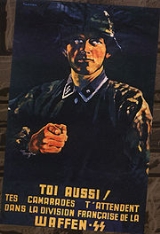
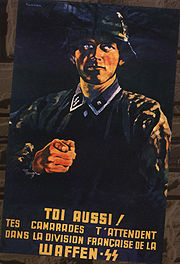
The French volunteers formed the Legion of French Volunteers Against Bolshevism
and the Legion Imperiale
, in 1945 the 33rd Waffen Grenadier Division of the SS Charlemagne (1st French)
, which was among the final defenders of Berlin
.
and François Debeauvais
had longstanding links with Nazi Germany because of the their fascist and Nordicist ideologies, linked to the belief that the Bretons were a "pure" Celtic branch of the Aryan-Nordic race. At the outbreak of the war they left France and declared support for Germany. After 1940, they returned and their supporters such as Célestin Lainé
and Yann Goulet
organized militias that worked in collaboration with the Germans. Lainé and Goulet later took refuge in Ireland.
invasion of Greece, a Nazi-held government was put in place. All three quisling
prime ministers, (Georgios Tsolakoglou
, Konstantinos Logothetopoulos
and Ioannis Rallis
), cooperated with the Axis authorities. Although their administrations did not directly assist the occupation forces, they did instigate suppressive measures, the most significant of which was the encouragement and, with the consent of the German forces, the creation of armed "anti-communist" and "anti-gangster" paramilitary organisations such as X
, the Security Battalions
and others. Moreover, small but active Greek National-Socialist parties, like the Greek National Socialist Party, or openly anti-semitic organisations, like the National Union of Greece
, helped German authorities fight the Resistance
, and identify and deport
Greek Jews.
About one thousand Greeks from Greece and more from the Soviet Union, ostensibly avenging their ethnic persecution from Soviet authorities, joined the Waffen-SS, mostly in Ukrainian divisions. A special case was that of the infamous Ukrainian-Greek Sevastianos Foulidis, a fanatical anti-communist who had been recruited by the Abwehr
as early as 1938 and became an official of the Wehrmacht, with extensive action in intelligence and agitation work in the Eastern front.
During the Axis occupation, a number of Cham Albanians
set up their own administration and militia in Thesprotia
, Greece, subservient to the fascist Balli Kombetar
organization, and actively collaborated first with the Italian and, subsequently, the German occupation forces, committing a number of atrocities. In one incident, on 29 September 1943, Nuri and Mazzar Dino, Albanian paramilitary leaders, instigated the mass execution of all Greek officials and notables
of Paramythia
.
was a war ally and then puppet state of Nazi Germany. The Hungarians played an active role in the murder of about 23,600 Jews (14,000–18,000 of whom were from Hungary) in Kamenets-Podolsk in late August 1941. and in the 1942 raid in Novi Sad
.
Radical Hungarian governments—mainly the puppet government of Döme Sztójay
, appointed after the German occupation—actively participated in the Holocaust.
The Arrow Cross Party
was a Hungarian Nazi party led by Ferenc Szálasi
which ruled Hungary from 15 October 1944-January 1945 following the German SS coup
in Budapest
. During its short rule, 80,000 Jews were deported from Hungary to their deaths. Out of 825,000 Hungarian Jews before the war, only 260,000 survived.
, captured by the Axis
in North Africa
. Many, if not most, of the Indian volunteers who switched sides to fight with the German Army and against the British were strongly nationalistic supporters of the exiled, anti-British, former president of the Indian National Congress
, Netaji (the Leader) Subhash Chandra Bose
. A Japanese supported sovereign
and autonomous state- the Azad Hind (Free India)
was also established with the Indian National Army
as its military force. See also the Tiger Legion.
in November 1943 were Sukarno
and Mohammad Hatta
. Sukarno
actively recruited and organised Indonesian Romusha
forced labour. They succeeded respectively to become the founding President of the Republic of Indonesia and Vice President of the Republic of Indonesia in August 1945.
of Nazi Germany
led by the "Leader of the Nation" (Duce) and "Minister of Foreign Affairs" Benito Mussolini
. The RSI exercised official sovereignty
in northern Italy
but was largely dependent on the German Army (Wehrmacht Heer) to maintain control. The state was informally known as the "Salò Republic" (Repubblica di Salò) because the RSI's Ministry of Foreign Affairs (Mussolini) was headquartered in Salò
, a small town on Lake Garda
. The Italian Social Republic was the second and last incarnation of a Fascist Italian state.
in summer 1941, German command, capitalizing on Latvian anti-Soviet sentiments, created the local voluntary troops (Schutzmannschaft or Schuma), to fight the Soviet partisans and serve as guards in concentration camps for Jews and Soviet
prisoners of war
. The group of the Latvian auxiliary police
known as Arājs Commando
murdered about 26,000 Jews, mainly in November and December 1941.
and in exile believed Germany would grant the country autonomy along the lines of the status of the Slovakia protectorate. German intelligence Abwehr
believed it had control of the Lithuanian Activist Front
, a pro-German organization based in the Lithuanian embassy in Berlin
. The German Nazis allowed Lithuanians to form the Provisional Government
, but did not recognize it diplomatically and did not allow Lithuanian ambassador Kazys Škirpa
to become the Prime Minister. Once German military rule in Lithuania was replaced by a German civil authority, the Provisional Government was disbanded.
Rogue
units organised by Algirdas Klimaitis
and led by SS Brigadeführer
Walter Stahlecker started pogrom
s in and around Kaunas
on June 25, 1941. Lithuanian collaborators would become involved in the murders of hundreds of thousands of Jews and Poles.
In 1941, the Lithuanian Security Police
(Lietuvos saugumo policija), subordinate to Nazi Germany's Security Police and Nazi Germany's Criminal Police, was created. Of the 26 local police battalions formed, 10 were involved in systematic extermination of Jews known as the Holocaust
. The Special SD and German Security Police Squad
in Vilnius
killed tens of thousands of Jews and ethnic Poles in Paneriai
(see Ponary massacre
) and other places. In Minsk, the 2nd Battalion shot about 9,000 Soviet prisoners of war, in Slutsk it massacred 5,000 Jews. In March 1942 in Poland, the 2nd Lithuanian Battalion carried out guard duty in the Majdanek
extermination camp. In July 1942, the 2nd Battalion participated in the deportation of Jews from the Warsaw ghetto
to a death camp. In August–October 1942, the police battalions formed from Lithuanians were in Ukraine: the 3rd in Molodechno, the 4th in Donetsk
, the 7th-в in Vinnitsa, the 11th in Korosten
, the 16th in Dnepropetrovsk, the 254th in Poltava
and the 255th in Mogilyov (Belarus). One of the battalions was also used to put down the Warsaw Ghetto Uprising
in 1943.
; LTDF has self disbanded after it was ordered to act under Nazi command. Shortly before it was disbanded, LTDF suffered a major defeat from Polish partisans in the battle of Murowana Oszmianka
.
The participation of the local populace was a key factor in the Holocaust in Nazi-occupied Lithuania
which resulted in the near total destruction of Lithuanian Jews
living in the Nazi-controlled Lithuanian territories that would, from July 17, 1941, become the Generalbezirk Litauen of Reichskommissariat Ostland
. Out of approximately 210,000 Jews, (208,000 according to the Lithuanian pre-war statistical data) an estimated 195,000–196,000 perished before the end of World War II
(wider estimates are sometimes published); most from June to December 1941. The events that took place in the western regions of the USSR occupied by Nazi Germany
in the first weeks after the German invasion
(including Lithuania - see map) marked the sharp intensification of The Holocaust
.
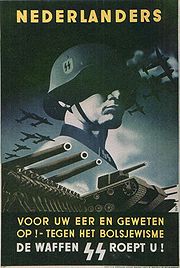 Thousands of Dutch volunteers joined the 11th SS Volunteer Panzergrenadier Division Nordland
(created in February 1943). The division participated in fighting against the Soviet army and was crushed in the Battle of Berlin
in April–May 1945.
This was also the case for the 5th SS Panzergrenadier Division Wiking. It was involved in several major battles on the Eastern Front
.
SS-Freiwilligen Legion Niederlande, manned by Dutch volunteers and German officers, battled the Soviet army from 1941. In December 1943, it gained brigade status after fighting on the front around Leningrad. It was at Leningrad that the first European volunteer, a Dutchman, earned the Knight's Cross of the Iron Cross
: Gerardus Mooyman
. In December 1944, it was transformed into the 23rd SS Volunteer Panzergrenadier Division Nederland and fought in Courland
and Pomerania
. It found its end scattered across Germany. 49. SS-Freiwilligen-Panzergrenadier-Regiment "de Ruyter" fought at the Oder and surrendered on 3 May 1945 to the Americans. 48. SS-Freiwilligen-Panzergrenadier-Regiment "General Seyffardt" however was split up into two groups. The first of these fought with Kampfgruppe Vieweger and went under in the fighting near Halbe
. The few remaining survivors were captured by the Soviets. The other half of "General Seyffart" fought with Korpsgruppe Tettau
and surrendered to the western Allies.
During the war famous actor and singer Johannes Heesters
made his career in Nazi-Germany, befriending high-ranking Nazis such as Joseph Goebbels
and living in houses stolen from wealthy Jews.
, the national government
, headed by Vidkun Quisling
, was installed by the Germans as a puppet regime during the occupation
, while king Haakon VII
and the previous government were in exile. He encouraged Norwegians
to serve as volunteers in the Waffen-SS
, collaborating in the deportation of Jews, and was responsible for the executions of Norwegian patriots
.
About 45,000 Norwegian collaborators joined the pro-Nazi party Nasjonal Samling (National Union), and some police units helped arrest many of Norway's Jews. It had very little support among the population at large and Norway was one of few countries where resistance during World War II
was widespread before the turning point of the war in 1942/43. After the war, Quisling and other collaborators were executed
. Quisling's name has become an international eponym
for traitor.
Arab nationalist
and a Muslim
religious leader, the Grand Mufti
of Jerusalem Mohammad Amin al-Husayni
worked for the Nazi Germany as a propagandist and a recruiter of Muslim volunteers for the Waffen SS and other units.
On November 28, 1941, Hitler officially received al-Husayni in Berlin. Hitler made a declaration that after "...the last traces of the Jewish-Communist European hegemony had been obliterated... the German army would... gain the southern exit of Caucasus... the Führer would offer the Arab world his personal assurance that the hour of liberation had struck. Thereafter, Germany's only remaining objective in the region would be limited to the Vernichtung des... Judentums ['destruction of the Jewish element', sometimes taken to be a euphemism for 'annihilation of the Jews'] living under British protection in Arab lands.."
The Mufti spent the remainder of the war assisting with the formation of Muslim Waffen SS units in the Balkans
and the formation of schools and training centers for imam
s and mullah
s who would accompany the Muslim SS and Wehrmacht units. Beginning in 1943, al-Husayni was involved in the organization and recruitment of Bosnian Muslims
into several divisions. The largest of which was the 13th "Handschar" division
of 21,065 men.
In 1944, al-Husayni sponsored an unsuccessful chemical warfare
assault on the Jewish community in Palestine. Five parachutists were supplied with maps of Tel Aviv
, canisters of a German–manufactured "fine white powder," and instructions from the Mufti to dump chemicals into the Tel Aviv water system
. District police commander Fayiz Bey Idrissi later recalled, "The laboratory report stated that each container held enough poison to kill 25,000 people, and there were at least ten containers."
The German Zionist organization concluded an economic agreement called the Haavara (Transfer in Hebrew) Agreement with Nazi Germany in 1933. The Haavara agreement
would last by most accounts until 1941. PBS states: "Haavara (Transfer) was a company established in 1935 as the result of an agreement between the Jewish Agency (the official Jewish executive in Palestine) and the Nazi regime. The agreement was designed to facilitate Jewish emigration to Palestine. Though the Nazis had ordered Jewish emigrants to surrender most of their property before leaving Germany, the Ha'avara agreement
let them retain some of their assets by transferring them to Palestine as German export goods. Approximately 50,000 Jews emigrated to Palestine under this arrangement." The Nazi German official Baron von Mildenstein was a guest of Jews in Palestine in 1933 and a commemorative medal was struck marking the occasion for the Nazi propaganda publication "Der Angriff"; wherein one side of the medal coin featured the Nazi swastika and other side featured the Star of David.
In 1940, Lehi
, a militant Zionist
group founded by Avraham ("Yair") Stern
, proposed intervening in World War II on the side of Nazi Germany. It offered assistance in transferring the Jews of Europe to Palestine, in return for Germany's help in expelling Britain from Mandatory Palestine. Late in 1940, Lehi representative Naftali Lubenchik went to Beirut
to meet German official Werner Otto von Hentig
(who also was involved with the Haavara or Transfer Agreement
, which had been transferring German Jews and their funds to Palestine since 1933). Lubenchik told von Hentig that Lehi had not yet revealed its full power and that they were capable of organizing a whole range of anti-British operations. This proposed alliance with Nazi Germany cost Lehi and Stern much support.
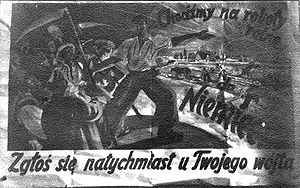 Unlike in most European countries occupied by Nazi Germany
where the Germans sought and found true collaborators among the localsin occupied Poland there was no official collaboration either at the political or at the economic level. Poland also never officially surrendered to the Germans. Under German occupation, the Polish army continued to fight underground, as Armia Krajowa
and forest partisans – Leśni
. The Polish resistance movement in World War II
in German-occupied Poland was the largest resistance movement in all of occupied Europe. As a result, Polish citizens were unlikely to be given positions of any significant authority. The vast majority of the pre-war citizenry collaborating with the Nazis was the German minority in Poland
which was offered one of several possible grades of the German citizenship. In 1939, before the German invasion of Poland, 800,000 people declared themselves as members of the German minority in Poland mostly in Pomerania
and Western Silesia
. During the war there were about 3 million former Polish citizens of German origin who signed the official list of Volksdeutsche
. People who became Volksdeutsche were treated by Poles with special contempt, and the fact of them having signed the Volksliste
constituted high treason according to the Polish underground law.
There is a general consensus among historians that there was very little collaboration with the Nazis among the Polish nation as a whole, compared to other German-occupied countries. Depending on a definition of collaboration (and of a Polish citizen, based on ethnicity and minority status), scholars estimate number of "Polish collaborators" at around several thousand in a population of about 35 million (that number is supported by the Israeli War Crimes Commission). The estimate is based primarily on the number of death sentences for treason
by the Special Courts
of the Polish Underground State. Some estimates are higher, counting in all members of the German minority in Poland and any former Polish citizens declaring their German ethnicity (Volksdeutsche
), as well as conscripted members of the Blue Police
, low-ranking Polish bureaucrats employed in German occupational administration, and even workers in forced labor camps (ex. Zivilarbeiter
and Baudienst
). Most of the Blue Police
were forcibly drafted into service; nevertheless, a significant number acted as spies for Polish resistance movement Armia Krajowa
. John Connelly quoted a Polish historian (Leszek Gondek) calling the phenomenon of Polish collaboration "marginal" and wrote that "only relatively small percentage of Polish population engaged in activities that may be described as collaboration when seen against the backdrop of European and world history".
The anti-Jewish actions of szmalcownicy
were very harmful to the Polish Jews as well as the gentile Poles aiding them. Anti-Jewish collaboration of Poles was particularly widespread and effective in the rural areas. It is estimated that some 200 thousand hiding Jews died in 1942-1945 in direct result of this collaboration. The collaboration by some Polish Jews, who belonged to Żagiew
, was also harmful to both Jewish and ethnic Polish Underground.
In October 1939, the Nazis ordered the mobilization
of the pre-war Polish police to the service of the occupational authorities. The policemen were to report for duty or face death penalty. Blue Police
was formed. At its peak in 1943, it numbered around 16,000. Its primary task was to act as a regular police
force and to deal with criminal activities, but were also used by the Germans in combating smuggling, resistance, and in measures against the Polish (and Polish Jewish) population: for example, it was present in łapankas (rounding up random civilians for labor duties) and patrolling for Jewish escapees from the ghetto
s. Nonetheless many individuals in the Blue Police followed German orders reluctantly, often disobeyed German orders or even risked death acting against them. Many members of the Blue Police were in fact double agent
s for the Polish resistance. Some of its officers were ultimately awarded the Righteous among the Nations
awards for saving Jews.
Following Nazi Germany's attack on the Soviet Union
in June 1941, German forces quickly overran the territory of Poland controlled by the Soviets since their joint invasion of Poland in accordance with the Molotov-Ribbentrop Pact
. A number of people collaborating with the Soviets before Operation Barbarossa
were killed by local people. Belief in the Żydokomuna
stereotype, combined with the German Nazi encouragement for expression of anti-Semitic attitudes, was a principal cause of massacres of Jews by gentile Poles in Poland's northeastern Łomża province in the summer of 1941, including the massacre at Jedwabne
.
In 1944 Germans clandestinely armed a few regional Armia Krajowa
(AK) units operating in the area of Vilnius
in order to encourage them to act against the Soviet partisans
in the region; in Nowogrodek district and to a lesser degree in Vilnius district (AK turned these weapons against the Nazis during Operation Ostra Brama). Such arrangements were purely tactical and did not evidence the type of ideological collaboration as shown by Vichy regime in France or Quisling regime
in Norway. The Poles main motivation was to gain intelligence on German morale and preparedness and to acquire much needed equipment. There are no known joint Polish-German actions, and the Germans were unsuccessful in their attempt to turn the Poles toward fighting exclusively against Soviet partisans. Further, most of such collaboration of local commanders with the Germans was condemned by AK headquarters. Tadeusz Piotrowski
quotes Joseph Rothschild
saying "The Polish Home Army was by and large untainted by collaboration" and adds that "the honor of AK as a whole is beyond reproach".
One partisan unit of Polish right-wing National Armed Forces, the Holy Cross Mountains Brigade
, decided to tacitly cooperate with the Germans in late 1944. It ceased hostile actions against the Germans for a few months, accepted logistic help and withdrew from Poland into Czechoslovakia with German approval (where they resumed hostilities against the Germans) in late stages of the war in order to avoid capture by the Soviets.
of Nazi Germany
. The Slovak Republic existed on roughly the same territory as present-day Slovakia
(with the exception of the southern and eastern parts of present-day Slovakia). The Republic bordered Germany, the Protectorate of Bohemia and Moravia
, Poland
, and Hungary
.
and Vyacheslav Molotov
with its invasion of the Soviet Union at 3:15 am on June 22, 1941. Large areas of the European part of the Soviet Union
would be placed under German occupation between 1941 and 1944. Soviet collaborators included numerous Russians and members of other ethnic groups.
The Germans attempted to recruit Soviet citizens (and to a lesser extent other Eastern Europeans) voluntarily for the OST-Arbeiter
or Eastern worker program; originally this worked, but the news of the terrible conditions they faced dried up the volunteers and the program became forcible.
villagers. Many of these collaborators retreated with German forces in the wake of the Red Army
advance, and in January 1945, formed the 30th Waffen Grenadier Division of the SS (1st Belarussian).
, Turkic and Caucasian forces deployed by the Nazis consisted primarily of Red Army POWs, assembled into ill-trained legions. Among these battalions were 18,000 Armenians, 13,000 Azerbaidjanis, 14,000 Georgians and 10,000 men from the "North Caucasus." American historian Alexander Dallin notes that Armenian Legion and Georgian battalions were sent to the Netherlands as a result of Hitler's distrust for them, many of which deserted
. According to military historian Christopher Ailsby, the Turkic and Caucasian forces formed by the Germans were "poorly armed, trained, and motivated," and were "unreliable and next to useless."
Armenian Revolutionary Federation (The Dashnaks) was conquered by the Russian Bolshevik
s in 1920, and ceased to exist. During World War II, some of the Dashnaks saw an opportunity in the collaboration with the Germans to regain those territories. The legion participated in the occupation of the Crimea
n Peninsula and the Caucasus
. On December 15, 1942, the Armenian National Council was granted official recognition by Alfred Rosenberg
, the Reich Ministry for the Occupied Eastern Territories
. The president of Council was Professor Ardasher Abeghian, its vice-president Abraham Guilkhandanian and it numbered among its members Garegin Nzhdeh and Vahan Papazian. Until the end of 1944 it published a weekly journal, Armenian, edited by Viken Shantn who also broadcast on Radio Berlin with the aid of Dr. Paul Rohrbach
.
proper, ethnic Russians were allowed to govern the Lokot Republic
, an autonomous sector in Nazi-occupied Russia. Military groups under Nazi command were formed, such as the notorious Kaminski Brigade, infamous because of its involvement in atrocities in Belarus and Poland, and the 30th Waffen Grenadier Division of the SS (2nd Russian)
.
Ethnic Russians also enlisted in large numbers into the many German auxiliary police units. Local civilians and Russian POWs, as well as Red Army
defectors were encouraged to join the Wehrmacht as "hilfswillige
". Some of them also served in so-called Ost battalions which, in particular, defended the French coastline against the expected Allied invasion.
The Kalmykian Voluntary Cavalry Corps
was a unit of about 5,000 Kalmyk
Mongol volunteers who chose to join the Wehrmacht in 1942 rather than remain in Kalmykia
as the German Army retreated before the Red Army
.
In May 1943, German General Helmuth von Pannwitz
was given authorization to create a Cossack
Division consisting of two brigades primarily from Don
and Kuban Cossacks
, including former exiled White Army commanders such as Pyotr Krasnov
and Andrei Shkuro
. The division however was then not sent to fight the Red Army, but was ordered, in September 1943, to proceed to Yugoslavia
and fight Josip Broz Tito
's partisans
. In the summer of 1944, the two brigades were upgraded to become the 1st Cossack Cavalry Division
and 2nd Cossack Cavalry Division. From the beginning of 1945, these divisions were combined to become XVth SS Cossack Cavalry Corps
.
Pro-German Russian forces also included the anti-communist Russian Liberation Army
(ROA), which saw action as a part of the Wehrmacht
. On May 1, 1945, however, ROA turned against the SS and fought on the side of Czech insurgents
during the Prague Uprising
.
was divided primarily between the Ukrainian SSR
of the Soviet Union
and the Second Polish Republic
. Smaller regions were administered by Romania
and Czechoslovakia
. Only the Soviet Union recognised Ukrainian autonomy, and large numbers of Ukrainians, particularly from the East, fought in the Red Army
.
The negative impact of Soviet policies implemented in the 1930s were still fresh in the memory of Ukrainians. These included the Holodomor
of 1933, the Great Terror, the persecution of intellectuals during the Great Purge
of 1937-38, the massacre of Ukrainian intellectuals after the annexation of Western Ukraine
from Poland in 1939, the introduction and implementation of Collectivisation.
As a result, the population of whole towns, cities and villages, greeted the Germans as liberators which helps explain the unprecedented rapid progress of the German forces in the occupation of Ukraine.
Even before the German invasion, the Nachtigall
and Roland
battalions were set up and trained as Ukrainian battalions in the Wehrmacht, and were part of the initial invading force.
With the change in regime ethnic, Ukrainians were allowed and encouraged to work in administrative positions. These included and the auxiliary police, post office, and other government structures; taking the place of Poles, Russians and Jews.
Soviet citizens had a page in their internal passport
s with information regarding their ethnicity, party status, military rank, service in the Soviet Army reserve, and information as to where they were to assemble in case of war. This document also contained markings regarding a citizens social status and reliability, (i.e. son of a kulak
, party or Komsomol
membership. Soviet POWs who were able to demonstrate Soviet unreliability i.e. non membership in the CPSU
, Komsomol or be of a discriminated class were quickly released from the POW camps. Often they were offered administrative and clerical positions or encouraged to join local police units. Some were trained as camp guards, while others were encouraged (in some cases forced) to enlist to fight in anti-Soviet military divisions.
During the period of occupation, Nazi-controlled Ukrainian newspaper Volhyn wrote that "The element that settled our cities (Jews)... must disappear completely from our cities. The Jewish problem is already in the process of being solved.
There is evidence of some Ukrainian participation in the Holocaust. The auxiliary police in Kiev participated in rounding up of Jews who were directed to the Babi Yar
massacre.
Ukrainians participated in crushing the Warsaw Ghetto Uprising
of 1943 and the Warsaw Uprising
of 1944 where a mixed force of German SS troops, Russians, Cossacks, Azeris and Ukrainians, backed by German regular army units — killed up to 40,000 civilians.
In Zhytomyr
on September 18, 1941, 3,145 Jews were murdered with the assistance of Ukrainian militia (Operational Report 106) and Korosten
where Ukrainian militia rounded up 238 Jews for liquidation (Operational Report 80). At times the assistance was more active. Operational Report 88, for example, reports that on September 6, 1941, 1,107 Jewish adults were shot while the Ukrainian militia unit assisting them liquidated 561 Jewish children and youths.
On April 28, 1943 German Command anounced the estblishment of the SS-Freiwilligen-Schützen-Division «Galizien». It has been accounted that approximately 83,000 people volunteered for service in the Division. The Division, was used in Anti-partisan operations in Poland
, Czechoslovakia
and Yugoslavia
. During the Brody offensive and Vienna Offensive
to fight the Soviet forces. Those that survived surrendered to the Allies and the bulk emigrated to the West, primarily England, Australia and Canada.
, the Yugoslav government was working on forging a pact with Germany. That pact was rejected by Yugoslav antifascists, who guided by general Dušan Simović
demonstrated on March 26, 1941, and forced the government to withdraw. Angered by what he perceived as treason, Hitler invaded Kingdom of Yugoslavia
without warning on April 6, 1941. Eleven days later Yugoslavia capitulated.
and Croats
, but commanded by German officers, was created in February 1943. The division participated in anti-guerrilla operations in Yugoslavia. The division operated until 1945 with considerable strength, although by that time many tried to leave Bosnia along with the SS Prinz Eugen, Ustase, Serbian Volunteer Corps, Serbian State Guard, and Chetniks. They were massacred at Bleiburg all together.
's Croatian puppet state was an ally of Nazi Germany. The Croatian extreme nationalists, Ustaše
, killed 700 thousands of Serbs and other victims in the Jasenovac concentration camp
.
The 13th Waffen Mountain Division of the SS Handschar (1st Croatian), created in February 1943, and the 23rd Waffen Mountain Division of the SS Kama
, created in January 1944, were manned by Croats and Bosniaks as well as local Germans.
(party militia of the extreme right-wing Yugoslav National Movement "Zbor"
had a few thousand members and helped guard and run concentration camps.
created 21st Waffen Mountain Division of the SS Skanderbeg (1st Albanian)
manned by Albanian
and Kosovar Albanian volunteers. By June 1944, the military value was deemed low in lieu of partisan aggression and by November 1944 it was disbanded. The remaining cadre, now called Kampfgruppe Skanderbeg, was transferred to the Prinz Eugen Division where they successfully participated in actions against Tito's partisans in December 1944. The emblem of the division was a black Albanian eagle. Balli Kombëtar
was an Albanian
nationalist and anti-communist organization which collaborated with the Axis Powers
during their occupation of Greece and Yugoslavia
. Their agenda was the creation of "Great Albania."
(then a part of Yugoslavia
). An individual member was a Domobranec, the plural of which was Domobranci. The SD functioned like most collaborationist forces in Axis-occupied Europe during World War II, but had limited autonomy, and at first functioned as an auxiliary police force that assisted the Germans in anti-Partisan
actions. Later, it gained more autonomy and conducted most of the anti-partisan operations in the Province of Ljubljana
. Much of the SD equipment was Italian
(confiscated when Italy dropped out of the war in 1943), although German weapons and equipment were used as well, especially later in the war. Similar, but much smaller units were also formed in Littoral
(Primorska) and Upper Carniola
(Gorenjska).
were the only British territory
in Europe occupied by Nazi Germany during World War II. The policy of the Island governments, acting under instructions from the British government communicated before the occupation, was one of passive co-operation, although this has been criticised, particularly in the treatment of Jews in the islands. These measures were administered by the Bailiff and the Aliens Office. "In Britain the administrators and the police in the Channel Islands who had helped with the deportation of Jews continued to work in their old positions, and some of them even received the Order of the British Empire
for the bravery they had shown in the war years."
Following the liberation of 1945 allegations against those accused of collaborating with the occupying authorities were investigated. By November 1946, the UK Home Secretary was in a position to inform the UK House of Commons that most of the allegations lacked substance and only 12 cases of collaboration were considered for prosecution, but the Director of Public Prosecutions
had ruled out prosecutions on insufficient grounds. In particular, it was decided that there were no legal grounds for proceeding against those alleged to have informed to the occupying authorities against their fellow-citizens.
In Jersey
and Guernsey
, laws were passed to retrospectively confiscate the financial gains made by war profiteers and black marketeers, although these measures also affected those who had made legitimate profits during the years of military occupation.
During the occupation, cases of women fraternising with German soldiers had aroused indignation among some citizens. In the hours following the liberation, members of the British liberating forces were obliged to intervene to prevent revenge attacks.
countries (British Free Corps
). Overall, almost 600,000 of Waffen-SS members were non-German http://www.scrapbookpages.com/DachauScrapbook/DachauLiberation/BuechnerAccount.html with some countries as Belgium and the Netherlands contributing thousands of volunteers.
Various collaborationalist parties in occupied France
and the Vichy
government assisted in establishing the Légion des volontaires français contre le bolchevisme (LVF)
. This volunteer army initially counted some 10,000 volunteers and would later become the 33rd Waffen SS division and one of the first SS divisions comprising mostly foreigners.
Following is a list of the 18 largest Waffen SS division composed mostly or totally of foreign volunteers (note that there were other foreign Waffen SS divisions composed mostly of forced conscripts).
Apart from frontline units volunteers played another important role notably in the large Schutzmannschaft units in the German occupied territories in Eastern Europe. After Operation Barbarossa
recruitment of local forces began almost immediately mostly by initiative of Himmler. These forces were not members of the regular armed forces and were not intended for frontline duty but were instead used for rear echelon activities including maintaining peace, fighting partisans
, acting as police and organizing supplies for the front lines. In the later years of the war, these units numbered almost 200,000.
By the end of World War II, 60% of the Waffen SS was made up of non-German volunteers from occupied countries. The predominantly Scandinavian 11th SS Volunteer Panzergrenadier Division Nordland division along with remnants of French
, Italian
, Spanish
and Dutch
volunteers were last defenders of the Reichstag
in Berlin
.
The Nuremberg Trials
, in declaring the Waffen SS a criminal organisation, explicitly excluded conscripts, who had committed no crimes. In 1950, The U.S. High Commission in Germany and the U.S. Displaced Persons Commission clarified the U.S. position on the Baltic Waffen SS Units, considering them distinct from the German SS in purpose, ideology, activities and qualifications for membership.
of the Balkans
. Albania
, having an Italian puppet state, declared war on the Allies along with the Kingdom of Italy
in 1940, although the resistance movements and the peoples were against this. Later that year Slovakia
declared war on Great Britain
and the United States
. Slovakian, Croatian and Albanian collaborators fought with the German forces against the Soviet Union
on the eastern front throughout the war. Molotov–Ribbentrop Pact and Soviet invasion of Poland
in 1939 should also be mentioned.
However, significant support was also given by many countries initially at war with Germany but which subsequently elected to adopt a policy of co-operation.
The Vichy
government in France is one of the best known and most significant examples of collaboration between former enemies of Germany and Germany itself. When the French Vichy government emerged at the same time of the Free French in London
there was much confusion regarding the loyalty of French overseas colonies and more importantly their overseas armies and naval fleet. The reluctance of Vichy France to either disarm or surrender their naval fleet resulted in the British destruction of the French Fleet at Mers-el-Kebir
on 3 July 1940. Later in the war French colonies were frequently used as staging areas for invasions or airbases for the Axis powers both in Indo China and Syria
. This resulted in the invasion of Syria and Lebanon
with the capture of Damascus
on June 17 and later the Battle of Madagascar
against Vichy French forces which lasted for seven months until November the same year.
Many other countries cooperated to some extent and in different ways. Denmark's government cooperated with the German occupiers until 1943 and actively helped recruit members for the Nordland and Wiking Waffen SS divisions and helped organize trade and sale of industrial and agricultural products to Germany. In Greece, the three quisling prime ministers (Georgios Tsolakoglou
, Konstantinos Logothetopoulos
and Ioannis Rallis
) cooperated with the Axis authorities. Agricultural products (especially tobacco) were sent to Germany, Greek "volunteers" were sent to work to German factories, and special armed forces (such as the Security Battalions
were created to fight along German soldiers against the Allies and the Resistance movement. In Norway the government successfully managed to escape to London
but Vidkun Quisling
established a puppet regime in its absence—albeit with little support from the local population.
Axis Powers
The Axis powers , also known as the Axis alliance, Axis nations, Axis countries, or just the Axis, was an alignment of great powers during the mid-20th century that fought World War II against the Allies. It began in 1936 with treaties of friendship between Germany and Italy and between Germany and...
, some citizens, driven by nationalism
Nationalism
Nationalism is a political ideology that involves a strong identification of a group of individuals with a political entity defined in national terms, i.e. a nation. In the 'modernist' image of the nation, it is nationalism that creates national identity. There are various definitions for what...
, ethnic hatred
Ethnic hatred
Ethnic hatred, inter-ethnic hatred, racial hatred, or ethnic tension refers to feelings and acts of prejudice and hostility towards an ethnic group in various degrees. See list of anti-ethnic and anti-national terms for specific cases....
, anti-communism
Anti-communism
Anti-communism is opposition to communism. Organized anti-communism developed in reaction to the rise of communism, especially after the 1917 October Revolution in Russia and the beginning of the Cold War in 1947.-Objections to communist theory:...
, anti-Semitism
Anti-Semitism
Antisemitism is suspicion of, hatred toward, or discrimination against Jews for reasons connected to their Jewish heritage. According to a 2005 U.S...
or opportunism
Opportunism
-General definition:Opportunism is the conscious policy and practice of taking selfish advantage of circumstances, with little regard for principles. Opportunist actions are expedient actions guided primarily by self-interested motives. The term can be applied to individuals, groups,...
, knowingly engaged in collaboration with the Axis Powers during World War II. Some of these collaborationists committed the worst crimes and atrocities of the Holocaust.
Collaboration ranged from urging the civilian population to remain calm and accept foreign occupation without conflict, organizing trade, production, financial and economic support to joining various branches of the armed forces of the Axis powers
Tripartite Pact
The Tripartite Pact, also the Three-Power Pact, Axis Pact, Three-way Pact or Tripartite Treaty was a pact signed in Berlin, Germany on September 27, 1940, which established the Axis Powers of World War II...
or special "national" military units fighting under their command.
Requirements for collaboration
The Nazis did not consider everyone equally fit for cooperation. Even people from closely related nations were often valued differently in accordance with Nazi racial theoriesRacial policy of Nazi Germany
The racial policy of Nazi Germany was a set of policies and laws implemented by Nazi Germany, asserting the superiority of the "Aryan race", and based on a specific racist doctrine which claimed scientific legitimacy...
.
The Jews were considered to be worst of all nations and thus unfit for cooperation, although some were used in concentration camps as Kapos
Kapo (concentration camp)
A kapo was a prisoner who worked inside German Nazi concentration camps during World War II in any of certain lower administrative positions. The official Nazi word was Funktionshäftling, or "prisoner functionary", but the Nazis commonly referred to them as kapos.- Etymology :The origin of "kapo"...
to report on other prisoners and enforce order. Others governed ghettos and helped organize deportation
Deportation
Deportation means the expulsion of a person or group of people from a place or country. Today it often refers to the expulsion of foreign nationals whereas the expulsion of nationals is called banishment, exile, or penal transportation...
s to extermination camps (Jewish Ghetto Police
Jewish Ghetto Police
Jewish Ghetto Police , also known as the Jewish Police Service and referred to by the Jews as the Jewish Police, were the auxiliary police units organized in the Jewish ghettos of Europe by local Judenrat councils under orders of occupying German Nazis.Members of the did not have official...
).
Albania
In April 1943, Reichsfuhrer-SS Heinrich HimmlerHeinrich Himmler
Heinrich Luitpold Himmler was Reichsführer of the SS, a military commander, and a leading member of the Nazi Party. As Chief of the German Police and the Minister of the Interior from 1943, Himmler oversaw all internal and external police and security forces, including the Gestapo...
created the 21st Waffen Mountain Division of the SS Skanderbeg (1st Albanian)
21st Waffen Mountain Division of the SS Skanderbeg (1st Albanian)
The 21st Division of the SS Skanderbeg was a Mountain division of the SS set up by Heinrich Himmler in March 1944, officially under the title of the 21. Waffen-Gebirgs Division der SS Skanderbeg...
manned by Albanian
Albanians
Albanians are a nation and ethnic group native to Albania and neighbouring countries. They speak the Albanian language. More than half of all Albanians live in Albania and Kosovo...
and Kosovar Albanian volunteers . By June 1944, the military value was deemed low in lieu of partisan aggression and by November 1944 it was disbanded. The remaining cadre, now called Kampfgruppe Skanderbeg, was transferred to the Prinz Eugen Division where they successfully participated in actions against Tito's partisans in December 1944. The emblem of the division was a black Albanian eagle.
Belgium
The 373rd infantryInfantry
Infantrymen are soldiers who are specifically trained for the role of fighting on foot to engage the enemy face to face and have historically borne the brunt of the casualties of combat in wars. As the oldest branch of combat arms, they are the backbone of armies...
battalion
Battalion
A battalion is a military unit of around 300–1,200 soldiers usually consisting of between two and seven companies and typically commanded by either a Lieutenant Colonel or a Colonel...
of Wehrmacht
Wehrmacht
The Wehrmacht – from , to defend and , the might/power) were the unified armed forces of Nazi Germany from 1935 to 1945. It consisted of the Heer , the Kriegsmarine and the Luftwaffe .-Origin and use of the term:...
, manned by Walloon Belgians, took part in anti-guerrilla actions in the occupied territory of the USSR from August 1941-February 1942. In May 1943, the battalion was transformed into the 5th SS Volunteer Sturmbrigade Wallonien and sent to the Eastern Front
Eastern Front (World War II)
The Eastern Front of World War II was a theatre of World War II between the European Axis powers and co-belligerent Finland against the Soviet Union, Poland, and some other Allies which encompassed Northern, Southern and Eastern Europe from 22 June 1941 to 9 May 1945...
. In the autumn, the brigade had been transformed into 28th SS Volunteer Grenadier Division Wallonien. Its remnants surrendered to British troops in the final days of war. Flemish Belgian collaborators were organized first into the 6th SS Volunteer Brigade
6th SS Volunteer Sturmbrigade Langemarck
The 27th SS Volunteer Division Langemarck was a German Waffen-SS volunteer division comprising volunteers of Flemish background. It saw action on the Eastern Front during World War II....
and later the 27th SS Infantry (Grenadier) Division. Belgians served in the German forces from mid-1941 until the end of the war.
China
The Japanese set up several puppet regimes in occupied Chinese territories. The first of which was ManchukuoManchukuo
Manchukuo or Manshū-koku was a puppet state in Manchuria and eastern Inner Mongolia, governed under a form of constitutional monarchy. The region was the historical homeland of the Manchus, who founded the Qing Empire in China...
in 1932, followed by the East Hebei Autonomous Council
East Hebei Autonomous Council
The East Hebei Autonomous Council also known as the East Ji Autonomous Council and the East Hopei Autonomous Anti-Communist Council, was a short-lived Japanese puppet state in northern China in the late 1930s.-History:...
in 1935. Similar to Manchukuo
Manchukuo
Manchukuo or Manshū-koku was a puppet state in Manchuria and eastern Inner Mongolia, governed under a form of constitutional monarchy. The region was the historical homeland of the Manchus, who founded the Qing Empire in China...
in its supposed ethnic identity, Mengjiang
Mengjiang
Mengjiang , also known in English as Mongol Border Land, was an autonomous area in Inner Mongolia, operating under nominal Chinese sovereignty and Japanese control. It consisted of the then-Chinese provinces of Chahar and Suiyuan, corresponding to the central part of modern Inner Mongolia...
(Mengkukuo) was set up in late 1936. Wang Kemin
Wang Kemin
Wang Kemin was a leading official in the Chinese republican movement and early Beiyang government, later noted for his role as in the collaborationist Provisional Government of the Republic of China and Nanjing Nationalist Government during World War II....
's collaborationist Provisional Government of the Republic of China was set up in Beiping in 1937 following the start of full-scale military operations between China and Japan
Second Sino-Japanese War
The Second Sino-Japanese War was a military conflict fought primarily between the Republic of China and the Empire of Japan. From 1937 to 1941, China fought Japan with some economic help from Germany , the Soviet Union and the United States...
, another puppet regime was the Reformed Government of the Republic of China, setup in Nanjing
Nanjing
' is the capital of Jiangsu province in China and has a prominent place in Chinese history and culture, having been the capital of China on several occasions...
in 1938. The Wang Jingwei
Wang Jingwei
Wang Jingwei , alternate name Wang Zhaoming, was a Chinese politician. He was initially known as a member of the left wing of the Kuomintang , but later became increasingly anti-Communist after his efforts to collaborate with the CCP ended in political failure...
collaborationist government, established in 1940, "consolidated" these regimes, though in reality neither Wang's government nor the constituent governments had any autonomy, although the military of the Wang Jingwei Government
Wang Jingwei Government
In March 1940 a puppet government led by Wang Jingwei was established in the Republic of China under the protection of the Empire of Japan. The regime officially called itself the Republic of China and its government the Reorganized National Government of China...
was equipped by the Japanese with planes, cannons, tanks, boats, and German-style stahlhelm
Stahlhelm
Stahlhelm is German for "steel helmet". The Imperial German Army began to replace the traditional boiled-leather Pickelhaube with the Stahlhelm during World War I in 1916...
(already widely used by the National Revolutionary Army
National Revolutionary Army
The National Revolutionary Army , pre-1928 sometimes shortened to 革命軍 or Revolutionary Army and between 1928-1947 as 國軍 or National Army was the Military Arm of the Kuomintang from 1925 until 1947, as well as the national army of the Republic of China during the KMT's period of party rule...
, the "official" army of the Republic of China
Republic of China (1912–1949)
In 1911, after over two thousand years of imperial rule, a republic was established in China and the monarchy overthrown by a group of revolutionaries. The Qing Dynasty, having just experienced a century of instability, suffered from both internal rebellion and foreign imperialism...
).
The military forces of these puppet regimes, known collectively as the Collaborationist Chinese Army
Collaborationist Chinese Army
The Collaborationist Chinese Army in the Second Sino-Japanese War went under different names at different times depending on which collaborationist leader or puppet regime it was organized under....
, numbered more than a million at their height, with some estimates that the number exceeded 2 million conscripts. Great number of collaborationist troops were men originally serving in warlord forces within the National Revolutionary Army who had defected when facing both Communists and Japanese as enemies. Although its manpower was very large, the soldiers were very ineffective compared to NRA soldiers due to low morale for being considered as "Hanjian
Hanjian
In Chinese culture, a Hanjian is a derogatory and pejorative term for a race traitor to the Han Chinese nation or state, and to a lesser extent, Han ethnicity. The word Hanjian is distinct from the general word for traitor, which could be used for any race or country...
". Although certain collaborationist forces had limited battlefield presence during the Second Sino-Japanese War
Second Sino-Japanese War
The Second Sino-Japanese War was a military conflict fought primarily between the Republic of China and the Empire of Japan. From 1937 to 1941, China fought Japan with some economic help from Germany , the Soviet Union and the United States...
, most were relegated to behind-the-line duties.
The Wang Jingwei government was disbanded after Japanese surrender to Allies in 1945, and Manchukuo and Mengjiang were destroyed by Soviet troops in the invasion of Manchuria.
Denmark
At 04:15 on 9 April 1940 (Danish standard time), German forces crossed the border into neutralNeutral country
A neutral power in a particular war is a sovereign state which declares itself to be neutral towards the belligerents. A non-belligerent state does not need to be neutral. The rights and duties of a neutral power are defined in Sections 5 and 13 of the Hague Convention of 1907...
Denmark, in direct violation of a German-Danish treaty of non-aggression signed the previous year. After two hours the Danish government surrendered
Surrender (military)
Surrender is when soldiers, nations or other combatants stop fighting and eventually become prisoners of war, either as individuals or when ordered to by their officers. A white flag is a common symbol of surrender, as is the gesture of raising one's hands empty and open above one's head.When the...
, believing that resistance was useless and hoping to work out an advantageous agreement with Germany.
As a result of the cooperative attitude of the Danish authorities, German officials claimed that they would "respect Danish sovereignty and territorial integrity, as well as neutrality." The German authorities were inclined towards lenient terms with Denmark for several reasons. These factors allowed Denmark a very favorable relationship with Nazi Germany. The government remained intact and the parliament
Parliament
A parliament is a legislature, especially in those countries whose system of government is based on the Westminster system modeled after that of the United Kingdom. The name is derived from the French , the action of parler : a parlement is a discussion. The term came to mean a meeting at which...
continued to function more or less as it had before. They were able to maintain much of their former control over domestic policy. Danish public opinion generally backed the new government, particularly after the fall of France in June 1940. There was a general feeling that the unpleasant reality of German occupation must be confronted in the most realistic way possible, given the international situation. Newspaper articles and news reports "which might jeopardize German-Danish relations" were outlawed. After the assault on the Soviet Union, Operation Barbarossa
Operation Barbarossa
Operation Barbarossa was the code name for Germany's invasion of the Soviet Union during World War II that began on 22 June 1941. Over 4.5 million troops of the Axis powers invaded the USSR along a front., the largest invasion in the history of warfare...
, Denmark joined the Anti-Comintern Pact
Anti-Comintern Pact
The Anti-Comintern Pact was an Anti-Communist pact concluded between Nazi Germany and the Empire of Japan on November 25, 1936 and was directed against the Communist International ....
, together with the fellow Nordic
Nordic countries
The Nordic countries make up a region in Northern Europe and the North Atlantic which consists of Denmark, Finland, Iceland, Norway and Sweden and their associated territories, the Faroe Islands, Greenland and Åland...
state of Finland
Finland
Finland , officially the Republic of Finland, is a Nordic country situated in the Fennoscandian region of Northern Europe. It is bordered by Sweden in the west, Norway in the north and Russia in the east, while Estonia lies to its south across the Gulf of Finland.Around 5.4 million people reside...
; the Communist Party
Communist party
A political party described as a Communist party includes those that advocate the application of the social principles of communism through a communist form of government...
was banned in Denmark. Industrial production
Industry
Industry refers to the production of an economic good or service within an economy.-Industrial sectors:There are four key industrial economic sectors: the primary sector, largely raw material extraction industries such as mining and farming; the secondary sector, involving refining, construction,...
and trade was, partly due to geopolitical reality and economic necessity, redirected toward Germany. Many government officials saw expanded trade with Germany as vital to maintaining social order in Denmark. Increased unemployment
Unemployment
Unemployment , as defined by the International Labour Organization, occurs when people are without jobs and they have actively sought work within the past four weeks...
and poverty was feared to lead to more of open revolt within the country, since Danes tended to blame all negative developments on the Germans. It was feared that any revolt would result in a crackdown by the German authorities.
In return for these concessions, the Danish cabinet rejected German demands for legislation discriminating against Denmark's Jewish minority. Demands to introduce the death penalty were likewise rebuffed and so were German demands to allow German military courts jurisdiction over Danish citizens. Denmark also rejected demands for the transfer of Danish army units to German military use. Throughout the years of its hold on power, the government consistently refused to accept German demands regarding the Jews. The authorities would not enact special laws concerning Jews, and their civil rights remained equal with those of the rest of the population. German authorities became increasingly exasperated with this position but concluded that any attempt to remove or mistreat Jews would be "politically unacceptable." Even the Gestapo
Gestapo
The Gestapo was the official secret police of Nazi Germany. Beginning on 20 April 1934, it was under the administration of the SS leader Heinrich Himmler in his position as Chief of German Police...
officer Dr. Werner Best
Werner Best
Dr. Werner Best was a German Nazi, jurist, police chief, SS-Obergruppenführer and Nazi Party leader from Darmstadt, Hesse. He studied law and in 1927 obtained his doctorate degree at Heidelberg...
, plenipotentiary in Denmark from November 1942, believed that any attempt to remove the Jews would be enormously disruptive to the relationship between the two governments and recommended against any action concerning the Jews of Denmark.
On 29 June 1941, days after the invasion of the USSR
Operation Barbarossa
Operation Barbarossa was the code name for Germany's invasion of the Soviet Union during World War II that began on 22 June 1941. Over 4.5 million troops of the Axis powers invaded the USSR along a front., the largest invasion in the history of warfare...
, Frikorps Danmark
Frikorps Danmark
Free Corps Denmark was a Danish volunteer free corps created by the Danish Nazi Party in cooperation with Germany, to fight the Soviet Union during the Second World War. On June 29, 1941, days after the German invasion of the Soviet Union, the DNSAP's newspaper Fædrelandet proclaimed the creation...
(Free Corps Denmark) was founded as a corps of Danish volunteers to fight against the Soviet Union. Frikorps Danmark was set up at the initiative of the SS and DNSAP who approached Lieutenant-Colonel C.P. Kryssing of the Danish army shortly after the invasion of the USSR had begun. The Nazi paper Fædrelandet proclaimed the creation of the corps on 29 June 1941. According to Danish law, it was not illegal to join a foreign army, but active recruiting on Danish soil was illegal. The SS disregarded this law and began recruiting efforts — predominantly recruiting Danish Nazis and members of the German-speaking minority.
Estonia
Although the Estonian Self-AdministrationEstonian Self-Administration
Estonian Self-Administration , also known as the Directorate, was the puppet government set up in Estonia during occupation of Estonia by Nazi Germany...
did not have complete freedom of action, it exercised a significant measure of autonomy, within the framework of German policy, political, racial and economic. Thus, the Directors exercised their powers pursuant to the laws and regulations of the Republic of Estonia, but only to the extent that these had not been repealed or amended by the German military command. The Director's position was voluntary. The Self-Administration’s autonomy enabled it to maintain police structures that
cooperated with the Germans in rounding up and
killing Jews and Roma, and in seeking out
and killing Estonians deemed to be opponents of the
occupiers, and which were ultimately incorporated
into the Estonian Security Police and SD
Estonian Security Police and SD
The Estonian Security Police and SD , or Sipo, was a security police force created by the Germans in 1942 that integrated both Germans and Estonians within a unique structure mirroring the German Sicherheitspolizei....
. It also extended to the
unlawful conscription
Conscription
Conscription is the compulsory enlistment of people in some sort of national service, most often military service. Conscription dates back to antiquity and continues in some countries to the present day under various names...
of Estonians for forced labor
or for military service
Military service
Military service, in its simplest sense, is service by an individual or group in an army or other militia, whether as a chosen job or as a result of an involuntary draft . Some nations require a specific amount of military service from every citizen...
under German command.
The Estonian Security Police and SD, the 286th, 287th and 288th Estonian Auxiliary Police
Estonian Auxiliary Police
Estonian Auxiliary Police were Estonian units that fought in World War II under command of Germany. Estonian regular units allied with Nazi Germany began to be established on 25 August 1941, when under the order of Generalfeldmarschall Wilhelm Ritter von Leeb, commander of the Army Group North,...
Battalions, and 2.5–3% of Estonian Omakaitse
Omakaitse
The Omakaitse was a militia organisation in Estonia. It was founded in 1917 following the Russian Revolution. On the eve of the Occupation of Estonia by the German Empire the Omakaitse units took over major towns in the country allowing the Salvation Committee of the Estonian Provincial Assembly...
(Home Guard) militia
Militia
The term militia is commonly used today to refer to a military force composed of ordinary citizens to provide defense, emergency law enforcement, or paramilitary service, in times of emergency without being paid a regular salary or committed to a fixed term of service. It is a polyseme with...
units (approximately between 1000 and 1200 men) were directly involved in criminal acts, taking part in the round-up, guarding or killing of 400–1000 Roma people and 6000 Jews in the concentration camps of Pskov region in Russia and the Jägala
Jägala
Jägala is a village in Jõelähtme Parish, Harju County, Estonia. It had 139 inhabitants in 2007.-See also:*Jägala River*Jägala Waterfall*Jägala concentration camp*Jägala Army Base*Jägala Airfield-External links:* *...
, Vaivara, Klooga
Klooga concentration camp
Klooga was a Nazi labor subcamp of the Vaivara concentration camp complex established in September 1943 in Harju County, during World War II, in German-occupied Estonia near the northern Estonian village Klooga...
, and Lagedi
Lagedi
Lagedi is a small borough in Rae Parish, Harju County, northern Estonia. It has a population of 847 .-External links:*...
camps in Estonia. Guarded by the above listed formations, 15,000 Soviet POW died in Estonia, part of them because of neglect and mistreatment and part executed.
France
Philippe Pétain
Henri Philippe Benoni Omer Joseph Pétain , generally known as Philippe Pétain or Marshal Pétain , was a French general who reached the distinction of Marshal of France, and was later Chief of State of Vichy France , from 1940 to 1944...
and Pierre Laval
Pierre Laval
Pierre Laval was a French politician. He was four times President of the council of ministers of the Third Republic, twice consecutively. Following France's Armistice with Germany in 1940, he served twice in the Vichy Regime as head of government, signing orders permitting the deportation of...
, actively collaborated in the extermination of the European Jews. It also participated in Porrajmos, the extermination of Rom people, and in the extermination of other "undesirables." Vichy opened up a series of concentration camps in France where it interned Jews, Gypsies, homosexuals, political opponents, etc. Directed by René Bousquet
René Bousquet
René Bousquet was a high-ranking French civil servant, who served as secretary general to the Vichy regime police from May 1942 to 31 December 1943.-Biography:...
, the French police helped in the deportation of 76,000 Jews to the extermination camps. In 1995, President Jacques Chirac
Jacques Chirac
Jacques René Chirac is a French politician who served as President of France from 1995 to 2007. He previously served as Prime Minister of France from 1974 to 1976 and from 1986 to 1988 , and as Mayor of Paris from 1977 to 1995.After completing his studies of the DEA's degree at the...
officially recognized the responsibility of the French state for the deportation of Jews during the war, in particular the more than 13,000 victims the Vel' d'Hiv Roundup of July 1942, during which Laval decided, by his own, to deport children along with their parents. Only 2,500 of the deported Jews survived the war. The 1943 Battle of Marseille
Battle of Marseille
The Marseille´s Roundup took place in the Old Port of Marseille, under the Vichy regime, on 22, 23 and 24 January 1943. Assisted by the French police, which was directed by René Bousquet, the Nazis organized a raid to arrest Jewish people...
was another event during which the French police assisted the Gestapo in a massive raid, which included an urban reshaping plan involving the destruction of a whole neighbourhood in the popular Old Port. Some few collaborators were tried in the 1980s for crimes against humanity (Paul Touvier
Paul Touvier
Paul Touvier was a French Nazi collaborator. In 1994, he was the first Frenchman convicted of crimes against humanity for his actions in Vichy France.- Early life :...
, etc.), while Maurice Papon
Maurice Papon
Maurice Papon was a French civil servant, industrial leader and Gaullist politician, who was convicted for crimes against humanity for his participation in the deportation of over 1600 Jews during World War II when he was secretary general for police of the Prefecture of Bordeaux.Papon also...
, who had become after the war prefect of police of Paris (a function in which he illustrated himself during the 1961 Paris massacre) was convicted in 1998 for crimes against humanity. He had been Budget Minister under President Valéry Giscard d'Estaing
Valéry Giscard d'Estaing
Valéry Marie René Georges Giscard d'Estaing is a French centre-right politician who was President of the French Republic from 1974 until 1981...
. Other collaborators, such as Emile Dewoitine
Émile Dewoitine
Émile Dewoitine was a French aviation industrialist.- Prewar industrial activities :Born in Crépy-en-Laonnois, Émile Dewoitine entered the aviation industry by working at Latécoère during Word War I...
, managed to have important functions after the war (Dewoitine was eventually named head of Aérospatiale
Aérospatiale
Aérospatiale was a French aerospace manufacturer that built both civilian and military aircraft, rockets and satellites. It was originally known as Société Nationale Industrielle Aérospatiale...
, the firm which created the Concorde plane). Debates concerning state collaboration remain, in 2008, very strong in France.
The French volunteers formed the Legion of French Volunteers Against Bolshevism
Legion of French Volunteers Against Bolshevism
The Legion of French Volunteers Against Bolshevism was a collaborationist French militia founded on July 8, 1941. It gathered various collaborationist parties, including Marcel Bucard's Mouvement Franciste, Marcel Déat's National Popular Rally, Jacques Doriot's French Popular Party, Eugène...
and the Legion Imperiale
Legion Imperiale
The Legion Imperiale was created by the Vichy French government in November 1942 to oppose the Allies, who had invaded North Africa in order to drive the Axis out. They were only able to raise a single weak battalion for the Legion, called the Phalange Africaine. It consisted of 400-450 men, about...
, in 1945 the 33rd Waffen Grenadier Division of the SS Charlemagne (1st French)
33rd Waffen Grenadier Division of the SS Charlemagne (1st French)
The 33. Waffen-Grenadier-Division der SS Charlemagne and Charlemagne Regiment are collective names used for units of French volunteers in the Wehrmacht and later Waffen-SS during World War II...
, which was among the final defenders of Berlin
Battle of Berlin
The Battle of Berlin, designated the Berlin Strategic Offensive Operation by the Soviet Union, was the final major offensive of the European Theatre of World War II....
.
Brittany
Breton nationists such as Olier MordrelOlier Mordrel
Olier Mordrel is the Breton language version of Olivier Mordrelle, a Breton nationalist and wartime collaborator with the Third Reich who founded the separatist Breton National Party. Before the war he worked as an architect. His architectural work was influenced by Art Deco and the International...
and François Debeauvais
François Debeauvais
François Debeauvais was a Breton nationalist and wartime collaborator with Nazi Germany. His name is also spelled in many "Breton" variants: François Debauvais, Fransez Debeauvais, Fransez Debauvais, Fañch Debeauvais, Fañch Debauvais, Fañch deb.-Breiz Atao:Debeauvais was the son of a gardener from...
had longstanding links with Nazi Germany because of the their fascist and Nordicist ideologies, linked to the belief that the Bretons were a "pure" Celtic branch of the Aryan-Nordic race. At the outbreak of the war they left France and declared support for Germany. After 1940, they returned and their supporters such as Célestin Lainé
Célestin Lainé
Célestin Lainé was a Breton nationalist and collaborator during the Second World War who led the SS affiliated Bezen Perrot militia. His Breton language name is Neven Hénaff. He was a chemical engineer by training. After the war he lived in Ireland.- Breton terrorism :He was born in 1908 in Nantes...
and Yann Goulet
Yann Goulet
Yann Goulet was a sculptor, Breton nationalist and war-time collaborationist with Nazi Germany who headed the Breton Bagadou Stourm militia. He later took Irish citizenship and became professor of sculpture at the Royal Hibernian Academy.-Early career:Goulet was born in Saint-Nazaire...
organized militias that worked in collaboration with the Germans. Lainé and Goulet later took refuge in Ireland.
Greece
After the GermanGermany
Germany , officially the Federal Republic of Germany , is a federal parliamentary republic in Europe. The country consists of 16 states while the capital and largest city is Berlin. Germany covers an area of 357,021 km2 and has a largely temperate seasonal climate...
invasion of Greece, a Nazi-held government was put in place. All three quisling
Quisling
Quisling is a term used in reference to fascist and collaborationist political parties and military and paramilitary forces in occupied Allied countries which collaborated with Axis occupiers in World War II, as well as for their members and other collaborators.- Etymology :The term was coined by...
prime ministers, (Georgios Tsolakoglou
Georgios Tsolakoglou
Georgios Tsolakoglou was a Greek military officer who became the first Prime Minister of the Greek collaborationist government during the Axis Occupation in 1941-1942.-Military career:...
, Konstantinos Logothetopoulos
Konstantinos Logothetopoulos
Konstantinos Logothetopoulos was a distinguished Greek medical doctor who became Prime Minister of Greece, directing the Greek collaborationist government during the Axis occupation of Greece during World War II.Logothetopoulos was born in Nafplion in 1878...
and Ioannis Rallis
Ioannis Rallis
Ioannis Rallis was the third and last collaborationist prime minister of Greece during the Axis occupation of Greece during World War II, holding office from 7 April 1943 to 12 October 1944, succeeding Konstantinos Logothetopoulos in the Nazi-controlled Greek puppet government in Athens.- Early...
), cooperated with the Axis authorities. Although their administrations did not directly assist the occupation forces, they did instigate suppressive measures, the most significant of which was the encouragement and, with the consent of the German forces, the creation of armed "anti-communist" and "anti-gangster" paramilitary organisations such as X
Organization of National Resistance of the Interior X (Chi)
The Organization of National Resistance of the Interior X , commonly known as Organization X or simply X , was a resistance group formed during the Axis occupation of Greece, in June 1941...
, the Security Battalions
Security Battalions
The Security Battalions were Greek collaborationist military groups, formed during the Axis occupation of Greece during World War II in order to support the German occupation troops.- History :...
and others. Moreover, small but active Greek National-Socialist parties, like the Greek National Socialist Party, or openly anti-semitic organisations, like the National Union of Greece
National Union of Greece
The National Union of Greece was an anti-Semitic nationalist party established in Thessaloniki, Greece, in 1927.Registered as a mutual aid society, the EEE was founded by Asia Minor refugee merchants. According to the organisation's constitution, only Christians could join...
, helped German authorities fight the Resistance
Greek Resistance
The Greek Resistance is the blanket term for a number of armed and unarmed groups from across the political spectrum that resisted the Axis Occupation of Greece in the period 1941–1944, during World War II.-Origins:...
, and identify and deport
Nazi concentration camps
Nazi Germany maintained concentration camps throughout the territories it controlled. The first Nazi concentration camps set up in Germany were greatly expanded after the Reichstag fire of 1933, and were intended to hold political prisoners and opponents of the regime...
Greek Jews.
About one thousand Greeks from Greece and more from the Soviet Union, ostensibly avenging their ethnic persecution from Soviet authorities, joined the Waffen-SS, mostly in Ukrainian divisions. A special case was that of the infamous Ukrainian-Greek Sevastianos Foulidis, a fanatical anti-communist who had been recruited by the Abwehr
Abwehr
The Abwehr was a German military intelligence organisation from 1921 to 1944. The term Abwehr was used as a concession to Allied demands that Germany's post-World War I intelligence activities be for "defensive" purposes only...
as early as 1938 and became an official of the Wehrmacht, with extensive action in intelligence and agitation work in the Eastern front.
During the Axis occupation, a number of Cham Albanians
Cham Albanians
Cham Albanians, or Chams , are a sub-group of Albanians who originally resided in the coastal region of Epirus in northwestern Greece, an area known among Albanians as Chameria. The Chams have their own peculiar cultural identity, which is a mixture of Albanian and Greek influences as well as many...
set up their own administration and militia in Thesprotia
Thesprotia
Thesprotia is one of the regional units of Greece. It is part of the Epirus region. Its capital is the town of Igoumenitsa. It is named after the Thesprotians, an ancient Greek tribe that inhabited the region in antiquity.-History:...
, Greece, subservient to the fascist Balli Kombetar
Balli Kombëtar
Balli Kombëtar was an Albanian nationalist, anti-communist and anti-monarchy organization established in October 1939. It was led by Ali Këlcyra and Mit’hat Frashëri...
organization, and actively collaborated first with the Italian and, subsequently, the German occupation forces, committing a number of atrocities. In one incident, on 29 September 1943, Nuri and Mazzar Dino, Albanian paramilitary leaders, instigated the mass execution of all Greek officials and notables
Paramythia executions
The Paramythia executions, also known as the Paramythia massacre was a combined Nazi and Cham Albanian war crime perpetrated by members of the 1st Mountain Division and the Muslim Cham militia in the town of Paramythia and its surrounding region, during the Axis occupation of Greece...
of Paramythia
Paramythia
Paramythia is a village and a former municipality in Thesprotia, Epirus, Greece. Since the 2011 local government reform it is part of the municipality Souli, of which it is the seat and a municipal unit. Population 7,859 .-Name:...
.
Hungary
HungaryHungary
Hungary , officially the Republic of Hungary , is a landlocked country in Central Europe. It is situated in the Carpathian Basin and is bordered by Slovakia to the north, Ukraine and Romania to the east, Serbia and Croatia to the south, Slovenia to the southwest and Austria to the west. The...
was a war ally and then puppet state of Nazi Germany. The Hungarians played an active role in the murder of about 23,600 Jews (14,000–18,000 of whom were from Hungary) in Kamenets-Podolsk in late August 1941. and in the 1942 raid in Novi Sad
1942 raid in Novi Sad
The 1942 raid in southern Bačka was a genocidal attack against civilians in Hungarian occupied Bačka in January 1942, after the Axis invasion and partition of Yugoslavia...
.
Radical Hungarian governments—mainly the puppet government of Döme Sztójay
Döme Sztójay
Döme Sztójay born Demeter Sztojakovich was a Hungarian soldier and diplomat of Serb origin, who served as Prime Minister of Hungary during World War II.- Biography :...
, appointed after the German occupation—actively participated in the Holocaust.
The Arrow Cross Party
Arrow Cross Party
The Arrow Cross Party was a national socialist party led by Ferenc Szálasi, which led in Hungary a government known as the Government of National Unity from October 15, 1944 to 28 March 1945...
was a Hungarian Nazi party led by Ferenc Szálasi
Ferenc Szálasi
Ferenc Szálasi was the leader of the National Socialist Arrow Cross Party – Hungarist Movement, the "Leader of the Nation" , being both Head of State and Prime Minister of the Kingdom of Hungary's "Government of National Unity" for the final three months of Hungary's participation in World War II...
which ruled Hungary from 15 October 1944-January 1945 following the German SS coup
Operation Panzerfaust
Operation Panzerfaust, known as Unternehmen Eisenfaust in Germany, was a military operation to keep the Kingdom of Hungary at Germany's side in the war, conducted in October 1944 by the German military...
in Budapest
Budapest
Budapest is the capital of Hungary. As the largest city of Hungary, it is the country's principal political, cultural, commercial, industrial, and transportation centre. In 2011, Budapest had 1,733,685 inhabitants, down from its 1989 peak of 2,113,645 due to suburbanization. The Budapest Commuter...
. During its short rule, 80,000 Jews were deported from Hungary to their deaths. Out of 825,000 Hungarian Jews before the war, only 260,000 survived.
India
The Legion Freies Indien, or Indische Freiwilligen Infanterie Regiment 950 (also known as the Indische Freiwilligen-Legion der Waffen-SS) was created in August 1942, chiefly from disaffected Indian soldiers of the British Indian ArmyBritish Indian Army
The British Indian Army, officially simply the Indian Army, was the principal army of the British Raj in India before the partition of India in 1947...
, captured by the Axis
Axis Powers
The Axis powers , also known as the Axis alliance, Axis nations, Axis countries, or just the Axis, was an alignment of great powers during the mid-20th century that fought World War II against the Allies. It began in 1936 with treaties of friendship between Germany and Italy and between Germany and...
in North Africa
North Africa
North Africa or Northern Africa is the northernmost region of the African continent, linked by the Sahara to Sub-Saharan Africa. Geopolitically, the United Nations definition of Northern Africa includes eight countries or territories; Algeria, Egypt, Libya, Morocco, South Sudan, Sudan, Tunisia, and...
. Many, if not most, of the Indian volunteers who switched sides to fight with the German Army and against the British were strongly nationalistic supporters of the exiled, anti-British, former president of the Indian National Congress
Indian National Congress
The Indian National Congress is one of the two major political parties in India, the other being the Bharatiya Janata Party. It is the largest and one of the oldest democratic political parties in the world. The party's modern liberal platform is largely considered center-left in the Indian...
, Netaji (the Leader) Subhash Chandra Bose
Subhash Chandra Bose
Subhas Chandra Bose known by name Netaji was an Indian revolutionary who led an Indian national political and military force against Britain and the Western powers during World War II. Bose was one of the most prominent leaders in the Indian independence movement and is a legendary figure in...
. A Japanese supported sovereign
Sovereign state
A sovereign state, or simply, state, is a state with a defined territory on which it exercises internal and external sovereignty, a permanent population, a government, and the capacity to enter into relations with other sovereign states. It is also normally understood to be a state which is neither...
and autonomous state- the Azad Hind (Free India)
Provisional Government of Free India
Arzi Hukumat-e-Azad Hind , simply Free India or Azad Hind, was an Indian provisional government established in Singapore in 1943....
was also established with the Indian National Army
Indian National Army
The Indian National Army or Azad Hind Fauj was an armed force formed by Indian nationalists in 1942 in Southeast Asia during World War II. The aim of the army was to overthrow the British Raj in colonial India, with Japanese assistance...
as its military force. See also the Tiger Legion.
Indonesia
Among Indonesians to receive Japanese imperial honours from HirohitoHirohito
, posthumously in Japan officially called Emperor Shōwa or , was the 124th Emperor of Japan according to the traditional order, reigning from December 25, 1926, until his death in 1989. Although better known outside of Japan by his personal name Hirohito, in Japan he is now referred to...
in November 1943 were Sukarno
Sukarno
Sukarno, born Kusno Sosrodihardjo was the first President of Indonesia.Sukarno was the leader of his country's struggle for independence from the Netherlands and was Indonesia's first President from 1945 to 1967...
and Mohammad Hatta
Mohammad Hatta
was born in Bukittinggi, West Sumatra, Dutch East Indies . He was Indonesia's first vice president, later also serving as the country's Prime Minister. Known as "The Proclamator", he and a number of Indonesians, including the first president of Indonesia, Sukarno, fought for the independence of...
. Sukarno
Sukarno
Sukarno, born Kusno Sosrodihardjo was the first President of Indonesia.Sukarno was the leader of his country's struggle for independence from the Netherlands and was Indonesia's first President from 1945 to 1967...
actively recruited and organised Indonesian Romusha
Romusha
were forced laborers during the Japanese occupation of Indonesia in World War II. The U.S. Library of Congress estimates that in Java, between four and 10 million romusha were forced to work by the Japanese military. About 270,000 of these Javanese laborers were sent to other Japanese-held areas...
forced labour. They succeeded respectively to become the founding President of the Republic of Indonesia and Vice President of the Republic of Indonesia in August 1945.
Italy
The Italian Social Republic (Repubblica Sociale Italiana or RSI) was a client stateClient state
Client state is one of several terms used to describe the economic, political and/or military subordination of one state to a more powerful state in international affairs...
of Nazi Germany
Nazi Germany
Nazi Germany , also known as the Third Reich , but officially called German Reich from 1933 to 1943 and Greater German Reich from 26 June 1943 onward, is the name commonly used to refer to the state of Germany from 1933 to 1945, when it was a totalitarian dictatorship ruled by...
led by the "Leader of the Nation" (Duce) and "Minister of Foreign Affairs" Benito Mussolini
Benito Mussolini
Benito Amilcare Andrea Mussolini was an Italian politician who led the National Fascist Party and is credited with being one of the key figures in the creation of Fascism....
. The RSI exercised official sovereignty
Sovereignty
Sovereignty is the quality of having supreme, independent authority over a geographic area, such as a territory. It can be found in a power to rule and make law that rests on a political fact for which no purely legal explanation can be provided...
in northern Italy
Northern Italy
Northern Italy is a wide cultural, historical and geographical definition, without any administrative usage, used to indicate the northern part of the Italian state, also referred as Settentrione or Alta Italia...
but was largely dependent on the German Army (Wehrmacht Heer) to maintain control. The state was informally known as the "Salò Republic" (Repubblica di Salò) because the RSI's Ministry of Foreign Affairs (Mussolini) was headquartered in Salò
Salò
Salò is a town and commune in the Province of Brescia in the region of Lombardy on the banks of Lake Garda. The city was the capital of Italian Social Republic from 1943 to 1945, with the ISR often being called the "Republic of Salò" .-History:Salò was founded in the Roman period as Pagus...
, a small town on Lake Garda
Lake Garda
Lake Garda is the largest lake in Italy. It is located in Northern Italy, about half-way between Brescia and Verona, and between Venice and Milan. Glaciers formed this alpine region at the end of the last ice age...
. The Italian Social Republic was the second and last incarnation of a Fascist Italian state.
Latvia
Having occupied LatviaLatvia
Latvia , officially the Republic of Latvia , is a country in the Baltic region of Northern Europe. It is bordered to the north by Estonia , to the south by Lithuania , to the east by the Russian Federation , to the southeast by Belarus and shares maritime borders to the west with Sweden...
in summer 1941, German command, capitalizing on Latvian anti-Soviet sentiments, created the local voluntary troops (Schutzmannschaft or Schuma), to fight the Soviet partisans and serve as guards in concentration camps for Jews and Soviet
Soviet Union
The Soviet Union , officially the Union of Soviet Socialist Republics , was a constitutionally socialist state that existed in Eurasia between 1922 and 1991....
prisoners of war
Prisoner of war
A prisoner of war or enemy prisoner of war is a person, whether civilian or combatant, who is held in custody by an enemy power during or immediately after an armed conflict...
. The group of the Latvian auxiliary police
Auxiliary police
Auxiliary police or special constables in England) are usually the part-time reserves of a regular police force. They may be armed or unarmed. They may be unpaid volunteers or paid members of the police service with which they are affiliated...
known as Arājs Commando
Arajs Commando
The Arajs Kommando , led by SS-Sturmbannführer Viktors Arājs, was a unit of Latvian Auxiliary Police subordinated to the Nazi SD...
murdered about 26,000 Jews, mainly in November and December 1941.
Part 1
Prior to the German invasion, some leaders in LithuaniaLithuania
Lithuania , officially the Republic of Lithuania is a country in Northern Europe, the biggest of the three Baltic states. It is situated along the southeastern shore of the Baltic Sea, whereby to the west lie Sweden and Denmark...
and in exile believed Germany would grant the country autonomy along the lines of the status of the Slovakia protectorate. German intelligence Abwehr
Abwehr
The Abwehr was a German military intelligence organisation from 1921 to 1944. The term Abwehr was used as a concession to Allied demands that Germany's post-World War I intelligence activities be for "defensive" purposes only...
believed it had control of the Lithuanian Activist Front
Lithuanian Activist Front
Lithuanian Activist Front or LAF was a short-lived resistance organization established in 1940 after Lithuania was occupied by the Soviet Union. The goal of the organization was to liberate Lithuania and re-establish its independence...
, a pro-German organization based in the Lithuanian embassy in Berlin
Berlin
Berlin is the capital city of Germany and is one of the 16 states of Germany. With a population of 3.45 million people, Berlin is Germany's largest city. It is the second most populous city proper and the seventh most populous urban area in the European Union...
. The German Nazis allowed Lithuanians to form the Provisional Government
Provisional Government of Lithuania
The Provisional Government of Lithuania was a temporary government aiming for independent Lithuania during the last days of the Soviet occupation and the first weeks of German Nazi occupation in 1941. It was secretly formed on 22 April, 1941, announced on 23 June, 1941, and dissolved on 5 August,...
, but did not recognize it diplomatically and did not allow Lithuanian ambassador Kazys Škirpa
Kazys Škirpa
Kazys Škirpa was a Lithuanian military officer and diplomat best known for his attempts to establish Lithuanian independence in 1941.- Army career:...
to become the Prime Minister. Once German military rule in Lithuania was replaced by a German civil authority, the Provisional Government was disbanded.
Rogue
Rogue (vagrant)
A rogue is a vagrant person who wanders from place to place. Like a drifter, a rogue is an independent person who rejects conventional rules of society in favor of following their own personal goals and values....
units organised by Algirdas Klimaitis
Algirdas Klimaitis
Algirdas Jonas Klimaitis was a Lithuanian para-military commander.When the Nazi Germans entered Lithuania, in 1941, at the start of Operation Barbarossa, he formed a military unit of roughly 600 members, which was not subordinate to the Lithuanian Activist Front or the Provisional Government of...
and led by SS Brigadeführer
Brigadeführer
SS-Brigadeführer was an SS rank that was used in Nazi Germany between the years of 1932 and 1945. Brigadeführer was also an SA rank....
Walter Stahlecker started pogrom
Pogrom
A pogrom is a form of violent riot, a mob attack directed against a minority group, and characterized by killings and destruction of their homes and properties, businesses, and religious centres...
s in and around Kaunas
Kaunas
Kaunas is the second-largest city in Lithuania and has historically been a leading centre of Lithuanian economic, academic, and cultural life. Kaunas was the biggest city and the center of a powiat in Trakai Voivodeship of the Grand Duchy of Lithuania since 1413. During Russian Empire occupation...
on June 25, 1941. Lithuanian collaborators would become involved in the murders of hundreds of thousands of Jews and Poles.
In 1941, the Lithuanian Security Police
Lithuanian Security Police
The Lithuanian Security Police, also referred to as Saugumas , was a Lithuanian Nazi collaborationist police force that operated from 1941 to 1944. It had a staff of approximately 400 people, 250 of them in Kaunas and around another 130 in Vilnius....
(Lietuvos saugumo policija), subordinate to Nazi Germany's Security Police and Nazi Germany's Criminal Police, was created. Of the 26 local police battalions formed, 10 were involved in systematic extermination of Jews known as the Holocaust
The Holocaust
The Holocaust , also known as the Shoah , was the genocide of approximately six million European Jews and millions of others during World War II, a programme of systematic state-sponsored murder by Nazi...
. The Special SD and German Security Police Squad
Ypatingasis burys
Ypatingasis būrys or Special SD and German Security Police Squad was a Nazi killing squad of approximately 50 men, also called the "Lithuanian equivalent of Sonderkommando", operating in the Vilnius Region...
in Vilnius
Vilnius
Vilnius is the capital of Lithuania, and its largest city, with a population of 560,190 as of 2010. It is the seat of the Vilnius city municipality and of the Vilnius district municipality. It is also the capital of Vilnius County...
killed tens of thousands of Jews and ethnic Poles in Paneriai
Paneriai
Paneriai is a neighborhood of Vilnius, situated about 10 kilometres away from the city center. It is the largest elderate in the Vilnius city municipality. It is located on low forested hills, on the Vilnius-Warsaw road...
(see Ponary massacre
Ponary massacre
The Ponary massacre was the mass-murder of 100,000 people, mostly Polish Jews, by German SD and SS and Lithuanian Nazi collaborators Sonderkommando collaborators...
) and other places. In Minsk, the 2nd Battalion shot about 9,000 Soviet prisoners of war, in Slutsk it massacred 5,000 Jews. In March 1942 in Poland, the 2nd Lithuanian Battalion carried out guard duty in the Majdanek
Majdanek
Majdanek was a German Nazi concentration camp on the outskirts of Lublin, Poland, established during the German Nazi occupation of Poland. The camp operated from October 1, 1941 until July 22, 1944, when it was captured nearly intact by the advancing Soviet Red Army...
extermination camp. In July 1942, the 2nd Battalion participated in the deportation of Jews from the Warsaw ghetto
Warsaw Ghetto
The Warsaw Ghetto was the largest of all Jewish Ghettos in Nazi-occupied Europe during World War II. It was established in the Polish capital between October and November 15, 1940, in the territory of General Government of the German-occupied Poland, with over 400,000 Jews from the vicinity...
to a death camp. In August–October 1942, the police battalions formed from Lithuanians were in Ukraine: the 3rd in Molodechno, the 4th in Donetsk
Donetsk
Donetsk , is a large city in eastern Ukraine on the Kalmius river. Administratively, it is a center of Donetsk Oblast, while historically, it is the unofficial capital and largest city of the economic and cultural Donets Basin region...
, the 7th-в in Vinnitsa, the 11th in Korosten
Korosten
Korosten is a historic city and a large railway node in the Zhytomyr Oblast of northern Ukraine. Serving as the administrative center of the Korosten Raion , the city itself is also designated as a separate raion within the oblast, and is located on the Uzh River.The city was founded over a...
, the 16th in Dnepropetrovsk, the 254th in Poltava
Poltava
Poltava is a city in located on the Vorskla River in central Ukraine. It is the administrative center of the Poltava Oblast , as well as the surrounding Poltava Raion of the oblast. Poltava's estimated population is 298,652 ....
and the 255th in Mogilyov (Belarus). One of the battalions was also used to put down the Warsaw Ghetto Uprising
Warsaw Ghetto Uprising
The Warsaw Ghetto Uprising was the Jewish resistance that arose within the Warsaw Ghetto in German occupied Poland during World War II, and which opposed Nazi Germany's effort to transport the remaining ghetto population to Treblinka extermination camp....
in 1943.
Lithuanian Territorial Defense Force
The Lithuanian Territorial Defense Force was formed of volunteers in 1944. Its leadership was Lithuanian, whereas arms were provided by Germans. The purpose of the Lithuanian Territorial Defense Force was to defend Lithuania against approaching Soviet Army and to defend civilian population in the territory of Lithuania form actions of partisans. In practice, it was primarily engaged in suppressing the Polish population and the anti-Nazi Polish resistance of Armia KrajowaArmia Krajowa
The Armia Krajowa , or Home Army, was the dominant Polish resistance movement in World War II German-occupied Poland. It was formed in February 1942 from the Związek Walki Zbrojnej . Over the next two years, it absorbed most other Polish underground forces...
; LTDF has self disbanded after it was ordered to act under Nazi command. Shortly before it was disbanded, LTDF suffered a major defeat from Polish partisans in the battle of Murowana Oszmianka
Battle of Murowana Oszmianka
The Battle of Murowana Oszmianka of May 13–May 14, 1944 was the largest clash between the Polish resistance movement organization Home Army and the Nazi Lithuanian Territorial Defense Force ; a Lithuanian volunteer security force subordinated to Nazi Germany...
.
The participation of the local populace was a key factor in the Holocaust in Nazi-occupied Lithuania
Holocaust in Nazi-occupied Lithuania
The Holocaust in Nazi-occupied Lithuania resulted in the near total destruction of Lithuanian Jews living in the Nazi-controlled Lithuanian territories...
which resulted in the near total destruction of Lithuanian Jews
Lithuanian Jews
Lithuanian Jews or Litvaks are Jews with roots in the Grand Duchy of Lithuania:...
living in the Nazi-controlled Lithuanian territories that would, from July 17, 1941, become the Generalbezirk Litauen of Reichskommissariat Ostland
Reichskommissariat Ostland
Reichskommissariat Ostland, literally "Reich Commissariat Eastland", was the civilian occupation regime established by Nazi Germany in the Baltic states and much of Belarus during World War II. It was also known as Reichskommissariat Baltenland initially...
. Out of approximately 210,000 Jews, (208,000 according to the Lithuanian pre-war statistical data) an estimated 195,000–196,000 perished before the end of World War II
World War II
World War II, or the Second World War , was a global conflict lasting from 1939 to 1945, involving most of the world's nations—including all of the great powers—eventually forming two opposing military alliances: the Allies and the Axis...
(wider estimates are sometimes published); most from June to December 1941. The events that took place in the western regions of the USSR occupied by Nazi Germany
Nazi Germany
Nazi Germany , also known as the Third Reich , but officially called German Reich from 1933 to 1943 and Greater German Reich from 26 June 1943 onward, is the name commonly used to refer to the state of Germany from 1933 to 1945, when it was a totalitarian dictatorship ruled by...
in the first weeks after the German invasion
Operation Barbarossa
Operation Barbarossa was the code name for Germany's invasion of the Soviet Union during World War II that began on 22 June 1941. Over 4.5 million troops of the Axis powers invaded the USSR along a front., the largest invasion in the history of warfare...
(including Lithuania - see map) marked the sharp intensification of The Holocaust
The Holocaust
The Holocaust , also known as the Shoah , was the genocide of approximately six million European Jews and millions of others during World War II, a programme of systematic state-sponsored murder by Nazi...
.
Netherlands
11th SS Volunteer Panzergrenadier Division Nordland
The 11th SS Volunteer Panzergrenadier Division Nordland, also known as Kampfverband Waräger, Germanische-Freiwilligen-Division, SS-Panzergrenadier-Division 11 or 11. SS-Freiwilligen-Panzergrenadier-Division Nordland, was a Waffen SS, Panzergrenadier division recruited from foreign volunteers...
(created in February 1943). The division participated in fighting against the Soviet army and was crushed in the Battle of Berlin
Battle of Berlin
The Battle of Berlin, designated the Berlin Strategic Offensive Operation by the Soviet Union, was the final major offensive of the European Theatre of World War II....
in April–May 1945.
This was also the case for the 5th SS Panzergrenadier Division Wiking. It was involved in several major battles on the Eastern Front
Eastern Front (World War II)
The Eastern Front of World War II was a theatre of World War II between the European Axis powers and co-belligerent Finland against the Soviet Union, Poland, and some other Allies which encompassed Northern, Southern and Eastern Europe from 22 June 1941 to 9 May 1945...
.
SS-Freiwilligen Legion Niederlande, manned by Dutch volunteers and German officers, battled the Soviet army from 1941. In December 1943, it gained brigade status after fighting on the front around Leningrad. It was at Leningrad that the first European volunteer, a Dutchman, earned the Knight's Cross of the Iron Cross
Knight's Cross of the Iron Cross
The Knight's Cross of the Iron Cross was a grade of the 1939 version of the 1813 created Iron Cross . The Knight's Cross of the Iron Cross was the highest award of Germany to recognize extreme battlefield bravery or successful military leadership during World War II...
: Gerardus Mooyman
Gerardus Mooyman
Gerardus Leonardus Mooyman was a Dutch volunteer in the Waffen-SS.- Biography :Gerardus Mooyman was born in Apeldoorn, Netherlands. He grew up in a very pro-German household. His father was a small time retailer whose business suffered greatly during the great depression, resulting in his joining...
. In December 1944, it was transformed into the 23rd SS Volunteer Panzergrenadier Division Nederland and fought in Courland
Courland
Courland is one of the historical and cultural regions of Latvia. The regions of Semigallia and Selonia are sometimes considered as part of Courland.- Geography and climate :...
and Pomerania
Pomerania
Pomerania is a historical region on the south shore of the Baltic Sea. Divided between Germany and Poland, it stretches roughly from the Recknitz River near Stralsund in the West, via the Oder River delta near Szczecin, to the mouth of the Vistula River near Gdańsk in the East...
. It found its end scattered across Germany. 49. SS-Freiwilligen-Panzergrenadier-Regiment "de Ruyter" fought at the Oder and surrendered on 3 May 1945 to the Americans. 48. SS-Freiwilligen-Panzergrenadier-Regiment "General Seyffardt" however was split up into two groups. The first of these fought with Kampfgruppe Vieweger and went under in the fighting near Halbe
Halbe
Halbe is a municipality in the Dahme-Spreewald district of Brandenburg, Germany. It is situated near the capital city Berlin and the SpreewaldFour other villages are part of Halbe: Briesen/Brand with the Tropical Islands Dom, Teurow, Freidorf and Oderin....
. The few remaining survivors were captured by the Soviets. The other half of "General Seyffart" fought with Korpsgruppe Tettau
Hans von Tettau
Hans Bernhard Carl Otto von Tettau was a highly decorated General der Infanterie in the Wehrmacht during World War II who held commands at the division and corps level. He was also a recipient of the Knight's Cross of the Iron Cross with Oak Leaves...
and surrendered to the western Allies.
During the war famous actor and singer Johannes Heesters
Johannes Heesters
Johan Marius Nicolaas "Johannes" Heesters is a Dutch actor, singer and entertainer with a -year career, almost exclusively in the German-speaking world. In Germany and Austria, Heesters is mainly known for his acting career...
made his career in Nazi-Germany, befriending high-ranking Nazis such as Joseph Goebbels
Joseph Goebbels
Paul Joseph Goebbels was a German politician and Reich Minister of Propaganda in Nazi Germany from 1933 to 1945. As one of Adolf Hitler's closest associates and most devout followers, he was known for his zealous oratory and anti-Semitism...
and living in houses stolen from wealthy Jews.
Norway
In NorwayNorway
Norway , officially the Kingdom of Norway, is a Nordic unitary constitutional monarchy whose territory comprises the western portion of the Scandinavian Peninsula, Jan Mayen, and the Arctic archipelago of Svalbard and Bouvet Island. Norway has a total area of and a population of about 4.9 million...
, the national government
Quisling regime
The Quisling regime, or the Quisling government are common names used to refer to the collaborationist government led by Vidkun Quisling in occupied Norway during the Second World War. The official name of the regime from 1 February 1942 until its dissolution in May 1945 was Nasjonale regjering...
, headed by Vidkun Quisling
Vidkun Quisling
Vidkun Abraham Lauritz Jonssøn Quisling was a Norwegian politician. On 9 April 1940, with the German invasion of Norway in progress, he seized power in a Nazi-backed coup d'etat that garnered him international infamy. From 1942 to 1945 he served as Minister-President, working with the occupying...
, was installed by the Germans as a puppet regime during the occupation
Occupation of Norway by Nazi Germany
The occupation of Norway by Nazi Germany started with the German invasion of Norway on April 9, 1940, and ended on May 8, 1945, after the capitulation of German forces in Europe. Throughout this period, Norway was continuously occupied by the Wehrmacht...
, while king Haakon VII
Haakon VII
Haakon VII may refer to:People* Haakon VII of Norway , King of Norway Ships* HNoMS King Haakon VII, a Royal Norwegian Navy escort ship in commission from 1942 to 1951...
and the previous government were in exile. He encouraged Norwegians
Norwegians
Norwegians constitute both a nation and an ethnic group native to Norway. They share a common culture and speak the Norwegian language. Norwegian people and their descendants are found in migrant communities worldwide, notably in United States, Canada and Brazil.-History:Towards the end of the 3rd...
to serve as volunteers in the Waffen-SS
5th SS Panzer Division Wiking
The 5th SS Panzer Division Wiking was one of the elite Panzer divisions of the thirty eight Waffen SS divisions. It was recruited from foreign volunteers, from Scandinavia, Finland, Estonia, The Netherlands, and Belgium under the command of German officers...
, collaborating in the deportation of Jews, and was responsible for the executions of Norwegian patriots
Norwegian resistance movement
The Norwegian resistance to the occupation of Norway by Nazi Germany began after Operation Weserübung in 1940 and ended in 1945. It took several forms:...
.
About 45,000 Norwegian collaborators joined the pro-Nazi party Nasjonal Samling (National Union), and some police units helped arrest many of Norway's Jews. It had very little support among the population at large and Norway was one of few countries where resistance during World War II
Resistance during World War II
Resistance movements during World War II occurred in every occupied country by a variety of means, ranging from non-cooperation, disinformation and propaganda to hiding crashed pilots and even to outright warfare and the recapturing of towns...
was widespread before the turning point of the war in 1942/43. After the war, Quisling and other collaborators were executed
Legal purge in Norway after World War II
When the occupation of Norway ended in May 1945, several thousand Norwegians and foreign citizens were tried and convicted for various acts that the occupying powers sanctioned...
. Quisling's name has become an international eponym
Eponym
An eponym is the name of a person or thing, whether real or fictitious, after which a particular place, tribe, era, discovery, or other item is named or thought to be named...
for traitor.
Palestine
A PalestinianPalestinian people
The Palestinian people, also referred to as Palestinians or Palestinian Arabs , are an Arabic-speaking people with origins in Palestine. Despite various wars and exoduses, roughly one third of the world's Palestinian population continues to reside in the area encompassing the West Bank, the Gaza...
Arab nationalist
Arab nationalism
Arab nationalism is a nationalist ideology celebrating the glories of Arab civilization, the language and literature of the Arabs, calling for rejuvenation and political union in the Arab world...
and a Muslim
Muslim
A Muslim, also spelled Moslem, is an adherent of Islam, a monotheistic, Abrahamic religion based on the Quran, which Muslims consider the verbatim word of God as revealed to prophet Muhammad. "Muslim" is the Arabic term for "submitter" .Muslims believe that God is one and incomparable...
religious leader, the Grand Mufti
Grand Mufti
The title of Grand Mufti refers to the highest official of religious law in a Sunni or Ibadi Muslim country. The Grand Mufti issues legal opinions and edicts, fatwā, on interpretations of Islamic law for private clients or to assist judges in deciding cases...
of Jerusalem Mohammad Amin al-Husayni
Mohammad Amin al-Husayni
Haj Mohammed Effendi Amin el-Husseini was a Palestinian Arab nationalist and Muslim leader in the British Mandate of Palestine. From as early as 1920, in order to secure the independence of Palestine as an Arab state he actively opposed Zionism, and was implicated as a leader of a violent riot...
worked for the Nazi Germany as a propagandist and a recruiter of Muslim volunteers for the Waffen SS and other units.
On November 28, 1941, Hitler officially received al-Husayni in Berlin. Hitler made a declaration that after "...the last traces of the Jewish-Communist European hegemony had been obliterated... the German army would... gain the southern exit of Caucasus... the Führer would offer the Arab world his personal assurance that the hour of liberation had struck. Thereafter, Germany's only remaining objective in the region would be limited to the Vernichtung des... Judentums ['destruction of the Jewish element', sometimes taken to be a euphemism for 'annihilation of the Jews'] living under British protection in Arab lands.."
The Mufti spent the remainder of the war assisting with the formation of Muslim Waffen SS units in the Balkans
Balkans
The Balkans is a geopolitical and cultural region of southeastern Europe...
and the formation of schools and training centers for imam
Imam
An imam is an Islamic leadership position, often the worship leader of a mosque and the Muslim community. Similar to spiritual leaders, the imam is the one who leads Islamic worship services. More often, the community turns to the mosque imam if they have a religious question...
s and mullah
Mullah
Mullah is generally used to refer to a Muslim man, educated in Islamic theology and sacred law. The title, given to some Islamic clergy, is derived from the Arabic word مَوْلَى mawlā , meaning "vicar", "master" and "guardian"...
s who would accompany the Muslim SS and Wehrmacht units. Beginning in 1943, al-Husayni was involved in the organization and recruitment of Bosnian Muslims
Bosniaks
The Bosniaks or Bosniacs are a South Slavic ethnic group, living mainly in Bosnia and Herzegovina, with a smaller minority also present in other lands of the Balkan Peninsula especially in Serbia, Montenegro and Croatia...
into several divisions. The largest of which was the 13th "Handschar" division
13th Waffen Mountain Division of the SS Handschar (1st Croatian)
The 13th Waffen Mountain Division of the SS Handschar was one of the thirty-eight divisions fielded as part of the Waffen-SS during World War II. Its recruits were composed of Muslim Bosniaks. The Handschar division was a mountain infantry formation, the equivalent of the German "Gebirgsjäger" ...
of 21,065 men.
In 1944, al-Husayni sponsored an unsuccessful chemical warfare
Chemical warfare
Chemical warfare involves using the toxic properties of chemical substances as weapons. This type of warfare is distinct from Nuclear warfare and Biological warfare, which together make up NBC, the military acronym for Nuclear, Biological, and Chemical...
assault on the Jewish community in Palestine. Five parachutists were supplied with maps of Tel Aviv
Tel Aviv
Tel Aviv , officially Tel Aviv-Yafo , is the second most populous city in Israel, with a population of 404,400 on a land area of . The city is located on the Israeli Mediterranean coastline in west-central Israel. It is the largest and most populous city in the metropolitan area of Gush Dan, with...
, canisters of a German–manufactured "fine white powder," and instructions from the Mufti to dump chemicals into the Tel Aviv water system
Water well
A water well is an excavation or structure created in the ground by digging, driving, boring or drilling to access groundwater in underground aquifers. The well water is drawn by an electric submersible pump, a trash pump, a vertical turbine pump, a handpump or a mechanical pump...
. District police commander Fayiz Bey Idrissi later recalled, "The laboratory report stated that each container held enough poison to kill 25,000 people, and there were at least ten containers."
The German Zionist organization concluded an economic agreement called the Haavara (Transfer in Hebrew) Agreement with Nazi Germany in 1933. The Haavara agreement
Haavara Agreement
The Haavara Agreement was signed on 25 August 1933 after three months of talks by the Zionist Federation of Germany , the Anglo-Palestine Bank and the economic authorities of Nazi Germany...
would last by most accounts until 1941. PBS states: "Haavara (Transfer) was a company established in 1935 as the result of an agreement between the Jewish Agency (the official Jewish executive in Palestine) and the Nazi regime. The agreement was designed to facilitate Jewish emigration to Palestine. Though the Nazis had ordered Jewish emigrants to surrender most of their property before leaving Germany, the Ha'avara agreement
Haavara Agreement
The Haavara Agreement was signed on 25 August 1933 after three months of talks by the Zionist Federation of Germany , the Anglo-Palestine Bank and the economic authorities of Nazi Germany...
let them retain some of their assets by transferring them to Palestine as German export goods. Approximately 50,000 Jews emigrated to Palestine under this arrangement." The Nazi German official Baron von Mildenstein was a guest of Jews in Palestine in 1933 and a commemorative medal was struck marking the occasion for the Nazi propaganda publication "Der Angriff"; wherein one side of the medal coin featured the Nazi swastika and other side featured the Star of David.
In 1940, Lehi
Lehi (group)
Lehi , commonly referred to in English as the Stern Group or Stern Gang, was a militant Zionist group founded by Avraham Stern in the British Mandate of Palestine...
, a militant Zionist
Zionism
Zionism is a Jewish political movement that, in its broadest sense, has supported the self-determination of the Jewish people in a sovereign Jewish national homeland. Since the establishment of the State of Israel, the Zionist movement continues primarily to advocate on behalf of the Jewish state...
group founded by Avraham ("Yair") Stern
Avraham Stern
Avraham Stern , alias Yair was a Jewish paramilitary leader who founded and led the militant Zionist organization later known as Lehi .-Early life:Stern was born in Suwałki, Poland...
, proposed intervening in World War II on the side of Nazi Germany. It offered assistance in transferring the Jews of Europe to Palestine, in return for Germany's help in expelling Britain from Mandatory Palestine. Late in 1940, Lehi representative Naftali Lubenchik went to Beirut
Beirut
Beirut is the capital and largest city of Lebanon, with a population ranging from 1 million to more than 2 million . Located on a peninsula at the midpoint of Lebanon's Mediterranean coastline, it serves as the country's largest and main seaport, and also forms the Beirut Metropolitan...
to meet German official Werner Otto von Hentig
Werner Otto von Hentig
Werner Otto von Hentig was a German diplomat from Berlin. He was the elder brother of criminal psychologist Hans von Hentig and the father of Hartmut von Hentig....
(who also was involved with the Haavara or Transfer Agreement
Haavara Agreement
The Haavara Agreement was signed on 25 August 1933 after three months of talks by the Zionist Federation of Germany , the Anglo-Palestine Bank and the economic authorities of Nazi Germany...
, which had been transferring German Jews and their funds to Palestine since 1933). Lubenchik told von Hentig that Lehi had not yet revealed its full power and that they were capable of organizing a whole range of anti-British operations. This proposed alliance with Nazi Germany cost Lehi and Stern much support.
Poland
German–occupied Europe
German–occupied Europe or Nazi Empire refers to the countries of Europe which were occupied by the military forces of Nazi Germany at various times between 1938 and 1945....
where the Germans sought and found true collaborators among the localsin occupied Poland there was no official collaboration either at the political or at the economic level. Poland also never officially surrendered to the Germans. Under German occupation, the Polish army continued to fight underground, as Armia Krajowa
Armia Krajowa
The Armia Krajowa , or Home Army, was the dominant Polish resistance movement in World War II German-occupied Poland. It was formed in February 1942 from the Związek Walki Zbrojnej . Over the next two years, it absorbed most other Polish underground forces...
and forest partisans – Leśni
Leśni
Leśni is one of the informal names applied to the anti-German partisan groups operating in occupied Poland during World War II. The groups were formed mostly by people who for various reasons could not operate from settlements they lived in and had to retreat to the forests...
. The Polish resistance movement in World War II
Polish resistance movement in World War II
The Polish resistance movement in World War II, with the Home Army at its forefront, was the largest underground resistance in all of Nazi-occupied Europe, covering both German and Soviet zones of occupation. The Polish defence against the Nazi occupation was an important part of the European...
in German-occupied Poland was the largest resistance movement in all of occupied Europe. As a result, Polish citizens were unlikely to be given positions of any significant authority. The vast majority of the pre-war citizenry collaborating with the Nazis was the German minority in Poland
German minority in Poland
The registered German minority in Poland consists of 152,900 people, according to a 2002 census.The German language is used in certain areas in Opole Voivodeship , where most of the minority resides...
which was offered one of several possible grades of the German citizenship. In 1939, before the German invasion of Poland, 800,000 people declared themselves as members of the German minority in Poland mostly in Pomerania
Pomerania
Pomerania is a historical region on the south shore of the Baltic Sea. Divided between Germany and Poland, it stretches roughly from the Recknitz River near Stralsund in the West, via the Oder River delta near Szczecin, to the mouth of the Vistula River near Gdańsk in the East...
and Western Silesia
Silesia
Silesia is a historical region of Central Europe located mostly in Poland, with smaller parts also in the Czech Republic, and Germany.Silesia is rich in mineral and natural resources, and includes several important industrial areas. Silesia's largest city and historical capital is Wrocław...
. During the war there were about 3 million former Polish citizens of German origin who signed the official list of Volksdeutsche
Volksdeutsche
Volksdeutsche - "German in terms of people/folk" -, defined ethnically, is a historical term from the 20th century. The words volk and volkische conveyed in Nazi thinking the meanings of "folk" and "race" while adding the sense of superior civilization and blood...
. People who became Volksdeutsche were treated by Poles with special contempt, and the fact of them having signed the Volksliste
Volksliste
The Deutsche Volksliste was a Nazi institution whose purpose was the classification of inhabitants of German occupied territories into categories of desirability according to criteria systematized by Heinrich Himmler. The institution was first established in occupied western Poland...
constituted high treason according to the Polish underground law.
There is a general consensus among historians that there was very little collaboration with the Nazis among the Polish nation as a whole, compared to other German-occupied countries. Depending on a definition of collaboration (and of a Polish citizen, based on ethnicity and minority status), scholars estimate number of "Polish collaborators" at around several thousand in a population of about 35 million (that number is supported by the Israeli War Crimes Commission). The estimate is based primarily on the number of death sentences for treason
Treason
In law, treason is the crime that covers some of the more extreme acts against one's sovereign or nation. Historically, treason also covered the murder of specific social superiors, such as the murder of a husband by his wife. Treason against the king was known as high treason and treason against a...
by the Special Courts
Special Courts
Special Courts were the underground courts organized by the Polish Government in Exile during World War II in occupied Poland. The courts determined punishments for the citizens of Poland who were subject to the Polish law before the war.-History:After the Polish Defense War of 1939...
of the Polish Underground State. Some estimates are higher, counting in all members of the German minority in Poland and any former Polish citizens declaring their German ethnicity (Volksdeutsche
Volksdeutsche
Volksdeutsche - "German in terms of people/folk" -, defined ethnically, is a historical term from the 20th century. The words volk and volkische conveyed in Nazi thinking the meanings of "folk" and "race" while adding the sense of superior civilization and blood...
), as well as conscripted members of the Blue Police
Blue Police
The Blue Police, more correctly translated as The Navy-Blue Police was the popular name of the collaborationist police in the German occupied area of the Second Polish Republic, known as General Government during the Second World War...
, low-ranking Polish bureaucrats employed in German occupational administration, and even workers in forced labor camps (ex. Zivilarbeiter
Zivilarbeiter
Zivilarbeiter refers primarily to Polish prisoners from the General Government , used during WWII as forced laborers in Germany. Poles were conscripted on the basis of the Polish decrees ....
and Baudienst
Baudienst
Baudienst , full name Polnischer Baudienst im Generalgouvernement , was the labour battalion created in Nazi-occupied Poland . Baudienst was subordinate to the Reichsarbeitsdienst Baudienst (from German, lit. "building service" or "construction service"), full name Polnischer Baudienst im...
). Most of the Blue Police
Blue Police
The Blue Police, more correctly translated as The Navy-Blue Police was the popular name of the collaborationist police in the German occupied area of the Second Polish Republic, known as General Government during the Second World War...
were forcibly drafted into service; nevertheless, a significant number acted as spies for Polish resistance movement Armia Krajowa
Armia Krajowa
The Armia Krajowa , or Home Army, was the dominant Polish resistance movement in World War II German-occupied Poland. It was formed in February 1942 from the Związek Walki Zbrojnej . Over the next two years, it absorbed most other Polish underground forces...
. John Connelly quoted a Polish historian (Leszek Gondek) calling the phenomenon of Polish collaboration "marginal" and wrote that "only relatively small percentage of Polish population engaged in activities that may be described as collaboration when seen against the backdrop of European and world history".
The anti-Jewish actions of szmalcownicy
Szmalcownik
Szmalcownik is a pejorative Polish slang word used during World War II that denoted a person blackmailing Jews who were hiding, or blackmailing Poles who protected Jews during the Nazi occupation...
were very harmful to the Polish Jews as well as the gentile Poles aiding them. Anti-Jewish collaboration of Poles was particularly widespread and effective in the rural areas. It is estimated that some 200 thousand hiding Jews died in 1942-1945 in direct result of this collaboration. The collaboration by some Polish Jews, who belonged to Żagiew
Zagiew
Żagiew was a collaborationist Jewish organisation in German Nazi-occupied Warsaw, founded by the Germans in February 1943, during World War II at the beginning of the Warsaw Ghetto Uprising...
, was also harmful to both Jewish and ethnic Polish Underground.
In October 1939, the Nazis ordered the mobilization
Mobilization
Mobilization is the act of assembling and making both troops and supplies ready for war. The word mobilization was first used, in a military context, in order to describe the preparation of the Prussian army during the 1850s and 1860s. Mobilization theories and techniques have continuously changed...
of the pre-war Polish police to the service of the occupational authorities. The policemen were to report for duty or face death penalty. Blue Police
Blue Police
The Blue Police, more correctly translated as The Navy-Blue Police was the popular name of the collaborationist police in the German occupied area of the Second Polish Republic, known as General Government during the Second World War...
was formed. At its peak in 1943, it numbered around 16,000. Its primary task was to act as a regular police
Police
The police is a personification of the state designated to put in practice the enforced law, protect property and reduce civil disorder in civilian matters. Their powers include the legitimized use of force...
force and to deal with criminal activities, but were also used by the Germans in combating smuggling, resistance, and in measures against the Polish (and Polish Jewish) population: for example, it was present in łapankas (rounding up random civilians for labor duties) and patrolling for Jewish escapees from the ghetto
Ghetto
A ghetto is a section of a city predominantly occupied by a group who live there, especially because of social, economic, or legal issues.The term was originally used in Venice to describe the area where Jews were compelled to live. The term now refers to an overcrowded urban area often associated...
s. Nonetheless many individuals in the Blue Police followed German orders reluctantly, often disobeyed German orders or even risked death acting against them. Many members of the Blue Police were in fact double agent
Double agent
A double agent, commonly abbreviated referral of double secret agent, is a counterintelligence term used to designate an employee of a secret service or organization, whose primary aim is to spy on the target organization, but who in fact is a member of that same target organization oneself. They...
s for the Polish resistance. Some of its officers were ultimately awarded the Righteous among the Nations
Righteous Among the Nations
Righteous among the Nations of the world's nations"), also translated as Righteous Gentiles is an honorific used by the State of Israel to describe non-Jews who risked their lives during the Holocaust to save Jews from extermination by the Nazis....
awards for saving Jews.
Following Nazi Germany's attack on the Soviet Union
Operation Barbarossa
Operation Barbarossa was the code name for Germany's invasion of the Soviet Union during World War II that began on 22 June 1941. Over 4.5 million troops of the Axis powers invaded the USSR along a front., the largest invasion in the history of warfare...
in June 1941, German forces quickly overran the territory of Poland controlled by the Soviets since their joint invasion of Poland in accordance with the Molotov-Ribbentrop Pact
Molotov-Ribbentrop Pact
The Molotov–Ribbentrop Pact, named after the Soviet foreign minister Vyacheslav Molotov and the German foreign minister Joachim von Ribbentrop, was an agreement officially titled the Treaty of Non-Aggression between Germany and the Soviet Union and signed in Moscow in the late hours of 23 August 1939...
. A number of people collaborating with the Soviets before Operation Barbarossa
Operation Barbarossa
Operation Barbarossa was the code name for Germany's invasion of the Soviet Union during World War II that began on 22 June 1941. Over 4.5 million troops of the Axis powers invaded the USSR along a front., the largest invasion in the history of warfare...
were killed by local people. Belief in the Żydokomuna
Zydokomuna
Żydokomuna is a pejorative antisemitic stereotype which came into use between World Wars I and II, blaming Jews for the rise of communism in Poland, where communism was identified as part of a wider Jewish-led conspiracy to seize power....
stereotype, combined with the German Nazi encouragement for expression of anti-Semitic attitudes, was a principal cause of massacres of Jews by gentile Poles in Poland's northeastern Łomża province in the summer of 1941, including the massacre at Jedwabne
Jedwabne pogrom
The Jedwabne pogrom of July 1941 during German occupation of Poland, was a massacre of at least 340 Polish Jews of all ages. These are the official findings of the Institute of National Remembrance, "confirmed by the number of victims in the two graves, according to the estimate of the...
.
In 1944 Germans clandestinely armed a few regional Armia Krajowa
Armia Krajowa
The Armia Krajowa , or Home Army, was the dominant Polish resistance movement in World War II German-occupied Poland. It was formed in February 1942 from the Związek Walki Zbrojnej . Over the next two years, it absorbed most other Polish underground forces...
(AK) units operating in the area of Vilnius
Vilnius
Vilnius is the capital of Lithuania, and its largest city, with a population of 560,190 as of 2010. It is the seat of the Vilnius city municipality and of the Vilnius district municipality. It is also the capital of Vilnius County...
in order to encourage them to act against the Soviet partisans
Soviet partisans in Poland
Poland was annexed and partitioned by Germany and the Soviet Union in the aftermath of the invasion of Poland in 1939. In the pre-war Polish territories annexed by the Soviets the first Soviet partisan groups were formed in 1941, soon after Operation Barbarossa, the German invasion of the Soviet...
in the region; in Nowogrodek district and to a lesser degree in Vilnius district (AK turned these weapons against the Nazis during Operation Ostra Brama). Such arrangements were purely tactical and did not evidence the type of ideological collaboration as shown by Vichy regime in France or Quisling regime
Quisling regime
The Quisling regime, or the Quisling government are common names used to refer to the collaborationist government led by Vidkun Quisling in occupied Norway during the Second World War. The official name of the regime from 1 February 1942 until its dissolution in May 1945 was Nasjonale regjering...
in Norway. The Poles main motivation was to gain intelligence on German morale and preparedness and to acquire much needed equipment. There are no known joint Polish-German actions, and the Germans were unsuccessful in their attempt to turn the Poles toward fighting exclusively against Soviet partisans. Further, most of such collaboration of local commanders with the Germans was condemned by AK headquarters. Tadeusz Piotrowski
Tadeusz Piotrowski (sociologist)
Tadeusz Piotrowski or Thaddeus Piotrowski is a Polish-American sociologist. He is a Professor of Sociology in the Social Science Division of the University of New Hampshire at Manchester in Manchester, New Hampshire, where he lives....
quotes Joseph Rothschild
Joseph Rothschild
Joseph Rothschild was an American Jewish professor of history and political science at Columbia University, specializing in Central European and Eastern European history....
saying "The Polish Home Army was by and large untainted by collaboration" and adds that "the honor of AK as a whole is beyond reproach".
One partisan unit of Polish right-wing National Armed Forces, the Holy Cross Mountains Brigade
Holy Cross Mountains Brigade
The Holy Cross Mountains Brigade was a tactical unit of the Polish underground NSZ organization during World War II, which did not obey orders to merge with the Home Army in 1944 and as a result was part of the NSZ-ZJ faction....
, decided to tacitly cooperate with the Germans in late 1944. It ceased hostile actions against the Germans for a few months, accepted logistic help and withdrew from Poland into Czechoslovakia with German approval (where they resumed hostilities against the Germans) in late stages of the war in order to avoid capture by the Soviets.
Slovakia
The Slovak Republic (Slovenská republika) was an independent national Slovak state which existed from 14 March 1939 to 8 May 1945 as an ally and client stateClient state
Client state is one of several terms used to describe the economic, political and/or military subordination of one state to a more powerful state in international affairs...
of Nazi Germany
Nazi Germany
Nazi Germany , also known as the Third Reich , but officially called German Reich from 1933 to 1943 and Greater German Reich from 26 June 1943 onward, is the name commonly used to refer to the state of Germany from 1933 to 1945, when it was a totalitarian dictatorship ruled by...
. The Slovak Republic existed on roughly the same territory as present-day Slovakia
Slovakia
The Slovak Republic is a landlocked state in Central Europe. It has a population of over five million and an area of about . Slovakia is bordered by the Czech Republic and Austria to the west, Poland to the north, Ukraine to the east and Hungary to the south...
(with the exception of the southern and eastern parts of present-day Slovakia). The Republic bordered Germany, the Protectorate of Bohemia and Moravia
Protectorate of Bohemia and Moravia
The Protectorate of Bohemia and Moravia was the majority ethnic-Czech protectorate which Nazi Germany established in the central parts of Bohemia, Moravia and Czech Silesia in what is today the Czech Republic...
, Poland
Poland
Poland , officially the Republic of Poland , is a country in Central Europe bordered by Germany to the west; the Czech Republic and Slovakia to the south; Ukraine, Belarus and Lithuania to the east; and the Baltic Sea and Kaliningrad Oblast, a Russian exclave, to the north...
, and Hungary
Hungary
Hungary , officially the Republic of Hungary , is a landlocked country in Central Europe. It is situated in the Carpathian Basin and is bordered by Slovakia to the north, Ukraine and Romania to the east, Serbia and Croatia to the south, Slovenia to the southwest and Austria to the west. The...
.
The Soviet Union
Nazi Germany terminated the Non-Aggression Pact signed by Joachim von RibbentropJoachim von Ribbentrop
Ulrich Friedrich Wilhelm Joachim von Ribbentrop was Foreign Minister of Germany from 1938 until 1945. He was later hanged for war crimes after the Nuremberg Trials.-Early life:...
and Vyacheslav Molotov
Vyacheslav Molotov
Vyacheslav Mikhailovich Molotov was a Soviet politician and diplomat, an Old Bolshevik and a leading figure in the Soviet government from the 1920s, when he rose to power as a protégé of Joseph Stalin, to 1957, when he was dismissed from the Presidium of the Central Committee by Nikita Khrushchev...
with its invasion of the Soviet Union at 3:15 am on June 22, 1941. Large areas of the European part of the Soviet Union
Soviet Union
The Soviet Union , officially the Union of Soviet Socialist Republics , was a constitutionally socialist state that existed in Eurasia between 1922 and 1991....
would be placed under German occupation between 1941 and 1944. Soviet collaborators included numerous Russians and members of other ethnic groups.
The Germans attempted to recruit Soviet citizens (and to a lesser extent other Eastern Europeans) voluntarily for the OST-Arbeiter
OST-Arbeiter
OST-Arbeiter was a designation for slave workers gathered from Eastern Europe to do forced labor in Germany during World War II. The Ostarbeiters were mostly from the territory of Reichskommissariat Ukraine . Ukrainians made up the largest portion although many Belarusians, Russians, Poles and...
or Eastern worker program; originally this worked, but the news of the terrible conditions they faced dried up the volunteers and the program became forcible.
Belarus
Belarusian collaborators participated in various massacres of BelarusianBelarusians
Belarusians ; are an East Slavic ethnic group who populate the majority of the Republic of Belarus. Introduced to the world as a new state in the early 1990s, the Republic of Belarus brought with it the notion of a re-emerging Belarusian ethnicity, drawn upon the lines of the Old Belarusian...
villagers. Many of these collaborators retreated with German forces in the wake of the Red Army
Red Army
The Workers' and Peasants' Red Army started out as the Soviet Union's revolutionary communist combat groups during the Russian Civil War of 1918-1922. It grew into the national army of the Soviet Union. By the 1930s the Red Army was among the largest armies in history.The "Red Army" name refers to...
advance, and in January 1945, formed the 30th Waffen Grenadier Division of the SS (1st Belarussian).
Caucasus
ArmenianArmenians
Armenian people or Armenians are a nation and ethnic group native to the Armenian Highland.The largest concentration is in Armenia having a nearly-homogeneous population with 97.9% or 3,145,354 being ethnic Armenian....
, Turkic and Caucasian forces deployed by the Nazis consisted primarily of Red Army POWs, assembled into ill-trained legions. Among these battalions were 18,000 Armenians, 13,000 Azerbaidjanis, 14,000 Georgians and 10,000 men from the "North Caucasus." American historian Alexander Dallin notes that Armenian Legion and Georgian battalions were sent to the Netherlands as a result of Hitler's distrust for them, many of which deserted
Georgian Uprising of Texel
The Georgian Uprising on Texel was an insurrection by the 882nd Infantry Battalion Königin Tamara of the Georgian Legion of the German Army stationed on the German occupied Dutch island of Texel . The battalion was made up of 800 Georgians and 400 Germans, with mainly German officers...
. According to military historian Christopher Ailsby, the Turkic and Caucasian forces formed by the Germans were "poorly armed, trained, and motivated," and were "unreliable and next to useless."
Armenian Revolutionary Federation (The Dashnaks) was conquered by the Russian Bolshevik
Bolshevik
The Bolsheviks, originally also Bolshevists , derived from bol'shinstvo, "majority") were a faction of the Marxist Russian Social Democratic Labour Party which split apart from the Menshevik faction at the Second Party Congress in 1903....
s in 1920, and ceased to exist. During World War II, some of the Dashnaks saw an opportunity in the collaboration with the Germans to regain those territories. The legion participated in the occupation of the Crimea
Crimea
Crimea , or the Autonomous Republic of Crimea , is a sub-national unit, an autonomous republic, of Ukraine. It is located on the northern coast of the Black Sea, occupying a peninsula of the same name...
n Peninsula and the Caucasus
Caucasus
The Caucasus, also Caucas or Caucasia , is a geopolitical region at the border of Europe and Asia, and situated between the Black and the Caspian sea...
. On December 15, 1942, the Armenian National Council was granted official recognition by Alfred Rosenberg
Alfred Rosenberg
' was an early and intellectually influential member of the Nazi Party. Rosenberg was first introduced to Adolf Hitler by Dietrich Eckart; he later held several important posts in the Nazi government...
, the Reich Ministry for the Occupied Eastern Territories
Reich Ministry for the Occupied Eastern Territories
The Reich Ministry for the Occupied Eastern Territories was created by Adolf Hitler on July 1941 and headed by the Nazi theoretical expert and Baltic German, Alfred Rosenberg. Alfred Meyer was Rosenberg's deputy. This ministry was created to control the vast areas captured by the Germans in...
. The president of Council was Professor Ardasher Abeghian, its vice-president Abraham Guilkhandanian and it numbered among its members Garegin Nzhdeh and Vahan Papazian. Until the end of 1944 it published a weekly journal, Armenian, edited by Viken Shantn who also broadcast on Radio Berlin with the aid of Dr. Paul Rohrbach
Paul Rohrbach
Paul Rohrbach was a German writer, concerned with "world politics." He was born at Irgen, Courland. Between 1887 and 1896 he attended the universities of Dorpat, Berlin, and Strassburg, afterward he traveled extensively in Asia and Africa, and in 1903-06 he was Royal Commissioner to southwest...
.
Russia
In RussiaRussia
Russia or , officially known as both Russia and the Russian Federation , is a country in northern Eurasia. It is a federal semi-presidential republic, comprising 83 federal subjects...
proper, ethnic Russians were allowed to govern the Lokot Republic
Lokot Republic
The Lokot Autonomy was a semi-autonomous region in Nazi German-occupied Central Russia led by Bronislav Kaminski's administration from July 1942 to August 1943. The name is derived from the region's administrative center, the urban-type settlement of Lokot in Oryol Oblast...
, an autonomous sector in Nazi-occupied Russia. Military groups under Nazi command were formed, such as the notorious Kaminski Brigade, infamous because of its involvement in atrocities in Belarus and Poland, and the 30th Waffen Grenadier Division of the SS (2nd Russian)
30th Waffen Grenadier Division of the SS (2nd Russian)
The 30th SS Grenadier Division was a German Waffen SS infantry division formed largely from Belarussian, Russian and Ukrainian personnel of the Schutzmannschaft-Brigade Siegling in August 1944 at Warsaw, Poland. The division was moved by rail to southeastern France by mid-August 1944 to combat the...
.
Ethnic Russians also enlisted in large numbers into the many German auxiliary police units. Local civilians and Russian POWs, as well as Red Army
Red Army
The Workers' and Peasants' Red Army started out as the Soviet Union's revolutionary communist combat groups during the Russian Civil War of 1918-1922. It grew into the national army of the Soviet Union. By the 1930s the Red Army was among the largest armies in history.The "Red Army" name refers to...
defectors were encouraged to join the Wehrmacht as "hilfswillige
Hiwi (volunteer)
Hiwi is a German abbreviation. It has two meanings, "voluntary assistant" and "assistant scientist" .- :...
". Some of them also served in so-called Ost battalions which, in particular, defended the French coastline against the expected Allied invasion.
The Kalmykian Voluntary Cavalry Corps
Kalmykian Voluntary Cavalry Corps
The Kalmykian Voluntary Cavalry Corps was a unit of about 5,000 Kalmykian volunteers who chose to join the German Armed Forces in 1942 rather than remain in Kalmykia as the German Army retreated before the Red Army...
was a unit of about 5,000 Kalmyk
Kalmyk people
Kalmyk people is the name given to the Oirats, western Mongols in Russia, whose descendants migrated from Dzhungaria in 1607. Today they form a majority in the autonomous Republic of Kalmykia on the western shore of the Caspian Sea. Kalmykia is Europe's only Buddhist government...
Mongol volunteers who chose to join the Wehrmacht in 1942 rather than remain in Kalmykia
Kalmykia
The Republic of Kalmykia is a federal subject of Russia . Population: It is the only Buddhist region in Europe. It has also become well-known as an international chess mecca because its former President, Kirsan Ilyumzhinov, is the head of the International Chess Federation .-Geography:*Area:...
as the German Army retreated before the Red Army
Red Army
The Workers' and Peasants' Red Army started out as the Soviet Union's revolutionary communist combat groups during the Russian Civil War of 1918-1922. It grew into the national army of the Soviet Union. By the 1930s the Red Army was among the largest armies in history.The "Red Army" name refers to...
.
In May 1943, German General Helmuth von Pannwitz
Helmuth von Pannwitz
Helmuth von Pannwitz was a German general who distinguished himself as a cavalry officer during the First and the Second World Wars. Lieutenant General of the Wehrmacht and Supreme Ataman of the XV...
was given authorization to create a Cossack
Cossack
Cossacks are a group of predominantly East Slavic people who originally were members of democratic, semi-military communities in what is today Ukraine and Southern Russia inhabiting sparsely populated areas and islands in the lower Dnieper and Don basins and who played an important role in the...
Division consisting of two brigades primarily from Don
Don Cossacks
Don Cossacks were Cossacks who settled along the middle and lower Don.- Etymology and origins :The Don Cossack Host was a frontier military organization from the end of the 16th until the early 20th century....
and Kuban Cossacks
Kuban Cossacks
Kuban Cossacks or Kubanians are Cossacks who live in the Kuban region of Russia. Most of the Kuban Cossacks are of descendants of two major groups who were re-settled in the Western Northern Caucasus during the Caucasus War in the late 18th century...
, including former exiled White Army commanders such as Pyotr Krasnov
Pyotr Krasnov
Pyotr Nikolayevich Krasnov , 1869 – January 17, 1947), sometimes referred to in English as Peter Krasnov, was Lieutenant General of the Russian army when the revolution broke out in 1917, and one of the leaders of the counterrevolutionary White movement afterward.- Russian Army :Pyotr Krasnov...
and Andrei Shkuro
Andrei Shkuro
Andrei Grigoriyevich Shkuro was a Lieutenant General of the White Army.-Biography:...
. The division however was then not sent to fight the Red Army, but was ordered, in September 1943, to proceed to Yugoslavia
Yugoslavia
Yugoslavia refers to three political entities that existed successively on the western part of the Balkans during most of the 20th century....
and fight Josip Broz Tito
Josip Broz Tito
Marshal Josip Broz Tito – 4 May 1980) was a Yugoslav revolutionary and statesman. While his presidency has been criticized as authoritarian, Tito was a popular public figure both in Yugoslavia and abroad, viewed as a unifying symbol for the nations of the Yugoslav federation...
's partisans
Partisans (Yugoslavia)
The Yugoslav Partisans, or simply the Partisans were a Communist-led World War II anti-fascist resistance movement in Yugoslavia...
. In the summer of 1944, the two brigades were upgraded to become the 1st Cossack Cavalry Division
1st Cossack Division
The 1st Cossack Division was a Russian Cossack division of the German Army that served during World War II. It was created on the Eastern Front mostly out of Don Cossacks already serving in the Wehrmacht, those who escaped from the advancing Red Army and Soviet POWs. In 1945, the division was...
and 2nd Cossack Cavalry Division. From the beginning of 1945, these divisions were combined to become XVth SS Cossack Cavalry Corps
XVth SS Cossack Cavalry Corps
The XV SS Cossack Cavalry Corps was a German cavalry corps during World War II. With order of February 1, 1945 the Corps was transferred to the Waffen-SS.-History:The summer of 1942 marked the high tide of German success in the East...
.
Pro-German Russian forces also included the anti-communist Russian Liberation Army
Russian Liberation Army
Russian Liberation Army was a group of predominantly Russian forces subordinated to the Nazi German high command during World War II....
(ROA), which saw action as a part of the Wehrmacht
Wehrmacht
The Wehrmacht – from , to defend and , the might/power) were the unified armed forces of Nazi Germany from 1935 to 1945. It consisted of the Heer , the Kriegsmarine and the Luftwaffe .-Origin and use of the term:...
. On May 1, 1945, however, ROA turned against the SS and fought on the side of Czech insurgents
Insurgency
An insurgency is an armed rebellion against a constituted authority when those taking part in the rebellion are not recognized as belligerents...
during the Prague Uprising
Prague uprising
The Prague uprising was an attempt by the Czech resistance to liberate the city of Prague from German occupation during World War II. Events began on May 5, 1945, in the last moments of the war in Europe...
.
Ukraine
Before World War II, UkraineUkraine
Ukraine is a country in Eastern Europe. It has an area of 603,628 km², making it the second largest contiguous country on the European continent, after Russia...
was divided primarily between the Ukrainian SSR
Ukrainian SSR
The Ukrainian Soviet Socialist Republic or in short, the Ukrainian SSR was a sovereign Soviet Socialist state and one of the fifteen constituent republics of the Soviet Union lasting from its inception in 1922 to the breakup in 1991...
of the Soviet Union
Soviet Union
The Soviet Union , officially the Union of Soviet Socialist Republics , was a constitutionally socialist state that existed in Eurasia between 1922 and 1991....
and the Second Polish Republic
Second Polish Republic
The Second Polish Republic, Second Commonwealth of Poland or interwar Poland refers to Poland between the two world wars; a period in Polish history in which Poland was restored as an independent state. Officially known as the Republic of Poland or the Commonwealth of Poland , the Polish state was...
. Smaller regions were administered by Romania
Romania
Romania is a country located at the crossroads of Central and Southeastern Europe, on the Lower Danube, within and outside the Carpathian arch, bordering on the Black Sea...
and Czechoslovakia
Czechoslovakia
Czechoslovakia or Czecho-Slovakia was a sovereign state in Central Europe which existed from October 1918, when it declared its independence from the Austro-Hungarian Empire, until 1992...
. Only the Soviet Union recognised Ukrainian autonomy, and large numbers of Ukrainians, particularly from the East, fought in the Red Army
Red Army
The Workers' and Peasants' Red Army started out as the Soviet Union's revolutionary communist combat groups during the Russian Civil War of 1918-1922. It grew into the national army of the Soviet Union. By the 1930s the Red Army was among the largest armies in history.The "Red Army" name refers to...
.
The negative impact of Soviet policies implemented in the 1930s were still fresh in the memory of Ukrainians. These included the Holodomor
Holodomor
The Holodomor was a man-made famine in the Ukrainian SSR between 1932 and 1933. During the famine, which is also known as the "terror-famine in Ukraine" and "famine-genocide in Ukraine", millions of Ukrainians died of starvation in a peacetime catastrophe unprecedented in the history of...
of 1933, the Great Terror, the persecution of intellectuals during the Great Purge
Great Purge
The Great Purge was a series of campaigns of political repression and persecution in the Soviet Union orchestrated by Joseph Stalin from 1936 to 1938...
of 1937-38, the massacre of Ukrainian intellectuals after the annexation of Western Ukraine
Ukraine
Ukraine is a country in Eastern Europe. It has an area of 603,628 km², making it the second largest contiguous country on the European continent, after Russia...
from Poland in 1939, the introduction and implementation of Collectivisation.
As a result, the population of whole towns, cities and villages, greeted the Germans as liberators which helps explain the unprecedented rapid progress of the German forces in the occupation of Ukraine.
Even before the German invasion, the Nachtigall
Nachtigall Battalion
The Nachtigall Battalion , officially known as Special Group Nachtigall, was the subunit under command of the Abwehr special operation unit Lehrregiment "Brandenburg" z.b.V. 800...
and Roland
Roland Battalion
The Roland Battalion , officially known as Special Group Roland, was the subunit under command of the Abwehr special operation unit Lehrregiment "Brandenburg" z.b.V. 800...
battalions were set up and trained as Ukrainian battalions in the Wehrmacht, and were part of the initial invading force.
With the change in regime ethnic, Ukrainians were allowed and encouraged to work in administrative positions. These included and the auxiliary police, post office, and other government structures; taking the place of Poles, Russians and Jews.
Soviet citizens had a page in their internal passport
Internal passport
An internal passport is an identity document used in some countries to control the internal movement and residence of its people. Countries that currently have internal passports include Russia, Ukraine, China and North Korea...
s with information regarding their ethnicity, party status, military rank, service in the Soviet Army reserve, and information as to where they were to assemble in case of war. This document also contained markings regarding a citizens social status and reliability, (i.e. son of a kulak
Kulak
Kulaks were a category of relatively affluent peasants in the later Russian Empire, Soviet Russia, and early Soviet Union...
, party or Komsomol
Komsomol
The Communist Union of Youth , usually known as Komsomol , was the youth division of the Communist Party of the Soviet Union. The Komsomol in its earliest form was established in urban centers in 1918. During the early years, it was a Russian organization, known as the Russian Communist Union of...
membership. Soviet POWs who were able to demonstrate Soviet unreliability i.e. non membership in the CPSU
Communist Party of the Soviet Union
The Communist Party of the Soviet Union was the only legal, ruling political party in the Soviet Union and one of the largest communist organizations in the world...
, Komsomol or be of a discriminated class were quickly released from the POW camps. Often they were offered administrative and clerical positions or encouraged to join local police units. Some were trained as camp guards, while others were encouraged (in some cases forced) to enlist to fight in anti-Soviet military divisions.
During the period of occupation, Nazi-controlled Ukrainian newspaper Volhyn wrote that "The element that settled our cities (Jews)... must disappear completely from our cities. The Jewish problem is already in the process of being solved.
There is evidence of some Ukrainian participation in the Holocaust. The auxiliary police in Kiev participated in rounding up of Jews who were directed to the Babi Yar
Babi Yar
Babi Yar is a ravine in the Ukrainian capital Kiev and a site of a series of massacres carried out by the Nazis during their campaign against the Soviet Union. The most notorious and the best documented of these massacres took place on September 29–30, 1941, wherein 33,771 Jews were killed in a...
massacre.
Ukrainians participated in crushing the Warsaw Ghetto Uprising
Warsaw Ghetto Uprising
The Warsaw Ghetto Uprising was the Jewish resistance that arose within the Warsaw Ghetto in German occupied Poland during World War II, and which opposed Nazi Germany's effort to transport the remaining ghetto population to Treblinka extermination camp....
of 1943 and the Warsaw Uprising
Warsaw Uprising
The Warsaw Uprising was a major World War II operation by the Polish resistance Home Army , to liberate Warsaw from Nazi Germany. The rebellion was timed to coincide with the Soviet Union's Red Army approaching the eastern suburbs of the city and the retreat of German forces...
of 1944 where a mixed force of German SS troops, Russians, Cossacks, Azeris and Ukrainians, backed by German regular army units — killed up to 40,000 civilians.
In Zhytomyr
Zhytomyr
Zhytomyr is a city in the North of the western half of Ukraine. It is the administrative center of the Zhytomyr Oblast , as well as the administrative center of the surrounding Zhytomyr Raion...
on September 18, 1941, 3,145 Jews were murdered with the assistance of Ukrainian militia (Operational Report 106) and Korosten
Korosten
Korosten is a historic city and a large railway node in the Zhytomyr Oblast of northern Ukraine. Serving as the administrative center of the Korosten Raion , the city itself is also designated as a separate raion within the oblast, and is located on the Uzh River.The city was founded over a...
where Ukrainian militia rounded up 238 Jews for liquidation (Operational Report 80). At times the assistance was more active. Operational Report 88, for example, reports that on September 6, 1941, 1,107 Jewish adults were shot while the Ukrainian militia unit assisting them liquidated 561 Jewish children and youths.
On April 28, 1943 German Command anounced the estblishment of the SS-Freiwilligen-Schützen-Division «Galizien». It has been accounted that approximately 83,000 people volunteered for service in the Division. The Division, was used in Anti-partisan operations in Poland
Poland
Poland , officially the Republic of Poland , is a country in Central Europe bordered by Germany to the west; the Czech Republic and Slovakia to the south; Ukraine, Belarus and Lithuania to the east; and the Baltic Sea and Kaliningrad Oblast, a Russian exclave, to the north...
, Czechoslovakia
Czechoslovakia
Czechoslovakia or Czecho-Slovakia was a sovereign state in Central Europe which existed from October 1918, when it declared its independence from the Austro-Hungarian Empire, until 1992...
and Yugoslavia
Yugoslavia
Yugoslavia refers to three political entities that existed successively on the western part of the Balkans during most of the 20th century....
. During the Brody offensive and Vienna Offensive
Vienna Offensive
The Vienna Offensive was launched by the Soviet 3rd Ukrainian Front in order to capture Vienna, Austria. The offensive lasted from 2–13 April 1945...
to fight the Soviet forces. Those that survived surrendered to the Allies and the bulk emigrated to the West, primarily England, Australia and Canada.
Yugoslavia
Prior to being invaded by Nazi GermanyNazi Germany
Nazi Germany , also known as the Third Reich , but officially called German Reich from 1933 to 1943 and Greater German Reich from 26 June 1943 onward, is the name commonly used to refer to the state of Germany from 1933 to 1945, when it was a totalitarian dictatorship ruled by...
, the Yugoslav government was working on forging a pact with Germany. That pact was rejected by Yugoslav antifascists, who guided by general Dušan Simović
Dušan Simovic
Dušan T. Simović was a Yugoslav general who served as chief of the air force and commander-in-chief of the Royal Yugoslav Army and as the Prime Minister of Yugoslavia.-Life and career:...
demonstrated on March 26, 1941, and forced the government to withdraw. Angered by what he perceived as treason, Hitler invaded Kingdom of Yugoslavia
Kingdom of Yugoslavia
The Kingdom of Yugoslavia was a state stretching from the Western Balkans to Central Europe which existed during the often-tumultuous interwar era of 1918–1941...
without warning on April 6, 1941. Eleven days later Yugoslavia capitulated.
Bosnia
The 13th Waffen Mountain Division of the SS (also known as the 1st Croatian or Handschar division), manned by BosniaksBosniaks
The Bosniaks or Bosniacs are a South Slavic ethnic group, living mainly in Bosnia and Herzegovina, with a smaller minority also present in other lands of the Balkan Peninsula especially in Serbia, Montenegro and Croatia...
and Croats
Croats
Croats are a South Slavic ethnic group mostly living in Croatia, Bosnia and Herzegovina and nearby countries. There are around 4 million Croats living inside Croatia and up to 4.5 million throughout the rest of the world. Responding to political, social and economic pressure, many Croats have...
, but commanded by German officers, was created in February 1943. The division participated in anti-guerrilla operations in Yugoslavia. The division operated until 1945 with considerable strength, although by that time many tried to leave Bosnia along with the SS Prinz Eugen, Ustase, Serbian Volunteer Corps, Serbian State Guard, and Chetniks. They were massacred at Bleiburg all together.
Croatia
Ante PavelićAnte Pavelic
Ante Pavelić was a Croatian fascist leader, revolutionary, and politician. He ruled as Poglavnik or head, of the Independent State of Croatia , a World War II puppet state of Nazi Germany in Axis-occupied Yugoslavia...
's Croatian puppet state was an ally of Nazi Germany. The Croatian extreme nationalists, Ustaše
Ustaše
The Ustaša - Croatian Revolutionary Movement was a Croatian fascist anti-Yugoslav separatist movement. The ideology of the movement was a blend of fascism, Nazism, and Croatian nationalism. The Ustaše supported the creation of a Greater Croatia that would span to the River Drina and to the border...
, killed 700 thousands of Serbs and other victims in the Jasenovac concentration camp
Jasenovac concentration camp
Jasenovac concentration camp was the largest extermination camp in the Independent State of Croatia and occupied Yugoslavia during World War II...
.
The 13th Waffen Mountain Division of the SS Handschar (1st Croatian), created in February 1943, and the 23rd Waffen Mountain Division of the SS Kama
23rd Waffen Mountain Division of the SS Kama
The 23rd Waffen Mountain Division of the SS Kama was a military formation composed of German officers and Bosniak soldiers in the Waffen-SS during World War II. The numerical designation "23rd" was given to the 4th SS Volunteer Panzergrenadier Brigade Nederland after the division was disbanded in...
, created in January 1944, were manned by Croats and Bosniaks as well as local Germans.
Serbia
Serbian collaborationist organizations Serbian State Guard, Serbian Volunteer CorpsSerbian Volunteer Corps
The Serbian Volunteer Corps or SDK , also known as Ljotićevci after their ideological leader Dimitrije Ljotić, was a collaborationist anti-Partisan military formation in Nedić's Serbia during World War II. In July 1941, a full scale rebellion by the communist Yugoslav Partisans and the royalist...
(party militia of the extreme right-wing Yugoslav National Movement "Zbor"
ZBOR
Yugoslav National Movement "Zbor" , commonly known simply as ZBOR, was a Yugoslav fascist and conservative nationalist movement formed in 1935 by Dimitrije Ljotić. ZBOR's ideology was a blend of Italian Fascism, Nazism, and Serbian Orthodox Christian fundamentalism...
had a few thousand members and helped guard and run concentration camps.
Albanians
In April 1943, Heinrich HimmlerHeinrich Himmler
Heinrich Luitpold Himmler was Reichsführer of the SS, a military commander, and a leading member of the Nazi Party. As Chief of the German Police and the Minister of the Interior from 1943, Himmler oversaw all internal and external police and security forces, including the Gestapo...
created 21st Waffen Mountain Division of the SS Skanderbeg (1st Albanian)
21st Waffen Mountain Division of the SS Skanderbeg (1st Albanian)
The 21st Division of the SS Skanderbeg was a Mountain division of the SS set up by Heinrich Himmler in March 1944, officially under the title of the 21. Waffen-Gebirgs Division der SS Skanderbeg...
manned by Albanian
Albanians
Albanians are a nation and ethnic group native to Albania and neighbouring countries. They speak the Albanian language. More than half of all Albanians live in Albania and Kosovo...
and Kosovar Albanian volunteers. By June 1944, the military value was deemed low in lieu of partisan aggression and by November 1944 it was disbanded. The remaining cadre, now called Kampfgruppe Skanderbeg, was transferred to the Prinz Eugen Division where they successfully participated in actions against Tito's partisans in December 1944. The emblem of the division was a black Albanian eagle. Balli Kombëtar
Balli Kombëtar
Balli Kombëtar was an Albanian nationalist, anti-communist and anti-monarchy organization established in October 1939. It was led by Ali Këlcyra and Mit’hat Frashëri...
was an Albanian
Albanians
Albanians are a nation and ethnic group native to Albania and neighbouring countries. They speak the Albanian language. More than half of all Albanians live in Albania and Kosovo...
nationalist and anti-communist organization which collaborated with the Axis Powers
Axis Powers
The Axis powers , also known as the Axis alliance, Axis nations, Axis countries, or just the Axis, was an alignment of great powers during the mid-20th century that fought World War II against the Allies. It began in 1936 with treaties of friendship between Germany and Italy and between Germany and...
during their occupation of Greece and Yugoslavia
Kingdom of Yugoslavia
The Kingdom of Yugoslavia was a state stretching from the Western Balkans to Central Europe which existed during the often-tumultuous interwar era of 1918–1941...
. Their agenda was the creation of "Great Albania."
Slovenia
Slovensko domobranstvo (English: Slovene Home Guard, German: Slowenische Landeswehr,) or SD for short, was a collaborationist force, formed in September 1943 in the area of Province of LjubljanaProvince of Ljubljana
The Province of Ljubljana was a province of the Kingdom of Italy and of the Nazi German Adriatic Littoral during World War II. It was created on May 3, 1941 from territory occupied and annexed to Italy after the Axis invasion and dissolution of Yugoslavia, and it was abolished on May 9, 1945, when...
(then a part of Yugoslavia
Yugoslavia
Yugoslavia refers to three political entities that existed successively on the western part of the Balkans during most of the 20th century....
). An individual member was a Domobranec, the plural of which was Domobranci. The SD functioned like most collaborationist forces in Axis-occupied Europe during World War II, but had limited autonomy, and at first functioned as an auxiliary police force that assisted the Germans in anti-Partisan
Partisans (Yugoslavia)
The Yugoslav Partisans, or simply the Partisans were a Communist-led World War II anti-fascist resistance movement in Yugoslavia...
actions. Later, it gained more autonomy and conducted most of the anti-partisan operations in the Province of Ljubljana
Province of Ljubljana
The Province of Ljubljana was a province of the Kingdom of Italy and of the Nazi German Adriatic Littoral during World War II. It was created on May 3, 1941 from territory occupied and annexed to Italy after the Axis invasion and dissolution of Yugoslavia, and it was abolished on May 9, 1945, when...
. Much of the SD equipment was Italian
Italy
Italy , officially the Italian Republic languages]] under the European Charter for Regional or Minority Languages. In each of these, Italy's official name is as follows:;;;;;;;;), is a unitary parliamentary republic in South-Central Europe. To the north it borders France, Switzerland, Austria and...
(confiscated when Italy dropped out of the war in 1943), although German weapons and equipment were used as well, especially later in the war. Similar, but much smaller units were also formed in Littoral
Littoral
The littoral zone is that part of a sea, lake or river that is close to the shore. In coastal environments the littoral zone extends from the high water mark, which is rarely inundated, to shoreline areas that are permanently submerged. It always includes this intertidal zone and is often used to...
(Primorska) and Upper Carniola
Upper Carniola
Upper Carniola is a traditional region of Slovenia, the northern mountainous part of the larger Carniola region. The centre of the region is Kranj, while other urban centers include Jesenice, Tržič, Škofja Loka, Kamnik, and Domžale.- Historical background :...
(Gorenjska).
Channel Islands
The Channel IslandsChannel Islands
The Channel Islands are an archipelago of British Crown Dependencies in the English Channel, off the French coast of Normandy. They include two separate bailiwicks: the Bailiwick of Guernsey and the Bailiwick of Jersey...
were the only British territory
British Empire
The British Empire comprised the dominions, colonies, protectorates, mandates and other territories ruled or administered by the United Kingdom. It originated with the overseas colonies and trading posts established by England in the late 16th and early 17th centuries. At its height, it was the...
in Europe occupied by Nazi Germany during World War II. The policy of the Island governments, acting under instructions from the British government communicated before the occupation, was one of passive co-operation, although this has been criticised, particularly in the treatment of Jews in the islands. These measures were administered by the Bailiff and the Aliens Office. "In Britain the administrators and the police in the Channel Islands who had helped with the deportation of Jews continued to work in their old positions, and some of them even received the Order of the British Empire
Order of the British Empire
The Most Excellent Order of the British Empire is an order of chivalry established on 4 June 1917 by George V of the United Kingdom. The Order comprises five classes in civil and military divisions...
for the bravery they had shown in the war years."
Following the liberation of 1945 allegations against those accused of collaborating with the occupying authorities were investigated. By November 1946, the UK Home Secretary was in a position to inform the UK House of Commons that most of the allegations lacked substance and only 12 cases of collaboration were considered for prosecution, but the Director of Public Prosecutions
Director of Public Prosecutions
The Director of Public Prosecutions is the officer charged with the prosecution of criminal offences in several criminal jurisdictions around the world...
had ruled out prosecutions on insufficient grounds. In particular, it was decided that there were no legal grounds for proceeding against those alleged to have informed to the occupying authorities against their fellow-citizens.
In Jersey
Jersey
Jersey, officially the Bailiwick of Jersey is a British Crown Dependency off the coast of Normandy, France. As well as the island of Jersey itself, the bailiwick includes two groups of small islands that are no longer permanently inhabited, the Minquiers and Écréhous, and the Pierres de Lecq and...
and Guernsey
Guernsey
Guernsey, officially the Bailiwick of Guernsey is a British Crown dependency in the English Channel off the coast of Normandy.The Bailiwick, as a governing entity, embraces not only all 10 parishes on the Island of Guernsey, but also the islands of Herm, Jethou, Burhou, and Lihou and their islet...
, laws were passed to retrospectively confiscate the financial gains made by war profiteers and black marketeers, although these measures also affected those who had made legitimate profits during the years of military occupation.
During the occupation, cases of women fraternising with German soldiers had aroused indignation among some citizens. In the hours following the liberation, members of the British liberating forces were obliged to intervene to prevent revenge attacks.
Volunteers
Volunteers joined the Wehrmacht, the auxiliary police (Schutzmannschaft) and the Waffen SS from most occupied countries and even a small number from some CommonwealthCommonwealth of Nations
The Commonwealth of Nations, normally referred to as the Commonwealth and formerly known as the British Commonwealth, is an intergovernmental organisation of fifty-four independent member states...
countries (British Free Corps
British Free Corps
During World War II, the British Free Corps was a unit of the consisting of British and Dominion prisoners of war who had been recruited by the Nazis. The unit was originally known as The Legion of St...
). Overall, almost 600,000 of Waffen-SS members were non-German http://www.scrapbookpages.com/DachauScrapbook/DachauLiberation/BuechnerAccount.html with some countries as Belgium and the Netherlands contributing thousands of volunteers.
Various collaborationalist parties in occupied France
France
The French Republic , The French Republic , The French Republic , (commonly known as France , is a unitary semi-presidential republic in Western Europe with several overseas territories and islands located on other continents and in the Indian, Pacific, and Atlantic oceans. Metropolitan France...
and the Vichy
Vichy
Vichy is a commune in the department of Allier in Auvergne in central France. It belongs to the historic province of Bourbonnais.It is known as a spa and resort town and was the de facto capital of Vichy France during the World War II Nazi German occupation from 1940 to 1944.The town's inhabitants...
government assisted in establishing the Légion des volontaires français contre le bolchevisme (LVF)
33rd Waffen Grenadier Division of the SS Charlemagne (1st French)
The 33. Waffen-Grenadier-Division der SS Charlemagne and Charlemagne Regiment are collective names used for units of French volunteers in the Wehrmacht and later Waffen-SS during World War II...
. This volunteer army initially counted some 10,000 volunteers and would later become the 33rd Waffen SS division and one of the first SS divisions comprising mostly foreigners.
Following is a list of the 18 largest Waffen SS division composed mostly or totally of foreign volunteers (note that there were other foreign Waffen SS divisions composed mostly of forced conscripts).
- Wiking
- Nordland11th SS Volunteer Panzergrenadier Division NordlandThe 11th SS Volunteer Panzergrenadier Division Nordland, also known as Kampfverband Waräger, Germanische-Freiwilligen-Division, SS-Panzergrenadier-Division 11 or 11. SS-Freiwilligen-Panzergrenadier-Division Nordland, was a Waffen SS, Panzergrenadier division recruited from foreign volunteers...
- 1st Croatian13th Waffen Mountain Division of the SS Handschar (1st Croatian)The 13th Waffen Mountain Division of the SS Handschar was one of the thirty-eight divisions fielded as part of the Waffen-SS during World War II. Its recruits were composed of Muslim Bosniaks. The Handschar division was a mountain infantry formation, the equivalent of the German "Gebirgsjäger" ...
- 1st Ukrainian
- 1st Albanian21st Waffen Mountain Division of the SS Skanderbeg (1st Albanian)The 21st Division of the SS Skanderbeg was a Mountain division of the SS set up by Heinrich Himmler in March 1944, officially under the title of the 21. Waffen-Gebirgs Division der SS Skanderbeg...
- Kama23rd Waffen Mountain Division of the SS KamaThe 23rd Waffen Mountain Division of the SS Kama was a military formation composed of German officers and Bosniak soldiers in the Waffen-SS during World War II. The numerical designation "23rd" was given to the 4th SS Volunteer Panzergrenadier Brigade Nederland after the division was disbanded in...
- Nederland
- 1st Hungarian25th Waffen Grenadier Division of the SS Hunyadi (1st Hungarian)The 25th Waffen Grenadier Division of the SS Hunyadi was a Hungarian unit of the Waffen-SS. It was established on November 2, 1944 in Hungary....
- 2nd Hungarian26th Waffen Grenadier Division of the SS (2nd Hungarian)The 26th Waffen-Grenadier Division der SS was one of the thirty-eight divisions fielded by the Waffen-SS during World War II. It had a proper name as well as a number, Hungaria. It was formed very late in the war, recruited primarily from Hungarians, and thus bore the secondary designation...
- 1st Flemish
- Wallonien
- 1st Russian
- 1st Italian29th Waffen Grenadier Division of the SS (1st Italian)The 29th Waffen Grenadier Division of the SS or Legione SS Italiana was created on 10 February 1945 as the second SS-Division numbered 29. The first on the 29th Waffen Grenadier Division of the SS , was disbanded. The new unit created in November 1943, was based on the Waffen-Grenadier-Brigade...
- 2nd Russian30th Waffen Grenadier Division of the SS (2nd Russian)The 30th SS Grenadier Division was a German Waffen SS infantry division formed largely from Belarussian, Russian and Ukrainian personnel of the Schutzmannschaft-Brigade Siegling in August 1944 at Warsaw, Poland. The division was moved by rail to southeastern France by mid-August 1944 to combat the...
- 1st Belarussian
- 3rd Hungarian33rd Waffen Cavalry Division of the SS (3rd Hungarian)33rd Waffen Cavalry Division of the SS was formed from Hungarian volunteers, in December 1944.It never had more than one regiment when it was absorbed by the 26th Waffen Grenadier Division of the SS the following month, after it was almost destroyed in the fighting near Budapest...
- 33rd Waffen Grenadier Division of the SS Charlemagne (1st French)33rd Waffen Grenadier Division of the SS Charlemagne (1st French)The 33. Waffen-Grenadier-Division der SS Charlemagne and Charlemagne Regiment are collective names used for units of French volunteers in the Wehrmacht and later Waffen-SS during World War II...
- Landstorm Nederland
Apart from frontline units volunteers played another important role notably in the large Schutzmannschaft units in the German occupied territories in Eastern Europe. After Operation Barbarossa
Operation Barbarossa
Operation Barbarossa was the code name for Germany's invasion of the Soviet Union during World War II that began on 22 June 1941. Over 4.5 million troops of the Axis powers invaded the USSR along a front., the largest invasion in the history of warfare...
recruitment of local forces began almost immediately mostly by initiative of Himmler. These forces were not members of the regular armed forces and were not intended for frontline duty but were instead used for rear echelon activities including maintaining peace, fighting partisans
Partisans (Yugoslavia)
The Yugoslav Partisans, or simply the Partisans were a Communist-led World War II anti-fascist resistance movement in Yugoslavia...
, acting as police and organizing supplies for the front lines. In the later years of the war, these units numbered almost 200,000.
By the end of World War II, 60% of the Waffen SS was made up of non-German volunteers from occupied countries. The predominantly Scandinavian 11th SS Volunteer Panzergrenadier Division Nordland division along with remnants of French
France
The French Republic , The French Republic , The French Republic , (commonly known as France , is a unitary semi-presidential republic in Western Europe with several overseas territories and islands located on other continents and in the Indian, Pacific, and Atlantic oceans. Metropolitan France...
, Italian
Italy
Italy , officially the Italian Republic languages]] under the European Charter for Regional or Minority Languages. In each of these, Italy's official name is as follows:;;;;;;;;), is a unitary parliamentary republic in South-Central Europe. To the north it borders France, Switzerland, Austria and...
, Spanish
Spanish people
The Spanish are citizens of the Kingdom of Spain. Within Spain, there are also a number of vigorous nationalisms and regionalisms, reflecting the country's complex history....
and Dutch
Dutch people
The Dutch people are an ethnic group native to the Netherlands. They share a common culture and speak the Dutch language. Dutch people and their descendants are found in migrant communities worldwide, notably in Suriname, Chile, Brazil, Canada, Australia, South Africa, New Zealand, and the United...
volunteers were last defenders of the Reichstag
Reichstag (building)
The Reichstag building is a historical edifice in Berlin, Germany, constructed to house the Reichstag, parliament of the German Empire. It was opened in 1894 and housed the Reichstag until 1933, when it was severely damaged in a fire. During the Nazi era, the few meetings of members of the...
in Berlin
Berlin
Berlin is the capital city of Germany and is one of the 16 states of Germany. With a population of 3.45 million people, Berlin is Germany's largest city. It is the second most populous city proper and the seventh most populous urban area in the European Union...
.
The Nuremberg Trials
Nuremberg Trials
The Nuremberg Trials were a series of military tribunals, held by the victorious Allied forces of World War II, most notable for the prosecution of prominent members of the political, military, and economic leadership of the defeated Nazi Germany....
, in declaring the Waffen SS a criminal organisation, explicitly excluded conscripts, who had committed no crimes. In 1950, The U.S. High Commission in Germany and the U.S. Displaced Persons Commission clarified the U.S. position on the Baltic Waffen SS Units, considering them distinct from the German SS in purpose, ideology, activities and qualifications for membership.
Collaboration of Governments
The most significant support of Germany came from the European Axis powersAxis Powers
The Axis powers , also known as the Axis alliance, Axis nations, Axis countries, or just the Axis, was an alignment of great powers during the mid-20th century that fought World War II against the Allies. It began in 1936 with treaties of friendship between Germany and Italy and between Germany and...
of the Balkans
Balkans
The Balkans is a geopolitical and cultural region of southeastern Europe...
. Albania
Albania
Albania , officially known as the Republic of Albania , is a country in Southeastern Europe, in the Balkans region. It is bordered by Montenegro to the northwest, Kosovo to the northeast, the Republic of Macedonia to the east and Greece to the south and southeast. It has a coast on the Adriatic Sea...
, having an Italian puppet state, declared war on the Allies along with the Kingdom of Italy
Italy
Italy , officially the Italian Republic languages]] under the European Charter for Regional or Minority Languages. In each of these, Italy's official name is as follows:;;;;;;;;), is a unitary parliamentary republic in South-Central Europe. To the north it borders France, Switzerland, Austria and...
in 1940, although the resistance movements and the peoples were against this. Later that year Slovakia
Slovakia
The Slovak Republic is a landlocked state in Central Europe. It has a population of over five million and an area of about . Slovakia is bordered by the Czech Republic and Austria to the west, Poland to the north, Ukraine to the east and Hungary to the south...
declared war on Great Britain
Great Britain
Great Britain or Britain is an island situated to the northwest of Continental Europe. It is the ninth largest island in the world, and the largest European island, as well as the largest of the British Isles...
and the United States
United States
The United States of America is a federal constitutional republic comprising fifty states and a federal district...
. Slovakian, Croatian and Albanian collaborators fought with the German forces against the Soviet Union
Soviet Union
The Soviet Union , officially the Union of Soviet Socialist Republics , was a constitutionally socialist state that existed in Eurasia between 1922 and 1991....
on the eastern front throughout the war. Molotov–Ribbentrop Pact and Soviet invasion of Poland
Soviet invasion of Poland
Soviet invasion of Poland can refer to:* the second phase of the Polish-Soviet War of 1920 when Soviet armies marched on Warsaw, Poland* Soviet invasion of Poland of 1939 when Soviet Union allied with Nazi Germany attacked Second Polish Republic...
in 1939 should also be mentioned.
However, significant support was also given by many countries initially at war with Germany but which subsequently elected to adopt a policy of co-operation.
The Vichy
Vichy France
Vichy France, Vichy Regime, or Vichy Government, are common terms used to describe the government of France that collaborated with the Axis powers from July 1940 to August 1944. This government succeeded the Third Republic and preceded the Provisional Government of the French Republic...
government in France is one of the best known and most significant examples of collaboration between former enemies of Germany and Germany itself. When the French Vichy government emerged at the same time of the Free French in London
London
London is the capital city of :England and the :United Kingdom, the largest metropolitan area in the United Kingdom, and the largest urban zone in the European Union by most measures. Located on the River Thames, London has been a major settlement for two millennia, its history going back to its...
there was much confusion regarding the loyalty of French overseas colonies and more importantly their overseas armies and naval fleet. The reluctance of Vichy France to either disarm or surrender their naval fleet resulted in the British destruction of the French Fleet at Mers-el-Kebir
Destruction of the French Fleet at Mers-el-Kebir
The Attack on Mers-el-Kébir, part of Operation Catapult and also known as the Battle of Mers-el-Kébir, was a naval engagement fought at Mers-el-Kébir on the coast of what was then French Algeria on 3 July 1940...
on 3 July 1940. Later in the war French colonies were frequently used as staging areas for invasions or airbases for the Axis powers both in Indo China and Syria
Syria
Syria , officially the Syrian Arab Republic , is a country in Western Asia, bordering Lebanon and the Mediterranean Sea to the West, Turkey to the north, Iraq to the east, Jordan to the south, and Israel to the southwest....
. This resulted in the invasion of Syria and Lebanon
Lebanon
Lebanon , officially the Republic of LebanonRepublic of Lebanon is the most common term used by Lebanese government agencies. The term Lebanese Republic, a literal translation of the official Arabic and French names that is not used in today's world. Arabic is the most common language spoken among...
with the capture of Damascus
Damascus
Damascus , commonly known in Syria as Al Sham , and as the City of Jasmine , is the capital and the second largest city of Syria after Aleppo, both are part of the country's 14 governorates. In addition to being one of the oldest continuously inhabited cities in the world, Damascus is a major...
on June 17 and later the Battle of Madagascar
Battle of Madagascar
The Battle of Madagascar was the Allied campaign to capture Vichy-French-controlled Madagascar during World War II. It began on 5 May 1942. Fighting did not cease until 6 November.-Geo-political:...
against Vichy French forces which lasted for seven months until November the same year.
Many other countries cooperated to some extent and in different ways. Denmark's government cooperated with the German occupiers until 1943 and actively helped recruit members for the Nordland and Wiking Waffen SS divisions and helped organize trade and sale of industrial and agricultural products to Germany. In Greece, the three quisling prime ministers (Georgios Tsolakoglou
Georgios Tsolakoglou
Georgios Tsolakoglou was a Greek military officer who became the first Prime Minister of the Greek collaborationist government during the Axis Occupation in 1941-1942.-Military career:...
, Konstantinos Logothetopoulos
Konstantinos Logothetopoulos
Konstantinos Logothetopoulos was a distinguished Greek medical doctor who became Prime Minister of Greece, directing the Greek collaborationist government during the Axis occupation of Greece during World War II.Logothetopoulos was born in Nafplion in 1878...
and Ioannis Rallis
Ioannis Rallis
Ioannis Rallis was the third and last collaborationist prime minister of Greece during the Axis occupation of Greece during World War II, holding office from 7 April 1943 to 12 October 1944, succeeding Konstantinos Logothetopoulos in the Nazi-controlled Greek puppet government in Athens.- Early...
) cooperated with the Axis authorities. Agricultural products (especially tobacco) were sent to Germany, Greek "volunteers" were sent to work to German factories, and special armed forces (such as the Security Battalions
Security Battalions
The Security Battalions were Greek collaborationist military groups, formed during the Axis occupation of Greece during World War II in order to support the German occupation troops.- History :...
were created to fight along German soldiers against the Allies and the Resistance movement. In Norway the government successfully managed to escape to London
London
London is the capital city of :England and the :United Kingdom, the largest metropolitan area in the United Kingdom, and the largest urban zone in the European Union by most measures. Located on the River Thames, London has been a major settlement for two millennia, its history going back to its...
but Vidkun Quisling
Vidkun Quisling
Vidkun Abraham Lauritz Jonssøn Quisling was a Norwegian politician. On 9 April 1940, with the German invasion of Norway in progress, he seized power in a Nazi-backed coup d'etat that garnered him international infamy. From 1942 to 1945 he served as Minister-President, working with the occupying...
established a puppet regime in its absence—albeit with little support from the local population.
See also
- Collaboration: Japanese Agents and Local Elites in Wartime ChinaCollaboration: Japanese Agents and Local Elites in Wartime ChinaCollaboration: Japanese Agents and Local Elites in Wartime China is a history book which investigates collaboration between the Chinese elites and Japanese, following the attack on the Chinese city of Shanghai in August 1937, just before the outbreak of the Second World War, and during the...
- CollaborationismCollaborationismCollaborationism is cooperation with enemy forces against one's country. Legally, it may be considered as a form of treason. Collaborationism may be associated with criminal deeds in the service of the occupying power, which may include complicity with the occupying power in murder, persecutions,...
- Responsibility for the HolocaustResponsibility for the HolocaustHistorians differ as to where the responsibility for the Holocaust lies. Intentionalist historians such as Lucy Dawidowicz argue that Adolf Hitler planned the extermination of the Jewish people from as early as 1918, and that he personally oversaw its execution...
- SchutzmannschaftSchutzmannschaftSchutzmannschaft or Hilfspolizei were the collaborationist auxiliary police battalions of native policemen in occupied countries in East, which were created to fight the resistance during World War II mostly in the Eastern European countries occupied by Nazi Germany. Hilfspolizei refers also to...
- Axis PowersAxis PowersThe Axis powers , also known as the Axis alliance, Axis nations, Axis countries, or just the Axis, was an alignment of great powers during the mid-20th century that fought World War II against the Allies. It began in 1936 with treaties of friendship between Germany and Italy and between Germany and...
- Resistance during World War IIResistance during World War IIResistance movements during World War II occurred in every occupied country by a variety of means, ranging from non-cooperation, disinformation and propaganda to hiding crashed pilots and even to outright warfare and the recapturing of towns...
- Pursuit of Nazi collaboratorsPursuit of Nazi collaboratorsThe pursuit of Nazi collaborators refers to the post-World War II pursuit and apprehension of individuals who were not citizens of the Third Reich at the outbreak of World War II and collaborated with the Nazi regime during the war...
- Molotov–Ribbentrop Pact
- Blue DivisionBlue DivisionThe Blue Division officially designated as División Española de Voluntarios by the Spanish Army and 250. Infanterie-Division in the German Army, was a unit of Spanish volunteers that served in the German Army on the Eastern Front of the Second World War.-Origins:Although Spanish leader Field...
Further reading
- Arad, Yitzhak. Belzec, Sobibor, Treblinka — The Operation Reinhard Death Camps, Indiana University Press, Bloomington and Indianapolis, 1987
- Peter Suppli Benson, Bjørn Lamnek and Stig Ørskov: Mærsk · manden og magten, Politiken Bøger, 2004 ("Maersk · The Man and Power", in Danish)
- Christian Jensen, Tomas Kristiansen and Karl Erik Nielsen: Krigens købmænd, Gyldendal, 2000 ("The Merchants of War", in Danish)
- Chuev, Sergei Gennadevic: Prokliatye soldaty, [Damned soldiers], ĖKSMO, 2004, ISBN 5699059709
- Williamson, Gordon: The SS: Hitler's Instrument of Terror, Brown Packaging Limited, 1994
- Gerlach, Christian: Kalkulierte Morde, Hamburger Edition, Hamburg, 1999
- Klaus-Peter Friedrich Collaboration in a "Land without a Quisling": Patterns of Cooperation with the Nazi German Occupation Regime in Poland during World War II — Slavic ReviewSlavic ReviewSlavic Review is a leading international peer-reviewed academic journal publishing scholarly studies and book reviews in all disciplines concerned with Russia, Central Eurasia, and Eastern and Central Europe...
Vol. 64, No. 4 (Winter, 2005), pp. 711–746 - Jeffrey W. Jones "Every Family Has Its Freak": Perceptions of Collaboration in Occupied Soviet Russia, 1943–1948 — Slavic ReviewSlavic ReviewSlavic Review is a leading international peer-reviewed academic journal publishing scholarly studies and book reviews in all disciplines concerned with Russia, Central Eurasia, and Eastern and Central Europe...
Vol. 64, No. 4 (Winter, 2005), pp. 747–770 - Birn, Ruth Bettina, Collaboration with Nazi Germany in Eastern Europe: the Case of the Estonian Security Police. Contemporary European History 2001, 10.2, 181–198.
- Simon Kitson, The Hunt for Nazi Spies, Fighting Espionage in Vichy France, Chicago, University of Chicago Press, 2008.