


Alfred Rosenberg

Encyclopedia
was an early and intellectually influential member of the Nazi Party. Rosenberg was first introduced to Adolf Hitler
by Dietrich Eckart
; he later held several important posts in the Nazi government. He is considered one of the main authors of key Nazi ideological creeds, including its racial theory
, persecution of the Jews, Lebensraum
, abrogation of the Treaty of Versailles
, and opposition to "degenerate"
modern art
. He is also known for his rejection of Christianity
, having played an important role in the development of Positive Christianity
, which he intended to be transitional to a new Nazi faith. At Nuremberg
he was tried, sentenced to death
and executed by hanging
as a war criminal
.
, in Estonia
, then part of the Russian Empire
) to a family of Baltic Germans: his father, Waldemar Wilhelm Rosenberg, was a wealthy merchant from Latvia
, his mother, Elfriede, from Estonia
. (Tallinn archivist J. Rajandi claimed in the 1930s that Rosenberg's family had Estonian origins.)
The young Rosenberg studied architecture
at the Riga Polytechnical Institute and engineering
at Moscow Highest Technical School
completing his Ph.D.
studies in 1917. While in Riga, he was a member of the Baltic German student fraternity "Rubonia". During the Russian Revolution of 1917
Rosenberg supported the counter-revolutionaries; following their failure he emigrated to Germany in 1918 along with Max Scheubner-Richter who served as something of a mentor to Rosenberg and to his ideology. He arrived in Munich
and contributed to Dietrich Eckart
's publication, the Völkischer Beobachter
(People's Observer). By this time, he was both an antisemite - influenced by Houston Stewart Chamberlain
's book The Foundations of the Nineteenth Century
(one of the key proto-Nazi books of racial theory) - and an anti-bolshevik
(as a result of his family's exile
).
Rosenberg became one of the earliest members of the German Workers Party (later the National Socialist German Workers Party, better known as the Nazi Party), joining in January 1919; Adolf Hitler
did not join until October 1919. Rosenberg had also been a member of the Thule Society
, with Eckart. After the Völkischer Beobachter
became the Nazi party newspaper (December, 1920), Rosenberg became its editor in 1923. Rosenberg was a leading member of Aufbau Vereinigung
, Reconstruction Organisation, a conspiratorial organisation of White Russian émigrés which had a critical influence on early Nazi policy.
In 1923, after the failed Beer Hall Putsch
, Hitler—who had been imprisoned for treason
—appointed Rosenberg as a leader of the Nazi movement, a position he held until Hitler's release. Hitler remarked privately in later years that his choice of Rosenberg, whom he regarded as weak and lazy, was strategic; Hitler did not want the temporary leader of the Nazis to be overly popular or hungry for power, because a person with either of those two qualities might not want to cede the party leadership after Hitler's release. However, at the time of the appointment Hitler had no reason to believe that he would soon be released, and Rosenberg had not appeared weak, so that this may been reading back into history his dissatisfaction with Rosenberg for the job he did.
In 1929 Rosenberg founded the Militant League for German Culture
. He later formed the "Institute for the Study of the Jewish Question", dedicated to identifying and attacking Jewish influence in German culture and to recording the history of Judaism from an antisemitic perspective. He became a Reichstag
Deputy in 1930 and published his book on racial theory
The Myth of the Twentieth Century
(Der Mythus des 20. Jahrhunderts) which deals with key issues in the national socialist ideology, such as the "Jewish question". Rosenberg intended his book as a sequel to Houston Stewart Chamberlain
's above-cited book. Despite selling more than a million copies by 1945, its influence within Nazism (beyond providing specious intellectual cover for unintellectual governance) remains doubtful. It is often said to have been a book that was officially venerated within Nazism, but that few actually read beyond the first chapter or even found comprehensible. Hitler called it "stuff nobody can understand" and disapproved of its pseudo-religious tone.
Rosenberg's attitude towards Soviet Bolshevism obviously had some influence on Hitler. He convinced Hitler of the Communist threat and of the supposed fragility of the Soviet political structure. "Jewish-Bolshevism" was accepted as a target for Nazism during the early 1920s.
Rosenberg was named leader of the Nazi Party's foreign political office in 1933, but he played little practical part in the role. His visit to Britain
in that year was designed to reassure the British that the Nazis would not be a threat, and to encourage links between the new regime and the British Empire. It was a notable failure. When Rosenberg laid a wreath bearing a swastika
at the tomb of the unknown soldier
, a British war veteran threw it into the Thames.
In January 1934 Hitler granted Rosenberg responsibility for the spiritual and philosophical education of the Party and all related organizations.
policies. Rosenberg built on the works of Arthur de Gobineau
, Houston Stewart Chamberlain
and Madison Grant
, as well as the beliefs of Hitler. He considered blacks and Jews to be at the very bottom of the ladder, while at the very top stood the white or "Aryan
" race. Rosenberg promoted the Nordic theory
which considered Germans to be the "master race
", superior to all others, including other Aryans (Indo-Europeans).
Rosenberg reshaped Nazi racial policy throughout the years, but it always consisted of Aryan supremacy, extreme German nationalism and rabid antisemitism. Rosenberg was also an outspoken opponent of homosexuality
, notably in his pamphlet "Der Sumpf" ("The Swamp"), having viewed homosexuality (particularly lesbianism) as a hindrance to the expansion of the Nordic population.
Rosenberg's attitude towards the Slav depended on the particular nation involved. He despised Czechs and Poles, and wrote "no considerations can be taken for Poles, Czechs etc., who are as impotent as they are valueless and overbearing. They must be driven back to the east, so that the soil may become free to be tilled by the horny hands of Teutonic peasants", as a result of the ideology of "Drang nach Osten
" Rosenberg believed his mission to be conquest and colonization of Slavic east. In Der Mythus des 20. Jahrhunderts, Rosenberg describes Slavs, in particular Poles, as racial "subhumans".
Regarding Ukrainians he was in favour of creating a buffer state to ease pressure on German eastern frontier, while agreeing with the notion that Russia should be exploited for the benefit of Germany
religions, notably ancient European (Celtic, Germanic, Baltic, Roman
) paganism
, Zoroastrianism
and Vedic Hinduism
. Unlike Heinrich Himmler
, he had less attachment to Buddhism
.
He rejected Christianity for its universality, for original sin, at least for Germans whom he declared on one occasion were born noble, and for the immortality of the soul. Indeed, absorbing Christianity enfeebled a people. Publicly, he affected to deplore Christianity's degeneration owing to Jewish influence. Following Chamberlain's ideas, he condemned what he called "negative Christianity," the orthodox beliefs of Protestant and Catholic churches, arguing instead for a so-called "positive" Christianity
based on Chamberlain's claim that Jesus
was a member of a Nordic enclave resident in ancient Galilee
who struggled against Judaism. For Rosenberg religious doctrine
was not important; what mattered was that a belief should serve the interests of the Nordic race, connecting the individual to his racial nature. Rosenberg stated that "The general ideas of the Roman and of the Protestant churches are negative Christianity and do not, therefore, accord with our (German) soul." His support for Luther as a great German figure was always ambivalent.
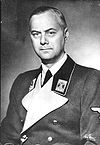 In 1940 Rosenberg was made head of the Hohe Schule (literally "high school", but in Germanic languages refers to a college), the Centre of National Socialist Ideological and Educational Research. He created a "Special Task Force for Music" (Sonderstab Musik) to collect the best musical instrument
s and scores for use in a university to be built in Hitler's home town of Linz
, Austria
. The orders given the Sonderstab Musik were to loot all forms of Jewish property in Germany and of those found in any country taken over by the German army and any musical instruments or scores were to be immediately shipped to Berlin
.
of the USSR
, Rosenberg was appointed head of the Reich Ministry for the Occupied Eastern Territories
(Reichsministerium für die besetzten Ostgebiete). Alfred Meyer
served as his deputy and represented him at the Wannsee Conference
. Another official of the Ministry, Georg Leibbrandt
, also attended the conference, at Rosenberg's request.
Rosenberg had presented Hitler with his plan for the organization of the conquered Eastern territories, suggesting the establishment of new administrative districts, to replace the previously Soviet-controlled territories with new Reichskommissar
iats. These would be:
Such suggestions were intended to encourage certain non-Russia
n nationalism and to promote German
interests for the benefit of future Aryan
generations, in accord with geopolitical "Lebensraum
im Osten" plans. They would provide a buffer against Soviet expansion in preparation for the total eradication of Communism
and Bolshevism by decisive pre-emptive military action.
Following these plans, when Wehrmacht
forces invaded Soviet-controlled territory, they immediately implemented the first of the proposed Reichskommissariats of Ostland
and Ukraine
, under the leadership of Hinrich Lohse
and Erich Koch
, respectively. The organization of these administrative territories led to conflict between Rosenberg and the SS over the treatment of Slavs under German occupation. As Nazi Germany's chief racial theorist, Rosenberg considered Slavs, though lesser than Germans, to be Aryan. Rosenberg often complained to Hitler and Himmler about the treatment of non-Jewish occupied peoples. He proposed creation of buffer satellite states made out of Greater Finland, Baltica, Ukraine, Caucasus. He made no complaints about the murders of Jews. At the Nuremberg Trials
he claimed to be ignorant of the Holocaust, despite the fact that Leibbrandt and Meyer were present at the Wannsee conference
.
to impose the New Order
was essentially a war of conquest and extermination, German propaganda
efforts designed to win over Russian opinion were patchy and inconsistent. Alfred Rosenberg was one of the few in the Nazi hierarchy who advocated a policy designed to encourage anti-Communist opinion.
Amongst other things, Rosenberg issued a series of posters announcing the end of the Soviet collective farms (kolkhoz
). He also issued an Agrarian Law in February 1942, annulling all Soviet legislation on farming, restoring family farms for those willing to collaborate with the occupiers. But decollectivisation conflicted with the wider demands of wartime food production, and Hermann Göring
demanded that the collective farms be retained, save for a change of name. Hitler himself denounced the redistribution of land as "stupid".
There were also numerous German armed forces (Wehrmacht
) posters asking for assistance in the Bandenkrieg, the war against the Soviet partisans
, though, once again, German policy had the effect of adding to their problems. Posters for "volunteer" labour, with inscriptions like "Come work with us to shorten the war", hid the appalling realities faced by Russian workers in Germany
. Many people joined the partisans rather than risk being sent to an unknown fate in the west.
Another of Rosenberg's initiatives, the "Free Caucasus" campaign, was rather more successful, attracting various nationalities into the so-called Eastern Legion (Ostlegionen
), though in the end this made little difference.
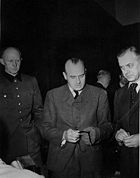
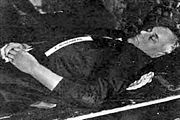 Rosenberg was captured by Allied
troops at the end of the war. He was tried at Nuremberg
and found guilty of conspiracy to commit crimes against peace; planning, initiating and waging wars of aggression; war crimes; and crimes against humanity. He was sentenced to death and executed with other condemned co-defendants at Nuremberg on the morning of 16 October 1946. Throughout the trial, it was agreed that Rosenberg had a decisive role in shaping Nazi philosophy and ideology; such examples include: his book, Myth of the Twentieth Century, which was published in 1930, where he incited hatred against "Liberal Imperialism
" and "Bolshevik Marxism
"; furthering the influence of the "Lebensraum
" idea in Germany during the war; facilitating the persecution of Christian churches and the Jews in general; and opposition to the Versailles Treaty during the war.
According to Howard K. Smith
, who covered the executions for the International News Service
, Rosenberg was the only condemned man, who when asked at the gallows if he had any last statement to make, replied with only one word: "No".
Rosenberg's influence in the Nazi Party is controversial. He was perceived as lacking the charisma and political skills of the other Nazi leaders, and was somewhat isolated. In some of his speeches Hitler appeared to be close to Rosenberg's views: rejecting traditional Christianity
as a religion based on Jewish culture, preferring an ethnically and culturally pure "Race" whose destiny was supposed to be assigned to the German people by "Providence". In others, he adhered to the Nazi Party line, which advocated a "positive Christianity".
After Hitler's assumption of power he moved to reassure the Protestant and Catholic churches that the party was not intending to reinstitute Germanic paganism
. He placed himself in the position of being the man to save Positive Christianity from utter destruction at the hands of the atheistic antitheist Communist
s of the Soviet Union
. This was especially true immediately before and after the elections of 1932; Hitler wanted to appear non-threatening to major Christian faiths and consolidate his power. Further, Hitler felt that Catholic-Protestant infighting had been a major factor in weakening the German state and allowing its dominance by foreign powers.
Some Nazi leaders, such as Martin Bormann
, were anti-Christian and sympathetic to Rosenberg. Once in power, however, Hitler and most Nazi leaders sought to unify the Christian denominations in favor of "positive Christianity." They privately complained about Rosenberg's radical, openly anti-Christian views; they also did not support small neo-pagan groups that were seeking parity with Christianity, which Rosenberg encouraged. However, Goebbels and Hitler both agreed that after the Endsieg
(Final Victory) the Reich Church
should be pressed into evolving into a German social evolutionist organisation proclaiming the cult of race, blood and battle, instead of Redemption and the Ten Commandments
of Moses
, which they deemed outdated and Jewish.
Heinrich Himmler
's views were among the closest to Rosenberg's, and their estrangement was perhaps created by Himmler's abilities to put into action what Rosenberg had only written of. Also, while Rosenberg thought Christianity should be allowed to die out, Himmler actively set out to create countering pagan rituals.
Lieutenant Colonel William Harold Dunn (1898 - 1955) wrote a medical and psychiatric report on him in prison to evaluate him as a suicide risk:
Summarizing the unresolved conflict between the personal views of Rosenberg and the pragmatism of the Nazi elite:
, in 1915; after eight years of marriage, they divorce
d in 1923. He married his second wife, Hedwig Kramer, in 1925; the marriage lasted until his death. He and Kramer had two children; a son, who died in infancy, and a daughter, Irene; who was born in 1930. His daughter has refused contact with anyone seeking information about her father.
Adolf Hitler
Adolf Hitler was an Austrian-born German politician and the leader of the National Socialist German Workers Party , commonly referred to as the Nazi Party). He was Chancellor of Germany from 1933 to 1945, and head of state from 1934 to 1945...
by Dietrich Eckart
Dietrich Eckart
Dietrich Eckart was a German journalist and politician, together with Adolf Hitler one of the early key members of the Nazi Party and a participant of the 1923 Beer Hall Putsch.-Biography:...
; he later held several important posts in the Nazi government. He is considered one of the main authors of key Nazi ideological creeds, including its racial theory
Nazism and race
Nazism developed several theories concerning races. The Nazis claimed to scientifically measure a strict hierarchy of human race; at the top was the master race, the "Aryan race", narrowly defined by the Nazis as being identical with the Nordic race, followed by lesser races.At the bottom of this...
, persecution of the Jews, Lebensraum
Lebensraum
was one of the major political ideas of Adolf Hitler, and an important component of Nazi ideology. It served as the motivation for the expansionist policies of Nazi Germany, aiming to provide extra space for the growth of the German population, for a Greater Germany...
, abrogation of the Treaty of Versailles
Treaty of Versailles
The Treaty of Versailles was one of the peace treaties at the end of World War I. It ended the state of war between Germany and the Allied Powers. It was signed on 28 June 1919, exactly five years after the assassination of Archduke Franz Ferdinand. The other Central Powers on the German side of...
, and opposition to "degenerate"
Degenerate art
Degenerate art is the English translation of the German entartete Kunst, a term adopted by the Nazi regime in Germany to describe virtually all modern art. Such art was banned on the grounds that it was un-German or Jewish Bolshevist in nature, and those identified as degenerate artists were...
modern art
Modern art
Modern art includes artistic works produced during the period extending roughly from the 1860s to the 1970s, and denotes the style and philosophy of the art produced during that era. The term is usually associated with art in which the traditions of the past have been thrown aside in a spirit of...
. He is also known for his rejection of Christianity
Christianity
Christianity is a monotheistic religion based on the life and teachings of Jesus as presented in canonical gospels and other New Testament writings...
, having played an important role in the development of Positive Christianity
Positive Christianity
Positive Christianity was a slogan of Nazi propaganda adopted at the NSDAP congress 1920 to express a worldview which is Christian, non-confessional, vigorously opposed to the spirit of "Jewish Materialism", and oriented to the principle of voluntary association of those with a common...
, which he intended to be transitional to a new Nazi faith. At Nuremberg
Nuremberg Trials
The Nuremberg Trials were a series of military tribunals, held by the victorious Allied forces of World War II, most notable for the prosecution of prominent members of the political, military, and economic leadership of the defeated Nazi Germany....
he was tried, sentenced to death
Capital punishment
Capital punishment, the death penalty, or execution is the sentence of death upon a person by the state as a punishment for an offence. Crimes that can result in a death penalty are known as capital crimes or capital offences. The term capital originates from the Latin capitalis, literally...
and executed by hanging
Hanging
Hanging is the lethal suspension of a person by a ligature. The Oxford English Dictionary states that hanging in this sense is "specifically to put to death by suspension by the neck", though it formerly also referred to crucifixion and death by impalement in which the body would remain...
as a war criminal
War crime
War crimes are serious violations of the laws applicable in armed conflict giving rise to individual criminal responsibility...
.
Early career
Rosenberg was born in 1893 in Reval (today's TallinnTallinn
Tallinn is the capital and largest city of Estonia. It occupies an area of with a population of 414,940. It is situated on the northern coast of the country, on the banks of the Gulf of Finland, south of Helsinki, east of Stockholm and west of Saint Petersburg. Tallinn's Old Town is in the list...
, in Estonia
Estonia
Estonia , officially the Republic of Estonia , is a state in the Baltic region of Northern Europe. It is bordered to the north by the Gulf of Finland, to the west by the Baltic Sea, to the south by Latvia , and to the east by Lake Peipsi and the Russian Federation . Across the Baltic Sea lies...
, then part of the Russian Empire
Russian Empire
The Russian Empire was a state that existed from 1721 until the Russian Revolution of 1917. It was the successor to the Tsardom of Russia and the predecessor of the Soviet Union...
) to a family of Baltic Germans: his father, Waldemar Wilhelm Rosenberg, was a wealthy merchant from Latvia
Latvia
Latvia , officially the Republic of Latvia , is a country in the Baltic region of Northern Europe. It is bordered to the north by Estonia , to the south by Lithuania , to the east by the Russian Federation , to the southeast by Belarus and shares maritime borders to the west with Sweden...
, his mother, Elfriede, from Estonia
Estonia
Estonia , officially the Republic of Estonia , is a state in the Baltic region of Northern Europe. It is bordered to the north by the Gulf of Finland, to the west by the Baltic Sea, to the south by Latvia , and to the east by Lake Peipsi and the Russian Federation . Across the Baltic Sea lies...
. (Tallinn archivist J. Rajandi claimed in the 1930s that Rosenberg's family had Estonian origins.)
The young Rosenberg studied architecture
Architecture
Architecture is both the process and product of planning, designing and construction. Architectural works, in the material form of buildings, are often perceived as cultural and political symbols and as works of art...
at the Riga Polytechnical Institute and engineering
Engineering
Engineering is the discipline, art, skill and profession of acquiring and applying scientific, mathematical, economic, social, and practical knowledge, in order to design and build structures, machines, devices, systems, materials and processes that safely realize improvements to the lives of...
at Moscow Highest Technical School
completing his Ph.D.
Doctor of Philosophy
Doctor of Philosophy, abbreviated as Ph.D., PhD, D.Phil., or DPhil , in English-speaking countries, is a postgraduate academic degree awarded by universities...
studies in 1917. While in Riga, he was a member of the Baltic German student fraternity "Rubonia". During the Russian Revolution of 1917
Russian Revolution of 1917
The Russian Revolution is the collective term for a series of revolutions in Russia in 1917, which destroyed the Tsarist autocracy and led to the creation of the Soviet Union. The Tsar was deposed and replaced by a provisional government in the first revolution of February 1917...
Rosenberg supported the counter-revolutionaries; following their failure he emigrated to Germany in 1918 along with Max Scheubner-Richter who served as something of a mentor to Rosenberg and to his ideology. He arrived in Munich
Munich
Munich The city's motto is "" . Before 2006, it was "Weltstadt mit Herz" . Its native name, , is derived from the Old High German Munichen, meaning "by the monks' place". The city's name derives from the monks of the Benedictine order who founded the city; hence the monk depicted on the city's coat...
and contributed to Dietrich Eckart
Dietrich Eckart
Dietrich Eckart was a German journalist and politician, together with Adolf Hitler one of the early key members of the Nazi Party and a participant of the 1923 Beer Hall Putsch.-Biography:...
's publication, the Völkischer Beobachter
Völkischer Beobachter
The Völkischer Beobachter was the newspaper of the National Socialist German Workers' Party from 1920. It first appeared weekly, then daily from February 8, 1923...
(People's Observer). By this time, he was both an antisemite - influenced by Houston Stewart Chamberlain
Houston Stewart Chamberlain
Houston Stewart Chamberlain was a British-born German author of books on political philosophy, natural science and the German composer Richard Wagner. He later became a German citizen. Chamberlain married Wagner's daughter, Eva, some years after Wagner's death...
's book The Foundations of the Nineteenth Century
The Foundations of the Nineteenth Century
The Foundations of the Nineteenth Century was the best-selling work by Houston Stewart Chamberlain...
(one of the key proto-Nazi books of racial theory) - and an anti-bolshevik
Anti-bolshevism
Anti-bolshevism has two principal forms:* Anti-bolshevik Anti-communism* Anti-Bolshevik Communism...
(as a result of his family's exile
Exile
Exile means to be away from one's home , while either being explicitly refused permission to return and/or being threatened with imprisonment or death upon return...
).
Rosenberg became one of the earliest members of the German Workers Party (later the National Socialist German Workers Party, better known as the Nazi Party), joining in January 1919; Adolf Hitler
Adolf Hitler
Adolf Hitler was an Austrian-born German politician and the leader of the National Socialist German Workers Party , commonly referred to as the Nazi Party). He was Chancellor of Germany from 1933 to 1945, and head of state from 1934 to 1945...
did not join until October 1919. Rosenberg had also been a member of the Thule Society
Thule Society
The Thule Society , originally the Studiengruppe für germanisches Altertum , was a German occultist and völkisch group in Munich, named after a mythical northern country from Greek legend...
, with Eckart. After the Völkischer Beobachter
Völkischer Beobachter
The Völkischer Beobachter was the newspaper of the National Socialist German Workers' Party from 1920. It first appeared weekly, then daily from February 8, 1923...
became the Nazi party newspaper (December, 1920), Rosenberg became its editor in 1923. Rosenberg was a leading member of Aufbau Vereinigung
Aufbau Vereinigung
Aufbau Vereinigung was a Munich based counterrevolutionary conspiratorial group formed in the aftermath of The German occupation of the Ukraine in 1918 and the Latvian Intervention of 1919, composed of White Russian émigrés and early German National Socialists...
, Reconstruction Organisation, a conspiratorial organisation of White Russian émigrés which had a critical influence on early Nazi policy.
In 1923, after the failed Beer Hall Putsch
Beer Hall Putsch
The Beer Hall Putsch was a failed attempt at revolution that occurred between the evening of 8 November and the early afternoon of 9 November 1923, when Nazi Party leader Adolf Hitler, Generalquartiermeister Erich Ludendorff, and other heads of the Kampfbund unsuccessfully tried to seize power...
, Hitler—who had been imprisoned for treason
Treason
In law, treason is the crime that covers some of the more extreme acts against one's sovereign or nation. Historically, treason also covered the murder of specific social superiors, such as the murder of a husband by his wife. Treason against the king was known as high treason and treason against a...
—appointed Rosenberg as a leader of the Nazi movement, a position he held until Hitler's release. Hitler remarked privately in later years that his choice of Rosenberg, whom he regarded as weak and lazy, was strategic; Hitler did not want the temporary leader of the Nazis to be overly popular or hungry for power, because a person with either of those two qualities might not want to cede the party leadership after Hitler's release. However, at the time of the appointment Hitler had no reason to believe that he would soon be released, and Rosenberg had not appeared weak, so that this may been reading back into history his dissatisfaction with Rosenberg for the job he did.
In 1929 Rosenberg founded the Militant League for German Culture
Militant League for German Culture
The Militant League for German Culture [German: Kampfbund für deutsche Kultur ], was a nationalist-minded anti-Semtic political society during the Weimar Republic and the Nazi era...
. He later formed the "Institute for the Study of the Jewish Question", dedicated to identifying and attacking Jewish influence in German culture and to recording the history of Judaism from an antisemitic perspective. He became a Reichstag
Reichstag (Weimar Republic)
The Reichstag was the parliament of Weimar Republic .German constitution commentators consider only the Reichstag and now the Bundestag the German parliament. Another organ deals with legislation too: in 1867-1918 the Bundesrat, in 1919–1933 the Reichsrat and from 1949 on the Bundesrat...
Deputy in 1930 and published his book on racial theory
Master race
Master race was a phrase and concept originating in the slave-holding Southern US. The later phrase Herrenvolk , interpreted as 'master race', was a concept in Nazi ideology in which the Nordic peoples, one of the branches of what in the late-19th and early-20th century was called the Aryan race,...
The Myth of the Twentieth Century
The Myth of the Twentieth Century
The Myth of the Twentieth Century is a book by Alfred Rosenberg, one of the principal ideologues of the Nazi party and editor of the Nazi paper Völkischer Beobachter. It was the most influential Nazi text after Hitler's Mein Kampf. The titular "myth" is "the myth of blood, which under the sign of...
(Der Mythus des 20. Jahrhunderts) which deals with key issues in the national socialist ideology, such as the "Jewish question". Rosenberg intended his book as a sequel to Houston Stewart Chamberlain
Houston Stewart Chamberlain
Houston Stewart Chamberlain was a British-born German author of books on political philosophy, natural science and the German composer Richard Wagner. He later became a German citizen. Chamberlain married Wagner's daughter, Eva, some years after Wagner's death...
's above-cited book. Despite selling more than a million copies by 1945, its influence within Nazism (beyond providing specious intellectual cover for unintellectual governance) remains doubtful. It is often said to have been a book that was officially venerated within Nazism, but that few actually read beyond the first chapter or even found comprehensible. Hitler called it "stuff nobody can understand" and disapproved of its pseudo-religious tone.
Rosenberg's attitude towards Soviet Bolshevism obviously had some influence on Hitler. He convinced Hitler of the Communist threat and of the supposed fragility of the Soviet political structure. "Jewish-Bolshevism" was accepted as a target for Nazism during the early 1920s.
Rosenberg was named leader of the Nazi Party's foreign political office in 1933, but he played little practical part in the role. His visit to Britain
United Kingdom
The United Kingdom of Great Britain and Northern IrelandIn the United Kingdom and Dependencies, other languages have been officially recognised as legitimate autochthonous languages under the European Charter for Regional or Minority Languages...
in that year was designed to reassure the British that the Nazis would not be a threat, and to encourage links between the new regime and the British Empire. It was a notable failure. When Rosenberg laid a wreath bearing a swastika
Swastika
The swastika is an equilateral cross with its arms bent at right angles, in either right-facing form in counter clock motion or its mirrored left-facing form in clock motion. Earliest archaeological evidence of swastika-shaped ornaments dates back to the Indus Valley Civilization of Ancient...
at the tomb of the unknown soldier
The Unknown Warrior
The British tomb of The Unknown Warrior holds an unidentified British soldier killed on a European battlefield during the First World War. He was buried in Westminster Abbey, London on 11 November 1920, simultaneously with a similar interrment of a French unknown soldier at the Arc de Triomphe in...
, a British war veteran threw it into the Thames.
In January 1934 Hitler granted Rosenberg responsibility for the spiritual and philosophical education of the Party and all related organizations.
Racial theories
As the Nazi Party's chief racial theorist, Rosenberg was in charge of building a human racial ladder that justified Hitler's genocidalGenocide
Genocide is defined as "the deliberate and systematic destruction, in whole or in part, of an ethnic, racial, religious, or national group", though what constitutes enough of a "part" to qualify as genocide has been subject to much debate by legal scholars...
policies. Rosenberg built on the works of Arthur de Gobineau
Arthur de Gobineau
Joseph Arthur Comte de Gobineau was a French aristocrat, novelist and man of letters who became famous for developing the theory of the Aryan master race in his book An Essay on the Inequality of the Human Races...
, Houston Stewart Chamberlain
Houston Stewart Chamberlain
Houston Stewart Chamberlain was a British-born German author of books on political philosophy, natural science and the German composer Richard Wagner. He later became a German citizen. Chamberlain married Wagner's daughter, Eva, some years after Wagner's death...
and Madison Grant
Madison Grant
Madison Grant was an American lawyer, historian and physical anthropologist, known primarily for his work as a eugenicist and conservationist...
, as well as the beliefs of Hitler. He considered blacks and Jews to be at the very bottom of the ladder, while at the very top stood the white or "Aryan
Aryan
Aryan is an English language loanword derived from Sanskrit ārya and denoting variously*In scholarly usage:**Indo-Iranian languages *in dated usage:**the Indo-European languages more generally and their speakers...
" race. Rosenberg promoted the Nordic theory
Nordic theory
The Nordic race is one of the racial subcategories into which the Caucasian race was divided by anthropologists in the first half of the 20th century...
which considered Germans to be the "master race
Master race
Master race was a phrase and concept originating in the slave-holding Southern US. The later phrase Herrenvolk , interpreted as 'master race', was a concept in Nazi ideology in which the Nordic peoples, one of the branches of what in the late-19th and early-20th century was called the Aryan race,...
", superior to all others, including other Aryans (Indo-Europeans).
Rosenberg reshaped Nazi racial policy throughout the years, but it always consisted of Aryan supremacy, extreme German nationalism and rabid antisemitism. Rosenberg was also an outspoken opponent of homosexuality
Homosexuality
Homosexuality is romantic or sexual attraction or behavior between members of the same sex or gender. As a sexual orientation, homosexuality refers to "an enduring pattern of or disposition to experience sexual, affectional, or romantic attractions" primarily or exclusively to people of the same...
, notably in his pamphlet "Der Sumpf" ("The Swamp"), having viewed homosexuality (particularly lesbianism) as a hindrance to the expansion of the Nordic population.
Rosenberg's attitude towards the Slav depended on the particular nation involved. He despised Czechs and Poles, and wrote "no considerations can be taken for Poles, Czechs etc., who are as impotent as they are valueless and overbearing. They must be driven back to the east, so that the soil may become free to be tilled by the horny hands of Teutonic peasants", as a result of the ideology of "Drang nach Osten
Drang nach Osten
Drang nach Osten was a term coined in the 19th century to designate German expansion into Slavic lands. The term became a motto of the German nationalist movement in the late nineteenth century...
" Rosenberg believed his mission to be conquest and colonization of Slavic east. In Der Mythus des 20. Jahrhunderts, Rosenberg describes Slavs, in particular Poles, as racial "subhumans".
Regarding Ukrainians he was in favour of creating a buffer state to ease pressure on German eastern frontier, while agreeing with the notion that Russia should be exploited for the benefit of Germany
Religious theories
Rosenberg argued for a new "religion of the blood," based on the supposed innate promptings of the Nordic soul to defend its noble character against racial and cultural degeneration. He believed that this had been embodied in early Indo-EuropeanProto-Indo-Europeans
The Proto-Indo-Europeans were the speakers of the Proto-Indo-European language , a reconstructed prehistoric language of Eurasia.Knowledge of them comes chiefly from the linguistic reconstruction, along with material evidence from archaeology and archaeogenetics...
religions, notably ancient European (Celtic, Germanic, Baltic, Roman
Roman Empire
The Roman Empire was the post-Republican period of the ancient Roman civilization, characterised by an autocratic form of government and large territorial holdings in Europe and around the Mediterranean....
) paganism
Paganism
Paganism is a blanket term, typically used to refer to non-Abrahamic, indigenous polytheistic religious traditions....
, Zoroastrianism
Zoroastrianism
Zoroastrianism is a religion and philosophy based on the teachings of prophet Zoroaster and was formerly among the world's largest religions. It was probably founded some time before the 6th century BCE in Greater Iran.In Zoroastrianism, the Creator Ahura Mazda is all good, and no evil...
and Vedic Hinduism
Historical Vedic religion
The religion of the Vedic period is a historical predecessor of Hinduism. Its liturgy is reflected in the mantra portion of the four Vedas, which are compiled in Sanskrit. The religious practices centered on a clergy administering rites...
. Unlike Heinrich Himmler
Heinrich Himmler
Heinrich Luitpold Himmler was Reichsführer of the SS, a military commander, and a leading member of the Nazi Party. As Chief of the German Police and the Minister of the Interior from 1943, Himmler oversaw all internal and external police and security forces, including the Gestapo...
, he had less attachment to Buddhism
Buddhism
Buddhism is a religion and philosophy encompassing a variety of traditions, beliefs and practices, largely based on teachings attributed to Siddhartha Gautama, commonly known as the Buddha . The Buddha lived and taught in the northeastern Indian subcontinent some time between the 6th and 4th...
.
He rejected Christianity for its universality, for original sin, at least for Germans whom he declared on one occasion were born noble, and for the immortality of the soul. Indeed, absorbing Christianity enfeebled a people. Publicly, he affected to deplore Christianity's degeneration owing to Jewish influence. Following Chamberlain's ideas, he condemned what he called "negative Christianity," the orthodox beliefs of Protestant and Catholic churches, arguing instead for a so-called "positive" Christianity
Positive Christianity
Positive Christianity was a slogan of Nazi propaganda adopted at the NSDAP congress 1920 to express a worldview which is Christian, non-confessional, vigorously opposed to the spirit of "Jewish Materialism", and oriented to the principle of voluntary association of those with a common...
based on Chamberlain's claim that Jesus
Jesus
Jesus of Nazareth , commonly referred to as Jesus Christ or simply as Jesus or Christ, is the central figure of Christianity...
was a member of a Nordic enclave resident in ancient Galilee
Galilee
Galilee , is a large region in northern Israel which overlaps with much of the administrative North District of the country. Traditionally divided into Upper Galilee , Lower Galilee , and Western Galilee , extending from Dan to the north, at the base of Mount Hermon, along Mount Lebanon to the...
who struggled against Judaism. For Rosenberg religious doctrine
Doctrine
Doctrine is a codification of beliefs or a body of teachings or instructions, taught principles or positions, as the body of teachings in a branch of knowledge or belief system...
was not important; what mattered was that a belief should serve the interests of the Nordic race, connecting the individual to his racial nature. Rosenberg stated that "The general ideas of the Roman and of the Protestant churches are negative Christianity and do not, therefore, accord with our (German) soul." His support for Luther as a great German figure was always ambivalent.
Wartime activities
Musical instrument
A musical instrument is a device created or adapted for the purpose of making musical sounds. In principle, any object that produces sound can serve as a musical instrument—it is through purpose that the object becomes a musical instrument. The history of musical instruments dates back to the...
s and scores for use in a university to be built in Hitler's home town of Linz
Linz
Linz is the third-largest city of Austria and capital of the state of Upper Austria . It is located in the north centre of Austria, approximately south of the Czech border, on both sides of the river Danube. The population of the city is , and that of the Greater Linz conurbation is about...
, Austria
Austria
Austria , officially the Republic of Austria , is a landlocked country of roughly 8.4 million people in Central Europe. It is bordered by the Czech Republic and Germany to the north, Slovakia and Hungary to the east, Slovenia and Italy to the south, and Switzerland and Liechtenstein to the...
. The orders given the Sonderstab Musik were to loot all forms of Jewish property in Germany and of those found in any country taken over by the German army and any musical instruments or scores were to be immediately shipped to Berlin
Berlin
Berlin is the capital city of Germany and is one of the 16 states of Germany. With a population of 3.45 million people, Berlin is Germany's largest city. It is the second most populous city proper and the seventh most populous urban area in the European Union...
.
Reich Minister for the Occupied Eastern Territories
Following the invasionOperation Barbarossa
Operation Barbarossa was the code name for Germany's invasion of the Soviet Union during World War II that began on 22 June 1941. Over 4.5 million troops of the Axis powers invaded the USSR along a front., the largest invasion in the history of warfare...
of the USSR
Soviet Union
The Soviet Union , officially the Union of Soviet Socialist Republics , was a constitutionally socialist state that existed in Eurasia between 1922 and 1991....
, Rosenberg was appointed head of the Reich Ministry for the Occupied Eastern Territories
Reich Ministry for the Occupied Eastern Territories
The Reich Ministry for the Occupied Eastern Territories was created by Adolf Hitler on July 1941 and headed by the Nazi theoretical expert and Baltic German, Alfred Rosenberg. Alfred Meyer was Rosenberg's deputy. This ministry was created to control the vast areas captured by the Germans in...
(Reichsministerium für die besetzten Ostgebiete). Alfred Meyer
Alfred Meyer
Dr. Alfred Meyer was a Nazi official, achieving the rank of Staatssekretär and Deputy Reichsminister in the Reich Ministry for the Occupied Eastern Territories .-Early life:Meyer was born in Göttingen, the son of a government official...
served as his deputy and represented him at the Wannsee Conference
Wannsee Conference
The Wannsee Conference was a meeting of senior officials of the Nazi German regime, held in the Berlin suburb of Wannsee on 20 January 1942. The purpose of the conference was to inform administrative leaders of Departments responsible for various policies relating to Jews, that Reinhard Heydrich...
. Another official of the Ministry, Georg Leibbrandt
Georg Leibbrandt
Georg Leibbrandt was a scholar and politician in the Nazi Party.- Early life :Leibbrandt was born to ethnic German parents in Torosovo , near Odessa, in the Zebrikovo district of the Tsarist Russia...
, also attended the conference, at Rosenberg's request.
Rosenberg had presented Hitler with his plan for the organization of the conquered Eastern territories, suggesting the establishment of new administrative districts, to replace the previously Soviet-controlled territories with new Reichskommissar
Reichskommissar
Reichskommissar , in German history, was an official gubernatorial title used for various public offices during the period of the German Empire and the Nazi Third Reich....
iats. These would be:
- OstlandReichskommissariat OstlandReichskommissariat Ostland, literally "Reich Commissariat Eastland", was the civilian occupation regime established by Nazi Germany in the Baltic states and much of Belarus during World War II. It was also known as Reichskommissariat Baltenland initially...
(Baltic countriesBaltic countriesThe term Baltic states refers to the Baltic territories which gained independence from the Russian Empire in the wake of World War I: primarily the contiguous trio of Estonia, Latvia, Lithuania ; Finland also fell within the scope of the term after initially gaining independence in the 1920s.The...
and BelarusBelarusBelarus , officially the Republic of Belarus, is a landlocked country in Eastern Europe, bordered clockwise by Russia to the northeast, Ukraine to the south, Poland to the west, and Lithuania and Latvia to the northwest. Its capital is Minsk; other major cities include Brest, Grodno , Gomel ,...
), - UkraineReichskommissariat UkraineReichskommissariat Ukraine , literally "Reich Commissariat of Ukraine", was the civilian occupation regime of much of German-occupied Ukraine during World War II. Between September 1941 and March 1944, the Reichskommissariat was administered by Reichskommissar Erich Koch as a colony...
(UkraineUkraineUkraine is a country in Eastern Europe. It has an area of 603,628 km², making it the second largest contiguous country on the European continent, after Russia...
and nearest territories), - KaukasusReichskommissariat KaukasusReichskommissariat Kaukasus , literally "Reich Commissariat of the Caucasus ", was the theoretical political division and planned civilian occupation regime of Nazi Germany in the conquered territories of the Caucasus during World War II...
(CaucasiaCaucasusThe Caucasus, also Caucas or Caucasia , is a geopolitical region at the border of Europe and Asia, and situated between the Black and the Caspian sea...
area), - MoskauReichskommissariat MoskauReichskommissariat Moskowien , literally "Reich Commissariat of Muscovy ", was the civilian occupation regime that Nazi Germany intended to create in central and northern European Russia during World War II, one of several similar Reichskommissariate...
(MoscowMoscowMoscow is the capital, the most populous city, and the most populous federal subject of Russia. The city is a major political, economic, cultural, scientific, religious, financial, educational, and transportation centre of Russia and the continent...
metropolitan area and the rest of nearest Russian European areas)
Such suggestions were intended to encourage certain non-Russia
Russia
Russia or , officially known as both Russia and the Russian Federation , is a country in northern Eurasia. It is a federal semi-presidential republic, comprising 83 federal subjects...
n nationalism and to promote German
Germany
Germany , officially the Federal Republic of Germany , is a federal parliamentary republic in Europe. The country consists of 16 states while the capital and largest city is Berlin. Germany covers an area of 357,021 km2 and has a largely temperate seasonal climate...
interests for the benefit of future Aryan
Aryan race
The Aryan race is a concept historically influential in Western culture in the period of the late 19th century and early 20th century. It derives from the idea that the original speakers of the Indo-European languages and their descendants up to the present day constitute a distinctive race or...
generations, in accord with geopolitical "Lebensraum
Lebensraum
was one of the major political ideas of Adolf Hitler, and an important component of Nazi ideology. It served as the motivation for the expansionist policies of Nazi Germany, aiming to provide extra space for the growth of the German population, for a Greater Germany...
im Osten" plans. They would provide a buffer against Soviet expansion in preparation for the total eradication of Communism
Communism
Communism is a social, political and economic ideology that aims at the establishment of a classless, moneyless, revolutionary and stateless socialist society structured upon common ownership of the means of production...
and Bolshevism by decisive pre-emptive military action.
Following these plans, when Wehrmacht
Wehrmacht
The Wehrmacht – from , to defend and , the might/power) were the unified armed forces of Nazi Germany from 1935 to 1945. It consisted of the Heer , the Kriegsmarine and the Luftwaffe .-Origin and use of the term:...
forces invaded Soviet-controlled territory, they immediately implemented the first of the proposed Reichskommissariats of Ostland
Ostland
Ostland may refer to:* In World War II, the Reichskommissariat Ostland was the official designation of some of the eastern territories occupied by Nazi Germany* Ostland is a province of the land called The Empire in Warhammer Fantasy Battles...
and Ukraine
Ukraine
Ukraine is a country in Eastern Europe. It has an area of 603,628 km², making it the second largest contiguous country on the European continent, after Russia...
, under the leadership of Hinrich Lohse
Hinrich Lohse
Hinrich Lohse was a Nazi German politician, best known for his World War II rule of the Baltic states.-Early life:...
and Erich Koch
Erich Koch
Erich Koch was a Gauleiter of the Nazi Party in East Prussia from 1928 until 1945. Between 1941 and 1945 he was the Chief of Civil Administration of Bezirk Bialystok. During this period, he was also the Reichskommissar in Reichskommissariat Ukraine from 1941 until 1943...
, respectively. The organization of these administrative territories led to conflict between Rosenberg and the SS over the treatment of Slavs under German occupation. As Nazi Germany's chief racial theorist, Rosenberg considered Slavs, though lesser than Germans, to be Aryan. Rosenberg often complained to Hitler and Himmler about the treatment of non-Jewish occupied peoples. He proposed creation of buffer satellite states made out of Greater Finland, Baltica, Ukraine, Caucasus. He made no complaints about the murders of Jews. At the Nuremberg Trials
Nuremberg Trials
The Nuremberg Trials were a series of military tribunals, held by the victorious Allied forces of World War II, most notable for the prosecution of prominent members of the political, military, and economic leadership of the defeated Nazi Germany....
he claimed to be ignorant of the Holocaust, despite the fact that Leibbrandt and Meyer were present at the Wannsee conference
Wannsee Conference
The Wannsee Conference was a meeting of senior officials of the Nazi German regime, held in the Berlin suburb of Wannsee on 20 January 1942. The purpose of the conference was to inform administrative leaders of Departments responsible for various policies relating to Jews, that Reinhard Heydrich...
.
Wartime propaganda efforts
Because the invasion of the Soviet UnionSoviet Union
The Soviet Union , officially the Union of Soviet Socialist Republics , was a constitutionally socialist state that existed in Eurasia between 1922 and 1991....
to impose the New Order
New Order (political system)
The New Order or the New Order of Europe was the political order which the Nazis wanted to impose on Europe, and eventually the rest of the world, during their reign over Germany from 1933 to 1945...
was essentially a war of conquest and extermination, German propaganda
Propaganda
Propaganda is a form of communication that is aimed at influencing the attitude of a community toward some cause or position so as to benefit oneself or one's group....
efforts designed to win over Russian opinion were patchy and inconsistent. Alfred Rosenberg was one of the few in the Nazi hierarchy who advocated a policy designed to encourage anti-Communist opinion.
Amongst other things, Rosenberg issued a series of posters announcing the end of the Soviet collective farms (kolkhoz
Kolkhoz
A kolkhoz , plural kolkhozy, was a form of collective farming in the Soviet Union that existed along with state farms . The word is a contraction of коллекти́вное хозя́йство, or "collective farm", while sovkhoz is a contraction of советское хозяйство...
). He also issued an Agrarian Law in February 1942, annulling all Soviet legislation on farming, restoring family farms for those willing to collaborate with the occupiers. But decollectivisation conflicted with the wider demands of wartime food production, and Hermann Göring
Hermann Göring
Hermann Wilhelm Göring, was a German politician, military leader, and a leading member of the Nazi Party. He was a veteran of World War I as an ace fighter pilot, and a recipient of the coveted Pour le Mérite, also known as "The Blue Max"...
demanded that the collective farms be retained, save for a change of name. Hitler himself denounced the redistribution of land as "stupid".
There were also numerous German armed forces (Wehrmacht
Wehrmacht
The Wehrmacht – from , to defend and , the might/power) were the unified armed forces of Nazi Germany from 1935 to 1945. It consisted of the Heer , the Kriegsmarine and the Luftwaffe .-Origin and use of the term:...
) posters asking for assistance in the Bandenkrieg, the war against the Soviet partisans
Soviet partisans
The Soviet partisans were members of a resistance movement which fought a guerrilla war against the Axis occupation of the Soviet Union during World War II....
, though, once again, German policy had the effect of adding to their problems. Posters for "volunteer" labour, with inscriptions like "Come work with us to shorten the war", hid the appalling realities faced by Russian workers in Germany
OST-Arbeiter
OST-Arbeiter was a designation for slave workers gathered from Eastern Europe to do forced labor in Germany during World War II. The Ostarbeiters were mostly from the territory of Reichskommissariat Ukraine . Ukrainians made up the largest portion although many Belarusians, Russians, Poles and...
. Many people joined the partisans rather than risk being sent to an unknown fate in the west.
Another of Rosenberg's initiatives, the "Free Caucasus" campaign, was rather more successful, attracting various nationalities into the so-called Eastern Legion (Ostlegionen
Ostlegionen
Ostlegionen or Osttruppen were conscripts and volunteers from the occupied eastern territories recruited into the German Army of the Third Reich during the Second World War....
), though in the end this made little difference.
Trial and execution
Allies
In everyday English usage, allies are people, groups, or nations that have joined together in an association for mutual benefit or to achieve some common purpose, whether or not explicit agreement has been worked out between them...
troops at the end of the war. He was tried at Nuremberg
Nuremberg Trials
The Nuremberg Trials were a series of military tribunals, held by the victorious Allied forces of World War II, most notable for the prosecution of prominent members of the political, military, and economic leadership of the defeated Nazi Germany....
and found guilty of conspiracy to commit crimes against peace; planning, initiating and waging wars of aggression; war crimes; and crimes against humanity. He was sentenced to death and executed with other condemned co-defendants at Nuremberg on the morning of 16 October 1946. Throughout the trial, it was agreed that Rosenberg had a decisive role in shaping Nazi philosophy and ideology; such examples include: his book, Myth of the Twentieth Century, which was published in 1930, where he incited hatred against "Liberal Imperialism
Liberal Imperialists
The Liberal Imperialists were a grouping within the British Liberal Party, the most prominent of whom were R. B. Haldane, H. H. Asquith, Sir Edward Grey and Lord Rosebery....
" and "Bolshevik Marxism
Marxism
Marxism is an economic and sociopolitical worldview and method of socioeconomic inquiry that centers upon a materialist interpretation of history, a dialectical view of social change, and an analysis and critique of the development of capitalism. Marxism was pioneered in the early to mid 19th...
"; furthering the influence of the "Lebensraum
Lebensraum
was one of the major political ideas of Adolf Hitler, and an important component of Nazi ideology. It served as the motivation for the expansionist policies of Nazi Germany, aiming to provide extra space for the growth of the German population, for a Greater Germany...
" idea in Germany during the war; facilitating the persecution of Christian churches and the Jews in general; and opposition to the Versailles Treaty during the war.
According to Howard K. Smith
Howard K. Smith
Howard Kingsbury Smith was an American journalist, radio reporter, television anchorman, political commentator, and film actor. He was one of the original Edward R. Murrow boys.-Early life:...
, who covered the executions for the International News Service
International News Service
International News Service was a U.S.-based news agency founded by newspaper publisher William Randolph Hearst in 1909.Established two years after the Scripps family founded the United Press Association, INS scrapped among the newswires...
, Rosenberg was the only condemned man, who when asked at the gallows if he had any last statement to make, replied with only one word: "No".
Nazi policy and Rosenberg's views
Hitler was a leader oriented towards practical politics, whereas, for Rosenberg, religion and philosophy were key and he was the most influential within the party. Several accounts of the time before the Nazi ascension to power, indeed, speak of Hitler as being a mouthpiece for Rosenberg's views, and he clearly exerted a great deal of intellectual influence.Rosenberg's influence in the Nazi Party is controversial. He was perceived as lacking the charisma and political skills of the other Nazi leaders, and was somewhat isolated. In some of his speeches Hitler appeared to be close to Rosenberg's views: rejecting traditional Christianity
Conservative Christianity
Conservative Christianity is a term applied to a number of groups or movements seen as giving priority to traditional Christian beliefs and practices...
as a religion based on Jewish culture, preferring an ethnically and culturally pure "Race" whose destiny was supposed to be assigned to the German people by "Providence". In others, he adhered to the Nazi Party line, which advocated a "positive Christianity".
After Hitler's assumption of power he moved to reassure the Protestant and Catholic churches that the party was not intending to reinstitute Germanic paganism
Germanic paganism
Germanic paganism refers to the theology and religious practices of the Germanic peoples of north-western Europe from the Iron Age until their Christianization during the Medieval period...
. He placed himself in the position of being the man to save Positive Christianity from utter destruction at the hands of the atheistic antitheist Communist
Religion in the Soviet Union
The Soviet Union was the first state to have as an ideological objective the elimination of religion and its replacement with atheism. To that end, the communist regime confiscated religious property, ridiculed religion, harassed believers, and propagated atheism in schools...
s of the Soviet Union
Soviet Union
The Soviet Union , officially the Union of Soviet Socialist Republics , was a constitutionally socialist state that existed in Eurasia between 1922 and 1991....
. This was especially true immediately before and after the elections of 1932; Hitler wanted to appear non-threatening to major Christian faiths and consolidate his power. Further, Hitler felt that Catholic-Protestant infighting had been a major factor in weakening the German state and allowing its dominance by foreign powers.
Some Nazi leaders, such as Martin Bormann
Martin Bormann
Martin Ludwig Bormann was a prominent Nazi official. He became head of the Party Chancellery and private secretary to Adolf Hitler...
, were anti-Christian and sympathetic to Rosenberg. Once in power, however, Hitler and most Nazi leaders sought to unify the Christian denominations in favor of "positive Christianity." They privately complained about Rosenberg's radical, openly anti-Christian views; they also did not support small neo-pagan groups that were seeking parity with Christianity, which Rosenberg encouraged. However, Goebbels and Hitler both agreed that after the Endsieg
Endsieg
Endsieg is German for "final victory". It is used in the meaning that a victory is taken for granted even though all odds are against it.- Origin and historical usage :The word became commonly used in World War I...
(Final Victory) the Reich Church
Protestant Reich Church
The Protestant Reich Church, officially German Evangelical Church and colloquially Reichskirche, was formed in 1936 to merge the 28 regional churches into a unified state church that espoused a single doctrine compatible with National Socialism...
should be pressed into evolving into a German social evolutionist organisation proclaiming the cult of race, blood and battle, instead of Redemption and the Ten Commandments
Ten Commandments
The Ten Commandments, also known as the Decalogue , are a set of biblical principles relating to ethics and worship, which play a fundamental role in Judaism and most forms of Christianity. They include instructions to worship only God and to keep the Sabbath, and prohibitions against idolatry,...
of Moses
Moses
Moses was, according to the Hebrew Bible and Qur'an, a religious leader, lawgiver and prophet, to whom the authorship of the Torah is traditionally attributed...
, which they deemed outdated and Jewish.
Heinrich Himmler
Heinrich Himmler
Heinrich Luitpold Himmler was Reichsführer of the SS, a military commander, and a leading member of the Nazi Party. As Chief of the German Police and the Minister of the Interior from 1943, Himmler oversaw all internal and external police and security forces, including the Gestapo...
's views were among the closest to Rosenberg's, and their estrangement was perhaps created by Himmler's abilities to put into action what Rosenberg had only written of. Also, while Rosenberg thought Christianity should be allowed to die out, Himmler actively set out to create countering pagan rituals.
Lieutenant Colonel William Harold Dunn (1898 - 1955) wrote a medical and psychiatric report on him in prison to evaluate him as a suicide risk:
He gave the impression of clinging to his own theories in a fanatical and unyielding fashion and to have been little influenced by the unfolding during the trial of the cruelty and crimes of the party.
Summarizing the unresolved conflict between the personal views of Rosenberg and the pragmatism of the Nazi elite:
The ruthless pursuit of Nazi aims turned out to mean not, as Rosenberg had hoped, the permeation of German life with the new ideology; it meant concentration of the combined resources of party and state on total warTotal warTotal war is a war in which a belligerent engages in the complete mobilization of fully available resources and population.In the mid-19th century, "total war" was identified by scholars as a separate class of warfare...
.
Family life
Rosenberg was married twice. He married his first wife, Hilda Leesmann, an ethnic EstonianEstonians
Estonians are a Finnic people closely related to the Finns and inhabiting, primarily, the country of Estonia. They speak a Finnic language known as Estonian...
, in 1915; after eight years of marriage, they divorce
Divorce
Divorce is the final termination of a marital union, canceling the legal duties and responsibilities of marriage and dissolving the bonds of matrimony between the parties...
d in 1923. He married his second wife, Hedwig Kramer, in 1925; the marriage lasted until his death. He and Kramer had two children; a son, who died in infancy, and a daughter, Irene; who was born in 1930. His daughter has refused contact with anyone seeking information about her father.
Writings
- Das Verbrechen der Freimaurerei: Judentum, Jesuitismus, Deutsches Christentum, 1921 ("The Crime of Freemasonry: Judaism, Jesuitism, German Christianity")
- Die Protokolle der Weisen von Zion und die jüdische Weltpolitik, 1923 ("The Protocols of the Elders of Zion and the Jewish World Politics")
- Der Mythus des 20. JahrhundertsThe Myth of the Twentieth CenturyThe Myth of the Twentieth Century is a book by Alfred Rosenberg, one of the principal ideologues of the Nazi party and editor of the Nazi paper Völkischer Beobachter. It was the most influential Nazi text after Hitler's Mein Kampf. The titular "myth" is "the myth of blood, which under the sign of...
, 1930 ("The Myth of the 20th Century") - Dietrich Eckhart. Ein Vermächtnis, 1935 ("Dietrich Eckhart: A Legacy")
- An die Dunkelmänner unserer Zeit. Eine Antwort auf die Angriffe gegen den „Mythus des 20. Jahrhunderts“, 1937 ("The Obscurantists of Our Time: A Response to the Attacks Against 'The Myth of the 20th Century'")
- Protestantische RompilgerProtestantische RompilgerProtestantische Rompilger was a polemic written by Alfred Rosenberg to answer the Protestant criticism of his 1930 The Myth of the Twentieth Century. It was also aimed against Friedrich Rittelmeyer and the Christengemeinschaft...
. Der Verrat an Luther und der „Mythus des 20. Jahrhunderts“, 1937 ("Protestant Rome Pilgrims: The Betrayal of Luther and the 'Myth of the 20th Century'")
See also
- Antisemitism
- Myth of the Twentieth Century
- Nordische GesellschaftNordische GesellschaftNordische Gesellschaft was an association founded in 1921, with the objective of strengthening German-Nordic cultural and political cooperation. It was based in Lübeck, Germany. The association had both German and Scandinavian members. After the National Socialist take-over in Germany 1933...
- RacismRacismRacism is the belief that inherent different traits in human racial groups justify discrimination. In the modern English language, the term "racism" is used predominantly as a pejorative epithet. It is applied especially to the practice or advocacy of racial discrimination of a pernicious nature...
External links
- Rosenbergs 1946 memoirs, at archive.org
- The Myth of the Twentieth Century at archive.org
- Der Mythus Des Zwanzigsten Jahrhunderts at archive.org
- Der Protestantische Rompilger at archive.org.
- An die Dunkelmänner unserer Zeit at archive.org.
- Tradition und Gegenwart - Reden und Aufsätze 1936-1940 at archive.org.
- Die Protokolle der Weisen von Zion und die jüdische Weltpolitik at archive.org.
- Unmoral in Talmud at archive.org.
- Wesen, Grundsätze und Ziele der NSDAP - Das Programm der Bewegung at archive.org.
- United States Holocaust Memorial Museum - Alfred Rosenberg
- Rosenberg on Churchill
- Rosenberg on Nuremberg Rally