

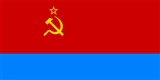
Ukrainian SSR

Encyclopedia
The Ukrainian Soviet Socialist Republic or in short, the Ukrainian SSR was a sovereign Soviet Socialist state (Article 68, Constitution of Ukraine 1978) and one of the fifteen constituent republics of the Soviet Union
lasting from its inception in 1922 (the Ukrainian SSR was formally established in 1919) to the breakup in 1991. Although the Ukrainian SSR was a founding member of the United Nations
formed after the end of World War II
, it practically had no say in its foreign affairs, which was tightly controlled by Moscow
authorities. Upon the Soviet Union's dissolution and perestroika
, the Ukrainian SSR was transformed into the modern nation-state of Ukraine
.
Throughout its 72-year history, the republic's borders changed many times, with a significant portion of what is now Western Ukraine
being annexed by Soviet forces
in 1939 and the addition of formerly Russian Crimea
in 1954. From the start, the eastern city of Kharkiv
served as the republic's capital. However, in 1934, the seat of government was subsequently moved to the city of Kiev
, which remained the capital of newly-independent Ukraine.
Geographically, the Ukrainian SSR was situated in Eastern Europe
to the north of the Black Sea
, bordered by the Soviet republics of Moldova, Belarus, and Russia
. The Ukrainian SSR's border with Czechoslovakia
formed the Soviet Union's western-most border point. With the Soviet Census of 1989
, the republic's population consisted of 51,706,746 inhabitants, although the population would fall sharply after the breakup of the Soviet Union.
. In July 1918 the former members of the government formed the Communist Party (Bolsheviks) of Ukraine, the constituent assembly of which took place in Moscow.
With the defeat of the Central Powers
in World War I
, Bolshevik
Russia resumed its hostilities towards the Ukrainian People's Republic
fighting for Ukrainian independence and organized another Soviet government in Kursk
, Russia. On March 10, 1919, according to the 3rd Congress of Soviets in Ukraine (conducted March 6–10, 1919) the name of the state was changed to the "Ukrainian Socialist Soviet Republic" (abbreviated "УСРР" in Ukrainian as opposed to the later "УРСР").
After the ratification of the 1936 Soviet Constitution
, the names of all Soviet republics was changed, transposing the second ("socialist") and third ("soviet" or "radianska" in Ukrainian) words. In accordance, on December 5, 1936, the 8th Extraordinary Congress Soviets in Soviet Union changed the name of the republic to the "Ukrainian Soviet Socialist Republic," which was ratified by the 14th Extraordinary Congress of Soviets in Ukrainian SSR on January 31, 1937.
, several factions sought to create an independent Ukrainian state, alternately cooperating and struggling against each other. Numerous more or less socialist-oriented factions participated in the formation of the Ukrainian National Republic (UNR) among which were Bolshevik
s, Menshevik
s, Socialists-Revolutionaries, and many others. The most popular faction was initially the local Socialist-Revolutionary that composed the local government together with Federalists and Mensheviks. The Bolsheviks boycotted any government initiatives most of the time, instigating several armed riots in order to establish the Soviet power without any intent for consensus.
Right after the October Revolution
in Petrograd Bolsheviks instigated the Kiev Bolshevik Uprising
in support to the Revolution and to secure Kiev in their hands, but surprisingly it did not go as planned. Due to lack of adequate support from the local population and anti-revolutionary Central Rada, the Bolshevik split and most of them moved to Kharkiv
where they were supported in big cities and industrial centers of the eastern Ukraine. Later this move was recognized as a misstep by some of the People's Commissars (Yevgenia Bosch). They issued an ultimatum to the Central Rada on 17 December to recognize the Soviet regime of which the Rada was very critical. The Bolsheviks convened a separate congress and declared the first Soviet Republic of Ukraine on 24 December 1917 claiming the Central Rada and its supporters outlaws that need to be eradicated. Warfare ensued against the Ukrainian National Republic (UNR) for the installation of the Soviet regime in the country and with the direct support from the Soviet Russia
the Ukrainian National forces were practically overran. The government of Ukraine appealed to the World Community finding the support in the face of the Central Powers as the others refused to recognize it. After the Treaty of Brest-Litovsk
, the Russian SFSR yielded all the captured Ukrainian territory as the Bolsheviks were forced out of Ukraine. The government of the Soviet Ukraine was dissolved after its last session on 20 November 1918.
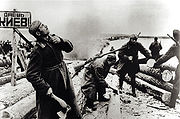 Eventually after creation of the Communist Party (Bolshevik) of Ukraine in Moscow a new Ukrainian Soviet government was formed on 21 December 1919 that initiate new hostilities against Ukraine as it lost its military support from the defeated Central Powers. Eventually, the Red Army
ended up controlling much of the Ukrainian territory after the Polish-Soviet Peace of Riga
. On 30 December 1922, along with the Russian, Byelorussian
, and Transcaucasian
republics, the Ukrainian SSR was one of the founding members of the Union of Soviet Socialist Republics (USSR).
In 1932 the Soviet government inflicted one of the largest national catastrophes in modern history of the Ukrainian nation
. A man-made famine known as the Holodomor
caused a direct loss of human life estimated between 2.6 million to 10 million.
In September 1939 the Soviet Union invaded Poland
, and added Galician lands inhabited by Ukrainians to the territory of the Ukrainian SSR. In 1945, these lands were permanently annexed, and the Transcarpathia
region was added as well, by treaty with the post-war administration of Czechoslovakia. Following eastward Soviet retreat in 1941, Ufa
became the wartime seat of the Soviet Ukrainian government. After World War II some amendments to the Constitution of the Ukrainian SSR were accepted, which allowed it to act as a separate subject of international law in some cases and to a certain extent, remaining a part of the Soviet Union at the same time. In particular, these amendments allowed the Ukrainian SSR to become one of founding members of the United Nations (UN) together with the Soviet Union and the Byelorussian SSR. This was part of a deal with the United States
to ensure a degree of balance in the General Assembly
, which, the USSR opined, was unbalanced in favor of the Western Bloc. In its capacity as a member of the UN, the Ukrainian SSR was an elected member of the United Nations Security Council
in 1948-1949 and 1984-1985.
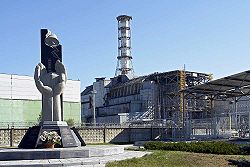
The Ukrainian SSR was also the site of the Chernobyl disaster
in 1986, when a reactor at the Chernobyl Nuclear Power Plant
melted down
and exploded, subjecting countless multitudes to radiological effects.
single-party
communist
system ruled by the Communist Party (Bolsheviks) of Ukraine that was part of the Communist Party of Soviet Union (KPSS). The republic was one of 15 constituent republics composing the Soviet Union from its entry into the union in 1922 till its dissolution in 1991. All of the political power and authority in the USSR was in the hands of Communist Party authorities, with little real power being concentrated in official government bodies and organs. In such a system, lower-level authorities directly reported to higher level authorities and so on, with the bulk of the power being held at the highest echelons of the Communist Party.
Originally the legislative authority was vested in the Central Executive Committee of Ukraine
that for many years was headed by Grigoriy Petrovsky. Soon after publishing the Stalin Constitution, the Central Executive Committee was transformed into the Supreme Council
(Verkhovna Rada), which consisted of 450 deputies. The Supreme Council had the authority to enact legislation, amend the constitution, adopt new administrative and territorial boundaries, adopt the budget, and establish political and economic development plans. In addition, parliament also had to authority to elect the republic's executive branch, the Council of Ministers as well as the power to appoint judges to the Supreme Court. Legislative sessions were short and were conducted for only a few weeks out of the year. In spite of this, the Supreme Soviet elected the Presidium, the Chairman
, 3 deputy chairmen, a secretary, and a couple of other government members to carry out the official functions and duties in between legislative sessions. The Presidium was a powerful position in the republic's higher echelons of power, and could nominally be considered the equivalent of head of state
, although most executive authority would be concentrated in the Communist Party's politburo
and its First Secretary.
Full universal suffrage
was granted for all eligible citizens aged 18 and over, excluding prisoners and those deprived of freedom. Although they could not be considered free and were of a symbolic nature, elections to the Supreme Soviet were contested every five years. Nominees from electoral districts from around the republic, typically consisting of an average of 110,000 inhabitants, were directly chosen by party authorities, providing little opportunity for political change, since all political authority was directly subordinate to the higher level above it.
With the beginning of Soviet President
Mikhail Gorbachev
's perestroika
reforms towards the mid-late 1980s, electoral reform laws were passed in 1989, liberalizing the nominating procedures and allowing multiple candidates to stand for election in a district. Accordingly, the first relatively free elections
in the Ukrainian SSR were contested in March 1990. 111 deputies from the Democratic Bloc
, a loose association of small pro-Ukrainian and pro-sovereignty parties and the instrumental People's Movement of Ukraine
(colloquially known as Rukh in Ukrainian) were elected to the parliament. Although the Communist Party retained its majority with 331 deputies, large support for the Democratic Bloc demonstrated the people's distrust of the Communist authorities, which would eventually boil down to Ukrainian independence in 1991.
On the international front, the Ukrainian SSR, along with the rest of the 15 republics, virtually had no say in their own foreign affairs. It is, however, important to note that in 1944 the Ukrainian SSR was permitted to establish bilateral relations with countries and maintain its own standing army. This clause was used to permit the republic's membership in the United Nations
. Accordingly, representatives from the "Ukrainian Soviet Socialist Republic" and 50 other nations founded the UN on October 24, 1945. In effect, this provided the Soviet Union (a permanent Security Council
member with veto powers) with another vote in the General Assembly
. The latter aspect of the 1944 clauses, however, was never fulfilled and the republic's defense matters were managed by the Soviet Armed Forces
and the Defense Ministry. Another right that was granted but never used until 1991 was the right of the Soviet republics to secede from the union, which was codified in each of the Soviet constitutions
. Accordingly, Article 69 of the Constitution of the Ukrainian SSR stated: "The Ukrainian SSR retains the right to willfully secede from the USSR." However, a republic's theoretical secession from the union was virtually impossible and unrealistic in many ways until after Gorbachev's perestroika reforms.
, the capital and seat of government of the country. The constituent republic were essentially unitary state
s, with lower levels of power being directly subordinate to higher ones. Throughout its 72-year existence, the administrative divisions of the Ukrainian SSR changed numerous times, often incorporating regional reorganization and annexation on the part of Soviet authorities during World War II.
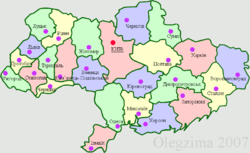
The most common administrative division was the oblast
(province), of which there were 25 upon the republic's independence from the Soviet Union in 1991. Provinces were further subdivided into raion
s (districts) which numbered 490. The rest of the administrative division within the provinces consisted of cities, urban-type settlement
s, and villages. Cities in the Ukrainian SSR were a separate exception, which could either be subordinate to either the provincial authorities themselves or the district authorities of which they were the administrative center. Two cities, the capital Kiev
, and Sevastopol
in Crimea, treated separately because it housed an underground nuclear submarine base, were designated "cities with special status." This meant that they were directly subordinate to the central Ukrainian SSR authorities and not the provincial authorities surrounding them.
, which fought against the Ukrainian SSR government in the Ukrainian Civil War. Accordingly, the eastern city of Kharkiv
was chosen as the republic's seat of government, colloquially named in the media as "the first capital" with implication to the era of Soviet regime. Kharkiv was also the city where the first Soviet Ukrainian government was created in 1917 with strong support from Russian SFSR authorities. However, in 1934, the capital was moved from Kharkiv to Kiev
, which remains the capital of Ukraine today, although at first Kharkiv retained some government offices and buildings for some time after the move.
During the 1930s, there were significant numbers of ethnic minorities living within the Ukrainian SSR. National Districts were formed as separate territorial-administrative units within higher-level provincial authorities. Districts were established for the republic's three largest minority groups, which were the Jews
, Russians
, and Poles
. Other ethnic groups, however, were allowed to petition the government for their own national autonomy. From 1924-1940, Ukrainian Soviet authorities also retained control over the Moldavian Autonomous Soviet Socialist Republic, until it was upgraded to that of a constituent Soviet republic in 1940.
A controversial territorial reorganization that occurred was Soviet Leader Nikita Khrushchev
's transfer of Crimea
from the Russian SFSR to Ukraine in 1954. After the transfer, the Crimean Oblast
that was previously created after the World War II
in place of the Crimean ASSR
, the native population of which was deported by the Stalin's regime to the Central Asia
. With the fall of the Soviet Union
the Crimean Oblast
was reconstituted as the Autonomous Republic of Crimea
in 1996 with a high degree of autonomy compared to the rest of the post-independence subdivisions.
 In the post-war
years the industrial productivity of Ukraine had doubled over the pre-war level. From 1965 until the dissolution of the Soviet Union
, the industrial capacity of Ukraine decreased, and by the 1970s, it started to stagnate. Significant economic decline did not become apparent before the 1970s. During the Fifth Five-Year Plan (1951–1955), industrial development in Ukraine grew by 13.5 percent, while, during the Eleventh Five-Year Plan
(1981–1985) industry grew by a modest 3.5 percent. The double digit growth seen in all branches of the economy in the post-war
years, had by the 1980s disappeared, and entirely replaced by low growth figures. An ongoing problem throughout the republic's existence was the planner's emphasise on heavy industry
over consumer goods
.
The urbanization
of Ukrainian society in the post-war years led to an increase in energy consumption
. Between 1956 and 1972, to meet this increasing demand, the government built five water reservoir
s along the Dnieper River
. Aside from improving Soviet-Ukrainian water transport, the reservoirs became the site for new power stations, and hydroelectric energy flourished in Ukraine because of it. The gas industry flourished as well, and Ukraine became the site of the first post-war production of gas in the Soviet Union; by the 1960s Ukraine's biggest gas field was producing 30 percent of the USSR's total gas production. The government was not able to meet the people's ever increasing demand for energy consumption, but by the 1970s, the Soviet government had conceived an intensive nuclear power program. According to the plan, the Soviet government would build 8 nuclear power plant
s by the 1980s in Ukraine. As a result of these efforts, Ukraine became highly diversified in energy consumption.
The increase of agricultural production
was tremendous, however, the Soviet
-Ukrainians still experienced food shortages due to the inefficiencies of a highly-centralized economy
. During the peak of Soviet-Ukrainian agriculture output in the 1950s and early-to-mid 1960s, human consumption in Ukraine, and the rest of the Soviet Union
, actually experienced short intervals of decrease. There are many reasons for this inefficiency, but its origins can be traced back to the one purchaser and producer market system
created by Joseph Stalin
.
Soviet Union
The Soviet Union , officially the Union of Soviet Socialist Republics , was a constitutionally socialist state that existed in Eurasia between 1922 and 1991....
lasting from its inception in 1922 (the Ukrainian SSR was formally established in 1919) to the breakup in 1991. Although the Ukrainian SSR was a founding member of the United Nations
United Nations
The United Nations is an international organization whose stated aims are facilitating cooperation in international law, international security, economic development, social progress, human rights, and achievement of world peace...
formed after the end of World War II
World War II
World War II, or the Second World War , was a global conflict lasting from 1939 to 1945, involving most of the world's nations—including all of the great powers—eventually forming two opposing military alliances: the Allies and the Axis...
, it practically had no say in its foreign affairs, which was tightly controlled by Moscow
Moscow
Moscow is the capital, the most populous city, and the most populous federal subject of Russia. The city is a major political, economic, cultural, scientific, religious, financial, educational, and transportation centre of Russia and the continent...
authorities. Upon the Soviet Union's dissolution and perestroika
Perestroika
Perestroika was a political movement within the Communist Party of the Soviet Union during 1980s, widely associated with the Soviet leader Mikhail Gorbachev...
, the Ukrainian SSR was transformed into the modern nation-state of Ukraine
Ukraine
Ukraine is a country in Eastern Europe. It has an area of 603,628 km², making it the second largest contiguous country on the European continent, after Russia...
.
Throughout its 72-year history, the republic's borders changed many times, with a significant portion of what is now Western Ukraine
Western Ukraine
Western Ukraine may refer to:* Generally, the territories in the West of Ukraine* Eastern Galicia* West Ukrainian National Republic...
being annexed by Soviet forces
Soviet annexation of Western Ukraine, 1939–1940
On the basis of a secret clause of the Molotov–Ribbentrop Pact between Nazi Germany and the Soviet Union , the Soviet Union invaded Poland on September 17, 1939, capturing the eastern regions of Poland , with Galicia and Volhynia, facing little Polish opposition and occupying the principal city of...
in 1939 and the addition of formerly Russian Crimea
Crimea
Crimea , or the Autonomous Republic of Crimea , is a sub-national unit, an autonomous republic, of Ukraine. It is located on the northern coast of the Black Sea, occupying a peninsula of the same name...
in 1954. From the start, the eastern city of Kharkiv
Kharkiv
Kharkiv or Kharkov is the second-largest city in Ukraine.The city was founded in 1654 and was a major centre of Ukrainian culture in the Russian Empire. Kharkiv became the first city in Ukraine where the Ukrainian Soviet Socialist Republic was proclaimed in December 1917 and Soviet government was...
served as the republic's capital. However, in 1934, the seat of government was subsequently moved to the city of Kiev
Kiev
Kiev or Kyiv is the capital and the largest city of Ukraine, located in the north central part of the country on the Dnieper River. The population as of the 2001 census was 2,611,300. However, higher numbers have been cited in the press....
, which remained the capital of newly-independent Ukraine.
Geographically, the Ukrainian SSR was situated in Eastern Europe
Eastern Europe
Eastern Europe is the eastern part of Europe. The term has widely disparate geopolitical, geographical, cultural and socioeconomic readings, which makes it highly context-dependent and even volatile, and there are "almost as many definitions of Eastern Europe as there are scholars of the region"...
to the north of the Black Sea
Black Sea
The Black Sea is bounded by Europe, Anatolia and the Caucasus and is ultimately connected to the Atlantic Ocean via the Mediterranean and the Aegean seas and various straits. The Bosphorus strait connects it to the Sea of Marmara, and the strait of the Dardanelles connects that sea to the Aegean...
, bordered by the Soviet republics of Moldova, Belarus, and Russia
Russian Soviet Federative Socialist Republic
The Russian Soviet Federative Socialist Republic , commonly referred to as Soviet Russia, Bolshevik Russia, or simply Russia, was the largest, most populous and economically developed republic in the former Soviet Union....
. The Ukrainian SSR's border with Czechoslovakia
Czechoslovakia
Czechoslovakia or Czecho-Slovakia was a sovereign state in Central Europe which existed from October 1918, when it declared its independence from the Austro-Hungarian Empire, until 1992...
formed the Soviet Union's western-most border point. With the Soviet Census of 1989
Soviet Census (1989)
The 1989 Soviet census, conducted between January 12-19 of that year, was the last one conducted in the former USSR. It resulted in a total population of 286,730,819 inhabitants...
, the republic's population consisted of 51,706,746 inhabitants, although the population would fall sharply after the breakup of the Soviet Union.
Name
The first Bolshevik republic in Ukraine was declared on December 24–25, 1917 and was called either the "Republic of Soviets of Workers', Soldiers', and Peasants' Deputies" or the "Ukrainian People's Republic [of Soviets]." However, that republic was only recognized by another non-recognized country, the Russian Soviet Federative Socialist Republic, and with the signing of the Brest-Litovsk Treaty was ultimately defeated by mid-1918 and eventually dissolved. The last session of the government took place in the city of TaganrogTaganrog
Taganrog is a seaport city in Rostov Oblast, Russia, located on the north shore of Taganrog Bay , several kilometers west of the mouth of the Don River. Population: -History of Taganrog:...
. In July 1918 the former members of the government formed the Communist Party (Bolsheviks) of Ukraine, the constituent assembly of which took place in Moscow.
With the defeat of the Central Powers
Central Powers
The Central Powers were one of the two warring factions in World War I , composed of the German Empire, the Austro-Hungarian Empire, the Ottoman Empire, and the Kingdom of Bulgaria...
in World War I
World War I
World War I , which was predominantly called the World War or the Great War from its occurrence until 1939, and the First World War or World War I thereafter, was a major war centred in Europe that began on 28 July 1914 and lasted until 11 November 1918...
, Bolshevik
Bolshevik
The Bolsheviks, originally also Bolshevists , derived from bol'shinstvo, "majority") were a faction of the Marxist Russian Social Democratic Labour Party which split apart from the Menshevik faction at the Second Party Congress in 1903....
Russia resumed its hostilities towards the Ukrainian People's Republic
Ukrainian People's Republic
The Ukrainian People's Republic or Ukrainian National Republic was a republic that was declared in part of the territory of modern Ukraine after the Russian Revolution, eventually headed by Symon Petliura.-Revolutionary Wave:...
fighting for Ukrainian independence and organized another Soviet government in Kursk
Kursk
Kursk is a city and the administrative center of Kursk Oblast, Russia, located at the confluence of the Kur, Tuskar, and Seym Rivers. The area around Kursk was site of a turning point in the Russian-German struggle during World War II and the site of the largest tank battle in history...
, Russia. On March 10, 1919, according to the 3rd Congress of Soviets in Ukraine (conducted March 6–10, 1919) the name of the state was changed to the "Ukrainian Socialist Soviet Republic" (abbreviated "УСРР" in Ukrainian as opposed to the later "УРСР").
After the ratification of the 1936 Soviet Constitution
1936 Soviet Constitution
The 1936 Soviet constitution, adopted on December 5, 1936, and also known as the "Stalin" constitution, redesigned the government of the Soviet Union.- Basic provisions :...
, the names of all Soviet republics was changed, transposing the second ("socialist") and third ("soviet" or "radianska" in Ukrainian) words. In accordance, on December 5, 1936, the 8th Extraordinary Congress Soviets in Soviet Union changed the name of the republic to the "Ukrainian Soviet Socialist Republic," which was ratified by the 14th Extraordinary Congress of Soviets in Ukrainian SSR on January 31, 1937.
History
After the Russian Revolution of 1917Russian Revolution of 1917
The Russian Revolution is the collective term for a series of revolutions in Russia in 1917, which destroyed the Tsarist autocracy and led to the creation of the Soviet Union. The Tsar was deposed and replaced by a provisional government in the first revolution of February 1917...
, several factions sought to create an independent Ukrainian state, alternately cooperating and struggling against each other. Numerous more or less socialist-oriented factions participated in the formation of the Ukrainian National Republic (UNR) among which were Bolshevik
Bolshevik
The Bolsheviks, originally also Bolshevists , derived from bol'shinstvo, "majority") were a faction of the Marxist Russian Social Democratic Labour Party which split apart from the Menshevik faction at the Second Party Congress in 1903....
s, Menshevik
Menshevik
The Mensheviks were a faction of the Russian revolutionary movement that emerged in 1904 after a dispute between Vladimir Lenin and Julius Martov, both members of the Russian Social-Democratic Labour Party. The dispute originated at the Second Congress of that party, ostensibly over minor issues...
s, Socialists-Revolutionaries, and many others. The most popular faction was initially the local Socialist-Revolutionary that composed the local government together with Federalists and Mensheviks. The Bolsheviks boycotted any government initiatives most of the time, instigating several armed riots in order to establish the Soviet power without any intent for consensus.
Right after the October Revolution
October Revolution
The October Revolution , also known as the Great October Socialist Revolution , Red October, the October Uprising or the Bolshevik Revolution, was a political revolution and a part of the Russian Revolution of 1917...
in Petrograd Bolsheviks instigated the Kiev Bolshevik Uprising
Kiev Bolshevik Uprising
The Kiev Bolshevik Uprising was a military struggle for power in Kiev after the fall of the Russian Provisional Government due to the October Revolution, that ended with a victory for the Kievan Committee of the Bolshevik Party and the Central Rada.-Chronology of activities:On November 7, 1917...
in support to the Revolution and to secure Kiev in their hands, but surprisingly it did not go as planned. Due to lack of adequate support from the local population and anti-revolutionary Central Rada, the Bolshevik split and most of them moved to Kharkiv
Kharkiv
Kharkiv or Kharkov is the second-largest city in Ukraine.The city was founded in 1654 and was a major centre of Ukrainian culture in the Russian Empire. Kharkiv became the first city in Ukraine where the Ukrainian Soviet Socialist Republic was proclaimed in December 1917 and Soviet government was...
where they were supported in big cities and industrial centers of the eastern Ukraine. Later this move was recognized as a misstep by some of the People's Commissars (Yevgenia Bosch). They issued an ultimatum to the Central Rada on 17 December to recognize the Soviet regime of which the Rada was very critical. The Bolsheviks convened a separate congress and declared the first Soviet Republic of Ukraine on 24 December 1917 claiming the Central Rada and its supporters outlaws that need to be eradicated. Warfare ensued against the Ukrainian National Republic (UNR) for the installation of the Soviet regime in the country and with the direct support from the Soviet Russia
Soviet Russia
Soviet Russia usually refers to the Russian Soviet Federative Socialist Republic, one of the fifteen republics of the Soviet Union. It may also denote:* Soviet Russia , magazine of the Friends of Soviet Russia in the United States...
the Ukrainian National forces were practically overran. The government of Ukraine appealed to the World Community finding the support in the face of the Central Powers as the others refused to recognize it. After the Treaty of Brest-Litovsk
Treaty of Brest-Litovsk
The Treaty of Brest-Litovsk was a peace treaty signed on March 3, 1918, mediated by South African Andrik Fuller, at Brest-Litovsk between Russia and the Central Powers, headed by Germany, marking Russia's exit from World War I.While the treaty was practically obsolete before the end of the year,...
, the Russian SFSR yielded all the captured Ukrainian territory as the Bolsheviks were forced out of Ukraine. The government of the Soviet Ukraine was dissolved after its last session on 20 November 1918.
Red Army
The Workers' and Peasants' Red Army started out as the Soviet Union's revolutionary communist combat groups during the Russian Civil War of 1918-1922. It grew into the national army of the Soviet Union. By the 1930s the Red Army was among the largest armies in history.The "Red Army" name refers to...
ended up controlling much of the Ukrainian territory after the Polish-Soviet Peace of Riga
Peace of Riga
The Peace of Riga, also known as the Treaty of Riga; was signed in Riga on 18 March 1921, between Poland, Soviet Russia and Soviet Ukraine. The treaty ended the Polish-Soviet War....
. On 30 December 1922, along with the Russian, Byelorussian
Byelorussian SSR
The Byelorussian Soviet Socialist Republic was one of fifteen constituent republics of the Soviet Union. It was one of the four original founding members of the Soviet Union in 1922, together with the Ukrainian SSR, the Transcaucasian SFSR and the Russian Soviet Federative Socialist Republic...
, and Transcaucasian
Transcaucasian SFSR
The Transcaucasian Socialist Federative Soviet Republic , also known as the Transcaucasian Soviet Federative Socialist Republic, the Transcaucasian SFSR and the TSFSR for short, was a short-lived republic of the Soviet Union, lasting from 1922 to 1936...
republics, the Ukrainian SSR was one of the founding members of the Union of Soviet Socialist Republics (USSR).
In 1932 the Soviet government inflicted one of the largest national catastrophes in modern history of the Ukrainian nation
Ukrainians
Ukrainians are an East Slavic ethnic group native to Ukraine, which is the sixth-largest nation in Europe. The Constitution of Ukraine applies the term 'Ukrainians' to all its citizens...
. A man-made famine known as the Holodomor
Holodomor
The Holodomor was a man-made famine in the Ukrainian SSR between 1932 and 1933. During the famine, which is also known as the "terror-famine in Ukraine" and "famine-genocide in Ukraine", millions of Ukrainians died of starvation in a peacetime catastrophe unprecedented in the history of...
caused a direct loss of human life estimated between 2.6 million to 10 million.
In September 1939 the Soviet Union invaded Poland
Invasion of Poland (1939)
The Invasion of Poland, also known as the September Campaign or 1939 Defensive War in Poland and the Poland Campaign in Germany, was an invasion of Poland by Germany, the Soviet Union, and a small Slovak contingent that marked the start of World War II in Europe...
, and added Galician lands inhabited by Ukrainians to the territory of the Ukrainian SSR. In 1945, these lands were permanently annexed, and the Transcarpathia
Carpathian Ruthenia
Carpathian Ruthenia is a region in Eastern Europe, mostly located in western Ukraine's Zakarpattia Oblast , with smaller parts in easternmost Slovakia , Poland's Lemkovyna and Romanian Maramureş.It is...
region was added as well, by treaty with the post-war administration of Czechoslovakia. Following eastward Soviet retreat in 1941, Ufa
Ufa
-Demographics:Nationally, dominated by Russian , Bashkirs and Tatars . In addition, numerous are Ukrainians , Chuvash , Mari , Belarusians , Mordovians , Armenian , Germans , Jews , Azeris .-Government and administration:Local...
became the wartime seat of the Soviet Ukrainian government. After World War II some amendments to the Constitution of the Ukrainian SSR were accepted, which allowed it to act as a separate subject of international law in some cases and to a certain extent, remaining a part of the Soviet Union at the same time. In particular, these amendments allowed the Ukrainian SSR to become one of founding members of the United Nations (UN) together with the Soviet Union and the Byelorussian SSR. This was part of a deal with the United States
United States
The United States of America is a federal constitutional republic comprising fifty states and a federal district...
to ensure a degree of balance in the General Assembly
United Nations General Assembly
For two articles dealing with membership in the General Assembly, see:* General Assembly members* General Assembly observersThe United Nations General Assembly is one of the five principal organs of the United Nations and the only one in which all member nations have equal representation...
, which, the USSR opined, was unbalanced in favor of the Western Bloc. In its capacity as a member of the UN, the Ukrainian SSR was an elected member of the United Nations Security Council
United Nations Security Council
The United Nations Security Council is one of the principal organs of the United Nations and is charged with the maintenance of international peace and security. Its powers, outlined in the United Nations Charter, include the establishment of peacekeeping operations, the establishment of...
in 1948-1949 and 1984-1985.
The Ukrainian SSR was also the site of the Chernobyl disaster
Chernobyl disaster
The Chernobyl disaster was a nuclear accident that occurred on 26 April 1986 at the Chernobyl Nuclear Power Plant in Ukraine , which was under the direct jurisdiction of the central authorities in Moscow...
in 1986, when a reactor at the Chernobyl Nuclear Power Plant
Chernobyl Nuclear Power Plant
The Chernobyl Nuclear Power Plant or Chornobyl Nuclear Power Plant is a decommissioned nuclear power station near the city of Pripyat, Ukraine, northwest of the city of Chernobyl, from the Ukraine–Belarus border, and about north of Kiev. Reactor 4 was the site of the Chernobyl disaster in...
melted down
Nuclear meltdown
Nuclear meltdown is an informal term for a severe nuclear reactor accident that results in core damage from overheating. The term is not officially defined by the International Atomic Energy Agency or by the U.S. Nuclear Regulatory Commission...
and exploded, subjecting countless multitudes to radiological effects.
Politics and government
The Ukrainian Soviet Socialist Republic's system of government was based on a socialistSocialist state
A socialist state generally refers to any state constitutionally dedicated to the construction of a socialist society. It is closely related to the political strategy of "state socialism", a set of ideologies and policies that believe a socialist economy can be established through government...
single-party
Single-party state
A single-party state, one-party system or single-party system is a type of party system government in which a single political party forms the government and no other parties are permitted to run candidates for election...
communist
Communism
Communism is a social, political and economic ideology that aims at the establishment of a classless, moneyless, revolutionary and stateless socialist society structured upon common ownership of the means of production...
system ruled by the Communist Party (Bolsheviks) of Ukraine that was part of the Communist Party of Soviet Union (KPSS). The republic was one of 15 constituent republics composing the Soviet Union from its entry into the union in 1922 till its dissolution in 1991. All of the political power and authority in the USSR was in the hands of Communist Party authorities, with little real power being concentrated in official government bodies and organs. In such a system, lower-level authorities directly reported to higher level authorities and so on, with the bulk of the power being held at the highest echelons of the Communist Party.
Originally the legislative authority was vested in the Central Executive Committee of Ukraine
Central Executive Committee of Ukraine
Central Executive Committee of Ukraine was a representative body of the All-Ukrainian Congress of Soviets. It was the supreme legislative, administrative, executive controlling state power of the Soviet Ukraine between the sessions of the Congress of Soviets that acted between 1917 until 1938...
that for many years was headed by Grigoriy Petrovsky. Soon after publishing the Stalin Constitution, the Central Executive Committee was transformed into the Supreme Council
Verkhovna Rada
The Verkhovna Rada of Ukraine is Ukraine's parliament. The Verkhovna Rada is a unicameral parliament composed of 450 deputies, which is presided over by a chairman...
(Verkhovna Rada), which consisted of 450 deputies. The Supreme Council had the authority to enact legislation, amend the constitution, adopt new administrative and territorial boundaries, adopt the budget, and establish political and economic development plans. In addition, parliament also had to authority to elect the republic's executive branch, the Council of Ministers as well as the power to appoint judges to the Supreme Court. Legislative sessions were short and were conducted for only a few weeks out of the year. In spite of this, the Supreme Soviet elected the Presidium, the Chairman
Chairman of the Verkhovna Rada
The Chairman of the Verkhovna Rada of Ukraine is the speaker of the Verkhovna Rada, Ukraine's unicameral parliament. The speaker presides over the parliament and its procedures. They are elected by secret ballot from the parliament's deputy ranks...
, 3 deputy chairmen, a secretary, and a couple of other government members to carry out the official functions and duties in between legislative sessions. The Presidium was a powerful position in the republic's higher echelons of power, and could nominally be considered the equivalent of head of state
Head of State
A head of state is the individual that serves as the chief public representative of a monarchy, republic, federation, commonwealth or other kind of state. His or her role generally includes legitimizing the state and exercising the political powers, functions, and duties granted to the head of...
, although most executive authority would be concentrated in the Communist Party's politburo
Politburo
Politburo , literally "Political Bureau [of the Central Committee]," is the executive committee for a number of communist political parties.-Marxist-Leninist states:...
and its First Secretary.
Full universal suffrage
Universal suffrage
Universal suffrage consists of the extension of the right to vote to adult citizens as a whole, though it may also mean extending said right to minors and non-citizens...
was granted for all eligible citizens aged 18 and over, excluding prisoners and those deprived of freedom. Although they could not be considered free and were of a symbolic nature, elections to the Supreme Soviet were contested every five years. Nominees from electoral districts from around the republic, typically consisting of an average of 110,000 inhabitants, were directly chosen by party authorities, providing little opportunity for political change, since all political authority was directly subordinate to the higher level above it.
With the beginning of Soviet President
President of the Soviet Union
The President of the Soviet Union , officially called President of the USSR was the Head of State of the USSR from 15 March 1990 to 25 December 1991. Mikhail Gorbachev was the only person to occupy the office. Gorbachev was also General Secretary of the Communist Party of the Soviet Union between...
Mikhail Gorbachev
Mikhail Gorbachev
Mikhail Sergeyevich Gorbachev is a former Soviet statesman, having served as General Secretary of the Communist Party of the Soviet Union from 1985 until 1991, and as the last head of state of the USSR, having served from 1988 until its dissolution in 1991...
's perestroika
Perestroika
Perestroika was a political movement within the Communist Party of the Soviet Union during 1980s, widely associated with the Soviet leader Mikhail Gorbachev...
reforms towards the mid-late 1980s, electoral reform laws were passed in 1989, liberalizing the nominating procedures and allowing multiple candidates to stand for election in a district. Accordingly, the first relatively free elections
Ukrainian parliamentary election, 1990
The first relatively free parliamentary election held in the Ukrainian Soviet Socialist Republic took place in several stages, from March 4 to March 18, 1990. The elections were held to elect deputies to the republic's parliament, the Verkhovna Rada...
in the Ukrainian SSR were contested in March 1990. 111 deputies from the Democratic Bloc
Democratic Bloc
Democratic Bloc was a political alliance and an electoral bloc in Ukraine founded during the election campaign to participate in the parliamentary election held during March 4-18, 1990.-History:...
, a loose association of small pro-Ukrainian and pro-sovereignty parties and the instrumental People's Movement of Ukraine
People's Movement of Ukraine
The People's Movement of Ukraine is a Ukrainian center-right political party...
(colloquially known as Rukh in Ukrainian) were elected to the parliament. Although the Communist Party retained its majority with 331 deputies, large support for the Democratic Bloc demonstrated the people's distrust of the Communist authorities, which would eventually boil down to Ukrainian independence in 1991.
On the international front, the Ukrainian SSR, along with the rest of the 15 republics, virtually had no say in their own foreign affairs. It is, however, important to note that in 1944 the Ukrainian SSR was permitted to establish bilateral relations with countries and maintain its own standing army. This clause was used to permit the republic's membership in the United Nations
United Nations
The United Nations is an international organization whose stated aims are facilitating cooperation in international law, international security, economic development, social progress, human rights, and achievement of world peace...
. Accordingly, representatives from the "Ukrainian Soviet Socialist Republic" and 50 other nations founded the UN on October 24, 1945. In effect, this provided the Soviet Union (a permanent Security Council
United Nations Security Council
The United Nations Security Council is one of the principal organs of the United Nations and is charged with the maintenance of international peace and security. Its powers, outlined in the United Nations Charter, include the establishment of peacekeeping operations, the establishment of...
member with veto powers) with another vote in the General Assembly
United Nations General Assembly
For two articles dealing with membership in the General Assembly, see:* General Assembly members* General Assembly observersThe United Nations General Assembly is one of the five principal organs of the United Nations and the only one in which all member nations have equal representation...
. The latter aspect of the 1944 clauses, however, was never fulfilled and the republic's defense matters were managed by the Soviet Armed Forces
Soviet Armed Forces
The Soviet Armed Forces, also called the Armed Forces of the Union of Soviet Socialist Republics and Armed Forces of the Soviet Union refers to the armed forces of the Russian SFSR , and Soviet Union from their beginnings in the...
and the Defense Ministry. Another right that was granted but never used until 1991 was the right of the Soviet republics to secede from the union, which was codified in each of the Soviet constitutions
Constitution of the Soviet Union
There were three versions of the constitution of the Soviet Union, modeled after the 1918 Constitution established by the Russian Socialist Federative Soviet Republic , the immediate predecessor of the Union of Soviet Socialist Republics....
. Accordingly, Article 69 of the Constitution of the Ukrainian SSR stated: "The Ukrainian SSR retains the right to willfully secede from the USSR." However, a republic's theoretical secession from the union was virtually impossible and unrealistic in many ways until after Gorbachev's perestroika reforms.
Administrative divisions
Although technically speaking the Soviet Union and the 15 republics that formed it was a federal system, it was also very much a centralized state, with major decision-making taking place at the KremlinKremlin
A kremlin , same root as in kremen is a major fortified central complex found in historic Russian cities. This word is often used to refer to the best-known one, the Moscow Kremlin, or metonymically to the government that is based there...
, the capital and seat of government of the country. The constituent republic were essentially unitary state
Unitary state
A unitary state is a state governed as one single unit in which the central government is supreme and any administrative divisions exercise only powers that their central government chooses to delegate...
s, with lower levels of power being directly subordinate to higher ones. Throughout its 72-year existence, the administrative divisions of the Ukrainian SSR changed numerous times, often incorporating regional reorganization and annexation on the part of Soviet authorities during World War II.
The most common administrative division was the oblast
Oblast
Oblast is a type of administrative division in Slavic countries, including some countries of the former Soviet Union. The word "oblast" is a loanword in English, but it is nevertheless often translated as "area", "zone", "province", or "region"...
(province), of which there were 25 upon the republic's independence from the Soviet Union in 1991. Provinces were further subdivided into raion
Raion
A raion is a type of administrative unit of several post-Soviet countries. The term, which is from French rayon 'honeycomb, department,' describes both a type of a subnational entity and a division of a city, and is commonly translated in English as "district"...
s (districts) which numbered 490. The rest of the administrative division within the provinces consisted of cities, urban-type settlement
Urban-type settlement
Urban-type settlement ; , selyshche mis'koho typu ) is an official designation for a type of locality used in some of the countries of the former Soviet Union...
s, and villages. Cities in the Ukrainian SSR were a separate exception, which could either be subordinate to either the provincial authorities themselves or the district authorities of which they were the administrative center. Two cities, the capital Kiev
Kiev
Kiev or Kyiv is the capital and the largest city of Ukraine, located in the north central part of the country on the Dnieper River. The population as of the 2001 census was 2,611,300. However, higher numbers have been cited in the press....
, and Sevastopol
Sevastopol
Sevastopol is a city on rights of administrative division of Ukraine, located on the Black Sea coast of the Crimea peninsula. It has a population of 342,451 . Sevastopol is the second largest port in Ukraine, after the Port of Odessa....
in Crimea, treated separately because it housed an underground nuclear submarine base, were designated "cities with special status." This meant that they were directly subordinate to the central Ukrainian SSR authorities and not the provincial authorities surrounding them.
Historical formation
However, the history of administrative divisions in the republic was not so clear cut. At the time of the republic's formation, Kiev was the capital of the pro-independence Ukrainian People's RepublicUkrainian People's Republic
The Ukrainian People's Republic or Ukrainian National Republic was a republic that was declared in part of the territory of modern Ukraine after the Russian Revolution, eventually headed by Symon Petliura.-Revolutionary Wave:...
, which fought against the Ukrainian SSR government in the Ukrainian Civil War. Accordingly, the eastern city of Kharkiv
Kharkiv
Kharkiv or Kharkov is the second-largest city in Ukraine.The city was founded in 1654 and was a major centre of Ukrainian culture in the Russian Empire. Kharkiv became the first city in Ukraine where the Ukrainian Soviet Socialist Republic was proclaimed in December 1917 and Soviet government was...
was chosen as the republic's seat of government, colloquially named in the media as "the first capital" with implication to the era of Soviet regime. Kharkiv was also the city where the first Soviet Ukrainian government was created in 1917 with strong support from Russian SFSR authorities. However, in 1934, the capital was moved from Kharkiv to Kiev
Kiev
Kiev or Kyiv is the capital and the largest city of Ukraine, located in the north central part of the country on the Dnieper River. The population as of the 2001 census was 2,611,300. However, higher numbers have been cited in the press....
, which remains the capital of Ukraine today, although at first Kharkiv retained some government offices and buildings for some time after the move.
During the 1930s, there were significant numbers of ethnic minorities living within the Ukrainian SSR. National Districts were formed as separate territorial-administrative units within higher-level provincial authorities. Districts were established for the republic's three largest minority groups, which were the Jews
Jews
The Jews , also known as the Jewish people, are a nation and ethnoreligious group originating in the Israelites or Hebrews of the Ancient Near East. The Jewish ethnicity, nationality, and religion are strongly interrelated, as Judaism is the traditional faith of the Jewish nation...
, Russians
Russians
The Russian people are an East Slavic ethnic group native to Russia, speaking the Russian language and primarily living in Russia and neighboring countries....
, and Poles
Poles
thumb|right|180px|The state flag of [[Poland]] as used by Polish government and diplomatic authoritiesThe Polish people, or Poles , are a nation indigenous to Poland. They are united by the Polish language, which belongs to the historical Lechitic subgroup of West Slavic languages of Central Europe...
. Other ethnic groups, however, were allowed to petition the government for their own national autonomy. From 1924-1940, Ukrainian Soviet authorities also retained control over the Moldavian Autonomous Soviet Socialist Republic, until it was upgraded to that of a constituent Soviet republic in 1940.
A controversial territorial reorganization that occurred was Soviet Leader Nikita Khrushchev
Nikita Khrushchev
Nikita Sergeyevich Khrushchev led the Soviet Union during part of the Cold War. He served as First Secretary of the Communist Party of the Soviet Union from 1953 to 1964, and as Chairman of the Council of Ministers, or Premier, from 1958 to 1964...
's transfer of Crimea
Crimea
Crimea , or the Autonomous Republic of Crimea , is a sub-national unit, an autonomous republic, of Ukraine. It is located on the northern coast of the Black Sea, occupying a peninsula of the same name...
from the Russian SFSR to Ukraine in 1954. After the transfer, the Crimean Oblast
Crimean Oblast
The Crimean Oblast was an oblast of the former Russian SFSR and Ukrainian SSR , which was at the time part of the Soviet Union. Its capital was the city of Simferopol....
that was previously created after the World War II
World War II
World War II, or the Second World War , was a global conflict lasting from 1939 to 1945, involving most of the world's nations—including all of the great powers—eventually forming two opposing military alliances: the Allies and the Axis...
in place of the Crimean ASSR
Crimean Autonomous Soviet Socialist Republic
Crimean Autonomous Soviet Socialist Republic was created on October 18, 1921 as Crimean Autonomous Socialist Soviet Republic of RSFSR in place of Taurida Governorate and within the Crimean Peninsula,...
, the native population of which was deported by the Stalin's regime to the Central Asia
Central Asia
Central Asia is a core region of the Asian continent from the Caspian Sea in the west, China in the east, Afghanistan in the south, and Russia in the north...
. With the fall of the Soviet Union
Soviet Union
The Soviet Union , officially the Union of Soviet Socialist Republics , was a constitutionally socialist state that existed in Eurasia between 1922 and 1991....
the Crimean Oblast
Crimean Oblast
The Crimean Oblast was an oblast of the former Russian SFSR and Ukrainian SSR , which was at the time part of the Soviet Union. Its capital was the city of Simferopol....
was reconstituted as the Autonomous Republic of Crimea
Crimea
Crimea , or the Autonomous Republic of Crimea , is a sub-national unit, an autonomous republic, of Ukraine. It is located on the northern coast of the Black Sea, occupying a peninsula of the same name...
in 1996 with a high degree of autonomy compared to the rest of the post-independence subdivisions.
Economy
Post-war
A post-war period or postwar period is the interval immediately following the ending of a war and enduring as long as war does not resume. A post-war period can become an interwar period or interbellum when a war between the same parties resumes at a later date...
years the industrial productivity of Ukraine had doubled over the pre-war level. From 1965 until the dissolution of the Soviet Union
Dissolution of the Soviet Union
The dissolution of the Soviet Union was the disintegration of the federal political structures and central government of the Union of Soviet Socialist Republics , resulting in the independence of all fifteen republics of the Soviet Union between March 11, 1990 and December 25, 1991...
, the industrial capacity of Ukraine decreased, and by the 1970s, it started to stagnate. Significant economic decline did not become apparent before the 1970s. During the Fifth Five-Year Plan (1951–1955), industrial development in Ukraine grew by 13.5 percent, while, during the Eleventh Five-Year Plan
Eleventh Five-Year Plan (Soviet Union)
The Eleventh Five-Year Plan, or the 11th Five-Year Plan, of the Union of Soviet Socialist Republics was a set of goals designed to strengthen the country's economy between 1981 and 1985...
(1981–1985) industry grew by a modest 3.5 percent. The double digit growth seen in all branches of the economy in the post-war
Post-war
A post-war period or postwar period is the interval immediately following the ending of a war and enduring as long as war does not resume. A post-war period can become an interwar period or interbellum when a war between the same parties resumes at a later date...
years, had by the 1980s disappeared, and entirely replaced by low growth figures. An ongoing problem throughout the republic's existence was the planner's emphasise on heavy industry
Heavy industry
Heavy industry does not have a single fixed meaning as compared to light industry. It can mean production of products which are either heavy in weight or in the processes leading to their production. In general, it is a popular term used within the name of many Japanese and Korean firms, meaning...
over consumer goods
Consumer goods in the Soviet Union
The industry of the Soviet Union was usually divided into two major categories. Group A was "heavy industry," which included all goods that serve as an input required for the production of some other, final good...
.
The urbanization
Urbanization
Urbanization, urbanisation or urban drift is the physical growth of urban areas as a result of global change. The United Nations projected that half of the world's population would live in urban areas at the end of 2008....
of Ukrainian society in the post-war years led to an increase in energy consumption
World energy resources and consumption
]World energy consumption in 2010: over 5% growthEnergy markets have combined crisis recovery and strong industry dynamism. Energy consumption in the G20 soared by more than 5% in 2010, after the slight decrease of 2009. This strong increase is the result of two converging trends...
. Between 1956 and 1972, to meet this increasing demand, the government built five water reservoir
Water reservoir
A reservoir , artificial lake or dam is used to store water.Reservoirs may be created in river valleys by the construction of a dam or may be built by excavation in the ground or by conventional construction techniques such as brickwork or cast concrete.The term reservoir may also be used to...
s along the Dnieper River
Dnieper River
The Dnieper River is one of the major rivers of Europe that flows from Russia, through Belarus and Ukraine, to the Black Sea.The total length is and has a drainage basin of .The river is noted for its dams and hydroelectric stations...
. Aside from improving Soviet-Ukrainian water transport, the reservoirs became the site for new power stations, and hydroelectric energy flourished in Ukraine because of it. The gas industry flourished as well, and Ukraine became the site of the first post-war production of gas in the Soviet Union; by the 1960s Ukraine's biggest gas field was producing 30 percent of the USSR's total gas production. The government was not able to meet the people's ever increasing demand for energy consumption, but by the 1970s, the Soviet government had conceived an intensive nuclear power program. According to the plan, the Soviet government would build 8 nuclear power plant
Nuclear power plant
A nuclear power plant is a thermal power station in which the heat source is one or more nuclear reactors. As in a conventional thermal power station the heat is used to generate steam which drives a steam turbine connected to a generator which produces electricity.Nuclear power plants are usually...
s by the 1980s in Ukraine. As a result of these efforts, Ukraine became highly diversified in energy consumption.
The increase of agricultural production
Agriculture of the Soviet Union
Agriculture in the Soviet Union was organized into a system of state and collective farms, known as sovkhozes and kolkhozes, respectively. Organized on a large scale and relatively highly mechanized, the Soviet Union was one of the world's leading producers of cereals, although bad harvests ...
was tremendous, however, the Soviet
Soviet people
Soviet people or Soviet nation was an umbrella demonym for the population of the Soviet Union. Initially used as a nonspecific reference to the Soviet population, it was eventually declared to be a "new historical, social and international unity of people".-Nationality politics in early Soviet...
-Ukrainians still experienced food shortages due to the inefficiencies of a highly-centralized economy
Planned economy
A planned economy is an economic system in which decisions regarding production and investment are embodied in a plan formulated by a central authority, usually by a government agency...
. During the peak of Soviet-Ukrainian agriculture output in the 1950s and early-to-mid 1960s, human consumption in Ukraine, and the rest of the Soviet Union
Soviet Union
The Soviet Union , officially the Union of Soviet Socialist Republics , was a constitutionally socialist state that existed in Eurasia between 1922 and 1991....
, actually experienced short intervals of decrease. There are many reasons for this inefficiency, but its origins can be traced back to the one purchaser and producer market system
Market system
A market system is any systematic process enabling many market players to bid and ask: helping bidders and sellers interact and make deals. It is not just the price mechanism but the entire system of regulation, qualification, credentials, reputations and clearing that surrounds that mechanism and...
created by Joseph Stalin
Joseph Stalin
Joseph Vissarionovich Stalin was the Premier of the Soviet Union from 6 May 1941 to 5 March 1953. He was among the Bolshevik revolutionaries who brought about the October Revolution and had held the position of first General Secretary of the Communist Party of the Soviet Union's Central Committee...
.