


Wang Jingwei

Encyclopedia
Wang Jingwei alternate name Wang Zhaoming, was a Chinese politician. He was initially known as a member of the left wing of the Kuomintang
(KMT), but later became increasingly anti-Communist after his efforts to collaborate with the CCP ended in political failure. His politics veered sharply to the right later in his career, after he joined the Japanese.
A close associate of Sun Yat-sen
, Wang is most noted for disagreements with Generalissimo
Chiang Kai-shek
and for his formation of a Japanese-supported collaborationist government
in Nanjing
. For this role he has often been labeled as a Hanjian
. His name in mainland China is also now a term used to refer to a traitor, similar to "Benedict Arnold
" for Americans or "Quisling
" for Norwegians.
, Guangdong, but of Zhejiang
origin, Wang went to Japan as an international student
sponsored by the Qing government in 1903, and joined the Tongmenghui
in 1905. As a young man, Wang came to blame the Qing dynasty for holding China back, and making it too weak to fight off exploitation by Western Imperialist powers. While in Japan, Wang became a close confidant of Sun Yat-Sen, and would later go on to become one of the most important members of the early Kuomintang.
. He was jailed for plotting an assassination of the regent, the 2nd Prince Chun
, and readily admitted his guilt at trial. He remained in jail from 1910 until the Wuchang Uprising
the next year, and became something of a national hero upon his release.
During and after the 1911 Revolution, Wang’s political life was defined by his opposition to Western Imperialism. In the early 1920s, he held several posts in Sun Yat-sen's Revolutionary Government in Guangzhou
, and was the only member of Sun's inner circle to accompany him on trips outside of KMT-held territory in the months immediately preceding Sun's death. He is believed by many to have drafted Sun's will during the short period before Sun's death, in the winter of 1925. He was considered one of the main contenders to replace Sun as leader of the Kuomintang
, but eventually lost control of the party and army to Chiang Kai-shek
. Wang had clearly lost control of the KMT by 1926, when, following the Zhongshan Warship Incident
, Chiang successfully sent Wang and his family to vacation in Europe. It was important for Chiang to have Wang away from Guangdong while Chiang was in the process of expelling communists from the KMT because Wang was then the leader of the left wing of the KMT, notably sympathetic to communists and communism, and may have opposed Chiang if he had remained in China.
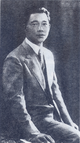
In early 1927, shortly before Chiang Captured Shanghai and moved the capital to Nanjing, Wang's faction declared the capital of the Republic to be Wuhan
. While attempting to direct the government from Wuhan, Wang was notable for his close collaboration with leading Communist figures, including Mao Zedong
, Chen Duxiu
, and Borodin
, and for his faction's provocative land-reform policies. Wang later blamed the failure of his Wuhan government on its excessive adoption of Communist agendas. Wang's regime was opposed by Chiang Kai-shek, who was in the midst of a bloody purge of Communists in Shanghai and was calling for a push farther north. The separation between the governments of Wang and Chiang are known as the "Ninghan Separation" .
Chiang Kai-shek occupied Shanghai in April 1927, and began a bloody suppression of suspected Communists known as the "White Terror
". Within several weeks of Chiang's suppression of Communists in Shanghai Wang's leftist government was attacked by a KMT-aligned warlord and disintegrated, leaving Chiang as the sole legitimate leader of the Republic. KMT troops occupying territories formerly controlled by Wang conducted massacres of suspected Communists in those areas: around Changsha alone, over ten thousand people were killed in a single twenty day period. Fearing retribution as a Communist sympathizer, Wang publicly claimed allegiance to Chiang and fled to Europe.
and Yan Xishan
to form a central government in opposition to the one headed by Chiang. Wang took part in a conference hosted by Yan to draft a new constitution, and was to serve as the Prime Minister under Yan, who would be President. Wang's attempts to aid Yan's government ended when Chiang defeated the alliance in the Central Plains War
.
In 1931, Wang joined another anti-Chiang government in Guangzhou
. After Chiang defeated this regime, Wang reconciled with Chiang's Nanjing
government and held prominent posts for most of the decade. Wang was appointed premier
just as the Battle of Shanghai (1932) began. He had frequent disputes with Chiang and would resign in protest several times only to have his resignation rescinded. As a result of these power struggles within the KMT, Wang was forced to spend much of his time in exile. He traveled to Germany, and maintained some contact with Adolf Hitler
. The effectiveness of the KMT was constantly hindered by leadership and personal struggles, such as that between Wang and Chiang. In December 1935, Wang permanently left the premiership after being seriously wounded during an assassination attempt a month earlier.
During the 1936 Xian Incident, in which Chiang was taken prisoner by his own general, Zhang Xueliang
, Wang favored sending a "punitive expedition" to attack Zhang. He was apparently ready to march on Zhang, but Chiang's wife, Soong Meiling, and brother, T.V. Soong, feared that such an action would lead to Chiang's death and his replacement by Wang, so they successfully opposed this action.
Wang Jingwei accompanied the government on its retreat to Chongqing
during the Second Sino-Japanese War
(1937–1945). During this time, he organized some right-wing groups under European fascist lines inside the KMT. Wang was originally part of the pro-war group; but, after the Japanese were successful in occupying large areas of coastal China, Wang became known for his pessimistic view on China's chances in the war against Japan. He often voiced defeatist opinions in KMT staff meetings, and continued to express his view that Western Imperialism was the greater danger to China, much to the chagrin of his associates. Wang believed that China needed to reach a negotiated settlement with Japan so that Asia could resist Western Powers.
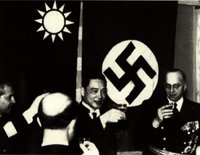 In late 1938, Wang left Chongqing for Hanoi
, French Indochina
, where he stayed for three months and announced his support for a negotiated settlement with the Japanese. During this time, he was wounded in an assassination attempt by KMT agents. Wang then flew to Shanghai, where he entered negotiations with Japanese authorities. The Japanese invasion had given him the opportunity he had long sought to establish a new government outside of Chiang Kai-shek’s control.
On 30 March 1940, Wang became the head of state of what came to be known as the Wang Jingwei regime based in Nanjing, serving as the President of the Executive Yuan and Chairman of the National Government (行政院長兼國民政府主席). In November, 1940, Wang's government signed the "Sino-Japanese Treaty" with the Japanese, a document that has been compared with Japan's Twenty-one Demands
for its broad political, military, and economic concessions. In June, 1941, Wang gave a public radio address from Tokyo in which he praised Japan, affirmed China's submission to it, criticized the Kuomintang government, and pledged to work with the Empire of Japan to resist Communism and Western imperialism. Wang continued to orchestrate politics within his regime in concert with Chiang's international relationship with foreign powers, seizing the French Concession
and the International Settlement of Shanghai
in 1943, after Western nations agreed by consensus to abolish extraterritoriality
.
The Government of National Salvation of the collaborationist "Republic of China", which Wang headed, was established on the Three Principles of Pan-Asianism
, anti-Communism
, and opposition to Chiang Kai-shek. Wang continued to maintain his contacts with German Nazis
and Italian fascists he had established while in exile. In March 1944, Wang left for Japan to undergo medical treatment for the wound left by an assassination attempt in 1939. He died in Nagoya on 10 November 1944, less than a year before Japan's surrender to the Allies, thus avoiding a trial for treason. Many of his senior followers who lived to see the end of the war were executed. Wang was buried in Nanjing near the Sun Yat-sen Mausoleum
, in an elaborately-constructed tomb. Soon after Japan's defeat, the Kuomintang government under Chiang Kai-shek moved its capital back to Nanjing, destroyed Wang's tomb, and burned the body. Today the site is commemorated with a small pavilion that notes Wang as a traitor.
. In Japanese-occupied Chinese territories the prices of basic necessities rose substantially as Japan's war effort expanded. In Shanghai of 1941, they increased elevenfold.
Daily life was often difficult in the Nanjing Nationalist Government-controlled Republic of China, and grew increasingly so as the war turned against Japan (c.1943). Local residents resorted to the black market in order to obtain needed items or to influence the ruling establishment. The Japanese Kempeitai
, Japanese Tokko
, collaborationist Chinese police, and Chinese citizens in the service of the Japanese all worked to censor information, monitor any opposition, and torture enemies and dissenters. A "native" secret agency, the Tewu, was created with the aid of Japanese Army "advisors". The Japanese also established prisoner-of-war detention centres, concentration camps, and Kamikaze
training centres to indoctrinate pilots.
Since Wang’s government held authority only over territories under Japanese military occupation, there was a limited amount that officials loyal to Wang could do to ease the suffering of Chinese under Japanese occupation. Wang himself became a focal point of anti-Japanese resistance. He was demonized and branded as an “arch-traitor” in both KMT and Communist
rhetoric. Wang and his government were deeply unpopular with the Chinese populace, who regarded them as traitors to both the Chinese state and Han Chinese
identity. Wang’s rule was constantly undermined by resistance and sabotage.
The strategy of the local education system was to create a workforce suited for employment in factories and mines, and for manual labour. The Japanese also attempted to introduce their culture and dress to the Chinese. Complaints and agitation called for more meaningful Chinese educational development. Shinto temples and similar cultural centres were built in order to instill Japanese culture and values. These activities came to a halt at the end of the war.
, Wang has been considered a traitor by most post-World War II Chinese historians in both Taiwan
and Mainland China
. His name has become a byword for "traitor" or "treason" in Mainland China and Taiwan. The Mainland’s Communist government despised Wang not only for his collaboration with the Japanese, but also for his anti-Communism, while the KMT downplayed his anti-Communism and emphasized his collaboration and betrayal of Chiang Kai-Shek. The Communists also used his KMT ties to demonstrate what they saw as the duplicitous, treasonous nature of the Kuomintang. Both sides downplayed his earlier association with Sun Yat-Sen because of his eventual collaboration.
in 1946.
Kuomintang
The Kuomintang of China , sometimes romanized as Guomindang via the Pinyin transcription system or GMD for short, and translated as the Chinese Nationalist Party is a founding and ruling political party of the Republic of China . Its guiding ideology is the Three Principles of the People, espoused...
(KMT), but later became increasingly anti-Communist after his efforts to collaborate with the CCP ended in political failure. His politics veered sharply to the right later in his career, after he joined the Japanese.
A close associate of Sun Yat-sen
Sun Yat-sen
Sun Yat-sen was a Chinese doctor, revolutionary and political leader. As the foremost pioneer of Nationalist China, Sun is frequently referred to as the "Father of the Nation" , a view agreed upon by both the People's Republic of China and the Republic of China...
, Wang is most noted for disagreements with Generalissimo
Generalissimo
Generalissimo and Generalissimus are military ranks of the highest degree, superior to Field Marshal and other five-star ranks.-Usage:...
Chiang Kai-shek
Chiang Kai-shek
Chiang Kai-shek was a political and military leader of 20th century China. He is known as Jiǎng Jièshí or Jiǎng Zhōngzhèng in Mandarin....
and for his formation of a Japanese-supported collaborationist government
Wang Jingwei Government
In March 1940 a puppet government led by Wang Jingwei was established in the Republic of China under the protection of the Empire of Japan. The regime officially called itself the Republic of China and its government the Reorganized National Government of China...
in Nanjing
Nanjing
' is the capital of Jiangsu province in China and has a prominent place in Chinese history and culture, having been the capital of China on several occasions...
. For this role he has often been labeled as a Hanjian
Hanjian
In Chinese culture, a Hanjian is a derogatory and pejorative term for a race traitor to the Han Chinese nation or state, and to a lesser extent, Han ethnicity. The word Hanjian is distinct from the general word for traitor, which could be used for any race or country...
. His name in mainland China is also now a term used to refer to a traitor, similar to "Benedict Arnold
Benedict Arnold
Benedict Arnold V was a general during the American Revolutionary War. He began the war in the Continental Army but later defected to the British Army. While a general on the American side, he obtained command of the fort at West Point, New York, and plotted to surrender it to the British forces...
" for Americans or "Quisling
Quisling
Quisling is a term used in reference to fascist and collaborationist political parties and military and paramilitary forces in occupied Allied countries which collaborated with Axis occupiers in World War II, as well as for their members and other collaborators.- Etymology :The term was coined by...
" for Norwegians.
Rise to Prominence
Born in SanshuiSanshui
For the style of Chinese painting, see Shan ShuiSanshui District , formerly Sanshui City, is a district with about 120,000 inhabitants in Guangdong province of the People's Republic of China...
, Guangdong, but of Zhejiang
Zhejiang
Zhejiang is an eastern coastal province of the People's Republic of China. The word Zhejiang was the old name of the Qiantang River, which passes through Hangzhou, the provincial capital...
origin, Wang went to Japan as an international student
International student
According to Organization of Economic Cooperation and Development , international students are those who travel to a country different from their own for the purpose of tertiary study. Despite that, the definition of international students varies in each country in accordance to their own national...
sponsored by the Qing government in 1903, and joined the Tongmenghui
Tongmenghui
The Tongmenghui, also known as the Chinese United League, United League, Chinese Revolutionary Alliance, Chinese Alliance and United Allegiance Society, was a secret society and underground resistance movement formed when merging many Chinese revolutionary groups together by Sun Yat-sen, Song...
in 1905. As a young man, Wang came to blame the Qing dynasty for holding China back, and making it too weak to fight off exploitation by Western Imperialist powers. While in Japan, Wang became a close confidant of Sun Yat-Sen, and would later go on to become one of the most important members of the early Kuomintang.
Early career
In the years leading up to the 1911 Revolution, Wang was active in opposing the Qing. Wang gained prominence during this period as an excellent public speaker and a staunch advocate of Chinese nationalismChinese nationalism
Chinese nationalism , sometimes synonymous with Chinese patriotism refers to cultural, historiographical, and political theories, movements and beliefs that assert the idea of a cohesive, unified Chinese people and culture in a unified country known as China...
. He was jailed for plotting an assassination of the regent, the 2nd Prince Chun
Zaifeng, 2nd Prince Chun
The 2nd Prince Chun was born Zaifeng , of the Manchu Aisin-Gioro clan . He was the leader of China between 1908 and 1911, serving as regent for his son Puyi, the Xuantong Emperor.His courtesy name was Yiyun...
, and readily admitted his guilt at trial. He remained in jail from 1910 until the Wuchang Uprising
Wuchang Uprising
The Wuchang Uprising began with the dissatisfaction of the handling of a railway crisis. The crisis then escalated to an uprising where the revolutionaries went up against Qing government officials. The uprising was then assisted by the New Army in a coup against their own authorities in the city...
the next year, and became something of a national hero upon his release.
During and after the 1911 Revolution, Wang’s political life was defined by his opposition to Western Imperialism. In the early 1920s, he held several posts in Sun Yat-sen's Revolutionary Government in Guangzhou
Guangzhou
Guangzhou , known historically as Canton or Kwangchow, is the capital and largest city of the Guangdong province in the People's Republic of China. Located in southern China on the Pearl River, about north-northwest of Hong Kong, Guangzhou is a key national transportation hub and trading port...
, and was the only member of Sun's inner circle to accompany him on trips outside of KMT-held territory in the months immediately preceding Sun's death. He is believed by many to have drafted Sun's will during the short period before Sun's death, in the winter of 1925. He was considered one of the main contenders to replace Sun as leader of the Kuomintang
Kuomintang
The Kuomintang of China , sometimes romanized as Guomindang via the Pinyin transcription system or GMD for short, and translated as the Chinese Nationalist Party is a founding and ruling political party of the Republic of China . Its guiding ideology is the Three Principles of the People, espoused...
, but eventually lost control of the party and army to Chiang Kai-shek
Chiang Kai-shek
Chiang Kai-shek was a political and military leader of 20th century China. He is known as Jiǎng Jièshí or Jiǎng Zhōngzhèng in Mandarin....
. Wang had clearly lost control of the KMT by 1926, when, following the Zhongshan Warship Incident
Zhongshan Warship Incident
The Zhongshan Warship Incident , or "March 20th Incident", on March 20, 1926, involved a suspected plot by Captain Li Zhilong of the warship Chung Shan to kidnap Chiang Kai-shek. It triggered a political struggle between the Communist Party of China and Kuomintang...
, Chiang successfully sent Wang and his family to vacation in Europe. It was important for Chiang to have Wang away from Guangdong while Chiang was in the process of expelling communists from the KMT because Wang was then the leader of the left wing of the KMT, notably sympathetic to communists and communism, and may have opposed Chiang if he had remained in China.
Leader of the Wuhan Government
During the Northern Expedition, Wang was the leading figure in the left-leaning faction of the KMT that called for continued cooperation with the Chinese Communist Party. Although Wang collaborated closely with Chinese Communists in Wuhan, he was philosophically opposed to communism and regarded the KMT’s Comintern advisors with suspicion. He did not believe that Communists could be true patriots or true Chinese nationalists.In early 1927, shortly before Chiang Captured Shanghai and moved the capital to Nanjing, Wang's faction declared the capital of the Republic to be Wuhan
Wuhan
Wuhan is the capital of Hubei province, People's Republic of China, and is the most populous city in Central China. It lies at the east of the Jianghan Plain, and the intersection of the middle reaches of the Yangtze and Han rivers...
. While attempting to direct the government from Wuhan, Wang was notable for his close collaboration with leading Communist figures, including Mao Zedong
Mao Zedong
Mao Zedong, also transliterated as Mao Tse-tung , and commonly referred to as Chairman Mao , was a Chinese Communist revolutionary, guerrilla warfare strategist, Marxist political philosopher, and leader of the Chinese Revolution...
, Chen Duxiu
Chen Duxiu
Chen Duxiu played many different roles in Chinese history. He was a leading figure in the anti-imperial Xinhai Revolution and the May Fourth Movement for Science and Democracy. Along with Li Dazhao, Chen was a co-founder of the Chinese Communist Party in 1921. He was its first General Secretary....
, and Borodin
Borodin
Borodin , or Borodina is a Russian last name and may refer to:*Alexander Borodin , Russian composer and chemist*Alexander Parfeniyevich Borodin, Russian scientist in the field of rail transport...
, and for his faction's provocative land-reform policies. Wang later blamed the failure of his Wuhan government on its excessive adoption of Communist agendas. Wang's regime was opposed by Chiang Kai-shek, who was in the midst of a bloody purge of Communists in Shanghai and was calling for a push farther north. The separation between the governments of Wang and Chiang are known as the "Ninghan Separation" .
Chiang Kai-shek occupied Shanghai in April 1927, and began a bloody suppression of suspected Communists known as the "White Terror
Shanghai massacre of 1927
The April 12 Incident of 1927 refers to the violent suppression of Chinese Communist Party organizations in Shanghai by the military forces of Chiang Kai-shek and conservative factions in the Kuomintang...
". Within several weeks of Chiang's suppression of Communists in Shanghai Wang's leftist government was attacked by a KMT-aligned warlord and disintegrated, leaving Chiang as the sole legitimate leader of the Republic. KMT troops occupying territories formerly controlled by Wang conducted massacres of suspected Communists in those areas: around Changsha alone, over ten thousand people were killed in a single twenty day period. Fearing retribution as a Communist sympathizer, Wang publicly claimed allegiance to Chiang and fled to Europe.
Political activities in Chiang's China
Between 1929 and 1930, Wang collaborated with Feng YuxiangFeng Yuxiang
Feng Yuxiang was a warlord and leader in Republican China. He was also known as the Christian General for his zeal to convert his troops and the Betrayal General for his penchant to break with the establishment. In 1911, he was an officer in the ranks of Yuan Shikai's Beiyang Army but joined...
and Yan Xishan
Yan Xishan
Yan Xishan, was a Chinese warlord who served in the government of the Republic of China. Yan effectively controlled the province of Shanxi from the 1911 Xinhai Revolution to the 1949 Communist victory in the Chinese Civil War...
to form a central government in opposition to the one headed by Chiang. Wang took part in a conference hosted by Yan to draft a new constitution, and was to serve as the Prime Minister under Yan, who would be President. Wang's attempts to aid Yan's government ended when Chiang defeated the alliance in the Central Plains War
Central Plains War
Central Plains War was a civil war within the factionalised Kuomintang that broke out in 1930. It was fought between the forces of Chiang Kai-shek and the coalition of three military commanders who had previously allied with Chiang: Yan Xishan, Feng Yuxiang, and Li Zongren...
.
In 1931, Wang joined another anti-Chiang government in Guangzhou
Guangzhou
Guangzhou , known historically as Canton or Kwangchow, is the capital and largest city of the Guangdong province in the People's Republic of China. Located in southern China on the Pearl River, about north-northwest of Hong Kong, Guangzhou is a key national transportation hub and trading port...
. After Chiang defeated this regime, Wang reconciled with Chiang's Nanjing
Nanjing
' is the capital of Jiangsu province in China and has a prominent place in Chinese history and culture, having been the capital of China on several occasions...
government and held prominent posts for most of the decade. Wang was appointed premier
Premier of the Republic of China
The President of the Executive Yuan , commonly known as the Premier of the Republic of China , is the head of the Executive Yuan, the executive branch of the Republic of China , which currently administers Taiwan, Matsu, and Kinmen. The premier is appointed by the President of the Republic of China...
just as the Battle of Shanghai (1932) began. He had frequent disputes with Chiang and would resign in protest several times only to have his resignation rescinded. As a result of these power struggles within the KMT, Wang was forced to spend much of his time in exile. He traveled to Germany, and maintained some contact with Adolf Hitler
Adolf Hitler
Adolf Hitler was an Austrian-born German politician and the leader of the National Socialist German Workers Party , commonly referred to as the Nazi Party). He was Chancellor of Germany from 1933 to 1945, and head of state from 1934 to 1945...
. The effectiveness of the KMT was constantly hindered by leadership and personal struggles, such as that between Wang and Chiang. In December 1935, Wang permanently left the premiership after being seriously wounded during an assassination attempt a month earlier.
During the 1936 Xian Incident, in which Chiang was taken prisoner by his own general, Zhang Xueliang
Zhang Xueliang
Zhang Xueliang or Chang Hsüeh-liang , occasionally called Peter Hsueh Liang Chang in English, nicknamed the Young Marshal , was the effective ruler of Manchuria and much of North China after the assassination of his father, Zhang Zuolin, by the Japanese on 4 June 1928...
, Wang favored sending a "punitive expedition" to attack Zhang. He was apparently ready to march on Zhang, but Chiang's wife, Soong Meiling, and brother, T.V. Soong, feared that such an action would lead to Chiang's death and his replacement by Wang, so they successfully opposed this action.
Wang Jingwei accompanied the government on its retreat to Chongqing
Chongqing
Chongqing is a major city in Southwest China and one of the five national central cities of China. Administratively, it is one of the PRC's four direct-controlled municipalities , and the only such municipality in inland China.The municipality was created on 14 March 1997, succeeding the...
during the Second Sino-Japanese War
Second Sino-Japanese War
The Second Sino-Japanese War was a military conflict fought primarily between the Republic of China and the Empire of Japan. From 1937 to 1941, China fought Japan with some economic help from Germany , the Soviet Union and the United States...
(1937–1945). During this time, he organized some right-wing groups under European fascist lines inside the KMT. Wang was originally part of the pro-war group; but, after the Japanese were successful in occupying large areas of coastal China, Wang became known for his pessimistic view on China's chances in the war against Japan. He often voiced defeatist opinions in KMT staff meetings, and continued to express his view that Western Imperialism was the greater danger to China, much to the chagrin of his associates. Wang believed that China needed to reach a negotiated settlement with Japan so that Asia could resist Western Powers.
Alliance with the Axis Powers
Hanoi
Hanoi , is the capital of Vietnam and the country's second largest city. Its population in 2009 was estimated at 2.6 million for urban districts, 6.5 million for the metropolitan jurisdiction. From 1010 until 1802, it was the most important political centre of Vietnam...
, French Indochina
French Indochina
French Indochina was part of the French colonial empire in southeast Asia. A federation of the three Vietnamese regions, Tonkin , Annam , and Cochinchina , as well as Cambodia, was formed in 1887....
, where he stayed for three months and announced his support for a negotiated settlement with the Japanese. During this time, he was wounded in an assassination attempt by KMT agents. Wang then flew to Shanghai, where he entered negotiations with Japanese authorities. The Japanese invasion had given him the opportunity he had long sought to establish a new government outside of Chiang Kai-shek’s control.
On 30 March 1940, Wang became the head of state of what came to be known as the Wang Jingwei regime based in Nanjing, serving as the President of the Executive Yuan and Chairman of the National Government (行政院長兼國民政府主席). In November, 1940, Wang's government signed the "Sino-Japanese Treaty" with the Japanese, a document that has been compared with Japan's Twenty-one Demands
Twenty-One Demands
The ' were a set of demands made by the Empire of Japan under Prime Minister Ōkuma Shigenobu sent to the nominal government of the Republic of China on January 18, 1915, resulting in two treaties with Japan on May 25, 1915.- Background :...
for its broad political, military, and economic concessions. In June, 1941, Wang gave a public radio address from Tokyo in which he praised Japan, affirmed China's submission to it, criticized the Kuomintang government, and pledged to work with the Empire of Japan to resist Communism and Western imperialism. Wang continued to orchestrate politics within his regime in concert with Chiang's international relationship with foreign powers, seizing the French Concession
Shanghai French Concession
The Shanghai French Concession was a foreign concession in Shanghai, China from 1849 until 1946, and it was progressively expanded in the late 19th and early 20th centuries. The concession came to an end in practice in 1943 when the Vichy French government signed it over to the pro-Japanese puppet...
and the International Settlement of Shanghai
Shanghai International Settlement
The Shanghai International Settlement began originally as a purely British settlement. It was one of the original five treaty ports which were established under the terms of the Treaty of Nanking at the end of the first opium war in the year 1842...
in 1943, after Western nations agreed by consensus to abolish extraterritoriality
Extraterritoriality
Extraterritoriality is the state of being exempt from the jurisdiction of local law, usually as the result of diplomatic negotiations. Extraterritoriality can also be applied to physical places, such as military bases of foreign countries, or offices of the United Nations...
.
The Government of National Salvation of the collaborationist "Republic of China", which Wang headed, was established on the Three Principles of Pan-Asianism
Pan-Asianism
Pan-Asianism is an ideology or a movement that Asian nations unite and solidify and create a continental identity to defeat the designs of the Western nations to perpetuate hegemony.-Japanese Asianism:...
, anti-Communism
Anti-communism
Anti-communism is opposition to communism. Organized anti-communism developed in reaction to the rise of communism, especially after the 1917 October Revolution in Russia and the beginning of the Cold War in 1947.-Objections to communist theory:...
, and opposition to Chiang Kai-shek. Wang continued to maintain his contacts with German Nazis
Nazism
Nazism, the common short form name of National Socialism was the ideology and practice of the Nazi Party and of Nazi Germany...
and Italian fascists he had established while in exile. In March 1944, Wang left for Japan to undergo medical treatment for the wound left by an assassination attempt in 1939. He died in Nagoya on 10 November 1944, less than a year before Japan's surrender to the Allies, thus avoiding a trial for treason. Many of his senior followers who lived to see the end of the war were executed. Wang was buried in Nanjing near the Sun Yat-sen Mausoleum
Sun Yat-sen Mausoleum
Dr. Sun Yat-sen's Mausoleum is situated at the foot of the second peak of Mount Zijin in Nanjing, China. Construction of the tomb started in January 1926 and was finished in spring of 1929. The architect was Lu Yanzhi, who died shortly after it was finished.- History :Dr...
, in an elaborately-constructed tomb. Soon after Japan's defeat, the Kuomintang government under Chiang Kai-shek moved its capital back to Nanjing, destroyed Wang's tomb, and burned the body. Today the site is commemorated with a small pavilion that notes Wang as a traitor.
Life under the Wang Jingwei Regime
Chinese under the regime had greater access to coveted war-time luxuries, and the Japanese enjoyed things like matches, rice, tea, coffee, cigars, foods, and alcoholic drinks, all of which were scarce in Japan proper, but consumer goods became more scarce after Japan entered World War IIWorld War II
World War II, or the Second World War , was a global conflict lasting from 1939 to 1945, involving most of the world's nations—including all of the great powers—eventually forming two opposing military alliances: the Allies and the Axis...
. In Japanese-occupied Chinese territories the prices of basic necessities rose substantially as Japan's war effort expanded. In Shanghai of 1941, they increased elevenfold.
Daily life was often difficult in the Nanjing Nationalist Government-controlled Republic of China, and grew increasingly so as the war turned against Japan (c.1943). Local residents resorted to the black market in order to obtain needed items or to influence the ruling establishment. The Japanese Kempeitai
Kempeitai
The was the military police arm of the Imperial Japanese Army from 1881 to 1945. It was not an English-style military police, but a French-style gendarmerie...
, Japanese Tokko
Tokko
', often shortened to ' was a police force established in 1911 in Japan, specifically to investigate and control political groups and ideologies deemed to be a threat to public order....
, collaborationist Chinese police, and Chinese citizens in the service of the Japanese all worked to censor information, monitor any opposition, and torture enemies and dissenters. A "native" secret agency, the Tewu, was created with the aid of Japanese Army "advisors". The Japanese also established prisoner-of-war detention centres, concentration camps, and Kamikaze
Kamikaze
The were suicide attacks by military aviators from the Empire of Japan against Allied naval vessels in the closing stages of the Pacific campaign of World War II, designed to destroy as many warships as possible....
training centres to indoctrinate pilots.
Since Wang’s government held authority only over territories under Japanese military occupation, there was a limited amount that officials loyal to Wang could do to ease the suffering of Chinese under Japanese occupation. Wang himself became a focal point of anti-Japanese resistance. He was demonized and branded as an “arch-traitor” in both KMT and Communist
Communist Party of China
The Communist Party of China , also known as the Chinese Communist Party , is the founding and ruling political party of the People's Republic of China...
rhetoric. Wang and his government were deeply unpopular with the Chinese populace, who regarded them as traitors to both the Chinese state and Han Chinese
Han Chinese
Han Chinese are an ethnic group native to China and are the largest single ethnic group in the world.Han Chinese constitute about 92% of the population of the People's Republic of China , 98% of the population of the Republic of China , 78% of the population of Singapore, and about 20% of the...
identity. Wang’s rule was constantly undermined by resistance and sabotage.
The strategy of the local education system was to create a workforce suited for employment in factories and mines, and for manual labour. The Japanese also attempted to introduce their culture and dress to the Chinese. Complaints and agitation called for more meaningful Chinese educational development. Shinto temples and similar cultural centres were built in order to instill Japanese culture and values. These activities came to a halt at the end of the war.
Post-War assessment and legacy
For his role in the Pacific WarPacific War
The Pacific War, also sometimes called the Asia-Pacific War refers broadly to the parts of World War II that took place in the Pacific Ocean, its islands, and in East Asia, then called the Far East...
, Wang has been considered a traitor by most post-World War II Chinese historians in both Taiwan
Republic of China
The Republic of China , commonly known as Taiwan , is a unitary sovereign state located in East Asia. Originally based in mainland China, the Republic of China currently governs the island of Taiwan , which forms over 99% of its current territory, as well as Penghu, Kinmen, Matsu and other minor...
and Mainland China
People's Republic of China
China , officially the People's Republic of China , is the most populous country in the world, with over 1.3 billion citizens. Located in East Asia, the country covers approximately 9.6 million square kilometres...
. His name has become a byword for "traitor" or "treason" in Mainland China and Taiwan. The Mainland’s Communist government despised Wang not only for his collaboration with the Japanese, but also for his anti-Communism, while the KMT downplayed his anti-Communism and emphasized his collaboration and betrayal of Chiang Kai-Shek. The Communists also used his KMT ties to demonstrate what they saw as the duplicitous, treasonous nature of the Kuomintang. Both sides downplayed his earlier association with Sun Yat-Sen because of his eventual collaboration.
Family
Wang was married to Chen Bijun and had six children with her, five of which survived into adulthood. Of those who survived into adulthood, Wang's eldest son, Wen-Jin, was born in France in 1913. Wang's eldest daughter, Wen-Xing, was born in France in 1915, and is now living in New York. Wang's second daughter, Wang Wenbin, was born in 1920. Wang's third daughter, Wen-Xun, was born in Guangzhou in 1922, and died in 2002 in Hong Kong. Wang's second son, Wen-ti, was born in 1928, and was sentenced for being a hanjianHanjian
In Chinese culture, a Hanjian is a derogatory and pejorative term for a race traitor to the Han Chinese nation or state, and to a lesser extent, Han ethnicity. The word Hanjian is distinct from the general word for traitor, which could be used for any race or country...
in 1946.
See also
- Chiang Kai-shekChiang Kai-shekChiang Kai-shek was a political and military leader of 20th century China. He is known as Jiǎng Jièshí or Jiǎng Zhōngzhèng in Mandarin....
- Sun Yat-senSun Yat-senSun Yat-sen was a Chinese doctor, revolutionary and political leader. As the foremost pioneer of Nationalist China, Sun is frequently referred to as the "Father of the Nation" , a view agreed upon by both the People's Republic of China and the Republic of China...
- KuomintangKuomintangThe Kuomintang of China , sometimes romanized as Guomindang via the Pinyin transcription system or GMD for short, and translated as the Chinese Nationalist Party is a founding and ruling political party of the Republic of China . Its guiding ideology is the Three Principles of the People, espoused...
- Japanese Empire
- Second Sino-Japanese WarSecond Sino-Japanese WarThe Second Sino-Japanese War was a military conflict fought primarily between the Republic of China and the Empire of Japan. From 1937 to 1941, China fought Japan with some economic help from Germany , the Soviet Union and the United States...
- Reorganized National Government of China
- Huang YiguangHuang YiguangHuang Yiguang took part in one of a number of assassination attempts on the life of the Chinese politician Wang Jingwei, during the Japanese occupation of China . An aviator and explorer, he travelled widely with strong connections with the Chinese community in the United Kingdom...
, and his assassination attempt on Wang Jingwei
Further reading
- David P. Barrett and Larry N. Shyu, eds.; Chinese Collaboration with Japan, 1932–1945: The Limits of Accommodation Stanford University Press 2001.
- Gerald Bunker, The Peace Conspiracy; Wang Ching-wei and the China war, 1937–1941 Harvard University Press, 1972.
- James C. Hsiung and Steven I. Levine, eds. China's Bitter Victory: The War with Japan, 1937–1945 M. E. Sharpe, 1992.
- Ch'i Hsi-sheng, Nationalist China at War: Military Defeats and Political Collapse, 1937–1945 University of Michigan Press, 1982.
External links
- Japan's Asian Axis Allies: Chinese National Government of Nanking