


Nanjing

Encyclopedia
is the capital of Jiangsu
province in China
and has a prominent place in Chinese history and culture, having been the capital of China
on several occasions. Its present name means "Southern Capital" and was widely romanized as Nankin and Nanking until the Pinyin language reform, after which Nanjing was gradually adopted as the standard spelling of the city's name in most languages that use the Roman alphabet.
Located in the lower Yangtze River
drainage basin and Yangtze River Delta
economic zone, Nanjing has long been one of China's most important cities. It is recognized as one of the Four Great Ancient Capitals of China
. It was the capital of Sun Quan
's Wu during the Three Kingdoms Period and the capital of the Republic of China
prior to its flight to Taiwan
during the Chinese Civil War
. Nanjing is also one of the fifteen sub-provincial cities
in the People's Republic of China's administrative structure, enjoying jurisdictional and economic autonomy only slightly less than that of a province. Nanjing has long been a national center of education, research, transport networks, and tourism. The city will host the 2014 Summer Youth Olympics
.
With an urban population of over five million (2006), Nanjing is the second-largest commercial center in the East China region after Shanghai
. It has been ranked seventh in the evaluation of "Cities with Strongest Comprehensive Strength" issued by the National Statistics Bureau
, and second in the evaluation of cities with most sustainable development potential in the Yangtze River Delta. It has also been awarded the title of 2008 Habitat Scroll of Honor of China, Special Award of UN Habitat Scroll of Honor and National Civilized City.
in today's Nanjing area in 495 BCE. Later in 473 BCE, the State of Yue conquered Wu and constructed the fort of Yuecheng on the outskirts of the present-day Zhonghua Gate. In 333 BCE, after eliminating the State of Yue, the State of Chu built Jinling Yi in the western part of present-day Nanjing. Under the Qin
and Han dynasties
, it was called Moling . Since then, the city has experienced destruction and renewal many times.,
, where Sun Quan
of the Wu Kingdom during the Three Kingdoms Period relocated its capital to Jianye
, a city he extended on the basis of Jinling Yi in 211 CE. Although conquered by the West Jin Dynasty in 280, Nanjing and its neighboring areas had been well cultivated and developed into one of the commercial, cultural, and political centers of China during the rule of East Wu. This city would soon play a vital role in the following centuries.
Shortly after the unification of the region, the West Jin state collapsed in wars. It was at first rebels of eight Jin princes
for the throne and later rebels and invasion from Xiongnu
and other nomadic peoples that destroyed the rule of Jin in the north. In 317, remnants of the Jin court, as well as nobles and wealthy families, fled from the north to the south and reestablished the Jin court in Nanjing, which was then called Jiankang
.
During the period of the North-South Division
, Nanjing remained the capital of the Southern Dynasties
for more than two and a half centuries. During this time, Nanjing was the international hub of the East Asia and one of the largest city in the world. Based on historical documents, the city had 280,000 registered households. Assuming an average Nanjing household had about 5.1 people at that time, the city had more than 1.4 million residents.
A number of sculptural ensembles
of that era, erected at the tombs of royals and other dignitaries, have survived (in various degrees of preservation) in Nanjing's northeastern and eastern suburbs, primarily in Qixia
and Jiangning
District. Possibly the best preserved of them is the ensemble of the Tomb of Xiao Xiu
(475–518), a brother of Emperor Wu of Liang
. The period of division ended when the Sui Dynasty
reunified China and destroyed almost the entire city, turning it into a small town.
. It was again chosen as the capital as Jinling during the short-lived Southern Tang
(937–975), who succeeded the Wu
. Jiankang's textile industry burgeoned and thrived during Song Dynasty
despite the constant threat from the northern foreign invasions. The Mongolians
, the occupiers of China, further consolidated the city's status as a hub of the textile industry under the Yuan Dynasty
.
Zhu Yuanzhang (the Hongwu Emperor) who overthrew the Yuan Dynasty rebuilt this city and made it the dynastic capital in 1368. He constructed what was the longest city wall in the world at that time. It took 200,000 laborers 21 years to finish the project. The present-day city wall of Nanjing
was mainly built during that time, and it is the longest surviving city wall in the world.
Nanjing remained the capital of the Ming Empire until 1421, when the third emperor of the dynasty, Zhu Di (the Yongle Emperor), relocated the capital to Beijing. It is believed that Nanjing was the largest city in the world from 1358 to 1425 with a population of 487,000 in 1400.
Besides the city wall, other famous Ming-era structures in the city included the famous Ming Xiaoling Mausoleum
and Porcelain Tower
, although the latter was destroyed by the Taipings
in the 19th century.
A monument to the huge human cost of some of the gigantic construction projects of the early Ming is the Yangshan Quarry
(located some 10 km (6 mi) east of the walled city an Ming Xiaoling), where a gigantic stele, cut on the orders of the Yongle Emperor, lies abandoned, just as it was left 600 years ago when it was understood that it is impossible to move or erect it.
As the center of the empire, early-Ming Nanjing had worldwide connections: it was home of the eunuch admiral Zheng He
, who went to sail the Pacific and Indian Oceans, and it was visited by foreign dignitaries, such as the sultan of Brunei
Abdul Majid Hassan
, who died during his visit to China in 1408. The sultan's grave, with a suitably royal spirit way
and a tortoise stele
, was discovered in Yuhuatai District
(south of the walled city) in 1958, and has been restored.
invaders, and the suicide of the last "real" Ming emperor Zhu Youjian (the Chongzhen Emperor) in the spring 1644, the Ming prince Zhu Yousong
was enthroned in Nanjing in June 1644 as the Hongguang Emperor. His short reign was described by later historians as the first reign of the so-called Southern Ming Dynasty
.
Zhu Yousong, however, fared a lot worse than his ancestor Zhu Yuanzhang three centuries earlier. Beset by factional conflicts, his regime could not offer effective resistance to Manchu troops, when the Manchu army, led by Prince Dodo
approached Jiangnan
the next spring. Days after Yangzhou
fell to the Manchus in late May 1645, the Hongguang Emperor fled Nanjing, and the imperial palace was looted by local residents. On June 6, Dodo's troops approached Nanjing, and the commander of the city's garrison, Zhao the Earl of Xincheng, promptly surrendered the city to them. The Manchus soon ordered all male residents of the city to shave their heads in the Manchu way
, requisitioned a large section of the city for the bannermen
's cantonment, and destroyed the former imperial palace, but otherwise the city was spared the mass murders and destruction that befell Yangzhou
.
Under the Qing Dynasty
(1644–1911), the Nanjing area was known as Jiangning and served as the seat of government for the Liangjiang Viceroy. It had been visited by the Kangxi and Qianlong Emperor
s a number of times on their tours of the southern provinces.
Nanjing was invaded by British troops during the close of the First Opium War
, which was ended by the Treaty of Nanking
in 1842.
As the capital of the brief-lived Taiping Kingdom
in the mid-19th century, Nanjing was known as Tianjing Both the Qing Viceroy and the Taiping king resided in buildings that would later be known as the Presidential Palace. When the Qing under Zeng Guofan
retook the city in 1864, a massive slaughter occurred in the city with over 100,000 estimated to have committed suicide or fought to the death.
led to the founding of the Republic of China
in January 1912 with Dr. Sun Yat-sen as the first provisional president and Nanjing was selected as its new capital. However, the Qing Dynasty
still controlled the northern provinces, so revolutionaries asked Yuan Shikai
to replace Sun as president in exchange for the emperor's abdication. Yuan demanded the capital be at Beijing (closer to his power base).
In 1927, the Kuomintang
(KMT) under Generalissimo Chiang Kai-shek
again established Nanjing as the capital of the Republic of China, and this became internationally recognized once KMT forces took Beijing in 1928. The following decade is known as the Nanjing decade
.
In 1937, Japan again invaded China, beginning the Second Sino-Japanese War
(often considered a theater of World War II
). Their troops occupied Nanjing in December and carried out the systematic and brutal Nanking massacre
(the "Rape of Nanking"). The total death toll, including those made by the International Military Tribunal for the Far East
and the Nanjing War Crimes Tribunal
, put the number of dead between 300,000 and 350,000. The Nanjing Massacre Memorial Hall
was built in 1985 to commemorate this event.
A few days before the fall of the city, the National Government of China was relocated to the southwestern city Chungking (now Chongqing)
and resumed Chinese resistance. In 1940,a Japanese-collaborationist government known as the "Nanjing Regime
" or "Nanjing Nationalist Government" led by Wang Jingwei
was established in Nanjing as a rival to Chiang Kai-Shek
's government in Chongqing. In 1946, after the Surrender of Japan
, the KMT relocated its central government back to Nanjing.
conquered Nanjing. After the establishment of the People's Republic of China in October, Nanjing was initially a province-level municipality, but very soon became and today remains the provincial capital of Jiangsu.
drainage basin
. The Yangtze River flows past the west side of Nanjing City, while the Ningzheng Ridge surrounds the north, east and south side of the city. The city is 300 kilometres (186.4 mi) west-northwest of Shanghai, 1200 kilometres (745.6 mi) south-southeast of Beijing, and 1400 kilometres (869.9 mi) east-northeast of Chongqing
.
Nanjing borders Yangzhou
to the northeast, one town downstream when following the north bank of the Yangtze, Zhenjiang
to the east, one town downstream when following the south bank of the Yangtze, and Changzhou
to the southeast. On its western boundary is Anhui
Province, where Nanjing borders 5 prefecture-level cities.
Nanjing has a humid subtropical climate
(Köppen
Cfa) and is under the influence of the East Asia Monsoon
. The four seasons are distinct here, with damp conditions seen throughout the year, very hot and muggy summers, cold, damp winters, and in between, spring and autumn are of reasonable length. Along with Wuhan and Chongqing, Nanjing is traditionally referred to as one of the "Three Furnacelike Cities" along the Yangtze River (长江流域三大火炉) for the perennially high temperatures in the summertime. However, the time from mid-June to the end of July is the plum blossom blooming season in which the meiyu (rainy season of East Asia; literally "plum rain") occurs, during which the city experiences a period of mild rain as well as dampness. Typhoons are uncommon but possible in the late stages of summer and early part of autumn. The annual mean temperature is around 15.5 °C (59.9 °F), with monthly mean values ranging from 2.4 to 27.8 °C (36.3 to 82 °F). The highest recorded temperature is 43 °C (109 °F) , and the lowest -16.9 °C. On average precipitation falls 115 days out of the year, and the average annual rainfall is 1062 millimetres (42 in).
Nanjing is endowed with rich natural resources, which include more than 40 kinds of minerals. Among them, iron and sulfur
reserves make up 40 percent of those of Jiangsu province. Its reserves of strontium
rank first in East Asia and the South East Asia region. Nanjing also possesses abundant water resources, both from the Yangtze River and groundwater. In addition, it has several natural hot springs such as Tangshan Hot Spring in Jiangning
and Tangquan Hot Spring in Pukou.
Nanjing is the intersection of Yangtze Riveran east-west water transport artery and Nanjing-Beijing railway—a south-north land transport artery, hence the name “door of the east and west, throat of the south and north”. Furthermore, the west part of the Ningzhen range is in Nanjing; the Loong-like Zhong Mountain is curling in the east of the city; the tiger-like Stone Mountain is crouching in the west of the city, hence the name “the Zhong Mountain, a dragon curling, and the Stone Mountain, a tiger crouching”. Mr. Sun Yet-sen spoke highly of Nanjing in the “Constructive Scheme for Our Country”, “The position of Nanjing is wonderful since mountains, lakes and plains all integrated in it. It is hardly [sic] to find another city like this.”
Surrounded by the Yangtze River and mountains, Nanjing also enjoys beautiful natural scenery. Natural lakes such as Xuanwu Lake
and Mochou Lake
are located in the center of the city and are easily accessible to the public, while hills like Purple Mountain are covered with evergreens and oaks and host various historical and cultural sites. Sun Quan
relocated his capital to Nanjing after Liu Bei
's suggestion as Liu Bei was impressed by Nanjing's impeccable geographic position when negotiating an alliance with Sun Quan. Sun Quan then renamed the city from Moling (秣陵) to Jianye (建邺) shortly thereafter.
, with the CPC Nanjing Committee Secretary as the de facto governor of the city and the mayor as the executive head of the government working under the secretary.
Nanjing currently consists of thirteen county-level divisions, of which eleven are districts, and two are counties. The districts are the urban areas of Nanjing while the counties are the rural areas governed by the city.
The current partition of districts of Nanjing might change in the future. There was a rumor that Lishui County would be designated as a new urban district in the near future.
>
Year
Residents (in million)
natural growth rate (%)
1995
5.2172
2.62
1996
5.2543
2.63
1997
5.2982
2.16
1998
5.3231
1.00
1999
5.3744
2.01
2000
5.4489
2.48
2001
5.5304
1.60
2002
5.6328
0.70
2003
5.7223
1.50
2006
6.0700
6.11
According to the Sixth China Census, the total population of the City of Nanjing reached 8.005 million in 2010. The statistics in 2008 estimated the total population to be 7.7 million, while the registered population was 6.3 million. The birth rate
was 8.86 percent and the death rate was 6.88 percent. The urban area had a population of 5.5 million people.
As in most of eastern China the ethnic makeup of Nanjing is predominantly Han nationality (98.56 percent), with 50 other minority nationalities. In 1999, 77,394 residents belonged to minority nationalities, among which the vast majority (64,832) were Hui nationalities, contributing 83.76 percent to the minority population. The second and third largest minority groups were Manchu (2,311) and Zhuang (533) nationalities. Most of the minority nationalities resided in Jianye District, comprising 9.13 percent of the district's population.
In 2010 the sex ratio
of the city population was 107.31 males to 100 females.
Into the first half of the twentieth century, Nanjing gradually shifted from a production hub into a heavy consumption city, mainly because of the rapid expansion of the wealthy population after Nanjing once again regained the political spotlight of China. A number of huge department stores such as Zhongyang Shangchang sprouted up, attracting merchants from all over China to sell their products in Nanjing. In 1933, the revenue generated by the food and entertainment industry in the city exceeded the sum of the output of the manufacturing and agriculture industry. One third of the city population worked in the service industry, while prostitution, drugs and gambling also thrived.
In the 1950s, the CPC invested heavily in Nanjing to build a series of state-owned heavy industries
, as part of the national plan of rapid industrialization. Electrical, mechanical, chemical and steel factories were established successively, converting Nanjing into a heavy industry production center of East China. Overenthusiastic in building a “world-class” industrial city, leaders of Nanjing also made many disastrous mistakes during the development, such as spending hundreds of millions of yuan to mine for non-existent coal, resulting in the negative economic growth in the late 1960s.
, petrochemical, iron and steel, and power as the "Five Pillar Industries". Some representative big state-owned firms are Panda Electronics
, Jincheng Motors and Nanjing Steel. The tertiary industry also regained prominence, accounting for 44 percent of the GDP of the city. The city is also vying for foreign investment against neighboring cities in the Yangtze River Delta, and so far a number of famous multinational firms
, such as Volkswagen Group
, Iveco
, A.O. Smith, and Sharp
, have established their lines there. Since China's entry into the WTO, Nanjing has received increasing attention from foreign investors, and on average, two new foreign firms establish offices in the city every day.
The city government is further improving the desirability of the city to investors by building large industrial park
s, which now total four: Gaoxin, Xingang, Huagong and Jiangning. Despite the effort, Nanjing's Gross Domestic Product is still falling behind that of other neighbouring cities such as Suzhou
, Wuxi
and Hangzhou
, which have an edge in attracting foreign investment and local innovation. In addition, the traditional state-owned enterprises find themselves incapable of competing with efficient multinational firms, and hence are either mired in heavy debt or forced into bankruptcy
or privatization
. This has resulted in large numbers of layoff workers
who are technically not unemployed but effectively jobless.
In recent years, Nanjing has been developing its economy, commerce, industry, as well as city construction. In 2010 the city's GDP was RMB 501 billion (3rd in Jiangsu), and GDP per capita was RMB 65,490, a 13 percent increase from 2009. The average urban resident's disposable income
was RMB 28,312, while the average rural resident's net income was RMB 11,050. The registered urban unemployment rate was 3.02 percent, lower than the national average (4.3 percent). Nanjing's Gross Domestic Product ranked 14th in 2010 in China, and its overall competence ranked 5th in mainland and 7th including Taiwan and Hongkong.
Nanjing Baixia Hi-Tech Industrial Zone is a national hi-tech industrial zone with 16.5 square kilometers planned area. The zone is only 13.5 km away from Nanjing downtown and 50 km away from Nanjing Lukou Airport. Several expressways pass through here. It is well equipped with comprehensive facilities, and it provides a good investment environment for high-tech industries. Electronic industry, automobile, chemical, machinery, instruments and building materials are the encouraged industries in the zone.
Established in 1992, Nanjing Economic and Technological Development Zone is a national level zone surrounded by convenient transportation network. Nanjing is the capital of Jiangsu Province. Situated in the downstream of Yangtze River Drainage Basin and Yangtze River Delta economic zone, Nanjing has always been a national center of commerce, education, research, transportation and tourism in the East China region, preceded only by Shanghai. It is only 20 km away from Nanjing Port and 40 km away from Nanjing Lukou Airport. It is well equipped with basic facilities like electricity, water, communication, gas, steam and so on. It has formed four specialized industries, which are electronic information, bio-pharmaceutical, machinery and new materials industry.
On March 10, 2003 the State Council approved the establishment of this Export Processing Zone (EPZ) in Nanjing's Southern District. This EPZ is free from import/export duty area and provides 24-hour customs-bonded conditions. It has a planned area of 3 square km. The Central Government has given the special economic region preferential policies to attract more enterprises engaged in processing trade investment in the region. It is only 20 km from Nanjing Port and several expressways pass through here.
Nanjing New & High-Tech Industry Development Zone was jointly founded by Jiangsu Provincial People's Government and Nanjing Municipal People's Government, and started to break ground of construction on September 1, 1988. It was established as a national new and high-tech industry development zone by the State Council on March 6, 1991. The zone is next to National Highway 104 and 312. Its pillar industries include electronic information, bio-engineering and pharmaceutical industry.
(which is itself composed of the old Jinpu
and Huning Railways), Nanjing-Wuhu (Ningwu), Nanjing-Qidong (Ningqi), Nanjing-Xian (Ningxi), Hefei-Nanjing (Hening) Railways. Currently, Nanjing has been connected within the high-speed railway network by Beijing–Shanghai High-Speed Railway and Shanghai–Nanjing Intercity High-Speed Railway, and more high-speed rail constructions will be finished in recent years.
Passenger rail service in Nanjing is provided by Nanjing Railway Station
and Nanjing South Railway Station, while Nanjing West Railway Station, Zhonghuamen Railway Station and Xianlin Railway Station
serve minor roles. Nanjing South Railway Station, which is one of the 5 hub stations on Beijing-Shanghai High-Speed Railway, has officially been claimed as the largest railway station in Asia in terms of GFA (Gross Floor Area).
, Nanjing is well-connected by over 60 state and provincial highways to all parts of China.
Express highways such as Hu-Ning, Ning-He, Ning-Hang enable commuters to travel to Shanghai, Hefei
, Hangzhou
, and other important cities quickly and conveniently. Inside the city of Nanjing, there are 230 kilometres (142.9 mi) of highways, with a highway coverage density of 3.38 kilometers per hundred square kilometers (2.10 mi/38.6 sq mi). The total road coverage density of the city is 112.56 kilometers per hundred square kilometers (69.94 mi/38.6 sq mi).
Nanjing Sample Technology Company Limited
is a major provider of Intelligent traffic systems.
Expressways:
National Highway:
, Argos, Xincheng and Xinningpu), provides more than 370 routes covering all parts of the city and suburban areas. Nanjing Metro
Line 1, started service on May 15, 2005. Line 2 and the extension of Line 1 officially opened to passenger service on May 28, 2010. The city is planning to complete a 655-kilometer (409 mi)-long Metro and light-rail system by 2030. The expansion of the Metro network will greatly facilitate the intracity transportation and reduce the currently heavy traffic congestion.
, Thailand
, Malaysia, Singapore
and Germany. The airport is connected by a 29-kilometer (18 mi) highway directly to the city center, and is also linked to various intercity highways, making it accessible to the passengers from the surrounding cities.
reaching 108.59 million ton
s in 2007. The port area is 98 kilometres (60.9 mi) in length and has 64 berths including 16 berths for ships with a tonnage of more than 10,000. Nanjing is also the biggest container port along the Yangtze River; in March 2004, the one million container-capacity base, Longtan Containers Port Area opened, further consolidating Nanjing as the leading port in the region. In the 1960s the first Yangtze river bridge was completed, becoming almost the only solid connection between North and South in eastern China at that time. The bridge became a source of pride and an important symbol of modern China, having been built and designed by the Chinese themselves following failed surveys by other nations and the reliance on and then rejection of Soviet expertise. Begun in 1960 and opened to traffic in 1968, the bridge is a two-tiered road and rail design spanning 4,600 metres on the upper deck, with approximately 1,580 metres spanning the river itself.
and Song
dynasties, Nanjing was a place where poets gathered and composed poems reminiscent of its luxurious past; during the Ming
and Qing
Dynasties, the city was the official imperial examination
center for the Jiangnan
region, again acting as a hub where different thoughts and opinions converged and thrived.
Today, with a long cultural tradition and strong support from local educational institutions, Nanjing is commonly viewed as a “city of culture” and one of the more pleasant cities to live in China.
Jiangsu Province Kun Opera is one of the best theatres for Kunqu
, China's oldest stage art. It is considered a conservative and traditional troupe. Nanjing also has professional opera troupes for the Yang, Yue (shaoxing), Xi and Jing (Chinese opera varieties) as well as Suzhou pingtan, spoken theatre, and puppet theatre.
Jiangsu Art Gallery
is the largest gallery in Jiangsu Province, presenting some of the best traditional and contemporary art pieces of China; many other smaller-scale galleries, such as Red Chamber Art Garden and Jinling Stone Gallery, also have their own special exhibitions.
Instead, Nanjing, as a popular tourist destination, hosts a series of government-organised events throughout the year. The annual International Plum Blossom Festival held in Plum Blossom Hill, the largest plum collection in China, attracts thousands of tourists both domestically and internationally. Other events include Nanjing Baima Peach Blossom and Kite Festival, Jiangxin Zhou Fruit Festival and Linggu Temple Sweet Osmanthus Festival.
, founded in 1907, houses more than 7 million volumes of printed materials and is the third largest library in China, after the National Library
in Beijing and Shanghai Library
. Other libraries, such as city-owned Jinling Library
and various district libraries, also provide considerable amount of information to citizens. Nanjing University Library
, owned by Nanjing University
, with a collection of 4.2 million volumes, is the second largest university libraries in China after Peking University Library. More than 100 multimedia networked-computers are available to readers.
, formerly known as National Central Museum under KMT rule, is the first modern museum and remains as one of the leading museums in China. Other museums include the China Modern History Museum in the Presidential Palace, the Nanjing Massacre Memorial Hall
, the City Museum of Nanjing, the Taiping Kingdom History Museum
, the Nanjing Customs Museum, the Nanjing City Wall Cultural Museum, and a small museum and tomb honoring the 15th century seafaring admiral Zheng He
.
, where night markets, restaurants and pubs thrived. Boating at night in the river was a main attraction of the city. Thus, one can see the statues of the famous teachers and educators of the past not too far from those of the courtesans who educated the young men in the other arts.
In the past 20 years, several commercial streets have been developed, hence the nightlife has become more diverse: there are shopping malls opening late in the Xinjiekou CBD and Hunan Road. The well-established "Nanjing 1912" district hosts a wide variety of pastime facilities ranging from traditional restaurants and western pubs to dance clubs. There are two major areas where bars are densely located; one is in 1912 block; the other is along Shanghai road and its neighborhood. Both are popular with international residents of the city.
These days, the most comprehensive source of nightlife information (in English) can be found on HelloNanjing.net and NanjingExpat.com.
Local people still very much enjoy street food, such as Kababu. As elsewhere in Asia, Karaoke
is popular with both young and old crowd.
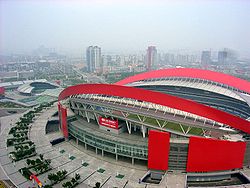 As one of the majors cities, Nanjing is the ground of many professional sports teams. Jiangsu Sainty
, the football club currently staying in China Super League, is a long-term tenant of Nanjing Olympic Sports Center
. Another football club that plays in secondary China professional level, China Jia League is Nanjing Yo Yo who hosts Wutaishan Sports Center
as their home stadium. Jiangsu Nangang Basketball Club
is a competitive team which has long been one of the major clubs fighting for the title in China top level league, CBA
. Jiangsu Volleyball men and women teams are also traditionally considered as at top level in China volleyball league.
There are two major sports centers in Nanjing, Wutaishan Sports Center
and Nanjing Olympic Sports Center
. Both of these two are comprehensive sports centers, including stadium, gymnasium, natatorium, tennis court, etc. Wutaishan Sports Center
was established in 1952 and it was one of the oldest and most advanced stadiums in early time of People's Republic of China.
Nanjing hosted the 10th National Games of P.R.C. in 2005 and will host the 2nd summer Youth Olympic Games in 2014.
In 2005, in order to host The 10th National Game of People's Republic of China, there was a new stadium, Nanjing Olympic Sports Center, constructed in Nanjing. Compared to Wutaishan Sports Center
, whose major stadium's capacity is 18,600, the stadium in Nanjing Olympic Sports Center is more advanced and has a bigger capacity. Nanjing Olympic Sports Center
has a stadium of capacity 60,000. Its gymnasium has capacity of 13,000, and natatorium of capacity 3,000.
Operated by Ministry of Industry and Information Technology
Operated by the joint Commission of the State Forest Administration and Public Order Ministry
Operated by the general sport Administration
, France Barranquilla
, Colombia Belo Horizonte
, Brazil Bloemfontein
, South Africa Daejeon
, South Korea Dallas, Texas, United States Eindhoven, Netherlands Florence
, Italy Hauts-de-Seine
, France Leipzig
, Germany Limassol
, Cyprus London, Ontario
, Canada Malacca Town
, Malaysia (2001) Mexicali
, Mexico Nagoya, Japan Perth
, Australia St. Louis, Missouri
, United States (November 2, 1978, The 1st pair of Twin Cities between the United States and People's Republic of China) Sunderland
, England, United Kingdom
|-
Jiangsu
' is a province of the People's Republic of China, located along the east coast of the country. The name comes from jiang, short for the city of Jiangning , and su, for the city of Suzhou. The abbreviation for this province is "苏" , the second character of its name...
province in China
China
Chinese civilization may refer to:* China for more general discussion of the country.* Chinese culture* Greater China, the transnational community of ethnic Chinese.* History of China* Sinosphere, the area historically affected by Chinese culture...
and has a prominent place in Chinese history and culture, having been the capital of China
Historical capitals of China
The Chinese phrase Four Great Ancient Capitals of China traditionally refers to Beijing , Nanjing, Luoyang, and Chang'an ....
on several occasions. Its present name means "Southern Capital" and was widely romanized as Nankin and Nanking until the Pinyin language reform, after which Nanjing was gradually adopted as the standard spelling of the city's name in most languages that use the Roman alphabet.
Located in the lower Yangtze River
Yangtze River
The Yangtze, Yangzi or Cháng Jiāng is the longest river in Asia, and the third-longest in the world. It flows for from the glaciers on the Tibetan Plateau in Qinghai eastward across southwest, central and eastern China before emptying into the East China Sea at Shanghai. It is also one of the...
drainage basin and Yangtze River Delta
Yangtze River Delta
The Yangtze River Delta, Yangtze Delta or YRD, also called Yangzi, or Chang Jiang Delta, Rive Chang Delta Tai Lake Region or the Golden Triangle of the Yangtze, generally comprises the triangular-shaped territory of Wu-speaking Shanghai, southern Jiangsu province and northern Zhejiang province of...
economic zone, Nanjing has long been one of China's most important cities. It is recognized as one of the Four Great Ancient Capitals of China
Historical capitals of China
The Chinese phrase Four Great Ancient Capitals of China traditionally refers to Beijing , Nanjing, Luoyang, and Chang'an ....
. It was the capital of Sun Quan
Sun Quan
Sun Quan , son of Sun Jian, formally Emperor Da of Wu, was the founder of Eastern Wu during the Three Kingdoms period of Chinese history. He ruled from 222 to 229 as King of Wu and from 229 to 252 as Emperor of Wu....
's Wu during the Three Kingdoms Period and the capital of the Republic of China
Republic of China
The Republic of China , commonly known as Taiwan , is a unitary sovereign state located in East Asia. Originally based in mainland China, the Republic of China currently governs the island of Taiwan , which forms over 99% of its current territory, as well as Penghu, Kinmen, Matsu and other minor...
prior to its flight to Taiwan
Taiwan
Taiwan , also known, especially in the past, as Formosa , is the largest island of the same-named island group of East Asia in the western Pacific Ocean and located off the southeastern coast of mainland China. The island forms over 99% of the current territory of the Republic of China following...
during the Chinese Civil War
Chinese Civil War
The Chinese Civil War was a civil war fought between the Kuomintang , the governing party of the Republic of China, and the Communist Party of China , for the control of China which eventually led to China's division into two Chinas, Republic of China and People's Republic of...
. Nanjing is also one of the fifteen sub-provincial cities
Sub-provincial city
A sub-provincial divisions in the People's Republic of China, is like a prefecture-level city that is ruled by a province, but is administered independently in regard to economy and law....
in the People's Republic of China's administrative structure, enjoying jurisdictional and economic autonomy only slightly less than that of a province. Nanjing has long been a national center of education, research, transport networks, and tourism. The city will host the 2014 Summer Youth Olympics
2014 Summer Youth Olympics
The 2014 Summer Youth Olympic Games is the second of the Summer Youth Olympics, a major international sports and cultural festival to be celebrated in the tradition of the Summer Olympic Games from 16 to 28 August 2014, during the XXX Olympiad...
.
With an urban population of over five million (2006), Nanjing is the second-largest commercial center in the East China region after Shanghai
Shanghai
Shanghai is the largest city by population in China and the largest city proper in the world. It is one of the four province-level municipalities in the People's Republic of China, with a total population of over 23 million as of 2010...
. It has been ranked seventh in the evaluation of "Cities with Strongest Comprehensive Strength" issued by the National Statistics Bureau
National Bureau of Statistics of China
The National Bureau of Statistics is an agency within the State Council of the People's Republic of China charged with the collection and publication of statistics related to the economy, population and society of the People's Republic of China at national and local levels.-List of Directors:*Xue...
, and second in the evaluation of cities with most sustainable development potential in the Yangtze River Delta. It has also been awarded the title of 2008 Habitat Scroll of Honor of China, Special Award of UN Habitat Scroll of Honor and National Civilized City.
Early history
Nanjing was one of the earliest established cities in what is now China. According to legend, Fu Chai, Lord of the State of Wu, founded a fort named YechengYecheng
Yecheng, Karghilik or Karghalik, also known as Chokkuka, is a city in Xinjiang, China. It is 249 km by road northwest to Kashgar, and 249 km south to Mazar....
in today's Nanjing area in 495 BCE. Later in 473 BCE, the State of Yue conquered Wu and constructed the fort of Yuecheng on the outskirts of the present-day Zhonghua Gate. In 333 BCE, after eliminating the State of Yue, the State of Chu built Jinling Yi in the western part of present-day Nanjing. Under the Qin
Qin Dynasty
The Qin Dynasty was the first imperial dynasty of China, lasting from 221 to 207 BC. The Qin state derived its name from its heartland of Qin, in modern-day Shaanxi. The strength of the Qin state was greatly increased by the legalist reforms of Shang Yang in the 4th century BC, during the Warring...
and Han dynasties
Han Dynasty
The Han Dynasty was the second imperial dynasty of China, preceded by the Qin Dynasty and succeeded by the Three Kingdoms . It was founded by the rebel leader Liu Bang, known posthumously as Emperor Gaozu of Han. It was briefly interrupted by the Xin Dynasty of the former regent Wang Mang...
, it was called Moling . Since then, the city has experienced destruction and renewal many times.,
Capital of the Six Dynasties
Nanjing first became a capital in 229 CECommon Era
Common Era ,abbreviated as CE, is an alternative designation for the calendar era originally introduced by Dionysius Exiguus in the 6th century, traditionally identified with Anno Domini .Dates before the year 1 CE are indicated by the usage of BCE, short for Before the Common Era Common Era...
, where Sun Quan
Sun Quan
Sun Quan , son of Sun Jian, formally Emperor Da of Wu, was the founder of Eastern Wu during the Three Kingdoms period of Chinese history. He ruled from 222 to 229 as King of Wu and from 229 to 252 as Emperor of Wu....
of the Wu Kingdom during the Three Kingdoms Period relocated its capital to Jianye
Jianye District
Jianye District is a district of Jiangsu, China. It is under the administration of Nanjing city.-External links:*...
, a city he extended on the basis of Jinling Yi in 211 CE. Although conquered by the West Jin Dynasty in 280, Nanjing and its neighboring areas had been well cultivated and developed into one of the commercial, cultural, and political centers of China during the rule of East Wu. This city would soon play a vital role in the following centuries.
Shortly after the unification of the region, the West Jin state collapsed in wars. It was at first rebels of eight Jin princes
War of the Eight Princes
The War of the Eight Princes or Rebellion of the Eight Kings or Rebellion of the Eight Princes was a civil war for power among princes and dukes of the Chinese Jin Dynasty from AD 291 to AD 306. It was fought mostly in northern China and devastated the country, later triggering the Wu Hu ravaging...
for the throne and later rebels and invasion from Xiongnu
Xiongnu
The Xiongnu were ancient nomadic-based people that formed a state or confederation north of the agriculture-based empire of the Han Dynasty. Most of the information on the Xiongnu comes from Chinese sources...
and other nomadic peoples that destroyed the rule of Jin in the north. In 317, remnants of the Jin court, as well as nobles and wealthy families, fled from the north to the south and reestablished the Jin court in Nanjing, which was then called Jiankang
Jiankang
Jiankang was the capital city of the Eastern Jin Dynasty and Southern Dynasties. Its walls are extant ruins in the modern municipal region of Nanjing.-History:...
.
During the period of the North-South Division
Southern and Northern Dynasties
The Southern and Northern Dynasties was a period in the history of China that lasted from 420 to 589 AD. Though an age of civil war and political chaos, it was also a time of flourishing arts and culture, advancement in technology, and the spreading of Mahayana Buddhism and Daoism...
, Nanjing remained the capital of the Southern Dynasties
Southern and Northern Dynasties
The Southern and Northern Dynasties was a period in the history of China that lasted from 420 to 589 AD. Though an age of civil war and political chaos, it was also a time of flourishing arts and culture, advancement in technology, and the spreading of Mahayana Buddhism and Daoism...
for more than two and a half centuries. During this time, Nanjing was the international hub of the East Asia and one of the largest city in the world. Based on historical documents, the city had 280,000 registered households. Assuming an average Nanjing household had about 5.1 people at that time, the city had more than 1.4 million residents.
A number of sculptural ensembles
Spirit way
A spirit way is the ornate road leading to a Chinese tomb of a major dignitary.The term is also sometimes translated as spirit road, spirit path or sacred way....
of that era, erected at the tombs of royals and other dignitaries, have survived (in various degrees of preservation) in Nanjing's northeastern and eastern suburbs, primarily in Qixia
Qixia District
Qixia District , Jiangsu, China a city district of the City of Nanjing directly northeast across the Yangtze River from Nanjing.It has an area of 80 km2 and the population of 400,000.-Natural and historical sights:...
and Jiangning
Jiangning District
Jiangning District is an administrative district in Nanjing, Jiangsu, China. The District has a population of 760,000 and an area of 1600 square kilometers. It includes southern and south-eastern suburbs of Nanjing....
District. Possibly the best preserved of them is the ensemble of the Tomb of Xiao Xiu
Xiao Xiu
Xiao Xiu , styled Prince Anchengkang ,was a younger half-brother of Emperor Wu, the first emperor of China's Liang Dynasty...
(475–518), a brother of Emperor Wu of Liang
Emperor Wu of Liang
Emperor Wu of Liang , personal name Xiao Yan , courtesy name Shuda , nickname Lian'er , was the founding emperor of the Chinese Liang Dynasty...
. The period of division ended when the Sui Dynasty
Sui Dynasty
The Sui Dynasty was a powerful, but short-lived Imperial Chinese dynasty. Preceded by the Southern and Northern Dynasties, it ended nearly four centuries of division between rival regimes. It was followed by the Tang Dynasty....
reunified China and destroyed almost the entire city, turning it into a small town.
Medieval period
The city of Nanjing was razed after Sui took it. It was reconstructed during late Tang DynastyTang Dynasty
The Tang Dynasty was an imperial dynasty of China preceded by the Sui Dynasty and followed by the Five Dynasties and Ten Kingdoms Period. It was founded by the Li family, who seized power during the decline and collapse of the Sui Empire...
. It was again chosen as the capital as Jinling during the short-lived Southern Tang
Southern Tang
Southern Tang was one of the Ten Kingdoms in south-central China created following the Tang Dynasty from 937-975. Southern Tang replaced the Wu Kingdom when Li Bian deposed the emperor Yang Pu....
(937–975), who succeeded the Wu
Wu (Ten Kingdoms)
Wu , also referred to as Huainan , Hongnong , Southern Wu , or Yang Wu , was one of the Ten Kingdoms in south-central China which was in existence between the years of 907 and 937. Its capital was Jiangdu Municipality...
. Jiankang's textile industry burgeoned and thrived during Song Dynasty
Song Dynasty
The Song Dynasty was a ruling dynasty in China between 960 and 1279; it succeeded the Five Dynasties and Ten Kingdoms Period, and was followed by the Yuan Dynasty. It was the first government in world history to issue banknotes or paper money, and the first Chinese government to establish a...
despite the constant threat from the northern foreign invasions. The Mongolians
Mongols
Mongols ) are a Central-East Asian ethnic group that lives mainly in the countries of Mongolia, China, and Russia. In China, ethnic Mongols can be found mainly in the central north region of China such as Inner Mongolia...
, the occupiers of China, further consolidated the city's status as a hub of the textile industry under the Yuan Dynasty
Yuan Dynasty
The Yuan Dynasty , or Great Yuan Empire was a ruling dynasty founded by the Mongol leader Kublai Khan, who ruled most of present-day China, all of modern Mongolia and its surrounding areas, lasting officially from 1271 to 1368. It is considered both as a division of the Mongol Empire and as an...
.
Capital of the Ming
The first emperor of the Ming DynastyMing Dynasty
The Ming Dynasty, also Empire of the Great Ming, was the ruling dynasty of China from 1368 to 1644, following the collapse of the Mongol-led Yuan Dynasty. The Ming, "one of the greatest eras of orderly government and social stability in human history", was the last dynasty in China ruled by ethnic...
Zhu Yuanzhang (the Hongwu Emperor) who overthrew the Yuan Dynasty rebuilt this city and made it the dynastic capital in 1368. He constructed what was the longest city wall in the world at that time. It took 200,000 laborers 21 years to finish the project. The present-day city wall of Nanjing
City Wall of Nanjing
The City Wall of Nanjing was designed by Emperor Zhu Yuanzhang after he founded the Ming Dynasty and established Nanjing as the capital 600 years ago. To consolidate his sovereignty and keep out invaders, he adopted the suggestions of advisor Zhu Sheng to build a higher city wall, to collect...
was mainly built during that time, and it is the longest surviving city wall in the world.
Nanjing remained the capital of the Ming Empire until 1421, when the third emperor of the dynasty, Zhu Di (the Yongle Emperor), relocated the capital to Beijing. It is believed that Nanjing was the largest city in the world from 1358 to 1425 with a population of 487,000 in 1400.
Besides the city wall, other famous Ming-era structures in the city included the famous Ming Xiaoling Mausoleum
Ming Xiaoling Mausoleum
The Ming Xiaoling Mausoleum is the tomb of the Hongwu Emperor, the founder of the Ming Dynasty. It lies at the southern foot of Purple Mountain , located east of the historical center of Nanjing, China...
and Porcelain Tower
Porcelain Tower of Nanjing
The Porcelain Tower of Nanjing , also known as Bao'ensi , is a historical site located on the south bank of the Yangtze in Nanjing, China...
, although the latter was destroyed by the Taipings
Taiping Rebellion
The Taiping Rebellion was a widespread civil war in southern China from 1850 to 1864, led by heterodox Christian convert Hong Xiuquan, who, having received visions, maintained that he was the younger brother of Jesus Christ, against the ruling Manchu-led Qing Dynasty...
in the 19th century.
A monument to the huge human cost of some of the gigantic construction projects of the early Ming is the Yangshan Quarry
Yangshan Quarry
The Yangshan Quarry is an ancient stone quarry near Nanjing, China, presently preserved as a historic site. Used during many centuries as a source of stone for buildings and monuments of Nanjing, the quarry is famous for the gigantic unfinished stele that was abandoned there during the reign of...
(located some 10 km (6 mi) east of the walled city an Ming Xiaoling), where a gigantic stele, cut on the orders of the Yongle Emperor, lies abandoned, just as it was left 600 years ago when it was understood that it is impossible to move or erect it.
As the center of the empire, early-Ming Nanjing had worldwide connections: it was home of the eunuch admiral Zheng He
Zheng He
Zheng He , also known as Ma Sanbao and Hajji Mahmud Shamsuddin was a Hui-Chinese mariner, explorer, diplomat and fleet admiral, who commanded voyages to Southeast Asia, South Asia, the Middle East, and East Africa, collectively referred to as the Voyages of Zheng He or Voyages of Cheng Ho from...
, who went to sail the Pacific and Indian Oceans, and it was visited by foreign dignitaries, such as the sultan of Brunei
Brunei
Brunei , officially the State of Brunei Darussalam or the Nation of Brunei, the Abode of Peace , is a sovereign state located on the north coast of the island of Borneo, in Southeast Asia...
Abdul Majid Hassan
Abdul Majid Hassan
Sultan Abdul Majid Hasan ascended the Brunei throne in 1402. He was never mentioned in Salasilah Raja-Raja Brunei but recorded in Ming historical record. He sent a mission to China in 1406 and his name is recorded as Ma-na-je-ka-na....
, who died during his visit to China in 1408. The sultan's grave, with a suitably royal spirit way
Spirit way
A spirit way is the ornate road leading to a Chinese tomb of a major dignitary.The term is also sometimes translated as spirit road, spirit path or sacred way....
and a tortoise stele
Bixi (tortoise)
Bixi , also called guifu or baxia , is a stone tortoise, used as a pedestal for a stele or tablet. Tortoise-mounted stelae have been traditionally used in the funerary complexes of Chinese emperors and other dignitaries. Later, they have also been used to commemorate an important event, such as...
, was discovered in Yuhuatai District
Yuhuatai District
Yuhuatai District is a district of Jiangsu, China. It is under the administration of Nanjing city.-References:*...
(south of the walled city) in 1958, and has been restored.
Qing period
Over two centuries after the removal of the capital to Beijing, Nanjing was destined to become the capital of a Ming emperor one more time. After the fall of Beijing to the Li Zicheng's rebels and then to Manchu QingQing Dynasty
The Qing Dynasty was the last dynasty of China, ruling from 1644 to 1912 with a brief, abortive restoration in 1917. It was preceded by the Ming Dynasty and followed by the Republic of China....
invaders, and the suicide of the last "real" Ming emperor Zhu Youjian (the Chongzhen Emperor) in the spring 1644, the Ming prince Zhu Yousong
Zhu Yousong, Prince of Fu
The Hongguang Emperor , was the first emperor of the Southern Ming Dynasty. He reigned briefly in Southern China from 1644-1645. His era name, Hongguang, means "Great light".-Biography:...
was enthroned in Nanjing in June 1644 as the Hongguang Emperor. His short reign was described by later historians as the first reign of the so-called Southern Ming Dynasty
Southern Ming Dynasty
The Southern Ming Dynasty was the Ming loyalist regime that continued in Southern China from 1644 to 1662 following the capture of Beijing by rebel armies and the death of the last Ming emperor in 1644....
.
Zhu Yousong, however, fared a lot worse than his ancestor Zhu Yuanzhang three centuries earlier. Beset by factional conflicts, his regime could not offer effective resistance to Manchu troops, when the Manchu army, led by Prince Dodo
Dodo (prince)
Dodo was a Manchu prince and military general of the early Qing Dynasty. His title was "Prince Yu of the First Rank" .-Family background:...
approached Jiangnan
Jiangnan
Jiangnan or Jiang Nan is a geographic area in China referring to lands immediately to the south of the lower reaches of the Yangtze River, including the southern part of the Yangtze Delta...
the next spring. Days after Yangzhou
Yangzhou
Yangzhou is a prefecture-level city in central Jiangsu Province, People's Republic of China. Sitting on the northern bank of the Yangtze River, it borders the provincial capital of Nanjing to the southwest, Huai'an to the north, Yancheng to the northeast, Taizhou to the east, and Zhenjiang across...
fell to the Manchus in late May 1645, the Hongguang Emperor fled Nanjing, and the imperial palace was looted by local residents. On June 6, Dodo's troops approached Nanjing, and the commander of the city's garrison, Zhao the Earl of Xincheng, promptly surrendered the city to them. The Manchus soon ordered all male residents of the city to shave their heads in the Manchu way
Queue (hairstyle)
The queue or cue is a hairstyle in which the hair is worn long and gathered up into a ponytail. It was worn traditionally by certain Native American groups and the Manchu of Manchuria.-Manchu Queue:...
, requisitioned a large section of the city for the bannermen
Eight Banners
The Eight Banners were administrative divisions into which all Manchu families were placed. They provided the basic framework for the Manchu military organization...
's cantonment, and destroyed the former imperial palace, but otherwise the city was spared the mass murders and destruction that befell Yangzhou
Yangzhou massacre
The Yangzhou massacre took place in 1645 in Yangzhou, China, during the Qing Dynasty. Mass killings of residents in Yangzhou were conducted by Qing troops under the command of Prince Dodo after they conquered the city from forces loyal to the Southern Ming regime of the Hongguang Emperor.The...
.
Under the Qing Dynasty
Qing Dynasty
The Qing Dynasty was the last dynasty of China, ruling from 1644 to 1912 with a brief, abortive restoration in 1917. It was preceded by the Ming Dynasty and followed by the Republic of China....
(1644–1911), the Nanjing area was known as Jiangning and served as the seat of government for the Liangjiang Viceroy. It had been visited by the Kangxi and Qianlong Emperor
Qianlong Emperor
The Qianlong Emperor was the sixth emperor of the Manchu-led Qing Dynasty, and the fourth Qing emperor to rule over China proper. The fourth son of the Yongzheng Emperor, he reigned officially from 11 October 1735 to 8 February 1796...
s a number of times on their tours of the southern provinces.
Nanjing was invaded by British troops during the close of the First Opium War
First Opium War
The First Anglo-Chinese War , known popularly as the First Opium War or simply the Opium War, was fought between the United Kingdom and the Qing Dynasty of China over their conflicting viewpoints on diplomatic relations, trade, and the administration of justice...
, which was ended by the Treaty of Nanking
Treaty of Nanking
The Treaty of Nanking was signed on 29 August 1842 to mark the end of the First Opium War between the United Kingdom of Great Britain and Ireland and the Qing Dynasty of China...
in 1842.
As the capital of the brief-lived Taiping Kingdom
Taiping Rebellion
The Taiping Rebellion was a widespread civil war in southern China from 1850 to 1864, led by heterodox Christian convert Hong Xiuquan, who, having received visions, maintained that he was the younger brother of Jesus Christ, against the ruling Manchu-led Qing Dynasty...
in the mid-19th century, Nanjing was known as Tianjing Both the Qing Viceroy and the Taiping king resided in buildings that would later be known as the Presidential Palace. When the Qing under Zeng Guofan
Zeng Guofan
Zeng Guofan was an eminent Han Chinese official, military general, and devout Confucian scholar of the late Qing Dynasty in China....
retook the city in 1864, a massive slaughter occurred in the city with over 100,000 estimated to have committed suicide or fought to the death.
Capital of the Republic
The Xinhai RevolutionXinhai Revolution
The Xinhai Revolution or Hsinhai Revolution, also known as Revolution of 1911 or the Chinese Revolution, was a revolution that overthrew China's last imperial dynasty, the Qing , and established the Republic of China...
led to the founding of the Republic of China
Republic of China (1912–1949)
In 1911, after over two thousand years of imperial rule, a republic was established in China and the monarchy overthrown by a group of revolutionaries. The Qing Dynasty, having just experienced a century of instability, suffered from both internal rebellion and foreign imperialism...
in January 1912 with Dr. Sun Yat-sen as the first provisional president and Nanjing was selected as its new capital. However, the Qing Dynasty
Qing Dynasty
The Qing Dynasty was the last dynasty of China, ruling from 1644 to 1912 with a brief, abortive restoration in 1917. It was preceded by the Ming Dynasty and followed by the Republic of China....
still controlled the northern provinces, so revolutionaries asked Yuan Shikai
Yuan Shikai
Yuan Shikai was an important Chinese general and politician famous for his influence during the late Qing Dynasty, his role in the events leading up to the abdication of the last Qing Emperor of China, his autocratic rule as the second President of the Republic of China , and his short-lived...
to replace Sun as president in exchange for the emperor's abdication. Yuan demanded the capital be at Beijing (closer to his power base).
In 1927, the Kuomintang
Kuomintang
The Kuomintang of China , sometimes romanized as Guomindang via the Pinyin transcription system or GMD for short, and translated as the Chinese Nationalist Party is a founding and ruling political party of the Republic of China . Its guiding ideology is the Three Principles of the People, espoused...
(KMT) under Generalissimo Chiang Kai-shek
Chiang Kai-shek
Chiang Kai-shek was a political and military leader of 20th century China. He is known as Jiǎng Jièshí or Jiǎng Zhōngzhèng in Mandarin....
again established Nanjing as the capital of the Republic of China, and this became internationally recognized once KMT forces took Beijing in 1928. The following decade is known as the Nanjing decade
Nanjing decade
The Nanjing decade was the decade from 1927 to 1937 in the Republic of China. It began when Nationalist Generalissimo Chiang Kai-shek took the city from Zhili clique warlord Sun Chuanfang halfway through the Northern Expedition in 1927. He declared it to be the national capital despite the...
.
In 1937, Japan again invaded China, beginning the Second Sino-Japanese War
Second Sino-Japanese War
The Second Sino-Japanese War was a military conflict fought primarily between the Republic of China and the Empire of Japan. From 1937 to 1941, China fought Japan with some economic help from Germany , the Soviet Union and the United States...
(often considered a theater of World War II
World War II
World War II, or the Second World War , was a global conflict lasting from 1939 to 1945, involving most of the world's nations—including all of the great powers—eventually forming two opposing military alliances: the Allies and the Axis...
). Their troops occupied Nanjing in December and carried out the systematic and brutal Nanking massacre
Nanking Massacre
The Nanking Massacre or Nanjing Massacre, also known as the Rape of Nanking, was a mass murder, genocide and war rape that occurred during the six-week period following the Japanese capture of the city of Nanjing , the former capital of the Republic of China, on December 13, 1937 during the Second...
(the "Rape of Nanking"). The total death toll, including those made by the International Military Tribunal for the Far East
International Military Tribunal for the Far East
The International Military Tribunal for the Far East , also known as the Tokyo Trials, the Tokyo War Crimes Tribunal, or simply the Tribunal, was convened on April 29, 1946, to try the leaders of the Empire of Japan for three types of crimes: "Class A" crimes were reserved for those who...
and the Nanjing War Crimes Tribunal
Nanjing War Crimes Tribunal
The Nanjing War Crimes Tribunal was established in 1946 by the government of Chiang Kai-Shek to judge four Japanese Imperial Army officers accused of crimes committed during the Second Sino-Japanese War...
, put the number of dead between 300,000 and 350,000. The Nanjing Massacre Memorial Hall
Nanjing Massacre Memorial Hall
The Memorial for compatriots killed in the Nanjing Massacre by Japanese Forces of Aggression is the Memorial Hall for the people killed in the Nanjing Massacre by the Japanese army in and around the then capital of China, Nanjing, after it fell to the Imperial Japanese Army on December 13, 1937...
was built in 1985 to commemorate this event.
A few days before the fall of the city, the National Government of China was relocated to the southwestern city Chungking (now Chongqing)
Chongqing
Chongqing is a major city in Southwest China and one of the five national central cities of China. Administratively, it is one of the PRC's four direct-controlled municipalities , and the only such municipality in inland China.The municipality was created on 14 March 1997, succeeding the...
and resumed Chinese resistance. In 1940,a Japanese-collaborationist government known as the "Nanjing Regime
Wang Jingwei Government
In March 1940 a puppet government led by Wang Jingwei was established in the Republic of China under the protection of the Empire of Japan. The regime officially called itself the Republic of China and its government the Reorganized National Government of China...
" or "Nanjing Nationalist Government" led by Wang Jingwei
Wang Jingwei
Wang Jingwei , alternate name Wang Zhaoming, was a Chinese politician. He was initially known as a member of the left wing of the Kuomintang , but later became increasingly anti-Communist after his efforts to collaborate with the CCP ended in political failure...
was established in Nanjing as a rival to Chiang Kai-Shek
Chiang Kai-shek
Chiang Kai-shek was a political and military leader of 20th century China. He is known as Jiǎng Jièshí or Jiǎng Zhōngzhèng in Mandarin....
's government in Chongqing. In 1946, after the Surrender of Japan
Surrender of Japan
The surrender of Japan in 1945 brought hostilities of World War II to a close. By the end of July 1945, the Imperial Japanese Navy was incapable of conducting operations and an Allied invasion of Japan was imminent...
, the KMT relocated its central government back to Nanjing.
People's Republic of China
On April 23, 1949, the People's Liberation ArmyPeople's Liberation Army
The People's Liberation Army is the unified military organization of all land, sea, strategic missile and air forces of the People's Republic of China. The PLA was established on August 1, 1927 — celebrated annually as "PLA Day" — as the military arm of the Communist Party of China...
conquered Nanjing. After the establishment of the People's Republic of China in October, Nanjing was initially a province-level municipality, but very soon became and today remains the provincial capital of Jiangsu.
Geography and climate
Nanjing, with a total land area of 6598 square kilometres (2,547.5 sq mi), is situated in one of the largest economic zones of China, the Yangtze River Delta, which is part of the downstream Yangtze RiverYangtze River
The Yangtze, Yangzi or Cháng Jiāng is the longest river in Asia, and the third-longest in the world. It flows for from the glaciers on the Tibetan Plateau in Qinghai eastward across southwest, central and eastern China before emptying into the East China Sea at Shanghai. It is also one of the...
drainage basin
Drainage basin
A drainage basin is an extent or an area of land where surface water from rain and melting snow or ice converges to a single point, usually the exit of the basin, where the waters join another waterbody, such as a river, lake, reservoir, estuary, wetland, sea, or ocean...
. The Yangtze River flows past the west side of Nanjing City, while the Ningzheng Ridge surrounds the north, east and south side of the city. The city is 300 kilometres (186.4 mi) west-northwest of Shanghai, 1200 kilometres (745.6 mi) south-southeast of Beijing, and 1400 kilometres (869.9 mi) east-northeast of Chongqing
Chongqing
Chongqing is a major city in Southwest China and one of the five national central cities of China. Administratively, it is one of the PRC's four direct-controlled municipalities , and the only such municipality in inland China.The municipality was created on 14 March 1997, succeeding the...
.
Nanjing borders Yangzhou
Yangzhou
Yangzhou is a prefecture-level city in central Jiangsu Province, People's Republic of China. Sitting on the northern bank of the Yangtze River, it borders the provincial capital of Nanjing to the southwest, Huai'an to the north, Yancheng to the northeast, Taizhou to the east, and Zhenjiang across...
to the northeast, one town downstream when following the north bank of the Yangtze, Zhenjiang
Zhenjiang
Zhenjiang is a prefecture-level city in the southwest of Jiangsu province in the eastern People's Republic of China . Sitting on the southern bank of the Yangtze River, it borders the provincial capital of Nanjing to the west, Changzhou to the east, and Yangzhou across the river to the north.Once...
to the east, one town downstream when following the south bank of the Yangtze, and Changzhou
Changzhou
Changzhou is a prefecture-level city in southern Jiangsu province of the People's Republic of China. It was previously known as Yanling, Lanling, Jinling, and Wujin. Located on the southern bank of the Yangtze River, Changzhou borders the provincial capital of Nanjing to the west, Zhenjiang to the...
to the southeast. On its western boundary is Anhui
Anhui
Anhui is a province in the People's Republic of China. Located in eastern China across the basins of the Yangtze River and the Huai River, it borders Jiangsu to the east, Zhejiang to the southeast, Jiangxi to the south, Hubei to the southwest, Henan to the northwest, and Shandong for a tiny...
Province, where Nanjing borders 5 prefecture-level cities.
Nanjing has a humid subtropical climate
Humid subtropical climate
A humid subtropical climate is a climate zone characterized by hot, humid summers and mild to cool winters...
(Köppen
Köppen climate classification
The Köppen climate classification is one of the most widely used climate classification systems. It was first published by Crimea German climatologist Wladimir Köppen in 1884, with several later modifications by Köppen himself, notably in 1918 and 1936...
Cfa) and is under the influence of the East Asia Monsoon
Monsoon
Monsoon is traditionally defined as a seasonal reversing wind accompanied by corresponding changes in precipitation, but is now used to describe seasonal changes in atmospheric circulation and precipitation associated with the asymmetric heating of land and sea...
. The four seasons are distinct here, with damp conditions seen throughout the year, very hot and muggy summers, cold, damp winters, and in between, spring and autumn are of reasonable length. Along with Wuhan and Chongqing, Nanjing is traditionally referred to as one of the "Three Furnacelike Cities" along the Yangtze River (长江流域三大火炉) for the perennially high temperatures in the summertime. However, the time from mid-June to the end of July is the plum blossom blooming season in which the meiyu (rainy season of East Asia; literally "plum rain") occurs, during which the city experiences a period of mild rain as well as dampness. Typhoons are uncommon but possible in the late stages of summer and early part of autumn. The annual mean temperature is around 15.5 °C (59.9 °F), with monthly mean values ranging from 2.4 to 27.8 °C (36.3 to 82 °F). The highest recorded temperature is 43 °C (109 °F) , and the lowest -16.9 °C. On average precipitation falls 115 days out of the year, and the average annual rainfall is 1062 millimetres (42 in).
Nanjing is endowed with rich natural resources, which include more than 40 kinds of minerals. Among them, iron and sulfur
Sulfur
Sulfur or sulphur is the chemical element with atomic number 16. In the periodic table it is represented by the symbol S. It is an abundant, multivalent non-metal. Under normal conditions, sulfur atoms form cyclic octatomic molecules with chemical formula S8. Elemental sulfur is a bright yellow...
reserves make up 40 percent of those of Jiangsu province. Its reserves of strontium
Strontium
Strontium is a chemical element with the symbol Sr and the atomic number 38. An alkaline earth metal, strontium is a soft silver-white or yellowish metallic element that is highly reactive chemically. The metal turns yellow when exposed to air. It occurs naturally in the minerals celestine and...
rank first in East Asia and the South East Asia region. Nanjing also possesses abundant water resources, both from the Yangtze River and groundwater. In addition, it has several natural hot springs such as Tangshan Hot Spring in Jiangning
Jiangning District
Jiangning District is an administrative district in Nanjing, Jiangsu, China. The District has a population of 760,000 and an area of 1600 square kilometers. It includes southern and south-eastern suburbs of Nanjing....
and Tangquan Hot Spring in Pukou.
Nanjing is the intersection of Yangtze Riveran east-west water transport artery and Nanjing-Beijing railway—a south-north land transport artery, hence the name “door of the east and west, throat of the south and north”. Furthermore, the west part of the Ningzhen range is in Nanjing; the Loong-like Zhong Mountain is curling in the east of the city; the tiger-like Stone Mountain is crouching in the west of the city, hence the name “the Zhong Mountain, a dragon curling, and the Stone Mountain, a tiger crouching”. Mr. Sun Yet-sen spoke highly of Nanjing in the “Constructive Scheme for Our Country”, “The position of Nanjing is wonderful since mountains, lakes and plains all integrated in it. It is hardly [sic] to find another city like this.”
Surrounded by the Yangtze River and mountains, Nanjing also enjoys beautiful natural scenery. Natural lakes such as Xuanwu Lake
Xuanwu Lake
Xuanwu Lake is a lake in the central-northeast part of Nanjing, Jiangsu, China, near Nanjing Railway Station and Ji Ming Temple. The Ming city wall borders the park to its south and east and there is a notable pagoda and the Zifeng Tower overlooking the lake.The lake covers 444 hectares and is 15...
and Mochou Lake
Mochou Lake
Mochou Lake lies outside Shuixi Gate of Nanjing City, with a total area of 47 hectares and a circumference of 5 km. In Qing Dynasty, it was a beautiful garden that was also famed as the first attraction of Nanjing. Mochou Lake was once part of Yangtze River...
are located in the center of the city and are easily accessible to the public, while hills like Purple Mountain are covered with evergreens and oaks and host various historical and cultural sites. Sun Quan
Sun Quan
Sun Quan , son of Sun Jian, formally Emperor Da of Wu, was the founder of Eastern Wu during the Three Kingdoms period of Chinese history. He ruled from 222 to 229 as King of Wu and from 229 to 252 as Emperor of Wu....
relocated his capital to Nanjing after Liu Bei
Liu Bei
Liu Bei , also known as Liu Xuande, was a warlord, military general and later the founding emperor of the state of Shu Han during the Three Kingdoms era of Chinese history...
's suggestion as Liu Bei was impressed by Nanjing's impeccable geographic position when negotiating an alliance with Sun Quan. Sun Quan then renamed the city from Moling (秣陵) to Jianye (建邺) shortly thereafter.
Government
The full name of the government of Nanjing is "People's Government of Nanjing City". The city is under the one-party rule of the CPCCommunist Party of China
The Communist Party of China , also known as the Chinese Communist Party , is the founding and ruling political party of the People's Republic of China...
, with the CPC Nanjing Committee Secretary as the de facto governor of the city and the mayor as the executive head of the government working under the secretary.
Nanjing currently consists of thirteen county-level divisions, of which eleven are districts, and two are counties. The districts are the urban areas of Nanjing while the counties are the rural areas governed by the city.
Administrative divisions
The sub-provincial city of Nanjing has direct jurisdiction over 11 districts (区 qu) and 2 Counties (县 xian):| Map | Subdivision | Hanzi |
|---|---|---|
| Nanjing City Proper | ||
| ■ Xuanwu-qu Xuanwu District, Nanjing Xuanwu District, Nanjing is a district of Jiangsu, China. It is under the administration of Nanjing city.-References:*... |
玄武区 | |
| ■ Baixia-qu Baixia District Baixia District is a district of Jiangsu Province, People's Republic of China, under the administration of Nanjing City. It has a population of 450,000 and a land area of .-Administrative subdivisions:Baixia District administers nine subdistricts.... |
白下区 | |
| ■ Qinhuai-qu Qinhuai District Qinhuai District is one of the districts of Nanjing.-Important areas in Qinhuai District:*Fuzimiao*Zhonghua Gate*Bao'ensi-External links:*... |
秦淮区 | |
| ■ Jianye-qu Jianye District Jianye District is a district of Jiangsu, China. It is under the administration of Nanjing city.-External links:*... |
建邺区 | |
| ■ Xiaguan-qu Xiaguan District Xiaguan District is an administrative district within the city of Nanjing, in Jiangsu province, China.-References:*... |
下关区 | |
| ■ Gulou-qu Gulou District, Nanjing Gulou District, Nanjing is a district of Jiangsu, China. It is under the administration of Nanjing city.-References:* *... |
鼓楼区 | |
| ■ Yuhuatai-qu Yuhuatai District Yuhuatai District is a district of Jiangsu, China. It is under the administration of Nanjing city.-References:*... |
雨花台区 | |
| ■ Qixia-qu Qixia District Qixia District , Jiangsu, China a city district of the City of Nanjing directly northeast across the Yangtze River from Nanjing.It has an area of 80 km2 and the population of 400,000.-Natural and historical sights:... |
栖霞区 | |
| Nanjing Suburban and Rural | ||
| ■ Jiangning-qu Jiangning District Jiangning District is an administrative district in Nanjing, Jiangsu, China. The District has a population of 760,000 and an area of 1600 square kilometers. It includes southern and south-eastern suburbs of Nanjing.... |
江宁区 | |
| ■ Pukou-qu Pukou District Pukou , Jiangsu, China a district in the City of Nanjing which lies northwest across the Yangtze River from downtown Nanjing.The district was formerly the southern terminus of the Tianjin-Pukou Railway; railcars had to be ferried across the river until it was bridged in 1968.-Geography:Pukou... |
浦口区 | |
| ■ Luhe-qu Luhe District Luhe District is a district of Jiangsu, China. It is under the administration of Nanjing city.-External links:*... |
六合区 | |
| ■ Lishui-xian Lishui County Lishui County is a county of Jiangsu, China. It is under the administration of Nanjing city. It's south of Nanjing and Jiangning and north of Gaochun... |
溧水县 | |
| ■ Gaochun-xian Gaochun County Gaochun County is a county-level city administered by Nanjing in Jiangsu Province. Located south of Nanjing's downtown, it spans an area of 802 km², with a total population of 430,000.-Culture:... |
高淳县 | |
The current partition of districts of Nanjing might change in the future. There was a rumor that Lishui County would be designated as a new urban district in the near future.
Demographics
| > | ||
| Year | Residents (in million) | natural growth rate (%) |
|---|---|---|
| 1949 | 2.5670 | 13.09 |
| 1950 | 2.5670 | 15.64 |
| 1955 | 2.8034 | 19.94 |
| 1960 | 3.2259 | 0.23 |
| 1965 | 3.4529 | 25.58 |
| 1970 | 3.6053 | 20.76 |
| 1975 | 3.9299 | 9.53 |
| 1978 | 4.1238 | 8.84 |
| 1980 | 4.3587 | 8.08 |
| 1985 | 4.6577 | 4.56 |
| 1990 | 5.0182 | 9.18 |
According to the Sixth China Census, the total population of the City of Nanjing reached 8.005 million in 2010. The statistics in 2008 estimated the total population to be 7.7 million, while the registered population was 6.3 million. The birth rate
Birth rate
Crude birth rate is the nativity or childbirths per 1,000 people per year . Another word used interchangeably with "birth rate" is "natality". When the crude birth rate is subtracted from the crude death rate, it reveals the rate of natural increase...
was 8.86 percent and the death rate was 6.88 percent. The urban area had a population of 5.5 million people.
As in most of eastern China the ethnic makeup of Nanjing is predominantly Han nationality (98.56 percent), with 50 other minority nationalities. In 1999, 77,394 residents belonged to minority nationalities, among which the vast majority (64,832) were Hui nationalities, contributing 83.76 percent to the minority population. The second and third largest minority groups were Manchu (2,311) and Zhuang (533) nationalities. Most of the minority nationalities resided in Jianye District, comprising 9.13 percent of the district's population.
In 2010 the sex ratio
Sex ratio
Sex ratio is the ratio of males to females in a population. The primary sex ratio is the ratio at the time of conception, secondary sex ratio is the ratio at time of birth, and tertiary sex ratio is the ratio of mature organisms....
of the city population was 107.31 males to 100 females.
Earlier development
Since the Three Kingdoms period, Nanjing has become an industrial center for textile and mint owing to its strategic geographical location and convenient transportation. During the Ming Dynasty Nanjing's industry was further expanded, and the city became one of the most prosperous cities in China and even the world. It led in textile, mint, printing, shipbuilding and many other industries, and was the busiest business center in the Far East.Into the first half of the twentieth century, Nanjing gradually shifted from a production hub into a heavy consumption city, mainly because of the rapid expansion of the wealthy population after Nanjing once again regained the political spotlight of China. A number of huge department stores such as Zhongyang Shangchang sprouted up, attracting merchants from all over China to sell their products in Nanjing. In 1933, the revenue generated by the food and entertainment industry in the city exceeded the sum of the output of the manufacturing and agriculture industry. One third of the city population worked in the service industry, while prostitution, drugs and gambling also thrived.
In the 1950s, the CPC invested heavily in Nanjing to build a series of state-owned heavy industries
Heavy industry
Heavy industry does not have a single fixed meaning as compared to light industry. It can mean production of products which are either heavy in weight or in the processes leading to their production. In general, it is a popular term used within the name of many Japanese and Korean firms, meaning...
, as part of the national plan of rapid industrialization. Electrical, mechanical, chemical and steel factories were established successively, converting Nanjing into a heavy industry production center of East China. Overenthusiastic in building a “world-class” industrial city, leaders of Nanjing also made many disastrous mistakes during the development, such as spending hundreds of millions of yuan to mine for non-existent coal, resulting in the negative economic growth in the late 1960s.
Today
The current industry of the city basically inherited the characteristics of the 1960s, with electronics, carsAutomobile
An automobile, autocar, motor car or car is a wheeled motor vehicle used for transporting passengers, which also carries its own engine or motor...
, petrochemical, iron and steel, and power as the "Five Pillar Industries". Some representative big state-owned firms are Panda Electronics
Panda Electronics
Panda Electronics is a Chinese manufacturer and brand for electronic products. The products include communications , TV sets and set top boxes, administrative software and electronic instruments....
, Jincheng Motors and Nanjing Steel. The tertiary industry also regained prominence, accounting for 44 percent of the GDP of the city. The city is also vying for foreign investment against neighboring cities in the Yangtze River Delta, and so far a number of famous multinational firms
Multinational corporation
A multi national corporation or enterprise , is a corporation or an enterprise that manages production or delivers services in more than one country. It can also be referred to as an international corporation...
, such as Volkswagen Group
Volkswagen Group
Volkswagen Group is a German multinational automobile manufacturing group. , Volkswagen was ranked as the world’s third largest motor vehicle manufacturer and Europe's largest....
, Iveco
Iveco
Iveco, an acronym for Industrial Vehicle Corporation, originally an alliance of European commercial vehicle manufacturers such as Fiat , Unic and Magirus. Iveco is now an Italian truck, bus, and diesel engine manufacturer, based in Turin...
, A.O. Smith, and Sharp
Sharp Corporation
is a Japanese multinational corporation that designs and manufactures electronic products. Headquartered in Abeno-ku, Osaka, Japan, Sharp employs more than 55,580 people worldwide as of June 2011. The company was founded in September 1912 and takes its name from one of its founder's first...
, have established their lines there. Since China's entry into the WTO, Nanjing has received increasing attention from foreign investors, and on average, two new foreign firms establish offices in the city every day.
The city government is further improving the desirability of the city to investors by building large industrial park
Industrial park
An industrial park is an area zoned and planned for the purpose of industrial development...
s, which now total four: Gaoxin, Xingang, Huagong and Jiangning. Despite the effort, Nanjing's Gross Domestic Product is still falling behind that of other neighbouring cities such as Suzhou
Suzhou
Suzhou , previously transliterated as Su-chou, Suchow, and Soochow, is a major city located in the southeast of Jiangsu Province in Eastern China, located adjacent to Shanghai Municipality. The city is situated on the lower reaches of the Yangtze River and on the shores of Taihu Lake and is a part...
, Wuxi
Wuxi
Wuxi is an old city in Jiangsu province, People's Republic of China. Split in half by Lake Tai, Wuxi borders Changzhou to the west and Suzhou to the east. The northern half looks across to Taizhou across the Yangtze River, while the southern half also borders the province of Zhejiang to the south...
and Hangzhou
Hangzhou
Hangzhou , formerly transliterated as Hangchow, is the capital and largest city of Zhejiang Province in Eastern China. Governed as a sub-provincial city, and as of 2010, its entire administrative division or prefecture had a registered population of 8.7 million people...
, which have an edge in attracting foreign investment and local innovation. In addition, the traditional state-owned enterprises find themselves incapable of competing with efficient multinational firms, and hence are either mired in heavy debt or forced into bankruptcy
Bankruptcy
Bankruptcy is a legal status of an insolvent person or an organisation, that is, one that cannot repay the debts owed to creditors. In most jurisdictions bankruptcy is imposed by a court order, often initiated by the debtor....
or privatization
Privatization
Privatization is the incidence or process of transferring ownership of a business, enterprise, agency or public service from the public sector to the private sector or to private non-profit organizations...
. This has resulted in large numbers of layoff workers
Layoff
Layoff , also called redundancy in the UK, is the temporary suspension or permanent termination of employment of an employee or a group of employees for business reasons, such as when certain positions are no longer necessary or when a business slow-down occurs...
who are technically not unemployed but effectively jobless.
In recent years, Nanjing has been developing its economy, commerce, industry, as well as city construction. In 2010 the city's GDP was RMB 501 billion (3rd in Jiangsu), and GDP per capita was RMB 65,490, a 13 percent increase from 2009. The average urban resident's disposable income
Disposable income
Disposable income is total personal income minus personal current taxes. In national accounts definitions, personal income, minus personal current taxes equals disposable personal income...
was RMB 28,312, while the average rural resident's net income was RMB 11,050. The registered urban unemployment rate was 3.02 percent, lower than the national average (4.3 percent). Nanjing's Gross Domestic Product ranked 14th in 2010 in China, and its overall competence ranked 5th in mainland and 7th including Taiwan and Hongkong.
Industrial zones
- Nanjing Baixia Hi-Tech Industrial Zone
Nanjing Baixia Hi-Tech Industrial Zone is a national hi-tech industrial zone with 16.5 square kilometers planned area. The zone is only 13.5 km away from Nanjing downtown and 50 km away from Nanjing Lukou Airport. Several expressways pass through here. It is well equipped with comprehensive facilities, and it provides a good investment environment for high-tech industries. Electronic industry, automobile, chemical, machinery, instruments and building materials are the encouraged industries in the zone.
- Nanjing Economic and Technological Development Zone
Established in 1992, Nanjing Economic and Technological Development Zone is a national level zone surrounded by convenient transportation network. Nanjing is the capital of Jiangsu Province. Situated in the downstream of Yangtze River Drainage Basin and Yangtze River Delta economic zone, Nanjing has always been a national center of commerce, education, research, transportation and tourism in the East China region, preceded only by Shanghai. It is only 20 km away from Nanjing Port and 40 km away from Nanjing Lukou Airport. It is well equipped with basic facilities like electricity, water, communication, gas, steam and so on. It has formed four specialized industries, which are electronic information, bio-pharmaceutical, machinery and new materials industry.
- Nanjing Export Processing Zone
On March 10, 2003 the State Council approved the establishment of this Export Processing Zone (EPZ) in Nanjing's Southern District. This EPZ is free from import/export duty area and provides 24-hour customs-bonded conditions. It has a planned area of 3 square km. The Central Government has given the special economic region preferential policies to attract more enterprises engaged in processing trade investment in the region. It is only 20 km from Nanjing Port and several expressways pass through here.
- Nanjing New & High-Tech Industry Development Zone
Nanjing New & High-Tech Industry Development Zone was jointly founded by Jiangsu Provincial People's Government and Nanjing Municipal People's Government, and started to break ground of construction on September 1, 1988. It was established as a national new and high-tech industry development zone by the State Council on March 6, 1991. The zone is next to National Highway 104 and 312. Its pillar industries include electronic information, bio-engineering and pharmaceutical industry.
Transportation
Nanjing is the transportation hub in eastern China and the downstream Yangtze River area. Different means of transportation constitute a three-dimensional transport system that includes land, water and air. As in most other Chinese cities, public transportation is the dominant mode of travel of the majority of the citizens. The city now has four bridge or tunnel crossings spanning the Yangtze, which are tying districts north of the river with the city center on the south bank. See also Transport in Nanjing.Rail
Nanjing is an important railway hub in eastern China. It serves as rail junction for the Beijing-Shanghai (Jinghu)Jinghu railway
The Beijing–Shanghai Railway or Jinghu railway is a railway line in China between Beijing and Shanghai. The line has a total length of 1,462 kilometres and connects the municipalities of Beijing, Tianjin, and Shanghai, as well as the provinces of Hebei, Shandong, Anhui and Jiangsu...
(which is itself composed of the old Jinpu
Jinpu railway
The Tianjin–Pukou or Jinpu Railway runs from Tianjin to Pukou outside Nanjing in Jiangsu province.In September 1898 at a conference in London, British and German capitalists decided to build a railway from Tianjin to Zhenjiang. In May 1899, the Qing government agreed to the financing of the...
and Huning Railways), Nanjing-Wuhu (Ningwu), Nanjing-Qidong (Ningqi), Nanjing-Xian (Ningxi), Hefei-Nanjing (Hening) Railways. Currently, Nanjing has been connected within the high-speed railway network by Beijing–Shanghai High-Speed Railway and Shanghai–Nanjing Intercity High-Speed Railway, and more high-speed rail constructions will be finished in recent years.
Passenger rail service in Nanjing is provided by Nanjing Railway Station
Nanjing Railway Station
Nanjing Railway Station is a major railway station of Nanjing, Jiangsu, China. It is located in the northern part of Nanjing's urban core , near Xuanwu Lake.-Services:...
and Nanjing South Railway Station, while Nanjing West Railway Station, Zhonghuamen Railway Station and Xianlin Railway Station
Xianlin Railway Station
Xianlin Railway Station is a railway station of Shanghai-Nanjing Intercity Railway located in Qixia District of Nanjing City, People's Republic of China. At the moment hardly any trains stop at this station....
serve minor roles. Nanjing South Railway Station, which is one of the 5 hub stations on Beijing-Shanghai High-Speed Railway, has officially been claimed as the largest railway station in Asia in terms of GFA (Gross Floor Area).
Road
As an important regional hub in the Yangtze River DeltaYangtze River Delta
The Yangtze River Delta, Yangtze Delta or YRD, also called Yangzi, or Chang Jiang Delta, Rive Chang Delta Tai Lake Region or the Golden Triangle of the Yangtze, generally comprises the triangular-shaped territory of Wu-speaking Shanghai, southern Jiangsu province and northern Zhejiang province of...
, Nanjing is well-connected by over 60 state and provincial highways to all parts of China.
Express highways such as Hu-Ning, Ning-He, Ning-Hang enable commuters to travel to Shanghai, Hefei
Hefei
Hefei is the capital and largest city of Anhui Province in Eastern China. A prefecture-level city, it is the political, economic, and cultural centre of Anhui...
, Hangzhou
Hangzhou
Hangzhou , formerly transliterated as Hangchow, is the capital and largest city of Zhejiang Province in Eastern China. Governed as a sub-provincial city, and as of 2010, its entire administrative division or prefecture had a registered population of 8.7 million people...
, and other important cities quickly and conveniently. Inside the city of Nanjing, there are 230 kilometres (142.9 mi) of highways, with a highway coverage density of 3.38 kilometers per hundred square kilometers (2.10 mi/38.6 sq mi). The total road coverage density of the city is 112.56 kilometers per hundred square kilometers (69.94 mi/38.6 sq mi).
Nanjing Sample Technology Company Limited
Nanjing Sample Technology Company Limited
Nanjing Sample Technology Company Limited is a high-technology enterprise which is located in Nanjing and is listed on the Main Board of the Hong Kong Stock Exchange....
is a major provider of Intelligent traffic systems.
Expressways:
- G42 Shanghai-Chengdu Expressway
- G40 Shanghai-Xi'an Expressway
- G25 Changchun-Shenzhen Expressway
- G36 Nanjing-Luoyang Expressway
- G4211 Nanjing-Wuhu Expressway
- S55 Nanjing-Gaochun Expressway
- S38 Yanjiang Expressway
- G2501 Nanjing Ring Expressway
- and also several CRH(China railway high-speed)lines(中国高速铁路 or “中国动车组”)
National Highway:
- China National Highway 312China National Highway 312China National Highway 312 , also referred to as Route 312 or The Mother Road, is an important highway that runs east-west across the breadth of People's Republic of China. It begins at the port city Shanghai and ends at Khorgas in the Ili River valley, on the border with Kazakhstan. In total it...
- China National Highway 104China National Highway 104China National Highway 104 runs from Beijing to Fuzhou via Jinan, Xuzhou, Nanjing, Hangzhou and Taizhou.It runs to approximately 2,390 km, and, on a map, runs southeast towards Nanjing and Hangzhou before turning south-southwest at Taizhou....
- China National Highway 205China National Highway 205China National Highway 205 runs from Shanhaiguan, Hebei Province to Shenzhen, Guangdong. It is 3,160 kilometres in length and runs south from Shanhaiguan towards Tianjin, Hebei, Shandong, Jiangsu, Anhui, Zhejiang, Fujian, and ends in Guangdong Province.- Route and distance:...
- China National Highway 328China National Highway 328China National Highway 328 runs from Nanjing to Hai'an in Jiangsu. It is 300 kilometres in length and runs east from Nanjing, going through Liuhe Town and Yangzhou.-Route and distance:...
Public Transportation
The city also boasts an efficient network of public transportation, which mainly consists of bus, taxi and metro systems. The bus network, which is currently run by five companies (Nanjing Gongjiao, ZhongbeiZhongbei
Zhongbei is a town in Xiqing District, in the western suburbs of the municipality of Tianjin, People's Republic of China....
, Argos, Xincheng and Xinningpu), provides more than 370 routes covering all parts of the city and suburban areas. Nanjing Metro
Nanjing Metro
The Nanjing Metro is a metro system serving the city of Nanjing, Jiangsu, China. It first opened in 2005, and as of 2011, there are two lines in operation, with of track in operation.-Current system:-Line 1:...
Line 1, started service on May 15, 2005. Line 2 and the extension of Line 1 officially opened to passenger service on May 28, 2010. The city is planning to complete a 655-kilometer (409 mi)-long Metro and light-rail system by 2030. The expansion of the Metro network will greatly facilitate the intracity transportation and reduce the currently heavy traffic congestion.
Air
Nanjing's airport, Lukou International Airport, serves both national and international flights. In 2010, the airport handled 12.5305 million passengers. It was ranked 14th among 126 civil airports in China in terms of yearly passenger transport, and 10th for yearly cargo transport. The airport currently has 85 routes to national and international destinations, which include Japan, KoreaKorea
Korea ) is an East Asian geographic region that is currently divided into two separate sovereign states — North Korea and South Korea. Located on the Korean Peninsula, Korea is bordered by the People's Republic of China to the northwest, Russia to the northeast, and is separated from Japan to the...
, Thailand
Thailand
Thailand , officially the Kingdom of Thailand , formerly known as Siam , is a country located at the centre of the Indochina peninsula and Southeast Asia. It is bordered to the north by Burma and Laos, to the east by Laos and Cambodia, to the south by the Gulf of Thailand and Malaysia, and to the...
, Malaysia, Singapore
Singapore
Singapore , officially the Republic of Singapore, is a Southeast Asian city-state off the southern tip of the Malay Peninsula, north of the equator. An island country made up of 63 islands, it is separated from Malaysia by the Straits of Johor to its north and from Indonesia's Riau Islands by the...
and Germany. The airport is connected by a 29-kilometer (18 mi) highway directly to the city center, and is also linked to various intercity highways, making it accessible to the passengers from the surrounding cities.
Water
Port of Nanjing is the largest inland port in China, yearly throughputThroughput
In communication networks, such as Ethernet or packet radio, throughput or network throughput is the average rate of successful message delivery over a communication channel. This data may be delivered over a physical or logical link, or pass through a certain network node...
reaching 108.59 million ton
Ton
The ton is a unit of measure. It has a long history and has acquired a number of meanings and uses over the years. It is used principally as a unit of weight, and as a unit of volume. It can also be used as a measure of energy, for truck classification, or as a colloquial term.It is derived from...
s in 2007. The port area is 98 kilometres (60.9 mi) in length and has 64 berths including 16 berths for ships with a tonnage of more than 10,000. Nanjing is also the biggest container port along the Yangtze River; in March 2004, the one million container-capacity base, Longtan Containers Port Area opened, further consolidating Nanjing as the leading port in the region. In the 1960s the first Yangtze river bridge was completed, becoming almost the only solid connection between North and South in eastern China at that time. The bridge became a source of pride and an important symbol of modern China, having been built and designed by the Chinese themselves following failed surveys by other nations and the reliance on and then rejection of Soviet expertise. Begun in 1960 and opened to traffic in 1968, the bridge is a two-tiered road and rail design spanning 4,600 metres on the upper deck, with approximately 1,580 metres spanning the river itself.
Culture and art
Being one of the four ancient capitals of China, Nanjing has always been a cultural center attracting intellectuals from all over the country. In the TangTang Dynasty
The Tang Dynasty was an imperial dynasty of China preceded by the Sui Dynasty and followed by the Five Dynasties and Ten Kingdoms Period. It was founded by the Li family, who seized power during the decline and collapse of the Sui Empire...
and Song
Song Dynasty
The Song Dynasty was a ruling dynasty in China between 960 and 1279; it succeeded the Five Dynasties and Ten Kingdoms Period, and was followed by the Yuan Dynasty. It was the first government in world history to issue banknotes or paper money, and the first Chinese government to establish a...
dynasties, Nanjing was a place where poets gathered and composed poems reminiscent of its luxurious past; during the Ming
Ming Dynasty
The Ming Dynasty, also Empire of the Great Ming, was the ruling dynasty of China from 1368 to 1644, following the collapse of the Mongol-led Yuan Dynasty. The Ming, "one of the greatest eras of orderly government and social stability in human history", was the last dynasty in China ruled by ethnic...
and Qing
Qing Dynasty
The Qing Dynasty was the last dynasty of China, ruling from 1644 to 1912 with a brief, abortive restoration in 1917. It was preceded by the Ming Dynasty and followed by the Republic of China....
Dynasties, the city was the official imperial examination
Imperial examination
The Imperial examination was an examination system in Imperial China designed to select the best administrative officials for the state's bureaucracy. This system had a huge influence on both society and culture in Imperial China and was directly responsible for the creation of a class of...
center for the Jiangnan
Jiangnan
Jiangnan or Jiang Nan is a geographic area in China referring to lands immediately to the south of the lower reaches of the Yangtze River, including the southern part of the Yangtze Delta...
region, again acting as a hub where different thoughts and opinions converged and thrived.
Today, with a long cultural tradition and strong support from local educational institutions, Nanjing is commonly viewed as a “city of culture” and one of the more pleasant cities to live in China.
Art
Some of the leading art groups of China are based in Nanjing; they include the Qianxian Dance Company, Nanjing Dance Company, Jiangsu Peking Opera Institute and Nanjing Xiaohonghua Art Company among others.Jiangsu Province Kun Opera is one of the best theatres for Kunqu
Kunqu
Kunqu , also known as Kunju , Kun opera or Kunqu Opera, is one of the oldest extant forms of Chinese opera. It evolved from the Kunshan melody, and dominated Chinese theatre from the 16th to the 18th centuries. The style originated in the Wu cultural area...
, China's oldest stage art. It is considered a conservative and traditional troupe. Nanjing also has professional opera troupes for the Yang, Yue (shaoxing), Xi and Jing (Chinese opera varieties) as well as Suzhou pingtan, spoken theatre, and puppet theatre.
Jiangsu Art Gallery
Jiangsu Art Gallery
Jiangsu Art Gallery, usually known as Jiangsu Provincial Art Museum, is a museum in Nanjing, in Jiangsu province in China.It was founded in 1936, during the Nanjing decade, as China’s first state level museum...
is the largest gallery in Jiangsu Province, presenting some of the best traditional and contemporary art pieces of China; many other smaller-scale galleries, such as Red Chamber Art Garden and Jinling Stone Gallery, also have their own special exhibitions.
Festivals
Many traditional festivals and customs were observed in the old times, which included climbing the City Wall on January 16, bathing in Qing Xi on March 3, hill hiking on September 9 and others (the dates are in Chinese lunar calendar). Almost none of them, however, are still celebrated by modern Nanjingese.Instead, Nanjing, as a popular tourist destination, hosts a series of government-organised events throughout the year. The annual International Plum Blossom Festival held in Plum Blossom Hill, the largest plum collection in China, attracts thousands of tourists both domestically and internationally. Other events include Nanjing Baima Peach Blossom and Kite Festival, Jiangxin Zhou Fruit Festival and Linggu Temple Sweet Osmanthus Festival.
Libraries
Nanjing LibraryNanjing Library
Nanjing Library is the third largest library in China with over 7 million items. It houses important scientific, cultural and arts literature relating to Jiangsu province and other national historical records such as ancient Chinese and foreign publications...
, founded in 1907, houses more than 7 million volumes of printed materials and is the third largest library in China, after the National Library
National Library of China
The National Library of China or NLC in Beijing is the largest library in Asia, and one of the largest in the world with a collection of over 23 million volumes...
in Beijing and Shanghai Library
Shanghai Library
Shanghai Library is the second largest library in China after the National Library of China in Beijing. It is located in Shanghai, China. At 24 stories and 348 feet tall, it is the tallest library in the world...
. Other libraries, such as city-owned Jinling Library
Jinling Library
Jinling Library is a Nanjing Municipal Library, founded in 1927, located at the former Pingjiangfu Chapel. Originally, it was called Nanjing Special Popular Library. In 1928, it changed its name into Nanjing No.1 Municipal Library, and in 1930 to Nanjing Special Municipal Demotic Library. It was...
and various district libraries, also provide considerable amount of information to citizens. Nanjing University Library
Nanjing University Library
The Nanjing University Library, owned by Nanjing University, is a library in Nanjing, China. With a collection of 4.2 million volumes, is also one of the leading university libraries in China and has more than 100 multimedia networked-computers are available to readers. It was established in 1960...
, owned by Nanjing University
Nanjing University
Nanjing University , or Nanking University, is one of the oldest and most prestigious institutions of higher learning in China...
, with a collection of 4.2 million volumes, is the second largest university libraries in China after Peking University Library. More than 100 multimedia networked-computers are available to readers.
Museums
Nanjing has some of the oldest and finest museums in China. Nanjing MuseumNanjing Museum
Nanjing Museum is located in Nanjing, Jiangsu Province, China, on East Zhongshan Road, about 3 km from the Xinjiekou traffic circle to the east, just inside Zhongshan Gate...
, formerly known as National Central Museum under KMT rule, is the first modern museum and remains as one of the leading museums in China. Other museums include the China Modern History Museum in the Presidential Palace, the Nanjing Massacre Memorial Hall
Nanjing Massacre Memorial Hall
The Memorial for compatriots killed in the Nanjing Massacre by Japanese Forces of Aggression is the Memorial Hall for the people killed in the Nanjing Massacre by the Japanese army in and around the then capital of China, Nanjing, after it fell to the Imperial Japanese Army on December 13, 1937...
, the City Museum of Nanjing, the Taiping Kingdom History Museum
Taiping Kingdom History Museum
The Taiping Kingdom History Museum The building was originally a palace of the first ruler of the Ming Dynasty, Hongwu . In 1853, it became the residence of Yang Xiuqing, a military leader in the Taiping Rebellion. In 1958, it became the site of the current museum.-External links:*...
, the Nanjing Customs Museum, the Nanjing City Wall Cultural Museum, and a small museum and tomb honoring the 15th century seafaring admiral Zheng He
Zheng He
Zheng He , also known as Ma Sanbao and Hajji Mahmud Shamsuddin was a Hui-Chinese mariner, explorer, diplomat and fleet admiral, who commanded voyages to Southeast Asia, South Asia, the Middle East, and East Africa, collectively referred to as the Voyages of Zheng He or Voyages of Cheng Ho from...
.
Theatre
Most of Nanjing's major theatres are multi-purpose, used as convention halls, cinemas, musical halls and theatres on different occasions. The major theatres include the People's Convention Hall and the Nanjing Arts and Culture Center.Night life
Traditionally Nanjing's nightlife was mostly centered around Confucius Temple area along the Qinhuai RiverQinhuai River
-Brief Introductions:The Qinhuai River is the biggest river in Nanjing. It's also the birthplace of the age-old Nanjing culture. As such, it's called "Nanjing's mother river". It is the "life blood" of the city. Qinhuai River is so fascinating that it captures the imaginations of people both at...
, where night markets, restaurants and pubs thrived. Boating at night in the river was a main attraction of the city. Thus, one can see the statues of the famous teachers and educators of the past not too far from those of the courtesans who educated the young men in the other arts.
In the past 20 years, several commercial streets have been developed, hence the nightlife has become more diverse: there are shopping malls opening late in the Xinjiekou CBD and Hunan Road. The well-established "Nanjing 1912" district hosts a wide variety of pastime facilities ranging from traditional restaurants and western pubs to dance clubs. There are two major areas where bars are densely located; one is in 1912 block; the other is along Shanghai road and its neighborhood. Both are popular with international residents of the city.
These days, the most comprehensive source of nightlife information (in English) can be found on HelloNanjing.net and NanjingExpat.com.
Local people still very much enjoy street food, such as Kababu. As elsewhere in Asia, Karaoke
Karaoke
is a form of interactive entertainment or video game in which amateur singers sing along with recorded music using a microphone and public address system. The music is typically a well-known pop song minus the lead vocal. Lyrics are usually displayed on a video screen, along with a moving symbol,...
is popular with both young and old crowd.
Sports and stadiums
Jiangsu Sainty
Jiangsu Sainty F.C. is a Chinese professional football club based in Nanjing, China that currently participates in the Chinese Super League. Home matches are played at the Nanjing Olympic Sports Center...
, the football club currently staying in China Super League, is a long-term tenant of Nanjing Olympic Sports Center
Nanjing Olympic Sports Center
The Nanjing Olympic Sports Center is located in Nanjing Hexi New City, covers an area of 89.6 hectares, with a total construction area of about 401,000 square meters...
. Another football club that plays in secondary China professional level, China Jia League is Nanjing Yo Yo who hosts Wutaishan Sports Center
Wutaishan Sports Center
Wutaishan Sports Center is a sports center in Nanjing, China, It was established in 1952 and it was one of the oldest and most advanced stadiums in early time of People's Republic of China.It is home to the Wutaishan Stadium.-External links:...
as their home stadium. Jiangsu Nangang Basketball Club
Jiangsu Dragons
Jiangsu Nangang Dragons or Jiangsu Dragons or Jiangsu Nangang or formerly known as Jiangsu Dahua are a basketball team in the South Division of the Chinese Basketball Association, based in Nanjing, Jiangsu....
is a competitive team which has long been one of the major clubs fighting for the title in China top level league, CBA
Chinese Basketball Association
The Chinese Basketball Association , often abbreviated to the CBA, is the pre-eminent men's professional basketball league in China.The league is commonly known as the CBA, and this acronym is often used even in Chinese...
. Jiangsu Volleyball men and women teams are also traditionally considered as at top level in China volleyball league.
There are two major sports centers in Nanjing, Wutaishan Sports Center
Wutaishan Sports Center
Wutaishan Sports Center is a sports center in Nanjing, China, It was established in 1952 and it was one of the oldest and most advanced stadiums in early time of People's Republic of China.It is home to the Wutaishan Stadium.-External links:...
and Nanjing Olympic Sports Center
Nanjing Olympic Sports Center
The Nanjing Olympic Sports Center is located in Nanjing Hexi New City, covers an area of 89.6 hectares, with a total construction area of about 401,000 square meters...
. Both of these two are comprehensive sports centers, including stadium, gymnasium, natatorium, tennis court, etc. Wutaishan Sports Center
Wutaishan Sports Center
Wutaishan Sports Center is a sports center in Nanjing, China, It was established in 1952 and it was one of the oldest and most advanced stadiums in early time of People's Republic of China.It is home to the Wutaishan Stadium.-External links:...
was established in 1952 and it was one of the oldest and most advanced stadiums in early time of People's Republic of China.
Nanjing hosted the 10th National Games of P.R.C. in 2005 and will host the 2nd summer Youth Olympic Games in 2014.
In 2005, in order to host The 10th National Game of People's Republic of China, there was a new stadium, Nanjing Olympic Sports Center, constructed in Nanjing. Compared to Wutaishan Sports Center
Wutaishan Sports Center
Wutaishan Sports Center is a sports center in Nanjing, China, It was established in 1952 and it was one of the oldest and most advanced stadiums in early time of People's Republic of China.It is home to the Wutaishan Stadium.-External links:...
, whose major stadium's capacity is 18,600, the stadium in Nanjing Olympic Sports Center is more advanced and has a bigger capacity. Nanjing Olympic Sports Center
Nanjing Olympic Sports Center
The Nanjing Olympic Sports Center is located in Nanjing Hexi New City, covers an area of 89.6 hectares, with a total construction area of about 401,000 square meters...
has a stadium of capacity 60,000. Its gymnasium has capacity of 13,000, and natatorium of capacity 3,000.
Tourism
Nanjing is one of the most beautiful cities of mainland China with lush green parks, natural scenic lakes, small mountains, historical buildings & monuments, relics and much more, which attracts thousands of tourists every year.Imperial period
- Beiji Ge
- City Wall of NanjingCity Wall of NanjingThe City Wall of Nanjing was designed by Emperor Zhu Yuanzhang after he founded the Ming Dynasty and established Nanjing as the capital 600 years ago. To consolidate his sovereignty and keep out invaders, he adopted the suggestions of advisor Zhu Sheng to build a higher city wall, to collect...
- Chaotian PalaceChaotian PalaceThe Chaotian Palace , is located in Nanjing, China. It was built as an imperial palace in the Ming Dynasty, and today it is the Nanjing Municipal Museum. The palace covers an area of more than 70,000 square meters...
- Confucius Temple (Temple of Confucius) and Qinhuai River
- Drum TowerDrum TowerThe term Drum tower is used to refer to a tower in the center of an old Chinese city, housing signal drums. There was usually also a Bell tower nearby...
- Jiangnan Gongyuan
- Jiming TempleJiming Temple-Brief Introduction:The Jiming Temple is a renowned Buddhist temple in Nanjing, Jiangsu, China. It is one of the most antique temples in Nanjing...
- Jinghai TempleJinghai TempleJinghai Temple is a 15th century temple in the southwest of Shizi Moutain in Nanjing, Jiangsu, China. It was constructed to recognize the contribution of Zheng He’s voyage by the emperor in Ming Dynasty. In 1842, China’s first unequal treaty Treaty of Nanking was discussed in the temple...
- Linggu TempleLinggu TempleLinggu Temple is a Buddhist temple in Nanjing, Jiangsu, China. The temple was described as the best Buddhist temple in the world. It was now surrounded by a large park.-History:...
- Ming Dynasty Palace SiteMing Palace, NanjingMing Palace in Nanjing, present day Jiangsu province, China was the 14th century imperial palace of the Hongwu Emperor, the first emperor of the Ming Dynasty.- History :...
- Ming Xiaoling MausoleumMing Xiaoling MausoleumThe Ming Xiaoling Mausoleum is the tomb of the Hongwu Emperor, the founder of the Ming Dynasty. It lies at the southern foot of Purple Mountain , located east of the historical center of Nanjing, China...
and its surrounding complex - Zhonghua GateGate of China, NanjingThe Gate of China in Nanjing , was a ceremonial gateway in Nanjing, China. It was the southern gate of Nanjing city. It is a renowned ancient city gate in China and the city gate with the most complex structure in the world.-History:...
- Qixia TempleQixia TempleQixia Temple is a Buddhist temple located on Qixia Hill in the suburban Qixia District of Nanjing, Jiangsu Province, People's Republic of China, northeast of downtown Nanjing...
- South Tang Mausoleums
- Stone CityStone CityThe Stone City is the popular name of an ancient fortified city within the current city of Nanjing. Almost all of the original city is gone; all that remains are portions of the massive city wall....
- The Porcelain Pagoda of Nanjing (demolished)
- Yuejiang Lou
- Xu GardenXu GardenXu Garden , also called '"Xi Hua Yuan"' , or literally, "West Flower Garden", is a famed classical garden in South China. Together with "Zhan Yuan" , they are called two prominent gardens in Jinling . It is located on 292 Changjiang Rd., Nanjing, Jiangsu Province, west side of Heavenly King Palace...
- Yangshan QuarryYangshan QuarryThe Yangshan Quarry is an ancient stone quarry near Nanjing, China, presently preserved as a historic site. Used during many centuries as a source of stone for buildings and monuments of Nanjing, the quarry is famous for the gigantic unfinished stele that was abandoned there during the reign of...
- Zhan Yuan GardenZhan Yuan GardenZhan Yuan Garden is a botanical garden, located on No. 128 Zhan Yuan Road, beside Fu Zi Temple, Nanjing, Jiangsu Province, The first garden on this site was built during the early Ming Dynasty by General Xu Da. It was destroyed during the uprising of Tai Ping Tian Guo, but rebuilt during the Qing...
Republic of China period
Because it was designated as the national capital, many structures were built around that time. Even today, some of them still remain which are open to tourists.- Central Hotel (237 E. Zhongshan Road)
- Central Stadium (present day Nanjing Physical Education Institute)
- China Bank of Communications Nanjing Branch (1 E. Zhongshan Road)
- Dahua Theatre (67 S. Zhongshan Road)
- Former Central Government Building Group along N. Zhongshan Road
- Former Foreign Embassies in Gu Lou Area
- Huiwen Institute Bell Tower (196 Zhongshan Road)
- Jiangsu Art Gallery (Former National Art Gallery)
- Lizhi She (307 E. Zhongshan Road)
- Macklin Hospital (321 Zhongshan Road, present day Gu Lou Hospital)
- Nanjing Massacre Memorial HallNanjing Massacre Memorial HallThe Memorial for compatriots killed in the Nanjing Massacre by Japanese Forces of Aggression is the Memorial Hall for the people killed in the Nanjing Massacre by the Japanese army in and around the then capital of China, Nanjing, after it fell to the Imperial Japanese Army on December 13, 1937...
- Nanjing Museum Complex
- Officials Residence Cluster along Yihe Road
- Presidential Palace, NanjingPresidential Palace (Nanjing)The Presidential Palace in Nanjing, China, housed the Office of the President of the Republic of China before the republic relocated to Taiwan in 1949. It is now a museum, the China Modern History Museum. It is located at 292 Changjiang Road, in the Xuanwu District of Nanjing.-History:In the Ming...
- Purple Mountain ObservatoryPurple Mountain ObservatoryPurple Mountain Observatory , also known as Zijinshan Astronomical Observatory, is an astronomical observatory located on the Purple Mountain in Nanjing, China.The long time director of the observatory was Zhang Yuzhe Purple Mountain Observatory , also known as Zijinshan Astronomical Observatory,...
- St. Paul's Church (396 S. Taiping Road)
- The Complex of Former Academia Sinica (39 E. Beijing Road)
- The Complex of Former Central UniversityNational Central UniversityNational Central University is a national comprehensive university in Taiwan .National Central University was founded in 1915 and originated in 258 CE at Nanjing, China. After NCU in Nanjing was renamed Nanjing University in 1949, NCU was re-established in Taiwan in 1962...
- The Complex of Former Jinling University
- Yangzi Hotel (2 Baoshan Road)
- Sun Yat-sen MausoleumSun Yat-sen MausoleumDr. Sun Yat-sen's Mausoleum is situated at the foot of the second peak of Mount Zijin in Nanjing, China. Construction of the tomb started in January 1926 and was finished in spring of 1929. The architect was Lu Yanzhi, who died shortly after it was finished.- History :Dr...
and its surrounding area
Contemporary
- Jinling HotelJinling HotelJinling Hotel Nanjing is a hotel in Nanjing, China, located near the city's Xinjiekou district. "Jinling" is an old name for Nanjing which is often used to refer to the city in a poetic context. The hotel was Nanjing's first modern hotel and is still often regarded as the pre-eminent five-star...
On Zhongshan (19th) Avenue - Nanjing Yangtze River BridgeNanjing Yangtze River BridgeThe Nanjing Yangtze River Bridge is the first bridge to be built across the Yangtze River in Nanjing, China. It was completed in 1968 and is the first double-decker, double-track highway and railway bridge designed and constructed by the Chinese without outside engineering assistance.After the...
- River-crossing Victory Monument
- Nanjing Harbor on Latitude 8th Street
Parks and gardens
- Purple Mountain Scenic Area
- Zhongshan Botanical GardenNanjing Botanical Garden, Mem. Sun Yat-SenThe Nanjing Botanical Garden Memorial Sun Yat-Sen , established in 1929, became the first national botanical garden in China. The original name, 'Botanical Garden Memorial Sun Yat-Sen', commemorated Dr. Sun Yat-Sen, the pioneer of Chinese democratic revolution. In 1954, it was renamed as Nanjing...
- Nanjing Zoo
Other places of interests
- Tangshan Hot Spring
- Jiangxin Islet
- Yangshan Tomb Stone
- Yangtze River Crossing Nanjing, tallest electricity pylonElectricity pylonA transmission tower is a tall structure, usually a steel lattice tower, used to support an overhead power line. They are used in high-voltage AC and DC systems, and come in a wide variety of shapes and sizes...
s built of concrete.
Education
Nanjing has been the educational center in southern China for more than 1700 years. Currently, it boasts of some of the most prominent educational institutions in the region, which are listed as follows:National Universities and Colleges
Operated by Ministry of Education- Nanjing UniversityNanjing UniversityNanjing University , or Nanking University, is one of the oldest and most prestigious institutions of higher learning in China...
(南京大学) - Southeast UniversitySoutheast UniversitySoutheast University , colloquially Dongda is a public, coeducational research university located in Nanjing, Jiangsu Province, China....
(东南大学) - Hohai UniversityHohai UniversityHohai University is a research university in Nanjing, China under the direct jurisdiction of the Ministry of Education of China...
(河海大学) - Nanjing Agricultural UniversityNanjing Agricultural UniversityNanjing Agricultural University, NAU, is a public university located in Nanjing, Jiangsu province, China. It offers courses in agricultural and sciences.-Introduction:...
(南京农业大学) - China Pharmaceutical UniversityChina Pharmaceutical UniversityChina Pharmaceutical University is a university in Nanjing, China that specializes in the pharmaceutical sciences.-History:China Pharmaceutical University, originally the National Pharmaceutical School founded in 1936, is China’s first independent school of pharmacy and it has been one of the best...
(中国药科大学)
Operated by Ministry of Industry and Information Technology
- Nanjing University of Aeronautics and Astronautics (南京航空航天大学)
- Nanjing University of Science & Technology (南京理工大学)
Operated by the joint Commission of the State Forest Administration and Public Order Ministry
- Nanjing Forest Police College (南京森林公安高等专科学校)
Operated by the general sport Administration
- Nanjing Sport Institute (南京体育学院)
National Military Universities and Colleges
- PLA University of Science and Technology (中国人民解放军理工大学)
- PLA Nanjing Political College (中国人民解放军南京政治学院)
- PLA Nanjing International Relation College (中国人民解放军南京国际关系学院)
- PLA Naval Command College (中国人民解放军海军指挥学院)
- PLA Nanjing Army Command College (中国人民解放军南京陆军指挥学院)
Provincial Universities and Colleges
- Nanjing Normal UniversityNanjing Normal UniversityNanjing Normal University , is a normal university located in Nanjing, Jiangsu, China.Nanjing Normal University was originally named Sanjiang Normal Institute, which was established in 1902 by Zhang Zhidong, the Governor-General of Jiangsu and Jiangxi...
(南京师范大学) - Nanjing University of TechnologyNanjing University of TechnologyNanjing University of Technology , colloquially known as Gong Da , is a university located in Nanjing, Jiangsu Province, China. The university specializes in engineering. English language courses are compulsory.- History :...
(南京工业大学) - Nanjing Forestry UniversityNanjing Forestry UniversityNanjing Forestry University is an institution of higher learning in Nanjing, China. It is jointly run and administered by central government of Jiangsu Provincial Government....
(南京林业大学) - Nanjing Medical UniversityNanjing Medical UniversityNanjing Medical University is a university in Nanjing, Jiangsu Province, China. It was established in 1934 in Zhenjiang, but subsequently relocated to Nanjing in 1957. The university has two main campuses: Wutai and Jiangning...
(南京医科大学) - Nanjing University of Traditional Chinese Medicine (南京中医药大学)
- Nanjing University of Finance & EconomicsNanjing University of Finance & EconomicsNanjing University of Finance & Economics , colloquially or is located in Nanjing, Jiangsu Province. The university specializes in financial and economic disciplines but also focuses on engineering, law, liberal arts, and science.- Campus :...
(南京财经大学) - Nanjing University of Posts and TelecommunicationsNanjing University of Posts and TelecommunicationsNanjing University of Posts and Telecommunications is a public university in Nanjing, Jiangsu province, China....
(南京邮电大学) - Nanjing University of Information Science and TechnologyNanjing University of Information Science and TechnologyNanjing University of Information Science and Technology , formerly the Meteorology College of Nanjing University, was established in 1960 by the China Meteorological Administration, then changed the name into Nanjing Institute of Meteorology in May, 1963...
(南京信息工程大学) - Nanjing Institute of Technology (南京工程学院)
- Nanjing Institute of Physical Education (南京体育学院)
- Nanjing Arts Institute (南京艺术学院)
- Nanjing Audit UniversityNanjing Audit UniversityNanjing Audit University is an accounting-focused university with its campus at Jianye, a district of Nanjing, China.The university was founded in 1983 and has emphasis on Economics and Management, with Law, Language and Literature, Science and Engineering...
(南京审计学院) - Nanjing Xiaozhuang College (南京晓庄学院)
- Jinling Institute of Technology (金陵科技学院)
Private Colleges
- Sanjiang CollegeSanjiang CollegeSanjiang University is a university located in the countryside of Nanjing city, which is the capital of China's Jiangsu Province.Sanjiang University is the first private institution of higher learning in the Jiangsu Province...
(三江学院) - Hopkins-Nanjing CenterHopkins-Nanjing CenterThe Hopkins-Nanjing Center , an international campus of the Paul H. Nitze School of Advanced International Studies, is a joint educational venture between Johns Hopkins University and Nanjing University that opened in Nanjing, China in 1986...
- Communication University Of China' Nanjing中国传媒大学南广学院
Notable High Schools
- Nanjing Foreign Language SchoolNanjing Foreign Language SchoolNanjing Foreign Language School, Nanjing Foreign Language School, Nanjing Foreign Language School, (NFLS, Simplified Chinese: 南京外国语学校, or Nan-Wai (南外) for short, is a middle and high school located in Nanjing, Jiangsu, People's Republic of China...
(南京外国语学校) - High School Affiliated to Nanjing Normal University (南京师范大学附属中学)
- Jinling High SchoolJinling High SchoolJinling High School is a high school in Nanjing, Jiangsu, People's Republic of China.Jinling High School was founded by American missionaries in 1888 as Fowler Biblical School...
(南京金陵中学) - Nanjing No.1 High SchoolNanjing No.1 High SchoolNanjing No. 1 High School is a high school in Nanjing, Jiangsu, China, located on the bank of the Qinhuai River.-History:Nanjing No. 1 High School dates back to 33rd year of Emperor Guangxu . At that time, Sun Shao Yun and three other local leaders established "Chong Wen School" in Nanjing for...
(南京第一中学) - Nanjing Zhonghua High School (南京中华中学)
- Nanjing No.13 High School(南京市第十三中学)
- Nanjing No.29 High School(南京第二十九中学)
- Nanjing No.9 High School (南京市第九中学)
- Nanjing International SchoolNanjing International SchoolNanjing International School is a non-profit International School serving the expatriate community of Nanjing, enrolling children age 3 to 18, PreK to Grade 12.-History:...
(南京国际学校) - The British School of NanjingBritish School of NanjingThe British School of Nanjing is a British Curriculum international school serving the expatriate community in Nanjing for children aged 2 to 12 years .- Governance :The school is wholly foreign owned and managed...
(南京英国学校)
Sister cities and friendship cities
Nanjing currently has 18 sister cities (areas): AlsaceAlsace
Alsace is the fifth-smallest of the 27 regions of France in land area , and the smallest in metropolitan France. It is also the seventh-most densely populated region in France and third most densely populated region in metropolitan France, with ca. 220 inhabitants per km²...
, France Barranquilla
Barranquilla
Barranquilla is an industrial port city and municipality located in northern Colombia, near the Caribbean Sea. The capital of the Atlántico Department, it is the largest industrial city and port in the Colombian Caribbean region with a population of 1,148,506 as of 2005, which makes it Colombia's...
, Colombia Belo Horizonte
Belo Horizonte
Belo Horizonte is the capital of and largest city in the state of Minas Gerais, located in the southeastern region of Brazil. It is the third largest metropolitan area in the country...
, Brazil Bloemfontein
Bloemfontein
Bloemfontein is the capital city of the Free State Province of South Africa; and, as the judicial capital of the nation, one of South Africa's three national capitals – the other two being Cape Town, the legislative capital, and Pretoria, the administrative capital.Bloemfontein is popularly and...
, South Africa Daejeon
Daejeon
Daejeon is South Korea's fifth largest metropolis and the provincial capital of Chungnam. Located in the center of the country, Daejeon had a population of over 1.5 million in 2010. It is at the crossroads of Gyeongbu railway, Honam railway, Gyeongbu Expressway, and Honam Expressway. Within the...
, South Korea Dallas, Texas, United States Eindhoven, Netherlands Florence
Florence
Florence is the capital city of the Italian region of Tuscany and of the province of Florence. It is the most populous city in Tuscany, with approximately 370,000 inhabitants, expanding to over 1.5 million in the metropolitan area....
, Italy Hauts-de-Seine
Hauts-de-Seine
Hauts-de-Seine is designated number 92 of the 101 départements in France. It is part of the Île-de-France region, and covers the western inner suburbs of Paris...
, France Leipzig
Leipzig
Leipzig Leipzig has always been a trade city, situated during the time of the Holy Roman Empire at the intersection of the Via Regia and Via Imperii, two important trade routes. At one time, Leipzig was one of the major European centres of learning and culture in fields such as music and publishing...
, Germany Limassol
Limassol
Limassol is the second-largest city in Cyprus, with a population of 228,000 . It is the largest city in geographical size, and the biggest municipality on the island. The city is located on Akrotiri Bay, on the island's southern coast and it is the capital of Limassol District.Limassol is the...
, Cyprus London, Ontario
London, Ontario
London is a city in Southwestern Ontario, Canada, situated along the Quebec City – Windsor Corridor. The city has a population of 352,395, and the metropolitan area has a population of 457,720, according to the 2006 Canadian census; the metro population in 2009 was estimated at 489,274. The city...
, Canada Malacca Town
Malacca Town
Most tourist attractions are concentrated in its small city centre which encompasses Jonker Walk which houses Malacca's traditional Chinatown that exhibits Peranakan architecture. A Famosa Fort, St. Paul Hill are among the tourist attractions located in the Bandar Hilir, old city area. There are...
, Malaysia (2001) Mexicali
Mexicali
Mexicali is the capital of the State of Baja California, seat of the Municipality of Mexicali, and 2nd largest city in Baja California. The City of Mexicali has a population of 689,775, according to the 2010 census, while the population of the entire metropolitan area reaches 936,826.The city...
, Mexico Nagoya, Japan Perth
Perth, Western Australia
Perth is the capital and largest city of the Australian state of Western Australia and the fourth most populous city in Australia. The Perth metropolitan area has an estimated population of almost 1,700,000....
, Australia St. Louis, Missouri
St. Louis, Missouri
St. Louis is an independent city on the eastern border of Missouri, United States. With a population of 319,294, it was the 58th-largest U.S. city at the 2010 U.S. Census. The Greater St...
, United States (November 2, 1978, The 1st pair of Twin Cities between the United States and People's Republic of China) Sunderland
City of Sunderland
The City of Sunderland is a local government district of Tyne and Wear, in North East England, with the status of a city and metropolitan borough...
, England, United Kingdom
See also
- Treaty of Nanjing
- Nanjing Massacre
- The Rape of Nanking (book)The Rape of Nanking (book)The Rape of Nanking: The Forgotten Holocaust of World War II is a bestselling 1997 non-fiction book written by Iris Chang about the 1937–1938 Nanking Massacre, the massacre and atrocities committed by the Imperial Japanese Army after it captured Nanjing, then capital of China, during the Second...
- JiangnanJiangnanJiangnan or Jiang Nan is a geographic area in China referring to lands immediately to the south of the lower reaches of the Yangtze River, including the southern part of the Yangtze Delta...
- List of cities in the People's Republic of China by population
External links
- Nanjing Government website
- Nanjing English guide with open directory
- NanjingExpat.com: Nanjing's largest English news network with city guide and classifieds
- HelloNanjing.net: Nanjing's most active social news and event network
- List of Nanjing Government Departments
- Jiangsu Official Travel and Tourism Website
- Historic US Army map of Nanjing, 1945
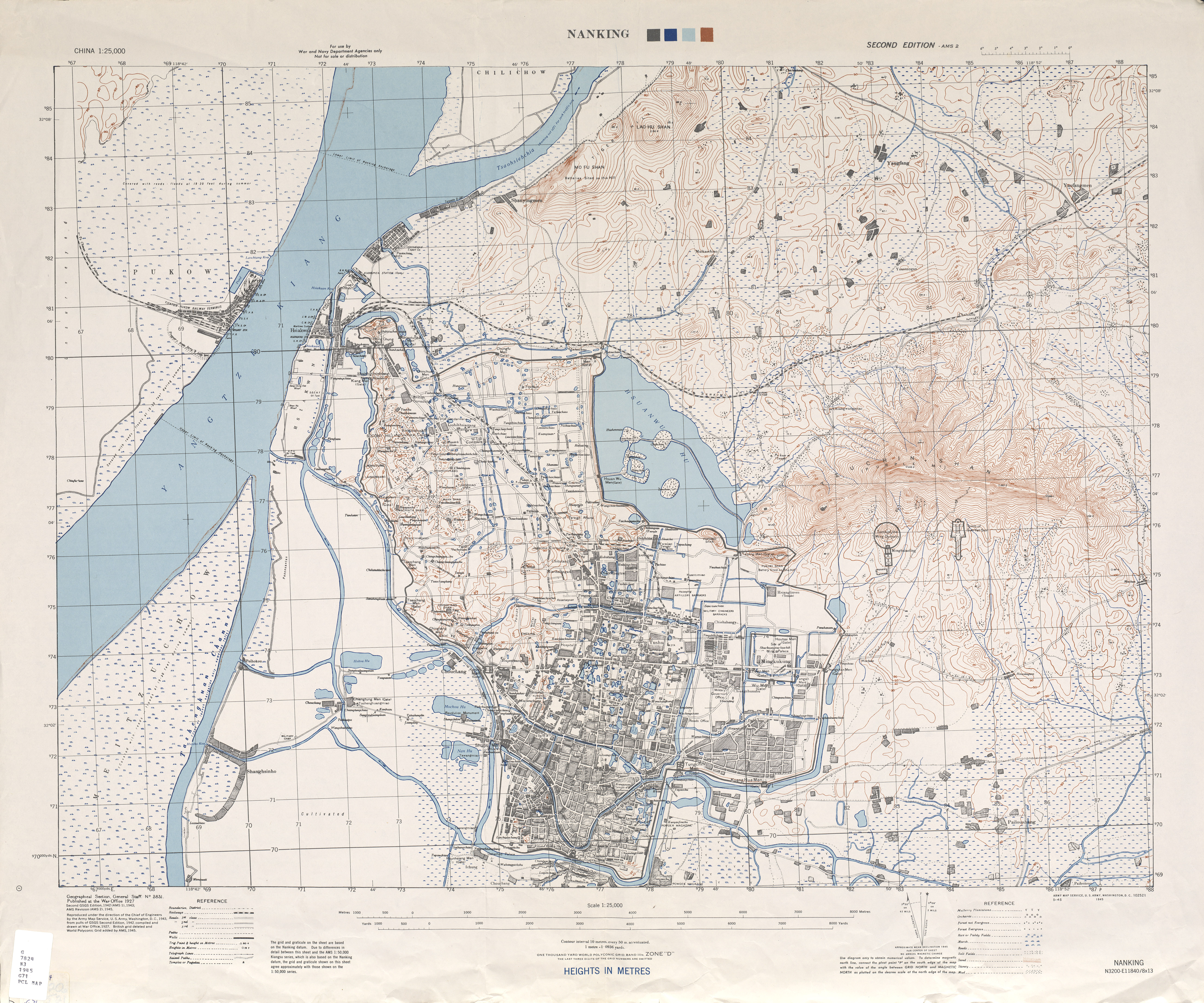
|-