


Kaunas

Encyclopedia
Kaunas (ˈkaʊnəs; kɐˈunɐs; see also other names) is the second-largest city
in Lithuania
and has historically been a leading centre of Lithuanian economic, academic, and cultural life. Kaunas was the biggest city and the center of a powiat
in Trakai Voivodeship
of the Grand Duchy of Lithuania
since 1413. During Russian Empire
occupation it was the capital of the Kovno Governorate
from 1843 to 1915. It became the only temporary
capital city
in Europe
during the Interwar period
. Now it is the capital of Kaunas County
, the seat of the Kaunas city municipality and the Kaunas district municipality
. It is also the seat of the Roman Catholic Archdiocese of Kaunas
. Kaunas is located at the confluence of the two largest Lithuanian rivers, the Nemunas
and the Neris
, and near the Kaunas Reservoir, the largest body of water entirely in Lithuania.
origins and most likely derives from a personal name
.
Before Lithuania regained independence, the city was generally known in English
as Kovno, the traditional Slavicized
form of its name; the Polish
name is Kowno; the Belarusian
name is Koўнa, Kowna. An earlier Russian
name was Ковно Kovno, although Каунас Kaunas has been used since 1940. The Yiddish
name is Kovne (קאָװנע), while its names in German
include Kaunas and Kauen. The city and its elderates also have names in other languages (see Names of Kaunas in other languages and names of Kaunas elderates in other languages).
. These Romans were supposedly led by a patrician named Palemon, who had three sons - Barcus, Kunas and Sperus. Palemon fled from Rome
because he feared the mad Emperor Nero
. Palemon, his sons and other relatives travelled all the way to Lithuania. After Palemon's death, his sons divided his land. Kunas got the land where Kaunas now stands. He built a fortress near the confluence of the Nemunas and Neris rivers, and the city that grew up there was named after him. There is also a suburban region in the vicinity named "Palemonas".
of Kaunas city was established by a special presidential decree. The coat of arms features a white auroch
with a golden cross between his horns
, set against a deep red background. The auroch is the original heraldic symbol of the city since 1400. The heraldic seal of Kaunas, introduced in the early 15th century during the reign of Grand Duke Vytautas, is the oldest city heraldic seal known in the territory of the Grand Duchy of Lithuania
. The current emblem
was the result of much study and discussion on the part of the Lithuanian Heraldry
Commission, and realized by the artist Raimondas Miknevičius. An aurochs has replaced a wisent
, depicted in the Soviet era emblem, used since 1969.
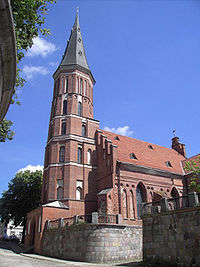 According to the archeological excavations, the most affluent collections of ceramics and other artefacts found at the confluence of the Nemunas
and the Neris
rivers are from the second
and first millennium
BC
. During that time people settled in some territories of the present Kaunas: the confluence of the two longest rivers of Lithuania area, Eiguliai
, Lampėdžiai, Linkuva, Kaniūkai, Marvelė, Pajiesys, Romainiai, Petrašiūnai
, Sargėnai, and Veršvai sites.
 A settlement had been established on the site of the current Kaunas old town at the confluence of two large rivers, at least by the 10th century AD. It is believed the town was founded in 1030, but it is first mentioned in written sources in 1361. In the 13th century, a stone wall
was built as protection from constant raids by the Teutonic Knights
. In 1362, the town was captured by the Teutonic Knights, who destroyed the Kaunas Castle
. The castle was rebuilt at the beginning of the 15th century.
In 1408 the town was granted Magdeburg Rights
by Vytautas the Great
and became a center of Kaunas Powiat in Trakai Voivodeship
in 1413. Vytautas ceded Kaunas the right to own the scales used for weighing the goods brought to the city or packed on site, wax processing, and woolen cloth trimming facilities. The power of the self-governing Kaunas was shared by three interrelated major institutions: vaitas (the Mayor
), the Magistrate
(12 lay judge
s and 4 burgomaster
s) and the so called Benchers' Court (12 persons). Kaunas then began to gain prominence, since it was at an intersection of trade route
s and a river port. In 1441 Kaunas joined the Hanseatic League
, and Hansa merchant office Kontor
was opened - the only one in the Grand Duchy of Lithuania
. By the 16th century, Kaunas also had a public school and a hospital and was one of the best-formed towns in the whole country.
In 1665, the Russia
n army attacked the city several times, and in 1701 the city was occupied by the Swedish army
. The Black Death
struck the area in 1657 and 1708, and fires destroyed parts of the city in 1731 and 1732.
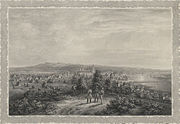
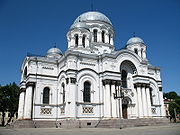 After the final partition
of the Polish–Lithuanian state in 1795, the city was taken over by the Russian Empire and became a part of Vilna Governorate
. During the French invasion of Russia in 1812, the Grand Army of Napoleon passed through Kaunas twice, devastating the city both times.
After the Partitions
, Kaunas was one of the centres of the November Uprising
(1830–1831) and the January Uprising
(1863–1864). To suppress the local population, the Russian
authorities subsequently established the Kaunas Prison
and placed a huge military garrison in the town. The Russian military fortification
s from that time still survive throughout the town.
Kovno Governorate
with a center in Kovno (Kaunas) was formed in 1843. In 1862 a railway connecting the Russian Empire
and Imperial Germany was built, making Kaunas a significant railway hub with one of the first railway tunnels in the Empire, completed in 1861. In 1898 the first power plant in Lithuania started operating.
Prior to the Second World War, Kaunas, like many other cities in eastern Europe, had a significant Jewish population. According to the Russian census of 1897, Jews numbered 25,500, 35.3% of the total of 73,500.The population was also 25.8% Russian, 22.7% Polish, 6.6% Lithuanian.

After Vilnius
was occupied by the Russian Bolshevik
s in 1919, the government of the Republic of Lithuania established its main base here. Later, when the capital Vilnius was forcibly annexed by Poland
, Kaunas became the temporary capital of Lithuania
, a position it held until 28 October 1939, when the Red Army
handed Vilnius back to Lithuania.
Between the World Wars
industry prospered in Kaunas; it was then the largest city in Lithuania. Under direction of the mayor Jonas Vileišis
(1921–1931) Kaunas grew rapidly and was extensively modernised. A water and waste water system, costing more than 15 million Lithuanian litas, was put in place, the city expanded from 18 square kilometers to 40, more than 2,500 buildings were built, plus three modern bridges over the Neris and Nemunas rivers. All the city's streets were paved, horse-drawn transportation was replaced with modern bus lines, new suburbs were planned and built (Žaliakalnis
neighborhood in particular), and new parks and squares were established. The foundations for a social security system
were laid, three new schools were built, and new public libraries
, including the Vincas Kudirka
library, were established. J. Vileišis maintained many contacts in other European cities, and as a result Kaunas was an active participant in European urban life.
During the inter-war period Kaunas had a Jewish population
of 35,000-40,000, about one quarter of the city's total population. Jews made up much of the city's commercial, artisan, and professional sectors. Kaunas was a center of Jewish learning, and the yeshiva in Slobodka (Vilijampolė
) was one of Europe's most prestigious institutes of higher Jewish learning. Kaunas had a rich and varied Jewish culture
. There were almost 100 Jewish organizations, 40 synagogues, many Yiddish schools, 4 Hebrew high school
s, a Jewish hospital
, and scores of Jewish-owned businesses. It was also an important Zionist center.
on 22 June, the June Uprising against the retreating Red Army
began in Kaunas and a short-lived period of independence was proclaimed in Kaunas on 23 June 1941. During the battles with the Red Army, Lithuanian rebels secured government offices, police stations, shops, warehouses, and attempted to re-establish order in the city. On 25 June the main German forces marched into the city without opposition and almost in parade fashion. The Nazi Germans did not recognize the new provisional government
, but they did not take any actions to dissolve it until the establishment of a German civil administration
on 17 July. The government's powers were taken over by the new occupants. Nazi Germany
established the Reichskommissariat Ostland
in the Baltic States
and much of Belarus
, and the administrative center for Lithuania (Generalbezirk Litauen) was in Kaunas ruled by Generalkommissar Adrian von Renteln
.
settlement on the right bank of the Neris
river. Jewish life in Kaunas was first disrupted when the Soviet Union occupied Lithuania in June 1940. The unwelcomed occupation was accompanied by arrests, confiscations, and the elimination of all free institutions. Jewish community organizations disappeared almost overnight. Soviet authorities confiscated the property of many Jews, while hundreds were exiled to Siberia
. Meanwhile, the Lithuanian Activist Front
, founded by Lithuanian nationalist émigrés in Berlin
, disseminated anti-semitic literature in Lithuania. Among other claims, the propaganda blamed Jews for the Soviet occupation.
Following Hitler's invasion of the Soviet Union on 22 June 1941, Soviet forces fled from Kaunas. Both before and after the German occupation of the city on June 25, the anti-Communist
Nazi organized insurgents
began to attack Jews
, blaming them for the Soviet repressions, especially along Jurbarko and Kriščiukaičio streets. They murdered more than 3,800 Jews and took hundreds more to the Lietūkis garage and killed them there.
The Nazis
eventually established the Kaunas Ghetto
and murdered most of the Jews by the end of the war.
Kaunas again became the major center of resistance against the Soviet regime. From the very start of the Lithuanian partisans
war, the most important partisan districts were based around Kaunas. Although guerrilla warfare
ended at the time of 1953, Lithuanian opposition to Soviet rule did not. In 1956 people in the Kaunas region supported the uprising in Hungary by rioting. On All Souls' Day in 1956, the first public anti-Soviet protest rally took place in Kaunas: citizens burned candles in the Kaunas military cemetery and sang national songs, resulting in clashes with the Militsiya.
 On 14 May 1972, a 19 years old Romas Kalanta
, having exclaimed "Freedom for Lithuania!", immolated himself in the garden of the Musical Theatre
, after making a speech denouncing the Soviet suppression of national and religious rights. The event broke into a politically-charged riot, which was forcibly dispersed by the KGB
and Militsiya
. It led to new forms of resistance: passive resistance
all around Lithuania. The continuous oppression of the Catholic Church and its resistance caused the appearance of The Chronicle of the Catholic Church in Lithuania. In strict conspiracy catholic priest Sigitas Tamkevičius
(now the Archbishop Metropolitan of Kaunas
) implemented this idea and its first issue was published in the Alytus district on 19 March 1972. The Kronika started a new phase of resistance in the life of Lithuania's Catholic Church
and of all Lithuania fighting against the occupation by making known to the world the violation of the human rights and freedoms in Lithuania for almost two decades. On 1 November 1987, a non-sanctioned rally took place near the Kaunas Cathedral Basilica
, where people gathered to mark famous Lithuanian poet Maironis
' 125th birthday anniversary. On 10 June 1988, the initiating group of the Kaunas movement of Sąjūdis
was formed. On 9 October 1988, the Flag of Lithuania
was raised above the tower of the Military Museum
. Kaunas, along with Vilnius, became the scene of nearly constant demonstrations as the Lithuanians, embarked on a process of self-discovery. The bodies of Lithuanians who died in Siberia
n exile were brought back to their homeland for reburial, and the anniversaries of deportations as well as the important dates in Lithuanian history
began to be noted with speeches and demonstrations. On 16 February 1989 Cardinal Vincentas Sladkevičius
, for the first time, called for the independence of Lithuania in his sermon at the Kaunas Cathedral. After the services, 200,000 persons gathered in the center of Kaunas to participate in the dedication of a new monument to freedom to replace the monument that had been torn down by the Soviet authorities after the World War II
.
 After World War II Kaunas became the main industrial city of Lithuania – it produced about a quarter of Lithuania's industrial output.
After the proclamation of Lithuanian independence
in 1990, Soviet attempts to suppress the rebellion focused on the Sitkūnai Radio Station
. They were defended by the citizenry of Kaunas. Pope John Paul II
made the Holy Mass
for the faithful of the Archdiocese of Kaunas
at the Kaunas Cathedral Basilica
and held the meeting with the young people of Lithuania at S. Darius and S. Girėnas Stadium, during his visit to Lithuania in 1993. Kaunas natives Vytautas Landsbergis
and Valdas Adamkus
became the Head of state in 1990, and, respectively, in 1998 and 2004. Since the restoration of independence, improving substantially air and land transport links with Western Europe
have made Kaunas easily accessible to foreign tourists.
s. Parks, groves, gardens, nature reserve
s, and agricultural areas occupy 8,329 hectares.
located to the east of the confluence of the Nemunas and Neris rivers. The formation of the new rectangular structure of the New Town started in Kaunas since 1847. The construction of the Kaunas Railway Tunnel and Railway Bridge across the Nemunas river helped move goods from the eastern part of Russian Empire
west to the German Empire
and Kaunas grew rapidly in the second part of 19th century. The oldest part of Kaunas was connected with Žaliakalnis
neighborhood in 1889. The city have increased once more when it was connected by bridges with Aleksotas
and Vilijampolė
districts in the 1920s.
(Köppen climate classification
Dfb). Despite its northern location, the climate in Kaunas is relatively mild compared to other locations in similar latitudes, mainly because of the Baltic Sea
. Because of its latitude, daylight in Kaunas extends 17 hours in midsummer, to only around 7 hours in midwinter. The Kazlų Rūda
Forest, west of Kaunas, create a microclimate
around the city, regulating humidity and temperature of the air, and protecting it from strong western winds.
Summers in Kaunas are warm and pleasant with average daytime high temperatures of 21–22 °C (69.8–71.6 F) and lows of around 12 °C (53.6 °F), but temperatures could reach 30 °C (86 °F) on some days. Winters are relatevely cold, and sometimes snowy with average temperatures ranging from -8 C, and rarely drop below -15 °C. Spring and autumn are generally cool to mild.
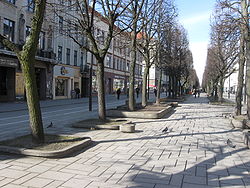
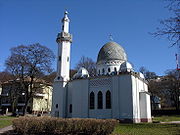 Central Kaunas
is defined by two pedestrian streets: the 2-km-long Laisvės alėja
(Liberty Avenue), a central street of the city, lined by linden tree
s, and its continuation, Vilnius Street, leading to the oldest part - Old Town of Kaunas. Some of the most prominent features in Kaunas include:
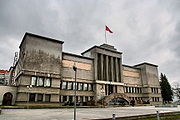
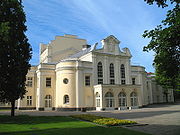 Kaunas is notable for the diverse culture life. Kaunas Symphony Orchestra is the main venue for classical music concerts. There is an old circus
tradition in Kaunas. There was established static circus in the Vytautas park of Kaunas in the beginning of 19th century. The only professional circus organization in Lithuania - Baltic Circus was founded in Kaunas in 1995. Kaunas theatres has played an important role in Lithuanian society. There are at least 7 professional theatres, lots of amateur theatres, ensembles, abundant groups of art and sports. Some of the best examples of culture life in Kaunas are theatres of various styles:
 The city of Kaunas has a number of parks and public open spaces. It devotes 7.3% of its total land acreage to parkland. Ąžuolynas
(literally, "Oak Grove") park is a main public park in the heart of Kaunas. It covers about 63 hectares and is the largest urban stand of mature oaks in Europe. To protect the unique lower landscape of Kaunas Reservoir, its natural ecosystem, and cultural heritage Kaunas Reservoir Regional Park was established in the eastern edge of Kaunas in 1992. By the initiative of a prominent Lithuanian zoologist Tadas Ivanauskas
and biologist Konstantinas Regelis
the Kaunas Botanical Garden
was founded in 1923. It serves not only as a recreational area for public, but also serves as a showcase for local plant life, and houses various research facilities.
Lithuania's premiere last resting place formally designated for graves of people influential in national history, politics, and arts is Petrašiūnai Cemetery
in Kaunas. It is also the burial site of some signatories of the 1918 Act of Independence
. There are four old Jewish cemeteries
within city limits.
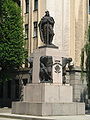 A lot of sculptuary is on display in the public areas of Kaunas.
, trade and services in Lithuania. The most developed industries in Kaunas are: food and beverage industry, textile and light industry, chemical industry, publishing and processing, pharmaceuticals, metal industry, wood processing and furniture industry. Recently information technology
and electronics
have become an important area of business activities in Kaunas. The city also has large construction
industry, including commercial, housing and road construction.
Primary foreign investors in Kaunas are companies from the USA, Finland
, and Estonia
. Head offices of several major International and Lithuanian companies are located in Kaunas, including "Kraft Foods
Lietuva", largest Generic Pharmaceuticals
producer in Lithuania "Sanitas group", producer of sportsweare AB "Audimas", one of the largest construction companies "YIT
Kausta", JSC "Senukai", largest producer in Lithuania of strong alcoholic drinks JSC "Stumbras
", Finnish capital brewery JSC "Ragutis
", JSC "Fazer
Gardesis", the largest wholesale, distribution and logistics company in Lithuania and Latvia JSC "Sanitex", JSC "Stora Enso
Packaging"", producer of pharmaceuticals, and the only producer of homoeopathic
medicines in Lithuania JSC "Aconitum".
The "UBIG group" (a branch of commercial Ūkio bank
) is a management company of diversified holdings that operates in the property development, banking, aluminium, mining, logistics, textiles, sports, financial intermediary, and other sectors.
There are also some innovative companies located in Kaunas, such as leading wholesaler of computer components, data storage media "ACME group", internet and TV provider, communications JSC "Mikrovisata group", developer and producer original products for TV and embedded technologies JSC "Selteka". Joint Lithuanian-German company "Net Frequency", based in Kaunas, is a multimedia and technology service provider. Kaunas is also home to JSC "Baltijos Programinė Įranga", a subsidiary of No Magic
, Inc., producing world-leading software modeling tools. A LED
lighting assembly plant was opened in Kaunas by South Korea
n company LK Technology in February 2011.
Kaunas Free Economic Zone
established in 1996 has also attracted some investors from abroad.
Before its disestablishment, Air Lithuania
had its head office in Kaunas. Kaunas Hydroelectric Power Plant
is the largest one in Lithuania.
Some notable changes are under construction and in the stage of disputes. The construction of a new landmark of Kaunas - the Žalgiris Arena - began in the autumn of 2008. Due to the delay of construction it is expected to be completed by 19 May 2011. Currently discussions are underway about the further development of the Vilijampolė
district on the right bank of the Neris
river and the Nemunas River, near their confluence.
 1897 Russian census
revealed the following ethnic composition in the city (by mother tongue
, out of 70,920):
Today, with almost 93 percent of its citizens being ethnic Lithuanians
, Kaunas is one of the most Lithuanian cities in the country. Kaunas has a higher proportion of ethnic Lithuanians than Vilnius
, and more ethnic Lithuanians than Riga
has ethnic Latvians
or Tallinn
has ethnic Estonians
.
Ethnic composition
in 2001, out of a total of 378,943:
 Kaunas city municipality council is the governing body of the Kaunas city municipality. It is responsible for municipality laws. The council is composed of 41 member elected for four-year terms.
The council is the member of The Association of Local Authorities in Lithuania.

point of view.
low-cost airline Ryanair
announced Kaunas Airport as their 40th base and first in the Central Europe
in February, 2010. Kaunas Airport is the fastest growing airport in the Baltic states
in 2009 and 2010. They believe that the airport will handle up to one million passengers in 2011. The smaller S. Darius and S. Girėnas Airport
, established in 1915, is located about three kilometers south of the city center. It is one the oldest still functioning airport
s in Europe used for tourism and air sports
purposes and now hosts the Lithuanian Aviation Museum
.
running from Prague
in the Czech Republic
to Helsinki
in Finland
by way of Poland
, Kaunas Lithuania
, Riga
(Latvia
), and Tallinn
(Estonia
). It is known as the Via Baltica
between Warsaw
and Tallinn, a distance of 670 kilometres (420 mi). It is the most important road connection between the Baltic states
. Kaunas also is linked to Vilnius
to its east and Klaipėda
, on the Baltic Sea
, via the A1
motorway and Daugavpils
(Latvia
), via E262
(A6
) highway.
 Since Kaunas is located at the confluence of two rivers, there were 34 bridges and viaducts built in the city at the end of 2007, including:
and the Railway bridge
across the Nemunas river. Kaunas Railway Station
is an important hub serving direct passenger connections to Vilnius and Warsaw as well as being a transit point of Pan-European corridors I and IX. Some trains run from Vilnius
to Šeštokai
, and, Poland
, through Kaunas. International route connecting Kaliningrad
, Russia
and Kharkiv
, Ukraine
, also crosses Kaunas. The first phase of the Standard gauge
Rail Baltica
railway section from Šeštokai
to Kaunas is under construction, and it is expected to be completed by 2013.
routes, 30 bus
routes and a wide shared taxi carrier network. In 2007 new electronic monthly tickets began to be introduced for public transport in Kaunas. The monthly E-ticket
cards may be bought once and might be credited with an appropriate amount of money in various ways including the Internet. Previous paper monthly tickets were in use until August 2009.
Kaunas is also one of the major river ports in the Baltic States
and has two pier
s designated for tourism purposes and located on the banks of Nemunas
river and Kaunas Reservoir - the largest Lithuanian artificial lake, created in 1959 by damming the Neman River
near Kaunas and Rumšiškės
.
(est.1920), LFLS Kaunas baseball club (est.1922), Žalgiris basketball club (est.1944). Ice hockey
was started to play in Lithuania in 1922. The first Lithuanian ice hockey championship
composed of four teams (LFLS, KSK, Kovas, and Macabi) was held in Kaunas, in 1926. Kaunas is home to some of historic venues such as: the main stadium of the city - S.Dariaus ir S.Girėno Sporto Centras (total capacity 9,000), which is also the Lithuanian soccer club FBK Kaunas
's and Lithuanian national football team home stadium established in 1923, and, Kaunas Sports Hall
, completed in 1939 for the Third European Basketball Championship
. S.Dariaus and S.Girėno Stadium is also used as the only large athletics stadium in Lithuania. The university status Lithuanian Academy of Physical Education
founded during the Interwar period
is the only state-supported institution of tertiary physical education
in Lithuania. The National Football Academy
- the national center for the training of the best Lithuanian young players of football was established in Kaunas in 2006.
Žalgiris
basketball
club, one of Europe's strongest, now plays in the Euroleague
. Kaunas has also hosted the knockout stage
of the European Basketball Championship
of 2011. The largest indoor Žalgiris Arena in the Baltics
has just been completed in Kaunas. The arena is used to host sports games as well as concerts. The city is also the birthplace or childhood home of many of the country's top basketball
stars, among them Arvydas Sabonis
, Šarūnas Marčiulionis
, Žydrūnas Ilgauskas
, Linas Kleiza
, Donatas Motiejūnas
and Šarūnas Jasikevičius
. Granitas Kaunas
is the strongest and most prominent men team handball
club in Lithuania. First golf
club "Elnias" in Lithuania was opened in Kaunas in 2000. Nemuno žiedas
is the only in Lithuania motor racing circuit, situated in Kačerginė
, a small town near Kaunas. A yacht club
operates in the Kaunas Reservoir Regional Park.
 Kaunas is often referred to as a city of students; there are about 50,000 students enrolled in its universities
. The first parochial school
in Kaunas was mentioned in 1473. A four-form Jesuit
school was opened in Kaunas in 1649. It was reorganized into a college in 1653. The oldest still functioning institution of higher education
is Kaunas Priest Seminary
, established in 1864.
Other institutes of higher education are:
Kaunas has also a large number of public and private basic and secondary schools
, as well as kindergartens and nurseries.
of Kaunas are held on weekends. Probably the longest established festival is the International Modern Dance Festival, which first ran in 1989.
with:
73059 Kaunas
discovered by Lithuania
n astronomers Kazimieras Černis and Justas Zdanavičius in 2002 is named after the city of Kaunas.
City
A city is a relatively large and permanent settlement. Although there is no agreement on how a city is distinguished from a town within general English language meanings, many cities have a particular administrative, legal, or historical status based on local law.For example, in the U.S...
in Lithuania
Lithuania
Lithuania , officially the Republic of Lithuania is a country in Northern Europe, the biggest of the three Baltic states. It is situated along the southeastern shore of the Baltic Sea, whereby to the west lie Sweden and Denmark...
and has historically been a leading centre of Lithuanian economic, academic, and cultural life. Kaunas was the biggest city and the center of a powiat
Powiat
A powiat is the second-level unit of local government and administration in Poland, equivalent to a county, district or prefecture in other countries. The term powiat is most often translated into English as "county", although other terms are also sometimes used...
in Trakai Voivodeship
Trakai Voivodeship
Trakai Voivodeship, Trakai Palatinate, or Troki Voivodeship , was a unit of administrative division and local government in the Grand Duchy of Lithuania from 1413 until 1795.-History:...
of the Grand Duchy of Lithuania
Grand Duchy of Lithuania
The Grand Duchy of Lithuania was a European state from the 12th /13th century until 1569 and then as a constituent part of Polish-Lithuanian Commonwealth until 1791 when Constitution of May 3, 1791 abolished it in favor of unitary state. It was founded by the Lithuanians, one of the polytheistic...
since 1413. During Russian Empire
Russian Empire
The Russian Empire was a state that existed from 1721 until the Russian Revolution of 1917. It was the successor to the Tsardom of Russia and the predecessor of the Soviet Union...
occupation it was the capital of the Kovno Governorate
Kovno Governorate
The Kovno Governorate or Government of Kovno was a governorate of the Russian Empire. Its capital was Kovno . It was formed on 18 December 1842 by tsar Nicholas I from the western part of the Vilna Governorate, and the order was carried out on 1 July 1843. It used to be a part of Northwestern Krai...
from 1843 to 1915. It became the only temporary
Temporary capital of Lithuania
The temporary capital of Lithuania was the official designation of the city of Kaunas in Lithuania during the interwar period. It was in contrast to the declared capital in Vilnius , which was under Polish control from 1920 until 1939...
capital city
Capital City
Capital City was a television show produced by Euston Films which focused on the lives of investment bankers in London living and working on the corporate trading floor for the fictional international bank Shane-Longman....
in Europe
Europe
Europe is, by convention, one of the world's seven continents. Comprising the westernmost peninsula of Eurasia, Europe is generally 'divided' from Asia to its east by the watershed divides of the Ural and Caucasus Mountains, the Ural River, the Caspian and Black Seas, and the waterways connecting...
during the Interwar period
Interwar period
Interwar period can refer to any period between two wars. The Interbellum is understood to be the period between the end of the Great War or First World War and the beginning of the Second World War in Europe....
. Now it is the capital of Kaunas County
Kaunas County
Kaunas County is one of ten counties of Lithuania. It is in the centre of the country, and its capital is Kaunas...
, the seat of the Kaunas city municipality and the Kaunas district municipality
Kaunas district municipality
Kaunas district municipality is one of 60 municipalities in Lithuania. The seat of the municipality is the city of Kaunas. It surrounds the Kaunas city municipality from the north, west and south, while in the east Kaunas district municipality borders Kaišiadorys district municipality...
. It is also the seat of the Roman Catholic Archdiocese of Kaunas
Roman Catholic Archdiocese of Kaunas
The Roman Catholic Metropolitan Archdiocese of Kaunas is an ecclesiastical territory or diocese of the Roman Catholic Church in Lithuania. It is based in Kaunas, the second-largest city in Lithuania. It was established as the Diocese of Samogitia in 1417 with a seat in Medininkai according to...
. Kaunas is located at the confluence of the two largest Lithuanian rivers, the Nemunas
Neman River
Neman or Niemen or Nemunas, is a major Eastern European river rising in Belarus and flowing through Lithuania before draining into the Curonian Lagoon and then into the Baltic Sea at Klaipėda. It is the northern border between Lithuania and Russia's Kaliningrad Oblast in its lower reaches...
and the Neris
Neris
Neris is a river rising in Belarus, flowing through Vilnius and becoming a tributary of the Neman River at Kaunas...
, and near the Kaunas Reservoir, the largest body of water entirely in Lithuania.
Etymology and other names
The city's name is of LithuanianLithuanian language
Lithuanian is the official state language of Lithuania and is recognized as one of the official languages of the European Union. There are about 2.96 million native Lithuanian speakers in Lithuania and about 170,000 abroad. Lithuanian is a Baltic language, closely related to Latvian, although they...
origins and most likely derives from a personal name
Personal name
A personal name is the proper name identifying an individual person, and today usually comprises a given name bestowed at birth or at a young age plus a surname. It is nearly universal for a human to have a name; except in rare cases, for example feral children growing up in isolation, or infants...
.
Before Lithuania regained independence, the city was generally known in English
English language
English is a West Germanic language that arose in the Anglo-Saxon kingdoms of England and spread into what was to become south-east Scotland under the influence of the Anglian medieval kingdom of Northumbria...
as Kovno, the traditional Slavicized
Slavic languages
The Slavic languages , a group of closely related languages of the Slavic peoples and a subgroup of Indo-European languages, have speakers in most of Eastern Europe, in much of the Balkans, in parts of Central Europe, and in the northern part of Asia.-Branches:Scholars traditionally divide Slavic...
form of its name; the Polish
Polish language
Polish is a language of the Lechitic subgroup of West Slavic languages, used throughout Poland and by Polish minorities in other countries...
name is Kowno; the Belarusian
Belarusian language
The Belarusian language , sometimes referred to as White Russian or White Ruthenian, is the language of the Belarusian people...
name is Koўнa, Kowna. An earlier Russian
Russian language
Russian is a Slavic language used primarily in Russia, Belarus, Uzbekistan, Kazakhstan, Tajikistan and Kyrgyzstan. It is an unofficial but widely spoken language in Ukraine, Moldova, Latvia, Turkmenistan and Estonia and, to a lesser extent, the other countries that were once constituent republics...
name was Ковно Kovno, although Каунас Kaunas has been used since 1940. The Yiddish
Yiddish language
Yiddish is a High German language of Ashkenazi Jewish origin, spoken throughout the world. It developed as a fusion of German dialects with Hebrew, Aramaic, Slavic languages and traces of Romance languages...
name is Kovne (קאָװנע), while its names in German
German language
German is a West Germanic language, related to and classified alongside English and Dutch. With an estimated 90 – 98 million native speakers, German is one of the world's major languages and is the most widely-spoken first language in the European Union....
include Kaunas and Kauen. The city and its elderates also have names in other languages (see Names of Kaunas in other languages and names of Kaunas elderates in other languages).
Legendary story
An old legend claims that Kaunas was established by the Romans in ancient timesAncient history
Ancient history is the study of the written past from the beginning of recorded human history to the Early Middle Ages. The span of recorded history is roughly 5,000 years, with Cuneiform script, the oldest discovered form of coherent writing, from the protoliterate period around the 30th century BC...
. These Romans were supposedly led by a patrician named Palemon, who had three sons - Barcus, Kunas and Sperus. Palemon fled from Rome
Rome
Rome is the capital of Italy and the country's largest and most populated city and comune, with over 2.7 million residents in . The city is located in the central-western portion of the Italian Peninsula, on the Tiber River within the Lazio region of Italy.Rome's history spans two and a half...
because he feared the mad Emperor Nero
Nero
Nero , was Roman Emperor from 54 to 68, and the last in the Julio-Claudian dynasty. Nero was adopted by his great-uncle Claudius to become his heir and successor, and succeeded to the throne in 54 following Claudius' death....
. Palemon, his sons and other relatives travelled all the way to Lithuania. After Palemon's death, his sons divided his land. Kunas got the land where Kaunas now stands. He built a fortress near the confluence of the Nemunas and Neris rivers, and the city that grew up there was named after him. There is also a suburban region in the vicinity named "Palemonas".
Coat of arms
On 30 June 1993 the historical coat of armsCoat of arms
A coat of arms is a unique heraldic design on a shield or escutcheon or on a surcoat or tabard used to cover and protect armour and to identify the wearer. Thus the term is often stated as "coat-armour", because it was anciently displayed on the front of a coat of cloth...
of Kaunas city was established by a special presidential decree. The coat of arms features a white auroch
Aurochs
The aurochs , the ancestor of domestic cattle, were a type of large wild cattle which inhabited Europe, Asia and North Africa, but is now extinct; it survived in Europe until 1627....
with a golden cross between his horns
Horn (anatomy)
A horn is a pointed projection of the skin on the head of various animals, consisting of a covering of horn surrounding a core of living bone. True horns are found mainly among the ruminant artiodactyls, in the families Antilocapridae and Bovidae...
, set against a deep red background. The auroch is the original heraldic symbol of the city since 1400. The heraldic seal of Kaunas, introduced in the early 15th century during the reign of Grand Duke Vytautas, is the oldest city heraldic seal known in the territory of the Grand Duchy of Lithuania
Grand Duchy of Lithuania
The Grand Duchy of Lithuania was a European state from the 12th /13th century until 1569 and then as a constituent part of Polish-Lithuanian Commonwealth until 1791 when Constitution of May 3, 1791 abolished it in favor of unitary state. It was founded by the Lithuanians, one of the polytheistic...
. The current emblem
Emblem
An emblem is a pictorial image, abstract or representational, that epitomizes a concept — e.g., a moral truth, or an allegory — or that represents a person, such as a king or saint.-Distinction: emblem and symbol:...
was the result of much study and discussion on the part of the Lithuanian Heraldry
Heraldry
Heraldry is the profession, study, or art of creating, granting, and blazoning arms and ruling on questions of rank or protocol, as exercised by an officer of arms. Heraldry comes from Anglo-Norman herald, from the Germanic compound harja-waldaz, "army commander"...
Commission, and realized by the artist Raimondas Miknevičius. An aurochs has replaced a wisent
Wisent
The wisent , Bison bonasus, also known as the European bison or European wood bison, is a species of Eurasian bison. It is the heaviest surviving land animal in Europe; a typical wisent is about long, not counting a tail of long, and tall. Weight typically can range from , with an occasional big...
, depicted in the Soviet era emblem, used since 1969.
Early history
Neman River
Neman or Niemen or Nemunas, is a major Eastern European river rising in Belarus and flowing through Lithuania before draining into the Curonian Lagoon and then into the Baltic Sea at Klaipėda. It is the northern border between Lithuania and Russia's Kaliningrad Oblast in its lower reaches...
and the Neris
Neris
Neris is a river rising in Belarus, flowing through Vilnius and becoming a tributary of the Neman River at Kaunas...
rivers are from the second
2nd millennium BC
The 2nd millennium BC marks the transition from the Middle to the Late Bronze Age.Its first half is dominated by the Middle Kingdom of Egypt and Babylonia. The alphabet develops. Indo-Iranian migration onto the Iranian plateau and onto the Indian subcontinent propagates the use of the chariot...
and first millennium
1st millennium BC
The 1st millennium BC encompasses the Iron Age and sees the rise of many successive empires, and spanned from 1000 BC to 1 BC.The Neo-Assyrian Empire, followed by the Achaemenids. In Greece, Classical Antiquity begins with the colonization of Magna Graecia and peaks with the rise of Hellenism. The...
BC
Anno Domini
and Before Christ are designations used to label or number years used with the Julian and Gregorian calendars....
. During that time people settled in some territories of the present Kaunas: the confluence of the two longest rivers of Lithuania area, Eiguliai
Eiguliai
Eiguliai is an eldership in the city of Kaunas, Lithuania. The settlement was a small village until it was incorporated into Kaunas in 1959 and a residential microdistrict was built in 1979. Located on the left bank of the Neris River, Eiguliai encompass Kleboniškis and part of Kalniečiai...
, Lampėdžiai, Linkuva, Kaniūkai, Marvelė, Pajiesys, Romainiai, Petrašiūnai
Petrašiunai
Petrašiūnai is a neighborhood in the eastern part of the Lithuanian city of Kaunas, with elderate status. In 2006 it occupied about 28.46 hectares, with a population of about 18,000. A part of the elderate belongs to the Kaunas Reservoir Regional Park....
, Sargėnai, and Veršvai sites.
Grand Duchy of Lithuania
Stone wall
Stone walls are a kind of masonry construction which have been made for thousands of years. First they were constructed by farmers and primitive people by piling loose field stones in what is called a dry stone wall, then later with the use of mortar and plaster especially in the construction of...
was built as protection from constant raids by the Teutonic Knights
Teutonic Knights
The Order of Brothers of the German House of Saint Mary in Jerusalem , commonly the Teutonic Order , is a German medieval military order, in modern times a purely religious Catholic order...
. In 1362, the town was captured by the Teutonic Knights, who destroyed the Kaunas Castle
Kaunas Castle
Kaunas Castle is located in Kaunas, Lithuania. Archeological evidence suggests that it was originally built during the mid-14th century, in the Gothic style. Its site is strategic – a rise on the banks of the Nemunas River near its confluence with the Neris River...
. The castle was rebuilt at the beginning of the 15th century.
In 1408 the town was granted Magdeburg Rights
Magdeburg rights
Magdeburg Rights or Magdeburg Law were a set of German town laws regulating the degree of internal autonomy within cities and villages granted by a local ruler. Modelled and named after the laws of the German city of Magdeburg and developed during many centuries of the Holy Roman Empire, it was...
by Vytautas the Great
Vytautas the Great
Vytautas ; styled "the Great" from the 15th century onwards; c. 1350 October 27, 1430) was one of the most famous rulers of medieval Lithuania. Vytautas was the ruler of the Grand Duchy of Lithuania which chiefly encompassed the Lithuanians and Ruthenians...
and became a center of Kaunas Powiat in Trakai Voivodeship
Trakai Voivodeship
Trakai Voivodeship, Trakai Palatinate, or Troki Voivodeship , was a unit of administrative division and local government in the Grand Duchy of Lithuania from 1413 until 1795.-History:...
in 1413. Vytautas ceded Kaunas the right to own the scales used for weighing the goods brought to the city or packed on site, wax processing, and woolen cloth trimming facilities. The power of the self-governing Kaunas was shared by three interrelated major institutions: vaitas (the Mayor
Mayor
In many countries, a Mayor is the highest ranking officer in the municipal government of a town or a large urban city....
), the Magistrate
Magistrate
A magistrate is an officer of the state; in modern usage the term usually refers to a judge or prosecutor. This was not always the case; in ancient Rome, a magistratus was one of the highest government officers and possessed both judicial and executive powers. Today, in common law systems, a...
(12 lay judge
Lay judge
A lay judge is a person assisting a judge in a trial. Lay judges are used in some civil law jurisdictions, such as Germany, Sweden and Finland. Japan began implementing a new lay judge system in 2009....
s and 4 burgomaster
Burgomaster
Burgomaster is the English form of various terms in or derived from Germanic languages for the chief magistrate or chairman of the executive council of a sub-national level of administration...
s) and the so called Benchers' Court (12 persons). Kaunas then began to gain prominence, since it was at an intersection of trade route
Trade route
A trade route is a logistical network identified as a series of pathways and stoppages used for the commercial transport of cargo. Allowing goods to reach distant markets, a single trade route contains long distance arteries which may further be connected to several smaller networks of commercial...
s and a river port. In 1441 Kaunas joined the Hanseatic League
Hanseatic League
The Hanseatic League was an economic alliance of trading cities and their merchant guilds that dominated trade along the coast of Northern Europe...
, and Hansa merchant office Kontor
Kontor
A kontor was a foreign trading post of the Hanseatic League. The word kontor means office in Norwegian and other Scandinavian languages....
was opened - the only one in the Grand Duchy of Lithuania
Grand Duchy of Lithuania
The Grand Duchy of Lithuania was a European state from the 12th /13th century until 1569 and then as a constituent part of Polish-Lithuanian Commonwealth until 1791 when Constitution of May 3, 1791 abolished it in favor of unitary state. It was founded by the Lithuanians, one of the polytheistic...
. By the 16th century, Kaunas also had a public school and a hospital and was one of the best-formed towns in the whole country.
In 1665, the Russia
Russia
Russia or , officially known as both Russia and the Russian Federation , is a country in northern Eurasia. It is a federal semi-presidential republic, comprising 83 federal subjects...
n army attacked the city several times, and in 1701 the city was occupied by the Swedish army
Swedish Army
The Swedish Army is one of the oldest standing armies in the world and a branch of the Swedish Armed Forces; it is in charge of land operations. General Sverker Göranson is the Supreme Commander-in-Chief of the Army.- Organization :...
. The Black Death
Black Death
The Black Death was one of the most devastating pandemics in human history, peaking in Europe between 1348 and 1350. Of several competing theories, the dominant explanation for the Black Death is the plague theory, which attributes the outbreak to the bacterium Yersinia pestis. Thought to have...
struck the area in 1657 and 1708, and fires destroyed parts of the city in 1731 and 1732.
Russian Empire
Partitions of Poland
The Partitions of Poland or Partitions of the Polish–Lithuanian Commonwealth took place in the second half of the 18th century and ended the existence of the Polish–Lithuanian Commonwealth, resulting in the elimination of sovereign Poland for 123 years...
of the Polish–Lithuanian state in 1795, the city was taken over by the Russian Empire and became a part of Vilna Governorate
Vilna Governorate
The Vilna Governorate or Government of Vilna was a governorate of the Russian Empire created after the Third Partition of the Polish-Lithuanian Commonwealth in 1795...
. During the French invasion of Russia in 1812, the Grand Army of Napoleon passed through Kaunas twice, devastating the city both times.
After the Partitions
Partitions of Poland
The Partitions of Poland or Partitions of the Polish–Lithuanian Commonwealth took place in the second half of the 18th century and ended the existence of the Polish–Lithuanian Commonwealth, resulting in the elimination of sovereign Poland for 123 years...
, Kaunas was one of the centres of the November Uprising
November Uprising
The November Uprising , Polish–Russian War 1830–31 also known as the Cadet Revolution, was an armed rebellion in the heartland of partitioned Poland against the Russian Empire. The uprising began on 29 November 1830 in Warsaw when the young Polish officers from the local Army of the Congress...
(1830–1831) and the January Uprising
January Uprising
The January Uprising was an uprising in the former Polish-Lithuanian Commonwealth against the Russian Empire...
(1863–1864). To suppress the local population, the Russian
Russian Empire
The Russian Empire was a state that existed from 1721 until the Russian Revolution of 1917. It was the successor to the Tsardom of Russia and the predecessor of the Soviet Union...
authorities subsequently established the Kaunas Prison
Kaunas Prison
Kaunas Prison is a prison in the center of Kaunas, second largest city of Lithuania. As of 2007, it houses approximately 300 prisoners and employs around 230 prison guards...
and placed a huge military garrison in the town. The Russian military fortification
Kaunas Fortress
Kaunas Fortress is the remains of a fortress complex in Kaunas, Lithuania. It was constructed and renovated between 1882 and 1915 to protect the Russian Empire's western borders, and was designated a "first-class" fortress in 1887...
s from that time still survive throughout the town.
Kovno Governorate
Kovno Governorate
The Kovno Governorate or Government of Kovno was a governorate of the Russian Empire. Its capital was Kovno . It was formed on 18 December 1842 by tsar Nicholas I from the western part of the Vilna Governorate, and the order was carried out on 1 July 1843. It used to be a part of Northwestern Krai...
with a center in Kovno (Kaunas) was formed in 1843. In 1862 a railway connecting the Russian Empire
Russian Empire
The Russian Empire was a state that existed from 1721 until the Russian Revolution of 1917. It was the successor to the Tsardom of Russia and the predecessor of the Soviet Union...
and Imperial Germany was built, making Kaunas a significant railway hub with one of the first railway tunnels in the Empire, completed in 1861. In 1898 the first power plant in Lithuania started operating.
Prior to the Second World War, Kaunas, like many other cities in eastern Europe, had a significant Jewish population. According to the Russian census of 1897, Jews numbered 25,500, 35.3% of the total of 73,500.The population was also 25.8% Russian, 22.7% Polish, 6.6% Lithuanian.
Inter-war Lithuania
After Vilnius
Vilnius
Vilnius is the capital of Lithuania, and its largest city, with a population of 560,190 as of 2010. It is the seat of the Vilnius city municipality and of the Vilnius district municipality. It is also the capital of Vilnius County...
was occupied by the Russian Bolshevik
Bolshevik
The Bolsheviks, originally also Bolshevists , derived from bol'shinstvo, "majority") were a faction of the Marxist Russian Social Democratic Labour Party which split apart from the Menshevik faction at the Second Party Congress in 1903....
s in 1919, the government of the Republic of Lithuania established its main base here. Later, when the capital Vilnius was forcibly annexed by Poland
Second Polish Republic
The Second Polish Republic, Second Commonwealth of Poland or interwar Poland refers to Poland between the two world wars; a period in Polish history in which Poland was restored as an independent state. Officially known as the Republic of Poland or the Commonwealth of Poland , the Polish state was...
, Kaunas became the temporary capital of Lithuania
Temporary capital of Lithuania
The temporary capital of Lithuania was the official designation of the city of Kaunas in Lithuania during the interwar period. It was in contrast to the declared capital in Vilnius , which was under Polish control from 1920 until 1939...
, a position it held until 28 October 1939, when the Red Army
Red Army
The Workers' and Peasants' Red Army started out as the Soviet Union's revolutionary communist combat groups during the Russian Civil War of 1918-1922. It grew into the national army of the Soviet Union. By the 1930s the Red Army was among the largest armies in history.The "Red Army" name refers to...
handed Vilnius back to Lithuania.
Between the World Wars
World war
A world war is a war affecting the majority of the world's most powerful and populous nations. World wars span multiple countries on multiple continents, with battles fought in multiple theaters....
industry prospered in Kaunas; it was then the largest city in Lithuania. Under direction of the mayor Jonas Vileišis
Jonas Vileišis
Jonas Vileišis was a Lithuanian lawyer, politician, and diplomat.-Early life and career:Vileišis was born in Mediniai, near Pasvalys. In 1892 he graduated from the Šiauliai gymnasium. During 1892-1894, he studied physics and mathematics at Saint Petersburg University. Later he transferred to the...
(1921–1931) Kaunas grew rapidly and was extensively modernised. A water and waste water system, costing more than 15 million Lithuanian litas, was put in place, the city expanded from 18 square kilometers to 40, more than 2,500 buildings were built, plus three modern bridges over the Neris and Nemunas rivers. All the city's streets were paved, horse-drawn transportation was replaced with modern bus lines, new suburbs were planned and built (Žaliakalnis
Žaliakalnis
Žaliakalnis is an elderate in Lithuania's second largest city, Kaunas. Žaliakalnis is located north of the old town and the downtown area, between the Neris and Girstupis rivers...
neighborhood in particular), and new parks and squares were established. The foundations for a social security system
Social security
Social security is primarily a social insurance program providing social protection or protection against socially recognized conditions, including poverty, old age, disability, unemployment and others. Social security may refer to:...
were laid, three new schools were built, and new public libraries
Public library
A public library is a library that is accessible by the public and is generally funded from public sources and operated by civil servants. There are five fundamental characteristics shared by public libraries...
, including the Vincas Kudirka
Vincas Kudirka
Vincas Kudirka was a Lithuanian poet and physician, and the author of both the music and lyrics of the Lithuanian National Anthem, Tautiška giesmė. He is regarded in Lithuania as a National Hero. Kudirka used pen names - V...
library, were established. J. Vileišis maintained many contacts in other European cities, and as a result Kaunas was an active participant in European urban life.
During the inter-war period Kaunas had a Jewish population
Jewish population
Jewish population refers to the number of Jews in the world. Precise figures are difficult to calculate because the definition of "Who is a Jew" is a source of controversy.-Total population:...
of 35,000-40,000, about one quarter of the city's total population. Jews made up much of the city's commercial, artisan, and professional sectors. Kaunas was a center of Jewish learning, and the yeshiva in Slobodka (Vilijampolė
Vilijampole
Vilijampolė is an elderate in the city of Kaunas, Lithuania, located on the right bank of the Neris River and the Nemunas River, near their confluence. The elderate covers 1,720 hectares and houses about 32,000 people....
) was one of Europe's most prestigious institutes of higher Jewish learning. Kaunas had a rich and varied Jewish culture
Secular Jewish culture
Secular Jewish culture embraces several related phenomena; above all, it is the international culture of secular communities of Jewish people, but it can also include the cultural contributions of individuals who identify as secular Jews...
. There were almost 100 Jewish organizations, 40 synagogues, many Yiddish schools, 4 Hebrew high school
High school
High school is a term used in parts of the English speaking world to describe institutions which provide all or part of secondary education. The term is often incorporated into the name of such institutions....
s, a Jewish hospital
Barnes-Jewish Hospital
Barnes-Jewish Hospital is the largest hospital in the U.S. state of Missouri. It is the adult teaching hospital for Washington University School of Medicine, and is located in St. Louis, Missouri. It is consistently rated one of the top hospitals in the United States by U.S. News & World Report...
, and scores of Jewish-owned businesses. It was also an important Zionist center.
Nazi occupation
After the outbreak of German invasion into USSROperation Barbarossa
Operation Barbarossa was the code name for Germany's invasion of the Soviet Union during World War II that began on 22 June 1941. Over 4.5 million troops of the Axis powers invaded the USSR along a front., the largest invasion in the history of warfare...
on 22 June, the June Uprising against the retreating Red Army
Red Army
The Workers' and Peasants' Red Army started out as the Soviet Union's revolutionary communist combat groups during the Russian Civil War of 1918-1922. It grew into the national army of the Soviet Union. By the 1930s the Red Army was among the largest armies in history.The "Red Army" name refers to...
began in Kaunas and a short-lived period of independence was proclaimed in Kaunas on 23 June 1941. During the battles with the Red Army, Lithuanian rebels secured government offices, police stations, shops, warehouses, and attempted to re-establish order in the city. On 25 June the main German forces marched into the city without opposition and almost in parade fashion. The Nazi Germans did not recognize the new provisional government
Provisional Government of Lithuania
The Provisional Government of Lithuania was a temporary government aiming for independent Lithuania during the last days of the Soviet occupation and the first weeks of German Nazi occupation in 1941. It was secretly formed on 22 April, 1941, announced on 23 June, 1941, and dissolved on 5 August,...
, but they did not take any actions to dissolve it until the establishment of a German civil administration
Occupation of Lithuania by Nazi Germany
The occupation of Lithuania by Nazi Germany refers to the occupation of Lithuania by Nazi Germany from the start of the German invasion of Soviet Union to the end of the Battle of Memel . At first the Germans were welcomed as "liberators" from the repressive Soviet regime which occupied Lithuania...
on 17 July. The government's powers were taken over by the new occupants. Nazi Germany
Nazi Germany
Nazi Germany , also known as the Third Reich , but officially called German Reich from 1933 to 1943 and Greater German Reich from 26 June 1943 onward, is the name commonly used to refer to the state of Germany from 1933 to 1945, when it was a totalitarian dictatorship ruled by...
established the Reichskommissariat Ostland
Reichskommissariat Ostland
Reichskommissariat Ostland, literally "Reich Commissariat Eastland", was the civilian occupation regime established by Nazi Germany in the Baltic states and much of Belarus during World War II. It was also known as Reichskommissariat Baltenland initially...
in the Baltic States
Baltic states
The term Baltic states refers to the Baltic territories which gained independence from the Russian Empire in the wake of World War I: primarily the contiguous trio of Estonia, Latvia, Lithuania ; Finland also fell within the scope of the term after initially gaining independence in the 1920s.The...
and much of Belarus
Belarus
Belarus , officially the Republic of Belarus, is a landlocked country in Eastern Europe, bordered clockwise by Russia to the northeast, Ukraine to the south, Poland to the west, and Lithuania and Latvia to the northwest. Its capital is Minsk; other major cities include Brest, Grodno , Gomel ,...
, and the administrative center for Lithuania (Generalbezirk Litauen) was in Kaunas ruled by Generalkommissar Adrian von Renteln
Adrian von Renteln
Theodor Adrian von Renteln was an activist and politician in Nazi Germany...
.
Kaunas' Jews' fate
Jewish people started settling in Kaunas in the second half of the 17th century. They were not allowed to live in the city, so most of them stayed in the VilijampolėVilijampole
Vilijampolė is an elderate in the city of Kaunas, Lithuania, located on the right bank of the Neris River and the Nemunas River, near their confluence. The elderate covers 1,720 hectares and houses about 32,000 people....
settlement on the right bank of the Neris
Neris
Neris is a river rising in Belarus, flowing through Vilnius and becoming a tributary of the Neman River at Kaunas...
river. Jewish life in Kaunas was first disrupted when the Soviet Union occupied Lithuania in June 1940. The unwelcomed occupation was accompanied by arrests, confiscations, and the elimination of all free institutions. Jewish community organizations disappeared almost overnight. Soviet authorities confiscated the property of many Jews, while hundreds were exiled to Siberia
Siberia
Siberia is an extensive region constituting almost all of Northern Asia. Comprising the central and eastern portion of the Russian Federation, it was part of the Soviet Union from its beginning, as its predecessor states, the Tsardom of Russia and the Russian Empire, conquered it during the 16th...
. Meanwhile, the Lithuanian Activist Front
Lithuanian Activist Front
Lithuanian Activist Front or LAF was a short-lived resistance organization established in 1940 after Lithuania was occupied by the Soviet Union. The goal of the organization was to liberate Lithuania and re-establish its independence...
, founded by Lithuanian nationalist émigrés in Berlin
Berlin
Berlin is the capital city of Germany and is one of the 16 states of Germany. With a population of 3.45 million people, Berlin is Germany's largest city. It is the second most populous city proper and the seventh most populous urban area in the European Union...
, disseminated anti-semitic literature in Lithuania. Among other claims, the propaganda blamed Jews for the Soviet occupation.
Following Hitler's invasion of the Soviet Union on 22 June 1941, Soviet forces fled from Kaunas. Both before and after the German occupation of the city on June 25, the anti-Communist
Anti-communism
Anti-communism is opposition to communism. Organized anti-communism developed in reaction to the rise of communism, especially after the 1917 October Revolution in Russia and the beginning of the Cold War in 1947.-Objections to communist theory:...
Nazi organized insurgents
Algirdas Klimaitis
Algirdas Jonas Klimaitis was a Lithuanian para-military commander.When the Nazi Germans entered Lithuania, in 1941, at the start of Operation Barbarossa, he formed a military unit of roughly 600 members, which was not subordinate to the Lithuanian Activist Front or the Provisional Government of...
began to attack Jews
Kaunas pogrom
The Kaunas pogrom was a massacre of Jewish people living in Kaunas, Lithuania that took place in from June 25 to June 29, 1941 – the first days of the Operation Barbarossa and of Nazi occupation of Lithuania. The most infamous incident occurred in the Lietūkis garrage, where several Jews were...
, blaming them for the Soviet repressions, especially along Jurbarko and Kriščiukaičio streets. They murdered more than 3,800 Jews and took hundreds more to the Lietūkis garage and killed them there.
The Nazis
Nazism
Nazism, the common short form name of National Socialism was the ideology and practice of the Nazi Party and of Nazi Germany...
eventually established the Kaunas Ghetto
Kaunas Ghetto
The Kovno ghetto was a ghetto established by Nazi Germany to hold the Lithuanian Jews of Kaunas during the Holocaust. At its peak, the Ghetto held 40,000 people, most of whom were later sent to concentration and extermination camps, or were shot at the Ninth Fort...
and murdered most of the Jews by the end of the war.
Soviet Re-occupation
Beginning in 1944, the Red Army began offensives that eventually took back all three of the Baltic states.Kaunas again became the major center of resistance against the Soviet regime. From the very start of the Lithuanian partisans
Lithuanian partisans
The Lithuanian partisans can refer to various irregular military units in different historical periods active in Lithuania against foreign invaders and occupiers:...
war, the most important partisan districts were based around Kaunas. Although guerrilla warfare
Guerrilla warfare
Guerrilla warfare is a form of irregular warfare and refers to conflicts in which a small group of combatants including, but not limited to, armed civilians use military tactics, such as ambushes, sabotage, raids, the element of surprise, and extraordinary mobility to harass a larger and...
ended at the time of 1953, Lithuanian opposition to Soviet rule did not. In 1956 people in the Kaunas region supported the uprising in Hungary by rioting. On All Souls' Day in 1956, the first public anti-Soviet protest rally took place in Kaunas: citizens burned candles in the Kaunas military cemetery and sang national songs, resulting in clashes with the Militsiya.
Romas Kalanta
Romas Kalanta was a Lithuanian high school student known for his public self-immolation protesting Soviet regime in Lithuania. Kalanta's death provoked the largest post-war riots in Lithuania and inspired similar self-immolations...
, having exclaimed "Freedom for Lithuania!", immolated himself in the garden of the Musical Theatre
Kaunas State Musical Theatre
Kaunas State Musical Theatre is musical theatre in Kaunas, Lithuania. It was established on November 27, 1940 in former State Theatre hall adjoining the Laisvės Alėja. For some time it was playing mostly operettas.-The building:...
, after making a speech denouncing the Soviet suppression of national and religious rights. The event broke into a politically-charged riot, which was forcibly dispersed by the KGB
KGB
The KGB was the commonly used acronym for the . It was the national security agency of the Soviet Union from 1954 until 1991, and was the premier internal security, intelligence, and secret police organization during that time.The State Security Agency of the Republic of Belarus currently uses the...
and Militsiya
Militsiya
Militsiya or militia is used as an official name of the civilian police in several former communist states, despite its original military connotation...
. It led to new forms of resistance: passive resistance
Nonviolent resistance
Nonviolent resistance is the practice of achieving goals through symbolic protests, civil disobedience, economic or political noncooperation, and other methods, without using violence. It is largely synonymous with civil resistance...
all around Lithuania. The continuous oppression of the Catholic Church and its resistance caused the appearance of The Chronicle of the Catholic Church in Lithuania. In strict conspiracy catholic priest Sigitas Tamkevičius
Sigitas Tamkevičius
Sigitas Tamkevičius is a Lithuanian archbishop of the Roman Catholic Church. He currently serves as Archbishop of Kaunas....
(now the Archbishop Metropolitan of Kaunas
Roman Catholic Archdiocese of Kaunas
The Roman Catholic Metropolitan Archdiocese of Kaunas is an ecclesiastical territory or diocese of the Roman Catholic Church in Lithuania. It is based in Kaunas, the second-largest city in Lithuania. It was established as the Diocese of Samogitia in 1417 with a seat in Medininkai according to...
) implemented this idea and its first issue was published in the Alytus district on 19 March 1972. The Kronika started a new phase of resistance in the life of Lithuania's Catholic Church
Roman Catholicism in Lithuania
The Roman Catholic Church in Lithuania is part of the worldwide Roman Catholic Church, under the spiritual leadership of the Pope and curia in Rome....
and of all Lithuania fighting against the occupation by making known to the world the violation of the human rights and freedoms in Lithuania for almost two decades. On 1 November 1987, a non-sanctioned rally took place near the Kaunas Cathedral Basilica
Kaunas Cathedral Basilica
Kaunas Cathedral Basilica is a Roman Catholic cathedral basilica in Kaunas, Lithuania.The exact date when the first Gothic style church dedicated to apostles Saint Peter and Saint Paul, was built is unknown, but it was first mentioned in written sources in 1413. The first parochial school in...
, where people gathered to mark famous Lithuanian poet Maironis
Maironis
Maironis is one of the most famous Lithuanian romantic poets. He was born in Pasandravys, Raseiniai district municipality, Lithuania. Maironis graduated from Kaunas high school and went on to study Literature at Kiev University. However, in 1884, after one year of studies at the university, he...
' 125th birthday anniversary. On 10 June 1988, the initiating group of the Kaunas movement of Sąjūdis
Sajudis
Sąjūdis initially known as the Reform Movement of Lithuania, is the political organization which led the struggle for Lithuanian independence in the late 1980s and early 1990s. It was established on June 3, 1988 and was led by Vytautas Landsbergis...
was formed. On 9 October 1988, the Flag of Lithuania
Flag of Lithuania
The flag of Lithuania consists of a horizontal tricolor of yellow, green and red. It was adopted on March 20, 1989, almost two years before the reestablishment of Lithuania's independence following the end of the Soviet Union. Before its readoption, the flag had been used from 1918 until 1940 when...
was raised above the tower of the Military Museum
Vytautas the Great War Museum
The Vytautas the Great War Museum is a museum in Kaunas, Lithuania. It was opened on 16 February 1936 and named after Vytautas the Great, Grand Duke of Lithuania. The museum displays historical artefacts pertaining to Lithuania and Kaunas from prehistoric times to the present day, including a...
. Kaunas, along with Vilnius, became the scene of nearly constant demonstrations as the Lithuanians, embarked on a process of self-discovery. The bodies of Lithuanians who died in Siberia
Siberia
Siberia is an extensive region constituting almost all of Northern Asia. Comprising the central and eastern portion of the Russian Federation, it was part of the Soviet Union from its beginning, as its predecessor states, the Tsardom of Russia and the Russian Empire, conquered it during the 16th...
n exile were brought back to their homeland for reburial, and the anniversaries of deportations as well as the important dates in Lithuanian history
History of Lithuania
The history of Lithuania dates back to at least 1009, the first recorded written use of the term. Lithuanians, a branch of the Baltic peoples, later conquered neighboring lands, establishing the Grand Duchy of Lithuania and in the 13th century the short-lived Kingdom of Lithuania. The Grand Duchy...
began to be noted with speeches and demonstrations. On 16 February 1989 Cardinal Vincentas Sladkevičius
Vincentas Sladkevicius
Vincentas Sladkevičius, MIC was a Lithuanian Cardinal of the Roman Catholic Church. He served as Archbishop of Kaunas from 1989 to 1996, and was elevated to the cardinalate in 1988.-Biography:...
, for the first time, called for the independence of Lithuania in his sermon at the Kaunas Cathedral. After the services, 200,000 persons gathered in the center of Kaunas to participate in the dedication of a new monument to freedom to replace the monument that had been torn down by the Soviet authorities after the World War II
World War II
World War II, or the Second World War , was a global conflict lasting from 1939 to 1945, involving most of the world's nations—including all of the great powers—eventually forming two opposing military alliances: the Allies and the Axis...
.
Restored Independence
After the proclamation of Lithuanian independence
Act of the Re-Establishment of the State of Lithuania
The Act of the Re-Establishment of the State of Lithuania or Act of March 11 was an independence declaration by the Lithuanian Soviet Socialist Republic adopted on March 11, 1990...
in 1990, Soviet attempts to suppress the rebellion focused on the Sitkūnai Radio Station
Sitkunai Radio Station
Sitkūnai Radio Station is a large facility for medium wave and shortwave broadcastingat Sitkūnai, Lithuania. The decision to build a new transmitting centre near the village of Sitkunai, about north of Kaunas was made by the Government of Lithuania in 1937...
. They were defended by the citizenry of Kaunas. Pope John Paul II
Pope John Paul II
Blessed Pope John Paul II , born Karol Józef Wojtyła , reigned as Pope of the Catholic Church and Sovereign of Vatican City from 16 October 1978 until his death on 2 April 2005, at of age. His was the second-longest documented pontificate, which lasted ; only Pope Pius IX ...
made the Holy Mass
Mass (liturgy)
"Mass" is one of the names by which the sacrament of the Eucharist is called in the Roman Catholic Church: others are "Eucharist", the "Lord's Supper", the "Breaking of Bread", the "Eucharistic assembly ", the "memorial of the Lord's Passion and Resurrection", the "Holy Sacrifice", the "Holy and...
for the faithful of the Archdiocese of Kaunas
Roman Catholic Archdiocese of Kaunas
The Roman Catholic Metropolitan Archdiocese of Kaunas is an ecclesiastical territory or diocese of the Roman Catholic Church in Lithuania. It is based in Kaunas, the second-largest city in Lithuania. It was established as the Diocese of Samogitia in 1417 with a seat in Medininkai according to...
at the Kaunas Cathedral Basilica
Kaunas Cathedral Basilica
Kaunas Cathedral Basilica is a Roman Catholic cathedral basilica in Kaunas, Lithuania.The exact date when the first Gothic style church dedicated to apostles Saint Peter and Saint Paul, was built is unknown, but it was first mentioned in written sources in 1413. The first parochial school in...
and held the meeting with the young people of Lithuania at S. Darius and S. Girėnas Stadium, during his visit to Lithuania in 1993. Kaunas natives Vytautas Landsbergis
Vytautas Landsbergis
Professor Vytautas Landsbergis is a Lithuanian conservative politician and Member of the European Parliament. He was the first head of state of Lithuania after its independence declaration from the Soviet Union, and served as the Head of the Lithuanian Parliament Seimas...
and Valdas Adamkus
Valdas Adamkus
Valdas Adamkus was President of Lithuania from 1998 to 2003 and again from 2004 to 2009.In Lithuania, the President's tenure lasts for five years; Adamkus' first term in office began on February 26, 1998 and ended on February 28, 2003, following his defeat by Rolandas Paksas in the next...
became the Head of state in 1990, and, respectively, in 1998 and 2004. Since the restoration of independence, improving substantially air and land transport links with Western Europe
Western Europe
Western Europe is a loose term for the collection of countries in the western most region of the European continents, though this definition is context-dependent and carries cultural and political connotations. One definition describes Western Europe as a geographic entity—the region lying in the...
have made Kaunas easily accessible to foreign tourists.
Geography
The city covers 15,700 hectareHectare
The hectare is a metric unit of area defined as 10,000 square metres , and primarily used in the measurement of land. In 1795, when the metric system was introduced, the are was defined as being 100 square metres and the hectare was thus 100 ares or 1/100 km2...
s. Parks, groves, gardens, nature reserve
Nature reserve
A nature reserve is a protected area of importance for wildlife, flora, fauna or features of geological or other special interest, which is reserved and managed for conservation and to provide special opportunities for study or research...
s, and agricultural areas occupy 8,329 hectares.
Administrative divisions
Kaunas is divided into 12 elderates:
|
Petrašiunai Petrašiūnai is a neighborhood in the eastern part of the Lithuanian city of Kaunas, with elderate status. In 2006 it occupied about 28.46 hectares, with a population of about 18,000. A part of the elderate belongs to the Kaunas Reservoir Regional Park.... Šanciai Šančiai is an elderate in the Lithuanian city of Kaunas. It is located on the right bank of the Nemunas River, and is divided into Higher and Lower Šančiai... Šilainiai Šilainiai is an elderate in the Lithuanian city of Kaunas, built as a microdistrict in the 1980s. It is one of the largest elderates in the city, covering 25.33 hectares, and housing over 70,000 people as of 2006... Vilijampole Vilijampolė is an elderate in the city of Kaunas, Lithuania, located on the right bank of the Neris River and the Nemunas River, near their confluence. The elderate covers 1,720 hectares and houses about 32,000 people.... Žaliakalnis Žaliakalnis is an elderate in Lithuania's second largest city, Kaunas. Žaliakalnis is located north of the old town and the downtown area, between the Neris and Girstupis rivers... |
Neighborhoods
The oldest part of Kaunas city is the Old TownCentras (Kaunas)
Centras is an elderate in the city of Kaunas, Lithuania, based on two neighbourhoods of Kaunas - the Old City and the New City. It lies at the confluence of two major Lithuanian rivers, the Nemunas and the Neris....
located to the east of the confluence of the Nemunas and Neris rivers. The formation of the new rectangular structure of the New Town started in Kaunas since 1847. The construction of the Kaunas Railway Tunnel and Railway Bridge across the Nemunas river helped move goods from the eastern part of Russian Empire
Russian Empire
The Russian Empire was a state that existed from 1721 until the Russian Revolution of 1917. It was the successor to the Tsardom of Russia and the predecessor of the Soviet Union...
west to the German Empire
German Empire
The German Empire refers to Germany during the "Second Reich" period from the unification of Germany and proclamation of Wilhelm I as German Emperor on 18 January 1871, to 1918, when it became a federal republic after defeat in World War I and the abdication of the Emperor, Wilhelm II.The German...
and Kaunas grew rapidly in the second part of 19th century. The oldest part of Kaunas was connected with Žaliakalnis
Žaliakalnis
Žaliakalnis is an elderate in Lithuania's second largest city, Kaunas. Žaliakalnis is located north of the old town and the downtown area, between the Neris and Girstupis rivers...
neighborhood in 1889. The city have increased once more when it was connected by bridges with Aleksotas
Aleksotas
Aleksotas is an elderate in the southern section of the city of Kaunas, Lithuania, bordering the left bank of the Neman River . Its population in 2006 was 21,694....
and Vilijampolė
Vilijampole
Vilijampolė is an elderate in the city of Kaunas, Lithuania, located on the right bank of the Neris River and the Nemunas River, near their confluence. The elderate covers 1,720 hectares and houses about 32,000 people....
districts in the 1920s.
Climate
Kaunas features a warm and humid continental climateHumid continental climate
A humid continental climate is a climatic region typified by large seasonal temperature differences, with warm to hot summers and cold winters....
(Köppen climate classification
Köppen climate classification
The Köppen climate classification is one of the most widely used climate classification systems. It was first published by Crimea German climatologist Wladimir Köppen in 1884, with several later modifications by Köppen himself, notably in 1918 and 1936...
Dfb). Despite its northern location, the climate in Kaunas is relatively mild compared to other locations in similar latitudes, mainly because of the Baltic Sea
Baltic Sea
The Baltic Sea is a brackish mediterranean sea located in Northern Europe, from 53°N to 66°N latitude and from 20°E to 26°E longitude. It is bounded by the Scandinavian Peninsula, the mainland of Europe, and the Danish islands. It drains into the Kattegat by way of the Øresund, the Great Belt and...
. Because of its latitude, daylight in Kaunas extends 17 hours in midsummer, to only around 7 hours in midwinter. The Kazlų Rūda
Kazlu Ruda
Kazlų Rūda is a city in Lithuania. It is located north from Marijampolė. The city is surrounded by forests, but a railway line crosses the city and divides it into almost equal parts. Former Soviet Army Kazlų Rūda airbase is 5 km northeast of Kazlų Rūda....
Forest, west of Kaunas, create a microclimate
Microclimate
A microclimate is a local atmospheric zone where the climate differs from the surrounding area. The term may refer to areas as small as a few square feet or as large as many square miles...
around the city, regulating humidity and temperature of the air, and protecting it from strong western winds.
Summers in Kaunas are warm and pleasant with average daytime high temperatures of 21–22 °C (69.8–71.6 F) and lows of around 12 °C (53.6 °F), but temperatures could reach 30 °C (86 °F) on some days. Winters are relatevely cold, and sometimes snowy with average temperatures ranging from -8 C, and rarely drop below -15 °C. Spring and autumn are generally cool to mild.
Points of interest
Centras (Kaunas)
Centras is an elderate in the city of Kaunas, Lithuania, based on two neighbourhoods of Kaunas - the Old City and the New City. It lies at the confluence of two major Lithuanian rivers, the Nemunas and the Neris....
is defined by two pedestrian streets: the 2-km-long Laisvės alėja
Laisves aleja
Laisvės Alėja is a prominent pedestrian street in the city of Kaunas, Lithuania. It stretches between the St. Michael the Archangel's Byzantine style church to the Central Post Office and Tadas Ivanauskas Zoological Museum around the Kaunas Old Town, the oldest section of Kaunas...
(Liberty Avenue), a central street of the city, lined by linden tree
Tilia cordata
Tilia cordata is a species of Tilia native to much of Europe and western Asia, north to southern Great Britain , central Scandinavia, east to central Russia, and south to central Spain, Italy, Bulgaria, Turkey, and the Caucasus; in the south of its range it is restricted to...
s, and its continuation, Vilnius Street, leading to the oldest part - Old Town of Kaunas. Some of the most prominent features in Kaunas include:
- the Kaunas CastleKaunas CastleKaunas Castle is located in Kaunas, Lithuania. Archeological evidence suggests that it was originally built during the mid-14th century, in the Gothic style. Its site is strategic – a rise on the banks of the Nemunas River near its confluence with the Neris River...
, a 14th century fortification; - the Vytautas' ChurchVytautas' the Great ChurchVytautas' the Great Church of the Assumption of The Holy Virgin Mary is a Roman Catholic church in the Old Town of Kaunas, Lithuania, and is one of the oldest churches in the city.-History:...
, one of the oldest churches in Lithuania and the oldest in Kaunas; - the St. Gertrude ChurchChurch of St. Gertrude, KaunasChurch of St. Gertrude is located in the Old Town of Kaunas and is one of the oldest Brick Gothic churches in Lithuania. Located just off Laisvės alėja , the church is somewhat hidden away and can be accessed from Laisves aleja through a gate at a hotel which is located nearby the Court building...
in Kaunas; - the Kaunas Cathedral BasilicaKaunas Cathedral BasilicaKaunas Cathedral Basilica is a Roman Catholic cathedral basilica in Kaunas, Lithuania.The exact date when the first Gothic style church dedicated to apostles Saint Peter and Saint Paul, was built is unknown, but it was first mentioned in written sources in 1413. The first parochial school in...
, the largest GothicGothic architectureGothic architecture is a style of architecture that flourished during the high and late medieval period. It evolved from Romanesque architecture and was succeeded by Renaissance architecture....
building in Lithuania, with a late BaroqueBaroqueThe Baroque is a period and the style that used exaggerated motion and clear, easily interpreted detail to produce drama, tension, exuberance, and grandeur in sculpture, painting, literature, dance, and music...
interior; - the St. George's Church, which was rumoured to have been turned into a dance studioDance studioA dance studio is a space in which dancers learn or rehearse. The term is typically used to describe a space that has either been built or equipped for the purpose....
during the Soviet Occupation; - the Pažaislis abbeyPažaislis MonasteryPažaislis monastery and church form the largest monastery complex in Lithuania, and the most magnificent example of Italian baroque architecture in the country...
, an impressive complex in Baroque styleBaroque architectureBaroque architecture is a term used to describe the building style of the Baroque era, begun in late sixteenth century Italy, that took the Roman vocabulary of Renaissance architecture and used it in a new rhetorical and theatrical fashion, often to express the triumph of the Catholic Church and...
; - the St. Francis Xavier ChurchChurch of St. Francis Xavier, KaunasChurch of St. Francis Xavier is located in the Old Town of Kaunas, Lithuania. The church dedicated to St. Francis Xavier was built at the Town Hall Square in the Old Town of Kaunas by Jesuits. They opened their first residence in Kaunas in 1642 and established a chapel in the House of Perkūnas in...
; - the massive Neo-Byzantine church of St. Michael the ArchangelSt. Michael the Archangel church in KaunasSt. Michael the Archangel's Church or the Garrison Church is a Roman Catholic church in Kaunas, Lithuania, closing the perspective of the Laisvės alėja, the main pedestrian street...
; - the Christ’s Resurrection ChurchChrist's Resurrection Church, KaunasChrist's Resurrection Church is a monumental Roman Catholic church in Kaunas, Lithuania. The church was consecrated in 2004, and in 2005 it was finally completed.-History:...
with an unfolding panoramic view of the city; - Kaunas ZooKaunas ZooLithuanian Zoo previously known as Kaunas' Zoo is the only Zoo in Lithuania. It is located in an Ąžuolynas oak grove park in the south-western Žaliakalnis elderate of Kaunas. The territory of the zoo is ....
, the only state-operated zooZooA zoological garden, zoological park, menagerie, or zoo is a facility in which animals are confined within enclosures, displayed to the public, and in which they may also be bred....
in LithuaniaLithuaniaLithuania , officially the Republic of Lithuania is a country in Northern Europe, the biggest of the three Baltic states. It is situated along the southeastern shore of the Baltic Sea, whereby to the west lie Sweden and Denmark...
; - Kaunas FortressKaunas FortressKaunas Fortress is the remains of a fortress complex in Kaunas, Lithuania. It was constructed and renovated between 1882 and 1915 to protect the Russian Empire's western borders, and was designated a "first-class" fortress in 1887...
, one of the largest defensive structures in Europe, occupying 65 km2 (25 sq mi), a 19-20th century military fortress, which includes a Holocaust site of the Ninth FortNinth FortThe Ninth Fort is a stronghold in the northern part of Šilainiai elderate, Kaunas, Lithuania. It is a part of the Kaunas Fortress, which was constructed in the late 19th century. During the occupation of Kaunas and the rest of Lithuania by the Soviet Union, the fort was used as a prison and...
; - Kaunas Botanical GardenKaunas Botanical GardenThe Kaunas Botanical Garden was founded in 1923 south of the center of Kaunas, Lithuania, in conjunction with the University of Lithuania by the initiative of Tadas Ivanauskas and Konstantinas Regelis...
; - Napoleon's HillNapoleon's HillNapoleon's hill, actually Jiesia hill fort mound is located in Kaunas, Lithuania, on the left bank of the Nemunas, between the Panemunė and Railway bridges. It is 63.3 meters high....
; - Kaunas SynagogueKaunas SynagogueKaunas Synagogue is one of two operating choral synagogues in Lithuania. It is located in Centras eldership, Kaunas. The Neo-Baroque synagogue was built in 1872...
; - House of PerkūnasHouse of PerkunasHouse of Perkūnas is one of the most original and archaic Gothic secular buildings, located in the Old Town of Kaunas, Lithuania. Originally built by Hanseatic merchants and served as their office from 1440 till 1532, it was sold in the 16th century to the Jesuits who had established a chapel there...
; - Kaunas Town HallTown Hall, KaunasThe Town Hall of Kaunas stands in the middle of the Town Hall Square at the heart of the Old Town, Kaunas, Lithuania.The structure dates from the 16th century. It houses a Museum of Ceramics.-History:...
and the square; - Interbellum functionalism architecture complexes;
- Two funicularFunicularA funicular, also known as an inclined plane or cliff railway, is a cable railway in which a cable attached to a pair of tram-like vehicles on rails moves them up and down a steep slope; the ascending and descending vehicles counterbalance each other.-Operation:The basic principle of funicular...
s - Žaliakalnis Funicular RailwayŽaliakalnis Funicular RailwayŽaliakalnis Funicular Railway is a funicular railway in Kaunas, Lithuania. Built in 1931, it is the oldest funicular in Lithuania. The funicular is made of a wood-paneled coachwork and is serviced by a uniformed, English-speaking operator. The climb of up from behind the Vytautas the Great War...
and the Aleksotas Funicular RailwayAleksotas Funicular RailwayAleksotas Funicular Railway is a funicular railway located in Aleksotas elderate of Kaunas, Lithuania. The funicular constructed on the right bank of the Neman River was officially opened on 6 December 1935. The track of the Aleksotas funicular remained unchanged. It is a monorail with a...
; - Kaunas MosqueKaunas MosqueKaunas Mosque or Vytautas the Great Mosque is one of four remaining mosques in Lithuania. It is located in Centras eldership, Kaunas. It is the only brick mosque in Lithuania....
; - ĄžuolynasAžuolynasĄžuolynas is a public park in Lithuania's second largest city, Kaunas, in the Žaliakalnis neighbourhood. The park covers about 63 hectares and is the largest urban stand of mature oaks in Europe. Vydūnas Alley serves as the park's northern border. It is a popular recreational destination for the...
Park and the valley of Girstupis River named after Adam MickiewiczAdam MickiewiczAdam Bernard Mickiewicz ) was a Polish poet, publisher and political writer of the Romantic period. One of the primary representatives of the Polish Romanticism era, a national poet of Poland, he is seen as one of Poland's Three Bards and the greatest poet in all of Polish literature...
; - the Memorial Petrašiūnai CemeteryPetrašiunai CemeteryPetrašiūnai Cemetery is Lithuania's premiere last resting place formally designated for graves of people influential in national history, politics, arts, and science.- Location :...
; - the Lithuanian open-air Ethnographic Museum displaying the heritage of Lithuanian rural life in a vast collection of authentic resurrected buildings is situated east of Kaunas on the bank of Kaunas Reservoir in a town of RumšiškėsRumšiškesRumšiškės is a Lithuanian town , situated east of Kaunas on the northern bank of Kaunas Reservoir. Southern part of the town is now under the waters of the artificial lake. The 18th century St...
; - Kaunas University of Medicine HospitalKaunas University of Medicine HospitalKaunas University of Medicine Hospital is the largest medical institution in Lithuania. The hospital was established in 1939 in Kaunas, Lithuania's second largest city...
; - The Marine aquariumMarine aquariumA marine aquarium is an aquarium that keeps marine plants and animals in a contained environment. Marine aquaria are further subdivided by hobbyists into fish only , fish only with live rock , and reef aquaria. Fish only tanks often showcase large or aggressive marine fish species and generally...
in the Mega Shopping mallShopping mallA shopping mall, shopping centre, shopping arcade, shopping precinct or simply mall is one or more buildings forming a complex of shops representing merchandisers, with interconnecting walkways enabling visitors to easily walk from unit to unit, along with a parking area — a modern, indoor version...
.
Museums
Kaunas is often called a city of museums, because of the abundance and variety of them. The museums in Kaunas include:- the War Museum of Vytautas the Great;
- the M. K. Čiurlionis National Art MuseumM. K. Ciurlionis National Art MuseumThe M. K. Čiurlionis National Art Museum is a group of museums based in Kaunas, Lithuania. It is primarily dedicated to exhibiting and publicizing the works of the painter and musician M.K. Čiurlionis ....
, commemorating the work of the early 20th century avant-gardeAvant-gardeAvant-garde means "advance guard" or "vanguard". The adjective form is used in English to refer to people or works that are experimental or innovative, particularly with respect to art, culture, and politics....
artist M. K. ČiurlionisMikalojus Konstantinas CiurlionisMikalojus Konstantinas Čiurlionis , also known as M. K. Čiurlionis was a Lithuanian painter and composer. Čiurlionis contributed to symbolism and art nouveau and was representative of the fin de siècle epoch. During his short life he composed about 250 pieces of music and created about 300 paintings...
who sought to combine painting and music into a single artistic mediumMedia (arts)In the arts, a media or medium is a material used by an artist or designer to create a work.-Architecture:In the art and science of architecture, the design and construction of buildings and interiors, infrastructure and other physical structures are created...
; - the Žmuidzinavičius MuseumŽmuidzinavicius MuseumŽmuidzinavičius Museum, commonly known as the Devils' Museum , is a museum in Kaunas, Lithuania, dedicated to collecting and exhibiting sculptures and carvings of devils from all over the world. As of 2009, its holdings encompass about 3,000 exhibits. The collection was initiated by painter Antanas...
(best known as the Devils' Museum), which houses a collection of more than two thousand sculptures and carvings of devilDevilThe Devil is believed in many religions and cultures to be a powerful, supernatural entity that is the personification of evil and the enemy of God and humankind. The nature of the role varies greatly...
s from all over the world, most of them of folk provenance. Of particular interest are the Adolf HitlerAdolf HitlerAdolf Hitler was an Austrian-born German politician and the leader of the National Socialist German Workers Party , commonly referred to as the Nazi Party). He was Chancellor of Germany from 1933 to 1945, and head of state from 1934 to 1945...
and Joseph StalinJoseph StalinJoseph Vissarionovich Stalin was the Premier of the Soviet Union from 6 May 1941 to 5 March 1953. He was among the Bolshevik revolutionaries who brought about the October Revolution and had held the position of first General Secretary of the Communist Party of the Soviet Union's Central Committee...
devils, together doing the dance of death over a playground littered with human bones;
- Lithuanian Aviation MuseumLithuanian Aviation MuseumThe Lithuanian Aviation Museum is located in Kaunas, Lithuania. The museum was officially opened in 1983. The permanent collection of the museum contains more than 18 000 displays of different fields of technology. The major part of the collection is dedicated to the history of aviation in Lithuania...
; - Museum of the History of Lithuanian Medicine and PharmacyMuseum of the History of Lithuanian Medicine and PharmacyThe Museum of the History of Lithuanian Medicine and Pharmacy is located in a restored 16th-century building at the Town Hall Square in the Old Town of Kaunas, Lithuania. It moved to its current location in 1987, although its history dates to 1936...
; - Historical Presidential PalaceHistorical Presidential Palace, KaunasThe Historical Presidential Palace is a Neo-baroque building in the Old Town of Kaunas, Lithuania that served as the Presidential Palace during the interwar years. Today, the palace is a branch of the M. K. Čiurlionis National Art Museum.-History:...
, displaying exhibits from the interwar period - Kaunas Museum for the BlindKaunas Museum for the BlindThe Kaunas Museum for the Blind in Kaunas, Lithuania opened in 2005. It was the first museum for the blind in the Baltic States and one of the first in Eastern Europe.The museum, located in the catacombs underneath St...
; - Povilas Stulga Museum of Lithuanian Folk InstrumentsPovilas Stulga Museum of Lithuanian Folk InstrumentsThe Povilas Stulga Museum of Lithuanian Folk Instruments is located in the Old Town of Kaunas, Lithuania. Its permanent collection contains Lithuanian and international musical instruments, recordings, books, placards, photographs, and letters....
; - Tadas IvanauskasTadas IvanauskasTadas Ivanauskas was a prominent Lithuanian zoologist and biologist, and one of the founders of Vytautas Magnus University.- Biography :...
Zoological MuseumTadas Ivanauskas Zoological MuseumThe Tadas Ivanauskas Zoological Museum was established in Kaunas, Lithuania, in 1919 by Tadas Ivanauskas. The museum collects and exhibits various animals: hunting trophies, stuffed animals, insect collections, skeletons, dissections...
; - SugiharaChiune Sugiharawas a Japanese diplomat who served as Vice-Consul for the Japanese Empire in Lithuania. During World War II, he helped several thousand Jews leave the country by issuing transit visas to Jewish refugees so that they could travel to Japan. Most of the Jews who escaped were refugees from...
house-museum; - Communication History MuseumCommunication History MuseumCommunications History Museum ia a museum supported by Teo LT AB, former AB Lietuvos Telekomas, in the Old Town of Kaunas, Lithuania. The building is an old merchant house, where were storages for grain to be exported. The building was taken in the use of the communications from 1830's in a form...
; - The so-called ab underground printing house was a part of the nonviolent resistanceNonviolent resistanceNonviolent resistance is the practice of achieving goals through symbolic protests, civil disobedience, economic or political noncooperation, and other methods, without using violence. It is largely synonymous with civil resistance...
press during the Soviet times. Now it is the branch of Kaunas War Museum, located 8 km north of Kaunas in a small Saliu village, near the town of DomeikavaDomeikavaDomeikava is village in the Kaunas district municipality, Lithuania. It is located north of Kaunas. There is a school Domeikavos Gimnazija, established in Domeikava, in early 1920s....
. Although the AB printing house worked regularly, it was never detected by KGBKGBThe KGB was the commonly used acronym for the . It was the national security agency of the Soviet Union from 1954 until 1991, and was the premier internal security, intelligence, and secret police organization during that time.The State Security Agency of the Republic of Belarus currently uses the...
. It was included into the Registry of Immovable Cultural Heritage Sites of Lithuania in 1999. - The apartments of some famous Kaunas natives, including Paulius GalaunėPaulius GalaunėPaulius Galaunė was a Lithuanian art historian, museum curator, and graphic artist. He was one of the first professional museum curators in Lithuania and was well-published on topics of Lithuanian folk art...
, Adam MickiewiczAdam MickiewiczAdam Bernard Mickiewicz ) was a Polish poet, publisher and political writer of the Romantic period. One of the primary representatives of the Polish Romanticism era, a national poet of Poland, he is seen as one of Poland's Three Bards and the greatest poet in all of Polish literature...
, Juozas GrušasJuozas GrušasJuozas Grušas was a Lithuanian writer, editor, dramatist and playwright.-Biography:...
, Balys SruogaBalys SruogaBalys Sruoga was a Lithuanian poet, playwright, critic, and literary theorist.He contributed to cultural journals from his early youth...
, Juozas Tumas-VaižgantasJuozas Tumas-VaižgantasJuozas Tumas, also known by the pen name Vaižgantas , was a prominent Lithuanian writer, Roman Catholic priest, social activist, literary historian, and one of the founders of the Party of National Progress. He wrote novels, short fictional pieces, and non-fiction...
, Salomėja NėrisSalomeja NerisSalomėja Nėris - Lithuanian poetess.- Biography :Nėris was born in Kiršai, in the current district of Vilkaviškis. She graduated from the University of Lithuania where she studied Lithuanian and German language and literature.After that she was a teacher in Lazdijai, Kaunas, and Panevėžys...
, Juozas ZikarasJuozas ZikarasJuozas Zikaras was a Lithuanian sculptor and artist, who created the design for pre-war Lithuanian litas coins. He is considered to be one of the first professional Lithuanian sculptors.-Biography:...
, Vincentas SladkevičiusVincentas SladkeviciusVincentas Sladkevičius, MIC was a Lithuanian Cardinal of the Roman Catholic Church. He served as Archbishop of Kaunas from 1989 to 1996, and was elevated to the cardinalate in 1988.-Biography:...
have been turned into public museums.
Theatres
Circus
A circus is commonly a travelling company of performers that may include clowns, acrobats, trained animals, trapeze acts, musicians, hoopers, tightrope walkers, jugglers, unicyclists and other stunt-oriented artists...
tradition in Kaunas. There was established static circus in the Vytautas park of Kaunas in the beginning of 19th century. The only professional circus organization in Lithuania - Baltic Circus was founded in Kaunas in 1995. Kaunas theatres has played an important role in Lithuanian society. There are at least 7 professional theatres, lots of amateur theatres, ensembles, abundant groups of art and sports. Some of the best examples of culture life in Kaunas are theatres of various styles:
- Kaunas State Drama TheatreKaunas State Drama TheatreThe Kaunas State Drama Theatre is the biggest theatre in Kaunas, and one of the oldest functioning theatres in Lithuania.-History :Its beginnings date to the 1920s, when the Lithuanian Artists' Association established drama and opera playhouses. The first play performed by the Kaunas Drama Theatre...
- Kaunas State Musical TheatreKaunas State Musical TheatreKaunas State Musical Theatre is musical theatre in Kaunas, Lithuania. It was established on November 27, 1940 in former State Theatre hall adjoining the Laisvės Alėja. For some time it was playing mostly operettas.-The building:...
- Kaunas Pantomime TheatreKaunas Pantomime TheatreKaunas pantomime theatre is pantomime theatre in Kaunas, Lithuania. Theatre was established in 1968. Founder and leader of Kaunas Pantomime theatre was artistic director Kestutis Adomaitis . Kaunas Municipality becomes the founder of Kaunas Pantomime Theatre in 2003...
- Kaunas Chamber TheatreKaunas Chamber TheatreKaunas Chamber Theatre is drama theatre in Kaunas, Lithuania. The theatre was established in 1976 as Kaunas Youth Musical Studio. Founder and present-day leader of Kaunas Youth Musical Theatre-Studio is famous Lithuanian actor Stanislovas Rubinovas. The theatre obtained the status of a...
- Kaunas Dance Theatre AuraKaunas Dance Theatre AuraKaunas Dance Theatre Aura is the professional theatre of modern dance in Kaunas, Lithuania.-History :A group of modern dance was founded in 1980 by Birutė Letukaitė and several other young dancers. In 1982 they gave their first performance. Under the leadership of B...
- Kaunas State Puppet TheatreKaunas State Puppet TheatreKaunas State Puppet Theatre is a puppet theatre in Kaunas, Lithuania. The professional theatre was established in 1958. Each theatrical season it offers to the spectators twenty puppet performances, and 4–5 new plays are usually staged. There are two halls for spectators – 226 and 50 seats each...
Parks and cemeteries
Ažuolynas
Ąžuolynas is a public park in Lithuania's second largest city, Kaunas, in the Žaliakalnis neighbourhood. The park covers about 63 hectares and is the largest urban stand of mature oaks in Europe. Vydūnas Alley serves as the park's northern border. It is a popular recreational destination for the...
(literally, "Oak Grove") park is a main public park in the heart of Kaunas. It covers about 63 hectares and is the largest urban stand of mature oaks in Europe. To protect the unique lower landscape of Kaunas Reservoir, its natural ecosystem, and cultural heritage Kaunas Reservoir Regional Park was established in the eastern edge of Kaunas in 1992. By the initiative of a prominent Lithuanian zoologist Tadas Ivanauskas
Tadas Ivanauskas
Tadas Ivanauskas was a prominent Lithuanian zoologist and biologist, and one of the founders of Vytautas Magnus University.- Biography :...
and biologist Konstantinas Regelis
Constantin Andreas von Regel
Constantin Andreas von Regel was a Russian and Lithuanian horticulturalist and botanist.He was a grandson of Eduard August von Regel....
the Kaunas Botanical Garden
Kaunas Botanical Garden
The Kaunas Botanical Garden was founded in 1923 south of the center of Kaunas, Lithuania, in conjunction with the University of Lithuania by the initiative of Tadas Ivanauskas and Konstantinas Regelis...
was founded in 1923. It serves not only as a recreational area for public, but also serves as a showcase for local plant life, and houses various research facilities.
Lithuania's premiere last resting place formally designated for graves of people influential in national history, politics, and arts is Petrašiūnai Cemetery
Petrašiunai Cemetery
Petrašiūnai Cemetery is Lithuania's premiere last resting place formally designated for graves of people influential in national history, politics, arts, and science.- Location :...
in Kaunas. It is also the burial site of some signatories of the 1918 Act of Independence
Signatories of the Act of Independence of Lithuania
The signatories of the Act of Independence of Lithuania were the twenty Lithuanian men who signed the Act of Independence of Lithuania on February 16, 1918. The signatories were elected to the Council of Lithuania by the Vilnius Conference in September 1917 and entrusted with the mission of...
. There are four old Jewish cemeteries
Jewish cemeteries of Kaunas
The Jewish cemeteries of Kaunas are the four Jewish cemeteries of the Lithuanian Jews living in Kaunas, known to them as Kovne, Lithuania. Jewish people started settling in Kaunas in the second half of the 17th century...
within city limits.
Public art
Economy
Kaunas is a large center of industryIndustry
Industry refers to the production of an economic good or service within an economy.-Industrial sectors:There are four key industrial economic sectors: the primary sector, largely raw material extraction industries such as mining and farming; the secondary sector, involving refining, construction,...
, trade and services in Lithuania. The most developed industries in Kaunas are: food and beverage industry, textile and light industry, chemical industry, publishing and processing, pharmaceuticals, metal industry, wood processing and furniture industry. Recently information technology
Information technology
Information technology is the acquisition, processing, storage and dissemination of vocal, pictorial, textual and numerical information by a microelectronics-based combination of computing and telecommunications...
and electronics
Electronics
Electronics is the branch of science, engineering and technology that deals with electrical circuits involving active electrical components such as vacuum tubes, transistors, diodes and integrated circuits, and associated passive interconnection technologies...
have become an important area of business activities in Kaunas. The city also has large construction
Construction
In the fields of architecture and civil engineering, construction is a process that consists of the building or assembling of infrastructure. Far from being a single activity, large scale construction is a feat of human multitasking...
industry, including commercial, housing and road construction.
Primary foreign investors in Kaunas are companies from the USA, Finland
Finland
Finland , officially the Republic of Finland, is a Nordic country situated in the Fennoscandian region of Northern Europe. It is bordered by Sweden in the west, Norway in the north and Russia in the east, while Estonia lies to its south across the Gulf of Finland.Around 5.4 million people reside...
, and Estonia
Estonia
Estonia , officially the Republic of Estonia , is a state in the Baltic region of Northern Europe. It is bordered to the north by the Gulf of Finland, to the west by the Baltic Sea, to the south by Latvia , and to the east by Lake Peipsi and the Russian Federation . Across the Baltic Sea lies...
. Head offices of several major International and Lithuanian companies are located in Kaunas, including "Kraft Foods
Kraft Foods
Kraft Foods Inc. is an American confectionery, food and beverage conglomerate. It markets many brands in more than 170 countries. 12 of its brands annually earn more than $1 billion worldwide: Cadbury, Jacobs, Kraft, LU, Maxwell House, Milka, Nabisco, Oscar Mayer, Philadelphia, Trident, Tang...
Lietuva", largest Generic Pharmaceuticals
Generic drug
A generic drug is a drug defined as "a drug product that is comparable to brand/reference listed drug product in dosage form, strength, route of administration, quality and performance characteristics, and intended use." It has also been defined as a term referring to any drug marketed under its...
producer in Lithuania "Sanitas group", producer of sportsweare AB "Audimas", one of the largest construction companies "YIT
YIT
YIT Oyj is a diversified Finnish-based company, headquartered in Helsinki, which provides a range of services, mainly to other businesses...
Kausta", JSC "Senukai", largest producer in Lithuania of strong alcoholic drinks JSC "Stumbras
Stumbras
AB Stumbras is the oldest and largest producer of strong alcoholic drinks in Kaunas, Lithuania. Company began its operations in 1906. "Stumbras" is also the largest exporter of strong alcoholic beverages and one of the biggest taxpayers in Lithuania...
", Finnish capital brewery JSC "Ragutis
Ragutis
Volfas Engelman is an alcohol beverage producer in Kaunas, Lithuania.Currently 99.57 % of Volfas Engelman shares belong to Finnish company group Olvi Plc...
", JSC "Fazer
Fazer
Fazer is one of the largest corporations in the Finnish food industry.The company was originally founded by Karl Fazer in 1891, as a "French-Russian conditory" in central Helsinki...
Gardesis", the largest wholesale, distribution and logistics company in Lithuania and Latvia JSC "Sanitex", JSC "Stora Enso
Stora Enso
Stora Enso Oyj is a Finnish pulp and paper manufacturer, formed by the merger of Swedish mining and forestry products company Stora and Finnish forestry products company Enso-Gutzeit Oy in 1998. It is headquartered in Helsinki, and it has approximately 29,000 employees...
Packaging"", producer of pharmaceuticals, and the only producer of homoeopathic
Homeopathy
Homeopathy is a form of alternative medicine in which practitioners claim to treat patients using highly diluted preparations that are believed to cause healthy people to exhibit symptoms that are similar to those exhibited by the patient...
medicines in Lithuania JSC "Aconitum".
The "UBIG group" (a branch of commercial Ūkio bank
Ukio Bankas
Ūkio Bankas is a Lithuanian commercial bank based in Kaunas. More than 50% of shares are owned by Lithuanian businessman Vladimir Romanov who therefore is in the control of the bank. It is the fifth largest and oldest private bank in Lithuania...
) is a management company of diversified holdings that operates in the property development, banking, aluminium, mining, logistics, textiles, sports, financial intermediary, and other sectors.
There are also some innovative companies located in Kaunas, such as leading wholesaler of computer components, data storage media "ACME group", internet and TV provider, communications JSC "Mikrovisata group", developer and producer original products for TV and embedded technologies JSC "Selteka". Joint Lithuanian-German company "Net Frequency", based in Kaunas, is a multimedia and technology service provider. Kaunas is also home to JSC "Baltijos Programinė Įranga", a subsidiary of No Magic
No Magic
No Magic Inc. is a software company producing the software modeling tool MagicDraw. No Magic operates worldwide; Software development facilities are located in the EU and Thailand...
, Inc., producing world-leading software modeling tools. A LED
Light-emitting diode
A light-emitting diode is a semiconductor light source. LEDs are used as indicator lamps in many devices and are increasingly used for other lighting...
lighting assembly plant was opened in Kaunas by South Korea
South Korea
The Republic of Korea , , is a sovereign state in East Asia, located on the southern portion of the Korean Peninsula. It is neighbored by the People's Republic of China to the west, Japan to the east, North Korea to the north, and the East China Sea and Republic of China to the south...
n company LK Technology in February 2011.
Kaunas Free Economic Zone
Kaunas Free Economic Zone
The Kaunas Free Economic Zone is a free economic zone near Kaunas, Lithuania. It is a 534 hectare industrial development area which offers favorable and smaller taxes for the investors that invest at least 1 million euros...
established in 1996 has also attracted some investors from abroad.
Before its disestablishment, Air Lithuania
Air Lithuania
Air Lithuania was a regional airline based in Kaunas in Lithuania. It operated scheduled and charter flights, provided cargo services and aircraft rental...
had its head office in Kaunas. Kaunas Hydroelectric Power Plant
Kaunas Hydroelectric Power Plant
The Kaunas Hydroelectric Power Plant, located on the Nemunas River about southeast of downtown Kaunas, Lithuania, was completed in 1960. Its dam created the Kaunas Reservoir. Owned by Lietuvos Energija, it operates in conjunction with the Kruonis Pumped Storage Plant.The plant, which has a...
is the largest one in Lithuania.
Some notable changes are under construction and in the stage of disputes. The construction of a new landmark of Kaunas - the Žalgiris Arena - began in the autumn of 2008. Due to the delay of construction it is expected to be completed by 19 May 2011. Currently discussions are underway about the further development of the Vilijampolė
Vilijampole
Vilijampolė is an elderate in the city of Kaunas, Lithuania, located on the right bank of the Neris River and the Nemunas River, near their confluence. The elderate covers 1,720 hectares and houses about 32,000 people....
district on the right bank of the Neris
Neris
Neris is a river rising in Belarus, flowing through Vilnius and becoming a tributary of the Neman River at Kaunas...
river and the Nemunas River, near their confluence.
Ethnic composition
Russian Empire Census
The Russian Imperial Census of 1897 was the first and the only census carried out in the Russian Empire . It recorded demographic data as of ....
revealed the following ethnic composition in the city (by mother tongue
First language
A first language is the language a person has learned from birth or within the critical period, or that a person speaks the best and so is often the basis for sociolinguistic identity...
, out of 70,920):
- JewsJewsThe Jews , also known as the Jewish people, are a nation and ethnoreligious group originating in the Israelites or Hebrews of the Ancient Near East. The Jewish ethnicity, nationality, and religion are strongly interrelated, as Judaism is the traditional faith of the Jewish nation...
25,052 - 35% - RussiansRussiansThe Russian people are an East Slavic ethnic group native to Russia, speaking the Russian language and primarily living in Russia and neighboring countries....
18,308 - 26% - PolesPolesthumb|right|180px|The state flag of [[Poland]] as used by Polish government and diplomatic authoritiesThe Polish people, or Poles , are a nation indigenous to Poland. They are united by the Polish language, which belongs to the historical Lechitic subgroup of West Slavic languages of Central Europe...
16,112 - 23% - LithuaniansLithuaniansLithuanians are the Baltic ethnic group native to Lithuania, where they number around 2,765,600 people. Another million or more make up the Lithuanian diaspora, largely found in countries such as the United States, Brazil, Canada, Colombia, Russia, United Kingdom and Ireland. Their native language...
4,092 - 6% - GermansGermansThe Germans are a Germanic ethnic group native to Central Europe. The English term Germans has referred to the German-speaking population of the Holy Roman Empire since the Late Middle Ages....
3,340 - 4.5% - Tatar 1,084 - 1.5%
- Other 2932 - 4%
Today, with almost 93 percent of its citizens being ethnic Lithuanians
Lithuanians
Lithuanians are the Baltic ethnic group native to Lithuania, where they number around 2,765,600 people. Another million or more make up the Lithuanian diaspora, largely found in countries such as the United States, Brazil, Canada, Colombia, Russia, United Kingdom and Ireland. Their native language...
, Kaunas is one of the most Lithuanian cities in the country. Kaunas has a higher proportion of ethnic Lithuanians than Vilnius
Vilnius
Vilnius is the capital of Lithuania, and its largest city, with a population of 560,190 as of 2010. It is the seat of the Vilnius city municipality and of the Vilnius district municipality. It is also the capital of Vilnius County...
, and more ethnic Lithuanians than Riga
Riga
Riga is the capital and largest city of Latvia. With 702,891 inhabitants Riga is the largest city of the Baltic states, one of the largest cities in Northern Europe and home to more than one third of Latvia's population. The city is an important seaport and a major industrial, commercial,...
has ethnic Latvians
Latvians
Latvians or Letts are the indigenous Baltic people of Latvia.-History:Latvians occasionally refer to themselves by the ancient name of Latvji, which may have originated from the word Latve which is a name of the river that presumably flowed through what is now eastern Latvia...
or Tallinn
Tallinn
Tallinn is the capital and largest city of Estonia. It occupies an area of with a population of 414,940. It is situated on the northern coast of the country, on the banks of the Gulf of Finland, south of Helsinki, east of Stockholm and west of Saint Petersburg. Tallinn's Old Town is in the list...
has ethnic Estonians
Estonians
Estonians are a Finnic people closely related to the Finns and inhabiting, primarily, the country of Estonia. They speak a Finnic language known as Estonian...
.
Ethnic composition
Ethnic group
An ethnic group is a group of people whose members identify with each other, through a common heritage, often consisting of a common language, a common culture and/or an ideology that stresses common ancestry or endogamy...
in 2001, out of a total of 378,943:
- LithuaniansLithuaniansLithuanians are the Baltic ethnic group native to Lithuania, where they number around 2,765,600 people. Another million or more make up the Lithuanian diaspora, largely found in countries such as the United States, Brazil, Canada, Colombia, Russia, United Kingdom and Ireland. Their native language...
352,051 - 92.9% - RussiansRussiansThe Russian people are an East Slavic ethnic group native to Russia, speaking the Russian language and primarily living in Russia and neighboring countries....
16,622 - 4.34% - UkrainiansUkrainiansUkrainians are an East Slavic ethnic group native to Ukraine, which is the sixth-largest nation in Europe. The Constitution of Ukraine applies the term 'Ukrainians' to all its citizens...
1,906 - 0.5% - PolesPolesthumb|right|180px|The state flag of [[Poland]] as used by Polish government and diplomatic authoritiesThe Polish people, or Poles , are a nation indigenous to Poland. They are united by the Polish language, which belongs to the historical Lechitic subgroup of West Slavic languages of Central Europe...
1,600 - 0.42% - Other - 6,764%
Municipality council
The council is the member of The Association of Local Authorities in Lithuania.
Mayors
- 1921-1931 - Jonas VileišisJonas VileišisJonas Vileišis was a Lithuanian lawyer, politician, and diplomat.-Early life and career:Vileišis was born in Mediniai, near Pasvalys. In 1892 he graduated from the Šiauliai gymnasium. During 1892-1894, he studied physics and mathematics at Saint Petersburg University. Later he transferred to the...
- 1931 - Juozas Vokietaitis
- 1932–1933 - Antanas Gravrogkas
- 1933–1939 - Antanas MerkysAntanas MerkysAntanas Merkys |Bajorai]], near Skapiškis, Vilna Governorate of the Russian Empire; died on March 5, 1955 in Vladimir Oblast, Soviet Union) was the last Prime Minister of independent Lithuania, serving from November 1939 to June 1940. When Soviet Union presented an ultimatum to Lithuania, President...
- 1940 - Antanas Garmus
- 1990–1991 – Vidmantas Adomonis
- 1991–1992 – Vilimas Čiurinskas
- 1992–1995 – Arimantas Račkauskas
- 1995 – Rimantas Tumosa
- 1995–1997 – Vladas Katkevičius
- 1997 – Alfonsas AndriuškevičiusAlfonsas AndriuškeviciusAlfonsas Andriuškevičius is a poet and art historian. He received the Lithuanian National Prize in 2007 for essay Rašymas dūmais and collection of art critique Lietuvių dailė 1975-1995 .Andriuškevičius graduated from Vilnius University in 1965, and went on to...
- 1997–2000 – Henrikas Tamulis
- 2000 – Vytautas ŠustauskasVytautas ŠustauskasVytautas Šustauskas is an often controversial Lithuanian politician, leader of the Lithuanian Freedom Union political party....
- 2000 – Gediminas Budnikas
- 2001–2002 – Erikas Tamašauskas
- 2002–2003 – Giedrius Donatas Ašmys
- 2003–2007 – Arvydas Garbaravičius
- 2007-2011 – Andrius Kupčinskas
- since 2011 – Rimantas Mikaitis.
Infrastructure
The city is located in the centre of Lithuania, making it highly significant from a logisticalLogistics
Logistics is the management of the flow of goods between the point of origin and the point of destination in order to meet the requirements of customers or corporations. Logistics involves the integration of information, transportation, inventory, warehousing, material handling, and packaging, and...
point of view.
Airports
Kaunas International Airport (KUN) is one of the biggest airports in the Baltic states. In 2010 it handled 809,732 passengers and 4,449 tonnes of cargo. An IrishRepublic of Ireland
Ireland , described as the Republic of Ireland , is a sovereign state in Europe occupying approximately five-sixths of the island of the same name. Its capital is Dublin. Ireland, which had a population of 4.58 million in 2011, is a constitutional republic governed as a parliamentary democracy,...
low-cost airline Ryanair
Ryanair
Ryanair is an Irish low-cost airline. Its head office is at Dublin Airport and its primary operational bases at Dublin Airport and London Stansted Airport....
announced Kaunas Airport as their 40th base and first in the Central Europe
Central Europe
Central Europe or alternatively Middle Europe is a region of the European continent lying between the variously defined areas of Eastern and Western Europe...
in February, 2010. Kaunas Airport is the fastest growing airport in the Baltic states
Baltic states
The term Baltic states refers to the Baltic territories which gained independence from the Russian Empire in the wake of World War I: primarily the contiguous trio of Estonia, Latvia, Lithuania ; Finland also fell within the scope of the term after initially gaining independence in the 1920s.The...
in 2009 and 2010. They believe that the airport will handle up to one million passengers in 2011. The smaller S. Darius and S. Girėnas Airport
S. Darius and S. Girenas Airport
S. Darius and S. Girėnas Airport , also known as Aleksotas Airport , is a small airport located in Aleksotas, close to the Europa Avenue, only 3 kilometres away from the Kaunas city centre in Lithuania.S. Darius and S...
, established in 1915, is located about three kilometers south of the city center. It is one the oldest still functioning airport
Airport
An airport is a location where aircraft such as fixed-wing aircraft, helicopters, and blimps take off and land. Aircraft may be stored or maintained at an airport...
s in Europe used for tourism and air sports
Air sports
The term Air sports covers a range of aerial activities such as:* Aerobatics* Ballooning* General aviation including Air racing* Gliding* Hang gliding* Human powered aircraft* Model aircraft* Parachuting* Paragliding...
purposes and now hosts the Lithuanian Aviation Museum
Lithuanian Aviation Museum
The Lithuanian Aviation Museum is located in Kaunas, Lithuania. The museum was officially opened in 1983. The permanent collection of the museum contains more than 18 000 displays of different fields of technology. The major part of the collection is dedicated to the history of aviation in Lithuania...
.
Highways
Kaunas is served by a number of major motorways. European route E67 is a highwayHighway
A highway is any public road. In American English, the term is common and almost always designates major roads. In British English, the term designates any road open to the public. Any interconnected set of highways can be variously referred to as a "highway system", a "highway network", or a...
running from Prague
Prague
Prague is the capital and largest city of the Czech Republic. Situated in the north-west of the country on the Vltava river, the city is home to about 1.3 million people, while its metropolitan area is estimated to have a population of over 2.3 million...
in the Czech Republic
Czech Republic
The Czech Republic is a landlocked country in Central Europe. The country is bordered by Poland to the northeast, Slovakia to the east, Austria to the south, and Germany to the west and northwest....
to Helsinki
Helsinki
Helsinki is the capital and largest city in Finland. It is in the region of Uusimaa, located in southern Finland, on the shore of the Gulf of Finland, an arm of the Baltic Sea. The population of the city of Helsinki is , making it by far the most populous municipality in Finland. Helsinki is...
in Finland
Finland
Finland , officially the Republic of Finland, is a Nordic country situated in the Fennoscandian region of Northern Europe. It is bordered by Sweden in the west, Norway in the north and Russia in the east, while Estonia lies to its south across the Gulf of Finland.Around 5.4 million people reside...
by way of Poland
Poland
Poland , officially the Republic of Poland , is a country in Central Europe bordered by Germany to the west; the Czech Republic and Slovakia to the south; Ukraine, Belarus and Lithuania to the east; and the Baltic Sea and Kaliningrad Oblast, a Russian exclave, to the north...
, Kaunas Lithuania
Lithuania
Lithuania , officially the Republic of Lithuania is a country in Northern Europe, the biggest of the three Baltic states. It is situated along the southeastern shore of the Baltic Sea, whereby to the west lie Sweden and Denmark...
, Riga
Riga
Riga is the capital and largest city of Latvia. With 702,891 inhabitants Riga is the largest city of the Baltic states, one of the largest cities in Northern Europe and home to more than one third of Latvia's population. The city is an important seaport and a major industrial, commercial,...
(Latvia
Latvia
Latvia , officially the Republic of Latvia , is a country in the Baltic region of Northern Europe. It is bordered to the north by Estonia , to the south by Lithuania , to the east by the Russian Federation , to the southeast by Belarus and shares maritime borders to the west with Sweden...
), and Tallinn
Tallinn
Tallinn is the capital and largest city of Estonia. It occupies an area of with a population of 414,940. It is situated on the northern coast of the country, on the banks of the Gulf of Finland, south of Helsinki, east of Stockholm and west of Saint Petersburg. Tallinn's Old Town is in the list...
(Estonia
Estonia
Estonia , officially the Republic of Estonia , is a state in the Baltic region of Northern Europe. It is bordered to the north by the Gulf of Finland, to the west by the Baltic Sea, to the south by Latvia , and to the east by Lake Peipsi and the Russian Federation . Across the Baltic Sea lies...
). It is known as the Via Baltica
European route E67
European route E 67 is a E-road running from Prague in the Czech Republic to Helsinki in Finland by way of Poland, Lithuania, Latvia, and Estonia....
between Warsaw
Warsaw
Warsaw is the capital and largest city of Poland. It is located on the Vistula River, roughly from the Baltic Sea and from the Carpathian Mountains. Its population in 2010 was estimated at 1,716,855 residents with a greater metropolitan area of 2,631,902 residents, making Warsaw the 10th most...
and Tallinn, a distance of 670 kilometres (420 mi). It is the most important road connection between the Baltic states
Baltic states
The term Baltic states refers to the Baltic territories which gained independence from the Russian Empire in the wake of World War I: primarily the contiguous trio of Estonia, Latvia, Lithuania ; Finland also fell within the scope of the term after initially gaining independence in the 1920s.The...
. Kaunas also is linked to Vilnius
Vilnius
Vilnius is the capital of Lithuania, and its largest city, with a population of 560,190 as of 2010. It is the seat of the Vilnius city municipality and of the Vilnius district municipality. It is also the capital of Vilnius County...
to its east and Klaipėda
Klaipeda
Klaipėda is a city in Lithuania situated at the mouth of the Nemunas River where it flows into the Baltic Sea. It is the third largest city in Lithuania and the capital of Klaipėda County....
, on the Baltic Sea
Baltic Sea
The Baltic Sea is a brackish mediterranean sea located in Northern Europe, from 53°N to 66°N latitude and from 20°E to 26°E longitude. It is bounded by the Scandinavian Peninsula, the mainland of Europe, and the Danish islands. It drains into the Kattegat by way of the Øresund, the Great Belt and...
, via the A1
A1 highway (Lithuania)
The A1 Highway is a highway in Lithuania . It connects the capital city of Vilnius with the port city of Klaipėda, via the second largest city, Kaunas. Its length is over , making it the longest highway in Lithuania....
motorway and Daugavpils
Daugavpils
Daugavpils is a city in southeastern Latvia, located on the banks of the Daugava River, from which the city gets its name. Daugavpils literally means "Daugava Castle". With a population of over 100,000, it is the second largest city in the country after the capital Riga, which is located some...
(Latvia
Latvia
Latvia , officially the Republic of Latvia , is a country in the Baltic region of Northern Europe. It is bordered to the north by Estonia , to the south by Lithuania , to the east by the Russian Federation , to the southeast by Belarus and shares maritime borders to the west with Sweden...
), via E262
European route E262
European route E 262 is a road part of the International E-road network. It begins in Kaunas, Lithuania and ends in Ostrov, Pskov Oblast, Russia. The section in Lithuania from Kaunas to the Latvia border, near Zarasai is named after A6 highway....
(A6
A6 highway (Lithuania)
The A6 highway is a highway in Lithuania . It runs from Kaunas to the Latvia border, near Zarasai. From there - road continues to Daugavpils. The length of the road is 185.40 km....
) highway.
Bridges
- Vytautas the Great BridgeVytautas the Great BridgeVytautas the Great Bridge, also known as Aleksotas Bridge before 1930 and from 1940 until 23 February 2008, crosses the Nemunas River to connect Aleksotas and Old Town in Kaunas, Lithuania. Its length exceeds 256 meters, and its width is of 16 meters. The means of payment for the building of the...
, connecting Old Town with AleksotasAleksotasAleksotas is an elderate in the southern section of the city of Kaunas, Lithuania, bordering the left bank of the Neman River . Its population in 2006 was 21,694....
across the NemunasNeman RiverNeman or Niemen or Nemunas, is a major Eastern European river rising in Belarus and flowing through Lithuania before draining into the Curonian Lagoon and then into the Baltic Sea at Klaipėda. It is the northern border between Lithuania and Russia's Kaliningrad Oblast in its lower reaches...
; - M. K. Čiurlionis BridgeM. K. Ciurlionis BridgeM. K. Čiurlionis Bridge is a bridge in Kaunas, Lithuania. It crosses the Nemunas River to connect Freda and Kaunas City center. The bridge is 475 meters in length and 29.4 meters in width. It carries six lanes of automobile traffic, with three lanes in each direction...
, an automotive bridge across the NemunasNeman RiverNeman or Niemen or Nemunas, is a major Eastern European river rising in Belarus and flowing through Lithuania before draining into the Curonian Lagoon and then into the Baltic Sea at Klaipėda. It is the northern border between Lithuania and Russia's Kaliningrad Oblast in its lower reaches...
; - Lampėdžiai BridgeLampėdžiai BridgeLampėdžiai Bridge is a bridge in Kaunas, Lithuania. It crosses the Nemunas River to connect Marvelė in Aleksotas district and Lampėdžiai neighbourhood in Vilijampolė elderate. The bridge is 446 meters in length. It carries four lanes of automobile traffic, with two lanes in each direction. The...
across the NemunasNeman RiverNeman or Niemen or Nemunas, is a major Eastern European river rising in Belarus and flowing through Lithuania before draining into the Curonian Lagoon and then into the Baltic Sea at Klaipėda. It is the northern border between Lithuania and Russia's Kaliningrad Oblast in its lower reaches...
that serves as western bypassBypass (road)A bypass is a road or highway that avoids or "bypasses" a built-up area, town, or village, to let through traffic flow without interference from local traffic, to reduce congestion in the built-up area, and to improve road safety....
of Kaunas; - Petras Vileišis Bridge, connecting Old Town with VilijampolėVilijampoleVilijampolė is an elderate in the city of Kaunas, Lithuania, located on the right bank of the Neris River and the Nemunas River, near their confluence. The elderate covers 1,720 hectares and houses about 32,000 people....
across the Neris River; - Varniai BridgeVarniai BridgeVarnių Bridge is a bridge across the Neris River, that connects Vilijampolė and Žaliakalnis districts of Kaunas, Lithuania. It was built in 1983. The bridge is 328 meters long and approximately 25 meters wide. It carries six lanes of automobile traffic, with three lanes in each direction...
, connecting ŽaliakalnisŽaliakalnisŽaliakalnis is an elderate in Lithuania's second largest city, Kaunas. Žaliakalnis is located north of the old town and the downtown area, between the Neris and Girstupis rivers...
with VilijampolėVilijampoleVilijampolė is an elderate in the city of Kaunas, Lithuania, located on the right bank of the Neris River and the Nemunas River, near their confluence. The elderate covers 1,720 hectares and houses about 32,000 people....
across the Neris River; - The Green railway bridgeRailway Bridge, KaunasRailway Bridge in Kaunas crosses Nemunas river to connect Central Kaunas and lower Freda of Aleksotas district. Because of its green paint, it is often called Green . Construction of the bridge started in 1859 and ended in 1862. The exploitation of the bridge started on the 4 February 1862...
, built in 1862.
Railways
Kaunas is an important railway hub in Lithuania. First railway connection passing through Kaunas was constructed in 1859-1861 and opened in 1862. It consisted of Kaunas Railway TunnelKaunas Railway Tunnel
Kaunas railway tunnel is one of the two tunnels existing in Lithuania and the only railway tunnel operating in the Baltic states. It connects Vilnius and Kaunas. The length of the tunnel is 1,285 metres , height – 6,6 metres, width – 8,8 metres...
and the Railway bridge
Railway Bridge, Kaunas
Railway Bridge in Kaunas crosses Nemunas river to connect Central Kaunas and lower Freda of Aleksotas district. Because of its green paint, it is often called Green . Construction of the bridge started in 1859 and ended in 1862. The exploitation of the bridge started on the 4 February 1862...
across the Nemunas river. Kaunas Railway Station
Kaunas Railway Station
Kaunas Railway Station is a Lithuanian Railways central railway station at the eastern edge of central part of Kaunas, Lithuania. Kaunas Railway Station was included into the Registry of Immovable Cultural Heritage Sites of the Republic of Lithuania in 2003....
is an important hub serving direct passenger connections to Vilnius and Warsaw as well as being a transit point of Pan-European corridors I and IX. Some trains run from Vilnius
Vilnius
Vilnius is the capital of Lithuania, and its largest city, with a population of 560,190 as of 2010. It is the seat of the Vilnius city municipality and of the Vilnius district municipality. It is also the capital of Vilnius County...
to Šeštokai
Šeštokai
Šeštokai is a small town in southern Lithuania. It is a railway junction on two gauges, and is also a transshipment hub....
, and, Poland
Poland
Poland , officially the Republic of Poland , is a country in Central Europe bordered by Germany to the west; the Czech Republic and Slovakia to the south; Ukraine, Belarus and Lithuania to the east; and the Baltic Sea and Kaliningrad Oblast, a Russian exclave, to the north...
, through Kaunas. International route connecting Kaliningrad
Kaliningrad
Kaliningrad is a seaport and the administrative center of Kaliningrad Oblast, the Russian exclave between Poland and Lithuania on the Baltic Sea...
, Russia
Russia
Russia or , officially known as both Russia and the Russian Federation , is a country in northern Eurasia. It is a federal semi-presidential republic, comprising 83 federal subjects...
and Kharkiv
Kharkiv
Kharkiv or Kharkov is the second-largest city in Ukraine.The city was founded in 1654 and was a major centre of Ukrainian culture in the Russian Empire. Kharkiv became the first city in Ukraine where the Ukrainian Soviet Socialist Republic was proclaimed in December 1917 and Soviet government was...
, Ukraine
Ukraine
Ukraine is a country in Eastern Europe. It has an area of 603,628 km², making it the second largest contiguous country on the European continent, after Russia...
, also crosses Kaunas. The first phase of the Standard gauge
Standard gauge
The standard gauge is a widely-used track gauge . Approximately 60% of the world's existing railway lines are built to this gauge...
Rail Baltica
Rail Baltica
thumb|300px|Map of Rail Baltica...
railway section from Šeštokai
Šeštokai
Šeštokai is a small town in southern Lithuania. It is a railway junction on two gauges, and is also a transshipment hub....
to Kaunas is under construction, and it is expected to be completed by 2013.
Public transportation
The public transportation system is managed by Kauno viešasis transportas (KVT). There are 16 trolleybusTrolleybus
A trolleybus is an electric bus that draws its electricity from overhead wires using spring-loaded trolley poles. Two wires and poles are required to complete the electrical circuit...
routes, 30 bus
Bus
A bus is a road vehicle designed to carry passengers. Buses can have a capacity as high as 300 passengers. The most common type of bus is the single-decker bus, with larger loads carried by double-decker buses and articulated buses, and smaller loads carried by midibuses and minibuses; coaches are...
routes and a wide shared taxi carrier network. In 2007 new electronic monthly tickets began to be introduced for public transport in Kaunas. The monthly E-ticket
Electronic ticket
An electronic ticket is a digital ticket. It may be issued by an airline, in road, urban or rail public transport, and in entertainment.-Airline ticket:...
cards may be bought once and might be credited with an appropriate amount of money in various ways including the Internet. Previous paper monthly tickets were in use until August 2009.
Kaunas is also one of the major river ports in the Baltic States
Baltic states
The term Baltic states refers to the Baltic territories which gained independence from the Russian Empire in the wake of World War I: primarily the contiguous trio of Estonia, Latvia, Lithuania ; Finland also fell within the scope of the term after initially gaining independence in the 1920s.The...
and has two pier
Pier
A pier is a raised structure, including bridge and building supports and walkways, over water, typically supported by widely spread piles or pillars...
s designated for tourism purposes and located on the banks of Nemunas
Neman River
Neman or Niemen or Nemunas, is a major Eastern European river rising in Belarus and flowing through Lithuania before draining into the Curonian Lagoon and then into the Baltic Sea at Klaipėda. It is the northern border between Lithuania and Russia's Kaliningrad Oblast in its lower reaches...
river and Kaunas Reservoir - the largest Lithuanian artificial lake, created in 1959 by damming the Neman River
Neman River
Neman or Niemen or Nemunas, is a major Eastern European river rising in Belarus and flowing through Lithuania before draining into the Curonian Lagoon and then into the Baltic Sea at Klaipėda. It is the northern border between Lithuania and Russia's Kaliningrad Oblast in its lower reaches...
near Kaunas and Rumšiškės
Rumšiškes
Rumšiškės is a Lithuanian town , situated east of Kaunas on the northern bank of Kaunas Reservoir. Southern part of the town is now under the waters of the artificial lake. The 18th century St...
.
Sports
Sports in Kaunas has a long and distinguished history. The city is home to a few historic clubs such as: LFLS Kaunas football clubLFLS Kaunas
LFLS Kaunas, or Lietuvos Fizinio Lavinimosi Sąjunga Kaunas, was a Lithuanian football club based in Kaunas in the years between World War I and World War II during Lithuania's first period of modern independence...
(est.1920), LFLS Kaunas baseball club (est.1922), Žalgiris basketball club (est.1944). Ice hockey
Ice hockey
Ice hockey, often referred to as hockey, is a team sport played on ice, in which skaters use wooden or composite sticks to shoot a hard rubber puck into their opponent's net. The game is played between two teams of six players each. Five members of each team skate up and down the ice trying to take...
was started to play in Lithuania in 1922. The first Lithuanian ice hockey championship
Lithuania Hockey League
-Group A:*SC Energija *SM Poseidonas *Sporto Centras *Kaliningrad Pioner -Group B:*Sparnai *LRK Kėdainiai *LRK Panevėžys *Sūduva *Velniai...
composed of four teams (LFLS, KSK, Kovas, and Macabi) was held in Kaunas, in 1926. Kaunas is home to some of historic venues such as: the main stadium of the city - S.Dariaus ir S.Girėno Sporto Centras (total capacity 9,000), which is also the Lithuanian soccer club FBK Kaunas
FBK Kaunas
Kauno futbolo beisbolo klubas is a Lithuanian football club from the city of Kaunas, that currently plays in the A Lyga, the top level of Lithuanian football.- History :...
's and Lithuanian national football team home stadium established in 1923, and, Kaunas Sports Hall
Kaunas Sports Hall
Kaunas Sports Hall , also known as the S. Darius and S. Girėnas Hall is the second largest arena of Kaunas, Lithuania. It is the first arena built in the residential Žaliakalnis neighbourhood of Kaunas specially for basketball in Europe and is referred to as a "Mecca of the Lithuanian basketball"....
, completed in 1939 for the Third European Basketball Championship
Eurobasket 1939
The 1939 European Basketball Championship, commonly called Eurobasket 1939, was the third regional championship held by FIBA Europe. Eight national teams affiliated with the International Basketball Federation took part in the competition...
. S.Dariaus and S.Girėno Stadium is also used as the only large athletics stadium in Lithuania. The university status Lithuanian Academy of Physical Education
Lithuanian Academy of Physical Education
The Lithuanian Academy of Physical Education is the only state-supported institution of tertiary physical education in Kaunas, Lithuania. It has the university status. Since its establishment, the academy is headquartered in Žaliakalnis neighbourhood of Kaunas, in close proximity to the Kaunas...
founded during the Interwar period
Interwar period
Interwar period can refer to any period between two wars. The Interbellum is understood to be the period between the end of the Great War or First World War and the beginning of the Second World War in Europe....
is the only state-supported institution of tertiary physical education
Physical education
Physical education or gymnastics is a course taken during primary and secondary education that encourages psychomotor learning in a play or movement exploration setting....
in Lithuania. The National Football Academy
National Football Academy
Nacionalinė Futbolo Akademija , commonly referred to as NFA, is the national association football centre of Lithuania; only the best players from the country train there. Established in Kaunas in 2006 with help of UEFA, it has already produced some high class players...
- the national center for the training of the best Lithuanian young players of football was established in Kaunas in 2006.
Žalgiris
BC Žalgiris
BC Žalgiris is a professional basketball team that is based in Kaunas, Lithuania. It is one of the oldest teams in the Euroleague and plays domestically in the Lietuvos krepšinio lyga , and regionally in the VTB United League...
basketball
Basketball
Basketball is a team sport in which two teams of five players try to score points by throwing or "shooting" a ball through the top of a basketball hoop while following a set of rules...
club, one of Europe's strongest, now plays in the Euroleague
Euroleague
Euroleague Basketball, commonly known as the Euroleague, is the highest level tier and most important professional club basketball competition in Europe, with teams from up to 18 different countries, members of FIBA Europe. For sponsorship reasons, for five seasons starting with 2010–2011, it is...
. Kaunas has also hosted the knockout stage
Single-elimination tournament
A single-elimination tournament, also called a knockout, cup or sudden death tournament, is a type of elimination tournament where the loser of each match or bracket is immediately eliminated from winning the championship or first prize in the event...
of the European Basketball Championship
Eurobasket 2011
EuroBasket 2011 was the 37th men's European Basketball Championship, held by FIBA Europe. The competition was hosted by Lithuania. This was the second time Eurobasket had been held in Lithuania, the country having also hosted the 1939 championship. FIBA Europe asserted that Lithuania managed to...
of 2011. The largest indoor Žalgiris Arena in the Baltics
Baltic states
The term Baltic states refers to the Baltic territories which gained independence from the Russian Empire in the wake of World War I: primarily the contiguous trio of Estonia, Latvia, Lithuania ; Finland also fell within the scope of the term after initially gaining independence in the 1920s.The...
has just been completed in Kaunas. The arena is used to host sports games as well as concerts. The city is also the birthplace or childhood home of many of the country's top basketball
Basketball
Basketball is a team sport in which two teams of five players try to score points by throwing or "shooting" a ball through the top of a basketball hoop while following a set of rules...
stars, among them Arvydas Sabonis
Arvydas Sabonis
Arvydas Romas Sabonis is a retired Lithuanian professional basketball player and a businessman. He was an eight-time European Player of the Year, winning the Euroscar Award six times, and the Mr...
, Šarūnas Marčiulionis
Šarunas Marciulionis
Raimondas Šarūnas Marčiulionis is a retired Lithuanian professional basketball player. He was one of the first Europeans to become a regular in the North American National Basketball Association...
, Žydrūnas Ilgauskas
Žydrunas Ilgauskas
Žydrūnas Ilgauskas , or "Big Z" , is a retired Lithuanian professional basketball center who played for the Cleveland Cavaliers and Miami Heat of the National Basketball Association...
, Linas Kleiza
Linas Kleiza
Linas Kleiza is a Lithuanian professional basketball player with the Toronto Raptors of the National Basketball Association. He is also a member of the Lithuanian national team. He can play either forward position. Kleiza signed a four year, $18.8 million contract prior to the 2010–11 NBA...
, Donatas Motiejūnas
Donatas Motiejunas
Donatas Motiejūnas is a Lithuanian professional basketball player. He plays the power forward and center positions. He is nicknamed "D-Mo" by Houston Rockets fans. Motiejūnas was selected twentieth overall in the 2011 NBA Draft....
and Šarūnas Jasikevičius
Šarunas Jasikevicius
Šarūnas Jasikevičius is a Lithuanian professional basketball player who plays for Panathinaikos BC. He is a member of the Lithuanian national team, and plays the point guard position.-Early years:...
. Granitas Kaunas
Granitas Kaunas
Granitas Kaunas is a team handball club from Kaunas, Lithuania. Currently, Granitas Kaunas competes in the Lithuanian First League of Handball....
is the strongest and most prominent men team handball
Team handball
Handball is a team sport in which two teams of seven players each pass a ball to throw it into the goal of the other team...
club in Lithuania. First golf
Golf
Golf is a precision club and ball sport, in which competing players use many types of clubs to hit balls into a series of holes on a golf course using the fewest number of strokes....
club "Elnias" in Lithuania was opened in Kaunas in 2000. Nemuno žiedas
Nemuno žiedas
Nemuno žiedas is a motor racing circuit in Kačerginė, a small town near Kaunas, Lithuania opened in 1960. Lithuanian and Baltic touring cars championships rounds are held in Nemuno žiedas, as well as many professional and amateur events....
is the only in Lithuania motor racing circuit, situated in Kačerginė
Kačerginė
Kačerginė is a small town west of Kaunas. The town of Kačerginė is located in Kaunas County, central Lithuania. Kačerginė was officially proclaimed a health resort in 1933. The only in Lithuania motor racing circuit Nemuno Žiedas was opened in 1960...
, a small town near Kaunas. A yacht club
Yacht club
A yacht club is a sports club specifically related to sailing and yachting.-Description:Yacht Clubs are mostly located by the sea, although there are some that have been established at a lake or riverside locations...
operates in the Kaunas Reservoir Regional Park.
Education
University
A university is an institution of higher education and research, which grants academic degrees in a variety of subjects. A university is an organisation that provides both undergraduate education and postgraduate education...
. The first parochial school
Parochial school
A parochial school is a school that provides religious education in addition to conventional education. In a narrower sense, a parochial school is a Christian grammar school or high school which is part of, and run by, a parish.-United Kingdom:...
in Kaunas was mentioned in 1473. A four-form Jesuit
Society of Jesus
The Society of Jesus is a Catholic male religious order that follows the teachings of the Catholic Church. The members are called Jesuits, and are also known colloquially as "God's Army" and as "The Company," these being references to founder Ignatius of Loyola's military background and a...
school was opened in Kaunas in 1649. It was reorganized into a college in 1653. The oldest still functioning institution of higher education
Higher education
Higher, post-secondary, tertiary, or third level education refers to the stage of learning that occurs at universities, academies, colleges, seminaries, and institutes of technology...
is Kaunas Priest Seminary
Kaunas Priest Seminary
Kaunas Priest Seminary is the largest seminary in Lithuania serving the Roman Catholic Archdiocese of Kaunas. It is part of the Faculty of Theology of Vytautas Magnus University. Its current rector is Aurelijus Žukauskas. As of 2007, the seminary had 35 students...
, established in 1864.
Other institutes of higher education are:
- ISM University of Management and EconomicsISM University of Management and EconomicsISM University of Management and Economics is an institution of undergraduate, graduate and post-graduate education in business, management and economics...
- one of the few private institutions of higher education in Lithuania - Vytautas Magnus UniversityVytautas Magnus UniversityVytautas Magnus University ) is a public university in Kaunas, Lithuania. The university was founded in 1922 during the interwar period as an alternate national university...
founded in 1922 as an alternate national universityNational universityA national university is generally a university created or run by a government, but which at the same time operates autonomously without direct oversight or control by the state. Some national universities are closely associated with national cultural or political aspirations...
. - Kaunas Business College
- Kaunas University of Applied Sciences (Kaunas College)
- Kaunas University of MedicineKaunas University of MedicineLithuanian University of Health Sciences ) is a medical school in Kaunas, Lithuania. It was founded in 1919 and from 1922 it was a Faculty of Medicine of University of Lithuania....
- Kaunas University of TechnologyKaunas University of Technology- KTU :Kaunas University of Technology is one of the largest technical universities in the Baltic States.In Webometrics Ranking of World Universities 2010 KTU took the highest ratings among Lithuanian higher education institutions as having the web of best presence, visibility and accessibility...
- the largest technical university in the Baltic StatesBaltic statesThe term Baltic states refers to the Baltic territories which gained independence from the Russian Empire in the wake of World War I: primarily the contiguous trio of Estonia, Latvia, Lithuania ; Finland also fell within the scope of the term after initially gaining independence in the 1920s.The... - Lithuanian Academy of Physical EducationLithuanian Academy of Physical EducationThe Lithuanian Academy of Physical Education is the only state-supported institution of tertiary physical education in Kaunas, Lithuania. It has the university status. Since its establishment, the academy is headquartered in Žaliakalnis neighbourhood of Kaunas, in close proximity to the Kaunas...
- Lithuanian University of AgricultureLithuanian University of AgricultureLithuanian University of Agriculture is a university in Lithuania, located in Akademija west of Kaunas.-History:After restructurisation of the Agronomy – Forestry Department at the University of Lithuania and Dotnuva Agricultural College,the Agricultural Academy was established on September 3,...
- Lithuanian Veterinary AcademyLithuanian Veterinary AcademyThe Lithuanian Veterinary Academy , located in Vilijampolė neighbourhood of Kaunas, Lithuania, was a state-owned, autonomous institution of higher education, with university level status. It conferred degrees in veterinary medicine and provided scientific advice and scientific support in fields...
- Vilnius University Kaunas Faculty of HumanitiesVilnius UniversityVilnius University is the oldest university in the Baltic states and one of the oldest in Eastern Europe. It is also the largest university in Lithuania....
- Mykolas Romeris University Faculty of Public SecurityMykolas Romeris UniversityMykolas Romeris University is a university in the capital city of Vilnius, Lithuania, bearing the name of the Lithuanian legal scholar, judge and father of Lithuania's Constitutional Law Mykolas Römeris. Established in 2004, it is a state-funded institution....
- Kaunas Art Institute
Kaunas has also a large number of public and private basic and secondary schools
Education in Lithuania
Education in Lithuania is free of charge and compulsory from the age of 6 or 7 to 16 years, as stated in the national Law on Education. In 1996, the gross primary enrollment rate was 98 percent. Primary school attendance rates were unavailable for Lithuania as of 2001...
, as well as kindergartens and nurseries.
Annual events
Kaunas is best known for the Kaunas Jazz Festival, International Operetta Festival, Photo Art Festival "Kaunas photo" or Pažaislis music festival, which usually run from early June until late August each year. The open-air concerts of the historical 49-bell CarillonCarillon
A carillon is a musical instrument that is typically housed in a free-standing bell tower, or the belfry of a church or other municipal building. The instrument consists of at least 23 cast bronze, cup-shaped bells, which are played serially to play a melody, or sounded together to play a chord...
of Kaunas are held on weekends. Probably the longest established festival is the International Modern Dance Festival, which first ran in 1989.
- Kaziukas FairKaziuko mugeKaziuko mugė is a large annual folk arts and crafts fair dating to the beginning of the 17th century. It was originally held at the two main markets in Vilnius, Lithuania, as well as in the city streets....
Kaunas fork (beginning of March) - International open-air "Kaunas Jazz Festival" (April–May)
- Day of Kaunas cityKauno Miesto DienaDays of Kaunas City is an annual series of cultural events to celebrate the anniversary of Kaunas, Lithuania. The festivities mark May 20, 1463, when Grand Duke Casimir IV Jagiellon renewed and expanded the privileges of the city in 1463. The oldest original privilege is kept in Saint Petersburg...
(middle of May) - Pažaislis music festival (June–August)
- Traditional folk musicFolk musicFolk music is an English term encompassing both traditional folk music and contemporary folk music. The term originated in the 19th century. Traditional folk music has been defined in several ways: as music transmitted by mouth, as music of the lower classes, and as music with unknown composers....
competitionCompetitionCompetition is a contest between individuals, groups, animals, etc. for territory, a niche, or a location of resources. It arises whenever two and only two strive for a goal which cannot be shared. Competition occurs naturally between living organisms which co-exist in the same environment. For...
"Play, Jurgelis" (November) - Christmas treeChristmas treeThe Christmas tree is a decorated evergreen coniferous tree, real or artificial, and a tradition associated with the celebration of Christmas. The tradition of decorating an evergreen tree at Christmas started in Livonia and Germany in the 16th century...
lighting (end of November) - Bike Show Millenium (middle of June)
- International Hanseatic Days (end of August)
Twin towns — Sister cities
Kaunas is twinnedTown twinning
Twin towns and sister cities are two of many terms used to describe the cooperative agreements between towns, cities, and even counties in geographically and politically distinct areas to promote cultural and commercial ties.- Terminology :...
with:
| Brno Brno Brno by population and area is the second largest city in the Czech Republic, the largest Moravian city, and the historical capital city of the Margraviate of Moravia. Brno is the administrative centre of the South Moravian Region where it forms a separate district Brno-City District... , Czech Republic Czech Republic The Czech Republic is a landlocked country in Central Europe. The country is bordered by Poland to the northeast, Slovakia to the east, Austria to the south, and Germany to the west and northwest.... Los Angeles, California Los Angeles, California Los Angeles , with a population at the 2010 United States Census of 3,792,621, is the most populous city in California, USA and the second most populous in the United States, after New York City. It has an area of , and is located in Southern California... , United States United States The United States of America is a federal constitutional republic comprising fifty states and a federal district... Wrocław, Poland Poland Poland , officially the Republic of Poland , is a country in Central Europe bordered by Germany to the west; the Czech Republic and Slovakia to the south; Ukraine, Belarus and Lithuania to the east; and the Baltic Sea and Kaliningrad Oblast, a Russian exclave, to the north... Łomża, Poland Poland Poland , officially the Republic of Poland , is a country in Central Europe bordered by Germany to the west; the Czech Republic and Slovakia to the south; Ukraine, Belarus and Lithuania to the east; and the Baltic Sea and Kaliningrad Oblast, a Russian exclave, to the north... Myślibórz Myslibórz Myślibórz is a city in north-west Poland, in West Pomeranian Voivodeship. It is the capital of the Powiat of Myślibórz... , Poland Poland Poland , officially the Republic of Poland , is a country in Central Europe bordered by Germany to the west; the Czech Republic and Slovakia to the south; Ukraine, Belarus and Lithuania to the east; and the Baltic Sea and Kaliningrad Oblast, a Russian exclave, to the north... Tartu Tartu Tartu is the second largest city of Estonia. In contrast to Estonia's political and financial capital Tallinn, Tartu is often considered the intellectual and cultural hub, especially since it is home to Estonia's oldest and most renowned university. Situated 186 km southeast of Tallinn, the... , Estonia Estonia Estonia , officially the Republic of Estonia , is a state in the Baltic region of Northern Europe. It is bordered to the north by the Gulf of Finland, to the west by the Baltic Sea, to the south by Latvia , and to the east by Lake Peipsi and the Russian Federation . Across the Baltic Sea lies... Lippe Lippe Lippe is a Kreis in the east of North Rhine-Westphalia, Germany. Neighboring districts are Herford, Minden-Lübbecke, Höxter, Paderborn, Gütersloh, and district-free Bielefeld, which forms the region Ostwestfalen-Lippe.... , Germany Germany Germany , officially the Federal Republic of Germany , is a federal parliamentary republic in Europe. The country consists of 16 states while the capital and largest city is Berlin. Germany covers an area of 357,021 km2 and has a largely temperate seasonal climate... |
Tampere Tampere Tampere is a city in southern Finland. It is the most populous inland city in any of the Nordic countries. The city has a population of , growing to approximately 300,000 people in the conurbation and over 340,000 in the metropolitan area. Tampere is the third most-populous municipality in... , Finland Finland Finland , officially the Republic of Finland, is a Nordic country situated in the Fennoscandian region of Northern Europe. It is bordered by Sweden in the west, Norway in the north and Russia in the east, while Estonia lies to its south across the Gulf of Finland.Around 5.4 million people reside... Odense Odense The city of Odense is the third largest city in Denmark.Odense City has a population of 167,615 and is the main city of the island of Funen... , Denmark Denmark Denmark is a Scandinavian country in Northern Europe. The countries of Denmark and Greenland, as well as the Faroe Islands, constitute the Kingdom of Denmark . It is the southernmost of the Nordic countries, southwest of Sweden and south of Norway, and bordered to the south by Germany. Denmark... Grenoble Grenoble Grenoble is a city in southeastern France, at the foot of the French Alps where the river Drac joins the Isère. Located in the Rhône-Alpes region, Grenoble is the capital of the department of Isère... , France France The French Republic , The French Republic , The French Republic , (commonly known as France , is a unitary semi-presidential republic in Western Europe with several overseas territories and islands located on other continents and in the Indian, Pacific, and Atlantic oceans. Metropolitan France... , since 1997 Linköping Linköping Linköping is a city in southern middle Sweden, with 104 232 inhabitants in 2010. It is the seat of Linköping Municipality with 146 736 inhabitants and the capital of Östergötland County... , Sweden Sweden Sweden , officially the Kingdom of Sweden , is a Nordic country on the Scandinavian Peninsula in Northern Europe. Sweden borders with Norway and Finland and is connected to Denmark by a bridge-tunnel across the Öresund.... Kharkiv Kharkiv Kharkiv or Kharkov is the second-largest city in Ukraine.The city was founded in 1654 and was a major centre of Ukrainian culture in the Russian Empire. Kharkiv became the first city in Ukraine where the Ukrainian Soviet Socialist Republic was proclaimed in December 1917 and Soviet government was... , Ukraine Ukraine Ukraine is a country in Eastern Europe. It has an area of 603,628 km², making it the second largest contiguous country on the European continent, after Russia... Brescia Brescia Brescia is a city and comune in the region of Lombardy in northern Italy. It is situated at the foot of the Alps, between the Mella and the Naviglio, with a population of around 197,000. It is the second largest city in Lombardy, after the capital, Milan... , Italy Italy Italy , officially the Italian Republic languages]] under the European Charter for Regional or Minority Languages. In each of these, Italy's official name is as follows:;;;;;;;;), is a unitary parliamentary republic in South-Central Europe. To the north it borders France, Switzerland, Austria and... Ferrara Ferrara Ferrara is a city and comune in Emilia-Romagna, northern Italy, capital city of the Province of Ferrara. It is situated 50 km north-northeast of Bologna, on the Po di Volano, a branch channel of the main stream of the Po River, located 5 km north... , Italy Italy Italy , officially the Italian Republic languages]] under the European Charter for Regional or Minority Languages. In each of these, Italy's official name is as follows:;;;;;;;;), is a unitary parliamentary republic in South-Central Europe. To the north it borders France, Switzerland, Austria and... |
Hordaland Hordaland is a county in Norway, bordering Sogn og Fjordane, Buskerud, Telemark and Rogaland. Hordaland is the third largest county after Akershus and Oslo by population. The county administration is located in Bergen... , Norway Norway Norway , officially the Kingdom of Norway, is a Nordic unitary constitutional monarchy whose territory comprises the western portion of the Scandinavian Peninsula, Jan Mayen, and the Arctic archipelago of Svalbard and Bouvet Island. Norway has a total area of and a population of about 4.9 million... Växjö Växjö Växjö is a city and the seat of Växjö Municipality, Kronoberg County, Sweden with 64 200 inhabitants in 2010. It is the administrative, cultural and industrial centre of Kronoberg County. Furthermore it is the episcopal see of the Diocese of Växjö. It has a population of about 64 200, out of a... , Sweden Sweden Sweden , officially the Kingdom of Sweden , is a Nordic country on the Scandinavian Peninsula in Northern Europe. Sweden borders with Norway and Finland and is connected to Denmark by a bridge-tunnel across the Öresund.... Cava dei Tirreni, Italy Italy Italy , officially the Italian Republic languages]] under the European Charter for Regional or Minority Languages. In each of these, Italy's official name is as follows:;;;;;;;;), is a unitary parliamentary republic in South-Central Europe. To the north it borders France, Switzerland, Austria and... Tyumen Tyumen Tyumen is the largest city and the administrative center of Tyumen Oblast, Russia, located on the Tura River east of Moscow. Population: Tyumen is the oldest Russian settlement in Siberia. Founded in 16th century to support Russia's eastward expansion, the city has remained one of the most... , Russia Russia Russia or , officially known as both Russia and the Russian Federation , is a country in northern Eurasia. It is a federal semi-presidential republic, comprising 83 federal subjects... Xiamen Xiamen Xiamen , also known as Amoy , is a major city on the southeast coast of the People's Republic of China. It is administered as a sub-provincial city of Fujian province with an area of and population of 3.53 million... , China China Chinese civilization may refer to:* China for more general discussion of the country.* Chinese culture* Greater China, the transnational community of ethnic Chinese.* History of China* Sinosphere, the area historically affected by Chinese culture... Antignano Antignano Antignano is a comune in the Province of Asti in the Italian region Piedmont, located about 40 km southeast of Turin and about 8 km southwest of Asti... , Italy Italy Italy , officially the Italian Republic languages]] under the European Charter for Regional or Minority Languages. In each of these, Italy's official name is as follows:;;;;;;;;), is a unitary parliamentary republic in South-Central Europe. To the north it borders France, Switzerland, Austria and... |
Honours
A minor planetMinor planet
An asteroid group or minor-planet group is a population of minor planets that have a share broadly similar orbits. Members are generally unrelated to each other, unlike in an asteroid family, which often results from the break-up of a single asteroid...
73059 Kaunas
73059 Kaunas
73059 Kaunas is a main-belt asteroid discovered on March 16, 2002 by Kazimieras Černis and Justas Zdanavičius at Molėtai Astronomical Observatory.- External links :*...
discovered by Lithuania
Lithuania
Lithuania , officially the Republic of Lithuania is a country in Northern Europe, the biggest of the three Baltic states. It is situated along the southeastern shore of the Baltic Sea, whereby to the west lie Sweden and Denmark...
n astronomers Kazimieras Černis and Justas Zdanavičius in 2002 is named after the city of Kaunas.