
All Topics  
Sukarno

 
Sukarno

   Email Print
   Bookmark   Link


Sukarno


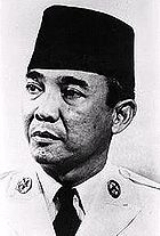
Sukarno, born Kusno Sosrodihardjo (June 6, 1901 - June 21, 1970) was the first President of Indonesia
President of Indonesia

The President of the Republic of Indonesia is the Head of State as well as the Head of the Government of the Republic of Indonesia.The current president is Susilo Bambang Yudhoyono....
. He helped the country win its independence from the Netherlands
Netherlands

The Netherlands is a country that is part of the Kingdom of the Netherlands. It is a parliamentary democratic constitutional monarchy. The Netherlands is located in North-West Europe, and bordered by the North Sea to the north and west, Belgium to the south, and Germany to the east....
 and was President from 1945 to 1967, presiding with mixed success over the country's turbulent transition to independence. Sukarno was forced out of power by one of his generals, Suharto, who formally became President in March 1967.

spelling "Sukarno" has been official in Indonesia since 1947 but the older spelling Soekarno is still frequently used, mainly because he signed his name in the old spelling.


Discussion
Ask a question about 'Sukarno'
Start a new discussion about 'Sukarno'
Answer questions from other users
Full Discussion Forum


Timeline

1901   Born

1945   Indonesian nationalists Sukarno and Mohammed Hatta declare the independence of Republic of Indonesia, Sukarno as a president. Dutch colonial authorities do not approve

1946   In Indonesia, Sukarno incites his supporters to fight Dutch colonial occupation

1949   Sukarno elected president of Republic of Indonesia.

1957   President Sukarno declares martial law in Indonesia.

1957   Grenade attack against Indonesian president Sukarno in Cikini School in Jakarta. Six children are killed, Sukarno survives unscathed.

1957   In Indonesia, Sukarno announces nationalization of 246 Dutch businesses.

1961   Sukarno announces that he will take West Irian by force if necessary.

1963   July 27 – Indonesian Confrontation: Indonesian president-for-life Sukarno declares that he will crush Malaysia.

1965   Indonesian president Sukarno collapses in publi


Encyclopedia


Sukarno, born Kusno Sosrodihardjo (June 6, 1901 - June 21, 1970) was the first President of Indonesia
President of Indonesia

The President of the Republic of Indonesia is the Head of State as well as the Head of the Government of the Republic of Indonesia.The current president is Susilo Bambang Yudhoyono....
. He helped the country win its independence from the Netherlands
Netherlands

The Netherlands is a country that is part of the Kingdom of the Netherlands. It is a parliamentary democratic constitutional monarchy. The Netherlands is located in North-West Europe, and bordered by the North Sea to the north and west, Belgium to the south, and Germany to the east....
 and was President from 1945 to 1967, presiding with mixed success over the country's turbulent transition to independence. Sukarno was forced out of power by one of his generals, Suharto, who formally became President in March 1967.

Name

The spelling "Sukarno" has been official in Indonesia since 1947 but the older spelling Soekarno is still frequently used, mainly because he signed his name in the old spelling. Official Indonesian presidential decrees from the period 1947-1968, however, printed his name using the 1947 spelling.

Indonesians also remember him as Bung Karno or Pak Karno. Like many Javanese people, he had only one name; in religious contexts, he was occasionally referred to as 'Achmad Sukarno'.

Background

The son of a Javanese primary school teacher, an aristocrat named Raden Soekemi Sosrodihardjo and his Bali
Bali

Bali is an Indonesian island located at , the westernmost of the Lesser Sunda Islands, lying between Java to the west and Lombok to the east. It is one of the country's 33 Provinces of Indonesia with the provincial capital at Denpasar towards the south of the island....
nese wife named Ida Ayu Nyoman Rai from Buleleng
Buleleng

File:Lambang Kabupaten Buleleng.pngFile:Location Buleleng Regency.pngFile:Singaraja 200507-8.jpgBuleleng is a Regencies of Indonesia of Bali, Indonesia....
 regency, Sukarno was born as Kusno Sosrodihardjo in Blitar
Blitar

Blitar is a city and also the capital of the List of regencies and cities of Indonesia of the same name on East Java, Indonesia, about 73 kilometers from Malang and 167 kilometers from Surabaya....
, East Java in the Dutch East Indies
Dutch East Indies

The Dutch East Indies, or Netherlands East Indies, was the Dutch colony that became modern Indonesia following World War II.It was formed from the nationalised colony of the former Dutch East India Company that came under the administration of the Netherlands in 1800....
 (now Indonesia
Indonesia

The Republic of Indonesia , is a transcontinental country in Southeast Asia and Oceania. Comprising Islands of Indonesia, it is the world's largest Archipelago state....
). Following Javanese custom, he was renamed after a childhood illness. He was admitted into a Dutch
Netherlands

The Netherlands is a country that is part of the Kingdom of the Netherlands. It is a parliamentary democratic constitutional monarchy. The Netherlands is located in North-West Europe, and bordered by the North Sea to the north and west, Belgium to the south, and Germany to the east....
-run school as a child. When his father sent him to Surabaya
Surabaya

Surabaya is Indonesia's List of largest cities and second largest cities by country, and the capital of the Provinces of Indonesia of East Java....
 in 1916 to attend a secondary school, he met Tjokroaminoto
Tjokroaminoto

Hadji Oemar Said Tjokroaminoto was a nationalism, the first leader of Sarekat Dagang Islam in Indonesia....
, a future nationalist. In 1921 he began to study at the Technische Hogeschool
Institut Teknologi Bandung

Bandung Institute of Technology is a state, coeducational research university located in Bandung, Indonesia. Established in 1920, ITB is the oldest technology-oriented university in Indonesia....
 (Technical Institute) in Bandung
Bandung

Bandung Indonesian: Kota Bandung is the capital of West Java province in Indonesia, and the country's third largest city, and Bandung Metropolitan Area, with 7.4 million in 2007....
. He studied civil engineering and focused on architecture.

Atypically, even among the colony's small educated elite, Sukarno was fluent in several languages. In addition to the Javanese language
Javanese language

Javanese is the language of the people in the central and eastern parts of the island of Java, in Indonesia. In addition, there are also some pockets of Javanese speakers in the northern coast of western Java....
 of his childhood, he was a master of Sundanese
Sundanese language

Sundanese is the language of about 27 million people from the western third of Java or about 15% of the Indonesian population.It is classified within the Austronesian languages - Malayo-Polynesian languages - Western Malayo-Polynesian languages - Sundic language family and has several dialects based on the locations of the people:...
, Balinese
Balinese language

Balinese or simply Bali is a Malayo-Polynesian languages spoken by 3.9 million people on the Indonesian island of Bali, as well as northern Nusa Penida, western Lombok and eastern Java....
 and of Indonesian
Indonesian language

Indonesian is the official national language of Indonesia. It is based on a version of Malay language from the Riau islands in western Indonesia, today called Riau Indonesian....
, and especially strong in Dutch
Dutch language

Dutch is a West Germanic languages spoken by over 22 million people as a first language, and about 5 million people as a second language."1% of the EU population claims to speak Dutch well enough in order to have a conversation." Outside the European Union the number of second language speakers of Dutch is very small. Most native...
. He was also quite comfortable in German
German language

German is a West Germanic languages, thus related to and classified alongside English language and Dutch language. It is one of the world's world language and the most widely spoken mother tongue in the European Union....
, English
English language

English is a West Germanic language that originated in Anglo-Saxon England and has lingua franca status in many parts of the world as a result of the military, economic, scientific, political and cultural influence of the British Empire in the 18th, 19th and early 20th centuries and that of the United States from the mid 20th century onwa...
, French
French language

French is a Romance language spoken around the world by around 80 million people as first language, by 190 million as second language, and by about another 200 million people as an acquired tongue, with significant speakers in 54 countries....
, Arabic
Arabic language

Arabic is a Central Semitic language, thus related to and classified alongside other Semitic languages languages such as Hebrew language and Aramaic language....
, and Japanese
Japanese language

IPA: [n?iho?go] is a language spoken by over 130 million people in Japan and in Japanese emigrant communities. It is related to the Ryukyuan languages....
, all of which were taught at his HBS. He was helped by his photographic memory and precocious mind
Child prodigy

A child prodigy is someone who at an early age masters one or more skills at an adult level. One heuristic for classifying prodigies is: a prodigy is a child, typically younger than 13 years old, who is performing at the level of a highly trained adult in a very demanding field of endeavor....
. Sukarno once remarked that when he was studying in Surabaya, he often sat behind the screen in movie theaters reading the Dutch subtitle
Subtitle (captioning)

Subtitles are textual versions of the dialog in films and television programs, usually displayed at the bottom of the screen. They can either be a form of written translation of a dialog in a foreign language, or a written rendering of the dialog in the same language, with or without added information to help viewers who are deaf and hard-o...
s in reverse because the front seats were only for elite Dutch people.

In his studies, Sukarno was "intensely modern," both in architecture and in politics. Sukarno interpreted these ideas in his dress, in his urban planning for the capital (eventually Jakarta
Jakarta

Jakarta is the Capital and largest city of Indonesia. It also has a List of urban areas by population than any other city in Southeast Asia. It was formerly known as Sunda Kelapa , Jayakarta , Batavia, Dutch East Indies , and Djakarta ....
), and in his socialist politics, though he did not extend his taste for modern art to pop music; he had Koes Plus
Koes Plus

Koes Plus is an Indonesian musical group that enjoyed success in the 1970s.Known as one of Indonesia's classic musical acts, the band peaked in popularity in the days far before the advent of private television companies, delivering stripped-down pop songs at the then-only TV station, TVRI....
 imprisoned for their allegedly decadent lyrics despite his reputation for womanising. For Sukarno, modernity was blind to race, neat and Western in style, and anti-imperialist.

Independence struggle

Sukarno became a leader of a pro-independence party, Partai Nasional Indonesia
Indonesian National Party

The Indonesian National Party is the same used by several political parties in Indonesia from 1927 until the present day.Pre-independence...
, when it was founded in 1927. He opposed imperialism and capitalism because he thought both systems worsened the life of Indonesian people.

He also hoped that Japan would commence a war against the western powers and that Java could then gain its independence with Japan's aid. He was arrested in 1929 by Dutch colonial authorities and sentenced to two years in prison. By the time he was released, he had become a popular hero. He was arrested several times during the 1930s and was in jail when Japan occupied the archipelago in 1942.

World War II and the Japanese occupation

In early 1929, during the so-called Indonesian National Revival, Sukarno and fellow Indonesian nationalist leader Mohammad Hatta
Mohammad Hatta

Mohammad Hatta was born in Bukittinggi, West Sumatra, Dutch East Indies . He was Indonesia's first List of Vice Presidents of Indonesia, later also serving as the country's List of Prime Ministers of Indonesia....
 (later Vice President)
List of Vice Presidents of Indonesia

This is a list of Vice Presidents of Indonesia. The Vice President of Indonesia is the second most powerful person in the Republic of Indonesia and first in the line of succession....
, first foresaw a Pacific War and the opportunity that a Japanese advance on Indonesia might present for the Indonesian independence cause. In February 1942 Imperial Japan invaded the Dutch East Indies
Dutch East Indies

The Dutch East Indies, or Netherlands East Indies, was the Dutch colony that became modern Indonesia following World War II.It was formed from the nationalised colony of the former Dutch East India Company that came under the administration of the Netherlands in 1800....
 quickly over-running outmatched Dutch forces who marched, bussed and trucked Sukarno three hundred kilometres to Padang
Padang, Indonesia

Padang is the capital and largest city of West Sumatra, Indonesia. It is located on the western coast of Sumatra at . It has an area of and a population of over 750,000 people....
, Sumatra
Sumatra

Sumatra is an island in western Indonesia, westernmost of the Sunda Islands. It is the largest island entirely in Indonesia , and the list of islands by area in the world ....
. They intended keeping him prisoner, but abruptly abandoned him to save themselves.

The Japanese had their own files on Sukarno and approached him with respect wanting to use him to organise and pacify the Indonesians. Sukarno on the other hand wanted to use the Japanese to free Indonesia: "The Lord be praised, God showed me the way; in that valley of the Ngarai I said: Yes, Independent Indonesia can only be achieved with Dai Nippon...For the first time in all my life, I saw myself in the mirror of Asia."

Subsequently, indigenous forces across both Sumatra and Java aided the Japanese against the Dutch but would not cooperate in the supply of the aviation fuel which was essential for the Japanese war effort. Desperate for local support in supplying the volatile cargo, Japan now brought Sukarno back to Jakarta. He helped the Japanese in obtaining its aviation fuel and labor conscripts, called sukarela in Indonesian and Romusha
Romusha

were forced laborers during the Japanese occupation of Indonesia in World War II. The U.S. Library of Congress estimates that in Java , between four and 10 million romusha were forced to work by the Japanese military....
 in Japanese
Japanese language

IPA: [n?iho?go] is a language spoken by over 130 million people in Japan and in Japanese emigrant communities. It is related to the Ryukyuan languages....
. Sukarno was lastingly ashamed of his role with the romusha. He also was involved with Peta and Heiho (Javanese volunteer army troops) via speeches broadcast on the Japanese radio and loud speaker networks across Java. By mid-1945 these units numbered around two million, and were preparing to defeat any Allied forces sent to re-take Java.

On November 10, 1943 Sukarno was decorated by the Emperor of Japan
Emperor of Japan

The of Japan is the symbol of the state and of the unity of the Japanese people. He is the head of the Imperial House of Japan. Under Japan's present constitution, the Emperor is the "symbol of the state and the unity of the people," and is a ceremonial figurehead in a constitutional monarchy ....
 in Tokyo
Tokyo

, officially , is one of the 47 prefectures of Japan of Japan and located on the eastern side of the main island Honshu. The twenty-three special wards of Tokyo, each governed as a city, cover the area that was once the Tokyo City in the eastern part of the prefecture, and total over 8 million people....
. He also became head of Badan Penyelidik Usaha Persiapan Kemerdekaan Indonesia (BPUPKI
BPUPKI

Badan Penyelidik Usaha Persiapan Kemerdekaan Indonesia was a Japanese-organized committee for granting independence to Indonesia.The organization was founded on April 29, 1945 by Lt....
), the Japanese-organized committee through which Indonesian independence was later gained. On 7 September 1944, with the war going badly for the Japanese, Prime Minister Koiso promised independence for Indonesia, although no date was set. This announcement was seen as immense vindication for Sukarno's apparent collaboration with the Japanese.

Early independence


Following the Japanese surrender, Sukarno, Mohammad Hatta, and Dr. Radjiman Wediodiningrat were summoned by Marshal Terauchi, Commander-in-Chief of Japan's Southern Expeditionary Forces in Saigon. Sukarno initially hesitated in declaring Indonesia's independence. He and Mohammad Hatta were kidnapped by Indonesian youth groups to Rengasdengklok, west of Jakarta. Finally Sukarno and Hatta declared the independence of the Republic of Indonesia
Indonesian Declaration of Independence

The Indonesian Declaration of Independence was officially proclaimed at 10.00 a.m. sharp on Friday, August 17, 1945. The declaration marked the start of the five year diplomatic and armed-resistance of the Indonesian National Revolution, fighting against the forces of the Netherlands until the latter officially acknowledged Indonesia's indepe...
 on August 17, 1945.

Sukarno's vision for the 1945 Indonesian constitution
Constitution of Indonesia

The Constitution of Indonesia is the basis for the government of the Republic of Indonesia.The constitution was written in June, July and August 1945, when Indonesia was emerging from Empire of Japan control at the end of World War II....
 comprised the Pancasila
Pancasila Indonesia

Pancasila, , is the official philosophy foundation of the Indonesian state. Pancasila consists of two Sanskrit words, "panca" meaning five, and "sila" meaning principles....
 (Sanskrit
Sanskrit

Sanskrit is a historical Indo-Aryan language, one of the liturgical languages of Hinduism and Buddhism, and one of the 22 official languages of India....
 - five principles). Sukarno's political philosophy, Marhaenism, was guided by (in no particular order) elements of Marxism
Marxism

Marxism is the political philosophy and practice derived from the work of Karl Marx and Friedrich Engels. Marxism holds at its core a Marxist analysis of Critique of capitalism and a theory of social change....
, nationalism
Nationalism

Nationalism refers to an ideology, a feeling, a form of culture, or a social movement that focuses on the nation. While there is significant debate over the historical origins of nations, nearly all Expert accept that nationalism, at least as an ideology and social movement, is a Modernity phenomenon originating in Europe....
 and Islam
Islam

Islam is a Monotheism, Abrahamic religion originating with the teachings of the Prophets of Islam Muhammad, a 7th century Arab religious and political figure....
. This is reflected in the Pancasila, in the order in which he originally espoused them in a speech on June 1, 19451:

  1. Nationalism
    Nationalism

    Nationalism refers to an ideology, a feeling, a form of culture, or a social movement that focuses on the nation. While there is significant debate over the historical origins of nations, nearly all Expert accept that nationalism, at least as an ideology and social movement, is a Modernity phenomenon originating in Europe....
     (with a focus on national unity)
  2. Internationalism
    Internationalism

    Internationalism may refer to:* Internationalism , a political movement that advocates a greater economic and political cooperation among nations...
     ('one nation sovereign amongst equals')
  3. Representative democracy
    Representative democracy

    File:Electoral democracies.pngRepresentative democracy is a form of government founded on the principle of Election individuals representing the people, as opposed to either autocracy or direct democracy....
     (all significant groups represented)
  4. Social Justice
    Social justice

    Social justice, sometimes called civil justice, refers to the concept of a society in which justice is achieved in every aspect of society, rather than merely the administration of law....
     (Marxist influenced)
  5. Theism
    Theism

    Theism, in its most inclusive usage, is the belief in at least one deity. Less inclusive usages specify that the deity believed in be a distinct identifiable entity, thereby contrasted with pantheism....
     (with a secular slant)


In the same speech, he argued that all of the principles of the nation could be summarized in the phrase gotong royong
Gotong royong

Gotong royong, is a conception of sociality familiar to large parts of Indonesia and Malaysia. The phrase has been translated into English in many ways, most of which harken to the conception of reciprocity or mutual aid....
.
The Indonesian parliament, founded on the basis of this original (and subsequently revised) constitution, proved all but ungovernable. This was due to irreconcilable differences between various social, political, religious and ethnic factions2.

Sukarno's government initially postponed the formation of a national army, for fear of antagonizing the Allied occupation forces and their doubt over whether they would have been able to form an adequate military apparatus to maintain control of seized territory. The various militia
Militia

The term militia is commonly used today to refer to a military force composed of ordinary citizens to provide defense, emergency law enforcement, or paramilitary service, in times of emergency without being paid a regular salary or committed to a fixed term of service....
 groups at that time were encouraged to join the BKR -- Badan Keamanan Rakyat (The People's Security Organization) -- itself a subordinate of the "War Victims Assistance Organization". It was only in October 1945 that the BKR was reformed into the TKR -- Tentara Keamanan Rakyat (The People's Security Army) in response to the increasing Dutch presence in Indonesia. In the ensuing chaos between various factions and Dutch attempts to re-establish colonial control, Dutch troops captured Sukarno in December 1948, but were forced to release him after the ceasefire
Ceasefire

A ceasefire is a temporary stoppage of any armed conflict, where each side of the conflict agrees with the other to suspend aggressive actions....
. He returned to Jakarta
Jakarta

Jakarta is the Capital and largest city of Indonesia. It also has a List of urban areas by population than any other city in Southeast Asia. It was formerly known as Sunda Kelapa , Jayakarta , Batavia, Dutch East Indies , and Djakarta ....
 in December 28, 1949. At this time, Indonesia adopted a new federal constitution
Federal Constitution of 1949

The Federal Constitution of the United States of Indonesia replaced the 1945 Constitution of Indonesia when sovereignty was officially transferred from the Netherlands to Indonesia following the Dutch-Indonesian Round Table Conference....
 that made the country a federal state. This was replaced by another provisional constitution
Provisional Constitution of 1950

The 1950 Provisional Constitution replaced the Federal Constitution of 1949 when Indonesia unilaterally withdrew from the union with the Netherlands agreed at the Dutch-Indonesian Round Table Conference and returned to being a unitary state....
 in 1950 that restored a unitary form of government. Both constitutions were parliamentary in nature, which--on paper--limited presidential power. However, even with his formally reduced role, he commanded a good deal of moral authority as Father of the Nation
Father of the Nation

Father ofhjkjijolkpx?gsoplqhdtrsjdewfathers]] may be used if more than one person is considered key....
.

Sukarno's government was not universally accepted in Indonesia. Indeed, many factions and regions attempted to separate themselves from his government, and there were several internal conflicts even during the period of armed insurgency against the Dutch. One such example is the leftist-backed coup attempt by elements of the military in Madiun
Madiun

Madiun is a city in the western part of the province of East Java Indonesia, an agricultural centre best known as the site of an uprising in 1948 which resulted in thousands of deaths....
, East Java
East Java

East Java is a Provinces of Indonesia of Indonesia. It is located on the eastern part of the island of Java and also includes neighboring Madura Island and Bawean islands....
 in 1948, in which many supporters of communism were allegedly executed.

There were further attempts of military coups against Sukarno in 1956, including the PRRI-Permesta
Permesta

Permesta was a rebel movement in Indonesia, the name coming from Piagam Perjuangan Semesta . It was declared by civil and military leaders of East Indonesia on March 2, 1957....
 rebellion in Sulawesi
Sulawesi

Sulawesi is one of the four larger Sunda Islands of Indonesia and is situated between Borneo and the Maluku Islands....
 supported by the CIA, during which an American aviator, Allen Lawrence Pope
Allen Lawrence Pope

Allen Lawrence Pope was a US Air Force pilot who was shot down on May 18, 1958 while flying a B-26 Invader during a raid on government forces in Indonesia....
, operating in support of the rebels was shot down and captured. 6

'Guided Democracy' and increasing autocracy

Sukarno resented his figurehead position and used the increasing disorder to intervene more in the country's political life. Claiming Western-style democracy
Liberal democracy

Liberal democracy is the dominant form of democracy in the 21st century. During the Cold War, liberal democracies were contrasted with the Communist People's Republics or "Popular Democracies", which claimed an alternative conception of democracy....
 wasn't suitable for Indonesia, he called for a system of "guided democracy" based on what he called traditional Indonesian principles. The Indonesian way of deciding important questions, he argued, was by way of prolonged deliberation
Deliberation

Legal deliberation is the process in which a jury in a trial in court discusses in private the findings of the court and decides by vote with which argument to agree of either opposing side....
 designed to achieve a consensus
Consensus

Consensus has two common meanings. One is a general Wiktionary:agreement among the members of a given group or community, each of which exercises some discretion in decision making and follow-up action....
. He proposed a government based not only on political parties
Political Parties

Political Parties: A Sociological Study of the Oligarchical Tendencies of Modern Democracy is a book by sociologist Robert Michels, published in 1911 , and first introducing the concept of iron law of oligarchy....
 but on "functional groups" composed of the nation's basic elements, in which a national consensus could express itself under presidential guidance.

During this later part of his presidency, Sukarno came to increasingly rely on the army and the support of the Communist Party of Indonesia
Communist Party of Indonesia

The Communist Party of Indonesia was the largest non-ruling communist party in the world prior to being crushed in 1965 and banned the following year....
 (PKI).

In the 1950s he increased his ties to China and admitted more communists into his government. He also began to accept increasing amounts of Soviet
Soviet Union

The Union of Soviet Socialist Republics was a Constitution of the Soviet Union socialist state that existed in Eurasia from 1922 to 1991.The name is a translation of the , romanization of Russian Soyuz Sovetskikh Sotsialisticheskikh Respublik, abbreviated ????, SSSR....
 bloc military aid. This aid, however, was surpassed by military aid from the Eisenhower
Dwight D. Eisenhower

Dwight David ?Ike? Eisenhower was the List of Presidents of the United States President of the United States from 1953 until 1961 and a General of the Army in the United States Army....
 Administration, which worried about a leftward drift should Sukarno rely too much on Soviet bloc aid. However, Sukarno increasingly attempted to forge a new alliance called the "New Emerging Forces", as a counter to the old superpowers, whom he accused of spreading "Neo-Colonialism, Colonialism and Imperialism" (NEKOLIM). His political alliances gradually shifted towards Asian powers such as the PRC and North Korea
North Korea

North Korea, officially the Democratic People's Republic of Korea , is a state in East Asia, occupying the northern half of the Korean Peninsula....
. In 1961, this first president of Indonesia also found another political alliance, an organization, called the Non-Aligned Movement
Non-Aligned Movement

The Non-Aligned Movement is an international organization of states considering themselves not formally aligned with or against any major power bloc....
 (NAM, in Indonesia known as Gerakan Non-Blok, GNB) with Egypt
Egypt

Egypt is a country mainly in North Africa, with the Sinai Peninsula forming a land bridge in Western Asia. Covering an area of about , Egypt borders the Mediterranean Sea to the north, the Gaza Strip and Israel to the northeast, the Red Sea to the east, Sudan to the south and Libya to the west....
's President Gamal Abdel Nasser
Gamal Abdel Nasser

Gamal Abdel Nasser was the second President of Egypt from 1956 until his death in 1970. Along with Muhammad Naguib, he led the Egyptian Revolution of 1952, which removed Farouk of Egypt and heralded a new period of industrialization in Egypt, together with a profound advancement of Arab nationalism, including a short-lived United Arab Republ...
, India
India

India, officially the Republic of India , is a country in South Asia. It is the List of countries and outlying territories by total area country by geographical area, the List of countries by population country, and the most populous liberal democracy in the world....
's Prime Minister Pandit Jawaharlal Nehru, Yugoslavia
Socialist Federal Republic of Yugoslavia

The Socialist Federal Republic of Yugoslavia and in Slovene language: Socialisticna Federativna Republika Jugoslavija The Slovene language name also uses this Gaj?s Latin alphabet version with a slight difference in spelling....
's President Josip Broz Tito
Josip Broz Tito

Josip Broz Tito, original name Josip Broz was the leader of the Socialist Federal Republic of Yugoslavia from 1945 until his death in 1980. During World War II, Tito organized the anti-fascist resistance movement known as the People's Liberation Movement led by Yugoslav Partisans....
, and Ghana
Ghana

The Republic of Ghana is a country in West Africa. It borders C?te d'Ivoire to the west, Burkina Faso to the north, Togo to the east, and the Gulf of Guinea to the south....
's President Kwame Nkrumah
Kwame Nkrumah

Kwame Nkrumah , was an influential 20th century advocate of Pan-Africanism, and the leader of Ghana and its predecessor state, the Gold Coast , from 1952 to 1966....
, in an action called The Initiative of Five (Sukarno, Nkrumah, Nasser, Tito, and Nehru). This action was a movement to not give any favour to the two superpower blocs, who were involved in the Cold War
Cold War

The Cold War was the continuing state of conflict, tension and competition that existed between a number of world powers, including the United States, the Soviet Union, People's Republic of China, France, United Kingdom and those countries' respective allies from the mid-1940s to the early 1990s....
.

The Bandung Conference was held in 1955, with the goal of uniting developing Asian and African countries into a non-aligned movement to counter against the competing superpowers at the time. In order to increase Indonesia's prestige, Sukarno supported and won the bid for the 1962 Asian Games
1962 Asian Games

The 4th Asian Games were held from August 24, 1962 to September 4, 1962 in Jakarta, Indonesia. Most notable is the expulsion of Israel and the Republic of China from the Games....
 held in Jakarta
Jakarta

Jakarta is the Capital and largest city of Indonesia. It also has a List of urban areas by population than any other city in Southeast Asia. It was formerly known as Sunda Kelapa , Jayakarta , Batavia, Dutch East Indies , and Djakarta ....
. Many sporting facilities such as the Senayan sports complex (now Bung Karno Stadium
Bung Karno Stadium

Bung Karno Stadium is a multi-use stadium in Central Jakarta, Indonesia. It is named after Sukarno, Indonesia's first List of Presidents of Indonesia....
), and supporting infrastructure were built to accommodate the games. There was political tension when the Indonesians refused the entry of delegations from Israel
Israel

Israel officially the State of Israel , is a country in the Middle East located on the eastern shore of the Mediterranean Sea. It borders Lebanon in the north, Syria in the northeast, Jordan in the east, and Egypt on the southwest, and contains geographically diverse features within its relatively small area....
 and Taiwan
Republic of China

The Republic of China , also known as Nationalist China is a country in East Asia that has evolved from a single-party state with full global recognition into a multi-party democratic state with Political status of Taiwan....
.

On November 30, 1957, an assassination attempt was made by grenade attack against Sukarno when he was visiting a school in Cikini, Central Jakarta
Central Jakarta

Central Jakarta is a Cities of Indonesia of Jakarta, Indonesia. It has an area of 48.17 km?, the smallest among five cities of Jakarta. The current city's mayor is Muhayat....
. Six children were killed, but Sukarno did not suffer any serious wounds. In December he ordered the nationalization of 246 Dutch businesses. In February he began a crackdown on the PRRI rebels at Bukittinggi
Bukittinggi

Bukittinggi is one of the larger cities in West Sumatra, Indonesia, with a population of over 91,000 people and an area of 25.24 km?. It is situated in the Minangkabau highlands, 90 km by road from the West Sumatran capital city of Padang, Indonesia....
.

These PRRI rebels, a mix of anti-communist and Islamic movements, received arms and aid from Western sources, including the CIA, until J. Allan Pope, an American pilot, was shot down after a bombing raid in northern Indonesia in 1958. The CIA sent arms to rebel movements on Sumatra as well as Sulawesi. The downing of this pilot, together with impressive victories of government forces against the PRRI, evoked a shift in US policy, leading to closer ties with Sukarno as well as Major General Abdul Haris Nasution
Abdul Haris Nasution

Abdul Haris Nasution was an Indonesian general who was twice appointed Army Chief of Staff and who escaped an assassination attempt during the 1965 coup attempt by 30 September Movement....
, the head of the army and the most powerful anti-communist in the Jakarta government.

Sukarno also established government control over media and book publishing as well as laws discriminating against Chinese permanent residents (China Totok). On July 5, 1959 he reestablished the 1945 constitution by presidential edict
President Sukarno's 1959 Decree

The Presidential Decree of July 5 1959 was issued by President Sukarno in the face of the inability of the Constitutional Assembly of Indonesia to achieve the two-thirds majority to reimpose the Constitution of Indonesia....
. It established a presidential system which he believed would make it easier to implement the principles of guided democracy. He called the system Manifesto Politik or Manipol--but was actually government by decree. He sent his opponents to internal exile.

In March 1960 Sukarno dissolved the elected Assembly (Dewan Perwakilan Rakyat
People's Representative Council

The People's Representative Council is the lower house of the legislature of Indonesia. Before the Indonesian legislative election, 2004, the DPR had 500 members, of whom 462 were elected by proportional representation from each of Indonesia's 27 provinces, and 38 were chosen to represent the Indonesian armed forces and police....
) and replaced it with an appointed Assembly--the Gotong Royong Parliament.

In August Sukarno broke off diplomatic relations with the Netherlands over Dutch New Guinea (West Papua.) After West Papua declared itself independent in December 1961, Sukarno ordered raids on West Irian (Dutch New Guinea). There were more assassination attempts when he visited Sulawesi
Sulawesi

Sulawesi is one of the four larger Sunda Islands of Indonesia and is situated between Borneo and the Maluku Islands....
 in 1962. West Irian was brought under Indonesian authority in May 1963 under the Bunker Plan.

In July of the same year People's Consultative Assembly (Majelis Permusyawaratan Rakyat
People's Consultative Assembly

The People's Consultative Assembly is the legislative branch in Politics of Indonesia. It comprises the members of the People's Representative Council and the Regional Representatives Council ....
) proclaimed Sukarno as President for Life
President for Life

President for Life is a title assumed by some dictators to remove their term limit, in the hope that their authority, Legitimacy , and term will never be dissenting opinion....
.

Sukarno also opposed the British-supported Federation of Malaysia
Malaysia

Malaysia is a federation that consists of States of Malaysia in Southeast Asia with a total landmass of . The capital city is Kuala Lumpur, while Putrajaya is the seat of the federal government....
, claiming that it was a neocolonial plot to advance British interests. In spite of his political overtures, which was partly justified when some political elements in British Borneo territories Sarawak
Sarawak

Sarawak is one of two Malaysian states on the island of Borneo. Known as Bumi Kenyalang , it is situated on the north-west of the island. It is the largest state in Malaysia; the second largest, Sabah, lies to the northeast....
 and Brunei
Brunei

Brunei Darussalam, officially the State of Brunei, Abode of Peace , is a country located on the north coast of the island of Borneo, in Southeast Asia....
 opposed the Federation plan and aligned themselves with Sukarno, Malaysia was proclaimed in September 1963. This led to the Indonesia-Malaysia confrontation
Indonesia-Malaysia confrontation

The Indonesia-Malaysia confrontation was an intermittent battle over the future of the island of Borneo, between British-backed Malaysia and Indonesia in 1962?1966....
 (Konfrontasi) and the end of remaining US military aid to Indonesia. Sukarno withdrew Indonesia from the UN membership in 1965 when, with US backing, the nascent Federation of Malaysia took a seat of UN Security Council. Sukarno's increasing illness was demonstrated when he collapsed in public in August 9, 1965, and he was secretly diagnosed with kidney disease.

Removal from power

On the night of 30 September 1965, six of Indonesia
Indonesia

The Republic of Indonesia , is a transcontinental country in Southeast Asia and Oceania. Comprising Islands of Indonesia, it is the world's largest Archipelago state....
's most senior generals were killed by a movement calling themselves the "30 September Movement (G30S)." With much of its senior leadership killed or missing, Major General Suharto, commander of the Army's strategic reserves, took control of the army the following morning. Suharto issued an ultimatum to the Halim Air Force Base, where the G30S had based themselves and where Sukarno (the reasons for his presence are unclear and were subject of claim and counter-claim), Air Marshal Omar Dhani and Aidit had gathered. By the following day, it was clear that the incompetently organised and poorly coordinated coup had failed. By 2 October, Suharto's faction was firmly in control of the army. Sukarno's obedience to Suharto's 1 October ultimatum to leave Halim is seen as changing all power relationships. Sukarno's fragile balance of power between the military, political Islam, communists, and nationalists that underlay his "Guided Democracy
Guided Democracy (1957–1965)

Guided Democracy was the political system in place in Indonesia from 1957 until the New Order began in 1966. It was the brainchild of President Sukarno, and was an attempt to bring about political stability....
" was now collapsing.

In early October, a military propaganda campaign began to sweep the country, successfully convincing both Indonesian and international audiences that it was a Communist coup, and that the murders were cowardly atrocities against Indonesian heroes. The PKI's denials of involvement had little effect. The army led campaign to purge Indonesian society, government and armed forces of the communist party and other leftist organisations. Leading PKI members were immediately arrested, some summarily executed. The purge quickly spread from Jakarta to the rest of the country, and the worst massacres were in Java and Bali. (see: Indonesian killings of 1965–66
Indonesian killings of 1965–66

The Indonesian killings of 1965–66 were a violent anti-Communist purge following 30 September Movement in the Indonesian capital of Jakarta....
) The situation varied across the country; in some areas the army organised civilian groups and local militias, in other areas communal vigilante action preceded the army. The most widely accepted estimates are that at least half a million were killed. Many others were also imprisoned and for the next ten years people were still being imprisoned as suspects. It is thought that as many as 1.5m were imprisoned at one stage or another.

As a result of the purge, one of Sukarno's three pillars of support, the Indonesian Communist Party, had been effectively eliminated by the other two, the military and political Islam, although of the two, the military were in the position of unchallenged power. The killings and the failure of his tenuous "revolution" distressed Sukarno and he tried unsuccessfully to maintain his influence appealing in a January 1966 broadcast for the the country to follow him. Subandrio sought to create a Sukarnoist colum (Barisan Sukarno), which was undermined by Suharto's pledge of loyalty to Sukarno and the concurrent instruction for all those loyal to Sukarno to announce their support for the army. In February, Sukarno reshuffled his cabinet, sacking Nasution as Defence Minister and abolishing his position of armed forces chief of staff, but Nasution refused to step down.

On March 11, 1966, Suharto and his supporters in the military forced Sukarno to issue a Presidential Order called Supersemar
Supersemar

The Supersemar, the Indonesian language abbreviation for Surat Perintah Sebelas Maret was a document ostensibly signed by the Indonesian President Sukarno on March 11, 1966, giving the Army commander Lt....
 (Surat Perintah Sebelas Maret -- The March 11 Order), in which Sukarno gave orders to Suharto only to restore peace and order, not to transfer of power to him. After obtaining the Presidential Order, Suharto had the PKI declared illegal and the party was abolished. He also arrested many high ranking officials that were loyal to Sukarno on the charge of being PKI members and/or sympathizers, further reducing Sukarno's political power and influence.

Sukarno was stripped of his presidential title by Majelis Permusyawaratan Rakyat
People's Consultative Assembly

The People's Consultative Assembly is the legislative branch in Politics of Indonesia. It comprises the members of the People's Representative Council and the Regional Representatives Council ....
 Sementara (Provisional Peoples Representative Assembly) on March 12, 1967, led by his former ally, Nasution, and remained under house arrest
House arrest

In justice and law, house arrest is a measure by which a person is confined by the authorities to his or her House. Travel is usually restricted, if allowed at all....
 until his death at age 69 in Jakarta in 1970. He was buried in Blitar
Blitar

Blitar is a city and also the capital of the List of regencies and cities of Indonesia of the same name on East Java, Indonesia, about 73 kilometers from Malang and 167 kilometers from Surabaya....
, East Java
East Java

East Java is a Provinces of Indonesia of Indonesia. It is located on the eastern part of the island of Java and also includes neighboring Madura Island and Bawean islands....
, Indonesia
Indonesia

The Republic of Indonesia , is a transcontinental country in Southeast Asia and Oceania. Comprising Islands of Indonesia, it is the world's largest Archipelago state....
. In recent decades, his grave has been a significant venue in the network of places that Javanese visit on ziarah and for some is of equal significance to those of the Wali Songo.

While the semi-official version of the events of 1965-1966 claims that the Indonesian Communist Party (PKI) ordered the murders of the six generals, others blame Sukarno, and still others believe Suharto orchestrated the assassinations to remove potential rivals for the presidency.

Family

Sukarno officially married eight wives, namely Oetari, Inggit Garnasih, Fatmawati, Hartini, Ratna Sari Dewi Soekarno, Haryati, Yurike Sanger, and Kartini Manoppo. Megawati Sukarnoputri
Megawati Sukarnoputri

Diah Permata Megawati Setiawati Soekarnoputri , was President of Indonesia from July 2001 to October 20, 2004. She was the country's first List of Female Presidents, and the first Indonesian leader born after independence....
, who served as the fifth president of Indonesia, is his daughter by his wife Fatmawati. Her younger brother Guruh Sukarnoputra
Guruh Sukarnoputra

Muhammad Guruh Irianto Sukarnoputra is a member of Indonesia's People's Representative Council and a choreographer. He is the oldest son of Indonesia first president, Sukarno with his third wife, Fatmawati....
 (born 1953) has inherited Sukarno's artistic bent and is a choreographer and songwriter
Songwriter

File:Beethoven.jpgA songwriter is someone who writes the lyrics, as well the musical composition or melody to songs. One who writes only lyrics is a lyricist, while one who writes only music is a composer....
, who made a movie Untukmu, Indonesiaku (For You, My Indonesia) about Indonesian culture. He is also a member of the Indonesian People's Representative Council
People's Representative Council

The People's Representative Council is the lower house of the legislature of Indonesia. Before the Indonesian legislative election, 2004, the DPR had 500 members, of whom 462 were elected by proportional representation from each of Indonesia's 27 provinces, and 38 were chosen to represent the Indonesian armed forces and police....
 for Megawati's Indonesian Democratic Party – Struggle. His siblings Guntur Sukarnoputra, Rachmawati Sukarnoputri and Sukmawati Sukarnoputri have all been active in politics. Sukarno had a daughter named Kartika by Dewi Sukarno
Dewi Sukarno

Dewi Sukarno , born , is a Japanese socialite and one of the wives of former Indonesian leader Sukarno....
. In 2006 Kartika Sukarno married Frits Seegers, the Netherlands-born chief executive officer of the Barclays Global Retail and Commercial Bank. Other offspring include Taufan and Bayu by his wife Hartini, and a son named Toto Suryawan Soekarnoputra (born 1967, in Germany), by his wife Kartini Manoppo. Popular ladies' magazines such as Femina and Kartini regularly run features about newly discovered lookalike sons and daughters throughout the archipelago, who often miraculously disappear when pressed to take a DNA
DNA

Deoxyribonucleic acid is a nucleic acid that contains the genetics instructions used in the development and functioning of all known living organisms and some viruses....
 test by the official Sukarno children.

Awards

  • International Lenin Peace Prize (1960)


See also

  • History of Indonesia
    History of Indonesia

    Indonesia is an archipelago country of 17,508 islands stretching along the equator in South East Asia. The country's strategic sea-lane position fostered inter-island and international trade; trade has since fundamentally shaped Indonesian history....


External links

  • - Extensive list of online reading on Sukarno
  • - From a 1999 dissertation
  • [https://www.odci.gov/csi/kent_csi/docs/v14i2a02p_0002.htm the "official" CIA version - further documents released]


General

  • Kahin, Audrey R. and George McT. "Subversion as Foreign Policy: The Secret Eisenhower and Dulles Debacle in Indonesia", The New Press, 1995.
  • Smith, Roger M (ed). Southeast Asia. Documents of Political Development and Change, Ithaca and London, 1974, pp. 174-183.
  • Blum, William. Killing Hope: US Military and CIA Interventions Since World War II, Black Rose, 1998, pp. 193-198
  • U.S. Central Intelligence Agency, Research Study: Indonesia -- The Coup that Backfired, 1968, p. 71n.
  • Robert Cribb, ‘Nation: Making Indonesia’, in Donald K. Emmerson (ed.), Indonesia Beyond Suharto: Polity, Economy, Society, Transition. Armonk, New York: M.E. Sharpe, 1999, pp.3-38
  • Andrew Roadnight, United States Policy towards Indonesia in the Truman and Eisenhower Years. New York: Palgrave Macmillan, 2002
  • Bob Hering, 2001, Soekarno, architect of a nation, 1901-1970, KIT Publishers Amsterdam, ISBN 90-6832-510-8, KITLV
    KITLV

    The Royal Netherlands Institute of Southeast Asian and Caribbean Studies at Leiden was founded in 1851. Its objective is the advancement of the study of the anthropology, linguistics, social sciences, and history of South East Asia, the Pacific Area, and the Caribbean....
     Leiden, ISBN 90-6718-178-1
  • Oei Tjoe Tat, 1995, Memoar Oei Tjoe Tat: Pembantu Presiden Soekarno(The memoir of Oei Tjoe Tat, assistant to President Sukarno), Hasta Mitra, ISBN 979-8659-0-31 (banned in Indonesia)
  • Lambert J. Giebels, 1999, Soekarno. Nederlandsch onderdaan. Biografie 1901-1950. Biography part 1, Bert Bakker Amsterdam, ISBN 90-351-2114-7
  • Lambert J. Giebels, 2001, Soekarno. President, 1950-1970, Biography part 2, Bert Bakker Amsterdam, ISBN 90-351-2294-1 geb., ISBN 90-351-2325-5 pbk.
  • Lambert J. Giebels, 2005, De stille genocide: de fatale gebeurtenissen rond de val van de Indonesische president Soekarno, ISBN 90-351-2871-0