
All Topics  
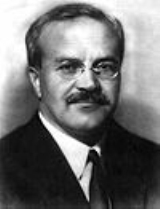
Vyacheslav Molotov

 
Vyacheslav Molotov

   Email Print
   Bookmark   Link


Vyacheslav Molotov


Molotov redirects here. For other uses, see Molotov (disambiguation)
Molotov (disambiguation)

Molotov can refer to*Vyacheslav Molotov , a Soviet politician and diplomat, foreign minister under Stalin**The Molotov-Ribbentrop Pact of 1939 between Nazi Germany and the Soviet Union...
.


Vyacheslav Mikhailovich Molotov (Vjaceslav Mihajlovic Molotov; – 8 November 1986), Soviet
Soviet Union

The Union of Soviet Socialist Republics was a Constitution of the Soviet Union socialist state that existed in Eurasia from 1922 to 1991.The name is a translation of the , romanization of Russian Soyuz Sovetskikh Sotsialisticheskikh Respublik, abbreviated ????, SSSR....
 politician
Politician

A politician is an individual who is involved in influencing public decision making through the influence of politics or a person who influences the way a society is governed....
 and diplomat
Diplomacy

Diplomacy is the art and practice of conducting negotiations between representatives of groups or states. It usually refers to international diplomacy, the conduct of international relations through the intercession of professional diplomats with regard to issues of peace-making, trade, war, economics and culture....
, was a leading figure in the Soviet government
Government of the Soviet Union

Council of Ministers of the USSR was the Soviet government?the highest executive and Administration body of the Soviet Union. Between 1922 and 1946 it was named Council of People's Commissars of the USSR ....
 from the 1920s, when he rose to power as a protégé of Joseph Stalin
Joseph Stalin

Joseph Stalin was the General Secretary of the Communist Party of the Soviet Union's Central Committee of the Communist Party of the Soviet Union from 1922 until his death in 1953....
, to 1957, when he was dismissed from Presidium (Politburo) of the Central Committee by Nikita Khrushchev
Nikita Khrushchev

Nikita Sergeyevich Khrushchev served as General Secretary of the Communist Party of the Soviet Union of the Communist Party of the Soviet Union from 1953 to 1964, following the death of Joseph Stalin, and Premier of the Soviet Union from 1958 to 1964....
. He was the principal Soviet signatory of the Nazi
Nazi Germany

Nazi Germany and the Third Reich are the colloquial English names for Germany under the regime of Adolf Hitler and the Nazi Party , which established a Totalitarianism dictatorship that existed from 1933 to 1945....
-Soviet non-aggression pact
Non-aggression pact

A non-aggression pact is an international treaty between two or more states, agreeing to avoid war or armed conflict between them and resolve their disputes through peaceful negotiations....
 of 1939 (also known as the Molotov-Ribbentrop Pact
Molotov-Ribbentrop Pact

The Molotov?Ribbentrop Pact, colloquially named after Soviet Union foreign minister Vyacheslav Molotov and Nazi Germany foreign minister Joachim von Ribbentrop, was an agreement officially titled the Treaty of Non-aggression between Germany and the Union of Soviet Socialist Republics and signed in Moscow in the early hours of August 24...
).


Discussion
Ask a question about 'Vyacheslav Molotov'
Start a new discussion about 'Vyacheslav Molotov'
Answer questions from other users
Full Discussion Forum


Encyclopedia


Molotov redirects here. For other uses, see Molotov (disambiguation)
Molotov (disambiguation)

Molotov can refer to*Vyacheslav Molotov , a Soviet politician and diplomat, foreign minister under Stalin**The Molotov-Ribbentrop Pact of 1939 between Nazi Germany and the Soviet Union...
.


Vyacheslav Mikhailovich Molotov (Vjaceslav Mihajlovic Molotov; – 8 November 1986), Soviet
Soviet Union

The Union of Soviet Socialist Republics was a Constitution of the Soviet Union socialist state that existed in Eurasia from 1922 to 1991.The name is a translation of the , romanization of Russian Soyuz Sovetskikh Sotsialisticheskikh Respublik, abbreviated ????, SSSR....
 politician
Politician

A politician is an individual who is involved in influencing public decision making through the influence of politics or a person who influences the way a society is governed....
 and diplomat
Diplomacy

Diplomacy is the art and practice of conducting negotiations between representatives of groups or states. It usually refers to international diplomacy, the conduct of international relations through the intercession of professional diplomats with regard to issues of peace-making, trade, war, economics and culture....
, was a leading figure in the Soviet government
Government of the Soviet Union

Council of Ministers of the USSR was the Soviet government?the highest executive and Administration body of the Soviet Union. Between 1922 and 1946 it was named Council of People's Commissars of the USSR ....
 from the 1920s, when he rose to power as a protégé of Joseph Stalin
Joseph Stalin

Joseph Stalin was the General Secretary of the Communist Party of the Soviet Union's Central Committee of the Communist Party of the Soviet Union from 1922 until his death in 1953....
, to 1957, when he was dismissed from Presidium (Politburo) of the Central Committee by Nikita Khrushchev
Nikita Khrushchev

Nikita Sergeyevich Khrushchev served as General Secretary of the Communist Party of the Soviet Union of the Communist Party of the Soviet Union from 1953 to 1964, following the death of Joseph Stalin, and Premier of the Soviet Union from 1958 to 1964....
. He was the principal Soviet signatory of the Nazi
Nazi Germany

Nazi Germany and the Third Reich are the colloquial English names for Germany under the regime of Adolf Hitler and the Nazi Party , which established a Totalitarianism dictatorship that existed from 1933 to 1945....
-Soviet non-aggression pact
Non-aggression pact

A non-aggression pact is an international treaty between two or more states, agreeing to avoid war or armed conflict between them and resolve their disputes through peaceful negotiations....
 of 1939 (also known as the Molotov-Ribbentrop Pact
Molotov-Ribbentrop Pact

The Molotov?Ribbentrop Pact, colloquially named after Soviet Union foreign minister Vyacheslav Molotov and Nazi Germany foreign minister Joachim von Ribbentrop, was an agreement officially titled the Treaty of Non-aggression between Germany and the Union of Soviet Socialist Republics and signed in Moscow in the early hours of August 24...
). The Molotov cocktail
Molotov cocktail

The Molotov cocktail, also known as the petrol bomb, gasoline bomb, or Molotov bomb, or simply "Molotov", is a generic name used for a variety of improvised Incendiary devices....
 was named after him by the Finnish
Finland

Finland , officially the Republic of Finland , is a Nordic countries situated in the Fennoscandian region of northern Europe. It borders Sweden on the west, Russia on the east, and Norway on the north, while Estonia lies to its south across the Gulf of Finland....
 military during the Winter War
Winter War

The Winter War or the Soviet-Finnish War began when the Soviet Union attacked Finland on 30 November 1939, three months after the invasion of Poland by Germany that started World War II....
.

Origins and early life

Molotov was born in the village of Kukarka
Sovetsk, Kirov Oblast

Sovetsk is a types of settlements in Russia in Kirov Oblast, Russia. Population: 18,167 ; 19,368 .Kukarka was founded in the ancient centuries by Mari people as a stronghold....
 (now Sovetsk in Kirov Oblast
Kirov Oblast

Kirov Oblast is a federal subjects of Russia of Russia . Its administrative center is the types of inhabited localities in Russia of Kirov, Kirov Oblast....
) as ???????? ?????????? ????´??? (Vyacheslav Mikhailovich Skriabin), son of a shop clerk. Contrary to a commonly repeated error, he was not related to the composer Alexander Scriabin
Alexander Scriabin

Alexander Nikolayevich Scriabin was a Russian composer and pianist who initially developed a highly lyrical and idiosyncratic tonal language inspired by the music of Chopin....
. He was educated at a secondary school in Kazan
Kazan

Kazan is the capital types of inhabited localities in Russia of the Tatarstan, Russia, and one of Russia's largest cities. It is a major industrial, commercial and cultural center, and remains the most important center of Tatar culture....
, and joined the Bolshevik
Bolshevik

Bolsheviks, originally also Bolshevists were a faction of the Marxism Russian Social Democratic Labour Party which split apart from the Menshevik faction at the 2nd Congress of the RSDLP in 1903 and ultimately became the Communist Party of the Soviet Union....
 faction of the Russian Social Democratic Labour Party
Russian Social Democratic Labour Party

The Russian Social-Democratic Labour Party, or RSDLP , also known as the Russian Social-Democratic Workers' Party and the Russian Social-Democratic Party, was a revolutionary socialist Russian political party formed in 1898 in Minsk to unite the various revolutionary organizations into one party....
 in 1906. For his political work he took the pseudonym
Pseudonym

A pseudonym, , is a fictitious alternative to a person's legal name. In some cases, pseudonyms are adopted because it is part of a cultural or organizational tradition, as in the case of Religious names used by members of some religious orders and "cadre names" used by Communist party leaders such as Leon Trotsky and Joseph Stalin....
 Molotov (from the Russian molot, "hammer
Hammer

A hammer is a tool meant to deliver an impact to an object. The most common uses are for driving Nail s, fitting parts, and breaking up objects....
"). He was arrested in 1909 and spent two years in exile in Vologda
Vologda

Vologda is a city in Russia and the administrative center of Vologda Oblast. Population: 293,700 ; Vologda takes its name, of likely Finno-Ugrian origin, from the Vologda River which flows through the city....
. In 1911 he enrolled at the St Petersburg Polytechnic, and also joined the editorial staff of Pravda
Pravda

Pravda was a leading newspaper of the Soviet Union and an official organ of the Central Committee of the Communist Party of the Soviet Union of the Communist Party of the Soviet Union between 1912 and 1991....
, the underground Bolshevik newspaper, of which Joseph Stalin
Joseph Stalin

Joseph Stalin was the General Secretary of the Communist Party of the Soviet Union's Central Committee of the Communist Party of the Soviet Union from 1922 until his death in 1953....
 was editor. In 1913 Molotov was again arrested and deported to Irkutsk
Irkutsk

Irkutsk is one of the largest types of inhabited localities in Russia in Siberia and the administrative center of Irkutsk Oblast, situated by rail from Moscow....
, but in 1915 he escaped and returned to the capital.

Early career


In 1916, Molotov became a member of Bolshevik Party's committee in Petrograd. When the February Revolution broke out in February 1917, he was one of the few Bolsheviks of any standing in the capital. Under his direction Pravda
Pravda

Pravda was a leading newspaper of the Soviet Union and an official organ of the Central Committee of the Communist Party of the Soviet Union of the Communist Party of the Soviet Union between 1912 and 1991....
 took a turn "left" in opposing the Provisional Government which was formed after the revolution. Consequently, when Stalin returned to the capital, he reversed Molotov's line. However, when the party leader, Vladimir Lenin
Vladimir Lenin

Vladimir Ilyich Lenin , born Vladimir Ilyich Ulyanov and also known by the pseudonyms V.I. Lenin and N. Lenin, was a Russians revolutionary, a Bolshevik Communism politician, the principal leader of the October Revolution and the first head of the USSR....
, arrived, he overruled Stalin. Despite this, Molotov became a protégé and close adherent of Stalin, an alliance to which he owed not only his later prominence, but almost certainly his life as well; Molotov was one of only four of the leading Old Bolsheviks to survive the Great Purges. The other three were Kalinin
Mikhail Kalinin

Mikhail Ivanovich Kalinin was a Bolshevik revolutionary and the titular head of state of the Soviet Union from 1919 to 1946. Though only four years older than Joseph Stalin, Kalinin was celebrated as Dedushka by the Young Pioneers....
, Alexandra Kollontai
Alexandra Kollontai

Alexandra Mikhailovna Kollontai was a Russian Communist revolutionary, first as a member of the Mensheviks, then from 1914 on as a Bolshevik....
 and Stalin himself. Molotov became a member of the Military Revolutionary Committee
Petrograd Soviet

The Petrograd Soviet of Workers' and Soldiers' Deputies, usually called the Petrograd Soviet, was the Soviet in Saint Petersburg , Russia established in March 1917 after the February Revolution as the representative body of the city's workers....
 which planned the October Revolution (effectively bringing the Bolsheviks to power).

In 1918, Molotov was sent to Ukraine
Ukraine

Ukraine is a country in Eastern Europe. It is bordered by Russia to the east; Belarus to the north; Poland, Slovakia, and Hungary to the west; Romania and Moldova to the southwest; and the Black Sea and Sea of Azov to the south....
 to take part in the so-called civil war
Russian Civil War

The Russian Civil War was a multi-party war that occurred within the former Russian Empire after the Russian provisional government collapsed and the Bolshevik party assumed power in Saint Petersburg....
 (Ukrainian-Soviet War of 1918-1921) then breaking out. Since he was not a military man, Molotov took no part in the fighting. In 1920, he became secretary to the Central Committee of the Ukrainian Bolshevik Party. Lenin recalled him to Moscow in 1921, elevating him to full membership in the Central Committee
Central Committee

Central Committee most commonly refers to the central executive unit of a Leninist or Communist party, whether ruling or non-ruling. In a Communist party, the Central Committee is made up of delegates elected at a Party Congress....
 and Orgburo
Orgburo

The Organizational Bureau of the Central Committee of the CPSU existed from 1919 to 1952, until the 19th Congress, when the Orgburo was abolished and its functions were transferred to the enlarged Secretariat of the CPSU Central Committee....
, and putting him in charge of the party secretariat. In 1922, Stalin became General Secretary of the Bolshevik Party with Molotov as the de facto "second" secretary. Under Stalin's patronage, Molotov became a member of the Politburo
Politburo

Politburo, short for Political Bureau, Russian language Politicheskoye Buro, is the executive organization for a number of political parties, most notably those of Communist Party....
 in 1926.

During the power struggles which followed Lenin's death in 1924, Molotov remained a loyal supporter of Stalin against his various rivals: first Leon Trotsky
Leon Trotsky

Leon Trotsky , born Lev Davidovich Bronstein , was a Bolshevik revolutionary and Marxism theorist. He was one of the leaders of the Russian October Revolution, second only to Lenin....
, later Lev Kamenev
Lev Kamenev

was a Bolshevik revolutionary and a prominent Soviet Union politician. He was briefly the nominal head of the Soviet state in 1917 and a founding member and later chairman of the ruling Politburo of the CPSU Central Committee....
 and Grigory Zinoviev
Grigory Zinoviev

Gregory Yevseevich Zinoviev...
 and finally Nikolai Bukharin
Nikolai Bukharin

Nikolai Ivanovich Bukharin , was a Bolshevik Russian Revolution of 1917 and intelligentsia and Soviet Union politician....
. He became a leading figure in the "Stalinist centre" of the party, which also included Kliment Voroshilov
Kliment Voroshilov

, popularly known as Klim Voroshilov was a Soviet Union Military of the Soviet Union commander and Politics of the Soviet Union.Voroshilov was born in Dnipropetrovsk, near Yekaterinoslav , Ukraine, under the Russian Empire, to a railway worker's family of Russians ethnicity....
, Lazar Kaganovich
Lazar Kaganovich

Lazar Moiseyevich Kaganovich was a Soviet Union politician and administrator and a close associate of Joseph Stalin....
, Sergo Ordzhonikidze
Grigoriy Ordzhonikidze

File:Sergo ordzhonikidze.jpgGrigoriy Konstantinovich Ordzhonikidze , generally known as Sergo Ordzhonikidze was a member of the Politburo of the CPSU Central Committee, and close friend to Stalin....
 and Sergei Kirov. Trotsky and his supporters underestimated Molotov as many others did. Trotsky called him "mediocrity personified", whilst Molotov himself pedantically corrected comrades referring to him as 'Stone-Arse' by saying that Lenin had actually dubbed him 'Iron Arse'. However, this outward dullness concealed a sharp mind and great administrative talent. He operated mainly behind the scenes and cultivated an image as a colorless bureaucrat - for example, he was the only Bolshevik leader who always wore a suit and tie (Lenin's attire routine changed in the later years).

Prime minister


When Bukharin's ally, Alexei Rykov
Alexei Rykov

Alexei Ivanovich Rykov was a Russian Marxist revolutionary and Soviet Union politician, Soviet head of the government from between 1924 to 1930....
, was removed as Chairman of the Council of People's Commissars (the equivalent of a prime minister
Prime minister

A prime minister is the most senior minister of Cabinet in the Executive branch of government in a parliamentary system. The position is usually held by, but need not always be held by, a politician....
) in December 1930, Molotov succeeded him. In this post, he oversaw the Stalin regime's greatest social revolution, the collectivisation of agriculture
Collectivisation in the USSR

Collectivization in the Soviet Union was a policy pursued under Joseph Stalin, between 1928 and 1940, to consolidate individual land and labour into collective farms ....
. Molotov carried out Stalin's line of using a combination of force and propaganda to crush peasant resistance to collectivisation, including the deportation of millions of kulak
Kulak

Kulaks were a category of relatively affluent and well-endowed peasants in the later Russian Empire, Soviet Russia, and early Soviet Union. The word kulak originally referred to independent farmers in the Russian Empire who emerged as a result of the Stolypin reform which began in 1906....
s
(peasants with property) to labor camp
Labor camp

A labor camp is a simplified detention facility where inmates are forced to engage in penal labor. Labor camps have many common aspects with slavery and with prisons....
s. An enormous number of the deportees died from exposure and overwork. He signed the "Law of Spikelets
Law of Spikelets

Law of Spikelets was a common name of the law based on the decree of Supreme Soviet and Sovnarkom of the USSR "About protection of the property of state enterprises, kolkhozes and cooperatives, and strengthening of the public property" dated August 7, 1932....
" and personally led the Extraordinary Commission for Grain Delivery in Ukraine, which seized a reported 4.2 million tonnes of grain from the peasants, during a widespread famine
Famine

A famine is a widespread shortage of food that may apply to any faunal species, which phenomenon is usually accompanied by regional malnutrition, starvation, epidemic, and increased death....
 (known in Ukraine as Holodomor
Holodomor

The Holodomor refers to the famine of 1932?1933 in the Ukrainian SSR during which millions of people were starved to death because of the Soviet policies that forced farmers into Collectivization in the Soviet Unions....
). Contemporary historians estimate that between four and six million people died, either of starvation or in labor camps, in the move to collectivise farms. Molotov also oversaw the implementation of the first Five-Year Plan
Five-Year Plan

Five-Year Plan may refer to:*Five-Year Plan *Five-Year Plans of China*Five-year plans of India*Five-year plans of Nepal*Five-year plans of Pakistan...
 for rapid industrialisation.

Sergei Kirov was assassinated by a oppositionist sympathizer in 1934. This is now believed by some historians to have been ordered by Stalin, triggering a second crisis, the Great Purge
Great Purge

Great Purge was a series of campaigns of political repression and persecution in the Soviet Union orchestrated by Joseph Stalin in 1936-1938. Also described as a "Soviet holocaust" by several authors, it involved the purge of the Communist Party of the Soviet Union, repression of kulaks, Red Army leadership, and the persecution of unaffiliat...
. This purge acquired momentum through 1935 and 1936 and culminated in 1937-38 in the Moscow Trials
Moscow Trials

The Moscow Trials were a series of trials of political opponents of Joseph Stalin during the Great Purge. Many of the defendants were executed....
, in which most of the pre-Stalin Bolshevik leaders were convicted on usually fabricated charges of treason
Treason

In law, treason is the crime that covers some of the more serious acts of loyalty to one's sovereignty or nation. Historically, treason also covered the murder of specific social superiors, such as the murder of a husband by his wife ....
 and espionage
Espionage

Espionage or spying involves an individual obtaining information that is considered secrecy or confidential without the permission of the holder of the information....
, and millions of other Russians were deported to labor camps. Although the purges were carried out by Stalin's successive police chiefs, Genrikh Yagoda
Genrikh Yagoda

Genrikh Grigor'evich Yagoda was the head of the NKVD, the Soviet Union internal affairs and border guards body, from 1934 to 1936....
, Nikolai Yezhov
Nikolai Yezhov

Nikolai Ivanovich Yezhov was a senior figure in the NKVD during the period of the Great Purge. His reign is sometimes known as the "Yezhovschina" ....
 and Lavrenty Beria, Molotov was intimately involved in the processes. Stalin frequently required him and other Politburo members to sign the death warrants of prominent purge victims, and Molotov always did so without question. There is no record of Molotov attempting to moderate the course of the purges or even to save individuals, as some other Soviet leaders did.

Despite the great human cost, the Soviet Union under Molotov's nominal prime ministership made great strides in the adoption and widespread implementation of agrarian and industrial technology (See command economy). The rise of Adolf Hitler
Adolf Hitler

Adolf Hitler was an Austrian-born Germany politician and the leader of the National Socialist German Workers Party , popularly known as the Nazi Party....
 in Nazi Germany
Nazi Germany

Nazi Germany and the Third Reich are the colloquial English names for Germany under the regime of Adolf Hitler and the Nazi Party , which established a Totalitarianism dictatorship that existed from 1933 to 1945....
 gave the development of a modern armaments industry great urgency, and Molotov and the commissar of industry, Lazar Kaganovich
Lazar Kaganovich

Lazar Moiseyevich Kaganovich was a Soviet Union politician and administrator and a close associate of Joseph Stalin....
, were primarily responsible for guiding this success. Ultimately, it was this arms industry which enabled the Soviet Union to prevail in World War II
World War II

World War II, or the Second World War , was a global military conflict which involved a Participants in World War II, including all of the great powers, organised into two opposing military alliances: the Allies of World War II and the Axis powers....
. However, the purges of the Red Army
Red Army

The Red Army was the armed force first organized by the Bolsheviks during the Russian Civil War in 1918 and, in 1922, became the army of the Soviet Union....
 leadership, in which Molotov participated, weakened the Soviet Union's defence capacity. This somewhat contributed to the military disasters of 1941 and 1942, which were mostly caused by unreadiness for war. It also led to the dismantling of the peasant class, and its replacement by collectivised agriculture left a legacy of chronic agricultural under-production which the Soviet regime never fully overcame.

Following the purges, Molotov was generally regarded as Stalin's deputy and as his long-term successor, although Molotov was careful not to encourage any such suggestion. The American journalist John Gunther
John Gunther

John Gunther was an American journalist and author whose success came primarily in the 1940s and 1950s with a series of popular sociopolitical works known as the "Inside" books....
 wrote in 1938: "Molotov has a fine forehead, and looks and acts like a French professor of medicine - orderly, precise, pedantic. He is... a man of first-rate intelligence and influence. Molotov is a vegetarian and a teetotaller. Stalin gives him much of the dirty work to do".

Foreign minister


Molotovribbentropstalin
In 1939, following the Munich agreement
Munich Agreement

The Munich Agreement was an agreement regarding the Sudetenland, which were areas along borders of Czechoslovakia, mainly inhabited by Czech Germans....
 and Hitler's subsequent invasion of Czechoslovakia
Czechoslovakia

Czechoslovakia was a sovereign state in Central Europe that existed from October 1918 until 1992 . On January 1, 1993, Czechoslovakia dissolution of Czechoslovakia into the Czech Republic and Slovakia....
 in 1938, Stalin decided that Soviet expansion would benefit by signing a treaty with Hitler. In May 1939, Foreign Minister Maxim Litvinov
Maxim Litvinov

Maxim Maximovich Litvinov was a Russian-Jewish revolutionary and prominent Soviet Union diplomacy....
 (who was Jewish and therefore not appropriate for these negotiations) was dismissed, and Molotov was appointed to succeed him. Molotov remained at the head of the Sovnarkom until May 1941, when Stalin took over as the official head of the Soviet government.

At first, Hitler rebuffed Soviet diplomatic hints that Stalin desired a treaty, but in early August, he authorised Foreign Minister Joachim von Ribbentrop
Joachim von Ribbentrop

Ulrich Friedrich Wilhelm Joachim von Ribbentrop was Foreign Minister of Germany from 1938 until 1945. He was later hanging for war crimes after the Nuremberg Trials....
 to begin serious negotiations. A trade agreement was concluded on 18 August, and on 22 August, Ribbentrop flew to Moscow
Moscow

Moscow is the capital and the largest types of inhabited localities in Russia of the Russian Federation. It is also the largest European cities and metropolitan areas, with the Moscow metropolitan area ranking among the largest urban areas in the world....
 to conclude a formal non-aggression treaty. Although the treaty is known as the Molotov-Ribbentrop Pact
Molotov-Ribbentrop Pact

The Molotov?Ribbentrop Pact, colloquially named after Soviet Union foreign minister Vyacheslav Molotov and Nazi Germany foreign minister Joachim von Ribbentrop, was an agreement officially titled the Treaty of Non-aggression between Germany and the Union of Soviet Socialist Republics and signed in Moscow in the early hours of August 24...
, Molotov and Ribbentrop acted only as agents for their masters, Stalin and Hitler. The most important part of the agreement was the secret protocol, which provided for the partition of Poland, Finland and the Baltic States between Nazi Germany and the Soviet Union and for the Soviet annexation of Bessarabia
Bessarabia

Bessarabia is a historical term for the geographic entity in Eastern Europe bounded by the Dniester River on the east and the Prut River on the west....
 (then part of Romania
Romania

Romania is a country located in Southeastern Europe Central Europe, North of the Balkan Peninsula, on the Lower Danube, within and outside the Carpathian Mountains, bordering on the Black Sea....
, now Moldova
Moldova

Moldova , officially the Republic of Moldova is a landlocked country in Eastern Europe, located between Romania to the west and Ukraine to the north, east and south....
). This protocol gave Hitler the green light for his invasion of Poland, which began on 1 September.

Under the terms of the Pact, Stalin was, in effect, given authorisation to occupy and annex Estonia
Estonia

Estonia , officially the Republic of Estonia is a country in the Baltic region of Northern Europe. It is bordered to the north by Finland across the Gulf of Finland, to the west by Sweden across the Baltic Sea, to the south by Latvia , and to the east by the Russia ....
, Latvia
Latvia

Latvia The Latvians are a Baltic peoples culturally related to the Estonians and Lithuanians, with the Latvian language having many similarities with Lithuanian language, but not with the Estonian language....
 and Bessarabia
Bessarabia

Bessarabia is a historical term for the geographic entity in Eastern Europe bounded by the Dniester River on the east and the Prut River on the west....
, as well as the part of Poland east of the Curzon Line
Curzon Line

The Curzon Line was a demarcation line between the Second Polish Republic and Bolshevik Russia, first proposed on December 8, 1919 at the Allied Supreme Council declaration....
 (an area in which Ukrainians and Byelorussians comprised the majority of the population). He was also given a free hand in relation to Finland
Finland

Finland , officially the Republic of Finland , is a Nordic countries situated in the Fennoscandian region of northern Europe. It borders Sweden on the west, Russia on the east, and Norway on the north, while Estonia lies to its south across the Gulf of Finland....
. In the Soviet-Finnish War that ensued, a combination of fierce Finnish resistance and Soviet mismanagement resulted in Finland losing parts of its territory, but not its independence. During this conflict, the Finns coined the term Molotov cocktail
Molotov cocktail

The Molotov cocktail, also known as the petrol bomb, gasoline bomb, or Molotov bomb, or simply "Molotov", is a generic name used for a variety of improvised Incendiary devices....
 for a homemade incendiary device to be used against tanks. Germany was authorised to occupy the western two-thirds of Poland (much of which was annexed to Germany), as well as Lithuania
Lithuania

Lithuania , officially the Republic of Lithuania is a country in Northern Europe, the southernmost of the three Baltic states. Situated along the southeastern shore of the Baltic Sea, it shares borders with Latvia to the north, Belarus to the southeast, Poland, and the Russian exclave of Kaliningrad Oblast to the southwest....
, but the Pact was later amended to allocate Lithuania to the Soviet sphere in exchange for a more favourable border in Poland. All these annexations led to massive suffering and loss of life in the countries which were occupied and partitioned by the two dictatorships.

The Molotov-Ribbentrop Pact governed Soviet-German relations until June 1941 when Hitler, having occupied France and neutralised Britain (or so he thought), turned east and attacked the Soviet Union
Soviet Union

The Union of Soviet Socialist Republics was a Constitution of the Soviet Union socialist state that existed in Eurasia from 1922 to 1991.The name is a translation of the , romanization of Russian Soyuz Sovetskikh Sotsialisticheskikh Respublik, abbreviated ????, SSSR....
. Molotov was also responsible for telling the Soviet people of the attack, when he announced the war, instead of Joseph Stalin. His , broadcasted by radio on June 22, played in Russia a role similar to Winston Churchill's wartime speeches to Britain, and had impact on Russian popular culture.

Following the invasion, Molotov conducted urgent negotiations with Britain and, later, the United States
United States

The United States of America is a Federal government constitutional republic comprising U.S. state and a federal district. The country is situated mostly in central North America, where its Contiguous United States and Washington, D.C., the Capital districts and territories, lie between the Pacific Ocean and Atlantic Oceans, Borders of the U...
 for wartime alliances and traveled to London
London

London is the capital of both England and the United Kingdom, and the most populous municipality in the European Union. An important settlement for two millennia, History of London goes back to its founding by the Roman Empire....
 in 1941 and to Washington
Washington, D.C.

Washington, D.C. , formally the District of Columbia and commonly referred to as Washington, the District, or simply D.C., is the Capital of the United States, founded on July 16, 1790....
 in 1942. In 1942, he signed the Anglo-Soviet Treaty of Alliance. He also secured Franklin D. Roosevelt
Franklin D. Roosevelt

Franklin Delano Roosevelt , often referred to by his initials FDR, was the List of Presidents of the United States President of the United States....
 and Winston Churchill
Winston Churchill

Sir Winston Leonard Spencer-Churchill, Order of the Garter, Order of Merit, Order of the Companions of Honour, Territorial Decoration, Fellow of the Royal Society, Her Majesty's Most Honourable Privy Council, Queen's Privy Council for Canada was a Politics of the United Kingdom known chiefly for his leadership of the United King...
's agreement to create a "second front" in Europe. He accompanied Stalin to the Teheran conference in 1943, the Yalta conference
Yalta Conference

The Yalta Conference, sometimes called the Crimea Conference and Code name the Argonaut Conference, was the wartime meeting from 4 February 1945 to 11 February 1945 among the heads of government of the United States, the United Kingdom, and the Soviet Union?President of the United States Franklin D....
 in 1945 and the Potsdam conference
Potsdam Conference

The Potsdam Conference was held at Cecilienhof, the home of William, German Crown Prince, in Potsdam, Germany, from July 16 to August 2, 1945....
, which followed the defeat of Germany. He represented the Soviet Union
Soviet Union

The Union of Soviet Socialist Republics was a Constitution of the Soviet Union socialist state that existed in Eurasia from 1922 to 1991.The name is a translation of the , romanization of Russian Soyuz Sovetskikh Sotsialisticheskikh Respublik, abbreviated ????, SSSR....
 at the San Francisco Conference, which created the United Nations
United Nations

The United Nations is an international organization whose stated aims are to facilitate cooperation in international law, international security, economic development, Social change, human rights and achieving world peace....
. Even during the period of wartime alliance, Molotov was known as a tough negotiator and determined defender of Soviet interests. In this he was carrying out Stalin's wishes.

From 1945 to 1947 Molotov took part in all four conferences of foreign ministers of the victorious states in the Second World War. In general, he was distinguished by an uncooperative attitude towards the Western powers.

Winston Churchill
Winston Churchill

Sir Winston Leonard Spencer-Churchill, Order of the Garter, Order of Merit, Order of the Companions of Honour, Territorial Decoration, Fellow of the Royal Society, Her Majesty's Most Honourable Privy Council, Queen's Privy Council for Canada was a Politics of the United Kingdom known chiefly for his leadership of the United King...
 in his wartime memoirs lists many meetings with Molotov. Acknowledging him as a ruthless and difficult diplomat, Churchill was generous enough to conclude: "In the conduct of foreign affairs, Mazarin; Talleyrand, Metternich, would welcome him to their company, if there be another world to which Bolsheviks allow themselves to go."

Postwar career


In the postwar period, Molotov's position began to decline. In 1949, he was replaced as Foreign Minister by Andrey Vyshinsky
Andrey Vyshinsky

Andrey Januaryevich Vyshinskiy , was a Russian and Soviet Union jurist and diplomat. He is mostly known as a state prosecutor of Stalin's show trials....
, although retaining his position as Deputy Prime Minister and membership of the Politburo. Following the death of Andrei Zhdanov
Andrei Zhdanov

Andrei Alexandrovich Zhdanov was a Soviet Union politician. He was of Russians ethnicity....
, who had come to be seen as Stalin's most likely successor, Stalin and Beria began to plan a new purge, which would have removed most of the older party leaders such as Molotov from their positions. New leaders, such as Georgii Malenkov and Nikita Khrushchev
Nikita Khrushchev

Nikita Sergeyevich Khrushchev served as General Secretary of the Communist Party of the Soviet Union of the Communist Party of the Soviet Union from 1953 to 1964, following the death of Joseph Stalin, and Premier of the Soviet Union from 1958 to 1964....
, enjoyed Stalin's patronage.

A clear sign of Molotov's precarious position was his inability to prevent the arrest of his Jewish wife, Polina Zhemchuzhina
Polina Zhemchuzhina

Polina Semyonovna Zhemchuzhina was the wife of Vyacheslav Molotov.Born Pearl Karpovskaya to the family of a Jewish tailor in the village of Pologi, in the Yekaterinoslav region , she joined the Russian Social Democratic Labour Party of Bolsheviks in 1918 and served as a propaganda commissar in the Red Army during the Russian Civil W...
, in December 1948 for "treason". Stalin had long distrusted her. The couple were reunited by Beria upon the death of Stalin. At the 19th Party Congress
19th Congress of the Communist Party of the Soviet Union

The 19th Congress of the Communist Party of the Soviet Union was held from 5 to 14 October 1952. It was the last of the regime of Joseph Stalin and the first to take place since before World War II....
 in 1952, Molotov was elected to the new, expanded Presidium
Presidium

The presidium or pr?sidium is the name for the executive committee of various legislative and organizational bodies.In Communist states the presidium was the permanent executive committee of legislative bodies such as the Supreme Soviet in the USSR....
 of the Communist Party but was excluded from the smaller standing committee of the Presidium (although this was not made public). It seems likely that Stalin's death in March 1953 saved Molotov from being purged as part of a "clean out" of the Soviet leadership.

Following Stalin's death, a realignment of the leadership was sought, in the course of which Molotov's position was strengthened. Beria was purged and executed, and Molotov regained the Foreign Ministry under Malenkov as Prime Minister. However, the new Party Secretary, Khrushchev, soon emerged as the real power in the regime. He presided over a gradual domestic liberalisation and a "thaw" in foreign policy, shown by the reconciliation with Tito's government in Yugoslavia
Yugoslavia

File:LocationYugoslavia2.pngYugoslavia is a term that describes three political entities that existed successively on the Balkan Peninsula in Europe, during most of the 20th century....
 (which Stalin had expelled from the communist movement). Molotov, an old-guard Stalinist, seemed increasingly out of place in this new environment, but he represented the Soviet Union with his usual tenacity at the Geneva Conference of 1955 which discussed European security, German reunification and disarmament.

The events which led to Molotov's downfall began in February 1956 when Khrushchev launched an unexpected denunciation of Stalin at the 20th Congress of the Communist Party. Khrushchev attacked Stalin both over the purges of the 1930s and the defeats of the early years of World War II, which he blamed on Stalin's over-trusting attitude to Hitler and the purges of the Red Army. Since Molotov was most senior of Stalin's collaborators still alive and had played a leading role in the purges, it became obvious that Khrushchev's examination into the past would probably result in Molotov's fall from power. Consequently, he became the leader of the "old guard" in resisting Khrushchev, although whether he actually plotted to overthrow Khrushchev, as was later alleged, is not clear.

In June 1956, Molotov was removed as Foreign Minister, and in June 1957 was expelled from the Presidium (Politburo) following a failed attempt to remove Khrushchev as First Secretary. Although Molotov's faction initially won a vote in the Presidium 7-4 to remove Khrushchev, the latter refused to resign unless a Central Committee plenum decided so. In the plenum, which lasted from 22 to 29 June, Molotov and his faction were defeated. Eventually he was banished as ambassador to Mongolia
Mongolia

Mongolia is a landlocked country in East Asia and Central Asia. It borders Russia to the north and People's Republic of China to the south, east and west....
. In 1960, he was appointed Soviet representative to the International Atomic Energy Agency
International Atomic Energy Agency

The International Atomic Energy Agency is an international organization that seeks to promote the peaceful use of nuclear technology and to inhibit its use for nuclear weapon....
, which was seen as a partial rehabilitation. However, after the 22nd Party Congress in 1961, during which Khrushchev carried his de-Stalinization
De-Stalinization

De-Stalinization refers to the process of eliminating the cult of personality and Stalinist political system created by Soviet Union leader Joseph Stalin....
 campaign to remove Stalin's body from Lenin's Mausoleum
Lenin's Mausoleum

Lenin's Mausoleum also known as Lenin's Tomb, situated in Red Square in Moscow, is the mausoleum that serves as the current cemetery of Vladimir Lenin....
, Molotov was removed from all positions and expelled from the Communist Party. In March 1962, it was announced that Molotov had retired from public life.

In retirement, Molotov remained totally unrepentant about his role during Stalin's period of rule. After the Sino-Soviet split
Sino-Soviet split

Sino-Soviet split was a gradual worsening of relations between the People's Republic of China and the Soviet Union during the Cold War. There is no particular date or event which marked the onset of the split, for tensions had plagued the Sino-Soviet alliance even at its best, but there was growing divergence between the two countries sinc...
, it was reported that he agreed with the criticisms made by Mao Zedong
Mao Zedong

Mao Zedong was a China military and politics dictator. Mao led the Communist Party of China to victory against the Kuomintang in the Chinese Civil War, and was the leader of the People?s Republic of China from its establishment in 1949 until his death in 1976....
 of the supposed "revisionism" of Khrushchev's policies. According to Roy Medvedev
Roy Medvedev

Roy Aleksandrovich Medvedev is a Russian historian renowned as the author of the dissident history of Stalinism, Let History Judge, first published in English in 1972....
, Stalin's daughter, Svetlana
Svetlana Alliluyeva

Svetlana Iosifovna Alliluyeva is the youngest child and only daughter of Soviet Premier Joseph Stalin. A writer and naturalized United States citizen, Alliluyeva caused an international furor by defecting to the United States in 1967....
, recalled Molotov and his wife telling her: "Your father was a genius. There's no revolutionary spirit around nowadays, just opportunism everywhere. China's our only hope! Only they have kept alive the revolutionary spirit". In 1976, he said:

"The fact that atomic war may break out, isn't that class struggle? There is no alternative to class struggle. This is a very serious question. The be-all and end-all is not peaceful coexistence. After all, we have been holding on for some time, and under Stalin we held on to the point where the imperialists felt able to demand point-blank: either surrender such and such positions, or it means war. So far the imperialists haven't renounced that".


Molotov was partly rehabilitated during the Leonid Brezhnev
Leonid Brezhnev

Leonid Ilyich Brezhnev was General Secretary of the Communist Party of the Soviet Union from 1964 to 1982, serving in that position longer than anyone other than Joseph Stalin....
 years and was allowed to rejoin the Communist Party in 1984 under Konstantin Chernenko
Konstantin Chernenko

Konstantin Ustinovich Chernenko was a Soviet Union politician and General Secretary of the Communist Party of the Soviet Union of the Communist Party of the Soviet Union....
. He died at the age of 96 in Moscow
Moscow

Moscow is the capital and the largest types of inhabited localities in Russia of the Russian Federation. It is also the largest European cities and metropolitan areas, with the Moscow metropolitan area ranking among the largest urban areas in the world....
 in November 1986, only five years before the dissolution of the Soviet Union. At the time of his death he was the last surviving major participant in the events of 1917. He was buried at the Novodevichy Cemetery
Novodevichy Cemetery

Novodevichy Cemetery is the most famous cemetery in Moscow, Russia, situated next to the World Heritage Site, the 16th-century Novodevichy Convent, which is the city's third most popular tourist site....
, Moscow
Moscow

Moscow is the capital and the largest types of inhabited localities in Russia of the Russian Federation. It is also the largest European cities and metropolitan areas, with the Moscow metropolitan area ranking among the largest urban areas in the world....
. A collection of interviews with Molotov, Molotov Remembers: Inside Kremlin Politics, was published posthumously by Felix Chuev. At the end of 1989, two years before the final collapse of the Soviet Union, the Congress of People's Deputies of the Soviet Union and Mikhail Gorbachev
Mikhail Gorbachev

Mikhail Sergeyevich Gorbachev is a Russian politician. He was the last General Secretary of the Communist Party of the Soviet Union, serving from 1985 until 1991, and also the last head of state of the USSR, serving from 1988 until its collapse in 1991....
's government formally denounced the Molotov-Ribbentrop Pact, acknowledging that the annexation of the Baltic States and the partition of Poland had been illegal.

Molotov was one of the few, if not the only person to have shaken hands with Stalin, Mao
Mao

, is a Japanese remake of the Korean suspense drama series titled Ma Wang which aired on Korean Broadcasting System in 2007. The drama stars Satoshi Ohno of Arashi and Toma Ikuta, both under the talent agency Johnny & Associates....
, Hitler, Churchill and Roosevelt
Roosevelt

Roosevelt is a surname of Dutch language origin, with the literal meaning of "rose field"....
.

See also

  • Soviet-German relations before 1941
  • Molotov Plan
    Molotov Plan

    The Molotov Plan was the system created by the Soviet Union in 1947 in order to provide aid to rebuild the countries in Eastern Europe that were politically and economically aligned to the Soviet Union....
  • Katyn
  • Molotov Line
    Molotov Line

    The so-called Molotov Line was a system of fortifications built by the Soviet Union in the years 1940–1941, along its new western border after it annexed the Baltic States, Eastern Poland and Bessarabia....


External links