


Stahlhelm

Encyclopedia
Stahlhelm is German
for "steel helmet". The Imperial German Army
began to replace the traditional boiled-leather
Pickelhaube
(spiked combat helmet
) with the Stahlhelm during World War I
in 1916. The term Stahlhelm refers both to a generic steel helmet, and more specifically to the distinctive (and iconic) German design.
The Stahlhelm, with its distinctive "coal scuttle" shape, was an instantly recognizable icon for military imagery and became a common element of military propaganda
on both sides, just like the Pickelhaube
before it.
Its name was also used by the Stahlhelm
, a paramilitary nationalist
organization established at the end of 1918.
began, the number of casualties on all sides suffering from severe head wounds (more often caused by shrapnel than by gunfire) increased dramatically. The French
were the first to see a need for more protection—in late 1915 they began to issue Adrian helmet
s to their troops. The British
and Commonwealth
troops followed with the Brodie helmet
, which was also later worn by US forces, and the Germans with the Stahlhelm.
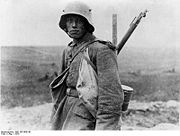 The design of the Stahlhelm was carried out by Dr. Friedrich Schwerd of the Technical Institute of Hanover
. In early 1915, Schwerd had carried out a study of head wounds suffered during trench warfare and submitted a recommendation for steel helmets, shortly after which he was ordered to Berlin. Schwerd then undertook the task of designing and producing a suitable helmet broadly based on the
15th century sallet
, which provided good protection for the head and neck.
After lengthy development work, which included testing a selection of German and Allied headgear, the first Stahlhelms were tested in November 1915 at the Kummersdorf
Proving Ground and then field tested by the 1st Assault Battalion. Thirty thousand examples were ordered, but it was not approved for general issue until New Year 1916, hence it is most usually referred to as the "Model 1916". In February 1916 it was distributed to troops at Verdun
, following which the incidence of serious head injuries fell dramatically.
In contrast to the Hadfield steel used in the British Brodie helmet
, the Germans used a harder martensitic
silicon
/nickel
steel. As a result, and also due to the helmet's form, the Stahlhelm had to be formed in heated dies at a greater unit cost than the British helmet, which could be formed in one piece.
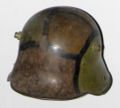 The Stahlhelm was introduced into regular service during the Verdun campaign
in early 1916.
The M1916 design had side-mounted horn-like ventilator lugs which were intended to be support for an additional steel brow plate or Stirnpanzer, which only ever saw limited use by snipers and trench raiding parties, as it was too heavy for general use.
The shell came in different sizes, from 60 to 68, with some size 70s reported. The suspension, or liner, consisted of a headband with three segmented leather pouches, each holding padding materials, and leather or fabric cords could be adjusted to provide a comfortable fit. The one-piece leather chin strap was attached to the shell by M1891 chinstrap lugs, the same kind used in the Pickelhaube
helmet.
The M1916 design provided excellent protection: Reserve Lieutenant Walter Schulze of 8th Company Reserve Infantry Regiment 76 described his combat introduction to the helmet on the Somme, 29 July 1916:
But the helmet was not without its flaws. The ventilator horns often let cold air in during the winter, requiring the wearer to block the vents with mud or fabric. The large, flared skirt tended to make it difficult for soldiers to hear, distorting surrounding sounds and creating an echo when the wearer spoke.
Originally painted Feldgrau (field grey), the Stahlhelm was often camouflaged by troops in the field using mud, foliage, cloth covers, and paint. Official issue cloth covers in white and grey appeared in late 1916 and early 1917. Camouflage paint was not formally introduced until July 1918, when German Army Order II, No 91 366, signed by General Erich Ludendorff
on 7 July 1918, outlined official standards for helmet camouflage. The order stipulated that helmets should be painted in several colors, separated by a finger-wide black line. The colors should be relevant to the season, such as using green, brown and ochre in summer.
After the effectiveness of the M1916 design was validated during the 1916 campaigns, incremental improvements were subsequently made. The M1917 version saw improvements to the liner, but was otherwise identical to the original design.
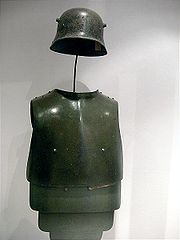 Extensive redesigns were made for the M1918 model. A new two-piece chin strap was introduced, and was attached directly to the helmet liner rather than the shell. Certain examples of the M1918 had cutouts in the rim along the sides of the helmet. It has incorrectly been said that these cutouts were to accommodate using headphones while wearing the helmet. These cutouts were actually done to improve hearing and to reduce echo created by the large, flared skirt.
The M1918 Stahlhelm can be distinguished from the M1916, as the M1918 shell lacks the chinstrap rivet on the lower side of the helmet skirt found on earlier models.
and the Ottoman Empire
used, or had commissioned, variations of the Stahlhelm design. The Austria
ns' M1917 helmet was similar to the German M1916, but had a cloth webbing chinstrap and had the chinstrap rivet located higher up on the steel shell. The Hungarians
produced their own M1917 version that was similar to the Austrian design, but the chinstrap rivet was smaller in size and located even higher up than the Austrian version. The Austro-Hungarian helmets were manufactured by Krupp Berndorfer Metallwarenfabriken, and were brown in color.
Germany delivered 5,400 visorless versions of the M1918 helmet for Turkey
. The missing front visor was thought by the Germans to be for religious reasons, and it was claimed that it was to allow Turkish soldiers to touch their foreheads to the ground during prayer, without removing their helmets. However, this story has been disputed. The Turks rejected any more than the 5,400 delivered and an unknown number from the overrun were issued to German armed forces and were used by German Freikorps
units after the war.
". The Model 1933 Vulkanfiber helmet kept the basic form of previous helmets but was much lighter. It was put into limited production following favourable field tests in early 1933 and small numbers were issued to Reichswehr
infantry, artillery and communications units. It was removed from service following the introduction of the M1935 helmet and most of the remaining stock were reissued to civil organizations such as fire brigades and police forces. Some examples were also retained for parade use by senior officers, who were not generally issued with the Stahlhelm.
carried out prototype design and testing, with Dr. Friedrich Schwerd once again taking a hand.
The new helmet was pressed from sheets of molybdenum
steel in several stages. The size of the flared visor and skirt was reduced, and the large projecting lugs for the obsolete armour shield were eliminated. The ventilator holes were retained, but were set in smaller hollow rivets mounted to the helmet's shell. The edges of the shell were rolled over, creating a smooth edge along the helmet. Finally, a completely new leather suspension, or liner, was incorporated that greatly improved the helmet's safety, adjustability, and comfort for each wearer. These improvements made the new M1935 helmet lighter, more compact, and more comfortable to wear than the previous designs.
The Army's Supreme Command officially accepted the new helmet on June 25, 1935 and it was intended to replace all other helmets in service.
Over 1 million M1935 helmets were manufactured in the first two years after its introduction, and millions more were produced until 1940 when the basic design and production methods were changed.
paratrooper
) units. It was so designed in order to lessen the risk of head injury on landing after a parachute jump; also to reduce the significant wind resistance and resulting neck trauma. Early Fallschirmjäger helmets were manufactured from existing M1935 helmets by removing the undesirable projections, which were omitted when the new design entered full production. The modified shell also incorporated a completely different and more substantial liner and chinstrap design that provided far more protection for German airborne troops.
Office, was also stamped out of one piece of metal but with sloped sides. Similar in appearance to the British 1944 Type Mk III helmet
. Allegedly personally rejected by Hitler as being too foreign.
Many collectors and historians are of the opinion that the M1945 helmet is either just a regular M1942 helmet that lacked the vents simply because of machine malfunctions in the factory, or unfinished M1942 that were completed in the post-war era.
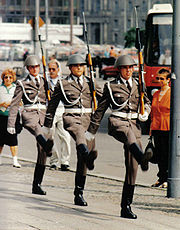 The East German M-56 helmet was originally designed in 1942 as a replacement for the M1935/M1940 model Stahlhelms. The design was never progressed and was unused until the requirement for a new German helmet for the Volkspolizei
and the National People's Army
arose, it being realized that the reintroduction of the Stahlhelm would not have been tolerated by the Soviet Union. It came in three basic versions, Mod 1 or I/56, Mod 2 or I/57 and Mod 3 or I/71, and was widely sold (or given) to Third World
armies.
decal
s usually were affixed to one or both sides of the helmet. Almost every military, naval, and political organization had its own distinctive insignia, which was applied as decals to the sides of helmets. The right side of early M35 helmets bore the tricolored shield of black, white, and red stripes, the traditional national colors of Imperial Germany
(cf. the black, red, and gold of today's Germany
, harking back to the 1848 Revolt). The left side of the shell often received decal insignia denoting the branch of the armed forces, or Wehrmacht
, or an organization within the Nazi Party
.
The Wehrmacht consisted of the Heer (army
), the Kriegsmarine
(navy
), and the Luftwaffe (air force
). While not technically part of the Wehrmacht, the Waffen-SS
("Armed-SS
") tactically operated as such and was considered part of Germany's armed forces during the war. The same was true of some Sturmabteilung
(SA) units, along with other subsidiary organizations, which functioned as part of the armed forces particularly towards the end of the war. Wehrmacht branches typically displayed distinctive emblems in the form of decals on their helmets. The Heer, or army, displayed a black shield bearing the frontal view of a silver-colored German eagle holding a swastika
in its talons (known as the Reichsadler), while the navy used the same eagle emblem in gold. Luftwaffe decals displayed the side view of an eagle in flight, also holding a swastika. The SS
was both a paramilitary
and a political organization, and its black runic initials
on a silver-colored shield (normally applied to the right side of the shell) looked like twin lightning bolts. Other military, political, and civil or defense organizations used similar decal insignia to distinguish their helmets. Such visible identification devices were gradually abandoned as the war progressed, however, so that by war's end most Wehrmacht helmet insignia had been eliminated to reduce the wearer's visibility in combat.
in 1935 and 1936. Spain
also received shipments of the helmet. During the inter-war years several military missions were sent to South America under the command of Hans Kundt and the Bolivian army used to wear the helmet up until recently. The exported M1935 helmets were similar to the German issue, except for a different liner. Hungary produced its own 35M helmet; it was a modified German M1935 helmet. Hungary used a variation of the M1942 helmet that had a metal belt loop on the back of the shell. Some countries manufactured their own helmets using the M1935 design, and this basic design was in use in various nations as late as the 1970s.
After the end of World War I Poland
seized large quantities of M1918 helmets. Most of those were later sold to various countries, including Spain. However, at the end of the 1930s it was discovered that the standard Polish wz. 31 helmet was unsuitable for tank
troops and motorized units; while offering decent protection, it was too large and heavy. As a stop-gap measure before a new helmet was developed, the General Staff decided to issue M1918 helmets to the 10th Motorized Cavalry Brigade
, which used them during the Polish Defensive War
. During the time of the Warsaw Uprising
the helmet was also worn by the members of the Polish Home Army
and it was during this time that the helmet became the symbol of the resistance, as every Stahlhelm worn by the soldier of the underground army signified a dead German occupier it was taken from.
During the inter-war years, the Irish Defence Forces
equipped its troops with a copy of the M1918 helmet manufactured by Vickers
. At the outbreak of World War II, Ireland remained neutral, but in 1940 replaced it with the German-style uniforms with British-style helmets.
of Paraná State
: M1935 Republic of China Army
1935–1950s?
Switzerland used a helmet that was roughly similar to the M1916, but had a shallower, more rounded crown and skirt. This was to protect against the harsh winter winds of the alpine regions.
abandoned the distinctive Stahlhelm, which had become a symbol of German military aggression, for a variant of the more "harmless-looking" United States Army
"GI pot"
helmet. The Bundesgrenzschutz
border guards and some West German police units kept the Stahlhelm in their inventories, though it was seldom worn (although police units can be seen wearing them during footage of the Black September
hostage crisis
in 1972), and the Fallschirmjäger
variant was used for some time by the GSG 9
. Some German firefighter
units today still use Stahlhelm-shaped helmets in a fluorescent color. After the U.S. Personnel Armor System for Ground Troops
helmet had politically rehabilitated the German World War II helmet shape, the German Army adopted a Kevlar
helmet (Gefechtshelm) in the 1990s, which sported the distinct form once more.
East Germany's M-56 helmet was modelled on an unused 1942 German design with a more conical
shape. The Chilean Army
still uses the Stahlhelm design for ceremonial purposes. There are also some Japanese bicycle helmets (with accompanying goggles) that resemble the Stahlhelm.
The U.S. Army's 1980s and 90s era kevlar
Personnel Armor System for Ground Troops Helmet was sometimes called the "Fritz helmet" for its resemblance to the Stahlhelm. The U.S. Army and Marines have continued to use a design akin to the PASGT helmet with the MICH TC-2000 Combat Helmet
and Lightweight Helmet
, respectively.
German language
German is a West Germanic language, related to and classified alongside English and Dutch. With an estimated 90 – 98 million native speakers, German is one of the world's major languages and is the most widely-spoken first language in the European Union....
for "steel helmet". The Imperial German Army
German Army (German Empire)
The German Army was the name given the combined land forces of the German Empire, also known as the National Army , Imperial Army or Imperial German Army. The term "Deutsches Heer" is also used for the modern German Army, the land component of the German Bundeswehr...
began to replace the traditional boiled-leather
Boiled leather
Boiled leather, sometimes called cuir bouilli, was a historical construction material for armour. It consists of thick leather, boiled in water . The boiling causes the leather to be harder but more brittle...
Pickelhaube
Pickelhaube
The Pickelhaube , also "Pickelhelm," was a spiked helmet worn in the 19th and 20th centuries by German military, firefighters, and police...
(spiked combat helmet
Combat helmet
A combat helmet or battle helmet is a type of personal armor designed specifically to protect the head during combat. Helmets are among the oldest forms of personal protective equipment and are known to have been worn by the Akkadians/Sumerians in the 23rd century BC, Mycenaean Greeks since 17th...
) with the Stahlhelm during World War I
World War I
World War I , which was predominantly called the World War or the Great War from its occurrence until 1939, and the First World War or World War I thereafter, was a major war centred in Europe that began on 28 July 1914 and lasted until 11 November 1918...
in 1916. The term Stahlhelm refers both to a generic steel helmet, and more specifically to the distinctive (and iconic) German design.
The Stahlhelm, with its distinctive "coal scuttle" shape, was an instantly recognizable icon for military imagery and became a common element of military propaganda
Propaganda
Propaganda is a form of communication that is aimed at influencing the attitude of a community toward some cause or position so as to benefit oneself or one's group....
on both sides, just like the Pickelhaube
Pickelhaube
The Pickelhaube , also "Pickelhelm," was a spiked helmet worn in the 19th and 20th centuries by German military, firefighters, and police...
before it.
Its name was also used by the Stahlhelm
Stahlhelm, Bund der Frontsoldaten
The Stahlhelm, Bund der Frontsoldaten also known in short form as Der Stahlhelm was one of the many paramilitary organizations that arose after the defeat of World War I in the Weimar Republic...
, a paramilitary nationalist
Nationalism
Nationalism is a political ideology that involves a strong identification of a group of individuals with a political entity defined in national terms, i.e. a nation. In the 'modernist' image of the nation, it is nationalism that creates national identity. There are various definitions for what...
organization established at the end of 1918.
Background
At the beginning of World War I, none of the combatants were issued with any form of protection for the head other than cloth and leather caps, designed at most to protect against saber cuts and the like. When trench warfareTrench warfare
Trench warfare is a form of occupied fighting lines, consisting largely of trenches, in which troops are largely immune to the enemy's small arms fire and are substantially sheltered from artillery...
began, the number of casualties on all sides suffering from severe head wounds (more often caused by shrapnel than by gunfire) increased dramatically. The French
French Army
The French Army, officially the Armée de Terre , is the land-based and largest component of the French Armed Forces.As of 2010, the army employs 123,100 regulars, 18,350 part-time reservists and 7,700 Legionnaires. All soldiers are professionals, following the suspension of conscription, voted in...
were the first to see a need for more protection—in late 1915 they began to issue Adrian helmet
Adrian helmet
The M15 Adrian helmet was a combat helmet issued to the French Army during World War I. It was the first standard helmet of the French Army and was designed when millions of French troops were engaged in trench warfare, and head wounds became a frequent cause of battlefield casualties...
s to their troops. The British
British Army
The British Army is the land warfare branch of Her Majesty's Armed Forces in the United Kingdom. It came into being with the unification of the Kingdom of England and Scotland into the Kingdom of Great Britain in 1707. The new British Army incorporated Regiments that had already existed in England...
and Commonwealth
Commonwealth of Nations
The Commonwealth of Nations, normally referred to as the Commonwealth and formerly known as the British Commonwealth, is an intergovernmental organisation of fifty-four independent member states...
troops followed with the Brodie helmet
Brodie helmet
The Brodie helmet, called Helmet, steel, Mark I helmet in Britain and the M1917 Helmet in the U.S., was a steel combat helmet designed and patented in 1915 by the Briton John Leopold Brodie...
, which was also later worn by US forces, and the Germans with the Stahlhelm.
Origin
Hanover
Hanover or Hannover, on the river Leine, is the capital of the federal state of Lower Saxony , Germany and was once by personal union the family seat of the Hanoverian Kings of Great Britain, under their title as the dukes of Brunswick-Lüneburg...
. In early 1915, Schwerd had carried out a study of head wounds suffered during trench warfare and submitted a recommendation for steel helmets, shortly after which he was ordered to Berlin. Schwerd then undertook the task of designing and producing a suitable helmet broadly based on the
15th century sallet
Sallet
The sallet was a war helmet that replaced the bascinet in northern Europe and Hungary during the mid-15th century. Some sallets were close fitting except at the back of the head where they extended and formed a pointed tail. Some Italian ones followed the shape of the neck, and had an additional...
, which provided good protection for the head and neck.
After lengthy development work, which included testing a selection of German and Allied headgear, the first Stahlhelms were tested in November 1915 at the Kummersdorf
Kummersdorf
Kummersdorf is the name of an estate near Luckenwalde at , around 25km south of Berlin, in the Brandenburg region of Germany. Until 1945 Kummersdorf hosted the weapon office of the German Army which ran a development centre for future weapons as well as an artillery range.In 1929 the Army Weapons...
Proving Ground and then field tested by the 1st Assault Battalion. Thirty thousand examples were ordered, but it was not approved for general issue until New Year 1916, hence it is most usually referred to as the "Model 1916". In February 1916 it was distributed to troops at Verdun
Battle of Verdun
The Battle of Verdun was one of the major battles during the First World War on the Western Front. It was fought between the German and French armies, from 21 February – 18 December 1916, on hilly terrain north of the city of Verdun-sur-Meuse in north-eastern France...
, following which the incidence of serious head injuries fell dramatically.
In contrast to the Hadfield steel used in the British Brodie helmet
Brodie helmet
The Brodie helmet, called Helmet, steel, Mark I helmet in Britain and the M1917 Helmet in the U.S., was a steel combat helmet designed and patented in 1915 by the Briton John Leopold Brodie...
, the Germans used a harder martensitic
Martensite
Martensite, named after the German metallurgist Adolf Martens , most commonly refers to a very hard form of steel crystalline structure, but it can also refer to any crystal structure that is formed by displacive transformation. It includes a class of hard minerals occurring as lath- or...
silicon
Silicon
Silicon is a chemical element with the symbol Si and atomic number 14. A tetravalent metalloid, it is less reactive than its chemical analog carbon, the nonmetal directly above it in the periodic table, but more reactive than germanium, the metalloid directly below it in the table...
/nickel
Nickel
Nickel is a chemical element with the chemical symbol Ni and atomic number 28. It is a silvery-white lustrous metal with a slight golden tinge. Nickel belongs to the transition metals and is hard and ductile...
steel. As a result, and also due to the helmet's form, the Stahlhelm had to be formed in heated dies at a greater unit cost than the British helmet, which could be formed in one piece.
Models
The different Stahlhelm designs are named for their year of introduction. For example, the Modell 1942 which was introduced in 1942 is commonly known as M1942 or simply M42. Here, they are referred to by their M19XX names.M1916 and M1917
Battle of Verdun
The Battle of Verdun was one of the major battles during the First World War on the Western Front. It was fought between the German and French armies, from 21 February – 18 December 1916, on hilly terrain north of the city of Verdun-sur-Meuse in north-eastern France...
in early 1916.
The M1916 design had side-mounted horn-like ventilator lugs which were intended to be support for an additional steel brow plate or Stirnpanzer, which only ever saw limited use by snipers and trench raiding parties, as it was too heavy for general use.
The shell came in different sizes, from 60 to 68, with some size 70s reported. The suspension, or liner, consisted of a headband with three segmented leather pouches, each holding padding materials, and leather or fabric cords could be adjusted to provide a comfortable fit. The one-piece leather chin strap was attached to the shell by M1891 chinstrap lugs, the same kind used in the Pickelhaube
Pickelhaube
The Pickelhaube , also "Pickelhelm," was a spiked helmet worn in the 19th and 20th centuries by German military, firefighters, and police...
helmet.
The M1916 design provided excellent protection: Reserve Lieutenant Walter Schulze of 8th Company Reserve Infantry Regiment 76 described his combat introduction to the helmet on the Somme, 29 July 1916:
"... suddenly, with a great clanging thud, I was hit on the forehead and knocked flying onto the floor of the trench... a shrapnel bullet had hit my helmet with great violence, without piercing it, but sufficiently hard to dent it. If I had, as had been usual up until a few days previously, been wearing a cap, then the Regiment would have had one more man killed."
But the helmet was not without its flaws. The ventilator horns often let cold air in during the winter, requiring the wearer to block the vents with mud or fabric. The large, flared skirt tended to make it difficult for soldiers to hear, distorting surrounding sounds and creating an echo when the wearer spoke.
Originally painted Feldgrau (field grey), the Stahlhelm was often camouflaged by troops in the field using mud, foliage, cloth covers, and paint. Official issue cloth covers in white and grey appeared in late 1916 and early 1917. Camouflage paint was not formally introduced until July 1918, when German Army Order II, No 91 366, signed by General Erich Ludendorff
Erich Ludendorff
Erich Friedrich Wilhelm Ludendorff was a German general, victor of Liège and of the Battle of Tannenberg...
on 7 July 1918, outlined official standards for helmet camouflage. The order stipulated that helmets should be painted in several colors, separated by a finger-wide black line. The colors should be relevant to the season, such as using green, brown and ochre in summer.
After the effectiveness of the M1916 design was validated during the 1916 campaigns, incremental improvements were subsequently made. The M1917 version saw improvements to the liner, but was otherwise identical to the original design.
M1918
The M1918 Stahlhelm can be distinguished from the M1916, as the M1918 shell lacks the chinstrap rivet on the lower side of the helmet skirt found on earlier models.
Central Power variants
Austria-HungaryAustria-Hungary
Austria-Hungary , more formally known as the Kingdoms and Lands Represented in the Imperial Council and the Lands of the Holy Hungarian Crown of Saint Stephen, was a constitutional monarchic union between the crowns of the Austrian Empire and the Kingdom of Hungary in...
and the Ottoman Empire
Ottoman Empire
The Ottoman EmpireIt was usually referred to as the "Ottoman Empire", the "Turkish Empire", the "Ottoman Caliphate" or more commonly "Turkey" by its contemporaries...
used, or had commissioned, variations of the Stahlhelm design. The Austria
Austria
Austria , officially the Republic of Austria , is a landlocked country of roughly 8.4 million people in Central Europe. It is bordered by the Czech Republic and Germany to the north, Slovakia and Hungary to the east, Slovenia and Italy to the south, and Switzerland and Liechtenstein to the...
ns' M1917 helmet was similar to the German M1916, but had a cloth webbing chinstrap and had the chinstrap rivet located higher up on the steel shell. The Hungarians
Hungary
Hungary , officially the Republic of Hungary , is a landlocked country in Central Europe. It is situated in the Carpathian Basin and is bordered by Slovakia to the north, Ukraine and Romania to the east, Serbia and Croatia to the south, Slovenia to the southwest and Austria to the west. The...
produced their own M1917 version that was similar to the Austrian design, but the chinstrap rivet was smaller in size and located even higher up than the Austrian version. The Austro-Hungarian helmets were manufactured by Krupp Berndorfer Metallwarenfabriken, and were brown in color.
Germany delivered 5,400 visorless versions of the M1918 helmet for Turkey
Turkey
Turkey , known officially as the Republic of Turkey , is a Eurasian country located in Western Asia and in East Thrace in Southeastern Europe...
. The missing front visor was thought by the Germans to be for religious reasons, and it was claimed that it was to allow Turkish soldiers to touch their foreheads to the ground during prayer, without removing their helmets. However, this story has been disputed. The Turks rejected any more than the 5,400 delivered and an unknown number from the overrun were issued to German armed forces and were used by German Freikorps
Freikorps
Freikorps are German volunteer military or paramilitary units. The term was originally applied to voluntary armies formed in German lands from the middle of the 18th century onwards. Between World War I and World War II the term was also used for the paramilitary organizations that arose during...
units after the war.
M1933
In 1932 the Army High Command ordered the testing of a new prototype helmet intended to replace the older models. It was made entirely from a composite plastic material called "VulkanfiberVulcanized fibre
Vulcanized fibre is a laminated plastic composed of only cellulose. The material is a tough, resilient, hornlike material that is lighter than aluminium, tougher than leather, stiffer than most thermoplastics...
". The Model 1933 Vulkanfiber helmet kept the basic form of previous helmets but was much lighter. It was put into limited production following favourable field tests in early 1933 and small numbers were issued to Reichswehr
Reichswehr
The Reichswehr formed the military organisation of Germany from 1919 until 1935, when it was renamed the Wehrmacht ....
infantry, artillery and communications units. It was removed from service following the introduction of the M1935 helmet and most of the remaining stock were reissued to civil organizations such as fire brigades and police forces. Some examples were also retained for parade use by senior officers, who were not generally issued with the Stahlhelm.
M1935
In 1934 tests began on an improved Stahlhelm, whose design was a development of World War I models. The Eisenhüttenwerke company of ThaleThale
Thale is a town in the Harz district in Saxony-Anhalt in central Germany.-Geography:It is situated on the river Bode, approximately 8 km west of Quedlinburg. It is the terminus of the Magdeburg–Thale railway.- History :...
carried out prototype design and testing, with Dr. Friedrich Schwerd once again taking a hand.
The new helmet was pressed from sheets of molybdenum
Molybdenum
Molybdenum , is a Group 6 chemical element with the symbol Mo and atomic number 42. The name is from Neo-Latin Molybdaenum, from Ancient Greek , meaning lead, itself proposed as a loanword from Anatolian Luvian and Lydian languages, since its ores were confused with lead ores...
steel in several stages. The size of the flared visor and skirt was reduced, and the large projecting lugs for the obsolete armour shield were eliminated. The ventilator holes were retained, but were set in smaller hollow rivets mounted to the helmet's shell. The edges of the shell were rolled over, creating a smooth edge along the helmet. Finally, a completely new leather suspension, or liner, was incorporated that greatly improved the helmet's safety, adjustability, and comfort for each wearer. These improvements made the new M1935 helmet lighter, more compact, and more comfortable to wear than the previous designs.
The Army's Supreme Command officially accepted the new helmet on June 25, 1935 and it was intended to replace all other helmets in service.
Over 1 million M1935 helmets were manufactured in the first two years after its introduction, and millions more were produced until 1940 when the basic design and production methods were changed.
M1940
The M1935 design was slightly modified in 1940 to simplify its construction, the manufacturing process now incorporating more automated stamping methods. The principal change was to stamp the ventilator hole mounts directly onto the shell, rather than utilizing separate fittings. In other respects, the M1940 helmet was identical to the M1935.Fallschirmjäger version
A variant of the M1935 helmet with a shell lacking the projecting visor and deep, flared rim was issued to Fallschirmjäger (GermanGerman Army
The German Army is the land component of the armed forces of the Federal Republic of Germany. Following the disbanding of the Wehrmacht after World War II, it was re-established in 1955 as the Bundesheer, part of the newly formed West German Bundeswehr along with the Navy and the Air Force...
paratrooper
Paratrooper
Paratroopers are soldiers trained in parachuting and generally operate as part of an airborne force.Paratroopers are used for tactical advantage as they can be inserted into the battlefield from the air, thereby allowing them to be positioned in areas not accessible by land...
) units. It was so designed in order to lessen the risk of head injury on landing after a parachute jump; also to reduce the significant wind resistance and resulting neck trauma. Early Fallschirmjäger helmets were manufactured from existing M1935 helmets by removing the undesirable projections, which were omitted when the new design entered full production. The modified shell also incorporated a completely different and more substantial liner and chinstrap design that provided far more protection for German airborne troops.
M1942
The M1942 design was a result of wartime demands. The rolled edge on the shell was eliminated, creating an unfinished edge along the rim. This edge slightly flared out, along the base of the skirt. The elimination of the rolled edge expedited the manufacturing process and reduced the amount of metal used in each helmet. Shell paint colors towards the end of the war typically ran to matte gray-green, and the decals were gradually eliminated to speed up production and reduce the helmet's combat visibility. Greater manufacturing flaws were also observed in M42 helmets made late in the war.M1944
A simpler variant, designed in 1944 by the Army OrdnanceMilitary logistics
Military logistics is the discipline of planning and carrying out the movement and maintenance of military forces. In its most comprehensive sense, it is those aspects or military operations that deal with:...
Office, was also stamped out of one piece of metal but with sloped sides. Similar in appearance to the British 1944 Type Mk III helmet
Mk III Turtle helmet
The Mk III Helmet was a steel military combat helmet developed for the British Army in 1941. First worn in combat by British and Canadian troops on D-Day, the Mk III was used alongside the Brodie helmet for the remainder of the Second World War...
. Allegedly personally rejected by Hitler as being too foreign.
M1945
There have been reports of a variant manufactured in the last months of the war. The M1945 was reported to have been similar to the M1942 design, but did away completely with the ventilator. These helmets are reported to be extremely rare.Many collectors and historians are of the opinion that the M1945 helmet is either just a regular M1942 helmet that lacked the vents simply because of machine malfunctions in the factory, or unfinished M1942 that were completed in the post-war era.
M1954
A variant of the M1944 with a modified suspension system, developed further into the M1956.M1956
Volkspolizei
The Volkspolizei , or VP, were the national police of the German Democratic Republic . The Volkspolizei were responsible for most law enforcement in East Germany, but its organisation and structure were such that it could be considered a paramilitary force as well...
and the National People's Army
National People's Army
The National People’s Army were the armed forces of the German Democratic Republic .The NVA was established in 1956 and disestablished in 1990. There were frequent reports of East German advisors with Communist African countries during the Cold War...
arose, it being realized that the reintroduction of the Stahlhelm would not have been tolerated by the Soviet Union. It came in three basic versions, Mod 1 or I/56, Mod 2 or I/57 and Mod 3 or I/71, and was widely sold (or given) to Third World
Third World
The term Third World arose during the Cold War to define countries that remained non-aligned with either capitalism and NATO , or communism and the Soviet Union...
armies.
Decals & insignia
After Stahlhelm shells were painted, the colours of which varied by organization, small identification or insigniaInsignia
Insignia or insigne pl -nia or -nias : a symbol or token of personal power, status or office, or of an official body of government or jurisdiction...
decal
Decal
A decal or transfer is a plastic, cloth, paper or ceramic substrate that has printed on it a pattern or image that can be moved to another surface upon contact, usually with the aid of heat or water. The word is short for decalcomania...
s usually were affixed to one or both sides of the helmet. Almost every military, naval, and political organization had its own distinctive insignia, which was applied as decals to the sides of helmets. The right side of early M35 helmets bore the tricolored shield of black, white, and red stripes, the traditional national colors of Imperial Germany
German Empire
The German Empire refers to Germany during the "Second Reich" period from the unification of Germany and proclamation of Wilhelm I as German Emperor on 18 January 1871, to 1918, when it became a federal republic after defeat in World War I and the abdication of the Emperor, Wilhelm II.The German...
(cf. the black, red, and gold of today's Germany
Germany
Germany , officially the Federal Republic of Germany , is a federal parliamentary republic in Europe. The country consists of 16 states while the capital and largest city is Berlin. Germany covers an area of 357,021 km2 and has a largely temperate seasonal climate...
, harking back to the 1848 Revolt). The left side of the shell often received decal insignia denoting the branch of the armed forces, or Wehrmacht
Wehrmacht
The Wehrmacht – from , to defend and , the might/power) were the unified armed forces of Nazi Germany from 1935 to 1945. It consisted of the Heer , the Kriegsmarine and the Luftwaffe .-Origin and use of the term:...
, or an organization within the Nazi Party
National Socialist German Workers Party
The National Socialist German Workers' Party , commonly known in English as the Nazi Party, was a political party in Germany between 1920 and 1945. Its predecessor, the German Workers' Party , existed from 1919 to 1920...
.
The Wehrmacht consisted of the Heer (army
Army
An army An army An army (from Latin arma "arms, weapons" via Old French armée, "armed" (feminine), in the broadest sense, is the land-based military of a nation or state. It may also include other branches of the military such as the air force via means of aviation corps...
), the Kriegsmarine
Kriegsmarine
The Kriegsmarine was the name of the German Navy during the Nazi regime . It superseded the Kaiserliche Marine of World War I and the post-war Reichsmarine. The Kriegsmarine was one of three official branches of the Wehrmacht, the unified armed forces of Nazi Germany.The Kriegsmarine grew rapidly...
(navy
Navy
A navy is the branch of a nation's armed forces principally designated for naval and amphibious warfare; namely, lake- or ocean-borne combat operations and related functions...
), and the Luftwaffe (air force
Air force
An air force, also known in some countries as an air army, is in the broadest sense, the national military organization that primarily conducts aerial warfare. More specifically, it is the branch of a nation's armed services that is responsible for aerial warfare as distinct from an army, navy or...
). While not technically part of the Wehrmacht, the Waffen-SS
Waffen-SS
The Waffen-SS was a multi-ethnic and multi-national military force of the Third Reich. It constituted the armed wing of the Schutzstaffel or SS, an organ of the Nazi Party. The Waffen-SS saw action throughout World War II and grew from three regiments to over 38 divisions, and served alongside...
("Armed-SS
Schutzstaffel
The Schutzstaffel |Sig runes]]) was a major paramilitary organization under Adolf Hitler and the Nazi Party. Built upon the Nazi ideology, the SS under Heinrich Himmler's command was responsible for many of the crimes against humanity during World War II...
") tactically operated as such and was considered part of Germany's armed forces during the war. The same was true of some Sturmabteilung
Sturmabteilung
The Sturmabteilung functioned as a paramilitary organization of the National Socialist German Workers' Party . It played a key role in Adolf Hitler's rise to power in the 1920s and 1930s...
(SA) units, along with other subsidiary organizations, which functioned as part of the armed forces particularly towards the end of the war. Wehrmacht branches typically displayed distinctive emblems in the form of decals on their helmets. The Heer, or army, displayed a black shield bearing the frontal view of a silver-colored German eagle holding a swastika
Swastika
The swastika is an equilateral cross with its arms bent at right angles, in either right-facing form in counter clock motion or its mirrored left-facing form in clock motion. Earliest archaeological evidence of swastika-shaped ornaments dates back to the Indus Valley Civilization of Ancient...
in its talons (known as the Reichsadler), while the navy used the same eagle emblem in gold. Luftwaffe decals displayed the side view of an eagle in flight, also holding a swastika. The SS
Schutzstaffel
The Schutzstaffel |Sig runes]]) was a major paramilitary organization under Adolf Hitler and the Nazi Party. Built upon the Nazi ideology, the SS under Heinrich Himmler's command was responsible for many of the crimes against humanity during World War II...
was both a paramilitary
Paramilitary
A paramilitary is a force whose function and organization are similar to those of a professional military, but which is not considered part of a state's formal armed forces....
and a political organization, and its black runic initials
Sig Rune
Sig is the name given by Guido von List for the Sigel or s rune of the Armanen Futharkh, and is also used by Karl Maria Wiligut for his runes.-Nazism:...
on a silver-colored shield (normally applied to the right side of the shell) looked like twin lightning bolts. Other military, political, and civil or defense organizations used similar decal insignia to distinguish their helmets. Such visible identification devices were gradually abandoned as the war progressed, however, so that by war's end most Wehrmacht helmet insignia had been eliminated to reduce the wearer's visibility in combat.
Stahlhelm use in other countries
Germany exported versions of the M1935 helmet to various countries. Versions of the M1935 Stahlhelm were sent to Nationalist ChinaChina
Chinese civilization may refer to:* China for more general discussion of the country.* Chinese culture* Greater China, the transnational community of ethnic Chinese.* History of China* Sinosphere, the area historically affected by Chinese culture...
in 1935 and 1936. Spain
Spain
Spain , officially the Kingdom of Spain languages]] under the European Charter for Regional or Minority Languages. In each of these, Spain's official name is as follows:;;;;;;), is a country and member state of the European Union located in southwestern Europe on the Iberian Peninsula...
also received shipments of the helmet. During the inter-war years several military missions were sent to South America under the command of Hans Kundt and the Bolivian army used to wear the helmet up until recently. The exported M1935 helmets were similar to the German issue, except for a different liner. Hungary produced its own 35M helmet; it was a modified German M1935 helmet. Hungary used a variation of the M1942 helmet that had a metal belt loop on the back of the shell. Some countries manufactured their own helmets using the M1935 design, and this basic design was in use in various nations as late as the 1970s.
After the end of World War I Poland
Poland
Poland , officially the Republic of Poland , is a country in Central Europe bordered by Germany to the west; the Czech Republic and Slovakia to the south; Ukraine, Belarus and Lithuania to the east; and the Baltic Sea and Kaliningrad Oblast, a Russian exclave, to the north...
seized large quantities of M1918 helmets. Most of those were later sold to various countries, including Spain. However, at the end of the 1930s it was discovered that the standard Polish wz. 31 helmet was unsuitable for tank
Tank
A tank is a tracked, armoured fighting vehicle designed for front-line combat which combines operational mobility, tactical offensive, and defensive capabilities...
troops and motorized units; while offering decent protection, it was too large and heavy. As a stop-gap measure before a new helmet was developed, the General Staff decided to issue M1918 helmets to the 10th Motorized Cavalry Brigade
Polish 10th Motorized Cavalry Brigade
The 10th Cavalry Brigade was a Polish military unit, the only fully operational Polish motorized infantry unit during the Invasion of Poland of 1939, at the onset of World War II. Commanded by Col...
, which used them during the Polish Defensive War
Invasion of Poland (1939)
The Invasion of Poland, also known as the September Campaign or 1939 Defensive War in Poland and the Poland Campaign in Germany, was an invasion of Poland by Germany, the Soviet Union, and a small Slovak contingent that marked the start of World War II in Europe...
. During the time of the Warsaw Uprising
Warsaw Uprising
The Warsaw Uprising was a major World War II operation by the Polish resistance Home Army , to liberate Warsaw from Nazi Germany. The rebellion was timed to coincide with the Soviet Union's Red Army approaching the eastern suburbs of the city and the retreat of German forces...
the helmet was also worn by the members of the Polish Home Army
Armia Krajowa
The Armia Krajowa , or Home Army, was the dominant Polish resistance movement in World War II German-occupied Poland. It was formed in February 1942 from the Związek Walki Zbrojnej . Over the next two years, it absorbed most other Polish underground forces...
and it was during this time that the helmet became the symbol of the resistance, as every Stahlhelm worn by the soldier of the underground army signified a dead German occupier it was taken from.
During the inter-war years, the Irish Defence Forces
Irish Defence Forces
The armed forces of Ireland, known as the Defence Forces encompass the Army, Naval Service, Air Corps and Reserve Defence Force.The current Supreme Commander of the Irish Defence forces is His Excellency Michael D Higgins in his role as President of Ireland...
equipped its troops with a copy of the M1918 helmet manufactured by Vickers
Vickers
Vickers was a famous name in British engineering that existed through many companies from 1828 until 1999.-Early history:Vickers was formed in Sheffield as a steel foundry by the miller Edward Vickers and his father-in-law George Naylor in 1828. Naylor was a partner in the foundry Naylor &...
. At the outbreak of World War II, Ireland remained neutral, but in 1940 replaced it with the German-style uniforms with British-style helmets.
Other countries that used Stahlhelm-type helmets included
: Firefighters CorpsFirefighters Corps of Paraná State
In the State of Paraná, Brazil, the Firefighters Corps is part of the structure of the Military Police of State.The mission of the Firefighters Corps is the implementation of activities of Civil Defense, prevention and firefighting, search and rescue, and public assistance under the State of Paraná...
of Paraná State
Paraná (state)
Paraná is one of the states of Brazil, located in the South of the country, bordered on the north by São Paulo state, on the east by the Atlantic Ocean, on the south by Santa Catarina state and the Misiones Province of Argentina, and on the west by Mato Grosso do Sul and the republic of Paraguay,...
: M1935 Republic of China Army
Republic of China Army
The ROC Army's current operational strength includes 3 armies, 5 corps. As of 2005, the Army's 35 brigades include 25 infantry brigades, 5 armoured brigades and 3 mechanized infantry brigades...
1935–1950s?
Switzerland used a helmet that was roughly similar to the M1916, but had a shallower, more rounded crown and skirt. This was to protect against the harsh winter winds of the alpine regions.
Postwar
After World War II, West GermanyWest Germany
West Germany is the common English, but not official, name for the Federal Republic of Germany or FRG in the period between its creation in May 1949 to German reunification on 3 October 1990....
abandoned the distinctive Stahlhelm, which had become a symbol of German military aggression, for a variant of the more "harmless-looking" United States Army
United States Army
The United States Army is the main branch of the United States Armed Forces responsible for land-based military operations. It is the largest and oldest established branch of the U.S. military, and is one of seven U.S. uniformed services...
"GI pot"
M1 Helmet
The M1 helmet is a combat helmet that was used by the American military from World War II until it was succeeded by the PASGT helmet beginning in 1985. For over forty years, the M1 was standard issue for the U.S...
helmet. The Bundesgrenzschutz
Bundesgrenzschutz
Bundesgrenzschutz was the first federal police organization in Western Germany after World War II permitted by the Allied occupation authorities. In July 2005, the BGS was renamed Bundespolizei to reflect its transition to a multi-faceted police agency.It was established in 1951...
border guards and some West German police units kept the Stahlhelm in their inventories, though it was seldom worn (although police units can be seen wearing them during footage of the Black September
Black September (group)
The Black September Organization was a Palestinian paramilitary group, founded in 1970. It was responsible for the kidnapping and murder of eleven Israeli athletes and officials, and fatal shooting of a West German policeman, during the 1972 Summer Olympics in Munich, their most publicized event...
hostage crisis
Munich massacre
The Munich massacre is an informal name for events that occurred during the 1972 Summer Olympics in Munich, Bavaria in southern West Germany, when members of the Israeli Olympic team were taken hostage and eventually killed by the Palestinian group Black September. Members of Black September...
in 1972), and the Fallschirmjäger
Fallschirmjäger
are German paratroopers. Together with the Gebirgsjäger they are perceived as the elite infantry units of the German Army....
variant was used for some time by the GSG 9
GSG 9
The GSG 9 der Bundespolizei , is the elite counter-terrorism and special operations unit of the German Federal Police.-History and name:...
. Some German firefighter
Firefighter
Firefighters are rescuers extensively trained primarily to put out hazardous fires that threaten civilian populations and property, to rescue people from car incidents, collapsed and burning buildings and other such situations...
units today still use Stahlhelm-shaped helmets in a fluorescent color. After the U.S. Personnel Armor System for Ground Troops
Personnel Armor System for Ground Troops
Personnel Armor System for Ground Troops, sometimes abbreviated to PASGT, was a combat helmet and ballistic vest used by the American military from the mid 1980s until 2005, when the system was succeeded by the Lightweight Helmet, Modular Integrated Communications Helmet, and Interceptor body...
helmet had politically rehabilitated the German World War II helmet shape, the German Army adopted a Kevlar
Kevlar
Kevlar is the registered trademark for a para-aramid synthetic fiber, related to other aramids such as Nomex and Technora. Developed at DuPont in 1965, this high strength material was first commercially used in the early 1970s as a replacement for steel in racing tires...
helmet (Gefechtshelm) in the 1990s, which sported the distinct form once more.
East Germany's M-56 helmet was modelled on an unused 1942 German design with a more conical
Cone (geometry)
A cone is an n-dimensional geometric shape that tapers smoothly from a base to a point called the apex or vertex. Formally, it is the solid figure formed by the locus of all straight line segments that join the apex to the base...
shape. The Chilean Army
Chilean Army
The Chilean Army is the land arm of the Military of Chile. This 45,000-person army is organized into seven divisions, a special operations brigade and an air brigade....
still uses the Stahlhelm design for ceremonial purposes. There are also some Japanese bicycle helmets (with accompanying goggles) that resemble the Stahlhelm.
The U.S. Army's 1980s and 90s era kevlar
Kevlar
Kevlar is the registered trademark for a para-aramid synthetic fiber, related to other aramids such as Nomex and Technora. Developed at DuPont in 1965, this high strength material was first commercially used in the early 1970s as a replacement for steel in racing tires...
Personnel Armor System for Ground Troops Helmet was sometimes called the "Fritz helmet" for its resemblance to the Stahlhelm. The U.S. Army and Marines have continued to use a design akin to the PASGT helmet with the MICH TC-2000 Combat Helmet
MICH TC-2000 Combat Helmet
The Modular Integrated Communications Helmet , is a combat helmet used by the United States Army. It was developed by the United States Army Soldier Systems Center to be the next generation of protective combat helmets for use by the U.S. Army...
and Lightweight Helmet
Lightweight Helmet
The Lightweight Helmet is the U.S. Marine Corps replacement for the PASGT combat helmet. As it is nearly identical to untrained eyes in shape to the PASGT, it is still called the Fritz helmet or K-pot...
, respectively.
