

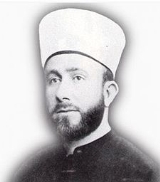
Mohammad Amin al-Husayni

Encyclopedia
Haj Mohammed Effendi Amin el-Husseini was a Palestinian
Arab nationalist
and Muslim
leader in the British Mandate of Palestine. From as early as 1920, in order to secure the independence of Palestine as an Arab state he actively opposed Zionism
, and was implicated as a leader of a violent riot that broke out over the establishment of a national home for the Jewish people in Palestine. From 1921 to 1937 al-Husseini was the Grand Mufti of Jerusalem
, using the position to promote Islam
and rally Palestinian nationalism
against Zionism
.
His opposition to the British started during the 1936-1939 Arab revolt in Palestine. In 1937, evading an arrest warrant, he fled Palestine and took refuge in, successively, the French Mandate of Lebanon
and the Kingdom of Iraq
, until he established himself in Italy and finally Germany. During World War II
he actively collaborated with both Nazi Germany
and Fascist Italy
, meeting Adolf Hitler
personally and asking him to back Arab independence. He requested, as part of the Pan-Arab struggle
, Hitler's support to oppose the establishment in Palestine of a Jewish national home. He was promised the leadership of the Arabs after German troops had driven out the British. He helped recruit Muslims for the Waffen-SS
. At war's end, he came under French protection, and managed to slip away to Cairo to avoid eventual prosecution.
During the 1948 Palestine War
, Husseini represented the Arab Higher Committee
and opposed both the 1947 UN Partition Plan
and King Abdullah's entente with Zionists to annex the Arab part of British Mandatory Palestine to Jordan
. In September 1948, he participated in establishment of All-Palestine Government
. Seated in Egyptian ruled Gaza, this government won a limited recognition of Arab states, but was eventually dissolved by Gamal Nasser in 1959. After the war and subsequent Palestinian exodus
, his claims to leadership, wholly discredited, left him eventually sidelined by the Palestine Liberation Organization
, and he lost most of his residual political influence. He died in Beirut
, Lebanon
, in July 1974.
Husseini was and remains a highly controversed figure. Historians debate to what extent his fierce opposition to Zionism
was grounded in nationalism
or antisemitism or a combination of both.
clan consisted of wealthy landowners in southern Palestine,
centred around the district of Jerusalem. Thirteen members of the clan had been Mayors of Jerusalem between 1864 and 1920. Another member of the clan and Amin's half-brother, Kamil al-Husayni
, also served as Mufti of Jerusalem. In Jerusalem Amin al-Husseini attended an Qur'anic school (kuttub), and Ottoman government secondary school (rüshidiyye) where he learnt Turkish
, and a Catholic secondary school run by French missionaries
, the Catholic Frères, where he learnt French. He also studied at the Alliance Israélite Universelle
with its Non-Zionist Jewish director Albert Antébi
. In 1912 he studied Islamic law
briefly at Al-Azhar University
in Cairo
and at the Dar al-Da'wa wa-l-Irshad, under Rashid Rida
, a salafi
intellectual, who was to remain Amin's mentor till his death in 1935. Though groomed to hold religious office from youth, his education was typical of the Ottoman effendi at the time, and he only donned a religious turban in 1921 after being appointed mufti.
In 1913 at the age of 18, al-Husseini accompanied his pious mother Zainab to Mecca
and received the honorary title
of Hajj
. Prior to World War I
, he studied at the School of Administration in Istanbul
, the most secular of Ottoman institutions.
in 1914, al-Husseini first joined the Ottoman
Turkish
army, receiving a commission as an artillery
officer
and being assigned to the Forty-Seventh Brigade stationed in and around the city of Izmir
. In November 1916 he left the Ottoman army on a three month disability leave and returned to Jerusalem, which was captured by the British while he was recovering from an illness there. The British and Sherifian armies
conquered Ottoman-controlled Palestine and Syria in 1918 with Arab Palestinian recruits also taking part in the offensive against the Turks, alongside Jewish troops. As a Sherifian officer, al-Husseini recruited men to serve in Faisal bin Al Hussein Bin Ali El-Hashemi
's army during the Arab Revolt
, a task he undertook while employed as a recruiter by the British military administration in Jerusalem and Damascus
. The post-war Palin Report
noted that the English recruiting officer, Captain
C.D.Brunton, found al-Husseini, with whom he cooperated, very pro-English, and that, via the diffusion of War Office pamphlets dropped from the air promising them peace and prosperity under English rule, 'the recruits (were) being given to understand that they were fighting in a national cause and to liberate their country from the Turks'.
held in Damascus
where he supported Emir Faisal for King of Syria
. That year al-Husseini founded the pro-British Jerusalem branch of the Syrian-based 'Arab Club' (Al-Nadi al-arabi), which then vied with the Nashashibi-sponsored 'Literary Club' (Al-muntada al-adabi) for influence over public opinion, and he soon became its President. At the same time he wrote articles for the Suriyya al-Janubiyya
(Southern Syria). The paper was published in Jerusalem beginning in September 1919 by the lawyer Muhammad Hassan al-Budayri, and edited by Aref al-Aref
, both prominent members of al-Nadi al-'Arabi.
During the annual Nabi Musa
procession in Jerusalem in April 1920, violent rioting
broke out in protest at the implementation of the Balfour Declaration which supported the establishment in Palestine of a homeland for the Jewish people. Much damage to Jewish live and property was caused. The Palin Report
laid the blame for the explosion of tensions on both sides. Ze'ev Jabotinsky, organiser of Jewish paramilitary defences, received a 15-year sentence. Al-Husseini, then a teacher at the Rashidiya school
, near Herod's Gate
in East Jerusalem, was charged with inciting the Arab crowds with an inflammatory speech and sentenced in absentia
to ten years inprisonment by a military court. It was asserted soon after, by Chaim Weizmann
and British army Lieutenant Colonel
Richard Meinertzhagen
, that al-Husseini had been put up to inciting the riot by British Field-marshal Allenby
's Chief of Staff
, Colonel Bertie Harry Waters-Taylor, to demonstrate to the world that Arabs would not tolerate a Jewish homeland in Palestine. For a reading which follows closely Meinertzhagen's reading of the events as a British army plot, see . The assertion was never proven, and Meinertzhagen was dismissed.
After the April riots an event took place that turned the traditional rivalry between the Husseini and Nashashibi clans into a serious rift, with long-term consequences for al-Husseini and Palestinian nationalism
. According to Sir Louis Bols
, great pressure was brought to bear on the military administration from Zionist leaders and officials such as David Yellin, to have the Mayor of Jerusalem, Musa Kazim Pasha al-Husayni, dismissed, given his presence in the demonstration of the previous March. Colonel Storrs, the Military Governor of Jerusalem, removed him without further inquiry, replacing him with Raghib al-Nashashibi
of the rival Nashashibi clan. This, according to the Palin report, 'had a profound effect on his co-religionists, definitely confirming the conviction they had already formed from other evidence that the Civil Administration was the mere puppet of the Zionist Organization.'
Until late 1921, al-Husseini focused his efforts on Pan-Arabism
and the ideology of the Greater Syria
in particular, with Palestine understood as a southern province of an Arab state whose capital was to be established in Damascus. Greater Syria was to include territory now occupied by Syria
, Lebanon
, Jordan
and Israel
. The struggle for Greater Syria collapsed after Britain ceded control over present day Syria and Lebanon to France
in July 1920 in accordance with the prior Sykes-Picot Agreement
. The French army entered Damascus at that time, overthrew King Faisal and put an end to the project of a Greater Syria.
Al-Husseini, like many of his class and period, then turned from Damascus-oriented Pan-Arabism to a specifically Palestinian ideology centered on Jerusalem, which sought to block Jewish immigration to Palestine. The frustration of pan-Arab aspirations lent an Islamic colour to the struggle for independence, and increasing resort to the idea of restoring the land to Dar al-Islam
. From his election as Mufti until 1923, al-Husseini exercised total control over the secret society, Al-Fida’iyya (The Self-Sacrificers), which, together with al-Ikha’ wal-‘Afaf (Brotherhood and Purity), played an important role in clandestine anti-British and anti-Zionist activities, and, via members in the gendarmerie, had engaged in riotous activities as early as April 1920.
in March 1921, the British High Commissioner
Sir Herbert Samuel
pardon
ed al-Husseini. He and another Arab had been excluded from the general amnesty
, six weeks earlier, because they had fled before their convictions had been passed down. Elections were then held, and of the four candidates running for the office of Mufti, al-Husseini received the least number of votes, the first three being Nashashibi candidates. Nevertheless, Samuel was anxious to keep a balance between the al-Husseinis and their rival clan the Nashashibi
s. A year earlier the British had replaced Musa al-Husayni
as Mayor of Jerusalem with Ragheb al-Nashashibi. They then moved to secure for the Husseini clan a compensatory function of prestige by appointing one of them to the position of mufti, and, with the support of Ragheb al-Nashashibi and Sheikh Hussam Jārallāh, prevailing upon the Nashashibi front-runner, Sheikh
Hussam ad-Din Jarallah
, to withdraw. This automatically promoted Amin al-Husseini to third position, which, under Ottoman law, allowed him to qualify, and Samuel then chose him as Mufti. His initial appointment was as Mufti, but when the Supreme Muslim Council was created in the following year, Husseini demanded and received the title Grand Mufti that had earlier been created, perhaps on the lines of Egyptian usage, by the British for his half-brother Kamil
. The position came with a life tenure.
In 1922, al-Husseini was elected President of the Supreme Muslim Council
which had been created by Samuel in 1921. The Council controlled the Waqf
funds, worth annually tens of thousands of pounds and the orphan funds, worth annually about £50,000, as compared to the £600,000 in the Jewish Agency's annual budget. In addition, he controlled the Islamic courts in Palestine. Among other functions, these courts were entrusted with the power to appoint teachers and preachers.
The British initially balanced appointments to the Supreme Muslim Council
between the Husseinis
and their supporters (known as the majlisiya, or council supporters) and the Nashashibis and their allied clans (known as the mu'aridun, the opposition). The mu'aridun, were more disposed to a compromise with the Jews, and indeed had for some years received annual subventions from the Jewish Agency. During most of the period of the British mandate, bickering between these two families seriously undermined any Palestinian Arab unity. In 1936, however, they achieved a measure of concerted policy when all the Palestinian Arab groups joined to create a permanent executive organ known as the Arab Higher Committee
under al-Husseini's chairmanship.
, launched an international campaign in Muslim countries to gather funds to restore and improve the Noble Sanctuary (Haram ash-Sharif) or Temple Mount
, and particularly its mosque
s, Al-Aqsa and the Dome of the Rock
(which houses the holiest site in Judaism). The whole area required extensive restoration, given the disrepair into which it had fallen from neglect in Ottoman times. Jerusalem was the original direction towards which Muslims prayed, until the Qibla
was reorientated towards Mecca
. In one tradition it would reassume its prior role at the end of time. Al-Husseini commissioned the Turkish architect Mimar Kemalettin. In restoring the site, al-Husseini was also assisted by the Mandatory power's Catholic
Director of Antiquities
, Ernest Tatham Richmond. Under Richmond's supervision, the Turkish architect drew up a plan, and the execution of the works gave a notable stimulus to the revival of traditional artisan
arts like mosaic tesselation
, glassware
production, woodcraft
, wicker
work and iron-mongering
.
Al-Husseini's vigorous efforts to transform the Haram
into a symbol of pan-Arabic and Palestinian nationalism
were intended to rally Arab support against the postwar influx of Jewish immigrants. In his campaigning, al-Husseini often accused Jews of planning to take possession of the Western Wall
of Jerusalem, which belonged to the waqf of Abu Madyan
as an inalienable property, and rebuild the Temple over the Al-Aqsa Mosque
. He took certain statements, for example, by the Ashkenazi chief rabbi
of Palestine, Abraham Isaac Kook
regarding the eventual return in time of the Temple Mount
back to Jewish hands, and turned them to a concrete political plot to seize control of the area. Al-Husseini's intensive work to refurbish the shrine as a cynosure for the Muslim world, and Jewish endeavours to improve their access to, and establish a ritually appropriate ambiance on the plaza by the Western Wall
, led to increased conflict between the two communities, each seeing the site only from their own traditional perspective and interests. Zionist narratives pinpointed al-Husseini's works on, and publicity about, the site and threats to it, as attempts to restore his own family's waning prestige. Arab narratives read the heightened agitation of certain Jewish groups over the Wall as an attempt to revive diaspora
interest in Zionism after some years of relative decline, depression and emigration. Each attempt to make minor alterations to the status quo
, still governed by Ottoman law, was bitterly protested before the British authorities by the Muslim authorities. If Moslems could cite an Ottoman regulation of 1912 specifically forbidding objects like seating to be introduced, the Jews could cite testimonies to the fact that before 1914 certain exceptions had been made to improve their access and use of the Wall. The decade witnessed several such episodes of strong friction, and the simmering tensions came to a head in late 1928, only to erupt, after a brief respite, into an explosion of violence a year later.
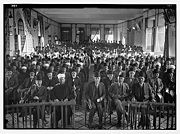 On August 10, 1928, a constituent assembly
convened by the French in Syria was rapidly adjourned when calls were made for a reunification with Palestine. Al-Husseini and Awni Abd al-Hadi
met with the Syrian nationalists and they made a joint proclamation for a unified monarchical
state under a son of Ibn Sa'ud. On the 26th. the completion of the first stage of restoration work on the Haram's mosques was celebrated with great pomp, in the presence of representatives from the Muslim countries which had financed the project, the Mandatory authorities, and Abdullah, Emir of Jordan
. A month later, after an article appeared in the Jewish press proposing the purchase and destruction of houses in the Moroccan quarter bordering on the wall to improve pilgrim access and further thereby the 'Redemption of Israel.' Soon after, on September 23, Yom Kippur
, a Jewish beadle
introduced a screen to separate male and female worshippers at the Wall. Informed by residents in the neighbouring Mughrabi quarter
, the waqf authority complained to Harry Luke, acting Chief Secretary
to the Government of Palestine, that this virtually changed the lane into a synagogue, and violated the status quo, as had the collapsible seats in 1926. British constables, encountering a refusal, used force to remove the screen, and a jostling clash ensued between worshippers and police.
Zionist allegations that disproportionate force had been employed during what was a solemn occasion of prayer created an outcry throughout the diaspora
. Worldwide Jewish protests remonstrated with Britain for the violence exercised at the Wall. The Jewish National Council Vaad Leumi
‘demanded that British administration expropriate the wall for the Jews’. In reply, the Muslims organized a Defence Committee for the Protection of the Noble Buraq, and huge crowd rallies took place on the Al-Aqsa plaza in protest. Work, often noisy, was immediately undertaken on a mosque above the Jewish prayer site. Disturbances such as opening a passage for donkeys to pass through the area, angered worshippers. After intense negotiations, the Zionist organisation denied any intent to take over the whole Haram Ash-Sharif, but demanded the government expropriate and raze the Moroccan quarter. A law of 1924 allowed the British authorities to expropriate property, and fear of this in turn greatly agitated the Muslim community, though the laws of donation of the waqf explicitly disallowed any such alienation. After lengthy deliberation, a White Paper
was made public on December 11, 1928 in favour of the status quo.
After the nomination of the new High Commissioner
Sir John Chancellor
to succeed Lord Plumer in December 1928, the question was re-examined, and in February 1929 legal opinion established that the mandatory authority was within its powers to intervene to ensure Jewish rights of access and prayer. Al-Husseini pressed him for a specific clarification of the legal status quo regarding the Wall. Chancellor mulled weakening the SMC
and undermining al-Husseini's authority by making the office of mufti elective. The Nabi Musa
festival of April that year passed without incident, despite al-Husseini's warnings of possible incidents. Chancellor thought his power was waning, and after conferring with London, admitted to al-Husseini on 6 May that he was impotent to act decisively in the matter. Al-Husseini replied that, unless the Mandatory authorities acted, then, very much like Christian monks protecting their sacred sites in Jerusalem, the sheikhs would have to take infringements of the status quo into their own hands, and personally remove any objects introduced by Jews to the area. Chancellor asked him to be patient, and al-Husseini offered to stop works on the Mount on condition that this gesture not be taken as a recognition of Jewish rights. A change of government in Britain in June led to a new proposal: only Muslim works in the sector near where Jews prayed should be subject to mandatory authorisation: Jews could employ ritual objects, but the introduction of seats and screens would be subject to Muslim authorisation. Chancellor authorised the Muslims to recommence their reconstructive work, while, responding to further Zionist complaints, prevailed on the SMC to stop the raucous Zikr
ceremonies in the vicinity of the wall. He also asked the Zionist representatives to refrain from filling their newspapers with attacks on the government and Muslim authorities. Chancellor then departed for Europe where the Mandatory Commission was deliberating.
, in Zurich
for the 16th. Zionist Congress (attended also by Ze'ev Jabotinsky), the SMC
resumed works, confidentially authorised, on the Haram only to be met with outcries from the Jewish press. The administration rapidly published the new rules on 22 July, with a serious error in translation that fueled Zionist reports of a plot against Jewish rights. A protest in London led to a public declaration by a member of the Zionist Commission that Jewish rights were bigger than the status quo, a statement which encouraged in turn Arab suspicions that local agreements were again being overthrown by Jewish intrigues abroad. News that the Zurich Congress, in creating the Jewish Agency on August 11., had brought unity among Zionists and the world Jewish community, a measure that would greatly increase Jewish investment in British Palestine, set off alarm bells. On 15 August, Tisha B'Av
, a day memorializing the destruction of the Temple of Jerusalem
, the revisionist
Betar
movement, despite Pinhas Rutenberg
's plea on 8 August to the acting High Commissioner Harry Luke to stop such groups from participating, rallied members from Tel Aviv
to join them in the religious commemoration. Kisch, before leaving, had banned Jewish demonstrations in Jerusalem's Arab quarters. The Betar youth gave the ceremony a strong nationalist tinge by singing the Hatikvah
, waving the flag of Israel
, and chanting the slogan 'The Wall is Ours'. The following day coincided with mawlid (or mawsin al-nabi), the anniversity of the birth of Islam's prophet
, Muhammad
. Muslim worshippers, after prayers on the esplanade of the Haram, passed through the narrow lane by the Wailing Wall and ripped up prayer books, and kotel notes
(wall petitions), without harming however three Jews present. Contacted by Luke, al-Husseini undertook to do his best to maintain calm on the Haram, but could not stop demonstrators from gathering at the Wall.
On 17 August a young Jewish boy was stabbed to death by Arabs while retrieving a football, while an Arab was badly wounded in a brawl with Palestinian Jews. Strongly tied to the anti-Hashemite
party, and attacked by supporters of Abdullah
in Transjordan
for misusing funds marked out for campaigning against France, al-Husseini asked for a visa for himself and Awni Abd al-Hadi to travel to Syria, where the leadership of the Syrian anti-French cause was being contested. Averse to his presence in Syria, the French asked him to put off the journey. Meanwhile, despite Harry Luke's lecturing journalists to avoid reporting such material, rumours circulated in both communities, of an imminent massacre of Jews by Muslims, and of an assault on the Haram ash-Sharif by Jews. On 21 August a funeral cortège, taking the form of a public demonstration for the dead Jewish boy, wound its way through the old city, with the police blocking attempts to break into the Arab quarters. On the 22nd, Luke convoked representatives of both parties to calm things down, and undersign a joint declaration. Awni Abd al-Hadi and Jamal al-Husayni
were ready to recognize Jewish visiting rights at the Wall in exchange for Jewish recognition of Islamic prerogatives at the Buraq. The Jewish representative, Yitzhak Ben-Zvi
, considered this beyond his brief- which was limited to an appeal for calm- and the Arabs in turn refused. They agreed to pursue their dialogue the following week.
On 23 August, a Friday, two or three Arabs were murdered in the Jewish quarter of Mea Shearim
. It was also a day of Muslim prayer. A large crowd, composed of many people from outlying villages, thronged into Jerusalem, many armed with sticks and knives. It is not known whether this was organized by al-Husseini or the result of spontaneous mobilisation. The sermon at Al-Aqsa was to be delivered by another preacher, but Luke prevailed on al-Husseini to leave his home and go to the mosque, where he was greeted as 'the sword of the faith' and where he instructed the preacher to deliver a pacific sermon, while sending an urgent message for police reinforcements around the Haram. Deluded by the lenitive address, extremists harangued the crowd, accusing al-Husseini of being an infidel to the Muslim cause. The same violent accusation was launched in Jaffa
against sheikh Muzaffir, an otherwise radical Islamic preacher, who gave a sermon calling for calm on the same day. An assault was launched on the Jewish quarter. Violent mob attacks on Jewish communities, fueled by wildfire hearsay about ostensible massacres of Arabs and attempts to seize the Wall, took place over the following days in Hebron
, Safed
and Haifa
. In all, in the killings and subsequent revenge attacks, 136 Arabs and 135 Jews died, while 340 of the latter were wounded, as well as an estimated 240 Arabs.
demanded his arrest for orchestrating all anti-British unrest throughout the Middle East
. Consular documentation discarded the plot thesis rapidly, and identified the deeper cause as political, not religious, namely in what the Palin report had earlier identified as profound Arab discontent over Zionism. Arab memoirs on the fitna (troubles) follow a contemporary proclamation for the Defence of the Wall on 31 August, which justified the riots as legitimate, but nowhere mention a coordinated plan. Izzat Darwaza
, an Arab nationalist rival of al-Husseini, alone asserts, without details, that al-Husseini was responsible. Al-Husseini in his memoirs never claimed to have played such a role.
The High Commissioner received al-Husseini twice officially on October 1, 1929 and a week later, and the latter complained of pro-Zionist bias in an area where the Arab population still viewed Great Britain favorably. Al-Husseini argued that the weakness of the Arab position was that they lacked political representation in Europe, whereas for millennia, in his view, the Jews dominated with their genius for intrigue. He assured Chancellor of his cooperation in maintaining public order.
Two official investigations were conducted by the British and the League of Nations
's Mandatory Commission. The former, The Shaw Report, concluded that the incident on August 23 consisted of an attack by Arabs on Jews, but rejected the view that the riots had been premeditated. Al-Husseini certainly played an energetic role in Muslim demonstrations from 1928 onwards, but could not be held responsible for the August riots, even if he had 'a share in the responsibility for the disturbances'. He had nonetheless collaborated from the 23rd. of that month in pacifying rioters and reestablishing order. The worst outbreaks occurred in areas, Hebron, Safed, Jaffa
, and Haifa
where his Arab political adversaries were dominant. The root cause of the violent outbreaks lay in the fear of territorial dispossession. In a Note of Reservation, Mr. Harry Snell
, who had apparently been swayed by Sir Herbert Samuel
's son, Edwin Samuel
states that, although he was satisfied that the Mufti was not directly responsible for the violence or had connived at it, he believed the Mufti was aware of the nature of the anti-Zionist campaign and the danger of disturbances. He therefore attributed to the Mufti a greater share of the blame than the official report had. The Dutch Vice-Chairman of the Permanent Mandates Commission, M. Van Rees, argued that 'the disturbances of August 1929, as well as the previous disturbances of a similar character, were, in brief, only a special aspect of the resistance offered everywhere in the East, with its traditional and feudal civilisation, to the invasion of a European civilisation introduced by a Western administration' but concluded that in his view 'the responsibility for what had happened must lie with the religious and political leaders of the Arabs'.
, on which he was to serve as president. Versions differ as to whether or not al-Husseini supported Izz ad-Din al-Qassam
when he undertook clandestine activities against the British Mandate authorities. His appointment as imam
of the al-Istiqlal mosque
in Haifa had been approved by al-Husseini. Lachman argues that he secretly encouraged, and perhaps financed al-Qassam at this period. Whatever their relations, the latter's independent activism, and open challenge to the British authorities appears to have led to a rupture between the two. By 1935 al-Husseini did take control of one clandestine organization, of whose nature he had not been informed until the preceding year, which had been set up in 1931 by Musa Kazim al-Husayni's son, Abd al-Qadir al-Husayni
and recruited from the Palestinian Arab Boy Scout
movement, called the 'Holy Struggle' (al-jihad al-muqaddas). This and another paramilitary youth organization, al-Futuwwah, paralleled the clandestine Jewish Haganah
. Rumours, and occasional discovery of caches and shipments of arms, strengthened military preparations on both sides.
of the northern al-Qassam group, with links to the Nashashibis. After the arrest and execution of Farhan, al-Husseini seized the initiative by negotiating an alliance with the al-Qassam faction. Apart from some foreign subsidies, including a substantial amount from Fascist Italy, he controlled waqf
and orphan funds that generated annual income of about 115,000 Palestine pounds. After the start of the revolt, most of that money was used to finance the activities of his representatives throughout the country. To Italy's Consul-General in Jerusalem, Mariano de Angelis, he explained in July that his decision to get directly involved in the conflict arose from the trust he reposed in Italian dictator Benito Mussolini
's backing and promises. Upon al-Husseini's initiative, the leaders of Palestinian Arab clans formed the Arab Higher Committee
under the Mufti's chairmanship. The Committee called for nonpayment of taxes after May 15 and for a general strike
of Arab workers and businesses, demanding an end to the Jewish immigration. The British High Commissioner
for Palestine, Sir
Arthur Wauchope
, responded by engaging in negotiations with al-Husseini and the Committee. The talks, however, soon proved fruitless. Al-Husseini issued a series of warnings, threatening the 'revenge of God Almighty' unless the Jewish immigration were to stop, and the general strike began, paralyzing the government, public transportation, Arab businesses and agriculture.
As the time passed, by autumn the Arab middle class had exhausted its resources.> Under these circumstances, the Mandatory government was looking for an intermediary who might help persuade the Arab Higher Committee to end the rebellion. Al-Husseini and the Committee rejected King Abdullah
of Transjordan
as mediator because of his dependence on the British and friendship with the Zionists, but accepted the Iraq
i Foreign Minister Nuri as-Said
. As Wauchope warned of an impending military campaign and simultaneously offered to dispatch a Royal Commission of Inquiry to hear the Arab complaints, the Arab Higher Committee called off the strike on October 11. When the promised Royal Commission of Inquiry
arrived in Palestine in November, al-Husseini testified before it as chief witness for the Arabs.
In July 1937, British police were sent to arrest al-Husseini for his part in the Arab rebellion, but, tipped off, he managed to escape to the sanctuary of asylum in the Haram
. He stayed there for three months, directing the revolt from within. Four days after the assassination of the Acting District Commissioner for that area Lewis Yelland Andrews
by Galilean
members of the al-Qassam group on September 26, al-Husseini was deposed from the presidency of the Muslim Supreme Council, the Arab Higher Committee was declared illegal, and warrants for the arrest of its leaders were issued, as being at least 'morally responsible', though no proofs existed for their complicity. Of them only Jamal al-Husayni
managed to escape to Syria:
the remaining five were exiled to the Seychelles
. Al-Husseini was not among the indicted but, fearing imprisonment, on October 13–14, after sliding under cover of darkess down a rope from the Haram's wall, he himself fled via Jaffa
to Lebanon
, disguised as a Bedouin, where he reconstituted the committee under his leadership. Al-Husseini's tactics, his abuse of power to punish other clans, and the killing of 'traitors', alienated many Palestinian Arabs. One local leader, Abu Shair, told Da'ud al-Husayni, an emissary from Damascus who bore a list of people to be assassinated during the uprising that:
for two years, under French
surveillance in the Christian
village of Zouk
, but, in October 1939, his deteriorating relationship with the French and Syrian
authorities led him to withdraw to the Kingdom of Iraq
. By June 1939, after the disintegration of the revolt, Husseini's policy of killing only proven turncoats changed to one of liquidating all suspects, even members of his own family, according to one intelligence report.
The rebellion itself had lasted until March 1939, when it was finally quelled by British troops. It forced Britain to make substantial concessions to Arab demands. Jewish immigration was to continue but under restrictions, with a quota of 75,000 places spread out over the following five years. On the expiry of this period further Jewish immigration would depend on Arab consent. Besides local unrest, another key factor in bringing about a decisive change in British policy was Nazi Germany's preparations for a European war, which would develop into a worldwide conflict. In British strategic thinking, securing the loyalty and support of the Arab world assumed an importance of some urgency. While Jewish support was unquestioned, Arab backing in a new global conflict was by no means assured. By promising to phase out Jewish immigration into Palestine, Britain hoped to win back support from wavering Arabs. Al-Husseini nonetheless felt that the concessions did not go far enough, and he rejected the new policy.
See also Peel Commission
, White Paper of 1939
.
Neve Gordon writes that al-Husseini regard all alternative nationalist views as treasonous, opponents became traitors and collaborators, and patronizing or employing Jews of any description illegitimate. From Beirut he continued to issue directives. The price for murdering opposition leaders and peace leaders rose by July to 100 Palestinian pounds: a suspected traitor 25 pounds, and a Jew 10. Notwithstanding this, ties with the Jews were reestablished by leading families such as the Nashashibis, and by the Fahoum of Nazareth.
, the German Consul-General in Palestine
, the pro-nazi Heinrich Wolff, sent a telegram to Berlin reporting al-Husseini's belief that Palestinian Muslims were enthusiastic about the new regime and looked forward to the spread of Fascism throughout the region. Wolff met al-Husseini and many sheiks again, a month later, at Nabi Musa
. They expressed their approval of the anti-Jewish boycott in Germany and asked Wolff not to send any Jews to Palestine. Wolff subsequently wrote in his annual report for that year that the Arabs' political naïvety led them to fail to recognize the link between German Jewish policy and their problems in Palestine, and that their enthusiasm for Nazi Germany was devoid of any real understanding of the phenomenon. The various proposals by Palestinian Arab notables like al-Husseini were rejected consistently over the years out of concern to avoid disrupting Anglo-German relations, in line with Germany's policy of not imperilling their economic and cultural interests in the region by a change in their policy of neutrality, and respect for British interests. Hitler's Englandpolitik essentially precluded significant assistance to Arab leaders. Italy also made the nature of its assistance to the Palestinian contingent on the outcome of its own negotiations with Britain, and cut off aid when it appeared that the British were ready to admit the failure of their pro-Zionist policy in Palestine. Al-Husseini's adversary, Ze'ev Jabotinsky had at the same time cut off Irgun
ties with Italy after the passage of antisemitic racial legislation.
Though Italy did offer substantial aid, some German assistance also trickled through. After asking the new German Consul-General, Hans Döhle on 21 July 1937 for support, the Abwehr
briefly made an exception to its policy and gave some limited aid. But this was aimed to exert pressure on Britain over Czechoslovakia
. Promised arms shipments never eventuated. This was not the only diplomatic front on which al-Husseini was active. A month after his visit to Döhle, he met with the American Consul George Wadsworth
(August 1937), to whom he professed his belief that America was remote from imperialist ambitions and therefore able to understand that Zionism 'represented a hostile and imperialist aggression directed against an inhabited country’. In a further interview with Wadsworth on August 31, he expressed his fears that Jewish influence in the United States might persuade the country to side with Zionists. In the same period he courted the French government by expressing a willingness to assist them in the region.
's agreement - he wished to persuade al-Husseini of the value of the British White Paper of 1939 - they invited al-Husseini to Iraq in October 1939, and he was to play an influential role there in the following two years. A quadrumvirate of four younger generals among the seven, three of whom had served with al-Husseini in WW1, were hostile to the idea of subordinating Iraqi national interests to Britain's war strategy and requirements. In March 1940, the nationalist Rashid Ali replaced Nuri as-Said. Ali made covert contacts with German representatives in the Middle East
, though he was not yet an openly pro-Axis supporter, and al-Husseini's personal secretary Kemal Hadad acted as a liaison between the Axis powers and these officers.
In mid May 1940, despairing of their ability to secure control of Iraq's oil fields and deny access to Germany, the British turned to the extremist Irgun
, approaching one of its commanders, David Raziel
, whom they had imprisoned in Palestine. They asked him if he would undertake to destroy Iraq's oil refineries, and thus turn off the spigots to Germany. Raziel agreed on condition he be allowed to kidnap the Mufti and bring him back to Palestine. The mission plan was changed at the last moment, however, and Raziel died when his plane was shot down by a German fighter.
When the Anglo-Iraqi War
broke out, like many clerics in Iraq, al-Husseini issued a fatwa
for a holy war against Britain. When the coup d'état failed, - what little German and Italian assistance was given played a negligible role in the war - he escaped to Persia, where he was granted legation asylum
first by Japan, and then by Italy. On October 8, after the occupation of Persia by the Allies
and after the new Persian government of Shah
Mohammad Reza Pahlavi
severed diplomatic relations with the Axis powers
, al-Husseini fled through Turkey
to Axis Europe
. Specifically, he fled to Fascist Italy with the Italian diplomats who provided him with an Italian service passport. To avoid recognition, al-Husseini changed his appearance by shaving his beard and dying his hair.
on October 11, 1941, and immediately contacted Italian Military Intelligence
(Servizio Informazioni Militari
, or SIM
). He presented himself as head of a secret Arab nationalist
organization with offices in all Arab countries. On condition that the Axis powers
'recognize in principle the unity, independence, and sovereignty, of an Arab state, including Iraq, Syria, Palestine, and Transjordan', he offered support in the war against Britain and stated his willingness to discuss the issues of 'the Holy Places, Lebanon, the Suez Canal
, and Aqaba
'. The Italian foreign ministry approved al-Husseini's proposal, recommended giving him a grant of one million lire, and referred him to Benito Mussolini
, who met al-Husseini on October 27. According to al-Husseini's account, it was an amicable meeting in which Mussolini expressed his hostility to the Jews and Zionism.
Back in the summer of 1940 and again in February 1941, al-Husseini submitted to the German government a draft declaration of German-Arab cooperation, containing a clause:
Now, encouraged by his meeting with the Italian leader, al-Husseini prepared a draft declaration, affirming the Axis support for the Arabs on November 3. In three days, the declaration, slightly amended by the Italian foreign ministry, received the formal approval of Mussolini and was forwarded to the German embassy in Rome. On November 6, al-Husseini arrived in Berlin
, where he discussed the text of his declaration with Ernst von Weizsäcker
and other German officials. In the final draft, which differed only marginally from al-Husseini's original proposal, the Axis powers declared their readiness to approve the elimination (Beseitigung) of the Jewish National Home in Palestine.
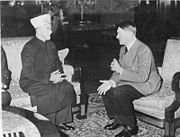 On November 20, al-Husseini met the German Foreign Minister Joachim von Ribbentrop
and was officially received by Adolf Hitler on November 28. He asked Hitler for a public declaration that 'recognized and sympathized with the Arab struggles for independence and liberation, and that would support the elimination of a national Jewish homeland'. Hitler refused to make such a public announcement, saying that it would strengthen the Gaullists against the Vichy France
, but asked al-Husseini to 'to lock ...deep in his heart' the following points, which Christopher Browning
summarizes as follows, that
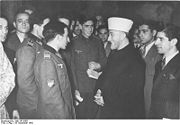 A separate record of the meeting was made by Fritz Grobba
, who until recently had been the German ambassor to Iraq. His version of the crucial words reads 'when the hour of Arab liberation comes, Germany has no interest there other than the destruction of the power protecting the Jews". Al-Husseini's own account of this point, as recorded in his diary, is very similar to Grobba's.
In December 1942, al-Husseini held a speech at the celebration of the opening of the Islamic Central Institute (Islamische Zentralinstitut) in Berlin
, of which he served as honorary chair. In the speech, he harshly criticised those he considered as aggressors against Muslims, namely "Jews, Bolsheviks and Anglo-Saxons." At the time of the opening of the Islamic Central Institute, there were an estimated 3,000 Muslims in Germany, including 400 German converts. The Islamic Central Institute gave the Muslims in Germany institutional ties to the 'Third Reich'.
On November 2, 1943, Himmler sent a telegram to the Mufti: To the Grand Mufti: The National Socialist movement of Greater Germany has, since its inception, inscribed upon its flag the fight against the world Jewry. It has therefore followed with particular sympathy the struggle of freedom-loving Arabs, especially in Palestine, against Jewish interlopers. In the recognition of this enemy and of the common struggle against it lies the firm foundation of the natural alliance that exists between the National Socialist Greater Germany and the freedom-loving Muslims of the whole world. In this spirit I am sending you on the anniversary of the infamous Balfour declaration my hearty greetings and wishes for the successful pursuit of your struggle until the final victory. Reichsfuehrer S.S. Heinrich Himmler
Husseini intervened on May 13, 1943, with the German Foreign Office to block possible transfers of Jews from Bulgaria, Hungary and Romania, after reports reached him that 4000 Jewish children accompanied by 500 adults had managed to reach Palestine. He asked that the Foreign Minister "to do his utmost" to block all such proposals and this request was complied with. A year later, on the 25 July 1944, he wrote to the Hungarian foreign minister to register his objection to the release of certificates for 900 Jewish children and 100 adults for transfer from Hungary, fearing they might end up in Palestine. He suggested that if such transfers of population were deemed necessary, then:
Among the acts of sabotage
al-Husseini attempted to implement, Michael Bar Zohar reports a chemical warfare
assault on the second largest and predominantly Jewish city in Palestine, Tel Aviv
. According to him, five parachutists
were sent with a toxin
to dump into the water system. The police caught the infiltrators in a cave near Jericho
, and according to Jericho district police commander Fayiz Bey Idrissi, 'The laboratory report stated that each container held enough poison to kill 25,000 people, and there were at least ten containers.'. Medoff concludes,
Wolfgang G. Schwanitz
notes that in his memoirs Husseini recalled that Heinrich Himmler
, in the summer of 1943, while confiding some German war secrets, inveighed against Jewish "war guilt", and, speaking of Germany’s persecution of the Jews said that "up to now we have exterminated (in Arabic, abadna) around three million of them". In his memoirs, Husseini wrote he was astonished to hear this. Schwanitz doubts the sincerity of his surprise since, he argues, Husseini had publicly declared that Muslims should follow the example Germans set for a "definitive solution to the Jewish problem".
In September 1943, intense negotiations to rescue 500 Jewish children from the town of Arbe in Croatia collapsed due to the objection of al-Husseini who blocked the children's departure to Turkey because they would end up in Palestine.
According to two researchers, Klaus Michael Mallmann and Martin Cüppers, recent Nazi documents uncovered in the German Ministry of Foreign Affairs and the Military Archive Service in Freiburg indicate that, in the event of the British being defeated in Egypt by Generalfeldmarschall
Erwin Rommel's
Afrika Korps
, the Nazis planned to deploy a special unit called Einsatzkommando Ägypten
to exterminate Palestinian Jews and that they wanted Arab support to prevent the emergence of a Jewish state.
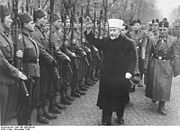 Throughout World War II, al-Husseini worked for the Axis Powers
as a broadcaster in propaganda targeting Arab public opinion. The Mufti was paid “an absolute fortune” of 50,000 marks a month (when a German field marshal was making 25,000 marks a year). Walter Winchell
called him 'the Arabian Lord Haw-Haw
.'
He recruited Muslim volunteers for the German armed forces operating in the Balkans
. Beginning in 1941, al-Husseini visited Bosnia, and convinced Muslim leaders that a Muslim S.S. division would be in the interest of Islam. In spite of these and other propaganda efforts, "only half of the expected 20,000 to 25,000 Muslims volunteered'. Al-Husseini was involved in the organization and recruitment of Bosnian
Muslims into several divisions of the Waffen SS and other units. The largest was the 13th Handschar division
of 21,065 men, which conducted operations against Communist partisans
in the Balkans from February 1944, committing numerous atrocities against their traditional ethnic rivals the local Christian Serbs.
In 1942, al-Husseini helped organize Arab students and North African emigres in Germany into the "Arabisches Freiheitkorps," an Arab Legion in the German Army that hunted down Allied parachutists in the Balkans and fought on the Russian front.
On March 1, 1944, while speaking on Radio Berlin, al-Husseini said: 'Arabs, rise as one man and fight for your sacred rights. Kill the Jews wherever you find them. This pleases God, history, and religion. This saves your honor. God is with you.' He was promised the leadership of Palestine after German troops had driven out the British. At the end of the war, he was allowed to flee to Syria as part of an attempt to prevent the alienation of Middle Eastern regimes.
's deputies, Dieter Wisliceny
, stated after the war that al-Husseini had actively encouraged the extermination of European Jews, and that he had had an elaborate meeting with Eichmann at his office, during which Eichmann gave him an intensive look at the current state of the “Solution of the Jewish Question in Europe” by the Third Reich. This testimony was denied by Eichmann at his 1961 trial in Jerusalem. Eichmann stated that he had only been introduced to al-Husseini during an official reception, along with all other department heads. In the final judgement, the Jerusalem court stated: 'In the light of this partial admission by the Accused, we accept as correct Wisliceny's statement about this conversation between the Mufti and the Accused. In our view it is not important whether this conversation took place in the Accused's office or elsewhere. On the other hand, we cannot determine decisive findings with regard to the Accused on the basis of the notes appearing in the Mufti's diary which were submitted to us.'
Hannah Arendt
, who attended the complete Eichmann trial, concluded in her book Eichmann in Jerusalem: A Report on the Banality of Evil
that, 'The trial revealed only that all rumours about Eichmann's connection with Haj Amin el Husseini, the former Mufti of Jerusalem, were unfounded.'
Rafael Medoff
concludes that 'actually there is no evidence that the Mufti's presence was a factor at all; the Wisliceny hearsay is not merely uncorroborated, but conflicts with everything else that is known about the origins of the Final Solution.' Bernard Lewis
also called Wisliceny's testimony into doubt: 'There is no independent documentary confirmation of Wisliceny's statements, and it seems unlikely that the Nazis needed any such additional encouragement from the outside.'
Some have argued that efforts by the Mufti to halt Jewish emigration to Palestine set the stage for the Nazi extermination programme.
, was detained and expelled back to Germany.. He was arrested at Constanz by the French occupying troops on 5 May 1945, and on 19 May, he was transferred to the Paris region and put under house arrest
.
Henri Ponsot, a former ambassador of France in Syria, lead the discussions with him and had a decisive influence on the events. The French authorities expected an improvement of France status in the Arab world through his intermediaries and accorded him "special detention conditions, benefits and ever more important privileges and constantly worried about his well-being and that of his entourage'. In October, he was even given permission to buy a car in the name of one of his secretaries and enjoyed some freedom of movement and could also meet whoever he wanted. Al-Husseini proposed to the French two possibilities of cooperation: 'either an action in Egypt, Iraq and even Transjordan to calm the anti-French excitement after the events in Syria and because of its domination in North Africa; or that he would take the initiative of provocations in [Palestine], in Egypt and in Iraq against Great Britain', so that the Arabs countries will pay more attention to British policy than to that of France. Al-Husseini was very satisfied with his situation in France and stayed there for a full year.
As early as 24 May, Great Britain requested al-Husseini's extradition, arguing that he was a British citizen who had collaborated with the Nazis. Despite the fact that he was on the list of war criminals, France decided to consider him as a political prisoner
and refused to comply with the British request. France also refused to extradite him to Yugoslavia where the government wanted to prosecute him for the massacres of Serbs. Poussot believed al-Husseini's claims that the massacre of Serbs had been performed by General Mikhailovitch and not by him. Al-Husseini also explained that 200,000 Muslims and 40,000 Christians had been assassinated by the Serbs and that he had established a division of soldiers only after Bosnian Muslims had asked for his help, and that Germans and Italians had refused to provide any support to them. In the meantime, the Zionist authorities—fearing that al-Husseini would escape—backed Yugoslavia's request for extradition. They stated that al-Husseini was also responsible for massacres in Greece and pointed out his action against the Allies in Iraq in 1941; additionally they requested the support of the United States in the matter.
In June, Yishuv
leaders decided to eliminate al-Husseini. Although al-Husseini was located by Jewish Army members who began to plan an assassination, the mission was canceled in December by Moshe Sharett
or by David Ben Gurion, probably because they feared turning the Grand Mufti into a martyr.
In September, the French decided to organize his transfer to an Arab country. Egypt, Saudi Arabia or Yemen were considered and diplomatic contacts were made with their authorities and with the Arab League.
On 29 May, al-Husseini left France on a TWA flight for Cairo using a fake Syrian passport. It took more than 12 days for the French Foreign Minister to realize he had fled, and the British were not able to arrest him in Egypt.
On 12 August 1947, al-Husseini wrote to French Foreign Minister Georges Bidault
, thanking him for French behavior towards him and suggesting that France continue this policy to increase its prestige in the eyes of all Muslims. In September, a delegation of the Arab Higher Committee
went to Paris and proposed that Arabs would adopt a neutral position on the North African question in exchange of France's support in the Palestinian question.
, reached a secret entente with Golda Meir
to thwart the mufti and annex the part of Palestine in exchange for Jordan's dropping its opposition to the establishment of a Jewish state. The meeting, in Shlaim's words, 'laid the foundations for a partition of Palestine along lines radically different from the ones eventually envisaged by the United Nations'. Husseini's popularity in the Arab world had risen during his time with the Nazis, and Arab leaders rushed to greet him on his return, and the masses accorded him an enthusiastic reception, an attitude which was to change rapidly after the defeat of 1948, when he was singled out as a scapegoat to blame for the failure.
From his Egyptian exile, al-Husseini used what influence he had to encourage the participation of the Egyptian military in the 1948 Arab-Israeli War
. He was involved in some high level negotiations between Arab leaders - before and during the War - at a meeting held in Damascus
in February 1948, to organize Palestinian Field Commands and the commanders of the Holy War Army. Hasan Salama
and Abd al-Qadir al-Husayni
(his nephew), were allocated to the Lydda
district and Jerusalem respectively. This decision paved the way for undermining the Mufti's position among the Arab States. On February 9, four days after the Damascus meeting, he suffered a severe setback at the Arab League
's Cairo
session, when his demands for more Palestinian self-determination for Palestine's fate were rejected. His demands included, the appointment of a Palestinian Arab representative to the League's General Staff, the formation of a Palestinian Provisional Government, the transfer of authority to local National Committees in areas evacuated by the British, and both a loan for Palestinian administration and an appropriation of large sums to the Arab Higher Executive for Palestinian Arabs entitled to war damages.
The Arab League blocked recruitment to al-Husseini's forces, and they collapsed following the death of one of his most charismatic commanders, Abd al-Qadir al-Husayni
, on April 8.
Following rumors that King Abdullah I
of Transjordan
was reopening the bilateral negotiations with Israel that he had previously conducted clandestinely with the Jewish Agency, the Arab League - led by Egypt - decided to set up the All-Palestine Government
in Gaza
on 8 September 1948 under the nominal leadership of al-Husseini. Avi Shlaim writes:
The All-Palestine Government was under the nominal leadership of Amin al-Husseini, the Mufti of Jerusalem. Ahmed Hilmi Abd al-Baqi was named Prime Minister
. Hilmi's cabinet consisted largely of relatives and followers of Amin al-Husseini, but also included representatives of other factions of the Palestinian ruling class. Jamal al-Husayni
became foreign minister, Raja al-Husayni became defense minister, Michael Abcarius was finance minister, and Anwar Nusseibeh
was secretary of the cabinet. Twelve ministers in all, living in different Arab countries, headed for Gaza to take up their new positions. The decision to set up the All-Palestine Government
made the Arab Higher Committee
irrelevant, but Amin al-Husseini continued to exercise an influence in Palestinian affairs. A Palestinian National Council
was convened in Gaza on 30 September 1948, under the chairmanship of Amin al-Husseini. The council passed a series of resolutions culminating on 1 October 1948 with a declaration of independence over the whole of Palestine
, with Jerusalem as its capital..
Abdullah
regarded the attempt to revive al-Husseini's Holy War Army as a challenge to his authority and on October 3, his minister of defense ordered all armed bodies operating in the areas controlled by the Arab Legion
to be disbanded. Glubb Pasha carried out the order ruthlessly and efficiently. The sum effect was that:
had assigned the position of Grand Mufti of Jerusalem
to Husam Al-din Jarallah. The king was assassinated on 20 July 1951, on the eve of projected secret talks with Israel, by a militant, Mustafa Ashu, of the jihad al-muqaddas, while entering the Haram ash-Sharif to pray. There is no evidence al-Husseini was involved, though Musa al-Husayni was among the six indicted and executed after a disputed verdict. Abdullah was succeeded by King Talal
- who refused to allow al-Husseini entry into Jerusalem. Abdullah's grandson, Hussein
, who had been present at the murder, eventually lifted the ban in 1967, receiving al-Husseini as an honoured guest in his Jerusalem royal residence after uprooting the PLO from Jordan.
Al-Husseini remained in exile at Heliopolis
in Egypt throughout much of the 1950s. As before 1948 when the Yishuv
believed the ex-Mufti's hand could be detected 'behind every anti-Jewish pogrom, murder, and act of sabotage', Israel persisted in asserting that al-Husseini was behind many border raids from Jordanian and Egyptian-held territory, and Egypt expressed a readiness to deport him if evidence were forthcoming to substantiate the charges. In 1959 he moved to Lebanon
.
Al-Husseini died in Beirut
, on 4 July 1974. He wished to be buried in Jerusalem, but the Israel
i government refused this request, and as in the meantime, during the Six-Day War
in 1967, Israel had captured East Jerusalem
from Jordan, it exercised administrative jurisdiction over the area. His granddaughter married Ali Hassan Salameh
, the founder of PLO's Black September
.
Zvi Elpeleg, while rehabilitating him from other charges, concludes his chapter concerning al-Husseini's involvement in the extermination of the Jews as follows:
In a study dedicated to the role and use of the Holocaust in Israeli nationalist discourse, Idith Zertal takes a new look at al-Husseini's alleged antisemitism. She states that 'in more correct proportions, [he should be pictured] as a fanatic nationalist-religious Palestinian leader'. Benny Morris has recently argued that 'al-Husayni was deeply anti-Semitic', since he 'explained the Holocaust as owing to the Jews' sabotage of the German war effort in World War I and [their] character: (...) their selfishness, rooted in their belief that they are the chosen people of God'. For Morris attempts to picture al-Husaini as merely anti-Zionist are wrong, given his expressions of extreme hatred towards the Jews in general. In the same lecture he affirmed his belief that al-Huseini certainly knew of the Holocaust during his sojourn in Berlin, and that, while not one of the perpertrators, he was 'rather happy it is taking place'.
Klaus Michael Mallmann and Martin Cüppers write that, 'Haj Amin al-Husseini, the mufti of Jerusalem, was the Nazis' most important collaborator and an absolute Arab anti-Semite.'
, described him as virulently antisemitic, as did, a decade and a half later, Joseph Schechtman
. More recent biographers like Mattar and Elpeleg, writing in the late 1980s and early 1990s, began to emphasize his nationalism
. While the Palestinian historian Mattar blames him as the main culprit of sowing the seeds of the Arab-Israeli conflict, Israeli historian Elpeleg, who formerly governed both the West Bank
and the Gaza Strip
, compares him to Chaim Weizmann
, David Ben-Gurion
, and even to Theodor Herzl
.
Peter Novick
has argued that the post-war historiographical depiction of al-Husseini reflected complex geopolitical interests that distorted the record.
In a report of recently declassified information by the American government and published in the National Archives, the British head of Palestine’s Criminal Investigation Division told an American military attaché that the Mufti might be the only person who could unite the Palestinian Arabs and 'cool off the Zionists'.
Palestinian nationalism
Palestinian nationalism is the national movement of the Palestinian people. It has roots in Pan-Arabism and other movements rejecting colonialism and calling for national independence. More recently, Palestinian Nationalism is expressed through the Israeli–Palestinian conflict...
Arab nationalist
Arab nationalism
Arab nationalism is a nationalist ideology celebrating the glories of Arab civilization, the language and literature of the Arabs, calling for rejuvenation and political union in the Arab world...
and Muslim
Muslim
A Muslim, also spelled Moslem, is an adherent of Islam, a monotheistic, Abrahamic religion based on the Quran, which Muslims consider the verbatim word of God as revealed to prophet Muhammad. "Muslim" is the Arabic term for "submitter" .Muslims believe that God is one and incomparable...
leader in the British Mandate of Palestine. From as early as 1920, in order to secure the independence of Palestine as an Arab state he actively opposed Zionism
Zionism
Zionism is a Jewish political movement that, in its broadest sense, has supported the self-determination of the Jewish people in a sovereign Jewish national homeland. Since the establishment of the State of Israel, the Zionist movement continues primarily to advocate on behalf of the Jewish state...
, and was implicated as a leader of a violent riot that broke out over the establishment of a national home for the Jewish people in Palestine. From 1921 to 1937 al-Husseini was the Grand Mufti of Jerusalem
Grand Mufti of Jerusalem
The Grand Mufti of Jerusalem is the Sunni Muslim cleric in charge of Jerusalem's Islamic holy places, including the Al-Aqsa Mosque.-Ottoman era:...
, using the position to promote Islam
Islam
Islam . The most common are and . : Arabic pronunciation varies regionally. The first vowel ranges from ~~. The second vowel ranges from ~~~...
and rally Palestinian nationalism
Palestinian nationalism
Palestinian nationalism is the national movement of the Palestinian people. It has roots in Pan-Arabism and other movements rejecting colonialism and calling for national independence. More recently, Palestinian Nationalism is expressed through the Israeli–Palestinian conflict...
against Zionism
Zionism
Zionism is a Jewish political movement that, in its broadest sense, has supported the self-determination of the Jewish people in a sovereign Jewish national homeland. Since the establishment of the State of Israel, the Zionist movement continues primarily to advocate on behalf of the Jewish state...
.
His opposition to the British started during the 1936-1939 Arab revolt in Palestine. In 1937, evading an arrest warrant, he fled Palestine and took refuge in, successively, the French Mandate of Lebanon
French Mandate of Lebanon
The state of Greater Lebanon, the predecessor of modern Lebanon, was created in 1920 as part of the French scheme of dividing the French Mandate of Syria into six states....
and the Kingdom of Iraq
Kingdom of Iraq
The Kingdom of Iraq was the sovereign state of Iraq during and after the British Mandate of Mesopotamia. The League of Nations mandate started in 1920. The kingdom began in August 1921 with the coronation of Faisal bin al-Hussein bin Ali al-Hashemi as King Faisal I...
, until he established himself in Italy and finally Germany. During World War II
World War II
World War II, or the Second World War , was a global conflict lasting from 1939 to 1945, involving most of the world's nations—including all of the great powers—eventually forming two opposing military alliances: the Allies and the Axis...
he actively collaborated with both Nazi Germany
Nazi Germany
Nazi Germany , also known as the Third Reich , but officially called German Reich from 1933 to 1943 and Greater German Reich from 26 June 1943 onward, is the name commonly used to refer to the state of Germany from 1933 to 1945, when it was a totalitarian dictatorship ruled by...
and Fascist Italy
Fascist Italy
"Fascist Italy" refers to Italy under the rule of Benito Mussolini and Italian Fascism. The Fascists led two polities:*The Kingdom of Italy , under the National Fascist Party, and,...
, meeting Adolf Hitler
Adolf Hitler
Adolf Hitler was an Austrian-born German politician and the leader of the National Socialist German Workers Party , commonly referred to as the Nazi Party). He was Chancellor of Germany from 1933 to 1945, and head of state from 1934 to 1945...
personally and asking him to back Arab independence. He requested, as part of the Pan-Arab struggle
Pan-Arabism
Pan-Arabism is an ideology espousing the unification--or, sometimes, close cooperation and solidarity against perceived enemies of the Arabs--of the countries of the Arab world, from the Atlantic Ocean to the Arabian Sea. It is closely connected to Arab nationalism, which asserts that the Arabs...
, Hitler's support to oppose the establishment in Palestine of a Jewish national home. He was promised the leadership of the Arabs after German troops had driven out the British. He helped recruit Muslims for the Waffen-SS
Waffen-SS
The Waffen-SS was a multi-ethnic and multi-national military force of the Third Reich. It constituted the armed wing of the Schutzstaffel or SS, an organ of the Nazi Party. The Waffen-SS saw action throughout World War II and grew from three regiments to over 38 divisions, and served alongside...
. At war's end, he came under French protection, and managed to slip away to Cairo to avoid eventual prosecution.
During the 1948 Palestine War
1948 Palestine war
The 1948 Palestine war refers to the events in the British Mandate of Palestine between the United Nations vote on the partition plan on November 30, 1947, to the end of the first Arab-Israeli war on July 20, 1949.The war is divided into two phases:...
, Husseini represented the Arab Higher Committee
Arab Higher Committee
The Arab Higher Committee was the central political organ of the Arab community of Mandate Palestine. It was established on 25 April 1936, on the initiative of Hajj Amin al-Husayni, the Grand Mufti of Jerusalem, and comprised the leaders of Palestinian Arab clans under the mufti's...
and opposed both the 1947 UN Partition Plan
1947 UN Partition Plan
The United Nations Partition Plan for Palestine was created by the United Nations Special Committee on Palestine in 1947 to replace the British Mandate for Palestine with "Independent Arab and Jewish States" and a "Special International Regime for the City of Jerusalem" administered by the United...
and King Abdullah's entente with Zionists to annex the Arab part of British Mandatory Palestine to Jordan
Jordan
Jordan , officially the Hashemite Kingdom of Jordan , Al-Mamlaka al-Urduniyya al-Hashemiyya) is a kingdom on the East Bank of the River Jordan. The country borders Saudi Arabia to the east and south-east, Iraq to the north-east, Syria to the north and the West Bank and Israel to the west, sharing...
. In September 1948, he participated in establishment of All-Palestine Government
All-Palestine Government
The All-Palestine Government was established by the Arab League on 22 September 1948, during the 1948 Arab-Israeli War. Shortly thereafter, an Arab-Palestinian Congress named King Abdullah I of Transjordan, "King of Arab Palestine"...
. Seated in Egyptian ruled Gaza, this government won a limited recognition of Arab states, but was eventually dissolved by Gamal Nasser in 1959. After the war and subsequent Palestinian exodus
1948 Palestinian exodus
The 1948 Palestinian exodus , also known as the Nakba , occurred when approximately 711,000 to 725,000 Palestinian Arabs left, fled or were expelled from their homes, during the 1948 Arab-Israeli War and the Civil War that preceded it. The exact number of refugees is a matter of dispute...
, his claims to leadership, wholly discredited, left him eventually sidelined by the Palestine Liberation Organization
Palestine Liberation Organization
The Palestine Liberation Organization is a political and paramilitary organization which was created in 1964. It is recognized as the "sole legitimate representative of the Palestinian people" by the United Nations and over 100 states with which it holds diplomatic relations, and has enjoyed...
, and he lost most of his residual political influence. He died in Beirut
Beirut
Beirut is the capital and largest city of Lebanon, with a population ranging from 1 million to more than 2 million . Located on a peninsula at the midpoint of Lebanon's Mediterranean coastline, it serves as the country's largest and main seaport, and also forms the Beirut Metropolitan...
, Lebanon
Lebanon
Lebanon , officially the Republic of LebanonRepublic of Lebanon is the most common term used by Lebanese government agencies. The term Lebanese Republic, a literal translation of the official Arabic and French names that is not used in today's world. Arabic is the most common language spoken among...
, in July 1974.
Husseini was and remains a highly controversed figure. Historians debate to what extent his fierce opposition to Zionism
Zionism
Zionism is a Jewish political movement that, in its broadest sense, has supported the self-determination of the Jewish people in a sovereign Jewish national homeland. Since the establishment of the State of Israel, the Zionist movement continues primarily to advocate on behalf of the Jewish state...
was grounded in nationalism
Nationalism
Nationalism is a political ideology that involves a strong identification of a group of individuals with a political entity defined in national terms, i.e. a nation. In the 'modernist' image of the nation, it is nationalism that creates national identity. There are various definitions for what...
or antisemitism or a combination of both.
Early life
Amin al-Husseini was born either in 1895 or, more probably, in 1897 in Jerusalem, the son of the then mufti of that city and prominent early opponent of Zionism, Tahir al-Husayni. The al-HusseiniAl-Husayni
Husayni is the name of a prominent Palestinian Arab clan formerly based in Jerusalem. Several members of the clan held important political positions such as Mayor and Grand Mufti of Jerusalem and founded and led many Palestinian Arab Islamist groups such as the Holy War Army, the Palestine Arab...
clan consisted of wealthy landowners in southern Palestine,
centred around the district of Jerusalem. Thirteen members of the clan had been Mayors of Jerusalem between 1864 and 1920. Another member of the clan and Amin's half-brother, Kamil al-Husayni
Kamil al-Husayni
Kamil al-Husayni was a Sunni Muslim religious leader of the Palestinian people and was the Grand Mufti of Jerusalem from 1908 until his death....
, also served as Mufti of Jerusalem. In Jerusalem Amin al-Husseini attended an Qur'anic school (kuttub), and Ottoman government secondary school (rüshidiyye) where he learnt Turkish
Turkish language
Turkish is a language spoken as a native language by over 83 million people worldwide, making it the most commonly spoken of the Turkic languages. Its speakers are located predominantly in Turkey and Northern Cyprus with smaller groups in Iraq, Greece, Bulgaria, the Republic of Macedonia, Kosovo,...
, and a Catholic secondary school run by French missionaries
Catholic missions
As the church normally organizes itself along territorial lines, and because they had the human and material resources, religious orders—some even specializing in it—undertook most missionary work, especially in the early phases...
, the Catholic Frères, where he learnt French. He also studied at the Alliance Israélite Universelle
Alliance Israélite Universelle
The Alliance Israélite Universelle is a Paris-based international Jewish organization founded in 1860 by the French statesman Adolphe Crémieux to safeguard the human rights of Jews around the world...
with its Non-Zionist Jewish director Albert Antébi
Albert Antébi
Albert-Abraham Antébi was a Jewish public activist and communitary leader born in Syria, who worked for the defense of the interests of the Jewish old and new settlement in Palestine during the Ottoman rule, especially in the realm of education, philanthropy and estate, as representative of the...
. In 1912 he studied Islamic law
Sharia
Sharia law, is the moral code and religious law of Islam. Sharia is derived from two primary sources of Islamic law: the precepts set forth in the Quran, and the example set by the Islamic prophet Muhammad in the Sunnah. Fiqh jurisprudence interprets and extends the application of sharia to...
briefly at Al-Azhar University
Al-Azhar University
Al-Azhar University is an educational institute in Cairo, Egypt. Founded in 970~972 as a madrasa, it is the chief centre of Arabic literature and Islamic learning in the world. It is the oldest degree-granting university in Egypt. In 1961 non-religious subjects were added to its curriculum.It is...
in Cairo
Cairo
Cairo , is the capital of Egypt and the largest city in the Arab world and Africa, and the 16th largest metropolitan area in the world. Nicknamed "The City of a Thousand Minarets" for its preponderance of Islamic architecture, Cairo has long been a centre of the region's political and cultural life...
and at the Dar al-Da'wa wa-l-Irshad, under Rashid Rida
Rashid Rida
Muhammad Rashid Rida is said to have been "one of the most influential scholars and jurists of his generation" and the "most prominent disciple of Muhammad Abduh"...
, a salafi
Salafi
A Salafi come from Sunni Islam is a follower of an Islamic movement, Salafiyyah, that is supposed to take the Salaf who lived during the patristic period of early Islam as model examples...
intellectual, who was to remain Amin's mentor till his death in 1935. Though groomed to hold religious office from youth, his education was typical of the Ottoman effendi at the time, and he only donned a religious turban in 1921 after being appointed mufti.
In 1913 at the age of 18, al-Husseini accompanied his pious mother Zainab to Mecca
Mecca
Mecca is a city in the Hijaz and the capital of Makkah province in Saudi Arabia. The city is located inland from Jeddah in a narrow valley at a height of above sea level...
and received the honorary title
Honorific
An honorific is a word or expression with connotations conveying esteem or respect when used in addressing or referring to a person. Sometimes, the term is used not quite correctly to refer to an honorary title...
of Hajj
Hajj
The Hajj is the pilgrimage to Mecca, Saudi Arabia. It is one of the largest pilgrimages in the world, and is the fifth pillar of Islam, a religious duty that must be carried out at least once in their lifetime by every able-bodied Muslim who can afford to do so...
. Prior to World War I
World War I
World War I , which was predominantly called the World War or the Great War from its occurrence until 1939, and the First World War or World War I thereafter, was a major war centred in Europe that began on 28 July 1914 and lasted until 11 November 1918...
, he studied at the School of Administration in Istanbul
Istanbul
Istanbul , historically known as Byzantium and Constantinople , is the largest city of Turkey. Istanbul metropolitan province had 13.26 million people living in it as of December, 2010, which is 18% of Turkey's population and the 3rd largest metropolitan area in Europe after London and...
, the most secular of Ottoman institutions.
World War I
With the outbreak of World War IWorld War I
World War I , which was predominantly called the World War or the Great War from its occurrence until 1939, and the First World War or World War I thereafter, was a major war centred in Europe that began on 28 July 1914 and lasted until 11 November 1918...
in 1914, al-Husseini first joined the Ottoman
Ottoman Empire
The Ottoman EmpireIt was usually referred to as the "Ottoman Empire", the "Turkish Empire", the "Ottoman Caliphate" or more commonly "Turkey" by its contemporaries...
Turkish
Turkey
Turkey , known officially as the Republic of Turkey , is a Eurasian country located in Western Asia and in East Thrace in Southeastern Europe...
army, receiving a commission as an artillery
Artillery
Originally applied to any group of infantry primarily armed with projectile weapons, artillery has over time become limited in meaning to refer only to those engines of war that operate by projection of munitions far beyond the range of effect of personal weapons...
officer
Officer (armed forces)
An officer is a member of an armed force or uniformed service who holds a position of authority. Commissioned officers derive authority directly from a sovereign power and, as such, hold a commission charging them with the duties and responsibilities of a specific office or position...
and being assigned to the Forty-Seventh Brigade stationed in and around the city of Izmir
Izmir
Izmir is a large metropolis in the western extremity of Anatolia. The metropolitan area in the entire Izmir Province had a population of 3.35 million as of 2010, making the city third most populous in Turkey...
. In November 1916 he left the Ottoman army on a three month disability leave and returned to Jerusalem, which was captured by the British while he was recovering from an illness there. The British and Sherifian armies
Sharifian Army
The Sharifian Army was the military force behind the Arab Revolt which was a part of the Middle Eastern theatre of World War I. Sharif Husayn ibn 'Ali led the Sharifian Army in a rebellion against the Ottoman Empire with the ultimate goal of uniting the Arab people under and independent government...
conquered Ottoman-controlled Palestine and Syria in 1918 with Arab Palestinian recruits also taking part in the offensive against the Turks, alongside Jewish troops. As a Sherifian officer, al-Husseini recruited men to serve in Faisal bin Al Hussein Bin Ali El-Hashemi
Faisal I of Iraq
Faisal bin Hussein bin Ali al-Hashemi, was for a short time King of the Arab Kingdom of Syria or Greater Syria in 1920, and was King of the Kingdom of Iraq from 23 August 1921 to 1933...
's army during the Arab Revolt
Arab Revolt
The Arab Revolt was initiated by the Sherif Hussein bin Ali with the aim of securing independence from the ruling Ottoman Turks and creating a single unified Arab state spanning from Aleppo in Syria to Aden in Yemen.- Background :...
, a task he undertook while employed as a recruiter by the British military administration in Jerusalem and Damascus
Damascus
Damascus , commonly known in Syria as Al Sham , and as the City of Jasmine , is the capital and the second largest city of Syria after Aleppo, both are part of the country's 14 governorates. In addition to being one of the oldest continuously inhabited cities in the world, Damascus is a major...
. The post-war Palin Report
Palin Report 1920
The Palin Report or Palin Commission of Inquiry examined the rioting in Jerusalem between 4 and 7 April 1920. It foresaw increasing problems between the various parties and the administration.-Commission operations:...
noted that the English recruiting officer, Captain
Captain (OF-2)
The army rank of captain is a commissioned officer rank historically corresponding to command of a company of soldiers. The rank is also used by some air forces and marine forces. Today a captain is typically either the commander or second-in-command of a company or artillery battery...
C.D.Brunton, found al-Husseini, with whom he cooperated, very pro-English, and that, via the diffusion of War Office pamphlets dropped from the air promising them peace and prosperity under English rule, 'the recruits (were) being given to understand that they were fighting in a national cause and to liberate their country from the Turks'.
Early political activism
In 1919, al-Husseini attended the Pan-Syrian CongressSyrian National Congress
The Syrian National Congress was convened in July 1919 in Damascus, Syria to prepare for the King-Crane Commission of inquiry on the future of Greater Syria after the fall of the Ottoman Empire. The congress was attended by representative from all parts of Syria. The participants showed...
held in Damascus
Damascus
Damascus , commonly known in Syria as Al Sham , and as the City of Jasmine , is the capital and the second largest city of Syria after Aleppo, both are part of the country's 14 governorates. In addition to being one of the oldest continuously inhabited cities in the world, Damascus is a major...
where he supported Emir Faisal for King of Syria
Syria
Syria , officially the Syrian Arab Republic , is a country in Western Asia, bordering Lebanon and the Mediterranean Sea to the West, Turkey to the north, Iraq to the east, Jordan to the south, and Israel to the southwest....
. That year al-Husseini founded the pro-British Jerusalem branch of the Syrian-based 'Arab Club' (Al-Nadi al-arabi), which then vied with the Nashashibi-sponsored 'Literary Club' (Al-muntada al-adabi) for influence over public opinion, and he soon became its President. At the same time he wrote articles for the Suriyya al-Janubiyya
Southern Syria (newspaper)
Suriyya al-Janubiyya was the name of a newspaper published in Jerusalem beginning in September 1919 by the lawyer Muhammad Hasan al-Budayri, and edited by Aref al-Aref, with contributions from, amongst others, Haj Amin al-Husayni....
(Southern Syria). The paper was published in Jerusalem beginning in September 1919 by the lawyer Muhammad Hassan al-Budayri, and edited by Aref al-Aref
Aref al-Aref
Aref al-Aref was a Palestinian journalist, historian and politician who served as mayor of East Jerusalem in the 1950s.-Biography:...
, both prominent members of al-Nadi al-'Arabi.
During the annual Nabi Musa
Nabi Musa
Nabi Musa is the name of a site in the Judean desert that popular Palestinian folklore associates with Moses. It is also the name of a seven-day long religious festival that was celebrated annually by Palestinian Muslims, beginning on the Friday before Good Friday in the old Orthodox Greek calendar...
procession in Jerusalem in April 1920, violent rioting
1920 Palestine riots
The 1920 Palestine riots, or Nabi Musa riots, took place in British Mandate of Palestine April 4–7, 1920 in and around the Old City of Jerusalem....
broke out in protest at the implementation of the Balfour Declaration which supported the establishment in Palestine of a homeland for the Jewish people. Much damage to Jewish live and property was caused. The Palin Report
Palin Report 1920
The Palin Report or Palin Commission of Inquiry examined the rioting in Jerusalem between 4 and 7 April 1920. It foresaw increasing problems between the various parties and the administration.-Commission operations:...
laid the blame for the explosion of tensions on both sides. Ze'ev Jabotinsky, organiser of Jewish paramilitary defences, received a 15-year sentence. Al-Husseini, then a teacher at the Rashidiya school
Rashidiya school
Rashidiya School , or Al-Rashidiya Secondary School for Boys , is a public school located in East Jerusalem next to Herod's Gate . Rashidiya served as the main learning establishment for the residents of East Jerusalem since the late Ottoman era...
, near Herod's Gate
Herod's Gate
Herod's Gate is a gate in the walls of the Old City of Jerusalem. Its elevation is 755 meters above sea level. It adjoins the Muslim Quarter, and is a short distance to the east of the Damascus Gate. In proximity to the gate is an Arab neighborhood called Bab a-Zahara, a variation of the Arabic...
in East Jerusalem, was charged with inciting the Arab crowds with an inflammatory speech and sentenced in absentia
In absentia
In absentia is Latin for "in the absence". In legal use, it usually means a trial at which the defendant is not physically present. The phrase is not ordinarily a mere observation, but suggests recognition of violation to a defendant's right to be present in court proceedings in a criminal trial.In...
to ten years inprisonment by a military court. It was asserted soon after, by Chaim Weizmann
Chaim Weizmann
Chaim Azriel Weizmann, , was a Zionist leader, President of the Zionist Organization, and the first President of the State of Israel. He was elected on 1 February 1949, and served until his death in 1952....
and British army Lieutenant Colonel
Lieutenant colonel
Lieutenant colonel is a rank of commissioned officer in the armies and most marine forces and some air forces of the world, typically ranking above a major and below a colonel. The rank of lieutenant colonel is often shortened to simply "colonel" in conversation and in unofficial correspondence...
Richard Meinertzhagen
Richard Meinertzhagen
Colonel Richard Henry Meinertzhagen CBE DSO was a British soldier, intelligence officer and ornithologist.- Background and youth :Meinertzhagen was born into a socially connected, wealthy British family...
, that al-Husseini had been put up to inciting the riot by British Field-marshal Allenby
Edmund Allenby, 1st Viscount Allenby
Field Marshal Edmund Henry Hynman Allenby, 1st Viscount Allenby GCB, GCMG, GCVO was a British soldier and administrator most famous for his role during the First World War, in which he led the Egyptian Expeditionary Force in the conquest of Palestine and Syria in 1917 and 1918.Allenby, nicknamed...
's Chief of Staff
Chief of Staff
The title, chief of staff, identifies the leader of a complex organization, institution, or body of persons and it also may identify a Principal Staff Officer , who is the coordinator of the supporting staff or a primary aide to an important individual, such as a president.In general, a chief of...
, Colonel Bertie Harry Waters-Taylor, to demonstrate to the world that Arabs would not tolerate a Jewish homeland in Palestine. For a reading which follows closely Meinertzhagen's reading of the events as a British army plot, see . The assertion was never proven, and Meinertzhagen was dismissed.
After the April riots an event took place that turned the traditional rivalry between the Husseini and Nashashibi clans into a serious rift, with long-term consequences for al-Husseini and Palestinian nationalism
Palestinian nationalism
Palestinian nationalism is the national movement of the Palestinian people. It has roots in Pan-Arabism and other movements rejecting colonialism and calling for national independence. More recently, Palestinian Nationalism is expressed through the Israeli–Palestinian conflict...
. According to Sir Louis Bols
Louis Bols
Lieutenant-General Sir Louis Jean Bols KCB, KCMG, DSO was born in Cape Town and educated at Lancing College in England. He was a distinguished British military officer...
, great pressure was brought to bear on the military administration from Zionist leaders and officials such as David Yellin, to have the Mayor of Jerusalem, Musa Kazim Pasha al-Husayni, dismissed, given his presence in the demonstration of the previous March. Colonel Storrs, the Military Governor of Jerusalem, removed him without further inquiry, replacing him with Raghib al-Nashashibi
Raghib al-Nashashibi
Raghib al-Nashashibi was a wealthy landowner and public figure during the Ottoman Empire, the British Mandate and the Jordanian administration. He was mayor of Jerusalem in 1920–1934.-Background:...
of the rival Nashashibi clan. This, according to the Palin report, 'had a profound effect on his co-religionists, definitely confirming the conviction they had already formed from other evidence that the Civil Administration was the mere puppet of the Zionist Organization.'
Until late 1921, al-Husseini focused his efforts on Pan-Arabism
Pan-Arabism
Pan-Arabism is an ideology espousing the unification--or, sometimes, close cooperation and solidarity against perceived enemies of the Arabs--of the countries of the Arab world, from the Atlantic Ocean to the Arabian Sea. It is closely connected to Arab nationalism, which asserts that the Arabs...
and the ideology of the Greater Syria
Greater Syria
Greater Syria , also known simply as Syria, is a term that denotes a region in the Near East bordering the Eastern Mediterranean Sea or the Levant....
in particular, with Palestine understood as a southern province of an Arab state whose capital was to be established in Damascus. Greater Syria was to include territory now occupied by Syria
Syria
Syria , officially the Syrian Arab Republic , is a country in Western Asia, bordering Lebanon and the Mediterranean Sea to the West, Turkey to the north, Iraq to the east, Jordan to the south, and Israel to the southwest....
, Lebanon
Lebanon
Lebanon , officially the Republic of LebanonRepublic of Lebanon is the most common term used by Lebanese government agencies. The term Lebanese Republic, a literal translation of the official Arabic and French names that is not used in today's world. Arabic is the most common language spoken among...
, Jordan
Jordan
Jordan , officially the Hashemite Kingdom of Jordan , Al-Mamlaka al-Urduniyya al-Hashemiyya) is a kingdom on the East Bank of the River Jordan. The country borders Saudi Arabia to the east and south-east, Iraq to the north-east, Syria to the north and the West Bank and Israel to the west, sharing...
and Israel
Israel
The State of Israel is a parliamentary republic located in the Middle East, along the eastern shore of the Mediterranean Sea...
. The struggle for Greater Syria collapsed after Britain ceded control over present day Syria and Lebanon to France
France
The French Republic , The French Republic , The French Republic , (commonly known as France , is a unitary semi-presidential republic in Western Europe with several overseas territories and islands located on other continents and in the Indian, Pacific, and Atlantic oceans. Metropolitan France...
in July 1920 in accordance with the prior Sykes-Picot Agreement
Sykes-Picot Agreement
The Sykes–Picot Agreement of 1916 was a secret agreement between the governments of the United Kingdom and France, with the assent of Imperial Russia, defining their respective spheres of influence and control in Western Asia after the expected downfall of the Ottoman Empire during World War I...
. The French army entered Damascus at that time, overthrew King Faisal and put an end to the project of a Greater Syria.
Al-Husseini, like many of his class and period, then turned from Damascus-oriented Pan-Arabism to a specifically Palestinian ideology centered on Jerusalem, which sought to block Jewish immigration to Palestine. The frustration of pan-Arab aspirations lent an Islamic colour to the struggle for independence, and increasing resort to the idea of restoring the land to Dar al-Islam
Dar al-Islam
The idea of geographical divisions along religious lines i.e. the dur is neither mentioned in the Qur'an nor in the sayings of the Prophet , which are considered the primary sources in Islamic jurisprudence...
. From his election as Mufti until 1923, al-Husseini exercised total control over the secret society, Al-Fida’iyya (The Self-Sacrificers), which, together with al-Ikha’ wal-‘Afaf (Brotherhood and Purity), played an important role in clandestine anti-British and anti-Zionist activities, and, via members in the gendarmerie, had engaged in riotous activities as early as April 1920.
Mufti of Jerusalem
Following the death of Amin's half-brother, the mufti Kamil al-HusayniKamil al-Husayni
Kamil al-Husayni was a Sunni Muslim religious leader of the Palestinian people and was the Grand Mufti of Jerusalem from 1908 until his death....
in March 1921, the British High Commissioner
High Commissioner
High Commissioner is the title of various high-ranking, special executive positions held by a commission of appointment.The English term is also used to render various equivalent titles in other languages.-Bilateral diplomacy:...
Sir Herbert Samuel
Herbert Samuel, 1st Viscount Samuel
Herbert Louis Samuel, 1st Viscount Samuel GCB OM GBE PC was a British politician and diplomat.-Early years:...
pardon
Pardon
Clemency means the forgiveness of a crime or the cancellation of the penalty associated with it. It is a general concept that encompasses several related procedures: pardoning, commutation, remission and reprieves...
ed al-Husseini. He and another Arab had been excluded from the general amnesty
Amnesty
Amnesty is a legislative or executive act by which a state restores those who may have been guilty of an offense against it to the positions of innocent people, without changing the laws defining the offense. It includes more than pardon, in as much as it obliterates all legal remembrance of the...
, six weeks earlier, because they had fled before their convictions had been passed down. Elections were then held, and of the four candidates running for the office of Mufti, al-Husseini received the least number of votes, the first three being Nashashibi candidates. Nevertheless, Samuel was anxious to keep a balance between the al-Husseinis and their rival clan the Nashashibi
Nashashibi
Nashashibi is the name of a prominent Palestinian family based in Jerusalem. Many of its members held senior positions in the government of Jerusalem. Raghib al-Nashashibi was Mayor of Jerusalem .- History :...
s. A year earlier the British had replaced Musa al-Husayni
Musa al-Husayni
Musa Kazim al-Husayni was nominated to several senior posts in the Ottoman administration. He belongs to the prominent al-Husayni family of northeastern Jerusalem...
as Mayor of Jerusalem with Ragheb al-Nashashibi. They then moved to secure for the Husseini clan a compensatory function of prestige by appointing one of them to the position of mufti, and, with the support of Ragheb al-Nashashibi and Sheikh Hussam Jārallāh, prevailing upon the Nashashibi front-runner, Sheikh
Sheikh
Not to be confused with sikhSheikh — also spelled Sheik or Shaikh, or transliterated as Shaykh — is an honorific in the Arabic language that literally means "elder" and carries the meaning "leader and/or governor"...
Hussam ad-Din Jarallah
Hussam ad-Din Jarallah
Hussam al-Din Jarallah was a Sunni Muslim leader of the Palestinian people during the British Mandate of Palestine and was the Grand Mufti of Jerusalem from 1948 until his death....
, to withdraw. This automatically promoted Amin al-Husseini to third position, which, under Ottoman law, allowed him to qualify, and Samuel then chose him as Mufti. His initial appointment was as Mufti, but when the Supreme Muslim Council was created in the following year, Husseini demanded and received the title Grand Mufti that had earlier been created, perhaps on the lines of Egyptian usage, by the British for his half-brother Kamil
Kamil al-Husayni
Kamil al-Husayni was a Sunni Muslim religious leader of the Palestinian people and was the Grand Mufti of Jerusalem from 1908 until his death....
. The position came with a life tenure.
In 1922, al-Husseini was elected President of the Supreme Muslim Council
Supreme Muslim Council
The Supreme Muslim Council was the highest body in charge of Muslim community affairs in Mandate Palestine under British control. It was established to create an advisory body composed of Muslims and Christians with whom the High Commissioner could consult...
which had been created by Samuel in 1921. The Council controlled the Waqf
Waqf
A waqf also spelled wakf formally known as wakf-alal-aulad is an inalienable religious endowment in Islamic law, typically denoting a building or plot of land for Muslim religious or charitable purposes. The donated assets are held by a charitable trust...
funds, worth annually tens of thousands of pounds and the orphan funds, worth annually about £50,000, as compared to the £600,000 in the Jewish Agency's annual budget. In addition, he controlled the Islamic courts in Palestine. Among other functions, these courts were entrusted with the power to appoint teachers and preachers.
The British initially balanced appointments to the Supreme Muslim Council
Supreme Muslim Council
The Supreme Muslim Council was the highest body in charge of Muslim community affairs in Mandate Palestine under British control. It was established to create an advisory body composed of Muslims and Christians with whom the High Commissioner could consult...
between the Husseinis
Al-Husayni
Husayni is the name of a prominent Palestinian Arab clan formerly based in Jerusalem. Several members of the clan held important political positions such as Mayor and Grand Mufti of Jerusalem and founded and led many Palestinian Arab Islamist groups such as the Holy War Army, the Palestine Arab...
and their supporters (known as the majlisiya, or council supporters) and the Nashashibis and their allied clans (known as the mu'aridun, the opposition). The mu'aridun, were more disposed to a compromise with the Jews, and indeed had for some years received annual subventions from the Jewish Agency. During most of the period of the British mandate, bickering between these two families seriously undermined any Palestinian Arab unity. In 1936, however, they achieved a measure of concerted policy when all the Palestinian Arab groups joined to create a permanent executive organ known as the Arab Higher Committee
Arab Higher Committee
The Arab Higher Committee was the central political organ of the Arab community of Mandate Palestine. It was established on 25 April 1936, on the initiative of Hajj Amin al-Husayni, the Grand Mufti of Jerusalem, and comprised the leaders of Palestinian Arab clans under the mufti's...
under al-Husseini's chairmanship.
The Haram ash-Sharif and the Western Wall
The Supreme Muslim Council and its head al-Husseini, who regarded himself as guardian of one of the three holy sites of IslamIslam
Islam . The most common are and . : Arabic pronunciation varies regionally. The first vowel ranges from ~~. The second vowel ranges from ~~~...
, launched an international campaign in Muslim countries to gather funds to restore and improve the Noble Sanctuary (Haram ash-Sharif) or Temple Mount
Temple Mount
The Temple Mount, known in Hebrew as , and in Arabic as the Haram Ash-Sharif , is one of the most important religious sites in the Old City of Jerusalem. It has been used as a religious site for thousands of years...
, and particularly its mosque
Mosque
A mosque is a place of worship for followers of Islam. The word is likely to have entered the English language through French , from Portuguese , from Spanish , and from Berber , ultimately originating in — . The Arabic word masjid literally means a place of prostration...
s, Al-Aqsa and the Dome of the Rock
Dome of the Rock
The Dome of the Rock is a shrine located on the Temple Mount in the Old City of Jerusalem. The structure has been refurbished many times since its initial completion in 691 CE at the order of Umayyad Caliph Abd al-Malik...
(which houses the holiest site in Judaism). The whole area required extensive restoration, given the disrepair into which it had fallen from neglect in Ottoman times. Jerusalem was the original direction towards which Muslims prayed, until the Qibla
Qibla
The Qiblah , also transliterated as Qibla, Kiblah or Kibla, is the direction that should be faced when a Muslim prays during salah...
was reorientated towards Mecca
Mecca
Mecca is a city in the Hijaz and the capital of Makkah province in Saudi Arabia. The city is located inland from Jeddah in a narrow valley at a height of above sea level...
. In one tradition it would reassume its prior role at the end of time. Al-Husseini commissioned the Turkish architect Mimar Kemalettin. In restoring the site, al-Husseini was also assisted by the Mandatory power's Catholic
Catholic
The word catholic comes from the Greek phrase , meaning "on the whole," "according to the whole" or "in general", and is a combination of the Greek words meaning "about" and meaning "whole"...
Director of Antiquities
Antiquities
Antiquities, nearly always used in the plural in this sense, is a term for objects from Antiquity, especially the civilizations of the Mediterranean: the Classical antiquity of Greece and Rome, Ancient Egypt and the other Ancient Near Eastern cultures...
, Ernest Tatham Richmond. Under Richmond's supervision, the Turkish architect drew up a plan, and the execution of the works gave a notable stimulus to the revival of traditional artisan
Artisan
An artisan is a skilled manual worker who makes items that may be functional or strictly decorative, including furniture, clothing, jewellery, household items, and tools...
arts like mosaic tesselation
Mosaic
Mosaic is the art of creating images with an assemblage of small pieces of colored glass, stone, or other materials. It may be a technique of decorative art, an aspect of interior decoration, or of cultural and spiritual significance as in a cathedral...
, glassware
Glassware
This list of glassware includes drinking vessels , tableware, such as dishes, and flatware used to set a table for eating a meal, general glass items such as vases, and glasses used in the catering industry whether made of glass or plastics such as polystyrene and...
production, woodcraft
Woodcraft
Woodcraft is a recreational/educational program devised by Ernest Thompson Seton in 1902, for young people based on camping, outdoor skills and woodcrafts. Thompson Seton's Woodcraft ideas were incorporated into the early Scout movement, but also in many other organisations in many countries.In the...
, wicker
Wicker
Wicker is hard woven fiber formed into a rigid material, usually used for baskets or furniture. Wicker is often made of material of plant origin, but plastic fibers are also used....
work and iron-mongering
Wrought iron
thumb|The [[Eiffel tower]] is constructed from [[puddle iron]], a form of wrought ironWrought iron is an iron alloy with a very low carbon...
.
Al-Husseini's vigorous efforts to transform the Haram
Haram
The Arabic term has a meaning of "sanctuary" or "holy site" in Islam.-Etymology:The Arabic language has two separate words, and , both derived from the same triliteral Semitic root . Both of these words can mean "forbidden" and/or "sacred" in a general way, but each has also developed some...
into a symbol of pan-Arabic and Palestinian nationalism
Palestinian nationalism
Palestinian nationalism is the national movement of the Palestinian people. It has roots in Pan-Arabism and other movements rejecting colonialism and calling for national independence. More recently, Palestinian Nationalism is expressed through the Israeli–Palestinian conflict...
were intended to rally Arab support against the postwar influx of Jewish immigrants. In his campaigning, al-Husseini often accused Jews of planning to take possession of the Western Wall
Western Wall
The Western Wall, Wailing Wall or Kotel is located in the Old City of Jerusalem at the foot of the western side of the Temple Mount...
of Jerusalem, which belonged to the waqf of Abu Madyan
Abu Madyan
Abu Madyan , also known as Abū Madyan S̲h̲uʿayb, Abū Madyan, or Sidi Abu Madyan Shuayb ibn al-Hussein al-Ansari, was an influential Andalusian mystic and Sufist. Some even refer to him as the national figure of Maghreb mysticism as he was such a forerunner of Sufism in this geographical area...
as an inalienable property, and rebuild the Temple over the Al-Aqsa Mosque
Al-Aqsa Mosque
Al-Aqsa Mosque also known as al-Aqsa, is the third holiest site in Sunni Islam and is located in the Old City of Jerusalem...
. He took certain statements, for example, by the Ashkenazi chief rabbi
Chief Rabbi
Chief Rabbi is a title given in several countries to the recognized religious leader of that country's Jewish community, or to a rabbinic leader appointed by the local secular authorities...
of Palestine, Abraham Isaac Kook
Abraham Isaac Kook
Abraham Isaac Kook was the first Ashkenazi chief rabbi of the British Mandate for Palestine, the founder of the Religious Zionist Yeshiva Merkaz HaRav, Jewish thinker, Halachist, Kabbalist and a renowned Torah scholar...
regarding the eventual return in time of the Temple Mount
Temple Mount
The Temple Mount, known in Hebrew as , and in Arabic as the Haram Ash-Sharif , is one of the most important religious sites in the Old City of Jerusalem. It has been used as a religious site for thousands of years...
back to Jewish hands, and turned them to a concrete political plot to seize control of the area. Al-Husseini's intensive work to refurbish the shrine as a cynosure for the Muslim world, and Jewish endeavours to improve their access to, and establish a ritually appropriate ambiance on the plaza by the Western Wall
Western Wall
The Western Wall, Wailing Wall or Kotel is located in the Old City of Jerusalem at the foot of the western side of the Temple Mount...
, led to increased conflict between the two communities, each seeing the site only from their own traditional perspective and interests. Zionist narratives pinpointed al-Husseini's works on, and publicity about, the site and threats to it, as attempts to restore his own family's waning prestige. Arab narratives read the heightened agitation of certain Jewish groups over the Wall as an attempt to revive diaspora
Jewish diaspora
The Jewish diaspora is the English term used to describe the Galut גלות , or 'exile', of the Jews from the region of the Kingdom of Judah and Roman Iudaea and later emigration from wider Eretz Israel....
interest in Zionism after some years of relative decline, depression and emigration. Each attempt to make minor alterations to the status quo
Status quo
Statu quo, a commonly used form of the original Latin "statu quo" – literally "the state in which" – is a Latin term meaning the current or existing state of affairs. To maintain the status quo is to keep the things the way they presently are...
, still governed by Ottoman law, was bitterly protested before the British authorities by the Muslim authorities. If Moslems could cite an Ottoman regulation of 1912 specifically forbidding objects like seating to be introduced, the Jews could cite testimonies to the fact that before 1914 certain exceptions had been made to improve their access and use of the Wall. The decade witnessed several such episodes of strong friction, and the simmering tensions came to a head in late 1928, only to erupt, after a brief respite, into an explosion of violence a year later.
Prelude
Constituent assembly
A constituent assembly is a body composed for the purpose of drafting or adopting a constitution...
convened by the French in Syria was rapidly adjourned when calls were made for a reunification with Palestine. Al-Husseini and Awni Abd al-Hadi
Awni Abd al-Hadi
Awni Abd al-Hadi, , was a Palestinian political figure. He was educated in Beirut, Istanbul, and at the Sorbonne University in Paris. His wife was Tarab Abd al-Hadi, a Palestinian activist and feminist....
met with the Syrian nationalists and they made a joint proclamation for a unified monarchical
Monarchy
A monarchy is a form of government in which the office of head of state is usually held until death or abdication and is often hereditary and includes a royal house. In some cases, the monarch is elected...
state under a son of Ibn Sa'ud. On the 26th. the completion of the first stage of restoration work on the Haram's mosques was celebrated with great pomp, in the presence of representatives from the Muslim countries which had financed the project, the Mandatory authorities, and Abdullah, Emir of Jordan
Abdullah I of Jordan
Abdullah I bin al-Hussein, King of Jordan [‘Abd Allāh ibn al-Husayn] عبد الله الأول بن الحسين born in Mecca, Second Saudi State, was the second of three sons of Sherif Hussein bin Ali, Sharif and Emir of Mecca and his first wife Abdiyya bint Abdullah...
. A month later, after an article appeared in the Jewish press proposing the purchase and destruction of houses in the Moroccan quarter bordering on the wall to improve pilgrim access and further thereby the 'Redemption of Israel.' Soon after, on September 23, Yom Kippur
Yom Kippur
Yom Kippur , also known as Day of Atonement, is the holiest and most solemn day of the year for the Jews. Its central themes are atonement and repentance. Jews traditionally observe this holy day with a 25-hour period of fasting and intensive prayer, often spending most of the day in synagogue...
, a Jewish beadle
Beadle
Beadle, sometimes spelled "bedel," is a lay official of a church or synagogue who may usher, keep order, make reports, and assist in religious functions; or a minor official who carries out various civil, educational, or ceremonial duties....
introduced a screen to separate male and female worshippers at the Wall. Informed by residents in the neighbouring Mughrabi quarter
Moroccan Quarter
The Moroccan Quarter or Mughrabi Quarter was an 800-year old neighborhood in the southeast corner of the Old City of Jerusalem, bordering on the western wall of the Temple Mount on the east , the Old City walls on the south , the Jewish Quarter to the west, and the Muslim Quarter to...
, the waqf authority complained to Harry Luke, acting Chief Secretary
Chief Secretary
The Chief Secretary is the title of a senior civil servant in members of the Commonwealth of Nations, and, historically, in the British Empire. Prior to the dissolution of the colonies, the Chief Secretary was the second most important official in a colony of the British Empire after the...
to the Government of Palestine, that this virtually changed the lane into a synagogue, and violated the status quo, as had the collapsible seats in 1926. British constables, encountering a refusal, used force to remove the screen, and a jostling clash ensued between worshippers and police.
Zionist allegations that disproportionate force had been employed during what was a solemn occasion of prayer created an outcry throughout the diaspora
Diaspora
A diaspora is "the movement, migration, or scattering of people away from an established or ancestral homeland" or "people dispersed by whatever cause to more than one location", or "people settled far from their ancestral homelands".The word has come to refer to historical mass-dispersions of...
. Worldwide Jewish protests remonstrated with Britain for the violence exercised at the Wall. The Jewish National Council Vaad Leumi
Vaad Leumi
The Jewish National Council , also known as the Jewish People's Council was the main national institution of the Jewish community within the British Mandate of Palestine.-History:...
‘demanded that British administration expropriate the wall for the Jews’. In reply, the Muslims organized a Defence Committee for the Protection of the Noble Buraq, and huge crowd rallies took place on the Al-Aqsa plaza in protest. Work, often noisy, was immediately undertaken on a mosque above the Jewish prayer site. Disturbances such as opening a passage for donkeys to pass through the area, angered worshippers. After intense negotiations, the Zionist organisation denied any intent to take over the whole Haram Ash-Sharif, but demanded the government expropriate and raze the Moroccan quarter. A law of 1924 allowed the British authorities to expropriate property, and fear of this in turn greatly agitated the Muslim community, though the laws of donation of the waqf explicitly disallowed any such alienation. After lengthy deliberation, a White Paper
White paper
A white paper is an authoritative report or guide that helps solve a problem. White papers are used to educate readers and help people make decisions, and are often requested and used in politics, policy, business, and technical fields. In commercial use, the term has also come to refer to...
was made public on December 11, 1928 in favour of the status quo.
After the nomination of the new High Commissioner
High Commissioner
High Commissioner is the title of various high-ranking, special executive positions held by a commission of appointment.The English term is also used to render various equivalent titles in other languages.-Bilateral diplomacy:...
Sir John Chancellor
John Chancellor (British administrator)
Lieutenant-Colonel Sir John Robert Chancellor, GCMG, GCVO, GBE, DSO was a British soldier and colonial official.After a career in the British Army's Corps of Royal Engineers, which included service on the North West Frontier and being Secretary of the Colonial Defence Committee, he became a...
to succeed Lord Plumer in December 1928, the question was re-examined, and in February 1929 legal opinion established that the mandatory authority was within its powers to intervene to ensure Jewish rights of access and prayer. Al-Husseini pressed him for a specific clarification of the legal status quo regarding the Wall. Chancellor mulled weakening the SMC
Supreme Muslim Council
The Supreme Muslim Council was the highest body in charge of Muslim community affairs in Mandate Palestine under British control. It was established to create an advisory body composed of Muslims and Christians with whom the High Commissioner could consult...
and undermining al-Husseini's authority by making the office of mufti elective. The Nabi Musa
Nabi Musa
Nabi Musa is the name of a site in the Judean desert that popular Palestinian folklore associates with Moses. It is also the name of a seven-day long religious festival that was celebrated annually by Palestinian Muslims, beginning on the Friday before Good Friday in the old Orthodox Greek calendar...
festival of April that year passed without incident, despite al-Husseini's warnings of possible incidents. Chancellor thought his power was waning, and after conferring with London, admitted to al-Husseini on 6 May that he was impotent to act decisively in the matter. Al-Husseini replied that, unless the Mandatory authorities acted, then, very much like Christian monks protecting their sacred sites in Jerusalem, the sheikhs would have to take infringements of the status quo into their own hands, and personally remove any objects introduced by Jews to the area. Chancellor asked him to be patient, and al-Husseini offered to stop works on the Mount on condition that this gesture not be taken as a recognition of Jewish rights. A change of government in Britain in June led to a new proposal: only Muslim works in the sector near where Jews prayed should be subject to mandatory authorisation: Jews could employ ritual objects, but the introduction of seats and screens would be subject to Muslim authorisation. Chancellor authorised the Muslims to recommence their reconstructive work, while, responding to further Zionist complaints, prevailed on the SMC to stop the raucous Zikr
Dhikr
Dhikr , plural ; ), is an Islamic devotional act, typically involving the repetition of the Names of God, supplications or formulas taken from hadith texts and verses of the Qur'an. Dhikr is usually done individually, but in some Sufi orders it is instituted as a ceremonial activity...
ceremonies in the vicinity of the wall. He also asked the Zionist representatives to refrain from filling their newspapers with attacks on the government and Muslim authorities. Chancellor then departed for Europe where the Mandatory Commission was deliberating.
Riots
With Chancellor abroad, and the Zionist Commission itself, with its leader Colonel Frederick KischFrederick Kisch
Frederick Kisch was a British Army officer and Zionist leader.-Biography:Frederick Kisch was born in India in 1888, and served in the British Army Royal Engineers...
, in Zurich
Zürich
Zurich is the largest city in Switzerland and the capital of the canton of Zurich. It is located in central Switzerland at the northwestern tip of Lake Zurich...
for the 16th. Zionist Congress (attended also by Ze'ev Jabotinsky), the SMC
Supreme Muslim Council
The Supreme Muslim Council was the highest body in charge of Muslim community affairs in Mandate Palestine under British control. It was established to create an advisory body composed of Muslims and Christians with whom the High Commissioner could consult...
resumed works, confidentially authorised, on the Haram only to be met with outcries from the Jewish press. The administration rapidly published the new rules on 22 July, with a serious error in translation that fueled Zionist reports of a plot against Jewish rights. A protest in London led to a public declaration by a member of the Zionist Commission that Jewish rights were bigger than the status quo, a statement which encouraged in turn Arab suspicions that local agreements were again being overthrown by Jewish intrigues abroad. News that the Zurich Congress, in creating the Jewish Agency on August 11., had brought unity among Zionists and the world Jewish community, a measure that would greatly increase Jewish investment in British Palestine, set off alarm bells. On 15 August, Tisha B'Av
Tisha B'Av
|Av]],") is an annual fast day in Judaism, named for the ninth day of the month of Av in the Hebrew calendar. The fast commemorates the destruction of both the First Temple and Second Temple in Jerusalem, which occurred about 655 years apart, but on the same Hebrew calendar date...
, a day memorializing the destruction of the Temple of Jerusalem
Siege of Jerusalem (70)
The Siege of Jerusalem in the year 70 AD was the decisive event of the First Jewish-Roman War. The Roman army, led by the future Emperor Titus, with Tiberius Julius Alexander as his second-in-command, besieged and conquered the city of Jerusalem, which had been occupied by its Jewish defenders in...
, the revisionist
Revisionist Zionism
Revisionist Zionism is a nationalist faction within the Zionist movement. It is the founding ideology of the non-religious right in Israel, and was the chief ideological competitor to the dominant socialist Labor Zionism...
Betar
Betar
The Betar Movement is a Revisionist Zionist youth movement founded in 1923 in Riga, Latvia, by Vladimir Jabotinsky. It has been traditionally linked to the original Herut and then Likud political parties of Israel, and was closely affiliated with the pre-Israel Revisionist Zionist splinter group...
movement, despite Pinhas Rutenberg
Pinhas Rutenberg
Pinhas Rutenberg was a prominent engineer and a businessman, a Russian socialist and a Zionist leader. He played an active role in two Russian revolutions, in 1905 and 1917. During World War I, he was among the founders of the Jewish Legion and of the American Jewish Congress...
's plea on 8 August to the acting High Commissioner Harry Luke to stop such groups from participating, rallied members from Tel Aviv
Tel Aviv
Tel Aviv , officially Tel Aviv-Yafo , is the second most populous city in Israel, with a population of 404,400 on a land area of . The city is located on the Israeli Mediterranean coastline in west-central Israel. It is the largest and most populous city in the metropolitan area of Gush Dan, with...
to join them in the religious commemoration. Kisch, before leaving, had banned Jewish demonstrations in Jerusalem's Arab quarters. The Betar youth gave the ceremony a strong nationalist tinge by singing the Hatikvah
Hatikvah
"Hatikvah" is the national anthem of Israel. The anthem was written by Naphtali Herz Imber, a secular Galician Jew from Zolochiv , who moved to the Land of Israel in the early 1880s....
, waving the flag of Israel
Flag of Israel
The flag of Israel was adopted on October 28, 1948, five months after the country's establishment. It depicts a blue Star of David on a white background, between two horizontal blue stripes...
, and chanting the slogan 'The Wall is Ours'. The following day coincided with mawlid (or mawsin al-nabi), the anniversity of the birth of Islam's prophet
Seal of the Prophets
Seal of the Prophets is a title given to the Islamic prophet Muhammad by a verse in the Qur'an. Muslims traditionally agree upon that Muhammad received the final revelation in the form of the Qur'an for all mankind, for all time....
, Muhammad
Muhammad
Muhammad |ligature]] at U+FDF4 ;Arabic pronunciation varies regionally; the first vowel ranges from ~~; the second and the last vowel: ~~~. There are dialects which have no stress. In Egypt, it is pronounced not in religious contexts...
. Muslim worshippers, after prayers on the esplanade of the Haram, passed through the narrow lane by the Wailing Wall and ripped up prayer books, and kotel notes
Western Wall
The Western Wall, Wailing Wall or Kotel is located in the Old City of Jerusalem at the foot of the western side of the Temple Mount...
(wall petitions), without harming however three Jews present. Contacted by Luke, al-Husseini undertook to do his best to maintain calm on the Haram, but could not stop demonstrators from gathering at the Wall.
On 17 August a young Jewish boy was stabbed to death by Arabs while retrieving a football, while an Arab was badly wounded in a brawl with Palestinian Jews. Strongly tied to the anti-Hashemite
Hashemite
Hashemite is the Latinate version of the , transliteration: Hāšimī, and traditionally refers to those belonging to the Banu Hashim, or "clan of Hashim", a clan within the larger Quraish tribe...
party, and attacked by supporters of Abdullah
Abdullah I of Jordan
Abdullah I bin al-Hussein, King of Jordan [‘Abd Allāh ibn al-Husayn] عبد الله الأول بن الحسين born in Mecca, Second Saudi State, was the second of three sons of Sherif Hussein bin Ali, Sharif and Emir of Mecca and his first wife Abdiyya bint Abdullah...
in Transjordan
Transjordan
The Emirate of Transjordan was a former Ottoman territory in the Southern Levant that was part of the British Mandate of Palestine...
for misusing funds marked out for campaigning against France, al-Husseini asked for a visa for himself and Awni Abd al-Hadi to travel to Syria, where the leadership of the Syrian anti-French cause was being contested. Averse to his presence in Syria, the French asked him to put off the journey. Meanwhile, despite Harry Luke's lecturing journalists to avoid reporting such material, rumours circulated in both communities, of an imminent massacre of Jews by Muslims, and of an assault on the Haram ash-Sharif by Jews. On 21 August a funeral cortège, taking the form of a public demonstration for the dead Jewish boy, wound its way through the old city, with the police blocking attempts to break into the Arab quarters. On the 22nd, Luke convoked representatives of both parties to calm things down, and undersign a joint declaration. Awni Abd al-Hadi and Jamal al-Husayni
Jamal al-Husayni
Jamal al-Husayni , , was born in Jerusalem and was a member of the Husayni family.Husayni served as Secretary of the Palestinian Arab Action Committee and the Muslim Supreme Council. He was founder and chairman of the Palestine Arab Party and its delegate to the Arab Higher Committee, led by his...
were ready to recognize Jewish visiting rights at the Wall in exchange for Jewish recognition of Islamic prerogatives at the Buraq. The Jewish representative, Yitzhak Ben-Zvi
Yitzhak Ben-Zvi
Yitzhak Ben-Zvi was a historian, Labor Zionist leader, the second and longest-serving President of Israel.-Biography:...
, considered this beyond his brief- which was limited to an appeal for calm- and the Arabs in turn refused. They agreed to pursue their dialogue the following week.
On 23 August, a Friday, two or three Arabs were murdered in the Jewish quarter of Mea Shearim
Mea Shearim
Mea Shearim is one of the oldest Jewish neighborhoods in Jerusalem, Israel. It is populated mainly by Haredi Jews and was built by the original settlers of the Yishuv haYashan.-Name:...
. It was also a day of Muslim prayer. A large crowd, composed of many people from outlying villages, thronged into Jerusalem, many armed with sticks and knives. It is not known whether this was organized by al-Husseini or the result of spontaneous mobilisation. The sermon at Al-Aqsa was to be delivered by another preacher, but Luke prevailed on al-Husseini to leave his home and go to the mosque, where he was greeted as 'the sword of the faith' and where he instructed the preacher to deliver a pacific sermon, while sending an urgent message for police reinforcements around the Haram. Deluded by the lenitive address, extremists harangued the crowd, accusing al-Husseini of being an infidel to the Muslim cause. The same violent accusation was launched in Jaffa
Jaffa
Jaffa is an ancient port city believed to be one of the oldest in the world. Jaffa was incorporated with Tel Aviv creating the city of Tel Aviv-Yafo, Israel. Jaffa is famous for its association with the biblical story of the prophet Jonah.-Etymology:...
against sheikh Muzaffir, an otherwise radical Islamic preacher, who gave a sermon calling for calm on the same day. An assault was launched on the Jewish quarter. Violent mob attacks on Jewish communities, fueled by wildfire hearsay about ostensible massacres of Arabs and attempts to seize the Wall, took place over the following days in Hebron
1929 Hebron massacre
The Hebron massacre refers to the killing of sixty-seven Jews on 23 and 24 August 1929 in Hebron, then part of the British Mandate of Palestine, by Arabs incited to violence by rumors that Jews were massacring Arabs in Jerusalem and seizing control of Muslim holy places...
, Safed
1929 Safed massacre
The 1929 Safed pogrom took place on 29 August during the 1929 Palestine riots. Eighteen Jews were killed and eighty wounded. The main Jewish street was looted and burned...
and Haifa
Haifa
Haifa is the largest city in northern Israel, and the third-largest city in the country, with a population of over 268,000. Another 300,000 people live in towns directly adjacent to the city including the cities of the Krayot, as well as, Tirat Carmel, Daliyat al-Karmel and Nesher...
. In all, in the killings and subsequent revenge attacks, 136 Arabs and 135 Jews died, while 340 of the latter were wounded, as well as an estimated 240 Arabs.
Aftermath
Many observers saw al-Husseini as the mastermind behind the riots, dispatching secret emissaries to inflame regional passions. In London, Lord MelchettAlfred Mond, 1st Baron Melchett
Alfred Moritz Mond, 1st Baron Melchett PC, FRS , known as Sir Alfred Mond, Bt, between 1910 and 1928, was a British industrialist, financier and politician...
demanded his arrest for orchestrating all anti-British unrest throughout the Middle East
Middle East
The Middle East is a region that encompasses Western Asia and Northern Africa. It is often used as a synonym for Near East, in opposition to Far East...
. Consular documentation discarded the plot thesis rapidly, and identified the deeper cause as political, not religious, namely in what the Palin report had earlier identified as profound Arab discontent over Zionism. Arab memoirs on the fitna (troubles) follow a contemporary proclamation for the Defence of the Wall on 31 August, which justified the riots as legitimate, but nowhere mention a coordinated plan. Izzat Darwaza
Izzat Darwaza
Muhammad 'Izzat Darwaza was a Palestinian politician, historian, and educator from Nablus. Early in his career, he worked as an Ottoman bureaucrat in Palestine and Lebanon. Darwaza had long been a sympathizer of Arab nationalism and became an activist of that cause following the Arab revolt...
, an Arab nationalist rival of al-Husseini, alone asserts, without details, that al-Husseini was responsible. Al-Husseini in his memoirs never claimed to have played such a role.
The High Commissioner received al-Husseini twice officially on October 1, 1929 and a week later, and the latter complained of pro-Zionist bias in an area where the Arab population still viewed Great Britain favorably. Al-Husseini argued that the weakness of the Arab position was that they lacked political representation in Europe, whereas for millennia, in his view, the Jews dominated with their genius for intrigue. He assured Chancellor of his cooperation in maintaining public order.
Two official investigations were conducted by the British and the League of Nations
League of Nations
The League of Nations was an intergovernmental organization founded as a result of the Paris Peace Conference that ended the First World War. It was the first permanent international organization whose principal mission was to maintain world peace...
's Mandatory Commission. The former, The Shaw Report, concluded that the incident on August 23 consisted of an attack by Arabs on Jews, but rejected the view that the riots had been premeditated. Al-Husseini certainly played an energetic role in Muslim demonstrations from 1928 onwards, but could not be held responsible for the August riots, even if he had 'a share in the responsibility for the disturbances'. He had nonetheless collaborated from the 23rd. of that month in pacifying rioters and reestablishing order. The worst outbreaks occurred in areas, Hebron, Safed, Jaffa
Jaffa
Jaffa is an ancient port city believed to be one of the oldest in the world. Jaffa was incorporated with Tel Aviv creating the city of Tel Aviv-Yafo, Israel. Jaffa is famous for its association with the biblical story of the prophet Jonah.-Etymology:...
, and Haifa
Haifa
Haifa is the largest city in northern Israel, and the third-largest city in the country, with a population of over 268,000. Another 300,000 people live in towns directly adjacent to the city including the cities of the Krayot, as well as, Tirat Carmel, Daliyat al-Karmel and Nesher...
where his Arab political adversaries were dominant. The root cause of the violent outbreaks lay in the fear of territorial dispossession. In a Note of Reservation, Mr. Harry Snell
Harry Snell, 1st Baron Snell
Henry Snell, 1st Baron Snell CH, PC , was a British socialist politician and campaigner. He served in government under Ramsay MacDonald and Winston Churchill, and as the Labour Party's leader in the House of Lords in the late 1930s.-Background:Born in Sutton-on-Trent in Nottinghamshire, the son of...
, who had apparently been swayed by Sir Herbert Samuel
Herbert Samuel, 1st Viscount Samuel
Herbert Louis Samuel, 1st Viscount Samuel GCB OM GBE PC was a British politician and diplomat.-Early years:...
's son, Edwin Samuel
Edwin Samuel, 2nd Viscount Samuel
Edwin Herbert Samuel, 2nd Viscount Samuel CMG , was the son of Herbert Samuel and the father of Professor David Samuel. He served in the Jewish Legion....
states that, although he was satisfied that the Mufti was not directly responsible for the violence or had connived at it, he believed the Mufti was aware of the nature of the anti-Zionist campaign and the danger of disturbances. He therefore attributed to the Mufti a greater share of the blame than the official report had. The Dutch Vice-Chairman of the Permanent Mandates Commission, M. Van Rees, argued that 'the disturbances of August 1929, as well as the previous disturbances of a similar character, were, in brief, only a special aspect of the resistance offered everywhere in the East, with its traditional and feudal civilisation, to the invasion of a European civilisation introduced by a Western administration' but concluded that in his view 'the responsibility for what had happened must lie with the religious and political leaders of the Arabs'.
Political Activities 1930-1935
In 1931, al-Husseini founded the World Islamic CongressWorld Islamic Congress
The World Islamic Congress convened in Jerusalem from the 7 December until 1:30 p.m. on the 17 December 1931. It was attended by 130 delegates from 22 Muslim countries...
, on which he was to serve as president. Versions differ as to whether or not al-Husseini supported Izz ad-Din al-Qassam
Izz ad-Din al-Qassam
Sheikh Muhammad Izz ad-Din al-Qassam was a Tijani Sufi who led militant activities against British, French, and Zionist organizations in the Levant in the 1920's and 1930's.-Early life:...
when he undertook clandestine activities against the British Mandate authorities. His appointment as imam
Imam
An imam is an Islamic leadership position, often the worship leader of a mosque and the Muslim community. Similar to spiritual leaders, the imam is the one who leads Islamic worship services. More often, the community turns to the mosque imam if they have a religious question...
of the al-Istiqlal mosque
Mosque
A mosque is a place of worship for followers of Islam. The word is likely to have entered the English language through French , from Portuguese , from Spanish , and from Berber , ultimately originating in — . The Arabic word masjid literally means a place of prostration...
in Haifa had been approved by al-Husseini. Lachman argues that he secretly encouraged, and perhaps financed al-Qassam at this period. Whatever their relations, the latter's independent activism, and open challenge to the British authorities appears to have led to a rupture between the two. By 1935 al-Husseini did take control of one clandestine organization, of whose nature he had not been informed until the preceding year, which had been set up in 1931 by Musa Kazim al-Husayni's son, Abd al-Qadir al-Husayni
Abd al-Qadir al-Husayni
Abd al-Qadir al-Husayni was a Palestinian Arab nationalist and fighter who in late 1933 founded the secret militant group known as the Organization for Holy Struggle, , which he and Hasan Salama commanded as the Army of the Holy War during the 1936-1939 Arab Revolt and during the 1948...
and recruited from the Palestinian Arab Boy Scout
Boy Scout
A Scout is a boy or a girl, usually 11 to 18 years of age, participating in the worldwide Scouting movement. Because of the large age and development span, many Scouting associations have split this age group into a junior and a senior section...
movement, called the 'Holy Struggle' (al-jihad al-muqaddas). This and another paramilitary youth organization, al-Futuwwah, paralleled the clandestine Jewish Haganah
Haganah
Haganah was a Jewish paramilitary organization in what was then the British Mandate of Palestine from 1920 to 1948, which later became the core of the Israel Defense Forces.- Origins :...
. Rumours, and occasional discovery of caches and shipments of arms, strengthened military preparations on both sides.
Arab revolt of 1936-1939
On April 19, 1936, a wave of protest strikes and attacks against both the British authorities and Jews was unleashed in Palestine. Initially, the riots were led by Farhan al-Sa'di, a militant sheikSheikh
Not to be confused with sikhSheikh — also spelled Sheik or Shaikh, or transliterated as Shaykh — is an honorific in the Arabic language that literally means "elder" and carries the meaning "leader and/or governor"...
of the northern al-Qassam group, with links to the Nashashibis. After the arrest and execution of Farhan, al-Husseini seized the initiative by negotiating an alliance with the al-Qassam faction. Apart from some foreign subsidies, including a substantial amount from Fascist Italy, he controlled waqf
Waqf
A waqf also spelled wakf formally known as wakf-alal-aulad is an inalienable religious endowment in Islamic law, typically denoting a building or plot of land for Muslim religious or charitable purposes. The donated assets are held by a charitable trust...
and orphan funds that generated annual income of about 115,000 Palestine pounds. After the start of the revolt, most of that money was used to finance the activities of his representatives throughout the country. To Italy's Consul-General in Jerusalem, Mariano de Angelis, he explained in July that his decision to get directly involved in the conflict arose from the trust he reposed in Italian dictator Benito Mussolini
Benito Mussolini
Benito Amilcare Andrea Mussolini was an Italian politician who led the National Fascist Party and is credited with being one of the key figures in the creation of Fascism....
's backing and promises. Upon al-Husseini's initiative, the leaders of Palestinian Arab clans formed the Arab Higher Committee
Arab Higher Committee
The Arab Higher Committee was the central political organ of the Arab community of Mandate Palestine. It was established on 25 April 1936, on the initiative of Hajj Amin al-Husayni, the Grand Mufti of Jerusalem, and comprised the leaders of Palestinian Arab clans under the mufti's...
under the Mufti's chairmanship. The Committee called for nonpayment of taxes after May 15 and for a general strike
General strike
A general strike is a strike action by a critical mass of the labour force in a city, region, or country. While a general strike can be for political goals, economic goals, or both, it tends to gain its momentum from the ideological or class sympathies of the participants...
of Arab workers and businesses, demanding an end to the Jewish immigration. The British High Commissioner
High Commissioner
High Commissioner is the title of various high-ranking, special executive positions held by a commission of appointment.The English term is also used to render various equivalent titles in other languages.-Bilateral diplomacy:...
for Palestine, Sir
Sir
Sir is an honorific used as a title , or as a courtesy title to address a man without using his given or family name in many English speaking cultures...
Arthur Wauchope
Arthur Grenfell Wauchope
General Sir Arthur Grenfell Wauchope GCB GCMG CIE DSO was a British soldier and colonial administrator.-Military career:Educated at Repton School, Wauchope was commissioned into the Argyll and Sutherland Highlanders in 1893. He transferred to 2 Bn Black Watch in 1896.He served in World War I as...
, responded by engaging in negotiations with al-Husseini and the Committee. The talks, however, soon proved fruitless. Al-Husseini issued a series of warnings, threatening the 'revenge of God Almighty' unless the Jewish immigration were to stop, and the general strike began, paralyzing the government, public transportation, Arab businesses and agriculture.
As the time passed, by autumn the Arab middle class had exhausted its resources.> Under these circumstances, the Mandatory government was looking for an intermediary who might help persuade the Arab Higher Committee to end the rebellion. Al-Husseini and the Committee rejected King Abdullah
Abdullah I of Jordan
Abdullah I bin al-Hussein, King of Jordan [‘Abd Allāh ibn al-Husayn] عبد الله الأول بن الحسين born in Mecca, Second Saudi State, was the second of three sons of Sherif Hussein bin Ali, Sharif and Emir of Mecca and his first wife Abdiyya bint Abdullah...
of Transjordan
Transjordan
The Emirate of Transjordan was a former Ottoman territory in the Southern Levant that was part of the British Mandate of Palestine...
as mediator because of his dependence on the British and friendship with the Zionists, but accepted the Iraq
Iraq
Iraq ; officially the Republic of Iraq is a country in Western Asia spanning most of the northwestern end of the Zagros mountain range, the eastern part of the Syrian Desert and the northern part of the Arabian Desert....
i Foreign Minister Nuri as-Said
Nuri as-Said
Nuri Pasha al-Said was an Iraqi politician during the British Mandate and during the Kingdom of Iraq. He served in various key cabinet positions, and served seven terms as Prime Minister of Iraq....
. As Wauchope warned of an impending military campaign and simultaneously offered to dispatch a Royal Commission of Inquiry to hear the Arab complaints, the Arab Higher Committee called off the strike on October 11. When the promised Royal Commission of Inquiry
Peel Commission
The Peel Commission of 1936-1937, formally known as the Palestine Royal Commission, was a British Royal Commission of Inquiry set out to propose changes to the British Mandate of Palestine following the outbreak of the 1936-1939 Arab revolt in Palestine...
arrived in Palestine in November, al-Husseini testified before it as chief witness for the Arabs.
In July 1937, British police were sent to arrest al-Husseini for his part in the Arab rebellion, but, tipped off, he managed to escape to the sanctuary of asylum in the Haram
Haram
The Arabic term has a meaning of "sanctuary" or "holy site" in Islam.-Etymology:The Arabic language has two separate words, and , both derived from the same triliteral Semitic root . Both of these words can mean "forbidden" and/or "sacred" in a general way, but each has also developed some...
. He stayed there for three months, directing the revolt from within. Four days after the assassination of the Acting District Commissioner for that area Lewis Yelland Andrews
Lewis Yelland Andrews
Lewis Yelland Andrews . He was a son of A.E. Andrews from Sydney. Andrews had fought in World War I for the Australian Imperial Forces. He later served as British district commissioner for Galilee. His assassination on 26 September 1937, caused Britain to respond by outlawing the Arab Higher...
by Galilean
Galilee
Galilee , is a large region in northern Israel which overlaps with much of the administrative North District of the country. Traditionally divided into Upper Galilee , Lower Galilee , and Western Galilee , extending from Dan to the north, at the base of Mount Hermon, along Mount Lebanon to the...
members of the al-Qassam group on September 26, al-Husseini was deposed from the presidency of the Muslim Supreme Council, the Arab Higher Committee was declared illegal, and warrants for the arrest of its leaders were issued, as being at least 'morally responsible', though no proofs existed for their complicity. Of them only Jamal al-Husayni
Jamal al-Husayni
Jamal al-Husayni , , was born in Jerusalem and was a member of the Husayni family.Husayni served as Secretary of the Palestinian Arab Action Committee and the Muslim Supreme Council. He was founder and chairman of the Palestine Arab Party and its delegate to the Arab Higher Committee, led by his...
managed to escape to Syria:
French Mandate of Syria
Officially the French Mandate for Syria and the Lebanon was a League of Nations mandate founded after the First World War and the partitioning of the Ottoman Empire...
the remaining five were exiled to the Seychelles
Seychelles
Seychelles , officially the Republic of Seychelles , is an island country spanning an archipelago of 115 islands in the Indian Ocean, some east of mainland Africa, northeast of the island of Madagascar....
. Al-Husseini was not among the indicted but, fearing imprisonment, on October 13–14, after sliding under cover of darkess down a rope from the Haram's wall, he himself fled via Jaffa
Jaffa
Jaffa is an ancient port city believed to be one of the oldest in the world. Jaffa was incorporated with Tel Aviv creating the city of Tel Aviv-Yafo, Israel. Jaffa is famous for its association with the biblical story of the prophet Jonah.-Etymology:...
to Lebanon
French Mandate of Lebanon
The state of Greater Lebanon, the predecessor of modern Lebanon, was created in 1920 as part of the French scheme of dividing the French Mandate of Syria into six states....
, disguised as a Bedouin, where he reconstituted the committee under his leadership. Al-Husseini's tactics, his abuse of power to punish other clans, and the killing of 'traitors', alienated many Palestinian Arabs. One local leader, Abu Shair, told Da'ud al-Husayni, an emissary from Damascus who bore a list of people to be assassinated during the uprising that:
'I don’t work for Husayniya ('Husayni-ism') but for wataniya (nationalism).'He remained in Lebanon
French Mandate of Lebanon
The state of Greater Lebanon, the predecessor of modern Lebanon, was created in 1920 as part of the French scheme of dividing the French Mandate of Syria into six states....
for two years, under French
French Third Republic
The French Third Republic was the republican government of France from 1870, when the Second French Empire collapsed due to the French defeat in the Franco-Prussian War, to 1940, when France was overrun by Nazi Germany during World War II, resulting in the German and Italian occupations of France...
surveillance in the Christian
Christian
A Christian is a person who adheres to Christianity, an Abrahamic, monotheistic religion based on the life and teachings of Jesus of Nazareth as recorded in the Canonical gospels and the letters of the New Testament...
village of Zouk
Zouk Mikael
Zouk Mikael is a town in the Keserwan District of Mount Lebanon. The town is famous for its Ottoman era old souk, which was renovated and restored in 1995...
, but, in October 1939, his deteriorating relationship with the French and Syrian
French Mandate of Syria
Officially the French Mandate for Syria and the Lebanon was a League of Nations mandate founded after the First World War and the partitioning of the Ottoman Empire...
authorities led him to withdraw to the Kingdom of Iraq
Kingdom of Iraq
The Kingdom of Iraq was the sovereign state of Iraq during and after the British Mandate of Mesopotamia. The League of Nations mandate started in 1920. The kingdom began in August 1921 with the coronation of Faisal bin al-Hussein bin Ali al-Hashemi as King Faisal I...
. By June 1939, after the disintegration of the revolt, Husseini's policy of killing only proven turncoats changed to one of liquidating all suspects, even members of his own family, according to one intelligence report.
The rebellion itself had lasted until March 1939, when it was finally quelled by British troops. It forced Britain to make substantial concessions to Arab demands. Jewish immigration was to continue but under restrictions, with a quota of 75,000 places spread out over the following five years. On the expiry of this period further Jewish immigration would depend on Arab consent. Besides local unrest, another key factor in bringing about a decisive change in British policy was Nazi Germany's preparations for a European war, which would develop into a worldwide conflict. In British strategic thinking, securing the loyalty and support of the Arab world assumed an importance of some urgency. While Jewish support was unquestioned, Arab backing in a new global conflict was by no means assured. By promising to phase out Jewish immigration into Palestine, Britain hoped to win back support from wavering Arabs. Al-Husseini nonetheless felt that the concessions did not go far enough, and he rejected the new policy.
See also Peel Commission
Peel Commission
The Peel Commission of 1936-1937, formally known as the Palestine Royal Commission, was a British Royal Commission of Inquiry set out to propose changes to the British Mandate of Palestine following the outbreak of the 1936-1939 Arab revolt in Palestine...
, White Paper of 1939
White Paper of 1939
The White Paper of 1939, also known as the MacDonald White Paper after Malcolm MacDonald, the British Colonial Secretary who presided over it, was a policy paper issued by the British government under Neville Chamberlain in which the idea of partitioning the Mandate for Palestine, as recommended in...
.
Neve Gordon writes that al-Husseini regard all alternative nationalist views as treasonous, opponents became traitors and collaborators, and patronizing or employing Jews of any description illegitimate. From Beirut he continued to issue directives. The price for murdering opposition leaders and peace leaders rose by July to 100 Palestinian pounds: a suspected traitor 25 pounds, and a Jew 10. Notwithstanding this, ties with the Jews were reestablished by leading families such as the Nashashibis, and by the Fahoum of Nazareth.
Ties with the Axis Powers during World War II
The nature of al-Husseini's support for the Axis powers, and his alliance with Nazi Germany and Fascist Italy is hotly disputed. Some, like Renzo de Felice, deny that the relationship can be taken to reflect a putative affinity of Arab nationalism with Nazi/Fascist ideology, and that men like Husseini chose them as allies for purely strategic reasons, on the grounds that, as Husseini later wrote in his memoirs,'the enemy of your enemy is your friend', others think that Husseini's motives were deeply inflected by antisemitism from the outstart.Pre-war
In 1933, within weeks of Hitler's rise to power in GermanyGermany
Germany , officially the Federal Republic of Germany , is a federal parliamentary republic in Europe. The country consists of 16 states while the capital and largest city is Berlin. Germany covers an area of 357,021 km2 and has a largely temperate seasonal climate...
, the German Consul-General in Palestine
Palestine
Palestine is a conventional name, among others, used to describe the geographic region between the Mediterranean Sea and the Jordan River, and various adjoining lands....
, the pro-nazi Heinrich Wolff, sent a telegram to Berlin reporting al-Husseini's belief that Palestinian Muslims were enthusiastic about the new regime and looked forward to the spread of Fascism throughout the region. Wolff met al-Husseini and many sheiks again, a month later, at Nabi Musa
Nabi Musa
Nabi Musa is the name of a site in the Judean desert that popular Palestinian folklore associates with Moses. It is also the name of a seven-day long religious festival that was celebrated annually by Palestinian Muslims, beginning on the Friday before Good Friday in the old Orthodox Greek calendar...
. They expressed their approval of the anti-Jewish boycott in Germany and asked Wolff not to send any Jews to Palestine. Wolff subsequently wrote in his annual report for that year that the Arabs' political naïvety led them to fail to recognize the link between German Jewish policy and their problems in Palestine, and that their enthusiasm for Nazi Germany was devoid of any real understanding of the phenomenon. The various proposals by Palestinian Arab notables like al-Husseini were rejected consistently over the years out of concern to avoid disrupting Anglo-German relations, in line with Germany's policy of not imperilling their economic and cultural interests in the region by a change in their policy of neutrality, and respect for British interests. Hitler's Englandpolitik essentially precluded significant assistance to Arab leaders. Italy also made the nature of its assistance to the Palestinian contingent on the outcome of its own negotiations with Britain, and cut off aid when it appeared that the British were ready to admit the failure of their pro-Zionist policy in Palestine. Al-Husseini's adversary, Ze'ev Jabotinsky had at the same time cut off Irgun
Irgun
The Irgun , or Irgun Zevai Leumi to give it its full title , was a Zionist paramilitary group that operated in Mandate Palestine between 1931 and 1948. It was an offshoot of the earlier and larger Jewish paramilitary organization haHaganah...
ties with Italy after the passage of antisemitic racial legislation.
Though Italy did offer substantial aid, some German assistance also trickled through. After asking the new German Consul-General, Hans Döhle on 21 July 1937 for support, the Abwehr
Abwehr
The Abwehr was a German military intelligence organisation from 1921 to 1944. The term Abwehr was used as a concession to Allied demands that Germany's post-World War I intelligence activities be for "defensive" purposes only...
briefly made an exception to its policy and gave some limited aid. But this was aimed to exert pressure on Britain over Czechoslovakia
Czechoslovakia
Czechoslovakia or Czecho-Slovakia was a sovereign state in Central Europe which existed from October 1918, when it declared its independence from the Austro-Hungarian Empire, until 1992...
. Promised arms shipments never eventuated. This was not the only diplomatic front on which al-Husseini was active. A month after his visit to Döhle, he met with the American Consul George Wadsworth
George Wadsworth (diplomat)
George Wadsworth II was a United States diplomat, specializing in the Middle East.Wadsworth was born in Buffalo, New York and received a degree in chemical engineering from Union College in Schenectady, New York...
(August 1937), to whom he professed his belief that America was remote from imperialist ambitions and therefore able to understand that Zionism 'represented a hostile and imperialist aggression directed against an inhabited country’. In a further interview with Wadsworth on August 31, he expressed his fears that Jewish influence in the United States might persuade the country to side with Zionists. In the same period he courted the French government by expressing a willingness to assist them in the region.
In the Middle East
With the outbreak of the Second World War in September 1939 the Iraqi Government complied with a British request to break off diplomatic relations with Germany, interned all German nationals, and introduced emergency measures putting Iraq on a virtual war-footing. A circle of 7 officers opposed this decision and the measures taken. With Nuri as-SaidNuri as-Said
Nuri Pasha al-Said was an Iraqi politician during the British Mandate and during the Kingdom of Iraq. He served in various key cabinet positions, and served seven terms as Prime Minister of Iraq....
's agreement - he wished to persuade al-Husseini of the value of the British White Paper of 1939 - they invited al-Husseini to Iraq in October 1939, and he was to play an influential role there in the following two years. A quadrumvirate of four younger generals among the seven, three of whom had served with al-Husseini in WW1, were hostile to the idea of subordinating Iraqi national interests to Britain's war strategy and requirements. In March 1940, the nationalist Rashid Ali replaced Nuri as-Said. Ali made covert contacts with German representatives in the Middle East
Middle East
The Middle East is a region that encompasses Western Asia and Northern Africa. It is often used as a synonym for Near East, in opposition to Far East...
, though he was not yet an openly pro-Axis supporter, and al-Husseini's personal secretary Kemal Hadad acted as a liaison between the Axis powers and these officers.
In mid May 1940, despairing of their ability to secure control of Iraq's oil fields and deny access to Germany, the British turned to the extremist Irgun
Irgun
The Irgun , or Irgun Zevai Leumi to give it its full title , was a Zionist paramilitary group that operated in Mandate Palestine between 1931 and 1948. It was an offshoot of the earlier and larger Jewish paramilitary organization haHaganah...
, approaching one of its commanders, David Raziel
David Raziel
thumb|David RazielDavid Raziel was a fighter of the Jewish underground during the British mandate, and one of the founders of the Irgun.-Biography:...
, whom they had imprisoned in Palestine. They asked him if he would undertake to destroy Iraq's oil refineries, and thus turn off the spigots to Germany. Raziel agreed on condition he be allowed to kidnap the Mufti and bring him back to Palestine. The mission plan was changed at the last moment, however, and Raziel died when his plane was shot down by a German fighter.
When the Anglo-Iraqi War
Anglo-Iraqi War
The Anglo-Iraqi War was the name of the British campaign against the rebel government of Rashid Ali in the Kingdom of Iraq during the Second World War. The war lasted from 2 May to 31 May 1941. The campaign resulted in the re-occupation of Iraq by British armed forces and the return to power of the...
broke out, like many clerics in Iraq, al-Husseini issued a fatwa
Fatwa
A fatwā in the Islamic faith is a juristic ruling concerning Islamic law issued by an Islamic scholar. In Sunni Islam any fatwā is non-binding, whereas in Shia Islam it could be considered by an individual as binding, depending on his or her relation to the scholar. The person who issues a fatwā...
for a holy war against Britain. When the coup d'état failed, - what little German and Italian assistance was given played a negligible role in the war - he escaped to Persia, where he was granted legation asylum
Right of asylum
Right of asylum is an ancient juridical notion, under which a person persecuted for political opinions or religious beliefs in his or her own country may be protected by another sovereign authority, a foreign country, or church sanctuaries...
first by Japan, and then by Italy. On October 8, after the occupation of Persia by the Allies
Allies of World War II
The Allies of World War II were the countries that opposed the Axis powers during the Second World War . Former Axis states contributing to the Allied victory are not considered Allied states...
and after the new Persian government of Shah
Shah
Shāh is the title of the ruler of certain Southwest Asian and Central Asian countries, especially Persia , and derives from the Persian word shah, meaning "king".-History:...
Mohammad Reza Pahlavi
Mohammad Reza Pahlavi
Mohammad Rezā Shāh Pahlavi, Shah of Iran, Shah of Persia , ruled Iran from 16 September 1941 until his overthrow by the Iranian Revolution on 11 February 1979...
severed diplomatic relations with the Axis powers
Axis Powers
The Axis powers , also known as the Axis alliance, Axis nations, Axis countries, or just the Axis, was an alignment of great powers during the mid-20th century that fought World War II against the Allies. It began in 1936 with treaties of friendship between Germany and Italy and between Germany and...
, al-Husseini fled through Turkey
Turkey
Turkey , known officially as the Republic of Turkey , is a Eurasian country located in Western Asia and in East Thrace in Southeastern Europe...
to Axis Europe
Axis Powers
The Axis powers , also known as the Axis alliance, Axis nations, Axis countries, or just the Axis, was an alignment of great powers during the mid-20th century that fought World War II against the Allies. It began in 1936 with treaties of friendship between Germany and Italy and between Germany and...
. Specifically, he fled to Fascist Italy with the Italian diplomats who provided him with an Italian service passport. To avoid recognition, al-Husseini changed his appearance by shaving his beard and dying his hair.
In Nazi-occupied Europe
Al-Husseini arrived in RomeRome
Rome is the capital of Italy and the country's largest and most populated city and comune, with over 2.7 million residents in . The city is located in the central-western portion of the Italian Peninsula, on the Tiber River within the Lazio region of Italy.Rome's history spans two and a half...
on October 11, 1941, and immediately contacted Italian Military Intelligence
Servizio Informazioni Militari
The Italian Military Intelligence Service was the military intelligence organization for the Royal Army of the Kingdom of Italy from 1900 until 1946, and of the Republic of Italy until 1949...
(Servizio Informazioni Militari
Servizio Informazioni Militari
The Italian Military Intelligence Service was the military intelligence organization for the Royal Army of the Kingdom of Italy from 1900 until 1946, and of the Republic of Italy until 1949...
, or SIM
Servizio Informazioni Militari
The Italian Military Intelligence Service was the military intelligence organization for the Royal Army of the Kingdom of Italy from 1900 until 1946, and of the Republic of Italy until 1949...
). He presented himself as head of a secret Arab nationalist
Arab nationalism
Arab nationalism is a nationalist ideology celebrating the glories of Arab civilization, the language and literature of the Arabs, calling for rejuvenation and political union in the Arab world...
organization with offices in all Arab countries. On condition that the Axis powers
Axis Powers
The Axis powers , also known as the Axis alliance, Axis nations, Axis countries, or just the Axis, was an alignment of great powers during the mid-20th century that fought World War II against the Allies. It began in 1936 with treaties of friendship between Germany and Italy and between Germany and...
'recognize in principle the unity, independence, and sovereignty, of an Arab state, including Iraq, Syria, Palestine, and Transjordan', he offered support in the war against Britain and stated his willingness to discuss the issues of 'the Holy Places, Lebanon, the Suez Canal
Suez Canal
The Suez Canal , also known by the nickname "The Highway to India", is an artificial sea-level waterway in Egypt, connecting the Mediterranean Sea and the Red Sea. Opened in November 1869 after 10 years of construction work, it allows water transportation between Europe and Asia without navigation...
, and Aqaba
Aqaba
Aqaba is a coastal city in the far south of Jordan, the capital of Aqaba Governorate at the head of the Gulf of Aqaba. Aqaba is strategically important to Jordan as it is the country's only seaport. Aqaba is best known today as a diving and beach resort, but industrial activity remains important...
'. The Italian foreign ministry approved al-Husseini's proposal, recommended giving him a grant of one million lire, and referred him to Benito Mussolini
Benito Mussolini
Benito Amilcare Andrea Mussolini was an Italian politician who led the National Fascist Party and is credited with being one of the key figures in the creation of Fascism....
, who met al-Husseini on October 27. According to al-Husseini's account, it was an amicable meeting in which Mussolini expressed his hostility to the Jews and Zionism.
Back in the summer of 1940 and again in February 1941, al-Husseini submitted to the German government a draft declaration of German-Arab cooperation, containing a clause:
Germany and Italy recognize the right of the Arab countries to solve the question of the Jewish elements, which exist in Palestine and in the other Arab countries, as required by the national and ethnic (völkisch) interests of the Arabs, and as the Jewish question was solved in Germany and Italy.
Now, encouraged by his meeting with the Italian leader, al-Husseini prepared a draft declaration, affirming the Axis support for the Arabs on November 3. In three days, the declaration, slightly amended by the Italian foreign ministry, received the formal approval of Mussolini and was forwarded to the German embassy in Rome. On November 6, al-Husseini arrived in Berlin
Berlin
Berlin is the capital city of Germany and is one of the 16 states of Germany. With a population of 3.45 million people, Berlin is Germany's largest city. It is the second most populous city proper and the seventh most populous urban area in the European Union...
, where he discussed the text of his declaration with Ernst von Weizsäcker
Ernst von Weizsäcker
Ernst Freiherr von Weizsäcker was a German diplomat and politician. He served as State Secretary at the Foreign Office from 1938 to 1943, and as German Ambassador to the Holy See from 1943 to 1945...
and other German officials. In the final draft, which differed only marginally from al-Husseini's original proposal, the Axis powers declared their readiness to approve the elimination (Beseitigung) of the Jewish National Home in Palestine.
Joachim von Ribbentrop
Ulrich Friedrich Wilhelm Joachim von Ribbentrop was Foreign Minister of Germany from 1938 until 1945. He was later hanged for war crimes after the Nuremberg Trials.-Early life:...
and was officially received by Adolf Hitler on November 28. He asked Hitler for a public declaration that 'recognized and sympathized with the Arab struggles for independence and liberation, and that would support the elimination of a national Jewish homeland'. Hitler refused to make such a public announcement, saying that it would strengthen the Gaullists against the Vichy France
Vichy France
Vichy France, Vichy Regime, or Vichy Government, are common terms used to describe the government of France that collaborated with the Axis powers from July 1940 to August 1944. This government succeeded the Third Republic and preceded the Provisional Government of the French Republic...
, but asked al-Husseini to 'to lock ...deep in his heart' the following points, which Christopher Browning
Christopher Browning
Christopher Robert Browning is an American historian of the Holocaust.-Education:Browning received his bachelor's degree from Oberlin College in 1968 and his doctorate from the University of Wisconsin–Madison in 1975. He taught at Pacific Lutheran University from 1974 to 1999, eventually becoming...
summarizes as follows, that
‘Germany has resolved, step by step, to ask one European nation after the other to solve its Jewish problem, and at the proper time, direct a similar appeal to non-European nations as well'. When Germany had defeated Russia and broken through the Caucasus into the Middle East, it would have no further imperial goals of its own and would support Arab liberation... But Hitler did have one goal. "Germany’s objective would then be solely the destruction of the Jewish element residing in the Arab sphere under the protection of British power". (Das deutsche Ziel würde dann lediglich die Vernichtung des im arabischen Raum unter der Protektion der britischen Macht lebenden Judentums sein). In short, Jews were not simply to be driven out of the German sphere but would be hunted down and destroyed even beyond it.’
Fritz Grobba
Fritz Konrad Ferdinand Grobba is best remembered for being a German diplomat during the interwar period and World War II.-Biography:...
, who until recently had been the German ambassor to Iraq. His version of the crucial words reads 'when the hour of Arab liberation comes, Germany has no interest there other than the destruction of the power protecting the Jews". Al-Husseini's own account of this point, as recorded in his diary, is very similar to Grobba's.
In December 1942, al-Husseini held a speech at the celebration of the opening of the Islamic Central Institute (Islamische Zentralinstitut) in Berlin
Berlin
Berlin is the capital city of Germany and is one of the 16 states of Germany. With a population of 3.45 million people, Berlin is Germany's largest city. It is the second most populous city proper and the seventh most populous urban area in the European Union...
, of which he served as honorary chair. In the speech, he harshly criticised those he considered as aggressors against Muslims, namely "Jews, Bolsheviks and Anglo-Saxons." At the time of the opening of the Islamic Central Institute, there were an estimated 3,000 Muslims in Germany, including 400 German converts. The Islamic Central Institute gave the Muslims in Germany institutional ties to the 'Third Reich'.
The Holocaust
Al-Husseini had been residing in Berlin during the war, though denied knowing of the Holocaust in the aftermath trial.On November 2, 1943, Himmler sent a telegram to the Mufti: To the Grand Mufti: The National Socialist movement of Greater Germany has, since its inception, inscribed upon its flag the fight against the world Jewry. It has therefore followed with particular sympathy the struggle of freedom-loving Arabs, especially in Palestine, against Jewish interlopers. In the recognition of this enemy and of the common struggle against it lies the firm foundation of the natural alliance that exists between the National Socialist Greater Germany and the freedom-loving Muslims of the whole world. In this spirit I am sending you on the anniversary of the infamous Balfour declaration my hearty greetings and wishes for the successful pursuit of your struggle until the final victory. Reichsfuehrer S.S. Heinrich Himmler
Husseini intervened on May 13, 1943, with the German Foreign Office to block possible transfers of Jews from Bulgaria, Hungary and Romania, after reports reached him that 4000 Jewish children accompanied by 500 adults had managed to reach Palestine. He asked that the Foreign Minister "to do his utmost" to block all such proposals and this request was complied with. A year later, on the 25 July 1944, he wrote to the Hungarian foreign minister to register his objection to the release of certificates for 900 Jewish children and 100 adults for transfer from Hungary, fearing they might end up in Palestine. He suggested that if such transfers of population were deemed necessary, then:
"it would be indispensable and infinitely preferable to send them to other countries where they would find themselves under active control, as for example Poland, thus avoiding danger and preventing damage."
Among the acts of sabotage
Sabotage
Sabotage is a deliberate action aimed at weakening another entity through subversion, obstruction, disruption, or destruction. In a workplace setting, sabotage is the conscious withdrawal of efficiency generally directed at causing some change in workplace conditions. One who engages in sabotage is...
al-Husseini attempted to implement, Michael Bar Zohar reports a chemical warfare
Chemical warfare
Chemical warfare involves using the toxic properties of chemical substances as weapons. This type of warfare is distinct from Nuclear warfare and Biological warfare, which together make up NBC, the military acronym for Nuclear, Biological, and Chemical...
assault on the second largest and predominantly Jewish city in Palestine, Tel Aviv
Tel Aviv
Tel Aviv , officially Tel Aviv-Yafo , is the second most populous city in Israel, with a population of 404,400 on a land area of . The city is located on the Israeli Mediterranean coastline in west-central Israel. It is the largest and most populous city in the metropolitan area of Gush Dan, with...
. According to him, five parachutists
Parachuting
Parachuting, also known as skydiving, is the action of exiting an aircraft and returning to earth with the aid of a parachute. It may or may not involve a certain amount of free-fall, a time during which the parachute has not been deployed and the body gradually accelerates to terminal...
were sent with a toxin
Toxin
A toxin is a poisonous substance produced within living cells or organisms; man-made substances created by artificial processes are thus excluded...
to dump into the water system. The police caught the infiltrators in a cave near Jericho
Jericho
Jericho ; is a city located near the Jordan River in the West Bank of the Palestinian territories. It is the capital of the Jericho Governorate and has a population of more than 20,000. Situated well below sea level on an east-west route north of the Dead Sea, Jericho is the lowest permanently...
, and according to Jericho district police commander Fayiz Bey Idrissi, 'The laboratory report stated that each container held enough poison to kill 25,000 people, and there were at least ten containers.'. Medoff concludes,
Under Husseini's direction, teams of Arab saboteurs were parachuted into Iraq, Transjordan and Palestine, where they attacked Allied facilities such as telephone lines, pipelines, bridges and railways. One such sabotage team was armed with a substantial quantity of poison that they were supposed to dump into the Tel Aviv water system. (In a separate but related
matter, the Mufti repeatedly urged the Germans to bomb Tel Aviv and Jerusalem 'in order to injure Palestinian Jewry and for propaganda purposes in the Arab world', as his Nazi interlocutors put it. The proposals were rejected as militarily unfeasible.
Wolfgang G. Schwanitz
Wolfgang G. Schwanitz
Wolfgang G. Schwanitz is a German-American Middle East historian. He is a specialist in comparative studies of modern international relations between the United States, the Middle East, and Europe...
notes that in his memoirs Husseini recalled that Heinrich Himmler
Heinrich Himmler
Heinrich Luitpold Himmler was Reichsführer of the SS, a military commander, and a leading member of the Nazi Party. As Chief of the German Police and the Minister of the Interior from 1943, Himmler oversaw all internal and external police and security forces, including the Gestapo...
, in the summer of 1943, while confiding some German war secrets, inveighed against Jewish "war guilt", and, speaking of Germany’s persecution of the Jews said that "up to now we have exterminated (in Arabic, abadna) around three million of them". In his memoirs, Husseini wrote he was astonished to hear this. Schwanitz doubts the sincerity of his surprise since, he argues, Husseini had publicly declared that Muslims should follow the example Germans set for a "definitive solution to the Jewish problem".
In September 1943, intense negotiations to rescue 500 Jewish children from the town of Arbe in Croatia collapsed due to the objection of al-Husseini who blocked the children's departure to Turkey because they would end up in Palestine.
According to two researchers, Klaus Michael Mallmann and Martin Cüppers, recent Nazi documents uncovered in the German Ministry of Foreign Affairs and the Military Archive Service in Freiburg indicate that, in the event of the British being defeated in Egypt by Generalfeldmarschall
Generalfeldmarschall
Field Marshal or Generalfeldmarschall in German, was a rank in the armies of several German states and the Holy Roman Empire; in the Austrian Empire, the rank Feldmarschall was used...
Erwin Rommel's
Erwin Rommel
Erwin Johannes Eugen Rommel , popularly known as the Desert Fox , was a German Field Marshal of World War II. He won the respect of both his own troops and the enemies he fought....
Afrika Korps
Afrika Korps
The German Africa Corps , or the Afrika Korps as it was popularly called, was the German expeditionary force in Libya and Tunisia during the North African Campaign of World War II...
, the Nazis planned to deploy a special unit called Einsatzkommando Ägypten
Einsatzkommando
During World War II, the Nazi German Einsatzkommandos were a sub-group of five Einsatzgruppen mobile killing squads—up to 3,000 men each—usually composed of 500-1,000 functionaries of the SS and Gestapo, whose mission was to kill Jews, Romani, communists and the NKVD collaborators in the captured...
to exterminate Palestinian Jews and that they wanted Arab support to prevent the emergence of a Jewish state.
Propaganda and recruitment
Axis Powers
The Axis powers , also known as the Axis alliance, Axis nations, Axis countries, or just the Axis, was an alignment of great powers during the mid-20th century that fought World War II against the Allies. It began in 1936 with treaties of friendship between Germany and Italy and between Germany and...
as a broadcaster in propaganda targeting Arab public opinion. The Mufti was paid “an absolute fortune” of 50,000 marks a month (when a German field marshal was making 25,000 marks a year). Walter Winchell
Walter Winchell
Walter Winchell was an American newspaper and radio gossip commentator.-Professional career:Born Walter Weinschel in New York City, he left school in the sixth grade and started performing in a vaudeville troupe known as Gus Edwards' "Newsboys Sextet."His career in journalism was begun by posting...
called him 'the Arabian Lord Haw-Haw
Lord Haw-Haw
Lord Haw-Haw was the nickname of several announcers on the English-language propaganda radio programme Germany Calling, broadcast by Nazi German radio to audiences in Great Britain on the medium wave station Reichssender Hamburg and by shortwave to the United States...
.'
He recruited Muslim volunteers for the German armed forces operating in the Balkans
Balkans
The Balkans is a geopolitical and cultural region of southeastern Europe...
. Beginning in 1941, al-Husseini visited Bosnia, and convinced Muslim leaders that a Muslim S.S. division would be in the interest of Islam. In spite of these and other propaganda efforts, "only half of the expected 20,000 to 25,000 Muslims volunteered'. Al-Husseini was involved in the organization and recruitment of Bosnian
Bosnia and Herzegovina
Bosnia and Herzegovina , sometimes called Bosnia-Herzegovina or simply Bosnia, is a country in Southern Europe, on the Balkan Peninsula. Bordered by Croatia to the north, west and south, Serbia to the east, and Montenegro to the southeast, Bosnia and Herzegovina is almost landlocked, except for the...
Muslims into several divisions of the Waffen SS and other units. The largest was the 13th Handschar division
13th Waffen Mountain Division of the SS Handschar (1st Croatian)
The 13th Waffen Mountain Division of the SS Handschar was one of the thirty-eight divisions fielded as part of the Waffen-SS during World War II. Its recruits were composed of Muslim Bosniaks. The Handschar division was a mountain infantry formation, the equivalent of the German "Gebirgsjäger" ...
of 21,065 men, which conducted operations against Communist partisans
Partisans (Yugoslavia)
The Yugoslav Partisans, or simply the Partisans were a Communist-led World War II anti-fascist resistance movement in Yugoslavia...
in the Balkans from February 1944, committing numerous atrocities against their traditional ethnic rivals the local Christian Serbs.
In 1942, al-Husseini helped organize Arab students and North African emigres in Germany into the "Arabisches Freiheitkorps," an Arab Legion in the German Army that hunted down Allied parachutists in the Balkans and fought on the Russian front.
On March 1, 1944, while speaking on Radio Berlin, al-Husseini said: 'Arabs, rise as one man and fight for your sacred rights. Kill the Jews wherever you find them. This pleases God, history, and religion. This saves your honor. God is with you.' He was promised the leadership of Palestine after German troops had driven out the British. At the end of the war, he was allowed to flee to Syria as part of an attempt to prevent the alienation of Middle Eastern regimes.
Nuremburg and postwar accusations
One of Adolf EichmannAdolf Eichmann
Adolf Otto Eichmann was a German Nazi and SS-Obersturmbannführer and one of the major organizers of the Holocaust...
's deputies, Dieter Wisliceny
Dieter Wisliceny
Dieter Wisliceny was a member of the Nazi SS, and a key executioner in the final phase of the Holocaust.Wisliceny studied theology without obtaining a degree...
, stated after the war that al-Husseini had actively encouraged the extermination of European Jews, and that he had had an elaborate meeting with Eichmann at his office, during which Eichmann gave him an intensive look at the current state of the “Solution of the Jewish Question in Europe” by the Third Reich. This testimony was denied by Eichmann at his 1961 trial in Jerusalem. Eichmann stated that he had only been introduced to al-Husseini during an official reception, along with all other department heads. In the final judgement, the Jerusalem court stated: 'In the light of this partial admission by the Accused, we accept as correct Wisliceny's statement about this conversation between the Mufti and the Accused. In our view it is not important whether this conversation took place in the Accused's office or elsewhere. On the other hand, we cannot determine decisive findings with regard to the Accused on the basis of the notes appearing in the Mufti's diary which were submitted to us.'
Hannah Arendt
Hannah Arendt
Hannah Arendt was a German American political theorist. She has often been described as a philosopher, although she refused that label on the grounds that philosophy is concerned with "man in the singular." She described herself instead as a political theorist because her work centers on the fact...
, who attended the complete Eichmann trial, concluded in her book Eichmann in Jerusalem: A Report on the Banality of Evil
Eichmann in Jerusalem
Eichmann in Jerusalem: A Report on the Banality of Evil is a book written by political theorist Hannah Arendt, originally published in 1963...
that, 'The trial revealed only that all rumours about Eichmann's connection with Haj Amin el Husseini, the former Mufti of Jerusalem, were unfounded.'
Rafael Medoff
Rafael Medoff
Rafael Medoff is founding director of The David Wyman Institute for Holocaust Studies, which is based in Washington, D.C. and focuses on issues related to America's response to the Holocaust.-Academic career:...
concludes that 'actually there is no evidence that the Mufti's presence was a factor at all; the Wisliceny hearsay is not merely uncorroborated, but conflicts with everything else that is known about the origins of the Final Solution.' Bernard Lewis
Bernard Lewis
Bernard Lewis, FBA is a British-American historian, scholar in Oriental studies, and political commentator. He is the Cleveland E. Dodge Professor Emeritus of Near Eastern Studies at Princeton University...
also called Wisliceny's testimony into doubt: 'There is no independent documentary confirmation of Wisliceny's statements, and it seems unlikely that the Nazis needed any such additional encouragement from the outside.'
Some have argued that efforts by the Mufti to halt Jewish emigration to Palestine set the stage for the Nazi extermination programme.
Arrest and flight
After the end of the Second World War, al-Husseini fled to SwitzerlandSwitzerland
Switzerland name of one of the Swiss cantons. ; ; ; or ), in its full name the Swiss Confederation , is a federal republic consisting of 26 cantons, with Bern as the seat of the federal authorities. The country is situated in Western Europe,Or Central Europe depending on the definition....
, was detained and expelled back to Germany.. He was arrested at Constanz by the French occupying troops on 5 May 1945, and on 19 May, he was transferred to the Paris region and put under house arrest
House arrest
In justice and law, house arrest is a measure by which a person is confined by the authorities to his or her residence. Travel is usually restricted, if allowed at all...
.
Henri Ponsot, a former ambassador of France in Syria, lead the discussions with him and had a decisive influence on the events. The French authorities expected an improvement of France status in the Arab world through his intermediaries and accorded him "special detention conditions, benefits and ever more important privileges and constantly worried about his well-being and that of his entourage'. In October, he was even given permission to buy a car in the name of one of his secretaries and enjoyed some freedom of movement and could also meet whoever he wanted. Al-Husseini proposed to the French two possibilities of cooperation: 'either an action in Egypt, Iraq and even Transjordan to calm the anti-French excitement after the events in Syria and because of its domination in North Africa; or that he would take the initiative of provocations in [Palestine], in Egypt and in Iraq against Great Britain', so that the Arabs countries will pay more attention to British policy than to that of France. Al-Husseini was very satisfied with his situation in France and stayed there for a full year.
As early as 24 May, Great Britain requested al-Husseini's extradition, arguing that he was a British citizen who had collaborated with the Nazis. Despite the fact that he was on the list of war criminals, France decided to consider him as a political prisoner
Political prisoner
According to the Longman Dictionary of Contemporary English, a political prisoner is ‘someone who is in prison because they have opposed or criticized the government of their own country’....
and refused to comply with the British request. France also refused to extradite him to Yugoslavia where the government wanted to prosecute him for the massacres of Serbs. Poussot believed al-Husseini's claims that the massacre of Serbs had been performed by General Mikhailovitch and not by him. Al-Husseini also explained that 200,000 Muslims and 40,000 Christians had been assassinated by the Serbs and that he had established a division of soldiers only after Bosnian Muslims had asked for his help, and that Germans and Italians had refused to provide any support to them. In the meantime, the Zionist authorities—fearing that al-Husseini would escape—backed Yugoslavia's request for extradition. They stated that al-Husseini was also responsible for massacres in Greece and pointed out his action against the Allies in Iraq in 1941; additionally they requested the support of the United States in the matter.
In June, Yishuv
Yishuv
The Yishuv or Ha-Yishuv is the term referring to the body of Jewish residents in Palestine before the establishment of the State of Israel...
leaders decided to eliminate al-Husseini. Although al-Husseini was located by Jewish Army members who began to plan an assassination, the mission was canceled in December by Moshe Sharett
Moshe Sharett
Moshe Sharett on 15 October 1894, died 7 July 1965) was the second Prime Minister of Israel , serving for a little under two years between David Ben-Gurion's two terms.-Early life:...
or by David Ben Gurion, probably because they feared turning the Grand Mufti into a martyr.
In September, the French decided to organize his transfer to an Arab country. Egypt, Saudi Arabia or Yemen were considered and diplomatic contacts were made with their authorities and with the Arab League.
On 29 May, al-Husseini left France on a TWA flight for Cairo using a fake Syrian passport. It took more than 12 days for the French Foreign Minister to realize he had fled, and the British were not able to arrest him in Egypt.
On 12 August 1947, al-Husseini wrote to French Foreign Minister Georges Bidault
Georges Bidault
Georges-Augustin Bidault was a French politician. During World War II, he was active in the French Resistance. After the war, he served as foreign minister and prime minister on several occasions before he joined the Organisation armée secrète.-Early life:...
, thanking him for French behavior towards him and suggesting that France continue this policy to increase its prestige in the eyes of all Muslims. In September, a delegation of the Arab Higher Committee
Arab Higher Committee
The Arab Higher Committee was the central political organ of the Arab community of Mandate Palestine. It was established on 25 April 1936, on the initiative of Hajj Amin al-Husayni, the Grand Mufti of Jerusalem, and comprised the leaders of Palestinian Arab clans under the mufti's...
went to Paris and proposed that Arabs would adopt a neutral position on the North African question in exchange of France's support in the Palestinian question.
1948 Palestine War and establishment of All-Palestine Government
On the eve of the United Nations' partition of Mandatory Palestine, King Abdullah, who shared with Zionists an hostility to Palestinian nationalismPalestinian nationalism
Palestinian nationalism is the national movement of the Palestinian people. It has roots in Pan-Arabism and other movements rejecting colonialism and calling for national independence. More recently, Palestinian Nationalism is expressed through the Israeli–Palestinian conflict...
, reached a secret entente with Golda Meir
Golda Meir
Golda Meir ; May 3, 1898 – December 8, 1978) was a teacher, kibbutznik and politician who became the fourth Prime Minister of the State of Israel....
to thwart the mufti and annex the part of Palestine in exchange for Jordan's dropping its opposition to the establishment of a Jewish state. The meeting, in Shlaim's words, 'laid the foundations for a partition of Palestine along lines radically different from the ones eventually envisaged by the United Nations'. Husseini's popularity in the Arab world had risen during his time with the Nazis, and Arab leaders rushed to greet him on his return, and the masses accorded him an enthusiastic reception, an attitude which was to change rapidly after the defeat of 1948, when he was singled out as a scapegoat to blame for the failure.
From his Egyptian exile, al-Husseini used what influence he had to encourage the participation of the Egyptian military in the 1948 Arab-Israeli War
1948 Arab-Israeli War
The 1948 Arab–Israeli War, known to Israelis as the War of Independence or War of Liberation The war commenced after the termination of the British Mandate for Palestine and the creation of an independent Israel at midnight on 14 May 1948 when, following a period of civil war, Arab armies invaded...
. He was involved in some high level negotiations between Arab leaders - before and during the War - at a meeting held in Damascus
Damascus
Damascus , commonly known in Syria as Al Sham , and as the City of Jasmine , is the capital and the second largest city of Syria after Aleppo, both are part of the country's 14 governorates. In addition to being one of the oldest continuously inhabited cities in the world, Damascus is a major...
in February 1948, to organize Palestinian Field Commands and the commanders of the Holy War Army. Hasan Salama
Hasan Salama
Hasan Salama or Hassan Salameh was a commander of the Palestinian Holy War Army in the 1948 Arab-Israeli War along with Abd al-Qadir al-Husayni.- Biography :...
and Abd al-Qadir al-Husayni
Abd al-Qadir al-Husayni
Abd al-Qadir al-Husayni was a Palestinian Arab nationalist and fighter who in late 1933 founded the secret militant group known as the Organization for Holy Struggle, , which he and Hasan Salama commanded as the Army of the Holy War during the 1936-1939 Arab Revolt and during the 1948...
(his nephew), were allocated to the Lydda
Lod
Lod is a city located on the Sharon Plain southeast of Tel Aviv in the Center District of Israel. At the end of 2010, it had a population of 70,000, roughly 75 percent Jewish and 25 percent Arab.The name is derived from the Biblical city of Lod...
district and Jerusalem respectively. This decision paved the way for undermining the Mufti's position among the Arab States. On February 9, four days after the Damascus meeting, he suffered a severe setback at the Arab League
Arab League
The Arab League , officially called the League of Arab States , is a regional organisation of Arab states in North and Northeast Africa, and Southwest Asia . It was formed in Cairo on 22 March 1945 with six members: Egypt, Iraq, Transjordan , Lebanon, Saudi Arabia, and Syria. Yemen joined as a...
's Cairo
Cairo
Cairo , is the capital of Egypt and the largest city in the Arab world and Africa, and the 16th largest metropolitan area in the world. Nicknamed "The City of a Thousand Minarets" for its preponderance of Islamic architecture, Cairo has long been a centre of the region's political and cultural life...
session, when his demands for more Palestinian self-determination for Palestine's fate were rejected. His demands included, the appointment of a Palestinian Arab representative to the League's General Staff, the formation of a Palestinian Provisional Government, the transfer of authority to local National Committees in areas evacuated by the British, and both a loan for Palestinian administration and an appropriation of large sums to the Arab Higher Executive for Palestinian Arabs entitled to war damages.
The Arab League blocked recruitment to al-Husseini's forces, and they collapsed following the death of one of his most charismatic commanders, Abd al-Qadir al-Husayni
Abd al-Qadir al-Husayni
Abd al-Qadir al-Husayni was a Palestinian Arab nationalist and fighter who in late 1933 founded the secret militant group known as the Organization for Holy Struggle, , which he and Hasan Salama commanded as the Army of the Holy War during the 1936-1939 Arab Revolt and during the 1948...
, on April 8.
Following rumors that King Abdullah I
Abdullah I of Jordan
Abdullah I bin al-Hussein, King of Jordan [‘Abd Allāh ibn al-Husayn] عبد الله الأول بن الحسين born in Mecca, Second Saudi State, was the second of three sons of Sherif Hussein bin Ali, Sharif and Emir of Mecca and his first wife Abdiyya bint Abdullah...
of Transjordan
Transjordan
The Emirate of Transjordan was a former Ottoman territory in the Southern Levant that was part of the British Mandate of Palestine...
was reopening the bilateral negotiations with Israel that he had previously conducted clandestinely with the Jewish Agency, the Arab League - led by Egypt - decided to set up the All-Palestine Government
All-Palestine Government
The All-Palestine Government was established by the Arab League on 22 September 1948, during the 1948 Arab-Israeli War. Shortly thereafter, an Arab-Palestinian Congress named King Abdullah I of Transjordan, "King of Arab Palestine"...
in Gaza
Gaza
Gaza , also referred to as Gaza City, is a Palestinian city in the Gaza Strip, with a population of about 450,000, making it the largest city in the Palestinian territories.Inhabited since at least the 15th century BC,...
on 8 September 1948 under the nominal leadership of al-Husseini. Avi Shlaim writes:
'The decision to form the Government of All-Palestine in Gaza, and the feeble attempt to create armed forces under its control, furnished the members of the Arab League with the means of divesting themselves of direct responsibility for the prosecution of the war and of withdrawing their armies from Palestine with some protection against popular outcry. Whatever the long-term future of the Arab government of Palestine, its immediate purpose, as conceived by its Egyptian sponsors, was to provide a focal point of opposition to Abdullah and serve as an instrument for frustrating his ambition to federate the Arab regions with Transjordan'.
The All-Palestine Government was under the nominal leadership of Amin al-Husseini, the Mufti of Jerusalem. Ahmed Hilmi Abd al-Baqi was named Prime Minister
Prime minister
A prime minister is the most senior minister of cabinet in the executive branch of government in a parliamentary system. In many systems, the prime minister selects and may dismiss other members of the cabinet, and allocates posts to members within the government. In most systems, the prime...
. Hilmi's cabinet consisted largely of relatives and followers of Amin al-Husseini, but also included representatives of other factions of the Palestinian ruling class. Jamal al-Husayni
Jamal al-Husayni
Jamal al-Husayni , , was born in Jerusalem and was a member of the Husayni family.Husayni served as Secretary of the Palestinian Arab Action Committee and the Muslim Supreme Council. He was founder and chairman of the Palestine Arab Party and its delegate to the Arab Higher Committee, led by his...
became foreign minister, Raja al-Husayni became defense minister, Michael Abcarius was finance minister, and Anwar Nusseibeh
Anwar Nusseibeh
Anwar Nusseibeh Anwar Nusseibeh was a Palestinian nationalist who believed in maintaining Arab consensus, on the grounds that Arab unity was more important than the individual differences...
was secretary of the cabinet. Twelve ministers in all, living in different Arab countries, headed for Gaza to take up their new positions. The decision to set up the All-Palestine Government
All-Palestine Government
The All-Palestine Government was established by the Arab League on 22 September 1948, during the 1948 Arab-Israeli War. Shortly thereafter, an Arab-Palestinian Congress named King Abdullah I of Transjordan, "King of Arab Palestine"...
made the Arab Higher Committee
Arab Higher Committee
The Arab Higher Committee was the central political organ of the Arab community of Mandate Palestine. It was established on 25 April 1936, on the initiative of Hajj Amin al-Husayni, the Grand Mufti of Jerusalem, and comprised the leaders of Palestinian Arab clans under the mufti's...
irrelevant, but Amin al-Husseini continued to exercise an influence in Palestinian affairs. A Palestinian National Council
Palestinian National Council
The Palestinian National Council is the legislative body of the Palestine Liberation Organization and elects its Executive Committee, which assumes leadership of the organization between its sessions. The Council normally meets every two years. Resolutions are passed by a simple majority with a...
was convened in Gaza on 30 September 1948, under the chairmanship of Amin al-Husseini. The council passed a series of resolutions culminating on 1 October 1948 with a declaration of independence over the whole of Palestine
Palestine
Palestine is a conventional name, among others, used to describe the geographic region between the Mediterranean Sea and the Jordan River, and various adjoining lands....
, with Jerusalem as its capital..
Abdullah
Abdullah I of Jordan
Abdullah I bin al-Hussein, King of Jordan [‘Abd Allāh ibn al-Husayn] عبد الله الأول بن الحسين born in Mecca, Second Saudi State, was the second of three sons of Sherif Hussein bin Ali, Sharif and Emir of Mecca and his first wife Abdiyya bint Abdullah...
regarded the attempt to revive al-Husseini's Holy War Army as a challenge to his authority and on October 3, his minister of defense ordered all armed bodies operating in the areas controlled by the Arab Legion
Arab Legion
The Arab Legion was the regular army of Transjordan and then Jordan in the early part of the 20th century.-Creation:...
to be disbanded. Glubb Pasha carried out the order ruthlessly and efficiently. The sum effect was that:
'The leadership of al-Hajj Amin al-Husayni and the Arab Higher Committee, which had dominated the Palestinian political scene since the 1920s, was devastated by the disaster of 1948 and discredited by its failure to prevent it.'The nakba narratives, according to Hillel Cohen, tend to ignore the open resistance to al-Husseini by many influential Palestinians. A member of the Darwish family on expressing dissent with Husseini's war objective in favour of negotiation was told by the mufti: idha takalam al-seif, uskut ya kalam – 'when the sword talks, there is no place for talking'. Many recalled his policy of assassinating mukhtars in the Revolt of 1936-39 and viewed Husseini and his kind as 'an assembly of traitors'.
Exile from Jerusalem
King Abdullah IAbdullah I of Jordan
Abdullah I bin al-Hussein, King of Jordan [‘Abd Allāh ibn al-Husayn] عبد الله الأول بن الحسين born in Mecca, Second Saudi State, was the second of three sons of Sherif Hussein bin Ali, Sharif and Emir of Mecca and his first wife Abdiyya bint Abdullah...
had assigned the position of Grand Mufti of Jerusalem
Grand Mufti of Jerusalem
The Grand Mufti of Jerusalem is the Sunni Muslim cleric in charge of Jerusalem's Islamic holy places, including the Al-Aqsa Mosque.-Ottoman era:...
to Husam Al-din Jarallah. The king was assassinated on 20 July 1951, on the eve of projected secret talks with Israel, by a militant, Mustafa Ashu, of the jihad al-muqaddas, while entering the Haram ash-Sharif to pray. There is no evidence al-Husseini was involved, though Musa al-Husayni was among the six indicted and executed after a disputed verdict. Abdullah was succeeded by King Talal
Talal of Jordan
Talal I bin Abdullah 26 February 1909 – 7 July 1972) was the second King of Jordan from 20 July 1951 until forced to abdicate in favour of his son Hussein due to health reasons on 11 August 1952....
- who refused to allow al-Husseini entry into Jerusalem. Abdullah's grandson, Hussein
Hussein of Jordan
Hussein bin Talal was the third King of Jordan from the abdication of his father, King Talal, in 1952, until his death. Hussein's rule extended through the Cold War and four decades of Arab-Israeli conflict...
, who had been present at the murder, eventually lifted the ban in 1967, receiving al-Husseini as an honoured guest in his Jerusalem royal residence after uprooting the PLO from Jordan.
Al-Husseini remained in exile at Heliopolis
Heliopolis (Cairo Suburb)
Modern Heliopolis is a district in Cairo, Egypt. The city was established in 1905 by the Heliopolis Oasis Company, headed by the Belgian industrialist Édouard Louis Joseph, Baron Empain, as well as Boghos Nubar, son of the Egyptian Prime Minister Nubar Pasha.-History:The Baron Empain, a well known...
in Egypt throughout much of the 1950s. As before 1948 when the Yishuv
Yishuv
The Yishuv or Ha-Yishuv is the term referring to the body of Jewish residents in Palestine before the establishment of the State of Israel...
believed the ex-Mufti's hand could be detected 'behind every anti-Jewish pogrom, murder, and act of sabotage', Israel persisted in asserting that al-Husseini was behind many border raids from Jordanian and Egyptian-held territory, and Egypt expressed a readiness to deport him if evidence were forthcoming to substantiate the charges. In 1959 he moved to Lebanon
Lebanon
Lebanon , officially the Republic of LebanonRepublic of Lebanon is the most common term used by Lebanese government agencies. The term Lebanese Republic, a literal translation of the official Arabic and French names that is not used in today's world. Arabic is the most common language spoken among...
.
Al-Husseini died in Beirut
Beirut
Beirut is the capital and largest city of Lebanon, with a population ranging from 1 million to more than 2 million . Located on a peninsula at the midpoint of Lebanon's Mediterranean coastline, it serves as the country's largest and main seaport, and also forms the Beirut Metropolitan...
, on 4 July 1974. He wished to be buried in Jerusalem, but the Israel
Israel
The State of Israel is a parliamentary republic located in the Middle East, along the eastern shore of the Mediterranean Sea...
i government refused this request, and as in the meantime, during the Six-Day War
Six-Day War
The Six-Day War , also known as the June War, 1967 Arab-Israeli War, or Third Arab-Israeli War, was fought between June 5 and 10, 1967, by Israel and the neighboring states of Egypt , Jordan, and Syria...
in 1967, Israel had captured East Jerusalem
East Jerusalem
East Jerusalem or Eastern Jerusalem refer to the parts of Jerusalem captured and annexed by Jordan in the 1948 Arab-Israeli War and then captured and annexed by Israel in the 1967 Six-Day War...
from Jordan, it exercised administrative jurisdiction over the area. His granddaughter married Ali Hassan Salameh
Ali Hassan Salameh
Ali Hassan Salameh was the chief of operations—code name Abu Hassan—for Black September, the organization responsible for the 1972 Munich massacre and other attacks. He was also the founder of Force 17...
, the founder of PLO's Black September
Black September (group)
The Black September Organization was a Palestinian paramilitary group, founded in 1970. It was responsible for the kidnapping and murder of eleven Israeli athletes and officials, and fatal shooting of a West German policeman, during the 1972 Summer Olympics in Munich, their most publicized event...
.
Aftermath: Amin al-Husseini and antisemitism
al-Husseini is pictured by many scholars as a staunch antisemite Others state that he was not at all antisemitic.Zvi Elpeleg, while rehabilitating him from other charges, concludes his chapter concerning al-Husseini's involvement in the extermination of the Jews as follows:
'[i]n any case, there is no doubt that Haj Amin's hatred was not limited to Zionism, but extended to Jews as such. His frequent, close contacts with leaders of the Nazi regime cannot have left Haj Amin any doubt as to the fate which awaited Jews whose emigration was prevented by his efforts. His many comments show that he was not only delighted that Jews were prevented from emigrating to Palestine, but was very pleased by the Nazi's Final Solution'.This is also reported by Walter Laqueur
Walter Laqueur
Walter Zeev Laqueur is an American historian and political commentator. He was born in Breslau, Germany , to a Jewish family. In 1938, Laqueur left Germany for the British Mandate of Palestine. His parents, who were unable to leave, became victims of the Holocaust...
In a study dedicated to the role and use of the Holocaust in Israeli nationalist discourse, Idith Zertal takes a new look at al-Husseini's alleged antisemitism. She states that 'in more correct proportions, [he should be pictured] as a fanatic nationalist-religious Palestinian leader'. Benny Morris has recently argued that 'al-Husayni was deeply anti-Semitic', since he 'explained the Holocaust as owing to the Jews' sabotage of the German war effort in World War I and [their] character: (...) their selfishness, rooted in their belief that they are the chosen people of God'. For Morris attempts to picture al-Husaini as merely anti-Zionist are wrong, given his expressions of extreme hatred towards the Jews in general. In the same lecture he affirmed his belief that al-Huseini certainly knew of the Holocaust during his sojourn in Berlin, and that, while not one of the perpertrators, he was 'rather happy it is taking place'.
Klaus Michael Mallmann and Martin Cüppers write that, 'Haj Amin al-Husseini, the mufti of Jerusalem, was the Nazis' most important collaborator and an absolute Arab anti-Semite.'
Historical assessments
In the immediate postwar period, al-Husseini was almost invariably characterised as antisemitic. His first biographer, Moshe PearlmanIDF Spokesperson's Unit
The IDF Spokesperson's Unit is the unit in the IDF Operations Directorate, responsible for information policy and media relations. The unit is led by the IDF Spokesperson, a brigadier general and member of the General Staff, and by the Deputy Spokesperson, a colonel. The current Spokesperson is...
, described him as virulently antisemitic, as did, a decade and a half later, Joseph Schechtman
Joseph Schechtman
Joseph Boris Schechtman was a writer and Revisionist political activist. He was the author of several books of history, including The Arab Refugee Problem , and a two-volume biography of Vladimir Jabotinsky, The Life and Times of Vladimar Jabotinsky. Rebel and Statesman: The Early Years and...
. More recent biographers like Mattar and Elpeleg, writing in the late 1980s and early 1990s, began to emphasize his nationalism
Nationalism
Nationalism is a political ideology that involves a strong identification of a group of individuals with a political entity defined in national terms, i.e. a nation. In the 'modernist' image of the nation, it is nationalism that creates national identity. There are various definitions for what...
. While the Palestinian historian Mattar blames him as the main culprit of sowing the seeds of the Arab-Israeli conflict, Israeli historian Elpeleg, who formerly governed both the West Bank
West Bank
The West Bank ) of the Jordan River is the landlocked geographical eastern part of the Palestinian territories located in Western Asia. To the west, north, and south, the West Bank shares borders with the state of Israel. To the east, across the Jordan River, lies the Hashemite Kingdom of Jordan...
and the Gaza Strip
Gaza Strip
thumb|Gaza city skylineThe Gaza Strip lies on the Eastern coast of the Mediterranean Sea. The Strip borders Egypt on the southwest and Israel on the south, east and north. It is about long, and between 6 and 12 kilometres wide, with a total area of...
, compares him to Chaim Weizmann
Chaim Weizmann
Chaim Azriel Weizmann, , was a Zionist leader, President of the Zionist Organization, and the first President of the State of Israel. He was elected on 1 February 1949, and served until his death in 1952....
, David Ben-Gurion
David Ben-Gurion
' was the first Prime Minister of Israel.Ben-Gurion's passion for Zionism, which began early in life, led him to become a major Zionist leader and Executive Head of the World Zionist Organization in 1946...
, and even to Theodor Herzl
Theodor Herzl
Theodor Herzl , born Benjamin Ze’ev Herzl was an Ashkenazi Jew Austro-Hungarian journalist and the father of modern political Zionism and in effect the State of Israel.-Early life:...
.
Peter Novick
Peter Novick
Peter Novick is an American historian, best known for writing That Noble Dream: The "Objectivity Question" and the American Historical Profession and The Holocaust in American Life...
has argued that the post-war historiographical depiction of al-Husseini reflected complex geopolitical interests that distorted the record.
'The claims of Palestinian complicity in the murder of the European Jews were to some extent a defensive strategy, a preemptive response to the Palestinian complaint that if Israel was recompensed for the Holocaust, it was unjust that Palestinian Muslims should pick up the bill for the crimes of European Christians. The assertion that Palestinians were complicit in the Holocaust was mostly based on the case of the Mufti of Jerusalem, a pre-World War II Palestinian nationalist leader who, to escape imprisonment by the British, sought refuge during the war in Germany. The Mufti was in many ways a disreputable character, but post-war claims that he played any significant part in the Holocaust have never been sustained. This did not prevent the editors of the four-volume Encyclopedia of the Holocaust from giving him a starring role. The article on the Mufti is more than twice as long as the articles on GoebbelsJoseph GoebbelsPaul Joseph Goebbels was a German politician and Reich Minister of Propaganda in Nazi Germany from 1933 to 1945. As one of Adolf Hitler's closest associates and most devout followers, he was known for his zealous oratory and anti-Semitism...
and Goering, longer than the articles on Himmler and Heydrich combined, longer than the article on Eichmann--of all the biographical articles, it is exceeded in length, but only slightly, by the entry for Hitler.'
In a report of recently declassified information by the American government and published in the National Archives, the British head of Palestine’s Criminal Investigation Division told an American military attaché that the Mufti might be the only person who could unite the Palestinian Arabs and 'cool off the Zionists'.
See also
- Palestinian nationalismPalestinian nationalismPalestinian nationalism is the national movement of the Palestinian people. It has roots in Pan-Arabism and other movements rejecting colonialism and calling for national independence. More recently, Palestinian Nationalism is expressed through the Israeli–Palestinian conflict...
- Palestinian political violencePalestinian political violencePalestinian political violence refers to acts of violence undertaken to further the Palestinian cause. These political objectives include self-determination in and sovereignty over Palestine, the liberation of Palestine and establishment of a Palestinian state, either in place of both Israel and...
- Army of Shadows: Palestinian Collaboration with Zionism, 1917–1948