


Pierre Laval

Encyclopedia
- For a U.S. judge, see Pierre N. LevalPierre N. LevalPierre Nelson Leval is a judge on the United States Court of Appeals for the Second Circuit. At the time of his appointment by President Bill Clinton in 1993, he was a United States District Court Judge in the Southern District of New York....
.
Pierre Laval (pjɛʁ laval; 28 June 1883 15 October 1945) was a French politician. He was four times President of the council of ministers
Prime Minister of France
The Prime Minister of France in the Fifth Republic is the head of government and of the Council of Ministers of France. The head of state is the President of the French Republic...
of the Third Republic, twice consecutively. Following France's Armistice with Germany in 1940, he served twice in the Vichy Regime as head of government
Head of government
Head of government is the chief officer of the executive branch of a government, often presiding over a cabinet. In a parliamentary system, the head of government is often styled prime minister, chief minister, premier, etc...
, signing orders permitting the deportation
Deportation
Deportation means the expulsion of a person or group of people from a place or country. Today it often refers to the expulsion of foreign nationals whereas the expulsion of nationals is called banishment, exile, or penal transportation...
of foreign Jews from French soil to the death camps. After Liberation (1945), he was arrested, found guilty of high treason
High treason
High treason is criminal disloyalty to one's government. Participating in a war against one's native country, attempting to overthrow its government, spying on its military, its diplomats, or its secret services for a hostile and foreign power, or attempting to kill its head of state are perhaps...
, and executed by firing squad. The controversy surrounding his political activities has generated a dozen biographies.
Early life
Laval was born 28 June 1883 at ChâteldonChâteldon
Châteldon is a commune in the Puy-de-Dôme department in Auvergne in central France.-About the town:Châteldon is a medieval village in the northern part of Auvergne. It dates from the early Middle Ages, with many of its buildings dating back to the 14th century...
, Puy-de-Dôme, in the northern part of Auvergne
Auvergne (province)
Auvergne was a historic province in south central France. It was originally the feudal domain of the Counts of Auvergne. It is now the geographical and cultural area that corresponds to the former province....
. His father worked in the village as a café proprietor, butcher and postman, and owned a vineyard and horses. Laval was educated at the village school in Châteldon, then at the age of 15 he was sent to a Paris lycée to study for his baccalauréat
Baccalauréat
The baccalauréat , often known in France colloquially as le bac, is an academic qualification which French and international students take at the end of the lycée . It was introduced by Napoleon I in 1808. It is the main diploma required to pursue university studies...
. Returning south to Lyon
Lyon
Lyon , is a city in east-central France in the Rhône-Alpes region, situated between Paris and Marseille. Lyon is located at from Paris, from Marseille, from Geneva, from Turin, and from Barcelona. The residents of the city are called Lyonnais....
, he spent the next year reading for a degree in zoology
Zoology
Zoology |zoölogy]]), is the branch of biology that relates to the animal kingdom, including the structure, embryology, evolution, classification, habits, and distribution of all animals, both living and extinct...
. Laval joined the socialists in 1903, when he was living in Saint-Étienne
Saint-Étienne
Saint-Étienne is a city in eastern central France. It is located in the Massif Central, southwest of Lyon in the Rhône-Alpes region, along the trunk road that connects Toulouse with Lyon...
, 62 km southwest of Lyon. "I was never a very orthodox socialist", he said in 1945, "by which I mean that I was never much of a Marxist. My socialism was much more a socialism of the heart than a doctrinal socialism... I was much more interested in men, their jobs, their misfortunes and their conflicts than in the digressions of the great German pontiff."
Laval returned to Paris in 1907. He was called up for military service
Military service
Military service, in its simplest sense, is service by an individual or group in an army or other militia, whether as a chosen job or as a result of an involuntary draft . Some nations require a specific amount of military service from every citizen...
, and after serving in the ranks
Enlisted rank
An enlisted rank is, in most Militaries, any rank below a commissioned officer or warrant officer. The term can also be inclusive of non-commissioned officers...
was discharged for varicose veins
Varicose veins
Varicose veins are veins that have become enlarged and tortuous. The term commonly refers to the veins on the leg, although varicose veins can occur elsewhere. Veins have leaflet valves to prevent blood from flowing backwards . Leg muscles pump the veins to return blood to the heart, against the...
. In April 1913 he said: "Barrack-based armies are incapable of the slightest effort, because they are badly-trained and, above all, badly commanded." He favoured abolition of the army and replacement by a citizens' militia.
During this period Laval became familiar with the left-wing doctrines of George Sorel and Hubert Lagardelle
Hubert Lagardelle
Hubert Lagardelle was a French syndicalist thinker, influenced by Proudhon and Georges Sorel. He gradually moved to the right and served as Minister of Labour in the Vichy regime under Pierre Laval from 1942 to 1943....
. In 1909, he turned to the law. Shortly after becoming a member of the Paris bar, he married the daughter of a Dr. Claussat and set up a home in Paris with his new wife. Their only child, a daughter, was born in 1911. Although Laval's wife came from a political family, she never participated in politics. Laval was devoted to his family, a fact even his enemies never denied.
The years before the First World War were characterised by labour unrest, and Laval defended strikers, trade unionists, and left-wing agitators against attempts to prosecute them. At a trade union conference, Laval said:
During the First World War

Socialist Deputy for the Seine
In April 1914, as fear of war swept the nation, the SocialistsSocialist Party (France)
The Socialist Party is a social-democratic political party in France and the largest party of the French centre-left. It is one of the two major contemporary political parties in France, along with the center-right Union for a Popular Movement...
and Radicals geared up their electoral campaign in defense of peace. Their leaders were Jean Jaurès
Jean Jaurès
Jean Léon Jaurès was a French Socialist leader. Initially an Opportunist Republican, he evolved into one of the first social democrats, becoming the leader, in 1902, of the French Socialist Party, which opposed Jules Guesde's revolutionary Socialist Party of France. Both parties merged in 1905 in...
and Joseph Caillaux
Joseph Caillaux
Joseph-Marie–Auguste Caillaux was a major French politician of the Third Republic. The leader of the Radicals, he favored a policy of conciliation with Germany during his premiership from 1911 to 1912, which led to the maintenance of the peace during the Second Moroccan Crisis of 1911...
. The Bloc des Gauches (Leftist Bloc) denounced the law passed in July 1913 extending compulsory military service from two to three years. The Confédération générale du travail
Confédération générale du travail
The General Confederation of Labour is a national trade union center, the first of the five major French confederations of trade unions.It is the largest in terms of votes , and second largest in terms of membership numbers.Its membership decreased to 650,000 members in 1995-96 The General...
trade union sought Laval as Socialist candidate for the Seine
Seine River (electoral district)
Seine River is a provincial electoral division in the Canadian province of Manitoba. It was created by redistribution in 1989, and has formally existed since the 1990 provincial election...
, a Paris suburb. He won. The Radicals, with the support of Socialists, held the majority in the French Chamber of Deputies. Together they hoped to avert war. The assassination of Archduke Franz Ferdinand of Austria
Assassination of Archduke Franz Ferdinand of Austria
On 28 June 1914, Archduke Franz Ferdinand of Austria, heir presumptive to the Austro-Hungarian throne, and his wife, Sophie, Duchess of Hohenberg, were shot dead in Sarajevo, by Gavrilo Princip, one of a group of six Bosnian Serb assassins coordinated by Danilo Ilić...
on 28 June 1914 and of Jaurès on 31 July 1914 shattered those hopes. Laval's brother, Jean, died in the first months of the war.
Laval and 2,000 others were listed by the military in the Carnet B, a compilation of potentially subversive elements who might hinder mobilization. In the name of national unity, Minister of the Interior
Minister of the Interior (France)
The Minister of the Interior in France is one of the most important governmental cabinet positions, responsible for the following:* The general interior security of the country, with respect to criminal acts or natural catastrophes...
Jean-Louis Malvy, despite pressure from chiefs of staff, refused to have anyone apprehended. Laval remained true to his pacifist convictions
Pacifism
Pacifism is the opposition to war and violence. The term "pacifism" was coined by the French peace campaignerÉmile Arnaud and adopted by other peace activists at the tenth Universal Peace Congress inGlasgow in 1901.- Definition :...
during the war. In December 1915, Jean Longuet
Jean Longuet
Jean-Laurent-Frederick Longuet was a French socialist and Karl Marx's grandson.Son of Charles and Jenny Longuet. French lawyer and Socialist who in the First World War held a pacifist position but invariably voted for war credits. Founder and editor of the newspaper Le Populaire...
, grandson of Karl Marx
Karl Marx
Karl Heinrich Marx was a German philosopher, economist, sociologist, historian, journalist, and revolutionary socialist. His ideas played a significant role in the development of social science and the socialist political movement...
, proposed to Socialist parliamentarians that they communicate with socialists of other states, hoping to press governments into a negotiated peace. Laval signed on, but the motion was defeated.
With France's resources geared for war, goods were scarce or overpriced. On 30 January 1917, in the National Assembly Laval called upon Supply Minister Édouard Herriot
Édouard Herriot
Édouard Marie Herriot was a French Radical politician of the Third Republic who served three times as Prime Minister and for many years as President of the Chamber of Deputies....
to deal with the inadequate coal supply in Paris. When Herriot stated, "If I could, I would unload the barges myself", Laval retorted "Do not add ridicule to ineptitude." The words delighted the assembly and attracted the attention of George Clemenceau, but left the relationship between Laval and Herriot permanently strained.
Stockholm, the "polar star"
Laval scorned the conduct of the war and the poor supply of troops in the field. When mutinies broke out after General Robert NivelleRobert Nivelle
Robert Georges Nivelle was a French artillery officer who served in the Boxer Rebellion, and the First World War. In May 1916, he was given command of the French Third Army in the Battle of Verdun, leading counter-offensives that rolled back the German forces in late 1916...
's offensive of April 1917 at Chemin des Dames
Chemin des Dames
In France, the Chemin des Dames is part of the D18 and runs east and west in the département of Aisne, between in the west, the Route Nationale 2, and in the east, the D1044 at Corbeny. It is some thirty kilometres long and runs along a ridge between the valleys of the rivers Aisne and Ailette...
, he spoke in defense of the mutineers. When Marcel Cachin
Marcel Cachin
Marcel Cachin was a French politician.In 1891, Cachin joined Jules Guesde French Workers' Party . In 1905, he joined the new French Section of the Workers' International and won election to the Chamber of Deputies representing the Seine in 1914...
and Marius Moutet returned from St. Petersburg in June 1917 with the invitation to a socialist convention in Stockholm
Stockholm
Stockholm is the capital and the largest city of Sweden and constitutes the most populated urban area in Scandinavia. Stockholm is the most populous city in Sweden, with a population of 851,155 in the municipality , 1.37 million in the urban area , and around 2.1 million in the metropolitan area...
, Laval saw a chance for peace. In an address to the Assembly he urged the chamber to allow a delegation to go: "Yes, Stockholm, in response to the call of the Russian Revolution.... Yes, Stockholm, for peace.... Yes, Stockholm the polar star." The request was denied.
The hope of peace in spring 1917 was overwhelmed by discovery of traitors, some real, some imagined, as with Malvy. Because he refused to arrest Frenchmen on the Carnet B, Malvy became a suspect. Laval's "Stockholm, étoile polaire" speech had not been forgotten. Many of Laval's acquaintances, the publishers of the anarchist Bonnet rouge, and other pacifists were arrested or interrogated. Though Laval frequented pacifist circles – it was said that he was acquainted with Leon Trotsky
Leon Trotsky
Leon Trotsky , born Lev Davidovich Bronshtein, was a Russian Marxist revolutionary and theorist, Soviet politician, and the founder and first leader of the Red Army....
– the authorities did not pursue him. His status as a deputy, his caution, and his friendships protected him. In November 1917, Clemenceau offered him a post in government, but the Socialist Party by then refused to enter any government. Laval toed the party line, but he questioned the wisdom of such a policy in a meeting of the Socialist members of parliament.
From Socialist to Independent
In 1919 a conservative wave swept the Bloc National into control. Laval was not reelected. The Socialists' record of pacifism, their opposition to Clemenceau, and anxiety arising from the Bolshevik Revolution in Russia contributed to their defeat.The General Confederation of Labour (CGT), with 2,400,000 members, launched a general strike in 1920, which petered out as thousands of workers were laid off. In response, the government sought to dissolve the CGT. Laval, with Joseph Paul-Boncour
Joseph Paul-Boncour
Augustin Alfred Joseph Paul-Boncour was a French politician of the Third Republic.-Career:Born in Saint-Aignan, Loir-et-Cher, Paul-Boncour received a law degree from the University of Paris and became active in the labor movement, organizing the legal council of the Bourses du Travail...
as chief counsel, defended the union's leaders, saving the union by appealing to the ministers Théodore Steeg
Théodore Steeg
Théodore Steeg was a French politician of the Third Republic, deputy of the Seine from 1906 to 1914 and senator of the same department from 1914 to 1940....
(interior) and Auguste Isaac (commerce and industry
Minister of Commerce and Industry (France)
The Minister of Commerce and Industry was a cabinet member in the Government of France.The position was sometimes combined with Minister of Posts, Telegraphs and Telephones...
).
Laval's relations with the Socialist Party drew to an end. The last years with the Socialist caucus in the chamber combined with the party's disciplinary policies eroded Laval's attachment to the cause. With the Bolshevik victory in Russia the party was changing; at the Congress of Tours in December 1920, the Socialists split into two ideological components: the French Communist Party
French Communist Party
The French Communist Party is a political party in France which advocates the principles of communism.Although its electoral support has declined in recent decades, the PCF retains a large membership, behind only that of the Union for a Popular Movement , and considerable influence in French...
(SFIC later PCF), inspired by Moscow, and the more moderate French Section of the Workers' International (SFIO). Laval let his membership lapse, not taking sides as the two factions battled over the legacy of Jean Jaurès
Jean Jaurès
Jean Léon Jaurès was a French Socialist leader. Initially an Opportunist Republican, he evolved into one of the first social democrats, becoming the leader, in 1902, of the French Socialist Party, which opposed Jules Guesde's revolutionary Socialist Party of France. Both parties merged in 1905 in...
.
Mayor of Aubervilliers
In 1923 AubervilliersAubervilliers
Aubervilliers is a commune in the northeastern suburbs of Paris, France. It is located from the center of Paris.-Name:In medieval times the name Aubervilliers was recorded as Alberti Villare, meaning "estate of Adalbert"...
in northern Paris needed a mayor. As a former deputy of the constituency, Laval was an obvious candidate. To be eligible for election, Laval bought farmland, Les Bergeries. Few were aware of his defection from the Socialists. Laval was also asked by the local SFIO and Communist Party to head their lists. Laval chose to run under his own list, of former socialists he convinced to leave the party and work for him. This was an independent Socialist Party of sorts that only existed in Aubervilliers. In a four-way race Laval won in the second round. He remained mayor of Aubervilliers until just before his death.
Laval won over those he defeated by cultivating personal contacts. He developed a network among the humble and the well-to-do in Aubervilliers, and with mayors of neighboring towns. He was the only independent politician in the suburb. This let him avoid getting the ideological war between socialists and communists.
Independent Deputy for the Seine
In the 1924 legislative elections, the SFIO and the Radicals formed a national coalition known as the Cartel des GauchesCartel des Gauches
The Cartel des gauches was the name of the governmental alliance between the Radical-Socialist Party and the socialist French Section of the Workers' International after World War I , which lasted until the end of the Popular Front . The Cartel des gauches twice won general elections, in 1924 and...
. Laval headed a list of independent socialists in the Seine. The cartel won and Laval regained a seat in the National Assembly. His first act was to bring back Joseph Caillaux
Joseph Caillaux
Joseph-Marie–Auguste Caillaux was a major French politician of the Third Republic. The leader of the Radicals, he favored a policy of conciliation with Germany during his premiership from 1911 to 1912, which led to the maintenance of the peace during the Second Moroccan Crisis of 1911...
, former member of the National Assembly and once the star of the Radical Party. Clemenceau had had Caillaux arrested toward the end of the war for collusion with the enemy. He spent two years in prison and lost his civic rights. Laval stood for Caillaux's pardon and won. Caillaux became an influential patron.
Minister and Senator
Laval's reward for support of the cartel was appointment as Minister of Public WorksMinister of Public Works (France)
The Minister of Public Works was a cabinet member in the Government of France. Formerly known as "Ministre des Travaux Publics" , in 1870, it was largely subsumed by the position of Minister of Transportation. Since the 1960s, the positions of Minister of Public Works has reappeared, often...
in the government of Paul Painlevé
Paul Painlevé
Paul Painlevé was a French mathematician and politician. He served twice as Prime Minister of the Third Republic: 12 September – 13 November 1917 and 17 April – 22 November 1925.-Early life:Painlevé was born in Paris....
in April 1925. Six months later, the government collapsed. Laval from then on belonged to the club of former ministers from which new ministers were drawn. Between 1925 and 1926 Laval participated three more times in governments of Aristide Briand
Aristide Briand
Aristide Briand was a French statesman who served eleven terms as Prime Minister of France during the French Third Republic and received the 1926 Nobel Peace Prize.- Early life :...
, once as under-secretary to the premier and twice as Minister of Justice (garde des sceaux). When he first became Minister of Justice, Laval abandoned his law practice to avoid conflict of interest.
Laval's momentum was frozen after 1926 through a reshuffling of the cartel majority orchestrated by the Radical-Socialist mayor and deputy of Lyon, Édouard Herriot
Édouard Herriot
Édouard Marie Herriot was a French Radical politician of the Third Republic who served three times as Prime Minister and for many years as President of the Chamber of Deputies....
. Founded in 1901, the Radical Party became the hinge faction of the Third Republic. Its support or defection often meant survival or collapse of governments. Through this latest swing, Laval was excluded from the direction of France for four years. Author Gaston Jacquemin suggested that Laval chose not to partake in a Herriot government, which he judged incapable of handling the financial crisis. 1926 marked the definitive break between Laval and the left, but he maintained friends on the left.
In 1927 Laval was elected Senator for the Seine, withdrawing from and placing himself above the political battles for majorities in the National Assembly. He longed for a constitutional reform to strengthen the executive branch and eliminate political instability, the flaw of the Third Republic
French Third Republic
The French Third Republic was the republican government of France from 1870, when the Second French Empire collapsed due to the French defeat in the Franco-Prussian War, to 1940, when France was overrun by Nazi Germany during World War II, resulting in the German and Italian occupations of France...
.
On 2 March 1930 Laval returned as Minister of Labour in the second André Tardieu
André Tardieu
André Pierre Gabriel Amédée Tardieu was three times Prime Minister of France and a dominant figure of French political life in 1929-1932.-Biography:...
government. Tardieu and Laval knew each other from the days of Clemenceau, which developed into mutual appreciation. Tardieu needed men he could trust: his previous government had collapsed a little over a week earlier because of the defection of the minister of Labor, Louis Loucheur
Louis Loucheur
Louis Loucheur was a French politician in the Third Republic, at first a member of the conservative Republican Federation, then of the Democratic Republican Alliance and of the Independent Radicals.-Life:Coming from a background in the arms industry, Loucheur became Minister of Munitions in...
. But, when the Radical Socialist Camille Chautemps
Camille Chautemps
Camille Chautemps was a French Radical politician of the Third Republic, three times President of the Council .-Career:Described as "intellectually bereft", Chautemps nevertheless entered politics and became Mayor of Tours in 1912, and a Radical deputy in 1919...
failed to form a viable government, Tardieu was called back.
Personal investments
During 1927–30 Laval began to accumulate the sizable personal fortune which later gave rise to charges that he had used his political position to line his own pockets. "I have always thought", he wrote to the examining magistrate on 11 September 1945, "that a soundly-based material independence, if not indispensable, gives those statesmen who possess it a much greater political independence." Until 1927 his principal source of income had been his fees as a lawyer and in that year they totaled 113,350 francs, according to his income tax returns. Between August 1927 and June 1930, however, he undertook large-scale investments in various enterprises, totaling 51 million francs. Not all this money was his own, it came from a group of financiers who had the backing of an investment trust, the Union Syndicale et Financière and two banks, the Comptoir Lyon Allemand and the Banque Nationale de Crédit.Two of the investments which Laval and his backers acquired were provincial newspapers, Le Moniteur du Puy-de-Dôme and its associated printing works at Clermont-Ferrand
Clermont-Ferrand
Clermont-Ferrand is a city and commune of France, in the Auvergne region, with a population of 140,700 . Its metropolitan area had 409,558 inhabitants at the 1999 census. It is the prefecture of the Puy-de-Dôme department...
, and the Lyon Républicain. The circulation of the Moniteur stood at 27,000 in 1926 before Laval took it over. By 1933, it had more than doubled to 58,250. Thereafter it fell away again and never surpassed its earlier peak. Profits varied, but over the seventeen years of his control, Laval obtained some 39 million francs in income from the paper and the printing works combined, and the renewed plant was valued at 50 million francs, which led the high court expert to say with some justification that it had been "an excellent affair for him."
Minister of Labor and Social Insurance
More than 150,000 textile workers were on strike, and violence was feared. As Minister of Public Works in 1925, Laval had ended the strike of mine workers. Tardieu hoped he could do the same as Minister of Labor. The conflict was settled without bloodshed. Socialist politician Léon BlumLéon Blum
André Léon Blum was a French politician, usually identified with the moderate left, and three times the Prime Minister of France.-First political experiences:...
, never one of Laval's allies, conceded that Laval's "intervention was skillful, opportune and decisive."
Social insurance had been on the agenda for ten years. It had passed the Chamber of Deputies, but not the Senate, in 1928. Tardieu gave Laval until May Day to get the project through. The date was chosen to stifle the agitation of Labor Day. Laval's first effort went into clarifying the muddled collection of texts. He then consulted employer and labor organizations. Laval had to reconcile the divergent views of Chamber and Senate. "Had it not been for Laval's unwearying patience", Laval's associate Tissier wrote, "an agreement would never have been achieved",
In two months Laval presented the Assembly a text which overcame its original failure. It met the financial constraints, reduced the control of the government, and preserved the choice of doctors and their billing freedom. The Chamber and the Senate passed the law with an overwhelming majority.
When the bill had passed its final stages, Tardieu described his Minister of Labor as "displaying at every moment of the discussion as much tenacity as restraint and ingenuity."
The First Laval Government
Tardieu's government ultimately proved unable to weather the Oustric Affair. After the failure of the Oustric Bank, it appeared that members of the government had improper ties to it. The scandal involved Minister of Justice Raoul PéretRaoul Péret
Raoul Adolphe Péret was a French lawyer and politician.-Biography:Raoul Péret was born in Châtellerault , son of a magistrate. He followed his father into the law, becoming an advocate at the Court of Cassation in Paris. In 1893 he served as an aide to Justice Minister Eugène Guérin...
, and Under-Secretaries Henri Falcoz and Eugène Lautier. Though Tardieu was not involved, on 4 December 1930, he lost his majority in the Senate. President Gaston Doumergue
Gaston Doumergue
Pierre-Paul-Henri-Gaston Doumergue was a French politician of the Third Republic.Doumergue came from a Protestant family. Beginning as a Radical, he turned more towards the political right in his old age. He served as Prime Minister from 9 December 1913 to 2 June 1914...
called on Louis Barthou
Louis Barthou
Jean Louis Barthou was a French politician of the Third Republic.-Early years:He was born in Oloron-Sainte-Marie, Pyrénées-Atlantiques, and served as Deputy from that constituency. He was an authority on trade union history and law. Barthou was Prime Minister in 1913, and held ministerial office...
to form a government, but Barthou failed. Doumergue turned to Laval, who fared no better. The following month the government formed by Théodore Steeg
Théodore Steeg
Théodore Steeg was a French politician of the Third Republic, deputy of the Seine from 1906 to 1914 and senator of the same department from 1914 to 1940....
floundered. Doumergue renewed his offer to Laval. On 27 January 1931 he successfully formed his first government.
In the words of Léon Blum
Léon Blum
André Léon Blum was a French politician, usually identified with the moderate left, and three times the Prime Minister of France.-First political experiences:...
, the Socialist opposition was amazed and disappointed that the ghost of Tardieu's government reappeared within a few weeks of being defeated with Laval, "like a night bird surprised by the light" at its head. Laval's nomination as premier led to speculation that Tardieu, the new agriculture minister, held the real power in the Laval Government. Laval thought highly of Tardieu and Briand, and applied policies in line with theirs. Laval was not Tardieu's mouthpiece. Ministers who formed the Laval government were in great part those who had formed Tardieu governments but that was a function of the composite majority Laval could find at the National Assembly. Raymond Poincaré
Raymond Poincaré
Raymond Poincaré was a French statesman who served as Prime Minister of France on five separate occasions and as President of France from 1913 to 1920. Poincaré was a conservative leader primarily committed to political and social stability...
, Aristide Briand
Aristide Briand
Aristide Briand was a French statesman who served eleven terms as Prime Minister of France during the French Third Republic and received the 1926 Nobel Peace Prize.- Early life :...
and Tardieu before him had offered ministerial posts to Herriot's Radicals, but to no avail.
Besides Briand, André Maginot
André Maginot
André Maginot was a French civil servant, soldier, and Member of Parliament. He is undoubtedly best known for his advocacy for the string of forts that would be known as the Maginot Line.- Early years, to World War I :...
, Pierre-Étienne Flandin, Paul Reynaud
Paul Reynaud
Paul Reynaud was a French politician and lawyer prominent in the interwar period, noted for his stances on economic liberalism and militant opposition to Germany. He was the penultimate Prime Minister of the Third Republic and vice-president of the Democratic Republican Alliance center-right...
, Laval brought in as his advisors, friends such as Maurice Foulon from Aubervilliers, and Pierre Cathala, whom he knew from his days in Bayonne
Bayonne
Bayonne is a city and commune in south-western France at the confluence of the Nive and Adour rivers, in the Pyrénées-Atlantiques department, of which it is a sub-prefecture...
and who had worked in Laval's Labor ministry. Cathala began as Under-Secretary of the Interior and became Minister of the Interior in January 1932. Blaise Diagne
Blaise Diagne
Blaise Diagne was a French political leader, the first black African elected to the French National Assembly, and mayor of Dakar.- Background :...
of Senegal
Senegal
Senegal , officially the Republic of Senegal , is a country in western Africa. It owes its name to the Sénégal River that borders it to the east and north...
, the first African deputy, had joined the National Assembly at the same time as Laval in 1914. Laval invited Diagne to join his cabinet as under-secretary to the colonies, making him the first Black African in a French government. Laval called on financial experts such as Jacques Rueff
Jacques Rueff
Jacques Rueff was a French economist and adviser to the French Government.An influential French conservative and free market thinker, Rueff was born the son of a well known Parisian physician and studied economics and mathematics at the École Polytechnique...
, Charles Rist and Adéodat Boissard. André François-Poncet
André François-Poncet
André François-Poncet was a French politician and diplomat whose post as ambassador to Germany allowed him to witness first-hand the rise to power of Adolf Hitler and the Nazi Party, and the Nazi regime's preparations for war.François-Poncet was the son of a counselor of the Court of Appeals in...
was brought in as under-secretary to the premier and then as ambassador to Germany. Laval's government included an economist, Claude-Joseph Gignoux, when economists in government service were rare.
France in 1931 was unaffected by the world economic crisis. Laval declared on embarking for America on 16 October 1931, "France remained healthy thanks to work and savings." Agriculture, small industry, and protectionism were the bases of France's economy. The conservative policy of contained wages and limited social services, allowed France the largest gold reserves in the world after the United States. France reaped the benefit of devaluation
Devaluation
Devaluation is a reduction in the value of a currency with respect to those goods, services or other monetary units with which that currency can be exchanged....
of the franc orchestrated by Poincaré, which made French products competitive on the world market. In the whole of France, there were 12,000 people unemployed.
Laval and his cabinet considered the economy] and gold reserves as means to diplomatic ends. Laval left to visit London, Berlin and Washington
Washington, D.C.
Washington, D.C., formally the District of Columbia and commonly referred to as Washington, "the District", or simply D.C., is the capital of the United States. On July 16, 1790, the United States Congress approved the creation of a permanent national capital as permitted by the U.S. Constitution....
. He attended conferences on the world crisis, war reparations
War reparations
War reparations are payments intended to cover damage or injury during a war. Generally, the term war reparations refers to money or goods changing hands, rather than such property transfers as the annexation of land.- History :...
and debt, disarmament, and the gold standard
Gold standard
The gold standard is a monetary system in which the standard economic unit of account is a fixed mass of gold. There are distinct kinds of gold standard...
.
The Hoover Moratorium (20 June 1931)
The Hoover MoratoriumHoover Moratorium
The Hoover Moratorium was a public statement issued by U.S. President Herbert Hoover on June 20, 1931, which he hoped would ease the coming international economic crisis, as well as provide time for recovery. Hoover's proposition was to put a one-year moratorium on payments of World War I and other...
of 1931, a proposal made by American President Herbert Hoover
Herbert Hoover
Herbert Clark Hoover was the 31st President of the United States . Hoover was originally a professional mining engineer and author. As the United States Secretary of Commerce in the 1920s under Presidents Warren Harding and Calvin Coolidge, he promoted partnerships between government and business...
to freeze all intergovernmental debt for a one-year period, was, according to author and political advisor McGeorge Bundy
McGeorge Bundy
McGeorge "Mac" Bundy was United States National Security Advisor to Presidents John F. Kennedy and Lyndon Johnson from 1961 through 1966, and president of the Ford Foundation from 1966 through 1979...
, "the most significant action taken by an American president for Europe since Woodrow Wilson
Woodrow Wilson
Thomas Woodrow Wilson was the 28th President of the United States, from 1913 to 1921. A leader of the Progressive Movement, he served as President of Princeton University from 1902 to 1910, and then as the Governor of New Jersey from 1911 to 1913...
's administration." The reality was that the United States had enormous stakes in Germany: long-term German borrowers owed the United States private sector more than $1.25 billion; the short-term debt neared $1 billion. By comparison, the entire United States national income in 1931 was just $54 billion. To put it into perspective, authors Walter Lippmann
Walter Lippmann
Walter Lippmann was an American intellectual, writer, reporter, and political commentator famous for being among the first to introduce the concept of Cold War...
and William O. Scroggs stated in The United States in World Affairs, An Account of American Foreign Relations, that "the American stake in Germany's government and private obligations was equal to half that of all the rest of the world combined."
The proposed moratorium would also benefit Great Britain's investment in Germany's private sector making more likely the repayment of those loans while the public indebtedness was frozen. It certainly was in Hoover's interest to offer aid to an ailing British economy in light of Great Britain's indebtedness to the United States. France, on the other hand, had a relatively small stake in Germany's private debt but a huge interest in German reparations
World War I reparations
World War I reparations refers to the payments and transfers of property and equipment that Germany was forced to make under the Treaty of Versailles following its defeat during World War I...
; and payment to France would be compromised under Hoover's moratorium.
Already difficult to accept on the face of it was further complicated by ill timing, perceived collusion between the US, Great Britain and Germany and a breach of the Young Plan
Young Plan
The Young Plan was a program for settlement of German reparations debts after World War I written in 1929 and formally adopted in 1930. It was presented by the committee headed by American Owen D. Young. After the Dawes Plan was put into operation , it became apparent that Germany could not meet...
. Such breach could only be approved by the National Assembly and thus the survival of the Laval Government rested on the legislative body's approval of the moratorium. Seventeen days elapsed between the proposal and the vote of confidence of the French legislators. That delay was blamed for the lack of success of the Hoover Moratorium. The U.S. Congress only approved it in December of that year.
The Hoover Moratorium was the opening shot to a year of personal and direct diplomacy which took Laval to London, Berlin and the United States. While internally he was able to accomplish much, his international efforts were short in results. British Premier
Prime Minister of the United Kingdom
The Prime Minister of the United Kingdom of Great Britain and Northern Ireland is the Head of Her Majesty's Government in the United Kingdom. The Prime Minister and Cabinet are collectively accountable for their policies and actions to the Sovereign, to Parliament, to their political party and...
Ramsay McDonald and Foreign Secretary Arthur Anderson—preoccupied by internal political divisions and the collapse of the Pound Sterling
Pound sterling
The pound sterling , commonly called the pound, is the official currency of the United Kingdom, its Crown Dependencies and the British Overseas Territories of South Georgia and the South Sandwich Islands, British Antarctic Territory and Tristan da Cunha. It is subdivided into 100 pence...
– were unable to help. German Chancellor Heinrich Brüning
Heinrich Brüning
Heinrich Brüning was Chancellor of Germany from 1930 to 1932, during the Weimar Republic. He was the longest serving Chancellor of the Weimar Republic, and remains a controversial figure in German politics....
and Foreign Minister Julius Curtius
Julius Curtius
Julius Curtius was Foreign Minister of Germany from October, 1929 to October 1931. Curtius was a member of the national-liberal German People's Party and worked closely with Heinrich Brüning to revise the Treaty of Versailles in Germany's favor. However, Curtius was not a member of Brüning's inner...
, both eager for Franco-German reconciliation, were under siege on all quarters: they faced a very weak economy which made meeting government payroll a weekly miracle, and private bankruptcies and constant lay-offs had the communists on a short fuse. On the other end of the political spectrum the German army
German Army
The German Army is the land component of the armed forces of the Federal Republic of Germany. Following the disbanding of the Wehrmacht after World War II, it was re-established in 1955 as the Bundesheer, part of the newly formed West German Bundeswehr along with the Navy and the Air Force...
was actively spying on the Brüning cabinet and feeding information to the Stahlhelm, Bund der Frontsoldaten
Stahlhelm, Bund der Frontsoldaten
The Stahlhelm, Bund der Frontsoldaten also known in short form as Der Stahlhelm was one of the many paramilitary organizations that arose after the defeat of World War I in the Weimar Republic...
and the National Socialists, effectively freezing any overtures towards France.
In the United States the conference between Hoover and Laval was an exercise in mutual frustration. Hoover's plan for a reduced military had been rebuffed – albeit gently. A solution to the Danzig corridor had been retracted. The concept of introducing silver standard
Silver standard
The silver standard is a monetary system in which the standard economic unit of account is a fixed weight of silver. The silver specie standard was widespread from the fall of the Byzantine Empire until the 19th century...
for the countries that went off the gold standard was disregarded as a frivolous proposal by Laval and Albert-Buisson. Hoover thought it might have helped "Mexico, India, China and South America", but Laval dismissed the silver solution as an inflationary proposition adding that "it was cheaper to inflate paper."
Laval did not get a security pact, without which the French would never consider disarmament, nor did he obtain an endorsement for the political moratorium. The promise to match any reduction of German reparations with a decrease of the French debt was not put in the communiqué. What was stated in the joint statement was the attachment of France and the United States to the gold standard. The two governments also agreed that the Banque de France
Banque de France
The Banque de France is the central bank of France; it is linked to the European Central Bank . Its main charge is to implement the interest rate policy of the European System of Central Banks...
and the Federal Reserve would consult each other before the transfer of gold. This was welcome news after the run on American gold in the preceding weeks. In light of the financial crisis, they further agreed to review the economic situation of Germany before the Hoover moratorium ran its course.
These were no doubt meager political results. The Hoover-Laval encounter, however, had an impact. The American and French press was smitten with Laval. His optimism was such a contrast to his grim-sounding international contemporaries that Time magazine made him their 1931 Man of the Year
Person of the Year
Person of the Year is an annual issue of the United States newsmagazine Time that features and profiles a person, couple, group, idea, place, or machine that "for better or for worse, ...has done the most to influence the events of the year."- History :The tradition of selecting a Man of the Year...
, an honor never bestowed on a Frenchman before, following Mohandas K. Gandhi and preceding Franklin D. Roosevelt
Franklin D. Roosevelt
Franklin Delano Roosevelt , also known by his initials, FDR, was the 32nd President of the United States and a central figure in world events during the mid-20th century, leading the United States during a time of worldwide economic crisis and world war...
.
1934–1936
The second Cartel des gauchesCartel des Gauches
The Cartel des gauches was the name of the governmental alliance between the Radical-Socialist Party and the socialist French Section of the Workers' International after World War I , which lasted until the end of the Popular Front . The Cartel des gauches twice won general elections, in 1924 and...
(Left-Wing Cartel) was driven from power by the riots of 6 February 1934
6 February 1934 crisis
The 6 February 1934 crisis refers to an anti-parliamentarist street demonstration in Paris organized by far-right leagues that culminated in a riot on the Place de la Concorde, near the seat of the French National Assembly...
, staged by fascist, monarchist, and other far-right groups. (These groups had contacts with some conservative politicians, among whom were Laval and Marshal Philippe Pétain
Philippe Pétain
Henri Philippe Benoni Omer Joseph Pétain , generally known as Philippe Pétain or Marshal Pétain , was a French general who reached the distinction of Marshal of France, and was later Chief of State of Vichy France , from 1940 to 1944...
.) Laval became Minister of Colonies
Minister of Overseas France
The Minister of Overseas France is a cabinet member in the Government of France responsible for overseeing French overseas departments and territories .The position is currently held by Brice Hortefeux, who is also the Minister of the Interior...
in the new right-wing government of Gaston Doumergue
Gaston Doumergue
Pierre-Paul-Henri-Gaston Doumergue was a French politician of the Third Republic.Doumergue came from a Protestant family. Beginning as a Radical, he turned more towards the political right in his old age. He served as Prime Minister from 9 December 1913 to 2 June 1914...
. In October, Foreign Minister
Minister of Foreign Affairs (France)
Ministry of Foreign and European Affairs ), is France's foreign affairs ministry, with the headquarters located on the Quai d'Orsay in Paris close to the National Assembly of France. The Minister of Foreign and European Affairs in the government of France is the cabinet minister responsible for...
Louis Barthou
Louis Barthou
Jean Louis Barthou was a French politician of the Third Republic.-Early years:He was born in Oloron-Sainte-Marie, Pyrénées-Atlantiques, and served as Deputy from that constituency. He was an authority on trade union history and law. Barthou was Prime Minister in 1913, and held ministerial office...
was assassinated; Laval succeeded him, holding that office until 1936.
At this time, Laval was opposed to Germany, the "hereditary enemy" of France. He pursued anti-German alliances with Benito Mussolini
Benito Mussolini
Benito Amilcare Andrea Mussolini was an Italian politician who led the National Fascist Party and is credited with being one of the key figures in the creation of Fascism....
's Italy and Joseph Stalin
Joseph Stalin
Joseph Vissarionovich Stalin was the Premier of the Soviet Union from 6 May 1941 to 5 March 1953. He was among the Bolshevik revolutionaries who brought about the October Revolution and had held the position of first General Secretary of the Communist Party of the Soviet Union's Central Committee...
's Soviet Union
Soviet Union
The Soviet Union , officially the Union of Soviet Socialist Republics , was a constitutionally socialist state that existed in Eurasia between 1922 and 1991....
. He met with Mussolini in Rome, and they signed the Franco–Italian Agreement
Franco–Italian Agreement
On January 7, 1935, the French Foreign Minister Pierre Laval and Italian Prime Minister Benito Mussolini signed the Italo-French agreements in Rome.Pierre Laval succeeded Louis Barthou as Foreign Minister after his assassination in Marseilles at the side of the Alexander I King of Yugoslavia on...
of 1935 on 4 January. The agreement ceded parts of French Somaliland
French Somaliland
French Somaliland was a French colony in the Horn of Africa. Established after the French signed various treaties between 1883 and 1887 with the then ruling Somali Sultans, the colony lasted from 1896 until 1946, when it became an overseas territory of France....
to Italy and allowed Italy a free hand in Abyssinia, in exchange for support against any German aggression. In April 1935, Laval persuaded Italy and Great Britain to join France in the Stresa Front
Stresa Front
The Stresa Front was an agreement made in Stresa, a town on the banks of Lake Maggiore in Italy, between French foreign minister Pierre Laval, British prime minister Ramsay MacDonald, and Italian prime minister Benito Mussolini on April 14, 1935...
against German ambitions in Austria.
In June 1935, he became Prime Minister as well. In October 1935, Laval and British foreign minister Samuel Hoare proposed a "realpolitik
Realpolitik
Realpolitik refers to politics or diplomacy based primarily on power and on practical and material factors and considerations, rather than ideological notions or moralistic or ethical premises...
" solution to the Abyssinia Crisis
Abyssinia Crisis
The Abyssinia Crisis was a diplomatic crisis during the interwar period originating in the "Walwal incident." This incident resulted from the ongoing conflict between the Kingdom of Italy and the Empire of Ethiopia...
. When leaked to the media in December, the Hoare-Laval Pact
Hoare-Laval Pact
The Hoare-Laval Pact was a December 1935 proposal by British Foreign Secretary Samuel Hoare and French Prime Minister Pierre Laval for ending the Second Italo-Abyssinian War. Italy had wanted to take Abyssinia as part of its empire, and have an empire like the Romans had, and also to avenge...
was widely denounced as appeasement to Mussolini. Laval was forced to resign on 22 January 1936, and was driven completely out of ministerial politics.
The victory of the Popular Front
Popular Front (France)
The Popular Front was an alliance of left-wing movements, including the French Communist Party , the French Section of the Workers' International and the Radical and Socialist Party, during the interwar period...
in 1936 meant that Laval had a left-wing government as a target for his media.
Formation of the Vichy Government
During the phoney war, Laval's attitude towards the conflict reflected a cautious ambivalence. He was on record as saying although the war could have been avoided by diplomatic means; it was now up to the government to prosecute it with the utmost vigor.On 9 June 1940, the Germans were advancing on a front of more than 250 kilometres (155.3 mi) in length across the entire width of France. As far as General Maxime Weygand
Maxime Weygand
Maxime Weygand was a French military commander in World War I and World War II.Weygand initially fought against the Germans during the invasion of France in 1940, but then surrendered to and collaborated with the Germans as part of the Vichy France regime.-Early years:Weygand was born in Brussels...
was concerned, "if the Germans crossed the Seine and the Marne, it was the end."
Simultaneously, Marshal Philippe Pétain
Philippe Pétain
Henri Philippe Benoni Omer Joseph Pétain , generally known as Philippe Pétain or Marshal Pétain , was a French general who reached the distinction of Marshal of France, and was later Chief of State of Vichy France , from 1940 to 1944...
was increasing the pressure upon Prime Minister Paul Reynaud
Paul Reynaud
Paul Reynaud was a French politician and lawyer prominent in the interwar period, noted for his stances on economic liberalism and militant opposition to Germany. He was the penultimate Prime Minister of the Third Republic and vice-president of the Democratic Republican Alliance center-right...
to call for an armistice. During this time Laval was in Châteldon. On 10 June, in view of the German advance, the government left Paris for Tours. Weygand had informed Reynaud: "the final rupture of our lines may take place at any time." If that happened "our forces would continue to fight until their strength and resources were extinguished. But their disintegration would be no more than a matter of time."
Weygand had avoided using the word armistice, but it was on the minds of all those involved. Only Reynaud was in opposition. During this time Laval had left Châteldon for Bordeaux
Bordeaux
Bordeaux is a port city on the Garonne River in the Gironde department in southwestern France.The Bordeaux-Arcachon-Libourne metropolitan area, has a population of 1,010,000 and constitutes the sixth-largest urban area in France. It is the capital of the Aquitaine region, as well as the prefecture...
, where his daughter nearly convinced him of the necessity of going to the United States. Instead, it was reported that he was sending "messengers and messengers" to Pétain.
As the Germans occupied Paris, Pétain was asked to form a new government. To everyone's surprise, he produced a list of his ministers, convincing proof that he had been expecting the president's summons and he had prepared for it. Laval's name was on the list as Minister of Justice. When informed of his proposed appointment, Laval's temper and ambitions became apparent as he ferociously demanded of Pétain, despite the objections of more experienced men of government, that he be made Minister of Foreign Affairs. Laval realized that only through this position could he affect a reversal of alliances and bring himself to favor with Nazi Germany, the military power he viewed as the inevitable victor. In opposition to Laval's wrath, dissenting voices acquiesced and Laval became Minister of Foreign Affairs.
One result of these events was that Laval was later able to claim that he was not part of the government that requested the armistice. His name did not appear in the chronicles of events until June when he began to assume a more active role in criticizing the government's decision to leave France for North Africa.
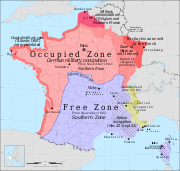
Laval in the Vichy government, 1940–1941
When Laval was included in Pétain's cabinet as minister of state, he began the work for which he would be remembered: the emulation of the totalitarian regime of Germany, the taking up of the cause of fascism, the destruction of democracy, and the dismantling of the Third Republic.In October 1940, Laval understood collaboration more or less in the same sense as Pétain. For both, to collaborate meant to give up the least possible in order to get the most. Laval, in his role of go-between, was forced to be in constant touch with the German authorities, to shift ground, to be wily, to plan ahead. All this, under the circumstances, drew more attention to him than to the Marshal and made him appear to many Frenchmen as "the agent of collaboration"; to others, he was "the Germans' man".
The meetings between Pétain and Adolf Hitler
Adolf Hitler
Adolf Hitler was an Austrian-born German politician and the leader of the National Socialist German Workers Party , commonly referred to as the Nazi Party). He was Chancellor of Germany from 1933 to 1945, and head of state from 1934 to 1945...
, and between Laval and Hitler, are often used as showing the collaboration of the French leaders and the Nazis. In fact the results of Montoire (24–26 October) were a disappointment for both sides. Hitler wanted France to declare war on the British, and the French wanted improved relations with her conqueror. Neither happened. Virtually the only concession the French obtained was the so-called 'Berlin protocol' of 16 November, which provided release of certain categories of French prisoners of war.
In November, Laval made a number of pro-German actions on his own, without consulting with his colleagues. The most notorious examples concerned turning over to the Germans the RTB Bor
RTB Bor
RTB Bor is a copper mining company located in Bor, Serbia.-History:After privatisation of the company, the following facilities of the company have remained with basic activities related to the extraction and treatment of copper ore:...
copper mines and the Belgian gold reserves. His post-war justification, apart from a denial that he acted unilaterally, was that the French were powerless to prevent the Germans from gaining something they were clearly so eager to obtain.
These actions by Laval were a factor in his dismissal on 13 December, when Pétain asked all the ministers to sign a collective letter of resignation during a full cabinet meeting. Laval did so thinking it was a device to get rid of M. Belin, the Minister of Labor. He was therefore stunned when the Marshal announced, "the resignations of MM. Laval and Ripert are accepted."
That evening, Laval was arrested and driven by the police to his home in Châteldon. The following day, Pétain announced his decision to remove Laval from the government. The reason for Laval's dismissal lies in the fundamental incompatibility between him and Pétain. Laval's methods of working appeared slovenly to the Marshal's precise military mind, and he showed a marked lack of deference, instanced by his habit of blowing cigarette smoke in Pétain's face, and in doing so he aroused not only Pétain's anger, but that of his cabinet colleagues as well.
Return to power, 1942
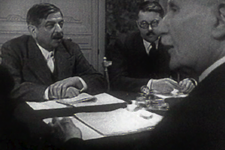
The role of Laval in the deportation of Jews to death camps has been hotly debated by both his accusers and defenders. When ordered to have all Jews in France be rounded up and loaded on railroad cars to be transported to Poland, Laval negotiated a compromise, allowing only those Jews who were not French citizens to be forfeited to the control of Germany. It has been estimated that by the end of the war the Germans had wiped out ninety percent of the Jewish population of the other occupied countries but in France fifty per cent of the pre-war French and foreign Jewish population, with perhaps ninety per cent of the purely French Jewish population still remaining alive. However, Laval went beyond the orders given to him by the Germans, by including Jewish children under 16 in the deportations. The Germans had given him permission to spare children under 16. In his book Churches and the Holocaust, Mordecai Paldiel claims that when Protestant leader Martin Boegner visited Laval in order to remonstrate, Laval claimed that he had ordered children to be deported along with their parents because families should not be separated and "children should remain with their parents". According to Paldiel, when Boegner argued that the children would almost certainly die, Laval replied "not one [Jewish child] must remain in France". Yet, Sarah Fishman claims that Laval also attempted to prevent Jewish children gaining visas to America, arranged by the American Friends Service Committee. He was not so much committed to expelling Jewish children from France, as making sure they reached Nazi camps. Neither Paldiel nor Fishman offer valid citations for what they have written, so it must be considered as hearsay.
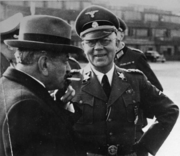
Quisling
Quisling is a term used in reference to fascist and collaborationist political parties and military and paramilitary forces in occupied Allied countries which collaborated with Axis occupiers in World War II, as well as for their members and other collaborators.- Etymology :The term was coined by...
Government made up of French Nazis. Compromise after compromise loaded Laval with the accusation he was nothing more than an agent of Germany.
1943–1945
In 1943, Laval became the nominal leader of the newly-created MiliceMilice
The Milice française , generally called simply Milice, was a paramilitary force created on January 30, 1943 by the Vichy Regime, with German aid, to help fight the French Resistance. The Milice's formal leader was Prime Minister Pierre Laval, though its chief of operations, and actual leader, was...
, though its actual leader was Secretary General Joseph Darnand
Joseph Darnand
Joseph Darnand was a French soldier and later a leader of the Vichy French collaborators with Nazi Germany....
.
With the Operation Torch
Operation Torch
Operation Torch was the British-American invasion of French North Africa in World War II during the North African Campaign, started on 8 November 1942....
, the landings of Allied forces in North Africa, Germany occupied all of France. Hitler continued to ask whether the French government was prepared to fight at his side against the Anglo-Saxons, wanting Vichy to declare war against Britain. Laval and Pétain agreed to maintain a firm refusal. During this time and the D-Day
D-Day
D-Day is a term often used in military parlance to denote the day on which a combat attack or operation is to be initiated. "D-Day" often represents a variable, designating the day upon which some significant event will occur or has occurred; see Military designation of days and hours for similar...
landings, Laval was in a struggle against ultra-collaborationist ministers.
In a broadcast speech on D-Day he appealed to the nation:
A few months later, he was arrested by the Germans and transported to Belfort
Belfort
Belfort is a commune in the Territoire de Belfort department in Franche-Comté in northeastern France and is the prefecture of the department. It is located on the Savoureuse, on the strategically important natural route between the Rhine and the Rhône – the Belfort Gap or Burgundian Gate .-...
. In view of the speed of the Allied advance, on 7 September, what was left of the Vichy government was moved from Belfort to the castle of Sigmaringen
Sigmaringen
Sigmaringen is a town in southern Germany, in the state of Baden-Württemberg. Situated on the upper Danube, it is the capital of the Sigmaringen district....
in Germany. By April 1945 U.S. General George S. Patton
George S. Patton
George Smith Patton, Jr. was a United States Army officer best known for his leadership while commanding corps and armies as a general during World War II. He was also well known for his eccentricity and controversial outspokenness.Patton was commissioned in the U.S. Army after his graduation from...
's army was near Sigmaringen so the Vichy ministers were forced to seek their own salvation. Laval received permission to enter Spain, only to be returned to Germany after a few months. The United States authorities immediately took him and his wife into custody, and turned them over to the Free French. They were flown to Paris to be imprisoned at Fresnes, Val-de-Marne
Fresnes, Val-de-Marne
Fresnes is a commune in the Val-de-Marne department in the southern suburbs of Paris, France. It is located from the center of Paris.The Fresnes Prison is located there.-Name:...
. Madame Laval was later released; Pierre Laval remained in prison to be tried as a traitor.
Trial and execution
Two trials were to be held. Although it had its faults, the Pétain trial permitted the presentation and examination of a vast amount of pertinent material. As to the second trial, a number of scholars including Robert Paxton and Geoffrey Warner are of the opinion that Laval's own trial illustrated nothing but the inadequacies of the judicial system and the poisonous political atmosphere of that purge-trial era.During his imprisonment pending the verdict of his treason trial, Laval wrote his only book, his posthumously published Diary, which his daughter, Josée de Chambrun smuggled out of the prison page by page.
Laval firmly believed that, if he could only secure a fair hearing, he would be able to convince his fellow-countrymen that he had been acting in their best interests all along. "Father-in-law wants a big trial which will illuminate everything", René de Chambrun
René de Chambrun
René de Chambrun , was a lawyer at the Court of Appeals of Paris and of the New York State Bar Association and a descendant of Lafayette, as well as a Chevalier of the Légion d'honneur, and honorary president of the Sons of the American Revolution in France...
told Laval's lawyers: "If he is given time to prepare his defence, if he is allowed to speak, to call witnesses and to obtain from abroad the information and documents which he needs, he will confound his accusers."
Laval more than suspected what would really happen. "Do you want me to tell you the set-up?" he asked one of his lawyers on 4 August. "There will be no pre-trial hearings and no trial. I will be condemned – and got rid of – before the elections."
Laval's trial began at 1:30 pm on Thursday, 4 October 1945. He was charged with plotting against the security of the State and intelligence (collaboration) with the enemy. He had three defence lawyers (Jaques Baraduc, Albert Naud, and Yves-Frédéric Jaffré).
None of his lawyers had ever met him before. He saw most of Jaffré, who sat with him, talked, listened and took down notes that he wanted to dictate. Baraduc, who quickly became convinced of Laval's innocence, kept contact with the Chambruns and at first shared their conviction that Laval would be acquitted or at most receive a sentence of temporary exile. Naud, who had been a member of the Resistance, believed Laval to be guilty and urged him to plead that he had made grave errors but had acted under constraint. Laval would not listen to him; he was convinced that he was innocent and could prove it. "He acted", said Naud, "as if his career, not his life, was at stake."
All three of his lawyers declined to be in court to hear the reading of the formal charges because "We fear that the haste which has been employed to open the hearings is inspired, not by judicial preoccupations, but motivated by political considerations." In lieu of attending the hearing they sent letters stating the shortcomings and asked to be discharged from the task of defending Laval.
Their letters had no effect, and the court carried on without them. The president of the court, Pierre Mongibeaux announced that the trial must be completed before the general election—scheduled for 21 October. The trial proceeded with the tone being set with Mongibeaux and Mornet, the public prosecutor, unable to control constant hostile outbursts from the jury. These occurred as increasingly heated exchanges between Mongibeaux and Laval became louder and louder. On the third day, Laval's three lawyers were with him as the President of the Bar Association had advised them to resume their duties.
After the adjournment, Mongibeaux announced that the part of the interrogation dealing with the charge of plotting against the security of the state was concluded and that he now proposed to deal with the charge of intelligence (collaboration) with the enemy. "Monsieur le Président", Laval replied, "the insulting way in which you questioned me earlier and the demonstrations in which some members of the jury indulged show me that I may be the victim of a judicial crime. I do not want to be an accomplice; I prefer to remain silent." Mongibeaux thereupon called the first of the prosecution witnesses, but they had not expected to give evidence so soon and none were present. Mongibeaux therefore adjourned the hearing for the second time so that they could be located. When the court reassembled half an hour later, Laval was no longer in his place.
Although Pierre-Henri Teitgen
Pierre-Henri Teitgen
Pierre-Henri Teitgen was a French lawyer, professor and politician.Teitgen was born in Rennes, Brittany. Made prisoner of war in 1940, he played a major role in the French Resistance....
, the Minister of Justice in Charles de Gaulle
Charles de Gaulle
Charles André Joseph Marie de Gaulle was a French general and statesman who led the Free French Forces during World War II. He later founded the French Fifth Republic in 1958 and served as its first President from 1959 to 1969....
's cabinet, personally appealed to Laval's lawyers to have him attend the hearings, he declined to do so. Teitgen freely confirmed the conduct of Mongibeaux and Mornet, professing he was unable to do anything to curb them. The trial continued without the accused, ending with Laval being sentenced to death. His lawyers were turned down when they requested a re-trial.
The execution was fixed for the morning of 15 October. Laval attempted to cheat the firing squad by taking poison from a phial which had been stitched inside the lining of his jacket since the war years. He did not intend, he explained in a suicide note, that French soldiers should become accomplices in a "judicial crime". The poison, however, was so old that it was ineffective, and repeated stomach-pumpings
Gastric lavage
Gastric lavage, also commonly called stomach pumping or Gastric irrigation, is the process of cleaning out the contents of the stomach. It has been used for over 200 years as a means of eliminating poisons from the stomach. Such devices are normally used on a person who has ingested a poison or...
revived Laval.
Laval requested his lawyers to witness his execution. He was shot shouting "Vive la France!". Shouts of "Murderers!" and "Long live Laval!" were apparently heard from the prison Laval's widow declared: "It is not the French way to try a man without letting him speak", she told an English newspaper, "That's the way he always fought against – the German way."
The High Court, which functioned until 1949, judged 108 cases, pronouncing eight death penalties, including one on Pétain but asking that it not be carried out because of his age. Only three of the death penalties were carried out: Pierre Laval, Fernand de Brinon
Fernand de Brinon
Fernand de Brinon, Marquis de Brinon was a French lawyer and journalist who was one of the architects of French collaboration with the Nazis during World War II...
, Vichy's Ambassador in Paris to the German authorities, and Joseph Darnand
Joseph Darnand
Joseph Darnand was a French soldier and later a leader of the Vichy French collaborators with Nazi Germany....
, head of the Milice
Milice
The Milice française , generally called simply Milice, was a paramilitary force created on January 30, 1943 by the Vichy Regime, with German aid, to help fight the French Resistance. The Milice's formal leader was Prime Minister Pierre Laval, though its chief of operations, and actual leader, was...
.
Laval's First Government, 27 January 1931 – 14 January 1932
- Pierre Laval – President of the Council and Minister of the Interior
- Léon BérardLéon BérardLéon Bérard was a French politician and lawyer.He was Minister of Public Instruction in 1919 and from 1921 to 1924, and Minister of Justice from 1931 to 1932 and was elected to the Académie française in 1934.Bérard was the Ambassador from Vichy France to the Holy See from 1940 to 1945.-Léon Bérard...
– Vice-President of the Council and Minister of Justice - Aristide BriandAristide BriandAristide Briand was a French statesman who served eleven terms as Prime Minister of France during the French Third Republic and received the 1926 Nobel Peace Prize.- Early life :...
– Minister of Foreign Affairs - André MaginotAndré MaginotAndré Maginot was a French civil servant, soldier, and Member of Parliament. He is undoubtedly best known for his advocacy for the string of forts that would be known as the Maginot Line.- Early years, to World War I :...
– Minister of War - Charles DumontCharles DumontCharles Dumont, born in 1929 in Cahors , is a French singer and composer.He wrote songs until the 1960s, sometimes under an alias, for Dalida, Gloria Lasso, Luis Mariano and Tino Rossi. He worked with lyricist Michel Vaucaire. In 1956 they wrote Non, je ne regrette rien, recorded in 1960 by Édith...
– Minister of Marine - Jacques-Louis Dumesnil – Minister of Air
- Mario Roustan – Minister of Public Instruction and Fine Arts
- Pierre Étienne FlandinPierre Étienne FlandinPierre Étienne Flandin was a French conservative politician of the Third Republic, leader of the Democratic Republican Alliance , and Prime Minister of France from 8 November 1934 to 31 May 1935....
– Minister of Finance - François PiétriFrançois PiétriFrançois Piétri was a minister in several governments in the later years of the French Third Republic and was French ambassador to Spain from 1940 to 1944 under the Vichy regime....
– Minister of Budget - Maurice Deligne – Minister of Public Works
- Louis Rollin – Minister of Commerce and Industry
- André TardieuAndré TardieuAndré Pierre Gabriel Amédée Tardieu was three times Prime Minister of France and a dominant figure of French political life in 1929-1932.-Biography:...
– Minister of Agriculture - Charles de Chappedelaine – Minister of Merchant Marine
- Auguste Champetier de RibesAuguste Champetier de RibesAuguste Champetier de Ribes was a French politician and jurist.A devout Catholic, he was an early follower of Albert de Mun and social Christianity. Wounded in the First World War, he was elected to the Chamber of Deputies from the Basses-Pyrénées as a Christian democrat from 1924 to 1934...
– Minister of Pensions - Adolphe Landry – Minister of Labour and Social Security Provisions
- Camille BlaisotCamille BlaisotCamille Blaisot was a French politician and lawyer.Blaisot was born in Valognes and was elected in 1914 to represent Caen in the Chamber of Deputies. He served as Minister of Health in 1931 and 1932 under Pierre Laval and André Tardieu, and again in 1935 and 1936 under Laval...
– Minister of Public Health - Charles Guernier – Minister of Posts, Telegraphs, and Telephones
- Paul ReynaudPaul ReynaudPaul Reynaud was a French politician and lawyer prominent in the interwar period, noted for his stances on economic liberalism and militant opposition to Germany. He was the penultimate Prime Minister of the Third Republic and vice-president of the Democratic Republican Alliance center-right...
– Minister of Colonies
Changes
A few changes after Aristide Briand's retirement and the death of André Maginot on 7 January 1932:- War: André TardieuAndré TardieuAndré Pierre Gabriel Amédée Tardieu was three times Prime Minister of France and a dominant figure of French political life in 1929-1932.-Biography:...
- Interieur: Pierre Cathala
- Agriculture: Achille FouldAchille FouldAchille Fould was a French financier and politician.Born in Paris, the son of a successful Jewish banker, he was associated with and afterwards succeeded his father in the management of the business. As early as 1842 he entered political life, having been elected in that year as a deputy for the...
- André François-PoncetAndré François-PoncetAndré François-Poncet was a French politician and diplomat whose post as ambassador to Germany allowed him to witness first-hand the rise to power of Adolf Hitler and the Nazi Party, and the Nazi regime's preparations for war.François-Poncet was the son of a counselor of the Court of Appeals in...
upon becoming ambassador to Germany was replaced by C.J. Gignoux.
Laval's Second Government, 14 January – 20 February 1932
- Pierre Laval – President of the Council and Minister of Foreign Affairs
- André TardieuAndré TardieuAndré Pierre Gabriel Amédée Tardieu was three times Prime Minister of France and a dominant figure of French political life in 1929-1932.-Biography:...
– Minister of War - Pierre Cathala – Minister of the Interior
- Pierre-Étienne Flandin – Minister of Finance
- François PiétriFrançois PiétriFrançois Piétri was a minister in several governments in the later years of the French Third Republic and was French ambassador to Spain from 1940 to 1944 under the Vichy regime....
– Minister of Budget - Adolphe Landry – Minister of Labour and Social Security Provisions
- Léon BérardLéon BérardLéon Bérard was a French politician and lawyer.He was Minister of Public Instruction in 1919 and from 1921 to 1924, and Minister of Justice from 1931 to 1932 and was elected to the Académie française in 1934.Bérard was the Ambassador from Vichy France to the Holy See from 1940 to 1945.-Léon Bérard...
– Minister of Justice - Charles DumontCharles DumontCharles Dumont, born in 1929 in Cahors , is a French singer and composer.He wrote songs until the 1960s, sometimes under an alias, for Dalida, Gloria Lasso, Luis Mariano and Tino Rossi. He worked with lyricist Michel Vaucaire. In 1956 they wrote Non, je ne regrette rien, recorded in 1960 by Édith...
– Minister of Marine - Louis de Chappedelaine – Minister of Merchant Marine
- Jacques-Louis Dumesnil – Minister of Air
- Mario Roustan – Minister of Public Instruction and Fine Arts
- Auguste Champetier de RibesAuguste Champetier de RibesAuguste Champetier de Ribes was a French politician and jurist.A devout Catholic, he was an early follower of Albert de Mun and social Christianity. Wounded in the First World War, he was elected to the Chamber of Deputies from the Basses-Pyrénées as a Christian democrat from 1924 to 1934...
– Minister of Pensions - Achille FouldAchille FouldAchille Fould was a French financier and politician.Born in Paris, the son of a successful Jewish banker, he was associated with and afterwards succeeded his father in the management of the business. As early as 1842 he entered political life, having been elected in that year as a deputy for the...
– Minister of Agriculture - Paul ReynaudPaul ReynaudPaul Reynaud was a French politician and lawyer prominent in the interwar period, noted for his stances on economic liberalism and militant opposition to Germany. He was the penultimate Prime Minister of the Third Republic and vice-president of the Democratic Republican Alliance center-right...
– Minister of Colonies - Maurice Deligne – Minister of Public Works
- Camille BlaisotCamille BlaisotCamille Blaisot was a French politician and lawyer.Blaisot was born in Valognes and was elected in 1914 to represent Caen in the Chamber of Deputies. He served as Minister of Health in 1931 and 1932 under Pierre Laval and André Tardieu, and again in 1935 and 1936 under Laval...
– Minister of Public Health - Charles Guernier – Minister of Posts, Telegraphs, and Telephones
- Louis Rollin – Minister of Commerce and Industry
Laval's Third Ministry, 7 June 1935 – 24 January 1936
- Pierre Laval – President of the Council and Minister of Foreign Affairs
- Jean Fabry – Minister of War
- Joseph Paganon – Minister of the Interior
- Marcel Régnier – Minister of Finance
- Ludovic-Oscar FrossardLudovic-Oscar FrossardLudovic-Oscar Frossard was a French socialist and communist politician, a member of six successive French governments between 1935 and 1940.-Early career and PCF:Born into an anti-clerical family opposed to the antisemitical side during the Dreyfus...
– Minister of Labour - Léon BérardLéon BérardLéon Bérard was a French politician and lawyer.He was Minister of Public Instruction in 1919 and from 1921 to 1924, and Minister of Justice from 1931 to 1932 and was elected to the Académie française in 1934.Bérard was the Ambassador from Vichy France to the Holy See from 1940 to 1945.-Léon Bérard...
– Minister of Justice - François PiétriFrançois PiétriFrançois Piétri was a minister in several governments in the later years of the French Third Republic and was French ambassador to Spain from 1940 to 1944 under the Vichy regime....
– Minister of Marine - Mario Roustan – Minister of Merchant Marine
- Victor Denain – Minister of Air
- Philippe Marcombes – Minister of National Education
- Henri Maupoil – Minister of Pensions
- Pierre Cathala – Minister of Agriculture
- Louis Rollin – Minister of Colonies
- Laurent EynacLaurent EynacLaurent Eynac was a French politician who was appointed Minister of Transportation on 7 June 1935 until 24 January 1936.He was born in Le Monastier-sur-Gazeille, Haute-Loire.-References:...
– Minister of Public Works - Ernest LafontErnest LafontLouis-Ernest Lafont was a French socialist politician. Lafont represented Loire in the French National Assembly between 1914 and 1928, and then Hautes-Alpes between 1928 and 1936. He served as Minister of Public Health 1935-1936...
– Minister of Public Health and Physical Education - Georges MandelGeorges MandelGeorges Mandel was a French politician, journalist, and French Resistance leader.-Biography:Born Louis George Rothschild in Chatou, Yvelines, was the son of a tailor...
– Minister of Posts, Telegraphs, and Telephones - Georges BonnetGeorges BonnetNot to be confused with the French Socialist Georges MonnetGeorges-Étienne Bonnet was a French politician and leading figure in the Radical-Socialist Party.- Early career :...
– Minister of Commerce and Industry - Édouard HerriotÉdouard HerriotÉdouard Marie Herriot was a French Radical politician of the Third Republic who served three times as Prime Minister and for many years as President of the Chamber of Deputies....
– Minister of State - Louis MarinLouis MarinLouis Marin was a French philosopher, historian, semiotician and art critic of the 20th century.He was born in La Tronche, He is usually referred to as a French Post-Structuralism thinker. He attended the University of Paris, Sorbonne and graduated with a Licence in Philosophy in 1952...
– Minister of State - Pierre Étienne FlandinPierre Étienne FlandinPierre Étienne Flandin was a French conservative politician of the Third Republic, leader of the Democratic Republican Alliance , and Prime Minister of France from 8 November 1934 to 31 May 1935....
– Minister of State
Changes
- 17 June 1935 – Mario Roustan succeeds Marcombes (d. 13 June) as Minister of National Education. William Bertrand succeeds Roustan as Minister of Merchant Marine.
Laval's Fourth Ministry, 18 April 1942 – 20 August 1944
- Pierre Laval – President of the Council, Minister of Foreign Affairs, Minister of the Interior, and Minister of Information
- Eugène Bridoux – Minister of War
- Pierre Cathala – Minister of Finance and National Economy
- Jean BichelonneJean BichelonneJean Bichelonne was a French businessman and member of the Vichy government that existed during World War II following the occupation of France by Nazi Germany....
– Minister of Industrial Production - Hubert LagardelleHubert LagardelleHubert Lagardelle was a French syndicalist thinker, influenced by Proudhon and Georges Sorel. He gradually moved to the right and served as Minister of Labour in the Vichy regime under Pierre Laval from 1942 to 1943....
– Minister of Labour - Joseph BarthélemyJoseph BarthélemyJoseph Barthélemy was a French jurist, politician and journalist. Initially a critic of Nazi Germany, he would go on to serve as a minister in the collaborationist Vichy regime.-Early years:...
– Minister of Justice - Gabriel AuphanGabriel AuphanGabriel Paul Auphan was a French admiral, chief of cabinet of Admiral Darlan under Vichy France and later Secrétaire d'État à la marine of Vichy.- Early career :...
– Minister of Marine - Jean-François Jannekeyn – Minister of Air
- Abel BonnardAbel BonnardAbel Bonnard was a French poet, novelist and politician.-Biography:Born in Poitiers, Vienne, his early education was in Marseilles with secondary studies at the Lycée Louis-le-Grand in Paris...
– Minister of National Education - Jacques Le Roy Ladurie – Minister of Agriculture
- Max Bonnafous – Minister of Supply
- Jules Brévié – Minister of Colonies
- Raymond Grasset – Minister of Family and Health
- Robert Gibrat – Minister of Communication
- Lucien RomierLucien RomierLucien Romier was a French journalist and politician.After studying at the École des Chartes, where he wrote a thesis on Jacques d'Albon de Saint-André, he was a member of the French School in Rome....
– Minister of State
Changes
- 11 September 1942 – Max Bonnafous succeeds Le Roy Ladurie as Minister of Agriculture, remaining also Minister of Supply
- 18 November 1942 – Jean-Charles Abrial succeeds Auphan as Minister of Marine. Jean BichelonneJean BichelonneJean Bichelonne was a French businessman and member of the Vichy government that existed during World War II following the occupation of France by Nazi Germany....
succeeds Gibrat as Minister of Communication, remaining also Minister of Industrial Production. - 26 March 1943 – Maurice Gabolde succeeds Barthélemy as Minister of Justice. Henri Bléhaut succeeds Abrial as Minister of Marine and Brévié as Minister of Colonies.
- 21 November 1943 – Jean BichelonneJean BichelonneJean Bichelonne was a French businessman and member of the Vichy government that existed during World War II following the occupation of France by Nazi Germany....
succeeds Lagardelle as Minister of Labour, remaining also Minister of Industrial Production and Communication. - 31 December 1943 – Minister of State Lucien Romier resigns from the government.
- 6 January 1944 – Pierre Cathala succeeds Bonnafous as Minister of Agriculture and Supply, remaining also Minister of Finance and National Economy.
- 3 March 1944 – The office of Minister of Supply is abolished. Pierre Cathala remains Minister of Finance, National Economy, and Agriculture.
- 16 March 1944 – Marcel DéatMarcel DéatMarcel Déat was a French Socialist until 1933, when he initiated a spin-off from the French Section of the Workers' International along with other right-wing 'Neosocialists'. He then founded the collaborationist National Popular Rally during the Vichy regime...
succeeds Bichelonne as Minister of Labour and National Solidarity. Bichelonne remains Minister of Industrial Production and Communication.
Critical of Laval
- Tissier, Pierre, I worked with Laval, London: George Harrap & Co, 1942
- Torrés, Henry, Pierre Laval (Translated by Norbert Guterman), New York: Oxford University Press, 1941
- Bois, Elie J., Truth on the Tragedy of France, (London, 1941)
- Pétain-Laval The Conspiracy, With a Foreword by Viscount Cecil, London: Constable, 1942
- Marrus, Michael & Paxton, Robert O. Vichy France and the Jews, New York: Basic Books New York 1981,
Post-war defences of Laval
- Julien Clermont (pseudonym for Georges Hilaire), L'Homme qu'il fallait tuer (Paris, 1949)
- Jacques Guerard, Criminel de Paix (Paris, 1953)
- Michel Letan, Pierre Laval de l'armistice au poteau (Paris, 1947)
- Alfred Mallet, Pierre Laval (Paris, 1955)
- Maurice Privat, Pierre Laval, cet inconnu (Paris, 1948)
- René de Chambrun, Pierre Laval, Traitor or Patriot?, (New York) 1984; and Mission and Betrayal, (London, 1993).
- Whitcomb, Philip W., France During The German Occupation 1940–1944, Stanford, California: Stanford University Press, 1957, In three vol.
Books by Laval's lawyers
- Baraduc, Jaques, Dans la Cellule de Pierre Laval, Paris: Editions Self, 1948
- Jaffré, Yves-Frédéric, Les Derniers Propos de Pierre Laval, Paris: Andre Bonne, 1953
- Naud, Albert, Pourquoi je n'ai pas défendu Pierre Laval, Paris: Fayard 1948
Full biographies
- Cointet, Jean-Paul, Pierre Laval, Paris: Fayard, 1993
- Cole, Hubert, Laval, New York: G. P. Putnam's Sons, 1963
- Kupferman, Fred, Laval 1883–1945, Paris: Flammarion, 1988
- Pourcher, Yves, Pierre Laval vu par sa fille, Paris: Le Grande Livre du Mois, 2002
- Warner, Geoffery, Pierre Laval and the eclipse of France, New York: The Macmillian Company, 1968
Other biographical material
- Man of the Year profile, 4 January 1932
- Time Magazine Cover Story article 27 April 1942 on the Laval treason trial, 15 Oct. 1945 on Laval's testimony in Petain's trial, 13 Aug. 1945
- Abrahamsen, David, Men, Mind, and Power, New York: Columbia University Press, 1945
- Bonnefous, Georges and Edouard: Histoire Politque de la Troisième République, Vol. V, Paris: Presses Universitaires de France, 1962
- Brody, J. Kenneth, The Avoidable War (Vol. 2) Pierre Laval & Politics of Reality 1935–1936, New Brunswick: Transaction Publishers, 2000
- Bechtel, Guy, Laval, vingt ans apres, Paris: Robert Laffont, 1963
- Chambrun, René de, Laval, Devant L'History, Paris: EDITIONS FRANCE-EMPIRE, 1983
- Chambrun, René de, Mission and Betrayal 1939–1945, London: André Deutch Ltd., 1993
- Clermont, Julien, L'homme qu'il Fallait Tuer --- Pierre Laval, Paris: Les Actes des Apotres, 1949
- Curtis, Michael, Verdict on Vichy, New York: Arcade Publishing, 2002
- De Gaulle Mémoires de Guerre, Vol. III, Le Salut 1944–46, Paris: Plon, 1959
- Farmer, Paul, Vichy --- Political Dilemma, London: Oxford University Press, 1955
- Gounelle, Claude, Le Dossier Laval, Paris: Librairie Plon, 1969
- Gun, Nerin E., Les secrets des archives américaines, Pétain, Laval, De Gaulle, Paris: Albin Michel, 1979
- Jacquemin, Gason, La vie publique de Pierre Laval, Paris: Plon, 1973
- Laval Parle, Notes et Mémoires Rédigées par Pierre Laval dans sa cellule, avec une préface de sa fille et de Nombreux Documents Inédits, Constant Bourquin (Editor), Geneva: Sditions du Cheval Ailé, 1947
- Laval, P. The Unpublished Diary of Pierre Laval, Falcon Press Ltd. London, 1948.
- Laval, Pierre, The Diary of Pierre Laval (With a Preface by his daughter, Josée Laval), New York: Scribner's Sons, 1948
- Le Procés Laval: Compte-rendu sténographique, Maurice Garçon (Editor), Paris: Albin Michel, 1946
- Letan, Michel, Pierre Laval – de l'armistice au Poteau, Paris: Éditions de la Couronne, 1947
- Mallet, Pierre Laval, Paris: Amiot Dumont, 1955, Volume I and II.
- Pannetier, Odette, Pierre Laval, Paris: Denoél et Steele, 1936
- Paxton, Robert O., Vichy France, Old Guard and New Order 1940–1944, New York: Columbia University Press, 1972 (1982)
- Pertinax, The Gravediggers of France, New York: Doubleday, Doran & Company, 1944
- Privat, Maurice, Pierre Laval, Paris: Editions Les Documents secrets, 1931
- Privat, Maurice, Pierre Laval, cet inconnu, Paris: Fourner-Valdés, 1948
- Saurel, Louis, La Fin de Pierre Laval, Paris: Éditions Rouff, 1965
- Thompson, David, Two Frenchman, Pierre Laval and Charles de Gaulle, London: The Cresset Press, 1951
- Volcker, Sebastian, Laval 1931, A Diplomatic Study, Thesis, University of Richmond, 1998
- Weygand, General Maxime, Mémoires, Vol. III, Paris: Flammarion, 1950
- The London Evening Standard, 15,16,and 17 October 1945 (cover pages).
- A collection containing all of the books and other reference material listed in the Notes and References as well as many other items concerning Pierre Laval are housed in the Donald PrellDonald PrellDonald B. Prell is a venture capitalist and futurist who created Datamation, the first magazine devoted solely to the computer hardware and software industry.-Early life:...
Pierre Laval Collection in the Special Collections Library at the University of California Riverside: http://scotty.ucr.edu/search/a?searchtype=Y&searcharg=Pierre+Laval+Collection&SORT=D&searchscope=5&submit=Go!