


Insurgency

Encyclopedia
Rebellion
Rebellion, uprising or insurrection, is a refusal of obedience or order. It may, therefore, be seen as encompassing a range of behaviors aimed at destroying or replacing an established authority such as a government or a head of state...
against a constituted authority (for example, an authority recognized as such by the United Nations
United Nations
The United Nations is an international organization whose stated aims are facilitating cooperation in international law, international security, economic development, social progress, human rights, and achievement of world peace...
) when those taking part in the rebellion are not recognized as belligerent
Belligerent
A belligerent is an individual, group, country or other entity which acts in a hostile manner, such as engaging in combat. Belligerent comes from Latin, literally meaning "to wage war"...
s. An insurgency can be fought via counter-insurgency
Counter-insurgency
A counter-insurgency or counterinsurgency involves actions taken by the recognized government of a nation to contain or quell an insurgency taken up against it...
warfare, and may also be opposed by measures to protect the population, and by political and economic actions of various kinds aimed at undermining the insurgents' claims against the incumbent regime. An "insurgency" may include, but not necessarily use, guerrilla warfare
Guerrilla warfare
Guerrilla warfare is a form of irregular warfare and refers to conflicts in which a small group of combatants including, but not limited to, armed civilians use military tactics, such as ambushes, sabotage, raids, the element of surprise, and extraordinary mobility to harass a larger and...
.
Not all rebellions are insurgencies. There have been many cases of non-violent rebellions, using civil resistance
Civil resistance
The term civil resistance, alongside the term nonviolent resistance, is used to describe political action that relies on the use of non-violent methods by civil groups to challenge a particular power, force, policy or regime. Civil resistance operates through appeals to the adversary, pressure and...
, as in the People Power Revolution in the Philippines
Philippines
The Philippines , officially known as the Republic of the Philippines , is a country in Southeast Asia in the western Pacific Ocean. To its north across the Luzon Strait lies Taiwan. West across the South China Sea sits Vietnam...
in the 1980s that ousted President Marcos
Ferdinand Marcos
Ferdinand Emmanuel Edralin Marcos, Sr. was a Filipino leader and an authoritarian President of the Philippines from 1965 to 1986. He was a lawyer, member of the Philippine House of Representatives and a member of the Philippine Senate...
and the Egyptian Revolution of 2011. Where a revolt takes the form of armed rebellion, it may not be viewed as an insurgency if a state of belligerency exists between one or more sovereign states and rebel forces. For example, during the American Civil War
American Civil War
The American Civil War was a civil war fought in the United States of America. In response to the election of Abraham Lincoln as President of the United States, 11 southern slave states declared their secession from the United States and formed the Confederate States of America ; the other 25...
, the Confederate States of America
Confederate States of America
The Confederate States of America was a government set up from 1861 to 1865 by 11 Southern slave states of the United States of America that had declared their secession from the U.S...
was not recognized as a sovereign state, but it was recognized as a belligerent power, and thus Confederate warships were given the same rights as United States warships in foreign ports.
When insurgency is used to describe a movement's unlawfulness by virtue of not being authorized by or in accordance with the law
Law
Law is a system of rules and guidelines which are enforced through social institutions to govern behavior, wherever possible. It shapes politics, economics and society in numerous ways and serves as a social mediator of relations between people. Contract law regulates everything from buying a bus...
of the land, its use is neutral. However when it is used by a state or another authority under threat, "insurgency" often also carries an implication that the rebels' cause is illegitimate, whereas those rising up will see the authority itself as being illegitimate.
A variety of terms, none precisely defined, all fall under the category of insurgency: rebellion, uprisings, etc. The value of the formal models (discussed below) is to have a taxonomy to categorize insurgencies. No two insurgencies are identical. The basis of the insurgency can be political, economic, religious, or ethnic, or a combination of factors.
Sometimes there may be one or more simultaneous insurgencies (multipolar) occurring in a country. The Iraq insurgency is one example of a recognized government versus multiple groups of insurgents. Other historic insurgencies, such as the Russian Civil War
Russian Civil War
The Russian Civil War was a multi-party war that occurred within the former Russian Empire after the Russian provisional government collapsed to the Soviets, under the domination of the Bolshevik party. Soviet forces first assumed power in Petrograd The Russian Civil War (1917–1923) was a...
, have been multipolar rather than a straightforward model made up of two sides. During the Angolan Civil War
Angolan Civil War
The Angolan Civil War was a major civil conflict in the Southern African state of Angola, beginning in 1975 and continuing, with some interludes, until 2002. The war began immediately after Angola became independent from Portugal in November 1975. Prior to this, a decolonisation conflict had taken...
there were two main sides: MPLA and UNITA
UNITA
The National Union for the Total Independence of Angola is the second-largest political party in Angola. Founded in 1966, UNITA fought with the Popular Movement for the Liberation of Angola in the Angolan War for Independence and then against the MPLA in the ensuing civil war .The war was one...
. At the same time, there was a another separatist movement for the independence of the Cabinda
Cabinda (province)
Cabinda is an exclave and province of Angola, a status that has been disputed by many political organizations in the territory. The capital city is also called Cabinda. The province is divided into four municipalities - Belize, Buco Zau, Cabinda and Cacongo.Modern Cabinda is the result of a fusion...
region headed up by FLEC. Multipolarity extends the definition of insurgency to situations where there is no recognized authority, as in the Somali Civil War
Somali Civil War
The Somali Civil War is an ongoing civil war taking place in Somalia. The conflict, which began in 1991, has caused destabilisation throughout the country, with the current phase of the conflict seeing the Somali government losing substantial control of the state to rebel forces...
, especially the period from 1998 to 2006, where it broke into quasi-autonomous smaller states, fighting among one another in changing alliances.
Definition
Belligerent
A belligerent is an individual, group, country or other entity which acts in a hostile manner, such as engaging in combat. Belligerent comes from Latin, literally meaning "to wage war"...
s then the rebellion is an insurgency. However not all rebellions are insurgencies, as state of belligerency may exist between one or more sovereign states and rebel forces. For example, during the American Civil War
American Civil War
The American Civil War was a civil war fought in the United States of America. In response to the election of Abraham Lincoln as President of the United States, 11 southern slave states declared their secession from the United States and formed the Confederate States of America ; the other 25...
, the Confederate States of America
Confederate States of America
The Confederate States of America was a government set up from 1861 to 1865 by 11 Southern slave states of the United States of America that had declared their secession from the U.S...
was not recognized as a sovereign state, but it was recognized as a belligerent power, and thus Confederate warships were given the same rights as United States warships in foreign ports.
When insurgency is used to describe a movement's unlawfulness by virtue of not being authorized by or in accordance with the law
Law
Law is a system of rules and guidelines which are enforced through social institutions to govern behavior, wherever possible. It shapes politics, economics and society in numerous ways and serves as a social mediator of relations between people. Contract law regulates everything from buying a bus...
of the land, its use is neutral. However when it is used by a state or another authority under threat, "insurgency" often also carries an implication that the rebels cause is illegitimate, whereas those rising up will see the authority itself as being illegitimate.
The use of the term insurgency does recognise the political motivation of those who participate in an insurgency, while the term brigandry implies no political motivation. If an uprising has little support (for example those who continue to resist towards the end of an armed conflict when most of their allies have surrendered) then such a resistance may be described as brigandry and those who participate as brigands.
The distinction on whether an uprising is an insurgency or a belligerency has not been as clearly codified as many other areas covered by the internationally accepted laws of war for two reasons. The first is that international law traditionally does not encroach on matter which are solely the internal affairs of a sovereign state (although recent developments such as the responsibility to protect
Responsibility to protect
The responsibility to protect is a norm or set of principles based on the idea that sovereignty is not a privilege, but a responsibility. RtoP focuses on preventing and halting four crimes: genocide, war crimes, crimes against humanity, and ethnic cleansing, which it places under the generic...
is starting to undermine this traditional approach). The second is because at the Hague Conference of 1899 there was disagreement between the Great Power
Great power
A great power is a nation or state that has the ability to exert its influence on a global scale. Great powers characteristically possess military and economic strength and diplomatic and cultural influence which may cause small powers to consider the opinions of great powers before taking actions...
s who considered francs-tireurs
Francs-tireurs
Francs-tireurs – literally "free shooters" – was used to describe irregular military formations deployed by France during the early stages of the Franco-Prussian War...
to be unlawful combatants subject to execution on capture and smaller states who maintained that they should be considered lawful combatants. The dispute resulted in a compromise wording being included in the Hague Conventions
Hague Conventions (1899 and 1907)
The Hague Conventions were two international treaties negotiated at international peace conferences at The Hague in the Netherlands: The First Hague Conference in 1899 and the Second Hague Conference in 1907...
known as the Martens Clause
Martens Clause
The Martens Clause was introduced into the preamble to the 1899 Hague Convention II – Laws and Customs of War on Land.The clause took its name from a declaration read by Fyodor Fyodorovich Martens, the Russian delegate at the Hague Peace Conferences 1899 and was based upon his words:The...
after the diplomat who drafted the clause.
The Third Geneva Convention
Third Geneva Convention
The Third Geneva Convention, relative to the treatment of prisoners of war, is one of the four treaties of the Geneva Conventions. It was first adopted in 1929, but was significantly updated in 1949...
, as well as the other Geneva Conventions, are oriented to conflict involving nation-states, and only loosely address irregular forces:
The United States Department of Defense
United States Department of Defense
The United States Department of Defense is the U.S...
(DOD) defines it as "An organized movement aimed at the overthrow of a constituted government through use of subversion and armed conflict." The United States counterinsurgency Field Manual, proposes a structure that includes both insurgency and counterinsurgency [COIN] (italics in original):
This definition does not consider the morality of the conflict, or the different viewpoints of the government and the insurgents. It is focused more on the operational aspects of the types of actions taken by the insurgents and the counterinsurgents.
The French expert on Indochina and Vietnam, Bernard Fall, who wrote Street Without Joy
Street Without Joy
Street Without Joy or La Rue Sans Joie was the name given by troops of the French Far East Expeditionary Corps to the stretch of Route 1 from Huế to Quảng Trị during the First Indochina War.-Situation:...
, said that "revolutionary warfare" (guerrilla warfare plus political action) might be a more accurate term to describe small wars such as insurgencies. Insurgency has been used for years in professional military literature. Under the British, the situation in Malaya (now Malaysia) was often called the "Malayan insurgency" or "the Troubles" in Northern Ireland
Northern Ireland
Northern Ireland is one of the four countries of the United Kingdom. Situated in the north-east of the island of Ireland, it shares a border with the Republic of Ireland to the south and west...
. Insurgencies have existed in many countries and regions, including the Philippines
Philippines
The Philippines , officially known as the Republic of the Philippines , is a country in Southeast Asia in the western Pacific Ocean. To its north across the Luzon Strait lies Taiwan. West across the South China Sea sits Vietnam...
, Afghanistan
Afghanistan
Afghanistan , officially the Islamic Republic of Afghanistan, is a landlocked country located in the centre of Asia, forming South Asia, Central Asia and the Middle East. With a population of about 29 million, it has an area of , making it the 42nd most populous and 41st largest nation in the world...
, Chechnya
Chechnya
The Chechen Republic , commonly referred to as Chechnya , also spelled Chechnia or Chechenia, sometimes referred to as Ichkeria , is a federal subject of Russia . It is located in the southeastern part of Europe in the Northern Caucasus mountains. The capital of the republic is the city of Grozny...
, Kashmir
Kashmir
Kashmir is the northwestern region of the Indian subcontinent. Until the mid-19th century, the term Kashmir geographically denoted only the valley between the Great Himalayas and the Pir Panjal mountain range...
, Northeast India, Yemen
Yemen
The Republic of Yemen , commonly known as Yemen , is a country located in the Middle East, occupying the southwestern to southern end of the Arabian Peninsula. It is bordered by Saudi Arabia to the north, the Red Sea to the west, and Oman to the east....
, Djibouti
Djibouti
Djibouti , officially the Republic of Djibouti , is a country in the Horn of Africa. It is bordered by Eritrea in the north, Ethiopia in the west and south, and Somalia in the southeast. The remainder of the border is formed by the Red Sea and the Gulf of Aden at the east...
, Colombia
Colombia
Colombia, officially the Republic of Colombia , is a unitary constitutional republic comprising thirty-two departments. The country is located in northwestern South America, bordered to the east by Venezuela and Brazil; to the south by Ecuador and Peru; to the north by the Caribbean Sea; to the...
, Sri Lanka
Sri Lanka
Sri Lanka, officially the Democratic Socialist Republic of Sri Lanka is a country off the southern coast of the Indian subcontinent. Known until 1972 as Ceylon , Sri Lanka is an island surrounded by the Indian Ocean, the Gulf of Mannar and the Palk Strait, and lies in the vicinity of India and the...
, and Democratic Republic of the Congo
Democratic Republic of the Congo
The Democratic Republic of the Congo is a state located in Central Africa. It is the second largest country in Africa by area and the eleventh largest in the world...
, the American colonies of Great Britain
Great Britain
Great Britain or Britain is an island situated to the northwest of Continental Europe. It is the ninth largest island in the world, and the largest European island, as well as the largest of the British Isles...
, and the Confederate States of America
Confederate States of America
The Confederate States of America was a government set up from 1861 to 1865 by 11 Southern slave states of the United States of America that had declared their secession from the U.S...
. Each had different specifics but share the property of an attempt to disrupt the central government by means considered illegal by that government. North points out, however, that insurgents today need not be part of a highly organized movement:
Tactics
Insurgencies differ in their use of tactics and methods. In a 2004 article, Robert R. Tomes spoke of four elements that "typically encompass an insurgency":- cell-networks that maintain secrecy
- terrorismTerrorismTerrorism is the systematic use of terror, especially as a means of coercion. In the international community, however, terrorism has no universally agreed, legally binding, criminal law definition...
used to foster insecurity among the population and drive them to the insurgents for protection - multifaceted attempts to cultivate support in the general population, often by undermining the new regime
- attacks against the government
Tomes is an example of a definition that does not cover all insurgencies, for example the French Revolution
French Revolution
The French Revolution , sometimes distinguished as the 'Great French Revolution' , was a period of radical social and political upheaval in France and Europe. The absolute monarchy that had ruled France for centuries collapsed in three years...
had no cell system, and in the American Revolution
American Revolution
The American Revolution was the political upheaval during the last half of the 18th century in which thirteen colonies in North America joined together to break free from the British Empire, combining to become the United States of America...
little to no attempt was made to terrorize civilians, or consecutive coups in 1977 and 1999 Pakistan the initial actions focused internally to the government rather than seeking broad support. While Tomes' definition fits well with Mao's Phase I, it does not deal well with larger civil wars. Mao does assume terrorism is usually part of the early phases, but it is not always present in revolutionary insurgency.
Tomes offers an indirect definition of insurgency, drawn from Trinquier's definition of counterinsurgency: "an interlocking system of actions—political, economic, psychological, military—that aims at the [insurgents’ intended] overthrow of the established authority in a country and its replacement by another regime."
Steven Metz observes that past models of insurgency do not perfectly fit modern insurgency, in that current instances are far more likely to have a multinational or transnational character than those of the past. Several insurgencies may belong to more complex conflicts, involving "third forces (armed groups which affect the outcome, such as militias) and fourth forces (unarmed groups which affect the outcome, such as international media), who may be distinct from the core insurgents and the recognized government. While overt state sponsorship becomes less common, sponsorship by transnational groups is more common. "The nesting of insurgency within complex conflicts associated with state weakness or failure..." (See the discussion of failed states below.) Metz suggests that contemporary insurgencies have far more complex and shifting participation than traditional wars, where discrete belligerents seek a clear strategic victory.
Terrorism
Not all insurgencies include terrorism, with the caveat that there is no universally accepted definition of terrorism. While there is no accepted definition in international law, United NationsUnited Nations
The United Nations is an international organization whose stated aims are facilitating cooperation in international law, international security, economic development, social progress, human rights, and achievement of world peace...
-sponsored working definitions include one drafted by Alex P. Schmid
Alex P. Schmid
Alex Peter Schmid is an internationally renowned Dutch scholar in Terrorism Studies and former Officer-in-Charge of the Terrorism Prevention Branch of the United Nations...
for the Policy Working Group on the United Nations and Terrorism. Reporting to the Secretary-General in 2002, the Working Group stated the following:
Yet another conflict of definitions involves insurgency versus terrorism. The winning essay of the 24th Annual United States
United States
The United States of America is a federal constitutional republic comprising fifty states and a federal district...
Chairman of the Joint Chiefs of Staff
Chairman of the Joint Chiefs of Staff
The Chairman of the Joint Chiefs of Staff is by law the highest ranking military officer in the United States Armed Forces, and is the principal military adviser to the President of the United States, the National Security Council, the Homeland Security Council and the Secretary of Defense...
Strategic Essay Contest, by Michael F. Morris, said [A pure terrorist group] "may pursue political, even revolutionary, goals, but their violence replaces rather than complements a political program." Morris made the point that the use, or non-use, of terrorism does not define insurgency, "but that organizational traits have traditionally provided another means to tell the two apart. Insurgencies normally field fighting forces orders of magnitude larger than those of terrorist organizations." Insurgencies have a political purpose, and may provide social services and have an overt, even legal, political wing. Their covert wing carries out attacks on military forces with tactics such as raids
Raid (military)
Raid, also known as depredation, is a military tactic or operational warfare mission which has a specific purpose and is not normally intended to capture and hold terrain, but instead finish with the raiding force quickly retreating to a previous defended position prior to the enemy forces being...
and ambush
Ambush
An ambush is a long-established military tactic, in which the aggressors take advantage of concealment and the element of surprise to attack an unsuspecting enemy from concealed positions, such as among dense underbrush or behind hilltops...
es, as well as acts of terror such as attacks that cause deliberate civilian casualties.
Mao considered terrorism a basic part of his first part of the three phases of revolutionary warfare. Several insurgency models recognize that completed acts of terrorism widen the security gap; the Marxist guerrilla theoretician Carlos Marighella
Carlos Marighella
Carlos Marighella , was a Brazilian Marxist revolutionary and writer.Marighella's most famous contribution to guerrilla literature was the Minimanual of the Urban Guerrilla, consisting of advice on how to disrupt and overthrow an authoritarian regime aiming a revolution. He also wrote For the...
specifically recommended acts of terror, as a means of accomplishing something that fits the concept of opening the security gap. Mao considered terrorism to be part of forming a guerilla movement.
Subversion
While not every insurgency involves terror, most involve an equally hard to define tactic, subversion. "When a country is being subverted it is not being outfought; it is being out-administered. Subversion is literally administration with a minus sign in front." The exceptional cases of insurgency without subversion are those when there is no accepted government that is providing administrative services.While it is less commonly used by current U.S. spokesmen, that may be due to the hyperbolic way it was used in the past, in a specifically anticommunist context. U.S. Secretary of State
United States Secretary of State
The United States Secretary of State is the head of the United States Department of State, concerned with foreign affairs. The Secretary is a member of the Cabinet and the highest-ranking cabinet secretary both in line of succession and order of precedence...
Dean Rusk
Dean Rusk
David Dean Rusk was the United States Secretary of State from 1961 to 1969 under presidents John F. Kennedy and Lyndon B. Johnson. Rusk is the second-longest serving U.S...
did in April 1962, when he declared that urgent action was required before the “enemy’s subversive politico-military teams find fertile spawning grounds for their fish eggs.”
In a Western context, Rosenau cites a British Secret Intelligence Service
Secret Intelligence Service
The Secret Intelligence Service is responsible for supplying the British Government with foreign intelligence. Alongside the internal Security Service , the Government Communications Headquarters and the Defence Intelligence , it operates under the formal direction of the Joint Intelligence...
definition as "a generalized intention to (emphasis added) “overthrow or undermine parliamentary democracy by political, industrial or violent means.” While insurgents do not necessarily use terror, it is hard to imagine any insurgency meeting its goals without undermining aspects of the legitimacy or power of the government or faction it opposes. Rosenau mentions a more recent definition that suggests subversion includes measures short of violence, which still serve the purposes of insurgents. Rarely, subversion alone can change a government; this arguably happened in the liberalization of Eastern Europe. To the Communist government of Poland
Poland
Poland , officially the Republic of Poland , is a country in Central Europe bordered by Germany to the west; the Czech Republic and Slovakia to the south; Ukraine, Belarus and Lithuania to the east; and the Baltic Sea and Kaliningrad Oblast, a Russian exclave, to the north...
, Solidarity appeared subversive but not violent.
Political rhetoric, myths and models
In arguing against the term Global War on TerrorWar on Terrorism
The War on Terror is a term commonly applied to an international military campaign led by the United States and the United Kingdom with the support of other North Atlantic Treaty Organisation as well as non-NATO countries...
, Francis Fukuyama said the United States was not fighting terrorism generically, as in Chechnya
Chechnya
The Chechen Republic , commonly referred to as Chechnya , also spelled Chechnia or Chechenia, sometimes referred to as Ichkeria , is a federal subject of Russia . It is located in the southeastern part of Europe in the Northern Caucasus mountains. The capital of the republic is the city of Grozny...
or Palestine
Palestine
Palestine is a conventional name, among others, used to describe the geographic region between the Mediterranean Sea and the Jordan River, and various adjoining lands....
. Rather, he said the slogan "war on terror" is directed at "radical Islamism, a movement that makes use of culture for political objectives." He suggested it might be deeper than the ideological conflict of the Cold War, but it should not be confused with Samuel Huntington
Samuel Huntington
Samuel Huntington may refer to:* Samuel Huntington , American jurist, statesman, and revolutionary leader* Samuel H. Huntington , American jurist* Samuel P. Huntington , American political scientist...
's "clash of civilizations". Addressing Huntington's thesis, Fukuyama stressed that the United States and its allies need to focus on specific radical groups, rather than clash with global Islam.
Fukuyama argued that political means, rather than direct military measures, are the most effective ways to defeat that insurgency. David Kilcullen
David Kilcullen
David John Kilcullen F.R.G.S is an Australian author and consultant who is a leading theorist on counterinsurgency and counterterrorism. In 2007 he served as the Senior Counterinsurgency Adviser to the Commander of the Multi-National Force - Iraq responsible for planning and executing the Joint...
wrote "We must distinguish Al Qa’eda and the broader militant movements it symbolises – entities that use terrorism – from the tactic of terrorism itself."
There may be utility in examining a war not specifically on the tactic of terror, but in coordination among multiple national or regional insurgencies. It may be politically infeasible to refer to a conflict as an "insurgency" rather than by some more charged term, but military analysts, when concepts associated with insurgency fit, should not ignore those ideas in their planning. Additionally, the recommendations can be applied to the strategic campaign, even if it is politically unfeasible to use precise terminology.
While it may be reasonable to consider transnational insurgency, Anthony Cordesman points out some of the myths in trying to have a worldwide view of terror:
- Cooperation can be based on trust and common values: One man’s terrorist is another man’s freedom fighter.
- A definition of terrorism exists that can be accepted by all.
- Intelligence can be freely shared.
- Other states can be counted on to keep information secure, and use it to mutual advantage.
- International institutions are secure and trustworthy.
- Internal instability and security issues do not require compartmentation and secrecy at national level.
- The “war on terrorism” creates common priorities and needs for action.
- Global and regional cooperation is the natural basis for international action.
- Legal systems are compatible enough for cooperation.
- Human rights and rule of law differences do not limit cooperation.
- Most needs are identical.
- Cooperation can be separated from financial needs and resources
Social scientists, soldiers, and sources of change have been modeling insurgency for nearly a century, if one starts with Mao. Counterinsurgency models, not mutually exclusive from one another, come from Kilcullen, McCormick, Barnett and Eizenstat. Kilcullen describes the "pillars" of a stable society, while Eizenstat addresses the "gaps" that form cracks in societal stability. McCormick's model shows the interplay among the actors: insurgents, government, population and external organizations. Barnett discusses the relationship of the country with the outside world, and Cordesman focuses on the specifics of providing security.
Kilcullen's pillars
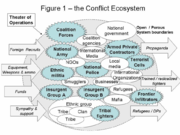
- those committed to the insurgents;
- those committed to the counterinsurgents;
- those who simply wish to get on with their lives.
Often, but not always, states or groups that aid one side or the other are outside the box. Outside-the-box intervention has dynamics of its own.
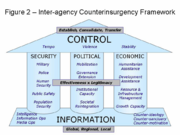
The counterinsurgency strategy can be described as efforts to end the insurgency by a campaign developed in balance along three "pillars": security, political, and economical.
"Obviously enough, you cannot command what you do not control. Therefore, unity of command (between agencies or among government and non-government actors) means little in this environment." Unity of command is one of the axioms of military doctrine that change with the use of swarming:. In Edwards' swarming
Swarming (military)
Military swarming is a behavior where autonomous, or semi-autonomous, units of action attack an enemy from several different directions and then regroup. Pulsing, where the units shift the point of attack, is a part of military swarming. Swarming is not limited to the human military realm...
model, as in Kilcullen's mode, unity of command becomes "unity of effort
Unity of effort
Unity of effort is the state of harmonizing efforts among multiple organizations working towards a similar objective. This prevents organizations from working at cross purposes and it reduces duplication of effort. Multiple organizations can achieve unity of effort through shared common objectives...
at best, and collaboration or deconfliction at least."
As in swarming, in Kilcullen's view unity of effort "depends less on a shared command and control hierarchy, and more on a shared diagnosis of the problem (i.e., the distributed knowledge of swarms), platforms for collaboration, information sharing and deconfliction. Each player must understand the others’ strengths, weaknesses, capabilities and objectives, and inter-agency teams must be structured for versatility (the ability to perform a wide variety of tasks) and agility (the ability to transition rapidly and smoothly between tasks)."
Eizenstat and closing gaps
Insurgencies, according to Stuart Eizenstat grow out of "gaps". To be viable, a state must be able to close three "gaps", of which the first is most important:- Security: protection "... against internal and external threats, and preserving sovereignty over territory. If a government cannot ensure security, rebellious armed groups or criminal nonstate actors may use violence to exploit this security gap—as in Haiti, Nepal, and Somalia."
- Capacity: the survival needs of water, electrical power, food and public health, closely followed by education, communications and a working economic system. "An inability to do so creates a capacity gap, which can lead to a loss of public confidence and then perhaps political upheaval. In most environments, a capacity gap coexists with—or even grows out of—a security gap. In Afghanistan and the Democratic Republic of the Congo, for example, segments of the population are cut off from their governments because of endemic insecurity. And in postconflict Iraq, critical capacity gaps exist despite the country’s relative wealth and strategic importance."
- Legitimacy: closing the legitimacy gap is more than an incantation of "democracy" and "elections", but a government that is perceived to exist by the consent of the governed, has minimal corruption, and has a working law enforcement and judicial system that enforce human rights.
Note the similarity between Eizenstat's gaps and Kilcullen's three pillars. In the table below, do not assume that a problematic state is unable to assist less developed states while closing its own gaps.
Cuba
The Republic of Cuba is an island nation in the Caribbean. The nation of Cuba consists of the main island of Cuba, the Isla de la Juventud, and several archipelagos. Havana is the largest city in Cuba and the country's capital. Santiago de Cuba is the second largest city...
, North Korea
North Korea
The Democratic People’s Republic of Korea , , is a country in East Asia, occupying the northern half of the Korean Peninsula. Its capital and largest city is Pyongyang. The Korean Demilitarized Zone serves as the buffer zone between North Korea and South Korea...
El Salvador
El Salvador or simply Salvador is the smallest and the most densely populated country in Central America. The country's capital city and largest city is San Salvador; Santa Ana and San Miguel are also important cultural and commercial centers in the country and in all of Central America...
, Ghana
Ghana
Ghana , officially the Republic of Ghana, is a country located in West Africa. It is bordered by Côte d'Ivoire to the west, Burkina Faso to the north, Togo to the east, and the Gulf of Guinea to the south...
, Mongolia
Mongolia
Mongolia is a landlocked country in East and Central Asia. It is bordered by Russia to the north and China to the south, east and west. Although Mongolia does not share a border with Kazakhstan, its western-most point is only from Kazakhstan's eastern tip. Ulan Bator, the capital and largest...
, Senegal
Senegal
Senegal , officially the Republic of Senegal , is a country in western Africa. It owes its name to the Sénégal River that borders it to the east and north...
, Nicaragua
Nicaragua
Nicaragua is the largest country in the Central American American isthmus, bordered by Honduras to the north and Costa Rica to the south. The country is situated between 11 and 14 degrees north of the Equator in the Northern Hemisphere, which places it entirely within the tropics. The Pacific Ocean...
, Uganda
Uganda
Uganda , officially the Republic of Uganda, is a landlocked country in East Africa. Uganda is also known as the "Pearl of Africa". It is bordered on the east by Kenya, on the north by South Sudan, on the west by the Democratic Republic of the Congo, on the southwest by Rwanda, and on the south by...
Afghanistan
Afghanistan , officially the Islamic Republic of Afghanistan, is a landlocked country located in the centre of Asia, forming South Asia, Central Asia and the Middle East. With a population of about 29 million, it has an area of , making it the 42nd most populous and 41st largest nation in the world...
, Egypt
Egypt
Egypt , officially the Arab Republic of Egypt, Arabic: , is a country mainly in North Africa, with the Sinai Peninsula forming a land bridge in Southwest Asia. Egypt is thus a transcontinental country, and a major power in Africa, the Mediterranean Basin, the Middle East and the Muslim world...
, Indonesia
Indonesia
Indonesia , officially the Republic of Indonesia , is a country in Southeast Asia and Oceania. Indonesia is an archipelago comprising approximately 13,000 islands. It has 33 provinces with over 238 million people, and is the world's fourth most populous country. Indonesia is a republic, with an...
, Iraq
Iraq
Iraq ; officially the Republic of Iraq is a country in Western Asia spanning most of the northwestern end of the Zagros mountain range, the eastern part of the Syrian Desert and the northern part of the Arabian Desert....
, Ivory Coast, Kazakhstan
Kazakhstan
Kazakhstan , officially the Republic of Kazakhstan, is a transcontinental country in Central Asia and Eastern Europe. Ranked as the ninth largest country in the world, it is also the world's largest landlocked country; its territory of is greater than Western Europe...
, Pakistan
Pakistan
Pakistan , officially the Islamic Republic of Pakistan is a sovereign state in South Asia. It has a coastline along the Arabian Sea and the Gulf of Oman in the south and is bordered by Afghanistan and Iran in the west, India in the east and China in the far northeast. In the north, Tajikistan...
, Kyrgyzstan
Kyrgyzstan
Kyrgyzstan , officially the Kyrgyz Republic is one of the world's six independent Turkic states . Located in Central Asia, landlocked and mountainous, Kyrgyzstan is bordered by Kazakhstan to the north, Uzbekistan to the west, Tajikistan to the southwest and China to the east...
, Myanmar
Myanmar
Burma , officially the Republic of the Union of Myanmar , is a country in Southeast Asia. Burma is bordered by China on the northeast, Laos on the east, Thailand on the southeast, Bangladesh on the west, India on the northwest, the Bay of Bengal to the southwest, and the Andaman Sea on the south....
, Republic of the Congo
Republic of the Congo
The Republic of the Congo , sometimes known locally as Congo-Brazzaville, is a state in Central Africa. It is bordered by Gabon, Cameroon, the Central African Republic, the Democratic Republic of the Congo , the Angolan exclave province of Cabinda, and the Gulf of Guinea.The region was dominated by...
, Sudan
Sudan
Sudan , officially the Republic of the Sudan , is a country in North Africa, sometimes considered part of the Middle East politically. It is bordered by Egypt to the north, the Red Sea to the northeast, Eritrea and Ethiopia to the east, South Sudan to the south, the Central African Republic to the...
, Syria
Syria
Syria , officially the Syrian Arab Republic , is a country in Western Asia, bordering Lebanon and the Mediterranean Sea to the West, Turkey to the north, Iraq to the east, Jordan to the south, and Israel to the southwest....
, Tajikistan
Tajikistan
Tajikistan , officially the Republic of Tajikistan , is a mountainous landlocked country in Central Asia. Afghanistan borders it to the south, Uzbekistan to the west, Kyrgyzstan to the north, and China to the east....
, Uzbekistan
Uzbekistan
Uzbekistan , officially the Republic of Uzbekistan is a doubly landlocked country in Central Asia and one of the six independent Turkic states. It shares borders with Kazakhstan to the west and to the north, Kyrgyzstan and Tajikistan to the east, and Afghanistan and Turkmenistan to the south....
, Zimbabwe
Zimbabwe
Zimbabwe is a landlocked country located in the southern part of the African continent, between the Zambezi and Limpopo rivers. It is bordered by South Africa to the south, Botswana to the southwest, Zambia and a tip of Namibia to the northwest and Mozambique to the east. Zimbabwe has three...
Angola
Angola, officially the Republic of Angola , is a country in south-central Africa bordered by Namibia on the south, the Democratic Republic of the Congo on the north, and Zambia on the east; its west coast is on the Atlantic Ocean with Luanda as its capital city...
, the Democratic Republic of the Congo
Democratic Republic of the Congo
The Democratic Republic of the Congo is a state located in Central Africa. It is the second largest country in Africa by area and the eleventh largest in the world...
, Haiti
Haiti
Haiti , officially the Republic of Haiti , is a Caribbean country. It occupies the western, smaller portion of the island of Hispaniola, in the Greater Antillean archipelago, which it shares with the Dominican Republic. Ayiti was the indigenous Taíno or Amerindian name for the island...
, Liberia
Liberia
Liberia , officially the Republic of Liberia, is a country in West Africa. It is bordered by Sierra Leone on the west, Guinea on the north and Côte d'Ivoire on the east. Liberia's coastline is composed of mostly mangrove forests while the more sparsely populated inland consists of forests that open...
, Palestine
Palestine
Palestine is a conventional name, among others, used to describe the geographic region between the Mediterranean Sea and the Jordan River, and various adjoining lands....
, Somalia
Somalia
Somalia , officially the Somali Republic and formerly known as the Somali Democratic Republic under Socialist rule, is a country located in the Horn of Africa. Since the outbreak of the Somali Civil War in 1991 there has been no central government control over most of the country's territory...
McCormick Magic Diamond
McCormick’s model is designed as a tool for counterinsurgency (COIN), but develops a symmetrical view of the required actions for both the Insurgent and COIN forces to achieve success. In this way the counterinsurgency model can demonstrate how both the insurgent and COIN forces succeed or fail. The model’s strategies and principle apply to both forces, therefore the degree the forces follow the model should have a direct correlation to the success or failure of either the Insurgent or COIN force.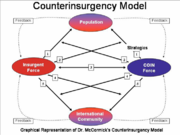
- Insurgent force
- Counterinsurgency force (i.e., the government)
- Population
- International community
All of these interact, and the different elements have to assess their best options in a set of actions:
- Gaining support of the population
- Disrupt opponent’s control over the population
- Direct action against opponent
- Disrupt opponent’s relations with the international community
- Establish relationships with the international community
Barnett and connecting to the core
In Thomas Barnett's paradigm, the world is divided into a "connected core" of nations enjoying a high level of communications among their organizations and individuals, and those nations that are disconnected internally and externally. In a reasonably peaceful situation, he describes a "system administrator" force, often multinational, which does what some call "nation-building", but, most importantly, connects the nation to the core and empowers the natives to communicate—that communication can be likened to swarm coordination. If the state is occupied, or in civil war, another paradigm comes into play: the leviathan, a first-world military force that takes down the opposition regular forces. Leviathan is not constituted to fight local insurgencies, but major forces. Leviathan may use extensive swarmingSwarming (military)
Military swarming is a behavior where autonomous, or semi-autonomous, units of action attack an enemy from several different directions and then regroup. Pulsing, where the units shift the point of attack, is a part of military swarming. Swarming is not limited to the human military realm...
at the tactical level, but its dispatch is a strategic decision that may be made unilaterally, or by an established group of the core such as NATO or ASEAN.
Cordesman and security
Other than brief "Leviathan" takedowns, security building appears to need to be regional, with logistical and other technical support from more developed countries and alliances (e.g., ASEAN, NATO). Noncombat military assistance in closing the security gap begins with training, sometimes in specialized areas such as intelligence. More direct, but still noncombat support, includes intelligence, planning, logistics and communications.Anthony Cordesman notes that security requirements differ by region and state in region. Writing on the Middle East, he identified different security needs for specific areas, as well as the US interest in security in those areas.
- In North AfricaNorth AfricaNorth Africa or Northern Africa is the northernmost region of the African continent, linked by the Sahara to Sub-Saharan Africa. Geopolitically, the United Nations definition of Northern Africa includes eight countries or territories; Algeria, Egypt, Libya, Morocco, South Sudan, Sudan, Tunisia, and...
, the US focus should be on security cooperation in achieving regional stability and in counterterrorism. - In the LevantLevantThe Levant or ) is the geographic region and culture zone of the "eastern Mediterranean littoral between Anatolia and Egypt" . The Levant includes most of modern Lebanon, Syria, Jordan, Israel, the Palestinian territories, and sometimes parts of Turkey and Iraq, and corresponds roughly to the...
, the US must largely compartment security cooperation with Israel and cooperation with friendly Arab states like EgyptEgyptEgypt , officially the Arab Republic of Egypt, Arabic: , is a country mainly in North Africa, with the Sinai Peninsula forming a land bridge in Southwest Asia. Egypt is thus a transcontinental country, and a major power in Africa, the Mediterranean Basin, the Middle East and the Muslim world...
, JordanJordanJordan , officially the Hashemite Kingdom of Jordan , Al-Mamlaka al-Urduniyya al-Hashemiyya) is a kingdom on the East Bank of the River Jordan. The country borders Saudi Arabia to the east and south-east, Iraq to the north-east, Syria to the north and the West Bank and Israel to the west, sharing...
, and LebanonLebanonLebanon , officially the Republic of LebanonRepublic of Lebanon is the most common term used by Lebanese government agencies. The term Lebanese Republic, a literal translation of the official Arabic and French names that is not used in today's world. Arabic is the most common language spoken among...
, but can improve security cooperation with all these states. - In the GulfPersian GulfThe Persian Gulf, in Southwest Asia, is an extension of the Indian Ocean located between Iran and the Arabian Peninsula.The Persian Gulf was the focus of the 1980–1988 Iran-Iraq War, in which each side attacked the other's oil tankers...
, the US must deal with the strategic importance of a region whose petroleum and growing gas exports fuel key elements of the global economy.
It is well to understand that counterterrorism, as used by Cordesman, does not mean using terrorism against the terrorism, but an entire spectrum of activities, nonviolent and violent, to disrupt an opposing terrorist organization. The French general, Joseph Gallieni, observed, while a colonial administrator in 1898,
Both Kilcullen and Eizenstat define a more abstract goal than does Cordesman. Kilcullen's security pillar is roughly equivalent to Eizenstat's security gap:
- Military security (securing the population from attack or intimidation by guerrillas, bandits, terrorists or other armed groups)
- Police security (community policing, police intelligence or “Special Branch” activities, and paramilitary police field forces).
- Human security, building a framework of human rights, civil institutions and individual protections, public safety (fire, ambulance, sanitation, civil defense) and population security.
Anthony Cordesman, while speaking of the specific situation in Iraq, makes some points that can be generalized to other nations in turmoil. Cordesman recognizes some value in the groupings in Samuel Huntington
Samuel Huntington
Samuel Huntington may refer to:* Samuel Huntington , American jurist, statesman, and revolutionary leader* Samuel H. Huntington , American jurist* Samuel P. Huntington , American political scientist...
's idea of the clash of civilizations
Clash of Civilizations
The Clash of Civilizations is a theory, proposed by political scientist Samuel P. Huntington, that people's cultural and religious identities will be the primary source of conflict in the post-Cold War world....
, but, rather assuming the civilizations must clash, these civilizations simply can be recognized as actors in a multinational world. In the case of Iraq, Cordesman observes that the burden is on the Islamic civilization, not unilaterally the West, if for no other reason that the civilization to which the problematic nation belongs will have cultural and linguistic context that Western civilization cannot hope to equal.
The heart of strengthening weak nations must come from within, and that heart will fail if they deny that the real issue is the future of their civilization, if they tolerate religious, cultural or separatist violence and terrorism when it strikes at unpopular targets, or if they continue to try to export the blame for their own failures to other nations, religions, and cultures.
Counterinsurgency
- See Counter-insurgencyCounter-insurgencyA counter-insurgency or counterinsurgency involves actions taken by the recognized government of a nation to contain or quell an insurgency taken up against it...
and Foreign internal defenseForeign internal defenseForeign internal defense is a term used by a number of Western militaries, including the United States, France and the United Kingdom, to describe an approach to combating actual or threatened insurgency in a foreign state called the Host Nation . The term counter-insurgency is more commonly used...
Before one counters an insurgency, however, one must understand what one is countering. Typically the most successful counterinsurgencies have been the British in the Malay Emergency and the Filipino government's countering of the Huk Rebellion.
See also
- Fourth generation warfareFourth generation warfareFourth generation warfare is conflict characterized by a blurring of the lines between war and politics, soldier and civilian.The term was first used in 1989 by a team of United States analysts, including William S. Lind, to describe warfare's return to a decentralized form...
- Insurrectionary anarchismInsurrectionary anarchismInsurrectionary anarchism is a revolutionary theory, practice and tendency within the anarchist movement which emphasizes the theme of insurrection within anarchist practice. It is critical of formal organizations such as labor unions and federations that are based on a political programme and...
- Irregular WarfareIrregular warfareIrregular warfare is warfare in which one or more combatants are irregular military rather than regular forces. Guerrilla warfare is a form of irregular warfare, and so is asymmetric warfare....
- Revolutionary warfare
- Political WarfarePolitical warfarePolitical warfare is the use of political means to compel an opponent to do one's will, based on hostile intent. The term political describes the calculated interaction between one's government and a target audience to include another country's government, military, and/or general population...
National doctrines
- Foreign internal defenseForeign internal defenseForeign internal defense is a term used by a number of Western militaries, including the United States, France and the United Kingdom, to describe an approach to combating actual or threatened insurgency in a foreign state called the Host Nation . The term counter-insurgency is more commonly used...
- Reagan DoctrineReagan DoctrineThe Reagan Doctrine was a strategy orchestrated and implemented by the United States under the Reagan Administration to oppose the global influence of the Soviet Union during the final years of the Cold War...
- Unconventional warfare (United States Department of Defense doctrine)Unconventional warfare (United States Department of Defense doctrine)In United States doctrine, unconventional warfare is the term for guerrilla warfare that is conducted or supported by units in the United States Special Operations Command. Guerrilla warfare is one aspect of the broader term insurgency. The American definition of UW is:-U.S...
Case studies
- List of revolutions and rebellions
- Insurgency in North East India