


Jewish Ghetto Police

Encyclopedia
Jews
The Jews , also known as the Jewish people, are a nation and ethnoreligious group originating in the Israelites or Hebrews of the Ancient Near East. The Jewish ethnicity, nationality, and religion are strongly interrelated, as Judaism is the traditional faith of the Jewish nation...
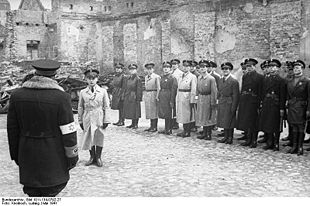
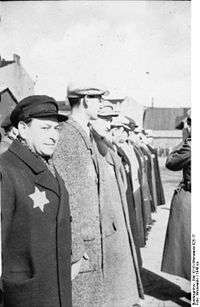
as the Jewish Police, were the auxiliary police
Auxiliary police
Auxiliary police or special constables in England) are usually the part-time reserves of a regular police force. They may be armed or unarmed. They may be unpaid volunteers or paid members of the police service with which they are affiliated...
units organized in the Jewish ghettos of Europe
Ghettos in occupied Europe 1939-1944
During World War II, ghettos in Nazi-occupied Europe were set up by the Third Reich in order to confine Jews and sometimes Gypsies into tightly packed areas of the cities...
by local Judenrat
Judenrat
Judenräte were administrative bodies during the Second World War that the Germans required Jews to form in the German occupied territory of Poland, and later in the occupied territories of the Soviet Union It is the overall term for the enforcement bodies established by the Nazi occupiers to...
councils under orders of occupying German Nazis
Nazi Germany
Nazi Germany , also known as the Third Reich , but officially called German Reich from 1933 to 1943 and Greater German Reich from 26 June 1943 onward, is the name commonly used to refer to the state of Germany from 1933 to 1945, when it was a totalitarian dictatorship ruled by...
.
Members of the did not have official uniform
Uniform
A uniform is a set of standard clothing worn by members of an organization while participating in that organization's activity. Modern uniforms are worn by armed forces and paramilitary organizations such as police, emergency services, security guards, in some workplaces and schools and by inmates...
s, often wearing just an identifying armband
Armband
An armband is a piece of material worn around the arm over the sleeve of other clothing if present. they may be worn for pure ornamentation to mark the wearer as belonging to group, having a certain rank or role, or being in a particular state or condition...
and a badge, and were not allowed to carry firearm
Firearm
A firearm is a weapon that launches one, or many, projectile at high velocity through confined burning of a propellant. This subsonic burning process is technically known as deflagration, as opposed to supersonic combustion known as a detonation. In older firearms, the propellant was typically...
s. They were used by the Germans
Germans
The Germans are a Germanic ethnic group native to Central Europe. The English term Germans has referred to the German-speaking population of the Holy Roman Empire since the Late Middle Ages....
primarily for securing the deportation
Deportation
Deportation means the expulsion of a person or group of people from a place or country. Today it often refers to the expulsion of foreign nationals whereas the expulsion of nationals is called banishment, exile, or penal transportation...
of other Jews to the concentration camps.
The Jüdischer Ordnungsdienst were Jews who usually had little prior association with the communities they oversaw (especially after the roundups and deportations to extermination camps began), and who could be relied upon to follow German orders. The first commander of the Warsaw ghetto
Ghetto
A ghetto is a section of a city predominantly occupied by a group who live there, especially because of social, economic, or legal issues.The term was originally used in Venice to describe the area where Jews were compelled to live. The term now refers to an overcrowded urban area often associated...
was Józef Szeryński
Józef Szeryński
Józef Andrzej Szeryński was a Polish-Jewish police-colonel inspector for the Lublin district and a commander of the Jewish Ghetto Police during the Second World War. Born Józef Szenkman, he changed his name and developed an anti-Semitic attitude, becoming a collaborator with the Nazis following...
, a Polish-Jewish police colonel who had converted to Christianity. He changed his name from Szenkman and developed an anti-Semitic attitude. Szerynski survived an assassination
Assassination
To carry out an assassination is "to murder by a sudden and/or secret attack, often for political reasons." Alternatively, assassination may be defined as "the act of deliberately killing someone, especially a public figure, usually for hire or for political reasons."An assassination may be...
attempt carried out by a member of the Jewish police, Yisrael Kanal, who was working on behalf of the underground Jewish Combat Organization. In ghettos where the Judenrat was resistant to German orders, the Jewish police were often used (as reportedly in Lutsk) to control or replace the council.
One of the largest police units was to be found in the Warsaw Ghetto
Warsaw Ghetto
The Warsaw Ghetto was the largest of all Jewish Ghettos in Nazi-occupied Europe during World War II. It was established in the Polish capital between October and November 15, 1940, in the territory of General Government of the German-occupied Poland, with over 400,000 Jews from the vicinity...
, where the Jüdischer Ordnungsdienst numbered about 2500. The Łódź Ghetto had about 1200, and the Lviv Ghetto 500.
The Polish-Jewish historian and the Warsaw Ghetto archivist Emanuel Ringelblum
Emanuel Ringelblum
Emanuel Ringelblum was a Polish-Jewish historian, politician and social worker, known for his Notes from the Warsaw Ghetto, Notes on the Refugees in Zbąszyn chronicling the deportation of Jews from the town of Zbąszyń, and the so-called Ringelblum's Archives of the Warsaw Ghetto.-Before the war:He...
has described the cruelty
Cruelty
Cruelty can be described as indifference to suffering, and even positive pleasure in inflicting it. If this is supported by a legal or social framework, then receives the name of perversion. Sadism can also be related to this form of action or concept....
of the ghetto police as "at times greater than that of the Germans
Germans
The Germans are a Germanic ethnic group native to Central Europe. The English term Germans has referred to the German-speaking population of the Holy Roman Empire since the Late Middle Ages....
, the Ukrainians
Ukrainians
Ukrainians are an East Slavic ethnic group native to Ukraine, which is the sixth-largest nation in Europe. The Constitution of Ukraine applies the term 'Ukrainians' to all its citizens...
and the Latvians
Latvians
Latvians or Letts are the indigenous Baltic people of Latvia.-History:Latvians occasionally refer to themselves by the ancient name of Latvji, which may have originated from the word Latve which is a name of the river that presumably flowed through what is now eastern Latvia...
."
See also
- JudenratJudenratJudenräte were administrative bodies during the Second World War that the Germans required Jews to form in the German occupied territory of Poland, and later in the occupied territories of the Soviet Union It is the overall term for the enforcement bodies established by the Nazi occupiers to...
- KapoKapo (concentration camp)A kapo was a prisoner who worked inside German Nazi concentration camps during World War II in any of certain lower administrative positions. The official Nazi word was Funktionshäftling, or "prisoner functionary", but the Nazis commonly referred to them as kapos.- Etymology :The origin of "kapo"...
- Adam CzerniakówAdam CzerniakówAdam Czerniaków , born in Warsaw, Poland, was a Polish-Jewish engineer and senator to the prewar Polish Sejm for Nonpartisan Bloc for Cooperation with the Government...
- Mordechai Chaim RumkowskiMordechai Chaim RumkowskiMordechai Chaim Rumkowski was a Polish Jew and functioned as the German Nazi-nominated head of the Ältestenrat , or Jewish authorities in the Łódź Ghetto....
External links
- Jüdischer Ordnungsdienst Yad VashemYad VashemYad Vashem is Israel's official memorial to the Jewish victims of the Holocaust, established in 1953 through the Yad Vashem Law passed by the Knesset, Israel's parliament....
- The Jewish Police of the Warsaw Ghetto-shoaheducation.com
- The "Order Rules" for the Police of the Warsaw Ghetto
- The relations between Judenrat and the Jewish police
- (Photo) Jewish Police in Westerbork camp
- (Photo) Jewish Police Station in the 4th precinct of the Warsaw ghetto