

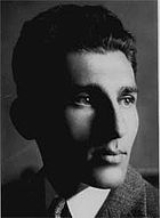
Avraham Stern

Encyclopedia
Zionism
Zionism is a Jewish political movement that, in its broadest sense, has supported the self-determination of the Jewish people in a sovereign Jewish national homeland. Since the establishment of the State of Israel, the Zionist movement continues primarily to advocate on behalf of the Jewish state...
organization later known as Lehi
Lehi (group)
Lehi , commonly referred to in English as the Stern Group or Stern Gang, was a militant Zionist group founded by Avraham Stern in the British Mandate of Palestine...
(called the "Stern Gang" by the British colonial authorities and by their assistants in the Yishuv establishment).
Early life
Stern was born in Suwałki, Poland. During the First World War his mother fled the Germans with him and his brother DavidDavid Stern (Israeli politician)
David Stern was an Israeli businessman and politician who served as a member of the Knesset for Likud between 1979 and 1981.-Biography:Stern was born in Suwałki in the Russian Empire in 1910. During World War I his mother fled the Germans with him and his brother, Avraham, and found refuge with...
. They found refuge with her sister in Russia. When he was separated from his mother the 13-year-old Avraham earned his keep by carrying river water in Siberia. Eventually he stayed with an uncle in St. Petersburg before walking home to Poland. At the age of 18, Stern immigrated on his own to Palestine.
Stern studied at the Hebrew University on Mount Scopus in Jerusalem. He specialized in Classical languages and literature (Greek and Latin). His first political involvement was to found a student organization called “Hulda,” whose regulations stated it was dedicated “solely to the revival of the Hebrew nation in a new state.” During the 1929 riots in Palestine, Jewish communities came under attack by local Arabs, and Stern served with the Haganah
Haganah
Haganah was a Jewish paramilitary organization in what was then the British Mandate of Palestine from 1920 to 1948, which later became the core of the Israel Defense Forces.- Origins :...
, doing guard duty on a synagogue rooftop in Jerusalem’s Old City.
Stern’s commander and friend Avraham Tehomi
Avraham Tehomi
Avraham T'homi was a noted Jewish militant, and a key figure in the history of the Hebrew National Military Organization and allegedly in the killing of Jacob Israël de Haan. His nickname in the Irgun was 'Gideon'....
quit the Haganah because it was under the authority of the local labor movement and union. Hoping to create an independent army, and also to take a more active and less defensive military position, Tehomi founded the Irgun Zvai Leumi ("National Military Organization" known for short as the rgun]"Organization"]). Stern joined the Irgun and completed an officer’s course in 1932.
During his life Stern wrote dozens of poems embodying a physical, almost sensual, love for the Jewish homeland and a similar attitude towards martyrdom on its behalf. One analyst referred to the poems as expressing the eroticism of death together with de-eroticism of women. Stern’s poetry was heavily influenced by Russian and Polish poetry, especially Vladimir Mayakovsky
Vladimir Mayakovsky
Vladimir Vladimirovich Mayakovsky was a Russian and Soviet poet and playwright, among the foremost representatives of early-20th century Russian Futurism.- Early life :...
’s. His song Unknown Soldiers was adopted first by the Irgun and later by the Lehi as an underground anthem. Lehi is an acronym for Lochamei Herut Yisrael ("Fighters for the Freedom of Israel"). In it Stern sang of Jews who would not be drafted by other countries while they wandered in Exile from their own country, but rather who would enlist in a volunteer army of their own, go underground and die fighting in the streets, only to be buried secretly at night. One of the commanders of Lehi, Israel Eldad
Israel Eldad
Israel Eldad , was a noted Israeli independence fighter and Revisionist Zionist philosopher...
, claimed this song (along with two others, written by Uri Zvi Greenberg
Uri Zvi Greenberg
Uri Zvi Grinberg was an acclaimed Israeli poet and journalist who wrote in Yiddish and Hebrew.-Biography:Uri Zvi Grinberg was born in Bialikamin, Galicia, then Austria-Hungary, into a prominent Hasidic family. He was raised in Lemberg . Some of his poems in Yiddish and Hebrew were published...
and Vladimir Jabotinsky) actually led to the creation of the underground. In other poems from the same period, up to eight years before he founded the Lehi underground, he detailed the feelings of revolutionaries hiding in basements or sitting in prison and wrote of dying in a hail of bullets. One example of his poetry is:
“You are betrothed to me, my homeland \ According to all the laws of Moses and Israel… \ And with my death I will bury my head in your lap \ And you will live forever in my blood.”
Stern became one of the university’s top students. He was awarded a stipend to study for a doctorate in Florence
Florence
Florence is the capital city of the Italian region of Tuscany and of the province of Florence. It is the most populous city in Tuscany, with approximately 370,000 inhabitants, expanding to over 1.5 million in the metropolitan area....
, Italy. Avraham Tehomi made a special trip to Florence to recall him, in order to make him his deputy in the Irgun.
Stern spent the rest of the 1930s traveling back and forth to Eastern Europe to organize revolutionary cells in Poland and promote immigration of Jews to Palestine in defiance of British restrictions (this was therefore known as “illegal immigration”).
Stern developed a plan to train 40,000 young Jews to sail for Palestine and take over the country from the British colonial authorities. He succeeded in enlisting the Polish government in this effort. The Poles began training Irgun members and arms were set aside, but then Germany invaded Poland and began the Second World War. This ended the training, and immigration routes were cut off. Stern was in Palestine at the time and was arrested the same night the war began. He was incarcerated together with the entire High Command of the Irgun in the Jerusalem Central Prison and Sarafand Detention Camp.
Lehi
While under arrest, Stern and the other members of the Irgun argued about what to do during the war. He founded LehiLehi (group)
Lehi , commonly referred to in English as the Stern Group or Stern Gang, was a militant Zionist group founded by Avraham Stern in the British Mandate of Palestine...
in August 1940 (though it did not adopt that name, which is a Hebrew acronym for Lohamei Herut Israel, meaning Fighters for the Freedom of Israel, until after his death), by splitting from the Irgun, when the latter adopted the Haganah’s policy of supporting the British in their fight against the Nazis.
Stern rejected collaboration with the British
British Empire
The British Empire comprised the dominions, colonies, protectorates, mandates and other territories ruled or administered by the United Kingdom. It originated with the overseas colonies and trading posts established by England in the late 16th and early 17th centuries. At its height, it was the...
, and claimed that only a continuing struggle against them would lead eventually to an independent Jewish state and resolve the Jewish situation in the Diaspora. The British White Paper of 1939
White Paper of 1939
The White Paper of 1939, also known as the MacDonald White Paper after Malcolm MacDonald, the British Colonial Secretary who presided over it, was a policy paper issued by the British government under Neville Chamberlain in which the idea of partitioning the Mandate for Palestine, as recommended in...
allowed only 75,000 Jews to immigrate
Aliyah
Aliyah is the immigration of Jews to the Land of Israel . It is a basic tenet of Zionist ideology. The opposite action, emigration from Israel, is referred to as yerida . The return to the Holy Land has been a Jewish aspiration since the Babylonian exile...
to Palestine over five years, and no more after that unless local Arabs gave their permission. But actually Stern’s opposition to British colonial rule in Palestine was not based on a particular policy. Stern defined the British Mandate as “foreign rule” regardless of their policies and took a radical position against such imperialism even if it were to be benevolent.
Stern was unpopular with the official Jewish establishment leaders of the Haganah and Jewish Agency and also those of the Irgun. His movement drew an eclectic crew of individuals, from all ends of the political spectrum, including people who became prominent such as Yitzhak Shamir
Yitzhak Shamir
' is a former Israeli politician, the seventh Prime Minister of Israel, in 1983–84 and 1986–92.-Biography:Icchak Jeziernicky was born in Ruzhany , Russian Empire . He studied at a Hebrew High School in Białystok, Poland. As a youth he joined Betar, the Revisionist Zionist youth movement...
, later an Israeli prime minister
Prime Minister of Israel
The Prime Minister of Israel is the head of the Israeli government and the most powerful political figure in Israel . The prime minister is the country's chief executive. The official residence of the prime minister, Beit Rosh Hamemshala is in Jerusalem...
, who supported Jewish settlement throughout the land, and who opposed ceding territory to Arabs in negotiations; Natan Yellin-Mor who later turned to radical politics, and Israel Eldad
Israel Eldad
Israel Eldad , was a noted Israeli independence fighter and Revisionist Zionist philosopher...
, who after the underground war ended spent nearly 15 years writing tracts and articles promoting Lehi’s brand of revolutionary Zionism.
Stern began organizing his new underground army by focusing on four fronts: 1) publishing a newspaper and making clandestine radio broadcasts offering theoretical justifications for urban guerilla warfare; 2) obtaining funds for the underground, either by donations or by robbing British banks; 3) opening negotiations with foreign powers for the purpose of saving Europe’s Jews and developing allies in the struggle against the British in Palestine; 4) actual military-style operations against the British.
None of these projects went well for the new underground. Without money or a printing press the stenciled newspapers were few and hard to read. The bank robberies and operations against British policemen resulted in shootouts in the streets and both British and Jewish police were killed and injured. A British sting operation entrapped Stern into attempting to negotiate with the Italians and Germans, and this further tainted Lehi’s reputation.
In January 1941, Stern attempted to make an agreement with the German Nazi authorities, offering to "actively take part in the war on Germany's side" in return for German support for Jewish immigration to Palestine and the establishment of a Jewish state. Another attempt to contact the Germans was made in late 1941, but there is no record of a German response in either case.
Death
Wanted posters appeared all over the country with a price on Stern’s head. Stern wandered from safe house to safe house in Tel Aviv, carrying a collapsible cot in a suitcase. When he ran out of hiding places he slept in apartment house stairwells. Eventually he moved into a Tel Aviv apartment rented by Moshe and Tova Svorai, who were members of Lehi. Moshe Svorai was caught by British detectives who raided another apartment, where two Lehi members were shot dead, and Svorai and one other wounded were hospitalized. Stern’s Lehi “contact,” Hisia Shapiro, thought she might have been followed one morning and stopped bringing messages. On 12 February 1942 she came with one last message, from the Haganah, offering to house Stern for the duration of the war if he would give up his fight against the British. Stern gave Shapiro a letter in reply declining the safe haven and suggesting cooperation between Lehi and the Haganah in fighting the British. A couple of hours later British detectives arrived to search the apartment and discovered Stern hiding there. Two neighbors were brought to attest to the propriety of the search. After they had left, Tova Svorai was also taken away so that Stern was alone with three armed policemen. Then, in circumstances that remain disputed today, Stern was shot dead.The "most secret" report made by the police to the British mandatory government said, "Stern was ... just finishing lacing his shoes when he suddenly leapt for the window opposite. He was half way out of the window when he was shot by two of the three policemen in the room." Assistant Superintendent Geoffrey J. Morton
Geoffrey J. Morton
Geoffrey J. Morton, BEM was a member of the Palestine Police who shot dead Avraham Stern, the leader of a radically militant Zionist group which staged an insurgency against British rule in Palestine during World War Two with the aim of creating a Jewish state.-Early life and career:Geoffrey...
, the most senior policeman present, later wrote in his memoirs that he had feared Stern was about to set off an explosive device as he had previously threatened to do if captured.
The police version was dismissed by Stern's followers and many others, who believed that Stern had been shot in cold blood. Morton successfully sued four publishers of books which claimed he murdered Stern, including the English publisher of The Revolt
The Revolt
The Revolt is a book about the militant Zionist organization Irgun Zvai Leumi, by one of its principal leaders, Menachem Begin...
, which settled without consulting the author, Menachem Begin, who wanted to go to court. Lehi tried unsuccessfully to assassinate Morton at least three times. Binyamin Gepner, a former Lehi member who in 1980 interviewed another policeman Stewart who had been present at Stern's death, said that Stewart had effectively admitted Stern was murdered but later refused to repeat it. The policeman whose gun was trained on Stern until Morton arrived, Bernard Stamp, said in a 1986 interview broadcast on Israel Radio, that Morton's account was "hogwash." According to Stamp, Morton pulled Stern from the couch on which he was sitting, "sort of pushed him, spun him around, and Morton shot him." Stamp has been cited saying Stern was killed while unarmed with no chance of escape.
Tova Svorai recalled in a memoir:
"At about 9:30 there was a knock at the door, too gentle a tapping to signal the presence of the police. Yair…went into the closet, and only then did I open the door. At the door stood the 'good' detective Wilkins with two men behind him. Wilkins was always very polite, too polite perhaps. He asked me why I hadn't gone to visit my husband Moshe and if I weren't worried about him. I told him that if I had gone to the hospital I would have been arrested immediately. They searched my room…then they went downstairs and brought two neighbors, women, so they might have witnesses…they went over to the closet…one of the policemen opened it. Yair was nowhere to be seen. The policemen thrust his left hand into the closet and began searching, and when his hand came upon Yair he pulled him out. At the same time he put his right hand into his back pocket and took out his gun. I ran between him and Yair and said "Don't shoot! If you shoot, you shoot me"…. in my innocence I thought I had saved Yair's life…how wrong I was. They made him sit on the sofa…more detectives appeared, they had handcuffs and used them to bind Yair's hands behind his back….they told me to get dressed and go downstairs…I got into a small car…suddenly I heard three shots."
Avraham Stern's memorial day is attended every year by Israeli political and government officials. In 1978, a postage stamp
Postage stamp
A postage stamp is a small piece of paper that is purchased and displayed on an item of mail as evidence of payment of postage. Typically, stamps are made from special paper, with a national designation and denomination on the face, and a gum adhesive on the reverse side...
was issued in his honor. His son, Yair, born a few months after Stern's killing, is a veteran broadcast journalist and TV news anchor who once headed Israel Television.
In 1981 the town of Kochav Yair (Yair's Star) was founded and named after Stern's nickname.
See also
- Lehi (group)Lehi (group)Lehi , commonly referred to in English as the Stern Group or Stern Gang, was a militant Zionist group founded by Avraham Stern in the British Mandate of Palestine...
- IrgunIrgunThe Irgun , or Irgun Zevai Leumi to give it its full title , was a Zionist paramilitary group that operated in Mandate Palestine between 1931 and 1948. It was an offshoot of the earlier and larger Jewish paramilitary organization haHaganah...
- Ze'ev Jabotinsky
- BetarBetarThe Betar Movement is a Revisionist Zionist youth movement founded in 1923 in Riga, Latvia, by Vladimir Jabotinsky. It has been traditionally linked to the original Herut and then Likud political parties of Israel, and was closely affiliated with the pre-Israel Revisionist Zionist splinter group...
Further reading
- J. Bowyer BellJ. Bowyer BellJ. Bowyer Bell was an American historian, artist and art critic.-Background and early life:Bell was born into an Episcopalian family on 15 November 1931 in New York City. The family later moved to Alabama, from where Bell attended Washington and Lee University in Lexington, Virginia, majoring in...
, Terror Out of Zion: Irgun Zvai Leumi, Lehi, and the Palestine Underground, 1929-1949, (Avon, 1977), ISBN 0-380-39396-4 - Israel EldadIsrael EldadIsrael Eldad , was a noted Israeli independence fighter and Revisionist Zionist philosopher...
, The First Tithe (Tel Aviv: Jabotinsky Institute, 2008), ISBN 9789654160155 - Zev Golan, Stern: The Man and His Gang (Tel Aviv, 2011), ISBN 9789659172405
- Avaraham Stern ("Yair"), by Hillel Kook at www.etzel.org.il - Profile at the Irgun website