

Mobilization

Encyclopedia
Mobilization is the act of assembling and making both troops and supplies ready for war
. The word mobilization was first used, in a military context, in order to describe the preparation of the Prussian army
during the 1850s and 1860s. Mobilization theories and techniques have continuously changed since then. Notably, before World War I
and World War II
, several countries developed intricate plans to achieve a fast and effective mobilization in case of war. The opposite of mobilization is demobilization
.
Mobilization became an issue with the introduction of conscription, and the introduction of the railways in the 19th Century. Mobilization institutionalized the mass levy of forces that was first introduced during the French Revolution
, and that had changed the character of war. A number of technological and societal changes promoted the move towards a more organized way of assembling armies. These included the telegraph, which allowed rapid spreading of orders, the railways, which allowed rapid concentration of troops, and conscription
, which provided a trained reserve
of soldiers available in the case of war.
 Intricate plans for mobilization contributed greatly to the beginning of World War I
, since in 1914, under the laws and customs of warfare then observed (not to mention the desire to avoid compromising national security), general mobilization of one nation's military forces was invariably considered an act of war
by that country's likely enemies. As the proverb claims, no army has ever mobilized without going to war.
In 1914, the United Kingdom
was the only Europe
an Great Power
without conscription
. The other Great Powers (Austria-Hungary
, France
, Germany
and Russia
) all relied on compulsory military service to supply each of their armies with the millions of men they believed they would need to win a major war. France enacted the “Three Year Law” (1913) to extend the service of conscripted soldiers to match the size of the German army, as the French population of 40 million was smaller than the German population of 60 million people. The British and the Germans also started a race to build up a stronger navy, sparked by the German enactment of the Second Naval Law. Each of the Great Powers could only afford to keep a fraction of these men in uniform during peacetime, the rest were reservists
with limited opportunities to train. Maneuvering formations of millions of men with limited military training required intricate plans which left no room for error, confusion or discretion after mobilization commenced. These plans were prepared under the assumption of worst-case scenarios
.
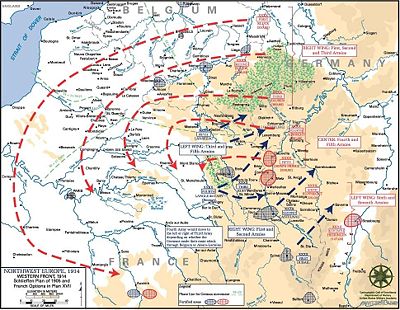
For example, German military leaders did not plan to mobilize for war with Russia whilst assuming that France would not come to her ally's aid, or vice-versa. The Schlieffen Plan
therefore dictated not only mobilization against both powers, but also the order of attack—France would be attacked first regardless of the diplomatic circumstances. To bypass the fortified Franco-German frontier, the German forces were to be ordered to march through Belgium. Whether or not Russia had committed the first provocation, the German plan agreed to by Emperor William II
called for the attack on Russia to take place only after France was defeated.
Similarly, the Russian Stavka
's war planning assumed that war against either Austria-Hungary
or Germany
would mean war against the other power. Although the plan allowed flexibility as to whether the main effort would be made against Germany
or Austria-Hungary
, in either case units would be mobilized on the frontiers of both Powers. On July 28, 1914, Tsar Nicholas II of Russia
(William's cousin) ordered partial mobilization against Austria-Hungary
only. While war with Austria-Hungary
seemed inevitable, Nicholas engaged in a personal dialogue with the German Emperor in an attempt to avoid war with Germany. However, Nicholas was advised that attempts to improvise a partial mobilization would lead to chaos and probable defeat if, as pessimists on the Russian side expected, no amount of diplomacy could convince the Germans to refrain from attacking Russia whilst she was engaged with Germany's ally. On July 29, 1914, the Tsar
ordered full mobilization. In response, Germany declared war on Russia.
Germany mobilized under von Moltke the Younger's revised version of the Schlieffen Plan
, which assumed a two-front war with Russia and France
. Like Russia, Germany decided to follow its two-front plans despite the one-front war. Germany declared war on France on August 3, 1914, one day after issuing an ultimatum to Belgium
demanding the right of German troops to pass through as part of the planned pincer action of the military. Finally, Britain declared war on Germany for violating Belgian neutrality.
Thus the entangling alliances of the Triple Alliance
and the Triple Entente
directed the intricate plans for mobilization. This brought all of the Great Powers of Europe
into the Great War without actually utilizing the provisions of either alliance.
The mobilization was like a holiday for many of the inexperienced soldiers; for example, some Germans wore flowers in the muzzles of their rifles as they marched. Trains brought soldiers to the front lines of battle. The Germans timetabled the movements of 11,000 trains as they brought troops across the Rhine River. The French mobilized around 7,000 trains for movement. Horse
s were also mobilized. The British had 165,000 horses prepared for cavalry
, the Austrians 600,000, the Germans 715,000, and the Russians over a million.
Britain's Dominion
s including Australia
, Canada
, New Zealand
and South Africa
were compelled to go to war when Britain did. However, it was largely left up to the individual Dominions to recruit and equip forces for the war effort. Canadian, Australian and New Zealand mobilizations all involved the creation of new field forces for overseas service rather than using the existing regimental structures as a framework. In the case of Canada, the Militia Minister, Sir Sam Hughes
, created the Canadian Expeditionary Force
from whole cloth by sending telegrams to 226 separate reserve unit commanders asking for volunteers to muster at Valcartier in Quebec. The field force served separately from the Militia (Canada's peace time army); in 1920 the Otter Commission was compelled to sort out which units would perpetuate the units that served in the trenches - the CEF or the prewar Militia. A unique solution of perpetuations was instituted, and mobilization during the Second World War did not repeat Sir Sam Hughes' model, which has been described by historians as being more closely akin to ancient Scottish clans assembling for battle than a modern, industrialized nation preparing for war.
"Colonials" served under British command, although perhaps owing to the limited autonomy granted to the Dominions regarding their respective mobilizations the Dominions eventually compelled the British government to overrule the objections of some British commanders and allow the Dominion forces to serve together instead of being distributed piecemeal amongst the various British divisions. The "colonials" would go on to be acknowledged by both the British and German high commands as being elite British units.
On May 23, 1915, Italy entered World War I on the Allied side. Despite being one of the weakest of the Allied powers, the Italians soon managed to populate its army from 560 to 693 infantry battalions in 1916; the army had grown in size from a million to one and a half million soldiers. On August 17, 1916, Romania
entered the war on the Allied side, mobilizing an army of 23 divisions. Romania was quickly defeated however by Germany, Austria-Hungary, and Bulgaria.
The production of supplies gradually increased throughout the war. In Russia, the expansion of industry allowed a 2,000 percent increase in the production of artillery shells - by November 1915, over 1,512,000 artillery shells were being produced per month. In France, a massive mobilization by the female population to work in factories allowed the rate of shell production to reach 100,000 shells a day by 1915.
Both sides also began drawing on larger amounts of soldiers. The British Secretary of State for War, Lord Kitchener, appealed for hundreds of thousands of soldiers, which was met with an enthusiastic response. 30 new British divisions were created. The response by volunteers allowed the British to put off the introduction of conscription until 1916. New Zealand followed suit, with Canada also eventually introducing conscription.
On April 6, 1917, the United States
entered the war on the Allied side. At the entrance, the U.S. only could mobilize its army of 107,641 soldiers, ranked only seventeenth in size worldwide at the time. The United States Navy
quickly mobilized, adding 5 dreadnoughts to the Allied navy. However, conscription quickly ensued. By March 1918, 318,000 U.S. soldiers had been mobilized to France. Eventually, a force of 3 million U.S. soldiers joined in the war effort.
partly mobilized its troops on August 24, 1939, and fully mobilized on August 30, 1939, following the increased confrontations with Germany
since March 1939. On September 1, 1939 Germany
invaded Poland
, which prompted both France and Britain to declare war on Germany. However, they were slow to mobilize, and by the time Poland had been overrun by the Axis powers, only minor operations had been carried out by the French at the Saar River
.
Canada actually carried out a partial mobilization on 25 August 1939. in anticipation of the growing diplomatic crisis. On September 1, 1939, the Canadian Active Service Force (a corps-sized force of two divisions) was mobilized despite war not being declared by Canada until September 10, 1939. Only one division went overseas in December 1939, and the government hoped to follow a "limited liability" war policy. When France was invaded in May 1940, the Canadian government realized that would not be possible and mobilized three additional divisions, beginning their overseas employment in August 1940 with the dispatch of the 2nd Canadian Division (some units of which were deployed to Iceland and Newfoundland for garrison duty before moving to the UK). Canada also enacted the National Resources Mobilization Act in 1940, which among other things compelled men to serve in the military, though conscripts mobilized under the NRMA did not serve overseas until 1944. Conscripts did, however, serve in the Aleutian Islands in 1943 though the anticipated Japanese defense never materialized due to the evacuation of the enemy garrison before the landings. Service in the Aleutians was not considered "overseas" as technically the islands were part of North America.
, though their enemies may be said to have mobilized, as well as the Falklands War
between the UK and Argentina.
legislated National Defense Mobilization Law
in 2010.
War
War is a state of organized, armed, and often prolonged conflict carried on between states, nations, or other parties typified by extreme aggression, social disruption, and usually high mortality. War should be understood as an actual, intentional and widespread armed conflict between political...
. The word mobilization was first used, in a military context, in order to describe the preparation of the Prussian army
Prussian Army
The Royal Prussian Army was the army of the Kingdom of Prussia. It was vital to the development of Brandenburg-Prussia as a European power.The Prussian Army had its roots in the meager mercenary forces of Brandenburg during the Thirty Years' War...
during the 1850s and 1860s. Mobilization theories and techniques have continuously changed since then. Notably, before World War I
World War I
World War I , which was predominantly called the World War or the Great War from its occurrence until 1939, and the First World War or World War I thereafter, was a major war centred in Europe that began on 28 July 1914 and lasted until 11 November 1918...
and World War II
World War II
World War II, or the Second World War , was a global conflict lasting from 1939 to 1945, involving most of the world's nations—including all of the great powers—eventually forming two opposing military alliances: the Allies and the Axis...
, several countries developed intricate plans to achieve a fast and effective mobilization in case of war. The opposite of mobilization is demobilization
Demobilization
Demobilization is the process of standing down a nation's armed forces from combat-ready status. This may be as a result of victory in war, or because a crisis has been peacefully resolved and military force will not be necessary...
.
Mobilization became an issue with the introduction of conscription, and the introduction of the railways in the 19th Century. Mobilization institutionalized the mass levy of forces that was first introduced during the French Revolution
French Revolution
The French Revolution , sometimes distinguished as the 'Great French Revolution' , was a period of radical social and political upheaval in France and Europe. The absolute monarchy that had ruled France for centuries collapsed in three years...
, and that had changed the character of war. A number of technological and societal changes promoted the move towards a more organized way of assembling armies. These included the telegraph, which allowed rapid spreading of orders, the railways, which allowed rapid concentration of troops, and conscription
Conscription
Conscription is the compulsory enlistment of people in some sort of national service, most often military service. Conscription dates back to antiquity and continues in some countries to the present day under various names...
, which provided a trained reserve
Reservist
A reservist is a person who is a member of a military reserve force. They are otherwise civilians, and in peacetime have careers outside the military. Reservists usually go for training on an annual basis to refresh their skills. This person is usually a former active-duty member of the armed...
of soldiers available in the case of war.
Mobilization in World War I
World War I
World War I , which was predominantly called the World War or the Great War from its occurrence until 1939, and the First World War or World War I thereafter, was a major war centred in Europe that began on 28 July 1914 and lasted until 11 November 1918...
, since in 1914, under the laws and customs of warfare then observed (not to mention the desire to avoid compromising national security), general mobilization of one nation's military forces was invariably considered an act of war
Casus belli
is a Latin expression meaning the justification for acts of war. means "incident", "rupture" or indeed "case", while means bellic...
by that country's likely enemies. As the proverb claims, no army has ever mobilized without going to war.
In 1914, the United Kingdom
United Kingdom of Great Britain and Ireland
The United Kingdom of Great Britain and Ireland was the formal name of the United Kingdom during the period when what is now the Republic of Ireland formed a part of it....
was the only Europe
Europe
Europe is, by convention, one of the world's seven continents. Comprising the westernmost peninsula of Eurasia, Europe is generally 'divided' from Asia to its east by the watershed divides of the Ural and Caucasus Mountains, the Ural River, the Caspian and Black Seas, and the waterways connecting...
an Great Power
Great power
A great power is a nation or state that has the ability to exert its influence on a global scale. Great powers characteristically possess military and economic strength and diplomatic and cultural influence which may cause small powers to consider the opinions of great powers before taking actions...
without conscription
Conscription
Conscription is the compulsory enlistment of people in some sort of national service, most often military service. Conscription dates back to antiquity and continues in some countries to the present day under various names...
. The other Great Powers (Austria-Hungary
Austria-Hungary
Austria-Hungary , more formally known as the Kingdoms and Lands Represented in the Imperial Council and the Lands of the Holy Hungarian Crown of Saint Stephen, was a constitutional monarchic union between the crowns of the Austrian Empire and the Kingdom of Hungary in...
, France
French Third Republic
The French Third Republic was the republican government of France from 1870, when the Second French Empire collapsed due to the French defeat in the Franco-Prussian War, to 1940, when France was overrun by Nazi Germany during World War II, resulting in the German and Italian occupations of France...
, Germany
German Empire
The German Empire refers to Germany during the "Second Reich" period from the unification of Germany and proclamation of Wilhelm I as German Emperor on 18 January 1871, to 1918, when it became a federal republic after defeat in World War I and the abdication of the Emperor, Wilhelm II.The German...
and Russia
Russian Empire
The Russian Empire was a state that existed from 1721 until the Russian Revolution of 1917. It was the successor to the Tsardom of Russia and the predecessor of the Soviet Union...
) all relied on compulsory military service to supply each of their armies with the millions of men they believed they would need to win a major war. France enacted the “Three Year Law” (1913) to extend the service of conscripted soldiers to match the size of the German army, as the French population of 40 million was smaller than the German population of 60 million people. The British and the Germans also started a race to build up a stronger navy, sparked by the German enactment of the Second Naval Law. Each of the Great Powers could only afford to keep a fraction of these men in uniform during peacetime, the rest were reservists
Military reserve
A military reserve, tactical reserve, or strategic reserve is a group of military personnel or units which are initially not committed to a battle by their commander so that they are available to address unforeseen situations or exploit suddenly developing...
with limited opportunities to train. Maneuvering formations of millions of men with limited military training required intricate plans which left no room for error, confusion or discretion after mobilization commenced. These plans were prepared under the assumption of worst-case scenarios
Scenario
A scenario is a synoptical collage of an event or series of actions and events. In the Commedia dell'arte it was an outline of entrances, exits, and action describing the plot of a play that was literally pinned to the back of the scenery...
.
For example, German military leaders did not plan to mobilize for war with Russia whilst assuming that France would not come to her ally's aid, or vice-versa. The Schlieffen Plan
Schlieffen Plan
The Schlieffen Plan was the German General Staff's early 20th century overall strategic plan for victory in a possible future war in which the German Empire might find itself fighting on two fronts: France to the west and Russia to the east...
therefore dictated not only mobilization against both powers, but also the order of attack—France would be attacked first regardless of the diplomatic circumstances. To bypass the fortified Franco-German frontier, the German forces were to be ordered to march through Belgium. Whether or not Russia had committed the first provocation, the German plan agreed to by Emperor William II
William II, German Emperor
Wilhelm II was the last German Emperor and King of Prussia, ruling the German Empire and the Kingdom of Prussia from 15 June 1888 to 9 November 1918. He was a grandson of the British Queen Victoria and related to many monarchs and princes of Europe...
called for the attack on Russia to take place only after France was defeated.
Similarly, the Russian Stavka
Stavka
Stavka was the term used to refer to a command element of the armed forces from the time of the Kievan Rus′, more formally during the history of Imperial Russia as administrative staff and General Headquarters during late 19th Century Imperial Russian armed forces and those of the Soviet Union...
's war planning assumed that war against either Austria-Hungary
Austria-Hungary
Austria-Hungary , more formally known as the Kingdoms and Lands Represented in the Imperial Council and the Lands of the Holy Hungarian Crown of Saint Stephen, was a constitutional monarchic union between the crowns of the Austrian Empire and the Kingdom of Hungary in...
or Germany
Germany
Germany , officially the Federal Republic of Germany , is a federal parliamentary republic in Europe. The country consists of 16 states while the capital and largest city is Berlin. Germany covers an area of 357,021 km2 and has a largely temperate seasonal climate...
would mean war against the other power. Although the plan allowed flexibility as to whether the main effort would be made against Germany
Germany
Germany , officially the Federal Republic of Germany , is a federal parliamentary republic in Europe. The country consists of 16 states while the capital and largest city is Berlin. Germany covers an area of 357,021 km2 and has a largely temperate seasonal climate...
or Austria-Hungary
Austria-Hungary
Austria-Hungary , more formally known as the Kingdoms and Lands Represented in the Imperial Council and the Lands of the Holy Hungarian Crown of Saint Stephen, was a constitutional monarchic union between the crowns of the Austrian Empire and the Kingdom of Hungary in...
, in either case units would be mobilized on the frontiers of both Powers. On July 28, 1914, Tsar Nicholas II of Russia
Russia
Russia or , officially known as both Russia and the Russian Federation , is a country in northern Eurasia. It is a federal semi-presidential republic, comprising 83 federal subjects...
(William's cousin) ordered partial mobilization against Austria-Hungary
Austria-Hungary
Austria-Hungary , more formally known as the Kingdoms and Lands Represented in the Imperial Council and the Lands of the Holy Hungarian Crown of Saint Stephen, was a constitutional monarchic union between the crowns of the Austrian Empire and the Kingdom of Hungary in...
only. While war with Austria-Hungary
Austria-Hungary
Austria-Hungary , more formally known as the Kingdoms and Lands Represented in the Imperial Council and the Lands of the Holy Hungarian Crown of Saint Stephen, was a constitutional monarchic union between the crowns of the Austrian Empire and the Kingdom of Hungary in...
seemed inevitable, Nicholas engaged in a personal dialogue with the German Emperor in an attempt to avoid war with Germany. However, Nicholas was advised that attempts to improvise a partial mobilization would lead to chaos and probable defeat if, as pessimists on the Russian side expected, no amount of diplomacy could convince the Germans to refrain from attacking Russia whilst she was engaged with Germany's ally. On July 29, 1914, the Tsar
Tsar
Tsar is a title used to designate certain European Slavic monarchs or supreme rulers. As a system of government in the Tsardom of Russia and Russian Empire, it is known as Tsarist autocracy, or Tsarism...
ordered full mobilization. In response, Germany declared war on Russia.
Germany mobilized under von Moltke the Younger's revised version of the Schlieffen Plan
Schlieffen Plan
The Schlieffen Plan was the German General Staff's early 20th century overall strategic plan for victory in a possible future war in which the German Empire might find itself fighting on two fronts: France to the west and Russia to the east...
, which assumed a two-front war with Russia and France
France
The French Republic , The French Republic , The French Republic , (commonly known as France , is a unitary semi-presidential republic in Western Europe with several overseas territories and islands located on other continents and in the Indian, Pacific, and Atlantic oceans. Metropolitan France...
. Like Russia, Germany decided to follow its two-front plans despite the one-front war. Germany declared war on France on August 3, 1914, one day after issuing an ultimatum to Belgium
Belgium
Belgium , officially the Kingdom of Belgium, is a federal state in Western Europe. It is a founding member of the European Union and hosts the EU's headquarters, and those of several other major international organisations such as NATO.Belgium is also a member of, or affiliated to, many...
demanding the right of German troops to pass through as part of the planned pincer action of the military. Finally, Britain declared war on Germany for violating Belgian neutrality.
Thus the entangling alliances of the Triple Alliance
Triple Alliance (1882)
The Triple Alliance was the military alliance between Germany, Austria–Hungary, and Italy, , that lasted from 1882 until the start of World War I in 1914...
and the Triple Entente
Triple Entente
The Triple Entente was the name given to the alliance among Britain, France and Russia after the signing of the Anglo-Russian Entente in 1907....
directed the intricate plans for mobilization. This brought all of the Great Powers of Europe
Europe
Europe is, by convention, one of the world's seven continents. Comprising the westernmost peninsula of Eurasia, Europe is generally 'divided' from Asia to its east by the watershed divides of the Ural and Caucasus Mountains, the Ural River, the Caspian and Black Seas, and the waterways connecting...
into the Great War without actually utilizing the provisions of either alliance.
The mobilization was like a holiday for many of the inexperienced soldiers; for example, some Germans wore flowers in the muzzles of their rifles as they marched. Trains brought soldiers to the front lines of battle. The Germans timetabled the movements of 11,000 trains as they brought troops across the Rhine River. The French mobilized around 7,000 trains for movement. Horse
Horse
The horse is one of two extant subspecies of Equus ferus, or the wild horse. It is a single-hooved mammal belonging to the taxonomic family Equidae. The horse has evolved over the past 45 to 55 million years from a small multi-toed creature into the large, single-toed animal of today...
s were also mobilized. The British had 165,000 horses prepared for cavalry
Cavalry
Cavalry or horsemen were soldiers or warriors who fought mounted on horseback. Cavalry were historically the third oldest and the most mobile of the combat arms...
, the Austrians 600,000, the Germans 715,000, and the Russians over a million.
Britain's Dominion
Dominion
A dominion, often Dominion, refers to one of a group of autonomous polities that were nominally under British sovereignty, constituting the British Empire and British Commonwealth, beginning in the latter part of the 19th century. They have included Canada, Australia, New Zealand, Newfoundland,...
s including Australia
Australia
Australia , officially the Commonwealth of Australia, is a country in the Southern Hemisphere comprising the mainland of the Australian continent, the island of Tasmania, and numerous smaller islands in the Indian and Pacific Oceans. It is the world's sixth-largest country by total area...
, Canada
Canada
Canada is a North American country consisting of ten provinces and three territories. Located in the northern part of the continent, it extends from the Atlantic Ocean in the east to the Pacific Ocean in the west, and northward into the Arctic Ocean...
, New Zealand
New Zealand
New Zealand is an island country in the south-western Pacific Ocean comprising two main landmasses and numerous smaller islands. The country is situated some east of Australia across the Tasman Sea, and roughly south of the Pacific island nations of New Caledonia, Fiji, and Tonga...
and South Africa
South Africa
The Republic of South Africa is a country in southern Africa. Located at the southern tip of Africa, it is divided into nine provinces, with of coastline on the Atlantic and Indian oceans...
were compelled to go to war when Britain did. However, it was largely left up to the individual Dominions to recruit and equip forces for the war effort. Canadian, Australian and New Zealand mobilizations all involved the creation of new field forces for overseas service rather than using the existing regimental structures as a framework. In the case of Canada, the Militia Minister, Sir Sam Hughes
Sam Hughes
For other people of the same name see Sam Hughes Sir Samuel Hughes, KCB, PC was the Canadian Minister of Militia and Defence during World War I...
, created the Canadian Expeditionary Force
Canadian Expeditionary Force
The Canadian Expeditionary Force was the designation of the field force created by Canada for service overseas in the First World War. Units of the C.E.F. were divided into field formation in France, where they were organized first into separate divisions and later joined together into a single...
from whole cloth by sending telegrams to 226 separate reserve unit commanders asking for volunteers to muster at Valcartier in Quebec. The field force served separately from the Militia (Canada's peace time army); in 1920 the Otter Commission was compelled to sort out which units would perpetuate the units that served in the trenches - the CEF or the prewar Militia. A unique solution of perpetuations was instituted, and mobilization during the Second World War did not repeat Sir Sam Hughes' model, which has been described by historians as being more closely akin to ancient Scottish clans assembling for battle than a modern, industrialized nation preparing for war.
"Colonials" served under British command, although perhaps owing to the limited autonomy granted to the Dominions regarding their respective mobilizations the Dominions eventually compelled the British government to overrule the objections of some British commanders and allow the Dominion forces to serve together instead of being distributed piecemeal amongst the various British divisions. The "colonials" would go on to be acknowledged by both the British and German high commands as being elite British units.
On May 23, 1915, Italy entered World War I on the Allied side. Despite being one of the weakest of the Allied powers, the Italians soon managed to populate its army from 560 to 693 infantry battalions in 1916; the army had grown in size from a million to one and a half million soldiers. On August 17, 1916, Romania
Romania
Romania is a country located at the crossroads of Central and Southeastern Europe, on the Lower Danube, within and outside the Carpathian arch, bordering on the Black Sea...
entered the war on the Allied side, mobilizing an army of 23 divisions. Romania was quickly defeated however by Germany, Austria-Hungary, and Bulgaria.
The production of supplies gradually increased throughout the war. In Russia, the expansion of industry allowed a 2,000 percent increase in the production of artillery shells - by November 1915, over 1,512,000 artillery shells were being produced per month. In France, a massive mobilization by the female population to work in factories allowed the rate of shell production to reach 100,000 shells a day by 1915.
Both sides also began drawing on larger amounts of soldiers. The British Secretary of State for War, Lord Kitchener, appealed for hundreds of thousands of soldiers, which was met with an enthusiastic response. 30 new British divisions were created. The response by volunteers allowed the British to put off the introduction of conscription until 1916. New Zealand followed suit, with Canada also eventually introducing conscription.
On April 6, 1917, the United States
United States
The United States of America is a federal constitutional republic comprising fifty states and a federal district...
entered the war on the Allied side. At the entrance, the U.S. only could mobilize its army of 107,641 soldiers, ranked only seventeenth in size worldwide at the time. The United States Navy
United States Navy
The United States Navy is the naval warfare service branch of the United States Armed Forces and one of the seven uniformed services of the United States. The U.S. Navy is the largest in the world; its battle fleet tonnage is greater than that of the next 13 largest navies combined. The U.S...
quickly mobilized, adding 5 dreadnoughts to the Allied navy. However, conscription quickly ensued. By March 1918, 318,000 U.S. soldiers had been mobilized to France. Eventually, a force of 3 million U.S. soldiers joined in the war effort.
Mobilization in World War II
PolandSecond Polish Republic
The Second Polish Republic, Second Commonwealth of Poland or interwar Poland refers to Poland between the two world wars; a period in Polish history in which Poland was restored as an independent state. Officially known as the Republic of Poland or the Commonwealth of Poland , the Polish state was...
partly mobilized its troops on August 24, 1939, and fully mobilized on August 30, 1939, following the increased confrontations with Germany
Nazi Germany
Nazi Germany , also known as the Third Reich , but officially called German Reich from 1933 to 1943 and Greater German Reich from 26 June 1943 onward, is the name commonly used to refer to the state of Germany from 1933 to 1945, when it was a totalitarian dictatorship ruled by...
since March 1939. On September 1, 1939 Germany
Germany
Germany , officially the Federal Republic of Germany , is a federal parliamentary republic in Europe. The country consists of 16 states while the capital and largest city is Berlin. Germany covers an area of 357,021 km2 and has a largely temperate seasonal climate...
invaded Poland
Poland
Poland , officially the Republic of Poland , is a country in Central Europe bordered by Germany to the west; the Czech Republic and Slovakia to the south; Ukraine, Belarus and Lithuania to the east; and the Baltic Sea and Kaliningrad Oblast, a Russian exclave, to the north...
, which prompted both France and Britain to declare war on Germany. However, they were slow to mobilize, and by the time Poland had been overrun by the Axis powers, only minor operations had been carried out by the French at the Saar River
Saar River
The Saar is a river in northeastern France and western Germany, and a right tributary of the Moselle. It rises in the Vosges mountains on the border of Alsace and Lorraine and flows northwards into the Moselle near Trier. It has two headstreams , that both start near Mont Donon, the highest peak...
.
Canada actually carried out a partial mobilization on 25 August 1939. in anticipation of the growing diplomatic crisis. On September 1, 1939, the Canadian Active Service Force (a corps-sized force of two divisions) was mobilized despite war not being declared by Canada until September 10, 1939. Only one division went overseas in December 1939, and the government hoped to follow a "limited liability" war policy. When France was invaded in May 1940, the Canadian government realized that would not be possible and mobilized three additional divisions, beginning their overseas employment in August 1940 with the dispatch of the 2nd Canadian Division (some units of which were deployed to Iceland and Newfoundland for garrison duty before moving to the UK). Canada also enacted the National Resources Mobilization Act in 1940, which among other things compelled men to serve in the military, though conscripts mobilized under the NRMA did not serve overseas until 1944. Conscripts did, however, serve in the Aleutian Islands in 1943 though the anticipated Japanese defense never materialized due to the evacuation of the enemy garrison before the landings. Service in the Aleutians was not considered "overseas" as technically the islands were part of North America.
Mobilization during the Cold War
Full scale mobilizations were not enacted by the two Super Powers, or their allies, during the Cold War, as the era was characterized by "war by proxy". While many leading nations participated in military actions, some of significant size, national mobilization in the historical sense never occurred. Examples of this would be US involvement in VietnamVietnam War
The Vietnam War was a Cold War-era military conflict that occurred in Vietnam, Laos, and Cambodia from 1 November 1955 to the fall of Saigon on 30 April 1975. This war followed the First Indochina War and was fought between North Vietnam, supported by its communist allies, and the government of...
, though their enemies may be said to have mobilized, as well as the Falklands War
Falklands War
The Falklands War , also called the Falklands Conflict or Falklands Crisis, was fought in 1982 between Argentina and the United Kingdom over the disputed Falkland Islands and South Georgia and the South Sandwich Islands...
between the UK and Argentina.
Mobilization After the Cold War
People's Republic of ChinaPeople's Republic of China
China , officially the People's Republic of China , is the most populous country in the world, with over 1.3 billion citizens. Located in East Asia, the country covers approximately 9.6 million square kilometres...
legislated National Defense Mobilization Law
National Defense Mobilization Law
National Mobilization Law was legislated in the National People's Congress of the People's Republic of China on 26 February 2010. The law gives the NPC Standing Committee the power to put the national economy and civilians in China, including foreign assets, in war-time footing if "state...
in 2010.