

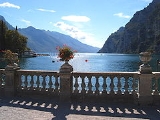
Lake Garda

Encyclopedia
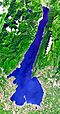
Lake Garda is the largest lake
in Italy
. It is located in Northern Italy, about half-way between Brescia
and Verona
, and between Venice
and Milan
. Glaciers formed this alpine region at the end of the last ice age
. The lake and its shoreline are divided between the provinces of Verona
(to the southeast), Brescia
(southwest), and Trentino (north). Being easily accessible from the north via the Brenner Pass
, the lake is a major tourist destination, including a number of exclusive hotels and resorts along its shore.
valley, probably having been formed under the action of a Paleolithic
glacier. Although traces of the glacier's actions are evident today, in more recent years it has been hypothesized that the glacier occupied a previously existing depression, created by stream erosion 5 to 6 million years ago.
The lake has numerous small islands and five main ones, the largest being Isola del Garda. Nearby to the south is Isola San Biagio, also known as the Isola dei Conigli ("Island of the Rabbits"). Both are offshore of San Felice del Benaco
, on the west side. The three other main islands are Isola dell'Olivo, Isola di Sogno, and Isola di Trimelone, all further north near the east side. The main tributary is the Sarca
River, while the only emissary is the Mincio
River.
, located on the south of the lake, is one particularly popular destination, home to the Virgilio & Catullo Spa Complexes, as well as numerous restaurants, bars, hotels, fashion stores and a market. The picturesque Scaliger
castle
dates from the 13th century. The Roman
poet Catullus
had a villa here, and visitors can see a ruined Roman spa named the Grotte di Catullo (Grotto of Catullus) although there is no evidence linking him to this particular building. The sulfur
springs
at the tip of the peninsula
have a reputation for the healing of catarrh
al conditions, particularly those involving the ear
. Nearby, there is Gardaland
, one of the most famous theme parks in Italy.
Lake
A lake is a body of relatively still fresh or salt water of considerable size, localized in a basin, that is surrounded by land. Lakes are inland and not part of the ocean and therefore are distinct from lagoons, and are larger and deeper than ponds. Lakes can be contrasted with rivers or streams,...
in Italy
Italy
Italy , officially the Italian Republic languages]] under the European Charter for Regional or Minority Languages. In each of these, Italy's official name is as follows:;;;;;;;;), is a unitary parliamentary republic in South-Central Europe. To the north it borders France, Switzerland, Austria and...
. It is located in Northern Italy, about half-way between Brescia
Brescia
Brescia is a city and comune in the region of Lombardy in northern Italy. It is situated at the foot of the Alps, between the Mella and the Naviglio, with a population of around 197,000. It is the second largest city in Lombardy, after the capital, Milan...
and Verona
Verona
Verona ; German Bern, Dietrichsbern or Welschbern) is a city in the Veneto, northern Italy, with approx. 265,000 inhabitants and one of the seven chef-lieus of the region. It is the second largest city municipality in the region and the third of North-Eastern Italy. The metropolitan area of Verona...
, and between Venice
Venice
Venice is a city in northern Italy which is renowned for the beauty of its setting, its architecture and its artworks. It is the capital of the Veneto region...
and Milan
Milan
Milan is the second-largest city in Italy and the capital city of the region of Lombardy and of the province of Milan. The city proper has a population of about 1.3 million, while its urban area, roughly coinciding with its administrative province and the bordering Province of Monza and Brianza ,...
. Glaciers formed this alpine region at the end of the last ice age
Ice age
An ice age or, more precisely, glacial age, is a generic geological period of long-term reduction in the temperature of the Earth's surface and atmosphere, resulting in the presence or expansion of continental ice sheets, polar ice sheets and alpine glaciers...
. The lake and its shoreline are divided between the provinces of Verona
Province of Verona
The Province of Verona is a province in the Veneto region of Italy. Its capital is the city of Verona.-Overview:The province has an area of 3,109 km², and a total population of 912,981...
(to the southeast), Brescia
Province of Brescia
The Province of Brescia is a Province in Lombardy, Italy. It borders with the province of Sondrio in the N and NW, the province of Bergamo in the W, province of Cremona in the SW and S, the province of Mantova to the S, and to the east, the province of Verona and Trentino .Source for statistical...
(southwest), and Trentino (north). Being easily accessible from the north via the Brenner Pass
Brenner Pass
- Roadways :The motorway E45 leading from Innsbruck via Bolzano to Verona and Modena uses this pass, and is one of the most important north-south connections in Europe...
, the lake is a major tourist destination, including a number of exclusive hotels and resorts along its shore.
Geography
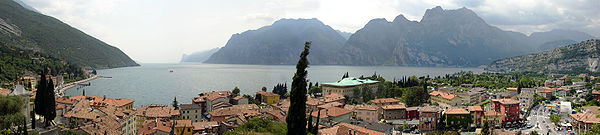
The northern part of the lake is narrower, surrounded by mountains, the majority of which belong to the Gruppo del Baldo. The shape is typical of a moraineMoraine
A moraine is any glacially formed accumulation of unconsolidated glacial debris which can occur in currently glaciated and formerly glaciated regions, such as those areas acted upon by a past glacial maximum. This debris may have been plucked off a valley floor as a glacier advanced or it may have...
valley, probably having been formed under the action of a Paleolithic
Paleolithic
The Paleolithic Age, Era or Period, is a prehistoric period of human history distinguished by the development of the most primitive stone tools discovered , and covers roughly 99% of human technological prehistory...
glacier. Although traces of the glacier's actions are evident today, in more recent years it has been hypothesized that the glacier occupied a previously existing depression, created by stream erosion 5 to 6 million years ago.
The lake has numerous small islands and five main ones, the largest being Isola del Garda. Nearby to the south is Isola San Biagio, also known as the Isola dei Conigli ("Island of the Rabbits"). Both are offshore of San Felice del Benaco
San Felice del Benaco
San Felice del Benaco is a comune in the province of Brescia, in Lombardy, northern Italy. The name derives most likely from the Latin sinux felix, meaning "pleasant harbour"....
, on the west side. The three other main islands are Isola dell'Olivo, Isola di Sogno, and Isola di Trimelone, all further north near the east side. The main tributary is the Sarca
Sarca
The Sarca is a river springing from the Adamello-Presanella mountains in the Italian Alps and flowing into Lake Garda in Northern Italy. As an emissary of the lake it becomes known as the Mincio....
River, while the only emissary is the Mincio
Mincio
Mincio is a river in the Lombardy region of northern Italy.Called the Sarca River before entering Lake Garda, it flows from there about 65 km past Mantua into the Po River....
River.
Localities and sights
The ancient fortified town of SirmioneSirmione
Sirmione is a comune in the province of Brescia, in Lombardy . It is bounded by the comunes of Desenzano del Garda and Peschiera del Garda in the province of Verona and the region of Veneto...
, located on the south of the lake, is one particularly popular destination, home to the Virgilio & Catullo Spa Complexes, as well as numerous restaurants, bars, hotels, fashion stores and a market. The picturesque Scaliger
Scaliger
The noble family of the Scaliger were Lords of Verona. When Ezzelino III was elected podestà of the commune in 1226, he was able to convert the office into a permanent lordship...
castle
Castle
A castle is a type of fortified structure built in Europe and the Middle East during the Middle Ages by European nobility. Scholars debate the scope of the word castle, but usually consider it to be the private fortified residence of a lord or noble...
dates from the 13th century. The Roman
Roman Republic
The Roman Republic was the period of the ancient Roman civilization where the government operated as a republic. It began with the overthrow of the Roman monarchy, traditionally dated around 508 BC, and its replacement by a government headed by two consuls, elected annually by the citizens and...
poet Catullus
Catullus
Gaius Valerius Catullus was a Latin poet of the Republican period. His surviving works are still read widely, and continue to influence poetry and other forms of art.-Biography:...
had a villa here, and visitors can see a ruined Roman spa named the Grotte di Catullo (Grotto of Catullus) although there is no evidence linking him to this particular building. The sulfur
Sulfur
Sulfur or sulphur is the chemical element with atomic number 16. In the periodic table it is represented by the symbol S. It is an abundant, multivalent non-metal. Under normal conditions, sulfur atoms form cyclic octatomic molecules with chemical formula S8. Elemental sulfur is a bright yellow...
springs
Spring (hydrosphere)
A spring—also known as a rising or resurgence—is a component of the hydrosphere. Specifically, it is any natural situation where water flows to the surface of the earth from underground...
at the tip of the peninsula
Peninsula
A peninsula is a piece of land that is bordered by water on three sides but connected to mainland. In many Germanic and Celtic languages and also in Baltic, Slavic and Hungarian, peninsulas are called "half-islands"....
have a reputation for the healing of catarrh
Catarrh
Catarrh is a disorder of inflammation of the mucous membranes in one of the airways or cavities of the body. It can result in a thick exudate of mucus and white blood cells caused by the swelling of the mucous membranes in the head in response to an infection...
al conditions, particularly those involving the ear
Ear
The ear is the organ that detects sound. It not only receives sound, but also aids in balance and body position. The ear is part of the auditory system....
. Nearby, there is Gardaland
Gardaland
Gardaland is the third-most-popular theme park in Europe and is between Peschiera and Lazise, at Lake Garda in Italy. Built on the eastern shore of Lake Garda at Castelnuovo del Garda, the park opened on July 19, 1975. It has expanded steadily in both size and attendance, topping 1 million visitors...
, one of the most famous theme parks in Italy.
| Trentino-Alto Adige/Südtirol |
Veneto |
Lombardy |
|---|---|---|
| Trentino (clockwise: west to east) |
Province of Verona (clockwise: north to south) |
Province of Brescia (clockwise: south to north) |
|
Malcesine Malcesine is a comune in the Province of Verona in the Italian region Veneto, located about 120 km northwest of Venice and about 40 km northwest of Verona.Malcesine lies on the shores of Lake Garda.-Main sights:... Brenzone Brenzone is a comune in the Province of Verona in the Italian region Veneto, located about 120 km west of Venice and about 35 km northwest of Verona... Torri del Benaco Torri del Benaco is a comune in the Province of Verona in the Italian region Veneto, located about 130 km west of Venice and about 30 km northwest of Verona, on the eastern coast of the Lake Garda.... Bardolino Bardolino is a comune in the Province of Verona in the Italian region Veneto, located about 130 km west of Venice and about 25 km northwest of Verona.... Lazise Lazise is a comune in the Province of Verona in the Italian region Veneto, located about 120 km west of Venice and about 20 km northwest of Verona. It is situated on the eastern shore of Lake Garda... Castelnuovo del Garda Castelnuovo del Garda is a comune in the Province of Verona in the Italian region Veneto, located about 120 km west of Venice and about 15 km west of Verona.... Peschiera del Garda Peschiera del Garda , is a town and comune in the province of Verona, in Veneto, Italy. When Lombardy-Venetia was under Austrian rule, Peschiera was the northwest anchor of the four fortified towns constituting the so-called Quadrilatero... |
Sirmione Sirmione is a comune in the province of Brescia, in Lombardy . It is bounded by the comunes of Desenzano del Garda and Peschiera del Garda in the province of Verona and the region of Veneto... Desenzano del Garda Desenzano del Garda is a town and comune in the province of Brescia, in Lombardy, Italy, which borders Lake Garda. It is bordered by other communes of Castiglione delle Stiviere, Lonato, Padenghe sul Garda and Sirmione.-History:... Lonato Lonato del Garda is a town and comune in the province of Brescia, in Lombardy, Italy. Lonato is located in the middle of northern Italy, about half way between Milan and Venice, on the south-west shore of Lake Garda, the biggest lake in Italy.The commune is bordered by those of near Castiglione... Padenghe sul Garda Padenghe sul Garda is a town and comune in the province of Brescia, in Lombardy. It is located alongside the coast of Lake Garda.-Sources:... Moniga del Garda Moniga del Garda is a town and comune in the province of Brescia, in the Italian region Lombardy. The municipality, located on the south-west side of Lake Garda, is bounded by other communes of Padenghe sul Garda, Manerba del Garda and Soiano del Lago.... Manerba del Garda Manerba del Garda is a town and comune in the province of Brescia, in Lombardy. It is located at the south-west side of the Lake Garda.Rocca di manerba, a historical site on a hill surrounded by the city, has been almost continuously occupied from the late Neolithic to the 16th century... San Felice del Benaco San Felice del Benaco is a comune in the province of Brescia, in Lombardy, northern Italy. The name derives most likely from the Latin sinux felix, meaning "pleasant harbour".... Salò Salò is a town and commune in the Province of Brescia in the region of Lombardy on the banks of Lake Garda. The city was the capital of Italian Social Republic from 1943 to 1945, with the ISR often being called the "Republic of Salò" .-History:Salò was founded in the Roman period as Pagus... Gardone Riviera Gardone Riviera is a town and comune in the province of Brescia, in Lombardy.-Main sights:* The Vittoriale degli Italiani is a former residence of the poet Gabriele D'Annunzio. He donated it to the Italian State before his death... Toscolano-Maderno Toscolano-Maderno is a town and comune on the West coast of Lake Garda, in the province of Brescia, in the region of Lombardy, in Italy. It is located c. 40 km from Brescia.... Gargnano Gargnano is a town and comune in the province of Brescia, in Lombardy.The municipal territory includes the artificial Valvestino Lake, created in 1962.... Tignale Tignale is a comune in the province of Brescia, in Lombardy, Italy. The crest is checkered with white, red on the left and black on the bottom-right with a golden animal in the middle.... Tremosine Tremosine is a comune in the province of Brescia, in Lombardy, near Lake Garda. It's divided into 18 little frazioni; Pieve is the frazione where there's the town hall, Vesio the biggest one... Limone sul Garda Limone sul Garda is a town and comune in the province of Brescia, in Lombardy , on the shore of Lake Garda.-History:Despite the presence of famous cultivations of lemons , the town's name is probably derived from the ancient lemos or limes Limone sul Garda is a town and comune in the province of... |
See also
- Battle of Lake BenacusBattle of Lake BenacusThe Battle of Lake Benacus was one of the decisive battles that marked the beginning of the Roman Empire's emergence from the Crisis of the Third Century...
, in which Roman forces defeated the AlamanniAlamanniThe Alamanni, Allemanni, or Alemanni were originally an alliance of Germanic tribes located around the upper Rhine river . One of the earliest references to them is the cognomen Alamannicus assumed by Roman Emperor Caracalla, who ruled the Roman Empire from 211 to 217 and claimed thereby to be...
on the shores of Lake Garda, in the year 268. - Battle of RivoliBattle of RivoliThe Battle of Rivoli was a key victory in the French campaign in Italy against Austria. Napoleon Bonaparte's 23,000 Frenchmen defeated an attack of 28,000 Austrians under Feldzeugmeister Jozsef Alvinczi, ending Austria's fourth and final attempt to relieve the Siege of Mantua...
, in 1797 during the French campaign of Napoleon INapoleon INapoleon Bonaparte was a French military and political leader during the latter stages of the French Revolution.As Napoleon I, he was Emperor of the French from 1804 to 1815...
in Italy against Austria. - Battle of SolferinoBattle of SolferinoThe Battle of Solferino, , was fought on June 24, 1859 and resulted in the victory of the allied French Army under Napoleon III and Sardinian Army under Victor Emmanuel II against the Austrian Army under Emperor Franz Joseph I; it was the last major battle in world...
in 1859, during the ItalianItalyItaly , officially the Italian Republic languages]] under the European Charter for Regional or Minority Languages. In each of these, Italy's official name is as follows:;;;;;;;;), is a unitary parliamentary republic in South-Central Europe. To the north it borders France, Switzerland, Austria and...
Risorgimento. The terrible aftermath of this battle led to the Geneva Convention and the formation of the Red Cross. - Benito MussoliniBenito MussoliniBenito Amilcare Andrea Mussolini was an Italian politician who led the National Fascist Party and is credited with being one of the key figures in the creation of Fascism....
established the capital of his rump Italian Social RepublicItalian Social RepublicThe Italian Social Republic was a puppet state of Nazi Germany led by the "Duce of the Nation" and "Minister of Foreign Affairs" Benito Mussolini and his Republican Fascist Party. The RSI exercised nominal sovereignty in northern Italy but was largely dependent on the Wehrmacht to maintain control...
in 1943 in a villa in the town of SalòSalòSalò is a town and commune in the Province of Brescia in the region of Lombardy on the banks of Lake Garda. The city was the capital of Italian Social Republic from 1943 to 1945, with the ISR often being called the "Republic of Salò" .-History:Salò was founded in the Roman period as Pagus...
on its shores. It served as a nexus for military operations and communications for German troops during World War IIWorld War IIWorld War II, or the Second World War , was a global conflict lasting from 1939 to 1945, involving most of the world's nations—including all of the great powers—eventually forming two opposing military alliances: the Allies and the Axis...
.
External links
- Ferry Services on Italian Lakes - Lake Garda, together with general information on the lake and its settlements.