

Tripartite Pact

Encyclopedia
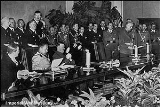
The Tripartite Pact, also the Three-Power Pact, Axis Pact, Three-way Pact or Tripartite Treaty was a pact
signed in Berlin
, Germany
on September 27, 1940, which established the Axis Powers
of World War II
. The pact was signed by representatives of Nazi Germany
(Adolf Hitler
), Fascist Italy
(foreign minister Galeazzo Ciano
), and Imperial Japan
(Japanese ambassador to Germany Saburo Kurusu
).
.
The pact supplemented the Anti-Comintern Pact
of 1936 and helped heal the rift that had developed between Japan and Germany following the 1939 Molotov-Ribbentrop Pact
between Germany and the Soviet Union.
The Tripartite Pact was subsequently joined by Hungary
(November 20, 1940), Romania
(November 23, 1940), Slovakia (November 24, 1940), Bulgaria
(March 1, 1941, prior to the arrival of German troops), Yugoslavia
(March 25, 1941), and Croatia
(June 15, 1941).
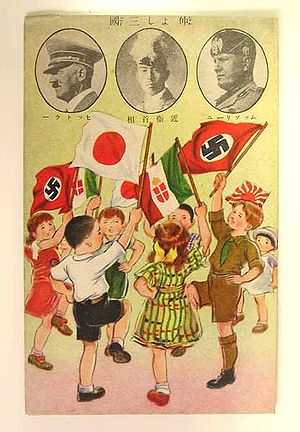 The Tripartite Treaty was immediately named by the Italian press Roberto based on the first syllables of Rome
, Berlin
and Tokyo
.
and had collapsed following the defeat by the Allies. Following the Treaty of Trianon
, the Kingdom of Hungary
was reduced greatly in size and this caused much resentment. To assuage this resentment, Germany and Italy implemented the Vienna Awards
in 1938 and 1940 and this was subsequently followed by Hungary joining the Tripartite Pact on November 20, 1940. Collusion was further heightened when the Fascist Arrow Cross Party
later came to power.
had joined the Allied Powers in World War I
and had received Transylvania
from Austro-Hungary. After Germany and Italy awarded parts of Transylvania back to Hungary and southern Dobruja
back to Bulgaria and after the Soviet Union
had taken Bessarabia
, the Fascist Iron Guard
party came to power and Romania joined the Tripartite Pact on November 23, 1940. This was due to the Romanian desire for protection against the Soviet Union.
, the Slovak Republic
was formed from a portion of the dismembered Czechoslovakia
. Hitler invited Monsignor
Jozef Tiso
to be the new nation's leader. Soon after it was formed, Slovakia was involved in a war with neighboring Hungary
. Although Slovakia had signed a "Protection Treaty" with Nazi Germany, Germany refused to help Slovakia in direct violation of that treaty. The war resulted in territorial gains by Hungary at Slovakia's expense. Even so, Slovakia supported the German invasion of Poland
. Slovakia joined the Tripartite Pact on 24 November 1940.
had been on the losing side in World War I, losing territory to Serbia and Greece
. During World War II, Germany needed military access through Bulgaria in order to attack Greece. Adolf Hitler promised the Bulgarian Tsar Boris III
that Bulgaria would receive all the territory she had lost in return for Bulgaria joining the Axis. Boris agreed and prime-minister Bogdan Filov
signed the Pact on March 1, 1941.
, Dragiša Cvetković
, Prime Minister of the Kingdom of Yugoslavia
, signed the Tripartite Pact. On March 27, the regime was overthrown by a military coup d'état
with British support, and the 17 year old King Peter II of Yugoslavia
seized power. General Dušan Simović
became Peter's Prime Minister and the Kingdom of Yugoslavia initially tried to dissolve the Pact but later declared adherence to it.
The initial agreement of the document also regarded Yugoslavia's acceptance of the free movement of German troops around the country; this was unsatisfactory to the Führer
, and resulted in the Invasion of Yugoslavia
.
Postponing Operation Barbarossa
, the Germans simultaneously attacked Yugoslavia and Greece
. Starting on April 6, the German Air Force (Luftwaffe
) bombed Belgrade
for three days and nights. German ground troops (Wehrmacht Heer) moved in, and Yugoslavia capitulated on April 17.
(Nezavisna Država Hrvatska, or NDH) was declared to be a member of the Axis on 10 April 1941 and joined the Tripartite Pact on June 15, 1941. Modern day Croatia
is not related to this country as its legal successor.
was thus sent to Berlin to discuss the pact and the possibility of the Soviet Union joining it.
For the Soviets, they considered joining the Tripartite Pact to be an update of existing agreements with Germany. On Molotov's visit, he agreed in principle to the Soviet Union joining the pact so long as some details, such as Soviet annexation of Finland, could be worked out. The Soviet government
sent a revised version of the pact to Germany on November 25. To demonstrate the benefits of partnership, the Soviet Union made large economic offerings to Germany.
Regardless of the talks however, the Germans had no intention of allowing the Soviets to join the pact. They were already in the preparation stages for their invasion of the Soviet Union and were committed to doing so regardless of any action the Soviets took.
When they received the Soviet offer in November, they simply did not reply. They did, however, accept the new economic offerings, and signed an agreement for such on January 10, 1941.
. Finland joined the Operation Barbarossa
on June 25, 1941, starting the Continuation War
. In November, Finland signed the Anti-Comintern Pact
(an anti-communist agreement directed against the Soviet Union) with many other countries allied with Germany. Soon after this Germany suggested Finland sign the Tripartite Pact. However, the Finnish government refused, because Finland saw its war as a "separate war" from the Second World War, and it saw its objectives as different from those of Nazi Germany. Finland also wanted to maintain diplomatic relations with the Allied Powers, the United States in particular. During the Second World War, Germany asked Finland several times to sign the pact, but always the Finnish government declined the offer. Diplomatic relations between Finland and the United States were maintained until June 1944, although the US ambassador had already been recalled earlier. The United Kingdom, however, declared war on Finland on December 6, 1941 in support of its ally, the Soviet Union.
in 1943, marking the beginning of the end for the Tripartite Pact. While dictator Benito Mussolini
's Italian Social Republic
(Repubblica Sociale Italiana, or RSI) continued to maintain its alliance with Germany until the end of the war, the RSI was never more than a puppet state
. In 1944, both Bulgaria and Romania changed sides and became military allies of the Soviet Union. After the Slovak National Uprising
in mid-1944, the Germans ended what little was left of the independence of Slovakia. Hungary was the last minor member of the pact aside from the major two (Germany and Japan). However, by early April 1945, Hungary was completely overrun and its pro-German dictator Ferenc Szálasi
and his Fascist government were forced to flee. While technically still in operation until Japan's surrender, the defeat of Germany brought an end to any effective meaning of the treaty.
Pact
A pact is a formal agreement.Pact, The Pact or PACT may also refer to:-PACT as an acronym:* Protein ACTivator of the interferon-induced protein kinase, a protein that activates protein kinase R...
signed in Berlin
Berlin
Berlin is the capital city of Germany and is one of the 16 states of Germany. With a population of 3.45 million people, Berlin is Germany's largest city. It is the second most populous city proper and the seventh most populous urban area in the European Union...
, Germany
Germany
Germany , officially the Federal Republic of Germany , is a federal parliamentary republic in Europe. The country consists of 16 states while the capital and largest city is Berlin. Germany covers an area of 357,021 km2 and has a largely temperate seasonal climate...
on September 27, 1940, which established the Axis Powers
Axis Powers
The Axis powers , also known as the Axis alliance, Axis nations, Axis countries, or just the Axis, was an alignment of great powers during the mid-20th century that fought World War II against the Allies. It began in 1936 with treaties of friendship between Germany and Italy and between Germany and...
of World War II
World War II
World War II, or the Second World War , was a global conflict lasting from 1939 to 1945, involving most of the world's nations—including all of the great powers—eventually forming two opposing military alliances: the Allies and the Axis...
. The pact was signed by representatives of Nazi Germany
Nazi Germany
Nazi Germany , also known as the Third Reich , but officially called German Reich from 1933 to 1943 and Greater German Reich from 26 June 1943 onward, is the name commonly used to refer to the state of Germany from 1933 to 1945, when it was a totalitarian dictatorship ruled by...
(Adolf Hitler
Adolf Hitler
Adolf Hitler was an Austrian-born German politician and the leader of the National Socialist German Workers Party , commonly referred to as the Nazi Party). He was Chancellor of Germany from 1933 to 1945, and head of state from 1934 to 1945...
), Fascist Italy
Kingdom of Italy (1861–1946)
The Kingdom of Italy was a state forged in 1861 by the unification of Italy under the influence of the Kingdom of Sardinia, which was its legal predecessor state...
(foreign minister Galeazzo Ciano
Galeazzo Ciano
Gian Galeazzo Ciano, 2nd Count of Cortellazzo and Buccari was an Italian Minister of Foreign Affairs and Benito Mussolini's son-in-law. In early 1944 Count Ciano was shot by firing squad at the behest of his father-in-law, Mussolini under pressure from Nazi Germany.-Early life:Ciano was born in...
), and Imperial Japan
Empire of Japan
The Empire of Japan is the name of the state of Japan that existed from the Meiji Restoration on 3 January 1868 to the enactment of the post-World War II Constitution of...
(Japanese ambassador to Germany Saburo Kurusu
Saburo Kurusu
was a Japanese career diplomat. He is remembered now as an envoy who tried to negotiate peace and understanding with the United States while Japan was secretly preparing the attack on Pearl Harbor....
).
Background and the agreement
The three nations agreed that for the next ten years they would "stand by and co-operate with one another in... their prime purpose to establish and maintain a new order of things... to promote the mutual prosperity and welfare of the peoples concerned." They recognized each other's spheres of interest and undertook "to assist one another with all political, economic and military means when one of the three contracting powers is attacked" by a country not already involved in the war, excluding the Soviet UnionSoviet Union
The Soviet Union , officially the Union of Soviet Socialist Republics , was a constitutionally socialist state that existed in Eurasia between 1922 and 1991....
.
The pact supplemented the Anti-Comintern Pact
Anti-Comintern Pact
The Anti-Comintern Pact was an Anti-Communist pact concluded between Nazi Germany and the Empire of Japan on November 25, 1936 and was directed against the Communist International ....
of 1936 and helped heal the rift that had developed between Japan and Germany following the 1939 Molotov-Ribbentrop Pact
Molotov-Ribbentrop Pact
The Molotov–Ribbentrop Pact, named after the Soviet foreign minister Vyacheslav Molotov and the German foreign minister Joachim von Ribbentrop, was an agreement officially titled the Treaty of Non-Aggression between Germany and the Soviet Union and signed in Moscow in the late hours of 23 August 1939...
between Germany and the Soviet Union.
The Tripartite Pact was subsequently joined by Hungary
Kingdom of Hungary
The Kingdom of Hungary comprised present-day Hungary, Slovakia and Croatia , Transylvania , Carpatho Ruthenia , Vojvodina , Burgenland , and other smaller territories surrounding present-day Hungary's borders...
(November 20, 1940), Romania
Romania
Romania is a country located at the crossroads of Central and Southeastern Europe, on the Lower Danube, within and outside the Carpathian arch, bordering on the Black Sea...
(November 23, 1940), Slovakia (November 24, 1940), Bulgaria
Bulgaria
Bulgaria , officially the Republic of Bulgaria , is a parliamentary democracy within a unitary constitutional republic in Southeast Europe. The country borders Romania to the north, Serbia and Macedonia to the west, Greece and Turkey to the south, as well as the Black Sea to the east...
(March 1, 1941, prior to the arrival of German troops), Yugoslavia
Yugoslavia
Yugoslavia refers to three political entities that existed successively on the western part of the Balkans during most of the 20th century....
(March 25, 1941), and Croatia
Independent State of Croatia
The Independent State of Croatia was a World War II puppet state of Nazi Germany, established on a part of Axis-occupied Yugoslavia. The NDH was founded on 10 April 1941, after the invasion of Yugoslavia by the Axis powers. All of Bosnia and Herzegovina was annexed to NDH, together with some parts...
(June 15, 1941).
Text of the pact
Rome
Rome is the capital of Italy and the country's largest and most populated city and comune, with over 2.7 million residents in . The city is located in the central-western portion of the Italian Peninsula, on the Tiber River within the Lazio region of Italy.Rome's history spans two and a half...
, Berlin
Berlin
Berlin is the capital city of Germany and is one of the 16 states of Germany. With a population of 3.45 million people, Berlin is Germany's largest city. It is the second most populous city proper and the seventh most populous urban area in the European Union...
and Tokyo
Tokyo
, ; officially , is one of the 47 prefectures of Japan. Tokyo is the capital of Japan, the center of the Greater Tokyo Area, and the largest metropolitan area of Japan. It is the seat of the Japanese government and the Imperial Palace, and the home of the Japanese Imperial Family...
.
Other signatories
Hungary
The Austro-Hungarian Empire had sided with Imperial Germany during World War IWorld War I
World War I , which was predominantly called the World War or the Great War from its occurrence until 1939, and the First World War or World War I thereafter, was a major war centred in Europe that began on 28 July 1914 and lasted until 11 November 1918...
and had collapsed following the defeat by the Allies. Following the Treaty of Trianon
Treaty of Trianon
The Treaty of Trianon was the peace agreement signed in 1920, at the end of World War I, between the Allies of World War I and Hungary . The treaty greatly redefined and reduced Hungary's borders. From its borders before World War I, it lost 72% of its territory, which was reduced from to...
, the Kingdom of Hungary
Kingdom of Hungary (1920–1946)
The Kingdom of Hungary also known as the Regency, existed from 1920 to 1946 and was a de facto country under Regent Miklós Horthy. Horthy officially represented the abdicated Hungarian monarchy of Charles IV, Apostolic King of Hungary...
was reduced greatly in size and this caused much resentment. To assuage this resentment, Germany and Italy implemented the Vienna Awards
Vienna Awards
The Vienna Awards are two arbitral awards by which arbiters of Nazi Germany and Fascist Italy sought to enforce peacefully the claims of Hungary on territory it had lost in 1920 when it signed the Treaty of Trianon...
in 1938 and 1940 and this was subsequently followed by Hungary joining the Tripartite Pact on November 20, 1940. Collusion was further heightened when the Fascist Arrow Cross Party
Arrow Cross Party
The Arrow Cross Party was a national socialist party led by Ferenc Szálasi, which led in Hungary a government known as the Government of National Unity from October 15, 1944 to 28 March 1945...
later came to power.
Romania
The Kingdom of RomaniaKingdom of Romania
The Kingdom of Romania was the Romanian state based on a form of parliamentary monarchy between 13 March 1881 and 30 December 1947, specified by the first three Constitutions of Romania...
had joined the Allied Powers in World War I
Allies of World War I
The Entente Powers were the countries at war with the Central Powers during World War I. The members of the Triple Entente were the United Kingdom, France, and the Russian Empire; Italy entered the war on their side in 1915...
and had received Transylvania
Transylvania
Transylvania is a historical region in the central part of Romania. Bounded on the east and south by the Carpathian mountain range, historical Transylvania extended in the west to the Apuseni Mountains; however, the term sometimes encompasses not only Transylvania proper, but also the historical...
from Austro-Hungary. After Germany and Italy awarded parts of Transylvania back to Hungary and southern Dobruja
Dobruja
Dobruja is a historical region shared by Bulgaria and Romania, located between the lower Danube river and the Black Sea, including the Danube Delta, Romanian coast and the northernmost part of the Bulgarian coast...
back to Bulgaria and after the Soviet Union
Soviet Union
The Soviet Union , officially the Union of Soviet Socialist Republics , was a constitutionally socialist state that existed in Eurasia between 1922 and 1991....
had taken Bessarabia
Bessarabia
Bessarabia is a historical term for the geographic region in Eastern Europe bounded by the Dniester River on the east and the Prut River on the west....
, the Fascist Iron Guard
Iron Guard
The Iron Guard is the name most commonly given to a far-right movement and political party in Romania in the period from 1927 into the early part of World War II. The Iron Guard was ultra-nationalist, fascist, anti-communist, and promoted the Orthodox Christian faith...
party came to power and Romania joined the Tripartite Pact on November 23, 1940. This was due to the Romanian desire for protection against the Soviet Union.
Slovakia
On 14 March 1939, after the Munich AgreementMunich Agreement
The Munich Pact was an agreement permitting the Nazi German annexation of Czechoslovakia's Sudetenland. The Sudetenland were areas along Czech borders, mainly inhabited by ethnic Germans. The agreement was negotiated at a conference held in Munich, Germany, among the major powers of Europe without...
, the Slovak Republic
Slovak Republic (1939-1945)
The Slovak Republic , also known as the First Slovak Republic or the Slovak State , was a fascist state which existed from 14 March 1939 to 8 May 1945 as a puppet state of Nazi Germany. It existed on roughly the same territory as present-day Slovakia...
was formed from a portion of the dismembered Czechoslovakia
Czechoslovakia
Czechoslovakia or Czecho-Slovakia was a sovereign state in Central Europe which existed from October 1918, when it declared its independence from the Austro-Hungarian Empire, until 1992...
. Hitler invited Monsignor
Monsignor
Monsignor, pl. monsignori, is the form of address for those members of the clergy of the Catholic Church holding certain ecclesiastical honorific titles. Monsignor is the apocopic form of the Italian monsignore, from the French mon seigneur, meaning "my lord"...
Jozef Tiso
Jozef Tiso
Jozef Tiso was a Slovak Roman Catholic priest, politician of the Slovak People's Party, and Nazi collaborator. Between 1939 and 1945, Tiso was the head of the Slovak State, a satellite state of Nazi Germany...
to be the new nation's leader. Soon after it was formed, Slovakia was involved in a war with neighboring Hungary
Slovak-Hungarian War
The Slovak–Hungarian War or Little War , was a war fought from March 23 to March 31/April 4, 1939 between the First Slovak Republic and Hungary in eastern Slovakia.-Prelude:...
. Although Slovakia had signed a "Protection Treaty" with Nazi Germany, Germany refused to help Slovakia in direct violation of that treaty. The war resulted in territorial gains by Hungary at Slovakia's expense. Even so, Slovakia supported the German invasion of Poland
Slovak invasion of Poland (1939)
The Slovak invasion of Poland occurred during Nazi Germany's invasion of Poland in 1939. The recently-created Slovak Republic joined the attack, and the Slovak field army contributed over 50,000 soldiers in three divisions...
. Slovakia joined the Tripartite Pact on 24 November 1940.
Bulgaria
The Kingdom of BulgariaKingdom of Bulgaria
The Kingdom of Bulgaria was established as an independent state when the Principality of Bulgaria, an Ottoman vassal, officially proclaimed itself independent on October 5, 1908 . This move also formalised the annexation of the Ottoman province of Eastern Rumelia, which had been under the control...
had been on the losing side in World War I, losing territory to Serbia and Greece
Greece
Greece , officially the Hellenic Republic , and historically Hellas or the Republic of Greece in English, is a country in southeastern Europe....
. During World War II, Germany needed military access through Bulgaria in order to attack Greece. Adolf Hitler promised the Bulgarian Tsar Boris III
Boris III of Bulgaria
Boris III the Unifier, Tsar of Bulgaria , originally Boris Klemens Robert Maria Pius Ludwig Stanislaus Xaver , son of Ferdinand I, came to the throne in 1918 upon the abdication of his father, following the defeat of the Kingdom of Bulgaria during World War I...
that Bulgaria would receive all the territory she had lost in return for Bulgaria joining the Axis. Boris agreed and prime-minister Bogdan Filov
Bogdan Filov
Bogdan Dimitrov Filov was a Bulgarian archaeologist, art historian and politician. He was Prime Minister of Bulgaria during World War II. During his service, Bulgaria became the seventh nation to join the Axis Powers....
signed the Pact on March 1, 1941.
Yugoslavia
On March 25, 1941 in ViennaVienna
Vienna is the capital and largest city of the Republic of Austria and one of the nine states of Austria. Vienna is Austria's primary city, with a population of about 1.723 million , and is by far the largest city in Austria, as well as its cultural, economic, and political centre...
, Dragiša Cvetković
Dragiša Cvetkovic
Dragiša Cvetković was a Yugoslav politician.He served as the prime minister of the Kingdom of Yugoslavia from 1939 to 1941. He developed the federalization of Yugoslavia through the creation of the Banovina of Croatia by an agreement with Croatian leader Vladko Maček...
, Prime Minister of the Kingdom of Yugoslavia
Kingdom of Yugoslavia
The Kingdom of Yugoslavia was a state stretching from the Western Balkans to Central Europe which existed during the often-tumultuous interwar era of 1918–1941...
, signed the Tripartite Pact. On March 27, the regime was overthrown by a military coup d'état
Coup d'état
A coup d'état state, literally: strike/blow of state)—also known as a coup, putsch, and overthrow—is the sudden, extrajudicial deposition of a government, usually by a small group of the existing state establishment—typically the military—to replace the deposed government with another body; either...
with British support, and the 17 year old King Peter II of Yugoslavia
Peter II of Yugoslavia
Peter II, also known as Peter II Karađorđević , was the third and last King of Yugoslavia...
seized power. General Dušan Simović
Dušan Simovic
Dušan T. Simović was a Yugoslav general who served as chief of the air force and commander-in-chief of the Royal Yugoslav Army and as the Prime Minister of Yugoslavia.-Life and career:...
became Peter's Prime Minister and the Kingdom of Yugoslavia initially tried to dissolve the Pact but later declared adherence to it.
The initial agreement of the document also regarded Yugoslavia's acceptance of the free movement of German troops around the country; this was unsatisfactory to the Führer
Führer
Führer , alternatively spelled Fuehrer in both English and German when the umlaut is not available, is a German title meaning leader or guide now most associated with Adolf Hitler, who modelled it on Benito Mussolini's title il Duce, as well as with Georg von Schönerer, whose followers also...
, and resulted in the Invasion of Yugoslavia
Invasion of Yugoslavia
The Invasion of Yugoslavia , also known as the April War , was the Axis Powers' attack on the Kingdom of Yugoslavia which began on 6 April 1941 during World War II...
.
Postponing Operation Barbarossa
Operation Barbarossa
Operation Barbarossa was the code name for Germany's invasion of the Soviet Union during World War II that began on 22 June 1941. Over 4.5 million troops of the Axis powers invaded the USSR along a front., the largest invasion in the history of warfare...
, the Germans simultaneously attacked Yugoslavia and Greece
Battle of Greece
The Battle of Greece is the common name for the invasion and conquest of Greece by Nazi Germany in April 1941. Greece was supported by British Commonwealth forces, while the Germans' Axis allies Italy and Bulgaria played secondary roles...
. Starting on April 6, the German Air Force (Luftwaffe
Luftwaffe
Luftwaffe is a generic German term for an air force. It is also the official name for two of the four historic German air forces, the Wehrmacht air arm founded in 1935 and disbanded in 1946; and the current Bundeswehr air arm founded in 1956....
) bombed Belgrade
Belgrade
Belgrade is the capital and largest city of Serbia. It is located at the confluence of the Sava and Danube rivers, where the Pannonian Plain meets the Balkans. According to official results of Census 2011, the city has a population of 1,639,121. It is one of the 15 largest cities in Europe...
for three days and nights. German ground troops (Wehrmacht Heer) moved in, and Yugoslavia capitulated on April 17.
Croatia
The Independent State of CroatiaIndependent State of Croatia
The Independent State of Croatia was a World War II puppet state of Nazi Germany, established on a part of Axis-occupied Yugoslavia. The NDH was founded on 10 April 1941, after the invasion of Yugoslavia by the Axis powers. All of Bosnia and Herzegovina was annexed to NDH, together with some parts...
(Nezavisna Država Hrvatska, or NDH) was declared to be a member of the Axis on 10 April 1941 and joined the Tripartite Pact on June 15, 1941. Modern day Croatia
Croatia
Croatia , officially the Republic of Croatia , is a unitary democratic parliamentary republic in Europe at the crossroads of the Mitteleuropa, the Balkans, and the Mediterranean. Its capital and largest city is Zagreb. The country is divided into 20 counties and the city of Zagreb. Croatia covers ...
is not related to this country as its legal successor.
Soviet Union
Just prior to the formation of Tripartite Pact, the Soviet Union was informed of its existence, and the potential of its joining. Vyacheslav MolotovVyacheslav Molotov
Vyacheslav Mikhailovich Molotov was a Soviet politician and diplomat, an Old Bolshevik and a leading figure in the Soviet government from the 1920s, when he rose to power as a protégé of Joseph Stalin, to 1957, when he was dismissed from the Presidium of the Central Committee by Nikita Khrushchev...
was thus sent to Berlin to discuss the pact and the possibility of the Soviet Union joining it.
For the Soviets, they considered joining the Tripartite Pact to be an update of existing agreements with Germany. On Molotov's visit, he agreed in principle to the Soviet Union joining the pact so long as some details, such as Soviet annexation of Finland, could be worked out. The Soviet government
Government of the Soviet Union
The Council of Ministers of the Union of Soviet Socialist Republics , was the de jure government comprising the highest executive and administrative body of the Soviet Union from 1946 until 1991....
sent a revised version of the pact to Germany on November 25. To demonstrate the benefits of partnership, the Soviet Union made large economic offerings to Germany.
Regardless of the talks however, the Germans had no intention of allowing the Soviets to join the pact. They were already in the preparation stages for their invasion of the Soviet Union and were committed to doing so regardless of any action the Soviets took.
When they received the Soviet offer in November, they simply did not reply. They did, however, accept the new economic offerings, and signed an agreement for such on January 10, 1941.
Finland
Military co-operation between Finland and Nazi Germany started in late 1940 after Finland had lost significant amount of her territory to Soviet aggression in the Winter WarWinter War
The Winter War was a military conflict between the Soviet Union and Finland. It began with a Soviet offensive on 30 November 1939 – three months after the start of World War II and the Soviet invasion of Poland – and ended on 13 March 1940 with the Moscow Peace Treaty...
. Finland joined the Operation Barbarossa
Operation Barbarossa
Operation Barbarossa was the code name for Germany's invasion of the Soviet Union during World War II that began on 22 June 1941. Over 4.5 million troops of the Axis powers invaded the USSR along a front., the largest invasion in the history of warfare...
on June 25, 1941, starting the Continuation War
Continuation War
The Continuation War was the second of two wars fought between Finland and the Soviet Union during World War II.At the time of the war, the Finnish side used the name to make clear its perceived relationship to the preceding Winter War...
. In November, Finland signed the Anti-Comintern Pact
Anti-Comintern Pact
The Anti-Comintern Pact was an Anti-Communist pact concluded between Nazi Germany and the Empire of Japan on November 25, 1936 and was directed against the Communist International ....
(an anti-communist agreement directed against the Soviet Union) with many other countries allied with Germany. Soon after this Germany suggested Finland sign the Tripartite Pact. However, the Finnish government refused, because Finland saw its war as a "separate war" from the Second World War, and it saw its objectives as different from those of Nazi Germany. Finland also wanted to maintain diplomatic relations with the Allied Powers, the United States in particular. During the Second World War, Germany asked Finland several times to sign the pact, but always the Finnish government declined the offer. Diplomatic relations between Finland and the United States were maintained until June 1944, although the US ambassador had already been recalled earlier. The United Kingdom, however, declared war on Finland on December 6, 1941 in support of its ally, the Soviet Union.
End of the Pact
The Kingdom of Italy surrendered to the Western AlliesWestern Allies
The Western Allies were a political and geographic grouping among the Allied Powers of the Second World War. It generally includes the United Kingdom and British Commonwealth, the United States, France and various other European and Latin American countries, but excludes China, the Soviet Union,...
in 1943, marking the beginning of the end for the Tripartite Pact. While dictator Benito Mussolini
Benito Mussolini
Benito Amilcare Andrea Mussolini was an Italian politician who led the National Fascist Party and is credited with being one of the key figures in the creation of Fascism....
's Italian Social Republic
Italian Social Republic
The Italian Social Republic was a puppet state of Nazi Germany led by the "Duce of the Nation" and "Minister of Foreign Affairs" Benito Mussolini and his Republican Fascist Party. The RSI exercised nominal sovereignty in northern Italy but was largely dependent on the Wehrmacht to maintain control...
(Repubblica Sociale Italiana, or RSI) continued to maintain its alliance with Germany until the end of the war, the RSI was never more than a puppet state
Puppet state
A puppet state is a nominal sovereign of a state who is de facto controlled by a foreign power. The term refers to a government controlled by the government of another country like a puppeteer controls the strings of a marionette...
. In 1944, both Bulgaria and Romania changed sides and became military allies of the Soviet Union. After the Slovak National Uprising
Slovak National Uprising
The Slovak National Uprising or 1944 Uprising was an armed insurrection organized by the Slovak resistance movement during World War II. It was launched on August 29 1944 from Banská Bystrica in an attempt to overthrow the collaborationist Slovak State of Jozef Tiso...
in mid-1944, the Germans ended what little was left of the independence of Slovakia. Hungary was the last minor member of the pact aside from the major two (Germany and Japan). However, by early April 1945, Hungary was completely overrun and its pro-German dictator Ferenc Szálasi
Ferenc Szálasi
Ferenc Szálasi was the leader of the National Socialist Arrow Cross Party – Hungarist Movement, the "Leader of the Nation" , being both Head of State and Prime Minister of the Kingdom of Hungary's "Government of National Unity" for the final three months of Hungary's participation in World War II...
and his Fascist government were forced to flee. While technically still in operation until Japan's surrender, the defeat of Germany brought an end to any effective meaning of the treaty.