
The
Polish resistance movement in World War II, with the
Home ArmyThe Armia Krajowa , or Home Army, was the dominant Polish resistance movement in World War II German-occupied Poland. It was formed in February 1942 from the Związek Walki Zbrojnej . Over the next two years, it absorbed most other Polish underground forces...
at its forefront, was the largest underground resistance in all of Nazi-occupied Europe, covering both German and Soviet zones of occupation. The Polish defence against the Nazi occupation was an important part of the European
anti-fascistAnti-fascism is the opposition to fascist ideologies, groups and individuals, such as that of the resistance movements during World War II. The related term antifa derives from Antifaschismus, which is German for anti-fascism; it refers to individuals and groups on the left of the political...
resistance movementResistance movements during World War II occurred in every occupied country by a variety of means, ranging from non-cooperation, disinformation and propaganda to hiding crashed pilots and even to outright warfare and the recapturing of towns...
. It is most notable for disrupting German supply lines to the
Eastern FrontThe Eastern Front of World War II was a theatre of World War II between the European Axis powers and co-belligerent Finland against the Soviet Union, Poland, and some other Allies which encompassed Northern, Southern and Eastern Europe from 22 June 1941 to 9 May 1945...
, providing
military intelligenceMilitary intelligence is a military discipline that exploits a number of information collection and analysis approaches to provide guidance and direction to commanders in support of their decisions....
to the British, and for saving more
JewishThe Jews , also known as the Jewish people, are a nation and ethnoreligious group originating in the Israelites or Hebrews of the Ancient Near East. The Jewish ethnicity, nationality, and religion are strongly interrelated, as Judaism is the traditional faith of the Jewish nation...
lives in
the HolocaustThe Holocaust , also known as the Shoah , was the genocide of approximately six million European Jews and millions of others during World War II, a programme of systematic state-sponsored murder by Nazi...
than any other
AlliedThe Allies of World War II were the countries that opposed the Axis powers during the Second World War . Former Axis states contributing to the Allied victory are not considered Allied states...
organization or government. It was a part of the Polish Underground State.
Organizations
The largest of all Polish resistance organizations was the
Home ArmyThe Armia Krajowa , or Home Army, was the dominant Polish resistance movement in World War II German-occupied Poland. It was formed in February 1942 from the Związek Walki Zbrojnej . Over the next two years, it absorbed most other Polish underground forces...
(in Polish,
Armia Krajowa or
AK), loyal to the
Polish government in exileThe Polish government-in-exile, formally known as the Government of the Republic of Poland in Exile , was the government in exile of Poland formed in the aftermath of the Invasion of Poland of September 1939, and the subsequent occupation of Poland by Nazi Germany and the Soviet Union, which...
in London. The
AK was formed in 1942 from within the Union for Armed Combat (
Związek Walki Zbrojnej or
ZWZ, created in 1939) and incorporated most other Polish resistance groups (except for the communists and some far-right groups). It was the military arm of the
Polish Secret StateThe Polish Underground State is a collective term for the World War II underground resistance organizations in Poland, both military and civilian, that remained loyal to the Polish Government in Exile in London. The first elements of the Underground State were put in place in the final days of the...
. From 1943 the AK was increasingly in competition with the communist resistance
People's ArmyPeople's Army was a title of several communist armed forces:* Czechoslovak People's Army* People's Army of Poland* Vietnam People's Army* National People's Army, of East Germany* Yugoslav People's Army* Korean People's Army...
(Polish
Armia Ludowa or AL), backed by the
Soviet UnionThe Soviet Union , officially the Union of Soviet Socialist Republics , was a constitutionally socialist state that existed in Eurasia between 1922 and 1991....
and controlled by the
Polish Workers' PartyThe Polish Workers' Party was a communist party in Poland from 1942 to 1948. It was founded as a reconstitution of the Communist Party of Poland, and merged with the Polish Socialist Party in 1948 to form the Polish United Workers' Party.-History:...
(Polish
Polska Partia Robotnicza or PPR). After the fall of France Poles who were not involved in the regular
Polish Army in FranceThe Polish Army in France formed in France under the command of General Władysław Sikorski in late 1939, after the fall of Poland resulting from the Polish Defensive War...
and combatants who not escaped to Britain created the
Polish resistance in FranceAfter the fall of France, many Poles who were not involved in the regular Polish Army in France during World War II, or who were unable to reach the United Kingdom where the Polish Army in the United Kingdom had been formed, became the pillars of the Polish resistance in France.-Origin:That...
.
Membership
By 1944 the AK had some 380,000 men, although not all of them were armed: the AL was much smaller, numbering around 30,000. By the summer of 1944 Polish underground forces numbered more than 300,000 with some estimates of over 400,000-500,000.
1939
On November 9, 1939, the two soldiers of Polish army
Witold PileckiWitold Pilecki was a soldier of the Second Polish Republic, the founder of the Secret Polish Army resistance group and a member of the Home Army...
and Major Jan Włodarkiewicz founded the Secret Polish Army (
Tajna Armia Polska, TAP), one of the first underground organizations in Poland after defeat. Pilecki became its organizational commander as TAP expanded to cover not only
WarsawWarsaw is the capital and largest city of Poland. It is located on the Vistula River, roughly from the Baltic Sea and from the Carpathian Mountains. Its population in 2010 was estimated at 1,716,855 residents with a greater metropolitan area of 2,631,902 residents, making Warsaw the 10th most...
but
SiedlceSiedlce ) is a city in eastern Poland with 77,392 inhabitants . Situated in the Masovian Voivodeship , previously the city was the capital of a separate Siedlce Voivodeship ....
,
RadomRadom is a city in central Poland with 223,397 inhabitants . It is located on the Mleczna River in the Masovian Voivodeship , having previously been the capital of Radom Voivodeship ; 100 km south of Poland's capital, Warsaw.It is home to the biennial Radom Air Show, the largest and...
,
LublinLublin is the ninth largest city in Poland. It is the capital of Lublin Voivodeship with a population of 350,392 . Lublin is also the largest Polish city east of the Vistula river...
and other major cities of central Poland. By 1940, TAP had approximately 8,000 men (more than half of them armed), some 20
machine gunA machine gun is a fully automatic mounted or portable firearm, usually designed to fire rounds in quick succession from an ammunition belt or large-capacity magazine, typically at a rate of several hundred rounds per minute....
s and several anti-tank rifles. Later, the organization was incorporated into the Union for Armed Struggle (
Związek Walki Zbrojnej), later renamed and better known as the Home Army (
Armia KrajowaThe Armia Krajowa , or Home Army, was the dominant Polish resistance movement in World War II German-occupied Poland. It was formed in February 1942 from the Związek Walki Zbrojnej . Over the next two years, it absorbed most other Polish underground forces...
).
1940
In March 1940, a partisan unit of the first
guerrillaGuerrilla warfare is a form of irregular warfare and refers to conflicts in which a small group of combatants including, but not limited to, armed civilians use military tactics, such as ambushes, sabotage, raids, the element of surprise, and extraordinary mobility to harass a larger and...
commanders in the Second World War in Europe under Major
Henryk Dobrzański "Hubal"Major Henryk Dobrzański aka "Hubal" was a Polish soldier, sportsman and partisan. He was the first guerrilla commander of the Second World War in Europe.-Early life and career:...
completely destroyed a
battalionA battalion is a military unit of around 300–1,200 soldiers usually consisting of between two and seven companies and typically commanded by either a Lieutenant Colonel or a Colonel...
of German infantry in a skirmish near the village of Huciska. A few days later in an ambush near the village of Szałasy it inflicted heavy casualties upon another German unit. To counter this threat the German authorities formed a special 1,000 men strong anti-partisan unit of combined SS–
WehrmachtThe Wehrmacht – from , to defend and , the might/power) were the unified armed forces of Nazi Germany from 1935 to 1945. It consisted of the Heer , the Kriegsmarine and the Luftwaffe .-Origin and use of the term:...
forces, including a
PanzerA Panzer is a German language word that, when used as a noun, means "tank". When it is used as an adjective, it means either tank or "armoured" .- Etymology :...
group. Although the unit of Major Dobrzański never exceeded 300 men, the Germans fielded at least 8,000 men in the area to secure it.
In 1940,
Witold PileckiWitold Pilecki was a soldier of the Second Polish Republic, the founder of the Secret Polish Army resistance group and a member of the Home Army...
, a member of the Polish resistance, presented to his superiors a plan to enter Germany's Auschwitz concentration camp, gather intelligence on the camp from the inside, and organize inmate resistance. The Home Army approved this plan, provided him a false identity card, and on September 19, 1940, he deliberately went out during a street roundup in Warsaw - łapanka, and was caught by the Germans along with other civilians and sent to Auschwitz. In the camp he organized the underground organization -
Związek Organizacji WojskowejZwiązek Organizacji Wojskowej was an underground resistance organization formed by Witold Pilecki at Auschwitz concentration camp in 1940.-Beginning:...
- ZOW.
From October 1940, ZOW sent its first report about the camp and the genocide in November 1940 to Home Army Headquarters in Warsaw through the resistance network organized in Auschwitz.
During the night of January 21–22, 1940, in the Soviet-occupied
PodoliaThe region of Podolia is an historical region in the west-central and south-west portions of present-day Ukraine, corresponding to Khmelnytskyi Oblast and Vinnytsia Oblast. Northern Transnistria, in Moldova, is also a part of Podolia...
n town of Czortków The
Czortków UprisingThe Czortków Uprising was a failed attempt by anti-Soviet Poles, most of them teenagers from local high schools, to storm the local Red Army barracks and a prison, in order to release Polish soldiers kept there. It occurred during the night of January 21–22, 1940, in the Soviet-occupied...
started. It was the first Polish uprising during World War II. Anti-Soviet Poles, most of them teenagers from local high schools, stormed the local
Red ArmyThe Workers' and Peasants' Red Army started out as the Soviet Union's revolutionary communist combat groups during the Russian Civil War of 1918-1922. It grew into the national army of the Soviet Union. By the 1930s the Red Army was among the largest armies in history.The "Red Army" name refers to...
barracks and a prison, in order to release Polish soldiers kept there.
On the end of 1940
Aleksander KamińskiAleksander Kamiński was a Polish school teacher, form tutor, author of Polish Cub Scout and Brownie method, writer, historian, Scoutmaster , and wartime resistance leader under the codenames: Kamyk, Dąbrowski, J...
created Polish youth resistance organization - "Wawer". It was part of the
Szare Szeregi"Gray Ranks" was a codename for the underground Polish Scouting Association during World War II.The wartime organisation was created on 27 September 1939, actively resisted and fought German occupation in Warsaw until 18 January 1945, and contributed to the resistance operations of the Polish...
(the underground Polish Scouting Association). Organisation provided many
minor sabotageA minor sabotage during World War II in Nazi-occupied Poland was any underground resistance operation that involved a disruptive but relatively minor and non-violent form of defiance, such as the painting of graffiti, the manufacture of fake documents, the disrupting of German propaganda...
operations in occupied Poland and its first action was series of
graffitiGraffiti is the name for images or lettering scratched, scrawled, painted or marked in any manner on property....
in
WarsawWarsaw is the capital and largest city of Poland. It is located on the Vistula River, roughly from the Baltic Sea and from the Carpathian Mountains. Its population in 2010 was estimated at 1,716,855 residents with a greater metropolitan area of 2,631,902 residents, making Warsaw the 10th most...
around the Christmas Eve of 1940, commemorating the
Wawer massacreThe Wawer massacre refers to the execution of 107 Polish civilians on the night of 26 to 27 December 1939 by the Nazi German occupiers of Wawer , Poland. The execution was a response to the deaths of two German NCOs...
. Members of the AK Wawer "Small Sabotage" units painted "Pomścimy Wawer" ("We'll avenge Wawer") on Warsaw walls. At first they painted the whole text, then to save time they shortened it to two letters, P and W. Later they invented
KotwicaThe Kotwica was a World War II emblem of the Polish Secret State and Armia Krajowa . It was created in 1942 by members of the AK Wawer "Small Sabotage" unit as an easily usable emblem for the Polish struggle to regain independence. The initial meaning of the initials "PW" was "Pomścimy Wawer"...
-"Anchor" - who became the symbol of all Polish resistance in occupied Poland.
1941
From April 1941 the
Bureau of Information and PropagandaThe Bureau of Information and Propaganda of the Headquarters of Związek Walki Zbrojnej, later of Armia Krajowa - in short: BIP) a conspiracy department created in spring 1940 during the German occupation of Poland, inside the Związek Walki Zbrojnej, then of the Supreme Command of Armia Krajowa...
of the Union for Armed Struggle started
Operation N headed by
Tadeusz ŻenczykowskiTadeusz Żenczykowski pseudonym Kania, Kowalik, Zawadzki , took part in the Warsaw Uprising of 1944, immediately after the war a member of anti-communist conspiracy in Poland, since 1945 an emigration journalist...
. It involved
sabotageSabotage is a deliberate action aimed at weakening another entity through subversion, obstruction, disruption, or destruction. In a workplace setting, sabotage is the conscious withdrawal of efficiency generally directed at causing some change in workplace conditions. One who engages in sabotage is...
,
subversionSubversion refers to an attempt to transform the established social order, its structures of power, authority, and hierarchy; examples of such structures include the State. In this context, a "subversive" is sometimes called a "traitor" with respect to the government in-power. A subversive is...
and
black-propagandaBlack propaganda is false information and material that purports to be from a source on one side of a conflict, but is actually from the opposing side. It is typically used to vilify, embarrass or misrepresent the enemy...
activities.
From March 1941, Witold Pilecki's reports were forwarded to the
Polish government in exileThe Polish government-in-exile, formally known as the Government of the Republic of Poland in Exile , was the government in exile of Poland formed in the aftermath of the Invasion of Poland of September 1939, and the subsequent occupation of Poland by Nazi Germany and the Soviet Union, which...
and through it, to the British and other Allied governments. These reports informed the Allies about the Holocaust and were the principal source of intelligence on Auschwitz-Birkenau for the Western Allies.
On March 7, 1941, two Polish agents of the Home Army killed Nazi
collaboratorCollaborationism is cooperation with enemy forces against one's country. Legally, it may be considered as a form of treason. Collaborationism may be associated with criminal deeds in the service of the occupying power, which may include complicity with the occupying power in murder, persecutions,...
actor
Igo SymKarol Juliusz "Igo" Sym was an Austrian-born Polish actor and collaborator with Nazi Germany. He was killed in Warsaw by members of the Polish resistance movement.-Early career:...
in his apartment in
WarsawWarsaw is the capital and largest city of Poland. It is located on the Vistula River, roughly from the Baltic Sea and from the Carpathian Mountains. Its population in 2010 was estimated at 1,716,855 residents with a greater metropolitan area of 2,631,902 residents, making Warsaw the 10th most...
. In reprisal, 21 Polish hostages were executed. Several Polish actors were also arrested by the Nazis and sent to Auschwitz, among them such notable figures as directors
Stefan JaraczStefan Jaracz was a Polish actor and theater director. The Stefan Jaracz Theatre in Łódź, Poland is named after him.-Life:He was born in Stare Żukowice, near Tarnów, and died in Otwock, near Warsaw....
and
Leon SchillerLeon Schiller de Schildenfeld was a Polish theater and film director, critic and theoretician. He was also a composer and wrote theater and radio screenplays....
.
In July 1941 Mieczysław Słowikowski (using the codename
"Rygor" — Polish for "Rigor") set up "Agency Africa," one of World War II's most successful intelligence organizations. His Polish allies in these endeavors included Lt. Col.
Gwido LangerLt. Col. Karol Gwido Langer was chief of the Polish General Staff's Cipher Bureau from at least mid-1931.-Life:...
and Major
Maksymilian CiężkiMaksymilian Ciężki was the head of the German section of the Polish Cipher Bureau in the 1930s, during which time the Bureau decrypted German Enigma messages....
. The information gathered by the Agency was used by the Americans and British in planning the amphibious November 1942
Operation TorchOperation Torch was the British-American invasion of French North Africa in World War II during the North African Campaign, started on 8 November 1942....
landings in North Africa. These were the first large-scale Allied landings of the war, and their success in turn paved the way for the Allies'
ItalianItaly , officially the Italian Republic languages]] under the European Charter for Regional or Minority Languages. In each of these, Italy's official name is as follows:;;;;;;;;), is a unitary parliamentary republic in South-Central Europe. To the north it borders France, Switzerland, Austria and...
campaign.
1942
On 20 June 1942 took place the most spectacular escape from Auschwitz concentration camp. Ukrainian Eugeniusz Bendera and three Poles,
Kazimierz PiechowskiKazimierz Piechowski is a retired engineer, a Boy Scout during the Second Polish Republic, a political prisoner of the Nazis at Auschwitz concentration camp, a soldier in the Polish Home Army then a prisoner for seven years of the communist government of Poland...
, Stanisław Gustaw Jaster and Józef Lempart made a daring escape. The escapees were dressed as members of the
SS-TotenkopfverbändeThe SS Division Totenkopf , also known as 3. SS-Panzergrenadier-Division Totenkopf and 3. SS-Panzer-Division Totenkopf, was one of the 38 divisions fielded by the Waffen-SS during World War II. Prior to achieving division status, the formation was known as Kampfgruppe Eicke...
, fully armed and in an SS staff car. They drove out the main gate in a stolen Rudolf Hoss automobile
SteyrSteyr was an Austrian automotive company from 1915 until 1990.Formed as a branch of Steyr Osterreichische Waffenfabriks-Gesellschaft in 1915, to diversify manufacturing, the founders hired 38-year-old designer Hans Ledwinka after he resigned from Nesselsdorfer-Wagenbau...
220 with a smuggled report from
Witold PileckiWitold Pilecki was a soldier of the Second Polish Republic, the founder of the Secret Polish Army resistance group and a member of the Home Army...
about the Holocaust. The Germans never recaptured any of them.
In September 1942 "
The Council to Aid Jews Żegota"Żegota" , also known as the "Konrad Żegota Committee", was a codename for the Polish Council to Aid Jews , an underground organization of Polish resistance in German-occupied Poland from 1942 to 1945....
" was founded by
Zofia Kossak-SzczuckaZofia Kossak-Szczucka was a Polish writer and World War II resistance fighter. She co-founded the wartime Polish organization Żegota, set up to assist Poland's Jews in escaping the Holocaust...
and
Wanda Krahelska-FilipowiczWanda Krahelska-Filipowicz code name “Alinka"” or “Alicja”, was a leading figure in Warsaw's underground resistance movement throughout the years of German occupation during World War II in Poland...
("Alinka") and made up of Polish Democrat as well as other Catholic activists. Poland was the only country in occupied Europe where there existed such a dedicated secret organization. Half of the Jews who survived the war (thus over 50,000) were aided in some shape or form by Żegota. Most known activist of Żegota was
Irena SendlerIrena Sendler was a Polish Catholic social worker who served in the Polish Underground and the Żegota resistance organization in German-occupied Warsaw during World War II...
head of the children's division who saved 2,500 Jewish children by smuggling them out of the
Warsaw GhettoThe Warsaw Ghetto was the largest of all Jewish Ghettos in Nazi-occupied Europe during World War II. It was established in the Polish capital between October and November 15, 1940, in the territory of General Government of the German-occupied Poland, with over 400,000 Jews from the vicinity...
, providing them false documents, and sheltering them in individual and group children's homes outside the Ghetto.
In 1942
Jan KarskiJan Karski was a Polish World War II resistance movement fighter and later scholar at Georgetown University. In 1942 and 1943 Karski reported to the Polish government in exile and the Western Allies on the situation in German-occupied Poland, especially the destruction of the Warsaw Ghetto, and...
reported to the Polish, British and U.S. governments on the situation in Poland, especially the Holocaust of the Jews. He met with Polish politicians in exile including the prime minister, as well as members of political parties such as the PPS, SN,
SPStronnictwo Pracy was a Polish Christian democratic political party, active from 1937 in the Second Polish Republic and later part of the Polish government in exile. Its founder and main activist was Karol Popiel....
,
SLThe People's Party was a Polish political party, active from 1931 in the Second Polish Republic. An agrarian populist party, its power base was composed mostly from peasants....
,
Jewish BundThe General Jewish Labour Bund in Poland was a Jewish socialist party in Poland which promoted the political, cultural and social autonomy of Jewish workers, sought to combat antisemitism and was generally opposed to Zionism.-Creation of the Polish Bund:...
and Poalei Zion. He also spoke to
Anthony EdenRobert Anthony Eden, 1st Earl of Avon, KG, MC, PC was a British Conservative politician, who was Prime Minister from 1955 to 1957...
, the British foreign secretary, and included a detailed statement on what he had seen in Warsaw and Bełżec.
The
Zamość UprisingThe Zamość Uprising refers to the actions by Polish resistance against the forced expulsion of Poles from the Zamość region under the Nazi Generalplan Ost...
was an armed uprising of Armia Krajowa and Bataliony Chłopskie against the forced expulsion of Poles from the
ZamośćZamość ukr. Замостя is a town in southeastern Poland with 66,633 inhabitants , situated in the south-western part of Lublin Voivodeship , about from Lublin, from Warsaw and from the border with Ukraine...
region under the Nazi
Generalplan OstGeneralplan Ost was a secret Nazi German plan for the colonization of Eastern Europe. Implementing it would have necessitated genocide and ethnic cleansing to be undertaken in the Eastern European territories occupied by Germany during World War II...
. Germans attempting to remove the local Poles from the Greater Zamość area (through forced removal, transfer to forced labor camps, or, in some cases,
mass murderMass murder is the act of murdering a large number of people , typically at the same time or over a relatively short period of time. According to the FBI, mass murder is defined as four or more murders occurring during a particular event with no cooling-off period between the murders...
) to get it ready for German colonization. It lasted from 1942 until 1944 and despite heavy casualties suffered by the Underground, the Germans failed.
On the night from 7 to 8 October 1942
Operation WieniecOperation Wieniec was one of the large-scale anti-Nazi operations of the Armia Krajowa during the World War II that took place on the night from 7 to 8 October 1942. It targeted rail infrastructure near Warsaw....
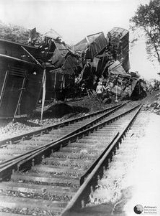
started. It targeted rail infrastructure near Warsaw. Similar operations aimed at disrupting German transport and communication in occupied Poland occurred in the coming months and years. It targeted railroads, bridges and supply depots, primarily near transport hubs such as Warsaw and
LublinLublin is the ninth largest city in Poland. It is the capital of Lublin Voivodeship with a population of 350,392 . Lublin is also the largest Polish city east of the Vistula river...
.
1943
In early 1943 two Polish slave janitors of Peenemünde's Camp Trassenheide provided maps, sketches and reports to
Polish Home Army IntelligenceThe Armia Krajowa , or Home Army, was the dominant Polish resistance movement in World War II German-occupied Poland. It was formed in February 1942 from the Związek Walki Zbrojnej . Over the next two years, it absorbed most other Polish underground forces...
, and in June 1943 British intelligence had received two such reports which identified the "rocket assembly hall', 'experimental pit', and 'launching tower'. When reconnaissance and intelligence information regarding the V-2 rocket became convincing, the
War Cabinet-The War Cabinet:Changes*August 1940: Lord Beaverbrook , Minister of Aircraft Production, joins the War Cabinet*October 1940: Sir John Anderson succeeds Neville Chamberlain as Lord President. Sir Kingsley Wood, the Chancellor of the Exchequer, and Ernest Bevin, the Minister of Labour, enter the War...
Defence Committee (Operations) directed the campaign's first planned raid (the
Operation Hydra bombingOperation Hydra was a Royal Air Force attack on the Peenemünde Army Research Center on the night of 17/18 August 1943. It began the Operation Crossbow strategic bombing campaign against Nazi Germany's V-weapon programme...
of
PeenemündeThe Peenemünde Army Research Center was founded in 1937 as one of five military proving grounds under the Army Weapons Office ....
in August 1943) and
Operation CrossbowCrossbow was the code name of the World War II campaign of Anglo-American "operations against all phases of the German long-range weapons programme—operations against research and development of the weapons, their manufacture, transportation and their launching sites, and against missiles in flight"...
.
On March 26, 1943 in Warsaw
Operation ArsenalThe Operation Arsenal, code name: "Meksyk II" was the first major operation by the Szare Szeregi Polish Underground formation during the Nazi occupation of Poland. It took place on March 26, 1943 in Warsaw...
was launched by the
Szare Szeregi"Gray Ranks" was a codename for the underground Polish Scouting Association during World War II.The wartime organisation was created on 27 September 1939, actively resisted and fought German occupation in Warsaw until 18 January 1945, and contributed to the resistance operations of the Polish...
(Gray Ranks) Polish Underground The successful operation led to the release of arrested troop leader
Jan Bytnar "Rudy"Jan Roman Bytnar was a Polish Scoutmaster , Polish Scouting resistance activist and Second Lieutenant of the Armia Krajowa during the Second World War...
. In an attack on the prison van Bytnar and 24 other prisoners were freed.
In 1943 in London Jan Karski met the then much known journalist
Arthur KoestlerArthur Koestler CBE was a Hungarian author and journalist. Koestler was born in Budapest and, apart from his early school years, was educated in Austria...
. He then traveled to the United States and reported to President
Franklin D. RooseveltFranklin Delano Roosevelt , also known by his initials, FDR, was the 32nd President of the United States and a central figure in world events during the mid-20th century, leading the United States during a time of worldwide economic crisis and world war...
. His report was a major factor in informing the West. In July 1943, again personally reported to Roosevelt about the situation in Poland. During their meeting Roosevelt suddenly interrupted his report and asked about the condition of horses in occupied Poland. He also met with many other government and civic leaders in the United States, including
Felix FrankfurterFelix Frankfurter was an Associate Justice of the United States Supreme Court.-Early life:Frankfurter was born into a Jewish family on November 15, 1882, in Vienna, Austria, then part of the Austro-Hungarian Empire in Europe. He was the third of six children of Leopold and Emma Frankfurter...
,
Cordell HullCordell Hull was an American politician from the U.S. state of Tennessee. He is best known as the longest-serving Secretary of State, holding the position for 11 years in the administration of President Franklin Delano Roosevelt during much of World War II...
,
William Joseph DonovanWilliam Joseph Donovan was a United States soldier, lawyer and intelligence officer, best remembered as the wartime head of the Office of Strategic Services...
, and
Stephen WiseStephen Samuel Wise was an Austro-Hungarian-born American Reform rabbi and Zionist leader.-Early life:...
. Karski also presented his report to media, bishops of various denominations (including Cardinal Samuel Stritch), members of the Hollywood film industry and artists, but without success. Many of those he spoke to did not believe him, or supposed that his testimony was much exaggerated or was propaganda from the
Polish government in exileThe Polish government-in-exile, formally known as the Government of the Republic of Poland in Exile , was the government in exile of Poland formed in the aftermath of the Invasion of Poland of September 1939, and the subsequent occupation of Poland by Nazi Germany and the Soviet Union, which...
.
In April 1943 the Germans began deporting the remaining Jews from the
Warsaw ghettoThe Warsaw Ghetto was the largest of all Jewish Ghettos in Nazi-occupied Europe during World War II. It was established in the Polish capital between October and November 15, 1940, in the territory of General Government of the German-occupied Poland, with over 400,000 Jews from the vicinity...
provoking the
Warsaw Ghetto Rising, April 19 to May 16. Some units of the AK tried to assist the Ghetto rising, but for the most part the resistance was unprepared and unable to defeat the Germans. One Polish AK unit, the National Security Corps (
Państwowy Korpus Bezpieczeństwa), under the command of
Henryk IwańskiHenryk Iwański , nom de guerre Bystry, was a member of the Polish resistance during WWII. He is known for leading one of the most daring actions of the Armia Krajowa in support of the Warsaw Ghetto Uprising...
("Bystry"), fought inside the
ghettoA ghetto is a section of a city predominantly occupied by a group who live there, especially because of social, economic, or legal issues.The term was originally used in Venice to describe the area where Jews were compelled to live. The term now refers to an overcrowded urban area often associated...
along with ŻZW. Subsequently, both groups retreated together (including 34 Jewish fighters). Although Iwański's action is the most well-known rescue mission, it was only one of many actions undertaken by the Polish resistance to help the Jewish fighters. In one attack, three cell units of AK under the command of Kapitan Józef Pszenny ("Chwacki") tried to breach the ghetto walls with explosives, but the Germans defeated this action. AK and GL engaged the Germans between April 19 and April 23 at six different locations outside the ghetto walls, shooting at German sentries and positions and in one case attempting to blow up a gate. After the failure of the uprising, the Jewish leaders knew they would be crushed, but they preferred to die fighting than wait to be deported to their deaths in the concentration camps.
In August 1943 the headquarters of the
Armia KrajowaThe Armia Krajowa , or Home Army, was the dominant Polish resistance movement in World War II German-occupied Poland. It was formed in February 1942 from the Związek Walki Zbrojnej . Over the next two years, it absorbed most other Polish underground forces...
ordered
Operation BeltOperation Belt was one of the large-scale anti-Nazi operations of the Armia Krajowa Kedyw during the World War II.In August 1943 the headquarters of the Armia Krajowa ordered Kedyw to prepare an armed action against German border guarding stations on the frontier between the General Government and...
who was one of the large-scale anti-Nazi operations of the AK during the war. By February 1944, 13 German outposts were destroyed with few losses on the Polish side.
Operation Heads started - action of the serial assassinations Nazi personnel sentenced to death by the
Special CourtsSpecial Courts were the underground courts organized by the Polish Government in Exile during World War II in occupied Poland. The courts determined punishments for the citizens of Poland who were subject to the Polish law before the war.-History:After the Polish Defense War of 1939...
for crimes against Polish citizens in occupied Poland.
On September 7, 1943, the Home Army killed
Franz BürklSS-Oberscharführer Franz Bürkl was a Gestapo officer in the Nazi-occupied Poland. He was assassinated in the Operation Bürkl on September 7, 1943....
during
Operation BürklOperation Bürkl , or the special combat action Bürkl , was an operation by the Polish resistance conducted on September 7, 1943...
. Bürkl was a high-ranking
GestapoThe Gestapo was the official secret police of Nazi Germany. Beginning on 20 April 1934, it was under the administration of the SS leader Heinrich Himmler in his position as Chief of German Police...
agent responsible for the murder and brutal interrogation of thousands of Polish Jews and resistance fighters and supporters. In reprisal, 20 inmates of
PawiakPawiak was a prison built in 1835 in Warsaw, Poland.During the January 1863 Uprising, it served as a transfer camp for Poles sentenced by Imperial Russia to deportation to Siberia....
were murdered in a
public executionPublic Execution is a Mouse and the Traps retrospective album that has been released in both LP and CD formats. The LP has an unusually large number of tracks , while the CD includes 4 bonus tracks and catalogues almost all of the released music by Mouse and the Traps and their associated bands: ...
by the Nazis.
From November 1943,
Operation Most IIIOperation Most III or Operation Wildhorn III was a World War II operation in which Poland's Armia Krajowa provided the Allies with crucial intelligence on the German V-2 rocket.-Background:...
started. The
Armia KrajowaThe Armia Krajowa , or Home Army, was the dominant Polish resistance movement in World War II German-occupied Poland. It was formed in February 1942 from the Związek Walki Zbrojnej . Over the next two years, it absorbed most other Polish underground forces...
provided the Allies with crucial intelligence on the German
V-2 rocketThe V-2 rocket , technical name Aggregat-4 , was a ballistic missile that was developed at the beginning of the Second World War in Germany, specifically targeted at London and later Antwerp. The liquid-propellant rocket was the world's first long-range combat-ballistic missile and first known...
. In effect some 50 kg of the most important parts of the captured V-2, as well as the final report, analyses, sketches and photos, were transported to
BrindisiBrindisi is a city in the Apulia region of Italy, the capital of the province of Brindisi, off the coast of the Adriatic Sea.Historically, the city has played an important role in commerce and culture, due to its position on the Italian Peninsula and its natural port on the Adriatic Sea. The city...
by a
Royal Air ForceThe Royal Air Force is the aerial warfare service branch of the British Armed Forces. Formed on 1 April 1918, it is the oldest independent air force in the world...
Douglas Dakota aircraft. In late July 1944, the V-2 parts were delivered to London.
1944
On 11 February 1944 the Resistance fighters of Polish
Home ArmyThe Armia Krajowa , or Home Army, was the dominant Polish resistance movement in World War II German-occupied Poland. It was formed in February 1942 from the Związek Walki Zbrojnej . Over the next two years, it absorbed most other Polish underground forces...
's unit
AgatBattalion Parasol was a Scouting battalion of the Armia Krajowa, the primary Polish resistance movement in World War II. It consisted mainly of members of the Szare Szeregi, distinguishing itself in many underground operations, and in the Warsaw Uprising of 1944 .-...
executed
Franz KutscheraFranz Kutschera was an SS General and Gauleiter of Carinthia...
,
SSThe Schutzstaffel |Sig runes]]) was a major paramilitary organization under Adolf Hitler and the Nazi Party. Built upon the Nazi ideology, the SS under Heinrich Himmler's command was responsible for many of the crimes against humanity during World War II...
and
ReichReich is a German word cognate with the English rich, but also used to designate an empire, realm, or nation. The qualitative connotation from the German is " sovereign state." It is the word traditionally used for a variety of sovereign entities, including Germany in many periods of its history...
's Police Chief in Warsaw in action known as
Operation KutscheraOperation Kutschera was the code name for the successful assassination of Franz Kutschera, SS and Reich's Police Chief in Warsaw, executed on 1 February 1944 by the Polish Resistance fighters of Home Army's Anti-Gestapo unit Agat...
. In a reprisal of this action 27 February 140 inmates of Pawiak - Poles and Jews were shot in a public execution by the Germans.
May 13–May 14, 1944 the
Battle of Murowana OszmiankaThe Battle of Murowana Oszmianka of May 13–May 14, 1944 was the largest clash between the Polish resistance movement organization Home Army and the Nazi Lithuanian Territorial Defense Force ; a Lithuanian volunteer security force subordinated to Nazi Germany...
the largest clash between the Polish anti-Nazi Home Army (Armia Krajowa, AK) and the Nazi Lithuanian Territorial Defense Force a Lithuanian volunteer security force subordinated to
Nazi GermanyNazi Germany , also known as the Third Reich , but officially called German Reich from 1933 to 1943 and Greater German Reich from 26 June 1943 onward, is the name commonly used to refer to the state of Germany from 1933 to 1945, when it was a totalitarian dictatorship ruled by...
. The battle took place in and near the village of Murowana Oszmianka in Generalbezirk Litauen
Reichskommissariat Ostland. The outcome of the battle was that the 301st LVR battalion was routed and the entire force was disbanded by the Germans soon afterwards.
On June 14, 1944 took place
Battle of Porytowe WzgórzeThe Battle of Porytowe Wzgórze took place on June 14, 1944, between Polish and Russian partisans and Nazi German forces. It was the largest battle between underground anti-Nazi resistance and German occupation forces in occupied Europe....
between Polish and Russian partisans, numbering around 3000, and the Nazi German units consisted of between 25000 to 30000 soldiers, with artillery, tanks and armored cars and air support.
On 25–26 June 1944 the
Battle of OsuchyThe Battle of Osuchy was one of the largest battles between the Polish resistance and Nazi Germany in occupied Poland during World War II, a part of the Zamość Uprising...
- one of the largest battles between the Polish resistance and Nazi Germany in occupied Poland during World War II, continuation of the
Zamość UprisingThe Zamość Uprising refers to the actions by Polish resistance against the forced expulsion of Poles from the Zamość region under the Nazi Generalplan Ost...
.
During 1943 the Home Army built up its forces in preparation for a national uprising. The plan of national anti nazi uprising on areas of prewar Poland was code-named
Operation TempestOperation Tempest was a series of uprisings conducted during World War II by the Polish Home Army , the dominant force in the Polish resistance....
. Preparation began in late 1943 but military actions start in 1944. Its most widely known elements were
Operation Ostra Brama,
Lwów Uprising and the
Warsaw Uprising.
On July 7 started
Operation Ostra Brama Approximately 12,500 Home Army soldiers attacked the German garrison and managed to seize most of the city center. Heavy street fighting in the outskirts lasted until July 14. In Vilnius' eastern suburbs, the Home Army units cooperated with reconnaissance groups of the Soviet
3rd Belorussian FrontThe 3rd Belorussian Front was a Front of the Soviet Army during the Second World War...
. The
Red ArmyThe Workers' and Peasants' Red Army started out as the Soviet Union's revolutionary communist combat groups during the Russian Civil War of 1918-1922. It grew into the national army of the Soviet Union. By the 1930s the Red Army was among the largest armies in history.The "Red Army" name refers to...
entered the city on July 15, and the
NKVDThe People's Commissariat for Internal Affairs was the public and secret police organization of the Soviet Union that directly executed the rule of power of the Soviets, including political repression, during the era of Joseph Stalin....
started to intern all Polish soldiers. On July 16, the HQ of the 3rd Belorussian Front invited Polish officers to a meeting and arrested them.
On July 23 started The
Lwów UprisingThe Lwów Uprising was the armed struggle started by the Polish resistance movement organization Polish Home Army against the Nazi occupiers in Lviv, during World War II. It began on July 23, 1944 as a part of a plan of all-national uprising codenamed Operation Tempest. The uprising lasted until...
the armed struggle started by the Polish Home Army (
Armia Krajowa) against the Nazi occupiers in Lwów, during World War II. It started on, 1944 as a part of a plan of all-national uprising codenamed Operation Tempest. The fights lasted until July 27 and resulted in liberation of the city. However, shortly afterwards the Polish soldiers were arrested by the invading Soviets and either forced to join the Red Army or sent to the
GulagThe Gulag was the government agency that administered the main Soviet forced labor camp systems. While the camps housed a wide range of convicts, from petty criminals to political prisoners, large numbers were convicted by simplified procedures, such as NKVD troikas and other instruments of...
s. The city itself was occupied by the Soviet Union.
In August 1944, as the Soviet armed forces approached Warsaw, the government in exile called for an uprising in the city, so that they could return to a liberated Warsaw and try to prevent a communist take-over. The AK, led by
Tadeusz Bór-KomorowskiGeneral Count Tadeusz Komorowski , better known by the name Bór-Komorowski was a Polish military leader....
, launched the
Warsaw UprisingThe Warsaw Uprising was a major World War II operation by the Polish resistance Home Army , to liberate Warsaw from Nazi Germany. The rebellion was timed to coincide with the Soviet Union's Red Army approaching the eastern suburbs of the city and the retreat of German forces...
. Soviet forces were less than 20 km away but on the orders of Soviet High Command they gave no assistance. Stalin described the rising as a "criminal adventure". The Poles appealed for the western Allies for help. The
Royal Air ForceThe Royal Air Force is the aerial warfare service branch of the British Armed Forces. Formed on 1 April 1918, it is the oldest independent air force in the world...
, and the Polish Air Force based in Italy, dropped some arms, but it was almost impossible for the Allies to help the Poles without Soviet assistance.
The fighting in Warsaw was desperate. The AK had between 12,000 and 20,000 armed soldiers, most with only small arms, against a well-armed German Army of 20,000
SSThe Schutzstaffel |Sig runes]]) was a major paramilitary organization under Adolf Hitler and the Nazi Party. Built upon the Nazi ideology, the SS under Heinrich Himmler's command was responsible for many of the crimes against humanity during World War II...
and regular Army units. Bór-Komorowski's hope that the AK could take and hold Warsaw for the return of the London government was never likely to be achieved. After 63 days of savage fighting the city was reduced to rubble, and the reprisals were savage. The SS and auxiliary units were particularly brutal.
After Bór-Komorowski's surrender the AK fighters were treated as prisoners-of-war by the Germans, much to the outrage of Stalin, but the civilian population were ruthlessly punished. Overall Polish casualties are estimated to be between 150,000–300,000 killed, 90,000 civilians were sent to labor camps in the
ReichReich is a German word cognate with the English rich, but also used to designate an empire, realm, or nation. The qualitative connotation from the German is " sovereign state." It is the word traditionally used for a variety of sovereign entities, including Germany in many periods of its history...
, while 60,000 were shipped to death and concentration camps such as
RavensbrückRavensbrück was a notorious women's concentration camp during World War II, located in northern Germany, 90 km north of Berlin at a site near the village of Ravensbrück ....
, Auschwitz,
MauthausenMauthausen Concentration Camp grew to become a large group of Nazi concentration camps that was built around the villages of Mauthausen and Gusen in Upper Austria, roughly east of the city of Linz.Initially a single camp at Mauthausen, it expanded over time and by the summer of 1940, the...
and others. The city was almost totally destroyed after German sappers systematically demolished the city. The Warsaw Uprising allowed the Germans to destroy the AK as a fighting force, but the main beneficiary was Stalin, who was able to impose a communist government on postwar Poland with little fear of armed resistance.
1945
In March 1945 staged trial of 16 leaders of the Polish Underground State held by the
Soviet UnionThe Soviet Union , officially the Union of Soviet Socialist Republics , was a constitutionally socialist state that existed in Eurasia between 1922 and 1991....
took place in
MoscowMoscow is the capital, the most populous city, and the most populous federal subject of Russia. The city is a major political, economic, cultural, scientific, religious, financial, educational, and transportation centre of Russia and the continent...
- (
Trial of the SixteenThe Trial of the Sixteen was a staged trial of 16 leaders of the Polish Underground State held by the Soviet Union in Moscow in 1945.-History:Some accounts say approaches were made in February with others saying March 1945...
).
[Malcher, G.C. (1993) Blank Pages Pyrford Press ISBN 1 897984 00 6 Page 73] The
Government DelegateThe Government Delegation for Poland was an agency of the Polish Government in Exile during World War II. It was the highest authority of the Polish Secret State in occupied Poland and was headed by the Government Delegate for Poland, a de facto deputy Polish Prime Minister.The Government...
, together with most members of the
Council of National UnityRada Jedności Narodowej was the quasi-parliament of the Polish Underground State during World War II...
and the C-i-C of the
Armia KrajowaThe Armia Krajowa , or Home Army, was the dominant Polish resistance movement in World War II German-occupied Poland. It was formed in February 1942 from the Związek Walki Zbrojnej . Over the next two years, it absorbed most other Polish underground forces...
, were invited by Soviet general
Ivan SerovState Security General Ivan Aleksandrovich Serov was a prominent leader of Soviet security and intelligence agencies, head of the KGB between March 1954 and December 1958, as well as head of the GRU between 1958 and 1963. He was Deputy Commissar of the NKVD under Lavrentiy Beria, and was to play a...
with agreement of
Joseph StalinJoseph Vissarionovich Stalin was the Premier of the Soviet Union from 6 May 1941 to 5 March 1953. He was among the Bolshevik revolutionaries who brought about the October Revolution and had held the position of first General Secretary of the Communist Party of the Soviet Union's Central Committee...
to a conference on their eventual entry to the Soviet-backed Provisional Government. They were presented with a warrant of safety, yet they were arrested in
PruszkówPruszków is a town in central Poland, situated in the Masovian Voivodeship since 1999. It was previously in Warszawa Voivodeship . Pruszków is the capital of Pruszków County, located along the western edge of the Warsaw urban area...
by the
NKVDThe People's Commissariat for Internal Affairs was the public and secret police organization of the Soviet Union that directly executed the rule of power of the Soviets, including political repression, during the era of Joseph Stalin....
on 27 and 28 March.
Leopold OkulickiGeneral Leopold Okulicki was a General of the Polish Army and the last commander of the anti-German underground Home Army during World War II. He was murdered after the war by the Soviet NKVD....
, Jan Stanisław Jankowski and
Kazimierz PużakKazimierz Pużak was a Polish politician of the interwar period. Active in the Polish Socialist Party, he was one of the leaders of the Polish Secret State and Polish resistance, sentenced by the Soviets in the infamous Trial of the Sixteen in 1945.-Biography:Born on 26 August 1883 in a family of...
were arrested on 27th with 12 more the next day. A.Zwierzynski had been arrested earlier. They were brought to
MoscowMoscow is the capital, the most populous city, and the most populous federal subject of Russia. The city is a major political, economic, cultural, scientific, religious, financial, educational, and transportation centre of Russia and the continent...
for interrogation in the Lubyanka. After several months of brutal interrogation and torture they were presented with the forged accusations of "
collaborationCollaboration is working together to achieve a goal. It is a recursive process where two or more people or organizations work together to realize shared goals, — for example, an intriguing endeavor that is creative in nature—by sharing...
with
Nazi GermanyNazi Germany , also known as the Third Reich , but officially called German Reich from 1933 to 1943 and Greater German Reich from 26 June 1943 onward, is the name commonly used to refer to the state of Germany from 1933 to 1945, when it was a totalitarian dictatorship ruled by...
" and "planning a military alliance with Nazi Germany"
In the latter years of the war, there were
increasing conflicts between Polish and Soviet partisansPoland was annexed and partitioned by Germany and the Soviet Union in the aftermath of the invasion of Poland in 1939. In the pre-war Polish territories annexed by the Soviets the first Soviet partisan groups were formed in 1941, soon after Operation Barbarossa, the German invasion of the Soviet...
.
Cursed soldiersThe cursed soldiers is a name applied to a variety of Polish resistance movements formed in the later stages of World War II and afterwards. Created by some members of the Polish Secret State, these clandestine organizations continued their armed struggle against the Stalinist government of Poland...
continued to oppose the Soviets long after the war. The last cursed soldier - member of the militant
anti-communist resistance in PolandAnti-communist resistance in Poland can be divided into two types: the armed partisan struggle, mostly led by former Armia Krajowa and Narodowe Siły Zbrojne soldiers, which ended in the late 1950s , and the non-violent, civil-resistance struggle that culminated in the creation and victory of the...
was
Józef FranczakJózef Franczak was a soldier of the Polish Army, Armia Krajowa World War II resistance, and last of the cursed soldiers - members of the militant anti-communist resistance in Poland. He used codenames Lalek , Laluś, Laleczka, Guściowa, and fake name Józef Babiński...
who was killed with pistol in his hand by
ZOMOZmotoryzowane Odwody Milicji Obywatelskiej , were paramilitary-police formations during the Communist Era, in the People's Republic of Poland...
in 1963.
On May 5, 1945 in
BohemiaBohemia is a historical region in central Europe, occupying the western two-thirds of the traditional Czech Lands. It is located in the contemporary Czech Republic with its capital in Prague...
Narodowe Siły Zbrojne brigade liberated prisoners from a Nazi concentration camp in Holiszowo, including 280 Jewish women prisoners. The brigade suffered heavy casualties.
On May 21, 1945, a unit of the Home Army (Armia Krajowa, AK), led by Colonel
Edward WasilewskiEdward Wasilewski , pseudonym Wichura , was one of the best known anti-communist fighters in the Polish resistance during the Soviet takeover of Poland. Under his command, 44 underground soldiers successfully attacked the NKVD camp in Rembertów on the night of 20–21 May 1945, and liberated 700–1000...
,
attacked a NKVD camp located in RembertówOn May 21, 1945, a unit of the Home Army , led by Colonel Edward Wasilewski, attacked a Soviet NKVD camp located in Rembertów on the eastern outskirts of Warsaw. The Russians incarcerated there many hundreds of Polish citizens; members of the Home Army and underground fighters, whom they were...
on the eastern outskirts of Warsaw. The Soviets kept there hundreds of Poles, members of the Home Army, whom they were systematically
deporting to SiberiaThe Polish term sybirak is synonymous to the Russian counterpart sibiryak and generally refers to all people resettled to Siberia, it is in most cases used to refer to Poles who have been imprisoned or exiled to Siberia-History:Many Poles were exiled to Siberia, starting with the 18th-century...
. However, this action of the
pro-independence Polish resistanceThe cursed soldiers is a name applied to a variety of Polish resistance movements formed in the later stages of World War II and afterwards. Created by some members of the Polish Secret State, these clandestine organizations continued their armed struggle against the Stalinist government of Poland...
freed all Polish political prisoners from the camp. Between 1944-1946 cursed soldiers attack many communist prisons in Soviet occupied Poland - Raids on communist prisons in Poland (1944–1946).
On May 7, 1945 in the village of Kuryłówka, southeastern Poland The
Battle of Kuryłówka started. It was the biggest battle in the history of the
Cursed soldiersThe cursed soldiers is a name applied to a variety of Polish resistance movements formed in the later stages of World War II and afterwards. Created by some members of the Polish Secret State, these clandestine organizations continued their armed struggle against the Stalinist government of Poland...
organization - National Military Alliance (NZW). In battle against Soviet Union's
NKVDThe People's Commissariat for Internal Affairs was the public and secret police organization of the Soviet Union that directly executed the rule of power of the Soviets, including political repression, during the era of Joseph Stalin....
units anti communist partisans shot 70 NKVD agents. The battle ended in a victory for the underground Polish forces.
From June 10 up to June 25, 1945
Augustów chase 1945The Augustów roundup was a military operation against the Polish World War II anti-communist partisans and sympathizers following the Soviet takeover of Poland...
(
PolishPolish is a language of the Lechitic subgroup of West Slavic languages, used throughout Poland and by Polish minorities in other countries...
Obława augustowska) took place. It was a big operation undertaken by Soviet forces of the
Red ArmyThe Workers' and Peasants' Red Army started out as the Soviet Union's revolutionary communist combat groups during the Russian Civil War of 1918-1922. It grew into the national army of the Soviet Union. By the 1930s the Red Army was among the largest armies in history.The "Red Army" name refers to...
, the
NKVDThe People's Commissariat for Internal Affairs was the public and secret police organization of the Soviet Union that directly executed the rule of power of the Soviets, including political repression, during the era of Joseph Stalin....
and
SMERSHSMERSH was the counter-intelligence agency in the Red Army formed in late 1942 or even earlier, but officially founded on April 14, 1943. The name SMERSH was coined by Joseph Stalin...
, with the assistance of Polish UB and LWP units against
former Armia Krajowa soldiersThe cursed soldiers is a name applied to a variety of Polish resistance movements formed in the later stages of World War II and afterwards. Created by some members of the Polish Secret State, these clandestine organizations continued their armed struggle against the Stalinist government of Poland...
in Suwałki and
AugustówAugustów is a town in north-eastern Poland with 29,600 inhabitants . It lies on the Netta River and the Augustów Canal. It is situated in the Podlaskie Voivodeship , having previously been in Suwałki Voivodeship . It is the seat of Augustów County and of Gmina Augustów.In 1970 Augustów became...
region in Poland. The operation also covered territory in occupied
LithuaniaLithuania , officially the Republic of Lithuania is a country in Northern Europe, the biggest of the three Baltic states. It is situated along the southeastern shore of the Baltic Sea, whereby to the west lie Sweden and Denmark...
. More than 2,000 Polish alleged anticommunist fighters were captured and detained in Russian
internment campsInternment is the imprisonment or confinement of people, commonly in large groups, without trial. The Oxford English Dictionary gives the meaning as: "The action of 'interning'; confinement within the limits of a country or place." Most modern usage is about individuals, and there is a distinction...
. 600 of the "Augustów Missing" are presumed dead and buried in an unknown location on the present territory of Russia. The Augustów Roundup was a part of an anti-guerilla operation in Lithuania.
List of confirmed sabotage-diversionary actions of the Union of Armed Combat (ZWZ) and Home Army (AK) from 1 January 1941 to 30 June 1944
| Sabotage / Diversionary Action Type |
Cumulative number of actions |
| Damaged locomotives |
6,930 |
| Delayed repairs to locomotives |
803 |
| Derailed transports |
732 |
| Transports set on fire |
443 |
| Damage to railway wagons |
19,058 |
| Blown up railway bridges |
38 |
| Disruptions to electricity supplies in the Warsaw grid |
638 |
| Army vehicles damaged or destroyed |
4,326 |
| Damaged aeroplanes |
28 |
| Fuel tanks destroyed |
1,167 |
| Fuel destroyed (in tonnes) |
4,674 |
| Blocked oil wells |
5 |
| Wagons of wood wool destroyed |
150 |
| Military stores burned down |
130 |
| Disruptions of production in factories |
7 |
| Built-in faults in parts for aircraft engines |
4,710 |
| Built-in faults into cannon muzzles |
203 |
| Built-in faults into artillery missiles |
92,000 |
| Built-in faults into air traffic radio stations |
107 |
| Built-in faults into condensers |
70,000 |
| Built-in faults into (electro-industrial) lathes |
1,700 |
| Damage to important factory machinery |
2,872 |
| Various acts of sabotage performed |
25,145 |
| Planned assassinations of Germans |
5,733 |
Squads/troops
- Antyfaszystowska Organizacja Bojowa
Antyfaszystowska Organizacja Bojowa was an underground organization formed in 1942 in the Ghetto in Białystok by former officers of the Polish Land Forces...
- Armia Krajowa
The Armia Krajowa , or Home Army, was the dominant Polish resistance movement in World War II German-occupied Poland. It was formed in February 1942 from the Związek Walki Zbrojnej . Over the next two years, it absorbed most other Polish underground forces...
- Armia Ludowa
Armia Ludowa was a communist partisan force set up by the Polish Workers' Party during World War II. Its aims were to support the military of the Soviet Union against German forces and aid the creation of a pro-Soviet communist government in Poland...
- Bataliony Chłopskie
- Brygada Swiętokrzyska
The Holy Cross Mountains Brigade was a tactical unit of the Polish underground NSZ organization during World War II, which did not obey orders to merge with the Home Army in 1944 and as a result was part of the NSZ-ZJ faction....
- Gwardia Ludowa
Gwardia Ludowa or GL was a communist armed organisation in Poland, organised by the Soviet created Polish Workers Party. It was the largest military organization which refused to join the structures of the Polish Underground State. It was created in 1942 and in 1944 it was incorporated by the...
- Gwardia Ludowa WRN
Gwardia Ludowa WRN was a part of the Polish resistance movement in World War II. Created in 1939 by Polish Socialist Party - WRN faction, since 1940 it was subordinated to ZWZ with a degree of autonomy. In 1944 it numbered about 42,000 people...
- Leśni
Leśni is one of the informal names applied to the anti-German partisan groups operating in occupied Poland during World War II. The groups were formed mostly by people who for various reasons could not operate from settlements they lived in and had to retreat to the forests...
- Narodowa Organizacja Wojskowa
- Narodowe Siły Zbrojne
- Obóz Polski Wałczącej
- Państwowy Korpus Bezpieczeństwa
Państwowy Korpus Bezpieczeństwa was a Polish underground police force organized by the Armia Krajowa and Government Delegate's Office at Home under German occupation during World War II...
- Polska Armia Ludowa
- Szare Szeregi
"Gray Ranks" was a codename for the underground Polish Scouting Association during World War II.The wartime organisation was created on 27 September 1939, actively resisted and fought German occupation in Warsaw until 18 January 1945, and contributed to the resistance operations of the Polish...
- Związek Odwetu
Związek Odwetu was a Polish World War II resistance organization established on April 20, 1940. It was created by Gen...
- Związek Walki Zbrojnej
Związek Walki Zbrojnej was an underground army formed in Poland following its invasion in September 1939 by Germany and the Soviet Union that opened World War II.The precursor to the ZWZ was the Service...
- Żydowska Organizacja Bojowa
The Jewish Combat Organization was a World War II resistance movement, which was instrumental in engineering the Warsaw Ghetto Uprising. ŻOB took part in a number of other resistance activities as well...
- Związek Organizacji Wojskowej
Związek Organizacji Wojskowej was an underground resistance organization formed by Witold Pilecki at Auschwitz concentration camp in 1940.-Beginning:...
- Żydowski Związek Wojskowy
Żydowski Związek Wojskowy was an underground resistance organization operating during World War II in the area of the Warsaw Ghetto which fought during the Warsaw Ghetto Uprising...
See also
- Polish Underground State
- Polish resistance in France during World War II
After the fall of France, many Poles who were not involved in the regular Polish Army in France during World War II, or who were unable to reach the United Kingdom where the Polish Army in the United Kingdom had been formed, became the pillars of the Polish resistance in France.-Origin:That...
- Anti-fascism
Anti-fascism is the opposition to fascist ideologies, groups and individuals, such as that of the resistance movements during World War II. The related term antifa derives from Antifaschismus, which is German for anti-fascism; it refers to individuals and groups on the left of the political...
- Home Army and V1 and V2
Aside from the military operations, the Polish Armia Krajowa was also heavily involved in intelligence work, including work done with regard to the German "Wunderwaffe" - the V-1 flying bomb and the V-2 rocket...
- Belarusian resistance movement
Belarusian resistance during World War II was focused towards Nazi Germany from 1941 until 1944. Belarus was one of the Soviet republics occupied during Operation Barbarossa...
- Cursed soldiers
The cursed soldiers is a name applied to a variety of Polish resistance movements formed in the later stages of World War II and afterwards. Created by some members of the Polish Secret State, these clandestine organizations continued their armed struggle against the Stalinist government of Poland...
- Lithuanian resistance during World War II
- General Government
The General Government was an area of Second Republic of Poland under Nazi German rule during World War II; designated as a separate region of the Third Reich between 1939–1945...
- History of Poland (1939–1945)
The history of Poland from 1939 to 1945 encompasses the German invasion of Poland as well as the Soviet invasion of Poland through to the end of World War II. On 1 September 1939, without a formal declaration of war, Germany invaded Poland...
- Polish areas annexed by Nazi Germany
At the beginning of World War II, nearly a quarter of the pre-war Polish areas were annexed by Nazi Germany and placed directly under German civil administration, while the rest of Nazi occupied Poland was named as General Government...
- Polish areas annexed by Soviet Union
- Polish partisans
- Resistance during World War II
Resistance movements during World War II occurred in every occupied country by a variety of means, ranging from non-cooperation, disinformation and propaganda to hiding crashed pilots and even to outright warfare and the recapturing of towns...
- Resistance movement
A resistance movement is a group or collection of individual groups, dedicated to opposing an invader in an occupied country or the government of a sovereign state. It may seek to achieve its objects through either the use of nonviolent resistance or the use of armed force...
- Operation Ostra Brama
- Western betrayal
Western betrayal, also called Yalta betrayal, refers to a range of critical views concerning the foreign policies of several Western countries between approximately 1919 and 1968 regarding Eastern Europe and Central Europe...
External links