


Kalmyk people

Encyclopedia
Kalmyk people (Kalmyk
: Хальмгуд, Halm'gud) is the name given to the Oirats
, western Mongols
in Russia
, whose descendants migrated from Dzhungaria in 1607. Today they form a majority in the autonomous Republic of Kalmykia on the western shore of the Caspian Sea
. Kalmykia is Europe's only Buddhist government. Through emigration, small Kalmyk communities have been established in the United States
, France
, Germany
, Switzerland
, and the Czech Republic
.
whose ancient grazing lands are now located in Kazakhstan
, Russia
, Mongolia
and the People's Republic of China
. After the fall of the Yuan Dynasty
in 1368, the Oirats emerged as a formidable foe against the Eastern Mongols, the Ming
Chinese and their successor, the Manchu
who founded the Qing Dynasty
, in a nearly 400 year military struggle for domination and control over both Inner Mongolia
and Outer Mongolia
. The struggle ended in 1757 with the defeat of the Oirats in Dzungaria
, the last of the Mongol groups to resist vassalage to China (Grousset, 1970: 502-541).
At the start of this 400-year era, the Western Mongol people designated themselves as Dörben Oirat ("Four Oirats
"). The alliance comprised four major Western Mongol tribes: Khoshut, Choros
, Torghut
and Dörbet. Collectively, the Dörben Oirat sought to position themselves as an alternative to the Mongols who were the patrilineal heirs to the legacy of Genghis Khan
.
In furtherance of its military objectives, the Dörben Oirat incorporated neighboring tribes or splinter groups of them so that there was a great deal of fluctuation in the composition of the alliance with larger tribes dominating or absorbing the smaller ones. Smaller tribes belonging to the confederation include the Khoits, Zakhchin, Bayids and Mangits.
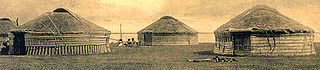 Together, these tribes roamed the grassy plains of western Inner Asia, between Lake Balkhash
in present-day eastern Kazakhstan and Lake Baikal
in present-day Russia, north of central Mongolia, where they freely pitched their yurt
(gher) and kept their herds of cattle, flock of sheep, horses, donkeys and camels.
Paul Pelliot
translated the name "Torghut" as garde de jour. He wrote that the Torghuts owed their name either to the memory of the guard of Genghis Khan or, as descendants of the Keraits, to the old garde de jour which existed among the Keraits, as we know from the Secret History of the Mongols, before it was taken over by Genghis Khan (Pelliot, 1930:30).
was a political entity formed by the four major Oirat tribes. During 15-17th century, they established under name "10 tumen Mongols" included 4 tumen oirats and 6 tumen Mongols They re-established their traditional pastoral nomadic lifestyle during the end of the Yuan Dynasty
. The Oirats formed this alliance to defend themselves against the Eastern Mongols and also to pursue the greater objective of reunifying Mongolia under their helm.
During its existence, the alliance was decentralized, informal and unstable. For instance, the Dörben Oirat did not have a central location from which it was governed, and it was not governed by a central figure for most of its existence. Further, the four Oirats did not establish a single military or even a unified monastic system. Lastly, it was not until 1640 that the Oirats adopted uniform customary laws.
As pastoral nomadists, the Oirats were organized at the tribal level where each tribe was ruled by a noyon (prince) who also functioned as the Chief Tayishi (Chieftain). The Chief Tayishi governed with the support of lesser noyons who were also called Tayisihi. These minor noyons controlled divisions of the tribe (ulus) and were politically and economically independent of the Chief Tayishi. The Chief Tayishi sought to influence and, in some cases, dominate the Chief Tayishis of the other tribes, causing inter-tribal rivalry, dissension and periodic skirmishes.
Under the leadership of Esen, Chief Tayishi of the Choros tribe, the Dörben Oirat unified Mongolia for a short period. After Esen's death in 1455, the political union of the Dörben Oirat dissolved quickly, resulting in two decades of Oirat-Eastern Mongol conflict. The deadlock ended during the reign of Dayan Khan
, a five-year old boy in whose name the loyal Eastern Mongol forces rallied. Dayan Khan took advantage of Oirat disunity and weakness and brought Oirats back under Mongolian rule. In doing so, he regained control of the Mongol homeland and restored the hegemony of the Eastern Mongols.
After the death of Dayan in 1543, the Oirats and the Eastern Mongols resumed their conflict. The Oirat forces thrust eastward, but Dayan's youngest son, Geresandza, was given command of the Eastern Mongol forces and drove the Oirats to Ubsa Nor in northwest Mongolia. In 1552, after the Oirats once again challenged the Eastern Mongols, Altan Khan
swept up from Inner Mongolia with Tümed and Ordos cavalry units, pushing elements of various Oirat tribes from Karakorum to the Kobdo region in northwest Mongolia, reuniting most of Mongolia in the process (Grousset, 1970:510).
The Oirats would later regroup south of the Altai Mountains in Dzungaria
. But Geresandza's grandson, Sholui Ubashi Khong Tayiji, pushed the Oirats further northwest, along the steppes of the Ob and Irtysh Rivers. Afterwards, he established a Khalkha Khanate under the name, Altan Khan, in the Oirat heartland of Dzungaria.
In spite of the setbacks, the Oirats would continue their campaigns against the Altan Khanate, trying to unseat Sholui Ubashi Khong Tayiji from Dzungaria. The continuous, back-and-forth nature of the struggle, which defined this period, is captured in the Oirat epic song "The Rout of Mongolian Sholui Ubashi Khong Tayiji," recounting the Oirat victory over the First Khan of the Altan Khanate in 1587.
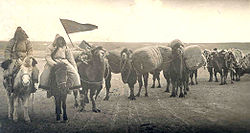 At the beginning of the 17th century, the First Altan Khan drove the Oirats
westward to present-day eastern Kazakhstan
. The Torghuts became the westernmost Oirat tribe, encamped in the Tarbagatai
region and along the northern stretches of the Irtysh
, Ishim
and Tobol Rivers. Further west, the Kazakhs
– a Turco-Mongol Muslim
people – prevented the Torghuts from sending its trading caravans to the Muslim towns and villages located along the Syr Darya
river. As a result, the Torghuts established a trading relationship with the newly established outposts of the Tsarist government whose expansion into and exploration of Siberia
was motivated mostly by the desire to profit from trade with Asia
.
The Khoshuts, by contrast, were the easternmost Oirat tribe, encamped near the Lake Zaisan area and the Semipalatinsk region along the lower portions of the Irtysh
river where they built several steppe monasteries. The Khoshuts were adjacent to the Eastern Mongol khanates of Altan Khan and Dzasagtu Khan. Both Khanates prevented the Khoshuts and the other Oirat tribes from trading with Chinese border towns. The Khoshuts were ruled by Baibagas Khan and Güshi Khan
who were the first of the Oirat leaders to convert to the Gelugpa sect.
Locked in between both tribes were the Choros
, Dörbet
s and Khoits (collectively "Dzungars"), who were slowly rebuilding the base of power they enjoyed under the Four Oirats
. The Choros were the dominant Oirat tribe of that era. Their chieftain, Khara Khula
attempted to follow Esen Khan in unifying the Oirat tribes to challenge the Eastern Mongols
.
Under the dynamic leadership of Khara Khula, the Dzungars stopped the expansion of the First Altan Khan and began planning the resurrection of the Dörben Oirat under the Dzungar banner. In furtherance of such plans, Khara Khula designed and built a capital city called "Kubak-sari," on the Imil river near the modern city of Chuguchak. During his attempt to build a nation, Khara Khula encouraged diplomacy, commerce and farming. He also sought to acquire modern weaponry and build small industry, such as metal works, to supply his military.
The attempted unification of the Oirats caused dissension among the tribes and their Chief Tayishis who were independent minded but also highly regarded leaders themselves. This dissension reputedly caused Kho Orluk to move the Torghut tribe and elements of the Dörbet tribe westward to the Volga region where his descendants formed the Kalmyk Khanate. In the east, Güshi Khan took part of the Khoshut tribe to the Tsaidam and Koko Nor regions in the Tibetan plateau where he formed the Khoshut Khanate to protect Tibet and the Gelugpa sect from both internal and external enemies. Khara Khula and his descendants, by contrast, formed the Dzungars Empire to fight the Eastern Mongols.
river region to the grazing pastures of the lower Volga River
region, located south of Saratov
and north of the Caspian Sea
, on both banks of the Volga Rver. The Torghuts were led by their Tayishi, Kho Orluk. They were the largest Oirat tribe to migrate, bringing along nearly the entire tribe. The second largest Oirat tribe was the Dörbets under their Tayishi, Dalai Batur. Together they moved west through southern Siberia and the southern Urals, avoiding the more direct route that would have taken them through the heart of the territory of their enemy, the Kazakhs. En route, they raided Russian settlements and Kazakh
and Bashkir encampments.
Many theories have been advanced to explain the reasons for the migration. One generally accepted theory is that there may have been discontent among the Oirat tribes, which arose from the attempt by Khara Khula, Tayishi of the Dzungars, to centralize political and military control over the tribes under his leadership. Some scholars, however, believe that the Torghuts sought uncontested pastures as their territory was being encroached upon by the Russians from the north, the Kazakhs from the south and the Dzungars from the east. The encroachments resulted in overcrowding of people and livestock, thereby diminished the food supply. Lastly, a third theory suggests that the Torghuts grew weary of the militant struggle between the Oirats and the Altan Khanate.
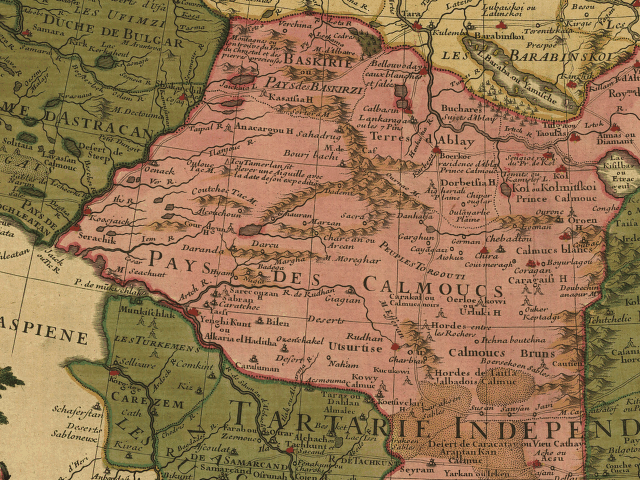 Upon arrival to the lower Volga region in 1630, the Oirats encamped on land that was once part of the Astrakhan Khanate, but was now claimed by the Tsarist government. The region was lightly populated, from south of Saratov to the Russian garrison at Astrakhan and on both the east and the west banks of the Volga River. The Tsarist government was not ready to colonize the area and was in no position to prevent the Oirats from encamping in the region. But it had a direct political interest in insuring that the Oirats would not become allied with its Turkic-speaking neighbors.
The Oirats quickly consolidated their position by expelling the majority of the native inhabitants, the Nogai Horde
. Large groups of Nogais fled southeast to the northern Caucasian plain and east to the Black Sea steppe, lands claimed by the Crimean Khanate
, itself a vassal or ally of Ottoman Turks
. Smaller groups of Nogais sought the protection of the Russian garrison at Astrakhan
. The remaining nomadic tribes became vassals of the Oirats.
At first, an uneasy relationship existed between the Russians and the Oirats. Mutual raiding by the Oirats of Russian settlements and by the Cossacks and the Bashkirs
(Muslim vassals of the Russians) of Oirat encampments was commonplace. Numerous oaths and treaties were signed to ensure Oirat loyalty and military assistance. Although the Oirats became subjects of the Tsar, such allegiance by the Oirats was deemed to be nominal.
In reality, the Oirats governed themselves pursuant to a document known as the Great Code of the Nomads (Iki Tsaadzhin Bichig). The Code was promulgated in 1640 by them, their brethren in Dzungaria and some of the Eastern Mongols who all gathered near the Tarbagatai Mountains in Dzungaria to resolve their differences and to unite under the banner of the Gelugpa sect. Although the goal of unification was not met, the summit leaders did ratify the Code, which regulated all aspects of nomadic life.
In securing their position, the Oirats became a borderland power, often allying themselves with the Tsarist government against the neighboring Muslim population. During the era of Ayuka Khan
, the Oirats rose to political and military prominence as the Tsarist government sought the increased use Oirat cavalry in support of its military campaigns against the Muslim powers in the south, such as Persia, the Ottoman Empire
, the Nogays and the Kuban
Tatars
and Crimean Khanate
. Ayuka Khan also waged wars against the Kazakhs
, subjugated the Mangyshlak Turkmens, and made multiple expeditions against the highlanders of the North Caucasus
. These campaigns highlighted the strategic importance of the Kalmyk Khanate which functioned as a buffer zone, separating Russia and the Muslim world, as Russia fought wars in Europe to establish itself as a European power.
To encourage the release of Oirat cavalrymen in support of its military campaigns, the Tsarist government increasingly relied on the provision of monetary payments and dry goods to the Oirat Khan and the Oirat nobility. In that respect, the Tsarist government treated the Oirats as it did the Cossacks. The provision of monetary payments and dry goods, however, did not stop the mutual raiding, and, in some instances, both sides failed to fulfill its promises (Halkovic, 1985:41-54).
Another significant incentive the Tsarist government provided to the Oirats was tariff-free access to the markets of Russian border towns, where the Oirats were permitted to barter their herds and the items they obtained from Asia and their Muslim neighbors in exchange for Russian goods. Trade also occurred with neighboring Turkic tribes under Russian control, such as the Tatars and the Bashkirs. Intermarriage became common with such tribes. This trading arrangement provided substantial benefits, monetary and otherwise, to the Oirat tayishis, noyons and zaisangs.
Fred Adelman described this era as the Frontier Period, lasting from the advent of the Torghut under Kho Orluk in 1630 to the end of the great khanate of Kho Orluk’s descendant, Ayuka Khan, in 1724, a phase accompanied by little discernible acculturative change (Adelman, 1960:14-15):
During the era of Ayuka Khan, the Kalmyk Khanate reached its peak of military and political power. The Khanate experienced economic prosperity from free trade with Russian border towns, China, Tibet and with their Muslim neighbors. During this era, Ayuka Khan also kept close contacts with his Oirat kinsmen in Dzungaria, as well as the Dalai Lama in Tibet.
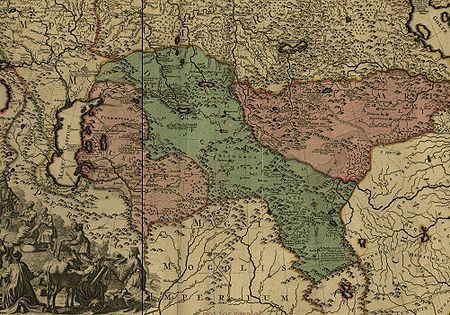 Historically, the West Mongolian tribes identified themselves by their respective tribal names. Probably, in the 15th century, the four major West Mongolian tribes formed an alliance, adopting "Dörben Oirat" as their collective name. After the alliance dissolved, the West Mongolian tribes were simply called "Oirat." In the early 17th century, a second great Oirat State emerged, called the Dzungar Empire. While the Dzungars (initially Choros, Dörbet and Khoit tribes) were establishing their empire in Western Inner Asia, the Khoshuts were establishing the Khoshut Khanate in Tibet, protecting the Gelugpa sect from its enemies, and the Torghuts formed the Kalmyk Khanate in the lower Volga region.
After encamping, the Oirats began to identify themselves as "Kalmyk." This named was supposedly given to them by their Muslim neighbors and later used by the Russians to describe them. The Oirats used this name in their dealings with outsiders, viz., their Russian and Muslim neighbors. But, they continued to refer to themselves by their tribal, clan, or other internal affiliations.
The name Kalmyk, however, wasn't immediately accepted by all of the Oirat tribes in the lower Volga region. As late as 1761, the Khoshut and Dzungars (refugees from the Manchu Empire) referred to themselves and the Torghuts exclusively as Oirats. The Torghuts, by contrast, used the name Kalmyk for themselves as well as the Khoshut and Dzungars. (Khodarkovsky, 1992:8)
Generally, European scholars have identified all West Mongolians collectively as Kalmyks, regardless of their location (Ramstedt
, 1935: v-vi). Such scholars (e.g. Sebastian Muenster) have relied on Muslim sources who traditionally used the word Kalmyk to describe the West Mongolians in a derogatory manner. But the West Mongolians of China and Mongolia have regarded that name as a term of abuse (Haslund, 1935:214-215). Instead, they use the name Oirat or the go by their respective tribal names, e.g., Khoshut, Dörbet, Choros, Torghut, Khoit, Bayid, Mingat, etc. (Anuchin, 1914:57).
Over time, the descendants of the Oirat migrants in the lower Volga region embraced the name Kalmyk, irrespective of their locations, viz., Astrakhan, the Don Cossack region, Orenburg, Stavropol, the Terek and the Urals. Another generally accepted name is Ulan Zalata or the "red buttoned ones" (Adelman, 1960:6).
In the winter of 1770-1771, Ubashi Khan, the great-grandson Ayuka Khan and the last Kalmyk Khan, decided to return his people to their ancestral homeland, Dzungaria, then under control of the Manchu Empire. The Dalai Lama
was contacted to request his blessing and to set the date of departure. After consulting the astrological chart, the Dalai Lama set the return date, but at the moment of departure, the weakening of the ice on the Volga River permitted only those Kalmyks who roamed on the left or eastern bank to leave. Those on the right bank were forced to stay behind.
Under Ubashi Khan’s leadership, approximately 200,000 Kalmyks began the journey from their pastures on the left bank of the Volga River to Dzungaria. Approximately five-sixths of the Torghut tribe followed Ubashi Khan. Most of the Khoshuts, Choros and Khoits also accompanied the Torghuts on their journey to Dzungaria. The Dörbet tribe, by contrast, elected not to go at all.
After failing to stop the flight, Catherine the Great abolished the Kalmyk Khanate, transferring all governmental powers to the Governor of Astrakhan
. The title of Khan was abolished. The highest native governing office remaining was the Vice-Khan who also was recognized by the government as the highest ranking Kalmyk prince. By appointing the Vice-Khan, the Tsarist government was now permanently the decisive force in Kalmyk government and affairs.
to the northwest and Lake Manych
to the west. In the spring, they moved along the Don River and the Sarpa lake system, attaining the higher grounds along the Don in the summer, passing the autumn in the Sarpa and Volga lowlands. In October and November they returned to their winter camps and pastures (Krader, 1963:121 citing Pallas, vol. 1, 1776:122-123).
Despite their great loss in population, the Torghuts still remained the numerically superior and dominating Kalmyk tribe. The other Kalmyk tribes in Russia included Dörbets and Khoshuts. Elements of the Choros and Khoits tribes also were present but were too few in number to retain their ulus (divisions of a tribe) as independent administrative units. As a result, they were absorbed by the ulus of the larger tribes.
The factors that caused the 1771 exodus continued to trouble the remaining Kalmyks. In the wake of the exodus, the Torghuts joined the Cossack rebellion of Yemelyan Pugachev
in hopes that he would restore the independence of the Kalmyks. After the Pugachev rebellion
was defeated, Catherine the Great transferred the office of the Vice-Khan from the Torghut tribe to the Dörbet tribe, whose princes supposedly remained loyal to the government during the rebellion. Thus, the Torghuts were removed from their role as the hereditary leaders of the Kalmyk people. The Khoshuts could not challenge this political arrangement due to their smaller population size.
The disruptions to Kalmyk society caused by the exodus and the Torghut participation in the Pugachev rebellion precipitated a major realignment in Kalmyk tribal structure. The government divided the Kalmyks into three administrative units attached, according to their respective locations, to the district governments of Astrakhan, Stavropol and the Don and appointed a special Russian official bearing the title of "Guardian of the Kalmyk People" for purposes of administration. The government also resettled some small groups of Kalmyks along the Ural, Terek and Kuma rivers and in Siberia.
The redistricting divided the now dominant Dörbet tribe into three separate administrative units. Those in the western Kalmyk steppe
were attached to the Astrakhan district government. They were called Baga (Lessor) Dörbet. By contrast, the Dörbets who moved to the northern part of the Stavropol province were called Ike (Greater) Dörbet even though their population was smaller. Finally, the Kalmyks of the Don became known as Buzava. Although they were composed of elements of all the Kalmyk tribes, the Buzava claimed descent from the Torghut tribe. Their name is derived from two tributaries of the Don River: Busgai and Busuluk. In 1798, Tsar Paul I recognized the Don Kalmyks as Don Cossacks. As such, they received the same rights and benefits as their Russian counterparts in exchange for providing national military services (Bajanowa, 1976:68-71). At the end of the Napoleonic wars
, Kalmyk cavalry units in Russian service entered Paris
.
Over time, the Kalmyks gradually created fixed settlements with houses and temples, in place of transportable round felt yurt
s. In 1865, Elista
, the future capital of the Kalmyk Autonomous Soviet Socialist Republic was founded. This process lasted until well after the Russian Revolution
.
, which replaced the Tsarist government, would allow greater autonomy and freedom with respect to their culture, religion and economy. This enthusiasm, however, would soon dissolve after the Bolsheviks took control over the national government during the second revolution in November 1917.
After the Bolsheviks took control, various political and ethnic groups opposed to Communism organized a loose political and military coalition called the "White Movement
". A volunteer army (called the "White Army") was raised to fight the Red Army, the military arm of the Bolshevik government. Initially, this army was composed primarily of volunteers and Tsarist supporters but were later joined by the Cossacks (including Don Kalmyks), many of whom resisted the Bolshevik policy of de-Cossackization.
The second revolution split the Kalmyk people into opposing camps. Many were dissatisfied with the Tsarist government for its historic role in promoting the colonization of the Kalmyk steppe and in encouraging the russification of the Kalmyk people. But others also felt hostility towards Bolshevism for two reasons: (1) the loyalty of the Kalmyk people to their traditional leaders (i.e., nobility and clergy) – sources of anti-Communism – was deeply ingrained; and (2) the Bolshevik exploitation of the conflict between the Kalmyks and the local Russian peasants who seized Kalmyk land and livestock (Loewenthal, 1952:4).
The Astrakhan Kalmyk nobility, led by Prince Dmitri Tundutov of the Baga Dörbets and Prince Sereb-Djab Tiumen of the Khoshuts, expressed their anti-Bolshevik sentiments by seeking to integrate the Astrakhan Kalmyks into the military units of the Astrakhan Cossacks. But before a general mobilization of Kalmyk horsemen could occur, the Red Army seized power in Astrakhan and in the Kalmyk steppe thereby preventing the mobilization from occurring.
After the capture of Astrakhan, the Bolsheviks engaged in savage reprisals against the Kalmyk people, especially against Buddhist temples and the Buddhist clergy (Arbakov, 1958:30-36). Eventually the Bolsheviks would draft as many as 18,000 Kalmyk horsemen in the Red Army to prevent them from joining the White Army (Borisov, 1926:84). This objective, however, failed to prevent many Red Army Kalmyk horsemen from defecting to the White side.
The majority of the Don Kalmyks also sided with the White Movement to preserve their Cossack lifestyle and proud traditions. As Don Cossacks, the Don Kalmyks first fought under White army General Anton Denikin and then under his successor, General Pyotr Wrangel. Because the Don Cossack Host to which they belonged was the main center of the White Movement and of Cossack resistance, the battles were fought on Cossack lands and was very disastrous for the Don Cossacks as villages and entire regions changed hands repeatedly in a fratricidal conflict in which both sides committed terrible atrocities. The Don Cossacks, including the Don Kalmyks, experienced heavy military and civilian losses, either from the fighting itself or from starvation and disease induced by the war. Some argue that the Bolsheviks were guilty of the mass extermination of the Don Cossack people, killing an estimated 70 percent (or 700,000 persons) of the Don Cossack population (Heller and Nekrich
, 1988:87).
By October 1920 the Red Army smashed General Wrangel
's resistance in the Crimea
, forcing the evacuation of some 150,000 White army soldiers and their families to Constantinople
, Turkey. A small group of Don Kalmyks managed to escape on the British and French vessels. The chaos at the Russian port city of Novorossiysk
was described by Major H.N.H. Williamson of the British Military Mission to the Don Cossacks as follows:
From there, this group resettled in Europe, primarily in Yugoslavia, Bulgaria, Czechoslovakia and France where its leaders remained active in the White movement. In 1922, several hundred Don Kalmyks returned home under a general amnesty. Some returnees, including Prince Dmitri Tundutov, were imprisoned and then executed soon after their return.
In October 1935, the Kalmyk Autonomous Oblast was reorganized into the Kalmyk Autonomous Soviet Socialist Republic. The chief occupations of the Republic were cattle breeding, agriculture, including the growing of cotton and fishing. There was no industry.
ordered the forced collectivization of agriculture, forcing the Astrakhan Kalmyks to abandon their traditional nomadic pastoralist lifestyle and to settle in villages. All Kalmyk herdsmen owning more than 500 sheep were deported to labor camps in Siberia. Kalmyk resistance to Stalin’s collectivization campaign and the famine that was induced by such campaign resulted in the deaths of a substantial number of Kalmyks.
In the 1930s, Stalin ordered the closure of all Buddhist monasteries and libraries, burning temples and religious texts in the process. The Buddhist clergy was either shot or condemned to long terms of confinement in the labor camps in Siberia where they all perished.
According to N. F. Bugai, the leading Russian expert on deportations, 4.9% of the Kalmuk population died during the first three months of 1944; 1.5% in the first three months of 1945; and 0.7% in the same period of 1946. From 1945-1950 15,206 Kalmuks died and 7843 were born.
The Kalmyk Autonomous Soviet Socialist Republic was quickly dissolved. Its territory was divided and transferred to the adjacent regions, viz., the Astrakhan and Stalingrad Oblasts and Stavropol Krai. Since no Kalmuks lived there any longer the Soviet authorities changed the names of towns and villages from Kalmyk names to Russian names. For example, Elista became Stepnoi.
permitted the Kalmyk people to return to their home. Upon return, however, the Kalmyks found their homeland had become settled by Russians
and Ukrainians
, many of whom chose to remain. On January 9, 1957, Kalmykia once again became an autonomous oblast, and on 29 July 1958, an autonomous republic within the Russian SFSR.
In the following years bad planning of agricultural and irrigation projects resulted in widespread desertification
. In addition, industrial plants were constructed without an analysis of the economic viability of such plants.
In 1992, after the dissolution of the Soviet Union, Kalmykia chose to remain an autonomous republic of the successor government, the Russian Federation. The dissolution, however, facilitated the collapse of the economy at both the national and the local level, causing widespread economic and social hardship. The resulting upheaval caused many young Kalmyks to leave Kalmykia, especially in the rural areas, for economic opportunities in and outside the Russian Federation.
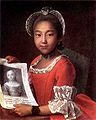 Historically, the Eastern Mongols regarded the Oirats as non-Mongols. The name "Mongols," the title "Khan," and the historic legacy attached to that name and title were claimed exclusively by the Eastern Mongols, viz., the Halh, Chahar and Tümed
tribes. They considered this claim as their birthright, since their lineage was traced back directly to the Mongolian Yuan Dynasty
and its progenitor, Genghis Khan.
Until the mid-17th century, when bestowal of the title of Khan was transferred to the Dalai Lama
, all Mongol tribes recognized this claim and the political prestige attached to it. Although the Oirats could not assert this claim prior to the mid-17th century, they did in fact have a close connection to Genghis Khan by virtue of the fact that Genghis Khan's brother, Hasar, was in command of the Khoshut tribe.
In response to the Western Mongols’ self-designation as the "Dörben Oirat" (Four Oirat), the Eastern Mongols began to refer to themselves as the "Döchin Mongols" (Forty Mongols), expressed otherwise as "Döchin Dörben Khoyar" (The Forty and Four). This means that the Eastern Mongols claimed to have forty tümen (a cavalry unit of 10,000 horsemen) to the four tümen maintained by the Dörben Oirat. Simply put, it's another way for them to clearly separate themselves from the Oirats (Khodarkovsky, 1992:7). Ironically, by the early 1690s, the Dzungar (successor state to the Dörben Oirat) attacks against the Eastern Mongols were so persistent and ferocious, the Eastern Mongol princes voluntarily led their people and Outer Mongolia into submission to the Manchu state
.
Until recently, the Oirats (including the Kalmyks) have not recognized themselves as Mongols. Nor have they considered themselves Western Mongols. Nevertheless, the close relationship among all Mongolian-speaking peoples, principally the Kalmyks, Oirats, Khalkhas and Buriats, is evident from the well-established fact that they all:
It is also noted that they share similar sub-tribal names as well, e.g., Kereit, Taichuud, Mergid and Chonos.
A recent publication of genetic studies of the Kalmyks seem to support their Mongol origins as well.
The Kalmyks' ability to maintain a mostly homogenous existence contrasts with the Russian admixture with other similar people, "as there is evidence for Russian admixture with Yakut
s," for example. Thus far, genetic analysis of the Kalmyks supports their Mongol roots that also shows that entire families of Kalmyks moved to Volga region and not simply males as is generally the case with most nomadic tribal groups.
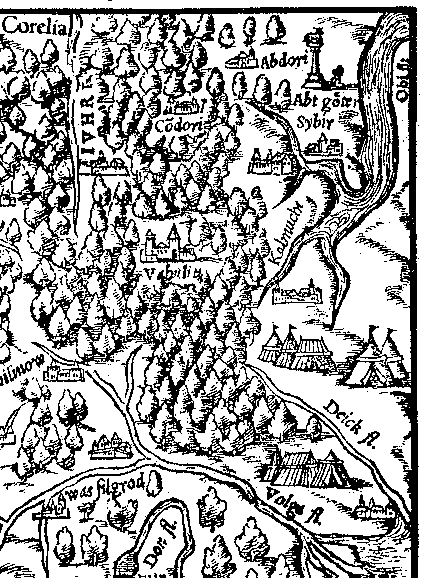 The name "Kalmyk" is a word of Turkic origin that means "remnant" or "to remain." Turkic tribes may have used this name as early as the thirteenth century. Arab geographer Ibn al-Wardi
is documented as the first person to use the term in referring to the Oirats in the fourteenth century (Khodarkovsky, 1992:5 citing Bretschneider, 1910:2:167). The khojas
of Kashgaria applied the name to Oirats in the fifteenth century (Grousset, 1970:506). Russian written sources mentioned the name "Kolmak Tatars" as early as 1530, and cartographer Sebastian Muenster (1488–1552) circumscribed the territory of the "Kalmuchi" on a map in his Cosmographia, which was published in 1544. The Oirats themselves, however, did not accept the name as their own.
, Dörbet
, and Buzava
. The Torghuts are numerically dominant. The Buzavs are a small minority and are considered to be the most russified Kalmyks.
. Kalmykia is located in the southeast European part of Russia, between the Volga and the Don rivers. It has borders with the Republic of Dagestan in the south; the Stavropol Krai
in the southwest; and the Rostov Oblast
and the Volgograd Oblast
in the west and the northwest, respectively. Its eastern border is the Astrakhan Oblast
. The southeast border is the Caspian Sea
.
After the collapse of the Soviet Union
, a large number of Kalmyks, primarily the young, moved from Kalmykia to larger cities in Russia, such as Moscow
and St. Petersburg, and to the United States
. The move was precipitated by the desire of these Kalmyks to pursue better educational and economic opportunities and continues today.
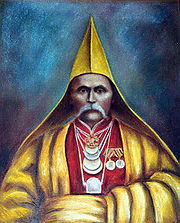
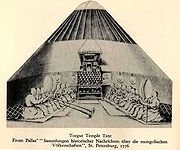
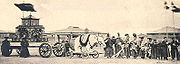
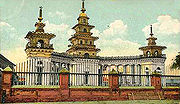
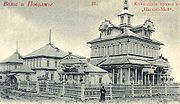 The Kalmyks are the only inhabitants of Europe
whose national religion is Buddhism
. They embraced Buddhism in the early part of the 17th century and belong to the Tibet
an Buddhist sect known as the Gelugpa (Virtuous Way). The Gelugpa are commonly referred to as the Yellow Hat sect. The religion is derived from the Indian Mahayana
form of Buddhism. In the West, it is commonly referred to as Lamaism, from the name of the Tibetan monks, the lamas ("heavy with wisdom"). Prior to their conversion, the Kalmyks practiced shamanism
.
Historically, Kalmyk clergy received their training either on the steppe or in Tibet. The pupils who received their religious training on the steppe joined Kalmyk monasteries, which were active centers of learning. Many of these monasteries operated out of felt tents, which accompanied the Kalmyk tribes as they migrated. The Oirats maintained tent monasteries throughout present-day eastern Kazakhstan and along the migratory route they took across southern Siberia to the Volga. They also maintained tent monasteries around Lake Issyk Kul in present-day Kyrgyzstan.
The Oirats also built stone monasteries in the regions of eastern Kazakhstan. For instance, the remains of stone Buddhist monasteries have been found at Almalik and at Kyzyl-Kent (See image to the right). In addition, there was a great Buddhist monastery in Semipalatinsk (seven palaces), which derives its name from that seven-halled Buddhist temple. Further, remains of Buddhist monasteries have been found at Ablaiket near Ust Kamenogorsk and at Talgar
, near Almaty, and at Sumbe in the Narynkol region, bordering China.
Upon completion of training, Kalmyk clergy dispensed not only spiritual guidance but also medical advice. As clergyman, the Kalmyk lamas enjoyed great political clout among the nobility and held a strong influence over the general tribal population. For many commoners, the only path to literacy and prestige was to join the Kalmyk monastic system.
As a matter of policy, the Tsarist government and the Russian Orthodox Church
sought to gradually absorb and convert any subject of another creed or nationality. The aim of the policy was to eliminate foreign influence and to entrench newly annexed areas. The baptized indigenous population would then become loyal to the Russian empire and would agree to be governed by Russian officials.
The Kalmyks migrated to territory annexed by the Tsarist government and were subject to this policy as long as they remained in this territory. At first, the policies contributed to the conversion of the Kalmyk nobility. One of the earliest converts were the children of Donduk-Ombo, the sixth Khan
of the Kalmyks who reigned between 1737 and 1741, and his Circassian-born wife (See Dondukov
family). Another important convert was Baksaday-Dorji, the grandson of Ayuka Khan who adopted the Christian name, Peter Taishin. Each conversion was motivated by political ambition to become the Kalmyk Khan. Kalmyk Tayishis, by contrast, were given salaries and towns and settlements were established for them and their ulus (Khodarkovsky, 1992:39).
Later on, the Tsarist government policy of encouraging Russian and German settlements along the Volga indirectly pressured Kalmyks to convert for economic reasons. The settlers took the most fertile land along the river, leaving barren lands for the Kalmyks to graze their herds. The resulting reduction of herds led to impoverishment for Kalmyk Tayishis, some of whom led their ulus to Christianity to obtain economic benefits.
To discourage the monastic lifestyle, the government required the building of permanent structures at government determined construction sites while imposing Russian architects (Pozdneev, 1914). This policy resulted in the suspension of Lamaist canonical regulations governing monastery construction and in Kalmyk temples resembling Russian Orthodox churches. For example, the Khoshutovsky Khurul is modeled after the Kazan Cathedral in St. Petersburg, Russia.
Other policies the Tsarist government implemented sought to gradually weaken the influence of the lamas. For instance, the government limited Kalmyk contact with Tibet. In addition, the Tsar began appointing the Šajin Lama (title of the High Lama of the Kalmyks). Further, the economic crises that resulted from settler encroachment forced many monasteries and temples to close and lamas to adopt a secularized lifestyle. The success of this policy is borne out by the decrease in the number of Kalmyk monasteries in the Volga region during the 19th century (Loewenthal, 1952 citing Riasanovsky, 1929).
|-
! colspan=2 align=”center”| Table – Number of Kalmyk Monasteries in the Volga Region
|-
! Year || Number
|-
| early 19th century
| style="text-align:center;"|200
|-
| 1834
| style="text-align:center;"|76
|-
| 1847
| style="text-align:center;"|67
|-
| before 1895
| style="text-align:center;"|62
|-
| before 1923
| style="text-align:center;"|60+
|}
Like the Tsarist government, the Communist regime was aware of the influence the Kalmyk clergy held over the general population. In the 1920s and the 1930s, the Soviet government implemented policies to eliminate religion through control and suppression. Towards that end, Kalmyk khuruls (temples) and monasteries were destroyed and property confiscated; the clergy and many believers were harassed, killed, or sent to labor camps; religious artifacts and books were destroyed; and young men were prohibited from religious training.
By 1940 all Kalmyk Buddhist temples were either closed or destroyed and the clergy systematically oppressed. Dr. Loewenthal writes that the policies were so enforced that the Kalmyk clergy and Buddhism were not mentioned in the work by B. Dzhimbinov, "Sovetskaia Kalmykiia," published in 1940. In 1944, the Soviet government exiled all Kalmyks not fighting in the Soviet army
to Central Asia
and Siberia
, accusing them of collaborating with the German Army. Upon rehabilitation in 1957, the Kalmyks were permitted to return home from exile, but all attempts by them to restore their religion and to build a temple failed.
By the 1980s, the Soviet campaign against religion was so successful that a majority of the Kalmyks had never received any formal spiritual guidance. By the late 1980s, however, the Soviet government reversed course and implemented policies favoring the liberalization of religion. As a result, the first Buddhist community was organized in 1988. By 1995, there were 21 Buddhist temples, 17 places of worship for various Christian
denominations, and 1 mosque
in the Republic of Kalmykia (Grin, 2000:7).
On December 27, 2005, a new khurul opened in Elista, the capital of the Republic of Kalmykia. The khurul was named "Burkhan Bakshin Altan Sume
". It is the largest Buddhist temple in Europe. The government of the Republic of Kalmykia sought to build a magnificent temple of a monumental scale in hopes of creating an international learning center for Buddhist scholars and students from all over the world. More significantly, the temple is a monument to the Kalmyk people who died in exile between 1944 and 1957.
The Kalmyks of Kyrgyzstan
live primarily in the Karakol
region of eastern Kyrgyzstan. They are referred to as "Sart Kalmyks." The origin of this name is unknown. Likewise, it is not known when, why and from where this small group of Kalmyks migrated to eastern Kyrgyzstan. Due to their minority status, the Sart Kalmyks have adopted the Turkic language and culture of the majority Kyrgyz population. As a result, nearly all now belong to the Muslim faith.
Although Sart Kalmyks are Muslims
, Kalmyks elsewhere by and large remain faithful to the Gelugpa Order of Tibetan Buddhism
. In Kalmykia, for example, the Gelugpa Order with the assistance of the government has constructed numerous Buddhist temples. In addition, the Kalmyk people recognize Tenzin Gyatso, 14th Dalai Lama as their spiritual leader and Erdne Ombadykow
, a Kalmyk American, as the supreme lama of the Kalmyk people. The Dalai Lama has visited Elista on a number of occasions.
belongs to the eastern branch of the Mongolian language
division. Gordon further classifies Kalmyk-Oirat under the Oirat-Khalkha group, since he contends that Kalmyk-Oirat is related to Khalkha Mongolian – the national language of Mongolia.
Other linguists, such as Nicholas N. Poppe, have classified the Kalmyk-Oirat language group as belonging to the western branch of the Mongolian language division, since the language group developed separately and is distinct. Moreover, Poppe contends that, although there is little phonetic and morphological difference, Kalmyk and Oirat
are two distinct languages. The major distinction is in their lexicons. The Kalmyk language, for example, has adopted many words of Russian origin. Consequently, mainly on lexiconal grounds, Kalmyk is classified as a distinct language (Poppe 1970).
By population, the major dialects of Kalmyk are Torghut, Dörbet and Buzava (Bormanshinov 1990). Minor dialects include Khoshut and Olöt. The Kalmyk dialects vary somewhat, but the differences are insignificant. Generally, the Russian Language less influenced the dialects of the pastoral nomadic Kalmyk tribes of the Volga region.
In contrast, the Dörbets (and later on, Torghuts) who migrated from the Volga region to the Sal’sk District of the Don region took the name Buzava (or Don Kalmyks). The Buzava dialect developed from their close interaction with Russians. In 1798 the Tsarist government recognized the Buzava as Don Cossacks, both militarily and administratively. As a result of their integration into the Don Host, the Buzava dialect incorporated many words of Russian origin. (Anon. 1914: 653-660)
During World War II, all Kalmyks not fighting in the Soviet Army were forcibly exiled to Siberia
and Central Asia
, where they were dispersed and not permitted to speak the Kalmyk language in public places. As a result, the Kalmyk language was not formally taught to the younger generation of Kalmyks.
Upon return from exile in 1957, the Kalmyks spoke and published primarily in Russian. Consequently, the younger generation of Kalmyks primarily speak Russian and not their own native language. This is a subject of popular concern. In recent years, attempts have been made by the Kalmyk government to revive the Kalmyk language. As such, some laws have been passed regarding the usage of Kalmyk on shop signs; for example, on entrance doors, the words 'Entrance' and 'Push-Pull' appear in Kalmyk.
The attempt to re-establish the Kalmyk language has suffered setbacks, however. Recently, the Russian Broadcasting Corporation cut broadcast time allocated to Kalmyk language programs on radio and television, choosing instead to purchase pre-produced programs, such as English language productions. This measure was undertaken to reduce production costs.
claim to prepare to immigrate 10000 people from China, since Torghut
s in China speak the Torgut dialect. However, the Chinese side does not confirm the information.
(clear script). The script, which is based on the classical vertical Mongol script, phonetically captured the Oirat language. In the later part of the 19th and early part of the 20th centuries, todo bichig fell into disuse until the Kalmyks abandoned it in 1923 and introduced the Russian Cyrillic alphabet. But soon afterwards, around 1930, Kalmyk language scholars introduced a modified Latin alphabet, which did not last long.
Kalmyk language
The Kalmyk language , or Russian Oirat, is the native speech of the Kalmyk people of the Republic of Kalmykia, a federal subject of the Russian Federation. In Russia, it is the normative form of the Oirat language , which belongs to the Mongolic language family...
: Хальмгуд, Halm'gud) is the name given to the Oirats
Oirats
Oirats are the westernmost group of the Mongols who unified several tribes origin whose ancestral home is in the Altai region of western Mongolia. Although the Oirats originated in the eastern parts of Central Asia, the most prominent group today is located in the Republic of Kalmykia, a federal...
, western Mongols
Mongols
Mongols ) are a Central-East Asian ethnic group that lives mainly in the countries of Mongolia, China, and Russia. In China, ethnic Mongols can be found mainly in the central north region of China such as Inner Mongolia...
in Russia
Russia
Russia or , officially known as both Russia and the Russian Federation , is a country in northern Eurasia. It is a federal semi-presidential republic, comprising 83 federal subjects...
, whose descendants migrated from Dzhungaria in 1607. Today they form a majority in the autonomous Republic of Kalmykia on the western shore of the Caspian Sea
Caspian Sea
The Caspian Sea is the largest enclosed body of water on Earth by area, variously classed as the world's largest lake or a full-fledged sea. The sea has a surface area of and a volume of...
. Kalmykia is Europe's only Buddhist government. Through emigration, small Kalmyk communities have been established in the United States
United States
The United States of America is a federal constitutional republic comprising fifty states and a federal district...
, France
France
The French Republic , The French Republic , The French Republic , (commonly known as France , is a unitary semi-presidential republic in Western Europe with several overseas territories and islands located on other continents and in the Indian, Pacific, and Atlantic oceans. Metropolitan France...
, Germany
Germany
Germany , officially the Federal Republic of Germany , is a federal parliamentary republic in Europe. The country consists of 16 states while the capital and largest city is Berlin. Germany covers an area of 357,021 km2 and has a largely temperate seasonal climate...
, Switzerland
Switzerland
Switzerland name of one of the Swiss cantons. ; ; ; or ), in its full name the Swiss Confederation , is a federal republic consisting of 26 cantons, with Bern as the seat of the federal authorities. The country is situated in Western Europe,Or Central Europe depending on the definition....
, and the Czech Republic
Czech Republic
The Czech Republic is a landlocked country in Central Europe. The country is bordered by Poland to the northeast, Slovakia to the east, Austria to the south, and Germany to the west and northwest....
.
Early history of the Oirats
The Kalmyks are a branch of the OiratsOirats
Oirats are the westernmost group of the Mongols who unified several tribes origin whose ancestral home is in the Altai region of western Mongolia. Although the Oirats originated in the eastern parts of Central Asia, the most prominent group today is located in the Republic of Kalmykia, a federal...
whose ancient grazing lands are now located in Kazakhstan
Kazakhstan
Kazakhstan , officially the Republic of Kazakhstan, is a transcontinental country in Central Asia and Eastern Europe. Ranked as the ninth largest country in the world, it is also the world's largest landlocked country; its territory of is greater than Western Europe...
, Russia
Russia
Russia or , officially known as both Russia and the Russian Federation , is a country in northern Eurasia. It is a federal semi-presidential republic, comprising 83 federal subjects...
, Mongolia
Mongolia
Mongolia is a landlocked country in East and Central Asia. It is bordered by Russia to the north and China to the south, east and west. Although Mongolia does not share a border with Kazakhstan, its western-most point is only from Kazakhstan's eastern tip. Ulan Bator, the capital and largest...
and the People's Republic of China
People's Republic of China
China , officially the People's Republic of China , is the most populous country in the world, with over 1.3 billion citizens. Located in East Asia, the country covers approximately 9.6 million square kilometres...
. After the fall of the Yuan Dynasty
Yuan Dynasty
The Yuan Dynasty , or Great Yuan Empire was a ruling dynasty founded by the Mongol leader Kublai Khan, who ruled most of present-day China, all of modern Mongolia and its surrounding areas, lasting officially from 1271 to 1368. It is considered both as a division of the Mongol Empire and as an...
in 1368, the Oirats emerged as a formidable foe against the Eastern Mongols, the Ming
Ming Dynasty
The Ming Dynasty, also Empire of the Great Ming, was the ruling dynasty of China from 1368 to 1644, following the collapse of the Mongol-led Yuan Dynasty. The Ming, "one of the greatest eras of orderly government and social stability in human history", was the last dynasty in China ruled by ethnic...
Chinese and their successor, the Manchu
Manchu
The Manchu people or Man are an ethnic minority of China who originated in Manchuria . During their rise in the 17th century, with the help of the Ming dynasty rebels , they came to power in China and founded the Qing Dynasty, which ruled China until the Xinhai Revolution of 1911, which...
who founded the Qing Dynasty
Qing Dynasty
The Qing Dynasty was the last dynasty of China, ruling from 1644 to 1912 with a brief, abortive restoration in 1917. It was preceded by the Ming Dynasty and followed by the Republic of China....
, in a nearly 400 year military struggle for domination and control over both Inner Mongolia
Inner Mongolia
Inner Mongolia is an autonomous region of the People's Republic of China, located in the northern region of the country. Inner Mongolia shares an international border with the countries of Mongolia and the Russian Federation...
and Outer Mongolia
Outer Mongolia
Outer Mongolia was a territory of the Qing Dynasty = the Manchu Empire. Its area was roughly equivalent to that of the modern state of Mongolia, which is sometimes informally called "Outer Mongolia" today...
. The struggle ended in 1757 with the defeat of the Oirats in Dzungaria
Dzungaria
Dzungaria, also called Zungaria, is a geographical region in northwest China corresponding to the northern half of Xinjiang. It covers approximately , lying mostly within Xinjiang, and extending into western Mongolia and eastern Kazakhstan...
, the last of the Mongol groups to resist vassalage to China (Grousset, 1970: 502-541).
At the start of this 400-year era, the Western Mongol people designated themselves as Dörben Oirat ("Four Oirats
Four Oirats
The Four Oirats or the Alliance of the Four Oirat tribes was the confederation of the Oirat tribes, which marked the rise of the Western Mongols in Mongolian history.Despite the universal currency of the term Four Oirats among Eastern Mongols and Oirats and numerous explanations by...
"). The alliance comprised four major Western Mongol tribes: Khoshut, Choros
Choros
Choros was the ruling clan of the Zungars and Dorbets and once ruled the whole Four Oirats. They founded the Zunghar Empire in the 17th century. According to a myth, their chiefs reckoned their descent from a boy nourished by a sacred tree, a legend shared with the Uyghur royal family.In the late...
, Torghut
Torghut
The Torgut are one of the four major subgroups of the Four Oirats. The Torghut ruling dynasty traced its descent to the Kereit ruler Wang Khan's bodyguards....
and Dörbet. Collectively, the Dörben Oirat sought to position themselves as an alternative to the Mongols who were the patrilineal heirs to the legacy of Genghis Khan
Genghis Khan
Genghis Khan , born Temujin and occasionally known by his temple name Taizu , was the founder and Great Khan of the Mongol Empire, which became the largest contiguous empire in history after his death....
.
In furtherance of its military objectives, the Dörben Oirat incorporated neighboring tribes or splinter groups of them so that there was a great deal of fluctuation in the composition of the alliance with larger tribes dominating or absorbing the smaller ones. Smaller tribes belonging to the confederation include the Khoits, Zakhchin, Bayids and Mangits.
Lake Balkhash
Lake Balkhash is one of the largest lakes in Asia and 12th largest continental lake in the world. It is located in southeastern Kazakhstan, in Central Asia, and belongs to an endorheic basin shared by Kazakhstan and China, with a small part in Kyrgyzstan. The basin drains into the lake via seven...
in present-day eastern Kazakhstan and Lake Baikal
Lake Baikal
Lake Baikal is the world's oldest at 30 million years old and deepest lake with an average depth of 744.4 metres.Located in the south of the Russian region of Siberia, between Irkutsk Oblast to the northwest and the Buryat Republic to the southeast, it is the most voluminous freshwater lake in the...
in present-day Russia, north of central Mongolia, where they freely pitched their yurt
Yurt
A yurt is a portable, bent wood-framed dwelling structure traditionally used by Turkic nomads in the steppes of Central Asia. The structure comprises a crown or compression wheel usually steam bent, supported by roof ribs which are bent down at the end where they meet the lattice wall...
(gher) and kept their herds of cattle, flock of sheep, horses, donkeys and camels.
Paul Pelliot
Paul Pelliot
Paul Pelliot was a French sinologist and explorer of Central Asia. Initially intending to enter the foreign service, Pelliot took up the study of Chinese and became a pupil of Sylvain Lévi and Édouard Chavannes....
translated the name "Torghut" as garde de jour. He wrote that the Torghuts owed their name either to the memory of the guard of Genghis Khan or, as descendants of the Keraits, to the old garde de jour which existed among the Keraits, as we know from the Secret History of the Mongols, before it was taken over by Genghis Khan (Pelliot, 1930:30).
Period of open conflict
The Dörben OiratFour Oirats
The Four Oirats or the Alliance of the Four Oirat tribes was the confederation of the Oirat tribes, which marked the rise of the Western Mongols in Mongolian history.Despite the universal currency of the term Four Oirats among Eastern Mongols and Oirats and numerous explanations by...
was a political entity formed by the four major Oirat tribes. During 15-17th century, they established under name "10 tumen Mongols" included 4 tumen oirats and 6 tumen Mongols They re-established their traditional pastoral nomadic lifestyle during the end of the Yuan Dynasty
Yuan Dynasty
The Yuan Dynasty , or Great Yuan Empire was a ruling dynasty founded by the Mongol leader Kublai Khan, who ruled most of present-day China, all of modern Mongolia and its surrounding areas, lasting officially from 1271 to 1368. It is considered both as a division of the Mongol Empire and as an...
. The Oirats formed this alliance to defend themselves against the Eastern Mongols and also to pursue the greater objective of reunifying Mongolia under their helm.
During its existence, the alliance was decentralized, informal and unstable. For instance, the Dörben Oirat did not have a central location from which it was governed, and it was not governed by a central figure for most of its existence. Further, the four Oirats did not establish a single military or even a unified monastic system. Lastly, it was not until 1640 that the Oirats adopted uniform customary laws.
As pastoral nomadists, the Oirats were organized at the tribal level where each tribe was ruled by a noyon (prince) who also functioned as the Chief Tayishi (Chieftain). The Chief Tayishi governed with the support of lesser noyons who were also called Tayisihi. These minor noyons controlled divisions of the tribe (ulus) and were politically and economically independent of the Chief Tayishi. The Chief Tayishi sought to influence and, in some cases, dominate the Chief Tayishis of the other tribes, causing inter-tribal rivalry, dissension and periodic skirmishes.
Under the leadership of Esen, Chief Tayishi of the Choros tribe, the Dörben Oirat unified Mongolia for a short period. After Esen's death in 1455, the political union of the Dörben Oirat dissolved quickly, resulting in two decades of Oirat-Eastern Mongol conflict. The deadlock ended during the reign of Dayan Khan
Dayan Khan
Dayan Khan , was a Mongol khan who reunited the Mongols under Chinggisid supremacy in the Northern Yuan Dynasty in Mongolia...
, a five-year old boy in whose name the loyal Eastern Mongol forces rallied. Dayan Khan took advantage of Oirat disunity and weakness and brought Oirats back under Mongolian rule. In doing so, he regained control of the Mongol homeland and restored the hegemony of the Eastern Mongols.
After the death of Dayan in 1543, the Oirats and the Eastern Mongols resumed their conflict. The Oirat forces thrust eastward, but Dayan's youngest son, Geresandza, was given command of the Eastern Mongol forces and drove the Oirats to Ubsa Nor in northwest Mongolia. In 1552, after the Oirats once again challenged the Eastern Mongols, Altan Khan
Altan Khan
Altan Khan , whose given name was Anda , was the ruler of the Tümet Mongols and de facto ruler of the Right Wing, or western tribes, of the Mongols...
swept up from Inner Mongolia with Tümed and Ordos cavalry units, pushing elements of various Oirat tribes from Karakorum to the Kobdo region in northwest Mongolia, reuniting most of Mongolia in the process (Grousset, 1970:510).
The Oirats would later regroup south of the Altai Mountains in Dzungaria
Dzungaria
Dzungaria, also called Zungaria, is a geographical region in northwest China corresponding to the northern half of Xinjiang. It covers approximately , lying mostly within Xinjiang, and extending into western Mongolia and eastern Kazakhstan...
. But Geresandza's grandson, Sholui Ubashi Khong Tayiji, pushed the Oirats further northwest, along the steppes of the Ob and Irtysh Rivers. Afterwards, he established a Khalkha Khanate under the name, Altan Khan, in the Oirat heartland of Dzungaria.
In spite of the setbacks, the Oirats would continue their campaigns against the Altan Khanate, trying to unseat Sholui Ubashi Khong Tayiji from Dzungaria. The continuous, back-and-forth nature of the struggle, which defined this period, is captured in the Oirat epic song "The Rout of Mongolian Sholui Ubashi Khong Tayiji," recounting the Oirat victory over the First Khan of the Altan Khanate in 1587.
Resurgence of Oirat power
Oirats
Oirats are the westernmost group of the Mongols who unified several tribes origin whose ancestral home is in the Altai region of western Mongolia. Although the Oirats originated in the eastern parts of Central Asia, the most prominent group today is located in the Republic of Kalmykia, a federal...
westward to present-day eastern Kazakhstan
Kazakhstan
Kazakhstan , officially the Republic of Kazakhstan, is a transcontinental country in Central Asia and Eastern Europe. Ranked as the ninth largest country in the world, it is also the world's largest landlocked country; its territory of is greater than Western Europe...
. The Torghuts became the westernmost Oirat tribe, encamped in the Tarbagatai
Tarbagatai Mountains
Tarbagatai Mountains is a range of mountains located in the north-western parts of Xinjiang, China and East Kazakhstan....
region and along the northern stretches of the Irtysh
Irtysh
The Irtysh River is a river in Siberia and is the chief tributary of the Ob River. Its name means White River. Irtysh's main affluent is the Tobol River...
, Ishim
Ishim
Ishim is a town in the south of Tyumen Oblast, Russia. Population: -History:It was founded in 1670 as the village of Korkina Sloboda. In 1721 by the order of Tsar Peter the Great the village gained the right to establish Nikolskaya Trade Fair which rapidly became one of the most important trade...
and Tobol Rivers. Further west, the Kazakhs
Kazakhs
The Kazakhs are a Turkic people of the northern parts of Central Asia ....
– a Turco-Mongol Muslim
Muslim
A Muslim, also spelled Moslem, is an adherent of Islam, a monotheistic, Abrahamic religion based on the Quran, which Muslims consider the verbatim word of God as revealed to prophet Muhammad. "Muslim" is the Arabic term for "submitter" .Muslims believe that God is one and incomparable...
people – prevented the Torghuts from sending its trading caravans to the Muslim towns and villages located along the Syr Darya
Syr Darya
The Syr Darya , also transliterated Syrdarya or Sirdaryo, is a river in Central Asia, sometimes known as the Jaxartes or Yaxartes from its Ancient Greek name . The Greek name is derived from Old Persian, Yakhsha Arta , a reference to the color of the river's water...
river. As a result, the Torghuts established a trading relationship with the newly established outposts of the Tsarist government whose expansion into and exploration of Siberia
Siberia
Siberia is an extensive region constituting almost all of Northern Asia. Comprising the central and eastern portion of the Russian Federation, it was part of the Soviet Union from its beginning, as its predecessor states, the Tsardom of Russia and the Russian Empire, conquered it during the 16th...
was motivated mostly by the desire to profit from trade with Asia
Asia
Asia is the world's largest and most populous continent, located primarily in the eastern and northern hemispheres. It covers 8.7% of the Earth's total surface area and with approximately 3.879 billion people, it hosts 60% of the world's current human population...
.
The Khoshuts, by contrast, were the easternmost Oirat tribe, encamped near the Lake Zaisan area and the Semipalatinsk region along the lower portions of the Irtysh
Irtysh
The Irtysh River is a river in Siberia and is the chief tributary of the Ob River. Its name means White River. Irtysh's main affluent is the Tobol River...
river where they built several steppe monasteries. The Khoshuts were adjacent to the Eastern Mongol khanates of Altan Khan and Dzasagtu Khan. Both Khanates prevented the Khoshuts and the other Oirat tribes from trading with Chinese border towns. The Khoshuts were ruled by Baibagas Khan and Güshi Khan
Güshi Khan
Güshi Khan , a Khoshut prince and leader of the Khoshut Khanate, who had supplanted the Tumed descendants of Altan Khan. His military assistance to the Gelug school enabled the 5th Dalai Lama to establish political control over Tibet...
who were the first of the Oirat leaders to convert to the Gelugpa sect.
Locked in between both tribes were the Choros
Choros
Choros was the ruling clan of the Zungars and Dorbets and once ruled the whole Four Oirats. They founded the Zunghar Empire in the 17th century. According to a myth, their chiefs reckoned their descent from a boy nourished by a sacred tree, a legend shared with the Uyghur royal family.In the late...
, Dörbet
Dörbet
Dörbet may refers to:* Dörbet , an Oirat tribe;* Dörbet , a Khorchin-Kharchin tribe;...
s and Khoits (collectively "Dzungars"), who were slowly rebuilding the base of power they enjoyed under the Four Oirats
Four Oirats
The Four Oirats or the Alliance of the Four Oirat tribes was the confederation of the Oirat tribes, which marked the rise of the Western Mongols in Mongolian history.Despite the universal currency of the term Four Oirats among Eastern Mongols and Oirats and numerous explanations by...
. The Choros were the dominant Oirat tribe of that era. Their chieftain, Khara Khula
Khara Khula
Khara Khula was a Choros-Oirat prince and tayishi of the Choros tribe. He is best known for forming and leading a coalition of the Four Oirats in battle against Ubasi Khun Tayishi, the Khalkha prince who ruled the Altan Khanate in present-day northwest Mongolia.At the beginning of the 17th...
attempted to follow Esen Khan in unifying the Oirat tribes to challenge the Eastern Mongols
Mongols
Mongols ) are a Central-East Asian ethnic group that lives mainly in the countries of Mongolia, China, and Russia. In China, ethnic Mongols can be found mainly in the central north region of China such as Inner Mongolia...
.
Under the dynamic leadership of Khara Khula, the Dzungars stopped the expansion of the First Altan Khan and began planning the resurrection of the Dörben Oirat under the Dzungar banner. In furtherance of such plans, Khara Khula designed and built a capital city called "Kubak-sari," on the Imil river near the modern city of Chuguchak. During his attempt to build a nation, Khara Khula encouraged diplomacy, commerce and farming. He also sought to acquire modern weaponry and build small industry, such as metal works, to supply his military.
The attempted unification of the Oirats caused dissension among the tribes and their Chief Tayishis who were independent minded but also highly regarded leaders themselves. This dissension reputedly caused Kho Orluk to move the Torghut tribe and elements of the Dörbet tribe westward to the Volga region where his descendants formed the Kalmyk Khanate. In the east, Güshi Khan took part of the Khoshut tribe to the Tsaidam and Koko Nor regions in the Tibetan plateau where he formed the Khoshut Khanate to protect Tibet and the Gelugpa sect from both internal and external enemies. Khara Khula and his descendants, by contrast, formed the Dzungars Empire to fight the Eastern Mongols.
Torghut migration
In 1618, the Torghuts and a small contingent of Dörbets chose to migrate from the upper IrtyshIrtysh
The Irtysh River is a river in Siberia and is the chief tributary of the Ob River. Its name means White River. Irtysh's main affluent is the Tobol River...
river region to the grazing pastures of the lower Volga River
Volga River
The Volga is the largest river in Europe in terms of length, discharge, and watershed. It flows through central Russia, and is widely viewed as the national river of Russia. Out of the twenty largest cities of Russia, eleven, including the capital Moscow, are situated in the Volga's drainage...
region, located south of Saratov
Saratov
-Modern Saratov:The Saratov region is highly industrialized, due in part to the rich in natural and industrial resources of the area. The region is also one of the more important and largest cultural and scientific centres in Russia...
and north of the Caspian Sea
Caspian Sea
The Caspian Sea is the largest enclosed body of water on Earth by area, variously classed as the world's largest lake or a full-fledged sea. The sea has a surface area of and a volume of...
, on both banks of the Volga Rver. The Torghuts were led by their Tayishi, Kho Orluk. They were the largest Oirat tribe to migrate, bringing along nearly the entire tribe. The second largest Oirat tribe was the Dörbets under their Tayishi, Dalai Batur. Together they moved west through southern Siberia and the southern Urals, avoiding the more direct route that would have taken them through the heart of the territory of their enemy, the Kazakhs. En route, they raided Russian settlements and Kazakh
Kazakhs
The Kazakhs are a Turkic people of the northern parts of Central Asia ....
and Bashkir encampments.
Many theories have been advanced to explain the reasons for the migration. One generally accepted theory is that there may have been discontent among the Oirat tribes, which arose from the attempt by Khara Khula, Tayishi of the Dzungars, to centralize political and military control over the tribes under his leadership. Some scholars, however, believe that the Torghuts sought uncontested pastures as their territory was being encroached upon by the Russians from the north, the Kazakhs from the south and the Dzungars from the east. The encroachments resulted in overcrowding of people and livestock, thereby diminished the food supply. Lastly, a third theory suggests that the Torghuts grew weary of the militant struggle between the Oirats and the Altan Khanate.
Period of self rule, 1630-1724
The Oirats quickly consolidated their position by expelling the majority of the native inhabitants, the Nogai Horde
Nogai Horde
The Nogai Horde was a confederation of about eighteen Turkic and Mongol tribes that occupied the Pontic-Caspian steppe from about 1500 until they were pushed west by the Kalmyks and south by the Russians in the 17th century. The Mongol tribe called the Manghits constituted a core of the Horde...
. Large groups of Nogais fled southeast to the northern Caucasian plain and east to the Black Sea steppe, lands claimed by the Crimean Khanate
Crimean Khanate
Crimean Khanate, or Khanate of Crimea , was a state ruled by Crimean Tatars from 1441 to 1783. Its native name was . Its khans were the patrilineal descendants of Toqa Temür, the thirteenth son of Jochi and grandson of Genghis Khan...
, itself a vassal or ally of Ottoman Turks
Ottoman Turks
The Ottoman Turks were the Turkish-speaking population of the Ottoman Empire who formed the base of the state's military and ruling classes. Reliable information about the early history of Ottoman Turks is scarce, but they take their Turkish name, Osmanlı , from the house of Osman I The Ottoman...
. Smaller groups of Nogais sought the protection of the Russian garrison at Astrakhan
Astrakhan
Astrakhan is a major city in southern European Russia and the administrative center of Astrakhan Oblast. The city lies on the left bank of the Volga River, close to where it discharges into the Caspian Sea at an altitude of below the sea level. Population:...
. The remaining nomadic tribes became vassals of the Oirats.
At first, an uneasy relationship existed between the Russians and the Oirats. Mutual raiding by the Oirats of Russian settlements and by the Cossacks and the Bashkirs
Bashkirs
The Bashkirs are a Turkic people indigenous to Bashkortostan extending on both parts of the Ural mountains, on the place where Europe meets Asia. Groups of Bashkirs also live in the republic of Tatarstan, Perm Krai, Chelyabinsk, Orenburg, Tyumen, Sverdlovsk, Kurgan, Samara and Saratov Oblasts of...
(Muslim vassals of the Russians) of Oirat encampments was commonplace. Numerous oaths and treaties were signed to ensure Oirat loyalty and military assistance. Although the Oirats became subjects of the Tsar, such allegiance by the Oirats was deemed to be nominal.
In reality, the Oirats governed themselves pursuant to a document known as the Great Code of the Nomads (Iki Tsaadzhin Bichig). The Code was promulgated in 1640 by them, their brethren in Dzungaria and some of the Eastern Mongols who all gathered near the Tarbagatai Mountains in Dzungaria to resolve their differences and to unite under the banner of the Gelugpa sect. Although the goal of unification was not met, the summit leaders did ratify the Code, which regulated all aspects of nomadic life.
In securing their position, the Oirats became a borderland power, often allying themselves with the Tsarist government against the neighboring Muslim population. During the era of Ayuka Khan
Ayuka Khan
Ayuka Khan was a Kalmyk leader under whose rule the Kalmyk Khanate reached its zenith in terms of economic, military, and politic power. On behalf of Russia, Ayuka Khan protected the southern borders of Russia, engaging in many military expeditions against the Muslim tribes of Central Asia, the...
, the Oirats rose to political and military prominence as the Tsarist government sought the increased use Oirat cavalry in support of its military campaigns against the Muslim powers in the south, such as Persia, the Ottoman Empire
Ottoman Empire
The Ottoman EmpireIt was usually referred to as the "Ottoman Empire", the "Turkish Empire", the "Ottoman Caliphate" or more commonly "Turkey" by its contemporaries...
, the Nogays and the Kuban
Kuban
Kuban is a geographic region of Southern Russia surrounding the Kuban River, on the Black Sea between the Don Steppe, Volga Delta and the Caucasus...
Tatars
Tatars
Tatars are a Turkic speaking ethnic group , numbering roughly 7 million.The majority of Tatars live in the Russian Federation, with a population of around 5.5 million, about 2 million of which in the republic of Tatarstan.Significant minority populations are found in Uzbekistan, Kazakhstan,...
and Crimean Khanate
Crimean Khanate
Crimean Khanate, or Khanate of Crimea , was a state ruled by Crimean Tatars from 1441 to 1783. Its native name was . Its khans were the patrilineal descendants of Toqa Temür, the thirteenth son of Jochi and grandson of Genghis Khan...
. Ayuka Khan also waged wars against the Kazakhs
Kazakhs
The Kazakhs are a Turkic people of the northern parts of Central Asia ....
, subjugated the Mangyshlak Turkmens, and made multiple expeditions against the highlanders of the North Caucasus
North Caucasus
The North Caucasus is the northern part of the Caucasus region between the Black and Caspian Seas and within European Russia. The term is also used as a synonym for the North Caucasus economic region of Russia....
. These campaigns highlighted the strategic importance of the Kalmyk Khanate which functioned as a buffer zone, separating Russia and the Muslim world, as Russia fought wars in Europe to establish itself as a European power.
To encourage the release of Oirat cavalrymen in support of its military campaigns, the Tsarist government increasingly relied on the provision of monetary payments and dry goods to the Oirat Khan and the Oirat nobility. In that respect, the Tsarist government treated the Oirats as it did the Cossacks. The provision of monetary payments and dry goods, however, did not stop the mutual raiding, and, in some instances, both sides failed to fulfill its promises (Halkovic, 1985:41-54).
Another significant incentive the Tsarist government provided to the Oirats was tariff-free access to the markets of Russian border towns, where the Oirats were permitted to barter their herds and the items they obtained from Asia and their Muslim neighbors in exchange for Russian goods. Trade also occurred with neighboring Turkic tribes under Russian control, such as the Tatars and the Bashkirs. Intermarriage became common with such tribes. This trading arrangement provided substantial benefits, monetary and otherwise, to the Oirat tayishis, noyons and zaisangs.
Fred Adelman described this era as the Frontier Period, lasting from the advent of the Torghut under Kho Orluk in 1630 to the end of the great khanate of Kho Orluk’s descendant, Ayuka Khan, in 1724, a phase accompanied by little discernible acculturative change (Adelman, 1960:14-15):
- There were few sustained interrelations between Kalmyks and Russians in the frontier period. Routine contacts consisted in the main of seasonal commodity exchanges of Kalmyk livestock and the products thereof for such nomad necessities as brick tea, grain, textiles and metal articles, at Astrakhan, Tsaritsyn and Saratov. This was the kind of exchange relationship between nomads and urban craftsmen and traders in which the Kalmyks traditionally engaged. Political contacts consisted of a series of treaty arrangements for the nominal allegiance of the Kalmyk Khans to Russia, and the cessation of mutual raiding by Kalmyks on the one hand and Cossacks and Bashkirs on the other. A few Kalmyk nobles became russified and nominally Christian who went to Moscow in hope of securing Russian help for their political ambitions on the Kalmyk steppe. Russian subsidies to Kalmyk nobles, however, became an effective means of political control only later. Yet gradually the Kalmyk princes came to require Russian support and to abide in Russian policy.
During the era of Ayuka Khan, the Kalmyk Khanate reached its peak of military and political power. The Khanate experienced economic prosperity from free trade with Russian border towns, China, Tibet and with their Muslim neighbors. During this era, Ayuka Khan also kept close contacts with his Oirat kinsmen in Dzungaria, as well as the Dalai Lama in Tibet.
From Oirat to Kalmyk
After encamping, the Oirats began to identify themselves as "Kalmyk." This named was supposedly given to them by their Muslim neighbors and later used by the Russians to describe them. The Oirats used this name in their dealings with outsiders, viz., their Russian and Muslim neighbors. But, they continued to refer to themselves by their tribal, clan, or other internal affiliations.
The name Kalmyk, however, wasn't immediately accepted by all of the Oirat tribes in the lower Volga region. As late as 1761, the Khoshut and Dzungars (refugees from the Manchu Empire) referred to themselves and the Torghuts exclusively as Oirats. The Torghuts, by contrast, used the name Kalmyk for themselves as well as the Khoshut and Dzungars. (Khodarkovsky, 1992:8)
Generally, European scholars have identified all West Mongolians collectively as Kalmyks, regardless of their location (Ramstedt
Gustaf John Ramstedt
Gustaf John Ramstedt was a Swedish-speaking Finnish linguist and diplomat.-Biography:Ramstedt was born in Ekenäs in Southern Finland....
, 1935: v-vi). Such scholars (e.g. Sebastian Muenster) have relied on Muslim sources who traditionally used the word Kalmyk to describe the West Mongolians in a derogatory manner. But the West Mongolians of China and Mongolia have regarded that name as a term of abuse (Haslund, 1935:214-215). Instead, they use the name Oirat or the go by their respective tribal names, e.g., Khoshut, Dörbet, Choros, Torghut, Khoit, Bayid, Mingat, etc. (Anuchin, 1914:57).
Over time, the descendants of the Oirat migrants in the lower Volga region embraced the name Kalmyk, irrespective of their locations, viz., Astrakhan, the Don Cossack region, Orenburg, Stavropol, the Terek and the Urals. Another generally accepted name is Ulan Zalata or the "red buttoned ones" (Adelman, 1960:6).
Reduction in autonomy, 1724-1771
After the death of Ayuka Khan in 1724, the political situation among the Kalmyks became unstable as various factions sought to be recognized as Khan. The Tsarist government also gradually chipped away at the autonomy of the Kalmyk Khanate. These policies, for instance, encouraged the establishment of Russian and German settlements on pastures the Kalmyks used to roam and feed their livestock. In addition, the Tsarist government imposed a council on the Kalmyk Khan, thereby diluting his authority, while continuing to expect the Kalmyk Khan to provide cavalry units to fight on behalf of Russia. The Russian Orthodox church, by contrast, pressured many Kalmyks to adopt Orthodoxy. By the mid-17th century, Kalmyks were increasingly disillusioned with settler encroachment and interference in its internal affairs.In the winter of 1770-1771, Ubashi Khan, the great-grandson Ayuka Khan and the last Kalmyk Khan, decided to return his people to their ancestral homeland, Dzungaria, then under control of the Manchu Empire. The Dalai Lama
Dalai Lama
The Dalai Lama is a high lama in the Gelug or "Yellow Hat" branch of Tibetan Buddhism. The name is a combination of the Mongolian word далай meaning "Ocean" and the Tibetan word bla-ma meaning "teacher"...
was contacted to request his blessing and to set the date of departure. After consulting the astrological chart, the Dalai Lama set the return date, but at the moment of departure, the weakening of the ice on the Volga River permitted only those Kalmyks who roamed on the left or eastern bank to leave. Those on the right bank were forced to stay behind.
Under Ubashi Khan’s leadership, approximately 200,000 Kalmyks began the journey from their pastures on the left bank of the Volga River to Dzungaria. Approximately five-sixths of the Torghut tribe followed Ubashi Khan. Most of the Khoshuts, Choros and Khoits also accompanied the Torghuts on their journey to Dzungaria. The Dörbet tribe, by contrast, elected not to go at all.
After failing to stop the flight, Catherine the Great abolished the Kalmyk Khanate, transferring all governmental powers to the Governor of Astrakhan
Astrakhan
Astrakhan is a major city in southern European Russia and the administrative center of Astrakhan Oblast. The city lies on the left bank of the Volga River, close to where it discharges into the Caspian Sea at an altitude of below the sea level. Population:...
. The title of Khan was abolished. The highest native governing office remaining was the Vice-Khan who also was recognized by the government as the highest ranking Kalmyk prince. By appointing the Vice-Khan, the Tsarist government was now permanently the decisive force in Kalmyk government and affairs.
Life In Tsarist Russia
After the 1771 exodus, the Kalmyks that remained part of the Russian Empire became under the control of the Tsarist government. They however continued their nomadic pastoral lifestyle, ranging the pastures between the Don and the Volga Rivers, wintering in the lowlands along the shores of the Caspian Sea as far as Lake SarpaSarpa Lake
Sarpa Lake is a lake of Kalmykia in south-western Russia. It covers an area of 42.6 square kilometres....
to the northwest and Lake Manych
Lake Manych-Gudilo
Lake Manych-Gudilo is a large saltwater reservoir lake in Kalmykia, Russia. Part of the lake lies also in Rostov Oblast and Stavropol Krai. It has an area of about 344 km² and average depth of only about 0.6 m....
to the west. In the spring, they moved along the Don River and the Sarpa lake system, attaining the higher grounds along the Don in the summer, passing the autumn in the Sarpa and Volga lowlands. In October and November they returned to their winter camps and pastures (Krader, 1963:121 citing Pallas, vol. 1, 1776:122-123).
Despite their great loss in population, the Torghuts still remained the numerically superior and dominating Kalmyk tribe. The other Kalmyk tribes in Russia included Dörbets and Khoshuts. Elements of the Choros and Khoits tribes also were present but were too few in number to retain their ulus (divisions of a tribe) as independent administrative units. As a result, they were absorbed by the ulus of the larger tribes.
The factors that caused the 1771 exodus continued to trouble the remaining Kalmyks. In the wake of the exodus, the Torghuts joined the Cossack rebellion of Yemelyan Pugachev
Yemelyan Pugachev
Yemelyan Ivanovich Pugachov , was a pretender to the Russian throne who led a great Cossack insurrection during the reign of Catherine II...
in hopes that he would restore the independence of the Kalmyks. After the Pugachev rebellion
Pugachev's Rebellion
Pugachev's Rebellion of 1774-75 was the principal revolt in a series of popular rebellions that took place in Russia after Catherine II seized power in 1762...
was defeated, Catherine the Great transferred the office of the Vice-Khan from the Torghut tribe to the Dörbet tribe, whose princes supposedly remained loyal to the government during the rebellion. Thus, the Torghuts were removed from their role as the hereditary leaders of the Kalmyk people. The Khoshuts could not challenge this political arrangement due to their smaller population size.
The disruptions to Kalmyk society caused by the exodus and the Torghut participation in the Pugachev rebellion precipitated a major realignment in Kalmyk tribal structure. The government divided the Kalmyks into three administrative units attached, according to their respective locations, to the district governments of Astrakhan, Stavropol and the Don and appointed a special Russian official bearing the title of "Guardian of the Kalmyk People" for purposes of administration. The government also resettled some small groups of Kalmyks along the Ural, Terek and Kuma rivers and in Siberia.
The redistricting divided the now dominant Dörbet tribe into three separate administrative units. Those in the western Kalmyk steppe
Kalmyk Steppe
Kalmuk Steppe, or Kalmyk Steppe is a steppe of approximately 100,000 km², bordering the northwest Caspian Sea, bounded by the Volga on the N.E., the Manych on the S.W. and the territory of the Don Cossacks on the N.W...
were attached to the Astrakhan district government. They were called Baga (Lessor) Dörbet. By contrast, the Dörbets who moved to the northern part of the Stavropol province were called Ike (Greater) Dörbet even though their population was smaller. Finally, the Kalmyks of the Don became known as Buzava. Although they were composed of elements of all the Kalmyk tribes, the Buzava claimed descent from the Torghut tribe. Their name is derived from two tributaries of the Don River: Busgai and Busuluk. In 1798, Tsar Paul I recognized the Don Kalmyks as Don Cossacks. As such, they received the same rights and benefits as their Russian counterparts in exchange for providing national military services (Bajanowa, 1976:68-71). At the end of the Napoleonic wars
Napoleonic Wars
The Napoleonic Wars were a series of wars declared against Napoleon's French Empire by opposing coalitions that ran from 1803 to 1815. As a continuation of the wars sparked by the French Revolution of 1789, they revolutionised European armies and played out on an unprecedented scale, mainly due to...
, Kalmyk cavalry units in Russian service entered Paris
Paris
Paris is the capital and largest city in France, situated on the river Seine, in northern France, at the heart of the Île-de-France region...
.
Over time, the Kalmyks gradually created fixed settlements with houses and temples, in place of transportable round felt yurt
Yurt
A yurt is a portable, bent wood-framed dwelling structure traditionally used by Turkic nomads in the steppes of Central Asia. The structure comprises a crown or compression wheel usually steam bent, supported by roof ribs which are bent down at the end where they meet the lattice wall...
s. In 1865, Elista
Elista
-Twin towns/sister cities:Elista is twinned with the following sister cities. Howell, New Jersey, United States Lhasa, Tibet, China. Ulan-Ude, Buryat Republic, Russia-See also:*Geden Sheddup Choikorling Monastery*Burkhan Bakshin Altan Sume-External links:...
, the future capital of the Kalmyk Autonomous Soviet Socialist Republic was founded. This process lasted until well after the Russian Revolution
Russian Revolution of 1917
The Russian Revolution is the collective term for a series of revolutions in Russia in 1917, which destroyed the Tsarist autocracy and led to the creation of the Soviet Union. The Tsar was deposed and replaced by a provisional government in the first revolution of February 1917...
.
Russian Revolution and Civil War
Like most people in Russia, the Kalmyks greeted the February 1917 revolution with enthusiasm. Kalmyk leaders believed that the Russian Provisional GovernmentRussian Provisional Government
The Russian Provisional Government was the short-lived administrative body which sought to govern Russia immediately following the abdication of Tsar Nicholas II . On September 14, the State Duma of the Russian Empire was officially dissolved by the newly created Directorate, and the country was...
, which replaced the Tsarist government, would allow greater autonomy and freedom with respect to their culture, religion and economy. This enthusiasm, however, would soon dissolve after the Bolsheviks took control over the national government during the second revolution in November 1917.
After the Bolsheviks took control, various political and ethnic groups opposed to Communism organized a loose political and military coalition called the "White Movement
White movement
The White movement and its military arm the White Army - known as the White Guard or the Whites - was a loose confederation of Anti-Communist forces.The movement comprised one of the politico-military Russian forces who fought...
". A volunteer army (called the "White Army") was raised to fight the Red Army, the military arm of the Bolshevik government. Initially, this army was composed primarily of volunteers and Tsarist supporters but were later joined by the Cossacks (including Don Kalmyks), many of whom resisted the Bolshevik policy of de-Cossackization.
The second revolution split the Kalmyk people into opposing camps. Many were dissatisfied with the Tsarist government for its historic role in promoting the colonization of the Kalmyk steppe and in encouraging the russification of the Kalmyk people. But others also felt hostility towards Bolshevism for two reasons: (1) the loyalty of the Kalmyk people to their traditional leaders (i.e., nobility and clergy) – sources of anti-Communism – was deeply ingrained; and (2) the Bolshevik exploitation of the conflict between the Kalmyks and the local Russian peasants who seized Kalmyk land and livestock (Loewenthal, 1952:4).
The Astrakhan Kalmyk nobility, led by Prince Dmitri Tundutov of the Baga Dörbets and Prince Sereb-Djab Tiumen of the Khoshuts, expressed their anti-Bolshevik sentiments by seeking to integrate the Astrakhan Kalmyks into the military units of the Astrakhan Cossacks. But before a general mobilization of Kalmyk horsemen could occur, the Red Army seized power in Astrakhan and in the Kalmyk steppe thereby preventing the mobilization from occurring.
After the capture of Astrakhan, the Bolsheviks engaged in savage reprisals against the Kalmyk people, especially against Buddhist temples and the Buddhist clergy (Arbakov, 1958:30-36). Eventually the Bolsheviks would draft as many as 18,000 Kalmyk horsemen in the Red Army to prevent them from joining the White Army (Borisov, 1926:84). This objective, however, failed to prevent many Red Army Kalmyk horsemen from defecting to the White side.
The majority of the Don Kalmyks also sided with the White Movement to preserve their Cossack lifestyle and proud traditions. As Don Cossacks, the Don Kalmyks first fought under White army General Anton Denikin and then under his successor, General Pyotr Wrangel. Because the Don Cossack Host to which they belonged was the main center of the White Movement and of Cossack resistance, the battles were fought on Cossack lands and was very disastrous for the Don Cossacks as villages and entire regions changed hands repeatedly in a fratricidal conflict in which both sides committed terrible atrocities. The Don Cossacks, including the Don Kalmyks, experienced heavy military and civilian losses, either from the fighting itself or from starvation and disease induced by the war. Some argue that the Bolsheviks were guilty of the mass extermination of the Don Cossack people, killing an estimated 70 percent (or 700,000 persons) of the Don Cossack population (Heller and Nekrich
Alexander Nekrich
Aleksandr Moiseyevich Nekrich was a Soviet Russian historian, since 1976 in emigration to the United States, known for his works on the history of the Soviet Union, especially under Joseph Stalin’s rule....
, 1988:87).
By October 1920 the Red Army smashed General Wrangel
Pyotr Nikolayevich Wrangel
Baron Pyotr Nikolayevich Wrangel or Vrangel was an officer in the Imperial Russian army and later commanding general of the anti-Bolshevik White Army in Southern Russia in the later stages of the Russian Civil War.-Life:Wrangel was born in Mukuliai, Kovno Governorate in the Russian Empire...
's resistance in the Crimea
Crimea
Crimea , or the Autonomous Republic of Crimea , is a sub-national unit, an autonomous republic, of Ukraine. It is located on the northern coast of the Black Sea, occupying a peninsula of the same name...
, forcing the evacuation of some 150,000 White army soldiers and their families to Constantinople
Constantinople
Constantinople was the capital of the Roman, Eastern Roman, Byzantine, Latin, and Ottoman Empires. Throughout most of the Middle Ages, Constantinople was Europe's largest and wealthiest city.-Names:...
, Turkey. A small group of Don Kalmyks managed to escape on the British and French vessels. The chaos at the Russian port city of Novorossiysk
Novorossiysk
Novorossiysk is a city in Krasnodar Krai, Russia. It is the country's main port on the Black Sea and the leading Russian port for importing grain. It is one of the few cities honored with the title of the Hero City. Population: -History:...
was described by Major H.N.H. Williamson of the British Military Mission to the Don Cossacks as follows:
- …We could still hear scattered rifle fire and the sound of naval guns, and the Bolshevik sympathisers were sniping from the rooftops. In places Red infantry had infiltrated into the town, and were going in for murder, rape and every kind of bestiality, while explosions rocked the towns as Whites set fire to petrol tanks, and the wind blew an immense pall of smoke across the bay. The waterfront was black with people, begging to be allowed on board the ships. Some of the Kalmuk Cossacks still had their horses and the little tented carts in which they had travelled, and in the water all sorts of rubbish floated – trunks, clothes, furniture, even corpses. Conditions were appalling. The refugees were still starving and the sick and the dead lay where they had collapsed. Masses of them had even tried to rush the evacuation office and the British troops had had to disperse then at bayonet point. Women were offering jewels, everything they possessed – even themselves – for the chance of a passage. But they hadn't a ghost of chance. The rule was only White troops, their dependents and the families of men who had worked with the British were allowed on board.
From there, this group resettled in Europe, primarily in Yugoslavia, Bulgaria, Czechoslovakia and France where its leaders remained active in the White movement. In 1922, several hundred Don Kalmyks returned home under a general amnesty. Some returnees, including Prince Dmitri Tundutov, were imprisoned and then executed soon after their return.
Formation of the Kalmyk Soviet Republic
The Soviet government established the Kalmyk Autonomous Oblast in November 1920. It was formed by merging the Stavropol Kalmyk settlements with a majority of the Astrakhan Kalmyks. A small number of Don Kalmyks (Buzava) from the Don Host migrated to this Oblast. The administrative center was Elista, a small village in the western part of the Oblast that was expanded in the 1920s to reflect its status as the capital of the Oblast.In October 1935, the Kalmyk Autonomous Oblast was reorganized into the Kalmyk Autonomous Soviet Socialist Republic. The chief occupations of the Republic were cattle breeding, agriculture, including the growing of cotton and fishing. There was no industry.
Collectivization
In 1929 Joseph StalinJoseph Stalin
Joseph Vissarionovich Stalin was the Premier of the Soviet Union from 6 May 1941 to 5 March 1953. He was among the Bolshevik revolutionaries who brought about the October Revolution and had held the position of first General Secretary of the Communist Party of the Soviet Union's Central Committee...
ordered the forced collectivization of agriculture, forcing the Astrakhan Kalmyks to abandon their traditional nomadic pastoralist lifestyle and to settle in villages. All Kalmyk herdsmen owning more than 500 sheep were deported to labor camps in Siberia. Kalmyk resistance to Stalin’s collectivization campaign and the famine that was induced by such campaign resulted in the deaths of a substantial number of Kalmyks.
In the 1930s, Stalin ordered the closure of all Buddhist monasteries and libraries, burning temples and religious texts in the process. The Buddhist clergy was either shot or condemned to long terms of confinement in the labor camps in Siberia where they all perished.
World War II and exile
In June 1941 the German army invaded the Soviet Union, taking control of the Kalmyk Autonomous Soviet Socialist Republic. In December 1942, however, the Red Army liberated the Republic from German control. On 28 December 1943, the Soviet government accused the Kalmyks of collaborating with the Germans and deported the entire population, including Kalmyk Red Army soldiers, to various locations in Central Asia and Siberia. Within 24 hours the population transfer occurred at night during winter without notice in unheated cattle cars.According to N. F. Bugai, the leading Russian expert on deportations, 4.9% of the Kalmuk population died during the first three months of 1944; 1.5% in the first three months of 1945; and 0.7% in the same period of 1946. From 1945-1950 15,206 Kalmuks died and 7843 were born.
The Kalmyk Autonomous Soviet Socialist Republic was quickly dissolved. Its territory was divided and transferred to the adjacent regions, viz., the Astrakhan and Stalingrad Oblasts and Stavropol Krai. Since no Kalmuks lived there any longer the Soviet authorities changed the names of towns and villages from Kalmyk names to Russian names. For example, Elista became Stepnoi.
Return from Siberian exile
In 1957, Soviet Premier Nikita KhrushchevNikita Khrushchev
Nikita Sergeyevich Khrushchev led the Soviet Union during part of the Cold War. He served as First Secretary of the Communist Party of the Soviet Union from 1953 to 1964, and as Chairman of the Council of Ministers, or Premier, from 1958 to 1964...
permitted the Kalmyk people to return to their home. Upon return, however, the Kalmyks found their homeland had become settled by Russians
Russians
The Russian people are an East Slavic ethnic group native to Russia, speaking the Russian language and primarily living in Russia and neighboring countries....
and Ukrainians
Ukrainians
Ukrainians are an East Slavic ethnic group native to Ukraine, which is the sixth-largest nation in Europe. The Constitution of Ukraine applies the term 'Ukrainians' to all its citizens...
, many of whom chose to remain. On January 9, 1957, Kalmykia once again became an autonomous oblast, and on 29 July 1958, an autonomous republic within the Russian SFSR.
In the following years bad planning of agricultural and irrigation projects resulted in widespread desertification
Desertification
Desertification is the degradation of land in drylands. Caused by a variety of factors, such as climate change and human activities, desertification is one of the most significant global environmental problems.-Definitions:...
. In addition, industrial plants were constructed without an analysis of the economic viability of such plants.
In 1992, after the dissolution of the Soviet Union, Kalmykia chose to remain an autonomous republic of the successor government, the Russian Federation. The dissolution, however, facilitated the collapse of the economy at both the national and the local level, causing widespread economic and social hardship. The resulting upheaval caused many young Kalmyks to leave Kalmykia, especially in the rural areas, for economic opportunities in and outside the Russian Federation.
Treatment as non-Mongols
Tümed
The Tümed are a Mongol subgroup. Most engage in sedentary agriculture, living in mixed communities in the suburbs of Huhhot. Part of them live along Hulun Buir, Inner Mongolia...
tribes. They considered this claim as their birthright, since their lineage was traced back directly to the Mongolian Yuan Dynasty
Yuan Dynasty
The Yuan Dynasty , or Great Yuan Empire was a ruling dynasty founded by the Mongol leader Kublai Khan, who ruled most of present-day China, all of modern Mongolia and its surrounding areas, lasting officially from 1271 to 1368. It is considered both as a division of the Mongol Empire and as an...
and its progenitor, Genghis Khan.
Until the mid-17th century, when bestowal of the title of Khan was transferred to the Dalai Lama
Dalai Lama
The Dalai Lama is a high lama in the Gelug or "Yellow Hat" branch of Tibetan Buddhism. The name is a combination of the Mongolian word далай meaning "Ocean" and the Tibetan word bla-ma meaning "teacher"...
, all Mongol tribes recognized this claim and the political prestige attached to it. Although the Oirats could not assert this claim prior to the mid-17th century, they did in fact have a close connection to Genghis Khan by virtue of the fact that Genghis Khan's brother, Hasar, was in command of the Khoshut tribe.
In response to the Western Mongols’ self-designation as the "Dörben Oirat" (Four Oirat), the Eastern Mongols began to refer to themselves as the "Döchin Mongols" (Forty Mongols), expressed otherwise as "Döchin Dörben Khoyar" (The Forty and Four). This means that the Eastern Mongols claimed to have forty tümen (a cavalry unit of 10,000 horsemen) to the four tümen maintained by the Dörben Oirat. Simply put, it's another way for them to clearly separate themselves from the Oirats (Khodarkovsky, 1992:7). Ironically, by the early 1690s, the Dzungar (successor state to the Dörben Oirat) attacks against the Eastern Mongols were so persistent and ferocious, the Eastern Mongol princes voluntarily led their people and Outer Mongolia into submission to the Manchu state
Qing Dynasty
The Qing Dynasty was the last dynasty of China, ruling from 1644 to 1912 with a brief, abortive restoration in 1917. It was preceded by the Ming Dynasty and followed by the Republic of China....
.
Until recently, the Oirats (including the Kalmyks) have not recognized themselves as Mongols. Nor have they considered themselves Western Mongols. Nevertheless, the close relationship among all Mongolian-speaking peoples, principally the Kalmyks, Oirats, Khalkhas and Buriats, is evident from the well-established fact that they all:
-
- share similar physical features with the Mongol people
- speak languages known by their close linguistic affinity;
- adhere to Tibetan BuddhismTibetan BuddhismTibetan Buddhism is the body of Buddhist religious doctrine and institutions characteristic of Tibet and certain regions of the Himalayas, including northern Nepal, Bhutan, and India . It is the state religion of Bhutan...
; and - maintain similar customs and traditions, despite centuries of internecine warfare and extensive and far-reaching migrations (Bormanshinov, 1990:3).
It is also noted that they share similar sub-tribal names as well, e.g., Kereit, Taichuud, Mergid and Chonos.
A recent publication of genetic studies of the Kalmyks seem to support their Mongol origins as well.
- The genetic results support the historical record in that they indicate a close relationship between Kalmyks and Mongolians. Moreover, the genetic results indicate that the Kalmyk migration involved substantial numbers of individuals, and that Kalmyks have not experienced detectable admixture with Russians.
The Kalmyks' ability to maintain a mostly homogenous existence contrasts with the Russian admixture with other similar people, "as there is evidence for Russian admixture with Yakut
Yakut
Yakut may refer to:* Yakuts, the Turkic people associated with the Sakha Republic* Yakut language, a Turkic language also known as Sakha.* Ruby in Turkish language* Yakut , a breed from Russia*Yakut Pony, horse breed from Siberia, Russia...
s," for example. Thus far, genetic analysis of the Kalmyks supports their Mongol roots that also shows that entire families of Kalmyks moved to Volga region and not simply males as is generally the case with most nomadic tribal groups.
Origin of the name "Kalmyk"
Ibn al-Wardi
Umar ibn Muzaffar ibn al-Wardi , known as Ibn al-Wardi, was an Arabic historian .- His Works :* Kharidat al-'Aja'ib wa Faridat al-Ghara'ib . . The work accompanied with a coloured world map and a picture of Ka'bah...
is documented as the first person to use the term in referring to the Oirats in the fourteenth century (Khodarkovsky, 1992:5 citing Bretschneider, 1910:2:167). The khojas
Khoja (Turkestan)
Khwāja or Khoja, , a Persian word literally meaning 'master', was used in Central Asia as a title of the descendants of the famous Central Asian Naqshbandi Sufi teacher, Ahmad Kasani . The most powerful religious figure in the late Timurid era was the Naqshbandi Shaykh Khoja Ahrar...
of Kashgaria applied the name to Oirats in the fifteenth century (Grousset, 1970:506). Russian written sources mentioned the name "Kolmak Tatars" as early as 1530, and cartographer Sebastian Muenster (1488–1552) circumscribed the territory of the "Kalmuchi" on a map in his Cosmographia, which was published in 1544. The Oirats themselves, however, did not accept the name as their own.
Subgroups
There are three main ethnic subgroups of Kalmyks: TorghutTorghut
The Torgut are one of the four major subgroups of the Four Oirats. The Torghut ruling dynasty traced its descent to the Kereit ruler Wang Khan's bodyguards....
, Dörbet
Dörbet
Dörbet may refers to:* Dörbet , an Oirat tribe;* Dörbet , a Khorchin-Kharchin tribe;...
, and Buzava
Buzava
The Buzava or Buzava Kalmyks are the ethnic Kalmyk people centered in the western Republic of Kalmykia, in the present day Southern Federal District of Russia....
. The Torghuts are numerically dominant. The Buzavs are a small minority and are considered to be the most russified Kalmyks.
Location
The Kalmyks live primarily in the Republic of Kalmykia, a federal subject of RussiaRussia
Russia or , officially known as both Russia and the Russian Federation , is a country in northern Eurasia. It is a federal semi-presidential republic, comprising 83 federal subjects...
. Kalmykia is located in the southeast European part of Russia, between the Volga and the Don rivers. It has borders with the Republic of Dagestan in the south; the Stavropol Krai
Stavropol Krai
Stavropol Krai is a federal subject of Russia . Its administrative center is the city of Stavropol. Population: -Geography:Stavropol Krai encompasses the central part of the Fore-Caucasus and most of the northern slopes of Caucasus Major...
in the southwest; and the Rostov Oblast
Rostov Oblast
Rostov Oblast is a federal subject of Russia , located in the Southern Federal District. Rostov Oblast has an area of and a population of making it the sixth most populous federal subject in Russia...
and the Volgograd Oblast
Volgograd Oblast
Volgograd Oblast is a federal subject of Russia . Its administrative center is the city of Volgograd. Population: -Geography:*Area: 113,900 km²;*Borders length: 2221,9 km²....
in the west and the northwest, respectively. Its eastern border is the Astrakhan Oblast
Astrakhan Oblast
Astrakhan Oblast is a federal subject of Russia . Its administrative center is the city of Astrakhan.-Demographics:Population: Ethnic groups...
. The southeast border is the Caspian Sea
Caspian Sea
The Caspian Sea is the largest enclosed body of water on Earth by area, variously classed as the world's largest lake or a full-fledged sea. The sea has a surface area of and a volume of...
.
After the collapse of the Soviet Union
Soviet Union
The Soviet Union , officially the Union of Soviet Socialist Republics , was a constitutionally socialist state that existed in Eurasia between 1922 and 1991....
, a large number of Kalmyks, primarily the young, moved from Kalmykia to larger cities in Russia, such as Moscow
Moscow
Moscow is the capital, the most populous city, and the most populous federal subject of Russia. The city is a major political, economic, cultural, scientific, religious, financial, educational, and transportation centre of Russia and the continent...
and St. Petersburg, and to the United States
United States
The United States of America is a federal constitutional republic comprising fifty states and a federal district...
. The move was precipitated by the desire of these Kalmyks to pursue better educational and economic opportunities and continues today.
Religion
Europe
Europe is, by convention, one of the world's seven continents. Comprising the westernmost peninsula of Eurasia, Europe is generally 'divided' from Asia to its east by the watershed divides of the Ural and Caucasus Mountains, the Ural River, the Caspian and Black Seas, and the waterways connecting...
whose national religion is Buddhism
Buddhism
Buddhism is a religion and philosophy encompassing a variety of traditions, beliefs and practices, largely based on teachings attributed to Siddhartha Gautama, commonly known as the Buddha . The Buddha lived and taught in the northeastern Indian subcontinent some time between the 6th and 4th...
. They embraced Buddhism in the early part of the 17th century and belong to the Tibet
Tibet
Tibet is a plateau region in Asia, north-east of the Himalayas. It is the traditional homeland of the Tibetan people as well as some other ethnic groups such as Monpas, Qiang, and Lhobas, and is now also inhabited by considerable numbers of Han and Hui people...
an Buddhist sect known as the Gelugpa (Virtuous Way). The Gelugpa are commonly referred to as the Yellow Hat sect. The religion is derived from the Indian Mahayana
Mahayana
Mahāyāna is one of the two main existing branches of Buddhism and a term for classification of Buddhist philosophies and practice...
form of Buddhism. In the West, it is commonly referred to as Lamaism, from the name of the Tibetan monks, the lamas ("heavy with wisdom"). Prior to their conversion, the Kalmyks practiced shamanism
Shamanism
Shamanism is an anthropological term referencing a range of beliefs and practices regarding communication with the spiritual world. To quote Eliade: "A first definition of this complex phenomenon, and perhaps the least hazardous, will be: shamanism = technique of ecstasy." Shamanism encompasses the...
.
Historically, Kalmyk clergy received their training either on the steppe or in Tibet. The pupils who received their religious training on the steppe joined Kalmyk monasteries, which were active centers of learning. Many of these monasteries operated out of felt tents, which accompanied the Kalmyk tribes as they migrated. The Oirats maintained tent monasteries throughout present-day eastern Kazakhstan and along the migratory route they took across southern Siberia to the Volga. They also maintained tent monasteries around Lake Issyk Kul in present-day Kyrgyzstan.
The Oirats also built stone monasteries in the regions of eastern Kazakhstan. For instance, the remains of stone Buddhist monasteries have been found at Almalik and at Kyzyl-Kent (See image to the right). In addition, there was a great Buddhist monastery in Semipalatinsk (seven palaces), which derives its name from that seven-halled Buddhist temple. Further, remains of Buddhist monasteries have been found at Ablaiket near Ust Kamenogorsk and at Talgar
Talgar
-Talgar Mountains:Talgar mountains is an informal name for a north-western part of Zailiisky Alatau adjacent to the town. The Talgar mountains are a popular tourist destination famous for their mountaineering routes, camping and recreational facilities...
, near Almaty, and at Sumbe in the Narynkol region, bordering China.
Upon completion of training, Kalmyk clergy dispensed not only spiritual guidance but also medical advice. As clergyman, the Kalmyk lamas enjoyed great political clout among the nobility and held a strong influence over the general tribal population. For many commoners, the only path to literacy and prestige was to join the Kalmyk monastic system.
As a matter of policy, the Tsarist government and the Russian Orthodox Church
Russian Orthodox Church
The Russian Orthodox Church or, alternatively, the Moscow Patriarchate The ROC is often said to be the largest of the Eastern Orthodox churches in the world; including all the autocephalous churches under its umbrella, its adherents number over 150 million worldwide—about half of the 300 million...
sought to gradually absorb and convert any subject of another creed or nationality. The aim of the policy was to eliminate foreign influence and to entrench newly annexed areas. The baptized indigenous population would then become loyal to the Russian empire and would agree to be governed by Russian officials.
The Kalmyks migrated to territory annexed by the Tsarist government and were subject to this policy as long as they remained in this territory. At first, the policies contributed to the conversion of the Kalmyk nobility. One of the earliest converts were the children of Donduk-Ombo, the sixth Khan
Khan (title)
Khan is an originally Altaic and subsequently Central Asian title for a sovereign or military ruler, widely used by medieval nomadic Turko-Mongol tribes living to the north of China. 'Khan' is also seen as a title in the Xianbei confederation for their chief between 283 and 289...
of the Kalmyks who reigned between 1737 and 1741, and his Circassian-born wife (See Dondukov
Dondukov
Dondukov is a Russian princely family descending from Donduk-Ombo, the sixth khan of the Kalmucks . In 1732 he led 11,000 Kalmuck households from the Volga banks to the border of the Ottoman Empire at the Kuban River, asking the sultan for protection...
family). Another important convert was Baksaday-Dorji, the grandson of Ayuka Khan who adopted the Christian name, Peter Taishin. Each conversion was motivated by political ambition to become the Kalmyk Khan. Kalmyk Tayishis, by contrast, were given salaries and towns and settlements were established for them and their ulus (Khodarkovsky, 1992:39).
Later on, the Tsarist government policy of encouraging Russian and German settlements along the Volga indirectly pressured Kalmyks to convert for economic reasons. The settlers took the most fertile land along the river, leaving barren lands for the Kalmyks to graze their herds. The resulting reduction of herds led to impoverishment for Kalmyk Tayishis, some of whom led their ulus to Christianity to obtain economic benefits.
To discourage the monastic lifestyle, the government required the building of permanent structures at government determined construction sites while imposing Russian architects (Pozdneev, 1914). This policy resulted in the suspension of Lamaist canonical regulations governing monastery construction and in Kalmyk temples resembling Russian Orthodox churches. For example, the Khoshutovsky Khurul is modeled after the Kazan Cathedral in St. Petersburg, Russia.
Other policies the Tsarist government implemented sought to gradually weaken the influence of the lamas. For instance, the government limited Kalmyk contact with Tibet. In addition, the Tsar began appointing the Šajin Lama (title of the High Lama of the Kalmyks). Further, the economic crises that resulted from settler encroachment forced many monasteries and temples to close and lamas to adopt a secularized lifestyle. The success of this policy is borne out by the decrease in the number of Kalmyk monasteries in the Volga region during the 19th century (Loewenthal, 1952 citing Riasanovsky, 1929).
-
-
-
- {| class="wikitable"
-
-
|-
! colspan=2 align=”center”| Table – Number of Kalmyk Monasteries in the Volga Region
|-
! Year || Number
|-
| early 19th century
| style="text-align:center;"|200
|-
| 1834
| style="text-align:center;"|76
|-
| 1847
| style="text-align:center;"|67
|-
| before 1895
| style="text-align:center;"|62
|-
| before 1923
| style="text-align:center;"|60+
|}
Like the Tsarist government, the Communist regime was aware of the influence the Kalmyk clergy held over the general population. In the 1920s and the 1930s, the Soviet government implemented policies to eliminate religion through control and suppression. Towards that end, Kalmyk khuruls (temples) and monasteries were destroyed and property confiscated; the clergy and many believers were harassed, killed, or sent to labor camps; religious artifacts and books were destroyed; and young men were prohibited from religious training.
By 1940 all Kalmyk Buddhist temples were either closed or destroyed and the clergy systematically oppressed. Dr. Loewenthal writes that the policies were so enforced that the Kalmyk clergy and Buddhism were not mentioned in the work by B. Dzhimbinov, "Sovetskaia Kalmykiia," published in 1940. In 1944, the Soviet government exiled all Kalmyks not fighting in the Soviet army
Soviet Army
The Soviet Army is the name given to the main part of the Armed Forces of the Soviet Union between 1946 and 1992. Previously, it had been known as the Red Army. Informally, Армия referred to all the MOD armed forces, except, in some cases, the Soviet Navy.This article covers the Soviet Ground...
to Central Asia
Central Asia
Central Asia is a core region of the Asian continent from the Caspian Sea in the west, China in the east, Afghanistan in the south, and Russia in the north...
and Siberia
Siberia
Siberia is an extensive region constituting almost all of Northern Asia. Comprising the central and eastern portion of the Russian Federation, it was part of the Soviet Union from its beginning, as its predecessor states, the Tsardom of Russia and the Russian Empire, conquered it during the 16th...
, accusing them of collaborating with the German Army. Upon rehabilitation in 1957, the Kalmyks were permitted to return home from exile, but all attempts by them to restore their religion and to build a temple failed.
By the 1980s, the Soviet campaign against religion was so successful that a majority of the Kalmyks had never received any formal spiritual guidance. By the late 1980s, however, the Soviet government reversed course and implemented policies favoring the liberalization of religion. As a result, the first Buddhist community was organized in 1988. By 1995, there were 21 Buddhist temples, 17 places of worship for various Christian
Christian
A Christian is a person who adheres to Christianity, an Abrahamic, monotheistic religion based on the life and teachings of Jesus of Nazareth as recorded in the Canonical gospels and the letters of the New Testament...
denominations, and 1 mosque
Mosque
A mosque is a place of worship for followers of Islam. The word is likely to have entered the English language through French , from Portuguese , from Spanish , and from Berber , ultimately originating in — . The Arabic word masjid literally means a place of prostration...
in the Republic of Kalmykia (Grin, 2000:7).
On December 27, 2005, a new khurul opened in Elista, the capital of the Republic of Kalmykia. The khurul was named "Burkhan Bakshin Altan Sume
Burkhan Bakshin Altan Sume
On December 27, 2005, the Burkhan Bakshin Altan Sume was opened in Elista, the capital of the Republic of Kalmykia, a federal subject of the Russian Federation...
". It is the largest Buddhist temple in Europe. The government of the Republic of Kalmykia sought to build a magnificent temple of a monumental scale in hopes of creating an international learning center for Buddhist scholars and students from all over the world. More significantly, the temple is a monument to the Kalmyk people who died in exile between 1944 and 1957.
The Kalmyks of Kyrgyzstan
Kyrgyzstan
Kyrgyzstan , officially the Kyrgyz Republic is one of the world's six independent Turkic states . Located in Central Asia, landlocked and mountainous, Kyrgyzstan is bordered by Kazakhstan to the north, Uzbekistan to the west, Tajikistan to the southwest and China to the east...
live primarily in the Karakol
Karakol
Karakol , formerly Przhevalsk, is fourth largest city in Kyrgyzstan, near the eastern tip of Issyk Kul Lake in Kyrgyzstan, about from the Kyrgyzstan-China border and from the capital Bishkek. It is the administrative capital of Issyk Kul Province...
region of eastern Kyrgyzstan. They are referred to as "Sart Kalmyks." The origin of this name is unknown. Likewise, it is not known when, why and from where this small group of Kalmyks migrated to eastern Kyrgyzstan. Due to their minority status, the Sart Kalmyks have adopted the Turkic language and culture of the majority Kyrgyz population. As a result, nearly all now belong to the Muslim faith.
Although Sart Kalmyks are Muslims
Islam
Islam . The most common are and . : Arabic pronunciation varies regionally. The first vowel ranges from ~~. The second vowel ranges from ~~~...
, Kalmyks elsewhere by and large remain faithful to the Gelugpa Order of Tibetan Buddhism
Tibetan Buddhism
Tibetan Buddhism is the body of Buddhist religious doctrine and institutions characteristic of Tibet and certain regions of the Himalayas, including northern Nepal, Bhutan, and India . It is the state religion of Bhutan...
. In Kalmykia, for example, the Gelugpa Order with the assistance of the government has constructed numerous Buddhist temples. In addition, the Kalmyk people recognize Tenzin Gyatso, 14th Dalai Lama as their spiritual leader and Erdne Ombadykow
Erdne Ombadykow
Erdne Ombadykow , also known as Telo Tulku Rinpoche, is the Tibetan Buddhist spiritual leader of the Kalmyk people. He received his formal training as a Buddhist monk in India and was recognized by the Dalai Lama as the current reincarnation of the Buddhist Mahasiddha Tilopa...
, a Kalmyk American, as the supreme lama of the Kalmyk people. The Dalai Lama has visited Elista on a number of occasions.
Language
According to Robert G. Gordon, Jr., editor of the Ethnologue: Languages of the World, the Kalmyk-Oirat languageKalmyk language
The Kalmyk language , or Russian Oirat, is the native speech of the Kalmyk people of the Republic of Kalmykia, a federal subject of the Russian Federation. In Russia, it is the normative form of the Oirat language , which belongs to the Mongolic language family...
belongs to the eastern branch of the Mongolian language
Mongolian language
The Mongolian language is the official language of Mongolia and the best-known member of the Mongolic language family. The number of speakers across all its dialects may be 5.2 million, including the vast majority of the residents of Mongolia and many of the Mongolian residents of the Inner...
division. Gordon further classifies Kalmyk-Oirat under the Oirat-Khalkha group, since he contends that Kalmyk-Oirat is related to Khalkha Mongolian – the national language of Mongolia.
Other linguists, such as Nicholas N. Poppe, have classified the Kalmyk-Oirat language group as belonging to the western branch of the Mongolian language division, since the language group developed separately and is distinct. Moreover, Poppe contends that, although there is little phonetic and morphological difference, Kalmyk and Oirat
Oirat language
Oirat belongs to the group of Mongolic languages. Scholars differ as to whether Oirat is a distinct language or a major dialect of the Mongolian language...
are two distinct languages. The major distinction is in their lexicons. The Kalmyk language, for example, has adopted many words of Russian origin. Consequently, mainly on lexiconal grounds, Kalmyk is classified as a distinct language (Poppe 1970).
By population, the major dialects of Kalmyk are Torghut, Dörbet and Buzava (Bormanshinov 1990). Minor dialects include Khoshut and Olöt. The Kalmyk dialects vary somewhat, but the differences are insignificant. Generally, the Russian Language less influenced the dialects of the pastoral nomadic Kalmyk tribes of the Volga region.
In contrast, the Dörbets (and later on, Torghuts) who migrated from the Volga region to the Sal’sk District of the Don region took the name Buzava (or Don Kalmyks). The Buzava dialect developed from their close interaction with Russians. In 1798 the Tsarist government recognized the Buzava as Don Cossacks, both militarily and administratively. As a result of their integration into the Don Host, the Buzava dialect incorporated many words of Russian origin. (Anon. 1914: 653-660)
During World War II, all Kalmyks not fighting in the Soviet Army were forcibly exiled to Siberia
Siberia
Siberia is an extensive region constituting almost all of Northern Asia. Comprising the central and eastern portion of the Russian Federation, it was part of the Soviet Union from its beginning, as its predecessor states, the Tsardom of Russia and the Russian Empire, conquered it during the 16th...
and Central Asia
Central Asia
Central Asia is a core region of the Asian continent from the Caspian Sea in the west, China in the east, Afghanistan in the south, and Russia in the north...
, where they were dispersed and not permitted to speak the Kalmyk language in public places. As a result, the Kalmyk language was not formally taught to the younger generation of Kalmyks.
Upon return from exile in 1957, the Kalmyks spoke and published primarily in Russian. Consequently, the younger generation of Kalmyks primarily speak Russian and not their own native language. This is a subject of popular concern. In recent years, attempts have been made by the Kalmyk government to revive the Kalmyk language. As such, some laws have been passed regarding the usage of Kalmyk on shop signs; for example, on entrance doors, the words 'Entrance' and 'Push-Pull' appear in Kalmyk.
The attempt to re-establish the Kalmyk language has suffered setbacks, however. Recently, the Russian Broadcasting Corporation cut broadcast time allocated to Kalmyk language programs on radio and television, choosing instead to purchase pre-produced programs, such as English language productions. This measure was undertaken to reduce production costs.
Immigration from China (the 2nd time)
In 2006, Kirsan IlyumzhinovKirsan Ilyumzhinov
Kirsan Nikolayevich Ilyumzhinov is a Kalmyk multi-millionaire businessman and politician. He was the President of the Republic of Kalmykia in the Russian Federation from 1993 to 2010, and he has been the President of FIDE , the world's pre-eminent international chess organization, since 1995...
claim to prepare to immigrate 10000 people from China, since Torghut
Torghut
The Torgut are one of the four major subgroups of the Four Oirats. The Torghut ruling dynasty traced its descent to the Kereit ruler Wang Khan's bodyguards....
s in China speak the Torgut dialect. However, the Chinese side does not confirm the information.
Writing system
In the 17th century, Zaya Pandita, a Lamist monk belonging to the Khoshut tribe, devised a script called Todo BichigTodo Bichig
Clear script is a Mongol alphabet created in 1648 by the Oirat Buddhist monk Zaya Pandita Oktorguin Dalai for the Oirat Mongol language...
(clear script). The script, which is based on the classical vertical Mongol script, phonetically captured the Oirat language. In the later part of the 19th and early part of the 20th centuries, todo bichig fell into disuse until the Kalmyks abandoned it in 1923 and introduced the Russian Cyrillic alphabet. But soon afterwards, around 1930, Kalmyk language scholars introduced a modified Latin alphabet, which did not last long.
List of modern oyirad groups
- MongoliaMongoliaMongolia is a landlocked country in East and Central Asia. It is bordered by Russia to the north and China to the south, east and west. Although Mongolia does not share a border with Kazakhstan, its western-most point is only from Kazakhstan's eastern tip. Ulan Bator, the capital and largest...
- Торгууд, Дөрвөд (Дөрвөд дотор Хотон), Баяд, Захчин, Мянгад, Хойд, Дархад, Хошууд, Өөлд, Урианхай
- ChinaChinaChinese civilization may refer to:* China for more general discussion of the country.* Chinese culture* Greater China, the transnational community of ethnic Chinese.* History of China* Sinosphere, the area historically affected by Chinese culture...
- Хөх нуур - Хошууд (Дээд Монгол)
- Өвөр Монголын Алшаа аймаг - Алшаа Өөлд Хошууд, Эзнээ Торгууд
- Шинжаань - Торгууд, Хошууд
- KyrgyzstanKyrgyzstanKyrgyzstan , officially the Kyrgyz Republic is one of the world's six independent Turkic states . Located in Central Asia, landlocked and mountainous, Kyrgyzstan is bordered by Kazakhstan to the north, Uzbekistan to the west, Tajikistan to the southwest and China to the east...
- Сарт-калмак (Хотон-Халимаг)
- Russian Federation
- Халимаг - Бузава (Бузаава), Торгууд, Дөрвөд, Хойд, Хошууд
- USA
- Халимаг - Бузава (Бузаава), Торгууд, Дөрвөд
External links
- The Construction of a Yurt
- Khoshotovsky Monastery Reconstruction Project
- "Carte de Tartarie," by Guillaume de L'Isle (1675-1726). From the Map Collection of the Library of Congress
- Kalmyk-Oirat: A Language of Russia (Europe)
- BBC News Regions and Territories: Kalmykia
- Kalmyk-Oirat: A Language of China
- Kalmyk-Oirat: A Language of Mongolia
- Prayer Profile: The Kalmyk of Russia
- Kalmyk. (2006). Encyclopædia Britannica. Retrieved March 7, 2006.
- History of Kalmykia. Retrieved from Official Web Site of the Government of the Republic of Kalmykia
- Трагедия Великой Степи (Tragedy of Great Steppe)
- Genetic Evidence for the Mongolian Ancestry of Kalmyks, American Journal of Physical Anthropology, 126 (2005)
- ibid., p7.
- Official Web Site of the Embassy of Republic of Kalmykia at the President of the Russian Federation.
- Dge-lugs-pa. (2006). Encyclopædia Britannica. Retrieved March 6, 2006.
- Tibetan Buddhism. The Columbia Encyclopedia, Sixth Edition. 2001-05. Retrieved March 6, 2006.
- Historical Sketch of Buddhism and Islam in West Turkistan
- Europe's biggest Buddhist temple opens in Kalmykia
- Linguistic Lineage for Kalmyk-Oirat
- Kalmyk News Agency
- The proof of business life of Kalmykia
- The Kalmyk between China and Russia
- Norsk Utenrikspolitisk Institutt (NUPI)'s Centre for Russian Studies Kalmykiya page
- Kalmyk Buddhist Temple in Belgrade, Yugoslavia (1929-1944);
- US Library of Congress Country Studies: Russia, The North Caucasus
- Web-Portal of the Interregional Not-for-Profit Organization "The Leaders of Kalmykia"
- Kalmyk Brotherhood Society, Philadelphia, PA
- Kalmyk American Society
- Kalmuck Mongolian Buddhist Center, Howell, NJ
- Kalmyk tales in Kalmyk language