
All Topics  
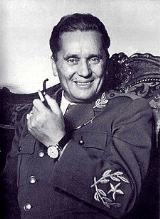
Josip Broz Tito

 
Josip Broz Tito

   Email Print
   Bookmark   Link


Josip Broz Tito


Josip Broz Tito, original name Josip Broz (Cyrillic script
Serbian Cyrillic alphabet

The Serbian Cyrillic alphabet is the official and traditional alphabet used to write the Serbian language. It is an adaptation of the Cyrillic alphabet for the Serbian language, and was developed in 1818 by Serbs linguistics Vuk Stefanovic Karad?ic....
: ????? ???? ???? 7 May 1892 – 4 May 1980) was the leader of the Socialist Federal Republic of Yugoslavia
Socialist Federal Republic of Yugoslavia

The Socialist Federal Republic of Yugoslavia and in Slovene language: Socialisticna Federativna Republika Jugoslavija The Slovene language name also uses this Gaj?s Latin alphabet version with a slight difference in spelling....
 from 1945 until his death in 1980. During World War II
World War II

World War II, or the Second World War , was a global military conflict which involved a Participants in World War II, including all of the great powers, organised into two opposing military alliances: the Allies of World War II and the Axis powers....
, Tito organized the anti-fascist resistance movement known as the People's Liberation Movement led by Yugoslav Partisans. Later he was a founding member of Cominform
Cominform

Cominform is the common name for what was officially referred to as the Information Bureau of the Communism and Workers' Parties. It was the first official forum of the international communist movement since the dissolution of the Comintern, and confirmed the new realities after World War II - including the creation of an Eastern Bloc....
, but resisted Soviet influence (see Titoism
Titoism

Titoism is an adaptation of Communism ideology named after Josip Broz Tito, leader of the Socialist Federal Republic of Yugoslavia, primarily used to describe the specific socialist system built in Yugoslavia after its refusal of the 1948 Resolution of the Cominform, when the Communist Party of Yugoslavia refused to take further dictates fro...
) and became one of the main founders and promoters of the Non-Aligned Movement
Non-Aligned Movement

The Non-Aligned Movement is an international organization of states considering themselves not formally aligned with or against any major power bloc....
.


Discussion
Ask a question about 'Josip Broz Tito'
Start a new discussion about 'Josip Broz Tito'
Answer questions from other users
Full Discussion Forum


Encyclopedia


Josip Broz Tito, original name Josip Broz (Cyrillic script
Serbian Cyrillic alphabet

The Serbian Cyrillic alphabet is the official and traditional alphabet used to write the Serbian language. It is an adaptation of the Cyrillic alphabet for the Serbian language, and was developed in 1818 by Serbs linguistics Vuk Stefanovic Karad?ic....
: ????? ???? ???? 7 May 1892 – 4 May 1980) was the leader of the Socialist Federal Republic of Yugoslavia
Socialist Federal Republic of Yugoslavia

The Socialist Federal Republic of Yugoslavia and in Slovene language: Socialisticna Federativna Republika Jugoslavija The Slovene language name also uses this Gaj?s Latin alphabet version with a slight difference in spelling....
 from 1945 until his death in 1980. During World War II
World War II

World War II, or the Second World War , was a global military conflict which involved a Participants in World War II, including all of the great powers, organised into two opposing military alliances: the Allies of World War II and the Axis powers....
, Tito organized the anti-fascist resistance movement known as the People's Liberation Movement led by Yugoslav Partisans. Later he was a founding member of Cominform
Cominform

Cominform is the common name for what was officially referred to as the Information Bureau of the Communism and Workers' Parties. It was the first official forum of the international communist movement since the dissolution of the Comintern, and confirmed the new realities after World War II - including the creation of an Eastern Bloc....
, but resisted Soviet influence (see Titoism
Titoism

Titoism is an adaptation of Communism ideology named after Josip Broz Tito, leader of the Socialist Federal Republic of Yugoslavia, primarily used to describe the specific socialist system built in Yugoslavia after its refusal of the 1948 Resolution of the Cominform, when the Communist Party of Yugoslavia refused to take further dictates fro...
) and became one of the main founders and promoters of the Non-Aligned Movement
Non-Aligned Movement

The Non-Aligned Movement is an international organization of states considering themselves not formally aligned with or against any major power bloc....
. He supported the creation of a Yugoslav
Yugoslavs

Yugoslavs is a national designation used by some people across the former Yugoslavia and by some of its diasporans, which continues to be used in some of its successor countries....
 nationality and identity as a Pan-Slavic replacement of the existing nationalities in Yugoslavia, and thus through his actions, was considered a Yugoslav
Yugoslavs

Yugoslavs is a national designation used by some people across the former Yugoslavia and by some of its diasporans, which continues to be used in some of its successor countries....
.

Early life


Pre-World War I

Josip Broz was born in Kumrovec
Kumrovec

Kumrovec is a village in central Croatia, part of Krapina-Zagorje county. It sits on the Sutla River, along the Croatian-Slovenian border. The Kumrovec municipality has 1,854 residents , but the village itself has only 304 people....
, in the small region of Hrvatsko Zagorje
Hrvatsko Zagorje

Hrvatsko zagorje is a historic region north of Zagreb, Croatia. It comprises the whole area north of Medvednica mountain up to Slovenia in the north and west, and up to the regions of Medimurje and Podravina in the north and east....
 in Croatia
Croatia

Croatia , officially the Republic of Croatia , is a Central European country at the crossroads of Pannonian Plain, Balkans, and the Mediterranean Sea....
. Then it was Croatia-Slavonia, a part of the Austro-Hungarian Empire. He was the seventh child of Franjo and Marija Broz. His father, Franjo Broz, was a Croat
Croats

Croats are a South Slavs nation mostly living in Croatia, Bosnia and Herzegovina and nearby countries. There are around 5 million Croats living in the southern Central Europe region, along the east bank of the Adriatic Sea and an estimated 9 million throughout the world....
, while his mother Marija (born Javeršek) was a Slovene. After spending part of his childhood years with his maternal grandfather in village of Podsreda
Podsreda

Podsreda is a town in Slovenia. It is located near the Croatia border. It is famous for its market, which takes place every Sunday. It offers wood, food, metal products....
, in 1900 he entered the primary school (four classes) in Kumrovec
Kumrovec

Kumrovec is a village in central Croatia, part of Krapina-Zagorje county. It sits on the Sutla River, along the Croatian-Slovenian border. The Kumrovec municipality has 1,854 residents , but the village itself has only 304 people....
, he failed the 2nd grade and graduated in 1905. In 1907, moving out of the rural environment, Broz started working as a machinist
Machinist

A machinist is a person who uses machine tools to make or modify parts, primarily metal parts, a process known as machining. This is accomplished by using machine tools to cut away excess material much as a woodcarver cuts away excess wood to produce his work....
's apprentice in Sisak
Sisak

Sisak is a city in central Croatia. The city's population in 2001 was 52,236 and it is the administrative centre of Sisak-Moslavina county....
. There, he became aware of the labor movement and celebrated 1 May - Labour Day
Labour Day

Labour Day or Labor Day is an Year holiday celebrated all over the world that resulted from the trade union movement, to celebrate the economic and social achievements of workers....
 for the first time. In 1910, he joined the union of metallurgy
Metallurgy

Metallurgy is a domain of materials science that studies the physical and chemical behavior of metallic Chemical element, their intermetallics, and their mixtures, which are called alloys....
 workers and at the same time the Social-Democratic Party of Croatia
Croatia

Croatia , officially the Republic of Croatia , is a Central European country at the crossroads of Pannonian Plain, Balkans, and the Mediterranean Sea....
 and Slavonia
Slavonia

Slavonia is a geographical and historical region in eastern Croatia. It is a fertile agricultural and forested lowland bounded, in part, by the Drava river in the north, the Sava river in the south, and the Danube river in the east....
. Between 1911 and 1913, Broz worked for shorter periods in Kamnik
Kamnik

Kamnik is the name of a municipality in Slovenia as well as the town that serves as its administrative, cultural, economic, and educational center....
, Cenkovo, Munich
Munich

Munich is the capital city of Bavaria, Germany. Munich is located on the River Isar north of the Northern Limestone Alps. Munich is the third largest city in Germany, after Berlin and Hamburg....
, and Mannheim
Mannheim

Mannheim is a city in Germany. With 327,318 inhabitants it is the second-largest city in the state of Baden-W?rttemberg after the capital Stuttgart....
, where he worked for the Benz
Benz

Benz may refer to:...
 automobile factory; he then went to Wiener Neustadt
Wiener Neustadt

Wiener Neustadt , is a town located south of Vienna, in the state of Lower Austria, Austria. It is a self-governed city and the seat of the district administration of Wiener Neustadt-Land....
, Austria, and worked as a test driver for Daimler
Daimler

Daimler may refer to:*Gottlieb Daimler, German automobile inventor...
.

In the autumn of 1913, he was drafted into the Austro-Hungarian Army
Austro-Hungarian Army

The Austro-Hungarian Army was the ground force of the Austria Hungary Dual Monarchy . It was composed of the joint army , the Austrian Landwehr , and the Hungarian Honv?ds?g ....
. He was sent to a school for non-commissioned officers and became a sergeant. In May 1914, Broz won a silver medal at an army fencing competition in Budapest
Budapest

Budapest is the Capitals of Hungary of Hungary. As the largest city of Hungary, it serves as the country's principal political, cultural, commerce, Industry, and transportation center and is considered an important hub in Central Europe....
. At the outbreak of World War I
World War I

World War I, or the First World War , was a global military conflict which involved the Great powers, organized into two opposing military alliances: the Allies of World War I and the Central Powers....
 in 1914, he was sent to Ruma
Ruma

Ruma is a town and municipality located in Vojvodina, Serbia at . In 2002 the town had a total population of 32,229, while Ruma municipality had a population of 60,006....
, where he was arrested for anti-war propaganda
Propaganda

Propaganda is the dissemination of information aimed at influencing the opinions or behaviors of large numbers of people. As opposed to Objectivity providing information, propaganda in its most basic sense presents information in order to influence its audience....
 and imprisoned in the Petrovaradin fortress
Petrovaradin fortress

Petrovaradin Fortress is a fortress in Novi Sad , Serbian province of Vojvodina, on the right bank of Danube river. The cornerstone of the present-day southern part of the fortress was laid on October 18, 1692, by Prince Croy....
. In January 1915, he was sent to the Eastern Front
Eastern Front (World War I)

The Eastern Front was a theatre of war during World War I in Central Europe and, primarily, Eastern Europe. The term is in contrast to the Western Front ....
 in Galicia
Galicia (Central Europe)

Galicia is a historical region in East Central Europe, currently divided between Poland and Ukraine, named after Ukra?ni?n city of Halych.The nucleus of historic Galicia is formed of three regions of western Ukraine: Lvivska oblast, Ternopilska oblast and Ivano-Frankivsk Oblast....
 to fight against Russia. He distinguished himself as a capable soldier and was recommended for military decoration. On Easter 25 March 1915, while in Bukovina
Bukovina

Bukovina is a historical region on the northern slopes of the northeastern Carpathian Mountains and the adjoining plains. It is currently split between Romania and Ukraine....
, he was seriously wounded and captured by the Russians.

Prisoner and revolutionary

After thirteen months at the hospital, Broz was sent to a work camp in the Ural Mountains
Ural Mountains

The Ural Mountains are a mountain range that runs roughly north and south through western Russia. They are usually considered as the natural boundary between Europe and Asia....
 where prisoners selected him for their camp leader. In February 1917, revolting workers broke into the prison and freed the prisoners. Broz subsequently joined a Bolshevik
Bolshevik

Bolsheviks, originally also Bolshevists were a faction of the Marxism Russian Social Democratic Labour Party which split apart from the Menshevik faction at the 2nd Congress of the RSDLP in 1903 and ultimately became the Communist Party of the Soviet Union....
 group. In April 1917, he was arrested again but managed to escape and participate in the July Days demonstrations in Petrograd
Saint Petersburg

Saint Petersburg is a types of inhabited localities in Russia and a federal subjects of Russia of Russia located on the Neva River at the head of the Gulf of Finland on the Baltic Sea....
 (Saint Petersburg) on 16 July-17, 1917. On his way to Finland, Broz was caught and imprisoned in the Petropavlovsk
Petropavlovsk

Petropavlovsk may refer to:*Russian battleship Petropavlovsk , Imperial Russia *Russian battleship Petropavlovsk , a Gangut class battleship in the Baltic Fleet ...
 fortress for three weeks. He was again sent to Kungur
Kungur

Kungur is a types of settlements in Russia in the south-east of Perm Krai, Russia, and is the administrative center of Kungursky District. Population: 68,943 ; 81,402 ; 64,800 ; 36,000 ....
, but escaped from the train. He hid out with a Russian family in Omsk
Omsk

Omsk is a types of inhabited localities in Russia in southwest Siberia in Russia, the administrative center of Omsk Oblast. It is the second-largest city in Russia beyond the Urals....
, Siberia
Siberia

Siberia , is the name given to the vast region constituting almost all of North Asia and for the most part currently serving as the massive central and eastern portion of the Russian Federation, having served in the same capacity previously for the Soviet Union from its beginning, and the Russian Empire beginning in the 16th century....
 where he met his future wife Pelagija Belousova. After the October Revolution, he joined a Red Guard
Red Guards (Russia)

For other uses of the term see Red GuardIn the context of the history of Russia and Soviet Union, Red Guards were armed groups of workers formed in the time frame of the Russian Revolution of 1917....
 unit in Omsk. Following a White counteroffensive, he fled to Kirgiziya (now Kyrgyzstan) and subsequently returned to Omsk, where he married Belousova. In the spring of 1918, he joined the South Slav
South Slavs

The South Slavs are a southern branch of the Slavic peoples that live in the Balkans mainly throughout the former Yugoslavia and Bulgaria. Geographically, the South Slavs are native to the southern Pannonian Plain, the eastern Alps and the Balkans and they speak South Slavic languages....
 section of the Russian Communist Party
Communist Party of the Soviet Union

The Communist Party of the Soviet Union was the ruling political party in the Soviet Union and one of the largest Communist Party in the world....
. By June of the same year, Broz left Omsk to find work and support his family, and was employed as a mechanic near Omsk for a year. In January 1920 he and his wife made a long and difficult journey home to Yugoslavia where he arrived in September.

Upon his return, Broz immediately joined the Communist Party of Yugoslavia. The CPY's influence on the political life of the Kingdom of Yugoslavia
Kingdom of Yugoslavia

The Kingdom of Yugoslavia was a monarchy stretching from the Western Balkans to Central Europe which existed during the often-tumultuous interwar era of 1918?1941....
 was growing rapidly. In the 1920 elections the Communists won 59 seats in the parliament and became the third strongest party. Winning numerous local elections, they even gained a stronghold in the second-largest city of Zagreb
Zagreb

Zagreb is the Capital and the largest city of Croatia. Zagreb is the Culture of Croatia, Croatian Academy of Sciences and Arts, Cinema of Croatia, Economy of Croatia and Government of Croatia center of the Croatia....
, electing Svetozar Delic
Svetozar Delic

Svetozar Delic was the first communism List of mayors of Zagreb of Zagreb, Croatia. Although he is known for his work in the Yugoslav early communist organization "Napred," Delic is mostly recognized for being the mayor with the shortest term in the history of Zagreb....
 for mayor. The King's regime, however, would not tolerate the CPY and declared it illegal. During 1920 and 1921 all Communist-won mandates were nullified. Broz continued his work underground despite pressure on Communists from the government. As 1921 began he moved to Veliko Trojstvo
Veliko Trojstvo

Veliko Trojstvo is a municipality in Bjelovar-Bilogora County, Croatia. There are 3,092 inhabitants, which 97% are Croats....
 near Bjelovar
Bjelovar

Bjelovar is a city in central Croatia. It is the administrative centre of Bjelovar-Bilogora County. During the 2001 census, there were 41,869 inhabitants, 90.51% which are Croats....
 and found work as a machinist. In 1925, Broz moved to Kraljevica
Kraljevica

Kraljevica is a town in the Kvarner region of the country of Croatia, located between Rijeka and Crikvenica, approximately thirty kilometers from Opatija and near the entrance to the bridge to the island of Krk....
 where he started working at a shipyard. He was elected as a union leader and a year later he led a shipyard strike. He was fired and moved to Belgrade, where he worked in a train coach factory in Smederevska Palanka
Smederevska Palanka

Smederevska Palanka is a town and municipality located in Serbia at 44.37? North, 20.96? East. Its name means "A hamlet near Smederevo" in Serbian language....
. He was elected as Workers Commissary but was fired as soon as his CPY membership was revealed. Broz then moved to Zagreb, where he was appointed secretary of Metal Workers Union of Croatia. In 1928, he became the Zagreb Branch Secretary of the CPY. In the same year he was arrested, tried in court for his illegal communist activities, and sent to jail. During his five years at Lepoglava
Lepoglava

Lepoglava is a town in Vara?din County, northern Croatia, located southwest of Vara?din, west of Ivanec and northeast of Krapina, at around . It has a population of 4,084, with a total of 8,718 people in the municipality ....
 prison he met Moša Pijade
Moša Pijade

Mo?a Pijade , nicknamed Cica Janko was a prominent Yugoslavian/Serbian Communist of Jewish origin, and a close collaborator of Josip Broz Tito, former President of Socialist Federal Republic of Yugoslavia....
 who became his ideological mentor. After his release, he lived incognito and assumed a number of noms de guerre, among them "Walter" and "Tito".

In 1934 the Zagreb Provincial Committee sent Tito to Vienna
Vienna

Vienna is the Capital of Republic of Austria and also one of the nine states of Austria. Vienna is Austria's primary city, with a population of about 1.7 million...
 where the Central Committee of the Communist Party of Yugoslavia had sought refuge. He was appointed to the Committee and started to appoint allies to him, among them Edvard Kardelj
Edvard Kardelj

Edvard Kardelj also known under the pseudonyms Sperans and Kri?tof was a Slovenes communist political leader, economist, Partisans , and publicist....
, Milovan Djilas, Aleksander Rankovic, and Boris Kidric
Boris Kidric

Boris Kidric was a leading Slovenes communist who was, jointly with Edvard Kardelj, one of the chief organizers of the Partisans struggle in Slovenia from 1941 to 1945....
. In 1935, Tito traveled to the Soviet Union, working for a year in the Balkan section of Comintern
Comintern

The 'Comintern' was an international Communism organization founded in Moscow in March 1919. The International intended to fight "by all available means, including armed force, for the overthrow of the international bourgeoisie and for the creation of an international Soviet republic as a transition stage to the complete abolition of the Sta...
. He was a member of the Soviet Communist Party and the Soviet secret police
Secret police

Secret police are a police agency which operates in secrecy to maintain national security against internal threats to the state.Secret police forces are typically associated with totalitarianism regimes, as they are often used to maintain the political power of the state rather than uphold the rule of law....
 (NKVD
NKVD

The NKVD or People's Commissariat for Internal Affairs was the leading secret police organization of the Soviet Union that was responsible for Soviet political repressions during the Stalinism era....
). In 1936, the Comintern sent "Comrade Walter" (i.e. Tito) back to Yugoslavia to purge the Communist Party there. In 1937, Stalin had the Secretary-General of the CPY, Milan Gorkic, murdered in Moscow. Subsequently Tito was appointed Secretary-General of the still-outlawed CPY.

World War II leader


Yugoslav People's Liberation War

On 6 April 1941, German, Italian, and Hungarian forces launched an invasion of Yugoslavia
Invasion of Yugoslavia

The Invasion of Yugoslavia , also known as the April War , was the Axis powers' attack on Kingdom of Yugoslavia on April 6, 1941 during World War II....
. Nazi Germany
Nazi Germany

Nazi Germany and the Third Reich are the colloquial English names for Germany under the regime of Adolf Hitler and the Nazi Party , which established a Totalitarianism dictatorship that existed from 1933 to 1945....
 initiated a three-pronged drive on the Yugoslavian capital, Belgrade
Belgrade

Belgrade is the capital and largest city of Serbia. The city lies on international waterway, at the confluence of the Sava River and Danube rivers, where the Pannonian Plain meets the Balkan Peninsula....
. Meanwhile, the Luftwaffe
Luftwaffe

is a generic German term for an air force. It is also the official name for two of the four historic German air forces, the Wehrmacht air arm founded in 1933 and disbanded in 1946; and the current Bundeswehr air arm founded in 1956....
 bombed Belgrade (Operation Punishment) and other major Yugoslavian cities. Attacked from all sides, the armed forces of the Kingdom of Yugoslavia
Kingdom of Yugoslavia

The Kingdom of Yugoslavia was a monarchy stretching from the Western Balkans to Central Europe which existed during the often-tumultuous interwar era of 1918?1941....
 quickly crumbled. Subsequently, on 17 April, after King Peter II
Peter II of Yugoslavia

Peter II , was the third and last King of the Kingdom of Yugoslavia, previously known as the Kingdom of Serbs, Croats and Slovenes before 1929....
 and other members of the government fled the country, the remaining representatives of the government and military met with the German officials in Belgrade. They quickly agreed to end military resistance.

The terms of the armistice were extremely severe, and the Axis proceeded to dismember Yugoslavia. Germany occupied northern Slovenia
Slovenia

Slovenia , officially the Republic of Slovenia , is a country in southern Central Europe bordering Italy to the west, the Adriatic Sea to the southwest, Croatia to the south and east, Hungary to the northeast, and Austria to the north....
, while retaining direct military administration over a rump Serbia and considerable influence over its newly created puppet state
Puppet state

The term puppet state describes a nominal sovereignty controlled effectively by a foreign power.. The term refers to a government controlled by the government of another country like a puppeteer controls the strings of a marionette....
, the Independent State of Croatia
Independent State of Croatia

The Independent State of Croatia was a puppet state of Nazi Germany. It was established on April 10, 1941, after the Kingdom of Yugoslavia was attacked by the Axis forces....
, which extended over much of today's Croatia
Croatia

Croatia , officially the Republic of Croatia , is a Central European country at the crossroads of Pannonian Plain, Balkans, and the Mediterranean Sea....
 and contained all of modern Bosnia and Herzegovina
Bosnia and Herzegovina

Bosnia and Herzegovina is a country on the Balkans peninsula of South Eastern Europe with an area of 51,129 square kilometres . Bordered by Croatia to the north, west and south, Serbia to the east, and Montenegro to the south, Bosnia and Herzegovina is Landlocked#Nearly landlocked, except for 26 kilometres of the Adriatic Sea coas...
. Mussolini's Italy
Kingdom of Italy (1861–1946)

The Kingdom of Italy was a state forged in 1861 by the Italian unification under the influence of the Kingdom of Sardinia; it existed until 1946 when the Italians opted for a republican constitution....
 gained the remainder of Slovenia, Kosovo
Kosovo

Kosovo is a disputed region in the Balkans. Its majority is governed by the partially-recognised Republic of Kosovo . Serbia does not recognise the secession of Kosovo and considers it a United Nations-governed entity within its sovereign territory, the Autonomous Province of Kosovo and Metohija that was re-created by Slobodan M...
, and large chunks of the coastal Dalmatia
Dalmatia

Dalmatia is a region on the eastern coast of the Adriatic Sea, situated mostly in modern Croatia and spreading between the island of Rab in the northwest and the Bay of Kotor in the southeast....
 region (along with nearly all its Adriatic
Adriatic Sea

The Adriatic Sea is a body of water separating the Italian Peninsula from the Balkan peninsula, and the system of the Apennine Mountains from that of the Dinaric Alps and adjacent ranges....
 islands). It also gained control over the newly created Montenegrin puppet state, and was granted the kingship in the Independent State of Croatia, though wielding little real power within it. Hungary dispatched the Hungarian Third Army
Hungarian Third Army

The Hungarian Third Army was a Hungarian field army which saw action during World War II....
 to occupy Vojvodina
Occupation of Vojvodina, 1941-1944

The Occupation of Vojvodina from 1941 to 1944 was carried out by Nazi Germany and its client states / puppet regimes: Mikl?s Horthy Hungary, the Independent State of Croatia, and what was known as "Serbia ."...
 in northern Serbia, and later forcibly annexed sections of Baranja
Baranja

Baranja may refer to:*Baranya *Baranja, Nepal...
, Backa
Backa

Backa is an area of the Pannonian plain lying between the rivers Danube and Tisa. It is divided between Serbia and Hungary, with small uninhabited pockets of land on the left bank of the Danube which belong to Croatia, but are under Serbian control since 1991 ....
, Medimurje, and Prekmurje
Prekmurje

Prekmurje is the easternmost region of Slovenia. It borders Hungary to the north-east, Austria to the north-west, Croatia to the south and the Slovenian region of Lower Styria to the south-west....
. Bulgaria
Military history of Bulgaria during World War II

The military history of Bulgaria during World War II encompasses an initial period of neutral country until 1 March 1941, a period of alliance with the Axis Powers until 9 September 1944 and a period of alignment with the Allies of World War II until the end of the war....
, meanwhile, annexed nearly all of the modern-day Republic of Macedonia
Republic of Macedonia

The Republic of Macedonia , , often referred to simply as Macedonia, is a landlocked country on the Balkans in southeastern Europe. It is bordered by Serbia to the north, Bulgaria to the east, Greece to the south and Albania to the west....
.

Tito's first responses to the German invasion of Yugoslavia
Invasion of Yugoslavia

The Invasion of Yugoslavia , also known as the April War , was the Axis powers' attack on Kingdom of Yugoslavia on April 6, 1941 during World War II....
 were the founding of a Military Committee within the Central Committee of the Yugoslav Communist Party 10 April 1941 and issuing a pamphlet on 1 May 1941 calling on the people to unite in a battle against occupation. On 4 July 1941, after Germany launched the invasion of the Soviet Union (Operation Barbarossa
Operation Barbarossa

Operation Barbarossa was the code name for Nazi Germany's invasion of the Soviet Union during World War II that commenced on 22 June 1941. Over 4.5 million troops of the Axis powers invaded the USSR along a 2,900 kilometer front ....
), Tito called a Central committee meeting which named him military commander and issued a call to arms. On the same day, Yugoslav Partisans formed the 1st Sisak Partisan Detachment
1st Sisak Partisan Detachment

The 1st Sisak Partisan Detachment was the first armed anti-fascist military unit in Europe. This first Yugoslav Partisans unit was established in Brezovica forest, near Sisak, Croatia on June 22 1941, the day Nazi Germany invaded the Soviet Union....
, the first armed resistance
Resistance during World War II

Resistance movement during World War II occurred in every occupied country by a variety of means, ranging from non-cooperation, disinformation and propaganda to hiding crashed pilots and even to outright warfare and the recapturing of towns....
 unit in Europe (mostly consisting of Croats
Croats

Croats are a South Slavs nation mostly living in Croatia, Bosnia and Herzegovina and nearby countries. There are around 5 million Croats living in the southern Central Europe region, along the east bank of the Adriatic Sea and an estimated 9 million throughout the world....
 from the nearby city). Founded in the Brezovica forest near Sisak
Sisak

Sisak is a city in central Croatia. The city's population in 2001 was 52,236 and it is the administrative centre of Sisak-Moslavina county....
, Croatia
Croatia

Croatia , officially the Republic of Croatia , is a Central European country at the crossroads of Pannonian Plain, Balkans, and the Mediterranean Sea....
, its creation marked the beginning of armed anti-Axis resistance in occupied Yugoslavia.

In the first period, Tito and the Partisans (promoting a pan-Yugoslav policy of tolerance) faced competition from the Serb
Serbs

Serbs are a South Slavs people living in the Balkans and Central Europe, mainly in Serbia, Montenegro, Bosnia-Herzegovina, and, to a lesser extent, in Croatia....
-dominated Chetnik movement. Led by Draža Mihailovic
Draža Mihailovic

Dragoljub "Dra?a" Mihailovic was a Serbian general now primarily remembered as the World War II leader of the Chetnik movement. The organization, officially named the "Yugoslav Army in the Fatherland" , was founded as a royalist/nationalist Serbian resistance movement, but eventually transformed into a Collaborationism Axis militia fighting...
, the latter increasingly collaborated with the Axis occupation and lost its international recognition as a resistance force. After a brief initial period of cooperation, the two factions quickly started fighting against each other. Gradually, the Chetniks ended up primarily fighting the Partisans instead of the occupation forces, and started cooperating with the Axis in their struggle to destroy Tito's forces, receiving increasing amounts of logistical assistance (in particular, from Italy
Kingdom of Italy (1861–1946)

The Kingdom of Italy was a state forged in 1861 by the Italian unification under the influence of the Kingdom of Sardinia; it existed until 1946 when the Italians opted for a republican constitution....
). The Partisans soon began a widespread and successful guerrilla
Guerrilla warfare

Guerrilla warfare is the Irregular warfare warfare and combat with which a small group of combatants use mobile Military tactics to combat a larger and less mobile formal army....
 campaign and started liberating areas of Yugoslav territory. Partisan activities provoked the Germans into "retaliation" against civilians. These retaliations resulted in mass murders (for each killed German soldier, 100 civilians were to be killed and for each wounded, 50). Despite this, liberated territories such as the "Republic of Užice
Republic of Užice

The Republic of U?ice was a short-lived military mini-state that existed in Autumn 1941 in the western part of Nazism-occupied Serbia . The Republic was established by the fighters of the Partisans and its capital was in the town of U?ice....
" were formed and fiercely defended.

In these liberated territories, the Partisans organized People's Committees to act as civilian government. The Anti-Fascist Council of National Liberation of Yugoslavia
AVNOJ

AVNOJ was the political umbrella organization for the national liberation councils of Yugoslavia. The AVNOJ was established on November 26, 1942 to administer terrorities under the Yugoslav Partisans' control....
 (AVNOJ), which convened in Bihac
Bihac

File:Novi_trg_Bihac.jpgBihac is a city and municipality on the Una River in the north-western part of Bosnia and Herzegovina, center of the Una-Sana Canton of the Federation of Bosnia and Herzegovina....
 on 26 November 1942 and in Jajce
Jajce

Jajce is a city and municipality located in the central part of Bosnia and Herzegovina. It is part of the Central Bosnia Canton of the Federation of Bosnia and Herzegovina entity....
 on 29 November 1943, was a representative body established by the resistance in which Tito played a leading role. In the two sessions, the resistance representatives established the basis for post-war organization of the country, deciding on a federation of the Yugoslav nations. In Jajce, Tito was named President of the National Committee of Liberation. On 4 December 1943, while most of the country was still occupied by the Axis, Tito proclaimed a provisional democratic Yugoslav government. However, with the growing possibility of an Allied invasion in the Balkans, the Axis began to divert more resources to the destruction of the Partisans. More specifically, the Germans planned and executed several massive anti-Partisan offensives with the aim of destroying the Partisan headquarters and mobile field hospital. The largest of these offensives were the Battle of Neretva (which included the Chetniks
Chetniks

The Chetnik movement or the Chetniks were a Serbs-nationalist/Monarchism paramilitary organization operating in the Balkans before and during World Wars....
 fighting alongside the Germans) and the Battle of Sutjeska (the Fourth and Fifth anti-Partisan offensives), involving nearly 200,000 troops. The Battle of Sutjeska in particular came very close to encircling and eliminating the resistance, however, the highly mobile Partisan formations managed to retreat beyond the reach of the Axis each time. The Germans therefore came close to capturing or killing Tito on at least three occasions: during the 1943 Battle of Neretva (Fall Weiss); during the subsequent Battle of Sutjeska (Fall Schwarz), in which he was wounded on 9 June, and on 25 May 1944, when he barely managed to evade the Germans after the Raid on Drvar (Operation Rösselsprung), an airborne assault
Airborne forces

Airborne forces are military units, usually light infantry, set up to be moved by aircraft and 'dropped' into battle. Thus they can be placed behind enemy lines, and have an ability to deploy almost anywhere with little warning....
 outside his Drvar
Drvar

Drvar is a town and municipality in western Bosnia and Herzegovina, located on the road between Bosansko Grahovo and Bosanski Petrovac, also near Glamoc....
 headquarters in Bosnia
Bosnia (region)

Historically and geographically, the region known as Bosnia lies mainly in the Dinaric Alps, ranging to the southern borders of the Pannonian plain, with the rivers Sava and Drina marking its northern and eastern borders....
.

After Tito's Partisans stood up to these intense Axis attacks between January and June 1943, and the extent of Chetnik
Chetniks

The Chetnik movement or the Chetniks were a Serbs-nationalist/Monarchism paramilitary organization operating in the Balkans before and during World Wars....
 collaboration became evident, Allied leaders switched their support from them to the Partisans. King Peter II of Yugoslavia
Peter II of Yugoslavia

Peter II , was the third and last King of the Kingdom of Yugoslavia, previously known as the Kingdom of Serbs, Croats and Slovenes before 1929....
, American President Franklin Roosevelt and British Prime Minister Winston Churchill
Winston Churchill

Sir Winston Leonard Spencer-Churchill, Order of the Garter, Order of Merit, Order of the Companions of Honour, Territorial Decoration, Fellow of the Royal Society, Her Majesty's Most Honourable Privy Council, Queen's Privy Council for Canada was a Politics of the United Kingdom known chiefly for his leadership of the United King...
 joined Soviet Premier Joseph Stalin
Joseph Stalin

Joseph Stalin was the General Secretary of the Communist Party of the Soviet Union's Central Committee of the Communist Party of the Soviet Union from 1922 until his death in 1953....
 in officially recognizing Tito and the Partisans at the Tehran Conference
Tehran Conference

The Tehran Conference was the meeting of Joseph Stalin, Franklin Delano Roosevelt and Winston Churchill between November 28 and December 1, 1943 in Tehran, Iran....
. This resulted in Allied aid being parachuted behind Axis lines to assist the Partisans. On 17 June 1944 on the Dalmatian island of Vis
Vis (island)

Vis [] , is a Croatian island in the Adriatic Sea, with an area of 90.26 km? and a population of 3,617 . Of all the inhabited Croatian islands, it is the furthest from the coast....
, the Treaty of Vis (Viški sporazum) was signed in an attempt to merge Tito's government (the AVNOJ
AVNOJ

AVNOJ was the political umbrella organization for the national liberation councils of Yugoslavia. The AVNOJ was established on November 26, 1942 to administer terrorities under the Yugoslav Partisans' control....
) with the government in exile of King Peter II. This treaty was also known as the Tito-Šubašic Agreement
Tito-Šubašic Agreement

The Treaty of Vis also known as the Tito-?uba?ic Agreement was an attempt by the Western Powers to merge the Kingdom of Yugoslavia in exile with the communist-led Partisans who were fighting the Axis powers occupation of Yugoslavia in the World War II and were de facto rulers on the liberated territories....
. As the leader of the Yugoslav forces, Tito was now personally a target for the Axis forces in occupied Yugoslavia. The Partisans were supported directly by Allied airdrops to their headquarters, with Brigadier Fitzroy Maclean
Fitzroy Maclean

Major-General Sir Fitzroy Hew Royle MacLean of Dunconnel, 1st Baronet Order of the Thistle Order of the British Empire was a Scottish diplomat, soldier, adventurer, writer and politician....
 playing a significant role in the liaison missions. The RAF Balkan Air Force was formed in June 1944 to control operations that were mainly aimed at aiding his forces.

On 28 September 1944, the Telegraph Agency of the Soviet Union
Telegraph Agency of the Soviet Union

The Telegraph Agency of the Soviet Union , was the central agency for collection and distribution of internal and international news for all Soviet newspapers, radio and television stations....
 (TASS) reported that Tito signed an agreement with the USSR allowing "temporary entry of Soviet troops into Yugoslav territory" which allowed the Red Army
Red Army

The Red Army was the armed force first organized by the Bolsheviks during the Russian Civil War in 1918 and, in 1922, became the army of the Soviet Union....
 to assist in operations in the northeastern areas of Yugoslavia. With their strategic right flank secured by the Allied advance, the Partisans prepared and executed a massive general offensive which succeeded in breaking through German lines and forcing a retreat beyond Yugoslav borders. After the Partisan victory and the end of hostilities in Europe, all external forces were ordered off Yugoslav territory.

Aftermath of World War II

On 7 March 1945, the provisional government of the Democratic Federal Yugoslavia (Demokratska Federativna Jugoslavija, DFY) was assembled in Belgrade
Belgrade

Belgrade is the capital and largest city of Serbia. The city lies on international waterway, at the confluence of the Sava River and Danube rivers, where the Pannonian Plain meets the Balkan Peninsula....
 by Josip Broz Tito, while the provisional name allowed for either a republic or monarchy. This government was headed by Tito as provisional Yugoslav Prime Minister
Prime minister

A prime minister is the most senior minister of Cabinet in the Executive branch of government in a parliamentary system. The position is usually held by, but need not always be held by, a politician....
 and included representatives from the royalist government-in-exile, among others Ivan Šubašic
Ivan Šubašic

Dr. Ivan ?uba?ic was Croatian and Yugoslav politician, best known as the last Ban of Croatia.He was born in Vukova Gorica, near Karlovac, then in Austria-Hungary....
. In accordance with the agreement between resistance leaders and the government-in-exile, post-war elections were held to determine the form of government
Form of government

A form of government is a term that refers to the set of political institutions by which a government of a state is organized in order to exert its powers over a body politic....
. In November 1945, Tito's pro-republican People's Front, led by the Communist Party of Yugoslavia
League of Communists of Yugoslavia

League of Communists of Yugoslavia , before 1952 the Communist Party of Yugoslavia , was a major Communist party in Yugoslavia. The party was founded as an opposition party in the Kingdom of Serbs, Croats and Slovenes in 1919....
, won the elections with an overwhelming majority. During the period, Tito evidently enjoyed massive popular support due to being generally viewed by the populace as the liberator of Yugoslavia. The Yugoslav administration in the immediate post-war period managed to unite a country that had been severely affected by ultra-nationalist upheavals and war devastation, while successfully suppressing the nationalist sentiments of the various nations in favor of tolerance, and the common Yugoslav goal. After the overwhelming electoral victory, Tito was confirmed as the Prime Minister and the Minister of Foreign Affairs of the DFY. The country was soon renamed the Federal People's Republic of Yugoslavia (FPRY) (later finally renamed into Socialist Federal Republic of Yugoslavia, SFRY). On 29 November 1945, King Peter II
Peter II of Yugoslavia

Peter II , was the third and last King of the Kingdom of Yugoslavia, previously known as the Kingdom of Serbs, Croats and Slovenes before 1929....
 was formally deposed by the Yugoslav Constituent Assembly. The Assembly drafted a new republican constitution
Constitution

A constitution is a system for government — often codified as a written document — that establishes the rules and principles of an autonomous political entity....
 soon afterwards.

Yugoslavia organized an army from the Partisan movement, the Yugoslav People's Army
Yugoslav People's Army

The Yugoslav People's Army was the military of the Socialist Federal Republic of Yugoslavia. The JNA enjoyed an international reputation as a powerful, well-equipped, and well trained force....
 (Jugoslavenska narodna armija, or JNA) which was, for a period, considered the fourth strongest in Europe. The State Security Administration
UDBA

UDBA or Uprava dr?avne bezbednosti/sigurnosti/varnosti was the secret police organization of the Socialist Federal Republic of Yugoslavia....
 (Uprava državne bezbednosti/sigurnosti/varnosti, UDBA) was also formed as the new secret police, along with a security agency
Security agency

A security agency is an organization which conducts intelligence activities for the internal security of a nation, state or organization. They are the domestic cousins of foreign Intelligence agency....
, the Department of People's Security
OZNA

OZNA or Organ Za?tite Naroda or Oddelek za za?cito naroda was a security agency of the Socialist Federal Republic of Yugoslavia....
 (Organ Zaštite Naroda (Armije), OZNA). Yugoslav intelligence was charged with imprisoning and bringing to trial large numbers of Nazi collaborators; controversially, this included Catholic clergymen due to the widespread involvement of Croatian Catholic clergy with the Ustaša regime
Involvement of Croatian Catholic clergy with the Ustaša regime

Involvement of Croatian Catholic clergy with the Usta?a regime refers to the role of the Catholic Church in Croatia in the Independent State of Croatia , founded by the Usta?e in 1941 as a Puppet state#World War II....
. Draža Mihailovic
Draža Mihailovic

Dragoljub "Dra?a" Mihailovic was a Serbian general now primarily remembered as the World War II leader of the Chetnik movement. The organization, officially named the "Yugoslav Army in the Fatherland" , was founded as a royalist/nationalist Serbian resistance movement, but eventually transformed into a Collaborationism Axis militia fighting...
 was found guilty of collaboration
Collaborationism

Collaborationism, can describe the treason of cooperation with enemy forces Military occupation one's country. As such it implies Crime deeds in the service of the occupying Power , including complicit with the occupying power in murder, persecutions, pillage, and economy exploitation as well as participation in a puppet government....
, high treason
High treason

High treason is criminal disloyalty to one's country. Participating in a war against one's country, attempting to overthrow its government, spying on its military, its diplomats, or its secret services for a hostile and foreign power, or attempting to kill its head of state are perhaps the best-known examples of high treason....
 and war crimes and was subsequently executed by firing squad in July 1946.

Prime Minister Josip Broz Tito met with the president of the Bishops' Conference of Yugoslavia
Bishops' Conference of Yugoslavia

The Bishops' Conference of Yugoslavia was an episcopal conference of the Catholic Church covering the territory of Yugoslavia.The first such bishops' conference was held in the Kingdom of Serbs, Croats and Slovenes in November of 1918....
, Aloysius Stepinac
Aloysius Stepinac

Beatification Alojzije Viktor Cardinal Stepinac was a Croatian Catholic Prelate. He was Archbishop of Zagreb from 1937 to 1960. In 1946, in a verdict that polarised public opinion both in Yugoslavia and beyond, a Belgrade court found him guilty of Involvement of Croatian Catholic clergy with the Usta?a regime and complicity in allowing the...
 on June 4, 1945, two days after his release from imprisonment. The two could not reach an agreement on the state of the Catholic Church. Under Stepinac's leadership, the bishops' conference released a letter condemning alleged Partisan war crimes in September, 1945. The following year Stepinac was arrested and put on trial. In October 1946, in its first special session for 75 years, the Vatican excommunicated Tito and the Yugoslav government for sentencing Stepinac to 16 years in prison on charges of assisting Ustaše
Ustaše

The Usta?a - Croatian Revolutionary Movement , members known collectively as Usta?e, but sometimes anglicised as Ustashas or Ustashi) was a Croatian and Nazi-like movement....
 terror and of supporting forced conversions of Serbs to Catholicism. Stepinac received preferential treatment in recognition of his status and the sentence was soon shortened and reduced to house-imprisonment, with the option of emigration open to the archbishop. At the conclusion of the "Informbiro period", reforms rendered Yugoslavia considerably more religiously liberal than the Eastern Bloc
Eastern bloc

During the Cold War, the terms Eastern Bloc, Communist Bloc or Soviet Bloc were used to refer to European annexed or expanded Soviet Socialist Republics of the USSR and Satellite state states, including members of the Soviet-dominated organizations Comecon and the Warsaw Pact....
 states.

In the first post war years Tito was widely considered a communist leader very loyal to Moscow, indeed, he was often viewed as second only to Stalin in the Eastern Bloc. Yugoslav forces shot down American aircraft flying over Yugoslav territory, and relations with the West were strained. In fact, Stalin and Tito had an uneasy alliance from the start, with Stalin considering Tito too independent.

Yugoslav President


Tito-Stalin split

Unlike the other new communist states in east-central Europe, Yugoslavia liberated itself from Axis domination, without any direct support from the Red Army
Red Army

The Red Army was the armed force first organized by the Bolsheviks during the Russian Civil War in 1918 and, in 1922, became the army of the Soviet Union....
 as the others. Tito's leading role in liberating Yugoslavia not only greatly strengthened his position in his party and among the Yugoslav people, but also caused him to be more insistent that Yugoslavia gets more room to follow its own interests than other Bloc leaders who had more reasons (and pressures) to recognize Soviet efforts in helping them liberate their own countries from Axis control. This had already led to some friction between the two countries before World War II
World War II

World War II, or the Second World War , was a global military conflict which involved a Participants in World War II, including all of the great powers, organised into two opposing military alliances: the Allies of World War II and the Axis powers....
 was even over. Although Tito was formally an ally of Stalin after World War II, the Soviets had set up a spy ring in the Yugoslav party as early as 1945, giving way to an uneasy alliance.

In the immediate aftermath of World War II, there occurred several armed incidents between Yugoslavia and the Western Allies
Western Allies

The Western Allies were the democracy and their colony peoples, within the broader coalition of Allies of World War II during World War II. The term is generally understood to refer to the countries of the United Kingdom Commonwealth of Nations and part of the military of Poland , exiled forces from Occupied Europe , the United States, , Fran...
. Following the war, Yugoslavia recovered the territory of Istria
Istria

File:Istria Croatian Adriatic.pngIstria , formerly Histria , is the largest peninsula in the Adriatic Sea. The peninsula is located at the head of the Adriatic between the Gulf of Trieste and the Bay of Kvarner....
, as well as the cities of Zadar
Zadar

Zadar is a List of cities in Croatia in Croatia on the Adriatic Sea. It is the centre of Zadar county and the wider northern Dalmatian region. Zadar faces the islands of Ugljan and Pa?man, from which it is separated by the narrow Zadar Strait....
 and Rijeka
Rijeka

Rijeka is the principal seaport of Croatia, located on Kvarner Bay, an inlet of the Adriatic Sea. It has 144,043 inhabitants and is Croatia's third largest city....
 that had been taken by Italy
Italy

Italy , officially the Italian Republic , is a country located on the Italian Peninsula in Southern Europe and on the two largest islands in the Mediterranean Sea, Sicily and Sardinia....
 in the 1920s. Yugoslav leadership was looking to incorporate Trieste
Trieste

Trieste is a city and port in northeastern Italy very near to the Slovenian border, to the North, East, and South. Trieste is located at the head of the Gulf of Trieste on the Adriatic Sea....
 into the country as well, which was opposed by the Western Allies. This led to several armed incidents, notably air attacks of Yugoslav fighter planes on U.S. transport aircraft, causing bitter criticism from the west. From 1945 to 1948, at least four US aircraft were shot down. Stalin was opposed to these provocations, as he felt the USSR unready to face the West in open war so soon after the losses of World War II. In addition, Tito was openly supportive of the Communist side in the Greek Civil War
Greek Civil War

The Greek Civil War , fought from 1946 to 1949 by the Governmental forces, receiving logistical support by the United Kingdom at first and later by the United States, and the Democratic Army of Greece , the military branch of the Communist Party of Greece , was the result of a highly polarized struggle between leftists and rightists which sta...
, while Stalin kept his distance, having agreed with Churchill not to pursue Soviet interests there. In 1948, motivated by the desire to create a strong independent economy, Tito modeled his economic development plan independently from Moscow, which resulted in a diplomatic escalation followed by a bitter exchange of letters in which Tito affirmed that The Soviet answer on May 4 admonished Tito and the Communist Party of Yugoslavia (CPY) for failing to admit and correct its mistakes, and went on to accuse them of being too proud of their successes against the Germans, maintaining that the Red Army had saved them from destruction. Tito's response on May 17 suggested that the matter be settled at the meeting of the Cominform to be held that June. However, Tito did not attend the second meeting of the Cominform
Cominform

Cominform is the common name for what was officially referred to as the Information Bureau of the Communism and Workers' Parties. It was the first official forum of the international communist movement since the dissolution of the Comintern, and confirmed the new realities after World War II - including the creation of an Eastern Bloc....
, fearing that Yugoslavia was to be openly attacked. At this point the crisis nearly escalated into an armed conflict, as Hungarian and Soviet forces were massing on the northern Yugoslav frontier. On June 28, the other member countries expelled Yugoslavia, citing "nationalist elements" that had "managed in the course of the past five or six months to reach a dominant position in the leadership" of the CPY. The expulsion effectively banished Yugoslavia from the international association of socialist states, while other socialist states of Eastern Europe subsequently underwent purges of alleged "Titoists". Stalin took the matter personally – for once, and attempted, unsuccessfully, to assassinate Tito on several occasions. In a correspondence between the two leaders, Tito openly wrote: However, Tito used the estrangement from the USSR to attain US aid via the Marshall Plan
Marshall Plan

The Marshall Plan was the primary plan of the United States for rebuilding and creating a stronger foundation for the countries of Western Europe, and repelling communism after World War II....
, as well as to involve Yugoslavia in the Non-Aligned Movement
Non-Aligned Movement

The Non-Aligned Movement is an international organization of states considering themselves not formally aligned with or against any major power bloc....
, in which he assured a leading position for Yugoslavia. The event was significant not only for Yugoslavia and Tito, but also for the global development of socialism, since it was the first major split between Communist states, casting doubt on Comintern's claims for socialism to be a unified force that would eventually control the whole world, as Tito became the first (and the only successful) socialist leader to defy Stalin's leadership in the COMINFORM
Cominform

Cominform is the common name for what was officially referred to as the Information Bureau of the Communism and Workers' Parties. It was the first official forum of the international communist movement since the dissolution of the Comintern, and confirmed the new realities after World War II - including the creation of an Eastern Bloc....
. This rift with the Soviet Union
Soviet Union

The Union of Soviet Socialist Republics was a Constitution of the Soviet Union socialist state that existed in Eurasia from 1922 to 1991.The name is a translation of the , romanization of Russian Soyuz Sovetskikh Sotsialisticheskikh Respublik, abbreviated ????, SSSR....
 brought Tito much international recognition, but also triggered a period of instability often referred to as the Informbiro
Informbiro

Informbiro was a period in the history of Socialist Federal Republic of Yugoslavia characterized by conflict and schism with the Soviet Union....
 period. Tito's form of communism was labeled "Titoism
Titoism

Titoism is an adaptation of Communism ideology named after Josip Broz Tito, leader of the Socialist Federal Republic of Yugoslavia, primarily used to describe the specific socialist system built in Yugoslavia after its refusal of the 1948 Resolution of the Cominform, when the Communist Party of Yugoslavia refused to take further dictates fro...
" by Moscow, which encouraged purges against suspected "Titoites'" throughout the Eastern bloc
Eastern bloc

During the Cold War, the terms Eastern Bloc, Communist Bloc or Soviet Bloc were used to refer to European annexed or expanded Soviet Socialist Republics of the USSR and Satellite state states, including members of the Soviet-dominated organizations Comecon and the Warsaw Pact....
.

As a result of cold war with USSR Yugoslavian government founded brutal prison camp on croatian island of Goli Otok
Goli otok

Goli otok is an island off the northern Adriatic Sea coast, located between Rab's northeastern shore and the mainland, in what is today Croatia's Primorje-Gorski Kotar county....
 for suspected pro-Soviet enemies of Tito and regime of CPY. In 1949, the entire island was officially made into a high-security, top secret prison and labor camp run by the authorities of SFR Yugoslavia. Until 1956, throughout the Informbiro period, it was used to incarcerate political prisoners. They included known and alleged Stalinists, but also other Communist Party members or even regular citizens accused of exhibiting any sort of sympathy or leanings towards the Soviet Union. Some 10.000 people went through the camp. There are a lot testimonies on brutalities of prison guards, officers and principals.

On 26 June 1950, the National Assembly supported a crucial bill written by Milovan Đilas
Milovan Đilas

Milovan ?ilas was a Montenegrins-Serbian Communist politician, theorist and author in Yugoslavia. He was a key figure in the Partisans movement during World War II, as in the post war government, and became one of the best known and most determined critics of the system, domestically and internationally....
 and Tito about "self-management
Workers' self-management

Worker self-management is a form of workplace decision-making in which the workers themselves agree on choices instead of an owner or traditional supervisor telling workers what to do, how to do it and where to do it....
" (samoupravljanje): a type of independent socialism
Socialism

Socialism refers to a broad set of economic theories of social organization advocating public or state ownership and administration of the means of production and distribution of goods, and a society characterized by equality for all individuals, with a fair or Egalitarianism method of compensation....
 that experimented with profit sharing
Profit sharing

Profit sharing, when used as a special term, refers to various incentive plans introduced by businesses that provide direct or indirect payments to employees that depend on company's profitability in addition to employees' regular salary and bonuses....
 with workers in state-run enterprises. On 13 January 1953, they established that the law on self-management was the basis of the entire social order in Yugoslavia. Tito also succeeded Ivan Ribar
Ivan Ribar

Ivan Ribar , was a Yugoslavia politician of Croatian descent.Ribar was born in Vukmanic near Karlovac. He had a PhD in law. In politics, Ribar was:...
 as the President of Yugoslavia on 14 January 1953. After Stalin's death Tito rejected the USSR's invitation for a visit to discuss normalization of relations between two nations. Nikita Khrushchev and Nikolai Bulganin visited Tito in Belgrade in 1955 and apologized for wrongdoings by Stalin's administration. Tito visited the USSR in 1956, which signaled to the world that animosity between Yugoslavia and USSR was easing. However, the relationship between the USSR and Yugoslavia would reach another low in the late 1960s. Commenting on the crisis, Tito concluded that:

Non-aligned Yugoslavia


Under Tito's leadership, Yugoslavia became a founding member of the Non-Aligned Movement
Non-Aligned Movement

The Non-Aligned Movement is an international organization of states considering themselves not formally aligned with or against any major power bloc....
. In 1961, Tito co-founded the movement with Egypt
Egypt

Egypt is a country mainly in North Africa, with the Sinai Peninsula forming a land bridge in Western Asia. Covering an area of about , Egypt borders the Mediterranean Sea to the north, the Gaza Strip and Israel to the northeast, the Red Sea to the east, Sudan to the south and Libya to the west....
's Gamal Abdel Nasser
Gamal Abdel Nasser

Gamal Abdel Nasser was the second President of Egypt from 1956 until his death in 1970. Along with Muhammad Naguib, he led the Egyptian Revolution of 1952, which removed Farouk of Egypt and heralded a new period of industrialization in Egypt, together with a profound advancement of Arab nationalism, including a short-lived United Arab Republ...
, India's Jawaharlal Nehru
Jawaharlal Nehru

Jawaharlal Nehru The son of the wealthy Indian barrister and politician Motilal Nehru, Nehru became a leader of the left-wing of the Indian National Congress at a remarkably young age....
, Indonesia
Indonesia

The Republic of Indonesia , is a transcontinental country in Southeast Asia and Oceania. Comprising Islands of Indonesia, it is the world's largest Archipelago state....
's Sukarno
Sukarno

Sukarno, born Kusno Sosrodihardjo was the first President of Indonesia. He helped the country win its independence from Netherlands and was President from 1945 to 1967, presiding with mixed success over the country's turbulent transition to independence....
 and Ghana
Ghana

The Republic of Ghana is a country in West Africa. It borders C?te d'Ivoire to the west, Burkina Faso to the north, Togo to the east, and the Gulf of Guinea to the south....
's Kwame Nkrumah
Kwame Nkrumah

Kwame Nkrumah , was an influential 20th century advocate of Pan-Africanism, and the leader of Ghana and its predecessor state, the Gold Coast , from 1952 to 1966....
, in an action called The Initiative of Five (Tito, Nehru, Nasser, Sukarno, Nkrumah), thus establishing strong ties with third world
Third World

Third World is a categorical label used to describe states that are considered to be developed in terms of their economy or level of industrialization, globalization, standard of living, health, education or other criteria for 'advancements'....
 countries. This move did much to improve Yugoslavia's diplomatic position.

On 7 April 1963, the country changed its official name to the Socialist Federal Republic of Yugoslavia
Socialist Federal Republic of Yugoslavia

The Socialist Federal Republic of Yugoslavia and in Slovene language: Socialisticna Federativna Republika Jugoslavija The Slovene language name also uses this Gaj?s Latin alphabet version with a slight difference in spelling....
. Reforms encouraged private enterprise and greatly relaxed restrictions on freedom of speech and religious expression. In 1966 an agreement with the Vatican, spawned by the death of Stepinac in 1960 and the decisions of the Second Vatican Council
Second Vatican Council

The Second Ecumenical Council of the Vatican, or Vatican II, was the twenty-first Ecumenical Council of the Roman Catholic Church. It opened under Pope John XXIII in 1962 and closed under Pope Paul VI in 1965....
, was signed according new freedom to the Yugoslav Roman Catholic Church, particularly to teach the catechism and open seminaries. The agreement also eased tensions, which had prevented the naming of new bishops in Yugoslavia since 1945. Tito's new socialism met opposition from traditional communists culminating in conspiracy headed by Aleksandar Rankovic
Aleksandar Rankovic

Aleksandar "Leka" Rankovic was a leading Socialist Federal Republic of Yugoslavia Communist of Serbian origin.Rankovic was a member of the Politburo from 1940....
. In the same year Tito declared that Communists must henceforth chart Yugoslavia's course by the force of their arguments (implying a granting of freedom of discussion and an abandonment of dictatorship). The state security agency (UDBA) saw its power scaled back and its staff reduced to 5000.

On 1 January 1967, Yugoslavia was the first communist country to open its borders to all foreign visitors and abolish visa requirements. In the same year Tito became active in promoting a peaceful resolution of the Arab-Israeli conflict. His plan called for Arabs to recognize State of Israel in exchange for territories Israel gained.

In 1967, Tito offered Czechoslovak leader Alexander Dubcek
Alexander Dubcek

Alexander Dubcek was a Slovaks politician and briefly leader of Czechoslovakia , famous for his attempt to reform the Communist regime . Later, after the overthrow of the Communist government in 1989, he was Speaker of the Federal Assembly of Czechoslovakia....
 to fly to Prague
Prague

Prague is the Capital and World's largest cities of the Czech Republic. Its official name is Hlavn? mesto Praha, meaning Prague, the Capital City....
 on three hours notice if Dubcek needed help in facing down the Soviets.

In 1971, Tito was re-elected as President of Yugoslavia for the sixth time. In his speech in front of the Federal Assembly he introduced 20 sweeping constitutional amendments that would provide an updated framework on which the country would be based. The amendments provided for a collective presidency, a 22 member body consisting of elected representatives from six republics and two autonomous provinces. The body would have a single chairman of the presidency and chairmanship would rotate among six republics. When the Federal Assembly fails to agree on legislation, the collective presidency would have the power to rule by decree. Amendments also provided for stronger cabinet with considerable power to initiate and pursue legislature independently from the Communist Party. Džemal Bijedic
Džemal Bijedic

D?emal Bijedic was a Yugoslavia League of Communists of Yugoslavia politician from Bosnia and Herzegovina, and the prime minister of Yugoslavia from 1971 until his death....
 was chosen as the Premier. The new amendments aimed to decentralize the country by granting greater autonomy to republics and provinces. The federal government would retain authority only over foreign affairs, defense, internal security, monetary affairs, free trade within Yugoslavia, and development loans to poorer regions. Control of education, healthcare, and housing would be exercised entirely by the governments of the republics and the autonomous provinces.

Tito's greatest strength, in the eyes of the western communists, had been in suppressing nationalist insurrections and maintaining unity throughout the country. It was Tito's call for unity, and related methods, that held together the people of Yugoslavia. This ability was put to a test several times during his reign, notably during the so-called Croatian Spring
Croatian Spring

The Croatian Spring was a political movement from the early 1970s that called for greater rights for Croatia which was then part of Socialist Federal Republic of Yugoslavia as well as democratic and economic reforms....
 (also referred to as masovni pokret, maspok, meaning "mass movement") when the government had to suppress both public demonstrations and dissenting opinions within the Communist Party. During the Spring, on December 22, 1971 in Rudo
Rudo

Rudo is a town and municipality in eastern Bosnia and Herzegovina near the border with Serbia. It appears in Ivo Andric's story "The bey of Rudo."...
 Broz allegedly said, "The Sava will flow upstream before the Croats get their own state". Despite this suppression, much of maspok's demands were later realised with the new constitution.

On 16 May 1974, the new Constitution was passed, and Josip Broz Tito was named President for life
President for Life

President for Life is a title assumed by some dictators to remove their term limit, in the hope that their authority, Legitimacy , and term will never be dissenting opinion....
.

Foreign policy

Tito was notable for pursuing a foreign policy of neutrality during the Cold War and for establishing close ties with developing countries. Tito's strong belief in self-determination caused early rift with Stalin and consequently, the Eastern Bloc
Eastern bloc

During the Cold War, the terms Eastern Bloc, Communist Bloc or Soviet Bloc were used to refer to European annexed or expanded Soviet Socialist Republics of the USSR and Satellite state states, including members of the Soviet-dominated organizations Comecon and the Warsaw Pact....
. His public speeches often reiterated that policy of neutrality and cooperation with all countries is natural as long as these countries are not using their influence to pressure Yugoslavia to take sides. Relations with the United States and Western European nations were generally cordial.

Yugoslavia had a liberal travel policy permitting foreigners to freely travel through the country and its citizens to travel worldwide. This was limited by most Communist countries. A number of Yugoslav citizens worked throughout Western Europe.

Tito also developed warm relations with Burma under U Nu
U Nu

U Nu was a leading Burma nationalist and political figure of the 20th century. He was the first Prime Minister of Burma under the provisions of the 1947 Constitution of the Union of Burma, from 4 January 1948 to 12 June 1956, again from 28 February 1957 to 28 October 1958, and finally from 4 April 1960 to 2 March 1962....
, traveling to the country in 1955 and again in 1959, though he didn't receive the same treatment in 1959 from the new leader, Ne Win
Ne Win

Ne Win was a Burma statesman and military commander. He was Prime Minister of Burma from 1958 to 1960 and 1962 to 1974 and also President of Burma from 1962 to 1981....
.

Because of its neutrality, Yugoslavia would often be one of the only Communist countries to have diplomatic relations with right-wing, anti-Communist
Anti-communism

Anti-communism is opposition to communism. Historically, the word communism has been used to refer to several types of communal social organization and their supporters, but, since the mid-19th century, the dominant school of communism in the world has been Marxism....
 governments. For example, Yugoslavia was the only communist country allowed to have an embassy in Alfredo Stroessner
Alfredo Stroessner

Alfredo Stroessner Matiauda, whose name is also spelled Str?ssner or Str??ner was a Paraguayan military officer and dictator from 1954 to 1989....
's Paraguay
Paraguay

Paraguay, officially the Republic of Paraguay , is one of the only two landlocked countries in South America . It lies on both banks of the Paraguay River and is bordered by Argentina to the south and southwest, Brazil to the east and northeast, and Bolivia to the northwest....
. However, one notable exception to Yugoslavia's neutral stance toward anti-communist countries was Chile
Chile

Chile, officially the Republic of Chile , is a country in South America occupying a long and narrow coastal strip wedged between the Andes mountains and the Pacific Ocean....
 under
Chile under Pinochet

General Augusto Pinochet, one of the most controversial figures in recent Chilean history, was head of the military junta that ruled Chile from 1973 to 1990....
 Augusto Pinochet; Yugoslavia was one of many left-wing countries which severed diplomatic relations with Chile after Allende
Salvador Allende

Salvador Isabelino Allende Gossens was President of Chile of Chile from November 1970 until his death during the 1973 Chilean coup d'?tat.Allende's involvement in Chilean political life spanned a period of nearly forty years....
 was overthrown.

Final years and aftermath


After the constitutional changes of 1974, Tito increasingly took the role of senior statesman. His direct involvement in domestic policy and governing was somewhat diminishing.

On January 7 & again on January 11, 1980, Tito was admitted to Klinicni center Ljubljana (the clinical center in Ljubljana
Ljubljana

Ljubljana is the capital city of Slovenia and its largest town. It is located in the center of the country and is a mid-sized city of some 270,000 inhabitants....
, Slovenia
Socialist Republic of Slovenia

The Socialist Republic of Slovenia was a socialist state that was a constituent country of the Socialist Federal Republic of Yugoslavia from 1963 until 1990 when Slovenia abandoned its Communist infrastructure and became a democratic constituent republic, still within Yugoslavia....
) with circulation problems in his legs. His left leg was amputated soon afterwards. He died there on 4 May 1980 at 3:05 pm. His funeral drew many world statesmen. Based on the number of attending politicians and state delegations, at the time it was the largest statesman funeral in history. They included four kings, thirty-one presidents, six princes, twenty-two prime ministers and forty-seven ministers of foreign affairs. They came from both sides of the Cold War, from 128 different countries.

At the time of his death, speculation began about whether his successors could continue to hold Yugoslavia together. Ethnic divisions and conflict grew and eventually erupted in a series of Yugoslav wars
Yugoslav wars

The Yugoslav Wars were a series of violent conflicts in the territory of the former Socialist Federal Republic of Yugoslavia that took place between 1991 and 2001....
 a decade after his death. Tito was buried in a mausoleum in Belgrade
Belgrade

Belgrade is the capital and largest city of Serbia. The city lies on international waterway, at the confluence of the Sava River and Danube rivers, where the Pannonian Plain meets the Balkan Peninsula....
, called Kuca Cveca
Kuca Cveca

House of Flowers , is the mausoleum of the leader of the Socialist Federal Republic of Yugoslavia, Josip Broz Tito, who died on May 4 1980. It is located in Dedinje, Belgrade, Serbia....
 (The House of Flowers) and numerous people visit the place as a shrine
Shrine

A shrine, from the Latin scrinium is a holy or sacred place which is dedicated to a specific deity, ancestor veneration, hero, martyr, saint or similar figure of awe and respect, at which they are veneration or worshipped....
 to "better times".

The gifts he received during his presidency are kept in the Museum of the History of Yugoslavia (whose old names were "Museum 25. May," and "Museum of the Revolution") in Belgrade. The collection includes works of many world-famous artists, including original prints of Los Caprichos
Los Caprichos

Caprichos is a set of 80 aquatint prints created by the Spain artist Francisco Goya during the 1790s.The prints were Goya's artistic experiment: a medium for his condemnation of the universal follies and foolishness in the Spanish society in which he lived....
 by Francisco Goya
Francisco Goya

Francisco Jos? de Goya y Lucientes was a Spanish Painting and Printmaking. Goya was a court painter to the Spanish Crown and a chronicler of history....
, and many others. The Government of Serbia
Government of Serbia

The Government of Serbia is the main element of the executive branch of government in Serbia....
 has planned to merge the museum into the Museum of the History of Serbia.

During his life and especially in the first year after his death, several places were named after Tito
List of places named after Tito

During Josip Broz Tito's presidency and in the years following his death in 1980, several places in the Socialist Federal Republic of Yugoslavia were named or renamed in honor of him as part of his cult of personality....
. Several of these places have since returned to their original names, such as Podgorica
Podgorica

Podgorica is the Capital and largest city of Montenegro. It is at , above sea level.A census in 2003 put the city's population at 136,473. Its favourable position, at the confluence of the Ribnica River and Moraca River rivers and the meeting point of the fertile Zeta Plain and Bjelopavlici Valley has encouraged settlement....
, formerly Titograd (though Podgorica's international airport is still identified by the code TGD), which reverted to its original name in 1992. Streets in Belgrade, the capital, have all reverted back to their original pre-World War II and pre-communist names as well. In 2004, Antun Augustincic's statue of Broz in his birthplace of Kumrovec
Kumrovec

Kumrovec is a village in central Croatia, part of Krapina-Zagorje county. It sits on the Sutla River, along the Croatian-Slovenian border. The Kumrovec municipality has 1,854 residents , but the village itself has only 304 people....
 was decapitated in an explosion. It was subsequently repaired. Two times 2008, protests took place in Zagreb's Marshal Tito Square, with an aim to force the city government to rename it ("Krug za Trg" (eng. Circle for the Square), while a counter-protests ("Gradanska inicijativa protiv ustaštva" eng. Citizens' Initiative Against Ustashizm
Neo-Nazism in Croatia

Neo-Nazism in Croatia, sometimes called Neo-Ustashism, is a post-World War II political movement influenced by the Usta?e, a Croatian far-right organization supported by the Nazism during the war....
) accused the "Circle for the Square" for historical revisionism and neo-fascism . In the Croatian coastal city of Opatija
Opatija

Opatija is a town in western Croatia, just southwest of Rijeka on the Adriatic coast, population 7,850 , total municipality population 12,719 ....
 the main street (also its longest street) still bears the name of Marshal Tito. Marshal Tito Street in Sarajevo
Sarajevo

Sarajevo is the Capital and largest urban center of Bosnia and Herzegovina, with a population of 304,065 people in the four municipalities that make up the city proper, and an estimated urban area population of 419,030 people in the Sarajevo Canton ....
 is shortened but is still the main street.

Every federal unit had one town or city renamed to have Tito's name included. Following are:
SR Bosnia and Herzegovina
Bosnia and Herzegovina

Bosnia and Herzegovina is a country on the Balkans peninsula of South Eastern Europe with an area of 51,129 square kilometres . Bordered by Croatia to the north, west and south, Serbia to the east, and Montenegro to the south, Bosnia and Herzegovina is Landlocked#Nearly landlocked, except for 26 kilometres of the Adriatic Sea coas...
 : Titov Drvar (previously Drvar
Drvar

Drvar is a town and municipality in western Bosnia and Herzegovina, located on the road between Bosansko Grahovo and Bosanski Petrovac, also near Glamoc....
)
SR Croatia
Croatia

Croatia , officially the Republic of Croatia , is a Central European country at the crossroads of Pannonian Plain, Balkans, and the Mediterranean Sea....
 : Titova Korenica (previously Korenica
Korenica

Korenica is a village in Lika, Croatia, located in the municipality of Plitvice Lakes , on the road between Plitvice and Udbina. It has 1,570 residents ....
)
SR Macedonia
Socialist Republic of Macedonia

The Socialist Republic of Macedonia was a socialist state that was a constituent country of the former Socialist Federal Republic of Yugoslavia....
 : Titov Veles (previously Veles
Veles

Veles refers to:* Veles , Slavic deity* Veles , a city in the Republic of Macedonia* Veles municipality, a municipality in the Republic of Macedonia...
)
SR Montenegro
Montenegro

Montenegro , Montenegrin language/Serbian language: ???? ????, Crna Gora , ) is a country located in Balkans. It has a coast on the Adriatic Sea to the south and is bordered by Croatia to the west, Bosnia and Herzegovina to the northwest, Serbia to the north, Kosovo to the east and Albania to the south....
 : Titograd (previously Podgorica
Podgorica

Podgorica is the Capital and largest city of Montenegro. It is at , above sea level.A census in 2003 put the city's population at 136,473. Its favourable position, at the confluence of the Ribnica River and Moraca River rivers and the meeting point of the fertile Zeta Plain and Bjelopavlici Valley has encouraged settlement....
)
SR Serbia
Serbia

Serbia , officially the Republic of Serbia , is a country in Central Europe and Balkans Europe, covering the southern part of the Pannonian Plain and the central part of the Balkans....
 : Titovo Uzice (previously Uzice)
SR Slovenija : Titovo Velenje (previously Velenje
Velenje

Velenje is a municipality with 33.331 inhabitants in the northeast of Slovenia. Stari Velenje is mentioned for the first time 1264 and 1374 as small market town and was a center of handicraft and trade....
)
SAP Vojvodina
Vojvodina

The Autonomous Province of Vojvodina is an Subdivisions of Serbia in Serbia, containing about 27% of its total population according to the 2002 Census....
 : Titov Vrbas (previously Vrbas
Vrbas

Vrbas may refer to:* Vrbas River, a river in Bosnia and Herzegovina* Vrbas , a town and municipality in Vojvodina, Serbia...
)
SAP Kosovo and Metohija : Titova Mitrovica (previously Kosovska Mitrovica
Kosovska Mitrovica

Kosovska Mitrovica or Mitrovica is a city and Municipalities of Kosovo in northern Kosovo. It is the administrative centre of the District of Kosovska Mitrovica....
)


SR - Socialistic Republic
SAP - Socialistic Autonomous Province

Family and personal life

Titoaugustincic
Tito carried on numerous affairs and was married several times.

In 1918 he was brought to Omsk
Omsk

Omsk is a types of inhabited localities in Russia in southwest Siberia in Russia, the administrative center of Omsk Oblast. It is the second-largest city in Russia beyond the Urals....
, Russia
Russia

Russia , or the Russian Federation , is a list of countries spanning more than one continent country extending over much of northern Eurasia....
 as the Russian prisoner of war. There he met Pelagija "Polka" Belousova who was then fifteen; he married her a year later, and she moved with him to Yugoslavia. Polka bore him five children but only their son Žarko (born 1924) survived. When Tito was jailed in 1928, she returned to Russia. After the divorce in 1936 she later remarried.

In 1936, when Tito stayed at the Hotel Lux in Moscow, he met the Austrian comrade Lucia Bauer. They married in October 1936, but the records of this marriage were later erased.

His next notable relationship was with Hertha Haas, whom he married. In May 1941, she bore him a son, Aleksandar nicknamed Miša. All throughout his relationship with Haas, Tito maintained a promiscuous life and had a parallel relationship with Davorjanka Paunovic, codename Zdenka, a courier and his personal secretary. Hertha and Tito suddenly parted company in 1943 in Jajce
Jajce

Jajce is a city and municipality located in the central part of Bosnia and Herzegovina. It is part of the Central Bosnia Canton of the Federation of Bosnia and Herzegovina entity....
 during the second meeting of AVNOJ
AVNOJ

AVNOJ was the political umbrella organization for the national liberation councils of Yugoslavia. The AVNOJ was established on November 26, 1942 to administer terrorities under the Yugoslav Partisans' control....
 after she reportedly walked in on him and Davorjanka. Paunovic, by most accounts, was the love of his life. She died of tuberculosis
Tuberculosis

Tuberculosis is a common and often deadly infectious disease caused by mycobacterium, mainly Mycobacterium tuberculosis . Tuberculosis usually attacks the lungs but can also affect the central nervous system, the lymphatic system, the circulatory system, the genitourinary system, the gastrointestinal system, bones, joints, and even the...
 in 1946 and Tito insisted that she be buried in the backyard of the Beli Dvor
Beli Dvor

Beli dvor is a mansion located in Belgrade, Serbia. The mansion is part of the Royal Compound, a real estate of royal residences and parklands located in Dedinje, an exclusive area of Belgrade....
, his Belgrade residence.

His best known wife was Jovanka Broz
Jovanka Broz

Jovanka Budisavljevic Broz is the widow of Yugoslav leader Josip Broz Tito. They were married from 1952 until his death in 1980. She now lives in Belgrade, Serbia....
 (née Budisavljevic). Tito was just shy of his 59th birthday, while she was 27, when they finally married in April 1952, with state security chief Aleksandar Rankovic
Aleksandar Rankovic

Aleksandar "Leka" Rankovic was a leading Socialist Federal Republic of Yugoslavia Communist of Serbian origin.Rankovic was a member of the Politburo from 1940....
 as the best man. Their eventual marriage came about somewhat unexpectedly since Tito actually rejected her some years earlier when his confidante Ivan Krajacic brought her in originally. At that time, she was in her early 20s and Tito, objecting to her energetic personality, opted for the more mature opera singer Zinka Kunc
Zinka Milanov

Zinka Milanov n?e Zinka Kunc was a Croatian-born operatic Voice type.Born in Zagreb, she studied with the Wagnerian soprano Milka Ternina and her assistant Marija Kostrencic....
 instead. Not the one to be discouraged easily, Jovanka continued working at Beli Dvor
Beli Dvor

Beli dvor is a mansion located in Belgrade, Serbia. The mansion is part of the Royal Compound, a real estate of royal residences and parklands located in Dedinje, an exclusive area of Belgrade....
, where she managed the staff of servants and eventually got another chance after Tito's strange relationship with Zinka failed. Since Jovanka was the only female companion he married while in power, she also went down in history as Yugoslavia's first lady. Their relationship was not a happy one, however. It had gone through many, often public, ups and downs with episodes of infidelities and even allegations of preparation for a coup d'etat
Coup d'état

A coup d??tat , often simply called a coup, is the sudden unconstitutional overthrow of a government by a part of the state establishment – usually the military – to replace the branch of the stricken government, either with another civil government or with a military government....
 by the latter pair. Certain unofficial reports suggest Tito and Jovanka even formally divorced in the late 1970s, shortly before his death. However, during Tito's funeral she was officially present as Tito's wife, and later claimed rights for inheritance. The couple did not have any children.

Tito's notable grandchildren include Aleksandra Broz, a prominent theatre director in Croatia, Svetlana Broz, a cardiologist and writer in Bosnia
Bosnia and Herzegovina

Bosnia and Herzegovina is a country on the Balkans peninsula of South Eastern Europe with an area of 51,129 square kilometres . Bordered by Croatia to the north, west and south, Serbia to the east, and Montenegro to the south, Bosnia and Herzegovina is Landlocked#Nearly landlocked, except for 26 kilometres of the Adriatic Sea coas...
 and Josip "Joška" Broz and Eduard Broz.

Though Tito was most likely born on 7 May, he celebrated his birthday on 25 May, after he became president of Yugoslavia, to mark the occasion of an unsuccessful Nazi attempt at his life in 1944. The Germans found forged documents of Tito's, where 25 May was stated as his birthday. They attacked Tito on the day they believed was his birthday.

As the leader of Yugoslavia Tito maintained a lavish life style and kept several mansions. In Belgrade he resided in the official palace, Beli dvor
Beli Dvor

Beli dvor is a mansion located in Belgrade, Serbia. The mansion is part of the Royal Compound, a real estate of royal residences and parklands located in Dedinje, an exclusive area of Belgrade....
, and maintained a separate private residence; he spend much time at his private island of Brijuni
Brijuni

Brionian are a group of fourteen small islands in the Croatian part of the northern Adriatic Sea, separated from the west coast of the Istria by the narrow Fa?ana Strait....
 (Brioni), an official residence from 1949 on, and at his palace at the Bled lake. His grounds at Karadjordjevo were the site of "diplomatic hunts". By 1974 Tito had 32 official residences.

As regards the knowledge of languages, Tito replied that he spoke Yugoslav, German, Russian and partly English.

25 May was institutionalized as the Day of Youth (Dan Mladosti) in former Yugoslavia. The Relay of Youth
Relay of Youth

The Relay of Youth was a symbolic relay race held in Socialist Federal Republic of Yugoslavia every year. The relay carried a baton with a birthday pledge to Josip Broz Tito ostensibly from all young people of Yugoslavia....
 started about two months earlier, each time from a different town of Yugoslavia. The baton passed through hundreds of hands of relay runners and typically visited all major cities of the country. On 25 May of each year, the baton finally passed into the hands of Marshal Tito at the end of festivities at Yugoslav People's Army Stadium (hosting FK Partizan
FK Partizan

Fudbalski klub Partizan is a professional football club based in Belgrade, Serbia. Being a household name in European football it holds records such as playing in the first UEFA Champions League match in 1955, becoming the first Eastern European club to play in the UEFA Champions League final in 1966, and becoming the first club from Serbia...
) in Belgrade.

Origin of the name "Tito"

It's not certain, but a popular explanation of the sobriquet claims that it is a conjunction of two Serbo-Croatian words, "ti" (meaning "you") and "to" (meaning "that"). As the story goes, during the frantic times of his command, he would issue commands with those two words, by pointing to the person, and then task. This explanation for the name's origin is provided in Fitzroy Maclean
Fitzroy Maclean

Major-General Sir Fitzroy Hew Royle MacLean of Dunconnel, 1st Baronet Order of the Thistle Order of the British Empire was a Scottish diplomat, soldier, adventurer, writer and politician....
's 1949 book, Eastern Approaches
Eastern Approaches

Eastern Approaches is an autobiographical account of Fitzroy Maclean life from his days as a junior diplomat in the Foreign Office to his travels in the Soviet Union and Central Asia to his exploits in the British Army and Special Air Service after being elected an Member of Parliament....
.

Tito is also an old, though uncommon, Croatian name, corresponding to Titus
Titus

Titus Flavius Vespasianus, commonly known as Titus , was a Roman Emperor who briefly reigned from 79 until his death in 81. Titus was the second emperor of the Flavian dynasty, which ruled the Roman Empire between 69 and 96, encompassing the reigns of Titus's father Vespasian , Titus himself and his younger brother Domitian ....
. Tito's biographer, Vladimir Dedijer
Vladimir Dedijer

Vladimir Dedijer was a Partisans , politician and historian.During World War II he was an Editing of the Yugoslav Communist Party newspaper Borba , and member of the agitprop section to the General Staff....
, claimed that it came from the Croatian romantic
Romance (genre)

As a literary genre of high culture, romance or chivalric romance refers to a style of heroic prose and Verse narrative that was particularly current in aristocratic literature of Middle Ages and Early Modern Europe, that narrated fantastic stories about the marvellous adventures of a chivalrous, heroic knight, often of super-human ab...
 writer, Tituš Brezovacki
Tituš Brezovacki

Titu? Brezovacki was a Croatian language writer.Brezovacki, as the great comedian of the period, wrote all of his dramatic works in Kajkavian dialect....
, but the name is very well known in Zagorje. Josip Broz in a hand written note from 1958 (the note is kept in Archive of Communist Party of Yugoslavia) confirmed that this name was very common in his region, and it was the main reason for adopting it between 1934 and 1936. Previously he used names Rudi (for domestic activities ) and Walter (for international activities). However, Rodoljub Colakovic
Rodoljub Colakovic

Rodoljub Colakovic was a Serbian and Yugoslav politician.A native of Bijeljina, Rodoljub Colakovic joined Socialist Party of Bosnia-Herzegovina in March 1919 as a student....
 already used name Rudi too, so Josip Broz replaced it with Tito.

The newest theory is from the Croatian journalist Denis Kuljiš. He got information from a descendant of the Comintern spy Baturin, operating in Istanbul in the thirties, about a code system that was used by the latter. Josip Broz was one of his agents, and his secret nicknames were allegedly always the names of pistols. Tito himself confirmed that he used the nickname "Walter", possibly after the German Walther PPK
Walther PPK

The Walther PP series pistols are Blowback Semi-automatic firearm pistols. They feature an exposed hammer, a Trigger #Double action trigger mechanism, a single-column magazine, and a fixed barrel which also acts as the guide rod for the recoil spring....
 pistol. According to Baturin, one of the last nicknames was "TT", after the Soviet TT-30 pistol, and Broz even signed a number of Communist Party documents with that name after returning to Yugoslavia. Kuljiš believes that after a few years "TT" (pronounced in Serbo-Croatian as "te te") became "Tito".

Quotes

On Brotherhood and Unity:

On Bosnia and Herzegovina:

Awards and decorations

Tito received many awards and decorations both from his own country and from other countries. Most notable of these (with defunct awards in italics) are:

Yugoslav awards and decorations

Award or decoration Country Date Place Remarks Ref
Order of the National Hero of Yugoslavia
(Awarded three times)
Flag of Sfr Yugoslavia
Yugoslavia
Socialist Federal Republic of Yugoslavia

The Socialist Federal Republic of Yugoslavia and in Slovene language: Socialisticna Federativna Republika Jugoslavija The Slovene language name also uses this Gaj?s Latin alphabet version with a slight difference in spelling....
6 November 1944,
15 May 1972,
16 May 1977
Vis
Vis (island)

Vis [] , is a Croatian island in the Adriatic Sea, with an area of 90.26 km? and a population of 3,617 . Of all the inhabited Croatian islands, it is the furthest from the coast....
,
Belgrade
Belgrade

Belgrade is the capital and largest city of Serbia. The city lies on international waterway, at the confluence of the Sava River and Danube rivers, where the Pannonian Plain meets the Balkan Peninsula....
, Belgrade
Belgrade

Belgrade is the capital and largest city of Serbia. The city lies on international waterway, at the confluence of the Sava River and Danube rivers, where the Pannonian Plain meets the Balkan Peninsula....
Only person to receive it three times. 
Order of the Yugoslavian Great Star
Flag of Sfr Yugoslavia
Yugoslavia
Socialist Federal Republic of Yugoslavia

The Socialist Federal Republic of Yugoslavia and in Slovene language: Socialisticna Federativna Republika Jugoslavija The Slovene language name also uses this Gaj?s Latin alphabet version with a slight difference in spelling....
1 February 1954Belgrade
Belgrade

Belgrade is the capital and largest city of Serbia. The city lies on international waterway, at the confluence of the Sava River and Danube rivers, where the Pannonian Plain meets the Balkan Peninsula....
Highest national order of the Socialist Federal Republic of Yugoslavia. 
Order of Freedom
Flag of Sfr Yugoslavia
Yugoslavia
Socialist Federal Republic of Yugoslavia

The Socialist Federal Republic of Yugoslavia and in Slovene language: Socialisticna Federativna Republika Jugoslavija The Slovene language name also uses this Gaj?s Latin alphabet version with a slight difference in spelling....
12 June 1945Belgrade
Belgrade

Belgrade is the capital and largest city of Serbia. The city lies on international waterway, at the confluence of the Sava River and Danube rivers, where the Pannonian Plain meets the Balkan Peninsula....
Highest military order of the Socialist Federal Republic of Yugoslavia. 
Order of the Hero of Socialist labour
Flag of Sfr Yugoslavia
Yugoslavia
Socialist Federal Republic of Yugoslavia

The Socialist Federal Republic of Yugoslavia and in Slovene language: Socialisticna Federativna Republika Jugoslavija The Slovene language name also uses this Gaj?s Latin alphabet version with a slight difference in spelling....
1950Belgrade
Belgrade

Belgrade is the capital and largest city of Serbia. The city lies on international waterway, at the confluence of the Sava River and Danube rivers, where the Pannonian Plain meets the Balkan Peninsula....
  
Order of National Liberation
Flag of Sfr Yugoslavia
Yugoslavia
Socialist Federal Republic of Yugoslavia

The Socialist Federal Republic of Yugoslavia and in Slovene language: Socialisticna Federativna Republika Jugoslavija The Slovene language name also uses this Gaj?s Latin alphabet version with a slight difference in spelling....
15 August 1943Jajce
Jajce

Jajce is a city and municipality located in the central part of Bosnia and Herzegovina. It is part of the Central Bosnia Canton of the Federation of Bosnia and Herzegovina entity....
  
Order of the War flag
Flag of Sfr Yugoslavia
Yugoslavia
Socialist Federal Republic of Yugoslavia

The Socialist Federal Republic of Yugoslavia and in Slovene language: Socialisticna Federativna Republika Jugoslavija The Slovene language name also uses this Gaj?s Latin alphabet version with a slight difference in spelling....
29 December 1951Belgrade
Belgrade

Belgrade is the capital and largest city of Serbia. The city lies on international waterway, at the confluence of the Sava River and Danube rivers, where the Pannonian Plain meets the Balkan Peninsula....
  
Order of the Yugoslav Flag with Sash
Flag of Sfr Yugoslavia
Yugoslavia
Socialist Federal Republic of Yugoslavia

The Socialist Federal Republic of Yugoslavia and in Slovene language: Socialisticna Federativna Republika Jugoslavija The Slovene language name also uses this Gaj?s Latin alphabet version with a slight difference in spelling....
26 November 1947Belgrade
Belgrade

Belgrade is the capital and largest city of Serbia. The city lies on international waterway, at the confluence of the Sava River and Danube rivers, where the Pannonian Plain meets the Balkan Peninsula....
  
Order of the Partisan Star with Golden Wreath
Flag of Sfr Yugoslavia
Yugoslavia
Socialist Federal Republic of Yugoslavia

The Socialist Federal Republic of Yugoslavia and in Slovene language: Socialisticna Federativna Republika Jugoslavija The Slovene language name also uses this Gaj?s Latin alphabet version with a slight difference in spelling....
15 August 1943Jajce
Jajce

Jajce is a city and municipality located in the central part of Bosnia and Herzegovina. It is part of the Central Bosnia Canton of the Federation of Bosnia and Herzegovina entity....
  
Order of the Republic with Golden Wreath
Flag of Sfr Yugoslavia
Yugoslavia
Socialist Federal Republic of Yugoslavia

The Socialist Federal Republic of Yugoslavia and in Slovene language: Socialisticna Federativna Republika Jugoslavija The Slovene language name also uses this Gaj?s Latin alphabet version with a slight difference in spelling....
2 July 1960Belgrade
Belgrade

Belgrade is the capital and largest city of Serbia. The city lies on international waterway, at the confluence of the Sava River and Danube rivers, where the Pannonian Plain meets the Balkan Peninsula....
  
Order of merits for the people with golden star
Flag of Sfr Yugoslavia
Yugoslavia
Socialist Federal Republic of Yugoslavia

The Socialist Federal Republic of Yugoslavia and in Slovene language: Socialisticna Federativna Republika Jugoslavija The Slovene language name also uses this Gaj?s Latin alphabet version with a slight difference in spelling....
9 June 1945Belgrade
Belgrade

Belgrade is the capital and largest city of Serbia. The city lies on international waterway, at the confluence of the Sava River and Danube rivers, where the Pannonian Plain meets the Balkan Peninsula....
  
Order of the brotherhood and unity with golden wreath
Flag of Sfr Yugoslavia
Yugoslavia
Socialist Federal Republic of Yugoslavia

The Socialist Federal Republic of Yugoslavia and in Slovene language: Socialisticna Federativna Republika Jugoslavija The Slovene language name also uses this Gaj?s Latin alphabet version with a slight difference in spelling....
15 August 1943Jajce
Jajce

Jajce is a city and municipality located in the central part of Bosnia and Herzegovina. It is part of the Central Bosnia Canton of the Federation of Bosnia and Herzegovina entity....
  
Order of the National Army with Laurel Wreath
Flag of Sfr Yugoslavia
Yugoslavia
Socialist Federal Republic of Yugoslavia

The Socialist Federal Republic of Yugoslavia and in Slovene language: Socialisticna Federativna Republika Jugoslavija The Slovene language name also uses this Gaj?s Latin alphabet version with a slight difference in spelling....
29 December 1951Belgrade
Belgrade

Belgrade is the capital and largest city of Serbia. The city lies on international waterway, at the confluence of the Sava River and Danube rivers, where the Pannonian Plain meets the Balkan Peninsula....
  
Order of Military Merit with Great Star
Flag of Sfr Yugoslavia
Yugoslavia
Socialist Federal Republic of Yugoslavia

The Socialist Federal Republic of Yugoslavia and in Slovene language: Socialisticna Federativna Republika Jugoslavija The Slovene language name also uses this Gaj?s Latin alphabet version with a slight difference in spelling....
29 December 1951Belgrade
Belgrade

Belgrade is the capital and largest city of Serbia. The city lies on international waterway, at the confluence of the Sava River and Danube rivers, where the Pannonian Plain meets the Balkan Peninsula....
  
Order of Courage
Flag of Sfr Yugoslavia
Yugoslavia
Socialist Federal Republic of Yugoslavia

The Socialist Federal Republic of Yugoslavia and in Slovene language: Socialisticna Federativna Republika Jugoslavija The Slovene language name also uses this Gaj?s Latin alphabet version with a slight difference in spelling....
15 August 1943Jajce
Jajce

Jajce is a city and municipality located in the central part of Bosnia and Herzegovina. It is part of the Central Bosnia Canton of the Federation of Bosnia and Herzegovina entity....
  
Commemorative Medal of the Yugoslav Partisans - 1941
Flag of Sfr Yugoslavia
Yugoslavia
Socialist Federal Republic of Yugoslavia

The Socialist Federal Republic of Yugoslavia and in Slovene language: Socialisticna Federativna Republika Jugoslavija The Slovene language name also uses this Gaj?s Latin alphabet version with a slight difference in spelling....
14 September 1944Vis
Vis (island)

Vis [] , is a Croatian island in the Adriatic Sea, with an area of 90.26 km? and a population of 3,617 . Of all the inhabited Croatian islands, it is the furthest from the coast....
  
"30 Years of Victory over Fascism" Medal
Flag of Sfr Yugoslavia
Yugoslavia
Socialist Federal Republic of Yugoslavia

The Socialist Federal Republic of Yugoslavia and in Slovene language: Socialisticna Federativna Republika Jugoslavija The Slovene language name also uses this Gaj?s Latin alphabet version with a slight difference in spelling....
9 May 1975Belgrade
Belgrade

Belgrade is the capital and largest city of Serbia. The city lies on international waterway, at the confluence of the Sava River and Danube rivers, where the Pannonian Plain meets the Balkan Peninsula....
  
"10 Years of Yugoslav Army" Medal
Flag of Sfr Yugoslavia
Yugoslavia
Socialist Federal Republic of Yugoslavia

The Socialist Federal Republic of Yugoslavia and in Slovene language: Socialisticna Federativna Republika Jugoslavija The Slovene language name also uses this Gaj?s Latin alphabet version with a slight difference in spelling....
22 December 1951Belgrade
Belgrade

Belgrade is the capital and largest city of Serbia. The city lies on international waterway, at the confluence of the Sava River and Danube rivers, where the Pannonian Plain meets the Balkan Peninsula....
  
"20 Years of Yugoslav Army" Medal
Flag of Sfr Yugoslavia
Yugoslavia
Socialist Federal Republic of Yugoslavia

The Socialist Federal Republic of Yugoslavia and in Slovene language: Socialisticna Federativna Republika Jugoslavija The Slovene language name also uses this Gaj?s Latin alphabet version with a slight difference in spelling....
22 December 1961Belgrade
Belgrade

Belgrade is the capital and largest city of Serbia. The city lies on international waterway, at the confluence of the Sava River and Danube rivers, where the Pannonian Plain meets the Balkan Peninsula....
  
"30 Years of Yugoslav Army" Medal
Flag of Sfr Yugoslavia
Yugoslavia
Socialist Federal Republic of Yugoslavia

The Socialist Federal Republic of Yugoslavia and in Slovene language: Socialisticna Federativna Republika Jugoslavija The Slovene language name also uses this Gaj?s Latin alphabet version with a slight difference in spelling....
22 December 1971Belgrade
Belgrade

Belgrade is the capital and largest city of Serbia. The city lies on international waterway, at the confluence of the Sava River and Danube rivers, where the Pannonian Plain meets the Balkan Peninsula....


International awards and decorations

Award or decoration Country Date Place Remarks Ref
Order of the Grand Star for Exceptional Merit of the Republic of Austria with Sash
Flag of Austria
Austria
Austria

Austria , officially the Republic of Austria , is a landlocked country in Central Europe. It borders both Germany and the Czech Republic to the north, Slovakia and Hungary to the east, Slovenia and Italy to the south, and Switzerland and Liechtenstein to the west....
9. February 1965Vienna
Vienna

Vienna is the Capital of Republic of Austria and also one of the nine states of Austria. Vienna is Austria's primary city, with a population of about 1.7 million...
Highest Austria
Austria

Austria , officially the Republic of Austria , is a landlocked country in Central Europe. It borders both Germany and the Czech Republic to the north, Slovakia and Hungary to the east, Slovenia and Italy to the south, and Switzerland and Liechtenstein to the west....
n order of merit.
 
Grand Collar of the Order of Almara with Sash Afghanistan
Afghanistan

Afghanistan , officially the Islamic republic of Afghanistan, is a landlocked country that is located approximately in the center of Asia....
1 November 1960Belgrade
Belgrade

Belgrade is the capital and largest city of Serbia. The city lies on international waterway, at the confluence of the Sava River and Danube rivers, where the Pannonian Plain meets the Balkan Peninsula....
Highest decoration of the Kingdom of Afghanistan. 
Grand Cross of the Order of Léopold with Sash
Order of Léopold

The Order of Leopold is one of the three Belgian national honorary Order s. It is the highest Order of Belgium and is named in honour of Monarch Leopold I of Belgium....
Flag of Belgium (civil)
Belgium
Belgium

* A small German-speaking Community of Belgium exists in eastern Wallonia. Belgium's linguistic diversity and related political and cultural conflicts are reflected in the history of Belgium and a complex Communities and regions of Belgium....
6 October 1970Brussels
Brussels

Brussels , officially the Brussels Capital-Region, is the de facto capital city of the European Union and the largest urban area in Belgium....
Highest military order
Order (decoration)

An order is a decoration, awarded by a government, a Dynasty, or a religious body to an individual, usually for distinguished service to a nation or to humanity....
 of Belgium
Belgium

* A small German-speaking Community of Belgium exists in eastern Wallonia. Belgium's linguistic diversity and related political and cultural conflicts are reflected in the history of Belgium and a complex Communities and regions of Belgium....
.
 
Grand Collar of the Order of the Andean Eagle
Flag of Bolivia
Bolivia
Bolivia

The Republic of Bolivia , named after Sim?n Bol?var, is a landlocked country in central South America. It is bordered by Brazil on the north and east, Paraguay and Argentina on the south, and Chile and Peru on the west....
29 September 1963Cochabamba
Cochabamba

Cochabamba is a city in central Bolivia, located in a valley bearing the same name in the Andes mountain range. It is the Capital of the Cochabamba Department and is the list of cities in Bolivia with an urban population of 608,276 and a metropolitan population of more than 1,000,000 people....
Bolivia
Bolivia

The Republic of Bolivia , named after Sim?n Bol?var, is a landlocked country in central South America. It is bordered by Brazil on the north and east, Paraguay and Argentina on the south, and Chile and Peru on the west....
n state order.
 
Grand Collar of the National Order of the Southern Cross
Order of the Southern Cross

The National Order of the Southern Cross is Brazil's highest order of merit.It was originally known as the Imperial Order of the Southern Cross....
Brazil
Brazil

Brazil , officially the Federative Republic of Brazil , is a country in South America. It is the List of countries and outlying territories by total area country by geographical area, occupying nearly half of South America, the List of countries by population country, and the fourth most populous democracy in the world....
19 September 1963Brasília
Brasília

Bras?lia is the Capital of Brazil. The city and its District are located in the Central-West Region, Brazil of the country, along a plateau known as Planalto Central....
Brazil
Brazil

Brazil , officially the Federative Republic of Brazil , is a country in South America. It is the List of countries and outlying territories by total area country by geographical area, occupying nearly half of South America, the List of countries by population country, and the fourth most populous democracy in the world....
's highest order of merit.
 
Order of People's Liberty 1st Class
Orders, decorations, and medals of Bulgaria

Order , State decoration and medals of Bulgaria are regulated by the law on the Orders and Medals of the Republic Of Bulgaria of 29 May 2003....
Bulgaria
People's Republic of Bulgaria

The History of Communist Bulgaria encompasses the period of Bulgarian history between 1944 and 1989. During this time, the country was known as the People's Republic of Bulgaria and was under the administration of the Bulgarian Communist Party ....
25 November 1947Sofia
Sofia

Sofia , is the Capital and largest city of the Bulgaria, with 2,5 million people living in the Capital Municipality. It is located in western Bulgaria, at the foot of the mountain massif Vitosha, and is the administrative, cultural, economic, and educational centre of the country....
Awarded for the participation in the revolutionary struggle of the Bulgaria
Bulgaria

The state of Bulgaria , Scientific transliteration Balgarija, officially the Republic of Bulgaria has played a significant role in the Balkans in south-eastern Europe for over fourteen centuries....
n people.
 
Order of the 9 September 1944 1st Class with Swords Bulgaria
People's Republic of Bulgaria

The History of Communist Bulgaria encompasses the period of Bulgarian history between 1944 and 1989. During this time, the country was known as the People's Republic of Bulgaria and was under the administration of the Bulgarian Communist Party ....
25 November 1947Sofia
Sofia

Sofia , is the Capital and largest city of the Bulgaria, with 2,5 million people living in the Capital Municipality. It is located in western Bulgaria, at the foot of the mountain massif Vitosha, and is the administrative, cultural, economic, and educational centre of the country....
Awarded to Bulgarian and foreign citizens who took part in the armed insurrection of September 9, 1944. 
Order of Georgi Dimitrov
Orders, decorations, and medals of Bulgaria

Order , State decoration and medals of Bulgaria are regulated by the law on the Orders and Medals of the Republic Of Bulgaria of 29 May 2003....
Bulgaria
People's Republic of Bulgaria

The History of Communist Bulgaria encompasses the period of Bulgarian history between 1944 and 1989. During this time, the country was known as the People's Republic of Bulgaria and was under the administration of the Bulgarian Communist Party ....
22 September 1965Sofia
Sofia

Sofia , is the Capital and largest city of the Bulgaria, with 2,5 million people living in the Capital Municipality. It is located in western Bulgaria, at the foot of the mountain massif Vitosha, and is the administrative, cultural, economic, and educational centre of the country....
Awarded for exceptional merit. Came with the title of "People's Hero of Bulgaria". 
Grand Collar of the Order of Thiri Thudhamma
Thiri Thudhamma Thingaha

The Thiri Thudhamma Thingaha or the Order of Thiri Thudhamma is the highest Burma commendation during AFPFL era. At that day, Burmese orders can be also use as title....
Burma6 January 1955RangoonThe highest Burmese commendation (at the time). 
Grand Cross of the Royal Order of Cambodia 1st Class with Sash
Royal Order of Cambodia

The Royal Order of Cambodia was a French colonial chivalric order of knighthood in Colonial Cambodia, still in use in the kingdom of Cambodia....
Flag of Cambodia
Cambodia
20 July 1956Brioni
Brioni

For the Adriatic islands of Brioni, see Brijuni. For the Italian towns, see Brione.Brioni is an Italy fashion house founded in 1945. It specialises in the sale of hand-made suits....
Cambodia
Cambodia

The Kingdom of Cambodia is a country in South East Asia with a population of over 13 million people. The kingdom's capital and largest city is Phnom Penh....
n chivalric order, originally established by France (still in use).
 
Grand Collar of National Independence
Flag of Cambodia
Cambodia
17 January 1968Phnom Penh
Phnom Penh

Phnom Penh is the Capital and largest city of Cambodia. It is also the capital of the Phnom Penh municipality. It is an economic, industrial, commercial, cultural, tourist and historical center....
Cambodian order. 
Grand Cross of the Order of Merit for Cameroon with Sash
Flag of Cameroon (1961)
Cameroon
Cameroon

The Republic of Cameroon is a unitary state of central and western Africa. It is bordered by Nigeria to the west; Chad to the northeast; the Central African Republic to the east; and Equatorial Guinea, Gabon, and the Republic of the Congo to the south....
21 June 1967Brijuni
Brijuni

Brionian are a group of fourteen small islands in the Croatian part of the northern Adriatic Sea, separated from the west coast of the Istria by the narrow Fa?ana Strait....
Highest order of merit of the Republic of Cameroon
Cameroon

The Republic of Cameroon is a unitary state of central and western Africa. It is bordered by Nigeria to the west; Chad to the northeast; the Central African Republic to the east; and Equatorial Guinea, Gabon, and the Republic of the Congo to the south....
.
 
Grand Collar of the Order of Merit of Republic of Chile
Flag of Chile
Chile
Chile

Chile, officially the Republic of Chile , is a country in South America occupying a long and narrow coastal strip wedged between the Andes mountains and the Pacific Ocean....
24 September 1963Santiago
Santiago

Santiago is Spanish and Portuguese for Saint James . It is the name of:In Argentina:*Santiago del Estero Province**Santiago del Estero, capital of the province...
Chilean order of merit. 
Order of Merit of the Congo with Sash Congo10 September 1975Belgrade
Belgrade

Belgrade is the capital and largest city of Serbia. The city lies on international waterway, at the confluence of the Sava River and Danube rivers, where the Pannonian Plain meets the Balkan Peninsula....
Highest order of merit in the Congo. 
Order of the White Lion I. Class with Collar
Order of the White Lion

The Order of the White Lion is the highest order of the Czech Republic, which continues a Czechoslovakia order of the same name created in 1922 as an award for foreigners ....
Flag of Czechoslovakia
Czechoslovakia
Czechoslovak Socialist Republic

The Czechoslovak Socialist Republic was the official name of Czechoslovakia from 1960 until early 1990 .The traditional name Ceskoslovensk? republika was changed on July 11, 1960 as a symbol of the "final victory of socialism" in the country, and remained so until the Velvet Revolution in Czechoslovakia....
22 March 1946Prague
Prague

Prague is the Capital and World's largest cities of the Czech Republic. Its official name is Hlavn? mesto Praha, meaning Prague, the Capital City....
The highest order
Order (decoration)

An order is a decoration, awarded by a government, a Dynasty, or a religious body to an individual, usually for distinguished service to a nation or to humanity....
 of Czechoslovakia
Czechoslovak Socialist Republic

The Czechoslovak Socialist Republic was the official name of Czechoslovakia from 1960 until early 1990 .The traditional name Ceskoslovensk? republika was changed on July 11, 1960 as a symbol of the "final victory of socialism" in the country, and remained so until the Velvet Revolution in Czechoslovakia....
.
 
Military Order of the White Lion "For Victory" I. Class
Order of the White Lion

The Order of the White Lion is the highest order of the Czech Republic, which continues a Czechoslovakia order of the same name created in 1922 as an award for foreigners ....
Flag of Czechoslovakia
Czechoslovakia
Czechoslovak Socialist Republic

The Czechoslovak Socialist Republic was the official name of Czechoslovakia from 1960 until early 1990 .The traditional name Ceskoslovensk? republika was changed on July 11, 1960 as a symbol of the "final victory of socialism" in the country, and remained so until the Velvet Revolution in Czechoslovakia....
22 March 1946Prague
Prague

Prague is the Capital and World's largest cities of the Czech Republic. Its official name is Hlavn? mesto Praha, meaning Prague, the Capital City....
Highest military order
Order (decoration)

An order is a decoration, awarded by a government, a Dynasty, or a religious body to an individual, usually for distinguished service to a nation or to humanity....
 of Czechoslovakia
Czechoslovak Socialist Republic

The Czechoslovak Socialist Republic was the official name of Czechoslovakia from 1960 until early 1990 .The traditional name Ceskoslovensk? republika was changed on July 11, 1960 as a symbol of the "final victory of socialism" in the country, and remained so until the Velvet Revolution in Czechoslovakia....
.
 
Knight's Order of the Elephant with Sash
Order of the Elephant

The Order of the Elephant is the highest Order of Denmark. The order is of ancient origin, but was instituted in its current form on 1 December 1693 by King Christian V....
Flag of Denmark
Denmark
Denmark

Denmark is a Scandinavian country in northern Europe and the senior member of the Kingdom of Denmark. It is the southernmost of the Nordic countries....
29 October 1974Copenhagen
Copenhagen

Copenhagen is the capital and largest city of Denmark, with an urban area with a population of 1,153,615 . Copenhagen is situated on the Islands of Zealand and Amager....
Highest order of Denmark
Denmark

Denmark is a Scandinavian country in northern Europe and the senior member of the Kingdom of Denmark. It is the southernmost of the Nordic countries....
.
 
Grand Collar of the Order of the Nile
Order of the Nile

The Order of the Nile is Egypt's highest state honor. The award was instituted in 1915 by Sultan Husayn Kamil to be awarded by Egypt to a person who did services for the nation....
Egypt
Egypt

Egypt is a country mainly in North Africa, with the Sinai Peninsula forming a land bridge in Western Asia. Covering an area of about , Egypt borders the Mediterranean Sea to the north, the Gaza Strip and Israel to the northeast, the Red Sea to the east, Sudan to the south and Libya to the west....
28 December 1955Cairo
Cairo

Cairo , which means "the triumphant", is the Cairo and largest city of Egypt.It is the most populous metropolitan area in Egypt and is also one of the most populous in the world....
Egypt
Egypt

Egypt is a country mainly in North Africa, with the Sinai Peninsula forming a land bridge in Western Asia. Covering an area of about , Egypt borders the Mediterranean Sea to the north, the Gaza Strip and Israel to the northeast, the Red Sea to the east, Sudan to the south and Libya to the west....
's highest state honor.
 
Grand Collar of the Order of the Queen of Sheba with Sash Ethiopia
Ethiopia

Ethiopia , officially the Federal Democratic Republic of Ethiopia, is a landlocked country situated in the Horn of Africa. Ethiopia is bordered by Eritrea to the north, Sudan to the west, Kenya to the south, Somalia to the east and Djibouti to the northeast....
21 July 1954Belgrade
Belgrade

Belgrade is the capital and largest city of Serbia. The city lies on international waterway, at the confluence of the Sava River and Danube rivers, where the Pannonian Plain meets the Balkan Peninsula....
Ethiopia
Ethiopia

Ethiopia , officially the Federal Democratic Republic of Ethiopia, is a landlocked country situated in the Horn of Africa. Ethiopia is bordered by Eritrea to the north, Sudan to the west, Kenya to the south, Somalia to the east and Djibouti to the northeast....
n imperial order.
 
War Medal of Saint George with Victory Leaves Ethiopia
Ethiopia

Ethiopia , officially the Federal Democratic Republic of Ethiopia, is a landlocked country situated in the Horn of Africa. Ethiopia is bordered by Eritrea to the north, Sudan to the west, Kenya to the south, Somalia to the east and Djibouti to the northeast....
21 July 1954Belgrade
Belgrade

Belgrade is the capital and largest city of Serbia. The city lies on international waterway, at the confluence of the Sava River and Danube rivers, where the Pannonian Plain meets the Balkan Peninsula....
Military medal of Ethiopia. 
Medal for Defence of the Country with Five Palm Leaves Ethiopia
Ethiopia

Ethiopia , officially the Federal Democratic Republic of Ethiopia, is a landlocked country situated in the Horn of Africa. Ethiopia is bordered by Eritrea to the north, Sudan to the west, Kenya to the south, Somalia to the east and Djibouti to the northeast....
21 July 1954Belgrade
Belgrade

Belgrade is the capital and largest city of Serbia. The city lies on international waterway, at the confluence of the Sava River and Danube rivers, where the Pannonian Plain meets the Balkan Peninsula....
Military medal of Ethiopia. 
Commander Grand Cross, with Collar, of the Order of the White Rose of Finland
Order of the White Rose

The Order of the White Rose of Finland is one of three official Order in Finland, along with the Order of the Cross of Liberty, and the Order of the Lion of Finland....
Flag of Finland (state)
Finland
Finland

Finland , officially the Republic of Finland , is a Nordic countries situated in the Fennoscandian region of northern Europe. It borders Sweden on the west, Russia on the east, and Norway on the north, while Estonia lies to its south across the Gulf of Finland....
6 May 1963Belgrade
Belgrade

Belgrade is the capital and largest city of Serbia. The city lies on international waterway, at the confluence of the Sava River and Danube rivers, where the Pannonian Plain meets the Balkan Peninsula....
One of three highest state orders of Finland
Finland

Finland , officially the Republic of Finland , is a Nordic countries situated in the Fennoscandian region of northern Europe. It borders Sweden on the west, Russia on the east, and Norway on the north, while Estonia lies to its south across the Gulf of Finland....
, established in 1919 by Carl Gustaf Emil Mannerheim
Carl Gustaf Emil Mannerheim

Baron Carl Gustaf Emil Mannerheim was the Commander-in-Chief of Finland's Finnish Defence Forces, Marshal of Finland, a politician, and a military commander....
.
 
Knight Grand Cross of the Order of the Bath with Collar and Sash
Order of the Bath

The Most Honourable Order of the Bath is a United Kingdom order of chivalry founded by George I of Great Britain on 18 May 1725. The name derives from the medieval ceremony for creating a knight, which involved bathing as one of its elements....
Flag of the United Kingdom
United Kingdom
United Kingdom

The United Kingdom of Great Britain and Northern Ireland, commonly known as the United Kingdom , the UK or Britain,is a sovereign state located off the northwestern coast of continental Europe....
17 October 1972Belgrade
Belgrade

Belgrade is the capital and largest city of Serbia. The city lies on international waterway, at the confluence of the Sava River and Danube rivers, where the Pannonian Plain meets the Balkan Peninsula....
British order of chivalry, awarded in Belgrade
Belgrade

Belgrade is the capital and largest city of Serbia. The city lies on international waterway, at the confluence of the Sava River and Danube rivers, where the Pannonian Plain meets the Balkan Peninsula....
 by Queen Elisabeth II.
 
Grand Cross of the Order of the Legion of Honour 1st Class with Sash
Légion d'honneur

The L?gion d'honneur or Ordre national de la L?gion d'honneur is a France order established by Napoleon I of France, First Consul of the French First Republic, on May 19, 1802....
Flag of France
France
France

France , officially the French Republic , is a country whose Metropolitan France is located in Western Europe and that also comprises various Overseas departments and territories of France....
7 May 1956Paris
Paris

Paris is the Capital of France and the country's largest city. It is situated on the river Seine, in northern France, at the heart of the ?le-de-France Regions of France ....
Highest decoration of France
France

France , officially the French Republic , is a country whose Metropolitan France is located in Western Europe and that also comprises various Overseas departments and territories of France....
, awarded to Tito for extraordinary contributions in the struggle for peace.
 
Médaille militaire
Médaille militaire

The M?daille militaire is a decoration of the French Republic which was first instituted in 1852.The creator of the m?daille was the emperor Napol?on III, who may have taken his inspiration in a medal issued by his father, Louis Bonaparte, King of Holland....
Flag of France
France
France

France , officially the French Republic , is a country whose Metropolitan France is located in Western Europe and that also comprises various Overseas departments and territories of France....
7 May 1956Paris
Paris

Paris is the Capital of France and the country's largest city. It is situated on the river Seine, in northern France, at the heart of the ?le-de-France Regions of France ....
Also received by Winston Churchill
Winston Churchill

Sir Winston Leonard Spencer-Churchill, Order of the Garter, Order of Merit, Order of the Companions of Honour, Territorial Decoration, Fellow of the Royal Society, Her Majesty's Most Honourable Privy Council, Queen's Privy Council for Canada was a Politics of the United Kingdom known chiefly for his leadership of the United King...
, Franklin D. Roosevelt
Franklin D. Roosevelt

Franklin Delano Roosevelt , often referred to by his initials FDR, was the List of Presidents of the United States President of the United States....
, and Dwight D. Eisenhower
Dwight D. Eisenhower

Dwight David ?Ike? Eisenhower was the List of Presidents of the United States President of the United States from 1953 until 1961 and a General of the Army in the United States Army....
.
 
Special class of the Grand Cross of the Order of Merit of Germany with Sash
Bundesverdienstkreuz

The Bundesverdienstkreuz is the only general state decoration of the Germany. This Federal Order of Merit has existed since September 7, 1951....
Flag of Germany
FR Germany
West Germany

West Germany was the common English name for the Germany , from its formation in May 1949 to German reunification in October 1990, when East Germany was dissolved and its States of Germany became part of the Federal Republic, ending the more than 40-year division of Germany....
24 June 1974Bonn
Bonn

Bonn is the 19th largest city in Germany. Located about 20 kilometres south of Cologne on the river Rhine in the Federal State of North Rhine-Westphalia, it was the Capital of Germany West Germany from 1949 to 1990 and the official seat of government of united Germany from 1990 to 1999....
Highest possible class of the only general state decoration
State decoration

State decorations are Order s, medals and other decorations granted by a state. International decorations are similar, but are not granted by a specific nation but rather an international organization....
 of the Federal Republic of Germany
West Germany

West Germany was the common English name for the Germany , from its formation in May 1949 to German reunification in October 1990, when East Germany was dissolved and its States of Germany became part of the Federal Republic, ending the more than 40-year division of Germany....
 (West Germany).
 
Order of Karl Marx
Order of Karl Marx

The Order of Karl Marx was the most important Order in the East Germany . Award of the order also included a prize of 20,000 East German marks....

(Awarded two times)
Flag of East Germany
GDR
12 November 1974,
12 January 1977
Berlin
Berlin

Berlin is the Capital of Germany city and one of sixteen States of Germany of Germany. With a population of 3.4 million within its city limits, Berlin is the country's largest city....
,
Belgrade
Belgrade

Belgrade is the capital and largest city of Serbia. The city lies on international waterway, at the confluence of the Sava River and Danube rivers, where the Pannonian Plain meets the Balkan Peninsula....
The most important order
Order (decoration)

An order is a decoration, awarded by a government, a Dynasty, or a religious body to an individual, usually for distinguished service to a nation or to humanity....
 in the German Democratic Republic, GDR (East Germany).
 
Grand Cross of the Order of the Redeemer with Sash
Order of the Redeemer

The Order of the Redeemer is an Order of Greece. The Order of the Redeemer has historically been the highest decoration awarded by the modern Greek state....
Flag of Greece
Greece
Greece

Greece , officially the Hellenic Republic , is a country in southeastern Europe, situated on the southern end of the Balkans. It has borders with Albania, Bulgaria and the former Yugoslav Republic of Macedonia to the north, and Turkey to the east....
2 June 1954Athens
Athens

Athens , the Capital and largest city of Greece, dominates the Attica periphery; as one of the List of cities by time of continuous habitation, its recorded history spans around 3,400 years....
Highest decoration of Greece
Greece

Greece , officially the Hellenic Republic , is a country in southeastern Europe, situated on the southern end of the Balkans. It has borders with Albania, Bulgaria and the former Yugoslav Republic of Macedonia to the north, and Turkey to the east....
.
 
Grand Cross with Star of the Order of the Hungarian Republic with Sash Hungary
People's Republic of Hungary

The People's Republic of Hungary or Hungarian People's Republic was the official state name of Hungary from 1949 to 1989 during its Communism period under the guidance of the Soviet Union....
7 December 1947Budapest
Budapest

Budapest is the Capitals of Hungary of Hungary. As the largest city of Hungary, it serves as the country's principal political, cultural, commerce, Industry, and transportation center and is considered an important hub in Central Europe....
Hungarian
People's Republic of Hungary

The People's Republic of Hungary or Hungarian People's Republic was the official state name of Hungary from 1949 to 1989 during its Communism period under the guidance of the Soviet Union....
 national order.
 
Order of Merit of the People's Republic of Hungary 1st Class Hungary
People's Republic of Hungary

The People's Republic of Hungary or Hungarian People's Republic was the official state name of Hungary from 1949 to 1989 during its Communism period under the guidance of the Soviet Union....
7 December 1947Budapest
Budapest

Budapest is the Capitals of Hungary of Hungary. As the largest city of Hungary, it serves as the country's principal political, cultural, commerce, Industry, and transportation center and is considered an important hub in Central Europe....
Highest Hungarian order of merit. 
Order of the Flag of People's Republic of Hungary 1st Class with Brilliants Hungary
People's Republic of Hungary

The People's Republic of Hungary or Hungarian People's Republic was the official state name of Hungary from 1949 to 1989 during its Communism period under the guidance of the Soviet Union....
14 September 1964Budapest
Budapest

Budapest is the Capitals of Hungary of Hungary. As the largest city of Hungary, it serves as the country's principal political, cultural, commerce, Industry, and transportation center and is considered an important hub in Central Europe....
Hungarian national order. 
Order of Shakti
Flag of Indonesia
Indonesia
Indonesia

The Republic of Indonesia , is a transcontinental country in Southeast Asia and Oceania. Comprising Islands of Indonesia, it is the world's largest Archipelago state....
28 December 1958Jakarta
Jakarta

Jakarta is the Capital and largest city of Indonesia. It also has a List of urban areas by population than any other city in Southeast Asia. It was formerly known as Sunda Kelapa , Jayakarta , Batavia, Dutch East Indies , and Djakarta ....
Indonesia
Indonesia

The Republic of Indonesia , is a transcontinental country in Southeast Asia and Oceania. Comprising Islands of Indonesia, it is the world's largest Archipelago state....
n order, awarded for extraordinary bravery.
 
Guerilla Medal
Flag of Indonesia
Indonesia
Indonesia

The Republic of Indonesia , is a transcontinental country in Southeast Asia and Oceania. Comprising Islands of Indonesia, it is the world's largest Archipelago state....
28 December 1958Jakarta
Jakarta

Jakarta is the Capital and largest city of Indonesia. It also has a List of urban areas by population than any other city in Southeast Asia. It was formerly known as Sunda Kelapa , Jayakarta , Batavia, Dutch East Indies , and Djakarta ....
Indonesian medal, crafted from the first exploded shell of the Indonesian National Revolution
Indonesian National Revolution

The Indonesian National Revolution or Indonesian War of Independence was an armed conflict and diplomatic struggle between Indonesia and the Netherlands, and an internal social revolution....
.
 
Grand Collar of the Order of Pahlavi with Sash
Flag of Iran (1964)
Iran
Pahlavi dynasty

The Pahlavi dynasty ruled Iran from the crowning of Reza Shah in 1925 to the overthrow of Reza Shah Pahlavi's son Mohammad Reza Pahlavi in the Iranian Revolution of 1979....
3 June 1966Baghdad
Baghdad

Baghdad is the Capital of Iraq and of Baghdad Governorate, with which it is also coterminous. With a municipal population estimated at 6.5 million, it is the largest city in Iraq, and the second largest city in the Arab World....
Iranian
Pahlavi dynasty

The Pahlavi dynasty ruled Iran from the crowning of Reza Shah in 1925 to the overthrow of Reza Shah Pahlavi's son Mohammad Reza Pahlavi in the Iranian Revolution of 1979....
 order.
 
Commemorative Order "2,500 years of the Iranian Empire"
Flag of Iran (1964)
Iran
Pahlavi dynasty

The Pahlavi dynasty ruled Iran from the crowning of Reza Shah in 1925 to the overthrow of Reza Shah Pahlavi's son Mohammad Reza Pahlavi in the Iranian Revolution of 1979....
14 October 1971Persepolis
Persepolis

Persepolis was the ceremonial capital of the Persian Empire during the Achaemenid dynasty. Persepolis is situated northeast of the modern city of Shiraz, Iran in the Fars Province of modern Iran....
Iranian order, commemorating 2,500 years of the Iranian Empire. 
Order "Al Rafidain" 1st Class with Sash
Flag of Iraq (1963 1991)
Iraq
Iraq

Iraq , officially the Republic of Iraq , is a country in Western Asia spanning most of the northwestern end of the Zagros Mountains, the eastern part of the Syrian Desert and the northern part of the Arabian Desert....
14 August 1967Belgrade
Belgrade

Belgrade is the capital and largest city of Serbia. The city lies on international waterway, at the confluence of the Sava River and Danube rivers, where the Pannonian Plain meets the Balkan Peninsula....
Contemporary Iraq
Iraq

Iraq , officially the Republic of Iraq , is a country in Western Asia spanning most of the northwestern end of the Zagros Mountains, the eastern part of the Syrian Desert and the northern part of the Arabian Desert....
i state order
Order (decoration)

An order is a decoration, awarded by a government, a Dynasty, or a religious body to an individual, usually for distinguished service to a nation or to humanity....
.
 
Military Order "Al Rafidain" 1st Class with Sash
Flag of Iraq (1963 1991)
Iraq
Iraq

Iraq , officially the Republic of Iraq , is a country in Western Asia spanning most of the northwestern end of the Zagros Mountains, the eastern part of the Syrian Desert and the northern part of the Arabian Desert....
7 February 1979Baghdad
Baghdad

Baghdad is the Capital of Iraq and of Baghdad Governorate, with which it is also coterminous. With a municipal population estimated at 6.5 million, it is the largest city in Iraq, and the second largest city in the Arab World....
Contemporary Iraqi military order
Order (decoration)

An order is a decoration, awarded by a government, a Dynasty, or a religious body to an individual, usually for distinguished service to a nation or to humanity....
.
 
Order of the Grand Cross of Merit of the Republic with Collar and Sash
Italian orders of merit

There are currently five Italian orders of merit that recognise contributions to the Italian Republic....

(Cavaliere di Gran Croce Decorato di Gran Cordone Ordine al Merito della Repubblica Italiana)
Flag of Italy
Italy
Italy

Italy , officially the Italian Republic , is a country located on the Italian Peninsula in Southern Europe and on the two largest islands in the Mediterranean Sea, Sicily and Sardinia....
2 October 1969Belgrade
Belgrade

Belgrade is the capital and largest city of Serbia. The city lies on international waterway, at the confluence of the Sava River and Danube rivers, where the Pannonian Plain meets the Balkan Peninsula....
Highest existing Italian
Italy

Italy , officially the Italian Republic , is a country located on the Italian Peninsula in Southern Europe and on the two largest islands in the Mediterranean Sea, Sicily and Sardinia....
 order of merit
Italian orders of merit

There are currently five Italian orders of merit that recognise contributions to the Italian Republic....
, awarded to Josip Broz Tito in Belgrade
Belgrade

Belgrade is the capital and largest city of Serbia. The city lies on international waterway, at the confluence of the Sava River and Danube rivers, where the Pannonian Plain meets the Balkan Peninsula....
.
 
Grand Cordon of the Supreme Order of the Chrysanthemum
Order of the Chrysanthemum

The Supreme Order of the Chrysanthemum is Japan's highest Order . The Grand Cordon of the Order was established in 1876 by Emperor Meiji of Japan; the collar of the Order was added on January 4, 1888....
Flag of Japan
Japan
Japan

Japan is an island country in East Asia. Located in the Pacific Ocean, it lies to the east of the Sea of Japan, People's Republic of China, North Korea, South Korea and Russia, stretching from the Sea of Okhotsk in the north to the East China Sea and Taiwan in the south....
8 April 1968Tokyo
Tokyo

, officially , is one of the 47 prefectures of Japan of Japan and located on the eastern side of the main island Honshu. The twenty-three special wards of Tokyo, each governed as a city, cover the area that was once the Tokyo City in the eastern part of the prefecture, and total over 8 million people....
Highest Japan
Japan

Japan is an island country in East Asia. Located in the Pacific Ocean, it lies to the east of the Sea of Japan, People's Republic of China, North Korea, South Korea and Russia, stretching from the Sea of Okhotsk in the north to the East China Sea and Taiwan in the south....
ese decoration for living persons.
 
Order of the Knight of the Golden Lion of the House of Nassau with Sash
Flag of Luxembourg
Luxembourg
Luxembourg

Luxembourg , officially the Grand Duchy of Luxembourg , is a small landlocked country in western Europe, bordered by Belgium, France, and Germany....
9 October 1970Luxembourg
Luxembourg (city)

The city of Luxembourg , also known as Luxembourg City , is a Communes of Luxembourg with List of cities in Luxembourg, and the Capital of the Luxembourg....
Chivalric Order of Luxembourg
Luxembourg

Luxembourg , officially the Grand Duchy of Luxembourg , is a small landlocked country in western Europe, bordered by Belgium, France, and Germany....
 
Collar of the Order of the Azetc Eagle
Order of the Aztec Eagle

The Order of the Aztec Eagle is the highest decoration awarded to foreigners in Mexico.It was created by decree on December 29, 1933 by President of Mexico Abelardo L....
Flag of Mexico
Mexico
Mexico

The United Mexican States , commonly known as Mexico , is a federalism constitutionalism republic in North America. It is bordered on the north by the United States; on the south and west by the Pacific Ocean; on the southeast by Guatemala, Belize, and the Caribbean Sea; and on the east by the Gulf of Mexico....
30 March 1963Belgrade
Belgrade

Belgrade is the capital and largest city of Serbia. The city lies on international waterway, at the confluence of the Sava River and Danube rivers, where the Pannonian Plain meets the Balkan Peninsula....
Highest decoration awarded to foreigners in Mexico
Mexico

The United Mexican States , commonly known as Mexico , is a federalism constitutionalism republic in North America. It is bordered on the north by the United States; on the south and west by the Pacific Ocean; on the southeast by Guatemala, Belize, and the Caribbean Sea; and on the east by the Gulf of Mexico....
.
 
Order of Suha Bator
Flag of the People's Republic of Mongolia (1949 1992)
Mongolia
20 April 1968Ulan BatorA national order of Mongolia. 
Grand Collar of the Order of Mehamedi
Flag of Morocco
Morocco
Morocco

Morocco , officially the Kingdom of Morocco , is a country located in North Africa with a population of nearly 34 million and an area just under 447,000 km2....
l April 1961Rabat
Rabat

Rabat , population 2 million , is the Capital of the Morocco. It is also the capital of the Rabat-Sal?-Zemmour-Zaer region.The city is located on the Atlantic Ocean at the mouth of the river Bou Regreg....
Moroccan
Morocco

Morocco , officially the Kingdom of Morocco , is a country located in North Africa with a population of nearly 34 million and an area just under 447,000 km2....
 order.
 
Knight Grand Cross of the Order of the Netherlands Lion
Flag of the Netherlands
Netherlands
Netherlands

The Netherlands is a country that is part of the Kingdom of the Netherlands. It is a parliamentary democratic constitutional monarchy. The Netherlands is located in North-West Europe, and bordered by the North Sea to the north and west, Belgium to the south, and Germany to the east....
20 October 1970Amsterdam
Amsterdam

Amsterdam is the Capital of the Netherlands and List of cities in the Netherlands with over 100,000 people of the Netherlands, located in the Provinces of the Netherlands of North Holland in the west of the country....
Order of the Netherlands which was first created by the first King of the Netherlands
Netherlands

The Netherlands is a country that is part of the Kingdom of the Netherlands. It is a parliamentary democratic constitutional monarchy. The Netherlands is located in North-West Europe, and bordered by the North Sea to the north and west, Belgium to the south, and Germany to the east....
, King William I
William I of the Netherlands

William I Frederick, born Willem Frederik Prins van Oranje-Nassau , was a Prince of Orange and the first King of the Netherlands and Grand Duke of Luxembourg....
.
 
Grand Cross with Collar of St. Olav
Flag of Norway
Norway
Norway

Norway , officially the Kingdom of Norway, is a constitutional monarchy in Northern Europe that occupies the western portion of the Scandinavian Peninsula....
13 May 1965Oslo
Oslo

is the Capital and largest List of cities in Norway in Norway.Metropolitan Oslo or the Greater Oslo Region makes up the third largest urban area in Scandinavia after Metropolitan Stockholm and Metropolitan Copenhagen....
Highest Norwegian
Norway

Norway , officially the Kingdom of Norway, is a constitutional monarchy in Northern Europe that occupies the western portion of the Scandinavian Peninsula....
 order of chivalry, founded in 1066.
 
Grand Collar of the Order of Manuel Amador Guerrero
Flag of Panama
Panama
Panama

Panama, officially the Republic of Panama , is the southernmost country of Central America and, in turn, North America. Situated on an isthmus connecting North and South America, some categorize it as a transcontinental nation....
15 March 1976Panama
Panama

Panama, officially the Republic of Panama , is the southernmost country of Central America and, in turn, North America. Situated on an isthmus connecting North and South America, some categorize it as a transcontinental nation....
The highest honour of Panama
Panama

Panama, officially the Republic of Panama , is the southernmost country of Central America and, in turn, North America. Situated on an isthmus connecting North and South America, some categorize it as a transcontinental nation....
.
 
Grand Cross of the Order of Polonia Restituta with Sash
Polonia Restituta

The Order of Polonia Restituta is one of Poland's highest Order . The Order can be conferred for outstanding achievements in the fields of education, science, sport, culture, art, economics, defense of the country, social work, civil service, or for furthering good relations between countries....

(Awarded two times)
Flag of Poland
Poland
Poland

Poland , officially the Republic of Poland , is a country in Central Europe. Poland is bordered by Germany to the west; the Czech Republic and Slovakia to the south; Ukraine, Belarus and Lithuania to the east; and the Baltic Sea and Kaliningrad Oblast, a Russian Enclave and exclave, to the north....
25 June 1964,
4 May 1973
Warsaw
Warsaw

Warsaw is the Capital and World's largest cities of Poland. It is located on the Vistula River roughly from both the Baltic Sea coast and the Carpathian Mountains....
,
Brdo Castle
One of Poland's highest orders. 
Grand Cross of the Order Virtuti Militari with Star
Virtuti Militari

The Order Virtuti Militari is Poland's highest military decoration for courage in the face of the enemy. It was created in 1792) by King of Poland Stanislaus II of Poland and is considered as one of the oldest military decorations in the world still in use....
Flag of Poland
Poland
Poland

Poland , officially the Republic of Poland , is a country in Central Europe. Poland is bordered by Germany to the west; the Czech Republic and Slovakia to the south; Ukraine, Belarus and Lithuania to the east; and the Baltic Sea and Kaliningrad Oblast, a Russian Enclave and exclave, to the north....
16 March 1946Warsaw
Warsaw

Warsaw is the Capital and World's largest cities of Poland. It is located on the Vistula River roughly from both the Baltic Sea coast and the Carpathian Mountains....
Poland's highest military decoration for courage in the face of the enemy. 
Medal Zwyciestwa i Wolnosci 1945

Medal Zwyciestwa i Wolnosci 1945 was a Poland military decoration, awarded to persons, who fought during the World War II against Germany....
Flag of Poland
Poland
Poland

Poland , officially the Republic of Poland , is a country in Central Europe. Poland is bordered by Germany to the west; the Czech Republic and Slovakia to the south; Ukraine, Belarus and Lithuania to the east; and the Baltic Sea and Kaliningrad Oblast, a Russian Enclave and exclave, to the north....
16 March 1946Warsaw
Warsaw

Warsaw is the Capital and World's largest cities of Poland. It is located on the Vistula River roughly from both the Baltic Sea coast and the Carpathian Mountains....
670,000 of the medals were awarded from 1958 to 1992. 
Krzyz Partyzancki
Krzyz Partyzancki

Krzyz Partyzancki was a Poland military decoration, awarded to World War II Partisan . It was introduced by the Council of Ministers on October 26, 1945....
Flag of Poland
Poland
Poland

Poland , officially the Republic of Poland , is a country in Central Europe. Poland is bordered by Germany to the west; the Czech Republic and Slovakia to the south; Ukraine, Belarus and Lithuania to the east; and the Baltic Sea and Kaliningrad Oblast, a Russian Enclave and exclave, to the north....
16 March 1946Warsaw
Warsaw

Warsaw is the Capital and World's largest cities of Poland. It is located on the Vistula River roughly from both the Baltic Sea coast and the Carpathian Mountains....
55,000 of the medals were awarded. 
Grand Collar of the Order of Saint James of the Sword with Sash
Flag of Portugal
Portugal
Portugal

Portugal , officially the Portuguese Republic , is a country on the Iberian Peninsula. Located in southwestern Europe, Portugal is the westernmost country of mainland Europe and is bordered by the Atlantic Ocean to the west and south and by Spain to the north and east....
23 October 1975Belgrade
Belgrade

Belgrade is the capital and largest city of Serbia. The city lies on international waterway, at the confluence of the Sava River and Danube rivers, where the Pannonian Plain meets the Balkan Peninsula....
Portuguese
Portugal

Portugal , officially the Portuguese Republic , is a country on the Iberian Peninsula. Located in southwestern Europe, Portugal is the westernmost country of mainland Europe and is bordered by the Atlantic Ocean to the west and south and by Spain to the north and east....
 order of chivalry, founded in 1171.
 
Grand Collar of the Order of Prince Henry with Sash
Order of Prince Henry (Ordem do Infante Dom Henrique)

The Order of Prince Henry the Navigator is a Portugal Order of knighthood created on June 2, 1960, to commemorate the fifth centenary of the death of the Infante Henrique, commonly known in English as Henry the Navigator, fifth son of King Jo?o I and Queen Philippa of Lancaster....
Flag of Portugal
Portugal
Portugal

Portugal , officially the Portuguese Republic , is a country on the Iberian Peninsula. Located in southwestern Europe, Portugal is the westernmost country of mainland Europe and is bordered by the Atlantic Ocean to the west and south and by Spain to the north and east....
17 October 1977Lisbon
Lisbon

Lisbon is the Capital and largest city of Portugal. It is also the seat of the Lisbon and capital of the Lisbon region. Its municipalities of Portugal, which matches the city proper excluding the larger continuous conurbation, has a municipal population of 564,477 in , while the Lisbon Metropolitan Area in total has around 2.8 million inha...
Portuguese National Order of Knighthood. 
Order of the Victory of Socialism Romania
Romania

Romania is a country located in Southeastern Europe Central Europe, North of the Balkan Peninsula, on the Lower Danube, within and outside the Carpathian Mountains, bordering on the Black Sea....
16 May 1972Drobeta-Turnu Severin
Drobeta-Turnu Severin

Drobeta-Turnu Severin is a city in Mehedinti County, Oltenia, Romania, on the left bank of the Danube, below the Iron Gates.Administratively, three villages are part of the city: Dudasu Schelei, Gura Vaii and Schela Cladovei....
Highest Romania
Romania

Romania is a country located in Southeastern Europe Central Europe, North of the Balkan Peninsula, on the Lower Danube, within and outside the Carpathian Mountains, bordering on the Black Sea....
n decoration, awarded with the title of "People's Hero of Romania".
 
Grand Cross of the Order for Civil and Military Merit of San Marino with Sash
Flag of San Marino
San Marino
San Marino

The Most Serene Republic of San Marino is a country in the Apennine Mountains. It is a landlocked country Enclave and exclave, completely surrounded by Italy....
25 September 1967Belgrade
Belgrade

Belgrade is the capital and largest city of Serbia. The city lies on international waterway, at the confluence of the Sava River and Danube rivers, where the Pannonian Plain meets the Balkan Peninsula....
Highest Oder of San Marino
San Marino

The Most Serene Republic of San Marino is a country in the Apennine Mountains. It is a landlocked country Enclave and exclave, completely surrounded by Italy....
.
 
Order of Victory
Order of Victory

The Order of Victory was the highest military decoration in the Soviet Union, and one of the rarest orders in the world. The order was awarded only to Generals and Marshals for successfully conducting combat operations involving one or more army groups and resulting in a "successful operation within the framework of one or several fronts res...
Flag of the Soviet Union
Soviet Union
Soviet Union

The Union of Soviet Socialist Republics was a Constitution of the Soviet Union socialist state that existed in Eurasia from 1922 to 1991.The name is a translation of the , romanization of Russian Soyuz Sovetskikh Sotsialisticheskikh Respublik, abbreviated ????, SSSR....
9 September 1945Belgrade
Belgrade

Belgrade is the capital and largest city of Serbia. The city lies on international waterway, at the confluence of the Sava River and Danube rivers, where the Pannonian Plain meets the Balkan Peninsula....
Highest military decoration
List of prizes, medals, and awards

A list of famous prizes, medals and awards including cups, trophy, bowls, badges, state decorations etc....
 of the Soviet Union
Soviet Union

The Union of Soviet Socialist Republics was a Constitution of the Soviet Union socialist state that existed in Eurasia from 1922 to 1991.The name is a translation of the , romanization of Russian Soyuz Sovetskikh Sotsialisticheskikh Respublik, abbreviated ????, SSSR....
, one of only 5 foreigners to receive it.
Last person to receive the Order (without having it revoked).
 
Order of Suvorov 1st Class
Order of Suvorov

The Order of Suvorov is a Soviet Union award, named after Aleksandr Suvorov , that was established on July 29, 1942 by a Decision of the Presidium of Supreme Soviet of the USSR....
Flag of the Soviet Union
Soviet Union
Soviet Union

The Union of Soviet Socialist Republics was a Constitution of the Soviet Union socialist state that existed in Eurasia from 1922 to 1991.The name is a translation of the , romanization of Russian Soyuz Sovetskikh Sotsialisticheskikh Respublik, abbreviated ????, SSSR....
September 1944Moscow
Moscow

Moscow is the capital and the largest types of inhabited localities in Russia of the Russian Federation. It is also the largest European cities and metropolitan areas, with the Moscow metropolitan area ranking among the largest urban areas in the world....
Awarded to military personnel for exceptional duty in combat operations, also received by Marshal Georgi K. Zhukov. 
Order of Lenin
Order of Lenin

The Order of Lenin , named after Vladimir Lenin of the Russian October Revolution, was the highest Order bestowed by the Soviet Union. The order was awarded...
Flag of the Soviet Union
Soviet Union
Soviet Union

The Union of Soviet Socialist Republics was a Constitution of the Soviet Union socialist state that existed in Eurasia from 1922 to 1991.The name is a translation of the , romanization of Russian Soyuz Sovetskikh Sotsialisticheskikh Respublik, abbreviated ????, SSSR....
5 June 1972Moscow
Moscow

Moscow is the capital and the largest types of inhabited localities in Russia of the Russian Federation. It is also the largest European cities and metropolitan areas, with the Moscow metropolitan area ranking among the largest urban areas in the world....
Highest National Order of the Soviet Union. 
Order of the October Revolution
Flag of the Soviet Union
Soviet Union
Soviet Union

The Union of Soviet Socialist Republics was a Constitution of the Soviet Union socialist state that existed in Eurasia from 1922 to 1991.The name is a translation of the , romanization of Russian Soyuz Sovetskikh Sotsialisticheskikh Respublik, abbreviated ????, SSSR....
16 August 1977Moscow
Moscow

Moscow is the capital and the largest types of inhabited localities in Russia of the Russian Federation. It is also the largest European cities and metropolitan areas, with the Moscow metropolitan area ranking among the largest urban areas in the world....
Second highest National Order of the Soviet Union. 


See also

  • Brotherhood and unity
    Brotherhood and unity

    Brotherhood and unity was a popular slogan of the Communist Party of Yugoslavia that was coined during the Yugoslav People's Liberation War , and which evolved into both a guiding principle of Yugoslavia's post-war inter-ethnic policy and a national motto of the country....
  • Jovanka Broz
    Jovanka Broz

    Jovanka Budisavljevic Broz is the widow of Yugoslav leader Josip Broz Tito. They were married from 1952 until his death in 1980. She now lives in Belgrade, Serbia....
     wife
  • List of places named after Tito
    List of places named after Tito

    During Josip Broz Tito's presidency and in the years following his death in 1980, several places in the Socialist Federal Republic of Yugoslavia were named or renamed in honor of him as part of his cult of personality....
  • List of Yugoslav politicians
  • Marshal of Yugoslavia
    Marshal of Yugoslavia

    Marshal of Yugoslavia was the highest Military rank of Yugoslav People's Army. The only person to ever hold the rank of "Marshal of Yugoslavia" was Marshal Josip Broz Tito....
  • Socialist Federal Republic of Yugoslavia
    Socialist Federal Republic of Yugoslavia

    The Socialist Federal Republic of Yugoslavia and in Slovene language: Socialisticna Federativna Republika Jugoslavija The Slovene language name also uses this Gaj?s Latin alphabet version with a slight difference in spelling....
  • Titoism
    Titoism

    Titoism is an adaptation of Communism ideology named after Josip Broz Tito, leader of the Socialist Federal Republic of Yugoslavia, primarily used to describe the specific socialist system built in Yugoslavia after its refusal of the 1948 Resolution of the Cominform, when the Communist Party of Yugoslavia refused to take further dictates fro...
  • Yugoslav Navy Yacht "Galeb"
  • Yugoslav Partisans
  • Yugoslav People's Army
    Yugoslav People's Army

    The Yugoslav People's Army was the military of the Socialist Federal Republic of Yugoslavia. The JNA enjoyed an international reputation as a powerful, well-equipped, and well trained force....
  • Yugoslav People's Liberation War
  • House of flowers
    House of Flowers

    House of Flowers may refer to:* Kuca Cveca, whose Serbian language name Kuca Cveca means "House of Flowers"* A short novella by Truman Capote, usually published along with his longer novella Breakfast at Tiffany's ...


Further reading

  • Barnett, Neil. Tito. London: Haus Publishing, 2006 (paperback, ISBN 1-904950-31-0).
    • by Adam LeBor in the , September 11, 2006.
  • Carter, April. Marshal Tito: A Bibliography (Bibliographies of World Leaders). Westport, CT: Greenwood Press, 1989 (hardcover, ISBN 0-313-28087-8).
  • Dedijer, Vladimir
    Vladimir Dedijer

    Vladimir Dedijer was a Partisans , politician and historian.During World War II he was an Editing of the Yugoslav Communist Party newspaper Borba , and member of the agitprop section to the General Staff....
    . Tito. New York: Arno Press, 1980 (hardcover, ISBN 0-405-04565-4).
  • Đilas, Milovan
    Milovan Đilas

    Milovan ?ilas was a Montenegrins-Serbian Communist politician, theorist and author in Yugoslavia. He was a key figure in the Partisans movement during World War II, as in the post war government, and became one of the best known and most determined critics of the system, domestically and internationally....
    , Tito: The Story from Inside. London: Phoenix Press, 2001 (new paperback ed., ISBN 1-84212-047-6).
  • Lorraine M. Lees. Keeping Tito Afloat - The United States, Yugoslavia, and the Cold War, 1945–1960. Pennsylvania State University Press, 1993 (paperback, ISBN 978-0-271-02650-3).
  • MacLean, Fitzroy
    Fitzroy Maclean

    Major-General Sir Fitzroy Hew Royle MacLean of Dunconnel, 1st Baronet Order of the Thistle Order of the British Empire was a Scottish diplomat, soldier, adventurer, writer and politician....
    . Tito: A Pictorial Biography. McGraw-Hill 1980 (Hardcover, ISBN 0-07-044671-7).
  • Pavlowitch, Stevan K. Tito: Yugoslavia's Great Dictator, A Reassessment. Columbus, OH: Ohio State University Press, 1992 (hardcover, ISBN 0-8142-0600-X; paperback, ISBN 0-8142-0601-8); London: C. Hurst & Co. (Publishers), 1993 (hardcover, ISBN 1-85065-150-7; paperback, ISBN 1-85065-155-8).
  • Vukcevich, Boško S. Tito: Architect of Yugoslav Disintegration. Orlando, FL: Rivercross Publishing, 1995 (hardcover, ISBN 0-944957-46-3).
  • West, Richard
    Richard West

    Richard West may refer to:*Richard West, 7th Baron De La Warr and 4th Baron West *Richard West , 18th century Irish politician and lawyer*Richard West , member of British rock band Threshold...
    . Tito and the Rise and Fall of Yugoslavia. London: Sinclair-Stevenson, 1994 (hardcover, ISBN 1-85619-437-X); New York: Carroll & Graf Publishers, 1996 (paperback, ISBN 0-7867-0332-6).


External links

  • at the Marxists Internet Archive
    Marxists Internet Archive

    Marxists Internet Archive is a volunteer based non-profit organization that maintains a multi-lingual Internet archive of Marxism writers and other similar authors on the website ....


|-