

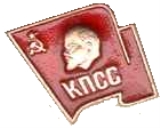
Communist Party of the Soviet Union

Encyclopedia
The Communist Party of the Soviet Union was the only legal, ruling political party
in the Soviet Union
and one of the largest communist organizations
in the world. It lost its dominance in the wake of the failed August 1991 coup d'état attempt led by authoritarian hardliners.
It emerged from the Bolshevik
faction of the Russian Social Democratic Labour Party
, under the leadership of Vladimir Lenin
. The party led the 1917 October Revolution
that overthrew the Russian Provisional Government
and established the world's first socialist state
. Given the central role under the Constitution of the Soviet Union
, the party controlled all tiers of government in the Soviet Union and tolerated no opposition. Its organization was subdivided into communist parties of the constituent Soviet republic
s as well as the mass youth organization, Komsomol
. The party was also the driving force of the Third International (Comintern).
The party ceased to exist after the coup d'état attempt in 1991 and was succeeded by the Communist Party of the Russian Federation
in Russia and the communist parties of the now-independent former Soviet republics.
which was held once in 1–5 years, depending on the historical period, with an exception of a long break from 1939 to 1952. Party Congresses would elect a Central Committee
which, in turn, would elect a Politburo
. Under Stalin the most powerful position in the party became the General Secretary
who was elected by the Politburo. In 1952 the title of General Secretary became First Secretary and the Politburo became the Presidium before reverting to their former names under Leonid Brezhnev
in 1966.
In theory, supreme power in the party was invested in the Party Congress. However, in practice, all executive power was in the hands of the General Secretary.
At lower levels, the organizational hierarchy was managed by Party Committees, or partkoms (партком). A partkom was headed by the elected "partkom bureau secretary" ("partkom secretary", секретарь парткома). At enterprises, institutions, kolkhoz
es, etc., they were called as such, i.e., "partkoms". At higher levels the Committees were abbreviated accordingly: raikoms (райком) at raion
level, obkoms (обком) at oblast
levels (known earlier as gubkoms (губком) for guberniya
s), gorkom (горком) at city level, etc.
The bottom level of the Party was the "primary party organization" (первичная партийная организация) or "party cell" (партийная ячейка). It was created within any organizational entity of any kind where there were at least three communists. The management of a cell was called "party bureau" (партийное бюро, партбюро). A partbureau was headed by the elected "bureau secretary" (секретарь партбюро).
At smaller party cells, secretaries were regular employees of the corresponding factory/hospital/school/etc. Sufficiently large party organizations were usually headed by an "exempt secretary
" (освобожденный секретарь), who drew his salary from the Party money.
During the 1970s the relative number of communists in Republics of the Soviet Union was as follows:
in Soviet society. Nomenklatura enjoyed many perquisites denied to the average Soviet citizen. Among those perks were shopping at well-stocked stores, access to foreign merchandise, preference in obtaining housing, access to dacha
s and holiday resorts, being allowed to travel abroad, sending their children to prestigious universities, and obtaining prestigious jobs (as well as party membership itself) for their children. It became virtually impossible to join the Soviet ruling and managing elite without being a member of the Communist Party.
Membership had its risks, however, especially in the 1930s when the party was subjected to purges under Joseph Stalin
. Membership in the party was not open. To become a party member one had to be approved by various committees and one's past was closely scrutinised. As generations grew up never having known anything but the USSR, party membership became something one generally achieved after passing a series of stages. Children would join the Young Pioneers
and then, at the age of 14, might graduate to the Komsomol
(Young Communist League) and ultimately, as an adult, if one had shown the proper adherence to party discipline
or had the right connections one would become a member of the Communist Party itself. However, membership also had its obligations. Komsomol
and CPSU members were expected not only to pay dues but also to carry out appropriate assignments and "social tasks" (общественная работа).
In 1918 it had a membership of approximately 200,000. In the late 1920s under Stalin, the party engaged in a heavy recruitment campaign (the "Lenin Levy") of new members from both the working class and rural areas. This was both an attempt to "proletarianize" the party and an attempt by Stalin to strengthen his base by outnumbering the Old Bolsheviks and reducing their influence in the party.
In 1925 there were 1,025,000 communist party members in a population of 147 million. In 1927, after an intensive recruitment campaign, membership rose to 1,200,000
By 1933, the party had approximately 3.5 million members but as a result of the Great Purge
party membership was cut down to 1.9 million by 1939. In 1986, the Communist Party of the Soviet Union had over 19 million members or approximately 10% of the USSR's adult population. Over 44% of party members were classified as industrial workers, 12% were collective farmers. The CPSU had party organizations in fourteen of the USSR's 15 republics. In the Russian Soviet Federative Socialist Republic
itself there was no separate Communist Party until 1990 as affairs were controlled directly by the CPSU.
political parties
) to coexist with the Communist Party and in 1990 obtained the repeal of Article Six of the USSR constitution which gave the party supremacy over all institutions in society, thus ending its vanguard
status. The Communist Party's power over the state formally ended that same year with the newly-created Soviet Presidency, whose first and only President was Party General Secretary Gorbachev.
The growing likelihood of the dissolution of the USSR itself led hardline elements in the CPSU to launch the August Coup
in 1991 which temporarily removed Gorbachev from power. On August 19, 1991, a day before the New Union Treaty
was to be signed devolving power to the republics, a group calling itself the "State Emergency Committee" seized power in Moscow declaring that Gorbachev was ill and therefore relieved of his position as president. Soviet vice-president Gennadiy Yanayev was named acting president. The committee's eight members included KGB
chairman Vladimir Kryuchkov
, Internal Affairs Minister Boris Pugo, Defense Minister Dmitriy Yazov, and Prime Minister Valentin Pavlov
. The coup dissolved because of large public demonstrations and the efforts of Boris Yeltsin
who became the real power in Russia as a result. Gorbachev returned to Moscow as president but resigned as General Secretary and vowed to purge the party of hardliners. Yeltsin had the CPSU formally banned within the Russian SFSR on August 26. The KGB
was disbanded as were other CPSU-related agencies and organisations. Yeltsin's action was later declared unconstitutional but by this time the USSR had ceased to exist.
The Communist Party in between Gorbachev's resignation and its suspension was politically impotent. By the time of the 28th Congress of the CPSU
in July 1990, the party was largely regarded as being unable to lead the country and had, in fifteen republics, split into opposing factions favouring either independent republics or the continuation of the Soviet Union. Stripped of its leading role in society the party lost its authority to lead the nation or the cohesion that kept the party united. Its last General Secretary was Vladimir Ivashko
, chosen on August 24, 1991. Actual political power lay in the positions of President of the Soviet Union
(held by Gorbachev) and President of the Russian SFSR (held by Yeltsin). Ivashko remained for five days as acting General Secretary until August 29 when the party's activity was suspended by the Supreme Soviet of the Soviet Union.
Archives of the Party are now preserved in a number of Russian state archives (Archive of the President of the Russian Federation
, Russian State Archive of Contemporary History, Russian State Archive of Socio-Political History, State Archive of the Russian Federation), many of them remain classified.
After the dissolution of the Soviet Union
, Russian adherents to the CPSU tradition, particularly as it existed before Gorbachev, reorganised themselves as the Communist Party of the Russian Federation
. Today there are many parties in Russia claiming to be the successors of CPSU. Several of them used the name CPSU. However, CPRF is generally seen (because of its large size) as the inheritor of the CPSU in Russia.
In other republics, communists established the Armenian Communist Party
, Communist Party of Azerbaijan
, Party of Communists of Kyrgyzstan
, Communist Party of Ukraine
, Party of Communists of Belarus
, Party of Communists of the Republic of Moldova, Communist Party of Kazakhstan
and the Communist Party of Tajikistan
. Along with the CPRF, these parties formed the Union of Communist Parties - Communist Party of the Soviet Union.
Source: A.A. Solov'ev, S"ezdy i konferentsii KPSS: Spravochnik. ("Congresses and Conferences of the CPSU: Handbook.") Moscow: Politizdat, 1986. All dates New Style.
Political party
A political party is a political organization that typically seeks to influence government policy, usually by nominating their own candidates and trying to seat them in political office. Parties participate in electoral campaigns, educational outreach or protest actions...
in the Soviet Union
Soviet Union
The Soviet Union , officially the Union of Soviet Socialist Republics , was a constitutionally socialist state that existed in Eurasia between 1922 and 1991....
and one of the largest communist organizations
Communist party
A political party described as a Communist party includes those that advocate the application of the social principles of communism through a communist form of government...
in the world. It lost its dominance in the wake of the failed August 1991 coup d'état attempt led by authoritarian hardliners.
It emerged from the Bolshevik
Bolshevik
The Bolsheviks, originally also Bolshevists , derived from bol'shinstvo, "majority") were a faction of the Marxist Russian Social Democratic Labour Party which split apart from the Menshevik faction at the Second Party Congress in 1903....
faction of the Russian Social Democratic Labour Party
Russian Social Democratic Labour Party
The Russian Social Democratic Labour Party , also known as Russian Social Democratic Workers' Party or Russian Social Democratic Party, was a revolutionary socialist Russian political party formed in 1898 in Minsk to unite the various revolutionary organizations into one party...
, under the leadership of Vladimir Lenin
Vladimir Lenin
Vladimir Ilyich Lenin was a Russian Marxist revolutionary and communist politician who led the October Revolution of 1917. As leader of the Bolsheviks, he headed the Soviet state during its initial years , as it fought to establish control of Russia in the Russian Civil War and worked to create a...
. The party led the 1917 October Revolution
October Revolution
The October Revolution , also known as the Great October Socialist Revolution , Red October, the October Uprising or the Bolshevik Revolution, was a political revolution and a part of the Russian Revolution of 1917...
that overthrew the Russian Provisional Government
Russian Provisional Government
The Russian Provisional Government was the short-lived administrative body which sought to govern Russia immediately following the abdication of Tsar Nicholas II . On September 14, the State Duma of the Russian Empire was officially dissolved by the newly created Directorate, and the country was...
and established the world's first socialist state
Socialist state
A socialist state generally refers to any state constitutionally dedicated to the construction of a socialist society. It is closely related to the political strategy of "state socialism", a set of ideologies and policies that believe a socialist economy can be established through government...
. Given the central role under the Constitution of the Soviet Union
Constitution of the Soviet Union
There were three versions of the constitution of the Soviet Union, modeled after the 1918 Constitution established by the Russian Socialist Federative Soviet Republic , the immediate predecessor of the Union of Soviet Socialist Republics....
, the party controlled all tiers of government in the Soviet Union and tolerated no opposition. Its organization was subdivided into communist parties of the constituent Soviet republic
Soviet Republic
Soviet republic, a republic ruled by soviets , may refer to one of the following:*Bolshevik Russia and the Russian SFSR after the Russian Revolution of 1917 and during the Russian Civil War.*Any of the Republics of the Soviet Union....
s as well as the mass youth organization, Komsomol
Komsomol
The Communist Union of Youth , usually known as Komsomol , was the youth division of the Communist Party of the Soviet Union. The Komsomol in its earliest form was established in urban centers in 1918. During the early years, it was a Russian organization, known as the Russian Communist Union of...
. The party was also the driving force of the Third International (Comintern).
The party ceased to exist after the coup d'état attempt in 1991 and was succeeded by the Communist Party of the Russian Federation
Communist Party of the Russian Federation
The Communist Party of the Russian Federation is a Russian political party. It is the second major political party in the Russian Federation.-History:...
in Russia and the communist parties of the now-independent former Soviet republics.
Names
- The BolshevikBolshevikThe Bolsheviks, originally also Bolshevists , derived from bol'shinstvo, "majority") were a faction of the Marxist Russian Social Democratic Labour Party which split apart from the Menshevik faction at the Second Party Congress in 1903....
factionPolitical factionA political faction is a grouping of individuals, such as a political party, a trade union, or other group with a political purpose. A faction or political party may include fragmented sub-factions, “parties within a party," which may be referred to as power blocs, or voting blocs. The individuals...
emerged within the Russian Social Democratic Labour PartyRussian Social Democratic Labour PartyThe Russian Social Democratic Labour Party , also known as Russian Social Democratic Workers' Party or Russian Social Democratic Party, was a revolutionary socialist Russian political party formed in 1898 in Minsk to unite the various revolutionary organizations into one party...
as a de factoDe factoDe facto is a Latin expression that means "concerning fact." In law, it often means "in practice but not necessarily ordained by law" or "in practice or actuality, but not officially established." It is commonly used in contrast to de jure when referring to matters of law, governance, or...
political blocVoting blocA voting bloc is a group of voters that are so motivated by a specific concern or group of concerns that it helps determine how they vote in elections. The divisions between voting blocs are known as cleavage...
separate from the MenshevikMenshevikThe Mensheviks were a faction of the Russian revolutionary movement that emerged in 1904 after a dispute between Vladimir Lenin and Julius Martov, both members of the Russian Social-Democratic Labour Party. The dispute originated at the Second Congress of that party, ostensibly over minor issues...
s in 1903. - The RSDLP was formally split in 1912, Henceforth, the Bolshevik faction was known as Russian Social Democratic Labour Party (bolsheviks), RSDLP(b) , РСДРП(б)).
- In 1918 the Russian element took the name Russian Communist Party . With Ukrainian independence coming about with the secession of Ukrainian People's RepublicUkrainian People's RepublicThe Ukrainian People's Republic or Ukrainian National Republic was a republic that was declared in part of the territory of modern Ukraine after the Russian Revolution, eventually headed by Symon Petliura.-Revolutionary Wave:...
the Ukrainian element became the Communist Party (Bolsheviks) of Ukraine ( Komunistychna Partiya (bilshovykiv) Ukrayiny). In 1920 the Communist Party (Bolsheviks) of Ukraine rejoined the RCP. - In 1925 the party was renamed the All-Union Communist Party , ВКП).
- In 1952 the party was renamed the Communist Party of the Soviet Union.
Structure CPSU
The governing body of the CPSU was the Party CongressCongress of the Communist Party of the Soviet Union
The Congress of the Communist Party of the Soviet Union was the gathering of the delegates of the Communist Party and its predecessors. According the party statute, it was the supreme ruling body of the entire Communist Party....
which was held once in 1–5 years, depending on the historical period, with an exception of a long break from 1939 to 1952. Party Congresses would elect a Central Committee
Central Committee
Central Committee was the common designation of a standing administrative body of communist parties, analogous to a board of directors, whether ruling or non-ruling in the twentieth century and of the surviving, mostly Trotskyist, states in the early twenty first. In such party organizations the...
which, in turn, would elect a Politburo
Politburo of the Central Committee of the Communist Party of the Soviet Union
The Politburo , known as the Presidium from 1952 to 1966, functioned as the central policymaking and governing body of the Communist Party of the Soviet Union.-Duties and responsibilities:The...
. Under Stalin the most powerful position in the party became the General Secretary
General Secretary of the Communist Party of the Soviet Union
General Secretary of the Central Committee of the Communist Party of the Soviet Union was the title given to the leader of the Communist Party of the Soviet Union. With some exceptions, the office was synonymous with leader of the Soviet Union...
who was elected by the Politburo. In 1952 the title of General Secretary became First Secretary and the Politburo became the Presidium before reverting to their former names under Leonid Brezhnev
Leonid Brezhnev
Leonid Ilyich Brezhnev – 10 November 1982) was the General Secretary of the Central Committee of the Communist Party of the Soviet Union , presiding over the country from 1964 until his death in 1982. His eighteen-year term as General Secretary was second only to that of Joseph Stalin in...
in 1966.
In theory, supreme power in the party was invested in the Party Congress. However, in practice, all executive power was in the hands of the General Secretary.
At lower levels, the organizational hierarchy was managed by Party Committees, or partkoms (партком). A partkom was headed by the elected "partkom bureau secretary" ("partkom secretary", секретарь парткома). At enterprises, institutions, kolkhoz
Kolkhoz
A kolkhoz , plural kolkhozy, was a form of collective farming in the Soviet Union that existed along with state farms . The word is a contraction of коллекти́вное хозя́йство, or "collective farm", while sovkhoz is a contraction of советское хозяйство...
es, etc., they were called as such, i.e., "partkoms". At higher levels the Committees were abbreviated accordingly: raikoms (райком) at raion
Raion
A raion is a type of administrative unit of several post-Soviet countries. The term, which is from French rayon 'honeycomb, department,' describes both a type of a subnational entity and a division of a city, and is commonly translated in English as "district"...
level, obkoms (обком) at oblast
Oblast
Oblast is a type of administrative division in Slavic countries, including some countries of the former Soviet Union. The word "oblast" is a loanword in English, but it is nevertheless often translated as "area", "zone", "province", or "region"...
levels (known earlier as gubkoms (губком) for guberniya
Guberniya
A guberniya was a major administrative subdivision of the Russian Empire usually translated as government, governorate, or province. Such administrative division was preserved for sometime upon the collapse of the empire in 1917. A guberniya was ruled by a governor , a word borrowed from Latin ,...
s), gorkom (горком) at city level, etc.
The bottom level of the Party was the "primary party organization" (первичная партийная организация) or "party cell" (партийная ячейка). It was created within any organizational entity of any kind where there were at least three communists. The management of a cell was called "party bureau" (партийное бюро, партбюро). A partbureau was headed by the elected "bureau secretary" (секретарь партбюро).
At smaller party cells, secretaries were regular employees of the corresponding factory/hospital/school/etc. Sufficiently large party organizations were usually headed by an "exempt secretary
Exempt secretary
Exempt secretary was a management position in some organizations of governing position in the Soviet Union....
" (освобожденный секретарь), who drew his salary from the Party money.
During the 1970s the relative number of communists in Republics of the Soviet Union was as follows:
- Russian SFSR: 7.2%
- Ukraine: 5.35% (1976)
- Moldavia: 3.43% (1975)
- Tajikistan: less than 3%
- The mean value for the Soviet Union was: 5.935% (1974)
Membership
Membership in the party ultimately became a privilege, with a small subset of the general population of Party becoming an elite class or nomenklaturaNomenklatura
The nomenklatura were a category of people within the Soviet Union and other Eastern Bloc countries who held various key administrative positions in all spheres of those countries' activity: government, industry, agriculture, education, etc., whose positions were granted only with approval by the...
in Soviet society. Nomenklatura enjoyed many perquisites denied to the average Soviet citizen. Among those perks were shopping at well-stocked stores, access to foreign merchandise, preference in obtaining housing, access to dacha
Dacha
Dacha is a Russian word for seasonal or year-round second homes often located in the exurbs of Soviet and post-Soviet cities. Cottages or shacks serving as family's main or only home are not considered dachas, although many purpose-built dachas are recently being converted for year-round residence...
s and holiday resorts, being allowed to travel abroad, sending their children to prestigious universities, and obtaining prestigious jobs (as well as party membership itself) for their children. It became virtually impossible to join the Soviet ruling and managing elite without being a member of the Communist Party.
Membership had its risks, however, especially in the 1930s when the party was subjected to purges under Joseph Stalin
Joseph Stalin
Joseph Vissarionovich Stalin was the Premier of the Soviet Union from 6 May 1941 to 5 March 1953. He was among the Bolshevik revolutionaries who brought about the October Revolution and had held the position of first General Secretary of the Communist Party of the Soviet Union's Central Committee...
. Membership in the party was not open. To become a party member one had to be approved by various committees and one's past was closely scrutinised. As generations grew up never having known anything but the USSR, party membership became something one generally achieved after passing a series of stages. Children would join the Young Pioneers
Young Pioneer organization of the Soviet Union
The Young Pioneer Organization of the Soviet Union, also Vladimir Lenin All-Union Pioneer Organization The Young Pioneer Organization of the Soviet Union, also Vladimir Lenin All-Union Pioneer Organization The Young Pioneer Organization of the Soviet Union, also Vladimir Lenin All-Union Pioneer...
and then, at the age of 14, might graduate to the Komsomol
Komsomol
The Communist Union of Youth , usually known as Komsomol , was the youth division of the Communist Party of the Soviet Union. The Komsomol in its earliest form was established in urban centers in 1918. During the early years, it was a Russian organization, known as the Russian Communist Union of...
(Young Communist League) and ultimately, as an adult, if one had shown the proper adherence to party discipline
Party discipline
Party discipline is the ability of a parliamentary group of a political party to get its members to support the policies of their party leadership. In liberal democracies, it usually refers to the control that party leaders have over its legislature...
or had the right connections one would become a member of the Communist Party itself. However, membership also had its obligations. Komsomol
Komsomol
The Communist Union of Youth , usually known as Komsomol , was the youth division of the Communist Party of the Soviet Union. The Komsomol in its earliest form was established in urban centers in 1918. During the early years, it was a Russian organization, known as the Russian Communist Union of...
and CPSU members were expected not only to pay dues but also to carry out appropriate assignments and "social tasks" (общественная работа).
In 1918 it had a membership of approximately 200,000. In the late 1920s under Stalin, the party engaged in a heavy recruitment campaign (the "Lenin Levy") of new members from both the working class and rural areas. This was both an attempt to "proletarianize" the party and an attempt by Stalin to strengthen his base by outnumbering the Old Bolsheviks and reducing their influence in the party.
In 1925 there were 1,025,000 communist party members in a population of 147 million. In 1927, after an intensive recruitment campaign, membership rose to 1,200,000
By 1933, the party had approximately 3.5 million members but as a result of the Great Purge
Great Purge
The Great Purge was a series of campaigns of political repression and persecution in the Soviet Union orchestrated by Joseph Stalin from 1936 to 1938...
party membership was cut down to 1.9 million by 1939. In 1986, the Communist Party of the Soviet Union had over 19 million members or approximately 10% of the USSR's adult population. Over 44% of party members were classified as industrial workers, 12% were collective farmers. The CPSU had party organizations in fourteen of the USSR's 15 republics. In the Russian Soviet Federative Socialist Republic
Russian Soviet Federative Socialist Republic
The Russian Soviet Federative Socialist Republic , commonly referred to as Soviet Russia, Bolshevik Russia, or simply Russia, was the largest, most populous and economically developed republic in the former Soviet Union....
itself there was no separate Communist Party until 1990 as affairs were controlled directly by the CPSU.
History
End of Communist rule
In 1989 Gorbachev allowed other political associations (de factoDe facto
De facto is a Latin expression that means "concerning fact." In law, it often means "in practice but not necessarily ordained by law" or "in practice or actuality, but not officially established." It is commonly used in contrast to de jure when referring to matters of law, governance, or...
political parties
Political Parties
Political Parties: A Sociological Study of the Oligarchical Tendencies of Modern Democracy is a book by sociologist Robert Michels, published in 1911 , and first introducing the concept of iron law of oligarchy...
) to coexist with the Communist Party and in 1990 obtained the repeal of Article Six of the USSR constitution which gave the party supremacy over all institutions in society, thus ending its vanguard
Vanguard party
A vanguard party is a political party at the forefront of a mass action, movement, or revolution. The idea of a vanguard party has its origins in the Communist Manifesto by Karl Marx and Friedrich Engels...
status. The Communist Party's power over the state formally ended that same year with the newly-created Soviet Presidency, whose first and only President was Party General Secretary Gorbachev.
The growing likelihood of the dissolution of the USSR itself led hardline elements in the CPSU to launch the August Coup
Soviet coup attempt of 1991
The 1991 Soviet coup d'état attempt , also known as the August Putsch or August Coup , was an attempt by a group of members of the Soviet Union's government to take control of the country from Soviet president Mikhail Gorbachev...
in 1991 which temporarily removed Gorbachev from power. On August 19, 1991, a day before the New Union Treaty
New Union Treaty
Union of Sovereign States was the proposed name of a reorganization of the Union of Soviet Socialist Republics into a new confederation body. Proposed by Mikhail Gorbachev, the proposal was an attempt to avert the collapse of the Soviet Union. The proposal was never implemented in the wake of the...
was to be signed devolving power to the republics, a group calling itself the "State Emergency Committee" seized power in Moscow declaring that Gorbachev was ill and therefore relieved of his position as president. Soviet vice-president Gennadiy Yanayev was named acting president. The committee's eight members included KGB
KGB
The KGB was the commonly used acronym for the . It was the national security agency of the Soviet Union from 1954 until 1991, and was the premier internal security, intelligence, and secret police organization during that time.The State Security Agency of the Republic of Belarus currently uses the...
chairman Vladimir Kryuchkov
Vladimir Kryuchkov
Vladimir Alexandrovich Kryuchkov was a former Soviet politician and Communist Party member, having been in the organization from 1944 until he was dismissed in 1991...
, Internal Affairs Minister Boris Pugo, Defense Minister Dmitriy Yazov, and Prime Minister Valentin Pavlov
Valentin Pavlov
Valentin Sergeyevich Pavlov was a Soviet official who became a Russian banker following the dissolution of the Soviet Union. Born in the city of Moscow, then part of the Russian Soviet Federative Socialist Republic, Pavlov began his political career in the Ministry of Finance in 1959...
. The coup dissolved because of large public demonstrations and the efforts of Boris Yeltsin
Boris Yeltsin
Boris Nikolayevich Yeltsin was the first President of the Russian Federation, serving from 1991 to 1999.Originally a supporter of Mikhail Gorbachev, Yeltsin emerged under the perestroika reforms as one of Gorbachev's most powerful political opponents. On 29 May 1990 he was elected the chairman of...
who became the real power in Russia as a result. Gorbachev returned to Moscow as president but resigned as General Secretary and vowed to purge the party of hardliners. Yeltsin had the CPSU formally banned within the Russian SFSR on August 26. The KGB
KGB
The KGB was the commonly used acronym for the . It was the national security agency of the Soviet Union from 1954 until 1991, and was the premier internal security, intelligence, and secret police organization during that time.The State Security Agency of the Republic of Belarus currently uses the...
was disbanded as were other CPSU-related agencies and organisations. Yeltsin's action was later declared unconstitutional but by this time the USSR had ceased to exist.
The Communist Party in between Gorbachev's resignation and its suspension was politically impotent. By the time of the 28th Congress of the CPSU
28th Congress of the CPSU
28th Congress of the CPSU was held in Moscow. It was held a year ahead of the traditional schedule and turned out to be the last Communist Party of the Soviet Union congress in the history of the party....
in July 1990, the party was largely regarded as being unable to lead the country and had, in fifteen republics, split into opposing factions favouring either independent republics or the continuation of the Soviet Union. Stripped of its leading role in society the party lost its authority to lead the nation or the cohesion that kept the party united. Its last General Secretary was Vladimir Ivashko
Vladimir Ivashko
Vladimir Antonovich Ivashko , was briefly the acting General Secretary of the Communist Party of the Soviet Union during the period from 24 August 1991 to 29 August 1991. On 24 August Mikhail Gorbachev resigned, and on 29 August the CPSU was suspended by the Supreme Soviet...
, chosen on August 24, 1991. Actual political power lay in the positions of President of the Soviet Union
President of the Soviet Union
The President of the Soviet Union , officially called President of the USSR was the Head of State of the USSR from 15 March 1990 to 25 December 1991. Mikhail Gorbachev was the only person to occupy the office. Gorbachev was also General Secretary of the Communist Party of the Soviet Union between...
(held by Gorbachev) and President of the Russian SFSR (held by Yeltsin). Ivashko remained for five days as acting General Secretary until August 29 when the party's activity was suspended by the Supreme Soviet of the Soviet Union.
Archives of the Party are now preserved in a number of Russian state archives (Archive of the President of the Russian Federation
Archive of the President of the Russian Federation
The Archive of the President of the Russian Federation is a Russian state archive established in 1991 and managed by the Presidential Administration of Russia...
, Russian State Archive of Contemporary History, Russian State Archive of Socio-Political History, State Archive of the Russian Federation), many of them remain classified.
After the dissolution of the Soviet Union
Dissolution of the Soviet Union
The dissolution of the Soviet Union was the disintegration of the federal political structures and central government of the Union of Soviet Socialist Republics , resulting in the independence of all fifteen republics of the Soviet Union between March 11, 1990 and December 25, 1991...
, Russian adherents to the CPSU tradition, particularly as it existed before Gorbachev, reorganised themselves as the Communist Party of the Russian Federation
Communist Party of the Russian Federation
The Communist Party of the Russian Federation is a Russian political party. It is the second major political party in the Russian Federation.-History:...
. Today there are many parties in Russia claiming to be the successors of CPSU. Several of them used the name CPSU. However, CPRF is generally seen (because of its large size) as the inheritor of the CPSU in Russia.
In other republics, communists established the Armenian Communist Party
Armenian Communist Party
The Armenian Communist Party is a communist political party in Armenia.It considers itself the successor of the Communist Party of Armenia of the Soviet Union, since the former leadership of this party, headed by Aram Gasparovich Sarkisyan, dissolved it and established the Democratic Party of...
, Communist Party of Azerbaijan
Azerbaijan Communist Party (1993)
The Azerbaijan Communist Party is a political party in Azerbaijan. AKP was set up in 1993 by Ramiz Ahmadov and registered by the Justice Ministry in 1994.-Ideology:...
, Party of Communists of Kyrgyzstan
Party of Communists of Kyrgyzstan
The Party of Communists of Kyrgyzstan is a political party in Kyrgyzstan. PKK was founded on June 22, 1992.It was the largest single party in the Legislative Assembly of Kyrgyzstan between 2001 and 2005 with 15 of the 60 seats. Since 2005 it has only 1 of 75 seats. It was led by Absamat...
, Communist Party of Ukraine
Communist Party of Ukraine
The Communist Party of Ukraine is a political party in Ukraine, currently led by Petro Symonenko.The party fights the Ukrainian national self-determination by identifying any Ukrainian national parties as the National-Fascist ones The Communist Party of Ukraine is a political party in Ukraine,...
, Party of Communists of Belarus
Party of Communists of Belarus
The Belarusian United Left Party "Fair World" or the Belarusian Party of United LeftistsA Just World, known until October 2009 as the Party of Belarusian Communists , is a left-wing political party in Belarus, which opposes the government of president Alexander Lukashenko.Founded as the Party of...
, Party of Communists of the Republic of Moldova, Communist Party of Kazakhstan
Communist Party of Kazakhstan
The Communist Party of Kazakhstan is a political party in Kazakhstan. -Origin:The Communist Party of Kazakhstan was founded 1936 when Kazakhstan was granted a Union Republic status within the Soviet Union...
and the Communist Party of Tajikistan
Communist Party of Tajikistan
The Communist Party of Tajikistan is a political party in Tajikistan.At the last legislative elections, 27 February and 13 March 2005, the party won 13.97% of the popular vote and 4 out of 63 seats....
. Along with the CPRF, these parties formed the Union of Communist Parties - Communist Party of the Soviet Union.
- In TurkmenistanTurkmenistanTurkmenistan , formerly also known as Turkmenia is one of the Turkic states in Central Asia. Until 1991, it was a constituent republic of the Soviet Union, the Turkmen Soviet Socialist Republic . Turkmenistan is one of the six independent Turkic states...
, the local party apparatus led by Saparmurat NiyazovSaparmurat NiyazovSaparmurat Atayevich Niyazov; , was a Turkmen politician who served as President of Turkmenistan from 2 November 1990 until his death in 2006...
was renamed the Democratic Party of TurkmenistanDemocratic Party of TurkmenistanThe Democratic Party of Turkmenistan is the only political party in Turkmenistan. The DPT was led by former Soviet provincial Party leader Saparmurat Niyazov from the dissolution of the Soviet Union in the early 1990s until his death in 2006...
and abandoned communist ideology. - In UzbekistanUzbekistanUzbekistan , officially the Republic of Uzbekistan is a doubly landlocked country in Central Asia and one of the six independent Turkic states. It shares borders with Kazakhstan to the west and to the north, Kyrgyzstan and Tajikistan to the east, and Afghanistan and Turkmenistan to the south....
, Islam Karimov changed the CPSU branch into the People's Democratic PartyPeople's Democratic Party of UzbekistanThe People's Democratic Party of Uzbekistan is a political party in Uzbekistan which was founded in October 1991 after the Communist Party of Uzbekistan voted to cut its ties with the Communist Party of the Soviet Union and change its name to PDPU...
. - In GeorgiaGeorgia (country)Georgia is a sovereign state in the Caucasus region of Eurasia. Located at the crossroads of Western Asia and Eastern Europe, it is bounded to the west by the Black Sea, to the north by Russia, to the southwest by Turkey, to the south by Armenia, and to the southeast by Azerbaijan. The capital of...
, the Socialist Labour Party was founded in 1992. This party would later evolve into the Communist Party of GeorgiaCommunist Party of GeorgiaCommunist Party of Georgia is a communist political party in Georgia. The party was founded on February 23, 1992 as the Socialist Labour Party. It was registered at the Ministry of Justice on February 27, 1998. In the 1992 elections it won four MPs. During the period 1994-1995 it maintained a...
(SKP). Another communist faction in Georgia, which is larger than SKP, is the United Communist Party of GeorgiaUnited Communist Party of GeorgiaThe United Communist Party of Georgia is a political party in Georgia. It was founded in 1994 through the merger of the Stalin Society, the Georgian Workers Communist Party and the Union of Communists of Georgia...
(SEKP). - In EstoniaEstoniaEstonia , officially the Republic of Estonia , is a state in the Baltic region of Northern Europe. It is bordered to the north by the Gulf of Finland, to the west by the Baltic Sea, to the south by Latvia , and to the east by Lake Peipsi and the Russian Federation . Across the Baltic Sea lies...
, the CPSU branch was in the hands of reformers, who converted it into the Estonian Democratic Labour Party (EDTP). A minority regrouped into the Communist Party of EstoniaCommunist Party of Estonia (1990)Communist Party of Estonia is a political party in Estonia. The party, initially known as Communist Party of Estonia Communist Party of Estonia (in Estonian: Eestimaa Kommunistlik Partei, in Russian: Kommunisticheskaya Partiya Estonii) is a political party in Estonia. The party, initially known...
. - In LithuaniaLithuaniaLithuania , officially the Republic of Lithuania is a country in Northern Europe, the biggest of the three Baltic states. It is situated along the southeastern shore of the Baltic Sea, whereby to the west lie Sweden and Denmark...
, the CPSU was banned in 1991. A branch of "progressive" communists led by Algirdas BrazauskasAlgirdas BrazauskasAlgirdas Mykolas Brazauskas was the first President of a newly independent post-Soviet Union Lithuania from 1993 to 1998 and Prime Minister from 2001 to 2006....
established the Democratic Labour Party of LithuaniaDemocratic Labour Party of LithuaniaDemocratic Labour Party of Lithuania was a social democratic political party in Lithuania, that emerged out of the Lithuanian section of the CPSU in December 1989 LDDP was led by Algirdas Brazauskas, the first president of independent Lithuania. Because Brazauskas was elected as the first...
in 1992. - In LatviaLatviaLatvia , officially the Republic of Latvia , is a country in the Baltic region of Northern Europe. It is bordered to the north by Estonia , to the south by Lithuania , to the east by the Russian Federation , to the southeast by Belarus and shares maritime borders to the west with Sweden...
, communist organizations were officially banned and a major part of the party there had broken away in 1990 and formed the Latvian Social Democratic PartyLatvian Social Democratic PartyThe Latvian Social Democratic Party was a political party in Latvia formed by a reformist wing of the Communist Party of Latvia.On 14 April 1990, a pro-independence faction under Ivars Ķezbers split off from the LKP to form the Independent Communist Party of Latvia . The main body of the LKP,...
. The remnants of CPSU became the Union of Communists of Latvia, which went underground. Later, communists regrouped into the Socialist Party of LatviaSocialist Party of LatviaThe Socialist Party of Latvia was formed in 1994 as a successor party to the Communist Party of Latvia, which was banned in 1991. In essence, the party is communist; according to the programme of the party, the LSP was founded as an organization upholding socialist ideas after the 1991 events that...
.
Branches
| Republic | Branch |
|---|---|
| Russian SFSR Russian Soviet Federative Socialist Republic The Russian Soviet Federative Socialist Republic , commonly referred to as Soviet Russia, Bolshevik Russia, or simply Russia, was the largest, most populous and economically developed republic in the former Soviet Union.... |
Communist Party of the RSFSR (1990–1991) |
| Ukrainian SSR | Communist Party of Ukraine |
| Belarusian SSR | Communist Party of Belorussia |
| Uzbek SSR | Communist Party of Uzbekistan Communist Party of Uzbekistan The Communist Party of Uzbekistan, initially known as Communist Party of Uzbekistan, was the ruling communist party of the Uzbek SSR, and a part of the Communist Party of the Soviet Union.... |
| Kazakh SSR | Communist Party of Kazakhstan Communist Party of Kazakhstan The Communist Party of Kazakhstan is a political party in Kazakhstan. -Origin:The Communist Party of Kazakhstan was founded 1936 when Kazakhstan was granted a Union Republic status within the Soviet Union... |
| Georgian SSR | Communist Party of Georgia Communist Party of Georgia Communist Party of Georgia is a communist political party in Georgia. The party was founded on February 23, 1992 as the Socialist Labour Party. It was registered at the Ministry of Justice on February 27, 1998. In the 1992 elections it won four MPs. During the period 1994-1995 it maintained a... |
| Azerbaijan SSR | Communist Party of Azerbaijan |
| Lithuanian SSR | Communist Party of Lithuania Communist Party of Lithuania The Communist Party of Lithuania was a communist party in Lithuania, established in early October 1918. The party was banned in December 1926.-History:... |
| Moldovan SSR | Communist Party of Moldova Communist Party of Moldova The Communist Party of Moldova was one of the fourteen republic-level parties that formed the Communist Party of the Soviet Union until the fall of the Soviet Union in 1991. Indeed, the PCM was the republic-level chapter of the CPSU in the Moldavian SSR from 1940 to 1991... |
| Latvian SSR | Communist Party of Latvia Communist Party of Latvia Communist Party of Latvia was a political party in Latvia.- Latvian Social-Democracy prior to 1919 :The party was founded at a congress in June 1904. Initially the party was known as the Latvian Social Democratic Workers' Party . During its second party congress in 1905 it adopted the programme of... |
| Kirghiz SSR Kirghiz Soviet Socialist Republic The Kirghiz Soviet Socialist Republic , also known as the Kirghiz SSR, the Kyrgyz SSR, or even Kirghizia, was one of republics that made up the Soviet Union... |
Communist Party of Kirghizia Communist Party of Kirghizia The Communist Party of Kirghizia was the ruling political party and the arm of the Communist Party of the Soviet Union in the Kirghiz Soviet Socialist Republic .... |
| Tajik SSR | Communist Party of Tajikistan Communist Party of Tajikistan The Communist Party of Tajikistan is a political party in Tajikistan.At the last legislative elections, 27 February and 13 March 2005, the party won 13.97% of the popular vote and 4 out of 63 seats.... |
| Armenian SSR | Communist Party of Armenia |
| Turkmen SSR | Communist Party of Turkmenistan |
| Estonian SSR Estonian Soviet Socialist Republic The Estonian Soviet Socialist Republic , often abbreviated as Estonian SSR or ESSR, was a republic of the Soviet Union, administered by and subordinated to the Government of the Soviet Union... |
Communist Party of Estonia Communist Party of Estonia Communist Party of Estonia was a political party in Estonia.EKP was formed November 5, 1920, as the Central Committee of the Estonian Sections of the Russian Communist Party was separated from its mother party. During the first half of 1920s the hopes to an immediate world revolution were still... |
| Turkestan ASSR Turkestan Autonomous Soviet Socialist Republic Turkestan Autonomous Soviet Socialist Republic was created from the Turkestan Krai of Imperial Russia... |
Communist Party of Turkestan Communist Party of Turkestan The Communist Part of Turkestan was a the Turkestani branch of the Russian Communist Party . It was formed in June 1918. At the time of its formation, the party was joined by a large section of Jadids.... |
| Bukharan SSR Bukharan People's Soviet Republic The Bukharan People's Soviet Republic was a short-lived Soviet state which governed the former Emirate of Bukhara during the period immediately following the Russian Revolution from 1920-1925. In 1924 its name was changed to the Bukharan Soviet Socialist Republic... (1920–1925) |
Communist Party of Bukhara Communist Party of Bukhara Communist Party of Bukhara was a political party in Bukhara. The party was founded in 1918, by a section of the Jadid movement. It was led by N. Husainovym, A. Aliyev, N. Kurbanovym, A... |
| Khorezm SSR Khorezm SSR Khorezm People's Soviet Republic was created as the successor to the Khanate of Khiva in February 1920, when the khan abdicated in response to popular pressure, and officially declared by the First Khorezm Kurultay on 26 April 1920... (1920–1925) |
Communist Party of Khorezm Communist Party of Khorezm Communist Party of Khorezm was a political party in Khiva/Khorezm.In 1922, the party became affiliated to the Russian Communist Party . During the spring of 1924, when proposals for reorganization of Soviet Central Asia were discussed the leadership of the Communist Party of Khorezm declined to... |
| Karelo-Finnish SSR Karelo-Finnish SSR The Karelo-Finnish Soviet Socialist Republic was a short-lived republic that was a part of the former Soviet Union. The republic existed from 1940 until it was merged back into the Russian SFSR in 1956 .... (1940–1956) |
Communist Party of the Karelo-Finnish SSR Communist Party of the Karelo-Finnish SSR Communist Party of the Karelo-Finnish SSR, initially known as the Communist Party of the Karelo-Finnish SSR, was the branch of the All-Union Communist Party/Communist Party of the Soviet Union in the Karelo Finnish SSR 1940-1956.... |
| Transcaucasian SFSR Transcaucasian SFSR The Transcaucasian Socialist Federative Soviet Republic , also known as the Transcaucasian Soviet Federative Socialist Republic, the Transcaucasian SFSR and the TSFSR for short, was a short-lived republic of the Soviet Union, lasting from 1922 to 1936... (1922–1936) |
Transcaucasian Regional Communist Party of the RKP(b)/VKP(b) |
Conventions (1917–1991)
| Gathering | Date | Delegates Voting + Non-Voting |
Notes |
|---|---|---|---|
| 7th All-Russian Conference of the RSDRP(b) | May 7–12, 1917 | 131 + 18 | |
| VI Congress of the RSDRP(b) 6th Congress of the Russian Social Democratic Labour Party (bolsheviks) The 6th Congress of the Russian Social Democratic Labour Party was held during 26 July - 3 August in Petrograd, Russia.... |
August 8–16, 1917 | 157 + 110 | |
| VII Extraordinary Congress of the RKP(b) | March 6–8, 1918 | 47 + 59 | |
| VIII Congress of the RKP(b) 8th Congress of the Russian Communist Party (Bolsheviks) The 8th Congress of the Russian Communist Party was held in Moscow 18 - 23 March, 1919.The Congress was attended by 301 voting delegates who represented 313,766 Party members... |
March 18–23, 1919 | 301 + 102 | |
| 8th All-Russian Conference of the RKP(b) | December 2–4, 1919 | 45 + 73 | |
| IX Congress of the RKP(b) 9th Congress of the Russian Communist Party (Bolsheviks) The 9th Congress of the Russian Communist Party took place from 29 March 1920 till 5 April 1920. The Congress opened in the Bolshoi Theatre with an introductory speech by Lenin. The following meetings of the Congress took place in one of the buildings of the Kremlin... |
March 29 – April 5, 1920 | 554 + 162 | |
| 9th All-Russian Conference of the RKP(b) | September 22–25, 1920 | 116 + 125 | |
| X Congress of the RKP(b) | March 8–16, 1921 | 694 + 296 | Factions formally banned in the Communist Party. |
| 10th All-Russian Conference of the RKP(b) | May 26–28, 1921 | 239 | |
| XI Congress of the RKP(b) | March 27 – April 2, 1922 | 522 + 165 | |
| 11th All-Russian Conference of the RKP(b) | August 4–7, 1922 | 129 + 92 | |
| XII Congress of the RKP(b) | April 17–25, 1923 | 409 + 417 | |
| 13th Conference of the RKP(b) | January 16–18, 1924 | 128 + 222 | |
| XIII Congress of the RKP(b) | May 23–31, 1924 | 748 + 416 | |
| 14th Conference of the RKP(b) | April 27–29, 1925 | 178 + 392 | |
| XIV Congress of the VKP(b) | December 18–31, 1925 | 665 + 641 | Changes party name to "All-Union Communist Party (bolsheviks)." |
| 15th Conference of the VKP(b) | October 26 – November 3, 1926 | 194 + 640 | |
| XV Congress of the VKP(b) | December 2–19, 1927 | 898 + 771 | |
| 16th Conference of the VKP(b) | April 23–29, 1929 | 254 + 679 | |
| XVI Congress of the VKP(b) | June 26 – July 13, 1930 | 1268 + 891 | |
| 17th Conference of the VKP(b) | January 30 – February 4, 1932 | 386 + 525 | |
| XVII Congress of the VKP(b) | January 26 – February 10, 1934 | 1225 + 736 | So-called "Congress of the Victors." |
| XVIII Congress of the VKP(b) | March 10–21, 1939 | 1569 + 466 | |
| 18th Conference of the VKP(b) | February 15–20, 1941 | 456 + 138 | |
| XIX Congress of the CPSU 19th Congress of the Communist Party of the Soviet Union The Nineteenth Congress of the Communist Party of the Soviet Union was held from October 5–14, 1952. It was the last congress of the Stalin regime and the first to take place since before World War II... |
October 5–14, 1952 | 1192 + 167 | Changes party name to "Communist Party of the Soviet Union." |
| XX Congress of the CPSU | February 14–25, 1956 | 1355 + 81 | Many delegates hear so-called "Secret Speech" of N.S. Khrushchev. |
| Extraordinary XXI Congress of the CPSU 21st Congress of the Communist Party of the Soviet Union The 21st Congress of the Communist Party of the Soviet Union took place in Moscow, USSR 27 January - 5 February 1959. It was a mid-term or "Extraordinary" Congress, timed so that Khrushchev could try to consolidate his power over rivals after the attempted coup of the so-called "Anti-Party Group"... |
January 27– February 5, 1959 | 1269 + 106 | Timed to aid Khrushchev's consolidation of power after defeat of so-called "Anti-Party Group." |
| XXII Congress of the CPSU | October 17–31, 1961 | 4394 + 405 | |
| XXIII Congress of the CPSU 23rd Congress of the Communist Party of the Soviet Union The 23rd Congress of the Communist Party of the Soviet Union took place in Moscow, RSFSR between 29 March and 8 April 1966. It was the first Congress during Leonid Brezhnev's leadership of the Party and state... |
March 29 – April 8, 1966 | 4620 + 323 | |
| XXIV Congress of the CPSU | March 30 – April 9, 1971 | 4740 + 223 | |
| XXV Congress of the CPSU | February 24 – March 5, 1976 | 4998 | |
| XXVI Congress of the CPSU | February 23 – March 3, 1981 | 5002 | |
| XXVII Congress of the CPSU 27th Congress of the Communist Party of the Soviet Union 27th Congress of the CPSU was held in Moscow. It was held after the deaths of Leonid Brezhnev, Yuri Andropov and Konstantin Chernenko. Mikhail Gorbachev was the General Secretary of the Central Committee of the CPSU... |
February 25 – March 6, 1986 | 5000 | |
| XXVIII Congress of the CPSU | July 2–13, 1990 | ||
Source: A.A. Solov'ev, S"ezdy i konferentsii KPSS: Spravochnik. ("Congresses and Conferences of the CPSU: Handbook.") Moscow: Politizdat, 1986. All dates New Style.
See also
- Communist PartyCommunist partyA political party described as a Communist party includes those that advocate the application of the social principles of communism through a communist form of government...
- Communist Party of the Russian FederationCommunist Party of the Russian FederationThe Communist Party of the Russian Federation is a Russian political party. It is the second major political party in the Russian Federation.-History:...
- Decommunization of Russia
- Index of Soviet Union-related articles
- Russian Communist Workers' Party – Revolutionary Party of CommunistsRussian Communist Workers' Party – Revolutionary Party of CommunistsThe Russian Communist Workers' Party – Revolutionary Party of Communists is a communist party in Russia. It was established in October 2001, through the unification of the Russian Communist Workers' Party and the Russian Party of Communists, with the aim of resurrecting socialism and the USSR.The...