

Don Cossacks

Encyclopedia
Don Cossacks were Cossacks who settled along the middle and lower Don
.
The name Cossack (казак, козак) was widely used to describe "free people" as opposed to others with different standing in a feudal society (i.e., peasants, nobles, clergy, etc..). The word 'cossack' was also applied to migrants, free-booters and bandits
.
Kazakh
(казах) is another example of a derivative of this word used to describe nomads of the Central Asian steppes.
The main theory on the origin of Cossacks is that they are descended from peasants fleeing the bonds of serfdom. According to this theory Cossacks originated as bands of run-away peasants of different ethnic origins (Ruthenians
, Turks
, Germans
etc.), but primarily Ukrainians and Russians. The necessity of defending their lifestyle (piracy, unregulated fishing and hunting) and protecting their settlements from the attacks of Tatars, Mongols and other nomadic tribes that lived in the steppes of Southern Russia, forced these bands of escapees to organize into a military society. In exchange for protection of the Southern borders of medieval Russia, the Don Cossacks were given the privilege of not paying taxes and the tsar's authority in Cossack lands was not as absolute as in other parts of Russia. They colonized areas previously occupied by nomadic tribes and were first to establish permanent settlements in Don area such as villages (станицы) and towns, which were populated originally by Turkic, Kypchak-speaking peoples, whom the Cossacks may have intermixed with to a degree.
s.
Don Cossacks were masters of horse riding and had superb military training, due to their long conflict with the Crimean Khanate
and the Ottoman Empire
. They were selling their military services to different powers in Eastern Europe. Together with the Polish King, they raided Moscow during the Time of Troubles
(Смутное Время) and under Russian authority carried out raids and expeditions against Turkey
and Persia.
The Cossacks faith is a Pravoslavny
one (literally, Those worshiping the right way, Orthodox ones) and they see themselves as its protectors.
Though there are some differences in traditions and customs, the Don Cossacks speak the Russian language and have always related themselves to the greater Russia, although with somewhat unique national identity.
The Don Cossacks have a tradition of choral singing and many of their songs, such as Chyorny Voron (Black Raven) and Lyubo, Bratsi, Lyubo (It's good, brothers, good) became popular throughout the rest of Russia. Many of the songs, unsurprisingly are about death in war.
Up to the 18th century marriages and divorces took place in the Common Assembly (Казачий Круг). If a Cossack wanted to marry a girl, he should have brought her to the Common Assembly and present her to it. If the Common Assembly gave an approval, the marriage followed. The same procedure took place if there was a divorce. Later on, Peter I banned marriages and divorces in the Common Assembly, so Cossacks could marry only in the church.
A Cossack marriage is a complex ritual, accompanied by songs, dances and performances. A bridegroom is to come on horseback and take his bride to the church. A marriage train with a bridegroom and a bride comes to the church. After a wedding everybody goes to the bridegroom's house. Parents bless a young couple, break a loaf of bread above their heads, and sprinkle them with wheat, nuts, sweets and hop. Then comes a rite of unbraiding the bride's hair.
When a son was born in a Cossack family, his relatives presented him an arrow, a bow, a cartridge, a bullet and a gun. All these things were hung on the wall, over the boy's bed. At the age of three, the boy could ride a horse, at the age of 7-8 he was allowed to ride in the street, to go fishing and hunt with grown-ups.
Cossacks liked horse races. A rider was to hit the mark. The most dexterous did it, standing on a horseback.
There was a tradition in a Cossack family to provide a young Cossack with 2 horses, uniform and arms.
Cossack leave-taking was always festive. All leaving Cossacks were used to gather in the church, then put on their necks a small bag with a pinch of the native soil and set off with a song. Having left their stanitsa, they drank a cup of vodka and said good-bye to their native land.
More than two thousand years ago the Scythians lived on the banks of the river Don. Many Scythian tombs have been found in this area.
Then the area was inhabited by the Khazars
and the Polovtsians. The steppes of the Don River were called "The Wild Field" (Дикое Поле). Numerous Tatar armed groups wandered there and attacked the Russian and foreign merchants.
Since the 14th century the vast steppe of the Don region was populated by those people who were not satisfied with the existing social order, by those who did not recognize the power of the land-owners, by the runaway serves, by those who longed for freedom. In the course of time they turned into a united community and were called "the Cossacks". At first the main occupation of these small armed detachments was hunting and fishing as well as constant struggle against the Turks and the Tatars who attacked them. Only later they began to settle and work on land. The first notes about the Cossack villages - "stanitsa" - dates back to 1549.
During the reign of Ivan the Terrible (Ivan IV), the legendary ataman Yermak Timofeyevich
went on an expedition to conquer Siberia
. After defeating Khan Kuchum in the fall of 1582 and occupying Isker
, the capital of the Siberian Khanate, Yermak sent a Cossack detachment down the Irtysh
in the winter of 1583. The detachment led by Bogdan Bryazga (according to other sources, the Cossack chieftain Nikita Pan) passed through the lands of the Konda-Pelym Voguls and reached the walls of the town of Samarovo. Taken by surprise by the Cossack attack, the Ostyaks surrendered. In fall 1585, shortly after Yermak's death, Cossacks led by voevoda (army commander) Ivan Mansurov founded the first Russian fortified town in Siberia, Obskoy, at the mouth of the Irtysh river on the right bank of the Ob
river. The Mansi and Khanty lands thus became part of the Russian state, finally secured by the founding of the cities of Pelym
and Berezov in 1592 and Surgut
in 1594. As a result of Yermak's expedition, Russia was able to annex Siberia.
During Polish–Russian War (1605–1618), Polish-Lithuanian noble Aleksander Józef Lisowski
founded cavalry mercenary group (named Lisowczycy
after his death) from various outlaws, partly Don Cossacks. This group served under Polish Crown, after war with Muscovites Lisowczycy took place in Moldavian Magnate Wars
(Battle of Humenné
- November 23, 1619 - at Upper Hungary
, novadays east of Slovakia
), later they plundered Silesia
and Moravia
as allies of Habsburg armies in The Bohemian Revolt - first phase of Thirty Years' War
. This phase ended by Battle of White Mountain
- November 8, 1620 (near Prague
, the capital of Lands of the Bohemian Crown
, novadays Czech republic
), where Lisowczycy were victoriously set by Johann Tserclaes, Count of Tilly against Hungarian cavalry. They captured twenty standards. After the battle, they terrorised village people around Prague and some other cities (page 8-9), so they were expeditiously paid and released from service in May 7, 1621. Some of them returned to Poland, others served under Habsburg Maximilian I, Elector of Bavaria
.
Under Peter the Great and subsequent rulers, the Don Cossacks participated in numerous military campaigns, which resulted in the expansion of the Russian Empire from the Black
to the Baltic Sea
. For years, the Cossacks waged war against the Ottomans
and Crimean Khanate
. The Siege of Azov
in 1641 was one of the key actions in Don Cossack history.
Three of Russia's most notorious rebels, Stenka Razin
, Kondraty Bulavin and Emelian Pugachev, were Don Cossacks.
Don Cossacks are credited with playing a significant part in repelling Napoleon's Invasion of Russia
. Under the command of Count Matvey Ivanovich Platov, the Don Cossacks successfully fought in the number of battles with Grande Armée. In the Battle of Borodino
Don Cossacks were making raids to the rear of the French Army. Ataman Platov commanded all Cossack troops and had successfully covered the retreat of the Russian Army to Moscow. The Don Cossacks distinguished themselves in all the campaigns to come and took part in the capture of Paris
. Napoleon is credited with declaring, "Cossacks are the finest light troops among all that exist. If I had them in my army, I would go through all the world with them."
Admiral Aleksandr Vasiliyevich Kolchak
, one of the leaders of the White Movement
during the Russian Civil War
, was of Don Cossack descent.
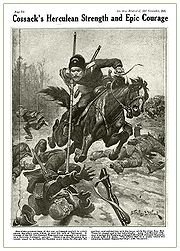 Since 1786, their territory was officially called Don Voisko Lands, and was renamed Don Voisko Province
in 1870 (presently shared by the Rostov
, Volgograd
, and Voronezh
regions of the Russian Federation as well as part of the Luhansk
region of Ukraine
). In 1916, the Don Host enlisted over 1.5 million cossacks. It was disbanded on Russian soil in 1918, after the Russian Revolution
, but the Don Cossacks in the White Army
and those who emigrated abroad, continued to preserve the traditions, musical and otherwise, of their host. Many found employment as trick riders in various circus
es throughout Europe and the United States.
Following the defeat of the White Army in Russian Civil War
, a policy of decossackization
(Raskazachivaniye) took place on the surviving Cossacks and their homelands since they were viewed as a potential threat to the new Soviet regime. The Cossack homelands were often very fertile, and during the collectivisation campaign many Cossacks shared the fate of the kulak
s. According to historian Michael Kort, "During 1919 and 1920, out of a population of approximately 1.5 million Don Cossacks, the Bolshevik
regime killed or deported an estimated 300,000 to 500,000". The region also suffered greatly during the Soviet famine of 1932–1933 as a result of the Soviet policies.
During World War II, the Don Cossacks mustered the largest single concentration of Cossacks within the German Army, the XVth SS Cossack Cavalry Corps
. A great part of the Cossacks were former Russian citizens who elected to fight not so much for Germany as against the Soviet Union. The XVth SS Cossack Cavalry Corps included the 1st Cossack Division
and the 2nd Cossack Division.
The Host was revived in the early 1990s and was officially recognised by the government in 1997.
On October 4, 2009 an ataman
of the Don Cossacks, Viktor Demyanenko, was refused entry into Ukraine
.
was a group of former officers of the Russian Imperial Army, discovered singing in Constantinople, where they had fled after the defeat of their army in the Crimea
. They made their formal concert debut in Vienna
in 1923, led by their founder, conductor and composer, Serge Jaroff
.
They were immensely popular in America and elsewhere, touring the world in the 1930s, 40s and 50s. The men, dressed as Cossacks, sang a cappella
in a repertory of Russian sacred and secular music, army, folk and art songs. Cossack dancing was eventually added to their programmes.
, deals sympathetically with the Don Cossacks and depicts the destruction of their way of life as a result of World War I and the Russian Civil War
.
Don River (Russia)
The Don River is one of the major rivers of Russia. It rises in the town of Novomoskovsk 60 kilometres southeast from Tula, southeast of Moscow, and flows for a distance of about 1,950 kilometres to the Sea of Azov....
.
Etymology and origins
The Don Cossack Host was a frontier military organization from the end of the 16th until the early 20th century.The name Cossack (казак, козак) was widely used to describe "free people" as opposed to others with different standing in a feudal society (i.e., peasants, nobles, clergy, etc..). The word 'cossack' was also applied to migrants, free-booters and bandits
Outlaw
In historical legal systems, an outlaw is declared as outside the protection of the law. In pre-modern societies, this takes the burden of active prosecution of a criminal from the authorities. Instead, the criminal is withdrawn all legal protection, so that anyone is legally empowered to persecute...
.
Kazakh
Kazakhs
The Kazakhs are a Turkic people of the northern parts of Central Asia ....
(казах) is another example of a derivative of this word used to describe nomads of the Central Asian steppes.
The main theory on the origin of Cossacks is that they are descended from peasants fleeing the bonds of serfdom. According to this theory Cossacks originated as bands of run-away peasants of different ethnic origins (Ruthenians
Ruthenians
The name Ruthenian |Rus']]) is a culturally loaded term and has different meanings according to the context in which it is used. Initially, it was the ethnonym used for the East Slavic peoples who lived in Rus'. Later it was used predominantly for Ukrainians...
, Turks
Turkish people
Turkish people, also known as the "Turks" , are an ethnic group primarily living in Turkey and in the former lands of the Ottoman Empire where Turkish minorities had been established in Bulgaria, Cyprus, Bosnia and Herzegovina, Georgia, Greece, Kosovo, Macedonia, and Romania...
, Germans
Germans
The Germans are a Germanic ethnic group native to Central Europe. The English term Germans has referred to the German-speaking population of the Holy Roman Empire since the Late Middle Ages....
etc.), but primarily Ukrainians and Russians. The necessity of defending their lifestyle (piracy, unregulated fishing and hunting) and protecting their settlements from the attacks of Tatars, Mongols and other nomadic tribes that lived in the steppes of Southern Russia, forced these bands of escapees to organize into a military society. In exchange for protection of the Southern borders of medieval Russia, the Don Cossacks were given the privilege of not paying taxes and the tsar's authority in Cossack lands was not as absolute as in other parts of Russia. They colonized areas previously occupied by nomadic tribes and were first to establish permanent settlements in Don area such as villages (станицы) and towns, which were populated originally by Turkic, Kypchak-speaking peoples, whom the Cossacks may have intermixed with to a degree.
Traditions and culture
The Cossacks had a democratic society where the most important decisions were made during a Common Assembly (Казачий Круг). The assembly elected temporary authorities — atamanAtaman
Ataman was a commander title of the Ukrainian People's Army, Cossack, and haidamak leaders, who were in essence the Cossacks...
s.
Don Cossacks were masters of horse riding and had superb military training, due to their long conflict with the Crimean Khanate
Crimean Khanate
Crimean Khanate, or Khanate of Crimea , was a state ruled by Crimean Tatars from 1441 to 1783. Its native name was . Its khans were the patrilineal descendants of Toqa Temür, the thirteenth son of Jochi and grandson of Genghis Khan...
and the Ottoman Empire
Ottoman Empire
The Ottoman EmpireIt was usually referred to as the "Ottoman Empire", the "Turkish Empire", the "Ottoman Caliphate" or more commonly "Turkey" by its contemporaries...
. They were selling their military services to different powers in Eastern Europe. Together with the Polish King, they raided Moscow during the Time of Troubles
Time of Troubles
The Time of Troubles was a period of Russian history comprising the years of interregnum between the death of the last Russian Tsar of the Rurik Dynasty, Feodor Ivanovich, in 1598, and the establishment of the Romanov Dynasty in 1613. In 1601-1603, Russia suffered a famine that killed one-third...
(Смутное Время) and under Russian authority carried out raids and expeditions against Turkey
Turkey
Turkey , known officially as the Republic of Turkey , is a Eurasian country located in Western Asia and in East Thrace in Southeastern Europe...
and Persia.
The Cossacks faith is a Pravoslavny
Russian Orthodox Church
The Russian Orthodox Church or, alternatively, the Moscow Patriarchate The ROC is often said to be the largest of the Eastern Orthodox churches in the world; including all the autocephalous churches under its umbrella, its adherents number over 150 million worldwide—about half of the 300 million...
one (literally, Those worshiping the right way, Orthodox ones) and they see themselves as its protectors.
Though there are some differences in traditions and customs, the Don Cossacks speak the Russian language and have always related themselves to the greater Russia, although with somewhat unique national identity.
The Don Cossacks have a tradition of choral singing and many of their songs, such as Chyorny Voron (Black Raven) and Lyubo, Bratsi, Lyubo (It's good, brothers, good) became popular throughout the rest of Russia. Many of the songs, unsurprisingly are about death in war.
Up to the 18th century marriages and divorces took place in the Common Assembly (Казачий Круг). If a Cossack wanted to marry a girl, he should have brought her to the Common Assembly and present her to it. If the Common Assembly gave an approval, the marriage followed. The same procedure took place if there was a divorce. Later on, Peter I banned marriages and divorces in the Common Assembly, so Cossacks could marry only in the church.
A Cossack marriage is a complex ritual, accompanied by songs, dances and performances. A bridegroom is to come on horseback and take his bride to the church. A marriage train with a bridegroom and a bride comes to the church. After a wedding everybody goes to the bridegroom's house. Parents bless a young couple, break a loaf of bread above their heads, and sprinkle them with wheat, nuts, sweets and hop. Then comes a rite of unbraiding the bride's hair.
When a son was born in a Cossack family, his relatives presented him an arrow, a bow, a cartridge, a bullet and a gun. All these things were hung on the wall, over the boy's bed. At the age of three, the boy could ride a horse, at the age of 7-8 he was allowed to ride in the street, to go fishing and hunt with grown-ups.
Cossacks liked horse races. A rider was to hit the mark. The most dexterous did it, standing on a horseback.
There was a tradition in a Cossack family to provide a young Cossack with 2 horses, uniform and arms.
Cossack leave-taking was always festive. All leaving Cossacks were used to gather in the church, then put on their necks a small bag with a pinch of the native soil and set off with a song. Having left their stanitsa, they drank a cup of vodka and said good-bye to their native land.
History
Don Cossack history is intertwined with that of the rest of Russia.More than two thousand years ago the Scythians lived on the banks of the river Don. Many Scythian tombs have been found in this area.
Then the area was inhabited by the Khazars
Khazars
The Khazars were semi-nomadic Turkic people who established one of the largest polities of medieval Eurasia, with the capital of Atil and territory comprising much of modern-day European Russia, western Kazakhstan, eastern Ukraine, Azerbaijan, large portions of the northern Caucasus , parts of...
and the Polovtsians. The steppes of the Don River were called "The Wild Field" (Дикое Поле). Numerous Tatar armed groups wandered there and attacked the Russian and foreign merchants.
Since the 14th century the vast steppe of the Don region was populated by those people who were not satisfied with the existing social order, by those who did not recognize the power of the land-owners, by the runaway serves, by those who longed for freedom. In the course of time they turned into a united community and were called "the Cossacks". At first the main occupation of these small armed detachments was hunting and fishing as well as constant struggle against the Turks and the Tatars who attacked them. Only later they began to settle and work on land. The first notes about the Cossack villages - "stanitsa" - dates back to 1549.
During the reign of Ivan the Terrible (Ivan IV), the legendary ataman Yermak Timofeyevich
Yermak Timofeyevich
Yermak Timofeyevich , Cossack leader, Russian folk hero and explorer of Siberia. His exploration of Siberia marked the beginning of the expansion of Russia towards this region and its colonization...
went on an expedition to conquer Siberia
Siberia
Siberia is an extensive region constituting almost all of Northern Asia. Comprising the central and eastern portion of the Russian Federation, it was part of the Soviet Union from its beginning, as its predecessor states, the Tsardom of Russia and the Russian Empire, conquered it during the 16th...
. After defeating Khan Kuchum in the fall of 1582 and occupying Isker
Qashliq
Qashliq, Isker or Sibir was a medieval Siberian Tatar fortress, in the 16th century the capital of the Khanate of Sibir, located on the right bank of the Irtysh River at its confluence with the Sibirka rivulet, some 17 km from the modern city of Tobolsk.The fortress is first mentioned in...
, the capital of the Siberian Khanate, Yermak sent a Cossack detachment down the Irtysh
Irtysh
The Irtysh River is a river in Siberia and is the chief tributary of the Ob River. Its name means White River. Irtysh's main affluent is the Tobol River...
in the winter of 1583. The detachment led by Bogdan Bryazga (according to other sources, the Cossack chieftain Nikita Pan) passed through the lands of the Konda-Pelym Voguls and reached the walls of the town of Samarovo. Taken by surprise by the Cossack attack, the Ostyaks surrendered. In fall 1585, shortly after Yermak's death, Cossacks led by voevoda (army commander) Ivan Mansurov founded the first Russian fortified town in Siberia, Obskoy, at the mouth of the Irtysh river on the right bank of the Ob
Ob River
The Ob River , also Obi, is a major river in western Siberia, Russia and is the world's seventh longest river. It is the westernmost of the three great Siberian rivers that flow into the Arctic Ocean .The Gulf of Ob is the world's longest estuary.-Names:The Ob is known to the Khanty people as the...
river. The Mansi and Khanty lands thus became part of the Russian state, finally secured by the founding of the cities of Pelym
Pelym
Pelym is the name of several inhabited localities in Russia.Urban localities*Pelym, Ivdel, Sverdlovsk Oblast, a work settlement under the administrative jurisdiction of the city of Ivdel, Sverdlovsk OblastRural localities...
and Berezov in 1592 and Surgut
Surgut
Surgut is a city in Khanty-Mansi Autonomous Okrug, Russia, located on the Ob River near its junction with the Irtysh River, the largest in the autonomous okrug and the second largest in Tyumen Oblast. Population:...
in 1594. As a result of Yermak's expedition, Russia was able to annex Siberia.
During Polish–Russian War (1605–1618), Polish-Lithuanian noble Aleksander Józef Lisowski
Aleksander Józef Lisowski
Aleksander Józef Lisowski was a Polish-Lithuanian noble , commander of a mercenary group that after his death adopted the name "Lisowczycy." His coat of arms was Jeż ....
founded cavalry mercenary group (named Lisowczycy
Lisowczycy
Lisowczycy or chorągiew elearska ; or in singular form: Lisowczyk or elear) - the name of an early 17th century irregular unit of Polish–Lithuanian Commonwealth light cavalry. The Lisowczycy took part in many battles across Europe and the historical accounts of the period characterized them as...
after his death) from various outlaws, partly Don Cossacks. This group served under Polish Crown, after war with Muscovites Lisowczycy took place in Moldavian Magnate Wars
Moldavian Magnate Wars
The Moldavian Magnate Wars refer to the period at the end of the 16th century and the beginning of the 17th century when the magnates of the Polish-Lithuanian Commonwealth intervened in the affairs of Moldavia, clashing with the Habsburgs and the Ottoman Empire for domination and influence over the...
(Battle of Humenné
Battle of Humenné
The Battle of Humenné took place on November 23, 1619 near Humenné during the first period of the Thirty Years' War between the Transylvanian army and the Polish forces of Lisowczycy...
- November 23, 1619 - at Upper Hungary
Upper Hungary
Upper Hungary is the usual English translation for the area that was historically the northern part of the Kingdom of Hungary, now mostly present-day Slovakia...
, novadays east of Slovakia
Slovakia
The Slovak Republic is a landlocked state in Central Europe. It has a population of over five million and an area of about . Slovakia is bordered by the Czech Republic and Austria to the west, Poland to the north, Ukraine to the east and Hungary to the south...
), later they plundered Silesia
Silesia
Silesia is a historical region of Central Europe located mostly in Poland, with smaller parts also in the Czech Republic, and Germany.Silesia is rich in mineral and natural resources, and includes several important industrial areas. Silesia's largest city and historical capital is Wrocław...
and Moravia
Moravia
Moravia is a historical region in Central Europe in the east of the Czech Republic, and one of the former Czech lands, together with Bohemia and Silesia. It takes its name from the Morava River which rises in the northwest of the region...
as allies of Habsburg armies in The Bohemian Revolt - first phase of Thirty Years' War
Thirty Years' War
The Thirty Years' War was fought primarily in what is now Germany, and at various points involved most countries in Europe. It was one of the most destructive conflicts in European history....
. This phase ended by Battle of White Mountain
Battle of White Mountain
The Battle of White Mountain, 8 November 1620 was an early battle in the Thirty Years' War in which an army of 30,000 Bohemians and mercenaries under Christian of Anhalt were routed by 27,000 men of the combined armies of Ferdinand II, Holy Roman Emperor under Charles Bonaventure de Longueval,...
- November 8, 1620 (near Prague
Prague
Prague is the capital and largest city of the Czech Republic. Situated in the north-west of the country on the Vltava river, the city is home to about 1.3 million people, while its metropolitan area is estimated to have a population of over 2.3 million...
, the capital of Lands of the Bohemian Crown
Lands of the Bohemian Crown
The Lands of the Bohemian Crown , also called the Lands of the Crown of Saint Wenceslas or simply the Bohemian Crown or Czech Crown lands , refers to the area connected by feudal relations under the joint rule of the Bohemian kings...
, novadays Czech republic
Czech Republic
The Czech Republic is a landlocked country in Central Europe. The country is bordered by Poland to the northeast, Slovakia to the east, Austria to the south, and Germany to the west and northwest....
), where Lisowczycy were victoriously set by Johann Tserclaes, Count of Tilly against Hungarian cavalry. They captured twenty standards. After the battle, they terrorised village people around Prague and some other cities (page 8-9), so they were expeditiously paid and released from service in May 7, 1621. Some of them returned to Poland, others served under Habsburg Maximilian I, Elector of Bavaria
Maximilian I, Elector of Bavaria
Maximilian I, Duke/Elector of Bavaria , called "the Great", was a Wittelsbach ruler of Bavaria and a prince-elector of the Holy Roman Empire. His reign was marked by the Thirty Years' War ....
.
Under Peter the Great and subsequent rulers, the Don Cossacks participated in numerous military campaigns, which resulted in the expansion of the Russian Empire from the Black
Black Sea
The Black Sea is bounded by Europe, Anatolia and the Caucasus and is ultimately connected to the Atlantic Ocean via the Mediterranean and the Aegean seas and various straits. The Bosphorus strait connects it to the Sea of Marmara, and the strait of the Dardanelles connects that sea to the Aegean...
to the Baltic Sea
Baltic Sea
The Baltic Sea is a brackish mediterranean sea located in Northern Europe, from 53°N to 66°N latitude and from 20°E to 26°E longitude. It is bounded by the Scandinavian Peninsula, the mainland of Europe, and the Danish islands. It drains into the Kattegat by way of the Øresund, the Great Belt and...
. For years, the Cossacks waged war against the Ottomans
Ottoman Empire
The Ottoman EmpireIt was usually referred to as the "Ottoman Empire", the "Turkish Empire", the "Ottoman Caliphate" or more commonly "Turkey" by its contemporaries...
and Crimean Khanate
Crimean Khanate
Crimean Khanate, or Khanate of Crimea , was a state ruled by Crimean Tatars from 1441 to 1783. Its native name was . Its khans were the patrilineal descendants of Toqa Temür, the thirteenth son of Jochi and grandson of Genghis Khan...
. The Siege of Azov
Azov
-External links:** *...
in 1641 was one of the key actions in Don Cossack history.
Three of Russia's most notorious rebels, Stenka Razin
Stenka Razin
Stepan Timofeyevich Razin Тимофеевич Разин, ; 1630 – ) was a Cossack leader who led a major uprising against the nobility and Tsar's bureaucracy in South Russia.-Early life:...
, Kondraty Bulavin and Emelian Pugachev, were Don Cossacks.
Don Cossacks are credited with playing a significant part in repelling Napoleon's Invasion of Russia
Invasion of Russia
Invasion of Russia can refer to:*Mongol invasion of Rus', a series of invasions in 1223 and 1236*Charles XII invasion of Russia, a Swedish invasion in 1707*French invasion of Russia, an invasion in 1812*Operation Barbarossa, a German invasion in 1941...
. Under the command of Count Matvey Ivanovich Platov, the Don Cossacks successfully fought in the number of battles with Grande Armée. In the Battle of Borodino
Battle of Borodino
The Battle of Borodino , fought on September 7, 1812, was the largest and bloodiest single-day action of the French invasion of Russia and all Napoleonic Wars, involving more than 250,000 troops and resulting in at least 70,000 casualties...
Don Cossacks were making raids to the rear of the French Army. Ataman Platov commanded all Cossack troops and had successfully covered the retreat of the Russian Army to Moscow. The Don Cossacks distinguished themselves in all the campaigns to come and took part in the capture of Paris
Battle of Paris (1814)
The Battle of Paris was fought during the Napoleonic Wars in 1814. The French defeat led directly to the abdication of Napoleon I.-Background:...
. Napoleon is credited with declaring, "Cossacks are the finest light troops among all that exist. If I had them in my army, I would go through all the world with them."
Admiral Aleksandr Vasiliyevich Kolchak
Aleksandr Kolchak
Aleksandr Vasiliyevich Kolchak was a Russian naval commander, polar explorer and later - Supreme ruler . Supreme ruler of Russia , was recognized in this position by all the heads of the White movement, "De jure" - Kingdom of Serbs, Croats and Slovenes, "De facto" - Entente States...
, one of the leaders of the White Movement
White movement
The White movement and its military arm the White Army - known as the White Guard or the Whites - was a loose confederation of Anti-Communist forces.The movement comprised one of the politico-military Russian forces who fought...
during the Russian Civil War
Russian Civil War
The Russian Civil War was a multi-party war that occurred within the former Russian Empire after the Russian provisional government collapsed to the Soviets, under the domination of the Bolshevik party. Soviet forces first assumed power in Petrograd The Russian Civil War (1917–1923) was a...
, was of Don Cossack descent.
Don Voisko Province
Don Voisko Province of Imperial Russia was the official name of the territory of Don Cossacks, roughly coinciding with today's Rostov Oblast of Russia. Its center was Cherkassk, later Novocherkassk....
in 1870 (presently shared by the Rostov
Rostov
Rostov is a town in Yaroslavl Oblast, Russia, one of the oldest in the country and a tourist center of the Golden Ring. It is located on the shores of Lake Nero, northeast of Moscow. Population:...
, Volgograd
Volgograd
Volgograd , formerly called Tsaritsyn and Stalingrad is an important industrial city and the administrative center of Volgograd Oblast, Russia. It is long, north to south, situated on the western bank of the Volga River...
, and Voronezh
Voronezh
Voronezh is a city in southwestern Russia, the administrative center of Voronezh Oblast. It is located on both sides of the Voronezh River, away from where it flows into the Don. It is an operating center of the Southeastern Railway , as well as the center of the Don Highway...
regions of the Russian Federation as well as part of the Luhansk
Luhansk Oblast
Luhansk Oblast ) is the easternmost oblast of Ukraine. Its administrative center is Luhansk. The oblast was established in 1938 and bore the name Voroshilovgrad Oblast in honor of Kliment Voroshilov....
region of Ukraine
Ukraine
Ukraine is a country in Eastern Europe. It has an area of 603,628 km², making it the second largest contiguous country on the European continent, after Russia...
). In 1916, the Don Host enlisted over 1.5 million cossacks. It was disbanded on Russian soil in 1918, after the Russian Revolution
Russian Revolution of 1917
The Russian Revolution is the collective term for a series of revolutions in Russia in 1917, which destroyed the Tsarist autocracy and led to the creation of the Soviet Union. The Tsar was deposed and replaced by a provisional government in the first revolution of February 1917...
, but the Don Cossacks in the White Army
White movement
The White movement and its military arm the White Army - known as the White Guard or the Whites - was a loose confederation of Anti-Communist forces.The movement comprised one of the politico-military Russian forces who fought...
and those who emigrated abroad, continued to preserve the traditions, musical and otherwise, of their host. Many found employment as trick riders in various circus
Circus
A circus is commonly a travelling company of performers that may include clowns, acrobats, trained animals, trapeze acts, musicians, hoopers, tightrope walkers, jugglers, unicyclists and other stunt-oriented artists...
es throughout Europe and the United States.
Following the defeat of the White Army in Russian Civil War
Russian Civil War
The Russian Civil War was a multi-party war that occurred within the former Russian Empire after the Russian provisional government collapsed to the Soviets, under the domination of the Bolshevik party. Soviet forces first assumed power in Petrograd The Russian Civil War (1917–1923) was a...
, a policy of decossackization
Decossackization
Decossackization is a term used to describe the Bolsheviks' policy of the systematic elimination of the Cossacks of the Don and the Kuban as a social and ethnic group...
(Raskazachivaniye) took place on the surviving Cossacks and their homelands since they were viewed as a potential threat to the new Soviet regime. The Cossack homelands were often very fertile, and during the collectivisation campaign many Cossacks shared the fate of the kulak
Kulak
Kulaks were a category of relatively affluent peasants in the later Russian Empire, Soviet Russia, and early Soviet Union...
s. According to historian Michael Kort, "During 1919 and 1920, out of a population of approximately 1.5 million Don Cossacks, the Bolshevik
Bolshevik
The Bolsheviks, originally also Bolshevists , derived from bol'shinstvo, "majority") were a faction of the Marxist Russian Social Democratic Labour Party which split apart from the Menshevik faction at the Second Party Congress in 1903....
regime killed or deported an estimated 300,000 to 500,000". The region also suffered greatly during the Soviet famine of 1932–1933 as a result of the Soviet policies.
During World War II, the Don Cossacks mustered the largest single concentration of Cossacks within the German Army, the XVth SS Cossack Cavalry Corps
XVth SS Cossack Cavalry Corps
The XV SS Cossack Cavalry Corps was a German cavalry corps during World War II. With order of February 1, 1945 the Corps was transferred to the Waffen-SS.-History:The summer of 1942 marked the high tide of German success in the East...
. A great part of the Cossacks were former Russian citizens who elected to fight not so much for Germany as against the Soviet Union. The XVth SS Cossack Cavalry Corps included the 1st Cossack Division
1st Cossack Division
The 1st Cossack Division was a Russian Cossack division of the German Army that served during World War II. It was created on the Eastern Front mostly out of Don Cossacks already serving in the Wehrmacht, those who escaped from the advancing Red Army and Soviet POWs. In 1945, the division was...
and the 2nd Cossack Division.
The Host was revived in the early 1990s and was officially recognised by the government in 1997.
On October 4, 2009 an ataman
Ataman
Ataman was a commander title of the Ukrainian People's Army, Cossack, and haidamak leaders, who were in essence the Cossacks...
of the Don Cossacks, Viktor Demyanenko, was refused entry into Ukraine
Ukraine
Ukraine is a country in Eastern Europe. It has an area of 603,628 km², making it the second largest contiguous country on the European continent, after Russia...
.
Don Cossack Choir
The Don Cossack Choir Serge JaroffDon Cossack Choir Serge Jaroff
The Don Cossack Choir Serge Jaroff was a men's chorus of exiled Russian Cossacks founded in 1921 by Serge Jaroff and conducted for almost sixty years by him.- Çilingir :...
was a group of former officers of the Russian Imperial Army, discovered singing in Constantinople, where they had fled after the defeat of their army in the Crimea
Crimea
Crimea , or the Autonomous Republic of Crimea , is a sub-national unit, an autonomous republic, of Ukraine. It is located on the northern coast of the Black Sea, occupying a peninsula of the same name...
. They made their formal concert debut in Vienna
Vienna
Vienna is the capital and largest city of the Republic of Austria and one of the nine states of Austria. Vienna is Austria's primary city, with a population of about 1.723 million , and is by far the largest city in Austria, as well as its cultural, economic, and political centre...
in 1923, led by their founder, conductor and composer, Serge Jaroff
Serge Jaroff
Serge Alexis Jaroff was the founder, conductor and composer of the Don Cossack Choir Serge Jaroff.-Early life:Jaroff was born in Makaryev, Kostroma Province, Russia. He trained at the Moscow Synod School for Choral Singing.-Army career:...
.
They were immensely popular in America and elsewhere, touring the world in the 1930s, 40s and 50s. The men, dressed as Cossacks, sang a cappella
A cappella
A cappella music is specifically solo or group singing without instrumental sound, or a piece intended to be performed in this way. It is the opposite of cantata, which is accompanied singing. A cappella was originally intended to differentiate between Renaissance polyphony and Baroque concertato...
in a repertory of Russian sacred and secular music, army, folk and art songs. Cossack dancing was eventually added to their programmes.
In popular culture
Mikhail Sholokhov's monumental work, And Quiet Flows the DonAnd Quiet Flows the Don
And Quiet Flows the Don or Quietly Flows the Don is the first part of the great Don epic Tikhiy Don , written by Michail Aleksandrovich Sholokhov. It originally appeared in serialized form between 1928 and 1940...
, deals sympathetically with the Don Cossacks and depicts the destruction of their way of life as a result of World War I and the Russian Civil War
Russian Civil War
The Russian Civil War was a multi-party war that occurred within the former Russian Empire after the Russian provisional government collapsed to the Soviets, under the domination of the Bolshevik party. Soviet forces first assumed power in Petrograd The Russian Civil War (1917–1923) was a...
.
See also
- And Quiet Flows the DonAnd Quiet Flows the DonAnd Quiet Flows the Don or Quietly Flows the Don is the first part of the great Don epic Tikhiy Don , written by Michail Aleksandrovich Sholokhov. It originally appeared in serialized form between 1928 and 1940...
- Betrayal of the CossacksBetrayal of the CossacksThe Repatriation of Cossacks after WW2, also known as the Betrayal of the Cossacks, the Tragedy of Drau or the Massacre of Cossacks at Lienz refers to the forced repatriation to the USSR of the Cossacks and ethnic Russians who were allies of Nazi Germany during the Second World War.The...
- List of Imperial Russian Army Don Cossack regiments
- Kondraty Bulavin
- Cossacks in TurkeyCossacks in TurkeyCossacks in Turkey refers to descendants of a group of Don Cossacks who had lived in the territory of the Republic of Turkey until they migrated in 1962.- History :...
- Don ArmyDon ArmyThe Don Army was part of the White movement of the Russian Civil War, operating from 1917 to 1919, in the Don region and centered in the town of Novocherkassk.- History :...
- Genocides in historyGenocides in historyGenocide is the deliberate and systematic destruction, in whole or in part, of an ethnic, racial, religious, or national group. It is defined in Article 2 of the Convention on the Prevention and Punishment of the Crime of Genocide as "any of the following acts committed with intent to destroy, in...
- Human rights in the Soviet UnionHuman rights in the Soviet UnionHuman rights in the Soviet Union have been viewed differently, one view by the communist ideology adopted by the Soviet Union and another by its critics. The Soviet Union was established after a revolution that ended centuries of Tsarist monarchy...
- Alexei Kaledin
- Pyotr KrasnovPyotr KrasnovPyotr Nikolayevich Krasnov , 1869 – January 17, 1947), sometimes referred to in English as Peter Krasnov, was Lieutenant General of the Russian army when the revolution broke out in 1917, and one of the leaders of the counterrevolutionary White movement afterward.- Russian Army :Pyotr Krasnov...
- Matvei PlatovMatvei PlatovCount Matvei Ivanovich Platov was a Russian general who commanded the Don Cossacks in the Napoleonic wars....
- Population transfer in the Soviet UnionPopulation transfer in the Soviet UnionPopulation transfer in the Soviet Union may be classified into the following broad categories: deportations of "anti-Soviet" categories of population, often classified as "enemies of workers," deportations of entire nationalities, labor force transfer, and organized migrations in opposite...
- Emilian Pugachev
- Stenka RazinStenka RazinStepan Timofeyevich Razin Тимофеевич Разин, ; 1630 – ) was a Cossack leader who led a major uprising against the nobility and Tsar's bureaucracy in South Russia.-Early life:...
- Yermak TimofeyevichYermak TimofeyevichYermak Timofeyevich , Cossack leader, Russian folk hero and explorer of Siberia. His exploration of Siberia marked the beginning of the expansion of Russia towards this region and its colonization...
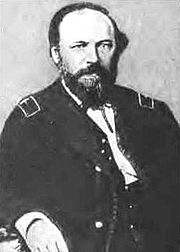
- John Turchin Don Cossack General in US Union Army
- Victims of YaltaVictims of YaltaVictims of Yalta is the British and The Secret Betrayal the American title of a 1977 book by Nikolai Tolstoy that chronicles the fate of Soviet people who had been under German control during World War II and at its end fallen into the hands of the Western Allies...