
|
|
|
|
Warsaw Ghetto
|
| |
|
| |
The Warsaw Ghetto was the largest of the Jewish ghettos located in the territory of General Government during the Second World War.
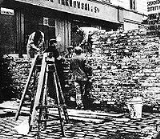
The Warsaw Ghetto was established by the German Governor-General Hans Frank on October 16, 1940. At this time, the population of the Ghetto was estimated to be 440,000 people, about 38% of the population of Warsaw. However, the size of the Ghetto was about 4.5% of the size of Warsaw. The ghetto was split into two areas, the small ghetto, generally inhabited by richer Jews and the large ghetto, where conditions were much worse.

Discussion
Ask a question about 'Warsaw Ghetto'
Start a new discussion about 'Warsaw Ghetto'
Answer questions from other users
|
Encyclopedia
The Warsaw Ghetto was the largest of the Jewish ghettos located in the territory of General Government during the Second World War.
The Warsaw Ghetto was established by the German Governor-General Hans Frank on October 16, 1940. At this time, the population of the Ghetto was estimated to be 440,000 people, about 38% of the population of Warsaw. However, the size of the Ghetto was about 4.5% of the size of Warsaw. The ghetto was split into two areas, the small ghetto, generally inhabited by richer Jews and the large ghetto, where conditions were much worse. The two ghettos were linked by a single footbridge . The Nazis then closed the Warsaw Ghetto from the outside world on November 16, 1940, building a wall with armed guards.
During the next year and a half, thousands of the Polish Jews as well as some Romani people from smaller cities and the countryside were brought into the Ghetto, while diseases (especially typhus) and starvation kept the inhabitants at about the same number. Average food rations in 1941 for Jews in Warsaw were limited to 1184 kcal, compared to 1669 kcal for gentile Poles and 2,614 kcal for Germans.
Unemployment was a major problem in the ghetto. Illegal workshops were created to manufacture goods to be sold illegally on the outside and raw goods were smuggled in often by children. Hundreds of four to five year old Jewish children went across en masse to the "Aryan side", sometimes several times a day, smuggling food into the ghettos, returning with goods that often weighed more than they did. Smuggling was often the only source of subsistence for Ghetto inhabitants, who would otherwise have died of starvation. Despite the grave hardships, life in the Warsaw Ghetto was rich with educational and cultural activities, conducted by its underground organizations. Hospitals, public soup kitchens, orphanages, refugee centers and recreation facilities were formed, as well as a school system. Some schools were illegal and operated under the guise of a soup kitchen. There were secret libraries, classes for the children and even a symphony orchestra. The life in the ghetto was chronicled by the Oyneg Shabbos group.
Over 100,000 of the Ghetto's residents died due to rampant disease or starvation, as well as random killings, even before the Nazis began massive deportations of the inhabitants from the Ghetto's Umschlagplatz to the Treblinka extermination camp during the Gross-aktion Warschau, part of the countrywide Operation Reinhard. Between Tisha B'Av (July 23) and Yom Kippur (September 21) of 1942, about 254,000 Ghetto residents (or at least 300,000 by different accounts) were sent to Treblinka and murdered there. In 1942 Polish resistance officer Jan Karski reported to the Western governments on the situation in the Ghetto and on the extermination camps. By the end of 1942, it was clear that the deportations were to their deaths, and many of the remaining Jews decided to fight.
Warsaw Ghetto Uprising and destruction of the Ghetto
On January 18, 1943, the first instance of armed resistance occurred when the Germans started the final expulsion of the remaining Jews. The Jewish fighters had some success: the expulsion stopped after four days and the ZOB and ZZW resistance organizations took control of the Ghetto, building shelters and fighting posts and operating against Jewish collaborators. During the next three months, all inhabitants of the Ghetto prepared for what they realized would be a final struggle.
The final battle started on the eve of Passover, April 19, 1943, when the large Nazi force entered the ghetto. After initial setbacks, the Germans under the field command of Jürgen Stroop systematically burned and blew up the ghetto buildings, block by block, rounding up or murdering anybody they could capture. Significant resistance ended on April 23 1943, and the Nazi operation officially ended in mid-May, symbolically culminated with the demolition of the Great Synagogue of Warsaw on May 16, 1943. According to the official report, at least 56,065 people were killed on the spot or deported to German Nazi concentration and death camps, most to Treblinka.
Remnants of the Ghetto Today
The ghetto was almost wholly levelled during the uprising, however, a number of buildings and streets survived, mostly in the small ghetto, which had been closed earlier and wasn't involved in the fighting. The buildings on ul.Prozna are the original residential buildings that once housed Jews in the Warsaw Ghetto. The buildings have largely remained empty since the war and the street is the focus for the annual Warsaw Jewish Festival. Nearby, the Nozyk synagogue also survived the war, as it was used as a stables by the German Wehrmacht. The synagogue has today been restored and is once again used as a temple. The last remaining piece of the ghetto wall is at ul.Zlota 62.
People of the Warsaw Ghetto
Casualties
- Tosia Altman - Resistance fighter, died in the Ghetto in 1943 uprising
- Mordechaj Anielewicz - Resistance leader in Zydowska Organizacja Bojowa, died in the Ghetto in 1943 uprising when he committed suicide at the Mila 18 command post
- Dawid Moryc Apfelbaum - Resistance leader and commander of Zydowski Zwiazek Wojskowy, died in the Ghetto in 1943 uprising
- Adam Czerniaków - Engineer and senator, head of the Warsaw Judenrat (Jewish council), committed suicide in 1942
- Yitzhak Gitterman - Director of the American Jewish Joint Distribution Committee in Poland, resistance fighter, died in the Ghetto in 1943 uprising
- Itzhak Katzenelson - Teacher, poet, dramatist and resistance fighter, died in Auschwitz in 1944
- Janusz Korczak - Children's author, pediatrician, and child pedagogist, died in Treblinka in 1942
- Simon Pullman - Conductor of the Warsaw Ghetto symphony orchestra, died in Treblinka in 1942
- Emanuel Ringelblum - Historian, politician and social worker, and leader of the Ghetto chroniclers, died in Warsaw in 1944
- Lidia Zamenhof - Esperantist, daughter of Dr. L. L. Zamenhof, died in Treblinka in 1942
- Menachem Ziemba - Distinguished rabbi, died in the Ghetto in 1943 uprising
Survivors
Associated people
* Wladyslaw Bartoszewski - Polish resistance activist of the Zegota organization in Warsaw
- Henryk Iwanski - Polish resistance officer in the charge of support for the Ghetto
- Jan Karski - Polish resistance courier who reported on the Ghetto for the Allies
- Szmul Zygielbojm - Polish-Jewish socialist politician, committed suicide in London in protest of the Allied indifference
See also
External links
|
| |
|
|