
Home      Discussion      Topics      Dictionary      Almanac
Signup       Login
Subhash Chandra Bose

Subhash Chandra Bose

Overview
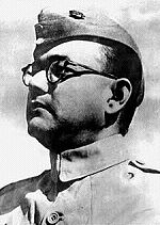
Subhas Chandra Bose known by name Netaji (Hindi: "Respected Leader") was an Indian revolutionary who led an Indian national political and military force against Britain and the Western powers during World War II. Bose was one of the most prominent leaders in the Indian independence movement
Indian independence movement
The term Indian independence movement encompasses a wide area of political organisations, philosophies, and movements which had the common aim of ending first British East India Company rule, and then British imperial authority, in parts of South Asia...

 and is a legendary figure in India today. Bose was born on 23 January 1897 in Cuttack
Cuttack
Cuttack is the former capital of the state of Orissa, India. It is the headquarters of Cuttack district and is located about 20 km to the north east of Bhubaneswar, the capital of Orissa. The name of the city is an anglicised form of Kataka that literally means The Fort, a reference to the...

, Orissa
Orissa
Orissa , officially Odisha since Nov 2011, is a state of India, located on the east coast of India, by the Bay of Bengal. It is the modern name of the ancient nation of Kalinga, which was invaded by the Maurya Emperor Ashoka in 261 BC. The modern state of Orissa was established on 1 April...

 to Janakinath Bose and Prabhabati Devi.
Discussion
Ask a question about 'Subhash Chandra Bose'
Start a new discussion about 'Subhash Chandra Bose'
Answer questions from other users
Full Discussion Forum
 
Quotations

An Indian Pilgrim : An unfinished autobiography -- My Faith (Philosophical) "Reality is, after all , too big for our frail understanding to fully comprehend. Nevertheless, we have to build our life on the theory which contains the maximum truth.We cannot sit still because we cannot, or do not , know the Absolute Truth."

Encyclopedia
Subhas Chandra Bose known by name Netaji (Hindi: "Respected Leader") was an Indian revolutionary who led an Indian national political and military force against Britain and the Western powers during World War II. Bose was one of the most prominent leaders in the Indian independence movement
Indian independence movement
The term Indian independence movement encompasses a wide area of political organisations, philosophies, and movements which had the common aim of ending first British East India Company rule, and then British imperial authority, in parts of South Asia...

 and is a legendary figure in India today. Bose was born on 23 January 1897 in Cuttack
Cuttack
Cuttack is the former capital of the state of Orissa, India. It is the headquarters of Cuttack district and is located about 20 km to the north east of Bhubaneswar, the capital of Orissa. The name of the city is an anglicised form of Kataka that literally means The Fort, a reference to the...

, Orissa
Orissa
Orissa , officially Odisha since Nov 2011, is a state of India, located on the east coast of India, by the Bay of Bengal. It is the modern name of the ancient nation of Kalinga, which was invaded by the Maurya Emperor Ashoka in 261 BC. The modern state of Orissa was established on 1 April...

 to Janakinath Bose and Prabhabati Devi.

He is presumed to have died "in absentia"
Death in absentia
Death in absentia is a legal declaration that a person is deceased in the absence of remains attributable to that person...

 on 18 August 1945 from injuries sustained in an alleged aircraft crash in Taihoku (Taipei
Taipei
Taipei City is the capital of the Republic of China and the central city of the largest metropolitan area of Taiwan. Situated at the northern tip of the island, Taipei is located on the Tamsui River, and is about 25 km southwest of Keelung, its port on the Pacific Ocean...

). However, no actual evidence of the death of Subhas Chandra Bose on that day has ever been officially authenticated and many committees were set up by the government of India to investigate the mystery of his presumed death.

Ideology and philosophy


Bose advocated complete unconditional independence for India, whereas the All-India Congress Committee wanted it in phases, through Dominion
Dominion
A dominion, often Dominion, refers to one of a group of autonomous polities that were nominally under British sovereignty, constituting the British Empire and British Commonwealth, beginning in the latter part of the 19th century. They have included Canada, Australia, New Zealand, Newfoundland,...

 status. Finally at the historic Lahore
Lahore
Lahore is the capital of the Pakistani province of Punjab and the second largest city in the country. With a rich and fabulous history dating back to over a thousand years ago, Lahore is no doubt Pakistan's cultural capital. One of the most densely populated cities in the world, Lahore remains a...

 Congress convention, the Congress adopted Purna Swaraj
Purna Swaraj
The Purna Swaraj declaration, or Declaration of the Independence of India was promulgated by the Indian National Congress on January 26, 1930, resolving the Congress and Indian nationalists to fight for Purna Swaraj, or complete self-rule independent of the British Empire...

 (complete independence) as its motto. Gandhi was given rousing receptions wherever he went after Gandhi-Irwin pact. Subhash Chandra Bose, travelling with Gandhi in these travels, later wrote that the great enthusiasm he saw among the people enthused him tremendously and that he doubted if any other leader anywhere in the world received such a reception as Gandhi did during these travels across the country. He was imprisoned and expelled from India. Defying the ban, he came back to India and was imprisoned again.

Bose was elected president of the Indian National Congress
Indian National Congress
The Indian National Congress is one of the two major political parties in India, the other being the Bharatiya Janata Party. It is the largest and one of the oldest democratic political parties in the world. The party's modern liberal platform is largely considered center-left in the Indian...

 for two consecutive terms, but had to resign from the post following ideological conflicts with Mohandas K. Gandhi and after openly attacking the Congress' foreign and internal policies. Bose believed that Gandhi's tactics of non-violence would never be sufficient to secure India's independence, and advocated violent resistance. He established a separate political party, the All India Forward Bloc
All India Forward Bloc
The All India Forward Bloc is a leftwing nationalist political party in India. It emerged as a faction within the Indian National Congress in 1939, led by Subhas Chandra Bose. The party re-established as an independent political party after the independence of India...

 and continued to call for the full and immediate independence of India from British rule. He was imprisoned by the British authorities eleven times. His famous motto was: "Give me blood and I will give you freedom".

His stance did not change with the outbreak of the Second World War
World War II
World War II, or the Second World War , was a global conflict lasting from 1939 to 1945, involving most of the world's nations—including all of the great powers—eventually forming two opposing military alliances: the Allies and the Axis...

, which he saw as an opportunity to take advantage of British weakness. At the outset of the war, he left India, travelling to the Soviet Union
Soviet Union
The Soviet Union , officially the Union of Soviet Socialist Republics , was a constitutionally socialist state that existed in Eurasia between 1922 and 1991....

, Nazi Germany
Nazi Germany
Nazi Germany , also known as the Third Reich , but officially called German Reich from 1933 to 1943 and Greater German Reich from 26 June 1943 onward, is the name commonly used to refer to the state of Germany from 1933 to 1945, when it was a totalitarian dictatorship ruled by...

 and Imperial Japan, seeking an alliance with each of them to attack the British government in India. With Imperial Japanese assistance, he re-organised and later led the Azad Hind Fauj or Indian National Army
Indian National Army
The Indian National Army or Azad Hind Fauj was an armed force formed by Indian nationalists in 1942 in Southeast Asia during World War II. The aim of the army was to overthrow the British Raj in colonial India, with Japanese assistance...

 (INA), formed with Indian prisoners-of-war and plantation workers from British Malaya
British Malaya
British Malaya loosely described a set of states on the Malay Peninsula and the Island of Singapore that were brought under British control between the 18th and the 20th centuries...

, Singapore
Singapore
Singapore , officially the Republic of Singapore, is a Southeast Asian city-state off the southern tip of the Malay Peninsula, north of the equator. An island country made up of 63 islands, it is separated from Malaysia by the Straits of Johor to its north and from Indonesia's Riau Islands by the...

, and other parts of Southeast Asia
Southeast Asia
Southeast Asia, South-East Asia, South East Asia or Southeastern Asia is a subregion of Asia, consisting of the countries that are geographically south of China, east of India, west of New Guinea and north of Australia. The region lies on the intersection of geological plates, with heavy seismic...

, against British forces. With Japanese monetary, political, diplomatic and military assistance, he formed the Azad Hind Government in exile, and regrouped and led the Indian National Army
Indian National Army
The Indian National Army or Azad Hind Fauj was an armed force formed by Indian nationalists in 1942 in Southeast Asia during World War II. The aim of the army was to overthrow the British Raj in colonial India, with Japanese assistance...

 in failed military campaigns against the allies at Imphal
Battle of Imphal
The Battle of Imphal took place in the region around the city of Imphal, the capital of the state of Manipur in North-East India from March until July 1944. Japanese armies attempted to destroy the Allied forces at Imphal and invade India, but were driven back into Burma with heavy losses...

 and in Burma
Burma Campaign
The Burma Campaign in the South-East Asian Theatre of World War II was fought primarily between British Commonwealth, Chinese and United States forces against the forces of the Empire of Japan, Thailand, and the Indian National Army. British Commonwealth land forces were drawn primarily from...

.

His political views and the alliances he made with Nazi and other militarist regimes at war with Britain have been the cause of arguments among historians and politicians, with some accusing him of fascist sympathies, while others in India have been more sympathetic towards the realpolitik
Realpolitik
Realpolitik refers to politics or diplomacy based primarily on power and on practical and material factors and considerations, rather than ideological notions or moralistic or ethical premises...

 that guided his social and political choices. It is also believed among a section of people in India that if Subhas Bose could win the freedom of India himself the face of today's Indian sub-continent would have been different.

Early life


Subhash Chandra Bose was born in a Bengali
Bengali Hindu
Bengali Hindus are an ethno-linguistic group, belonging to the Indo-Aryan family and are native to the Bengal region of the Indian Subcontinent. The Bengali Hindus along with other related ethno-linguistic groups constitute the vast majority of Hindus...

 Kayasth
Kayastha
Kayastha or Kayasth or Kayeth is a caste or community of Hindus originating in India. Kayastha means "scribe" in Sanskrit, and has traditionally denoted members of the writer caste....

 family on January 23, 1897 in Cuttack
Cuttack
Cuttack is the former capital of the state of Orissa, India. It is the headquarters of Cuttack district and is located about 20 km to the north east of Bhubaneswar, the capital of Orissa. The name of the city is an anglicised form of Kataka that literally means The Fort, a reference to the...

, Orissa
Orissa
Orissa , officially Odisha since Nov 2011, is a state of India, located on the east coast of India, by the Bay of Bengal. It is the modern name of the ancient nation of Kalinga, which was invaded by the Maurya Emperor Ashoka in 261 BC. The modern state of Orissa was established on 1 April...

, to Janakinath Bose, an advocate
Advocate
An advocate is a term for a professional lawyer used in several different legal systems. These include Scotland, South Africa, India, Scandinavian jurisdictions, Israel, and the British Crown dependencies of Jersey, Guernsey and the Isle of Man...

 and Prabhavati Devi. He was the ninth child of a total of fourteen siblings. He studied in an Anglo school [Stewart School] at Cuttack until the seventh standard as that time Stewart School functioned upto seventh standard only and then shifted to Ravenshaw Collegiate School. From there he went to the Presidency College
Presidency College, Kolkata
Presidency University, Kolkata, formerly Hindu College and Presidency College, is a unitary, state aided university, located in Kolkata, West Bengal. and one of the premier institutes of learning of liberal arts and sciences in India. In 2002 it was ranked number one by the weekly news magazine...

 where he studied briefly. His nationalistic temperament came to light when he was expelled for assaulting Professor Oaten for his anti-India comments. Bose later topped the matriculation examination of Calcutta province in 1911 and passed his B.A. in 1918 in philosophy from the Scottish Church College
Scottish Church College, Calcutta
The Scottish Church College is the oldest continuously running Christian liberal arts and sciences college in India. It is affiliated with the West Bengal Board of Secondary Education , the West Bengal Council of Higher Secondary Education for the awarding of baccalaureate and post baccalaureate...

 under University of Calcutta
University of Calcutta
The University of Calcutta is a public university located in the city of Kolkata , India, founded on 24 January 1857...

.

Bose went to study in Fitzwilliam Hall of the University of Cambridge
Fitzwilliam College, Cambridge
Fitzwilliam College is one of the constituent colleges of the University of Cambridge in England.The college traces its origins back to 1869 and the foundation of the Non-Collegiate Students Board, a venture intended to offer students from less financially privileged backgrounds a chance to study...

, and matriculated, that is formally enrolled in the Cambridge University, on 19 November 1919. He was a non-collegiate student. He studied Philosoe newspaper Swaraj and took charge of publicity for the Bengal Provincial Congress Committee. His mentor was Chittaranjan Das
Chittaranjan Das
Chittaranjan Das was an eminent Bengali lawyer and a major figure in the Indian independence movement.-Personal life:...

 who was a spokesman for aggressive nationalism in Bengal
Bengal
Bengal is a historical and geographical region in the northeast region of the Indian Subcontinent at the apex of the Bay of Bengal. Today, it is mainly divided between the sovereign land of People's Republic of Bangladesh and the Indian state of West Bengal, although some regions of the previous...

. In the year 1923, he was elected the President of All India Youth Congress and also the Secretary of Bengal State Congress. He was also Editor of the newspaper "Forward", founded by Deshabandhu. Bose worked as the CEO of the municipal corporation of Calcutta for Das when the latter was elected mayor of Calcutta in 1924. In a roundup of nationalists in 1925, Bose was arrested and sent to prison in Mandalay
Mandalay
Mandalay is the second-largest city and the last royal capital of Burma. Located north of Yangon on the east bank of the Irrawaddy River, the city has a population of one million, and is the capital of Mandalay Region ....

, where he contracted tuberculosis
Tuberculosis
Tuberculosis, MTB, or TB is a common, and in many cases lethal, infectious disease caused by various strains of mycobacteria, usually Mycobacterium tuberculosis. Tuberculosis usually attacks the lungs but can also affect other parts of the body...

.

National politics


In 1927, after being released from prison, Bose became general secretary of the Congress party and worked with Jawaharlal Nehru
Jawaharlal Nehru
Jawaharlal Nehru , often referred to with the epithet of Panditji, was an Indian statesman who became the first Prime Minister of independent India and became noted for his “neutralist” policies in foreign affairs. He was also one of the principal leaders of India’s independence movement in the...

 for independence. Again Bose was arrested and jailed for civil disobedience; this time he emerged to become Mayor of Calcutta in 1930. During the mid-1930s Bose travelled in Europe, visiting Indian students and European politicians, including Mussolini. He observed party organization and saw communism and fascism in action. By 1938 Bose had become as leader of national stature and agreed to accept nomination as Congress president.

He stood for unqualified Swaraj
Swaraj
Swaraj can mean generally self-governance or "self-rule", and was used synonymously with "home-rule" by Gandhi but the word usually refers to Gandhi's concept for Indian independence from foreign domination. Swaraj lays stress on governance not by a hierarchical government, but self governance...

 (self-governance), including the use of force against the British. This meant a confrontation with Mohandas Gandhi, who in fact opposed Bose's presidency, splitting the Indian National Congress
Indian National Congress
The Indian National Congress is one of the two major political parties in India, the other being the Bharatiya Janata Party. It is the largest and one of the oldest democratic political parties in the world. The party's modern liberal platform is largely considered center-left in the Indian...

 party. Bose attempted to maintain unity, but Gandhi advised Bose to form his own cabinet. The rift also divided Bose and Nehru. Bose appeared at the 1939 Congress meeting on a stretcher. He was elected president again over Gandhi's preferred candidate Pattabhi Sitaramayya. U. Muthuramalingam Thevar
U. Muthuramalingam Thevar
Ukkirapandi MuthuramalingaThevar , also known as Pasumpon Muthuramalingam Thevar, was an Indian politician. He hailed from the Maravar community, the dominant warrior caste group in his home district in southern Tamil Nadu...

 strongly supported Bose in the intra-Congress dispute. Thevar mobilised all south India votes for Bose. However, due to the manoeuvrings of the Gandhi-led clique in the Congress Working Committee, Bose found himself forced to resign from the Congress presidency. His uncompromising stand finally cut him off from the mainstream of Indian nationalism
Indian nationalism
Indian nationalism refers to the many underlying forces that molded the Indian independence movement, and strongly continue to influence the politics of India, as well as being the heart of many contrasting ideologies that have caused ethnic and religious conflict in Indian society...

. Bose then organized the Forward Bloc on June 22, aimed at consolidating the political left, but its main strength was in his home state, Bengal. U Muthuramalingam Thevar, who was disillusioned by the official Congress leadership which had not revoked the Criminal Tribes Act
Criminal Tribes Act
The term Criminal Tribes Act applies to various successive pieces of legislation enforced in India during British rule; the first enacted in 1871 as applied mostly in North India The Act was extended to Bengal Presidency and other areas in 1876, and finally with the Criminal Tribes Act 1911, it...

 (CTA), joined the Forward Bloc. When Bose visited Madurai on September 6, Thevar organised a massive rally as his reception.

Bose advocated the approach that the political instability of war-time Britain should be taken advantage of—rather than simply wait for the British to grant independence after the end of the war (which was the view of Gandhi, Jawaharlal Nehru
Jawaharlal Nehru
Jawaharlal Nehru , often referred to with the epithet of Panditji, was an Indian statesman who became the first Prime Minister of independent India and became noted for his “neutralist” policies in foreign affairs. He was also one of the principal leaders of India’s independence movement in the...

 and a section of the Congress leadership at the time). In this, he was influenced by the examples of Italian statesmen Giuseppe Garibaldi
Giuseppe Garibaldi
Giuseppe Garibaldi was an Italian military and political figure. In his twenties, he joined the Carbonari Italian patriot revolutionaries, and fled Italy after a failed insurrection. Garibaldi took part in the War of the Farrapos and the Uruguayan Civil War leading the Italian Legion, and...

 and Giuseppe Mazzini
Giuseppe Mazzini
Giuseppe Mazzini , nicknamed Soul of Italy, was an Italian politician, journalist and activist for the unification of Italy. His efforts helped bring about the independent and unified Italy in place of the several separate states, many dominated by foreign powers, that existed until the 19th century...

.

His correspondence reveals that despite his clear dislike for British subjugation, he was deeply impressed by their methodical and systematic approach and their steadfastly disciplinarian outlook towards life. In England, he exchanged ideas on the future of India with British Labour Party
Labour Party (UK)
The Labour Party is a centre-left democratic socialist party in the United Kingdom. It surpassed the Liberal Party in general elections during the early 1920s, forming minority governments under Ramsay MacDonald in 1924 and 1929-1931. The party was in a wartime coalition from 1940 to 1945, after...

 leaders and political thinkers like Lord Halifax, George Lansbury
George Lansbury
George Lansbury was a British politician, socialist, Christian pacifist and newspaper editor. He was a Member of Parliament from 1910 to 1912 and from 1922 to 1940, and leader of the Labour Party from 1932 to 1935....

, Clement Attlee
Clement Attlee
Clement Richard Attlee, 1st Earl Attlee, KG, OM, CH, PC, FRS was a British Labour politician who served as the Prime Minister of the United Kingdom from 1945 to 1951, and as the Leader of the Labour Party from 1935 to 1955...

, Arthur Greenwood
Arthur Greenwood
Arthur Greenwood CH was a prominent member of the Labour Party from the 1920s until the late 1940s. He rose to prominence within the party as secretary of its research department from 1920 and served as Parliamentary Secretary to the Ministry of Health in the short-lived Labour government of 1924...

, Harold Laski
Harold Laski
Harold Joseph Laski was a British Marxist, political theorist, economist, author, and lecturer, who served as the chairman of the Labour Party during 1945-1946, and was a professor at the LSE from 1926 to 1950....

, J.B.S. Haldane, Ivor Jennings, G.D.H. Cole, Gilbert Murray
Gilbert Murray
George Gilbert Aimé Murray, OM was an Australian born British classical scholar and public intellectual, with connections in many spheres. He was an outstanding scholar of the language and culture of Ancient Greece, perhaps the leading authority in the first half of the twentieth century...

 and Sir Stafford Cripps
Stafford Cripps
Sir Richard Stafford Cripps was a British Labour politician of the first half of the 20th century. During World War II he served in a number of positions in the wartime coalition, including Ambassador to the Soviet Union and Minister of Aircraft Production...

 . He came to believe that a free India needed socialist authoritarianism
Authoritarianism
Authoritarianism is a form of social organization characterized by submission to authority. It is usually opposed to individualism and democracy...

, on the lines of Turkey's Kemal Atatürk, for at least two decades. Bose was refused permission by the British authorities to meet Mr. Atatürk at Ankara
Ankara
Ankara is the capital of Turkey and the country's second largest city after Istanbul. The city has a mean elevation of , and as of 2010 the metropolitan area in the entire Ankara Province had a population of 4.4 million....

 for political reasons. During his sojourn in England, only the Labour Party and Liberal
Liberal Party (UK)
The Liberal Party was one of the two major political parties of the United Kingdom during the 19th and early 20th centuries. It was a third party of negligible importance throughout the latter half of the 20th Century, before merging with the Social Democratic Party in 1988 to form the present day...

 politicians agreed to meet with Bose when he tried to schedule appointments. Conservative Party
Conservative Party (UK)
The Conservative Party, formally the Conservative and Unionist Party, is a centre-right political party in the United Kingdom that adheres to the philosophies of conservatism and British unionism. It is the largest political party in the UK, and is currently the largest single party in the House...

 officials refused to meet Bose or show him courtesy because he was a politician coming from a colony. In the 1930s leading figures in the Conservative Party had opposed even Dominion status for India. It was during the Labour Party government of 1945–1951, with Attlee as the Prime Minister, that India gained independence.

On the outbreak of war, Bose advocated a campaign of mass civil disobedience to protest against Viceroy Lord Linlithgow's decision to declare war on India's behalf without consulting the Congress leadership. Having failed to persuade Gandhi of the necessity of this, Bose organized mass protests in Calcutta calling for the 'Holwell Monument' commemorating the Black Hole of Calcutta, which then stood at the corner of Dalhousie Square, to be removed. He was thrown in jail by the British, but was released following a seven-day hunger strike. Bose's house in Calcutta was kept under surveillance by the CID
Criminal Investigation Department
The Crime Investigation Department is the branch of all Territorial police forces within the British Police and many other Commonwealth police forces, to which plain clothes detectives belong. It is thus distinct from the Uniformed Branch and the Special Branch.The Metropolitan Police Service CID,...

 , but their vigilance left a good deal to be desired. With two court cases pending, he felt the British would not let him leave the country before the end of the war.

Escape from British India to Germany & Japan


This set the scene for Bose's escape to Germany, via Afghanistan
Afghanistan
Afghanistan , officially the Islamic Republic of Afghanistan, is a landlocked country located in the centre of Asia, forming South Asia, Central Asia and the Middle East. With a population of about 29 million, it has an area of , making it the 42nd most populous and 41st largest nation in the world...

 and the Soviet Union. A few days before his escape, he sought solitude and on this pretext avoided meeting British guards and grew a beard and on the night of his escape he dressed as a Pathan to avoid being identified. Bose escaped from under British surveillance at his house in Calcutta. On January 19, 1941, accompanied by his nephew Sisir K. Bose in a car that is now at display at his Calcutta home.

He journeyed to Peshawar
Peshawar
Peshawar is the capital of Khyber-Pakhtunkhwa and the administrative center and central economic hub for the Federally Administered Tribal Areas of Pakistan....

 with the help of the Abwehr
Abwehr
The Abwehr was a German military intelligence organisation from 1921 to 1944. The term Abwehr was used as a concession to Allied demands that Germany's post-World War I intelligence activities be for "defensive" purposes only...

, where he was met by Akbar Shah, Mohammed Shah and Bhagat Ram Talwar. Bose was taken to the home of Abad Khan, a trusted friend of Akbar Shah's. On 26 January 1941, Bose began his journey to reach Russia through India's North West frontier
North-West Frontier Province
Khyber Pakhtunkhwa , formerly known as the North-West Frontier Province and various other names, is one of the four provinces of Pakistan, located in the north-west of the country...

 with Afghanistan. For this reason, he enlisted the help of Mian Akbar Shah, then a Forward Bloc leader in the North-West Frontier Province
North-West Frontier Province
Khyber Pakhtunkhwa , formerly known as the North-West Frontier Province and various other names, is one of the four provinces of Pakistan, located in the north-west of the country...

. Shah had been out of India en route to the Soviet Union, and suggested a novel disguise for Bose to assume. Since Bose could not speak one word of Pashto
Pashto language
Pashto , known as Afghani in Persian and Pathani in Punjabi , is the native language of the indigenous Pashtun people or Afghan people who are found primarily between an area south of the Amu Darya in Afghanistan and...

, it would make him an easy target of Pashto speakers working for the British. For this reason, Shah suggested that Bose act deaf and dumb, and let his beard grow to mimic those of the tribesmen. Bose's guide Bhagat Ram Talwar, unknown to him, was a Soviet agent.

Supporters of the Aga Khan III
Aga Khan III
Sir Sultan Muhammed Shah, Aga Khan III, GCSI, GCMG, GCIE, GCVO, PC was the 48th Imam of the Shia Ismaili Muslims. He was one of the founders and the first president of the All-India Muslim League, and served as President of the League of Nations from 1937-38. He was nominated to represent India to...

 helped him across the border into Afghanistan where he was met by an Abwehr unit posing as a party of road construction engineers from the Organization Todt who then aided his passage across Afghanistan via Kabul
Kabul
Kabul , spelt Caubul in some classic literatures, is the capital and largest city of Afghanistan. It is also the capital of the Kabul Province, located in the eastern section of Afghanistan...

 to the border with Soviet Russia. After assuming the guise of a Pashtun
Pashtun people
Pashtuns or Pathans , also known as ethnic Afghans , are an Eastern Iranic ethnic group with populations primarily between the Hindu Kush mountains in Afghanistan and the Indus River in Pakistan...

 insurance agent ("Ziaudddin") to reach Afghanistan, Bose changed his guise and traveled to Moscow on the Italian passport of an Italian nobleman "Count Orlando Mazzotta". From Moscow, he reached Rome, and from there he traveled to Germany. Once in Russia the NKVD
NKVD
The People's Commissariat for Internal Affairs was the public and secret police organization of the Soviet Union that directly executed the rule of power of the Soviets, including political repression, during the era of Joseph Stalin....

 transported Bose to Moscow where he hoped that Russia's traditional enmity to British rule in India would result in support for his plans for a popular rising in India. However, Bose found the Soviets' response disappointing and was rapidly passed over to the German Ambassador in Moscow, Count von der Schulenburg
Friedrich Werner von der Schulenburg
Friedrich-Werner Graf von der Schulenburg was a German diplomat who served as the last German ambassador to the Soviet Union before Operation Barbarossa. He began his diplomatic career before World War I, serving as consul and ambassador in several countries...

. He had Bose flown on to Berlin in a special courier aircraft at the beginning of April where he was to receive a more favorable hearing from Joachim von Ribbentrop
Joachim von Ribbentrop
Ulrich Friedrich Wilhelm Joachim von Ribbentrop was Foreign Minister of Germany from 1938 until 1945. He was later hanged for war crimes after the Nuremberg Trials.-Early life:...

 and the Foreign Ministry officials at the Wilhelmstrasse.

In Germany, he instituted the Special Bureau for India under Adam von Trott zu Solz
Adam von Trott zu Solz
Adam von Trott zu Solz was a German lawyer and diplomat who was involved in the conservative opposition to the Nazi regime, and who played a central part in the 20 July Plot...

, broadcasting on the German-sponsored Azad Hind Radio
Azad Hind Radio
Azad Hind Radio was a propaganda radio service that was started in leadership of Netaji Subhash Chandra Bose in Germany in 1942 to encourage Indians to fight for freedom. Though initially based in Germany, its headquarters were shifted to Singapore and later Rangoon following the course of the war...

. He founded the Free India Center in Berlin, and created the Indian Legion (consisting of some 4500 soldiers) out of Indian prisoners of war who had previously fought for the British in North Africa
North African campaign
During the Second World War, the North African Campaign took place in North Africa from 10 June 1940 to 13 May 1943. It included campaigns fought in the Libyan and Egyptian deserts and in Morocco and Algeria and Tunisia .The campaign was fought between the Allies and Axis powers, many of whom had...

 prior to their capture by Axis forces. The Indian Legion was attached to the Wehrmacht, and later transferred to the Waffen SS. Its members swore the following allegiance to Hitler and Bose: "I swear by God this holy oath that I will obey the leader of the German race and state, Adolf Hitler
Adolf Hitler
Adolf Hitler was an Austrian-born German politician and the leader of the National Socialist German Workers Party , commonly referred to as the Nazi Party). He was Chancellor of Germany from 1933 to 1945, and head of state from 1934 to 1945...

, as the commander of the German armed forces in the fight for India, whose leader is Subhash Chandra Bose". This oath clearly abrogates control of the Indian legion to the German armed forces whilst stating Bose's overall leadership of India. He was also, however, prepared to envisage an invasion of India via the USSR by Nazi troops, spearheaded by the Azad Hind Legion; many have questioned his judgment here, as it seems unlikely that the Germans could have been easily persuaded to leave after such an invasion, which might also have resulted in an Axis victory in the War.

In all 3,000 Indian prisoners of war signed up for the Free India Legion. But instead of being delighted, Bose was worried. A left-wing admirer of Russia, he was devastated when Hitler's tanks rolled across the Soviet border. Matters were worsened by the fact that the now-retreating German army would be in no position to offer him help in driving the British from India. When he met Hitler in May 1942 his suspicions were confirmed, and he came to believe that the Nazi leader was more interested in using his men to win propaganda victories than military ones. So, in February 1943, Bose turned his back on his legionnaires and slipped secretly away aboard a submarine bound for Japan. This left the men he had recruited leaderless and demoralized in Germany.

Bose spent almost three years in Berlin, Germany from 1941 until 1943, during which he married Emilie Schenkl
Emilie Schenkl
Emilie Schenkl , an Austrian-born national, was the secretary of Subhas Chandra Bose, a leader in the Indian Independence Movement. She was married to Bose in 1937 in Bad Gastein, Austria or in 1941 or in 1942, in Berlin, Germany. Bose and Emilie Schenkl had a daughter, Anita Bose Pfaff , who is a...

 and a daughter Anita Bose Pfaff
Anita Bose Pfaff
Anita Bose Pfaff is the daughter of Indian freedom fighter and nationalist leader Subhas Chandra Bose and his Austrian wife, Emilie Schenkl....

 was born to them in 1942.
After being disillusioned that Germany could be of any help in liberating India, in 1943 he left for Japan. He traveled by the German submarine U-180 around the Cape of Good Hope
Cape of Good Hope
The Cape of Good Hope is a rocky headland on the Atlantic coast of the Cape Peninsula, South Africa.There is a misconception that the Cape of Good Hope is the southern tip of Africa, because it was once believed to be the dividing point between the Atlantic and Indian Oceans. In fact, the...

 to Imperial Japan (via ). This was the only civilian transfer between two submarines of two different Navies in World War II.

Taking over leadership of Azad Hind Fauj and later events


The Indian National Army
Indian National Army
The Indian National Army or Azad Hind Fauj was an armed force formed by Indian nationalists in 1942 in Southeast Asia during World War II. The aim of the army was to overthrow the British Raj in colonial India, with Japanese assistance...

 (INA) was originally founded by Capt Mohan Singh
Mohan Singh
Mohan Singh is an Indian politician from the Samajwadi Party. He was elected three times to the Lok Sabha from Deoria in Uttar Pradesh. He is currently the General Secretary of the Samajwadi Party.-Political career:...

 in Singapore in September 1942 with Japan's Indian POWs in the Far East. This was along the concept of—and with support of—what was then known as the Indian Independence League
Indian Independence League
The Indian Independence League was a political organisation operated from the 1920s to the 1940s to organize those living outside of India into seeking the removal of British colonial rule over India...

, headed by expatriate nationalist leader Rash Behari Bose
Rash Behari Bose
Rashbehari Bose was a revolutionary leader against the British Raj in India and was one of the key organisers of the Ghadar conspiracy and later, the Indian National Army.-Early life:...

. The first INA was however disbanded in December 1942 after disagreements between the Hikari Kikan
Hikari Kikan
The Hikari Kikan was the Japanese liaison office responsible for Japanese relations with the Azad Hind Government that replaced the I Kikan. It was initially headed by Colonel Bin Yamamoto, later replaced by Major-General Saburo Isoda....

 and Mohan Singh, who came to believe that the Japanese High Command was using the INA as a mere pawn and propaganda tool. Mohan Singh was taken into custody and the troops returned to the prisoner-of-war camp. However, the idea of a liberation army was revived with the arrival of Subhas Chandra Bose in the Far East in 1943. In July, at a meeting in Singapore, Rash Behari Bose handed over control of the organization to Subhas Chandra Bose. Bose was able to reorganize the fledgling army and organize massive support among the expatriate Indian population in south-east Asia, who lent their support by both enlisting in the Indian National Army, as well as financially in response to Bose's calls for sacrifice for the national cause. At its height it consisted of some 85,000 regular troops, including a separate women's unit, the Rani of Jhansi Regiment (named after Rani Lakshmi Bai) headed by Capt. Lakshmi Swaminathan
Lakshmi Sahgal
Lakshmi Sahgal née Swaminathan, also known as Captain Laxmi. is an activist of the Indian independence movement, an ex-officer of the Indian National Army, and the Minister of Women's affairs in the Azad Hind Government.A doctor by profession, Captain Lakshmi came into the limelight in India...

, which is seen as a first of its kind in Asia.

Even when faced with military reverses, Bose was able to maintain support for the Azad Hind movement. Spoken as a part of a motivational speech for the Indian National Army at a rally of Indians in Burma on July 4, 1944, Bose's most famous quote was "Give me blood, and I shall give you freedom!" In this, he urged the people of India to join him in his fight against the British Raj. Spoken in Hindi, Bose's words are highly evocative. The troops of the INA were under the aegis of a provisional government, the Azad Hind Government, which came to produce its own currency, postage stamps, court and civil code, and was recognised by nine Axis states—Germany, Japan, Italy
Kingdom of Italy (1861–1946)
The Kingdom of Italy was a state forged in 1861 by the unification of Italy under the influence of the Kingdom of Sardinia, which was its legal predecessor state...

, the Independent State of Croatia
Independent State of Croatia
The Independent State of Croatia was a World War II puppet state of Nazi Germany, established on a part of Axis-occupied Yugoslavia. The NDH was founded on 10 April 1941, after the invasion of Yugoslavia by the Axis powers. All of Bosnia and Herzegovina was annexed to NDH, together with some parts...

, Wang Jingwei regime in Nanjing
Nanjing
' is the capital of Jiangsu province in China and has a prominent place in Chinese history and culture, having been the capital of China on several occasions...

, China, a provisional government of Burma, Manchukuo
Manchukuo
Manchukuo or Manshū-koku was a puppet state in Manchuria and eastern Inner Mongolia, governed under a form of constitutional monarchy. The region was the historical homeland of the Manchus, who founded the Qing Empire in China...

 and Japanese-controlled Philippines
Philippines
The Philippines , officially known as the Republic of the Philippines , is a country in Southeast Asia in the western Pacific Ocean. To its north across the Luzon Strait lies Taiwan. West across the South China Sea sits Vietnam...

. Recent researches have shown that the USSR too had recognised the "Provisional Government of Free India
Provisional Government of Free India
Arzi Hukumat-e-Azad Hind , simply Free India or Azad Hind, was an Indian provisional government established in Singapore in 1943....

". Of those countries, five were authorities established under Axis occupation. This government participated in the so-called Greater East Asia Conference
Greater East Asia Conference
was an international summit held in Tokyo, Japan from 5 – 6 November 1943, in which Japan hosted the heads of state of various component members of the Greater East Asia Co-Prosperity Sphere...

 as an observer in November 1943.

The INA's first commitment was in the Japanese thrust towards Eastern Indian frontiers of Manipur
Manipur
Manipur is a state in northeastern India, with the city of Imphal as its capital. Manipur is bounded by the Indian states of Nagaland to the north, Mizoram to the south and Assam to the west; it also borders Burma to the east. It covers an area of...

. INA's special forces, the Bahadur Group, were extensively involved in operations behind enemy lines both during the diversionary attacks in Arakan, as well as the Japanese thrust towards Imphal
Imphal
Imphal is the capital of the Indian state of Manipur.In the heart of the town and surrounded by a moat, are ruins of the old Palace of Kangla. Kangla Fort used to be the home of the Assam Rifles, a paramilitary force and on November 2004 it was handed over to state of Manipur by Prime minister Dr....

 and Kohima, along with the Burmese National Army led by Ba Maw
Ba Maw
Dr. Ba Maw was a Burmese political leader, active during the interwar and World War II period.-Early life and education:Ba Maw was born in Maubin. Ba Maw came from a distinguished family of mixed Mon-Burmese parentage which bred many scholars and lawyers...

 and Aung San
Aung San
Bogyoke Aung San ; 13 February 1915 – 19 July 1947) was a Burmese revolutionary, nationalist, and founder of the modern Burmese army, the Tatmadaw....

.

Japanese also took possession of Andaman and Nicobar Islands in 1942 and a year later, the Provisional Government and the INA were established in the Andaman and Nicobar Islands with Lt Col. A.D. Loganathan appointed its Governor General. The islands were renamed Shaheed (Martyr) and Swaraj (Independence). However, the Japanese Navy remained in essential control of the island's administration. During Bose's only visit to the islands in early 1944, when he was carefully screened from the local population by the Japanese authorities, who at that time were torturing the leader of the Indian Independence League on the Islands, Dr. Diwan Singh
Diwan Singh
Diwan Singh Kalepani was a Punjabi poet. He was interested in the Indian freedom movement and the Non-cooperation movement in the 1920s. He wrote poetry in free verse and composed two volumes of poetry: Vagde Pani in 1938, and Antim Lehran which was published posthumously in 1962...

,who later died of his injuries, in the Cellular Jail. The islanders made several attempts to alert Bose to their plight, but apparently without success. Enraged with the lack of administrative control, Lt. Col Loganathan later relinquished his authority and returned to the Government's head quarters in Rangoon.

On the Indian mainland, an Indian Tricolour, modeled after that of the Indian National Congress
Indian National Congress
The Indian National Congress is one of the two major political parties in India, the other being the Bharatiya Janata Party. It is the largest and one of the oldest democratic political parties in the world. The party's modern liberal platform is largely considered center-left in the Indian...

, was raised for the first time in the town in Moirang
Moirang
Moirang is a city and a municipal council in Bishnupur district in the Indian state of Manipur.Moirang is a town situated in the north east of India, 45 km from Imphal, Manipur. The Moirang C.D. Block came into existence on 4 April 1985 with its headquarters at Moirang Khunou about 1.5 km...

, in Manipur
Manipur
Manipur is a state in northeastern India, with the city of Imphal as its capital. Manipur is bounded by the Indian states of Nagaland to the north, Mizoram to the south and Assam to the west; it also borders Burma to the east. It covers an area of...

, in north-eastern India. The towns of Kohima
Kohima
Kohima is the hilly capital of India's north eastern border state of Nagaland which shares its borders with Burma. It lies in Kohima District and is also one of the three Nagaland towns with Municipal council status along with Dimapur and Mokokchung....

 and Imphal were placed under siege by divisions of the Japanese, Burmese and the Gandhi and Nehru Brigades of INA during the attempted invasion of India, also known as Operation U-GO. However, Commonwealth forces held both positions and then counter-attacked, in the process inflicting serious losses on the besieging forces, which were then forced to retreat back into Burma.

When Japanese funding for the army diminished, Bose was forced to raise taxes on the Indian populations of Malaysia and Singapore . When the Japanese were defeated at the battles of Kohima and Imphal, the Provisional Government's aim of establishing a base in mainland India was lost forever. The INA was forced to pull back, along with the retreating Japanese army, and fought in key battles against the British Indian Army in its Burma campaign, notable in Meiktilla, Mandalay
Mandalay
Mandalay is the second-largest city and the last royal capital of Burma. Located north of Yangon on the east bank of the Irrawaddy River, the city has a population of one million, and is the capital of Mandalay Region ....

, Pegu, Nyangyu and Mount Popa
Mount Popa
Mount Popa is a volcano 1518 metres above sea level, and located in central Burma about southeast of Bagan in the Pegu Range. It can be seen from the River Ayeyarwady as far away as in clear weather. Mount Popa is perhaps best known for the nearby stunningly picturesque Popa Taungkalat...

. However, with the fall of Rangoon, Bose's government ceased to be an effective political entity. A large proportion of the INA troops surrendered under Lt Col Loganathan when Rangoon fell. The remaining troops retreated with Bose towards Malaya
British Malaya
British Malaya loosely described a set of states on the Malay Peninsula and the Island of Singapore that were brought under British control between the 18th and the 20th centuries...

 or made for Thailand
Thailand
Thailand , officially the Kingdom of Thailand , formerly known as Siam , is a country located at the centre of the Indochina peninsula and Southeast Asia. It is bordered to the north by Burma and Laos, to the east by Laos and Cambodia, to the south by the Gulf of Thailand and Malaysia, and to the...

. Japan's surrender at the end of the war also led to the eventual surrender of the Indian National Army, when the troops of the British Indian Army were repatriated to India and some tried for treason.

Earlier, in a speech broadcast by the Azad Hind Radio
Azad Hind Radio
Azad Hind Radio was a propaganda radio service that was started in leadership of Netaji Subhash Chandra Bose in Germany in 1942 to encourage Indians to fight for freedom. Though initially based in Germany, its headquarters were shifted to Singapore and later Rangoon following the course of the war...

 from Singapore on July 6, 1944, Bose addressed Mahatma Gandhi as the "Father of the Nation" and asked for his blessings and good wishes for the war he was fighting. This was the first time that Mahatma Gandhi was referred to by this appellation.

His famous quote/slogan was " तुम मुझे खून दो; मैं तुम्हें आजादी दूंगा " (Give me blood and I will give you freedom). His other famous quote were, "दिल्ली चलो(Dilli Chalo)", meaning "On to Delhi!" This was the call he used to give the INA armies to motivate them. "जय हिंद (Jai Hind)", or, "Glory to India!" was another slogan used by him and later adopted by the Government of India and the Indian Armed Forces. Other slogan coined by him was Ittefaq, Etemad, Qurbani. INA also used the slogan Inquilab Zindabad
Inquilab Zindabad
Inqhilab Zindabad is a Urdu phrase which translates to "Long Live Revolution". It was a common phrase used by revolutionaries during the British rule over India...

, which was coined by Maulana Hasrat Mohani
Hasrat Mohani
Maulana Hasrat Mohani was a romantic poet of Urdu language, journalist, politician, parliamentarian and a fearless freedom fighter of Indian Sub-continent . His real name was Syed Fazl ul Hasan. He was born in 1875 at Mohan in Unnao district of U.P...


Disappearance and alleged death


Bose is alleged to have died in a plane crash Taihoku (Taipei
Taipei
Taipei City is the capital of the Republic of China and the central city of the largest metropolitan area of Taiwan. Situated at the northern tip of the island, Taipei is located on the Tamsui River, and is about 25 km southwest of Keelung, its port on the Pacific Ocean...

), Taiwan
Taiwan
Taiwan , also known, especially in the past, as Formosa , is the largest island of the same-named island group of East Asia in the western Pacific Ocean and located off the southeastern coast of mainland China. The island forms over 99% of the current territory of the Republic of China following...

, on 18 August 1945 while en route to Tokyo and possibly then the Soviet Union. The Imperial Japanese Army Air Force Bomber
Bomber
A bomber is a military aircraft designed to attack ground and sea targets, by dropping bombs on them, or – in recent years – by launching cruise missiles at them.-Classifications of bombers:...

 (Mitsubishi Ki-21
Mitsubishi Ki-21
The was a Japanese bomber during World War II. It began operations during the Second Sino-Japanese War participating in the Nomonhan Incident, and in the first stages of the Pacific War, including the Malayan, Burmese, Dutch East Indies and New Guinea Campaigns...

) he was travelling on had engine trouble and when it crashed Bose was badly burned, dying in a local hospital four hours later. His body was then cremated, and a Buddhist memorial service was held at Nishi Honganji Temple in Taihoku (Taipei). His ashes were taken to Japan and interred at the Renkōji Temple
Renkoji Temple
is a Buddhist temple in Tokyo, Japan. It is assumed to be the purported location of the ashes of Netaji Subhas Chandra Bose, Indian freedom-fighter, which have been preserved since September 18, 1945....

 in Tokyo. This version of events is supported by the testimonies of a Captain Yoshida Taneyoshi, and a British spy known as "Agent 1189."

The absence of his body has led to many theories being put forward concerning his possible survival. One such claim is that Bose actually died later in Siberia
Siberia
Siberia is an extensive region constituting almost all of Northern Asia. Comprising the central and eastern portion of the Russian Federation, it was part of the Soviet Union from its beginning, as its predecessor states, the Tsardom of Russia and the Russian Empire, conquered it during the 16th...

, while in Soviet captivity. Several committees have been set up by the government of India to probe into this matter.

In May 1956, a four-man Indian team known as the Shah Nawaz Committee
Shah Nawaz Committee
The Shah Nawaz Committee was an enquiry committee established in 1956 to investigate the controversies surrounding the supposed death of Indian war time leader Subhas Chandra Bose in August 1945....

 visited Japan to probe the circumstances of Bose's alleged death. However, the Indian government did not then request assistance from the government of Taiwan in the matter, citing their lack of diplomatic relations with Taiwan.

However, the Inquiry Commission under Justice Mukherjee
Mukherjee Commission
The Mukherjee Commission refers to the one-man board of Mr. Justice Manoj Mukherjee , a retired judge of the Supreme Court of India which was instituted in 1999 to enquire into the controversy surrounding the reported death of Subhas Chandra Bose in 1945....

, which investigated the Bose disappearance mystery in the period 1999-2005, did approach the Taiwanese government, and obtained information from the Taiwan government that no plane carrying Bose had ever crashed in Taipei
Taipei
Taipei City is the capital of the Republic of China and the central city of the largest metropolitan area of Taiwan. Situated at the northern tip of the island, Taipei is located on the Tamsui River, and is about 25 km southwest of Keelung, its port on the Pacific Ocean...

, and there was, in fact, no plane crash in Taiwan on 18 August 1945 as alleged. The Mukherjee Commission
Mukherjee Commission
The Mukherjee Commission refers to the one-man board of Mr. Justice Manoj Mukherjee , a retired judge of the Supreme Court of India which was instituted in 1999 to enquire into the controversy surrounding the reported death of Subhas Chandra Bose in 1945....

 also received a report originating from the U.S. Department of State supporting the claim of the Taiwan Government that no such air crash took place during that time frame.

The Justice Mukherjee Commission of Inquiry submitted its report to the Indian government on November 8, 2005. The report was tabled in Parliament on May 17, 2006. The probe said in its report that as Bose did not die in the plane crash, and that the ashes at the Renkoji Temple
Renkoji Temple
is a Buddhist temple in Tokyo, Japan. It is assumed to be the purported location of the ashes of Netaji Subhas Chandra Bose, Indian freedom-fighter, which have been preserved since September 18, 1945....

 (said to be of Bose's) are not his. However, the Indian Government rejected the findings of the Commission, though no reasons were cited.

Several documents which could perhaps provide lead to the disappearance of Bose have not been declassified by the Government of India, the reason cited being publication of these documents could sour India's relations with some other countries.

Recently Netaji's grand nephew Sugata Bose in his book "His Majesty's Opponent" claimed that the founder of the Indian Independence League in Tokyo, Rama Murti had hidden a portion of alleged cremated remains of Bose as "extra precaution" in his house and secondly, this portion has been brought to India in 2006 and Prime Minister was informed about the development. But Prime Ministers Office has refused the word issued a statement "As per records, no such information exists."

Bose was posthumously awarded the Bharat Ratna
Bharat Ratna
Bharat Ratna is the Republic of India's highest civilian award, awarded for the highest degrees of national service. This service includes artistic, literary, and scientific achievements, as well as "recognition of public service of the highest order." Unlike knights, holders of the Bharat Ratna...

, India's highest civilian award in 1992, but it was later withdrawn in response to a Supreme Court
Supreme Court of India
The Supreme Court of India is the highest judicial forum and final court of appeal as established by Part V, Chapter IV of the Constitution of India...

 directive following a Public Interest Litigation filed in the Court against the "posthumous" nature of the award. The Award Committee could not give conclusive evidence on Bose's death and thus the "posthumous" award was invalidated. No headway was made on this issue however.

Bose's portrait hangs in the Indian Parliament, and a statue of him has been erected in front of the West Bengal
West Bengal
West Bengal is a state in the eastern region of India and is the nation's fourth-most populous. It is also the seventh-most populous sub-national entity in the world, with over 91 million inhabitants. A major agricultural producer, West Bengal is the sixth-largest contributor to India's GDP...

 Legislative Assembly.

Mysterious monk


There are two people who believed to have been Subhash Chandra Bose.

Several people believed that the founder of the "Shaulmari Ashram in North Bengal" was Netaji though he himself publicly refrained from making such statements. Dr.Suresh Padhye has documented his associations with "Shri Baba" of Shaulmari Ashram from 1966 until Shri Baba's death in January 1977. Dr.Padhye had gone before the Justice Khosla Commission in 1971 but refrained from giving a deposition at the last minute because he was advised by the Bose Family lawyer, Mr. Niharendu Dutt Mazumdar that giving deposition to the commission appointed by the then government will mean backstabbing Subhash because the truth will never see the light of the day. Dr. Padhye gave a very extensive testimony to the Mukherjee Commission in 2004. He also gave testimony that the ashes at Renkoji Temple in Japan are not that of Subhash Chandra Bose which also corroborated with similar testimonies from two other sources. According to Dr.Padhye, Subhash Chandra Bose died at Deharadun on January 2nd 1977 and was cremated on April 19th 1977 at Rishikesh on the banks of the river Ganges. Though all attempts by Dr.Padhye, his associates and x-INA workers failed to give a national funeral to Netaji, there was tremendous government interest & security and 135 armed guards surrounded the funeral pyre. Dr.Padhye has published his daily diaries from his associations along with arm chair research that was deposited to the Mukherjee Commission on his website http://netajibosemysteryrevealed.org.

Some people also believed that the Hindu sanyasi named Bhagwanji or 'Gumnami Baba', who lived in the house Ram Bhawan in Faizabad, Uttar Pradesh at least until 1985, was Subhas Chandra Bose. There had been at least four known occasions when Gumnami Baba reportedly claimed he was Netaji Subhas Chandra Bose. The belongings of the sanyasi were taken into custody after his death, following a court order. These were later subjected to inspection by the Justice Mukherjee Commission
Mukherjee Commission
The Mukherjee Commission refers to the one-man board of Mr. Justice Manoj Mukherjee , a retired judge of the Supreme Court of India which was instituted in 1999 to enquire into the controversy surrounding the reported death of Subhas Chandra Bose in 1945....

 of Inquiry. The commission came down against this belief, in the absence of any "clinching evidence". Some people believe that Gumnami Baba died on 16 September 1985, while some dispute this. The story of Gumnami Baba came to light on his death. It is alleged that he was cremated in the dead of night, just under the light of a motorcycle's headlamp, at Faizabad's popular picnic spot, on the bank of River Saraju, his face distorted by acid to protect his identity. Faizabad's Bengali community still pays homage at the memorial built at his cremation site on the anniversary of his birth. However, the life and activities of Bhagwanji remain a mystery even today.

Personal life


Bose married his Austrian secretary Emilie Schenkl
Emilie Schenkl
Emilie Schenkl , an Austrian-born national, was the secretary of Subhas Chandra Bose, a leader in the Indian Independence Movement. She was married to Bose in 1937 in Bad Gastein, Austria or in 1941 or in 1942, in Berlin, Germany. Bose and Emilie Schenkl had a daughter, Anita Bose Pfaff , who is a...

 (1910–96) in 1937. Their only daughter, Anita Bose Pfaff
Anita Bose Pfaff
Anita Bose Pfaff is the daughter of Indian freedom fighter and nationalist leader Subhas Chandra Bose and his Austrian wife, Emilie Schenkl....

 born in 1942, is an economist associated with the University of Augsburg
University of Augsburg
The University of Augsburg is a university located in the Universitätsviertel section of Augsburg, Germany. It was founded in 1970 and is organized in 7 Faculties....

.

Political phillosophy


Bose believed that the Bhagavad Gita
Bhagavad Gita
The ' , also more simply known as Gita, is a 700-verse Hindu scripture that is part of the ancient Sanskrit epic, the Mahabharata, but is frequently treated as a freestanding text, and in particular, as an Upanishad in its own right, one of the several books that constitute general Vedic tradition...

 was a great source of inspiration for the struggle against the British. Swami Vivekananda's teachings on universalism, his nationalist thoughts and his emphasis on social service and reform had all inspired Subhas Chandra Bose from his very young days. The fresh interpretation of the India's ancient scriptures had appealed immensely to him. Many scholars believe that Hindu spirituality formed the essential part of his political and social thought through his adult life, although there was no sense of bigotry or orthodoxy in it. Subhas who called himself a socialist, believed that socialism in India owed its origins to Swami Vivekananda. As historian Leonard Gordan explains "Inner religious explorations continued to be a part of his adult life. This set him apart from the slowly growing number of atheistic socialists and communists who dotted the Indian landscape.".

Bose's correspondence (prior to 1939) reflects his deep disapproval of the racist practices of, and annulment of democratic institutions in Nazi Germany. However, he expressed admiration for the authoritarian methods (though not the racial ideologies) which he saw in Italy and Germany during the 1930s, and thought they could be used in building an independent India.

Bose had clearly expressed his belief that democracy was the best option for India. The pro-Bose thinkers believe that his authoritarian control of the Azad Hind was based on political pragmatism and a post-colonial recovery doctrine rather than any anti-democratic belief. However, during the war (and possibly as early as the 1930s) Bose seems to have decided that no democratic system could be adequate to overcome India's poverty and social inequalities, and he wrote that an authoritarian state, similar to that of Soviet Russia (which he had also seen and admired) would be needed for the process of national re-building. Accordingly some suggest that Bose's alliance with the Axis during the war was based on more than just pragmatism, and that Bose was a militant nationalist, though not a Nazi nor a Fascist, for he supported empowerment of women, secularism and other democratic ideas; alternatively, others consider he might have been using populist methods of mobilisation common to many post-colonial leaders.
Bose never liked the Nazis but when he failed to contact the Russians for help in Afghanistan he approached the Germans and Italians for help. His comment was that if he had to shake hands with the devil for India's independence he would do that.

On August 23, 2007, Japanese Prime Minister Shinzo Abe
Shinzo Abe
was the 90th Prime Minister of Japan, elected by a special session of the National Diet on 26 September 2006. He was Japan's youngest post–World War II prime minister and the first born after the war. Abe served as prime minister for nearly twelve months, before resigning on 12 September 2007...

 visited the Subhas Chandra Bose memorial hall
Netaji Bhawan
Netaji Bhawan or Netaji Bhavan is a memorial hall of Netaji Subhas Chandra Bose in Kolkata, owned and managed by Netaji Research Bureau. It includes museum, archives and library....

 in Kolkata
Kolkata
Kolkata , formerly known as Calcutta, is the capital of the Indian state of West Bengal. Located on the east bank of the Hooghly River, it was the commercial capital of East India...

. Abe said to Bose's family "The Japanese are deeply moved by Bose's strong will to have led the Indian independence movement
Indian independence movement
The term Indian independence movement encompasses a wide area of political organisations, philosophies, and movements which had the common aim of ending first British East India Company rule, and then British imperial authority, in parts of South Asia...

 from British rule. Netaji is a much respected name in Japan." However in India many believe, including Infosys Technologies founder-chairman NR Narayana Murthy, that Netaji was not given the due respect that he deserved. According to him, India would have prospered as the second largest economy in the world by now had Netaji been a part of the post independence nation building.

Bose's legacy


In the book The Last Years of British India, Michael Edwardes, the distinguished British historian of the Raj, wrote of Bose:

"Only one outstanding personality of India took a different and violent path, and in a sense India owes more to him than to any other man"

After reviewing INA parade at Singapore on July the 5th, 1943. His concluding words were:

"I have said that today is the proudest day of my life. For an enslaved people, there can be no greater pride, no higher honour, than to be the first Soldier in the Army of Liberation. But this honour carries with it a corresponding responsibility and I am deeply conscious of it. I assure you that I shall be with you in darkness and in sunshine, in sorrow and in joy, in suffering and in victory. For the present, I can offer you nothing except hunger, thirst, privation, forced marches and death. But if you follow me in life and in death, as I am confident you will, I shall lead you to victory and freedom. It does not matter who among us will live to see India free. It is enough that India shall be free and that we shall give our all to make her free. May God now bless our Army and grant us victory in the coming fight."

After the atomic attack on Hiroshima and Nagasaki, Japan surrendered in August 1945 and so did the INA. It looked apparently like an unmitigated disaster, but Bose confidently predicted that once his activities and those of the INA were widely known in India after the end of the war, then not only the civilian population but also the British Indian armed forces wold rise in revolt against the British rule. This is exactly what happened in late 1945 and early 1946. When it was known that the INA was not a "puppet army" of Japan but a full-fledged nationalist force fighting for India's independence, which manifested a unique nationalist spirit of unity among all sections of the Indian people, the whole Indian nation was aroused. Not only youth, students, workers and peasants but also a section of the Indian armed forces revolted.
Netaji's contributions in the making of India are unique. Netaji inspired not only the Indians as a whole, but also the nationals of those countries who were still not independent. The actions of the Royal Indian Navy and of certain personnel of all the three Military Services at Bombay, Karachi and other places in the name of Netaji were like the last straw which broke the back of the mighty British Colonial Empire on whom the Sun never used to set.

Bose's chair at Red Fort


The following words are inscribed on a brass shield in front of the chair which is symbolic to the sovereignty of the Republic of India, and also add to enthusiasm of the Armed Forces of India. The chair rests in a glass case and is a symbol of pride as well as national heritage.
"Netaji Subhash Chandra Bose in order to free India from the shackles of British imperialism organized the Azad Hind Government from outside the country on October 21, 1943. Netaji set up the Provisional Government of Independent India (Azad Hind) and transferred its headquarter at Rangoon on January 7, 1944. On the 5th April, 1944, the "Azad Hind Bank" was inaugurated at Rangoon. It was on this occasion that Netaji used this chair for the first time. Later the chair was kept at the residence of Netaji at 51, University Avenue, Rangoon, where the office of the Azad Hind was also housed. Afterwords, at the time of leaving Burma, the British handed over the chair to the family of Mr.A.T. Ahuja, a well-known businessman of Rangoon. The chair was officially handed over to the Government of India in January 1979. It was brought to Calcutta on the 17th July, 1980. It has now been ceremonially installed at the Red Fort on July 7, 1981."

Artistic depictions of Bose

  • 2010: The lead character of a Kannada-language movie, Super, played by Upendra
    Upendra
    Upendra is a cine actor, director, script writer and singer. Born in a middle class family at Koteshwara near Kundapura, he belongs to Kannada speaking Kota Brahmin community. Upendra started his career off with famous director Kashinath as a writer and an assistant director...

    , is named Subhash Chandra Gandhi which is a portmanteau of Subhas Chandra Bose and Mahatma Gandhi -- the former known for his violent views to attaining freedom, and the latter, for his non-violence. Violence and non-violence are a recurrent theme in the film where the protagonist fights against corruption in contemporary India.
  • 2005: Sachin Khedekar
    Sachin Khedekar
    Sachin Khedekar is an Indian actor and director, best known for his roles in Astitva, Imtihaan, and as Netaji in Shyam Benegal's Netaji Subhas Chandra Bose: The Forgotten Hero...

     stars as Subhash Chandra Bose in Shyam Benegal
    Shyam Benegal
    Shyam Benegal is a prolific Indian director and screenwriter. With his first four feature films Ankur , Nishant Manthan and Bhumika he created a new genre, which has now come to be called the "middle cinema" in India although he himself has expressed dislike in the term preferring his work to...

    's biopic Netaji Subhas Chandra Bose: The Forgotten Hero
    Netaji Subhas Chandra Bose: The Forgotten Hero
    The music score that accompanies the film was composed by A. R. Rahman. The soundtrack features 19 pieces composed by Rahman, including 13 instrumentals and orchestral themes, in addition to 6 further songs, with lyrics by Javed Akhtar. Performers include the Western Choir Chennai and the Mumbai...

    which deals with the last five years of Bose's leadership as well as some aspects of his personal life.
  • 2002: Bose is portrayed by Keneth Desai in the film The Legend of Bhagat Singh
    The Legend of Bhagat Singh
    The Legend of Bhagat Singh is a 2002 Hindi historic biographical film about Bhagat Singh, a freedom fighter who fought for Indian independence. It was directed by Rajkumar Santoshi and starred Ajay Devgan, Sushant Singh, and Ian Davies...

    directed by Rajkumar Santoshi
    Rajkumar Santoshi
    Rajkumar Santoshi is a Filmfare award-winning Indian film director and producer of Hindi films. He is the son of producer-director P.L. Santoshi.-Career:...

    . It is a historical biographical film about the Indian freedom fighter Bhagat Singh.
  • 1989: In a satirical novel The Great Indian Novel
    The Great Indian Novel
    The Great Indian Novel is a satirical novel by Shashi Tharoor. It is a fictional work that takes the story of the Mahabharata, the epic of Hindu mythology, and recasts and resets it in the context of the Indian Independence Movement and the first three decades post-independence...

    by Shashi Tharoor
    Shashi Tharoor
    Shashi Tharoor is an Indian politician and a Member of Parliament from the Thiruvananthapuram constituency in Kerala...

    , the character of Pandu is simultaneously based on Bose as well as the mythological character Pandu
    Pandu
    In the Mahābhārata epic, King Pandu is the son of Ambalika and Rishi Ved Vyasa. He is more popularly known as the father of the Pandavas and ruled Hastinapur.-Birth:...

    .
  • 1950: Bose is a minor character in the successful 1950 Hindi film Samadhi, which is set in colonial Singapore on the backdrop of second INA rising. The film also features the famous regimental quick march song Kadam Kadam Badaye Ja
    Kadam Kadam Badaye Ja
    Kadam Kadam Badhaye Ja... was the regimental quick march of the Indian National Army. Composed by Ram Singh Thakur, the song has since became an extremely patriotic song in India, and is also currently the Regimental quickmarch of the Indian Army.-Lyrics:...

     of INA.

See also


  • Ekla Cholo Re - A poem by Rabindranath Tagore
    Rabindranath Tagore
    Rabindranath Tagore , sobriquet Gurudev, was a Bengali polymath who reshaped his region's literature and music. Author of Gitanjali and its "profoundly sensitive, fresh and beautiful verse", he became the first non-European Nobel laureate by earning the 1913 Prize in Literature...

     and publicized by Netaji Subhas Chandra Bose.
  • Indian National Army
    Indian National Army
    The Indian National Army or Azad Hind Fauj was an armed force formed by Indian nationalists in 1942 in Southeast Asia during World War II. The aim of the army was to overthrow the British Raj in colonial India, with Japanese assistance...

  • Mission Netaji
    Mission Netaji
    Mission Netaji is a Delhi based Indian non-profit trust, conducting research on Indian freedom fighter Netaji Subhas Chandra Bose. Mission Netaji mainly looks into the circumstances of disappearance of Netaji. Mission Netaji runs the websites www.missionnetaji.org and www.subhaschandrabose.org...

  • Netaji Subhas Chandra Bose: The Forgotten Hero
    Netaji Subhas Chandra Bose: The Forgotten Hero
    The music score that accompanies the film was composed by A. R. Rahman. The soundtrack features 19 pieces composed by Rahman, including 13 instrumentals and orchestral themes, in addition to 6 further songs, with lyrics by Javed Akhtar. Performers include the Western Choir Chennai and the Mumbai...

  • Netaji Subhash Chandra Bose International Airport
    Netaji Subhash Chandra Bose International Airport
    Netaji Subhash Chandra Bose International Airport is an airport located in Kolkata, West Bengal, India, serving the greater Kolkata metro area. The airport was originally known as Dum Dum Airport before being renamed in the honour of Subhas Chandra Bose...

  • Netaji Subhas Institute of Technology
    Netaji Subhas Institute of Technology
    Netaji Subhas Institute of Technology , New Delhi , formerly known as Delhi Institute of Technology, is a premier engineering college in New Delhi, India. It is an autonomous institution of the Government of NCT of Delhi...

  • Netaji Subhas Open University
    Netaji Subhas Open University
    Netaji Subhas Open University is an open university imparting distance education in eastern India. It is the 58th largest university in the world.-History:...


Further reading

  • Indian Pilgrim: an unfinished autobiography Subhas Chandra Bose; edited by Sisir Kumar Bose and Sugata Bose, Oxford University Press, Calcutta, 1997
  • The Indian Struggle, 1920-1942 Subhas Chandra Bose; edited by Sisir Kumar Bose and Sugata Bose, Oxford University Press, Calcutta, 1997 ISBN 978-0-19-564149-3
  • Brothers Against the Raj—A biography of Indian Nationalists Sarat and Subhas Chandra Bose Leonard A. Gordon, Princeton University Press, 1990
  • Lost hero: a biography of Subhas Bose Mihir Bose
    Mihir Bose
    Mihir Bose also referred to as Spermy ,is a British Indian sportswriter and journalist, who was the BBC's sports editor until 4 August 2009.-Early life:...

    , Quartet Books, London; 1982
  • Jungle alliance, Japan and the Indian National Army Joyce C. Lebra, Singapore, Donald Moore for Asia Pacific Press,1971
  • The Forgotten Army: India's Armed Struggle for Independence, 1942–1945, Peter W. Fay
    Peter W. Fay
    Peter Ward Fay was a noted historian and authority on India and China. He was a professor at the California Institute of Technology from 1955 until his retirement in 1997....

    , University of Michigan Press
    University of Michigan Press
    The University of Michigan Press is part of the University of Michigan Library and serves as a primary publishing unit of the University of Michigan, with special responsibility for the creation and promotion of scholarly, educational, and regional books and other materials in digital and print...

    , 1993, ISBN 0-472-08342-2 / ISBN 81-7167-356-2
  • Democracy Indian style: Subhas Chandra Bose and the creation of India's political culture Anton Pelinka; translated by Renée Schell, New Brunswick, New Jersey : Transaction Publishers (Rutgers University Press), 2003
  • Subhas Chandra Bose: a biography Marshall J. Getz, Jefferson, N.C. : McFarland & Co., USA, 2002
  • The Springing Tiger: Subhash Chandra Bose Hugh Toye : Cassell, London, 1959
  • Netaji and India's freedom: proceedings of the International Netaji Seminar, 1973 / edited by Sisir K. Bose. International Netaji Seminar (1973: Calcutta, India), Netaji Research Bureau, Calcutta, India, 1973
  • Correspondence and Selected Documents, 1930-1942 / Subhas Chandra Bose; edited by Ravindra Kumar, Inter-India, New Delhi, 1992.
  • Letters to Emilie Schenkl, 1934-1942 / Subhash Chandra Bose; edited by Sisir Kumar Bose and Sugata Bose, Permanent Black : New Delhi, 2004
  • Japanese-trained armies in Southeast Asia: independence and volunteer forces in World War II Joyce C. Lebra, New York : Columbia University Press, 1977
  • Burma: The Forgotten War Jon Latimer, London: John Murray, 2004

External links