

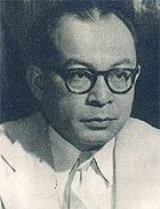
Mohammad Hatta

Encyclopedia
was born in Bukittinggi
, West Sumatra
, Dutch East Indies
(now Indonesia
). He was Indonesia's first vice president, later also serving as the country's Prime Minister. Known as "The Proclamator", he and a number of Indonesians, including the first president of Indonesia, Sukarno
, fought for the independence of Indonesia from the Dutch
. Despite his efforts to gain Indonesian independence, he studied in the Netherlands
from 1921 until 1932. Moreover, after his early education, he studied in Dutch schools in Indonesia.
Mohammad Hatta is often remembered as Bung Hatta ('Bung' is an affectionate title used to address colleagues, popular in the early 1900s and is still used by Indonesians).
on 12 August 1902 into a prominent and strongly Islam
ic family. His grandfather was a respected ulema
in Batuhampar
, near Payakumbuh
. His father, Haji Mohammad Djamil, died when he was eight months old and he was left with his six sisters and his mother. As in the matrilineal society of Minangkabau tradition, he was then raised in his mother's family. His mother's family was wealthy, and Hatta was able to study Dutch
as well as finishing Qur'an
after school.
He went to the Dutch language elementary school
(ELS or Europeesche Lagere School) in Padang
from 1913 to 1916 after he had finished Sekolah Melayu ('Malay
School') in Bukittinggi. When he was thirteen, he passed an exam that entitled him to enroll in the Dutch secondary school
(HBS or Hogere burgerschool) in Batavia (now Jakarta
). However his mother asked him to stay in Padang because he was still too young to go to the capital alone. Hatta then entered junior secondary school or MULO (Meer Uitgebreid Lager Onderwijs).
During his spare time, he worked part time in a post office
. Normally, MULO students were not allowed to work, but he was able to work there because of the HBS exam qualification. Hatta was interested in football; he joined his school's football team and was made its chairman. He broadened his sphere of contacts by using his position.
Hatta used to visit the office of the Sarikat Usaha (United Endeavor), led by Taher Marah Soetan. In the office, he read Dutch newspapers, particularly about political debates in the Volksraad (parliament
) of the Dutch East Indies
. It was at the age of sixteen that Hatta began to be interested in politics
and national movements. He was chosen the treasurer
of the branch of the Jong Sumatranen Bond (or youth association of Sumatra), which was first established in Padang in 1918.
in Rotterdam
, the Netherlands
. He took economics
as his major and earned a doctorandus
degree in 1932. The degree entitled him to follow a doctorate
program. He then continued to pursue the doctorate degree, and completed all requirements to be awarded it, but he never finished his thesis
. Politics had taken over Hatta's life.
In the Netherlands, Hatta joined the Indische Vereniging (or the Netherlands Indies Union). In 1922, the organization changed its name to Indonesische Vereniging and later to the Perhimpunan Indonesia (the same meaning but in Indonesian
). Hatta was the treasurer (1922—1925), and then the chairman (1926—1930). On his inauguration, Hatta delivered a speech with the title of "The Structure of the Global Economy and the Conflict of Power", in which he supported the idea of Indonesian non-cooperation with the Dutch colonial government in order to gain its independence
. Perhimpunan Indonesia then changed from being a from student organization into a political organization and had an unequivocal demand for Indonesia's independence. It expressed its voice through the a magazine called Indonesia Merdeka (or Free Indonesia) of which Hatta was the editor.
To gain more support from other nations, Hatta attended congresses all over Europe, always as the chairman of the Indonesian delegation. In 1926, Hatta and Perhimpunan Indonesia joined the International Democratic Congress for Peace in Bierville
, France
. In February 1927, Hatta went to Brussels
to attend a congress held by the League Against Imperialism and Colonial Oppression. He met many other prominent nationalists there, including Jawaharlal Nehru
from India
, Hafiz Ramadan Bey from Egypt
and Lamine Senghor from Africa. Later in the year, Hatta attended another congress held by the International Women's League for Peace and Freedom in Switzerland
. On that occasion, Hatta delivered a speech with the title of "Indonesia and the Matter of Independence".
By the middle of 1927, Perhimpunan Indonesias activities had alarmed the Dutch authorities. In June 1927, Dutch authorities raided the residence of the organization's leaders, searching through their rooms and putting Hatta and other four other Indonesian activists behind bars. After spending nearly six months in prison, they were taken to trial in the Hague. They were permitted to explain themselves during the hearing, and Hatta took to the opportunity to explain Indonesia's nationalist cause. He made a speech to the court explaining that Indonesia's interests were in conflict with those of the Dutch, and that was why they could not cooperate. Hatta advocated cooperation between Indonesia and the Netherlands, but only if Indonesia was independent and treated as an equal partner, not unequally because of its status as a colony. The speech became famous and it is known as the Indonesia Vrij or Free Indonesia speech.
In 1929, Hatta and other Perhimpunan Indonesia activists were released. They then joined forces with the Indonesian-based nationalist, Sukarno
and his Indonesian National Party
(PNI). Together, Hatta and Sukarno set up a cadre school to train people with nationalistic interests.In the school, potential cadres were trained in economics, the history of the nationalist movement and in the government administration. In July 1932, Hatta made his way home to Indonesia.
In December 1932, Sukarno was finally released from prison and the attention now turned to which party Sukarno would choose. Sukarno, who had wanted one united front to gain Indonesia's independence was uncertain, thinking that in choosing one over the other, he would encourage division. In this, he was criticized by Hatta, who was more pragmatic about differences, in this case the conflict between Partindo's radical and mass party approach versus the New PNI's moderate and cadre party approach. Sukarno insisted on negotiations to unify Partindo and New PNI but after failing, chose to join Partindo.
Between 1932 and 1933, Hatta wrote articles on politics and economics for the New PNI's newspaper Daulat Rakyat (The People's Authority). These articles were aimed at training new cadres for Indonesia's leadership.
Hatta seemed to be extremely critical of Sukarno at this point in time. In August 1933, with Sukarno once again arrested and facing trial, he wrote an article called "Sukarno Is Arrested". This was followed by articles entitled "The Tragedy of Sukarno" (November 1933) and "The Stance of a Leader" (December 1933).
The Dutch Colonial Government gave Sukarno a harsh punishment, exiling him to Ende on the island of Flores in December 1933. With Sukarno in exile, the Dutch Colonial Government now turned their eyes to the New PNI and its leadership. In February 1934, they made their move and arrested its leaders from its Jakarta branch (which included Hatta) and its Bandung branch. For a year they were jailed at prisons in Cipinang and Glodok, with Hatta spending his time in Glodok. During his time in prison, Hatta wrote a book entitled "The Economical Crisis and Capitalism".
In January 1935, it was decided that Hatta and his fellow New PNI leaders (including Syahrir) would be exiled to Boven Digoel in Papua. When Hatta arrived there, he was told by the local authorities that he had two options. The first option was to work for the Dutch Colonial Government as a civil servant for 40 cents a day with the hope of returning from exile, and the second option was being an exile, receiving food but having no hope of returning from exile. Hatta commented if he had decided to take a job as a civil servant in Jakarta, he would have earned a lot of money and knowing that, there was no need to go to Boven Digoel to be paid cheaply. In saying this, Hatta chose the second option.
During his exile, Hatta continued to write articles, this time for the Newspaper Pemandangan (The View). He earned enough money from that to make ends meet at Boven Digoel and to support his colleagues who had financial troubles. Hatta also used his books (which filled 16 chests when they were packed to leave Jakarta) to give his colleagues lessons on economics, history, and philosophy
. Later on these lessons would be made into books entitled "An Introduction on the Way to Knowledge" and "The Nature of Greek Thought" (four volumes).
In January 1936, Hatta and Syahrir were transferred to Bandaneira in Maluku. There they joined more nationalists such as Iwa Kusumasumantri and Dr. Cipto Mangunkusumo. Hatta and Syahrir were given more freedom and were able to interact with the locals. Hatta and Syahrir also gave lessons to the local children, teaching them about politics and history. Hatta adopted a local boy, Des Alwi
, as his son while living in Bandaneira. Alwi would become a prominent Indonesian historian
and diplomat
.
In February 1942, Hatta and Syahrir were transferred to Sukabumi
in West Java.
was well under way and the Empire of Japan
was fulfilling its imperial ambitions in East Asia and South East Asia. In March 1942, they began landing in Indonesia. Like their counterpart in Europe, the Dutch Colonial Government crumbled in the face of the invaders and by 9 March 1942, surrendered. On 22 March 1942, Hatta and Syahrir were again transferred to Jakarta.
In Jakarta, Hatta met with Major General
Harada, the Interim Head of Government. Harada asked Hatta to become an advisor for the occupational Government. Hatta accepted the job and then asked Harada if Japan was here to colonize Indonesia. Harada assured Hatta that Japan would not do. In Hatta's eyes, an acknowledgement of an Indonesian Independence by Japan was extremely important. If Japan, with its ultra-nationalistic ideology was able to recognize Indonesia's independence, it would put more pressure on the Allies
(especially America and the United Kingdom) as representatives of democracy to do the same thing.
In July 1942, Hatta was reunited with Sukarno who after Flores had been transferred to Sumatra before the Japanese arrived, and had also been asked for his services. Although they had left off on a bad note, Sukarno wanted to speak with Hatta before speaking with anyone else. In a secret meeting at Hatta's Jakarta home Sukarno, Hatta and Sjahrir agreed that Sjahrir would go underground to organise the revolutionary resistance while the other 2 would commence their cooperation with the Japanese occupier.
Hatta and Sukarno now had the common goal of working with the Japanese and then trying to achieve independence from them. Together with Ki Hadjar Dewantoro and Muhammadiyah
Chairman, Kiai Haji Mas Mansur, Hatta and Sukarno formed a quattuorvirate of leaders tasked by the Japanese occupational Government as their intermediary with the Indonesian people.
Hatta together with the other members of the quattuorvirate worked with much fervor under the Japanese Government. They echoed Japanese propaganda and presented the Japanese Empire
as the protector, leader, and the light of Asia. At the same time however, Hatta continued to promote Indonesia's desire for independence. In a speech in December 1942, Hatta said that Indonesia had been freed from the Dutch Colonial Government, but if they were freed only to be colonized by another power, he would rather see Indonesia drown to the bottom of the ocean.
On 9 March 1943, the Japanese Occupational Government approved the formation of the Centre of People's Power (Putera) with Hatta and the other quattuorvirate as the co-Chairmen of the association. Sukarno thought that this would be a way from which they could gain support for independence, instead the Japanese used this to their own cause and to start their romusha
(forced labour) regime in Indonesia.
In November 1943, Hatta and Sukarno's efforts in cooperating with the Japanese Occupational Government was recognized by Emperor Hirohito
who decorated them with awards in Tokyo
.
As the tide of the war began to turn against the Japanese, the Japanese Occupational Government in Indonesia became desperate to maintain control. Putera was disbanded and replaced with Djawa Hokokai in March 1944. Although still Chaired by Sukarno, the Indonesians had less freedom of movement than they had had in Putera. When defeat began looming on the horizon, Prime Minister
Koiso announced in September 1944 that Japan would grant Indonesia its independence in the near future.
From then on, momentum began to gather for the independence of Indonesia, fuelled by the nationalist sentiments of Indonesians and supported by sympathizers from Japan such as Rear Admiral
Maeda. In Maeda's case, he even set up a discussion forum called the Free Indonesia Centre and invited Hatta and Sukarno along to deliver lectures on nationalism. This was followed in April 1945, by the formation of the Investigative Body for the Preparation of Indonesian Independence (BPUPKI). BPUPKI would meet over the next three months and would decide on things such as the constitution and which territories would be part of Indonesia.
Hatta and Sukarno returned to Indonesia on 14 August. In Hatta's case, Syahrir was waiting for him with news of the atomic bombs in Hiroshima
and Nagasaki. Syahrir told Hatta that they would have to encourage Sukarno to proclaim Indonesia's independence immediately, because in a couple of days the Japanese might not be there to provide supervision. Syahrir told Hatta not to worry about the Japanese authorities because the people would be on their side.
Syahrir and Hatta then went to see Sukarno, with Syahrir repeating his argument in front of Sukarno. Hatta then spoke out, saying that he was worried the Allies would see them as Japanese collaborators. Sukarno shared this sentiment and Syahrir left the meeting out of frustration.
The next day, on 15 August 1945, Japan surrendered
to the Allies. In Indonesia, the news was only a rumor and had not been confirmed. Hatta and Sukarno went to the office of the Japanese Occupational Government in Jakarta, only to find it empty. Hatta and Sukarno then went to Maeda who confirmed that Japan had surrendered to the Allies. Hatta and Sukarno seemed shocked that Japan had surrendered. During the afternoon, Hatta and Sukarno were confronted by Indonesian youths who wanted independence to be proclaimed as soon as possible. A heated exchange followed, with Sukarno telling the youths to have more patience. Hatta, who was aware of his and Sukarno's superiority in the exchange, sarcastically commented on the youths' inability to proclaim independence without Sukarno.
On the morning of 16 August 1945, the Indonesian youths kidnapped both Hatta and Sukarno and took them to the town of Rengasdengklok where they continued trying to force Hatta and Sukarno to declare independence, but without success. In Jakarta, there was panic as PPKI was due to start meeting that day and had planned to elect Sukarno as Chairman and Hatta as Vice-Chairman. When knowledge of Hatta and Sukarno's whereabouts became available and the Japanese surrender was confirmed, Achmad Subardjo, a PPKI representative, went to Rengasdengklok to break the news to Hatta and Sukarno. That night, Hatta and Sukarno returned to Jakarta where, at Maeda's house, they worked on the Proclamation of Independence
.
Finally, on 17 August 1945, at Sukarno's residence, Indonesia's Independence was finally proclaimed in a short statement on paper signed by both Sukarno and Hatta.
As Vice President, Hatta quickly established himself as the day-to-day administrator of the government, with Sukarno setting government policy and then trying to win support for it. Although they had different styles of governing, many agree that the style difference complimented both men's talents perfectly. They were nicknamed the Duumvirate (Dwitunggal) and until today are hailed by many as the best President and Vice President partnership in Indonesia's history.
Hatta would make three important decisions in the republic's early days. In October, Hatta gave the Central National Committee of Indonesia (KNIP) legislative powers in addition to its advisory role to the president. In the same month, Hatta also authorized the formation of political parties
in Indonesia. The next month, in November, Hatta also made the decision which took away the president's role as Head of Government
and transferred it to a prime minister. Hatta was able to make these crucial decisions because Sukarno was unable to attend the meetings in question, leaving Hatta in charge. For his part, Sukarno did not seem to have to problem with Hatta's decisions, at least not during the War of Independence.
and Adam Malik
.
In January 1946, Hatta and Sukarno moved to Yogyakarta
, leaving Syahrir (who was by then prime minister) to head negotiations in Jakarta.
By the end of 1946, the diplomatic solution which Hatta and Sukarno had been looking for seemed to have been found. The Linggadjati Agreement
, signed in November 1946 called for Dutch recognition of the Republic of Indonesia. However, territorial recognition would only be over Java, Sumatra, and Madura. In addition, this republic would be part of a United States of Indonesia with the Queen of the Netherlands acting as the Head of State
. However, before the agreement was finally ratified by the Dutch House of Representatives, some compromises were made without the consent of the republic. In turn, Indonesia refused to implement its part of the deal, resulting in the first "Police Action" in July 1947.
During this time, Hatta was sent out of the country to look for support for Indonesia. One country that he went to was India, the homeland of his old friend, Nehru. Disguised as an airplane co-pilot, Hatta sneaked out of the country to ask for assistance. There he asked Nehru and Mahatma Gandhi
for help. Nehru assured him that India would support Indonesia and would make the support known at international forums such as the United Nations
(UN).
In December 1947, negotiations were held aboard USS Renville and an agreement
was signed in January 1948. This agreement was more favorable towards the Dutch and called for the republic to recognize the territories which the Dutch had taken during the first "Police Action". The agreement caused outrage and caused Amir Syarifuddin to resign from his position as prime minister.
To replace Syarifuddin, Sukarno appointed Hatta as Prime Minister and declared that the cabinet would be an emergency one and would be answerable to the President instead of the KNIP. Hatta also took on the position of minister of defense.
As Prime Minister, Hatta had to make an unpopular decision. In August 1948, with the Republic struggling to pay its troops
, Hatta was forced to demobilize some soldiers.
In December 1948, the Dutch launched their second "Police Action" and focused their attack on Yogyakarta. Hatta and Sukarno, instead of running away to fight guerilla warfare chose to remain in the city and were arrested. Sukarno transferred authority to the Emergency Government of the Republic of Indonesia
(PDRI), before going into exile with all the other Republican leaders. Hatta was sent to Bangka.
Resistance continued under General Sudirman
and TNI troops who fought a guerrilla war against the Dutch. In March, Sultan Hamengkubuwono IX organized 1 March General Offensive, in which the city of Yogyaharta was held by Indoneisna forces for six hours. This played an important role in causing international pressure to be put on the Netherlands. In May 1949, the Roem-Royen agreement was signed and the Netherlands promised to return the leaders of the Republican Government. In July 1949, Hatta and Sukarno made their return to Yogyakarta.
In August 1949, Hatta headed a delegation to the Hague for a Round Table conference
. In November 1949, the formation of the United States of Indonesia was finally agreed. It was to be a federation consisting of the Republic and 15 States which the Dutch had created during the National Revolution
. The Queen of the Netherlands would continue to become the symbolic Head of State while Sukarno and Hatta would continue as President and Vice President. On 27 December 1949, the Dutch authorities finally recognized Indonesian sovereignty.
 Hatta continued on as the Prime Minister of the United States of Indonesia and presided over the transition of the federal state to the unitary state, which was made official on 17 August 1950.
which advocated parliamentary democracy and reduced the president to the role of a ceremonial head of state. That left Hatta with little to do as vice president, especially since his term as prime minister was not renewed.
For his remaining time as vice president, Hatta was regularly invited to deliver lectures in universities. He also engaged in intellectual pursuits, writing essays and books about topics such as the economy and cooperatives. The idea of cooperatives being an integral part of economy would become a pet project for Hatta and he would become an enthusiastic promoter of the idea. In July 1951, on the occasion of Cooperatives Day, Hatta went on the radio to deliver a speech on cooperatives. In 1953, Hatta's contribution towards promoting cooperatives was recognized and he was given the title "Father of Indonesian Cooperatives" at the Indonesian Cooperative Congress.
In 1948, Hatta delivered a speech called "Rowing Between Two Rocks". In it, he referred to the Cold War
and the conflict between the United States
and the Soviet Union
. Hatta said that Indonesian foreign policy has to look after its own interest first, not that of the US and the USSR. In saying this, Hatta wanted Indonesia to be independent in deciding its stance during the Cold War. Hatta also added that Indonesia should be an active participant in world politics so that once again it would be Indonesia's interests that came first.
This doctrine, which would become known as the "Independent and Active" doctrine, continues to be the basis of Indonesian foreign policy.
(DPR) as well as the Constitutional Assembly, a body commissioned to create a new constitution, were formed as a result of the year's legislative
and assembly elections
, he would retire from the vice presidency. He announced this intention in a letter to Sukarno.
On the surface, it seemed as if Hatta was retiring for practical reasons. Because the presidency was a ceremonial role, this made the office of vice president pointless, and Hatta thought that the country was wasting a lot of money paying his wages. There were also personal reasons, however. As a man who believed in democracy, Hatta was beginning to feel disillusioned with Sukarno's increasing autocracy and authoritarianism. Hatta had continued to advise Sukarno against taking this road but he was ignored. Hatta finally gave up and thought that he could no longer work with Sukarno.
On 1 December 1956, Hatta resigned from the Vice Presidency.
The impact of Hatta's retirement was evident in the Revolutionary Government of the Republic of Indonesia
(PRRI) rebellion which wanted to break free from Indonesia, and the Universal Struggle (Permesta
) movement, which asked for decentralization. In negotiations with the central government, both PRRI and Permesta listed the reunification of the Sukarno/Hatta leadership as one of the concessions that they wanted from the central government.
In 1960, Hatta wrote a book called "Our Democracy". In it, he criticized Sukarno's Guided Democracy as another form of dictatorship. Sukarno immediately banned the books. The same year Sjahrir's political party was banned and 2 years later he was imprisoned on conspiracy charges. Hatta wrote a personal letter to Sukarno calling the arrest 'colonial' and 'non-rational', but to no avail. The old revolutionary trinity had definitively broken down.
coup attempt of 1965 to be cleared up and for Sukarno to be given a chance to defend his actions, as many believed that he was not guilty.
In July 1978, together with Abdul Haris Nasution
, Hatta set up the Institute for Constitutional Awareness Foundation (YLKB), set up to act as a forum for critics of Suharto's regime. Suharto's government moved quickly and did not allow YLKB to conduct its first meeting in January 1979. The YLKB did not give up. In August 1979, it managed to hold a meeting which DPR members attended. Perhaps significantly, members of the Indonesian Military
members also attended. During the meeting, Nasution criticized the New Order
for not fully implementing the Pancasila state ideology and the 1945 Constitution
.
Bukittinggi
Bukittinggi is one of the larger cities in West Sumatra, Indonesia, with a population of over 91,000 people and an area of 25.24 km². It is situated in the Minangkabau highlands, 90 km by road from the West Sumatran capital city of Padang. It is located at , near the volcanoes Mount...
, West Sumatra
West Sumatra
West Sumatra is a province of Indonesia. It lies on the west coast of the island Sumatra. It borders the provinces of North Sumatra to the north, Riau and Jambi to the east, and Bengkulu to the southeast. It includes the Mentawai Islands off the coast...
, Dutch East Indies
Dutch East Indies
The Dutch East Indies was a Dutch colony that became modern Indonesia following World War II. It was formed from the nationalised colonies of the Dutch East India Company, which came under the administration of the Netherlands government in 1800....
(now Indonesia
Indonesia
Indonesia , officially the Republic of Indonesia , is a country in Southeast Asia and Oceania. Indonesia is an archipelago comprising approximately 13,000 islands. It has 33 provinces with over 238 million people, and is the world's fourth most populous country. Indonesia is a republic, with an...
). He was Indonesia's first vice president, later also serving as the country's Prime Minister. Known as "The Proclamator", he and a number of Indonesians, including the first president of Indonesia, Sukarno
Sukarno
Sukarno, born Kusno Sosrodihardjo was the first President of Indonesia.Sukarno was the leader of his country's struggle for independence from the Netherlands and was Indonesia's first President from 1945 to 1967...
, fought for the independence of Indonesia from the Dutch
Dutch East Indies
The Dutch East Indies was a Dutch colony that became modern Indonesia following World War II. It was formed from the nationalised colonies of the Dutch East India Company, which came under the administration of the Netherlands government in 1800....
. Despite his efforts to gain Indonesian independence, he studied in the Netherlands
Netherlands
The Netherlands is a constituent country of the Kingdom of the Netherlands, located mainly in North-West Europe and with several islands in the Caribbean. Mainland Netherlands borders the North Sea to the north and west, Belgium to the south, and Germany to the east, and shares maritime borders...
from 1921 until 1932. Moreover, after his early education, he studied in Dutch schools in Indonesia.
Mohammad Hatta is often remembered as Bung Hatta ('Bung' is an affectionate title used to address colleagues, popular in the early 1900s and is still used by Indonesians).
Early life
Hatta was born in BukittinggiBukittinggi
Bukittinggi is one of the larger cities in West Sumatra, Indonesia, with a population of over 91,000 people and an area of 25.24 km². It is situated in the Minangkabau highlands, 90 km by road from the West Sumatran capital city of Padang. It is located at , near the volcanoes Mount...
on 12 August 1902 into a prominent and strongly Islam
Islam
Islam . The most common are and . : Arabic pronunciation varies regionally. The first vowel ranges from ~~. The second vowel ranges from ~~~...
ic family. His grandfather was a respected ulema
Ulema
Ulama , also spelt ulema, refers to the educated class of Muslim legal scholars engaged in the several fields of Islamic studies. They are best known as the arbiters of shari‘a law...
in Batuhampar
Batuhampar
Batuhampar is a village at Kab 50 Kota near Payakumbuh City in West Sumatra...
, near Payakumbuh
Payakumbuh
Payakumbuh is a city north-east of Bukittinggi , Indonesia. It has an area of 80.43 km² and a population of over 99,300 people. Literally translated, the city name means "grassy swamp"....
. His father, Haji Mohammad Djamil, died when he was eight months old and he was left with his six sisters and his mother. As in the matrilineal society of Minangkabau tradition, he was then raised in his mother's family. His mother's family was wealthy, and Hatta was able to study Dutch
Dutch language
Dutch is a West Germanic language and the native language of the majority of the population of the Netherlands, Belgium, and Suriname, the three member states of the Dutch Language Union. Most speakers live in the European Union, where it is a first language for about 23 million and a second...
as well as finishing Qur'an
Qur'an
The Quran , also transliterated Qur'an, Koran, Alcoran, Qur’ān, Coran, Kuran, and al-Qur’ān, is the central religious text of Islam, which Muslims consider the verbatim word of God . It is regarded widely as the finest piece of literature in the Arabic language...
after school.
He went to the Dutch language elementary school
Elementary school
An elementary school or primary school is an institution where children receive the first stage of compulsory education known as elementary or primary education. Elementary school is the preferred term in some countries, particularly those in North America, where the terms grade school and grammar...
(ELS or Europeesche Lagere School) in Padang
Padang, Indonesia
Padang is the capital and largest city of West Sumatra, Indonesia. It is located on the western coast of Sumatra at . It has an area of and a population of over 833,000 people at the 2010 Census.-History:...
from 1913 to 1916 after he had finished Sekolah Melayu ('Malay
Malay language
Malay is a major language of the Austronesian family. It is the official language of Malaysia , Indonesia , Brunei and Singapore...
School') in Bukittinggi. When he was thirteen, he passed an exam that entitled him to enroll in the Dutch secondary school
Secondary school
Secondary school is a term used to describe an educational institution where the final stage of schooling, known as secondary education and usually compulsory up to a specified age, takes place...
(HBS or Hogere burgerschool) in Batavia (now Jakarta
Jakarta
Jakarta is the capital and largest city of Indonesia. Officially known as the Special Capital Territory of Jakarta, it is located on the northwest coast of Java, has an area of , and a population of 9,580,000. Jakarta is the country's economic, cultural and political centre...
). However his mother asked him to stay in Padang because he was still too young to go to the capital alone. Hatta then entered junior secondary school or MULO (Meer Uitgebreid Lager Onderwijs).
During his spare time, he worked part time in a post office
Post office
A post office is a facility forming part of a postal system for the posting, receipt, sorting, handling, transmission or delivery of mail.Post offices offer mail-related services such as post office boxes, postage and packaging supplies...
. Normally, MULO students were not allowed to work, but he was able to work there because of the HBS exam qualification. Hatta was interested in football; he joined his school's football team and was made its chairman. He broadened his sphere of contacts by using his position.
Hatta used to visit the office of the Sarikat Usaha (United Endeavor), led by Taher Marah Soetan. In the office, he read Dutch newspapers, particularly about political debates in the Volksraad (parliament
Parliament
A parliament is a legislature, especially in those countries whose system of government is based on the Westminster system modeled after that of the United Kingdom. The name is derived from the French , the action of parler : a parlement is a discussion. The term came to mean a meeting at which...
) of the Dutch East Indies
Dutch East Indies
The Dutch East Indies was a Dutch colony that became modern Indonesia following World War II. It was formed from the nationalised colonies of the Dutch East India Company, which came under the administration of the Netherlands government in 1800....
. It was at the age of sixteen that Hatta began to be interested in politics
Politics
Politics is a process by which groups of people make collective decisions. The term is generally applied to the art or science of running governmental or state affairs, including behavior within civil governments, but also applies to institutions, fields, and special interest groups such as the...
and national movements. He was chosen the treasurer
Treasurer
A treasurer is the person responsible for running the treasury of an organization. The adjective for a treasurer is normally "tresorial". The adjective "treasurial" normally means pertaining to a treasury, rather than the treasurer.-Government:...
of the branch of the Jong Sumatranen Bond (or youth association of Sumatra), which was first established in Padang in 1918.
Time in the Netherlands
In 1919, Hatta finally went to the HBS in Batavia. He completed his study with distinction in 1921, and was allowed to continue to study at the Rotterdam School of CommerceErasmus University
Erasmus University Rotterdam is a university in the Netherlands, located in Rotterdam. The university is named after Desiderius Erasmus Roterodamus, a 15th century humanist and theologian...
in Rotterdam
Rotterdam
Rotterdam is the second-largest city in the Netherlands and one of the largest ports in the world. Starting as a dam on the Rotte river, Rotterdam has grown into a major international commercial centre...
, the Netherlands
Netherlands
The Netherlands is a constituent country of the Kingdom of the Netherlands, located mainly in North-West Europe and with several islands in the Caribbean. Mainland Netherlands borders the North Sea to the north and west, Belgium to the south, and Germany to the east, and shares maritime borders...
. He took economics
Economics
Economics is the social science that analyzes the production, distribution, and consumption of goods and services. The term economics comes from the Ancient Greek from + , hence "rules of the house"...
as his major and earned a doctorandus
Doctorandus
Doctorandus is a Dutch academic title according to the pre-bachelor-master system. The title is acquired by passing the doctoraalexamen, traditionally a matriculation exam for admission to study at doctoral level....
degree in 1932. The degree entitled him to follow a doctorate
Doctorate
A doctorate is an academic degree or professional degree that in most countries refers to a class of degrees which qualify the holder to teach in a specific field, A doctorate is an academic degree or professional degree that in most countries refers to a class of degrees which qualify the holder...
program. He then continued to pursue the doctorate degree, and completed all requirements to be awarded it, but he never finished his thesis
Thesis
A dissertation or thesis is a document submitted in support of candidature for an academic degree or professional qualification presenting the author's research and findings...
. Politics had taken over Hatta's life.
In the Netherlands, Hatta joined the Indische Vereniging (or the Netherlands Indies Union). In 1922, the organization changed its name to Indonesische Vereniging and later to the Perhimpunan Indonesia (the same meaning but in Indonesian
Indonesian language
Indonesian is the official language of Indonesia. Indonesian is a normative form of the Riau Islands dialect of Malay, an Austronesian language which has been used as a lingua franca in the Indonesian archipelago for centuries....
). Hatta was the treasurer (1922—1925), and then the chairman (1926—1930). On his inauguration, Hatta delivered a speech with the title of "The Structure of the Global Economy and the Conflict of Power", in which he supported the idea of Indonesian non-cooperation with the Dutch colonial government in order to gain its independence
Independence
Independence is a condition of a nation, country, or state in which its residents and population, or some portion thereof, exercise self-government, and usually sovereignty, over its territory....
. Perhimpunan Indonesia then changed from being a from student organization into a political organization and had an unequivocal demand for Indonesia's independence. It expressed its voice through the a magazine called Indonesia Merdeka (or Free Indonesia) of which Hatta was the editor.
To gain more support from other nations, Hatta attended congresses all over Europe, always as the chairman of the Indonesian delegation. In 1926, Hatta and Perhimpunan Indonesia joined the International Democratic Congress for Peace in Bierville
Bierville
Bierville is a commune in the Seine-Maritime department in the Haute-Normandie region in northern France.-Geography:A small farming village situated in the Pays de Bray some northeast of Rouen, at the junction of the D90 and the D213 roads.-Population:...
, France
France
The French Republic , The French Republic , The French Republic , (commonly known as France , is a unitary semi-presidential republic in Western Europe with several overseas territories and islands located on other continents and in the Indian, Pacific, and Atlantic oceans. Metropolitan France...
. In February 1927, Hatta went to Brussels
Brussels
Brussels , officially the Brussels Region or Brussels-Capital Region , is the capital of Belgium and the de facto capital of the European Union...
to attend a congress held by the League Against Imperialism and Colonial Oppression. He met many other prominent nationalists there, including Jawaharlal Nehru
Jawaharlal Nehru
Jawaharlal Nehru , often referred to with the epithet of Panditji, was an Indian statesman who became the first Prime Minister of independent India and became noted for his “neutralist” policies in foreign affairs. He was also one of the principal leaders of India’s independence movement in the...
from India
India
India , officially the Republic of India , is a country in South Asia. It is the seventh-largest country by geographical area, the second-most populous country with over 1.2 billion people, and the most populous democracy in the world...
, Hafiz Ramadan Bey from Egypt
Egypt
Egypt , officially the Arab Republic of Egypt, Arabic: , is a country mainly in North Africa, with the Sinai Peninsula forming a land bridge in Southwest Asia. Egypt is thus a transcontinental country, and a major power in Africa, the Mediterranean Basin, the Middle East and the Muslim world...
and Lamine Senghor from Africa. Later in the year, Hatta attended another congress held by the International Women's League for Peace and Freedom in Switzerland
Switzerland
Switzerland name of one of the Swiss cantons. ; ; ; or ), in its full name the Swiss Confederation , is a federal republic consisting of 26 cantons, with Bern as the seat of the federal authorities. The country is situated in Western Europe,Or Central Europe depending on the definition....
. On that occasion, Hatta delivered a speech with the title of "Indonesia and the Matter of Independence".
By the middle of 1927, Perhimpunan Indonesias activities had alarmed the Dutch authorities. In June 1927, Dutch authorities raided the residence of the organization's leaders, searching through their rooms and putting Hatta and other four other Indonesian activists behind bars. After spending nearly six months in prison, they were taken to trial in the Hague. They were permitted to explain themselves during the hearing, and Hatta took to the opportunity to explain Indonesia's nationalist cause. He made a speech to the court explaining that Indonesia's interests were in conflict with those of the Dutch, and that was why they could not cooperate. Hatta advocated cooperation between Indonesia and the Netherlands, but only if Indonesia was independent and treated as an equal partner, not unequally because of its status as a colony. The speech became famous and it is known as the Indonesia Vrij or Free Indonesia speech.
In 1929, Hatta and other Perhimpunan Indonesia activists were released. They then joined forces with the Indonesian-based nationalist, Sukarno
Sukarno
Sukarno, born Kusno Sosrodihardjo was the first President of Indonesia.Sukarno was the leader of his country's struggle for independence from the Netherlands and was Indonesia's first President from 1945 to 1967...
and his Indonesian National Party
Indonesian National Party
The Indonesian National Party is the same used by several political parties in Indonesia from 1927 until the present day.-Pre-independence:...
(PNI). Together, Hatta and Sukarno set up a cadre school to train people with nationalistic interests.In the school, potential cadres were trained in economics, the history of the nationalist movement and in the government administration. In July 1932, Hatta made his way home to Indonesia.
Struggle against Dutch colonial rule
Hatta returned home to an Indonesia whose nationalist momentum had been slowed down by the arrest and imprisonment of Sukarno. By the time Hatta had returned, most of the members of Sukarno's PNI had joined the Indonesian Party (Partindo) and more radical PNI members, together with the Dutch-educated Sutan Syahrir had banded together to form the New PNI. Although the initials were the same, the PNI in this case stood for the Indonesian National Education, indicating that it would focus on cadre training. In August 1932, after returning from the Netherlands, Hatta became the Chairman of the New PNI.In December 1932, Sukarno was finally released from prison and the attention now turned to which party Sukarno would choose. Sukarno, who had wanted one united front to gain Indonesia's independence was uncertain, thinking that in choosing one over the other, he would encourage division. In this, he was criticized by Hatta, who was more pragmatic about differences, in this case the conflict between Partindo's radical and mass party approach versus the New PNI's moderate and cadre party approach. Sukarno insisted on negotiations to unify Partindo and New PNI but after failing, chose to join Partindo.
Between 1932 and 1933, Hatta wrote articles on politics and economics for the New PNI's newspaper Daulat Rakyat (The People's Authority). These articles were aimed at training new cadres for Indonesia's leadership.
Hatta seemed to be extremely critical of Sukarno at this point in time. In August 1933, with Sukarno once again arrested and facing trial, he wrote an article called "Sukarno Is Arrested". This was followed by articles entitled "The Tragedy of Sukarno" (November 1933) and "The Stance of a Leader" (December 1933).
The Dutch Colonial Government gave Sukarno a harsh punishment, exiling him to Ende on the island of Flores in December 1933. With Sukarno in exile, the Dutch Colonial Government now turned their eyes to the New PNI and its leadership. In February 1934, they made their move and arrested its leaders from its Jakarta branch (which included Hatta) and its Bandung branch. For a year they were jailed at prisons in Cipinang and Glodok, with Hatta spending his time in Glodok. During his time in prison, Hatta wrote a book entitled "The Economical Crisis and Capitalism".
In January 1935, it was decided that Hatta and his fellow New PNI leaders (including Syahrir) would be exiled to Boven Digoel in Papua. When Hatta arrived there, he was told by the local authorities that he had two options. The first option was to work for the Dutch Colonial Government as a civil servant for 40 cents a day with the hope of returning from exile, and the second option was being an exile, receiving food but having no hope of returning from exile. Hatta commented if he had decided to take a job as a civil servant in Jakarta, he would have earned a lot of money and knowing that, there was no need to go to Boven Digoel to be paid cheaply. In saying this, Hatta chose the second option.
During his exile, Hatta continued to write articles, this time for the Newspaper Pemandangan (The View). He earned enough money from that to make ends meet at Boven Digoel and to support his colleagues who had financial troubles. Hatta also used his books (which filled 16 chests when they were packed to leave Jakarta) to give his colleagues lessons on economics, history, and philosophy
Philosophy
Philosophy is the study of general and fundamental problems, such as those connected with existence, knowledge, values, reason, mind, and language. Philosophy is distinguished from other ways of addressing such problems by its critical, generally systematic approach and its reliance on rational...
. Later on these lessons would be made into books entitled "An Introduction on the Way to Knowledge" and "The Nature of Greek Thought" (four volumes).
In January 1936, Hatta and Syahrir were transferred to Bandaneira in Maluku. There they joined more nationalists such as Iwa Kusumasumantri and Dr. Cipto Mangunkusumo. Hatta and Syahrir were given more freedom and were able to interact with the locals. Hatta and Syahrir also gave lessons to the local children, teaching them about politics and history. Hatta adopted a local boy, Des Alwi
Des Alwi
Des Alwi Abubakar was an Indonesian historian, diplomat, writer and advocate of the Banda Islands. He was the adopted son of Mohammad Hatta, the first Vice President of Indonesia, whom he called "Oom Kacamata" .Alwi was born on November 17, 1927, on Banda Neira, the largest of the Banda Islands in...
, as his son while living in Bandaneira. Alwi would become a prominent Indonesian historian
Historian
A historian is a person who studies and writes about the past and is regarded as an authority on it. Historians are concerned with the continuous, methodical narrative and research of past events as relating to the human race; as well as the study of all history in time. If the individual is...
and diplomat
Diplomat
A diplomat is a person appointed by a state to conduct diplomacy with another state or international organization. The main functions of diplomats revolve around the representation and protection of the interests and nationals of the sending state, as well as the promotion of information and...
.
In February 1942, Hatta and Syahrir were transferred to Sukabumi
Sukabumi
Sukabumi is a city surrounded by the regency of the same name in the highlands of West Java, Indonesia, about south of the national capital, Jakarta....
in West Java.
Japanese occupation
By 1942, World War IIWorld War II
World War II, or the Second World War , was a global conflict lasting from 1939 to 1945, involving most of the world's nations—including all of the great powers—eventually forming two opposing military alliances: the Allies and the Axis...
was well under way and the Empire of Japan
Empire of Japan
The Empire of Japan is the name of the state of Japan that existed from the Meiji Restoration on 3 January 1868 to the enactment of the post-World War II Constitution of...
was fulfilling its imperial ambitions in East Asia and South East Asia. In March 1942, they began landing in Indonesia. Like their counterpart in Europe, the Dutch Colonial Government crumbled in the face of the invaders and by 9 March 1942, surrendered. On 22 March 1942, Hatta and Syahrir were again transferred to Jakarta.
In Jakarta, Hatta met with Major General
Major General
Major general or major-general is a military rank used in many countries. It is derived from the older rank of sergeant major general. A major general is a high-ranking officer, normally subordinate to the rank of lieutenant general and senior to the ranks of brigadier and brigadier general...
Harada, the Interim Head of Government. Harada asked Hatta to become an advisor for the occupational Government. Hatta accepted the job and then asked Harada if Japan was here to colonize Indonesia. Harada assured Hatta that Japan would not do. In Hatta's eyes, an acknowledgement of an Indonesian Independence by Japan was extremely important. If Japan, with its ultra-nationalistic ideology was able to recognize Indonesia's independence, it would put more pressure on the Allies
Allies
In everyday English usage, allies are people, groups, or nations that have joined together in an association for mutual benefit or to achieve some common purpose, whether or not explicit agreement has been worked out between them...
(especially America and the United Kingdom) as representatives of democracy to do the same thing.
In July 1942, Hatta was reunited with Sukarno who after Flores had been transferred to Sumatra before the Japanese arrived, and had also been asked for his services. Although they had left off on a bad note, Sukarno wanted to speak with Hatta before speaking with anyone else. In a secret meeting at Hatta's Jakarta home Sukarno, Hatta and Sjahrir agreed that Sjahrir would go underground to organise the revolutionary resistance while the other 2 would commence their cooperation with the Japanese occupier.
Hatta and Sukarno now had the common goal of working with the Japanese and then trying to achieve independence from them. Together with Ki Hadjar Dewantoro and Muhammadiyah
Muhammadiyah
Muhammadiyah is an Islamic organization in Indonesia. Muhammadiyah, literally means "followers of Muhammad"...
Chairman, Kiai Haji Mas Mansur, Hatta and Sukarno formed a quattuorvirate of leaders tasked by the Japanese occupational Government as their intermediary with the Indonesian people.
Hatta together with the other members of the quattuorvirate worked with much fervor under the Japanese Government. They echoed Japanese propaganda and presented the Japanese Empire
Empire of Japan
The Empire of Japan is the name of the state of Japan that existed from the Meiji Restoration on 3 January 1868 to the enactment of the post-World War II Constitution of...
as the protector, leader, and the light of Asia. At the same time however, Hatta continued to promote Indonesia's desire for independence. In a speech in December 1942, Hatta said that Indonesia had been freed from the Dutch Colonial Government, but if they were freed only to be colonized by another power, he would rather see Indonesia drown to the bottom of the ocean.
On 9 March 1943, the Japanese Occupational Government approved the formation of the Centre of People's Power (Putera) with Hatta and the other quattuorvirate as the co-Chairmen of the association. Sukarno thought that this would be a way from which they could gain support for independence, instead the Japanese used this to their own cause and to start their romusha
Romusha
were forced laborers during the Japanese occupation of Indonesia in World War II. The U.S. Library of Congress estimates that in Java, between four and 10 million romusha were forced to work by the Japanese military. About 270,000 of these Javanese laborers were sent to other Japanese-held areas...
(forced labour) regime in Indonesia.
In November 1943, Hatta and Sukarno's efforts in cooperating with the Japanese Occupational Government was recognized by Emperor Hirohito
Hirohito
, posthumously in Japan officially called Emperor Shōwa or , was the 124th Emperor of Japan according to the traditional order, reigning from December 25, 1926, until his death in 1989. Although better known outside of Japan by his personal name Hirohito, in Japan he is now referred to...
who decorated them with awards in Tokyo
Tokyo
, ; officially , is one of the 47 prefectures of Japan. Tokyo is the capital of Japan, the center of the Greater Tokyo Area, and the largest metropolitan area of Japan. It is the seat of the Japanese government and the Imperial Palace, and the home of the Japanese Imperial Family...
.
As the tide of the war began to turn against the Japanese, the Japanese Occupational Government in Indonesia became desperate to maintain control. Putera was disbanded and replaced with Djawa Hokokai in March 1944. Although still Chaired by Sukarno, the Indonesians had less freedom of movement than they had had in Putera. When defeat began looming on the horizon, Prime Minister
Prime minister
A prime minister is the most senior minister of cabinet in the executive branch of government in a parliamentary system. In many systems, the prime minister selects and may dismiss other members of the cabinet, and allocates posts to members within the government. In most systems, the prime...
Koiso announced in September 1944 that Japan would grant Indonesia its independence in the near future.
From then on, momentum began to gather for the independence of Indonesia, fuelled by the nationalist sentiments of Indonesians and supported by sympathizers from Japan such as Rear Admiral
Rear Admiral
Rear admiral is a naval commissioned officer rank above that of a commodore and captain, and below that of a vice admiral. It is generally regarded as the lowest of the "admiral" ranks, which are also sometimes referred to as "flag officers" or "flag ranks"...
Maeda. In Maeda's case, he even set up a discussion forum called the Free Indonesia Centre and invited Hatta and Sukarno along to deliver lectures on nationalism. This was followed in April 1945, by the formation of the Investigative Body for the Preparation of Indonesian Independence (BPUPKI). BPUPKI would meet over the next three months and would decide on things such as the constitution and which territories would be part of Indonesia.
Proclamation of Independence
By August 1945, Japan was on the eve of defeat. This month, the Japanese Government finally approved Indonesian Independence and formed the Committee to Prepare for Indonesian Independence (PPKI) to supervise it. On 8 August 1945, Hatta and Sukarno were summoned to Saigon, to meet with Marshal Terauchi, the Commander-in-Chief of the Japanese forces in South East Asia. Terauchi told Hatta and Sukarno that the PPKI would be formed on 18 August and that Indonesia would be independent with Japanese supervision.Hatta and Sukarno returned to Indonesia on 14 August. In Hatta's case, Syahrir was waiting for him with news of the atomic bombs in Hiroshima
Hiroshima
is the capital of Hiroshima Prefecture, and the largest city in the Chūgoku region of western Honshu, the largest island of Japan. It became best known as the first city in history to be destroyed by a nuclear weapon when the United States Army Air Forces dropped an atomic bomb on it at 8:15 A.M...
and Nagasaki. Syahrir told Hatta that they would have to encourage Sukarno to proclaim Indonesia's independence immediately, because in a couple of days the Japanese might not be there to provide supervision. Syahrir told Hatta not to worry about the Japanese authorities because the people would be on their side.
Syahrir and Hatta then went to see Sukarno, with Syahrir repeating his argument in front of Sukarno. Hatta then spoke out, saying that he was worried the Allies would see them as Japanese collaborators. Sukarno shared this sentiment and Syahrir left the meeting out of frustration.
The next day, on 15 August 1945, Japan surrendered
Victory over Japan Day
Victory over Japan Day is a name chosen for the day on which the Surrender of Japan occurred, effectively ending World War II, and subsequent anniversaries of that event...
to the Allies. In Indonesia, the news was only a rumor and had not been confirmed. Hatta and Sukarno went to the office of the Japanese Occupational Government in Jakarta, only to find it empty. Hatta and Sukarno then went to Maeda who confirmed that Japan had surrendered to the Allies. Hatta and Sukarno seemed shocked that Japan had surrendered. During the afternoon, Hatta and Sukarno were confronted by Indonesian youths who wanted independence to be proclaimed as soon as possible. A heated exchange followed, with Sukarno telling the youths to have more patience. Hatta, who was aware of his and Sukarno's superiority in the exchange, sarcastically commented on the youths' inability to proclaim independence without Sukarno.
On the morning of 16 August 1945, the Indonesian youths kidnapped both Hatta and Sukarno and took them to the town of Rengasdengklok where they continued trying to force Hatta and Sukarno to declare independence, but without success. In Jakarta, there was panic as PPKI was due to start meeting that day and had planned to elect Sukarno as Chairman and Hatta as Vice-Chairman. When knowledge of Hatta and Sukarno's whereabouts became available and the Japanese surrender was confirmed, Achmad Subardjo, a PPKI representative, went to Rengasdengklok to break the news to Hatta and Sukarno. That night, Hatta and Sukarno returned to Jakarta where, at Maeda's house, they worked on the Proclamation of Independence
Indonesian Declaration of Independence
The Proclamation of Indonesian Independence was read at 10.00 a.m. on Friday, August 17, 1945. The declaration marked the start of the diplomatic and armed-resistance of the Indonesian National Revolution, fighting against the forces of the Netherlands until the latter officially acknowledged...
.
Finally, on 17 August 1945, at Sukarno's residence, Indonesia's Independence was finally proclaimed in a short statement on paper signed by both Sukarno and Hatta.
Election and first months In office
On 18 August 1945, Hatta was selected as Indonesia's first Vice President by the PPKI to accompany Sukarno, who had been elected as the nation's first president.As Vice President, Hatta quickly established himself as the day-to-day administrator of the government, with Sukarno setting government policy and then trying to win support for it. Although they had different styles of governing, many agree that the style difference complimented both men's talents perfectly. They were nicknamed the Duumvirate (Dwitunggal) and until today are hailed by many as the best President and Vice President partnership in Indonesia's history.
Hatta would make three important decisions in the republic's early days. In October, Hatta gave the Central National Committee of Indonesia (KNIP) legislative powers in addition to its advisory role to the president. In the same month, Hatta also authorized the formation of political parties
Political Parties
Political Parties: A Sociological Study of the Oligarchical Tendencies of Modern Democracy is a book by sociologist Robert Michels, published in 1911 , and first introducing the concept of iron law of oligarchy...
in Indonesia. The next month, in November, Hatta also made the decision which took away the president's role as Head of Government
Head of government
Head of government is the chief officer of the executive branch of a government, often presiding over a cabinet. In a parliamentary system, the head of government is often styled prime minister, chief minister, premier, etc...
and transferred it to a prime minister. Hatta was able to make these crucial decisions because Sukarno was unable to attend the meetings in question, leaving Hatta in charge. For his part, Sukarno did not seem to have to problem with Hatta's decisions, at least not during the War of Independence.
National revolution
When the Dutch began sending their troops back to Indonesia, Hatta, together with Syahrir and Sukarno, all agreed that a diplomatic solution should be worked for. This caused tensions with more radical elements within the government such as youth leaders Chaerul SalehChaerul Saleh
Chairul Saleh Dt Paduko Rajo was born in Sawahlunto, West Sumatra. He was an Indonesian government minister and vice prime minister during the Sukarno presidency. He was a close confident of Sukarno, who he had helped persuade to declare Indonesian independence in 1945...
and Adam Malik
Adam Malik
Adam Malik Batubara was Indonesia's third vice president, a senior diplomat, and one of the pioneers of Indonesian journalism.-Early life:...
.
In January 1946, Hatta and Sukarno moved to Yogyakarta
Yogyakarta (city)
Yogyakarta is a city in the Yogyakarta Special Region, Indonesia. It is renowned as a centre of classical Javanese fine art and culture such as batik, ballet, drama, music, poetry, and puppet shows. Yogyakarta was the Indonesian capital during the Indonesian National Revolution from 1945 to...
, leaving Syahrir (who was by then prime minister) to head negotiations in Jakarta.
By the end of 1946, the diplomatic solution which Hatta and Sukarno had been looking for seemed to have been found. The Linggadjati Agreement
Linggadjati Agreement
The Linggadjati Agreement, also known as the Cheribon Agreement, was a political accord concluded on 15 November 1946 by the Dutch administration and the unilaterally declared Republic of Indonesia. Negotiations took place 11–12 November...
, signed in November 1946 called for Dutch recognition of the Republic of Indonesia. However, territorial recognition would only be over Java, Sumatra, and Madura. In addition, this republic would be part of a United States of Indonesia with the Queen of the Netherlands acting as the Head of State
Head of State
A head of state is the individual that serves as the chief public representative of a monarchy, republic, federation, commonwealth or other kind of state. His or her role generally includes legitimizing the state and exercising the political powers, functions, and duties granted to the head of...
. However, before the agreement was finally ratified by the Dutch House of Representatives, some compromises were made without the consent of the republic. In turn, Indonesia refused to implement its part of the deal, resulting in the first "Police Action" in July 1947.
During this time, Hatta was sent out of the country to look for support for Indonesia. One country that he went to was India, the homeland of his old friend, Nehru. Disguised as an airplane co-pilot, Hatta sneaked out of the country to ask for assistance. There he asked Nehru and Mahatma Gandhi
Mahatma Gandhi
Mohandas Karamchand Gandhi , pronounced . 2 October 1869 – 30 January 1948) was the pre-eminent political and ideological leader of India during the Indian independence movement...
for help. Nehru assured him that India would support Indonesia and would make the support known at international forums such as the United Nations
United Nations
The United Nations is an international organization whose stated aims are facilitating cooperation in international law, international security, economic development, social progress, human rights, and achievement of world peace...
(UN).
In December 1947, negotiations were held aboard USS Renville and an agreement
Renville Agreement
The Renville Agreement was a United Nations Security Council brokered political accord between the Netherlands who were seeking to re-establish their colony in South East Asia, and Indonesian Republicans seeking to secure Indonesian independence during the Indonesian National Revolution...
was signed in January 1948. This agreement was more favorable towards the Dutch and called for the republic to recognize the territories which the Dutch had taken during the first "Police Action". The agreement caused outrage and caused Amir Syarifuddin to resign from his position as prime minister.
To replace Syarifuddin, Sukarno appointed Hatta as Prime Minister and declared that the cabinet would be an emergency one and would be answerable to the President instead of the KNIP. Hatta also took on the position of minister of defense.
As Prime Minister, Hatta had to make an unpopular decision. In August 1948, with the Republic struggling to pay its troops
TNI
TNI stands for:* Satna Airport, IATA code TNI* Tahitian Noni International, Inc.* Taqramiut Nipingat Inc., an Inuit broadcasting organization in Quebec, Canada* Telephone Network Interface; see Network Interface Device...
, Hatta was forced to demobilize some soldiers.
In December 1948, the Dutch launched their second "Police Action" and focused their attack on Yogyakarta. Hatta and Sukarno, instead of running away to fight guerilla warfare chose to remain in the city and were arrested. Sukarno transferred authority to the Emergency Government of the Republic of Indonesia
Emergency Government of the Republic of Indonesia
The Emergency Government of the Republic of Indonesia , was established by Indonesian Republicans after the Netherlands occupied Yogyakarta in Central Java the location of the temporary Republican capital...
(PDRI), before going into exile with all the other Republican leaders. Hatta was sent to Bangka.
Resistance continued under General Sudirman
Sudirman
General Sudirman was the first military commander of Indonesian forces during the country's fight for independence from the Dutch in the 1940s.-Life:...
and TNI troops who fought a guerrilla war against the Dutch. In March, Sultan Hamengkubuwono IX organized 1 March General Offensive, in which the city of Yogyaharta was held by Indoneisna forces for six hours. This played an important role in causing international pressure to be put on the Netherlands. In May 1949, the Roem-Royen agreement was signed and the Netherlands promised to return the leaders of the Republican Government. In July 1949, Hatta and Sukarno made their return to Yogyakarta.
In August 1949, Hatta headed a delegation to the Hague for a Round Table conference
Dutch-Indonesian Round Table Conference
The Dutch–Indonesian Round Table Conference was held in the Hague from August 23 - November 2, 1949, between representatives of the Netherlands, the Republic of Indonesia and the BFO representing various states the Dutch had created in the Indonesian archipelago...
. In November 1949, the formation of the United States of Indonesia was finally agreed. It was to be a federation consisting of the Republic and 15 States which the Dutch had created during the National Revolution
Indonesian National Revolution
The Indonesian National Revolution or Indonesian War of Independence was an armed conflict and diplomatic struggle between Indonesia and the Dutch Empire, and an internal social revolution...
. The Queen of the Netherlands would continue to become the symbolic Head of State while Sukarno and Hatta would continue as President and Vice President. On 27 December 1949, the Dutch authorities finally recognized Indonesian sovereignty.
Intellectual pursuits and cooperatives
Indonesia soon adopted a constitutionProvisional Constitution of 1950
The 1950 Provisional Constitution replaced the Federal Constitution of 1949 when Indonesia unilaterally withdrew from the union with the Netherlands agreed at the Round Table Conference and returned to being a unitary state. It came into force on August 17, 1950...
which advocated parliamentary democracy and reduced the president to the role of a ceremonial head of state. That left Hatta with little to do as vice president, especially since his term as prime minister was not renewed.
For his remaining time as vice president, Hatta was regularly invited to deliver lectures in universities. He also engaged in intellectual pursuits, writing essays and books about topics such as the economy and cooperatives. The idea of cooperatives being an integral part of economy would become a pet project for Hatta and he would become an enthusiastic promoter of the idea. In July 1951, on the occasion of Cooperatives Day, Hatta went on the radio to deliver a speech on cooperatives. In 1953, Hatta's contribution towards promoting cooperatives was recognized and he was given the title "Father of Indonesian Cooperatives" at the Indonesian Cooperative Congress.
Setting Indonesia's foreign policy doctrine
Aside from cooperatives, Hatta's other main contribution to Indonesia governance was the setting of the nation's foreign policy doctrine.In 1948, Hatta delivered a speech called "Rowing Between Two Rocks". In it, he referred to the Cold War
Cold War
The Cold War was the continuing state from roughly 1946 to 1991 of political conflict, military tension, proxy wars, and economic competition between the Communist World—primarily the Soviet Union and its satellite states and allies—and the powers of the Western world, primarily the United States...
and the conflict between the United States
United States
The United States of America is a federal constitutional republic comprising fifty states and a federal district...
and the Soviet Union
Soviet Union
The Soviet Union , officially the Union of Soviet Socialist Republics , was a constitutionally socialist state that existed in Eurasia between 1922 and 1991....
. Hatta said that Indonesian foreign policy has to look after its own interest first, not that of the US and the USSR. In saying this, Hatta wanted Indonesia to be independent in deciding its stance during the Cold War. Hatta also added that Indonesia should be an active participant in world politics so that once again it would be Indonesia's interests that came first.
This doctrine, which would become known as the "Independent and Active" doctrine, continues to be the basis of Indonesian foreign policy.
Retirement from the vice presidency
In 1955, Hatta announced that when the new People's Representative CouncilPeople's Representative Council
The People's Representative Council , sometimes referred to as the House of Representatives, is one of two elected national legislative assemblies in Indonesia....
(DPR) as well as the Constitutional Assembly, a body commissioned to create a new constitution, were formed as a result of the year's legislative
Indonesian legislative election, 1955
Indonesia's first parliamentary general election was held on 29 September 1955. The candidates were seeking to be elected to the 257-seat People's Representative Council, which would replace the existing provisional legislature...
and assembly elections
Indonesian Constituent Assembly election, 1955
Constitutional Assembly elections were held in Indonesia on 15 December 1955. The Indonesian Provisional Constitution of 1950 had provided for the establishment of a democratically elected Constitutional Assembly to draw up a permanent constitution. In April 1953 the legislature passed the election...
, he would retire from the vice presidency. He announced this intention in a letter to Sukarno.
On the surface, it seemed as if Hatta was retiring for practical reasons. Because the presidency was a ceremonial role, this made the office of vice president pointless, and Hatta thought that the country was wasting a lot of money paying his wages. There were also personal reasons, however. As a man who believed in democracy, Hatta was beginning to feel disillusioned with Sukarno's increasing autocracy and authoritarianism. Hatta had continued to advise Sukarno against taking this road but he was ignored. Hatta finally gave up and thought that he could no longer work with Sukarno.
On 1 December 1956, Hatta resigned from the Vice Presidency.
Impact of Retirement
Hatta's retirement caused shockwaves all around Indonesia, especially for those of non-Javanese ethnicity. In the eyes of non-Javanese people, Hatta was their main representative in a Javanese-dominated Government.The impact of Hatta's retirement was evident in the Revolutionary Government of the Republic of Indonesia
Revolutionary Government of the Republic of Indonesia
The Revolutionary Government of the Republic of Indonesia was a rebel movement led by army officers of the Indonesian Army.-The Rebellion of the Colonels:...
(PRRI) rebellion which wanted to break free from Indonesia, and the Universal Struggle (Permesta
Permesta
Permesta was a rebel movement in Indonesia, the name coming from Piagam Perjuangan Semesta . It was declared by civil and military leaders of East Indonesia on March 2, 1957. The center of the movement was in Manado, and the movement was led by Colonel Ventje Sumual...
) movement, which asked for decentralization. In negotiations with the central government, both PRRI and Permesta listed the reunification of the Sukarno/Hatta leadership as one of the concessions that they wanted from the central government.
Government critic
Now outside the government, Hatta began to openly criticize Sukarno. One of his criticisms was Sukarno's lack of commitment towards national development. Hatta said that the revolution ended with the Dutch recognition of Indonesian sovereignty and that the government's focus should be on development. Sukarno rejected this idea outright and responded to it during his 1959 Independence Day speech by saying that the revolution was not over.In 1960, Hatta wrote a book called "Our Democracy". In it, he criticized Sukarno's Guided Democracy as another form of dictatorship. Sukarno immediately banned the books. The same year Sjahrir's political party was banned and 2 years later he was imprisoned on conspiracy charges. Hatta wrote a personal letter to Sukarno calling the arrest 'colonial' and 'non-rational', but to no avail. The old revolutionary trinity had definitively broken down.
Transition from Old Order to New Order
During the tumultuous time which saw the Presidency changed hands from Sukarno to General Suharto, Hatta remained in the background. However, he would break his silence in June 1970, just a week before Sukarno died. In a letter to Suharto, Hatta said that he was disappointed that Sukarno was put under house arrest instead of being put on trial. Hatta's reason for this was not malicious: he just wanted matters relating to 30 September Movement30 September Movement
The Thirtieth of September Movement ) was a self-proclaimed organization of Indonesian National Armed Forces members who, in the early hours of 1 October 1965, assassinated six Indonesian Army generals in an abortive coup d'état. Later that morning, the organization declared that it was in control...
coup attempt of 1965 to be cleared up and for Sukarno to be given a chance to defend his actions, as many believed that he was not guilty.
New Order
Hatta's involvement with Suharto's government came at the beginning of 1970 when there were protests were made about corruption within it. In January 1970, Suharto appointed Hatta, along with three others as members of a commission to investigate corruption within the government. The results of the commission's investigation was never revealed to public until they leaked in July 1970. It then became apparent that the suspicions of the protesters were correct: there was widespread corruption within the government. Controversially, however, in August 1970, Suharto disbanded the commission and allowed for only two cases of corruption to be looked at by the Government.In July 1978, together with Abdul Haris Nasution
Abdul Haris Nasution
In this Indonesian name, the name "Nasution" is a family name, and the person should be referred to by the family name "Nasution".Abdul Haris Nasution was an Indonesian general who was twice appointed Army Chief of Staff and who escaped an assassination attempt during the...
, Hatta set up the Institute for Constitutional Awareness Foundation (YLKB), set up to act as a forum for critics of Suharto's regime. Suharto's government moved quickly and did not allow YLKB to conduct its first meeting in January 1979. The YLKB did not give up. In August 1979, it managed to hold a meeting which DPR members attended. Perhaps significantly, members of the Indonesian Military
Military of Indonesia
The Indonesian National Armed Forces in 2009 comprises approximately 432,129 personnel including the Army , Navy including the Indonesian Marine Corps and the Air Force ....
members also attended. During the meeting, Nasution criticized the New Order
New Order (Indonesia)
The New Order is the term coined by former Indonesian President Suharto to characterize his regime as he came to power in 1966. Suharto used this term to contrast his rule with that of his predecessor, Sukarno...
for not fully implementing the Pancasila state ideology and the 1945 Constitution
Constitution of Indonesia
The Constitution of Indonesia is the basis for the government of the Indonesia.The constitution was written in June, July and August 1945, when Indonesia was emerging from Japanese control at the end of World War II...
.
Death
Hatta died in 14 March 1980 in Jakarta and was buried at the city's Tanah Kusir public cemetery. He was declared a "Proclamation Hero" by the Suharto government in 1986.Miscellaneous
- His daughter, Meutia Farida Hatta previously served as Minister for Female Empowerment in Susilo Bambang YudhoyonoSusilo Bambang YudhoyonoSusilo Bambang Yudhoyono AC , is an Indonesian politician and retired Army general officer who has been President of Indonesia since 2004....
's Cabinet. She currently serves as President of the Indonesian Justice and Unity Party. - Hatta did not want to get married until Indonesia was independent.
- Soekarno-Hatta International AirportSoekarno-Hatta International AirportSoekarno–Hatta International Airport , popularly abbreviated SHIA or Soetta is the main airport serving the greater Jakarta area on the island of Java, Indonesia. The airport is named after the first President of Indonesia, Soekarno, and the first vice-president, Mohammad Hatta. The airport is...
is named in his honor.