

Domestication

Encyclopedia
Population
A population is all the organisms that both belong to the same group or species and live in the same geographical area. The area that is used to define a sexual population is such that inter-breeding is possible between any pair within the area and more probable than cross-breeding with individuals...
of animal
Animal
Animals are a major group of multicellular, eukaryotic organisms of the kingdom Animalia or Metazoa. Their body plan eventually becomes fixed as they develop, although some undergo a process of metamorphosis later on in their life. Most animals are motile, meaning they can move spontaneously and...
s or plant
Plant
Plants are living organisms belonging to the kingdom Plantae. Precise definitions of the kingdom vary, but as the term is used here, plants include familiar organisms such as trees, flowers, herbs, bushes, grasses, vines, ferns, mosses, and green algae. The group is also called green plants or...
s, through a process of selection, becomes accustomed to human
Human
Humans are the only living species in the Homo genus...
provision and control. In the Convention on Biological Diversity
Convention on Biological Diversity
The Convention on Biological Diversity , known informally as the Biodiversity Convention, is an international legally binding treaty...
a domesticated species is defined as a 'species in which the evolutionary process has been influenced by humans to meet their needs'. Therefore, a defining characteristic of domestication is artificial selection
Artificial selection
Artificial selection describes intentional breeding for certain traits, or combination of traits. The term was utilized by Charles Darwin in contrast to natural selection, in which the differential reproduction of organisms with certain traits is attributed to improved survival or reproductive...
by humans. Humans have brought these populations under their control and care for a wide range of reasons: to produce food
Food
Food is any substance consumed to provide nutritional support for the body. It is usually of plant or animal origin, and contains essential nutrients, such as carbohydrates, fats, proteins, vitamins, or minerals...
or valuable commodities
Commodity
In economics, a commodity is the generic term for any marketable item produced to satisfy wants or needs. Economic commodities comprise goods and services....
(such as wool
Wool
Wool is the textile fiber obtained from sheep and certain other animals, including cashmere from goats, mohair from goats, qiviut from muskoxen, vicuña, alpaca, camel from animals in the camel family, and angora from rabbits....
, cotton
Cotton
Cotton is a soft, fluffy staple fiber that grows in a boll, or protective capsule, around the seeds of cotton plants of the genus Gossypium. The fiber is almost pure cellulose. The botanical purpose of cotton fiber is to aid in seed dispersal....
, or silk
Silk
Silk is a natural protein fiber, some forms of which can be woven into textiles. The best-known type of silk is obtained from the cocoons of the larvae of the mulberry silkworm Bombyx mori reared in captivity...
), for help with various types of work (such as transportation, protection
Protection
Protection may refer to:-Music:*Protection , by Massive Attack*"Protection" *"Protection" *"Protection," a song by Krokus from To You All...
, and warfare), scientific research, or simply to enjoy as companion
Pet
A pet is a household animal kept for companionship and a person's enjoyment, as opposed to wild animals or to livestock, laboratory animals, working animals or sport animals, which are kept for economic or productive reasons. The most popular pets are noted for their loyal or playful...
s or ornaments
Ornamental plant
Ornamental plants are plants that are grown for decorative purposes in gardens and landscape design projects, as house plants, for cut flowers and specimen display...
.
Plants domesticated primarily for aesthetic enjoyment in and around the home are usually called house plants or ornamentals, while those domesticated for large-scale food production are generally called crops. A distinction can be made between those domesticated plants that have been deliberately altered or selected for special desirable characteristics (see cultigen
Cultigen
A cultigen is a plant that has been deliberately altered or selected by humans; it is the result of artificial selection. These "man-made" or anthropogenic plants are, for the most part, plants of commerce that are used in horticulture, agriculture and forestry...
) and those domesticated plants that are essentially no different from their wild counterparts (assuming domestication does not necessarily imply physical modification). Animals domesticated for home companionship are usually called pet
Pet
A pet is a household animal kept for companionship and a person's enjoyment, as opposed to wild animals or to livestock, laboratory animals, working animals or sport animals, which are kept for economic or productive reasons. The most popular pets are noted for their loyal or playful...
s while those domesticated for food or work are called livestock
Livestock
Livestock refers to one or more domesticated animals raised in an agricultural setting to produce commodities such as food, fiber and labor. The term "livestock" as used in this article does not include poultry or farmed fish; however the inclusion of these, especially poultry, within the meaning...
or farm animals.
Background
Charles DarwinCharles Darwin
Charles Robert Darwin FRS was an English naturalist. He established that all species of life have descended over time from common ancestry, and proposed the scientific theory that this branching pattern of evolution resulted from a process that he called natural selection.He published his theory...
described how the process of domestication can involve both unconscious and methodical elements. Routine human interactions with animals and plants create selection
Selection
In the context of evolution, certain traits or alleles of genes segregating within a population may be subject to selection. Under selection, individuals with advantageous or "adaptive" traits tend to be more successful than their peers reproductively—meaning they contribute more offspring to the...
pressures that cause adaptation
Adaptation
An adaptation in biology is a trait with a current functional role in the life history of an organism that is maintained and evolved by means of natural selection. An adaptation refers to both the current state of being adapted and to the dynamic evolutionary process that leads to the adaptation....
as species adjust to human presence, use or cultivation. Deliberate selective breeding
Selective breeding
Selective breeding is the process of breeding plants and animals for particular genetic traits. Typically, strains that are selectively bred are domesticated, and the breeding is sometimes done by a professional breeder. Bred animals are known as breeds, while bred plants are known as varieties,...
has also been used to create desired changes, often after initial domestication. These two forces, unconscious natural selection
Natural selection
Natural selection is the nonrandom process by which biologic traits become either more or less common in a population as a function of differential reproduction of their bearers. It is a key mechanism of evolution....
and methodical selective breeding, may have both played roles in the processes of domestication throughout history. Both have been described from man's perspective as processes of artificial selection
Artificial selection
Artificial selection describes intentional breeding for certain traits, or combination of traits. The term was utilized by Charles Darwin in contrast to natural selection, in which the differential reproduction of organisms with certain traits is attributed to improved survival or reproductive...
.
The domestication of wheat
Wheat
Wheat is a cereal grain, originally from the Levant region of the Near East, but now cultivated worldwide. In 2007 world production of wheat was 607 million tons, making it the third most-produced cereal after maize and rice...
provides an example. Wild wheat falls to the ground to reseed itself when ripe, but domesticated wheat stays on the stem for easier harvesting. There is evidence that this critical change came about as a result of a random mutation near the beginning of wheat's cultivation. Wheat with this mutation was harvested and became the seed for the next crop. Therefore, without realizing, early farmers selected for this mutation, which would otherwise have died out. The result is domesticated wheat, which relies on farmers for its own reproduction and dissemination.
Mutation is not the only way in which natural and artificial selection operate. Darwin describes how natural variations in individual plants and animals also support the selection of new traits. It is speculated that tamer than average wolves, less wary of humans, selected themselves as domestic dogs
Dog
The domestic dog is a domesticated form of the gray wolf, a member of the Canidae family of the order Carnivora. The term is used for both feral and pet varieties. The dog may have been the first animal to be domesticated, and has been the most widely kept working, hunting, and companion animal in...
over many generations. These wolves were able to thrive by following humans to scavenge for food near camp fires and garbage dumps. Eventually a symbiotic relationship developed between people and these proto
Proto
Proto- is a prefix meaning "first".Proto may also refer to:- Organizations :* Proto , a tool company , now a division of Stanley Black & Decker...
-dogs. The dogs fed on human food scraps, and humans found that dogs could warn them of approaching dangers, help with hunting, act as pets, provide warmth, or supplement their food supply. As this relationship , humans eventually began to keep these self-tamed wolves
Origin of the domestic dog
The origin of the domestic dog began with the domestication of the gray wolf several tens of thousands of years ago. Domesticated dogs provided early humans with a guard animal, a source of food, fur, and a beast of burden...
and breed from them the types of dogs that we have today.
In recent times, selective breeding may best explain how continuing processes of domestication often work. Some of the best-known evidence of the power of selective breeding comes from an experiment by Russian scientist, Dmitri K. Belyaev, in the 1950s. His team spent many years breeding the Silver Fox
Tame Silver Fox
The domesticated silver fox is a domesticated form of the silver morph of the red fox. As a result of selective breeding, the new foxes became not only tamer, but more dog-like as well....
(Vulpes vulpes) and selecting only those individuals that showed the least fear of humans. Eventually, Belyaev's team selected only those that showed the most positive response to humans. He ended up with a population of grey-coloured foxes whose behavior and appearance was significantly changed. They no longer showed any fear of humans and often wagged their tails and licked their human caretakers to show affection. Fascinatingly, these foxes had floppy ears, smaller skulls, rolled tails and other traits commonly found in dogs.
Despite the success of this experiment, it appears that selective breeding cannot always achieve domestication. Attempts to domesticate many kinds of wild animals have been unsuccessful. The zebra
Zebra
Zebras are several species of African equids united by their distinctive black and white stripes. Their stripes come in different patterns unique to each individual. They are generally social animals that live in small harems to large herds...
is one example. Despite the fact that four species of zebra can interbreed with and are part of the same genus
Genus
In biology, a genus is a low-level taxonomic rank used in the biological classification of living and fossil organisms, which is an example of definition by genus and differentia...
as the horse and the donkey, attempts at domestication have failed. The factors which influence 'domesticatability' of large animals (see below) are discussed in some detail in Jared Diamond's Guns, Germs, and Steel (1999). Surprisingly, in human history to date, only a few species of large animal have been domesticated. In approximate order of their earliest domestication these are: dog, sheep, goat, pig, cow, horse, donkey, water buffalo, llama, alpaca, bactrian camel, Arabian camel, yak, reindeer, and elephant.
Animals
According to evolutionary biologist Jared DiamondJared Diamond
Jared Mason Diamond is an American scientist and author whose work draws from a variety of fields. He is currently Professor of Geography and Physiology at UCLA...
, animal
Animal
Animals are a major group of multicellular, eukaryotic organisms of the kingdom Animalia or Metazoa. Their body plan eventually becomes fixed as they develop, although some undergo a process of metamorphosis later on in their life. Most animals are motile, meaning they can move spontaneously and...
species
Species
In biology, a species is one of the basic units of biological classification and a taxonomic rank. A species is often defined as a group of organisms capable of interbreeding and producing fertile offspring. While in many cases this definition is adequate, more precise or differing measures are...
must meet six criteria in order to be considered for domestication:
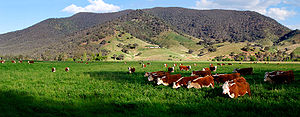
- Flexible dietDiet (nutrition)In nutrition, diet is the sum of food consumed by a person or other organism. Dietary habits are the habitual decisions an individual or culture makes when choosing what foods to eat. With the word diet, it is often implied the use of specific intake of nutrition for health or weight-management...
— Creatures that are willing to consume a wide variety of food sources and can live off less cumulative food from the food pyramidEcological pyramidthumb|300px|right|An ecological pyramid.An ecological pyramid is a graphical representation designed to show the biomass or biomass productivity at each trophic level in a given ecosystem....
(such as cornMaizeMaize known in many English-speaking countries as corn or mielie/mealie, is a grain domesticated by indigenous peoples in Mesoamerica in prehistoric times. The leafy stalk produces ears which contain seeds called kernels. Though technically a grain, maize kernels are used in cooking as a vegetable...
or wheatWheatWheat is a cereal grain, originally from the Levant region of the Near East, but now cultivated worldwide. In 2007 world production of wheat was 607 million tons, making it the third most-produced cereal after maize and rice...
), particularly food that is not utilized by humans (such as grassGrassGrasses, or more technically graminoids, are monocotyledonous, usually herbaceous plants with narrow leaves growing from the base. They include the "true grasses", of the Poaceae family, as well as the sedges and the rushes . The true grasses include cereals, bamboo and the grasses of lawns ...
and forage) are less expensive to keep in captivityCaptivity (animal)Animals that live under human care are in captivity. Captivity can be used as a generalizing term to describe the keeping of either domesticated animals or wild animals. This may include for example farms, private homes and zoos...
. CarnivoreCarnivoreA carnivore meaning 'meat eater' is an organism that derives its energy and nutrient requirements from a diet consisting mainly or exclusively of animal tissue, whether through predation or scavenging...
s by definition feed primarily or only on animal tissue, which requires the expenditure of many animalAnimalAnimals are a major group of multicellular, eukaryotic organisms of the kingdom Animalia or Metazoa. Their body plan eventually becomes fixed as they develop, although some undergo a process of metamorphosis later on in their life. Most animals are motile, meaning they can move spontaneously and...
s, though they may exploit sources of meat not utilized by humans, such as scraps and vermin. - Reasonably fast growth rate — Fast maturity rate compared to the human life span allows breeding intervention and makes the animal useful within an acceptable duration of caretaking. Large animals such as elephantElephantElephants are large land mammals in two extant genera of the family Elephantidae: Elephas and Loxodonta, with the third genus Mammuthus extinct...
s require many years before they reach a useful size. - Ability to be bredSelective breedingSelective breeding is the process of breeding plants and animals for particular genetic traits. Typically, strains that are selectively bred are domesticated, and the breeding is sometimes done by a professional breeder. Bred animals are known as breeds, while bred plants are known as varieties,...
in captivity — Creatures that are reluctant to breed when kept in captivity do not produce useful offspring, and instead are limited to capture in their wild state. Creatures such as the pandaPandaPanda or Panda bear most often refers to:*Giant panda, an animal in the Bear familyPanda may also refer to:*Red panda, the only living member in the Ailuridae family-In biology:* Species related to the Giant panda...
, antelopeAntelopeAntelope is a term referring to many even-toed ungulate species indigenous to various regions in Africa and Eurasia. Antelopes comprise a miscellaneous group within the family Bovidae, encompassing those old-world species that are neither cattle, sheep, buffalo, bison, nor goats...
and giant forest hogGiant forest hogThe Giant Forest Hog is native to wooded habitats in Africa and generally is considered the largest wild member of the Suidae . Despite its large size and relatively wide distribution, it was only described by scientists in 1904...
are territorial when breeding and cannot be maintained in crowded enclosures in captivity. - Pleasant disposition — Large creatures that are aggressiveAggressionIn psychology, as well as other social and behavioral sciences, aggression refers to behavior between members of the same species that is intended to cause humiliation, pain, or harm. Ferguson and Beaver defined aggressive behavior as "Behavior which is intended to increase the social dominance of...
toward humans are dangerous to keep in captivity. The African buffaloAfrican BuffaloThe African buffalo, affalo, nyati, Mbogo or Cape buffalo is a large African bovine. It is not closely related to the slightly larger wild Asian water buffalo, but its ancestry remains unclear...
has an unpredictable nature and is highly dangerous to humans; similarly, although the American bisonAmerican BisonThe American bison , also commonly known as the American buffalo, is a North American species of bison that once roamed the grasslands of North America in massive herds...
is raised in enclosed ranges in the US West, it is much too dangerous to be regarded as truly domesticated. Although similar to the domesticated pig in many ways, the American peccaryPeccaryA peccary is a medium-sized mammal of the family Tayassuidae, or New World Pigs. Peccaries are members of the artiodactyl suborder Suina, as are the pig family and possibly the hippopotamus family...
and Africa's warthogWarthogThe Warthog or Common Warthog is a wild member of the pig family that lives in grassland, savanna, and woodland in Sub-Saharan Africa. In the past it was commonly treated as a subspecies of P...
and bushpigBushpigThe bushpig, Potamochoerus larvatus, is a member of the pig family and lives in forests, woodland, riverine vegetation and reedbeds in East and Southern Africa. Probably introduced populations are also present in Madagascar and the Comoros archipelago. Bushpigs are mainly nocturnal. There are...
are also dangerous in captivity. However one must keep in mind that most modern large domestic animals were descendants of extremely aggressive ancestors, the wild boar is certainly renowned for their ferocity , other examples include the aurochs, horse, Bactrian camels and yaks, etc; all of which are extremely dangerous in their wild state. On the other hand humans have managed to tame dangerous species like the elephants, bears and cheetahs whose failed domestications had little to do with their aggressiveness. - TemperamentTemperamentIn psychology, temperament refers to those aspects of an individual's personality, such as introversion or extroversion, that are often regarded as innate rather than learned...
which makes it unlikely to panicPanicPanic is a sudden sensation of fear which is so strong as to dominate or prevent reason and logical thinking, replacing it with overwhelming feelings of anxiety and frantic agitation consistent with an animalistic fight-or-flight reaction...
— A creature with a nervous disposition is difficult to keep in captivity as it may attempt to flee whenever startled. The gazelleGazelleA gazelle is any of many antelope species in the genus Gazella, or formerly considered to belong to it. Six species are included in two genera, Eudorcas and Nanger, which were formerly considered subgenera...
is very flighty and it has a powerful leap that allows it to escape an enclosed pen. Some animals, such as the domestic sheepDomestic sheepSheep are quadrupedal, ruminant mammals typically kept as livestock. Like all ruminants, sheep are members of the order Artiodactyla, the even-toed ungulates. Although the name "sheep" applies to many species in the genus Ovis, in everyday usage it almost always refers to Ovis aries...
, still have a strong tendency to panic when their flight zoneFlight zoneThe flight zone of an animal is the area surrounding the animal that will cause alarm and escape behavior when encroached upon. If a person enters the flight zone of an animal, the animal will move away. The size of the flight zone depends upon the tameness of the animal. Completely tame animals...
is encroached upon. However, most sheep also show a flockingHerdingHerding is the act of bringing individual animals together into a group , maintaining the group and moving the group from place to place—or any combination of those. While the layperson uses the term "herding", most individuals involved in the process term it mustering, "working stock" or...
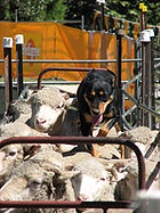
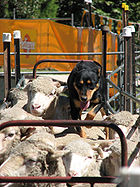
instinct, whereby they stay close together when pressed. Livestock with such an instinct may be herded by people and dogHerding dogA herding dog, also known as a stock dog or working dog, is a type of pastoral dog that either has been trained in herding or belongs to breeds developed for herding...
s. - Modifiable social hierarchy — Social creatures that recognize a hierarchy of dominance can be raised to recognize a human as the pack leaderLeadershipLeadership has been described as the “process of social influence in which one person can enlist the aid and support of others in the accomplishment of a common task". Other in-depth definitions of leadership have also emerged.-Theories:...
.
However, this list is of limited use because it fails to take into account the profound changes that domestication has on a species. While it is true that some animals, including parrots, whales, and most members of the Carnivora
Carnivora
The diverse order Carnivora |Latin]] carō "flesh", + vorāre "to devour") includes over 260 species of placental mammals. Its members are formally referred to as carnivorans, while the word "carnivore" can refer to any meat-eating animal...
, retain their wild instincts even if born in captivity, some factors must be taken into consideration. In particular, number (5) may not be a prerequisite for domestication, but rather a natural consequence of a species' having been domesticated. In other words, wild animals are naturally timid and flighty because they are constantly faced by predators; domestic animals do not need such a nervous disposition, because they are protected by their human owners. The same holds true for number (4)—aggressive temperament is an adaptation to the danger from predators. A Cape buffalo can kill even an attacking lion. Zoologist Marston Bates
Marston Bates
Marston Bates was an American zoologist. Bates' studies on mosquitoes contributed to the understanding of the epidemiology of yellow fever in northern South America....
devoted a chapter on domestication in his 1960 book The Forest and the Sea, in which he talks a great deal about how domestication alters a species: Dispersal mechanisms tend to disappear for the reason stated above, and also because people provide transportation for them. Chickens have practically lost their ability to fly. Similarly, domestic animals cease to have a definite mating season, and so the need to be territorial when mating loses its value. What he says suggests that the process of domestication can itself make a creature domesticable. Besides, the first steps towards agriculture may have involved hunters keeping young animals, who are always more impressionable than the adults, after killing their mothers.
Plants
The earliest human attempts at plant domestication occurred in South-Western Asia. There is early evidence for conscious cultivation and trait selection of plants by pre-Neolithic groups in Syria: grains of ryeRye
Rye is a grass grown extensively as a grain and as a forage crop. It is a member of the wheat tribe and is closely related to barley and wheat. Rye grain is used for flour, rye bread, rye beer, some whiskeys, some vodkas, and animal fodder...
with domestic traits have been recovered from Epi-Palaeolithic (c. 11,050 BP) contexts at Abu Hureyra in Syria
Syria
Syria , officially the Syrian Arab Republic , is a country in Western Asia, bordering Lebanon and the Mediterranean Sea to the West, Turkey to the north, Iraq to the east, Jordan to the south, and Israel to the southwest....
, but this appears to be a localised phenomenon resulting from cultivation of stands of wild rye, rather than a definitive step towards domestication.
By 10,000 BC the bottle gourd (Lagenaria siceraria) plant, used as a container before the advent of ceramic
Ceramic
A ceramic is an inorganic, nonmetallic solid prepared by the action of heat and subsequent cooling. Ceramic materials may have a crystalline or partly crystalline structure, or may be amorphous...
technology, appears to have been domesticated. The domesticated bottle gourd reached the Americas from Asia by 8000 BC, most likely due to the migration of peoples from Asia to America.
Cereal crops were first domesticated around 9000 BC in the Fertile Crescent
Fertile Crescent
The Fertile Crescent, nicknamed "The Cradle of Civilization" for the fact the first civilizations started there, is a crescent-shaped region containing the comparatively moist and fertile land of otherwise arid and semi-arid Western Asia. The term was first used by University of Chicago...
in the Middle East
Middle East
The Middle East is a region that encompasses Western Asia and Northern Africa. It is often used as a synonym for Near East, in opposition to Far East...
. The first domesticated crops were generally annuals with large seeds or fruits. These included pulse
Pulse (legume)
A pulse is an annual leguminous crop yielding from one to twelve seeds of variable size, shape, and color within a pod. Pulses are used for food and animal feed. The term "pulse", as used by the Food and Agricultural Organization , is reserved for crops harvested solely for the dry seed...
s such as pea
Pea
A pea is most commonly the small spherical seed or the seed-pod of the pod fruit Pisum sativum. Each pod contains several peas. Peapods are botanically a fruit, since they contain seeds developed from the ovary of a flower. However, peas are considered to be a vegetable in cooking...
s and grains such as wheat
Wheat
Wheat is a cereal grain, originally from the Levant region of the Near East, but now cultivated worldwide. In 2007 world production of wheat was 607 million tons, making it the third most-produced cereal after maize and rice...
.
The Middle East was especially suited to these species; the dry-summer climate was conducive to the evolution of large-seeded annual plants, and the variety of elevations led to a great variety of species. As domestication took place humans began to move from a hunter-gatherer
Hunter-gatherer
A hunter-gatherer or forage society is one in which most or all food is obtained from wild plants and animals, in contrast to agricultural societies which rely mainly on domesticated species. Hunting and gathering was the ancestral subsistence mode of Homo, and all modern humans were...
society to a settled agricultural society. This change would eventually lead, some 4000 to 5000 years later, to the first city states and eventually the rise of civilization
Civilization
Civilization is a sometimes controversial term that has been used in several related ways. Primarily, the term has been used to refer to the material and instrumental side of human cultures that are complex in terms of technology, science, and division of labor. Such civilizations are generally...
itself.
Continued domestication was gradual, a process of trial and error that occurred intermittently. Over time perennials and small trees began to be domesticated including apple
Apple
The apple is the pomaceous fruit of the apple tree, species Malus domestica in the rose family . It is one of the most widely cultivated tree fruits, and the most widely known of the many members of genus Malus that are used by humans. Apple grow on small, deciduous trees that blossom in the spring...
s and olive
Olive
The olive , Olea europaea), is a species of a small tree in the family Oleaceae, native to the coastal areas of the eastern Mediterranean Basin as well as northern Iran at the south end of the Caspian Sea.Its fruit, also called the olive, is of major agricultural importance in the...
s. Some plants were not domesticated until recently such as the macadamia nut and the pecan
Pecan
The pecan , Carya illinoinensis, is a species of hickory, native to south-central North America, in Mexico from Coahuila south to Jalisco and Veracruz, in the United States from southern Iowa, Illinois, Missouri, and Indiana east to western Kentucky, southwestern Ohio, North Carolina, South...
.
In other parts of the world very different species were domesticated. In the Americas
Americas
The Americas, or America , are lands in the Western hemisphere, also known as the New World. In English, the plural form the Americas is often used to refer to the landmasses of North America and South America with their associated islands and regions, while the singular form America is primarily...
squash
Squash (fruit)
Squashes generally refer to four species of the genus Cucurbita, also called marrows depending on variety or the nationality of the speaker...
, maize
Maize
Maize known in many English-speaking countries as corn or mielie/mealie, is a grain domesticated by indigenous peoples in Mesoamerica in prehistoric times. The leafy stalk produces ears which contain seeds called kernels. Though technically a grain, maize kernels are used in cooking as a vegetable...
, beans, and perhaps manioc (also known as cassava
Cassava
Cassava , also called yuca or manioc, a woody shrub of the Euphorbiaceae native to South America, is extensively cultivated as an annual crop in tropical and subtropical regions for its edible starchy tuberous root, a major source of carbohydrates...
) formed the core of the diet. In East Asia millet
Millet
The millets are a group of small-seeded species of cereal crops or grains, widely grown around the world for food and fodder. They do not form a taxonomic group, but rather a functional or agronomic one. Their essential similarities are that they are small-seeded grasses grown in difficult...
, rice
Rice
Rice is the seed of the monocot plants Oryza sativa or Oryza glaberrima . As a cereal grain, it is the most important staple food for a large part of the world's human population, especially in East Asia, Southeast Asia, South Asia, the Middle East, and the West Indies...
, and soy were the most important crops. Some areas of the world such as Southern Africa
Southern Africa
Southern Africa is the southernmost region of the African continent, variably defined by geography or geopolitics. Within the region are numerous territories, including the Republic of South Africa ; nowadays, the simpler term South Africa is generally reserved for the country in English.-UN...
, Australia
Australia
Australia , officially the Commonwealth of Australia, is a country in the Southern Hemisphere comprising the mainland of the Australian continent, the island of Tasmania, and numerous smaller islands in the Indian and Pacific Oceans. It is the world's sixth-largest country by total area...
, California
California
California is a state located on the West Coast of the United States. It is by far the most populous U.S. state, and the third-largest by land area...
and southern South America
Southern Cone
Southern Cone is a geographic region composed of the southernmost areas of South America, south of the Tropic of Capricorn. Although geographically this includes part of Southern and Southeast of Brazil, in terms of political geography the Southern cone has traditionally comprised Argentina,...
never saw local species domesticated.
Over the millennia many domesticated species have become utterly unlike their natural ancestors. Maize
Maize
Maize known in many English-speaking countries as corn or mielie/mealie, is a grain domesticated by indigenous peoples in Mesoamerica in prehistoric times. The leafy stalk produces ears which contain seeds called kernels. Though technically a grain, maize kernels are used in cooking as a vegetable...
ears
Ear (botany)
An ear is the grain-bearing tip part of the stem of a cereal plant, such as wheat or maize. It can also refer to "a prominent lobe in some leaves".The ear is a spike, consisting of a central stem on which grows tightly packed rows of flowers...
are now dozens of times the size of those of wild teosinte
Teosinte
Zea is a genus of grasses in the family Poaceae. Several species are commonly known as teosintes and are found in Mexico, Guatemala, and Nicaragua....
. A similar change occurred between wild strawberries and domesticated strawberries
Garden Strawberry
The garden strawberry, Fragaria × ananassa, is a hybrid species that is cultivated worldwide for its fruit, the strawberry. The fruit is widely appreciated for its characteristic aroma, bright red color, juicy texture, and sweetness...
.
Domesticated plant species often differ from their wild relatives in predictable ways. These differences are called the domestication syndrome, and include:
- Higher germination rates
- More predictable & synchronous germination
- Increased size of reproductive organs
- A tendency for ripe seeds to stay on the plant, rather than breaking off and falling to the ground
- Reduced physical and chemical defences
- Change in biomass allocation (more in fruits, roots, or stems, depending on human)
Degrees
Due to elephants' slow growth, the boundaries between surviving wild populations and domestic cladesCladistics
Cladistics is a method of classifying species of organisms into groups called clades, which consist of an ancestor organism and all its descendants . For example, birds, dinosaurs, crocodiles, and all descendants of their most recent common ancestor form a clade...
can be vague. Similar problems of definition arise when domesticated cats go feral. A classification
Categorization
Categorization is the process in which ideas and objects are recognized, differentiated and understood. Categorization implies that objects are grouped into categories, usually for some specific purpose. Ideally, a category illuminates a relationship between the subjects and objects of knowledge...
system that can help solve this confusion surrounding animal populations might be set up on a spectrum of increasing domestication:
- Wild: These populations experience their full life cycles without deliberate human intervention.
- Raised in Captivity/Captured from Wild (in zooZooA zoological garden, zoological park, menagerie, or zoo is a facility in which animals are confined within enclosures, displayed to the public, and in which they may also be bred....
s, botanical gardenBotanical gardenA botanical garden The terms botanic and botanical, and garden or gardens are used more-or-less interchangeably, although the word botanic is generally reserved for the earlier, more traditional gardens. is a well-tended area displaying a wide range of plants labelled with their botanical names...
s, or for human gain): These populations are nurtured by humans but (except in zoos) not normally bred under human control. They remain as a group essentially indistinguishable in appearance or behaviour from their wild counterparts. Examples include Asian elephants, animals such as sloth bears and cobras used by showmen in India, and animals such as Asian black bears (farmed for their bile), and zoo animals, kept in captivity as examples of their species. (It should be noted that zoos and botanical gardens sometimes exhibit domesticated or feral animals and plants such as camels, mustangMustang (horse)A Mustang is a free-roaming horse of the North American west that first descended from horses brought to the Americas by the Spanish. Mustangs are often referred to as wild horses, but there is intense debate over terminology...
s, and some orchids.) - Raised commercially (captive or semidomesticated): These populations are ranchRanchA ranch is an area of landscape, including various structures, given primarily to the practice of ranching, the practice of raising grazing livestock such as cattle or sheep for meat or wool. The word most often applies to livestock-raising operations in the western United States and Canada, though...
ed or farmFarmA farm is an area of land, or, for aquaculture, lake, river or sea, including various structures, devoted primarily to the practice of producing and managing food , fibres and, increasingly, fuel. It is the basic production facility in food production. Farms may be owned and operated by a single...
ed in large numbers for food, commodities, or the pet trade, commonly breed in captivity, but as a group are not substantially altered in appearance or behavior from their wild cousins. Examples include the ostrichOstrichThe Ostrich is one or two species of large flightless birds native to Africa, the only living member of the genus Struthio. Some analyses indicate that the Somali Ostrich may be better considered a full species apart from the Common Ostrich, but most taxonomists consider it to be a...
, various deerDeerDeer are the ruminant mammals forming the family Cervidae. Species in the Cervidae family include white-tailed deer, elk, moose, red deer, reindeer, fallow deer, roe deer and chital. Male deer of all species and female reindeer grow and shed new antlers each year...
, alligatorAlligatorAn alligator is a crocodilian in the genus Alligator of the family Alligatoridae. There are two extant alligator species: the American alligator and the Chinese alligator ....
, cricketCricket (insect)Crickets, family Gryllidae , are insects somewhat related to grasshoppers, and more closely related to katydids or bush crickets . They have somewhat flattened bodies and long antennae. There are about 900 species of crickets...
, pearlPearlA pearl is a hard object produced within the soft tissue of a living shelled mollusk. Just like the shell of a mollusk, a pearl is made up of calcium carbonate in minute crystalline form, which has been deposited in concentric layers. The ideal pearl is perfectly round and smooth, but many other...
oysterOysterThe word oyster is used as a common name for a number of distinct groups of bivalve molluscs which live in marine or brackish habitats. The valves are highly calcified....
, and ball pythonBall pythonPython regius is a nonvenomous python species found in Africa. This is the smallest of the African pythons and is popular in the pet trade. No subspecies are currently recognized. They are also known as royal pythons or ball pythons. The name ball python refers to the animal's tendency to curl into...
. (These species are sometimes referred to as partially domesticated.) - Domesticated: These populations are bred and raised under human control for many generations and are substantially altered as a group in appearance or behaviour. Examples include pigsPIGSPIGS is a four letter acronym that can stand for:* PIGS , Phosphatidylinositol glycan anchor biosynthesis, class S, a human gene* PIGS , the economies of Portugal, Italy , Greece and Spain...
, ferrets, turkeys, canariesDomestic CanaryThe Domestic Canary, often simply known as the canary, is a domesticated form of the wild Canary, a small songbird in the finch family originating from the Macaronesian Islands ....
, domestic pigeons, budgerigars, goldfishGoldfishThe goldfish is a freshwater fish in the family Cyprinidae of order Cypriniformes. It was one of the earliest fish to be domesticated, and is one of the most commonly kept aquarium fish....
, silkworms, dogs, cats, sheep, cattleCattleCattle are the most common type of large domesticated ungulates. They are a prominent modern member of the subfamily Bovinae, are the most widespread species of the genus Bos, and are most commonly classified collectively as Bos primigenius...
, chickens, llamas, guinea pigs, laboratory miceMouseA mouse is a small mammal belonging to the order of rodents. The best known mouse species is the common house mouse . It is also a popular pet. In some places, certain kinds of field mice are also common. This rodent is eaten by large birds such as hawks and eagles...
, goats and (silver) foxes
This classification system does not account for several complicating factors: genetically modified organisms, feral
Feral
A feral organism is one that has changed from being domesticated to being wild or untamed. In the case of plants it is a movement from cultivated to uncultivated or controlled to volunteer. The introduction of feral animals or plants to their non-native regions, like any introduced species, may...
populations, and hybridization. Many species that are farmed or ranched are now being genetically modified. This creates a unique category because it alters the organisms as a group but in ways unlike traditional domestication. Feral organisms are members of a population that was once raised under human control, but is now living and multiplying outside of human control. Examples include mustangs
Mustang (horse)
A Mustang is a free-roaming horse of the North American west that first descended from horses brought to the Americas by the Spanish. Mustangs are often referred to as wild horses, but there is intense debate over terminology...
. Hybrids can be wild, domesticated, or both: a liger
Liger
The liger is a hybrid cross between a male lion and a tigress . Thus, it has parents with the same genus but of different species. It is distinct from the similar hybrid tiglon. It is the largest of all known cats and extant felines.Ligers enjoy swimming, which is a characteristic of tigers, and...
is a hybrid of two wild animals, a mule
Mule
A mule is the offspring of a male donkey and a female horse. Horses and donkeys are different species, with different numbers of chromosomes. Of the two F1 hybrids between these two species, a mule is easier to obtain than a hinny...
is a hybrid of two domesticated animals, and a beefalo
Beefalo
Beefalo are a fertile hybrid offspring of domestic cattle, Bos taurus, and the American bison, Bison bison...
is a cross between a wild and a domestic animal.
A great difference exists between a tame animal and a domesticated animal. The term "domesticated" refers to an entire species or variety while the term "tame" can refer to just one individual within a species or variety. Humans have tamed many thousands of animals that have never been truly domesticated. These include the elephant, giraffes, and bears. There is debate over whether some species have been domesticated or just tamed. Some state that the elephant has been domesticated, while others argue the cat has never been. Dividing lines include whether a specimen born to wild parents would differ in appearance or behavior from one born to domesticated parents. For instance a dog is certainly domesticated because even a wolf (genetically the origin of all dogs) raised from a pup
Pup
Pup may refer to:In zoology:*Puppies, younger dogs*Pinniped young*Shark young*Rodent youngIn other uses:* Sopwith Pup, an aircraft used by the British in World War I* Beagle Pup, a 1960s British light aircraft...
would be very different from a dog, in both appearance and behaviour.
Limits
Selection of animals for visible “desirable” traits may make them unfit in other, unseen, ways. The consequences for the captive and domesticated animals were reduction in size, piebaldPiebald
A piebald or pied animal is one that has a spotting pattern of large unpigmented, usually white, areas of hair, feathers, or scales and normally pigmented patches, generally black. The colour of the animal's skin underneath its coat is also pigmented under the dark patches and unpigmented under...
color, shorter faces with smaller and fewer teeth, diminished horns, weak muscle ridges, and less genetic variability. Poor joint definition, late fusion of the limb bone epiphyses
Epiphysis
The epiphysis is the rounded end of a long bone, at its joint with adjacent bone. Between the epiphysis and diaphysis lies the metaphysis, including the epiphyseal plate...
with the diaphyses, hair changes, greater fat accumulation, smaller brains, simplified behavior patterns, extended immaturity, and more pathology are a few of the defects of domestic animals, All of these changes have been documented in direct observations of the rat in the 19th century, by archaeological evidence, and confirmed by animal breeders in the 20th century.
One side effect of domestication has been zoonotic diseases. For example, cattle have given humanity various viral pox
Poxviridae
Poxviruses are viruses that can, as a family, infect both vertebrate and invertebrate animals.Four genera of poxviruses may infect humans: orthopox, parapox, yatapox, molluscipox....
es, measles
Measles
Measles, also known as rubeola or morbilli, is an infection of the respiratory system caused by a virus, specifically a paramyxovirus of the genus Morbillivirus. Morbilliviruses, like other paramyxoviruses, are enveloped, single-stranded, negative-sense RNA viruses...
, and tuberculosis
Tuberculosis
Tuberculosis, MTB, or TB is a common, and in many cases lethal, infectious disease caused by various strains of mycobacteria, usually Mycobacterium tuberculosis. Tuberculosis usually attacks the lungs but can also affect other parts of the body...
; pigs and ducks have given influenza
Influenza
Influenza, commonly referred to as the flu, is an infectious disease caused by RNA viruses of the family Orthomyxoviridae , that affects birds and mammals...
; and horses have given the rhinovirus
Rhinovirus
Human rhinoviruses are the most common viral infective agents in humans and are the predominant cause of the common cold. Rhinovirus infection proliferates in temperatures between 33–35 °C , and this may be why it occurs primarily in the nose...
es. Humans share over sixty diseases with dogs . Many parasites also have their origins in domestic animals. The advent of domestication resulted in denser human populations which provided ripe conditions for pathogens to reproduce, mutate, spread, and eventually find a new host in humans.
Dates and places
Mesolithic
The Mesolithic is an archaeological concept used to refer to certain groups of archaeological cultures defined as falling between the Paleolithic and the Neolithic....
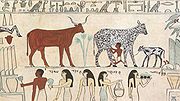
. The tribes that took part in hunting and gathering wild edible plants, started to make attempts to domesticate dogs, goats, and possibly sheep, which was as early as 9000 BC. However, it was not until the Neolithic Period that primitive agriculture appeared as a form of social activity, and domestication was well under way. The great majority of domesticated animals and plants that still serve humans were selected and developed during the Neolithic Period, a few other examples appeared later. The rabbit for example, was not domesticated until the Middle Ages, while the sugar beet came under cultivation as a sugar-yielding agricultural plant in the 19th century. As recently as the 20th century, mint became an object of agricultural production, and animal breeding programs to produce high-quality fur were started in the same time period.
The methods available to estimate domestication dates introduce further uncertainty, especially when domestication has occurred in the distant past. So the dates given here should be treated with caution; in some cases evidence is scanty and future discoveries may alter the dating significantly.
Dates and places of domestication are mainly estimated by archaeological
Archaeology
Archaeology, or archeology , is the study of human society, primarily through the recovery and analysis of the material culture and environmental data that they have left behind, which includes artifacts, architecture, biofacts and cultural landscapes...
methods, more precisely archaeozoology. These methods consist of excavating or studying the results of excavation in human prehistorical occupation sites. Animal remains are dated with archaeological methods, the species they belong to is determined, the age at death is also estimated, and if possible the form they had, that is to say a possible domestic form. Various other clues are taken advantage of, such as slaughter or cutting marks. The aim is to determine if they are game or raised animal, and more globally the nature of their relationship with humans. For example the skeleton of a cat found buried close to humans is a clue that it may have been a pet cat. The age structure of animal remains can also be a clue of husbandry, in which animals were killed at the optimal age.
New technologies and especially mitochondrial DNA
Mitochondrial DNA
Mitochondrial DNA is the DNA located in organelles called mitochondria, structures within eukaryotic cells that convert the chemical energy from food into a form that cells can use, adenosine triphosphate...
, which are simple DNA found in the mitochondria that determine its function in the cell provide an alternative angle of investigation, and make it possible to reestimate the dates of domestication based on research into the genealogical tree of modern domestic animals.
It is admitted for several species that domestication occurred in several places distinctly. For example, research on mitochondrial DNA of the modern cattle Bos taurus supports the archaeological assertions of separate domestication events in Asia and Africa. This research also shows that Bos taurus and Bos indicus haplotypes are all descendants of the extinct wild ox Bos primigenius. However, this does not rule out later crossing inside a species; therefore it appears useless to look for a separate wild ancestor for each domestic breed.
The first animal to be domesticated appears to have been the dog, in the Upper Paleolithic
Upper Paleolithic
The Upper Paleolithic is the third and last subdivision of the Paleolithic or Old Stone Age as it is understood in Europe, Africa and Asia. Very broadly it dates to between 40,000 and 10,000 years ago, roughly coinciding with the appearance of behavioral modernity and before the advent of...
era. This preceded the domestication of other species by several millennia. In the Neolithic
Neolithic
The Neolithic Age, Era, or Period, or New Stone Age, was a period in the development of human technology, beginning about 9500 BC in some parts of the Middle East, and later in other parts of the world. It is traditionally considered as the last part of the Stone Age...
a number of important species such as the goat, sheep, pig and cow were domesticated, as part of the spread of farming
Neolithic Revolution
The Neolithic Revolution was the first agricultural revolution. It was the transition from hunting and gathering to agriculture and settlement. Archaeological data indicates that various forms of plants and animal domestication evolved independently in 6 separate locations worldwide circa...
with characterises this period. The goat, sheep and pig in particular were domesticated independently in the Levant
Levant
The Levant or ) is the geographic region and culture zone of the "eastern Mediterranean littoral between Anatolia and Egypt" . The Levant includes most of modern Lebanon, Syria, Jordan, Israel, the Palestinian territories, and sometimes parts of Turkey and Iraq, and corresponds roughly to the...
and Asia
Asia
Asia is the world's largest and most populous continent, located primarily in the eastern and northern hemispheres. It covers 8.7% of the Earth's total surface area and with approximately 3.879 billion people, it hosts 60% of the world's current human population...
.
There is early evidence of beekeeping
Beekeeping
Beekeeping is the maintenance of honey bee colonies, commonly in hives, by humans. A beekeeper keeps bees in order to collect honey and other products of the hive , to pollinate crops, or to produce bees for sale to other beekeepers...
, in the form of rock painting
Cave painting
Cave paintings are paintings on cave walls and ceilings, and the term is used especially for those dating to prehistoric times. The earliest European cave paintings date to the Aurignacian, some 32,000 years ago. The purpose of the paleolithic cave paintings is not known...
s, dating to 13,000 BC.
Recent archaeological evidence from Cyprus indicates domestication of a type of cat
Cat
The cat , also known as the domestic cat or housecat to distinguish it from other felids and felines, is a small, usually furry, domesticated, carnivorous mammal that is valued by humans for its companionship and for its ability to hunt vermin and household pests...
by perhaps 9500 BC.
The earliest secure evidence of horse
Horse
The horse is one of two extant subspecies of Equus ferus, or the wild horse. It is a single-hooved mammal belonging to the taxonomic family Equidae. The horse has evolved over the past 45 to 55 million years from a small multi-toed creature into the large, single-toed animal of today...
domestication, bit wear on horse molars at Dereivka
Dereivka
Dereivka is an archaeological site located in the village of the same name in Kirovohrad Oblast, Ukraine, on the right bank of the Dneiper. The site dates to ca. 4500—3500 BC and is associated with the Sredny Stog culture....
in Ukraine, dates to around 4000 BC. The unequivocal date of domestication and use as a means of transport is at the Sintashta
Sintashta
Sintashta is an archaeological site in Chelyabinsk Oblast, Russia. It is the remains of a fortified settlement dating to the Bronze Age, c. 2800–1600 BC, and is the type site of the Sintashta culture...
chariot burials in the southern Urals, c. 2000 BC. Local equivalents and smaller species were domesticated from the 2500s BC.
The availability of both domesticated vegetable and animal species increased suddenly following the voyages of Christopher Columbus
Christopher Columbus
Christopher Columbus was an explorer, colonizer, and navigator, born in the Republic of Genoa, in northwestern Italy. Under the auspices of the Catholic Monarchs of Spain, he completed four voyages across the Atlantic Ocean that led to general European awareness of the American continents in the...
and the contact between the Eastern and Western Hemispheres. This is part of what is referred to as the Columbian Exchange
Columbian Exchange
The Columbian Exchange was a dramatically widespread exchange of animals, plants, culture, human populations , communicable disease, and ideas between the Eastern and Western hemispheres . It was one of the most significant events concerning ecology, agriculture, and culture in all of human history...
.
Approximate dates and locations of original domestication
| Species | Date | Location |
|---|---|---|
| Dog Dog The domestic dog is a domesticated form of the gray wolf, a member of the Canidae family of the order Carnivora. The term is used for both feral and pet varieties. The dog may have been the first animal to be domesticated, and has been the most widely kept working, hunting, and companion animal in... (Canis lupus familiaris) |
between 30000 BC and 7000 BC Origin of the domestic dog The origin of the domestic dog began with the domestication of the gray wolf several tens of thousands of years ago. Domesticated dogs provided early humans with a guard animal, a source of food, fur, and a beast of burden... |
East Asia East Asia East Asia or Eastern Asia is a subregion of Asia that can be defined in either geographical or cultural terms... and Africa Africa Africa is the world's second largest and second most populous continent, after Asia. At about 30.2 million km² including adjacent islands, it covers 6% of the Earth's total surface area and 20.4% of the total land area... |
| Sheep Domestic sheep Sheep are quadrupedal, ruminant mammals typically kept as livestock. Like all ruminants, sheep are members of the order Artiodactyla, the even-toed ungulates. Although the name "sheep" applies to many species in the genus Ovis, in everyday usage it almost always refers to Ovis aries... (Ovis orientalis aries) |
between 11000 BC and 9000 BC | Southwest Asia Southwest Asia Western Asia, West Asia, Southwest Asia or Southwestern Asia are terms that describe the westernmost portion of Asia. The terms are partly coterminous with the Middle East, which describes a geographical position in relation to Western Europe rather than its location within Asia... |
| Pig Domestic pig The domestic pig is a domesticated animal that traces its ancestry to the wild boar, and is considered a subspecies of the wild boar or a distinct species in its own right. It is likely the wild boar was domesticated as early as 13,000 BC in the Tigris River basin... (Sus scrofa domestica) |
9000 BC | Near East Near East The Near East is a geographical term that covers different countries for geographers, archeologists, and historians, on the one hand, and for political scientists, economists, and journalists, on the other... , China China Chinese civilization may refer to:* China for more general discussion of the country.* Chinese culture* Greater China, the transnational community of ethnic Chinese.* History of China* Sinosphere, the area historically affected by Chinese culture... , Germany Germany Germany , officially the Federal Republic of Germany , is a federal parliamentary republic in Europe. The country consists of 16 states while the capital and largest city is Berlin. Germany covers an area of 357,021 km2 and has a largely temperate seasonal climate... |
| Goat Goat The domestic goat is a subspecies of goat domesticated from the wild goat of southwest Asia and Eastern Europe. The goat is a member of the Bovidae family and is closely related to the sheep as both are in the goat-antelope subfamily Caprinae. There are over three hundred distinct breeds of... (Capra aegagrus hircus) |
8000 BC | Iran Iran Iran , officially the Islamic Republic of Iran , is a country in Southern and Western Asia. The name "Iran" has been in use natively since the Sassanian era and came into use internationally in 1935, before which the country was known to the Western world as Persia... |
| Cow (Bos primigenius taurus) | 8000 BC | India Indian subcontinent The Indian subcontinent, also Indian Subcontinent, Indo-Pak Subcontinent or South Asian Subcontinent is a region of the Asian continent on the Indian tectonic plate from the Hindu Kush or Hindu Koh, Himalayas and including the Kuen Lun and Karakoram ranges, forming a land mass which extends... , Middle East Middle East The Middle East is a region that encompasses Western Asia and Northern Africa. It is often used as a synonym for Near East, in opposition to Far East... , and North Africa North Africa North Africa or Northern Africa is the northernmost region of the African continent, linked by the Sahara to Sub-Saharan Africa. Geopolitically, the United Nations definition of Northern Africa includes eight countries or territories; Algeria, Egypt, Libya, Morocco, South Sudan, Sudan, Tunisia, and... |
| Cat Cat The cat , also known as the domestic cat or housecat to distinguish it from other felids and felines, is a small, usually furry, domesticated, carnivorous mammal that is valued by humans for its companionship and for its ability to hunt vermin and household pests... (Felis catus) |
7500 BC | Cyprus Cyprus Cyprus , officially the Republic of Cyprus , is a Eurasian island country, member of the European Union, in the Eastern Mediterranean, east of Greece, south of Turkey, west of Syria and north of Egypt. It is the third largest island in the Mediterranean Sea.The earliest known human activity on the... and Near East Near East The Near East is a geographical term that covers different countries for geographers, archeologists, and historians, on the one hand, and for political scientists, economists, and journalists, on the other... |
| Chicken Chicken The chicken is a domesticated fowl, a subspecies of the Red Junglefowl. As one of the most common and widespread domestic animals, and with a population of more than 24 billion in 2003, there are more chickens in the world than any other species of bird... (Gallus gallus domesticus) |
6000 BC | India Indian subcontinent The Indian subcontinent, also Indian Subcontinent, Indo-Pak Subcontinent or South Asian Subcontinent is a region of the Asian continent on the Indian tectonic plate from the Hindu Kush or Hindu Koh, Himalayas and including the Kuen Lun and Karakoram ranges, forming a land mass which extends... and Southeast Asia Southeast Asia Southeast Asia, South-East Asia, South East Asia or Southeastern Asia is a subregion of Asia, consisting of the countries that are geographically south of China, east of India, west of New Guinea and north of Australia. The region lies on the intersection of geological plates, with heavy seismic... |
| Guinea pig Guinea pig The guinea pig , also called the cavy, is a species of rodent belonging to the family Caviidae and the genus Cavia. Despite their common name, these animals are not in the pig family, nor are they from Guinea... (Cavia porcellus) |
5000 BC | Peru Peru Peru , officially the Republic of Peru , is a country in western South America. It is bordered on the north by Ecuador and Colombia, on the east by Brazil, on the southeast by Bolivia, on the south by Chile, and on the west by the Pacific Ocean.... |
| Donkey Donkey The donkey or ass, Equus africanus asinus, is a domesticated member of the Equidae or horse family. The wild ancestor of the donkey is the African Wild Ass, E... (Equus africanus asinus) |
5000 BC | Egypt Egypt Egypt , officially the Arab Republic of Egypt, Arabic: , is a country mainly in North Africa, with the Sinai Peninsula forming a land bridge in Southwest Asia. Egypt is thus a transcontinental country, and a major power in Africa, the Mediterranean Basin, the Middle East and the Muslim world... |
| Domesticated duck Domesticated duck Domesticated ducks are ducks that are raised for meat, eggs and down. Many ducks are also kept for show, as pets or for their ornamental value... (Anas platyrhynchos domesticus) |
4000 BC | China China Chinese civilization may refer to:* China for more general discussion of the country.* Chinese culture* Greater China, the transnational community of ethnic Chinese.* History of China* Sinosphere, the area historically affected by Chinese culture... |
| Water buffalo (Bubalus bubalis) | 4000 BC | India India India , officially the Republic of India , is a country in South Asia. It is the seventh-largest country by geographical area, the second-most populous country with over 1.2 billion people, and the most populous democracy in the world... , China China Chinese civilization may refer to:* China for more general discussion of the country.* Chinese culture* Greater China, the transnational community of ethnic Chinese.* History of China* Sinosphere, the area historically affected by Chinese culture... |
| Horse Horse The horse is one of two extant subspecies of Equus ferus, or the wild horse. It is a single-hooved mammal belonging to the taxonomic family Equidae. The horse has evolved over the past 45 to 55 million years from a small multi-toed creature into the large, single-toed animal of today... (Equus ferus caballus) |
4000 BC | Eurasian Steppes |
| Dromedary Dromedary The dromedary or Arabian camel is a large, even-toed ungulate with one hump on its back. Its native range is unclear, but it was probably the Arabian Peninsula. The domesticated form occurs widely in North Africa and the Middle East... (Camelus dromedarius) |
4000 BC | Arabia |
| Llama Llama The llama is a South American camelid, widely used as a meat and pack animal by Andean cultures since pre-Hispanic times.... (Lama glama) |
3500 BC | Peru Peru Peru , officially the Republic of Peru , is a country in western South America. It is bordered on the north by Ecuador and Colombia, on the east by Brazil, on the southeast by Bolivia, on the south by Chile, and on the west by the Pacific Ocean.... |
| Silkworm (Bombyx mori) | 3000 BC | China China Chinese civilization may refer to:* China for more general discussion of the country.* Chinese culture* Greater China, the transnational community of ethnic Chinese.* History of China* Sinosphere, the area historically affected by Chinese culture... |
| Reindeer Reindeer The reindeer , also known as the caribou in North America, is a deer from the Arctic and Subarctic, including both resident and migratory populations. While overall widespread and numerous, some of its subspecies are rare and one has already gone extinct.Reindeer vary considerably in color and size... (Rangifer tarandus) |
3000 BC | Russia Russia Russia or , officially known as both Russia and the Russian Federation , is a country in northern Eurasia. It is a federal semi-presidential republic, comprising 83 federal subjects... |
| Rock pigeon Domestic Pigeon The Domestic Pigeon was derived from the Rock Pigeon. The Rock Pigeon is the world's oldest domesticated bird. Mesopotamian cuneiform tablets mention the domestication of pigeons more than 5,000 years ago, as do Egyptian hieroglyphics.Research suggests that domestication of pigeons was as early as... (Columba livia) |
3000 BC | Mediterranean Basin Mediterranean Basin In biogeography, the Mediterranean Basin refers to the lands around the Mediterranean Sea that have a Mediterranean climate, with mild, rainy winters and hot, dry summers, which supports characteristic Mediterranean forests, woodlands, and scrub vegetation... |
| Goose (Anser anser domesticus) | 3000 BC | Egypt Egypt Egypt , officially the Arab Republic of Egypt, Arabic: , is a country mainly in North Africa, with the Sinai Peninsula forming a land bridge in Southwest Asia. Egypt is thus a transcontinental country, and a major power in Africa, the Mediterranean Basin, the Middle East and the Muslim world... |
| Bactrian camel Bactrian camel The Bactrian camel is a large, even-toed ungulate native to the steppes of central Asia. It is presently restricted in the wild to remote regions of the Gobi and Taklamakan Deserts of Mongolia and Xinjiang. A small number of wild Bactrian camels still roam the Mangystau Province of southwest... (Camelus bactrianus) |
2500 BC | Central Asia Central Asia Central Asia is a core region of the Asian continent from the Caspian Sea in the west, China in the east, Afghanistan in the south, and Russia in the north... |
| Yak Yak The yak, Bos grunniens or Bos mutus, is a long-haired bovine found throughout the Himalayan region of south Central Asia, the Tibetan Plateau and as far north as Mongolia and Russia. In addition to a large domestic population, there is a small, vulnerable wild yak population... (Bos grunniens) |
2500 BC | Tibet Tibet Tibet is a plateau region in Asia, north-east of the Himalayas. It is the traditional homeland of the Tibetan people as well as some other ethnic groups such as Monpas, Qiang, and Lhobas, and is now also inhabited by considerable numbers of Han and Hui people... |
| Banteng Banteng The banteng , also known as tembadau, is a species of wild cattle found in Southeast Asia.Banteng have been domesticated in several places in Southeast Asia, and there are around 1.5 million domestic banteng, which are called Bali cattle. These animals are used as working animals and for their meat... (Bos javanicus) |
Unknown | Southeast Asia Southeast Asia Southeast Asia, South-East Asia, South East Asia or Southeastern Asia is a subregion of Asia, consisting of the countries that are geographically south of China, east of India, west of New Guinea and north of Australia. The region lies on the intersection of geological plates, with heavy seismic... , Java Island |
| Gayal Gayal Gayal or mithun is the domestic gaur, probably a gaur-cattle hybrid breed.-Taxonomy:In his first description of 1804, Aylmer Bourke Lambert applied the binomial Bos frontalis to a domestic specimen probably from Chittagong.... (Bos gaurus frontalis) |
Unknown | Southeast Asia Southeast Asia Southeast Asia, South-East Asia, South East Asia or Southeastern Asia is a subregion of Asia, consisting of the countries that are geographically south of China, east of India, west of New Guinea and north of Australia. The region lies on the intersection of geological plates, with heavy seismic... |
| Alpaca Alpaca An alpaca is a domesticated species of South American camelid. It resembles a small llama in appearance.Alpacas are kept in herds that graze on the level heights of the Andes of southern Peru, northern Bolivia, Ecuador, and northern Chile at an altitude of to above sea level, throughout the year... (Vicugna pacos) |
1500 BC | Peru Peru Peru , officially the Republic of Peru , is a country in western South America. It is bordered on the north by Ecuador and Colombia, on the east by Brazil, on the southeast by Bolivia, on the south by Chile, and on the west by the Pacific Ocean.... |
| Ferret Ferret The ferret is a domesticated mammal of the type Mustela putorius furo. Ferrets are sexually dimorphic predators with males being substantially larger than females. They typically have brown, black, white, or mixed fur... (Mustela putorius furo) |
1500 BC- | Europe Europe Europe is, by convention, one of the world's seven continents. Comprising the westernmost peninsula of Eurasia, Europe is generally 'divided' from Asia to its east by the watershed divides of the Ural and Caucasus Mountains, the Ural River, the Caspian and Black Seas, and the waterways connecting... |
| Muscovy Duck (Cairina momelanotus) | Unknown | South America South America South America is a continent situated in the Western Hemisphere, mostly in the Southern Hemisphere, with a relatively small portion in the Northern Hemisphere. The continent is also considered a subcontinent of the Americas. It is bordered on the west by the Pacific Ocean and on the north and east... |
| Guineafowl Guineafowl The guineafowl are a family of birds in the Galliformes order, although some authorities include the guineafowl as a subfamily, Numidinae, of the family Phasianidae... |
Unknown | Africa Africa Africa is the world's second largest and second most populous continent, after Asia. At about 30.2 million km² including adjacent islands, it covers 6% of the Earth's total surface area and 20.4% of the total land area... |
| Common carp Common carp The Common carp is a widespread freshwater fish of eutrophic waters in lakes and large rivers in Europe and Asia. The wild populations are considered vulnerable to extinction, but the species has also been domesticated and introduced into environments worldwide, and is often considered an invasive... |
Unknown | East Asia East Asia East Asia or Eastern Asia is a subregion of Asia that can be defined in either geographical or cultural terms... |
| Domesticated turkey Domesticated turkey The domesticated turkey is a large poultry bird. The modern domesticated form descends from the wild turkey , one of the two species of turkey ; in the past the ocellated turkey was also domesticated.The turkey is raised throughout temperate parts of the world and is a popular form of poultry,... |
500 BC | Mexico Mexico The United Mexican States , commonly known as Mexico , is a federal constitutional republic in North America. It is bordered on the north by the United States; on the south and west by the Pacific Ocean; on the southeast by Guatemala, Belize, and the Caribbean Sea; and on the east by the Gulf of... |
| Goldfish Goldfish The goldfish is a freshwater fish in the family Cyprinidae of order Cypriniformes. It was one of the earliest fish to be domesticated, and is one of the most commonly kept aquarium fish.... |
Unknown | China China Chinese civilization may refer to:* China for more general discussion of the country.* Chinese culture* Greater China, the transnational community of ethnic Chinese.* History of China* Sinosphere, the area historically affected by Chinese culture... |
| European Rabbit European Rabbit The European Rabbit or Common Rabbit is a species of rabbit native to south west Europe and north west Africa . It has been widely introduced elsewhere often with devastating effects on local biodiversity... |
AD 600 | Europe Europe Europe is, by convention, one of the world's seven continents. Comprising the westernmost peninsula of Eurasia, Europe is generally 'divided' from Asia to its east by the watershed divides of the Ural and Caucasus Mountains, the Ural River, the Caspian and Black Seas, and the waterways connecting... |
Second circle
| Species | Date | Location |
|---|---|---|
| Zebu Zebu Zebu , sometimes known as humped cattle, indicus cattle, Cebu or Brahmin cattle are a type of domestic cattle originating in South Asia, particularly the Indian subcontinent. They are characterised by a fatty hump on their shoulders, drooping ears and a large dewlap... (Bos primigenius indicus) |
8000 BC | India |
| Honey bee Honey bee Honey bees are a subset of bees in the genus Apis, primarily distinguished by the production and storage of honey and the construction of perennial, colonial nests out of wax. Honey bees are the only extant members of the tribe Apini, all in the genus Apis... |
4000 BC | Multiple places |
| Asian Elephant Asian Elephant The Asian or Asiatic elephant is the only living species of the genus Elephas and distributed in Southeast Asia from India in the west to Borneo in the east. Three subspecies are recognized — Elephas maximus maximus from Sri Lanka, the Indian elephant or E. m. indicus from mainland Asia, and E. m.... |
2000 BC(Possibly Endangered | Indus Valley civilization Indus Valley Civilization The Indus Valley Civilization was a Bronze Age civilization that was located in the northwestern region of the Indian subcontinent, consisting of what is now mainly modern-day Pakistan and northwest India... |
| Fallow Deer Fallow Deer The Fallow Deer is a ruminant mammal belonging to the family Cervidae. This common species is native to western Eurasia, but has been introduced widely elsewhere. It often includes the rarer Persian Fallow Deer as a subspecies , while others treat it as an entirely different species The Fallow... |
1000 BC | Mediterranean Basin Mediterranean Basin In biogeography, the Mediterranean Basin refers to the lands around the Mediterranean Sea that have a Mediterranean climate, with mild, rainy winters and hot, dry summers, which supports characteristic Mediterranean forests, woodlands, and scrub vegetation... |
| Indian Peafowl Indian Peafowl The Indian Peafowl or Blue Peafowl is a large and brightly coloured bird of the pheasant family native to South Asia, but introduced and semi-feral in many other parts of the world... |
500 BC | India India India , officially the Republic of India , is a country in South Asia. It is the seventh-largest country by geographical area, the second-most populous country with over 1.2 billion people, and the most populous democracy in the world... |
| Barbary Dove Barbary Dove The Ringneck Dove, Ring Dove, or Barbary Dove, Streptopelia risoria, is a domestic member of the dove family .Although the Ringneck Dove is normally assigned its own systematic name, as Streptopelia risoria, considerable doubt exists as to its appropriate classification... |
500 BC | North Africa North Africa North Africa or Northern Africa is the northernmost region of the African continent, linked by the Sahara to Sub-Saharan Africa. Geopolitically, the United Nations definition of Northern Africa includes eight countries or territories; Algeria, Egypt, Libya, Morocco, South Sudan, Sudan, Tunisia, and... |
| Japanese Quail Japanese Quail The Japanese Quail, also known as Coturnix Quail, Coturnix japonica, is a species of Old World Quail found in East Asia. They are a migratory species, breeding in Manchuria, southeastern Siberia, northern Japan, and the Korean Peninsula, and wintering in the south of Japan and southern China. They... (see Quail Quail Quail is a collective name for several genera of mid-sized birds generally considered in the order Galliformes. Old World quail are found in the family Phasianidae, while New World quail are found in the family Odontophoridae... ) |
1100–1900 | Japan Japan Japan is an island nation in East Asia. Located in the Pacific Ocean, it lies to the east of the Sea of Japan, China, North Korea, South Korea and Russia, stretching from the Sea of Okhotsk in the north to the East China Sea and Taiwan in the south... |
| Mandarin Duck Mandarin Duck The Mandarin Duck , or just Mandarin, is a medium-sized perching duck, closely related to the North American Wood Duck. It is 41–49 cm long with a 65–75 cm wingspan.-Description:... |
Unknown | China China Chinese civilization may refer to:* China for more general discussion of the country.* Chinese culture* Greater China, the transnational community of ethnic Chinese.* History of China* Sinosphere, the area historically affected by Chinese culture... |
| Mute Swan Mute Swan The Mute Swan is a species of swan, and thus a member of the duck, goose and swan family Anatidae. It is native to much of Europe and Asia, and the far north of Africa. It is also an introduced species in North America, Australasia and southern Africa. The name 'mute' derives from it being less... |
1000–1500 | Europe Europe Europe is, by convention, one of the world's seven continents. Comprising the westernmost peninsula of Eurasia, Europe is generally 'divided' from Asia to its east by the watershed divides of the Ural and Caucasus Mountains, the Ural River, the Caspian and Black Seas, and the waterways connecting... |
| Canary Domestic Canary The Domestic Canary, often simply known as the canary, is a domesticated form of the wild Canary, a small songbird in the finch family originating from the Macaronesian Islands .... (Serinus canaria domestica) |
1600 | Canary Islands Canary Islands The Canary Islands , also known as the Canaries , is a Spanish archipelago located just off the northwest coast of mainland Africa, 100 km west of the border between Morocco and the Western Sahara. The Canaries are a Spanish autonomous community and an outermost region of the European Union... , Europe Europe Europe is, by convention, one of the world's seven continents. Comprising the westernmost peninsula of Eurasia, Europe is generally 'divided' from Asia to its east by the watershed divides of the Ural and Caucasus Mountains, the Ural River, the Caspian and Black Seas, and the waterways connecting... |
Modern instances
| Species | Date | Location |
|---|---|---|
| Fancy rat Fancy rat The fancy rat is a domesticated brown rat , which is the most common type of pet rat. The name fancy rat derives from the idea of animal fancy or the phrase "to fancy" .... |
1800s | UK |
| Fox Fox Fox is a common name for many species of omnivorous mammals belonging to the Canidae family. Foxes are small to medium-sized canids , characterized by possessing a long narrow snout, and a bushy tail .Members of about 37 species are referred to as foxes, of which only 12 species actually belong to... |
1800s | Europe Europe Europe is, by convention, one of the world's seven continents. Comprising the westernmost peninsula of Eurasia, Europe is generally 'divided' from Asia to its east by the watershed divides of the Ural and Caucasus Mountains, the Ural River, the Caspian and Black Seas, and the waterways connecting... |
| Mink Mink There are two living species referred to as "mink": the European Mink and the American Mink. The extinct Sea Mink is related to the American Mink, but was much larger. All three species are dark-colored, semi-aquatic, carnivorous mammals of the family Mustelidae, which also includes the weasels and... |
1800s | Europe Europe Europe is, by convention, one of the world's seven continents. Comprising the westernmost peninsula of Eurasia, Europe is generally 'divided' from Asia to its east by the watershed divides of the Ural and Caucasus Mountains, the Ural River, the Caspian and Black Seas, and the waterways connecting... |
| Budgerigar Budgerigar The Budgerigar , also known as Common Pet Parakeet or Shell Parakeet informally nicknamed the budgie, is a small, long-tailed, seed-eating parrot, and the only species in the Australian genus Melopsittacus... |
1850s | Europe Europe Europe is, by convention, one of the world's seven continents. Comprising the westernmost peninsula of Eurasia, Europe is generally 'divided' from Asia to its east by the watershed divides of the Ural and Caucasus Mountains, the Ural River, the Caspian and Black Seas, and the waterways connecting... |
| Cockatiel Cockatiel The Cockatiel , also known as the Quarrion and the Weiro, is the smallest cockatoo endemic to Australia. They are prized as a household pet and companion parrot throughout the world and are relatively easy to breed... |
1870s | Europe Europe Europe is, by convention, one of the world's seven continents. Comprising the westernmost peninsula of Eurasia, Europe is generally 'divided' from Asia to its east by the watershed divides of the Ural and Caucasus Mountains, the Ural River, the Caspian and Black Seas, and the waterways connecting... |
| Zebra Finch Zebra Finch The Zebra Finch, Taeniopygia guttata, is the most common and familiar estrildid finch of Central Australia and ranges over most of the continent, avoiding only the cool moist south and the tropical far north. It also can be found natively in Indonesia and East Timor... |
1900s | Australia Australia Australia , officially the Commonwealth of Australia, is a country in the Southern Hemisphere comprising the mainland of the Australian continent, the island of Tasmania, and numerous smaller islands in the Indian and Pacific Oceans. It is the world's sixth-largest country by total area... |
| Hamster Hamster Hamsters are rodents belonging to the subfamily Cricetinae. The subfamily contains about 25 species, classified in six or seven genera.... |
1930s | United States United States The United States of America is a federal constitutional republic comprising fifty states and a federal district... |
| Silver Fox Tame Silver Fox The domesticated silver fox is a domesticated form of the silver morph of the red fox. As a result of selective breeding, the new foxes became not only tamer, but more dog-like as well.... |
1950s | Soviet Union Soviet Union The Soviet Union , officially the Union of Soviet Socialist Republics , was a constitutionally socialist state that existed in Eurasia between 1922 and 1991.... |
| Muskox | 1960s | United States United States The United States of America is a federal constitutional republic comprising fifty states and a federal district... |
| Corn Snake Corn Snake The Corn Snake , or Red Rat Snake, is a North American species of Rat Snake that subdues its small prey by constriction. The name "Corn Snake" is a holdover from the days when southern farmers stored harvested ears of corn in a wood frame or log building called a crib... |
1960s | United States United States The United States of America is a federal constitutional republic comprising fifty states and a federal district... |
| Ball python Ball python Python regius is a nonvenomous python species found in Africa. This is the smallest of the African pythons and is popular in the pet trade. No subspecies are currently recognized. They are also known as royal pythons or ball pythons. The name ball python refers to the animal's tendency to curl into... |
1960s | |
| Madagascar hissing cockroach Madagascar hissing cockroach The Madagascar hissing Cockroach , also known as the Hissing Cockroach or simply Hisser, is one of the largest species of cockroach, reaching 2–4 inches at maturity. They are from the island of Madagascar off the African coast, where they can be found in rotting logs.Unlike most cockroaches, they... |
1960s | |
| Red Deer Red Deer The red deer is one of the largest deer species. Depending on taxonomy, the red deer inhabits most of Europe, the Caucasus Mountains region, Asia Minor, parts of western Asia, and central Asia. It also inhabits the Atlas Mountains region between Morocco and Tunisia in northwestern Africa, being... |
1970s | New Zealand New Zealand New Zealand is an island country in the south-western Pacific Ocean comprising two main landmasses and numerous smaller islands. The country is situated some east of Australia across the Tasman Sea, and roughly south of the Pacific island nations of New Caledonia, Fiji, and Tonga... |
| Hedgehog Hedgehog A hedgehog is any of the spiny mammals of the subfamily Erinaceinae and the order Erinaceomorpha. There are 17 species of hedgehog in five genera, found through parts of Europe, Asia, Africa, and New Zealand . There are no hedgehogs native to Australia, and no living species native to the Americas... |
1980s 1980s File:1980s decade montage.png|thumb|400px|From left, clockwise: The first Space Shuttle, Columbia, lifted off in 1981; American President Ronald Reagan and Soviet leader Mikhail Gorbachev eased tensions between the two superpowers, leading to the end of the Cold War; The Fall of the Berlin Wall in... |
United States United States The United States of America is a federal constitutional republic comprising fifty states and a federal district... |
| Sugar Glider Sugar Glider The sugar glider is a small gliding possum originating from the marsupial family.The sugar glider is native to eastern and northern mainland Australia and is also native to New Guinea and the Bismarck Archipelago.- Habitat :Sugar gliders can be found all throughout the northern and eastern parts of... |
1980s | Australia Australia Australia , officially the Commonwealth of Australia, is a country in the Southern Hemisphere comprising the mainland of the Australian continent, the island of Tasmania, and numerous smaller islands in the Indian and Pacific Oceans. It is the world's sixth-largest country by total area... |
| Skunk Skunk Skunks are mammals best known for their ability to secrete a liquid with a strong, foul odor. General appearance varies from species to species, from black-and-white to brown or cream colored. Skunks belong to the family Mephitidae and to the order Carnivora... |
1980s | United States United States The United States of America is a federal constitutional republic comprising fifty states and a federal district... |
| Kinkajou Kinkajou The kinkajou , also known as the honey bear , is a rainforest mammal of the family Procyonidae related to olingos, coatis, raccoons, and the ringtail and cacomistle. It is the only member of the genus Potos. Kinkajous may be mistaken for ferrets or monkeys, but are not closely related... |
date uncertain | Central America Central America Central America is the central geographic region of the Americas. It is the southernmost, isthmian portion of the North American continent, which connects with South America on the southeast. When considered part of the unified continental model, it is considered a subcontinent... |
A project is underway to find the genetic basis for taming. Researchers at the Max Planck institute in Germany have obtained two sets of rats bred in Russia. One set was selected for aggressiveness and another for tameness, mimicking the process by which neolithic farmers first domesticated animals.
Former instances
Some species are said to have been domesticated, but are not any more, either because they have totally disappeared, or since their domestic form no longer exists. Examples include the JaguarundiJaguarundi
The jaguarundi is a small-sized wild cat native to Central and South America. In 2002, the IUCN classified the jaguarundi as Least Concern as it is likely that no conservation units, with the probable exception of the mega-reserves of the Amazon basin could sustain long-term viable populations. It...
, the Kakapo
Kakapo
The Kakapo , Strigops habroptila , also called owl parrot, is a species of large, flightless nocturnal parrot endemic to New Zealand...
, the Ring-tailed Cat
Ring-tailed Cat
The ringtail is a mammal of the raccoon family , native to arid regions of North America. It is also known as the ringtail cat, ring-tailed cat or miner's cat, and is also sometimes mistakenly called a "civet cat"...
, Cheetah
Cheetah
The cheetah is a large-sized feline inhabiting most of Africa and parts of the Middle East. The cheetah is the only extant member of the genus Acinonyx, most notable for modifications in the species' paws...
, Caracal
Caracal
The caracal is a fiercely territorial medium-sized cat ranging over Western Asia, South Asia and Africa.The word caracal comes from the Turkish word "karakulak", meaning "black ear". In North India and Pakistan, the caracal is locally known as syahgosh or shyahgosh, which is a Persian term...
and Bos aegyptiacus
Bos aegyptiacus
Egyptian cattle were a domesticated form of cattle kept by the Ancient Egyptians. They are of uncertain origin.-Sources and origins:The earliest evidence for them is from the Fayum region, dating back to the 8th millennium BC...
.
Hybrid domestic animals
- AlpacaAlpacaAn alpaca is a domesticated species of South American camelid. It resembles a small llama in appearance.Alpacas are kept in herds that graze on the level heights of the Andes of southern Peru, northern Bolivia, Ecuador, and northern Chile at an altitude of to above sea level, throughout the year...
: DNA evidence shows that alpacas are a llamaLlamaThe llama is a South American camelid, widely used as a meat and pack animal by Andean cultures since pre-Hispanic times....
/vicuñaVicuñaThe vicuña or vicugna is one of two wild South American camelids, along with the guanaco, which live in the high alpine areas of the Andes. It is a relative of the llama, and is now believed to share a wild ancestor with domesticated alpacas, which are raised for their fibre...
hybrid - BeefaloBeefaloBeefalo are a fertile hybrid offspring of domestic cattle, Bos taurus, and the American bison, Bison bison...
- Bengal catBengal CatBengal Cat may refer to:*Leopard Cat*Bengal , a domestic cat breed...
- Cama (animal)Cama (animal)A cama is a hybrid between a male dromedary camel and a female llama, produced via artificial insemination at the Camel Reproduction Centre in Dubai. The first cama was born on January 14, 1998...
- ChausieChausieA Chausie is a hybrid of the domestic cat and the Jungle Cat . Despite their wild appearance, they are domestic.- Breeding history :...
- CheetohCheetoh-Origin:The Cheetoh cat breed is derived from crossings between specific Bengal cat and Ocicat bloodlines. Being a new breed, it is rare.-Appearance:...
- CoydogCoydogA coydog is the hybrid offspring of a male coyote and a female dog . Together they are genetically capable of producing fertile young. The dogote, a similar hybrid, is the result of breeding a male domestic dog with a female coyote...
- DzoDzoA dzo is a hybrid of yak and domestic cattle. The word dzo technically refers to a male hybrid, while a female is known as a dzomo or zhom. Alternative Romanizations of the Tibetan names include zho and zo. In Mongolian it is called khainag...
- Sheep-goat hybridSheep-goat hybridA sheep–goat hybrid is the hybrid offspring of a sheep and a goat. Although sheep and goats seem similar and can be mated, they belong to different genera in the subfamily Caprinae of the family Bovidae. Sheep belong to the genus Ovis and have 54 chromosomes, while goats belong to the genus Capra...
- HinnyHinnyA hinny is a domestic equine hybrid that is the offspring of a male horse and a female donkey . It is similar to the more common mule, which is the product of a female horse and a male donkey....
- HuarizoHuarizoA huarizo is a cross between a male llama and a female alpaca. It is generally bred for its exceptional fleece. Huarizo are generally sterile, but recent genetic research conducted at the University of Minnesota Rochester suggests that it may be possible to preserve fertility with minimal genetic...
- Iron Age PigIron Age PigThe Iron Age pig is a hybrid between a wild boar and a domestic pig meant to recreate the type of pig represented by prehistoric art works of the Iron Age. The project started in the early 1980s by crossing a male wild boar with a Tamworth sow to produce an animal that looks like the pig from long...
- MuleMuleA mule is the offspring of a male donkey and a female horse. Horses and donkeys are different species, with different numbers of chromosomes. Of the two F1 hybrids between these two species, a mule is easier to obtain than a hinny...
- Savannah (cat)Savannah (cat)The Savannah is a domestic hybrid cat breed. It is a cross between a serval and a domestic cat. -History:...
- TiglonTiglonA tiglon , tigon, and tion is a hybrid cross between a male tiger and a lioness . Thus, it has parents with the same genus but of different species. The tiglon is not currently as common as the converse hybrid, the liger; however, in the late 19th and early 20th centuries, tiglons were more...
- WolfdogWolfdogA wolfdog is a canid hybrid resulting from the mating of a wolf and a dog . The term "wolfdog" is preferred by most of the animals' proponents and breeders because the domestic dog recently was taxonomically recategorized as a subspecies of wolf...
- WolphinWolphinA Wholphin or Wolphin is a rare hybrid, born from a mating of a female Bottlenose Dolphin with a male false killer whale . The name implies a hybrid of whale and dolphin, although taxonomically, both are within the "oceanic dolphin" family, which is within the "toothed whale" suborder...
- YakaloYakaloThe yakalo is a cross of the yak and the American bison . It was produced by hybridisation experiments in the 1920s, when crosses were made between yak bulls and both pure bison cows and bison-cattle hybrid cows...
- Zeedonk
- ZetlandZetlandZetland can refer to:Places* Zetland, New South Wales, a suburb of Sydney, Australia* Zetland, an archaic spelling of ShetlandOther* Marquess of Zetland* Zetland Lifeboat* A type of Zony that's a cross between a male zebra and a female Shetland pony...
- Zorse
- Zony
- ZubronZubronŻubroń is a hybrid of domestic cattle and wisent. The wisent is the European bison; hence, the żubroń is analogous to the American beefalo...
Genetic pollution
Animals of domestic origin and feralFeral
A feral organism is one that has changed from being domesticated to being wild or untamed. In the case of plants it is a movement from cultivated to uncultivated or controlled to volunteer. The introduction of feral animals or plants to their non-native regions, like any introduced species, may...
ones sometimes can produce fertile hybrids with native, wild animals which leads to genetic pollution
Genetic pollution
Genetic pollution is a controversial term for uncontrolled gene flow into wild populations. This gene flow is undesirable according to some environmentalists and conservationists, including groups such as Greenpeace, TRAFFIC, and GeneWatch UK.-Usage:...
in the naturally evolved wild gene pool
Gene pool
In population genetics, a gene pool is the complete set of unique alleles in a species or population.- Description :A large gene pool indicates extensive genetic diversity, which is associated with robust populations that can survive bouts of intense selection...
s, many a times threatening rare species with extinction
Extinction
In biology and ecology, extinction is the end of an organism or of a group of organisms , normally a species. The moment of extinction is generally considered to be the death of the last individual of the species, although the capacity to breed and recover may have been lost before this point...
. Cases include the mallard duck, wildcat, wild boar, the rock dove or pigeon, the Red Junglefowl
Red Junglefowl
The Red Junglefowl is a tropical member of the Pheasant family. They are thought to be ancestors of the domestic chicken with some hybridisation with the Grey Junglefowl...
(Gallus gallus) (ancestor of all chickens), carp, and more recently salmon. Another example is the dingo
Dingo
The Australian Dingo or Warrigal is a free-roaming wild dog unique to the continent of Australia, mainly found in the outback. Its original ancestors are thought to have arrived with humans from southeast Asia thousands of years ago, when dogs were still relatively undomesticated and closer to...
, itself an early feral dog, which hybridizes with dogs of European origin. On the other hand, genetic pollution seems not to be noticed for rabbits. There is much debate over the degree to which feral hybridization compromises the purity of a wild species. In the case of the mallard, for example, some claim there are no populations which are completely free of any domestic ancestor.
See also
- Lists and timelines
- List of domesticated animals
- List of domesticated plants
- List of domesticated fungi and microorganisms
- Timeline of agriculture and food technologyTimeline of agriculture and food technologyTimeline of agriculture and food technology÷-Neolithic Revolution:* 11,500 BC – Rice domesticated in China.nt Near East]]* 12,000 BC – Natufians in the Levant begin harvesting wild grasses....
- Articles
- Animal husbandryAnimal husbandryAnimal husbandry is the agricultural practice of breeding and raising livestock.- History :Animal husbandry has been practiced for thousands of years, since the first domestication of animals....
- Columbian ExchangeColumbian ExchangeThe Columbian Exchange was a dramatically widespread exchange of animals, plants, culture, human populations , communicable disease, and ideas between the Eastern and Western hemispheres . It was one of the most significant events concerning ecology, agriculture, and culture in all of human history...
- Domestication of the horseDomestication of the horseThere are a number of hypotheses on many of the key issues regarding the domestication of the horse. Although horses appeared in Paleolithic cave art as early as 30,000 BCE, these were truly wild horses and were probably hunted for meat. How and when horses became domesticated is disputed...
- Domesticated silver fox
- Experimental evolutionExperimental evolutionIn evolutionary and experimental biology, the field of experimental evolution is concerned with testing hypotheses and theories of evolution by use of controlled experiments. Evolution may be observed in the laboratory as populations adapt to new environmental conditions and/or change by such...
- Genetic erosionGenetic erosionGenetic erosion is a process whereby an already limited gene pool of an endangered species of plant or animal diminishes even more when individuals from the surviving population die off without getting a chance to meet and breed with others in their endangered low population.Genetic erosion occurs...
- Genetic pollutionGenetic pollutionGenetic pollution is a controversial term for uncontrolled gene flow into wild populations. This gene flow is undesirable according to some environmentalists and conservationists, including groups such as Greenpeace, TRAFFIC, and GeneWatch UK.-Usage:...
- Genetic engineeringGenetic engineeringGenetic engineering, also called genetic modification, is the direct human manipulation of an organism's genome using modern DNA technology. It involves the introduction of foreign DNA or synthetic genes into the organism of interest...
- Genomics of domesticationGenomics of domesticationGenomics is the study of the structure, content, and evolution of genomes, or the entire genetic information of organisms. Domestication is the process by which humans alter the morphology and genes of targeted organisms in order to select for desirable traits.-Background:Since Domestication...
- HorticultureHorticultureHorticulture is the industry and science of plant cultivation including the process of preparing soil for the planting of seeds, tubers, or cuttings. Horticulturists work and conduct research in the disciplines of plant propagation and cultivation, crop production, plant breeding and genetic...
- Lion tamingLion tamingLion taming is the practice of taming lions, either for protection, whereby the practice was probably created, or, more commonly, entertainment, particularly in the circus. The term is also often used for the taming and display of other big cats such as tigers, leopards, jaguars, cheetahs, and pumas...
- Marker assisted selectionMarker assisted selectionMarker assisted selection or marker aided selection ' is a process whereby a marker is used for indirect selection of a genetic determinant or determinants of a trait of interest...
- Selective breedingSelective breedingSelective breeding is the process of breeding plants and animals for particular genetic traits. Typically, strains that are selectively bred are domesticated, and the breeding is sometimes done by a professional breeder. Bred animals are known as breeds, while bred plants are known as varieties,...
- Self-domestication
- Animal husbandry
- Related
- Domestication theoryDomestication theoryDomestication theory is an approach in science and technology studies and media studies that describes the processes by which innovations, especially new technology is 'tamed' or appropriated by its users. First, technologies are integrated into everyday life and adapted to daily practices....
describes the process of the 'taming' or appropriation of technologyTechnologyTechnology is the making, usage, and knowledge of tools, machines, techniques, crafts, systems or methods of organization in order to solve a problem or perform a specific function. It can also refer to the collection of such tools, machinery, and procedures. The word technology comes ;...
by its users.
- Domestication theory
External links
- Discussion of animal domestication
- Guns, Germs and Steel by Jared Diamond (ISBN 0-393-03891-2)
- News story about an early domesticated cat find
- Belyaev experiment with the domestic fox
- Use of Domestic Animals in Zoo Education
- The Initial Domestication of Cucurbita pepo in the Americas 10,000 Years Ago
- Cattle domestication diagram
- Major topic "domestication": free full-text articles (more than 100 plus reviews) in National Library of Medicine
- Why don't we ride zebras? an online children's film about animal domestication