


Uqba ibn Nafi

Encyclopedia
Uqba ibn Nafi was an Arab
hero and general who was serving the Umayyad
dynasty, in Amir Muavia and Yazid periods, who began the Islam
ic conquest of the Maghreb
, including present-day Algeria
, Tunisia
, Libya
and Morocco
in North Africa
. He was the nephew of 'Amr ibn al-'As
. Uqba is often surnamed al-Fihri in reference to the Banu Fihri, a clan connected to the Quraysh. His descendants would be known as the 'Oqbids' or 'Fihrids'. Uqba is the founder of the cultural city of Kairouan in Tunisia.
Uqba accompanied Al-‘As in his initial raids and capture of cities in North Africa starting with Barca
, then proceeding to Tripolitania
in 644 AD. In 670 now the emir or commander, Uqba led an Arab army to North Africa, crossing the Egypt
ian deserts, and setting up military posts at regular intervals along his route. In a region of what is now Tunisia
, he established the town now called Kairouan
(Kairwan or al Qayrawan, meaning "camp" or "caravanserai
" in Persian
) about 160 kilometres south of present-day Tunis
, which he used as a base for further operations.
According to one legend, one of Uqba's soldiers stumbled across a golden goblet buried in the sands. It was recognized as one that had disappeared from Mecca
some years before, and when it was dug out of the sand a spring appeared, with waters said to come from the same source as those of the sacred Zamzam Well
in Mecca. This story led to Kairouan becoming a place of pilgrimage
, and then a holy city (the Mecca of the Maghreb) and the most important city in North Africa.
In 683 Uqba was ambushed and killed near Biskra
by Kusaila
. Ironically he died beside his hated rival Abu al-Muhajir Dinar, during the battle with Kusaila's troops. His armies evacuated Kairouan and withdrew to Barqa
(though Kairouan was soon recaptured). His descendants can be found in the area stretching from the Lake Chad
region to Mauritania's coast. The trans-sahel Arab tribe of "Kounta" traces its origins to Uqba, in Algeria, Tunisia and Libya some of his descendants are known as Ouled Sidi Ukba.
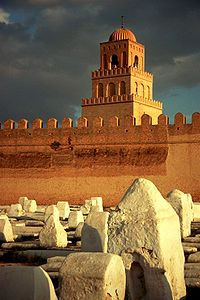 Most of the accounts which describe Arab conquests of North Africa in general and Uqba's conquests in particular date back to at least two centuries after the conquests have happened.
One of the earliest reports come from the Andalucian
chronicler Ibn Idhari Al-Marrakushi
in his Al-Bayan al-Mughrib fi akhbar al-Andalus
. In it, Ibn Idhari describes the moment when Uqba reached the Atlantic coast
saying "Oh God, if the sea had not prevented me, I would have galloped on for ever like Alexander the Great, upholding your faith and fighting the unbelievers!."
Edward Gibbon
, referring to Uqba ibn Nafi as Akbah, gives him the title "conqueror of Africa," beginning his story when he "marched from Damascus
at the head of ten thousand of the bravest Arabs; and the genuine force of the Moslems [sic] was enlarged by the doubtful aid and conversion of many thousand Barbarians." He then marched into North Africa. Gibbon continues: "It would be difficult, nor is it necessary, to trace the accurate line of the progress of Akbah." On the North African coast, "the well-known titles of Bugia
, and Tangier
define the more certain limits of the Saracen
victories." Gibbon then tells the story of Akbah's conquest of the Roman province
of Mauretania Tingitana
.
It should be pointed out that although much scholarship on the life and conquests of ibn Nafi are available, most have not been translated from their original Arabic into English or French.
Arab
Arab people, also known as Arabs , are a panethnicity primarily living in the Arab world, which is located in Western Asia and North Africa. They are identified as such on one or more of genealogical, linguistic, or cultural grounds, with tribal affiliations, and intra-tribal relationships playing...
hero and general who was serving the Umayyad
Umayyad
The Umayyad Caliphate was the second of the four major Arab caliphates established after the death of Muhammad. It was ruled by the Umayyad dynasty, whose name derives from Umayya ibn Abd Shams, the great-grandfather of the first Umayyad caliph. Although the Umayyad family originally came from the...
dynasty, in Amir Muavia and Yazid periods, who began the Islam
Islam
Islam . The most common are and . : Arabic pronunciation varies regionally. The first vowel ranges from ~~. The second vowel ranges from ~~~...
ic conquest of the Maghreb
Maghreb
The Maghreb is the region of Northwest Africa, west of Egypt. It includes five countries: Morocco, Algeria, Tunisia, Libya, and Mauritania and the disputed territory of Western Sahara...
, including present-day Algeria
Algeria
Algeria , officially the People's Democratic Republic of Algeria , also formally referred to as the Democratic and Popular Republic of Algeria, is a country in the Maghreb region of Northwest Africa with Algiers as its capital.In terms of land area, it is the largest country in Africa and the Arab...
, Tunisia
Tunisia
Tunisia , officially the Tunisian RepublicThe long name of Tunisia in other languages used in the country is: , is the northernmost country in Africa. It is a Maghreb country and is bordered by Algeria to the west, Libya to the southeast, and the Mediterranean Sea to the north and east. Its area...
, Libya
Libya
Libya is an African country in the Maghreb region of North Africa bordered by the Mediterranean Sea to the north, Egypt to the east, Sudan to the southeast, Chad and Niger to the south, and Algeria and Tunisia to the west....
and Morocco
Morocco
Morocco , officially the Kingdom of Morocco , is a country located in North Africa. It has a population of more than 32 million and an area of 710,850 km², and also primarily administers the disputed region of the Western Sahara...
in North Africa
North Africa
North Africa or Northern Africa is the northernmost region of the African continent, linked by the Sahara to Sub-Saharan Africa. Geopolitically, the United Nations definition of Northern Africa includes eight countries or territories; Algeria, Egypt, Libya, Morocco, South Sudan, Sudan, Tunisia, and...
. He was the nephew of 'Amr ibn al-'As
'Amr ibn al-'As
`Amr ibn al-`As was an Arab military commander who is most noted for leading the Muslim conquest of Egypt in 640. A contemporary of Muhammad, and one of the Sahaba , who rose quickly through the Muslim hierarchy following his conversion to Islam in the year 8 AH...
. Uqba is often surnamed al-Fihri in reference to the Banu Fihri, a clan connected to the Quraysh. His descendants would be known as the 'Oqbids' or 'Fihrids'. Uqba is the founder of the cultural city of Kairouan in Tunisia.
Uqba accompanied Al-‘As in his initial raids and capture of cities in North Africa starting with Barca
Barca
Barce was an ancient Greek colony and later Roman, Byzantine, city in North Africa. It occupied the coastal area of what is modern day Libya...
, then proceeding to Tripolitania
Tripolitania
Tripolitania or Tripolitana is a historic region and former province of Libya.Tripolitania was a separate Italian colony from 1927 to 1934...
in 644 AD. In 670 now the emir or commander, Uqba led an Arab army to North Africa, crossing the Egypt
Egypt
Egypt , officially the Arab Republic of Egypt, Arabic: , is a country mainly in North Africa, with the Sinai Peninsula forming a land bridge in Southwest Asia. Egypt is thus a transcontinental country, and a major power in Africa, the Mediterranean Basin, the Middle East and the Muslim world...
ian deserts, and setting up military posts at regular intervals along his route. In a region of what is now Tunisia
Tunisia
Tunisia , officially the Tunisian RepublicThe long name of Tunisia in other languages used in the country is: , is the northernmost country in Africa. It is a Maghreb country and is bordered by Algeria to the west, Libya to the southeast, and the Mediterranean Sea to the north and east. Its area...
, he established the town now called Kairouan
Kairouan
Kairouan , also known as Kirwan or al-Qayrawan , is the capital of the Kairouan Governorate in Tunisia. Referred to as the Islamic Cultural Capital, it is a UNESCO World Heritage site. The city was founded by the Arabs around 670...
(Kairwan or al Qayrawan, meaning "camp" or "caravanserai
Caravanserai
A caravanserai, or khan, also known as caravansary, caravansera, or caravansara in English was a roadside inn where travelers could rest and recover from the day's journey...
" in Persian
Persian language
Persian is an Iranian language within the Indo-Iranian branch of the Indo-European languages. It is primarily spoken in Iran, Afghanistan, Tajikistan and countries which historically came under Persian influence...
) about 160 kilometres south of present-day Tunis
Tunis
Tunis is the capital of both the Tunisian Republic and the Tunis Governorate. It is Tunisia's largest city, with a population of 728,453 as of 2004; the greater metropolitan area holds some 2,412,500 inhabitants....
, which he used as a base for further operations.
According to one legend, one of Uqba's soldiers stumbled across a golden goblet buried in the sands. It was recognized as one that had disappeared from Mecca
Mecca
Mecca is a city in the Hijaz and the capital of Makkah province in Saudi Arabia. The city is located inland from Jeddah in a narrow valley at a height of above sea level...
some years before, and when it was dug out of the sand a spring appeared, with waters said to come from the same source as those of the sacred Zamzam Well
Zamzam Well
The Well of Zamzam is a well located within the Masjid al-Haram in Mecca, Saudi Arabia, east of the Kaaba, the holiest place in Islam...
in Mecca. This story led to Kairouan becoming a place of pilgrimage
Pilgrimage
A pilgrimage is a journey or search of great moral or spiritual significance. Typically, it is a journey to a shrine or other location of importance to a person's beliefs and faith...
, and then a holy city (the Mecca of the Maghreb) and the most important city in North Africa.
In 683 Uqba was ambushed and killed near Biskra
Biskra
Biskra is the capital city of Biskra province, Algeria. In 2007, its population was recorded as 207,987.During Roman times the town was called Vescera, though this may have been simply a Latin transliteration of the native name. Around 200 AD under Septimius Severus' reign, it was seized by the...
by Kusaila
Kusaila
Kusaila or Kasila or Kusayla was a 7th century chief of the Awraba tribe of the Berber people and head of the Sanhadja confederation...
. Ironically he died beside his hated rival Abu al-Muhajir Dinar, during the battle with Kusaila's troops. His armies evacuated Kairouan and withdrew to Barqa
Barca
Barce was an ancient Greek colony and later Roman, Byzantine, city in North Africa. It occupied the coastal area of what is modern day Libya...
(though Kairouan was soon recaptured). His descendants can be found in the area stretching from the Lake Chad
Lake Chad
Lake Chad is a historically large, shallow, endorheic lake in Africa, whose size has varied over the centuries. According to the Global Resource Information Database of the United Nations Environment Programme, it shrank as much as 95% from about 1963 to 1998; yet it also states that "the 2007 ...
region to Mauritania's coast. The trans-sahel Arab tribe of "Kounta" traces its origins to Uqba, in Algeria, Tunisia and Libya some of his descendants are known as Ouled Sidi Ukba.
Historical accounts
One of the earliest reports come from the Andalucian
Al-Andalus
Al-Andalus was the Arabic name given to a nation and territorial region also commonly referred to as Moorish Iberia. The name describes parts of the Iberian Peninsula and Septimania governed by Muslims , at various times in the period between 711 and 1492, although the territorial boundaries...
chronicler Ibn Idhari Al-Marrakushi
Ibn Idhari
Abū al-Abbas Ahmad ibn Muhammad ibn Idhāri al-Marrākushi who lived in the late 13th and the early 14th century, was the author of an important medieval text on the history of the Maghreb and Iberia written in 1312.Little is known about the life of this author, who was born in Al-Andalus and...
in his Al-Bayan al-Mughrib fi akhbar al-Andalus
Al-Bayan al-Mughrib
Kitāb al-bayān al-mughrib fī ākhbār mulūk al-andalus wa'l-maghrib is an important medieval text on the history of the Maghreb and Iberia, written in Arabic in Marrakech in about the year 1312 by Ibn Idhari...
. In it, Ibn Idhari describes the moment when Uqba reached the Atlantic coast
Atlantic Ocean
The Atlantic Ocean is the second-largest of the world's oceanic divisions. With a total area of about , it covers approximately 20% of the Earth's surface and about 26% of its water surface area...
saying "Oh God, if the sea had not prevented me, I would have galloped on for ever like Alexander the Great, upholding your faith and fighting the unbelievers!."
Edward Gibbon
Edward Gibbon
Edward Gibbon was an English historian and Member of Parliament...
, referring to Uqba ibn Nafi as Akbah, gives him the title "conqueror of Africa," beginning his story when he "marched from Damascus
Damascus
Damascus , commonly known in Syria as Al Sham , and as the City of Jasmine , is the capital and the second largest city of Syria after Aleppo, both are part of the country's 14 governorates. In addition to being one of the oldest continuously inhabited cities in the world, Damascus is a major...
at the head of ten thousand of the bravest Arabs; and the genuine force of the Moslems [sic] was enlarged by the doubtful aid and conversion of many thousand Barbarians." He then marched into North Africa. Gibbon continues: "It would be difficult, nor is it necessary, to trace the accurate line of the progress of Akbah." On the North African coast, "the well-known titles of Bugia
Bugia
Bugia is either:*A Spanish and Italian name of the presently Algerian port city of Bejaia*The Italian word for a candle, especially used as the name for an additional candle carried by a server standing beside a bishop at some Christian liturgical celebrations carried. It is counted among the...
, and Tangier
Tangier
Tangier, also Tangiers is a city in northern Morocco with a population of about 700,000 . It lies on the North African coast at the western entrance to the Strait of Gibraltar where the Mediterranean meets the Atlantic Ocean off Cape Spartel...
define the more certain limits of the Saracen
Saracen
Saracen was a term used by the ancient Romans to refer to a people who lived in desert areas in and around the Roman province of Arabia, and who were distinguished from Arabs. In Europe during the Middle Ages the term was expanded to include Arabs, and then all who professed the religion of Islam...
victories." Gibbon then tells the story of Akbah's conquest of the Roman province
Roman province
In Ancient Rome, a province was the basic, and, until the Tetrarchy , largest territorial and administrative unit of the empire's territorial possessions outside of Italy...
of Mauretania Tingitana
Mauretania Tingitana
Mauretania Tingitana was a Roman province located in northwestern Africa, coinciding roughly with the northern part of present-day Morocco. The province extended from the northern peninsula, opposite Gibraltar, to Chellah and Volubilis to the south, and as far east as the Oued Laou river. Its...
.
- "The fearless Akbah plunged into the heart of the country, traversed the wilderness in which his successors erected the splendid capitals of FezFes, MoroccoFes or Fez is the second largest city of Morocco, after Casablanca, with a population of approximately 1 million . It is the capital of the Fès-Boulemane region....
and Morocco, and at length penetrated to the verge of the Atlantic and the great desertSaharaThe Sahara is the world's second largest desert, after Antarctica. At over , it covers most of Northern Africa, making it almost as large as Europe or the United States. The Sahara stretches from the Red Sea, including parts of the Mediterranean coasts, to the outskirts of the Atlantic Ocean...
. . . . The career, though not the zeal, of Akbah was checked by the prospect of a boundless ocean. He spurred his horse into the waves, and raising his eyes to heaven, exclaimed: Great God! if my course were not stopped by this sea, I would still go on, to the unknown kingdoms of the West, preaching the unity of the holy name, and putting to the sword the rebellious nations who worship another gods than Allah."
It should be pointed out that although much scholarship on the life and conquests of ibn Nafi are available, most have not been translated from their original Arabic into English or French.
See also
- Okba Ben Nafi Air Base
- Umayyad conquest of North AfricaUmayyad conquest of North AfricaThe Umayyad conquest of North Africa continued the century of rapid Arab Muslim expansion following the death of Muhammad in 632 CE. By 640 the Arabs controlled Mesopotamia, had invaded Armenia, and were concluding their conquest of Byzantine Syria. Damascus was the seat of the Umayyad caliphate....
- Medieval Muslim AlgeriaMedieval Muslim AlgeriaMedieval Muslim Algeria was a period of Muslim dominance in Algeria during the Middle Ages, roughly spanning the millennium from the 7th century to the 17th century. Unlike the invasions of previous religions and cultures, the coming of Islam, which was spread by Arabs, was to have pervasive and...
- Berbers and IslamBerbers and IslamThe Berbers are an ethnic group that had, until recently, few links to the Arabs. They have existed in ancient Mauretania, Numidia, Ifriqiya and Tripolitania, for thousands of years...
- KusailaKusailaKusaila or Kasila or Kusayla was a 7th century chief of the Awraba tribe of the Berber people and head of the Sanhadja confederation...
- Muslim conquestsMuslim conquestsMuslim conquests also referred to as the Islamic conquests or Arab conquests, began with the Islamic prophet Muhammad. He established a new unified polity in the Arabian Peninsula which under the subsequent Rashidun and Umayyad Caliphates saw a century of rapid expansion of Muslim power.They...
External links
- Edward Gibbon, History of the Decline and Fall of the Roman Empire Chapter 51