
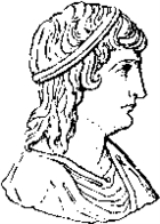
Apuleius was a
LatinLatin is an Italic language originally spoken in Latium and Ancient Rome. It, along with most European languages, is a descendant of the ancient Proto-Indo-European language. Although it is considered a dead language, a number of scholars and members of the Christian clergy speak it fluently, and...
prose writer. He was a
BerberBerbers are the indigenous peoples of North Africa west of the Nile Valley. They are continuously distributed from the Atlantic to the Siwa oasis, in Egypt, and from the Mediterranean to the Niger River. Historically they spoke the Berber language or varieties of it, which together form a branch...
, from
MadaurusM'Daourouch is a municipality in Souk Ahras Province, Algeria, occupying the site of the former Roman town of Madauras, Madaure, or Madaura which is now a Roman Catholic titular see in the former Roman province of Numidia....
(now M'Daourouch,
AlgeriaAlgeria , officially the People's Democratic Republic of Algeria , also formally referred to as the Democratic and Popular Republic of Algeria, is a country in the Maghreb region of Northwest Africa with Algiers as its capital.In terms of land area, it is the largest country in Africa and the Arab...
). He studied
Platonist philosophyPlatonism is the philosophy of Plato or the name of other philosophical systems considered closely derived from it. In a narrower sense the term might indicate the doctrine of Platonic realism...
in
AthensAthens , is the capital and largest city of Greece. Athens dominates the Attica region and is one of the world's oldest cities, as its recorded history spans around 3,400 years. Classical Athens was a powerful city-state...
; travelled to
ItalyItaly , officially the Italian Republic languages]] under the European Charter for Regional or Minority Languages. In each of these, Italy's official name is as follows:;;;;;;;;), is a unitary parliamentary republic in South-Central Europe. To the north it borders France, Switzerland, Austria and...
,
Asia MinorAsia Minor is a geographical location at the westernmost protrusion of Asia, also called Anatolia, and corresponds to the western two thirds of the Asian part of Turkey...
and
EgyptEgypt , officially the Arab Republic of Egypt, Arabic: , is a country mainly in North Africa, with the Sinai Peninsula forming a land bridge in Southwest Asia. Egypt is thus a transcontinental country, and a major power in Africa, the Mediterranean Basin, the Middle East and the Muslim world...
; and was an initiate in several cults or
mysteriesMystery religions, sacred Mysteries or simply mysteries, were religious cults of the Greco-Roman world, participation in which was reserved to initiates....
. The most famous incident in his life was when he was accused of using magic to gain the attentions (and fortune) of a wealthy widow. He declaimed and then distributed a witty
tour de force in his own defense before the
proconsulA proconsul was a governor of a province in the Roman Republic appointed for one year by the senate. In modern usage, the title has been used for a person from one country ruling another country or bluntly interfering in another country's internal affairs.-Ancient Rome:In the Roman Republic, a...
and a court of magistrates convened in
SabrathaSabratha, Sabratah or Siburata , in the Zawiya District in the northwestern corner of modern Libya, was the westernmost of the "three cities" of Tripolis. From 2001 to 2007 it was the capital of the former Sabratha wa Sorman District. It lies on the Mediterranean coast about west of Tripoli...
, near
TripoliTripoli is the capital and largest city in Libya. It is also known as Western Tripoli , to distinguish it from Tripoli, Lebanon. It is affectionately called The Mermaid of the Mediterranean , describing its turquoise waters and its whitewashed buildings. Tripoli is a Greek name that means "Three...
. This is known as the
Apologia.
His most famous work is his
bawdyRibaldry is humorous entertainment that ranges from bordering on indelicacy to gross indecency. It is also referred to as "bawdiness", "gaminess" or "bawdry"....
picaresque novelThe picaresque novel is a popular sub-genre of prose fiction which is usually satirical and depicts, in realistic and often humorous detail, the adventures of a roguish hero of low social class who lives by his wits in a corrupt society...
, the
Metamorphoses, otherwise known as
The Golden AssThe Metamorphoses of Apuleius, which St. Augustine referred to as The Golden Ass , is the only Latin novel to survive in its entirety....
. It is the only Latin novel that has survived in its entirety. It relates the ludicrous adventures of one Lucius, who experiments with magic and is accidentally turned into a
donkeyThe donkey or ass, Equus africanus asinus, is a domesticated member of the Equidae or horse family. The wild ancestor of the donkey is the African Wild Ass, E...
.
Life
Apuleius was born in
MadaurusM'Daourouch is a municipality in Souk Ahras Province, Algeria, occupying the site of the former Roman town of Madauras, Madaure, or Madaura which is now a Roman Catholic titular see in the former Roman province of Numidia....
(now M'Daourouch,
AlgeriaAlgeria , officially the People's Democratic Republic of Algeria , also formally referred to as the Democratic and Popular Republic of Algeria, is a country in the Maghreb region of Northwest Africa with Algiers as its capital.In terms of land area, it is the largest country in Africa and the Arab...
), a Roman colony in
NumidiaNumidia was an ancient Berber kingdom in part of present-day Eastern Algeria and Western Tunisia in North Africa. It is known today as the Chawi-land, the land of the Chawi people , the direct descendants of the historical Numidians or the Massyles The kingdom began as a sovereign state and later...
on the North African coast, bordering Gaetulia, and he described himself as "half-
NumidiaNumidia was an ancient Berber kingdom in part of present-day Eastern Algeria and Western Tunisia in North Africa. It is known today as the Chawi-land, the land of the Chawi people , the direct descendants of the historical Numidians or the Massyles The kingdom began as a sovereign state and later...
n half-
GaetuliaGaetuli was the Romanised name of an ancient Berber tribe inhabiting Getulia, covering the desert region south of the Atlas Mountains, bordering the Sahara. Other sources place Getulia in pre-Roman times along the Mediterranean coasts of what is now Algeria and Tunisia, and north of the Atlas...
n." Madaurus was the same
coloniaA Roman colonia was originally a Roman outpost established in conquered territory to secure it. Eventually, however, the term came to denote the highest status of Roman city.-History:...
where
Saint AugustineAugustine of Hippo , also known as Augustine, St. Augustine, St. Austin, St. Augoustinos, Blessed Augustine, or St. Augustine the Blessed, was Bishop of Hippo Regius . He was a Latin-speaking philosopher and theologian who lived in the Roman Africa Province...
later received part of his early education, and, though located well away from the
RomanizedRomanization or latinization indicate different historical processes, such as acculturation, integration and assimilation of newly incorporated and peripheral populations by the Roman Republic and the later Roman Empire...
coast, is today the site of some pristine Roman ruins. As to his first name, no
praenomenThe praenomen was a personal name chosen by the parents of a Roman child. It was first bestowed on the dies lustricus , the eighth day after the birth of a girl, or the ninth day after the birth of a boy...
is given in any ancient source; late-medieval manuscripts began the tradition of calling him
Lucius from the name of the hero of his novel. Details regarding his life come mostly from his defense speech (
Apology) and his work
Florida, which consists of snippets taken from some of his best speeches.
His father was a provincial magistrate (
duumvir) who bequeathed at his death the sum of nearly two millions of sesterces to his two sons. Apuleius studied with a master at
CarthageCarthage , implying it was a 'new Tyre') is a major urban centre that has existed for nearly 3,000 years on the Gulf of Tunis, developing from a Phoenician colony of the 1st millennium BC...
(where he later settled) and later at
AthensAthens , is the capital and largest city of Greece. Athens dominates the Attica region and is one of the world's oldest cities, as its recorded history spans around 3,400 years. Classical Athens was a powerful city-state...
, where he studied
Platonist philosophyPlatonism is the philosophy of Plato or the name of other philosophical systems considered closely derived from it. In a narrower sense the term might indicate the doctrine of Platonic realism...
among other subjects. He subsequently went to
RomeRome is the capital of Italy and the country's largest and most populated city and comune, with over 2.7 million residents in . The city is located in the central-western portion of the Italian Peninsula, on the Tiber River within the Lazio region of Italy.Rome's history spans two and a half...
to study
LatinLatin is an Italic language originally spoken in Latium and Ancient Rome. It, along with most European languages, is a descendant of the ancient Proto-Indo-European language. Although it is considered a dead language, a number of scholars and members of the Christian clergy speak it fluently, and...
oratoryOratory is a type of public speaking.Oratory may also refer to:* Oratory , a power metal band* Oratory , a place of worship* a religious order such as** Oratory of Saint Philip Neri ** Oratory of Jesus...
and, most likely, to declaim in the law courts for a time before returning to his native North Africa. He also travelled extensively in
Asia MinorAsia Minor is a geographical location at the westernmost protrusion of Asia, also called Anatolia, and corresponds to the western two thirds of the Asian part of Turkey...
and Egypt, studying philosophy and religion, burning up his inheritance while doing so.
Apuleius was an initiate in several cults or
mysteriesMystery religions, sacred Mysteries or simply mysteries, were religious cults of the Greco-Roman world, participation in which was reserved to initiates....
, including the
Dionysian mysteriesThe Dionysian Mysteries were a ritual of ancient Greece and Rome which used intoxicants and other trance-inducing techniques to remove inhibitions and social constraints, liberating the individual to return to a natural state. It also provided some liberation for those marginalized by Greek...
, and the cult of
IsisIsis or in original more likely Aset is a goddess in Ancient Egyptian religious beliefs, whose worship spread throughout the Greco-Roman world. She was worshipped as the ideal mother and wife as well as the matron of nature and magic...
. He was a priest of Aesculapius and, according to Augustine,
sacerdos provinciae Africae (i.e. priest of the province of Carthage).
Not long after his return home he set out upon a new journey to
AlexandriaAlexandria is the second-largest city of Egypt, with a population of 4.1 million, extending about along the coast of the Mediterranean Sea in the north central part of the country; it is also the largest city lying directly on the Mediterranean coast. It is Egypt's largest seaport, serving...
. On his way there he was taken ill at the town of Oea (modern-day
TripoliTripoli is the capital and largest city in Libya. It is also known as Western Tripoli , to distinguish it from Tripoli, Lebanon. It is affectionately called The Mermaid of the Mediterranean , describing its turquoise waters and its whitewashed buildings. Tripoli is a Greek name that means "Three...
) and was hospitably received into the house of Sicinius Pontianus, with whom he had been friends when he had studied in Athens. The mother of Pontianus, Pudentilla, was a very rich widow. With her son's consent – indeed encouragement – Apuleius agreed to marry her. Meanwhile Pontianus himself married the daughter of one Herennius Rufinus; he, indignant that Pudentilla's wealth should pass out of the family, instigated his son-in-law, together with a younger brother, Sicinius Pudens, a mere boy, and their paternal uncle, Sicinius Aemilianus, to join him in impeaching Apuleius upon the charge that he had gained the affections of Pudentilla by charms and magic spells. The case was heard at
SabrathaSabratha, Sabratah or Siburata , in the Zawiya District in the northwestern corner of modern Libya, was the westernmost of the "three cities" of Tripolis. From 2001 to 2007 it was the capital of the former Sabratha wa Sorman District. It lies on the Mediterranean coast about west of Tripoli...
, near Tripoli, c. 158 CE, before
Claudius MaximusClaudius Maximus was a Stoic philosopher and a teacher of Marcus Aurelius.Marcus describes him as the perfect sage:From Maximus I learned self-government, and not to be led aside by anything; and cheerfulness in all circumstances, as well as in illness; and a just admixture in the moral character...
,
proconsulA proconsul was a governor of a province in the Roman Republic appointed for one year by the senate. In modern usage, the title has been used for a person from one country ruling another country or bluntly interfering in another country's internal affairs.-Ancient Rome:In the Roman Republic, a...
of
AfricaThe Roman province of Africa was established after the Romans defeated Carthage in the Third Punic War. It roughly comprised the territory of present-day northern Tunisia, and the small Mediterranean coast of modern-day western Libya along the Syrtis Minor...
. The accusation itself seems to have been ridiculous, and the spirited and triumphant defence spoken by Apuleius is still extant. This is known as the
Apologia (A Discourse on Magic).
Of his subsequent career we know little. Judging from the many works of which he was author, he must have devoted himself assiduously to literature. He occasionally gave speeches in public with great applause; he had the charge of exhibiting gladiatorial shows and wild beast events in the province, and statues were erected in his honour by the senate of Carthage and of other senates.
Works
The Golden Ass
The Golden Ass (
Asinus Aureus) or
Metamorphoses is the only Latin novel that has survived in its entirety. It is an imaginative, irreverent, and amusing work that relates the ludicrous adventures of one Lucius, who experiments with magic and is accidentally turned into an
assThe donkey or ass, Equus africanus asinus, is a domesticated member of the Equidae or horse family. The wild ancestor of the donkey is the African Wild Ass, E...
. In this guise he hears and sees many unusual things, until escaping from his predicament in a rather unexpected way. Within this
frame storyA frame story is a literary technique that sometimes serves as a companion piece to a story within a story, whereby an introductory or main narrative is presented, at least in part, for the purpose of setting the stage either for a more emphasized second narrative or for a set of shorter stories...
are found multiple
digressionsA story within a story, also rendered story-within-a-story, is a literary device in which one narrative is presented during the action of another narrative. Mise en abyme is the French term for a similar literary device...
, the longest among them being the well-known tale of
Cupid and PsycheCupid and Psyche , is a legend that first appeared as a digressionary story told by an old woman in Lucius Apuleius' novel, The Golden Ass, written in the 2nd century CE. Apuleius likely used an earlier tale as the basis for his story, modifying it to suit the thematic needs of his novel.It has...
.
The
Metamorphoses ends with the (once again human) hero, Lucius, eager to be initiated into the mystery cult of
IsisIsis or in original more likely Aset is a goddess in Ancient Egyptian religious beliefs, whose worship spread throughout the Greco-Roman world. She was worshipped as the ideal mother and wife as well as the matron of nature and magic...
; he abstains from forbidden foods, bathes and purifies himself. He is introduced to the
Navigium IsidisThe Navigium Isidis or Isidis Navigium was an annual ancient Roman religious festival in honor of the goddess Isis. The festival outlived Christian persecution by Theodosius and Arcadius' persecution against the Roman religion.In the Roman Empire, it was still celebrated in Italy at least until...
. Then the secrets of the cult's books are explained to him, and further secrets revealed before going through the process of initiation which involves a trial by the elements in a journey to the underworld. Lucius is then asked to seek initiation into the cult of
OsirisOsiris is an Egyptian god, usually identified as the god of the afterlife, the underworld and the dead. He is classically depicted as a green-skinned man with a pharaoh's beard, partially mummy-wrapped at the legs, wearing a distinctive crown with two large ostrich feathers at either side, and...
in Rome, and eventually is initiated into the
pastophoroi—a group of priests that serves Isis and Osiris.
Other works
His other works are:
- Apologia (A Discourse on Magic). Apuleius' courtroom defense. The work has very little to do with magic, and a lot to do with making mincemeat of his opponents, with hilarity and panache. It is among the funniest works that have come down to us from Antiquity, and one of the most entertaining examples of Latin courtroom oratory to survive.
- Florida. A compilation of twenty-three extracts from his various speeches and lectures.
- On Plato and his Doctrine. An outline in two books of Plato
Plato , was a Classical Greek philosopher, mathematician, student of Socrates, writer of philosophical dialogues, and founder of the Academy in Athens, the first institution of higher learning in the Western world. Along with his mentor, Socrates, and his student, Aristotle, Plato helped to lay the...
's physics and ethics, preceded by a life of Plato
- De Deo Socratis (On the God of Socrates). A work on the existence and nature of daemons
The words dæmon and daimôn are Latinized spellings of the Greek "δαίμων", a reference to the daemons of Ancient Greek religion and mythology, as well as later Hellenistic religion and philosophy...
, the intermediaries between gods and humans. This treatise was roughly attacked by Augustine.
- On the Universe. This Latin translation of the work De Mundo is probably by Apuleius.
Apuleius wrote many other works which have not survived. He wrote works of
poetryPoetry is a form of literary art in which language is used for its aesthetic and evocative qualities in addition to, or in lieu of, its apparent meaning...
and
fictionFiction is the form of any narrative or informative work that deals, in part or in whole, with information or events that are not factual, but rather, imaginary—that is, invented by the author. Although fiction describes a major branch of literary work, it may also refer to theatrical,...
, as well as technical treatises on
politicsPolitics is a process by which groups of people make collective decisions. The term is generally applied to the art or science of running governmental or state affairs, including behavior within civil governments, but also applies to institutions, fields, and special interest groups such as the...
,
dendrologyDendrology or xylology is the science and study of wooded plants . There is no sharp boundary between plant taxonomy and dendrology. However, woody plants not only belong to many different plant families, but these families may be made up of both woody and non-woody members. Some families include...
,
agricultureAgriculture is the cultivation of animals, plants, fungi and other life forms for food, fiber, and other products used to sustain life. Agriculture was the key implement in the rise of sedentary human civilization, whereby farming of domesticated species created food surpluses that nurtured the...
,
medicineMedicine is the science and art of healing. It encompasses a variety of health care practices evolved to maintain and restore health by the prevention and treatment of illness....
,
natural historyNatural history is the scientific research of plants or animals, leaning more towards observational rather than experimental methods of study, and encompasses more research published in magazines than in academic journals. Grouped among the natural sciences, natural history is the systematic study...
,
astronomyAstronomy is a natural science that deals with the study of celestial objects and phenomena that originate outside the atmosphere of Earth...
,
musicMusic is an art form whose medium is sound and silence. Its common elements are pitch , rhythm , dynamics, and the sonic qualities of timbre and texture...
, and
arithmeticArithmetic or arithmetics is the oldest and most elementary branch of mathematics, used by almost everyone, for tasks ranging from simple day-to-day counting to advanced science and business calculations. It involves the study of quantity, especially as the result of combining numbers...
, and he translated Plato's
PhaedoPlato's Phaedo is one of the great dialogues of his middle period, along with the Republic and the Symposium. The Phaedo, which depicts the death of Socrates, is also Plato's seventh and last dialogue to detail the philosopher's final days .In the dialogue, Socrates...
.
Spurious works
The extant works wrongly attributed to Apuleius are:
- On interpretation (Peri Hermeneias). A brief Latin version of a guide to Aristotelian logic.
- Asclepius. A Latin paraphrase of a lost Greek dialogue (The perfect discourse) featuring Asclepius
Asclepius is the God of Medicine and Healing in ancient Greek religion. Asclepius represents the healing aspect of the medical arts; his daughters are Hygieia , Iaso , Aceso , Aglæa/Ægle , and Panacea...
and Hermes TrismegistusHermes Trismegistus is the eponymous author of the Hermetic Corpus, a sacred text belonging to the genre of divine revelation.-Origin and identity:...
.
Apuleian Sphere
The Apuleian Sphere, also known as '
Columcille'sColumcille the Scribe is a poem ascribed to Columbanus, though like a majority of such poems they were probably composed in the eleventh and twelfth centuries.-References:...
Circle' or '
Petosiris's CirclePetosiris to Nechepso is a letter describing an ancient divination technique using numerology and a diagram. It is likely to be a pseudepigraph. Petosiris and Nechepso are considered to be the founders of astrology in some traditions...
' is a magical prognosticating device for predicting the survival of a patient.
External links