
In Depth
See Also

Bread

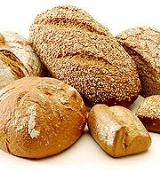
Bread is a staple food which is prepared by baking, steaming Steaming

Steaming is a method of cooking [i] using steam [i]. ... 

, or frying Frying

Frying is the cooking [i] of food [i] in oil [i] or fat [i]. ... 

 dough Dough

Dough is a paste made out of any cereal [i]s or leguminous [i] crops by grinding it with a small ... 

. Bread consists minimally of flour Flour

An ingredient used in many food [i]s, flour is a fine powder made from cereal [i]s or other starch [i]y ... 

 and water Water

Water is a taste [i]less, odor [i]less substance that is essential to all known forms of life [i] and i ... 

; salt Edible salt

Edible salt, also called table salt or just salt, is a mineral [i], one of a very few rocks ... 

 is present in most cases; and usually a leavening agent such as yeast Yeast

Yeasts are single-celled fungi [i], a few species of which are commonly used to leaven [i] ... 

 is used. Breads may also contain some amounts of sugar Sugar

In general use, non-scientists take "sugar" to mean sucrose [i], also called "table sugar" or saccharose, a wh ... 

, spice Spice

A spice is a dried seed [i], fruit [i], root [i], bark [i] or vegetative substance used in nutrition [i]... 

s, fruit Fruit

The term fruit has different meanings depending on context.... 

 , vegetable Vegetable

Vegetable is a culinary [i] term. ... 

s nuts and seeds , which are often used for decorative and flavoring purposes. There are a wide variety of breads and preferred varieties often vary from region to region. Fresh bread is prized for its taste and texture, and retaining its freshness is important to keep it appetizing.

Discussions

  Discussion Features

   Ask a question about 'Bread'

   Start a new discussion about 'Bread'

   Answer questions about 'Bread'

   'Bread' discussion forum

Timeline

1947   When the French France

France, officially the French Republic, is a country [i] whose metropolitan territory [i] ... 

 government lowers the bread ration Rationing

Rationing is the controlled distribution of resources and scarce [i] goods or services: it rest ... 

 to 200 grams, it causes riot Riot

Riots occur when crowds or even small groups of people gather to commit acts of violence [i] usually in ... 

s in Verdun Verdun

Verdun is a city and commune [i] in the Lorraine [i] rgion [i] ... 

 and Le Mans Le Mans

Le Mans is a city [i] in France [i], located on the Sarthe River [i]. ... 


Encyclopedia

Bread is a staple food which is prepared by baking, steaming Steaming

Steaming is a method of cooking [i] using steam [i].
... 

, or frying Frying

Frying is the cooking [i] of food [i] in oil [i] or fat [i]. ... 

 dough Dough

Dough is a paste made out of any cereal [i]s or leguminous [i] crops by grinding it with a small ... 

. Bread consists minimally of flour Flour

An ingredient used in many food [i]s, flour is a fine powder made from cereal [i]s or other starch [i]y ... 

 and water Water

Water is a taste [i]less, odor [i]less substance that is essential to all known forms of life [i] and i ... 

; salt Edible salt

Edible salt, also called table salt or just salt, is a mineral [i], one of a very few rocks ... 

 is present in most cases; and usually a leavening agent such as yeast Yeast

Yeasts are single-celled fungi [i], a few species of which are commonly used to leaven [i] ... 

 is used. Breads may also contain some amounts of sugar Sugar

In general use, non-scientists take "sugar" to mean sucrose [i], also called "table sugar" or saccharose, a wh ... 

, spice Spice

A spice is a dried seed [i], fruit [i], root [i], bark [i] or vegetative substance used in nutrition [i]... 

s, fruit Fruit

The term fruit has different meanings depending on context.... 

 , vegetable Vegetable

Vegetable is a culinary [i] term. ... 

s nuts and seeds , which are often used for decorative and flavoring purposes. There are a wide variety of breads and preferred varieties often vary from region to region.

Fresh bread is prized for its taste and texture, and retaining its freshness is important to keep it appetizing. Bread that has stiffened or dried past its prime is said to be stale. Modern bread is often wrapped in paper Paper

Paper is a thin, flat material produced by the amalgamation of plant fibre [i]s, which are subsequently ... 

 or plastic Plastic

Plastic covers a range of synthetic or semisynthetic polymerization [i] products. ... 

 film, or stored in airtight containers such as a breadbox Breadbox

A breadbox, also called a bread bin, is a container for storing bread [i] and other baked goods to ... 

 to keep it fresh longer. Bread that is kept in warm moist environments is prone to the growth of mold Mold

Molds, or moulds, are fungi [i] that grow in the form of mycelia [i] and usually p ... 

. It becomes stale more quickly in the low temperature of a refrigerator Refrigerator

A refrigerator is an appliance for the storage and preservation of perishable food.... 

, although by keeping it cool, mold is less likely to grow. A good way to keep bread fresh is to put it in the freezer, thus allowing it to stay fresh for several weeks.

Usage

Bread can be served ranging anywhere from room temperature to piping hot. Once baked, bread can subsequently be toast Toast

This page is about the food 'toast', for other meanings, see Toast [i].
... 

ed. Bread is most commonly picked up and eaten with the hands, although some applications of bread are more easily eaten with the aid of a utensil such as a fork Fork

As a piece of cutlery [i] or kitchenware [i], a fork is a tool consisting of a handle with several narro ... 

. It can be eaten by itself or as a carrier for another, usually less compact food. Bread may be dunked or dipped into a liquid , topped with various spreads, both sweet and savory, or serve as the enclosure for the ubiquitous sandwich Sandwich

A sandwich is a food [i] item typically consisting of two pieces of bread [i] between which are laid one ... 

 with any number of meats, cheeses, vegetables or condiments inside. Across the world, bread is the preferred vehicle for many toppings that vary from culture to culture, such as:
  • butter Butter

    Butter is a dairy product [i] made by churning [i] fresh or fermented [i] cream [i] ... 

     -- "bread and butter" has become a famous phrase connoting a duo.
  • nut butter Nut butter

    Nut butter refers to the mashing of nuts to create a spread.... 

    s such as peanut butter Peanut butter

    Peanut butter is a food made of roasted and ground peanut [i]s, usually salted and sweetened. ... 

  • fruit-based spreads such as jam Jam

    Jam is a type of sweet spread or condiment [i] made with certain fruit [i]s or vegetable [i]s, sugar, an ... 

    , jelly Jelly

    A jelly is a sweet or savoury food gel [i], usually made through the addition of gelatin [i] or pectin [i] ... 

    , apple butter or marmalade Marmalade

    Marmalade is a sweet conserve with a bitter tang made from citrus fruit [i], sugar [i], water, a... 

  • molasses, maple syrup Maple syrup

    Maple syrup is a sweetener made from the sap [i] of maple [i] trees. ... 

     or honey Honey

    Honey is a sweet and viscous fluid produced by honeybee [i]s from the nectar [i] of flower [i]s. ... 

  • liverwurst Liverwurst

    Liverwurst, literally meaning "liver sausage," is a typical sausage [i] served in Germany [i] and the Netherlands [i] ... 

     or other forms of pâté Pâté

    A pt is a spreadable paste, usually made from meat although vegetarian [i] variants exist, ... 

  • cream cheese or other soft processed cheese Processed cheese

    Processed cheese is a food product made from regular cheese [i] and other unfermented [i] d ... 

     spreads, such as The Laughing Cow The Laughing Cow

    The Laughing Cow is a brand of processed cheese [i] products owned by Groupe Bel [i]. ... 

  • yeast-based spreads such as Marmite Marmite

    Marmite is a British [i] savoury spread made from yeast extract [i], a by-product [i] of ... 

     or Vegemite Vegemite

    Vegemite is the registered brand name for a dark brown, salty food paste made from yeast extract [i], m ... 

  • hummus Hummus

    Hummus is a dip [i] made of chickpea [i] paste and tahini [i], with flavorings such as olive oil [i] ... 

    , refried beans and other bean Bean

    Bean is a common name for large plant seed [i]s of several genera [i] of Fabaceae [i] used for fo ... 

    -based spreads
  • prepared salad Salad

    Salad is a term applied broadly to many food [i] preparations that are a mixture of chopped or sliced in... 

    s, such as tuna Tuna

    Tuna, sometimes called tunafish, are several species [i] of ocean-dwelling fish [i] in the family ... 

    , chicken Chicken

    A chicken is a type of domesticated [i] bird [i] which is often raised as a type of poultry [i] ... 

    , egg or ham Ham

    Technically, ham is the thigh [i] and buttock [i] of any animal [i] that is slaughtered [i] fo ... 

     salad, and myriad other foods

Etymology

The word itself, Old English Old English language

Old English is an early form of the English language [i] that was spoken in parts of what is now England [i] ... 

 bread, is common in various forms to many Germanic language Germanic languages

The Germanic languages are a group of related languages constituting a branch of the Indo-European language family [i] ... 

s; such as German German language

German is a West Germanic language [i]. ... 

 Brot, Dutch Dutch language

Dutch is a West Germanic [i] language [i] spoken by around 22 million people, mainly in the Netherlands [i] ... 

 brood, Swedish bröd, and Norwegian Norwegian language

Norwegian is a Germanic language [i] spoken in Norway [i]. ... 

 brød; it has been derived from the root of brew Brewing

Brewing is the production of alcoholic beverage [i]s and alcohol fuel [i] through fermentation [i] ... 

, but more probably is connected with the root of break, for its early uses are confined to broken pieces, or bits of bread, the Latin Latin

Latin is an ancient Indo-European language [i] originally spoken in Latium [i], ... 

 frustum, and it was not until the 12th century 12th century

As a means of recording the passage of time [i], the 12th century was that century [i] which lasted from ... 

 that it took the place—as the generic name for bread—of hlaf , which appears to be the oldest Teutonic name; Old High German hleib and modern German German language

German is a West Germanic language [i]. ... 

 Laib, or Finnish leipä, Estonian leib, and Russian Russian language

Russian is the most widely spoken language of Eurasia [i] and the most widespread of the Slavic languages [i] ... 

 ???? are similar .

History

Bread is one of the oldest prepared foods, dating back to the Neolithic Neolithic

| style="border-bottom:3px solid; background:#efefef;" | This time period is part of theHolocene [i] epoch.
... 

 era. The first breads produced were probably cooked versions of a grain-paste, made from ground cereal grains and water, and may have been developed by accidental cooking or deliberate experimentation with water and grain flour. Descendants of these early breads are still commonly made from various grains worldwide, including the Mexican Mexico

The United Mexican States, generally known as Mexico is a country [i] located in North America [i] ... 

 tortilla Tortilla

The Spanish language [i] term tortilla can be used to mean several different dishes, depending on the a... 

, India India

India , officially the Republic of India, is a country in South Asia [i]. ... 

n and Pakistan Pakistan

[i] located in [[South Asia]... 

i chapati, Chinese China

China is a cultural region [i] and ancient civilization [i] in East Asia [i]. ... 

 bò bing, Scottish Scotland

Scotland is a nation [i] in northwest Europe [i] and one of the constituent [i] countries [i] ... 

 oatcake Oatcake

An oatcake is a type of cracker [i] or pancake [i], made from oatmeal [i], and sometimes flour [i] ... 

, North American johnnycake, and Ethiopia Ethiopia

Ethiopia, officially the Federal Democratic Republic of Ethiopia, is a country situated in the Horn of Africa [i] ... 

n injera Injera

Injera or taita, is a pancake [i]-like bread [i] made out of teff [i] flour [i]. ... 

. The basic flat breads of this type also formed a staple in the diet of many early civilizations with the Sumer Sumer

Sumer... 

ians eating a type of barley flat cake, and the 12th century BC Egyptians being able to purchase a flat bread called ta from stalls in the village streets.

The development of leavened bread can probably also be traced to prehistoric times. Yeast spores occur everywhere, including the surface of cereal grains, so any dough left to rest will become naturally leavened. Although leavening is likely of prehistoric origin, the earliest archaeological evidence is from ancient Egypt. Scanning electron microscopy has detected yeast cells in some ancient Egyptian loaves. However, ancient Egyptian bread was made from emmer wheat and has a dense crumb. In cases where yeast cells are not visible, it is difficult to determine whether the bread was leavened by visual examination. As a result, the extent to which bread was leavened in ancient Egypt remains uncertain.

There were multiple sources of leavening available for early bread. Air borne yeasts could be harnessed by leaving uncooked dough exposed to air for some time before cooking. Pliny the Elder Pliny the Elder

Gaius Plinius Secundus, better known as Pliny the Elder, was an ancient author [i] and natural philosopher [i] ... 

 reported that the Gauls Gaul

Gaul was the name given, in ancient times, to the region of Western Europe [i] comprising present-day n ... 

 and Iberians Iberians

The Iberians [i] were an ancient, Pre-Indo-European [i] people who inhabited the east and southeast of the Iberian Peninsula [i]... 

 used the foam skimmed from beer to produce "a lighter kind of bread than other peoples". Parts of the ancient world that drank wine instead of beer used a paste composed of grape juice and flour that was allowed to begin fermenting, or wheat bran steeped in wine, as a source for yeast. The most common source of leavening however was to retain a piece of dough from the previous day to utilize as a form of sourdough starter.

Even within antiquity there was a wide variety of breads available. In the Deipnosophistae, the Greek Ancient Greece

Ancient Greece is the period in Greek history [i] which lasted for around one thousand years and ended w ... 

 author Athenaeus describes some of the breads, cakes, cookies, and pastries available in the Classical world. Among the breads mentioned are griddle cakes, honey-and-oil bread, mushroom shaped loaves covered in poppy seeds, and the military specialty of rolls baked on a spit. The type and quality of flour used to produce bread could also vary as noted by Diphilus when he declared "bread made of wheat, as compared with that made of barley, is more nourishing, more digestible, and in every way superior. In order of merit, the bread made from refined [thoroughly sieved] flour comes first, after that bread from ordinary wheat, and then the unbolted, made of flour that has not been sifted."

Within medieval Europe Middle Ages

The Middle Ages formed the middle period in a traditional schematic division of European history [i] ... 

 bread served not only as a staple food but also as part of the table service. In the standard table setting of the day the trencher, a piece of stale bread roughly 6 inches by 4 inches , served as an absorbent plate. At the completion of a meal the trencher could then be eaten, given to the poor, or fed to the dogs. It was not until the 15th Century 15th century

As a means of recording the passage of time [i], the 15th century was that century [i] which lasted from ... 

 that trenchers made of wood started to replace the bread variety.

Otto Frederick Rohwedder is considered to be the father of sliced bread Sliced bread

Sliced bread usually refers to a loaf of bread [i] which has been pre-sliced and packaged for convenienc ... 

. In 1912 Rohwedder started work on inventing a machine that sliced bread, but bakeries were reluctant to use it since they were concerned the sliced bread would go stale. It was not until 1928, when Rohwedder invented a machine that both sliced and wrapped the bread, that sliced bread caught on. A bakery in Chillicothe, Missouri was the first to use this machine to produce sliced bread.

For generations, white bread was considered the preferred bread of the rich while the poor ate dark bread. However, the connotations reversed in the 20th century 20th century

The 20th century started on 1 January [i] 1901 [i] and ended on 31 December [i] 2000 [i], according to t... 

 with dark bread becoming preferred as having superior nutrition Nutrition

[i] and states of [[health]... 

al value while white bread became associated with lower class ignorance of nutrition.

Another major advance happened in 1961 with the development of the Chorleywood Bread Process which used the intense mechanical working of dough to dramatically reduce the fermentation period and the time taken to produce a loaf. This process is now widely used around the world.

Recently, domestic breadmaker Bread machine

A bread machine is a home appliance [i] for baking [i] bread [i]. ... 

s that automate the process of making bread are becoming popular in the home.

Cultural and Political Importance


As a foodstuff of great historical and contemporary importance, in many cultures bread has a significance beyond mere nutrition. The Lord's Prayer, for example, contains the line 'Give us today our daily bread'; here, 'bread' is commonly understood to mean necessities in general. In Israel Israel

Israel , officially the State of Israel, is a country in Western Asia [i] on the so ... 

 the most usual phrase in work related demonstrations is "lehem, avoda" [bread, work], and during the 1960s 1960s

The 1960s decade [i] refers to the years from 1960 [i] to 1969 [i], inclusive. ... 

, the hippie Hippie

Hippie, occasionally spelled hippy, refers to a subgroup of the 1960s countercultural movement [i] ... 

 community used the term bread as a euphemism for money Money

Economics [i] offers various definitions for money, though it is now commonly considered to be any good ... 

. The word bread is now commonly used around the world in English English language

English is a widely distributed language that originated in England [i] but is now the primary language ... 

 speaking countries as a synonym for money. In part, derived from the rhyming slang "Bread and honey". The cultural importance of 'bread' goes beyond slang, however, to serve as a metaphor for basic necessities and living conditions in general. A 'bread-winner' is a household's main economic contributor and has little to do with actual bread-provision, for example.

The political significance of bread is considerable. In Britain in the nineteenth century 19th century

The 19th century lasted from 1801 [i] through 1900 [i] in the Gregorian calendar [i].
... 

 the inflated price of bread due to the Corn Laws caused major political and social divisions, and was central to debates over free trade and protectionism. The Assize of Bread and Ale in the thirteenth century 13th century

As a means of recording the passage of time [i], the 13th century was that century [i] which lasted from ... 

 showed the importance of bread in medieval times by setting heavy punishments for short-changing bakers, and the foodstuff appeared in Magna Carta Magna Carta

[i] [[charter]... 

a century later.

Types

Bread is a popular food Food

Food is any substance, usually comprised primarily of carbohydrate [i]s, fat [i]s, vitamins, water and/o ... 

 in Western and most other societies such as Pakistan and India, however South-East Asian societies typically prefer rice Rice

Rice refers to two species of grass [i], native to tropical and subtropical southern & southeas ... 

. It is often made from a wheat Wheat

Wheat is a grass [i] that is cultivated worldwide. ... 

-flour Flour

An ingredient used in many food [i]s, flour is a fine powder made from cereal [i]s or other starch [i]y ... 

 dough Dough

Dough is a paste made out of any cereal [i]s or leguminous [i] crops by grinding it with a small ... 

 that is cultured with yeast, allowed to rise, and finally baked in an oven Oven

An oven is an enclosed compartment for heating, baking or drying.... 

. Owing to its high levels of gluten Gluten

Gluten is an amorphous ergastic [i] protein [i] found combined with starch [i] in the ... 

 , common wheat Common wheat

Common wheat is by far the most important wheat species in cultivation today.... 

  is the most common grain used for the preparation of bread, but bread is also made from the flour of other wheat species , rye Rye

Rye is a grass [i] grown extensively as a grain and forage crop. ... 

, barley Barley

Barley is a major food and animal feed crop, a member of the grass family Poaceae.... 

, maize Maize

Maize , also known as corn, is a cereal [i] grain [i] that was domesticated in Mesoamerica [i]. ... 

 , and oat Oat

The Oat is a species of cereal grain [i], and the seed [i]s of this plant [i].... 

s, usually, but not always, in combination with wheat flour. Although common wheat is best suited for making highly-risen white bread, other wheat species are capable of giving a good crumb. Spelt bread continues to be widely consumed in Germany, and emmer bread was a staple food in ancient Egypt.
Gallery

Image:Strucla sweet bread02.jpg|European sweetbread
Image:Four loaves.jpg|Four loaves
Image:French bread DSC09293.jpg|French bread
Image:Breads and rolls.jpg|Breads and Bread Rolls at a bakery
Image:Continental italian bread.jpg|Continental Italian Bread
Image:Tin vienna bread.jpg|Tin Vienna Bread
Image:Bread in a traditional oven.JPG|Bread in a traditional oven
Image:Brood.jpg|Pre-sliced bread
Image:Bread rolls.jpg|Bread rolls
Image:Pain aux noix.jpg|Pain aux noix
Image:Various grains.jpg|A cereal grain Cereal

Cereal crops [i] are mostly grasses [i] cultivated for their edible grains or seed [i] ... 


Composition and Chemistry


Formulation

The amount of water and flour are the most significant measurements in a bread recipe, as they affect texture and crumb the most. Professional bakers use a system of percentages known as Bakers' Percentage in their recipe formulations, and measure ingredients by weight instead of by volume. Measurement by weight is much more accurate and consistent than measurement by volume, especially for the dry ingredients.

Flour is always 100%, and the rest of the ingredients are a percent of that amount by weight. Common table bread in the U.S. uses approximately 50% water, resulting in a finely textured, light, bread. Most artisan bread formulas contain anywhere from 60 to 75% water. In yeast breads, the higher water percentages result in more CO2 bubbles, and a coarser bread crumb. One pound of flour will yield a standard loaf of bread, or two french loaves.

Flour

Flour Flour

An ingredient used in many food [i]s, flour is a fine powder made from cereal [i]s or other starch [i]y ... 

 is a product made from grain that has been ground into a powdery consistency. It is flour that provides the primary structure to the final baked bread. Commonly available flours are made from rye, barley, maize, and other grains, but it is wheat flour that is most commonly used for breads. Each of these grains provides starch and protein to the final product.

Wheat flour in addition to its starch contains three water soluble proteins groups, albumin, globulin, proteoses, and two non-water soluble proteins groups, glutenin and gliadin. When flour is mixed with water the water-soluble proteins dissolve, leaving the glutenin and gliadin to form the structure of the resulting dough. When worked by kneading, the glutenin forms strands of long thin chainlike molecules while the shorter gliadin forms bridges between the stands of glutenin. The resulting networks of strands produced by these two proteins is known as gluten Gluten

Gluten is an amorphous ergastic [i] protein [i] found combined with starch [i] in the ... 

. Gluten development improves if the dough is allowed to autolyse.

Liquids

Water, or some other liquid, is used to form the flour into a paste or dough. The volume of liquid required varies between recipes, but a ratio of 1 cup of liquid to 3 cups of flour is common for yeast breads while recipes that use steam as the primary leavening method may have a liquid content in excess of one part liquid to one part flour by volume. In addition to water, other types of liquids that may be used include dairy products, fruit juices, or beer. In addition to the water in each of these they also bring additional sweeteners, fats, and or leavening components.

Leavening

Leavening is the process of adding gas to a dough before or during baking to produce a lighter, more easily chewed bread. Most bread consumed in the West is leavened. However, unleavened breads have symbolic importance in Judaism Judaism

Judaism is the religion [i] of the Jew [i]ish people. ... 

 and Christianity Christianity

Christianity is a monotheistic [i] religion [i] centered on Jesus of Nazareth [i] ... 

. Jews consume unleavened breads such as Matzo Matzo

Matzo is a Jewish food [i] item made of plain flour [i] and water [i], which is not allo ... 

 during Passover Passover

Passover , also called ?? ????? is a Jewish holiday [i] which is celebrated in the spring [i]. ... 

. They are also used in the Christan liturgy when they perform the Eucharist Eucharist

The Eucharist or Communion or The Lord's Supper, is the rite [i] that Christians [i] ... 

, a rite derived from the Last Supper Last Supper

According to gospel [i], the Last Supper was the last meal Jesus [i] shared with his apostles [i] before ... 

 when Jesus Jesus

Jesus,Some of the historians and Biblical scholars who place the birth and death of Jesus within this ra... 

 broke bread with his disciples during a Passover Seder Passover Seder

[i]ish ritual which takes place on the first evening of [[Passover]... 

.
Chemical leavening
A simple technique for leavening bread is the use of gas-producing chemicals. There are two common methods. The first is to use baking powder or a self-rising flour Flour

An ingredient used in many food [i]s, flour is a fine powder made from cereal [i]s or other starch [i]y ... 

 that includes baking powder. The second is to have an acidic ingredient such as buttermilk and add baking soda Sodium bicarbonate

Sodium bicarbonate is the chemical compound [i] with the formula NaHCO3. ... 

. The reaction of the acid with the soda produces gas.

Chemically-leavened breads are called quick breads and soda bread Soda bread

Soda bread is a type of quick bread [i] in which yeast has been substituted with baking soda [i]. ... 

s
. This technique is commonly used to make muffin Muffin

The name muffin is given to two types of bread [i]stuffs. ... 

s and sweet breads such as banana bread Banana bread

Banana bread is a sweet, cake [i]like bread [i] which contains mashed banana [i]s. ... 

.
Yeast leavening
Many breads are leavened by yeast Yeast

Yeasts are single-celled fungi [i], a few species of which are commonly used to leaven [i] ... 

, a type of single-celled fungus Fungus

A fungus is a eukaryotic [i] organism [i] that digests its food [i] externally and absorbs th ... 

. The yeast used for leavening bread is Saccharomyces cerevisiae Saccharomyces cerevisiae

Saccharomyces cerevisiae is a species [i] of budding [i] yeast [i]. ... 

, the same species used for brewing alcoholic beverages. This yeast ferments carbohydrates Carbohydrate

Carbohydrates are chemical compound [i]s that contain oxygen [i], hydrogen [i], and carbon [i] atom [i]s ... 

 in the flour and any sugar Sugar

In general use, non-scientists take "sugar" to mean sucrose [i], also called "table sugar" or saccharose, a wh ... 

, producing carbon dioxide Carbon dioxide

Carbon dioxide is a chemical compound [i] composed of one carbon [i] and two oxygen [i] atoms. ... 

. Most bakers in the U.S. leaven their doughs with commercially produced baker's yeast. Baker's yeast has the advantage of producing uniform, quick, and reliable results, because it is obtained from a pure culture.

Both the baker's yeast, and the sourdough method of baking bread follow the same pattern. Water is mixed with flour, salt and the leavening agent . Other additions are not necessary to bake bread, but often used. The mixed dough is then allowed to rise one or more times , then loaves are formed and the bread is baked in an oven Oven

An oven is an enclosed compartment for heating, baking or drying.... 

.

Many breads are made from a straight dough, which means that all of the ingredients are combined in one step, and the dough baked after the rising time. Alternatively, doughs can be made with the starter method, when some of the flour, water, and the leavening are combined a day or so ahead of baking, and allowed to ferment overnight. On the day of the baking, the rest of the ingredients are added, and the rest of the process is the same as that for straight doughs. This produces a more flavorful bread with better texture. Many bakers see the starter method as a compromise between the highly reliable results of baker's yeast, and the flavor/complexity of a longer fermentation. It also allows the baker to use only a minimal amount of baker's yeast, which was scarce and expensive when it first became available.
Sourdough

The sour taste of sourdough Sourdough

Sourdough is a symbiotic [i] culture of lactobacilli [i] and yeast [i]s used to... 

s actually comes not from the yeast, but from a lactobacillus Lactobacillus

Lactobacillus is a genus [i] of Gram-positive [i] facultative anaerobe [i] bacteria [i]. ... 

, with which the yeast lives in symbiosis Symbiosis

In some cases, the term symbiosis is used only if the association is obligatory and benefits both organisms.... 

. The lactobacillus feeds on the byproducts of the yeast fermentation, and in turn makes the culture go sour by excreting lactic acid Lactic acid

Lactic acid, also known as milk acid, is a chemical compound [i] that plays a role in several biochemical [i] ... 

, which protects it from spoiling . All breads used to be sourdoughs, and the leavening process was not understood until the 19th century, when with the advance of microscopes, scientists were able to discover the microbes that make the dough rise. Since then, strains of yeast have been selected and cultured mainly for reliability and quickness of fermentation. Billions of cells of these strains are then packaged and marketed as "Baker's Yeast". Bread made with baker's yeast is not sour because of the absence of the lactobacillus. Bakers around the world quickly embraced baker's yeast for it made baking simple and so allowed for more flexibility in the bakery's operations. It made baking quick as well, allowing bakeries to make fresh bread from scratch as often as three times a day. While European bakeries kept producing sourdough breads, in the U.S., sourdough baking was widely replaced by baker's yeast, and only recently has that country seen the rebirth of sour-vinegar dough in artisan bakeries.

Sourdough breads are most often made with a sourdough starter . A sourdough starter is a culture of yeast and lactobacillus. It is essentially a dough-like or pancake-like flour/water mixture in which the yeast and lactobacilli live. A starter can be maintained indefinitely by periodically discarding a part of it and refreshing it by adding fresh flour and water. There are starters owned by bakeries and families that are several human generations old, much revered for creating a special taste or texture. Starters can be obtained by taking a piece of another starter and growing it, or they can be made from scratch. There are hobbyist groups on the web who will send their starter for a stamped, self-addressed envelope, and there are even mailorder companies that sell different starters from all over the world. An acquired starter has the advantage to be more proven and established than from-scratch starters.

There are other ways of sourdough baking and culture maintenance. A more traditional one is the process that was followed by peasant families throughout Europe in past centuries. The family would bake on a fixed schedule, perhaps once a week. The starter was saved from the previous week's dough. The starter was mixed with the new ingredients, the dough was left to rise, then a piece of it was saved . The rest was formed into loaves which were marked with the family sign , and taken to the communal oven to bake. These communal ovens over time evolved into what we know today as bakeries, when certain people specialized in bread baking, and with time enhanced the process so far as to be able to mass produce cheap bread for everyone in the village.
San Francisco sourdoughs

The most famous sourdough bread made in the U.S. is the San Francisco San Francisco, California

The City and County of San Francisco is the fourth-largest city in California [i] and the fourteenth-lar ... 

 Sourdough, which in contrast to the majority of the country has remained in continuous production for nearly 150 years, with some bakeries able to trace their starters back to California's territorial period. It is a white bread, characterized by a pronounced sourness , so much so that the dominant strain of lactobacillus in sourdough starters was named Lactobacillus sanfrancisco.
Steam leavening
The rapid expansion of steam produced during baking leavens the bread, which is as simple as it is unpredictable. The best known steam-leavened bread is the popover Popover

A popover is a light, hollow roll made from an egg [i] batter similar to that used in making Yorkshire pudding [i] ... 

. Steam-leavening is unpredictable since the steam is not produced until the bread is baked.

Steam leavening happens regardless of the rising agents
  • The rising agent generates carbon dioxide - or already contains air bubbles.
  • The heat vaporises the water from the inner surface of the bubbles within the dough.
  • The steam expands and makes the bread rise.

It is actually the main factor in the rise. CO2 Carbon dioxide

Carbon dioxide is a chemical compound [i] composed of one carbon [i] and two oxygen [i] atoms. ... 

 generation, on its own, is too small to account for the rise. Heat kills bacteria or yeast at an early stage, so the CO2 generation is stopped.
Bacterial leavening
Salt-risen bread employs a form of bacterial leavening that does not require yeast. Although the leavening action is not always consistent, and requires close attention to the incubating conditions, this bread is making a comeback due to its unique cheese-like flavor and fine texture. .

Fats or shortenings

Fats such as butter, vegetable oils, lard, or that contained in eggs affects the development of gluten in breads by coating and lubricating the individual strands of protein and also helping hold the structure together. If too much fat is included in a bread dough, the lubrication effect will cause the protein structures to divide. A fat content of approximately 3% by weight is the concentration that will produce the greatest leavening action.

This effect is used most popularly in cookie Cookie

In the United States [i] and Canada [i], a cookie is a small, flat baked [i] cake [i]. ... 

s, in that increased fat - typically shortening - causes a harder cookie while increased flour causes a softer cookie . As it is typically not acceptable to have harder bread, this effect is usually not available for use in breads.

In addition to their effects on leavening, fats also serve to tenderize the breads they are used in and also help to keep the bread fresh longer after baking.

Breads across different cultures


There are many variations on the basic recipe of bread, including pizza Pizza

Pizza or Pizza Pie is the name of an oven [i]-baked, flat [i], usually round bread [i] covered wi... 

, chapatis, tortilla Tortilla

The Spanish language [i] term tortilla can be used to mean several different dishes, depending on the a... 

s, baguette Baguette

A baguette is a variety of bread [i] distinguishable by its much greater length than width. ... 

s, brioche Brioche

Brioche is a light but rich French [i] bread [i] or cake [i] made with a yeast [i] dough enriched ... 

, pita Pita

Pita or pita bread, Arabic [i] ???? Kmaj or ??? ????, Cyrillic [i] ????, Greek [i] ... 

s, lavash, biscuit Biscuit

A biscuit is a small baked [i] bread [i] or cake [i].... 

s, pretzel Pretzel

A pretzel is a baked snack [i] that is ordinarily twisted into a unique knot [i]-like shape. ... 

s, naan Naan

Naan is a round flatbread [i] made of wheat [i] flour [i]. ... 

, bagel Bagel

The bagel is a bread product traditionally made of yeast [i]ed wheat [i] dough in the form of a roughly ... 

s, puris, and many other variations.

  • In Britain and the United States United States

    The United States of America, also known as the United States, the U.S., the U.S.A., a... 

    , the most widely consumed type of bread is soft-textured with a thin crust and is sold ready-sliced in packages. It is usually eaten with the crust, but some eaters or preparers may remove the crust due to a personal preference or style of serving, as for high tea Tea (meal)

    Tea, means different things in different countries.... 

    .
  • In South Asia , Roti Roti

    Roti is the Hindi [i], Urdu [i], Punjabi [i], Somali [i], Indonesian [i] ... 

     or Chapati, types of flat breads, are commonly used. A variant uses mustard flour rather than white flour. Another variant is Puri, a thin flat bread which is fried rather than baked and puffs up while cooked. Paratha is another variation on Roti Roti

    Roti is the Hindi [i], Urdu [i], Punjabi [i], Somali [i], Indonesian [i] ... 

    . Nan, however, is baked in brick ovens and is rarely prepared at home. White and brown breads are also very common, but not as much as Roti Roti

    Roti is the Hindi [i], Urdu [i], Punjabi [i], Somali [i], Indonesian [i] ... 

    .
  • Jew Jew

    Jews are followers of Judaism [i] or, more generally, members of the Jewish people , an ethno [i]... 

    s have traditionally baked challah Challah

    Challah, hallah, Barches, Barkis, Bergis, khala, khale is a traditio... 

    , a type of egg bread with a thin, hard crust and a soft, well-leavened center. It is made by wrapping plaits of dough and then lightly baking them in an oven. Challah is sometimes sweetened using honey Honey

    Honey is a sweet and viscous fluid produced by honeybee [i]s from the nectar [i] of flower [i]s. ... 

     and sometimes includes raisin Raisin

    Raisins are dried grapes [i]. ... 

    s.
  • In Scotland Scotland

    Scotland is a nation [i] in northwest Europe [i] and one of the constituent [i] countries [i] ... 

    , another form of bread called plain bread is also consumed. Plain bread loaves are noticeably taller and thinner, with burned crusts at only the top and bottom of the loaf. Plain bread has a much firmer texture than English and American pan bread. Plain Bread is becoming less common as the bread consumed elsewhere in Britain is becoming more popular with consumers.
  • In France France

    France, officially the French Republic, is a country [i] whose metropolitan territory [i] ... 

    , pan bread is known as pain de mie and is used only for toast Toast

    This page is about the food 'toast', for other meanings, see Toast [i].

... 

 or for making stuffing Stuffing

In cooking, stuffing, also known as dressing, is usually a mixture of various ingredients used to ... 

; standard bread has a thick crust and often has large bubbles of air inside. It is often baked three times daily and is sold totally unwrapped to keep the crust crisp. Some fancy breads contain walnut Walnut

The walnuts are plant [i]s in the walnut family Juglandaceae [i].... 

s, or are encrusted with poppy seeds Poppy

A poppy is any of a number of showy flower [i]s, borne one per stem [i], belonging to the poppy family [i] ... 

.
  • Focaccia Focaccia

    Focaccia is a flat bread [i] topped with spices and other products, which is related to modern pizza [i] ... 

     is quite popular in Italy, and is known in Provence Provence

    Provence is a former Roman province [i] and is now a region of southeastern France [i] ... 

     as fougasse or as fouace in the rest of southern France. It is usually seasoned with olive oil and herbs, and often either topped with cheese or stuffed with meat or vegetables. Focaccia doughs are similar in style and texture to pizza doughs.
  • White bread is made from flour containing only the central core of the grain .
  • Brown bread is made with endosperm and 10% bran.
  • Whole meal bread contains the whole of the wheat grain .
  • Wheat germ bread has added wheat germ for flavouring.
  • Whole grain bread is white bread with added whole grains to increase the fibre content.
  • Granary bread is bread made from granary flour, trademarked to Hovis Hovis

    Hovis is a UK [i] brand [i] of flour [i] and bread [i], now owned by RHM [i].

... 

 made from malted white or brown flour, wheat germ and whole grains.
  • Stottie cake Stottie cake

    A Stottie cake or stotty is a type of bread [i] produced in the North East of England [i] ... 

    is a thick, flat, round loaf. Stotties are common in the North East of England North East England

    North East England is one of the nine official regions of England [i] and comprises the combined area of ... 

    . Although it is called a cake Cake

    A cake is a form of food [i] that is usually sweet and often baked [i]. ... 

    , it is a type of bread.
  • Being the simplest, cheapest and most basic type of food, bread is often referred as a metaphor for "food" in general, in some languages and dialects, such as Greek.
  • Christian traditional societies , used to respect bread since Jesus Jesus

    Jesus,Some of the historians and Biblical scholars who place the birth and death of Jesus within this ra... 

     symbolised his body with it. The sign of the cross Sign of the cross

    The Sign of the Cross is a ritual performed mainly within Latin-Rite Catholicism [i], Eastern Orthodoxy [i] ... 

     was performed with the knife on the bread's surface, before the loaf was cut. Sometimes it was considered a sin to desecrate bread .

Bread in Germany

Germany has the widest variety of bread available to its residents. About 6,000 types of breads and approximately 1200 different types of pastry and rolls are produced in about 17,000 bakeries and another 10,000 in-shop bakeries.

82 million people consume around 1,100,000 tons of bread, 5,024,000,000 rolls and 454,000,000 pretzel Pretzel

A pretzel is a baked snack [i] that is ordinarily twisted into a unique knot [i]-like shape. ... 

s per year. This is a world record. Bread is served with almost every meal. A German breakfast typically consists of sliced bread or Semmeln with either cold cuts, cheese etc. or jam, honey and other sweet toppings. Supper, traditionally, usually just consists of cold cuts and cheese , although this tradition is rapidly changing. Bread is not considered a side dish and is considered important for a healthy diet.

Germany's top ten in bread are:

  1. Rye-wheat
  2. Toast bread
  3. whole-grain
  4. Wheat-rye
  5. White bread
  6. Multi-grain
  7. Rye
  8. Sunflower seed
  9. Pumpkin seed
  10. Onion bread


Especially the darker kinds of bread like Vollkornbrot or Schwarzbrot are typical of German cuisine. Internationally well known is Pumpernickel Pumpernickel

[i] that is made with a combination of [[rye]... 

which is steamed for a very long time, it is one kind of dark bread from Germany but not representative. Most German breads are made with sourdough. Whole grain is preferred for high fibre. Germans use almost all available types of grain for their breads — wheat, rye, barley, spelt, oats, sorghum, corn and rice. Some breads are even made from potato flour.

Denmark Denmark

The Kingdom of Denmark is the smallest and southernmost of the Nordic countries [i].... 

 and Bread

Bread is a very important part of the Scandinavian Scandinavia

Scandinavia is a region [i] in Northern Europe [i]. ... 

 table. It is usually enjoyed at home, in the workplace or in Danish restaurants Restaurant

A restaurant is an establishment that serves prepared food [i] and beverage [i]s to order, to be consumed [i] ... 

 and is usually based primarily on rugbrød Rugbrød

Rugbrd is the most commonly used bread [i] in Denmark [i]. ... 

, which is unleavened rye bread. It is a dark, heavy bread which is often bought pre-sliced, in varieties from light-coloured rye Rye

Rye is a grass [i] grown extensively as a grain and forage crop. ... 

, to very dark, and refined to whole grain Whole grain

Whole grains are cereal [i] grain [i]s which retain the bran [i] and germ [i] as well as the... 

. It forms the basis of smørrebrød, which is closely related to the Swedish smörgås, literally 'spread bread' . Traditional toppings include sild, which are pickled herrings , slightly sweeter than Dutch or German Germany

Germany , officially the Federal Republic of Germany , is a country [i] in central Europe [i]. ... 

 herrings; thinly-sliced cheese Cheese

[i]s, [[domestic sheep|sheep]... 

 in many varieties; sliced cucumber Cucumber

The cucumber is in the gourd [i] family Cucurbitaceae [i], which includes squash [i], and in the ... 

, tomato Tomato

The tomato is a plant [i] in the Solanaceae [i] or nightshade [i] family, native to Central [i] ... 

 and boiled eggs; leverpostej, which is pork Pork

Pork is the meat [i] taken from pig [i]s. ... 

 liver-paste; dozens of types of cured or processed meat in thin slices, or smoked fish such as salmon Salmon

Salmon is the common name for several species of fish [i] of the family Salmonidae [i]. ... 

; mackerel in tomato sauce; pickled cucumber Cucumber

The cucumber is in the gourd [i] family Cucurbitaceae [i], which includes squash [i], and in the ... 

; boiled egg, and rings of red onion Red onion

Red onions are cultivars [i] of the onion [i] with purplish red skin and white flesh tinged with red. ... 

. Mayonnaise mixed with peas Pea

A pea is the small, edible round green bean [i] which grows in a pod on the leguminous vine [i] Pisum [i] ... 

 and diced carrot Carrot

The carrot is a root vegetable [i], usually orange or white in color with a woody texture. ... 

, remoulade or other thick sauces often top the layered open sandwich Sandwich

A sandwich is a food [i] item typically consisting of two pieces of bread [i] between which are laid one ... 

, which is usually eaten with utensils Tool

A tool or device is a piece of equipment that provides a mechanical advantage [i] in accomp ... 

. It is custom to pass the dish of sliced breads around the table, and then to pass around each dish of toppings, and people help themselves. Hundreds of combinations and varieties of smørrebord are available.

A famous and very old restaurant in Copenhagen Copenhagen

Copenhagen is the capital [i] of Denmark [i] and the country's largest city , at present made up of 16 ... 

's historic Nyhavn harbour, Ida Davidsen, serves up many imaginative combinations, and the fridge in a typical Danish home will often be stocked with toppings for rugbrødsmad, or "rye bread meal", which is a way of saying "a plain normal lunch". Denmark has strong traditions of special types of food eaten at particular times of the year, such as smoked eel with slices of a sort of scrambled-egg loaf eaten on rye bread at New Year, accompanied by beer. Other types of bread are sold in supermarkets Supermarket

A supermarket is a departmentalized self-service store [i] offering a wide variety of food [i] and house ... 

 and in bakeries Baker

A baker is someone who primarily bake [i]s and sells bread [i]. ... 

, which are important shops in every town and shopping centre. Many women still bake at home, particularly boller, which are small bread rolls, and often the traditional kringle, which is a long cooked dough with currants and a brown sugar Brown sugar

Brown sugar is a sucrose [i] sugar [i] product with a distinctive brown color due to the presence of molasses [i] ... 

 and butter Butter