


Central Morocco Tamazight

Encyclopedia
- "TZM" redirects here. For the organisation, see The Zeitgeist MovementThe Zeitgeist MovementThe Zeitgeist Movement was founded in 2008 by Peter Joseph. The movement advocates the replacement of current civilization with a money-free and cybernated "resource-based economy". The Zeitgeist Movement and the Venus Project promote replacing human labour with automation, government will be...
Central Atlas Tamazight (Central Morocco Tamazight, Tamazight, Central Shilha, Braber, native name: ⵜⴰⵎⴰⵣⵉⵖⵜ Tamazight tæmæˈzɪɣt], [θæmæˈzɪɣθ) is a Berber languageCentral Atlas Tamazight may be referred to as either a Berber language or a Berber dialect. As Berber languages have a some degree of mutual intelligibility, there is little consensus on what is considered a "language
Language
Language may refer either to the specifically human capacity for acquiring and using complex systems of communication, or to a specific instance of such a system of complex communication...
" and what a "dialect
Dialect
The term dialect is used in two distinct ways, even by linguists. One usage refers to a variety of a language that is a characteristic of a particular group of the language's speakers. The term is applied most often to regional speech patterns, but a dialect may also be defined by other factors,...
". Additionally, Berber activists like to consider all Berber dialects to be a language to emphasize unity, though this is not entirely linguistically sound (e.g. geographically non-proximate "dialects" may be mutually unintelligible), see of the Afro-Asiatic language family, spoken by 3 to 5 million people in Central Morocco
Morocco
Morocco , officially the Kingdom of Morocco , is a country located in North Africa. It has a population of more than 32 million and an area of 710,850 km², and also primarily administers the disputed region of the Western Sahara...
, as well as by smaller emigrant communities in France
France
The French Republic , The French Republic , The French Republic , (commonly known as France , is a unitary semi-presidential republic in Western Europe with several overseas territories and islands located on other continents and in the Indian, Pacific, and Atlantic oceans. Metropolitan France...
and elsewhere. As of June 2011 is an official language of Morrocco alongside Arabic, in government, the legal system; it is primarily spoken in the private sphere, in recent decades within the school system.
Central Atlas Tamazight is one of the four most-spoken Berber languages, in addition to Kabyle
Kabyle language
Kabyle or Kabylian is a Berber language spoken by the Kabyle people north and northeast of Algeria. Estimates about the number of speakers range from 5 million to about 7 million speakers worldwide, the majority in Algeria.-Classification:The classification of Kabyle is Afro-Asiatic, Berber and...
, Shilha, and Riff, and in Morocco it rivals Shilha as the most-spoken Berber language. All four languages may be referred to as 'Tamazight', but Central Atlas Tamazight speakers are the only ones who use the term exclusively. As is typical of Afro-Asiatic languages, Tamazight has a series of "emphatic consonant
Emphatic consonant
Emphatic consonant is a term widely used in Semitic linguistics to describe one of a series of obstruent consonants which originally contrasted with series of both voiced and voiceless obstruents. In specific Semitic languages, the members of this series may be realized as pharyngealized,...
s" (realized as pharyngealized), uvulars, pharyngeals, and lacks the phoneme /p
Voiceless bilabial plosive
The voiceless bilabial plosive is a type of consonantal sound used in many spoken languages. The symbol in the International Phonetic Alphabet that represents this sound is , and the equivalent X-SAMPA symbol is p...
/. Tamazight has a phonemic three-vowel system, but also has numerous words without vowels.
Central Atlas Tamazight (unlike neighbouring Tashelhiyt) had no known significant writing tradition until the 20th century. It is now officially written in the Tifinagh
Tifinagh
Tifinagh is a series of abjad and alphabetic scripts used by some Berber peoples, notably the Tuareg, to write their language.A modern derivate of the traditional script, known as Neo-Tifinagh, was introduced in the 20th century...
script for instruction in Moroccan schools, while descriptive linguistic literature commonly uses the Latin alphabet
Latin alphabet
The Latin alphabet, also called the Roman alphabet, is the most recognized alphabet used in the world today. It evolved from a western variety of the Greek alphabet called the Cumaean alphabet, which was adopted and modified by the Etruscans who ruled early Rome...
, and the Arabic alphabet
Arabic alphabet
The Arabic alphabet or Arabic abjad is the Arabic script as it is codified for writing the Arabic language. It is written from right to left, in a cursive style, and includes 28 letters. Because letters usually stand for consonants, it is classified as an abjad.-Consonants:The Arabic alphabet has...
has also been used.
The standard word order is verb–subject–object but sometimes subject–verb–object. Words inflect
Inflection
In grammar, inflection or inflexion is the modification of a word to express different grammatical categories such as tense, grammatical mood, grammatical voice, aspect, person, number, gender and case...
for gender, number, and state, using prefixes, suffixes, and circumfix
Circumfix
A circumfix is an affix, a morpheme that is placed around another morpheme. Circumfixes contrast with prefixes, attached to the beginnings of words; suffixes, that are attached at the end; and infixes, inserted in the middle. See also epenthesis...
es. Verb
Verb
A verb, from the Latin verbum meaning word, is a word that in syntax conveys an action , or a state of being . In the usual description of English, the basic form, with or without the particle to, is the infinitive...
s are heavily inflected, being marked for tense
Grammatical tense
A tense is a grammatical category that locates a situation in time, to indicate when the situation takes place.Bernard Comrie, Aspect, 1976:6:...
, aspect, mode, voice
Voice (grammar)
In grammar, the voice of a verb describes the relationship between the action that the verb expresses and the participants identified by its arguments . When the subject is the agent or doer of the action, the verb is in the active voice...
, person
Grammatical person
Grammatical person, in linguistics, is deictic reference to a participant in an event; such as the speaker, the addressee, or others. Grammatical person typically defines a language's set of personal pronouns...
of the subject
Subject (grammar)
The subject is one of the two main constituents of a clause, according to a tradition that can be tracked back to Aristotle and that is associated with phrase structure grammars; the other constituent is the predicate. According to another tradition, i.e...
, and polarity
Grammatical polarity
Grammatical polarity is the distinction of affirmative and negative. In English, grammatical polarity is generally indicated by the presence or absence of the modifier not, which negates the statement. Many other languages contain similar modifiers: Italian and Interlingua have non, Spanish has...
, sometimes undergoing ablaut. Pervasive borrowing from Arabic extends to all major word classes, including verbs; borrowed verbs, however, are conjugated according to native patterns, including ablaut.
Classification
Central Atlas Tamazight is one of the four most-spoken Berber languages, in addition to KabyleKabyle language
Kabyle or Kabylian is a Berber language spoken by the Kabyle people north and northeast of Algeria. Estimates about the number of speakers range from 5 million to about 7 million speakers worldwide, the majority in Algeria.-Classification:The classification of Kabyle is Afro-Asiatic, Berber and...
, Shilha, and Riff, and rivals Shilha as the most-spoken Berber language in Morocco. Differentiating these dialects is complicated by the fact that speakers of other languages may also refer to their language as 'Tamazight'. The differences between all three groups are largely phonological
Phonology
Phonology is, broadly speaking, the subdiscipline of linguistics concerned with the sounds of language. That is, it is the systematic use of sound to encode meaning in any spoken human language, or the field of linguistics studying this use...
and lexical
Lexicon
In linguistics, the lexicon of a language is its vocabulary, including its words and expressions. A lexicon is also a synonym of the word thesaurus. More formally, it is a language's inventory of lexemes. Coined in English 1603, the word "lexicon" derives from the Greek "λεξικόν" , neut...
, rather than syntactic
Syntax
In linguistics, syntax is the study of the principles and rules for constructing phrases and sentences in natural languages....
. Tamazight itself has a relatively large degree of internal diversity, including whether spirantization occurs.
Central Atlas Tamazight speakers refer to themselves as Amazigh (pl. Imazighen), an endonymic ethnonym
Ethnonym
An ethnonym is the name applied to a given ethnic group. Ethnonyms can be divided into two categories: exonyms and autonyms or endonyms .As an example, the ethnonym for...
whose etymology is uncertain, but may translate as "free people". The term Tamazight, the feminine form of Amazigh, refers to the language. Both words are also used self-referentially by other Berber groups to replace local terms such as ašəlḥi
Chleuh
The Shilha people, commonly known as the Chleuh are a Berber ethnic group. They live mainly in Morocco's Atlas Mountains and Souss Valley. The Shilha population is estimated to be approximately 8 million.They speak the Shilha language in several regional varieties...
or rifi
Riffian people
The Rifians are a Berber people who inhabit the Rif in northern Morocco. The mother tongue of the Rifians is called Rifian, though many speak Moroccan Arabic, Spanish or French as second or third languages.-Physical anthropology:...
, although Central Atlas Tamazight speakers use them regularly and exclusively.Using
In older studies, Central Atlas Tamazight is sometimes referred to as "Braber" / "Beraber", a dialetical Arabic term, or its Tamazight equivalent "Taberbrit". This is related to the Standard Arabic and English term "Berber", used to refer to all Berber dialects/languages, though eschewed by many Berbers because its etymology is pejorative.
Tamazight belongs to the Berber
Berber languages
The Berber languages are a family of languages indigenous to North Africa, spoken from Siwa Oasis in Egypt to Morocco , and south to the countries of the Sahara Desert...
branch of the Afroasiatic language phylum; Afroasiatic subsumes a number of languages in North Africa
North Africa
North Africa or Northern Africa is the northernmost region of the African continent, linked by the Sahara to Sub-Saharan Africa. Geopolitically, the United Nations definition of Northern Africa includes eight countries or territories; Algeria, Egypt, Libya, Morocco, South Sudan, Sudan, Tunisia, and...
and Southwest Asia
Southwest Asia
Western Asia, West Asia, Southwest Asia or Southwestern Asia are terms that describe the westernmost portion of Asia. The terms are partly coterminous with the Middle East, which describes a geographical position in relation to Western Europe rather than its location within Asia...
including the Semitic languages
Semitic languages
The Semitic languages are a group of related languages whose living representatives are spoken by more than 270 million people across much of the Middle East, North Africa and the Horn of Africa...
, the Egyptian language
Egyptian language
Egyptian is the oldest known indigenous language of Egypt and a branch of the Afroasiatic language family. Written records of the Egyptian language have been dated from about 3400 BC, making it one of the oldest recorded languages known. Egyptian was spoken until the late 17th century AD in the...
, and the Chadic
Chadic languages
The Chadic languages constitute a language family of perhaps 200 languages spoken across northern Nigeria, Niger, Chad, Central African Republic and Cameroon, belonging to the Afroasiatic phylum...
and Cushitic languages
Cushitic languages
The Cushitic languages are a branch of the Afroasiatic language family spoken in the Horn of Africa, Tanzania, Kenya, Sudan and Egypt. They are named after the Biblical character Cush, who was identified as an ancestor of the speakers of these specific languages as early as AD 947...
. Along with most other Berber languages, Tamazight has retained a number of widespread Afroasiatic features, including a two-gender
Grammatical gender
Grammatical gender is defined linguistically as a system of classes of nouns which trigger specific types of inflections in associated words, such as adjectives, verbs and others. For a system of noun classes to be a gender system, every noun must belong to one of the classes and there should be...
system, verb–subject–object (VSO) typology
Linguistic typology
Linguistic typology is a subfield of linguistics that studies and classifies languages according to their structural features. Its aim is to describe and explain the common properties and the structural diversity of the world's languages...
, emphatic consonants (realized in Tamazight as pharyngealized), a templatic morphology, and a causative
Causative
In linguistics, a causative is a form that indicates that a subject causes someone or something else to do or be something, or causes a change in state of a non-volitional event....
morpheme /s/ (the latter also found in other macrofamilies, such as the Niger–Congo languages
Niger–Congo languages
The Niger–Congo languages constitute one of the world's major language families, and Africa's largest in terms of geographical area, number of speakers, and number of distinct languages. They may constitute the world's largest language family in terms of distinct languages, although this question...
.) Within Berber, it belongs, along with neighbouring Tashelhiyt, to the Atlas
Atlas languages
The Atlas languages, or more exactly Moroccan Atlas, also Masmuda, are a subgroup of the Northern Berber languages spoken in the Atlas Mountains of Morocco. By mutual intelligibility, they are a single language; however, they are distinct sociolinguistically and are considered separate languages by...
branch of the Northern Berber
Northern Berber languages
The Northern Berber languages form a dialect continuum across the Maghreb that constitute a branch of the Berber language subgroup of the Afroasiatic family...
subgroup.
Tamazight is in the middle of a dialect continuum
Dialect continuum
A dialect continuum, or dialect area, was defined by Leonard Bloomfield as a range of dialects spoken across some geographical area that differ only slightly between neighboring areas, but as one travels in any direction, these differences accumulate such that speakers from opposite ends of the...
between Riff to its north-east and Shilha to its south-west. The basic lexicon of Tamazight differs markedly from Shilha, and its verbal system is more similar to Riff or Kabyle. Moreover, Tamazight has a greater amount of internal diversity than Shilha.
Tamazight's dialects are divided into three distinct subgroups and geographic regions: those spoken in the Middle Atlas
Middle Atlas
The Middle Atlas is part of the Atlas mountain range lying in Morocco, a mountainous country with more than 100,000 km² or 15% of its landmass rising above 2,000 metres. The Middle Atlas is the northernmost of three Atlas Mountains chains that define a large plateaued basin extending eastward...
mountains; those spoken in the High Atlas
High Atlas
High Atlas, also called the Grand Atlas Mountains is a mountain range in central Morocco in Northern Africa.The High Atlas rises in the west at the Atlantic Ocean and stretches in an eastern direction to the Moroccan-Algerian border. At the Atlantic and to the southwest the range drops abruptly...
mountains; and those spoken in Jbel Saghro and its foothills. Although the characteristic spirantization of /b/ > [β]; /t/ > [θ] or [h]; /d/ > [ð]; /k/ > [ç] or [ʃ]; and /ɡ/ > [ʝ], [ʃ] or [j] is apparent in Berber languages in central and northern Morocco and Algeria, as in many Middle Atlas dialects, it is more rare in High Atlas Tamazight speakers, and is absent in Tamazight speakers from the foothills of Jbel Saghro. Southern dialects (e.g. Ayt Atta) may also be differentiated syntactically: while other dialects predicate with the auxiliary /d/ (e.g. /d argaz/ "it's a man"), Southern dialects use the typically (High Atlas, Souss-Basin rural country, Jbel Atlas Saghro) auxiliary verb /g/ (e.g. /iga argaz/ "it's a man"). The differences between each of the three groups are primarily phonological.
Groups speaking Tamazight include: Ait Ayache, Ait Morghi, Ait Alaham, Ait Youb, Marmoucha, Ait Youssi, Beni Mguild, Zayane
Zayanes
Zayanes are a Berber people in the Khenifra region in the central Middle Atlas Mountains of Morocco....
, Zemmour, Ait Rbaa, Ait Seri, Guerouane, Ait Segougou, Ait Yafelman
Ait Yafelman
The Ait Yafelman are a large Berber tribal confederation of the eastern High Atlas of Morocco, with their capital at Imilchil. They consist of four tribes: Ait Morghad, Ait Haddidou, Ait Izdeg and Ait Yahia. These tribes created the alliance in the 17th century to counter the expansion of their...
, Ait Sikhmane, Ayt Ndhir (Beni Mtir).(/ajt~/ literally means "children of ~", see
There is some ambiguity as to the eastern boundary of Central Atlas Tamazight. The dialect of the Ait Seghrouchen
Ait Seghrouchen Berber
-Classification:Ait Seghrouchen Berber commonly classed as Central Atlas Tamazight, and Ait Seghrouchen is reported to be mutually intelligible with the neighbouring Central Atlas Tamazight dialect of Ait Ayache...
and Ait Ouarain tribes are commonly classed as Central Atlas Tamazight, and Ait Seghrouchen is reported to be mutually intelligible with the neighbouring Tamazight dialect of Ait Ayache. Genetically, however, they belong to the Zenati
Zenati languages
The Zenati languages, named after the medieval Zenata tribe, are a subgroup of the Northern Berber language family, spoken in North Africa, proposed in Destaing They are distributed across the central Maghreb, from northeastern Morocco to just west of Algiers, and the northern Sahara, from...
subgroup of Northern Berber, rather than to the Atlas subgroup to which the rest of Central Atlas Tamazight belongs, and are therefore excluded by some sources from Central Atlas Tamazight. The Ethnologue
Ethnologue
Ethnologue: Languages of the World is a web and print publication of SIL International , a Christian linguistic service organization, which studies lesser-known languages, to provide the speakers with Bibles in their native language and support their efforts in language development.The Ethnologue...
lists another group of Zenati dialects, South Oran Berber
South Oran Berber
South Oran and Figuig Berber is a Zenati Berber dialect group spoken in a number of oases of southwestern Algeria, as well as nearby ones in Morocco...
(ksours sud-oranais), as a dialect of Central Atlas Tamazight, but these are even less similar, and are treated by Berber specialists as a separate dialect group.
History
The Berbers have lived in North Africa between western Egypt and the Atlantic Ocean since before recorded history began in the region about 33 centuries ago. By the 5th century B.C., the city of CarthageCarthage
Carthage , implying it was a 'new Tyre') is a major urban centre that has existed for nearly 3,000 years on the Gulf of Tunis, developing from a Phoenician colony of the 1st millennium BC...
, founded by Phoenicia
Phoenicia
Phoenicia , was an ancient civilization in Canaan which covered most of the western, coastal part of the Fertile Crescent. Several major Phoenician cities were built on the coastline of the Mediterranean. It was an enterprising maritime trading culture that spread across the Mediterranean from 1550...
ns, had extended its hegemony across much of North Africa
North Africa
North Africa or Northern Africa is the northernmost region of the African continent, linked by the Sahara to Sub-Saharan Africa. Geopolitically, the United Nations definition of Northern Africa includes eight countries or territories; Algeria, Egypt, Libya, Morocco, South Sudan, Sudan, Tunisia, and...
; in the wake of the Punic Wars
Punic Wars
The Punic Wars were a series of three wars fought between Rome and Carthage from 264 B.C.E. to 146 B.C.E. At the time, they were probably the largest wars that had ever taken place...
, Rome
Rome
Rome is the capital of Italy and the country's largest and most populated city and comune, with over 2.7 million residents in . The city is located in the central-western portion of the Italian Peninsula, on the Tiber River within the Lazio region of Italy.Rome's history spans two and a half...
replaced it as regional hegemon. The Central Atlas region itself remained independent throughout the classical period, but occasional loanwords into Central Atlas Tamazight, such as ayugu "plough ox" < Latin
Latin
Latin is an Italic language originally spoken in Latium and Ancient Rome. It, along with most European languages, is a descendant of the ancient Proto-Indo-European language. Although it is considered a dead language, a number of scholars and members of the Christian clergy speak it fluently, and...
iugum "team of oxen" and aẓalim "onion" < Punic
Punic language
The Punic language or Carthagian language is an extinct Semitic language formerly spoken in the Mediterranean region of North Africa and several Mediterranean islands, by people of the Punic culture.- Description :...
*bṣal-im, bear witness to their ancestors' contact with these conquerors.
Arabs conquered the area of modern-day Morocco
Morocco
Morocco , officially the Kingdom of Morocco , is a country located in North Africa. It has a population of more than 32 million and an area of 710,850 km², and also primarily administers the disputed region of the Western Sahara...
and Algeria
Algeria
Algeria , officially the People's Democratic Republic of Algeria , also formally referred to as the Democratic and Popular Republic of Algeria, is a country in the Maghreb region of Northwest Africa with Algiers as its capital.In terms of land area, it is the largest country in Africa and the Arab...
around the seventh century, prompting waves of Arab migration and Berber adoption of Islam
Islam
Islam . The most common are and . : Arabic pronunciation varies regionally. The first vowel ranges from ~~. The second vowel ranges from ~~~...
. Particularly following the arrival of the Banu Hilal
Banu Hilal
The Banu Hilal were a confederation of Arabian Bedouin tribes that migrated from Upper Egypt into North Africa in the 11th century, having been sent by the Fatimids to punish the Zirids for abandoning Shiism. Other authors suggest that the tribes left the grasslands on the upper Nile because of...
in modern-day Tunisia
Tunisia
Tunisia , officially the Tunisian RepublicThe long name of Tunisia in other languages used in the country is: , is the northernmost country in Africa. It is a Maghreb country and is bordered by Algeria to the west, Libya to the southeast, and the Mediterranean Sea to the north and east. Its area...
in the 11th century, more and more of North Africa became Arabic-speaking over the centuries. However, along with other high mountainous regions of North Africa, the Middle Atlas continued to speak Berber.
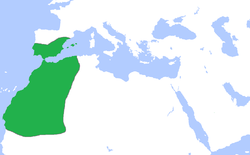
Alaouite Dynasty
The Alaouite Dynasty is the name of the current Moroccan royal family. The name Alaouite comes from the ‘Alī of its founder Moulay Ali Cherif who became Prince of Tafilalt in 1631. His son Mulay r-Rshid was able to unite and pacify the country...
, the current Moroccan royal family. However, effective control of the region was limited; until the twentieth century much of the Central Atlas was in a condition of siba, recognising the spiritual legitimacy of royal authority but rejecting its political claims. The expansion of the Ait Atta
Ait Atta
The Ait Atta are a large Berber tribal confederation of North eastern Morocco, estimated to number about 130,000 as of 1960. They are divided into "five fifths" , all said to descend from the forty sons of their common ancestor Dadda Atta: these "fifths" are the Ait Ouallal, Ait Ouahlim, Ait...
starting from the 16th century brought Tamazight back into the already Arabised Tafilalt
Tafilalt
Tafilalt or Tafilet is a region and the most important oasis of the Moroccan Sahara; it is also considered one of the largest oases in the world, the oasis is entirely located along the Ziz River. The oasis is ten days' journey south of Fez, across the Atlas Mountains...
region and put other regional tribes on the defensive, leading to the formation of the Ait Yafelman
Ait Yafelman
The Ait Yafelman are a large Berber tribal confederation of the eastern High Atlas of Morocco, with their capital at Imilchil. They consist of four tribes: Ait Morghad, Ait Haddidou, Ait Izdeg and Ait Yahia. These tribes created the alliance in the 17th century to counter the expansion of their...
alliance.
The 1912 Treaty of Fez
Treaty of Fez
By the Treaty of Fez , signed March 30, 1912, Sultan Abdelhafid gave up the sovereignty of Morocco to the French, making the country a protectorate, resolving the Agadir Crisis of July 1, 1911....
made most of Morocco a French protectorate, leaving the Alaouite monarchy but establishing a French military presence and installing a French commissioner-general. However, the Berber tribes of the Middle Atlas, as in other areas, put up stiff military resistance to French rule, lasting until 1933 in the case of the Ait Atta
Ait Atta
The Ait Atta are a large Berber tribal confederation of North eastern Morocco, estimated to number about 130,000 as of 1960. They are divided into "five fifths" , all said to descend from the forty sons of their common ancestor Dadda Atta: these "fifths" are the Ait Ouallal, Ait Ouahlim, Ait...
.
After Morocco's independence in 1956, a strong emphasis was laid on the country's Arab
Arab
Arab people, also known as Arabs , are a panethnicity primarily living in the Arab world, which is located in Western Asia and North Africa. They are identified as such on one or more of genealogical, linguistic, or cultural grounds, with tribal affiliations, and intra-tribal relationships playing...
identity, and a national Arabic language
Arabic language
Arabic is a name applied to the descendants of the Classical Arabic language of the 6th century AD, used most prominently in the Quran, the Islamic Holy Book...
educational system was instituted, in which Berber languages, including Middle Atlas Tamazight, had no place. However, in 1994 the government responded to Berber demands for recognition by decreeing that Berber should be taught and establishing television broadcasts in three Berber languages, including Central Atlas Tamazight. For the promotion of Tamazight and other Berber languages and cultures, the government created the Royal Institute of Amazigh Culture (IRCAM) in 2001.
Geographic distribution
Central Atlas Tamazight is among the four most-spoken Berber languages (the other three being KabyleKabyle language
Kabyle or Kabylian is a Berber language spoken by the Kabyle people north and northeast of Algeria. Estimates about the number of speakers range from 5 million to about 7 million speakers worldwide, the majority in Algeria.-Classification:The classification of Kabyle is Afro-Asiatic, Berber and...
, Shilha, and Riff), and rivals Shilha as the most-spoken Berber language in Morocco. Central Atlas Tamazight is mostly spoken in the entire Middle Atlas and its outcroppings, reaching east to Taza
Taza
Taza is a city in northern Morocco, which occupies the corridor between the Rif mountians and Middle Atlas mountains, about 120 km east of Fez. It is located at 150 km from Nador, and 210 km from Oujda...
and west to the region near Rabat
Rabat
Rabat , is the capital and third largest city of the Kingdom of Morocco with a population of approximately 650,000...
. It is also spoken in the central and eastern High Atlas mountains in Morocco. It is thus spoken across areas with widely varying ecological conditions — from the mountainous and forested regions of the Middle Atlas mountains to the oases of the northwestern Sahara (Tafilalt
Tafilalt
Tafilalt or Tafilet is a region and the most important oasis of the Moroccan Sahara; it is also considered one of the largest oases in the world, the oasis is entirely located along the Ziz River. The oasis is ten days' journey south of Fez, across the Atlas Mountains...
). Berber in Morocco is spread into three areas: Riff in the north, Central Atlas in the center, and Shilha in the south/southwest. Central Atlas is mutually intelligible with the dialects Riff and Shilha; but Shilha- and Riff-speakers cannot understand each other, although transitional varieties exist between these dialects, creating a smooth transition.
Figures for the number of speakers of Berber languages are generally a matter of estimates rather than linguistic censuses. At least a third of Moroccans seem to speak Berber languages,.André Basset estimated in 1952 that a "small majority" of Morocco's population spoke Berber, see Tamazight is estimated to be spoken by about 40~49% of Morocco's Berber-speakers, while Shilha commands 32~40% and Riff 20~25%.
Status
Tamazight, along with other Berber languages of Morocco, has a low sociolinguistic status, used mainly in the home, and rarely in official or formal contexts; it is not an official language. However, media broadcasts and music are available in it, and there is a policy of teaching it in schools.Of the Central Atlas Tamazight speakers, 40–45% are monolingual, while the others use Arabic as a second language. Monolingual speakers consist mostly of older generations and children. Women are more likely to be monolingual than men, since they typically stay in the village while the men go to work in the cities. Since Tamazight is the language of the home, girls grow up speaking Berber languages and pass them on to their children — this gender stratification helps to preserve the language. Bilingual Berber speakers have learned Moroccan Arabic
Moroccan Arabic
Moroccan Arabic is the variety of Arabic spoken in the Arabic-speaking areas of Morocco. For official communications, the government and other public bodies use Modern Standard Arabic, as is the case in most Arabic-speaking countries. A mixture of French and Moroccan Arabic is used in business...
via schooling, migration, media, or through the government. Most rural Berber children are monolingual. They struggle to succeed in schools where the teachers do not speak Berber, and require them to learn both Arabic and French.
Rural Morocco, including the Central Atlas area, suffers from poverty. Tamazight along with its relative Shilha are undergoing "contraction" as rural families, motivated by economic necessity, move to cities and stop speaking Tamazight, leading many intellectuals to fear Berber language shift or regression. However, Tamazight speakers are reported to immigrate less than many other Berber groups. Moreover, Tamazight has a large enough body of native speakers not to be considered under risk of endangerment, although Tamazight speakers reportedly have a lower birth rate than the country of Morocco as a whole.
Official status
Tamazight, like other Berber languages, is not an official language of Morocco. It is thus not used in courts, and fluency in other languages is a prerequisite for government (and most other formal) employment. However, in 1994, King Hassan II declared that a national Berber dialect would acquire a formal status; television broadcasts are summarized in Tamazight, as well as Shilha and Rif, three times a day; and educational materials for schools are being developed. On October 17, 2001 King Mohammed VI sealed the decree (Dahir 1–01–299) creating and organizing the Royal Institute of Amazigh Culture (IRCAM). IRCAM's board is composed of Amazigh experts, artists, and activists, all of whom are appointed by the king. The institute, located in RabatRabat
Rabat , is the capital and third largest city of the Kingdom of Morocco with a population of approximately 650,000...
, has played an important role in the establishment of the Tifinagh
Tifinagh
Tifinagh is a series of abjad and alphabetic scripts used by some Berber peoples, notably the Tuareg, to write their language.A modern derivate of the traditional script, known as Neo-Tifinagh, was introduced in the 20th century...
script in Morocco. There are multiple political parties and cultural associations in Morocco that advocate for the advancement of Berber, calling for it to be recognized as an official language, used more extensively in the mass media, and taught more in schools.
A legal issue affecting Tamazight speakers is restrictions on naming - Moroccan law stipulates that first names must have a "Moroccan character", and uncommon names, including some Berber ones used in the Central Atlas, are often rejected by the civil registry.
Orthography
Until the twentieth century Tamazight, like many other Berber languages but in contrast with neighbouring Tashelhiyt, was basically unwritten (although sporadic cases, using Arabic script, are attested.) It was preserved through oral use in rural areas, isolated from urban hubs. Scholars from the Middle Atlas, as elsewhere in North Africa, usually wrote in the more prestigious Arabic language, rather than their vernacular.At present three writing systems exist for Berber languages, including Tamazight: Neo-Tifinagh, the Latin alphabet
Latin alphabet
The Latin alphabet, also called the Roman alphabet, is the most recognized alphabet used in the world today. It evolved from a western variety of the Greek alphabet called the Cumaean alphabet, which was adopted and modified by the Etruscans who ruled early Rome...
and the Arabic script. To some extent, the choice of writing system is a political one, with various subgroups expressing preference based on ideology and politics. The orthography used for government services including schooling is Neo-Tifinagh, rendered official by a Dahir of King Mohammed VI based on the recommendation of IRCAM. However, various Latin transcriptions has been used in a number of linguistic works describing Central Atlas Tamazight, notably the dictionary of Taïfi (1991).
Consonants
Central Atlas Tamazight has a contrastive set of "flat" consonants, manifested in two ways:- For front segments, pharyngealization: /tˤ dˤ sˤ zˤ lˤ nˤ rˤ/)
- For back segments, labialization: /xʷ ɣʷ qʷ χʷ ʁʷ/)
Note that pharyngealization may spread to a syllable or even a whole word. Historically Proto-Berber
Proto-Berber language
Proto-Berber is the reconstructed proto-language from which the modern Berber languages stem. Proto-Berber was an Afroasiatic language, and its descendants are sisters to the Egyptian language, Cushitic languages, Semitic languages, Chadic languages, and the Omotic languages.-History:Proto-Berber...
only had two pharyngealized phonemes (/dˤ, zˤ/), but modern Berber languages have borrowed others from Arabic and developed new ones through sound shifts.
In addition Tamazight has uvular and pharyngeal consonants, as well as a conspicuous lack of /p/ in its plosive inventory.[p] is missing from about 10% of languages that have a [b]. (See voiced velar plosive
Voiced velar plosive
The voiced velar plosive is a type of consonantal sound, used in some spoken languages. The symbol in the International Phonetic Alphabet that represents this sound is , and the equivalent X-SAMPA symbol is g. Strictly, the IPA symbol is the so-called "opentail G" , though the "looptail G" is...
for another such gap.) This is an areal feature
Areal feature (linguistics)
In linguistics, an areal feature is any feature shared by languages within the same geographical area as a consequence of linguistic diffusion....
of the "circum-Saharan zone" (Africa north of the equator plus the Arabian peninsula
Arabian Peninsula
The Arabian Peninsula is a land mass situated north-east of Africa. Also known as Arabia or the Arabian subcontinent, it is the world's largest peninsula and covers 3,237,500 km2...
). It is not known how old this areal feature is, and whether it might be a recent phenomenon due to Arabic as a prestige language (Arabic lost its /p/ in prehistoric times), or whether Arabic was itself affected by a more ancient areal pattern. It is found in other areas as well; for example, in Europe, Proto-Celtic
Proto-Celtic language
The Proto-Celtic language, also called Common Celtic, is the reconstructed ancestor language of all the known Celtic languages. Its lexis can be confidently reconstructed on the basis of the comparative method of historical linguistics...
is reconstructed as having [b] but no [p]. Nonetheless, the [p] sound is very common cross-linguistically.
All segments may be geminated except for the pharyngeals /ʕ ħ/. In Ayt Ndhir, which is a dialect of Tamazight with spirantization, the spirantizeable consonants appear in their stop forms when geminated, and additionally the geminate correspondents of /ʁ, dˤ, ʃ, ʒ, w, j/ are usually /qː, tˤː, t͡ʃː, d͡ʒː, ɣʷː, ɣː/ respectively. However some native Berber words have /ʁː/ (not /qː/) where other dialects have singleton /ʁ/, and similarly for /ʃː, ʒː/. In addition, in Arabic loans singleton non-spirantized [b, t, tˤ, d, k, ɡ, q] occur (though [b t d] and to an extent [tˤ] often alternate with their spirantized versions in loans), giving this alternation marginal phonemic status.
In the table below, when consonants appear in pairs, the one on the left is voiceless.
| Labial Labial consonant Labial consonants are consonants in which one or both lips are the active articulator. This precludes linguolabials, in which the tip of the tongue reaches for the posterior side of the upper lip and which are considered coronals... |
Dental/ Alveolar Alveolar consonant Alveolar consonants are articulated with the tongue against or close to the superior alveolar ridge, which is called that because it contains the alveoli of the superior teeth... |
Post- alveolar Postalveolar consonant Postalveolar consonants are consonants articulated with the tongue near or touching the back of the alveolar ridge, further back in the mouth than the alveolar consonants, which are at the ridge itself, but not as far back as the hard palate... / Palatal Palatal consonant Palatal consonants are consonants articulated with the body of the tongue raised against the hard palate... |
Post-palatal | Velar Velar consonant Velars are consonants articulated with the back part of the tongue against the soft palate, the back part of the roof of the mouth, known also as the velum).... |
Uvular Uvular consonant Uvulars are consonants articulated with the back of the tongue against or near the uvula, that is, further back in the mouth than velar consonants. Uvulars may be plosives, fricatives, nasal stops, trills, or approximants, though the IPA does not provide a separate symbol for the approximant, and... |
Pharyn- geal Pharyngeal consonant A pharyngeal consonant is a type of consonant which is articulated with the root of the tongue against the pharynx.-Pharyngeal consonants in the IPA:Pharyngeal consonants in the International Phonetic Alphabet :... |
Glottal Glottal consonant Glottal consonants, also called laryngeal consonants, are consonants articulated with the glottis. Many phoneticians consider them, or at least the so-called fricative, to be transitional states of the glottis without a point of articulation as other consonants have; in fact, some do not consider... |
||||||||||||||
|---|---|---|---|---|---|---|---|---|---|---|---|---|---|---|---|---|---|---|---|---|---|
| plain | flat | plain | flat | plain | flat | ||||||||||||||||
| Nasal Nasal consonant A nasal consonant is a type of consonant produced with a lowered velum in the mouth, allowing air to escape freely through the nose. Examples of nasal consonants in English are and , in words such as nose and mouth.- Definition :... |
m Bilabial nasal The bilabial nasal is a type of consonantal sound used in almost all spoken languages. The symbol in the International Phonetic Alphabet that represents this sound is , and the equivalent X-SAMPA symbol is m... |
n Alveolar nasal The alveolar nasal is a type of consonantal sound used in numerous spoken languages. The symbol in the International Phonetic Alphabet that represents dental, alveolar, and postalveolar nasals is , and the equivalent X-SAMPA symbol is n.... |
nˤ | ||||||||||||||||||
| Plosive | b Voiced bilabial plosive The voiced bilabial plosive is a type of consonantal sound, used in some spoken languages. The symbol in the International Phonetic Alphabet that represents this sound is , and the equivalent X-SAMPA symbol is b. The voiced bilabial plosive occurs in English, and it is the sound denoted by the... 4 |
t Voiceless dental plosive The voiceless dental plosive is a type of consonantal sound, used in some spoken languages. The symbol in the International Phonetic Alphabet that represents this sound is , and the equivalent X-SAMPA symbol is t_d... 5 |
d Voiced dental plosive The voiced dental plosive is a type of consonantal sound, used in some spoken languages. The symbol in the International Phonetic Alphabet that represents this sound is... |
tˤ | dˤ | k~x | ɡ~ɣ | q | qʷ | ||||||||||||
| Fricative Fricative consonant Fricatives are consonants produced by forcing air through a narrow channel made by placing two articulators close together. These may be the lower lip against the upper teeth, in the case of ; the back of the tongue against the soft palate, in the case of German , the final consonant of Bach; or... |
f Voiceless labiodental fricative The voiceless labiodental fricative is a type of consonantal sound, used in some spoken languages. The symbol in the International Phonetic Alphabet that represents this sound is .-Features:Features of the voiceless labiodental fricative:... |
s Voiceless alveolar fricative The voiceless alveolar sibilant is a common consonant sound in spoken languages. It is the sound in English words such as sea and pass, and is represented in the International Phonetic Alphabet as . It has a characteristic high-pitched, highly perceptible hissing sound... |
z Voiced alveolar fricative The voiced alveolar fricatives are consonantal sounds. The symbol in the International Phonetic Alphabet that represents these sounds depends on whether a sibilant or non-sibilant fricative is being described.... |
sˤ | zˤ | ʃ Voiceless postalveolar fricative The voiceless palato-alveolar fricative or voiceless domed postalveolar fricative is a type of consonantal sound, used in many spoken languages, including English... |
ʒ | xʷ | ɣʷ | χ | ʁ | χʷ | ʁʷ | ħ Voiceless pharyngeal fricative The voiceless pharyngeal fricative is a type of consonantal sound, used in some spoken languages. The symbol in the International Phonetic Alphabet that represents this sound is h-bar .-Features:Features of the voiceless pharyngeal fricative:... |
ʕ Voiced pharyngeal fricative The voiced pharyngeal approximant or fricative is a type of consonantal sound, used in some spoken languages. The symbol in the International Phonetic Alphabet that represents it is , and the equivalent X-SAMPA symbol is ?\.... |
h Voiceless glottal fricative The voiceless glottal transition, commonly called a "fricative", is a type of sound used in some spoken languages which patterns like a fricative or approximant consonant phonologically, but often lacks the usual phonetic characteristics of a consonant... |
|||||
| Approximant Approximant consonant Approximants are speech sounds that involve the articulators approaching each other but not narrowly enough or with enough articulatory precision to create turbulent airflow. Therefore, approximants fall between fricatives, which do produce a turbulent airstream, and vowels, which produce no... |
j Palatal approximant The palatal approximant is a type of consonantal sound used in many spoken languages. The symbol in the International Phonetic Alphabet that represents this sound is '... |
w | |||||||||||||||||||
| Lateral Lateral consonant A lateral is an el-like consonant, in which airstream proceeds along the sides of the tongue, but is blocked by the tongue from going through the middle of the mouth.... |
l Alveolar lateral approximant The alveolar lateral approximant, also known as clear l, is a type of consonantal sound used in some spoken languages. The symbol in the International Phonetic Alphabet that represents dental, alveolar, and postalveolar lateral approximants is , and the equivalent X-SAMPA symbol is l.As a... |
lˤ | |||||||||||||||||||
| Flap Flap consonant In phonetics, a flap or tap is a type of consonantal sound, which is produced with a single contraction of the muscles so that one articulator is thrown against another.-Contrast with stops and trills:... /Trill Trill consonant In phonetics, a trill is a consonantal sound produced by vibrations between the articulator and the place of articulation. Standard Spanish <rr> as in perro is an alveolar trill, while in Parisian French it is almost always uvular.... Abdel-Massih refers to this as a "flap" produced with "vibration" of the tongue. |
r | rˤ | |||||||||||||||||||
Phonetic notes:
- pronounced as fricatives in the Ayt Ayache dialect
- rare—native speakers can freely substitute /χ ʁ/
- mainly in ArabicArabic languageArabic is a name applied to the descendants of the Classical Arabic language of the 6th century AD, used most prominently in the Quran, the Islamic Holy Book...
borrowings - For a small number of speakers, /b/ is sometimes lenited to [β].
- /t/ is aspirated [tʰ].
| Phoneme | Example | Gloss | Phoneme | Example | Gloss | Phoneme | Example | Gloss |
|---|---|---|---|---|---|---|---|---|
| /m/ | /ma/ | 'what?' | /n/ | /ini/ | 'say!' | /b/ | /bab/ | 'owner' |
| /t/ | /isalt/ | 'he asked him' | /d/ | /da/ | 'here' | /tˤ/ | /tˤalˤb/ | 'to demand' |
| /dˤ/ | /dˤmn/ | 'to guarantee' | /k/ | /ks/ | 'to tend sheep' | /ɡ/ | /iɡa/ | 'he did' |
| /xʷ/ | /xʷulː/ | 'all' | /ɣʷ/ | /aɣʷːa/ | 'a burden' | /q/ | /iqrˤːa/ | 'he confessed' |
| /qʷ/ | /iqʷmːrˤ/ | 'he gambled' | /f/ | /fa/ | 'to yawn' | /s/ | /sus/ | 'to shake off' |
| /z/ | /zːr/ | 'to pluck' | /sˤ/ | /sˤbrˤ/ | 'to be patient' | /zˤ/ | /zˤdˤ/ | 'to weave' |
| /ʃ/ | /ʃal/ | 'to buy grain' | /ʒ/ | /ʒhd/ | 'to be strong' | /χ/ | /χulf/ | 'to be different' |
| /ʁ/ | /ʁal/ | 'to think' | /χʷ/ | /aχʷmːas/ | 'share-cropper' | /ʁʷ/ | /ʁʷzif/ | 'tall' |
| /ħ/ | /ħml/ | 'to flood' | /ʕ/ | /ʕbd/ | 'to adore, worship' | /h/ | /ha/ | 'here is, are' |
| /j/ | /jːih/ | 'yes' | /w/ | /waχːa/ | 'all right' | /l/ | /la/ | 'no' |
| /lˤ/ | /lˤazˤ/ | 'hunger' | /r/ | /rdm/ | 'to demolish' | /rˤ/ | /rˤdˤu/ | 'to bless' |
Vowels
Tamazight has a typical phonemic three-vowel system, similarly to Classical ArabicClassical Arabic
Classical Arabic , also known as Qur'anic or Koranic Arabic, is the form of the Arabic language used in literary texts from Umayyad and Abbasid times . It is based on the Medieval dialects of Arab tribes...
:
| Front Front vowel A front vowel is a type of vowel sound used in some spoken languages. The defining characteristic of a front vowel is that the tongue is positioned as far in front as possible in the mouth without creating a constriction that would be classified as a consonant. Front vowels are sometimes also... |
Central Central vowel A central vowel is a type of vowel sound used in some spoken languages. The defining characteristic of a central vowel is that the tongue is positioned halfway between a front vowel and a back vowel... |
Back Back vowel A back vowel is a type of vowel sound used in spoken languages. The defining characteristic of a back vowel is that the tongue is positioned as far back as possible in the mouth without creating a constriction that would be classified as a consonant. Back vowels are sometimes also called dark... |
|
|---|---|---|---|
| Close Close vowel A close vowel is a type of vowel sound used in many spoken languages. The defining characteristic of a close vowel is that the tongue is positioned as close as possible to the roof of the mouth without creating a constriction that would be classified as a consonant.This term is prescribed by the... |
i | u | |
| Open Open vowel An open vowel is defined as a vowel sound in which the tongue is positioned as far as possible from the roof of the mouth. Open vowels are sometimes also called low vowels in reference to the low position of the tongue... |
a |
These phonemes have numerous allophones, conditioned by the following environments:
(# denotes word boundary, X denotes C[−flat −/χ/ −/ʁ/], C̣ denotes C[+flat], G denotes C, /χ/, and /ʁ/)
| Phoneme | Realization | Environment | Example | Gloss |
|---|---|---|---|---|
| /i/ | [i] | #_X | /ili/ | 'to exist' |
| [ɨ] | #_Xː / Xː_ | /idːa/ | 'he went' | |
| [ɪ] [e] | _G / G_ | /dˤːiqs/ | 'to burst out' | |
| [ɪj] | X_# | /isːfrˤħi/ | 'he made me happy' | |
| /u/ | [u] | #_X / X(ː)_X | /umsʁ/ | 'I painted' |
| [ʊ] [o] | _G / G_ | /idˤurˤ/ | 'he turned' | |
| [ʊw] | X(ː)_# | /bdu/ | 'to begin' | |
| /a/ | [æ] | #_X(ː) / X(ː)_X | /azn/ | 'to send' |
| [ɐ] | X(ː)_# | /da/ | 'here' | |
| [ɑ] | _C̣ / C̣_ | /ħadˤr/ | 'to be present' |
Phonetic Schwa
There is a predictable non-phonemic vowel inserted into consonant clusters, realized as ɪ̈ before front consonants (e.g. /b t d .../) and ə before back consonants (e.g. /k χ .../). It is voiced before voiced consonants and voiceless before voiceless consonants, or alternatively it can be realized as a voiced or unvoiced consonant release. It also may be realized as the syllabicity of a nasal, lateral, or /r/.
The occurrence of schwa epenthesis
Epenthesis
In phonology, epenthesis is the addition of one or more sounds to a word, especially to the interior of a word. Epenthesis may be divided into two types: excrescence, for the addition of a consonant, and anaptyxis for the addition of a vowel....
is governed morphophonemically. These are some of the rules governing the occurrence of [ə]:
(# denotes word boundary, L denotes /l r m n/, H denotes /h ħ ʕ w j/)
| Environment | Realization | Example | Pronunciation | Gloss |
|---|---|---|---|---|
| #C(ː)# | əC(ː) | /ɡ/ | [əɡ] | 'to be, to do' |
| #LC# | əLC or LəC | /ns/ | [əns] ~ [nəs] | 'to spend the night' |
| #CC# | CəC | /tˤsˤ/ | [tˤəsˤ] | 'to laugh' |
| #CːC# | əCːəC | /fːr/ | [əfːər] | 'to hide' |
| #CCC# | CCəC / C1C2 are not {L H} | /χdm/ | [χdəm] | 'to work' |
| /zʕf/ | [zʕəf] | 'to get mad' | ||
| #CCC# | əCCəC or #CəCəC# / {C1 C3} is {L H} | /hdm/ | [əhdəm] ~ [hədəm] | 'to demolish' |
| #CCC# | CəCəC / C2C3 = {L H} | /dˤmn/ | [dˤəmən] | 'to guarantee' |
Examples: > [tbərːəmənt] ('you (fp) turned') > [datːəħadˤar] ('she is present') > [ʕadˤːərˤ] ('to meet')
However note that word-initial initial /j, w/ are realized as /i, u/ before consonants. In word-medial or -final position [əj], [əʝ], and [əw] are realized as [ij], [ij], and [uw] respectively, and may become [i] and [u] in rapid speech.
Tamazight in fact has numerous words without phonemic vowels, and those consisting entirely of voiceless consonants will not phonetically contain voiced vowels.Audio recordings of selected words without vowels in Shilha can be downloaded from http://ed268.univ-paris3.fr/lpp/pages/EQUIPE/ridouane/audio.doc.
[ə] is written as <ⴻ> in neo-Tifinagh and as ⟨e⟩ in the Berber Latin alphabet
Berber Latin alphabet
The Berber Latin alphabet is the version of the Latin alphabet used to write the Berber language...
. French publications tended to include [ə] in their transcriptions of Berber forms despite their predictability, perhaps due to the French vowel system
French phonology
This article mainly discusses the phonological system of standard French based on the Parisian dialect. French is notable for its uvular r, nasal vowels, and three processes affecting word-final sounds: liaison, a certain type of sandhi, wherein word-final consonants are not pronounced unless...
. This can cause problems because alternations such as /iʁ(ə)rs/ 'he slaughtered' – /uriʁris/ 'he did not slaughter' would then have to conditioned morphologically.
Stress
Word stressStress (linguistics)
In linguistics, stress is the relative emphasis that may be given to certain syllables in a word, or to certain words in a phrase or sentence. The term is also used for similar patterns of phonetic prominence inside syllables. The word accent is sometimes also used with this sense.The stress placed...
is non-contrastive and predictable — it falls on the last vowel in a word (including schwa).
Examples: > [ˈsal] ('to ask') > [dajtːəħaˈdˤarˤ] ('he is present') > [fəsːˈər] ('to explain') > [təfəsːəˈrənt] ('you (fp) explained')
Grammar
Central Atlas Tamazight grammar has many features typical of Afro-Asiatic languagesAfro-Asiatic languages
The Afroasiatic languages , also known as Hamito-Semitic, constitute one of the world's largest language families, with about 375 living languages...
, including extensive apophony
Apophony
In linguistics, apophony is the alternation of sounds within a word that indicates grammatical information .-Description:Apophony is...
in both the derivational and inflectional morphology, gender
Grammatical gender
Grammatical gender is defined linguistically as a system of classes of nouns which trigger specific types of inflections in associated words, such as adjectives, verbs and others. For a system of noun classes to be a gender system, every noun must belong to one of the classes and there should be...
, possessive suffix
Possessive suffix
In linguistics, a possessive affix is a suffix or prefix attached to a noun to indicate its possessor, much in the manner of possessive adjectives. Possessive suffixes are found in some Uralic, Altaic, Semitic, and Indo-European languages...
es, VSO typology, the causative morpheme /s/, and use of the status constructus
Status constructus
The construct state or status constructus is a noun form occurring in Afro-Asiatic languages. It is particularly common in Semitic languages , Berber languages, and in the extinct Egyptian language...
.
Morphology
Tamazight nounNoun
In linguistics, a noun is a member of a large, open lexical category whose members can occur as the main word in the subject of a clause, the object of a verb, or the object of a preposition .Lexical categories are defined in terms of how their members combine with other kinds of...
s are inflected for gender, number, and state. Singular masculine nouns usually have the prefix /a-/ , and singular feminines the circumfix
Circumfix
A circumfix is an affix, a morpheme that is placed around another morpheme. Circumfixes contrast with prefixes, attached to the beginnings of words; suffixes, that are attached at the end; and infixes, inserted in the middle. See also epenthesis...
/t...t. Plurals may either involve a regular change ("sound plurals"), internal vowel change ("broken plurals"), or a combination of the two. Masculine plurals usually take the prefix /i-/, feminines /ti-/, and sound plurals also take the suffix /-n/ in masculine and /-in/} in feminine, although many other plural patterns are found too.
Examples:
- /axam/ → /ixamn/ 'big tent(s)' (m)
- /amaziɣ/ → /imaziɣn/ 'Berber(s)' (m)
- /adaʃu/ → /iduʃa/ 'sandal(s)' (m)
- /asrdun/ → /isrdan/ 'mule(s)' (m)
- /taxamt/ → /tixamin/ 'tent(s)' (f)
- /tafunast/ → /tifunasin/ 'cow(s)' (f)
- /tagrtilt/ → /tigrtal/ 'mat(s)' (f)
- /tamazirt/ → /timizar/ 'property(ies)' (f)
Nouns may be put into the construct state (contrasting with free state) to indicate possession, or when the subject of a verb follows the verb. This is also used for nouns following numerals and some prepositions, as well as the conjunction /d-/ ('and'). The construct state is formed as follows: in masculines, initial /a/ becomes /u, wː, wa/, initial /i/ becomes /i, j, ji/, and initial /u/ becomes /wu/. In feminines, initial /ta/ usually becomes /t/, initial /ti/ usually becomes /t/, and initial /tu/ remains unchanged.
Examples (in Ayt Ayache):
- /babuxam/ (< /axam/) 'head of the house'
- /ijːs ntslit/ (< /tislit/) 'the horse of the bride'
Central Atlas Tamazight's personal pronoun
Pronoun
In linguistics and grammar, a pronoun is a pro-form that substitutes for a noun , such as, in English, the words it and he...
s distinguish three persons, and two genders. Pronouns appear in three forms: an independent form used in the subject position, a possessive suffix
Possessive suffix
In linguistics, a possessive affix is a suffix or prefix attached to a noun to indicate its possessor, much in the manner of possessive adjectives. Possessive suffixes are found in some Uralic, Altaic, Semitic, and Indo-European languages...
(and a derived independent possessive pronoun), and an object form affixedprefixed or suffixed depending on multiple factors to the controlling verb.
Demonstrative pronouns distinguish between proximate and remote. When they occur independently, they inflect for number. They may also be suffixed to nouns, e.g. /tabardaja/ 'this pack-saddle'.
Central Atlas Tamazight verbs are heavily inflected, being marked for tense
Grammatical tense
A tense is a grammatical category that locates a situation in time, to indicate when the situation takes place.Bernard Comrie, Aspect, 1976:6:...
, aspect, mode, voice
Voice (grammar)
In grammar, the voice of a verb describes the relationship between the action that the verb expresses and the participants identified by its arguments . When the subject is the agent or doer of the action, the verb is in the active voice...
, person
Grammatical person
Grammatical person, in linguistics, is deictic reference to a participant in an event; such as the speaker, the addressee, or others. Grammatical person typically defines a language's set of personal pronouns...
, and polarity
Grammatical polarity
Grammatical polarity is the distinction of affirmative and negative. In English, grammatical polarity is generally indicated by the presence or absence of the modifier not, which negates the statement. Many other languages contain similar modifiers: Italian and Interlingua have non, Spanish has...
. Tamazight verbs have at their core a stem, modified by prefixes, suffixes, moveable affixes, circumfixes, and ablaut. The prefixes indicate voice, tense, aspect, and polarity, while the suffixes indicate mood (normal, horatory, or imperative). Subject markers are circumfixed to the verb, while object marking and satellite framing are accomplished via either prefixing or suffixing depending on environment Some verb forms are accompanied by ablaut, and sometimes metathesis
Metathesis (linguistics)
Metathesis is the re-arranging of sounds or syllables in a word, or of words in a sentence. Most commonly it refers to the switching of two or more contiguous sounds, known as adjacent metathesis or local metathesis:...
.
Pronominal complement markers cliticize to the verb, with the indirect object preceding the direct object, e.g. /iznz-as-t/ "he sold it to him".
Attributive Adjective
Adjective
In grammar, an adjective is a 'describing' word; the main syntactic role of which is to qualify a noun or noun phrase, giving more information about the object signified....
s after the noun they modify, and inflect for number and gender. Adjectives may also occur alone, in which case they become an NP. Practically all adjectives also have a verbal form used for predicative purposes, which behaves just like a normal verb.
- /argaz amʕdur/ 'the foolish man' (lit. 'man foolish')
- /tamtˤot tamʕdurt/ 'the foolish woman'
- /irgzen imʕdar/ 'the foolish men'
- /tajtʃin timʕdar/ 'the foolish women'
- /i-mmuʕdr urgaz/ 'the man is foolish' (lit. '3ps–foolish man')
- /argaz i-mmuʕdr-n/ 'the foolish man' [using a non-finite verb]
Prepositions include /xf/ ('on'), /qbl/ ('before'), /ɣr/ ('to'), and the proclitics /n/ ('of') and /d/ ('with, and')./n/ and /d/ assimilate to some initial consonants: e.g. /ʃa lːħlib/ 'some milk'), /aɣjul tːfunast/ 'the donkey and the cow'. These may take pronominal suffixes. Some prepositions require the following noun to be in the construct state, while others do not.
Syntax
Word order is usually VSO (with the subject in construct state) but sometimes is SVO (with the subject in free state), e.g. (/ifːɣ umaziɣ/ vs. /amaziɣ ifːɣ/ 'the Berber went out'). Tamazight also exhibits pro-drop behavior.Tamazight may use a null copula, but the word /ɡ/ 'to be, to do' can function as a copula in Ayt Ayache, especially in structures preceded by /aj/ 'who, which, what'.
wh- questions are always clefts, and multiple wh-questionssuch as the English "who saw what?", see do not occur. Consequently Tamazight's clefting, relativisation, and wh-interrogation contribute to anti-agreement effects, "nb">when the verb does not agree with, or agrees in a relative manner with wh-words, see . similar to Shilha
Shilha
Shilha, or Tashelhit, is a term used to refer to a number of Berber languages spoken across the northern Sahara. In international usage, it most commonly refers to the Shilha language spoken by the Shilha people of southwestern Morocco...
, and causes deletion of the verbal person marker in certain situations.
Vocabulary
As a result of relatively intense language contactLanguage contact
Language contact occurs when two or more languages or varieties interact. The study of language contact is called contact linguistics.Multilingualism has likely been common throughout much of human history, and today most people in the world are multilingual...
, Central Atlas Tamazight has a large stratum of Arabic loans. Many borrowed words in Berber also have native synonyms, e.g. /lbab/ or /tiflut/ 'door', the latter used more in rural areas. The contact was unequal, as Moroccan Arabic
Moroccan Arabic
Moroccan Arabic is the variety of Arabic spoken in the Arabic-speaking areas of Morocco. For official communications, the government and other public bodies use Modern Standard Arabic, as is the case in most Arabic-speaking countries. A mixture of French and Moroccan Arabic is used in business...
has not borrowed as much from Berber languages
Berber languages
The Berber languages are a family of languages indigenous to North Africa, spoken from Siwa Oasis in Egypt to Morocco , and south to the countries of the Sahara Desert...
, though Berber has contributed to Moroccan
Moroccan Arabic
Moroccan Arabic is the variety of Arabic spoken in the Arabic-speaking areas of Morocco. For official communications, the government and other public bodies use Modern Standard Arabic, as is the case in most Arabic-speaking countries. A mixture of French and Moroccan Arabic is used in business...
and Algerian Arabic
Algerian Arabic
Algerian Arabic is the variety or varieties of Arabic spoken in Algeria. In Algeria, as elsewhere, spoken Arabic differs from written Arabic; Algerian Arabic has a vocabulary mostly Arabic, with significant Berber substrates, and many new words and loanwords borrowed from French, Turkish and...
s' very reduced vowel systems.
Arabic loans span a wide range of lexical classes. Many nouns begin with /l-/, from the Arabic definite prefix, and some Arabic feminines may acquire the native Berber feminine ending /-t/, e.g. /lʕafit/ for /lʕafia/ 'fire'. Many Arabic loans have been integrated into the Tamazight verb lexicon. They adhere fully to inflectional patterns of native stems, and may even undergo ablaut. Even function word
Function word
Function words are words that have little lexical meaning or have ambiguous meaning, but instead serve to express grammatical relationships with other words within a sentence, or specify the attitude or mood of the speaker...
s are borrowed, e.g. /blli/ or /billa/ 'that', /waxxa/ 'although', /ɣir/ 'just', etc.
The first few (1–3 in Ayt Ayache and Ayt Ndhir) cardinal numerals have native Berber and borrowed Arabic
Arabic language
Arabic is a name applied to the descendants of the Classical Arabic language of the 6th century AD, used most prominently in the Quran, the Islamic Holy Book...
forms.In Ayt Ayache the Arabic numerals are only used for counting in order and for production of higher numbers when combined with the tens, see All higher cardinals are borrowed from Arabic, consistent with the linguistic universals that the numbers 1–3 are much more likely to be retained, and that a borrowed number generally implies that numbers greater than it are also borrowed. The retention of one is also motivated by the fact that Berber languages near-universally use unity as a determiner.
Central Atlas Tamazight uses a bipartate negative construction (e.g. /uriffiɣ ʃa/ 'he did not go out') which apparently was modeled after proximate Arabic
Arabic language
Arabic is a name applied to the descendants of the Classical Arabic language of the 6th century AD, used most prominently in the Quran, the Islamic Holy Book...
varieties, in a common development known as Jespersen's Cycle
Jespersen's Cycle
Jespersen's Cycle is a series of processes in historical linguistics, which describe the historical development of the expression of negation in a variety of languages, from a simple pre-verbal marker of negation, through a discontinous marker and in some cases through subsequent loss of the...
. It is present in multiple Berber varieties, and is argued to have originated in neighboring Arabic and been adopted by contact.
Examples
| English | Tamazight (Ayt Ayache) | |
|---|---|---|
| Hello | /sːalamuʕlikːum/ (to a man by a man)
|
|
| /lˤːahiʕawn/ (to or by a woman) |
||
| Good morning | /sˤbaħ lxirˤ/ | |
| Good evening | /mslxirˤ/ | |
| Good night | /ns jlman/ (to m.s. or f.s.)
|
|
| /nsat jlman/ (to m.p.)
|
||
| /nsint jlman/ (to f.p.)
|
||
| Goodbye |
/lˤːajhnːikː/ (to m.s.) /lˤːajhnːikːm/ (to f.s.) /lˤːajhnːikːn/ (to m.p.) /lˤːajhnːikːnt/ (to f.p.)
|
Universal Declaration of Human Rights
Universal Declaration of Human Rights
The Universal Declaration of Human Rights is a declaration adopted by the United Nations General Assembly . The Declaration arose directly from the experience of the Second World War and represents the first global expression of rights to which all human beings are inherently entitled...
:
ⵉⵎⴷⴰⵏⴻⵏ, ⴰⴽⴽⴻⵏ ⵎⴰ ⵍⵍⴰⵏ ⵜⵜⵍⴰⵍⴻⵏ ⴷ ⵉⵍⴻⵍⵍⵉⵢⴻⵏ ⵎⵙⴰⵡⴰⵏ ⴷⵉ ⵍⵃⵡⴻⵕⵎⴰ ⴷ ⵢⵉⵣⴻⵔⴼⴰⵏ-ⵖⵓⵔ ⵙⴻⵏ ⵜⴰⵎⵙⴰⴽⵡⵉⵜ ⴷ ⵍⴰⵇⵓⴻⵍ ⵓ ⵢⴻⵙⵙⴻⴼⴽ ⴰⴷ-ⵜⵉⵍⵉ ⵜⴻⴳⵎⴰⵜⵜ ⴳⴰⵔ ⴰⵙⴻⵏ.
Imdanen, akken ma llan ttlalen d ilelliyen msawan di lḥ weṛma d yizerfan- ghur sen tamsakwit d lâquel u yessefk ad-tili tegmatt gar asen.