

Berber languages

Encyclopedia
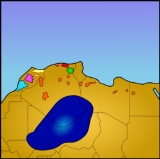
The Berber languages are a family of languages indigenous to North Africa
, spoken from Siwa Oasis
in Egypt to Morocco
(where the largest population of speakers exist), and south to the countries of the Sahara Desert. They constitute a branch of the Afroasiatic language family and have been attested since ancient times.
There is a movement among speakers of the closely related "Northern Berber" varieties to unite them into a single standard language
. The name Tamazight, originally the self-name of the Berber of the Atlas and the Rif regions, is being increasingly used for this Standard Berber, and even for Berber as a whole.
There are six major Berber languages spoken by nine-tenths of the Berber-speaking population. They are, in the order of demographic weight: Shilha (Tashelhit), Kabyle
(Taqbaylit), Central Atlas
(Tamazight), Rifian (Tarifit), Shawiya (Tacawit), and Tuareg
.
The Berber languages have had a written tradition, on and off, for over 2,000 years, although the tradition has been frequently disrupted by various invasions. It was first written in the Tifinagh
alphabet, still used by the Tuareg; the oldest dated inscription is from about 200 BC. Later, between about 1000 AD and 1500 AD, it was written in the Arabic alphabet
; since the 20th century, it has often been written in the Berber Latin alphabet
, especially among the Kabylians and within the cultural and linguistic communities of Morocco and Algeria.
A modernized form of the Tifinagh alphabet was made official in Morocco in 2003, and a similar one is sparsely used in Algeria. . Mali and Niger recognized the "Tuareg Berber Latin alphabet" and customized it to the Tuareg phonological system. However, traditional Tifinagh is still used in those countries. Both Tifinagh and Latin scripts are being increasingly used in Morocco and parts of Algeria, while the Arabic script has been abandoned by Berber writers.
The term Berber has been used in Europe since at least the 17th century, and is still used today. It was borrowed from either the Arabic designation for these populations, البربر, al-Barbar, see Berber (name); or from the Roman and Greek denominations of the Berber people.
The term Tamazight traditionally referred specifically to the Rif and the Central Morocco Tamazight
dialects. Many Berber linguists prefer to consider the term "Tamazight" as a pure Berber word to be used only in Berber text; while using the European word "Berber/ Berbero/ Berbère" in European texts to honour the traditions of European writings about the Berbers. Unlike Arabic, European languages distinguish between the words "Berber" and "barbaric".
Some other Berber writers, especially in Morocco, prefer to refer to Berber with "Amazigh" when writing about it in French or English.
Traditionally, the term "Tamazight" (in various forms: "thamazighth", "tamasheq", "tamajeq", "tamahaq") was used by many Berber groups to refer to the language they spoke, including the Middle Atlas, the Rif, Sened
in Tunisia, and the Tuareg.
However, other terms were used by other groups; for instance, many parts of western Algeria called their language "Taznatit" or Zenati
, while the Kabyle
s called theirs "Taqbaylit", the inhabitants of Siwa
"Siwi", and the Zenaga. In Tunisia, the local Berber languages are usually referred to as "Shelha".
One group, the Linguasphere Observatory
, has attempted to introduce the neologism "Tamazic languages" to refer to the Berber languages.
Its grouping within that family is uncertain.
Since modern Berber languages are relatively homogeneous, the date of the Proto-Berber language from which the modern group is derived was probably comparatively recent, comparable to the age of the Germanic
or Romance
families.
By contrast, the split of the group from the other Afro-Asiatic sub-phyla is much earlier, and is sometimes associated with the Mesolithic Capsian culture
.
countries to varying degrees pursued a policy of Arabization
, aimed partly at displacing French from its colonial position as the dominant language of education and literacy. Under this policy the use of the Amazigh / Berber languages was suppressed or even banned. This state of affairs has been contested by Berbers in Morocco and Algeria—especially Kabylie
—and is now being addressed in both countries by introducing the Berber language in some schools and by recognizing Berber as a "national language
" in Algeria, though not as an official
one. No such measures have been taken in the other Maghreb countries. In Mali and Niger, there are a few schools that teach partially in Tamasheq.
Although Algeria considers Tamazight to be a national language, and regional councils in Libya's Nafusa Mountains affiliated with the National Transitional Council
reportedly use the Berber dialect of Nafusi
and have called for it to be granted co-official status with Arabic in a prospective new constitution, Morocco is the only country where Tamazight is an official language
.
As areas of Libya south and west of Tripoli
such as the Nafusa Mountains were liberated from control by forces loyal to Colonel Gaddafi
in early summer 2011, Berber workshops and exhibitions sprang up to share and spread the Tamazight culture and language, after four decades during which there were severe punishments for speaking and writing Tamazight openly.
On June 17, 2011, King Mohammed VI
announced in a speech of new constitutional reform that "Tamazight" became an official language of Morocco alongside Arabic and will be used in all the administrations in the future.
provides a useful academic starting point; however, its bibliographic references are inadequate, and it rates its own accuracy at only B-C for the area. Early colonial censuses may provide better documented figures for some countries; however, these are also very much out of date.
A survey included in the official Moroccan census of 2004 and published by several Moroccan newspapers gave the following figures: 34% of people in rural regions spoke a Berber language and 21% in urban zones did, the national average would be 28.4% or 8.52 million. It is possible, however, that the survey asked for the language "used in daily life" which would result of course in figures clearly lower than those of native speakers, as the language is not recognized for official purposes and many Berbers who live in an Arabic-speaking environment cannot use it in daily life; also the use of Berber in public was frowned upon until the 1990s and might affect the result of the survey.
Adding up the population (according to the official census of 2004) of the Berber-speaking regions as shown on a 1973 map of the CIA
results in at least 10 million speakers, not counting the numerous Berber population which lives outside these regions in the bigger cities.
Mohamed Chafik
claims 80% of Moroccans are Berbers. It is not clear, however, whether he means "speakers of Berber languages" or "people of Berber descent".
The division of Moroccan Berber dialects in three groups, as used by The Ethnologue is common in linguistic publications, but is significantly complicated by local usage: thus Shilha is subdivided into Shilha of the Dra valley, Tasusit (the language of the Souss) and several other (mountain)-dialects. Moreover, linguistic boundaries are blurred, such that certain dialects cannot accurately be described as either Central Morocco Tamazight (spoken in the Central and eastern Atlas area) or Shilha.
Thus, judging by the not necessarily reliable Ethnologue, the total number of speakers of Berber languages in the Maghreb
proper appears to lie anywhere between 16 and 25 million, depending on which estimate is accepted; if we take Basset's estimate, it could be as high as 30 million. The vast majority are concentrated in Morocco and Algeria. The Tuareg of the Sahel
add another million or so.
s in the Berber languages vary in gender
(masculine versus feminine), in number (singular versus plural) and in state (free state versus construct state). In the case of the masculine, nouns generally begin with one of the three vowels of Berber, a, u or i (in standardised orthography, e represents a schwa [ə] inserted for reasons of pronunciation):
While the masculine is unmarked, the feminine (also used to form diminutive
s and singulatives, like an ear of wheat) is marked with the circumfix
t...t. Feminine plural takes a prefix t... :
Berber languages have two types of number
: singular and plural
, of which only the latter is marked. Plural has three forms according to the type of nouns. The first, "regular" type is known as the "external plural"; it consists in changing the initial vowel of the noun, and adding a suffix
-n:
The second form of the plural is known as the "broken plural". It involves only a change in the vowels of the word:
The third type of plural is a mixed form: it combines a change of vowels with the suffix -n:
Berber languages also have two types of states or cases
of the noun
, organized ergatively
: one is unmarked, while the other serves for the subject of a transitive verb and the object of a preposition, among other contexts. The former is often called free state, the latter construct state. The construct state of the noun derives from the free state through one of the following rules:
The first involves a vowel alternation, whereby the vowel a becomes u :
The second involves the loss of the initial vowel, in the case of some feminine nouns:
The third involves the addition of a semi-vowel (w or y) word-initially:
Finally, some nouns do not change for free state:
The following table gives the forms for the noun amghar "old man / leader":
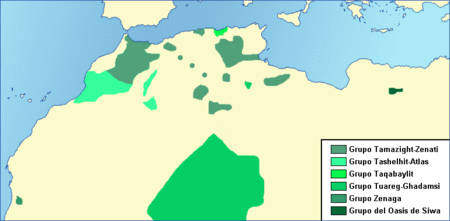 Subclassification of the Berber languages is made difficult by their mutual closeness; Maarten Kossmann (1999) describes it as two dialect continua
, Northern Berber
and Tuareg
, and a few peripheral languages, spoken in isolated pockets largely surrounded by Arabic, that fall outside these continua, namely Zenaga
and the Libyan and Egyptian varieties. Within Northern Berber, however, he recognizes a break in the continuum between Zenati
and their non-Zenati neighbors; and in the east, he recognizes a division between Ghadames
and Awjila on the one hand and Sokna (Al Fuqahā'
), Siwa, and Djebel Nefusa
on the other. The implied tree is:
There is so little data available on Guanche
that any classification is necessarily uncertain; however, it is almost universally acknowledged as Afro-Asiatic on the basis of the surviving glosses, and widely suspected to be Berber. Much the same can be said of the language, sometimes called "Numidian", used in the Libyan or Libyco-Berber inscriptions around the turn of the Common Era, whose alphabet is the ancestor of Tifinagh
.
The Ethnologue, mostly following Aikhenvald and Militarev (1991), treats the eastern varieties differently:
in such words and phrases as these: Berber: ya mut; Hausa ya mutu (he died); Berber: obanis; Hausa obansa (his father); Berber: a bat; Hausa ya bata (he was lost); Berber: eghare; Hausa ya kirra (he called). In addition he notes that the genitive in both languages is formed with n = "of".
North Africa
North Africa or Northern Africa is the northernmost region of the African continent, linked by the Sahara to Sub-Saharan Africa. Geopolitically, the United Nations definition of Northern Africa includes eight countries or territories; Algeria, Egypt, Libya, Morocco, South Sudan, Sudan, Tunisia, and...
, spoken from Siwa Oasis
Siwa Oasis
The Siwa Oasis is an oasis in Egypt, located between the Qattara Depression and the Egyptian Sand Sea in the Libyan Desert, nearly 50 km east of the Libyan border, and 560 km from Cairo....
in Egypt to Morocco
Morocco
Morocco , officially the Kingdom of Morocco , is a country located in North Africa. It has a population of more than 32 million and an area of 710,850 km², and also primarily administers the disputed region of the Western Sahara...
(where the largest population of speakers exist), and south to the countries of the Sahara Desert. They constitute a branch of the Afroasiatic language family and have been attested since ancient times.
There is a movement among speakers of the closely related "Northern Berber" varieties to unite them into a single standard language
Standard language
A standard language is a language variety used by a group of people in their public discourse. Alternatively, varieties become standard by undergoing a process of standardization, during which it is organized for description in grammars and dictionaries and encoded in such reference works...
. The name Tamazight, originally the self-name of the Berber of the Atlas and the Rif regions, is being increasingly used for this Standard Berber, and even for Berber as a whole.
There are six major Berber languages spoken by nine-tenths of the Berber-speaking population. They are, in the order of demographic weight: Shilha (Tashelhit), Kabyle
Kabyle language
Kabyle or Kabylian is a Berber language spoken by the Kabyle people north and northeast of Algeria. Estimates about the number of speakers range from 5 million to about 7 million speakers worldwide, the majority in Algeria.-Classification:The classification of Kabyle is Afro-Asiatic, Berber and...
(Taqbaylit), Central Atlas
Central Morocco Tamazight
Central Atlas Tamazight is a Berber languageCentral Atlas Tamazight may be referred to as either a Berber language or a Berber dialect...
(Tamazight), Rifian (Tarifit), Shawiya (Tacawit), and Tuareg
Tuareg languages
Tuareg is a Berber language or family of very closely related languages and dialects spoken by the Tuareg Berbers, in large parts of Mali, Niger, Algeria, Libya and Burkina Faso, with a few speakers, the Kinnin, in Chad.- Description :Other Berber languages and Tamashaq are quite mutually...
.
The Berber languages have had a written tradition, on and off, for over 2,000 years, although the tradition has been frequently disrupted by various invasions. It was first written in the Tifinagh
Tifinagh
Tifinagh is a series of abjad and alphabetic scripts used by some Berber peoples, notably the Tuareg, to write their language.A modern derivate of the traditional script, known as Neo-Tifinagh, was introduced in the 20th century...
alphabet, still used by the Tuareg; the oldest dated inscription is from about 200 BC. Later, between about 1000 AD and 1500 AD, it was written in the Arabic alphabet
Arabic alphabet
The Arabic alphabet or Arabic abjad is the Arabic script as it is codified for writing the Arabic language. It is written from right to left, in a cursive style, and includes 28 letters. Because letters usually stand for consonants, it is classified as an abjad.-Consonants:The Arabic alphabet has...
; since the 20th century, it has often been written in the Berber Latin alphabet
Berber Latin alphabet
The Berber Latin alphabet is the version of the Latin alphabet used to write the Berber language...
, especially among the Kabylians and within the cultural and linguistic communities of Morocco and Algeria.
A modernized form of the Tifinagh alphabet was made official in Morocco in 2003, and a similar one is sparsely used in Algeria. . Mali and Niger recognized the "Tuareg Berber Latin alphabet" and customized it to the Tuareg phonological system. However, traditional Tifinagh is still used in those countries. Both Tifinagh and Latin scripts are being increasingly used in Morocco and parts of Algeria, while the Arabic script has been abandoned by Berber writers.
Terminology
Etymologically, the Berber word "Amazigh" means "free man", "noble man" or "defender".The term Berber has been used in Europe since at least the 17th century, and is still used today. It was borrowed from either the Arabic designation for these populations, البربر, al-Barbar, see Berber (name); or from the Roman and Greek denominations of the Berber people.
The term Tamazight traditionally referred specifically to the Rif and the Central Morocco Tamazight
Central Morocco Tamazight
Central Atlas Tamazight is a Berber languageCentral Atlas Tamazight may be referred to as either a Berber language or a Berber dialect...
dialects. Many Berber linguists prefer to consider the term "Tamazight" as a pure Berber word to be used only in Berber text; while using the European word "Berber/ Berbero/ Berbère" in European texts to honour the traditions of European writings about the Berbers. Unlike Arabic, European languages distinguish between the words "Berber" and "barbaric".
Some other Berber writers, especially in Morocco, prefer to refer to Berber with "Amazigh" when writing about it in French or English.
Traditionally, the term "Tamazight" (in various forms: "thamazighth", "tamasheq", "tamajeq", "tamahaq") was used by many Berber groups to refer to the language they spoke, including the Middle Atlas, the Rif, Sened
Sened language
Sened is an extinct Berber language that was spoken in the nearby towns of Sened and Majoura in Southern Tunisia until the mid-twentieth century...
in Tunisia, and the Tuareg.
However, other terms were used by other groups; for instance, many parts of western Algeria called their language "Taznatit" or Zenati
Zenata
Zenata were an ethnic group of North Africa, who were technically an Eastern Berber group and who are found in Tunisia, Algeria and Morocco....
, while the Kabyle
Kabyle people
The Kabyle people are the largest homogeneous Algerian ethno-cultural and linguistical community and the largest nation in North Africa to be considered exclusively Berber. Their traditional homeland is Kabylie in the north of Algeria, one hundred miles east of Algiers...
s called theirs "Taqbaylit", the inhabitants of Siwa
Siwa Oasis
The Siwa Oasis is an oasis in Egypt, located between the Qattara Depression and the Egyptian Sand Sea in the Libyan Desert, nearly 50 km east of the Libyan border, and 560 km from Cairo....
"Siwi", and the Zenaga. In Tunisia, the local Berber languages are usually referred to as "Shelha".
One group, the Linguasphere Observatory
Linguasphere Observatory
The Linguasphere Observatory is a transnational linguistic research network...
, has attempted to introduce the neologism "Tamazic languages" to refer to the Berber languages.
Origin
Berber is a member of the Afroasiatic language family.Its grouping within that family is uncertain.
Since modern Berber languages are relatively homogeneous, the date of the Proto-Berber language from which the modern group is derived was probably comparatively recent, comparable to the age of the Germanic
Germanic languages
The Germanic languages constitute a sub-branch of the Indo-European language family. The common ancestor of all of the languages in this branch is called Proto-Germanic , which was spoken in approximately the mid-1st millennium BC in Iron Age northern Europe...
or Romance
Romance languages
The Romance languages are a branch of the Indo-European language family, more precisely of the Italic languages subfamily, comprising all the languages that descend from Vulgar Latin, the language of ancient Rome...
families.
By contrast, the split of the group from the other Afro-Asiatic sub-phyla is much earlier, and is sometimes associated with the Mesolithic Capsian culture
Capsian culture
The Capsian culture was a Mesolithic culture of the Maghreb, which lasted from about 10,000 to 6,000 BCE.It was concentrated mainly in modern Tunisia, and Algeria, with some sites attested in southern Spain to Sicily....
.
Orthography
There are a number of different scripts with which Berber languages may be written. The choice of writing system is often based on politics rather than practical considerations.Status
After independence, all the MaghrebMaghreb
The Maghreb is the region of Northwest Africa, west of Egypt. It includes five countries: Morocco, Algeria, Tunisia, Libya, and Mauritania and the disputed territory of Western Sahara...
countries to varying degrees pursued a policy of Arabization
Arabization
Arabization or Arabisation describes a growing cultural influence on a non-Arab area that gradually changes into one that speaks Arabic and/or incorporates Arab culture...
, aimed partly at displacing French from its colonial position as the dominant language of education and literacy. Under this policy the use of the Amazigh / Berber languages was suppressed or even banned. This state of affairs has been contested by Berbers in Morocco and Algeria—especially Kabylie
Kabylie
Kabylie or Kabylia , is a region in the north of Algeria.It is part of the Tell Atlas and is located at the edge of the Mediterranean Sea. Kabylia covers several provinces of Algeria: the whole of Tizi Ouzou and Bejaia , most of Bouira and parts of the wilayas of Bordj Bou Arreridj, Jijel,...
—and is now being addressed in both countries by introducing the Berber language in some schools and by recognizing Berber as a "national language
National language
A national language is a language which has some connection—de facto or de jure—with a people and perhaps by extension the territory they occupy. The term is used variously. A national language may for instance represent the national identity of a nation or country...
" in Algeria, though not as an official
Official language
An official language is a language that is given a special legal status in a particular country, state, or other jurisdiction. Typically a nation's official language will be the one used in that nation's courts, parliament and administration. However, official status can also be used to give a...
one. No such measures have been taken in the other Maghreb countries. In Mali and Niger, there are a few schools that teach partially in Tamasheq.
Although Algeria considers Tamazight to be a national language, and regional councils in Libya's Nafusa Mountains affiliated with the National Transitional Council
National Transitional Council
The National Transitional Council of Libya , sometimes known as the Transitional National Council, the Interim National Council, or the Libyan National Council,...
reportedly use the Berber dialect of Nafusi
Nafusi language
Nafusi is the Berber language of the Nafusa Mountains , a large area in northwestern Libya. This variety of the Berber language is spoken by the Ibadite communities around Jadu, Nalut , and Yafran...
and have called for it to be granted co-official status with Arabic in a prospective new constitution, Morocco is the only country where Tamazight is an official language
Official language
An official language is a language that is given a special legal status in a particular country, state, or other jurisdiction. Typically a nation's official language will be the one used in that nation's courts, parliament and administration. However, official status can also be used to give a...
.
As areas of Libya south and west of Tripoli
Tripoli
Tripoli is the capital and largest city in Libya. It is also known as Western Tripoli , to distinguish it from Tripoli, Lebanon. It is affectionately called The Mermaid of the Mediterranean , describing its turquoise waters and its whitewashed buildings. Tripoli is a Greek name that means "Three...
such as the Nafusa Mountains were liberated from control by forces loyal to Colonel Gaddafi
Muammar Gaddafi
Muammar Muhammad Abu Minyar Gaddafi or "September 1942" 20 October 2011), commonly known as Muammar Gaddafi or Colonel Gaddafi, was the official ruler of the Libyan Arab Republic from 1969 to 1977 and then the "Brother Leader" of the Libyan Arab Jamahiriya from 1977 to 2011.He seized power in a...
in early summer 2011, Berber workshops and exhibitions sprang up to share and spread the Tamazight culture and language, after four decades during which there were severe punishments for speaking and writing Tamazight openly.
On June 17, 2011, King Mohammed VI
Mohammed VI of Morocco
Mohammed VI is the present King of Morocco and Amir al-Mu'minin . He ascended to the throne on 23 July 1999 upon the death of his father.-Education:...
announced in a speech of new constitutional reform that "Tamazight" became an official language of Morocco alongside Arabic and will be used in all the administrations in the future.
Population
The exact population of Berber speakers is hard to ascertain, since most North African countries do not record language data in their censuses. The EthnologueEthnologue
Ethnologue: Languages of the World is a web and print publication of SIL International , a Christian linguistic service organization, which studies lesser-known languages, to provide the speakers with Bibles in their native language and support their efforts in language development.The Ethnologue...
provides a useful academic starting point; however, its bibliographic references are inadequate, and it rates its own accuracy at only B-C for the area. Early colonial censuses may provide better documented figures for some countries; however, these are also very much out of date.
- "Few census figures are available; all countries (Algeria and Morocco included) do not count Berber languages. The 1972 Niger census reported Tuareg, with other languages, at 127,000 speakers. Population shifts in location and number, effects of urbanization and education in other languages, etc., make estimates difficult. In 1952 André Basset (LLB.4) estimated the number of Berberophones at 5,500,000. Between 1968 and 1978 estimates ranged from eight to thirteen million (as reported by Galand, LELB 56, pp. 107, 123-25); Voegelin and Voegelin (1977, p. 297) call eight million a conservative estimate. In 2006, Salem Chaker estimated that the Berberophone populations of Kabylie and the three Moroccan groups numbered more than one million each; and that in Algeria, 12,650,000, or one out of three Algerians, speak a Berber language (Chaker 1984, pp. 8–9)."
- Morocco: In 1952, André Basset ("La langue berbère", Handbook of African Languages, Part I, Oxford) estimated that a "small majority" of Morocco's population spoke Berber. The 1960 census estimated that 34% of Moroccans spoke Berber, including bi-, tri-, and quadrilinguals. In 2000, Karl Prasse cited "more than half" in an interview conducted by Brahim Karada at Tawalt.com. According to the Ethnologue (by deduction from its Moroccan Arabic figures), the Berber-speaking population should be estimated at 35% or around 10.5 million speakers. However, the figures it gives for individual languages only add up to 7.5 million, divided into three dialects:
- Riff: 1.5 million (1991)
- Shilha: 3 million (1998)
- Central Morocco TamazightCentral Morocco TamazightCentral Atlas Tamazight is a Berber languageCentral Atlas Tamazight may be referred to as either a Berber language or a Berber dialect...
: 3 million (1998) - INALCO estimates the figure of Middle-Atlas speakers at 4-5 million
- INALCO estimates the figure of Shilha speakers at 8 million
A survey included in the official Moroccan census of 2004 and published by several Moroccan newspapers gave the following figures: 34% of people in rural regions spoke a Berber language and 21% in urban zones did, the national average would be 28.4% or 8.52 million. It is possible, however, that the survey asked for the language "used in daily life" which would result of course in figures clearly lower than those of native speakers, as the language is not recognized for official purposes and many Berbers who live in an Arabic-speaking environment cannot use it in daily life; also the use of Berber in public was frowned upon until the 1990s and might affect the result of the survey.
Adding up the population (according to the official census of 2004) of the Berber-speaking regions as shown on a 1973 map of the CIA
Languages of Morocco
A multitude of Languages are used in Morocco, the native languages of Moroccans are Moroccan Arabic and Amazigh Languages. The official Languages are Classical Arabic and the Amazigh Language....
results in at least 10 million speakers, not counting the numerous Berber population which lives outside these regions in the bigger cities.
Mohamed Chafik
Mohamed Chafik
Mohamed Chafik is a Moroccan writer and specialist in Berber language and literature.-Career:He is the author of a Berber-Arabic dictionary ....
claims 80% of Moroccans are Berbers. It is not clear, however, whether he means "speakers of Berber languages" or "people of Berber descent".
The division of Moroccan Berber dialects in three groups, as used by The Ethnologue is common in linguistic publications, but is significantly complicated by local usage: thus Shilha is subdivided into Shilha of the Dra valley, Tasusit (the language of the Souss) and several other (mountain)-dialects. Moreover, linguistic boundaries are blurred, such that certain dialects cannot accurately be described as either Central Morocco Tamazight (spoken in the Central and eastern Atlas area) or Shilha.
- Algeria: In 1906, the total population speaking Berber languages in Algeria (excluding the thinly populated Sahara) was estimated at 1,305,730 out of 4,447,149, i.e. 29%. (Doutté & Gautier, Enquête sur la dispersion de la langue berbère en Algérie, faite par l'ordre de M. le Gouverneur Général, Alger 1913.) The 1911 census, however, found 1,084,702 speakers out of 4,740,526, i.e. 23%; Doutté & Gautier suggest that this was the result of a serious undercounting of Shawiya in areas of widespread bilingualism. A trend was noted for Berber groups surrounded by Arabic (as in BlidaBlidaBlida is a city in Algeria. It is the capital of Blida Province, and it is located about 45 km south-west of Algiers, the national capital. The name Blida, i.e...
) to adopt Arabic, while Arabic speakers surrounded by Berber (as in Sikh ou Meddour near Tizi OuzouTizi OuzouTizi Ouzou is a city in Kabylia, Algeria, where it ranks second in population after Béjaïa. It is the capital and largest city of Tizi Ouzou Province and of Great Kabylia .-Etymology:The name comes from the Kabylian Berber Tizi n Uzezzu and is pronounced Tizuzzu, commonly...
) tended to adopt Berber. In 1952, André Basset estimated that about a third of Algeria's population spoke Berber. The Algerian census of 1966 found 2,297,997 out of 12,096,347 Algerians, or 19%, to speak "Berber". In 1980, Salem Chaker estimated that "in Algeria, 3,650,000, or one out of five Algerians, speak a Berber language" (Chaker 1984, pp. 8–9). According to the Ethnologue http://www.ethnologue.com/show_country.asp?name=DZ, more recent estimates include 14% (corresponding to the total figures it gives for each Berber language added together, 4 million) and (by deduction from its Algerian Arabic figures) 29% (Hunter 1996). Most of these are accounted for by two dialects (percentages based on historical population data from appropriate dates http://www.populstat.info/Africa/algeriac.htm):- KabyleKabyle languageKabyle or Kabylian is a Berber language spoken by the Kabyle people north and northeast of Algeria. Estimates about the number of speakers range from 5 million to about 7 million speakers worldwide, the majority in Algeria.-Classification:The classification of Kabyle is Afro-Asiatic, Berber and...
: 2,540,000 = 9% (Ethnologue, 1995) – 6,000,000 = 20% (Ethnologue, 1998). Total for all countries (Ethnologue): 3,126,000. (Needless to say, the latter two figures, though cited by the same source, are mutually contradictory.) Mainly in Algiers, Bejaia, Tizi-Ouzou, Bouira, Setif and Boumerdes. - Shawiya: 1.4 million (Ethnologue, 1993), equivalent to 5% of the population. Mainly in Batna, Khenchela, Sétif, Souk Ahras, Oum-El-Bouaghi, Tebessa.
- Kabyle
- A third group, despite a very small population, accounts for most of the area speaking Berber:
- Tuareg 25,000 in Algeria (Ethnologue, 1987), mainly in the Ahaggar mountains of the Sahara. Most Tuareg live in Mali and Niger (see below).
- Tunisia: Basset (1952) estimated about 1%, as did Penchoen (1968). According to the Ethnologue, there are only 26,000 speakers (1998) of a Berber language it calls "Djerbi", but which Tunisians call "Shelha", in Tunisia, all in the south around DjerbaDjerbaDjerba , also transliterated as Jerba or Jarbah, is, at 514 km², the largest island of North Africa, located in the Gulf of Gabes, off the coast of Tunisia.-Description:...
and MatmataMatmâtaMatmata is a small Berber speaking town in southern Tunisia. Some of the local Berber residents live in traditional underground "troglodyte" structures. In 2004 it had a population of 2,116....
. The more northerly enclave of SenedSened (town)Sened is a commune and small town in central Tunisia in Gafsa Governorate, and is also the name of the extinct Berber language that was spoken there and at the nearby town of Tmagourt until the mid-twentieth century. At the 2004 census it had a population of 8,931. In 1911, the whole town spoke...
apparently no longer speaks Berber. This would make 0.3% of the population. - Libya: According to the Ethnologue (by deduction from its combined Libyan Arabic and Egyptian Arabic figures) the non-Arabic-speaking population, most of which would be Berber, is estimated at 4% (1991, 1996). However, the individual language figures it gives add up to 162,000, i.e. about 3%. This is mostly accounted for by languages:
- NafusiNafusi languageNafusi is the Berber language of the Nafusa Mountains , a large area in northwestern Libya. This variety of the Berber language is spoken by the Ibadite communities around Jadu, Nalut , and Yafran...
in Zuwarah and Jabal Nafusa: 141,000 (1998). - Tahaggart TuaregTuareg languagesTuareg is a Berber language or family of very closely related languages and dialects spoken by the Tuareg Berbers, in large parts of Mali, Niger, Algeria, Libya and Burkina Faso, with a few speakers, the Kinnin, in Chad.- Description :Other Berber languages and Tamashaq are quite mutually...
of Ghat: 17,000 (Johnstone 1993).
- Nafusi
- Egypt: The oasis of SiwaSiwa OasisThe Siwa Oasis is an oasis in Egypt, located between the Qattara Depression and the Egyptian Sand Sea in the Libyan Desert, nearly 50 km east of the Libyan border, and 560 km from Cairo....
near the Libyan border speaks a Berber language; according to the Ethnologue, there are 5,000 speakers there (1995). Its population in 1907 was 3884 (according to the 1911 Encyclopædia BritannicaEncyclopædia BritannicaThe Encyclopædia Britannica , published by Encyclopædia Britannica, Inc., is a general knowledge English-language encyclopaedia that is available in print, as a DVD, and on the Internet. It is written and continuously updated by about 100 full-time editors and more than 4,000 expert...
); the claimed lack of increase seems surprising. - Mauritania: According to the Ethnologue, only 200-300 speakers of ZenagaZenaga languageZenaga is a Berber language spoken by some 200 people between Mederdra and the Atlantic coast in southwestern Mauritania. The language shares its basic structure with other Berber languages, but specific details are quite different; in fact, it is probably the most divergent surviving Berber...
remain (1998). It also mentions Tamasheq, but does not provide a population figure for it. Most non-Arabic speakers in Mauritania speak Niger–Congo languagesNiger–Congo languagesThe Niger–Congo languages constitute one of the world's major language families, and Africa's largest in terms of geographical area, number of speakers, and number of distinct languages. They may constitute the world's largest language family in terms of distinct languages, although this question...
. - Mali: The Ethnologue counts 440,000 Tuareg (1991) speaking:
- Tamasheq: 250,000
- Tamajaq: 190,000
- Niger: The Ethnologue counts 720,000 Tuareg (1998) speaking:
- Tawallamat Tamajaq: 450,000
- Tayart TamajeqTayart TamajeqTayart is a dialect of the Tuareg language Tamasheq spoken in the Agadez Region of Niger.There are two sub-dialects:*Air*Tanassfarwat...
: 250,000 - TamahaqTamahaq languageTamahaq is the only known Northern Tuareg language, spoken in Algeria, western Libya, and northern Niger. It varies little from the southern languages of Ayr, Azawagh or Adagh, with the differences mostly being substitution of sounds, for instance Tamahaq instead of Tamajaq or...
: 20,000- Burkina Faso: The Ethnologue counts 20,000–30,000 Tuareg (SILSIL InternationalSIL International is a U.S.-based, worldwide, Christian non-profit organization, whose main purpose is to study, develop and document languages, especially those that are lesser-known, in order to expand linguistic knowledge, promote literacy, translate the Christian Bible into local languages,...
1991), speaking Kidal Tamasheq. However the Ethnologue is very inaccurate here appearing to miss the largest group of Tamasheq in Burkina in the province of Oudalan. The Tamasheq speaking population of Burkina is nearer to 100,000 (2005), with around 70,000 Tamasheq speakers in the province of Oudalan, the rest mainly in Seno, Soum, Yagha, Yatenga and Kadiogo provinces. About 10% of Burkina Tamasheq speak a version of the Tawallamat dialect. - Nigeria: The Ethnologue notes the presence of "few" Tuareg, speaking Tawallamat Tamajaq.
- France: The Ethnologue lists 860,000 speakers for Riffian and 537,000 speakers for Kabyle, 150,000 for Central Morocco TamazightCentral Morocco TamazightCentral Atlas Tamazight is a Berber languageCentral Atlas Tamazight may be referred to as either a Berber language or a Berber dialect...
, and no figures for Shilha. For the rest of Europe, it has no figures. - Spain: Tamazight is spoken amongst MelillaMelillaMelilla is a autonomous city of Spain and an exclave on the north coast of Morocco. Melilla, along with the Spanish exclave Ceuta, is one of the two Spanish territories located in mainland Africa...
's 80,000 inhabitants but there has been no census as to the percentage of its speakers. A minority of CeutaCeutaCeuta is an autonomous city of Spain and an exclave located on the north coast of North Africa surrounded by Morocco. Separated from the Iberian peninsula by the Strait of Gibraltar, Ceuta lies on the border of the Mediterranean Sea and the Atlantic Ocean. Ceuta along with the other Spanish...
's inhabitants, speak Berber. - Israel: Around two thousand mostly elderly Moroccan-born Israelis of Berber JewishBerber JewsBerber Jews are the Berber-speaking Jewish communities which used to live in certain parts of Atlas mountains in Morocco. Their origins are not clear as one theory builds the case for "Judeo-cized Berbers" while another defends the "Berber-ized Jews" thesis....
descent use Judeo-Berber dialects (as opposed to Moroccan Jews who trace descent from Spanish-speaking Sephardi JewsSephardi JewsSephardi Jews is a general term referring to the descendants of the Jews who lived in the Iberian Peninsula before their expulsion in the Spanish Inquisition. It can also refer to those who use a Sephardic style of liturgy or would otherwise define themselves in terms of the Jewish customs and...
expelled from SpainAlhambra decreeThe Alhambra Decree was an edict issued on 31 March 1492 by the joint Catholic Monarchs of Spain ordering the expulsion of Jews from the Kingdom of Spain and its territories and possessions by 31 July of that year.The edict was formally revoked on 16 December 1968, following the Second...
, or Arabic-speaking Moroccan Jews).
- Burkina Faso: The Ethnologue counts 20,000–30,000 Tuareg (SIL
Thus, judging by the not necessarily reliable Ethnologue, the total number of speakers of Berber languages in the Maghreb
Maghreb
The Maghreb is the region of Northwest Africa, west of Egypt. It includes five countries: Morocco, Algeria, Tunisia, Libya, and Mauritania and the disputed territory of Western Sahara...
proper appears to lie anywhere between 16 and 25 million, depending on which estimate is accepted; if we take Basset's estimate, it could be as high as 30 million. The vast majority are concentrated in Morocco and Algeria. The Tuareg of the Sahel
Sahel
The Sahel is the ecoclimatic and biogeographic zone of transition between the Sahara desert in the North and the Sudanian Savannas in the south.It stretches across the North African continent between the Atlantic Ocean and the Red Sea....
add another million or so.
Grammar
NounNoun
In linguistics, a noun is a member of a large, open lexical category whose members can occur as the main word in the subject of a clause, the object of a verb, or the object of a preposition .Lexical categories are defined in terms of how their members combine with other kinds of...
s in the Berber languages vary in gender
Grammatical gender
Grammatical gender is defined linguistically as a system of classes of nouns which trigger specific types of inflections in associated words, such as adjectives, verbs and others. For a system of noun classes to be a gender system, every noun must belong to one of the classes and there should be...
(masculine versus feminine), in number (singular versus plural) and in state (free state versus construct state). In the case of the masculine, nouns generally begin with one of the three vowels of Berber, a, u or i (in standardised orthography, e represents a schwa [ə] inserted for reasons of pronunciation):
-
- afus "hand"
- argaz "man"
- udem "face"
- ul "heart"
- ixef "head"
- iles "tongue"
While the masculine is unmarked, the feminine (also used to form diminutive
Diminutive
In language structure, a diminutive, or diminutive form , is a formation of a word used to convey a slight degree of the root meaning, smallness of the object or quality named, encapsulation, intimacy, or endearment...
s and singulatives, like an ear of wheat) is marked with the circumfix
Circumfix
A circumfix is an affix, a morpheme that is placed around another morpheme. Circumfixes contrast with prefixes, attached to the beginnings of words; suffixes, that are attached at the end; and infixes, inserted in the middle. See also epenthesis...
t...t. Feminine plural takes a prefix t... :
-
- afus → tafust
- udem → tudemt
- ixef → tixeft
- ifassen → tifassin
Berber languages have two types of number
Grammatical number
In linguistics, grammatical number is a grammatical category of nouns, pronouns, and adjective and verb agreement that expresses count distinctions ....
: singular and plural
Plural
In linguistics, plurality or [a] plural is a concept of quantity representing a value of more-than-one. Typically applied to nouns, a plural word or marker is used to distinguish a value other than the default quantity of a noun, which is typically one...
, of which only the latter is marked. Plural has three forms according to the type of nouns. The first, "regular" type is known as the "external plural"; it consists in changing the initial vowel of the noun, and adding a suffix
Suffix
In linguistics, a suffix is an affix which is placed after the stem of a word. Common examples are case endings, which indicate the grammatical case of nouns or adjectives, and verb endings, which form the conjugation of verbs...
-n:
-
- afus → ifassen "hands"
- argaz → irgazen "men"
- ixef → ixfawen "heads"
- ul → ulawen "hearts"
The second form of the plural is known as the "broken plural". It involves only a change in the vowels of the word:
-
- adrar → idurar "mountain"
- agadir → igudar "wall / castle"
- abaghus → ibughas "monkey"
The third type of plural is a mixed form: it combines a change of vowels with the suffix -n:
-
- izi → izan "(the) fly"
- azur → izuran "root"
- iziker → izakaren "rope"
Berber languages also have two types of states or cases
Grammatical case
In grammar, the case of a noun or pronoun is an inflectional form that indicates its grammatical function in a phrase, clause, or sentence. For example, a pronoun may play the role of subject , of direct object , or of possessor...
of the noun
Noun
In linguistics, a noun is a member of a large, open lexical category whose members can occur as the main word in the subject of a clause, the object of a verb, or the object of a preposition .Lexical categories are defined in terms of how their members combine with other kinds of...
, organized ergatively
Ergative case
The ergative case is the grammatical case that identifies the subject of a transitive verb in ergative-absolutive languages.-Characteristics:...
: one is unmarked, while the other serves for the subject of a transitive verb and the object of a preposition, among other contexts. The former is often called free state, the latter construct state. The construct state of the noun derives from the free state through one of the following rules:
The first involves a vowel alternation, whereby the vowel a becomes u :
-
- argaz → urgaz
- amghar → umghar
- adrar → udrar
The second involves the loss of the initial vowel, in the case of some feminine nouns:
-
- tamghart → temghart "woman / mature woman"
- tamdint → temdint "town"
- tarbat → terbat "girl"
The third involves the addition of a semi-vowel (w or y) word-initially:
-
- asif → wasif "river"
- aḍu → waḍu "wind"
- iles → yiles "tongue"
- uccen → wuccen "wolf"
Finally, some nouns do not change for free state:
-
- taddart → taddart "house / village"
- tuccent → tuccent "female wolf"
The following table gives the forms for the noun amghar "old man / leader":
| masculine | feminine | |||
| default | agent | default | agent | |
| singular | amghar | umghar | tamghart | temghart |
| plural | imgharen | yimgharen | timgharin | temgharin |
Subclassification
Dialect continuum
A dialect continuum, or dialect area, was defined by Leonard Bloomfield as a range of dialects spoken across some geographical area that differ only slightly between neighboring areas, but as one travels in any direction, these differences accumulate such that speakers from opposite ends of the...
, Northern Berber
Northern Berber languages
The Northern Berber languages form a dialect continuum across the Maghreb that constitute a branch of the Berber language subgroup of the Afroasiatic family...
and Tuareg
Tuareg languages
Tuareg is a Berber language or family of very closely related languages and dialects spoken by the Tuareg Berbers, in large parts of Mali, Niger, Algeria, Libya and Burkina Faso, with a few speakers, the Kinnin, in Chad.- Description :Other Berber languages and Tamashaq are quite mutually...
, and a few peripheral languages, spoken in isolated pockets largely surrounded by Arabic, that fall outside these continua, namely Zenaga
Zenaga language
Zenaga is a Berber language spoken by some 200 people between Mederdra and the Atlantic coast in southwestern Mauritania. The language shares its basic structure with other Berber languages, but specific details are quite different; in fact, it is probably the most divergent surviving Berber...
and the Libyan and Egyptian varieties. Within Northern Berber, however, he recognizes a break in the continuum between Zenati
Zenati languages
The Zenati languages, named after the medieval Zenata tribe, are a subgroup of the Northern Berber language family, spoken in North Africa, proposed in Destaing They are distributed across the central Maghreb, from northeastern Morocco to just west of Algiers, and the northern Sahara, from...
and their non-Zenati neighbors; and in the east, he recognizes a division between Ghadames
Ghadamès language
Ghadamès is a language spoken mainly by some Libyan Berbers. It is spoken in Ghadames, a small oasis town near the Libyan border with Algeria and Tunisia. It is spoken by 2,000 people in Libya, and 2,000 elsewhere. It has two dialects, Ayt Waziten and Elt Ulid....
and Awjila on the one hand and Sokna (Al Fuqahā'
Al Fuqahā', Libya
Fuqaha or El-Foqaha is a spring-fed town in central Libya, 200 km by road south of Sokna, on the western edge of the great central Haruj volcano and lava field. It was one of the last holdouts of loyalists in the 2011 Libyan civil war....
), Siwa, and Djebel Nefusa
Nafusi language
Nafusi is the Berber language of the Nafusa Mountains , a large area in northwestern Libya. This variety of the Berber language is spoken by the Ibadite communities around Jadu, Nalut , and Yafran...
on the other. The implied tree is:
- NafusiNafusi languageNafusi is the Berber language of the Nafusa Mountains , a large area in northwestern Libya. This variety of the Berber language is spoken by the Ibadite communities around Jadu, Nalut , and Yafran...
-SiwiSiwi languageSiwi is a Berber language of Egypt, spoken by about 15,000 to 30,000 people in the oases of Siwa and Gara, near the Libyan border. The language has been heavily influenced by Egyptian Arabic, to a greater degree than most Berber languages...
languages (including Sokna) - GhadamesGhadamès languageGhadamès is a language spoken mainly by some Libyan Berbers. It is spoken in Ghadames, a small oasis town near the Libyan border with Algeria and Tunisia. It is spoken by 2,000 people in Libya, and 2,000 elsewhere. It has two dialects, Ayt Waziten and Elt Ulid....
-Awjila languages - Northern BerberNorthern Berber languagesThe Northern Berber languages form a dialect continuum across the Maghreb that constitute a branch of the Berber language subgroup of the Afroasiatic family...
- ZenatiZenati languagesThe Zenati languages, named after the medieval Zenata tribe, are a subgroup of the Northern Berber language family, spoken in North Africa, proposed in Destaing They are distributed across the central Maghreb, from northeastern Morocco to just west of Algiers, and the northern Sahara, from...
(including Riff) - KabyleKabyle languageKabyle or Kabylian is a Berber language spoken by the Kabyle people north and northeast of Algeria. Estimates about the number of speakers range from 5 million to about 7 million speakers worldwide, the majority in Algeria.-Classification:The classification of Kabyle is Afro-Asiatic, Berber and...
- AtlasAtlas languagesThe Atlas languages, or more exactly Moroccan Atlas, also Masmuda, are a subgroup of the Northern Berber languages spoken in the Atlas Mountains of Morocco. By mutual intelligibility, they are a single language; however, they are distinct sociolinguistically and are considered separate languages by...
- Zenati
- TuaregTuareg languagesTuareg is a Berber language or family of very closely related languages and dialects spoken by the Tuareg Berbers, in large parts of Mali, Niger, Algeria, Libya and Burkina Faso, with a few speakers, the Kinnin, in Chad.- Description :Other Berber languages and Tamashaq are quite mutually...
- ZenagaZenaga languageZenaga is a Berber language spoken by some 200 people between Mederdra and the Atlantic coast in southwestern Mauritania. The language shares its basic structure with other Berber languages, but specific details are quite different; in fact, it is probably the most divergent surviving Berber...
(which together with Tin Sert constitutes Western Berber)
There is so little data available on Guanche
Guanche language
Guanche is an extinct language that was spoken by the Guanches of the Canary Islands until the 16th or 17th century. It is only known today through a few sentences and individual words recorded by early travellers, supplemented by several placenames, as well as some words assimilated into the...
that any classification is necessarily uncertain; however, it is almost universally acknowledged as Afro-Asiatic on the basis of the surviving glosses, and widely suspected to be Berber. Much the same can be said of the language, sometimes called "Numidian", used in the Libyan or Libyco-Berber inscriptions around the turn of the Common Era, whose alphabet is the ancestor of Tifinagh
Tifinagh
Tifinagh is a series of abjad and alphabetic scripts used by some Berber peoples, notably the Tuareg, to write their language.A modern derivate of the traditional script, known as Neo-Tifinagh, was introduced in the 20th century...
.
The Ethnologue, mostly following Aikhenvald and Militarev (1991), treats the eastern varieties differently:
- GuancheGuanche languageGuanche is an extinct language that was spoken by the Guanches of the Canary Islands until the 16th or 17th century. It is only known today through a few sentences and individual words recorded by early travellers, supplemented by several placenames, as well as some words assimilated into the...
- Eastern BerberEastern Berber languagesThe Eastern Berber languages belong to the Afro-Asiatic family and are spoken in Libya and Egypt. They include Awjila, Sokna and Fezzan , Siwi, and Ghadamès. Kossmann divides them into two groups:...
- SiwiSiwi languageSiwi is a Berber language of Egypt, spoken by about 15,000 to 30,000 people in the oases of Siwa and Gara, near the Libyan border. The language has been heavily influenced by Egyptian Arabic, to a greater degree than most Berber languages...
- Awjila–Sokna
- Siwi
- Northern BerberNorthern Berber languagesThe Northern Berber languages form a dialect continuum across the Maghreb that constitute a branch of the Berber language subgroup of the Afroasiatic family...
- ZenatiZenati languagesThe Zenati languages, named after the medieval Zenata tribe, are a subgroup of the Northern Berber language family, spoken in North Africa, proposed in Destaing They are distributed across the central Maghreb, from northeastern Morocco to just west of Algiers, and the northern Sahara, from...
(including Riff, Figuig, Nafusi, and Ghadames) - KabyleKabyle languageKabyle or Kabylian is a Berber language spoken by the Kabyle people north and northeast of Algeria. Estimates about the number of speakers range from 5 million to about 7 million speakers worldwide, the majority in Algeria.-Classification:The classification of Kabyle is Afro-Asiatic, Berber and...
- ChenouaChenoua languageChenoua or Shenwa is the Berber language of Jebel Chenoua in Algeria, just west of Algiers near Tipasa and Cherchell. The speech of Jebel Chenoua proper is mutually comprehensible with that of the nearby Beni Menacer, and the two are thus treated as a single language...
- AtlasAtlas languagesThe Atlas languages, or more exactly Moroccan Atlas, also Masmuda, are a subgroup of the Northern Berber languages spoken in the Atlas Mountains of Morocco. By mutual intelligibility, they are a single language; however, they are distinct sociolinguistically and are considered separate languages by...
- Zenati
- TuaregTuareg languagesTuareg is a Berber language or family of very closely related languages and dialects spoken by the Tuareg Berbers, in large parts of Mali, Niger, Algeria, Libya and Burkina Faso, with a few speakers, the Kinnin, in Chad.- Description :Other Berber languages and Tamashaq are quite mutually...
- ZenagaZenaga languageZenaga is a Berber language spoken by some 200 people between Mederdra and the Atlantic coast in southwestern Mauritania. The language shares its basic structure with other Berber languages, but specific details are quite different; in fact, it is probably the most divergent surviving Berber...
Influence on other languages
The Berber languages have influenced Maghrebi Arabic dialects, such as Moroccan, Algerian and Tunisian Arabic. Their influence is also seen in some languages in Sub-Saharan Africa. F.W.H.Migeod pointed to strong resemblances between Berber and HausaHausa language
Hausa is the Chadic language with the largest number of speakers, spoken as a first language by about 25 million people, and as a second language by about 18 million more, an approximate total of 43 million people...
in such words and phrases as these: Berber: ya mut; Hausa ya mutu (he died); Berber: obanis; Hausa obansa (his father); Berber: a bat; Hausa ya bata (he was lost); Berber: eghare; Hausa ya kirra (he called). In addition he notes that the genitive in both languages is formed with n = "of".
External links
- Map of Tamazight language from the LL-Map Project
- Information about Tamazight language from the MultiTree Project
- The Tamazight Language Profile
- Etymolgy of "Berber"
- Etymology of "Amazigh"
- Early Christian history of Berbers
- Tawiza Amazigh Monthly newspaper
- Amuddu n-Umsiggel – a philosophical Berber story
- Interview with Karl-G. Prasse (source)
- Libyamazigh Page about Libyan culture with a Berber language section.
- Tifinagh
- Ancient Scripts
- Ennedi
- Berber
- Interview with Rachid Aadnani on the Amazigh issue
- Algerian Dardja Online Dictionary: contains many Berber terms
- Imyura Kabyle site about literature
French
- Berber Research Center (INALCO, Paris) Articles and maps of high scientific value for a large audience